
$14.95/month or $134.99/year · 7-day free trial · Streaming platform · Pilates + light strength training · Meditation included · Recipe collection included (no structured meal plan) Personally tested: 7-day free trial + approximately 6 weeks paid subscription · Total Body Tone with Kim programme · Signature Series with Melissa · Individual workouts across pilates, strength, cardio · Meditation sessions · App and web browser · Prices verified April 2026
Melissa Wood Health Review 2026: Quick Answer
Quick Verdict
Melissa Wood Health is a low-impact pilates and light strength training platform, rated 6.9 out of 10 after personal testing by a woman in her 40s navigating perimenopause. I signed up for the 7-day trial and continued with a paid monthly subscription for approximately six weeks, working through individual classes, two structured programmes, and the meditation library. I also asked my mum in her late 60s to test it alongside me, which turned out to be the most revealing part of the review. For her, MWH was perfect: short, gentle, never intimidating, and within two weeks she was training daily without anyone pushing her.
For me, an experienced exerciser coming from platforms like Burn360 and Fit with Coco, the workouts were sometimes too light with the recommended 1 to 3 pound dumbbells. I had been training with 11 to 20 lb per hand on other platforms, so the drop was significant. After about six weeks I noticed I had actually engaged muscles I do not normally target, and I was getting sore in new places, which was interesting. But I also felt like I had lost some of the strength I had built previously. Once I added heavier dumbbells and ankle weights the challenge improved, but that potentially conflicts with MWH’s own lean-body philosophy.
The candid caveats: there is no perimenopause or menopause-specific content, the muscle building potential is low for anyone who already trains, and the workouts start to feel repetitive after about six weeks. What works genuinely well is the meditation library, the beautiful design, and the unbeatable time efficiency of 15 to 20 minute sessions. The score reflects a platform that is excellent for women over 40, 50, and as my mum demonstrates, over 60, who are building daily exercise habits, but not comprehensive enough for the experienced exerciser looking for progressive strength development.
Is Melissa Wood Health right for you?
Melissa Wood Health is strongest for starting strength training (8.5 out of 10, against a 6.1 average across the 77 programmes scored) and weakest for building bone density (2.0 against 5.1).
| Question | Verdict | Rating | Score |
|---|---|---|---|
| How it suits a perimenopausal body | |||
| Is Melissa Wood Health good for pelvic floor problems?Based on pelvic floor support and low-impact design | Moderate, but better than mostmost score 4.6/10 | 6.5 / 10 | |
| Is Melissa Wood Health genuinely built for perimenopause and menopause?Based on menopause programming, hormone awareness, education and expert credibility | Low, and worse than mostmost score 3.3/10 | 2.0 / 10 | |
| Is Melissa Wood Health good for painful joints?Based on low-impact design and recovery provision | Moderate, about the same as mostmost score 6.2/10 | 6.5 / 10 | |
| Is Melissa Wood Health manageable when your energy is low?Based on recovery provision and mind-body support | Moderate, but better than mostmost score 5.7/10 | 6.5 / 10 | |
| Is Melissa Wood Health good if you are new to strength training?Based on beginner on-ramp and mind-body support | Strong, and better than mostmost score 6.1/10 | 8.5 / 10 | |
| Is Melissa Wood Health good for building bone density?Based on bone loading and progressive strength | Low, and worse than mostmost score 5.1/10 | 2.0 / 10 | |
| Does Melissa Wood Health help with nutrition?Based on midlife nutrition support | Low, and worse than mostmost score 4.0/10 | 3.0 / 10 | |
| How it performs as a product | |||
| Can you fit Melissa Wood Health into a busy week?Based on time efficiency | Strong, and better than mostmost score 7.6/10 | 9.0 / 10 | |
| Is Melissa Wood Health worth the money?Based on value for money | Strong, and better than mostmost score 6.9/10 | 8.0 / 10 | |
Jump to Section
Melissa Wood Health Review 2026: Why I Tested It
MWH kept coming up in conversations about calming home workouts for women who wanted to move daily without it becoming another stressful thing on the to-do list. By this point I have tested close to fifty platforms and I had read mixed reviews about whether MWH workouts actually produce results or just feel nice. I wanted to find out first-hand, especially because the approach is so different from the heavier strength training I had been doing on platforms like Burn360 and Fit with Coco, where I was regularly lifting 11 to 20 lb per hand.
The 15 to 20 minute session length was the hook: if the workouts genuinely work in that timeframe, this would be one of the most time-efficient platforms I have reviewed. I also wanted to test it alongside my mum, who is in her late 60s and had been looking for something gentle and structured that she could do at home alongside her treadmill walking.
What Is Melissa Wood Health?
Melissa Wood Health (MWH) is a streaming fitness and wellness platform built around mindful, low-impact movement. The method combines pilates, light strength training, yoga-inspired flows, and barre into sessions that typically run 15 to 20 minutes. The platform also includes a substantial meditation library, a recipe collection, lifestyle blog content, a community section, and a shop for equipment and recommended products.
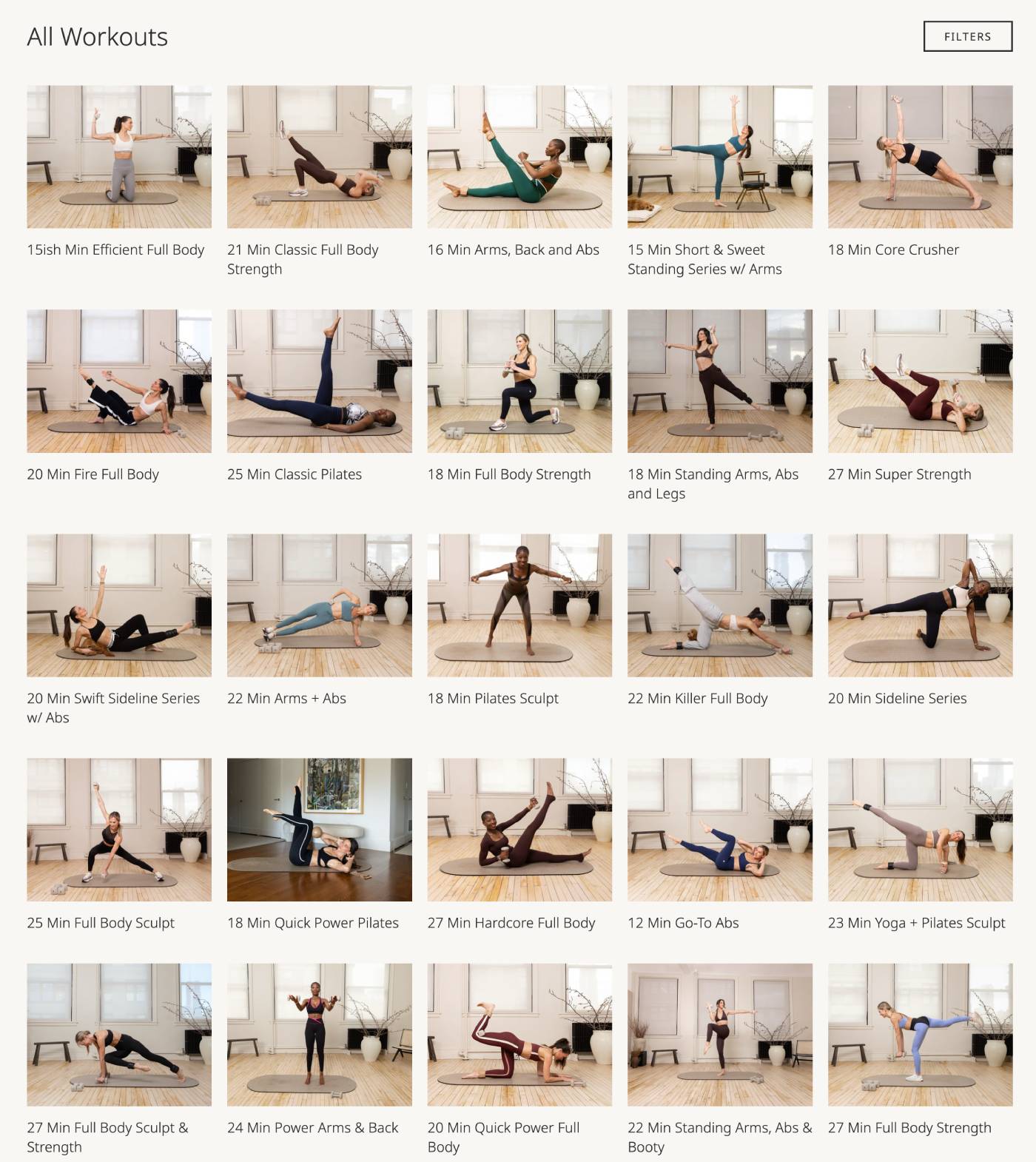
The workout library contains over 1,000 classes and meditations. Content is led by Melissa herself alongside a team of handpicked instructors including Kim Strother (who brings yoga, sculpt, and dedicated strength workouts), Nwando (athletic pilates), and pre/postnatal specialists Nikki and Amanda. A smaller cardio section includes treadmill walks, dance flows, rope skipping, and water/pool workouts.
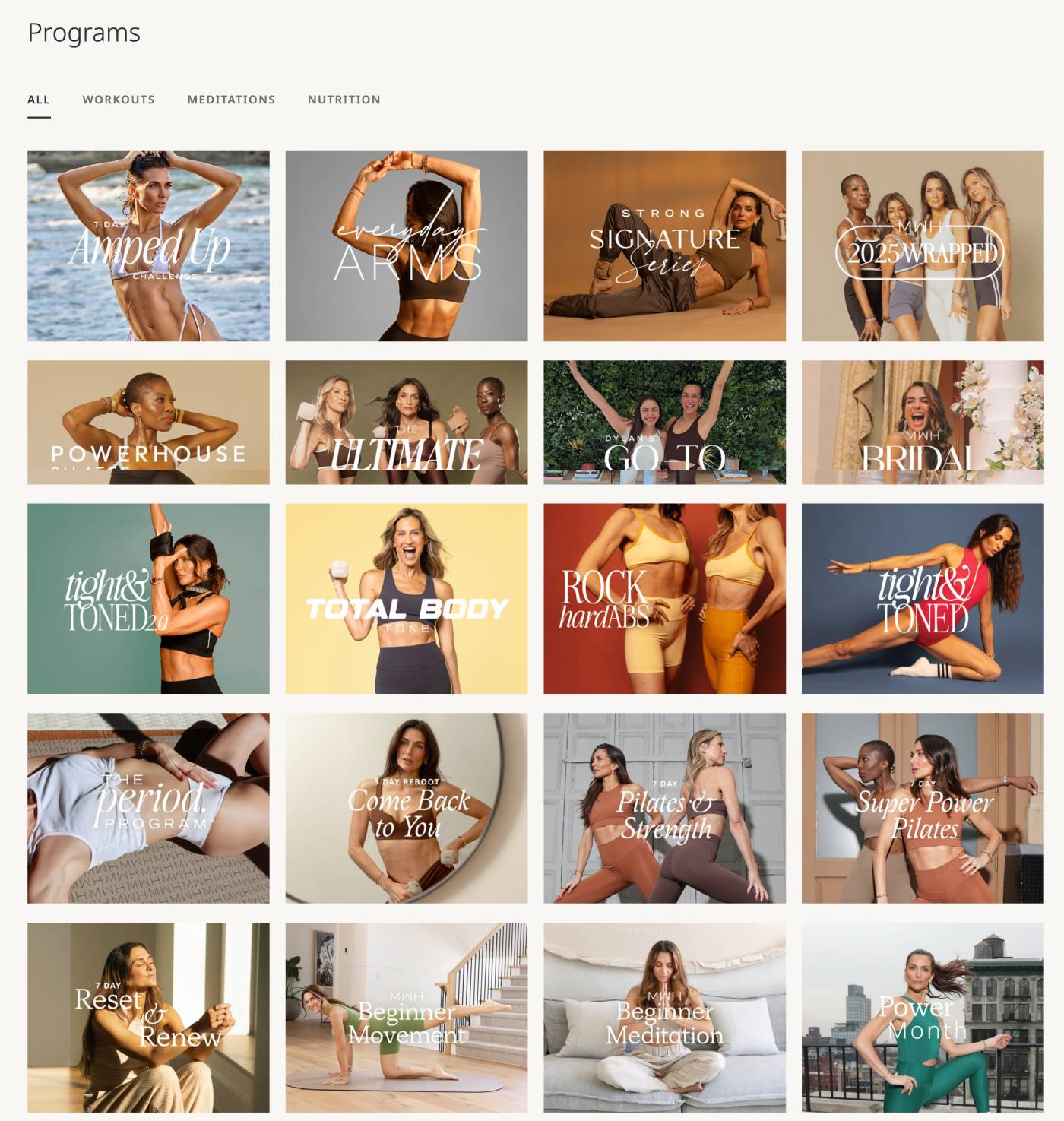
There is also a dedicated standing series for members who prefer not to get up and down from the floor, which is a practical detail for anyone with knee or hip limitations. Workouts are available via app and web browser. The platform also offers structured short programmes (typically 7 to 14 days), a weekly schedule for members who prefer guided programming, and the option to filter by creator, difficulty level, and workout type.
Who Is Melissa Wood?
Melissa Wood-Tepperberg is the founder and primary instructor of MWH. She is a certified yoga and Pilates instructor and holds a health coaching certificate from the Institute for Integrative Nutrition. She built the platform around her personal philosophy of mindful movement, combining pilates, yoga, and light strength training into a method that prioritises slow, controlled movements and the mind-body connection. Her teaching style is calm, precise, and heavily grounded in breathwork. Each session she leads opens and closes with intentional breathing, creating a ritual-like quality that makes even short workouts feel complete.
The platform has grown significantly and now features additional creators beyond Melissa herself, allowing members to choose instructors whose style suits them. Kim brings a more strength-oriented approach, while Nikki and Amanda specialise in pre and postnatal content. The multi-instructor model adds variety, though Melissa’s own sessions remain the signature experience and the reason most people subscribe.
How Do You Get Started with Melissa Wood Health?
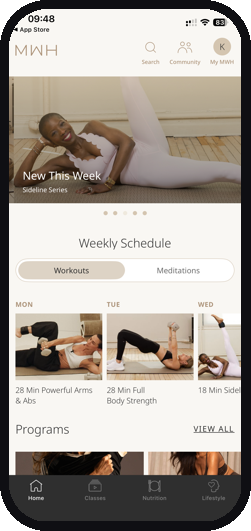
Signing up for the 7-day free trial was completely straightforward. No hidden steps, no confusing onboarding flow. You sign up, you are in, and you have full access to the library immediately. Once inside, the navigation is clean and intuitive: the main sections are clearly divided into Workouts and Meditation, Nutrition, Lifestyle, Community, and Shop.
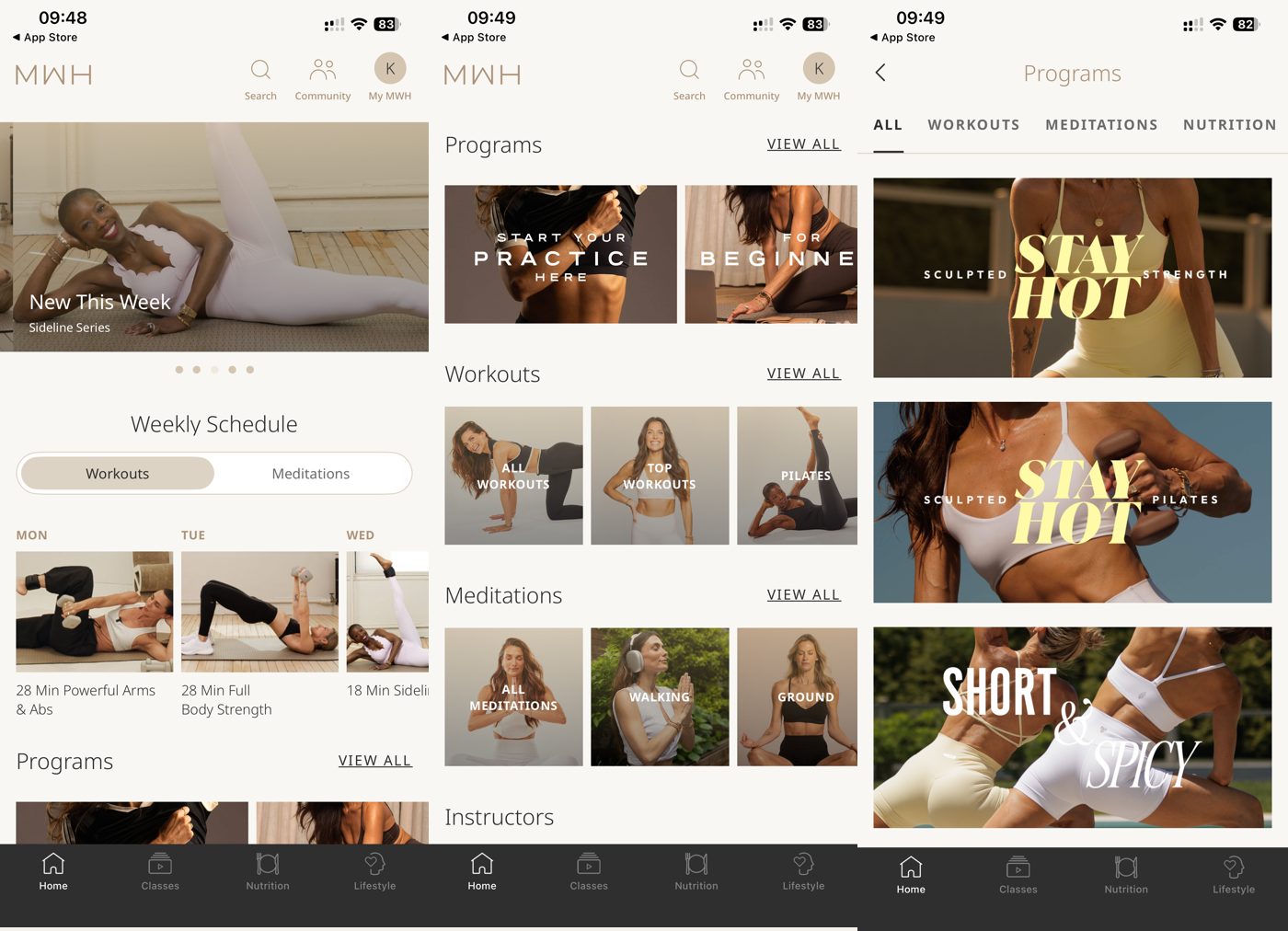
The design uses soft beige and white tones that feel calm and inviting from the first moment. It is one of the most visually pleasant fitness platforms I have used.
Within the workout section you can navigate to a weekly schedule if you want someone to tell you what to do each day, build a custom schedule for your own workout and meditation routine, browse structured programmes, explore individual workouts with filters, access meditation sessions, or browse content by creator. I went straight to individual workouts and programmes rather than following the weekly schedule, wanting to assess the breadth of content on my own terms.
What Equipment Do You Need for Melissa Wood Health?
Starter Dumbbells (up to 10 lb)
A light adjustable pair, a great starting point
~$65 to $80
Medium Dumbbells (up to 25 lb)
For steady progression as you get stronger
~$50 to $65
Ankle Weights
Light pair for pilates and lower body
$15 to $25
Exercise Mat
Any standard fitness mat
$15 to $30
Bodyweight
Many sessions need no equipment at all; great for travel or getting started
Free
One practical note: if you are an experienced exerciser, you will likely want heavier dumbbells than the 1 to 3 pound range MWH recommends. I had been training with 11 to 20 lb per hand on other platforms, and at those recommended weights I felt like I was barely working. I ended up using 5 to 8 pound dumbbells and heavier ankle weights to get a meaningful training stimulus, though even that was lighter than what I was used to. The MWH shop sells recommended equipment and links to products on Amazon, but nothing proprietary is required.
What I Actually Tested
During the 7-day trial I worked through multiple session types: pilates classes, strength sessions, a few cardio workouts, and several meditation sessions. I tried the rope skipping section a couple of times and loved it, but with my meniscus injury I was not confident enough to keep going, so I switched to the treadmill walking and dance flow sessions instead. I then subscribed monthly at $14.95 and continued for approximately six weeks, completing the Total Body Tone programme with Kim and the Signature Series with Melissa. I also tested the nutrition recipes, browsed the lifestyle and community sections, and used the meditation library regularly.
I came to MWH in my mid-forties, in perimenopause, with a previous meniscus injury. I had been training on platforms like Burn360, Fit with Coco, and Evlo before this, typically using 11 to 20 lb dumbbells per hand, so I arrived with a solid base of strength training and some pilates experience. Going from that to MWH’s recommended 1 to 3 pounds was a deliberate experiment in whether a lighter, more mindful approach could maintain what I had built.
My mum, in her late 60s, tested MWH alongside me. She primarily does treadmill walking and bodyweight exercises. Our experiences were strikingly different, which is itself the most informative thing about this platform.
What Are the Melissa Wood Health Workouts Like?
The first thing that stands out is the length. Most sessions are 15 to 20 minutes. Some are as short as 8 minutes. A few push past 25 minutes, but those are the exception. For a woman juggling work, children, and everything else that fills a day, this format is genuinely powerful. You can always find 15 minutes. Even on the worst days, when the idea of a 45-minute session feels impossible, a single MWH class is manageable. That is not a minor thing. That is how daily habits get built.
Melissa’s signature sessions follow a consistent ritual: a brief breathwork opening to settle your mind, the workout itself with slow, controlled movements, and a closing moment of acknowledgment. It sounds small, but that structure makes even a very short session feel like a complete practice rather than a rushed fragment. The movement style is deliberate throughout. Nothing is fast, nothing is explosive, nothing jars your joints.
The pilates elements dominate: controlled holds, slow repetitions, deep muscle engagement rather than large compound movements.
Strength sessions incorporate light dumbbells and ankle weights, but the loading is intentionally light. This is where the MWH philosophy becomes clear: the method is built around the idea of creating a lean, toned body through high repetitions with light resistance and deep muscle engagement, rather than through progressive overload with heavier weights. Whether that philosophy aligns with your goals is the central question of this review, and the answer depends entirely on where you are starting from.
The cardio section is a smaller part of the library but worth mentioning. Treadmill walks, dance-based sessions, and rope skipping are all available. I loved the rope skipping classes, they are short, fun, and a genuinely different stimulus from the pilates-heavy main library. But after a couple of sessions I stopped because I was not sure it was wise with my meniscus injury, and switched to the treadmill walking and dance flows instead. Those became my go-to for days when I wanted something lighter or a change of pace. Cardio is not the reason to subscribe to MWH, but it adds welcome variety and gives you options if certain movements do not suit your body.
Are Melissa Wood Health Workouts Challenging Enough?
For beginners, yes. For experienced exercisers, the recommended light weights (1 to 3 pounds) are unlikely to provide enough stimulus for meaningful strength gains. This is the most important section of this review.
I started with the recommended light weights as Melissa suggests. After about six weeks of training I noticed something nuanced: I had gained muscle engagement in areas I do not normally target. The slow, controlled pilates movements were activating smaller stabiliser muscles that my heavier training had been bypassing, and I was genuinely sore in new places. That was a real positive. But I also felt like I had lost some of the strength and conditioning I had built on other platforms where I was lifting 11 to 20 lb per hand. When I went back to exercises I used to do without getting sore, I was suddenly sore again. The MWH weights had been too light to maintain what I had built elsewhere, even as they were building something new.
Once I added heavier ankle weights and switched to 5 to 8 pound dumbbells, the workouts became noticeably more challenging. The pilates elements were genuinely engaging. The strength portions started to produce the kind of muscle fatigue that tells you something is actually working. But here is the tension: loading up heavier weights may go against MWH’s own lean-body philosophy and its emphasis on working with light resistance. Whether that matters to you depends on what you are training for.
For women over 40, published research suggests that resistance training with challenging loads may support bone density and muscle mass preservation.1 The American College of Sports Medicine’s physical activity guidelines include progressive resistance training in their recommendations for midlife women.5 MWH’s default approach of light weights and high repetitions provides a stimulus, but based on those guidelines it may not be sufficient on its own for women looking to address the muscle and bone changes that research associates with declining oestrogen. Speak to your doctor or a qualified professional about what level of resistance training is right for you.
The flip side: for true beginners, the light weights are exactly right. This is not a platform that throws you into the deep end. It meets you where you are, which for many women is not at the gym or anywhere near heavy dumbbells. Starting light and building the habit of daily movement is more valuable than starting heavy and quitting after a week.
Programmes I Tested
Total Body Tone with Kim
Kim’s teaching style suited me more than Melissa’s because alongside her yoga and sculpt classes she also has dedicated strength workouts that feel closer to what I am used to. The programme runs as a short challenge, 7 to 14 days, which makes committing to it feel easy rather than daunting. Coming from platforms where I was regularly lifting 11 to 20 lb per hand, I was curious whether Kim’s more strength-oriented approach would bridge the gap.
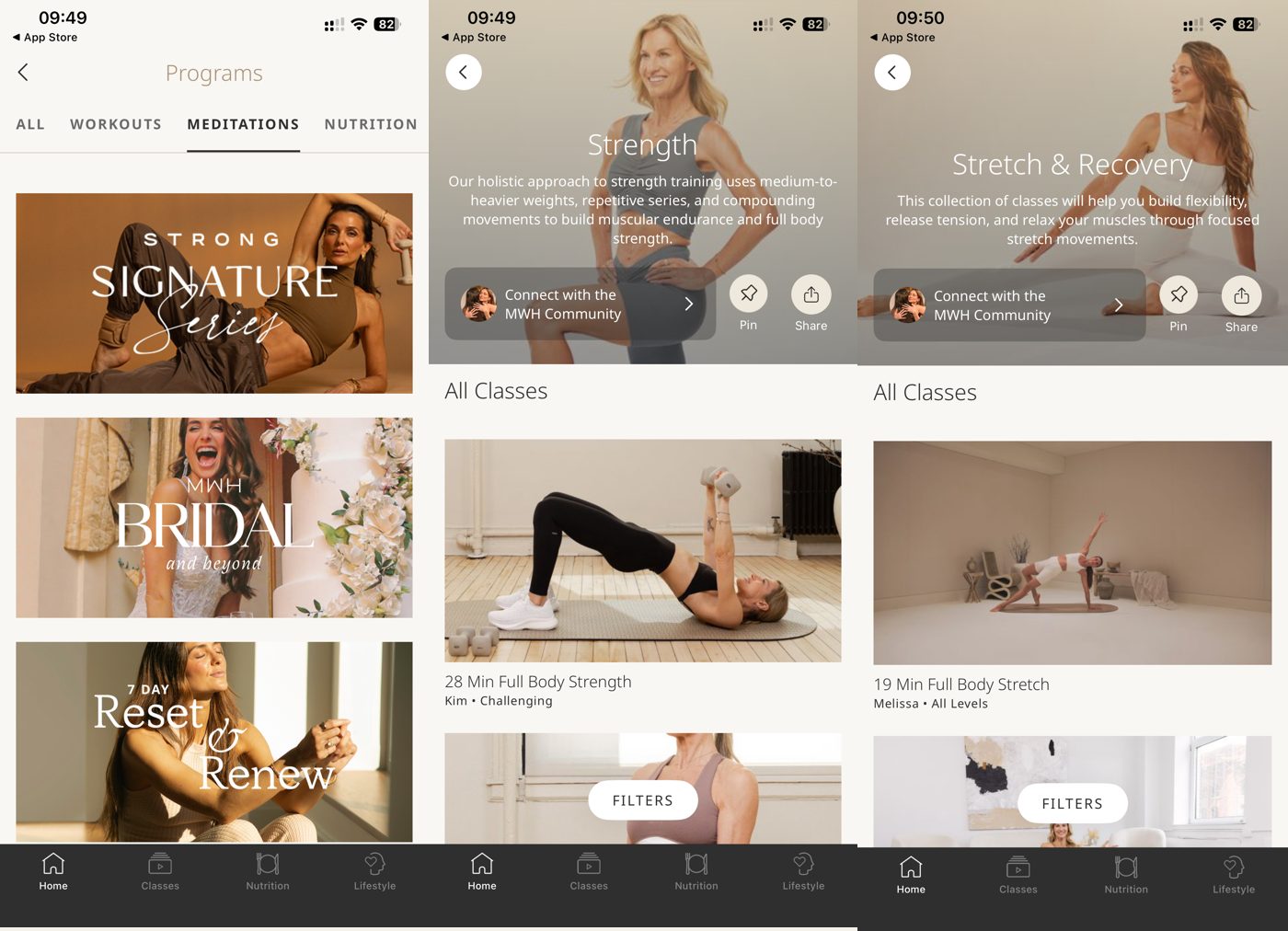
Each session opens with a brief breathwork exercise, then the workout, then a closing moment of acknowledgment that you showed up. The ritual is consistent across MWH programmes and I grew to appreciate it. The actual strength stimulus, though, was underwhelming with recommended weights. I finished most sessions feeling like I needed to stack another class on top to feel like I had done a proper workout. Once I added heavier weights, the programme improved significantly, but at that point I was working outside the intended method.
Signature Series with Melissa
This is more classically pilates-driven. Melissa’s cueing is calm and precise, focused on slow controlled movements and deep engagement. If you are genuinely new to pilates, this is a solid introduction that will teach you the fundamentals without rushing you. For me, after about six weeks of training on MWH, the pace felt too gentle to create meaningful adaptation. The movements and structure started to feel similar across sessions, and without clear progressive overload there was limited sense of advancing. The breathwork and mindfulness elements are woven through nicely, and I can see why people who are new to this style of training find it genuinely transformative. It just was not enough for where I am in my fitness.
Stacking Workouts
Because the classes are so short, I naturally started stacking two or three together: a pilates class followed by a strength session with Kim, then finishing with a treadmill walk or a dance flow. On days when I had 45 minutes instead of 15, this was the only way to feel like I had done a proper training session. The 15-minute classes are brilliant for busy days, but for someone used to longer, heavier workouts, a single session often was not enough.
The platform does not suggest stacking or provide any guidance on combining classes, but the short lengths make it instinctive to layer them yourself. I found that mixing creators worked well: Kim for strength, Melissa for pilates, then a cardio session to finish. If MWH built some guidance around this, combining specific class types for different goals, it would add real value for intermediate users who want more without leaving the platform.
My Mum’s Experience: Where MWH Really Shines
This is where the review shifts. My mum is in her late 60s. She walks on a treadmill regularly and does some bodyweight exercises at home. She is not a fitness beginner in the sense that she moves daily, but she has never followed a structured programme or used weights consistently. I asked her to try MWH alongside me.
For her, the recommended weights were exactly right. Sometimes even challenging enough that she removed them entirely for certain exercises. She loved the short workout length because it felt manageable rather than intimidating. The calm pace, the breathing exercises, the fact that nothing felt rushed or aggressive: these were not weaknesses for her. They were the entire point.
After two weeks, she was doing MWH classes daily without anyone pushing her. It had become her routine, which is something no other platform I have recommended to her has achieved.
That told me something valuable about who MWH actually serves best. Whether you are a woman over 40 or 50 returning to fitness, or over 60 like my mum and looking for a gentle structured way into regular movement, MWH is one of the best platforms I have tested for building the daily habit. The short programme lengths (7 to 14 days) mean you can finish something, feel accomplished, and start another. The daily time commitment is so small that it removes the most common excuse for not exercising. My mum is proof that this works. She is still training daily.
Is Melissa Wood Health Good for Women Over 40?
It depends on which woman over 40 you are. The platform’s low-impact, controlled movement style felt gentle on my joints. I trained with a previous meniscus injury and felt comfortable throughout, though individual experiences will vary and you should consult your doctor if you have specific joint concerns.
The breathing and mindfulness elements feel particularly relevant for women dealing with the mental fog, stress, and sleep disruption that perimenopause brings. The session lengths work for women juggling careers, families, and the accumulated responsibilities of midlife.
Where it falls short is the absence of deliberate programming for this life stage. There are no classes addressing the specific needs of women navigating hormonal changes: no progressive resistance programming for bone health, no content on adapting training to changing recovery capacity, no instructors speaking directly to the perimenopause or menopause experience. MWH suits women over 40 in practice more than it does on paper. But for a platform whose approach naturally aligns with what this audience needs, the gap between the product and the potential is noticeable.
For a woman over 40 or 50 who is a beginner or returning to fitness, MWH is an excellent place to start, and as my mum’s testing confirms, it is equally suitable for women over 60. For a woman over 40 who already trains and needs progressive challenge, it will not be enough on its own.
This is the perimenopause and menopause assessment, and it is separate from the overall score. Twelve things a programme either does for a midlife body or does not, each scored out of 10 with my reasoning next to it. Together they produce a single menopause fit score, and that becomes one of the nine categories in the overall scoring below.
How Melissa Wood Health Fits Perimenopause, Menopause & Beyond
Women Over 40 is our most important criterion, and here's the full breakdown behind it.
Melissa Wood Health is strongest for low-impact, mind-body support and beginner on-ramp, and weakest for menopause programming, hormone awareness, menopause education, progressive strength, bone loading, midlife nutrition, recovery & deload and pelvic floor, in our menopause and midlife capability assessment for women over 40.
At a glance
| Capability | Score | Rating | Why |
|---|---|---|---|
| Right training for a midlife body | |||
| Low-impact | 9/10 | Best-in-class | Gentle Pilates/yoga flows, joint-safe; meniscus-injury tester thrived. |
| Progressive strength | 2/10 | None | 1-3 lb weights, high reps, no overload; tester lost strength. |
| Bone loading | 2/10 | None | Light loads; insufficient for bone density per guidelines. |
| Recovery & deload | 4/10 | Minimal | Inherently gentle/restorative; no structured deload. |
| Built for menopause | |||
| Menopause programming | 1/10 | None | No peri/menopause programme or adapted content. |
| Pelvic floor | 4/10 | Minimal | Pilates core + pre/postnatal creators; nothing dedicated. |
| Hormone awareness | 1/10 | None | No hormonal-cycle or stage awareness. |
| Menopause education | 1/10 | None | No menopause talks or education. |
| Expert credibility | 5/10 | Some | Certified yoga/Pilates + IIN health coach; no medical/menopause expertise. |
| Whole-woman support | |||
| Mind-body support | 9/10 | Best-in-class | Standout meditation, breathing, mindfulness; best-in-class for stress/sleep. |
| Beginner on-ramp | 8/10 | Strong | Excellent for beginners/returners; modifications, weekly schedules. |
| Midlife nutrition | 3/10 | Minimal | Recipes only; no macros/protein/meal planning. |
ScaleBest-in-classStrongSomeMinimalNone
What the sources say: Agree gentle mind-body is great; light 1-3lb loading inadequate for bone/muscle in midlife (beginner-vs-trained framing gap). Zero menopause programming, unanimous.
These are evidence-informed suitability ratings, not clinical measurements. They combine exercise science with product-specific research and, where indicated, hands-on testing, alongside multi-source verification, and are approximate. Individual response varies. A starting point, not medical advice. How we score menopause fit
Does MWH Help with Perimenopause and Menopause?
There is no dedicated perimenopause or menopause programme. No menopause-specific talks, no hormonal training guidance, no content addressing the specific physiological changes of this life stage.
MWH offers pre and postnatal content with dedicated creators Nikki and Amanda, and the platform does include modifications that mainly help you scale between beginner and advanced levels, with some comfort-based alternatives. But beginner-versus-advanced scaling is not the same as programming designed for the hormonal reality of midlife, and there is nothing addressing specific injuries or conditions.
The low-impact approach may suit perimenopausal women who find high-intensity training counterproductive. Some research has explored whether excessive high-intensity cardio can affect cortisol levels in women experiencing hormonal changes, though findings vary and this is an evolving area of study.2 The meditation library is genuinely useful for the anxiety and sleep disruption that many women experience during perimenopause. But these are happy accidents of the platform’s general philosophy rather than deliberate design choices for this audience.
If dedicated perimenopause programming is a primary requirement, Pvolve’s Menopause Strong is the clear leader in this space with clinical research behind it. Fit with Coco does not have a dedicated programme either, but its 3-2-1 method provides a stronger resistance training stimulus that better addresses the muscle and bone preservation needs of midlife.
How Good Is the Melissa Wood Health Meditation Library?
The MWH meditation library is one of the best I have found on any online pilates or fitness platform, and it is a genuine highlight that sets Melissa Wood Health apart from most competitors. I did not use it daily, but on days when I felt scattered or needed grounding, the sessions were exactly what I wanted. They range from short 5-minute breathing exercises to longer guided meditations. The tone is calm without being saccharine, and the content integrates naturally with the workout philosophy rather than feeling like a separate product bolted on as an afterthought.
For women over 40, this matters more than it might sound. In my experience, sleep disruption, stress, and the mental load of midlife are not fully addressed by physical exercise alone. Having meditation built into the same platform as your workouts means you do not need a separate app or subscription. You can use it after a workout to cool down, on a rest day when you want to do something without a full session, or in the evening when your mind will not switch off. I found the evening sessions particularly useful.
If you are someone who has thought about starting a meditation practice but never quite managed to make it stick, having it integrated alongside workouts you are already doing removes a significant barrier. This is one area where MWH genuinely delivers for the over-40 audience, even without explicitly targeting them.
Does Melissa Wood Health Include a Meal Plan or Nutrition Guidance?
No. MWH offers a recipe collection rather than a structured meal plan, and there is no calorie counting, macronutrient data, or dietary guidance included. There is decent variety and the recipes align with the platform’s overall wellness philosophy: wholesome, healthy, and approachable. A few have stayed in my regular rotation. The dijon salmon is genuinely good: packed with protein, simple ingredients, and about 15 minutes from start to plate. I have made it multiple times since testing. The chili lime mocktail is a nice touch for anyone trying to cut back on alcohol without feeling like they are missing out, and it actually tastes like something you would order rather than a sad substitute.
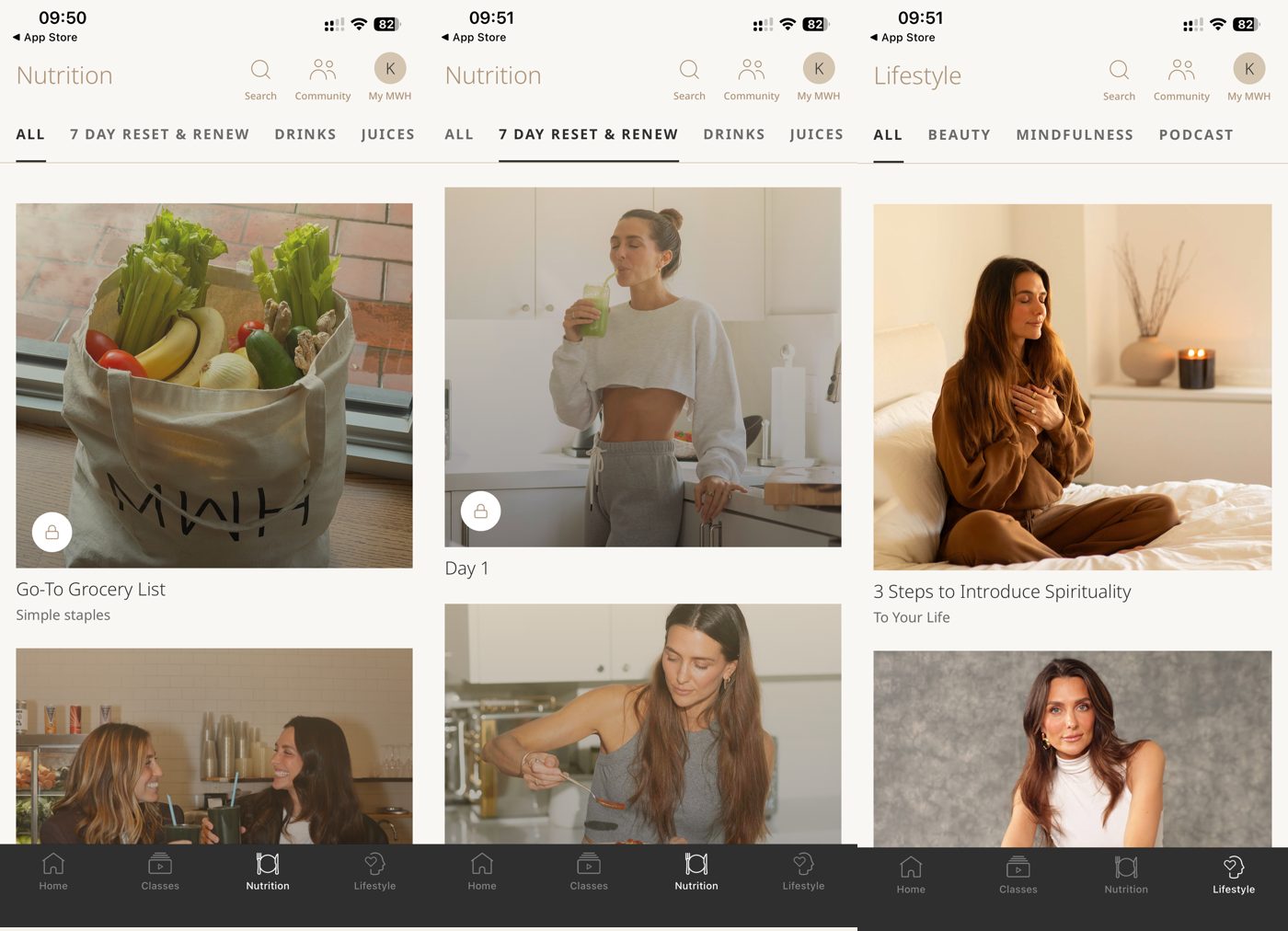
What is missing is everything that would make this section useful for someone trying to manage their nutrition deliberately. There are no calorie counts, no macronutrient breakdowns, and no guidance on how to use the recipes as part of a balanced eating plan. I ended up putting ingredients into ChatGPT to get approximate calorie and macro data, which worked fine but is something the platform should be providing natively. For women over 40 who are trying to hit protein targets or manage weight changes related to hormonal shifts, the absence of nutritional information alongside otherwise good recipes is a real missed opportunity.
For a platform that positions itself around holistic health, the absence of nutritional values alongside recipes feels like a gap, especially for women over 40 who may be managing weight changes related to hormonal shifts and need to understand what they are eating, not just what sounds appealing.
There is no meal planning feature, no dietary guidance, and no structured approach to nutrition that links back to the training. If you want a platform where nutrition and training work together as a system, Fit with Coco includes anti-inflammatory meal plans, and Evlo provides nutritional guidance as part of the programme.
Does Melissa Wood Health Have a Community?
Community
MWH has a community section, but it felt quiet when I used it. There is no specific space for women over 40, nothing addressing perimenopause or menopause conversations, and nothing that made me feel like I had found my people. It exists, and there are posts and interactions, but the energy is more general wellness than anything targeted at the audience I care about. If you are looking for a community of women in midlife supporting each other through fitness and hormonal changes, this is not where you will find it.
Lifestyle
The lifestyle section is essentially Melissa’s blog. I browsed through it briefly: wellness topics, personal reflections, product recommendations. It is fine if you are already inside the platform and want something to read, but it is not a reason to subscribe and I would not factor it into a purchasing decision.
Shop
The shop sells equipment and products Melissa uses and recommends. If you do not already own light dumbbells, ankle weights, or a mat, it is a convenient place to pick them up. Most items link through to Amazon. It is not a significant part of the platform experience, more of a practical add-on for members who want to buy what they see Melissa using in sessions.
How Good Is the Melissa Wood Health App?
Both the app and the web browser experience are excellent. The design is one of MWH’s strongest features: soft beige and white tones, clean layouts, and a calm visual identity that feels like walking into a well-designed studio rather than a shouty gym. Navigation is intuitive. The main sections are clearly divided and finding what you want takes seconds rather than minutes.
Within the workout section, you can browse by the weekly schedule, programmes, individual classes, meditation, or by creator. Filtering by difficulty level is available and I would strongly recommend using it from the start. When I first dipped in I chose some beginner classes without thinking and since I exercise regularly they felt far too easy. The difficulty labelling is actually helpful once you know to rely on it.
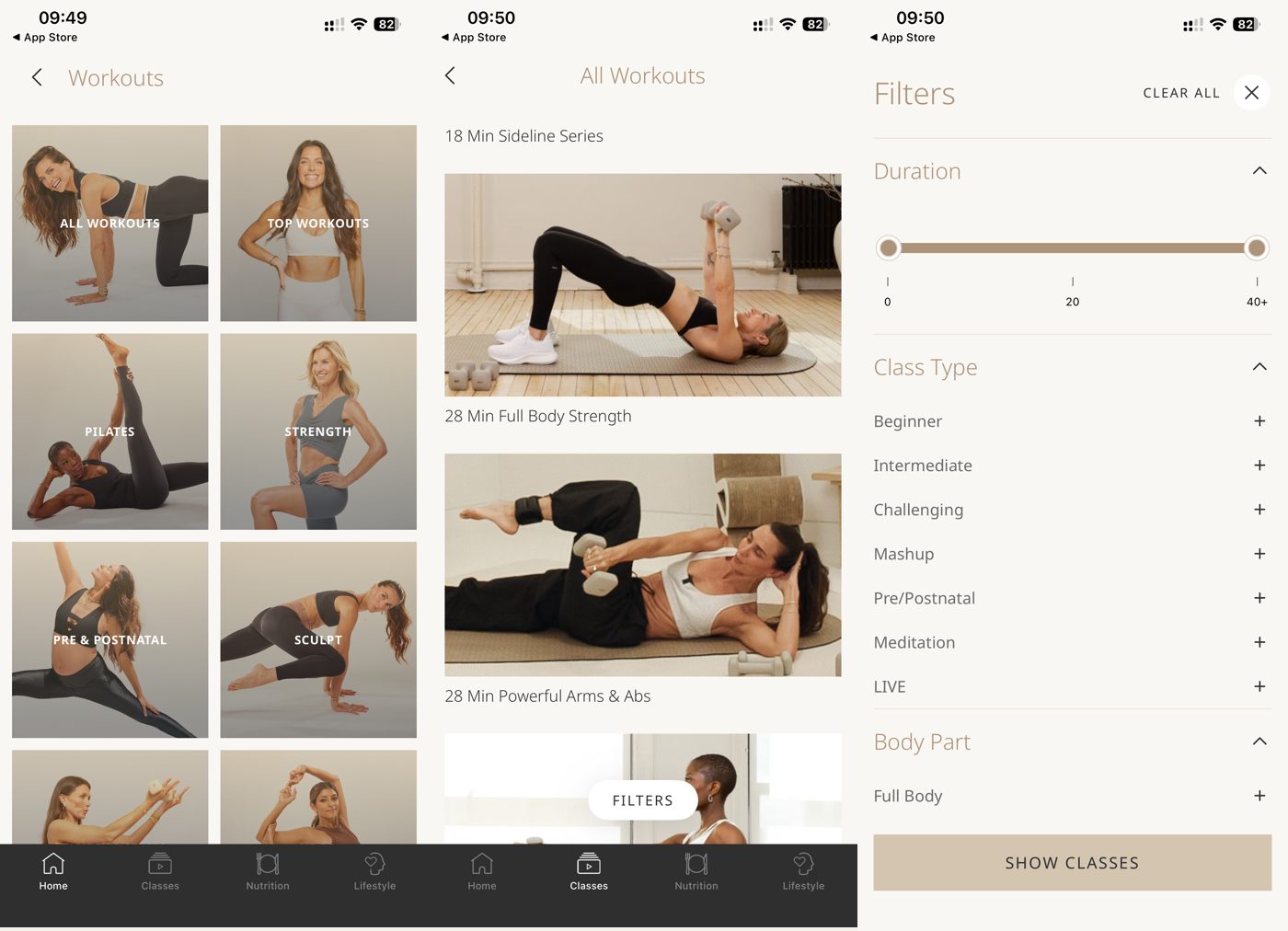
Video quality is high, loading is fast, and I experienced no buffering or playback issues on either device. The app holds a 5.0 rating on the iOS App Store with over 4,000 reviews at the time of writing, which is unusually high for a fitness app and consistent with my experience. For a platform at this price point, the user experience is genuinely impressive. It feels premium without being complicated. This is one area where MWH clearly outperforms several more expensive competitors.
How Much Does Melissa Wood Health Cost?
Melissa Wood Health costs $14.95 per month or $134.99 per year (equivalent to $11.25/month, saving 25%). Both plans include a 7-day free trial with full access. MWH charges in USD only, so UK users will see approximate conversions at checkout.
| Plan | Price | Notes |
|---|---|---|
| Monthly | $14.95/month | 7-day free trial included; cancel anytime |
| Annual | $134.99/year ($11.25/month equivalent) | Saves 25% vs monthly; 7-day free trial included |
Prices verified April 2026. MWH charges in US dollars only. UK users will see approximate conversions of ~£12/month or ~£107/year depending on exchange rates. Verify current pricing at melissawoodhealth.com.
At $14.95/month, MWH is one of the more affordable platforms I have tested. It is cheaper than Fit with Coco ($39.95/month), significantly cheaper than Evlo ($55.99/month), and cheaper than Pvolve streaming ($24.99/month). Whether it represents good value depends on your training level. For beginners who will use it daily, the per-workout cost is excellent. Over 1,000 classes for under $15/month is difficult to argue with. For experienced exercisers who find the workouts too easy and end up supplementing with another platform, you are paying for something that only covers part of your training needs, and the value calculation changes.
Will You Actually Stick With It?
For beginners: very likely. The session lengths are the most adherence-friendly of any platform I have tested. Fifteen minutes is so short that the decision to skip becomes harder to justify than the decision to show up. The calm tone, the breathwork ritual, and the short programme lengths (7 to 14 days) all reduce the psychological friction of starting and continuing. My mum is the clearest evidence of this: she went from doing nothing structured to training daily within two weeks.
For experienced exercisers: less likely. After about six weeks, the workouts started to feel repetitive. The movements and structures are similar across classes, and without progressive overload or clear advancement, the sense of going somewhere fades. I gained some new muscle engagement from the pilates movements, which was genuinely interesting, but I also felt like I had lost conditioning from dropping my usual heavier weights. I decided not to continue my subscription because the trade-off was not working in my favour. The platform had become pleasant but not productive for my goals.
Melissa Wood Health Weighted Scoring: How the 6.9/10 Was Calculated
This is the overall score, and it asks a broader question: how good is this programme, full stop. Nine categories, each weighted by how much it matters to a woman in perimenopause or beyond, which is why Muscle Potential counts for more than Value for Money. The Women Over 40 Specificity row is the perimenopause and menopause fit score from the twelve capabilities above, carried through.
| Category | Weight | Score | Weighted |
|---|---|---|---|
| Time Efficiency | 15% | 9.0 | 1.35 |
| Muscle Potential | 18% | 4.0 | 0.72 |
| Women Over 40 Specificity | 10% | 4.0 | 0.40 |
| Joint Friendliness | 12% | 8.5 | 1.02 |
| Recovery Compatibility | 10% | 9.5 | 0.95 |
| Programme Structure | 12% | 7.0 | 0.84 |
| Value for Money | 8% | 8.0 | 0.64 |
| UX and Design | 8% | 8.0 | 0.64 |
| Nutrition Integration | 7% | 5.0 | 0.35 |
| Total | 100% | 6.9 / 10 |
Scoring follows the HerDailyFit review methodology. All scores reflect the reviewer’s candid assessment based on personal testing. Scores are not influenced by affiliate relationships.
What Are the Pros and Cons of Melissa Wood Health?
What Works
- Session lengths of 15 to 20 minutes are the most time-efficient of any platform tested: practically impossible to claim you do not have time
- Beautiful, calm design with beige and white tones; the platform feels premium and inviting rather than aggressive
- Very low impact throughout; felt comfortable on my joints (previous meniscus injury) during testing, though individual experiences vary. Consult your doctor if you have specific joint concerns
- Meditation library is a genuine highlight, not a bolt-on; useful for stress, sleep disruption, and the mental load of midlife
- Short structured programmes (7 to 14 days) make committing easy and build daily exercise habits effectively
- My mum in her late 60s went from nothing structured to training daily within two weeks, the best beginner adoption I have seen
- Affordable at $14.95/month relative to most competitors
- Multiple instructors including Kim for more strength-oriented work; content sorted by creator so you can find your preferred teaching style
- Breathwork ritual at the start and end of sessions makes even 15 minutes feel like a complete practice
- Cardio section includes rope skipping, treadmill walks, and water/pool workouts for variety beyond pilates
- Standing series available for members who prefer not to get up and down from the floor, useful for knee or hip limitations
- Recipe collection includes some genuinely good meals (dijon salmon, chili lime mocktail)
- Works well on both app and web; no buffering or playback issues during testing
What to Know Before Signing Up
- Workouts are not challenging enough for regular exercisers; with recommended weights I gained new muscle engagement but lost conditioning I had built from heavier training
- No dedicated perimenopause or menopause content; no hormonal training guidance; no instructors speaking to the over-40 experience
- Light-weight philosophy limits muscle-building potential; adding heavier weights helps but may conflict with the platform’s intended method
- Workouts start to feel repetitive after about six weeks; similar movement patterns across classes without clear progressive overload
- Nutrition recipes have no calorie counts, macros, or meal planning guidance; you need to source that information yourself
- Community section does not cater to women over 40; no relevant subgroups or midlife-specific conversations
- Modifications mainly distinguish beginner vs advanced levels with some comfort alternatives; no injury-specific or life-stage-specific modification content
- No structured deload weeks built into programmes; recovery is available through meditation but not programmed into the training
- Priced in USD only; UK users will see exchange rate fluctuations
- If you already train regularly and want progressive results, you will likely end up supplementing with another platform
- Marketing language around “sculpting long lean lines” has attracted criticism for reinforcing a narrow body ideal
- Some longer-term subscribers feel newer content (dance flows, additional instructors) has shifted the platform away from its original identity
How Melissa Wood Health Compares to Similar Platforms
If you are deciding between women’s fitness platforms, this is how MWH sits against the most likely alternatives. All HerDailyFit scores marked with a number are from personal testing against the same weighted criteria.
| Feature | MWH | Fit with Coco | Pvolve | Evlo | The Sculpt Society |
|---|---|---|---|---|---|
| HerDailyFit score | 6.9 / 10 | 7.9 / 10 | 8.3 / 10 | 8.0 / 10 | 8.2 / 10 |
| Monthly price | $14.95/mo | $39.95/mo | $24.99/mo | $55.99/mo | $24.99/mo |
| Annual price | $134.99/yr | $359.95/yr | $224.91/yr | $599/yr | $179.99/yr |
| Free trial | 7 days | 7 days, no card (monthly) | 7 days | 7 days | 7 days |
| Method | Pilates + light strength, mindful movement | Strength + Pilates hybrid (3-2-1) | Functional fitness, 3D movement | Science-based strength + mobility | Dance cardio + low-impact sculpting |
| Session length | 15 to 20 min most sessions | 20 to 30 min most sessions | 5 to 60+ min; 20 min sessions plentiful | 30 to 45 min | 5 to 50 min; most 20 to 30 min |
| Equipment | Light dumbbells + ankle weights + mat | Dumbbells + mat | Bundle recommended; bands + dumbbells work | Dumbbells + mat | Mat; light weights + ankle weights optional |
| Muscle building potential | Low | Moderate to high | Moderate | High | Low to moderate |
| Perimenopause content | None | Menopause talk + meal plans; no dedicated programme | Best in class: Menopause Strong, clinical study | Yes, dedicated | Peri programme available |
| Meditation included | Yes, extensive library | No | No | No | No |
| Nutrition included | Recipes only (no macros) | Anti-inflammatory meal plans + guides | Not in streaming | Guidance included | Not included |
| Injury modifications | Beginner/advanced scaling; no rehab tracks | Beginner mods; no rehab tracks | Dedicated series for 6 body areas | Per exercise | Low-impact by design |
| Best suited to | Women 40+/50+/60+; beginners; habit building | 35 to 55, structured strength + Pilates | 35 to 55, perimenopause, joint issues | 35 to 55, science-based strength | 35 to 55, dance cardio lovers |
Competitor prices verified April 2026. Verify on each platform’s website. All scores are dynamically updated from individual reviews.
Is Melissa Wood Health Worth It?
For women over 40 and 50 who are beginners or building a daily exercise habit: yes, unequivocally. At $14.95/month for over 1,000 classes, a substantial meditation library, and the most time-efficient sessions of any platform I have tested, MWH delivers genuine value for women who need a gentle, structured entry point into regular movement. And as my mum’s experience shows, it works just as well for women over 60: she went from nothing structured to training daily within two weeks. If you have never followed a structured programme and need something that does not feel intimidating, this is one of the best places to begin.
For experienced exercisers who already train with weights: probably not as a primary platform. The workouts will feel too light. You will likely need to modify the weights upward, which conflicts with the intended method, and after about six weeks the repetitive movement patterns and limited progressive overload will leave you looking for something more challenging. I did not continue my subscription because, despite gaining some engagement in muscles I had not previously targeted, I felt like I was losing the strength I had built from heavier training.
MWH could work as a supplementary platform: using the meditation library, the short pilates sessions on recovery days, or the cardio section alongside a more demanding primary programme. At $14.95/month, that is a viable option if the meditation and gentle movement fill a genuine gap in your existing routine. The 7-day free trial means the decision carries no financial risk. Test it and see whether it fits the role you need it to play.
What Are the Most Common Melissa Wood Health Complaints?
The most consistent complaint I found in App Store reviews and online discussions mirrors my own experience: the workouts are not challenging enough for women who already exercise regularly. Users who arrive expecting a workout that produces visible strength gains are often disappointed. This is not a flaw in the platform so much as a misalignment of expectations: MWH is designed for mindful, gentle movement, not progressive overload, and the people who love it tend to be the ones who came looking for exactly that.
A second recurring theme is the feeling that classes become repetitive over time. The movement vocabulary across sessions is similar, and without clear progression markers it can feel like you are doing the same workout repeatedly. This is particularly noticeable for users who have been on the platform for several months.
A third point, and one worth being aware of: MWH’s marketing language around “sculpting long lean lines” has attracted criticism online for reinforcing a narrow body ideal. The method is marketed around creating a specific aesthetic rather than around functional fitness, strength, or health outcomes, and some users feel that language does not represent the full range of bodies that benefit from this style of movement. This is not unique to MWH, many fitness brands face similar scrutiny, but it is part of the conversation around the platform and worth knowing before you subscribe.
Price complaints are less common than on more expensive platforms, though some users question the value relative to free content available on YouTube. The nutrition section’s lack of structured guidance also appears in feedback, particularly from users who expected meal plans alongside their workout subscription.
Some longer-term subscribers have also noted that newer content additions, including dance flows and additional instructors, feel like a departure from the original MWH identity. A few have cancelled over this, feeling the platform’s focus has shifted. Whether that matters depends on whether you are subscribing for Melissa’s signature style specifically or for the broader library.
What is notably absent: significant technical complaints, billing disputes, or reports of poor customer service. The platform runs smoothly and the user experience is consistently praised even in otherwise critical reviews.
Melissa Wood Health FAQ
MWH can work well for women over 40, particularly beginners and those returning to fitness. The low-impact, controlled movements felt gentle on my joints during testing, and the 15 to 20 minute sessions fit around busy schedules. However, there is no dedicated perimenopause or menopause content, and the light-weight approach may not provide enough resistance for women looking for progressive strength training. Experienced exercisers will likely find it too easy. For dedicated perimenopause programming, Pvolve is the stronger choice. Consult your doctor about what training approach suits your individual needs.
Most MWH workouts run between 15 and 20 minutes, with some as short as 8 minutes and a few longer classes around 25 minutes. This makes them the shortest sessions of any platform I have tested. You can easily stack multiple classes for a longer workout when time allows.
MWH uses a light-weight, high-repetition philosophy focused on lean muscle tone. Beginners will see initial toning and engagement. Experienced exercisers are unlikely to build or maintain significant muscle with the recommended weights. You can add heavier equipment, though this may conflict with the platform’s intended method. For progressive muscle building, platforms like Evlo or Fit with Coco provide a stronger stimulus.
As of April 2026: $14.95/month or $134.99/year ($11.25/month equivalent, saving 25%). Both plans include a 7-day free trial. Pricing is in US dollars only; UK users will see exchange rate variations at checkout.
All MWH workouts are low impact with slow, controlled movements. I tested with a previous meniscus injury and experienced no joint discomfort. The platform offers modifications that mainly scale between beginner and advanced levels, with some comfort-based alternatives, though these are not tailored to specific injuries or conditions. If you have an existing injury or health condition, consult your doctor before starting.
MWH offers a recipe collection but not a structured meal plan. Recipes do not include calorie counts, macronutrient breakdowns, or dietary guidance. For a platform that includes nutrition as part of the training system, Fit with Coco provides anti-inflammatory meal plans and nutritional guidance integrated into the programme.
Light dumbbells (1 to 3 pounds recommended), ankle weights, and a mat. Some classes are bodyweight only. No proprietary equipment required. The MWH shop sells recommended equipment, though you can buy equivalent items anywhere. Experienced exercisers may want heavier weights than recommended.
Weight loss is individual and depends on many factors beyond your workout platform, so this is not something I can answer definitively. MWH sessions are lower intensity than many alternatives, which generally means fewer calories burned per session. That said, the short session format makes daily consistency realistic, and beginners who go from no structured exercise to daily MWH sessions may notice body composition changes over time. If weight loss is a primary goal and you already exercise, a platform with more intense cardio and strength training will typically create a larger calorie deficit per session. For personalised advice on weight management, speak to your doctor or a registered dietitian.
MWH does not prominently feature before-and-after transformation photos on its platform, which is consistent with its mindful wellness philosophy rather than a body transformation focus. User reviews and social media posts do show toning results, particularly among beginners who commit to daily practice over several months. The most visible changes tend to be improved posture, leaner muscle tone, and increased flexibility rather than dramatic weight loss or muscle gain. For my mum in her late 60s, the biggest change was going from no structured exercise to daily movement, which is a transformation in itself even without dramatic visible results.
As a primary training platform, likely not. The light-weight philosophy and short sessions limit the training stimulus for women who already exercise regularly. It could work as a supplementary platform for meditation, gentle pilates on recovery days, or the cardio section alongside a more demanding programme. At $14.95/month, that supplementary role is financially viable.
Yes, particularly for beginners. My mum in her late 60s found the recommended weights appropriately challenging, the session lengths perfectly manageable, and was training daily within two weeks. The calm pace, breathwork ritual, and gentle approach make it one of the best platforms I have tested for women over 50 who are building a regular exercise habit. The main limitation is the absence of progressive resistance training guidance, which many health organisations recommend for women in this age group. Speak to your doctor about what level of resistance training suits your needs.
You can cancel your Melissa Wood Health subscription through your account settings on the MWH website or app. Go to your profile, select subscription management, and follow the cancellation steps. Cancellation takes effect at the end of your current billing period. If you signed up through the App Store or Google Play, you will need to cancel through that platform’s subscription settings instead.
Based on general estimates for low-impact pilates-style exercise, a 15 to 20 minute MWH session likely burns in the region of 80 to 150 calories, though this varies significantly depending on your body weight, the specific workout, and whether you use added weights. Calorie burn is lower than on high-intensity platforms because MWH prioritises slow, controlled movements. The real value is in muscle engagement, mobility, and the consistency that comes from short daily sessions rather than calorie expenditure per workout.
Yes, and it is one of the platform’s genuine highlights. The meditation library includes guided meditations, breathwork exercises, and grounding sessions ranging from 5 minutes to longer practices. The quality is high and the content integrates naturally with the workout library. For women over 40 dealing with stress, sleep disruption, or anxiety, having meditation built into the same platform as your workouts is a practical and valuable bonus.
Final Verdict
I started MWH expecting to find a pleasant but ineffective wellness platform. What I found after six weeks was more nuanced than that. For my mum in her late 60s, this is one of the best fitness platforms I have tested: she went from no structured exercise to daily training within two weeks and has not stopped. For me, an experienced exerciser in my mid-forties who had been lifting 11 to 20 lb per hand, the recommended weights were too light. I did engage muscles I do not normally target, which surprised me, but I also lost conditioning that took effort to build. I did not continue my subscription past the testing period.
MWH is not trying to be everything. It is trying to be a calm, beautiful, time-efficient daily practice that makes movement accessible. For the right person, it succeeds completely. The meditation library is a genuine asset. The design is among the best I have tested. The session lengths are unmatched for busy women who need to fit exercise around everything else. The candid limitations are the low muscle-building potential, the absence of perimenopause or menopause programming, and the repetitive feel of the workouts over time. If dedicated perimenopause programming is a primary requirement, Pvolve is the stronger platform. If you want a structured method with meaningful resistance training, Fit with Coco delivers that.
But for women over 40 and 50 who are beginners or returning to fitness, and as my mum’s experience shows, for women over 60 too: MWH is a genuinely good place to start. She is proof that this platform builds the habit before it builds the muscle, and for many women that is exactly the right order.
Final Weighted Score
6.9 / 10
Excellent for women over 40, 50, and 60+ building daily exercise habits; too light for experienced exercisers seeking progressive strength
Sources
- Maltais ML, Desroches J, Dionne IJ. Changes in muscle mass and strength after menopause. Journal of Musculoskeletal and Neuronal Interactions. 2009;9(4):186 to 197.
- Hackney AC. Stress and the neuroendocrine system: the role of exercise as a stressor and modifier of stress. Expert Review of Endocrinology and Metabolism. 2006;1(6):783 to 792.
- Melissa Wood Health official platform. melissawoodhealth.com. Pricing and content verified April 2026.
- MWH Subscription Plans. MWH Support Centre. Accessed April 2026.
- American College of Sports Medicine. Physical Activity Guidelines: resistance training recommendations for bone health and muscle preservation in midlife women. 2018 (updated).
This review reflects personal testing experience. Pricing and features were verified April 2026 and may have changed since publication. Verify current pricing and trial terms at melissawoodhealth.com before signing up. Some affiliate links may be present. HerDailyFit does not accept payment from platforms reviewed and all opinions are the reviewer’s own. Research citations are provided for informational purposes only and do not constitute medical advice. Consult your GP or a qualified healthcare professional before beginning a new exercise programme.
Sources & Further Reading
- Resistance training for postmenopausal women: systematic review and meta-analysis, PubMed (2022)
- Physical activity and exercise interventions on menopausal symptoms: overview of reviews, PubMed (2024)
- Menopause FAQs: understanding the symptoms, North American Menopause Society (NAMS)
- Exercise as you get older, NHS
About this review: Every programme is personally tested by women over 40 and scored on 9 weighted criteria designed for this life stage. Read our editorial policy and affiliate disclosure. Reviewed by Katy.
Related Guides
What To Do Next
Not sure this is the right programme for you?
- → Take our 2-minute quiz for a personalised recommendation.
- → See our best workouts for perimenopause rankings
- → See our best workouts for women over 40 rankings
- → See how we score every programme using 9 weighted criteria.