


Why perimenopause changes which fitness app will actually work for you
Perimenopause is the transition phase that usually begins in the early forties and can last four to ten years before the final period, and it changes how your body responds to training.
Oestrogen supports muscle mass, bone density, connective tissue elasticity and recovery speed, and during perimenopause it fluctuates and declines. The practical consequence is that training which once produced results can start producing fatigue and disrupted sleep instead.
Discuss any significant change to your exercise routine with your doctor, particularly if symptoms are affecting your daily life.
This is not a reason to train less. It is a reason to train differently.
- Muscle and bone: Greendale and colleagues documented loss of lean mass and gain in fat mass across the menopause transition in JCI Insight in 2019. Progressive resistance training is the intervention that addresses it.
- Effort matters more than load: Schoenfeld and colleagues found low and high loads both build muscle when sets are taken close to failure, which matters if your joints no longer tolerate heavy weights.
- Short sessions work: Ramos-Campo and colleagues found circuit resistance training improved body composition, strength and fitness in middle-aged and older women.
One thing we will not claim: that exercise relieves hot flushes. The Cochrane review found the evidence insufficient, and our page on that sets out why.
The problem is that most fitness apps were not designed with this in mind. They do not distinguish between the needs of someone in perimenopause and someone younger training for different goals. After personally testing every platform on this list as a woman in my 40s navigating perimenopause these are the seven that are actually worth your time and money.
Which fitness apps for perimenopause score highest?
Eight apps qualify. Pvolve ranks first, followed by Owning Your Menopause, Obé Fitness, Menovation, The Sculpt Society, BODi, Flipping 50 and Peloton.
The ranking axis on this page is hormone awareness, meaning whether the app has actually thought about oestrogen decline, cycle irregularity, sleep disruption and recovery capacity, rather than taking a general fitness product and adding the word menopause to a landing page. That distinction removes most of the market. Nine of our 77 programmes score 7 or above on it.
How do the best perimenopause fitness apps compare?
| Rank | App | Hormone aware 70% | Ease of use 30% | Review score * | Length | Impact | Cost |
|---|---|---|---|---|---|---|---|
| 1 | PvolveFully tested | 8 | 8.5 | 8.3 | 16 to 25 min | Low | $24.99/mo or $224.91/yr |
| 2 | Owning Your MenopauseFully tested | 9 | 5 | 7.3 | 20 to 30 min | Moderate | £16.99/mo or £159.99/yr |
| 3 | Obé FitnessFully tested | 7 | 9.5 | 7.5 | 5 to 60 min | Moderate | $24.99/mo or $169.99/yr |
| 4 | MenovationFully tested | 8 | 6.5 | 7.7 | 20 to 30 min | Moderate | $28.99/mo or $199.99/yr |
| 5 | The Sculpt SocietyFully tested | 7 | 8.5 | 8.2 | 15 to 35 min | Low | $24.99/mo or $229.99/yr |
| 6 | BODiFully tested | 7 | 8.5 | 8.0 | 20 to 45 min | Moderate | $22.99/mo or $179/yr |
| 7 | Flipping 50Data profile | 7 | 8 | 7.8 | 20 to 40 min | Low | $69/mo |
| 8 | PelotonFully tested | 7 | 7.8 | 7.3 | 20 to 45 min | Moderate | App One $12.99/mo; App+ $28.99/mo |
* Full review score is the app’s overall rating across all nine criteria we score, the number on its review page. The rank comes from hormone awareness, weighted 70%, blended with ease of use, weighted 30%. Owning Your Menopause has the highest hormone awareness score of anything we have assessed and still ranks second, because it is noticeably harder to use than Pvolve. That trade-off is deliberate and we publish it rather than hiding it.
Three apps from the earlier version of this page have been removed. Burn360, Evlo and FitOn are all good products and none of them scores above 5 on hormone awareness. Evlo in particular remains one of the strongest platforms we have tested and it tops our low-cortisol list; it is a clinically rigorous strength platform rather than a perimenopause-aware one.
Pvolve: clinically advised, joint-friendly, and short enough to actually do
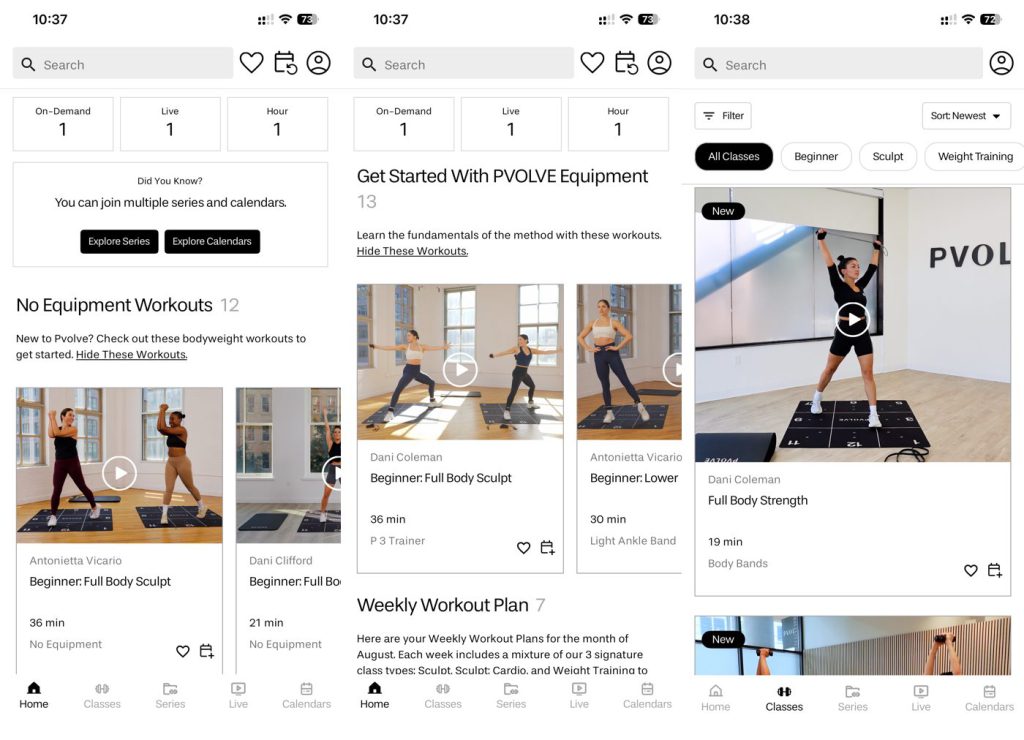
The best balance of perimenopause-specific thinking and a product that is pleasant to use
Pvolve runs a clinical advisory board including a doctor of physical therapy, and its programming is built around joint sensitivity and load without impact, which is the specific combination perimenopause tends to require.
Tested by Katy Cole, two months: I used standard long bands throughout and found the library accessible from the first week. At this point in my life, in my 40s, in early perimenopause, with a previous knee injury, two kids and a full-time job, I am far more precise about what I need. Pvolve is what I landed on.
Why it ranks first: 16 to 25 minute sessions at low impact, with the strongest usability score of any genuinely hormone-aware platform. The apps above it on hormone awareness alone are harder to live with.
The honest limitation: it leans on its own branded equipment beyond ordinary bands, which adds real cost, and loading stays light so the bone ceiling is low.
What a week looks like here: four sessions of 16 to 25 minutes, following a programme rather than browsing. Add a walk on two of the other days. The short session length is the feature: it is what makes four a week realistic rather than aspirational.
Cost: $24.99 a month, or $224.91 a year, about $18.74 a month. Fourteen-day trial, card required.
Start the 14-day free trialAffiliate link, opens pvolve.com. I earn a commission at no extra cost to you. Full disclosureOwning Your Menopause: the deepest menopause thinking, in the least polished app
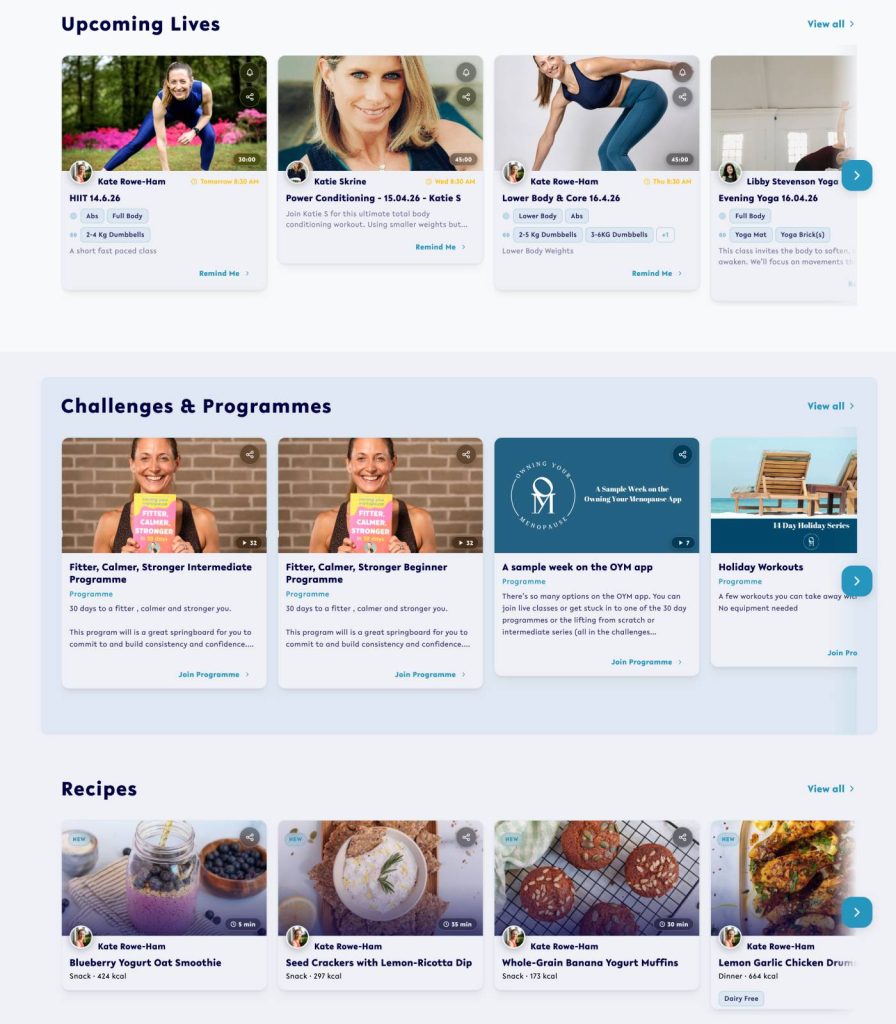
The highest hormone awareness score we have given, held back by the interface around it
Owning Your Menopause is built entirely around this life stage rather than adapted to it, and the depth of its programming reflects that.
Tested by Katy Cole, across two periods: an initial stint of several weeks post-injury, and then more recently I logged back in to reassess with fresh eyes. The menopause thinking held up. The experience of using it is the part that has not moved on.
The honest limitation: ease of use is the weakest of any app here, and video production is noticeably basic. It also carries more high-intensity work than its positioning suggests. If a clunky interface is the thing that stops you training, rank Pvolve or Obé above it for yourself.
What a week looks like here: three strength sessions from the structured programme, and use the education content on rest days. Skip the higher-intensity sessions while you are establishing the habit; they are in the library and they are not why this app ranks here.
Cost: £16.99 a month or £159.99 a year, which includes two months free. Fourteen-day trial. Ignore older listings that say seven days.
Obé Fitness: the one you will actually keep opening
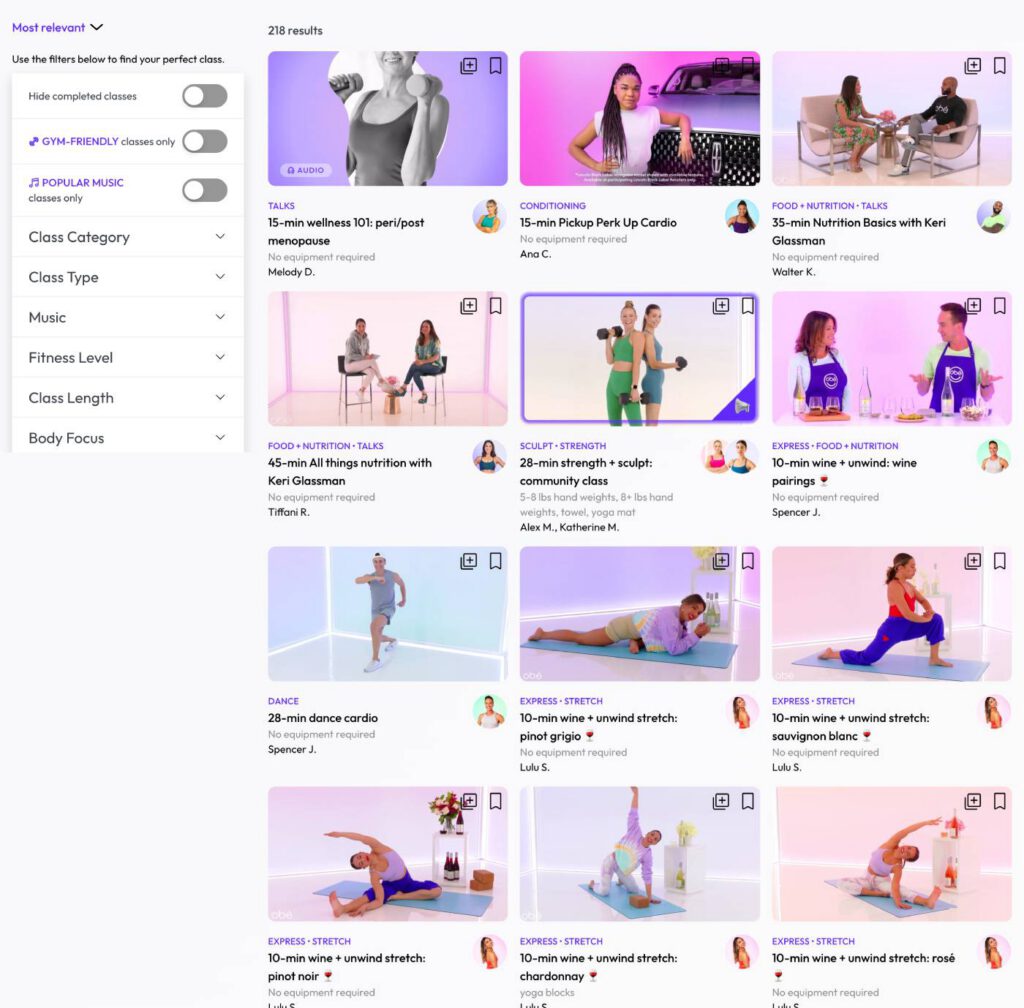
Genuine menopause programming inside the most enjoyable platform we have tested
Obé Fitness runs a six-week Menopause Program alongside signature 28-minute classes, and its filtering is the best of any app here.
Tested by Katy Cole, one month daily: I tested Obé in my 40s in perimenopause, after fifteen years of testing close to fifty platforms for women over 40. Being able to go from “I have 25 minutes and I slept badly” to a class that suits, in under a minute, is what turns a subscription into a habit.
The honest limitation: United States and Canada only, and it needs a US or Canadian card at signup. The wider library carries a lot of HIIT, so the perimenopause version of this app is one you assemble with filters.
What a week looks like here: run the six-week Menopause Program as your spine, then use the filters for everything else. Set them once, to 20 to 30 minutes and low or moderate intensity, and work from that list rather than the home screen.
Cost: $24.99 a month or $169.99 a year, about $14.17 a month. Seven-day trial, or 30 days via a Guest Pass referral.
Menovation: the best explanation of what is happening to you
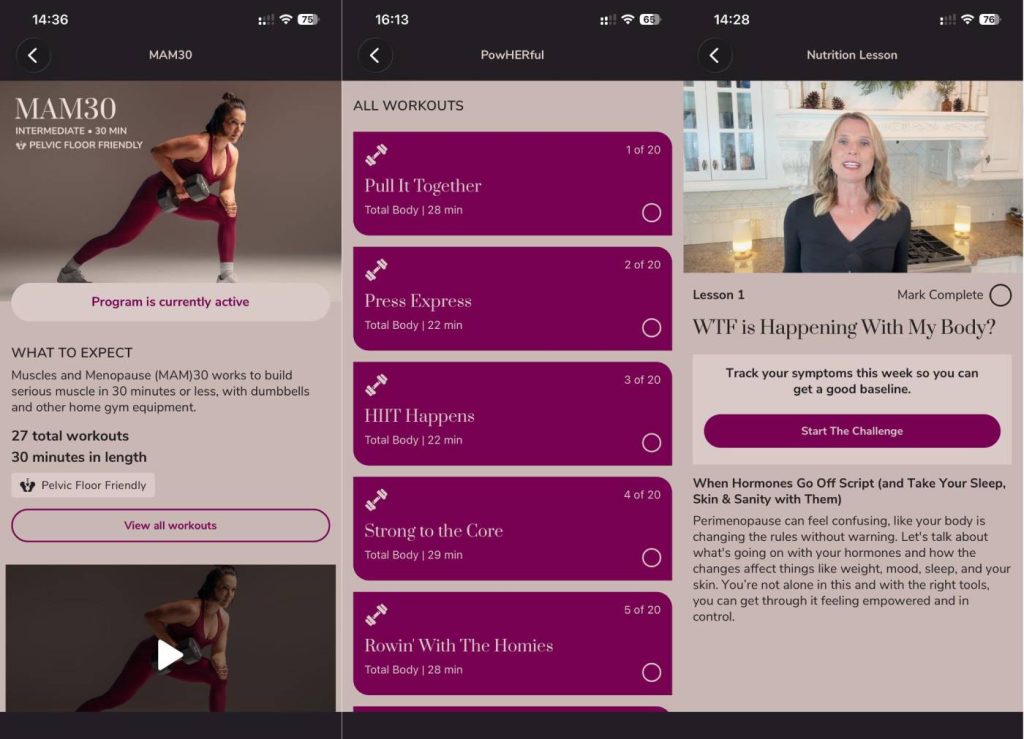
Education and nutrition lessons that are genuinely worth the subscription on their own
Menovation was built for peri and menopause rather than adapted to them, and pairs 20 to 30 minute sessions with real dumbbell loading and exceptional teaching.
Tested by Katy Cole: the education modules are the part I still think about months later. If the thing you are missing is an understanding of why the training that worked at 35 has stopped working, this is the app that fixes that.
The honest limitation: a dated interface and a library that is still growing. It is the best teacher here and not the best product.
What a week looks like here: three 20 to 30 minute strength sessions with real dumbbells, plus one education module a week. Treat the lessons as part of the programme rather than optional extras; they are the strongest thing the platform has.
Cost: $28.99 a month or $199.99 a year, with a quarterly option at $69.99. The checkout offers 8 days free although the homepage says 7.
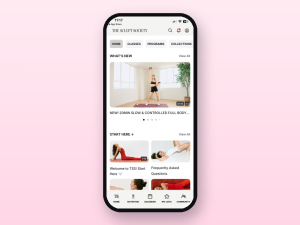
The Sculpt Society: the one you will enjoy enough to repeat
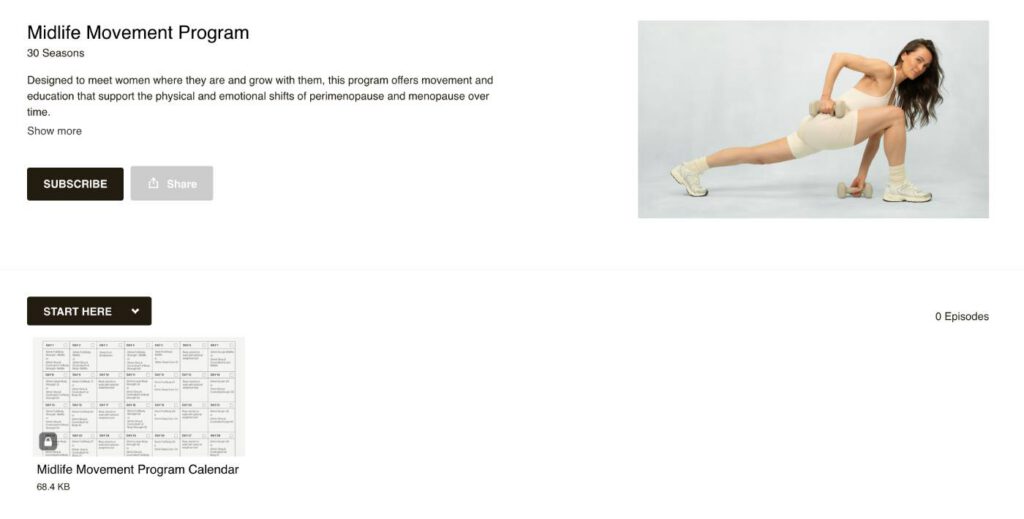
Joyful low-impact dance cardio and sculpt with a doctor-backed midlife programme added in 2026
The Sculpt Society is the most enjoyable platform in this group, and enjoyment is not a soft criterion: the app you keep using beats the app that scores better and sits unopened.
Tested by Katy Cole, four weeks: I used between 11 lb and 19 lb depending on the movement, and by the end of the block I had moved from 17 lb to 19 lb on exercises where I had started conservatively. Measurable progress inside a month, from a platform people dismiss as “just dance”.
The honest limitation: loading is light overall, so the bone and maximal strength ceiling is low, and the midlife programme is newer than the rest of the library.
What a week looks like here: run the four-week Midlife Movement Programme first, which pairs the dance cardio with sculpt work. Increase your dumbbells when the last two repetitions stop being hard, which for most women happens sooner than expected.
Cost: $24.99 a month web, or $229.99 a year, about $19.17 a month. Apple in-app is $27.99. Seven-day trial.
BODi: the strongest nutrition system, attached to the wrong default library
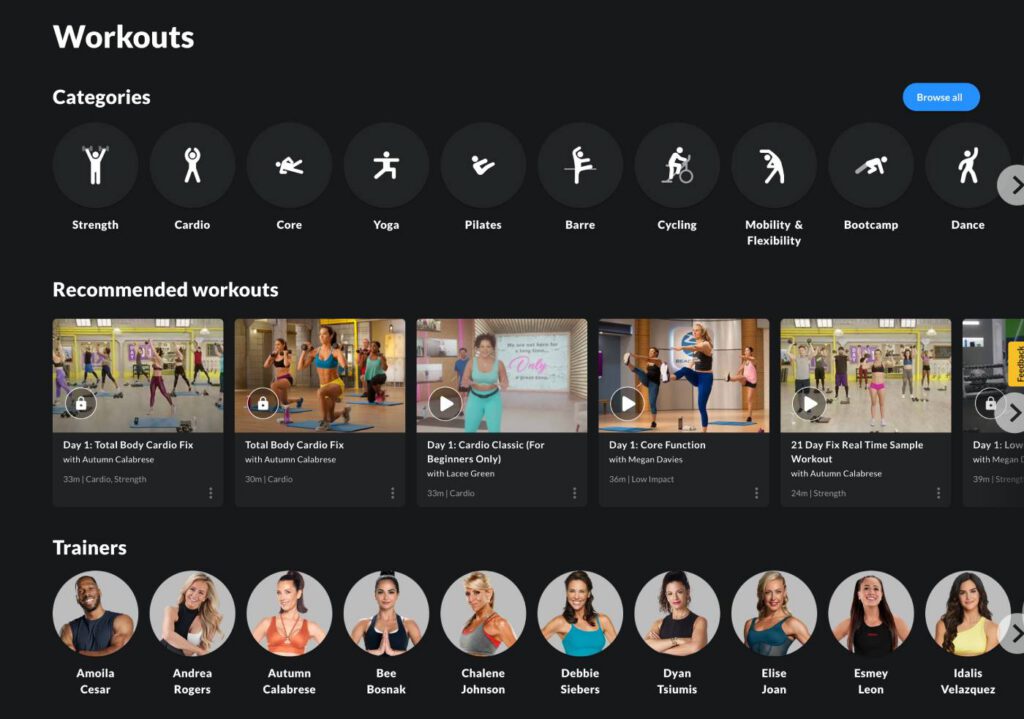
Belle Vitale is a genuine hormone programme; the rest of the platform is not built for you
BODi pairs a dedicated hormone programme with the most complete nutrition system of anything here, which matters because body composition in perimenopause is driven at least as much by what you eat as by how you train.
Tested by Katy Cole, several months across four programmes: I completed 28 days and lost 3 lb, saw noticeably tighter arms and legs, and felt meaningfully more energy by week two. The container-based nutrition system drove most of that, not the exercise.
The caveat: the mainstream library skews jump-heavy with poor joint modifications. Subscribe for Belle Vitale and the nutrition, and ignore what the home screen recommends.
What a week looks like here: Belle Vitale, four to five days a week, plus the nutrition system from day one. Do not browse the wider library. The nutrition side is where most of BODi’s results actually come from and it is the part people skip.
Cost: $22.99 a month, or $179 a year with a $119 first-year promotion running. Seven-day trial on monthly plans only.
Flipping 50: menopause-first programming at a serious price
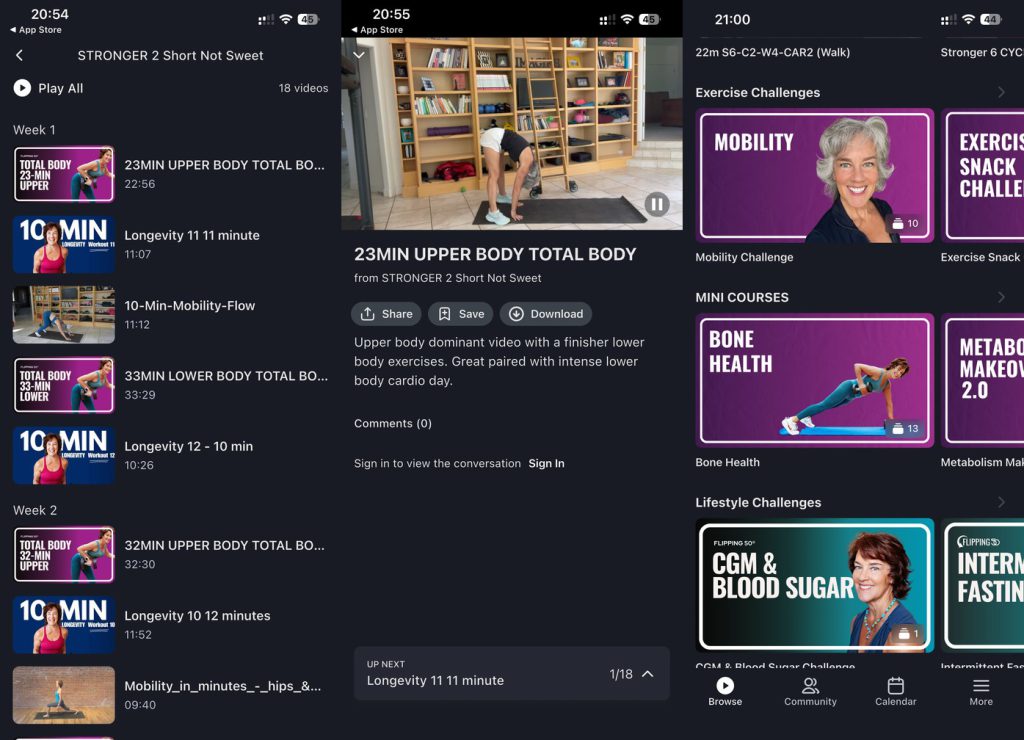
Twelve-week programmes staged separately for peri, meno and post, from a certified strength coach
Flipping 50 comes from Debra Atkinson, CSCS, and is one of very few programmes that treats perimenopause, menopause and postmenopause as different problems requiring different programming, with a dedicated pelvic floor track alongside.
This is a data profile, not a tested review. We have not run it first hand, so there is no personal testing note here. What the published information shows is properly staged progressive programming and a strong recovery philosophy. What we cannot verify is how the coaching and progression feel across a full twelve weeks.
The honest limitation: $69 a month is by far the most expensive option here, with no reliable free trial. For an untested programme that is a lot to ask, and the ranking reflects fit on paper rather than a personal recommendation.
What a week looks like here: the twelve-week programme for your specific phase, three sessions a week, with the pelvic floor track alongside. The method’s own position is that most midlife women train too much, so resist adding to it.
Cost: $69 a month, or $549 a year on the website. Apple in-app renews higher at $649.
Peloton: the cheapest way in, with real accountability
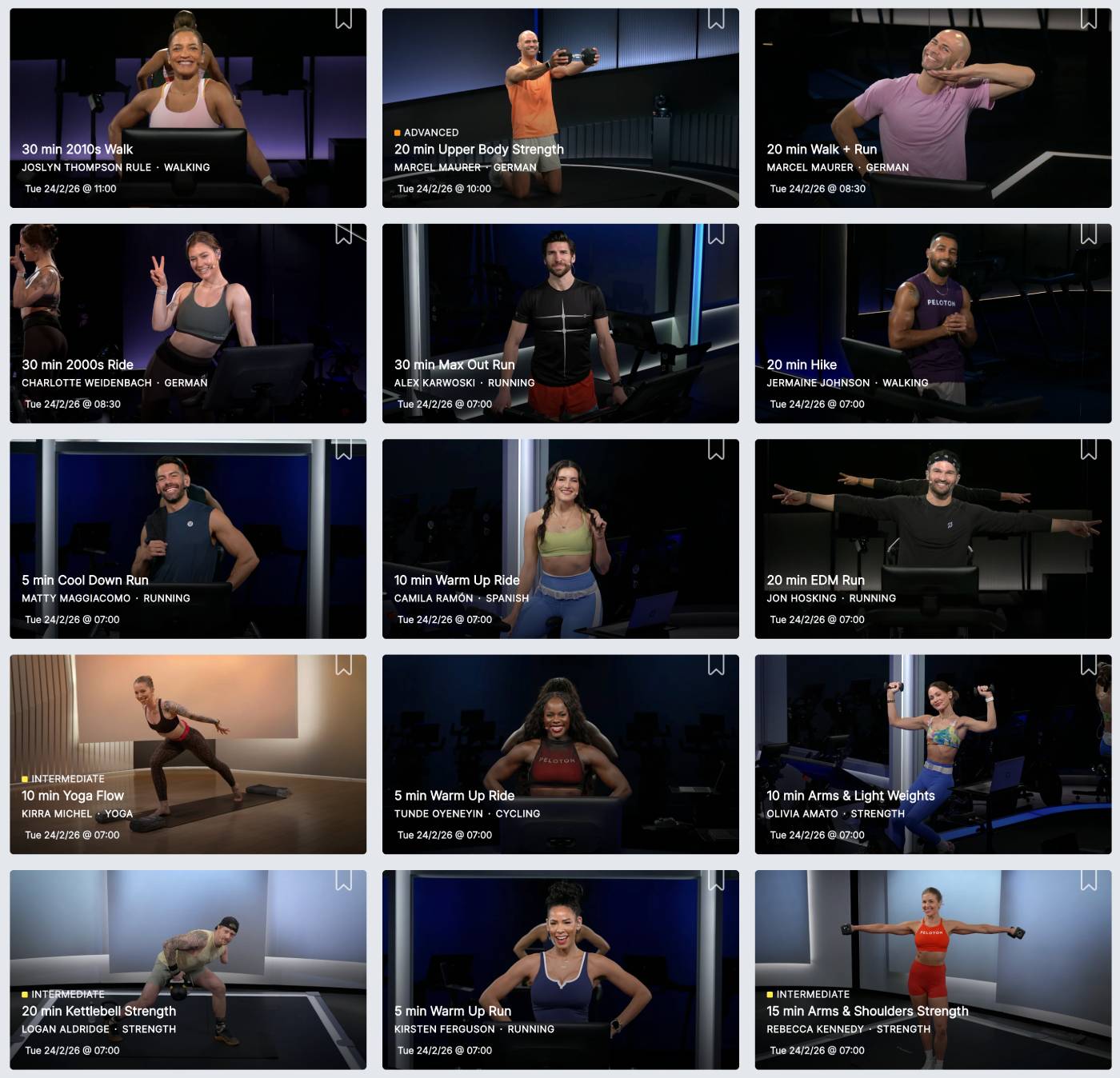
A menopause collection built with Respin Health, inside the largest library on this page
Peloton‘s menopause collection names the physiology directly: reduced tolerance for sustained high cortisol, joint sensitivity, and the need for load-bearing work without excessive impact. App One at $12.99 a month is the cheapest entry point in this group.
Tested by Katy Cole: I mixed classes across strength, yoga, walking and running, using my own treadmill and a single pair of 17 lb dumbbells. The live accountability is the real product, and it is the thing that gets people back on a Tuesday in February.
The honest limitation: no nutrition, no guided progressive overload and no symptom tracking. The menopause collection is a corner of a very large general library rather than the platform’s organising idea.
What a week looks like here: two strength classes from the menopause collection and two walks, using the collection as a filter rather than browsing. On-demand rather than live while you are building the habit, because live classes are designed to push you.
Cost: App One $12.99 a month on web, App+ $28.99. Thirty-day trial, the longest here.
How we tested: methodology
What changed: Burn360, Evlo and FitOn have been removed. All three are good products and none scores above 5 on hormone awareness.
Every platform on this list was personally tested by Katy, a woman in her 40s navigating perimenopause, over a minimum of 3 weeks of active use. Most were tested for 4 to 8 weeks. Testing was conducted between June 2025 and February 2026.
Each platform was scored across nine criteria weighted to reflect the specific priorities of perimenopausal women:
- Joint Friendliness (14%) injury risk, impact level, modification quality
- Recovery Compatibility (14%) session frequency, cortisol management, rest day programming
- Time Efficiency (12%) session length, warm-up/cool-down inclusion, filler content
- Adherence (12%) motivation systems, variety, instructor quality, sustainability
- Muscle Potential (10%) progressive overload, compound movement quality, load guidance
- Progression (10%) programme structure, measurable advancement, content depth
- Value (10%) price relative to content quality, trial terms, guarantee
- UX (10%) app quality, search/filter, navigation, device compatibility
- Equipment (8%) equipment requirement, availability of equipment-free options
Perimenopause-specific content (dedicated programmes, pelvic floor series, menopause collections, doctor-led context) was assessed separately and noted but not used to inflate the overall score a platform with no dedicated perimenopause content can still score highly if its method is intrinsically appropriate for this life phase.
Pricing was verified directly on each platform’s website in February/March 2026. All scores and recommendations reflect the reviewer’s personal experience and research; this is not sponsored content and no platform has paid for placement.
Which fitness app for perimenopause is right for you?
If your joints have started objecting and you have limited time, Pvolve. Low impact, 16 to 25 minutes, 14-day trial.
If you want the deepest menopause programming and can tolerate a clunky app, Owning Your Menopause.
If the problem is that you keep stopping, Obé Fitness if you are in the US or Canada, The Sculpt Society if you are not.
If you want to understand what is happening to your body, Menovation, for the education as much as the training.
If nutrition is the part you have not solved, BODi, running Belle Vitale only.
If you want to spend as little as possible, Peloton App One at $12.99 a month with a 30-day trial.
If you want programming staged specifically for your phase and price is not a constraint, Flipping 50, knowing we have not tested it first hand.
What should your first four weeks look like?
The most common mistake at this stage is not choosing the wrong app. It is starting at the volume you did ten years ago and stopping within a fortnight. Whichever platform you pick, this is the shape that works.
| Week | What to do | What to watch |
|---|---|---|
| 1 | Two strength sessions only. Nothing else structured. Walk when you feel like it. | How you sleep on the nights after training. This is your single best signal. |
| 2 | Two strength sessions, slightly harder. Add one short mobility or yoga session. | Whether soreness clears within 48 hours. If it does not, the sessions are too hard for now. |
| 3 | Three sessions: two strength, one of whatever you enjoy most on the platform. | Whether you are looking forward to them. Persistent dread means reduce, not push. |
| 4 | Three or four sessions. Increase load or reps on the strength work where the last two reps have stopped being hard. | Whether anything measurable has changed: weights used, reps completed, how stairs feel. |
Do not judge an app in the first fortnight. Weeks one and two tell you about the interface and whether you can fit it into your life, which is genuinely useful information. They tell you nothing about whether the programming works. Most trials here run 7 to 14 days, which is deliberately shorter than the point at which you could know. Peloton’s 30 days and MUTU’s 10 are the exceptions.
What to measure, and it is not your weight. Body composition changes in perimenopause without the scales moving, so weighing yourself is close to useless as feedback here. Track the weights you use and the repetitions you complete, and note once a month how you sleep and whether daily things, stairs, shopping, getting off the floor, have got easier. Those are the outcomes that matter and the ones that respond first.
Which app suits which perimenopause problem?
Most women arrive at this page because of a specific thing that has changed, not because they want a fitness app in the abstract. This maps the common ones onto what actually helps.
- Joints have started objecting. Low-impact loading with movement quality attention: Pvolve or The Sculpt Society. Both are low impact and neither asks you to jump.
- Body composition has changed without the scales moving. This needs progressive strength plus nutrition. BODi is the only app here with a complete nutrition system; Menovation has the best nutrition education.
- You are exhausted and training makes it worse. Reduce volume rather than intensity, and choose short sessions: Pvolve at 16 to 25 minutes. Our low-cortisol page covers this specifically.
- You are leaking, or something feels different down there. This is common, treatable and badly under-discussed. See a pelvic health physiotherapist, and look at our pelvic floor picks rather than a general fitness app.
- You do not understand what is happening to your body. Menovation for education, or Owning Your Menopause for depth.
- You keep starting and stopping. This is the most common problem and the one people are least likely to name. Pick the app you will enjoy, not the one that scores highest: Obé Fitness or The Sculpt Society.
None of this is medical advice, and an app is not a substitute for care. Heavy or irregular bleeding, new joint pain that does not settle, or exhaustion that does not improve are worth a conversation with your doctor rather than a different subscription.
How did we rank these eight?
Who wrote this. Katy Cole, mid-40s, currently in perimenopause, with a meniscus injury history. I am not a doctor, personal trainer or menopause specialist. Everything here comes from personally testing close to fifty fitness platforms over fifteen years and reading the published research, and none of it is medical advice.
The ranking axis is hormone awareness, weighted 70%, blended with ease of use, weighted 30%. Hormone awareness is one of the twelve capabilities we score on every programme, and it measures whether the platform has genuinely accounted for oestrogen decline, cycle irregularity, sleep disruption and reduced recovery capacity, rather than adding menopause to its marketing.
We blend it with ease of use for a reason we learned the hard way. Ranking on menopause capability alone put Owning Your Menopause first on eleven of our pages, on genuinely excellent programming, while its ease of use score is the lowest here and its own review notes that video production is basic.
An app you find unpleasant is an app you stop opening, and a programme you have stopped doing has no benefit at all. The two measures are close to independent, correlating at r = 0.22, so blending them adds information rather than double-counting.
Nine of our 77 programmes score 7 or above on hormone awareness. Eight of them appear here; the ninth is a Pilates platform better covered on our Pilates page.
Seven of the eight I have tested myself. Flipping 50 is a data profile built from published information and carries no first-hand testing claim.
We buy our own subscriptions. Some links on this page earn a commission, which never affects a score or a position.
How do you know if it is working?
Give any programme eight weeks before you judge the training, and two weeks before you judge the app. Those are different questions with different answers, and conflating them is why people cycle through subscriptions.
In two weeks you can tell whether the interface irritates you, whether the sessions fit your life, whether the instructor’s manner works for you, and whether you can find what you want quickly. These are real reasons to cancel and they are the ones trials are actually long enough to answer.
By eight weeks you should see at least one of: heavier weights or more repetitions on the same movements, daily tasks feeling easier, better sleep on training days, or clothes fitting differently while the scales have not moved. One of those is enough. All of them at once is unusual.
If eight weeks produce nothing at all, the likeliest cause in order is: you did fewer sessions than you think, the sessions were not hard enough at the end, the programme is not progressive, or something medical is in the way. Check them in that order. Most women who tell us nothing worked completed about half the sessions they intended, which is not a criticism of them or the app.
Consistency beats optimisation by a wide margin at this stage. The difference between the first and eighth app on this page is much smaller than the difference between doing three sessions a week and doing one. If you are choosing between two of them and cannot decide, pick the one you will enjoy and start this week.
The five most common training mistakes in perimenopause
These come up repeatedly, in the research, in the reviews we write, and in what women tell us. None of them is a character flaw and all of them are fixable.
1. Adding cardio when the answer is strength. The instinctive response to a changing body is to do more cardio, because that is what worked before. Greendale and colleagues’ work shows the loss across the menopause transition is lean mass, and cardio does not address that. If you have limited time and you are choosing, choose strength. Two sessions a week is the floor, not the target.
2. Training harder rather than more consistently. Four excellent sessions in week one followed by nothing for a fortnight loses to three ordinary sessions a week for a year, and it is not close. Recovery capacity genuinely does fall at this stage, so the volume that used to be sustainable often is not. Reduce until it is sustainable, then hold.
3. Avoiding load because something hurts. Joint pain is common in perimenopause and the instinct is to go gentler everywhere. Usually the answer is to change the movement rather than remove the load: swap a lunge for a split squat to a box, a floor press for a bench press, jumping for a step. Under-loading protects nothing.
4. Judging progress by the scales. Body composition shifts without weight changing, so the scales can stay flat while something real is happening in either direction. Track the weights you lift and the reps you complete instead. It is the only feedback in this list that responds within weeks.
5. Treating symptoms as a training problem. Exercise helps with sleep, mood, body composition and bone, and it is not a treatment for perimenopause. If heavy bleeding, persistent exhaustion or joint pain that will not settle are what brought you here, a different app is not the answer. Perimenopause symptoms also overlap with thyroid disease, anaemia and depression, all of which are worth ruling out.
What these apps will not do for you
Worth saying plainly, because the category’s marketing implies otherwise.
None of them will manage your symptoms. An app can programme sensible training around perimenopause. It cannot treat hot flushes, heavy bleeding or sleep disruption, and where any platform’s marketing suggests otherwise, that is marketing rather than evidence.
Most of them will not load your bones enough. This is the biggest structural gap in the whole category. Menopause-branded platforms skew low impact and light loading, because that is what the audience says it wants, while the evidence points towards combining impact with high-magnitude resistance work. Almost every app here needs supplementing on this specific point, and almost none of them will tell you so.
None of them will tell you where you are in the transition. Perimenopause is diagnosed clinically, not by an app questionnaire, and the staging matters for decisions that are not about exercise at all.
Only one will feed you. BODi is the only platform here with a complete nutrition system. Since body composition in perimenopause responds at least as much to what you eat as to how you train, that is a real gap in the rest, and it means the honest cost of most of these apps is this subscription plus something else.
What they will do, and it is not a small thing, is give you a structure you will follow, designed by someone who has thought about this life stage, for less than the cost of a single personal training session a month.
What does the research say about training in perimenopause?
The physiological case for changing how you train in perimenopause is stronger than the case for any particular app, and it is worth understanding before you spend anything.
Body composition changes independently of what you weigh. Greendale and colleagues tracked women through the menopause transition and found measurable loss of lean mass and gain in fat mass across the transition, published in JCI Insight in 2019. This is why the scales can stay still while your body clearly changes, and why “eat less, move more” advice fails so many women at this stage.
Bone needs load, and it needs the right kind. Martyn-St James and Carroll’s meta-analysis in the British Journal of Sports Medicine found that programmes combining impact with high-magnitude resistance work reduced postmenopausal bone loss more effectively than either alone. Most menopause-branded apps are light on exactly this, which is the single biggest gap in the category.
Load does not have to be heavy to build muscle, but effort does have to be real. Schoenfeld and colleagues found in a systematic review that low and high loads both build muscle when sets are taken close to failure. That is genuinely good news if your joints have stopped tolerating heavy weights: what matters is that the last repetitions are hard, not what is in your hands.
Short sessions work. Ramos-Campo and colleagues found that circuit resistance training improved body composition, strength and cardiorespiratory fitness in middle-aged and older women, in the Journal of Aging and Physical Activity in 2022. The 20-minute sessions most of these apps are built around are not a compromise.
Bands count. Lopes and colleagues’ meta-analysis found elastic resistance produced similar strength gains to conventional weights, which matters for the equipment-light platforms here.
Read together: two progressive strength sessions a week, effort taken close to hard, sessions kept short enough to actually complete, and impact added deliberately where your joints allow. Every recommendation on this page is a judgement about which app makes that easiest for a particular woman.
Nothing here is medical advice. Perimenopause symptoms overlap with thyroid disease, anaemia and depression, and a fitness app is not a diagnosis. If you feel unwell rather than merely different, see your doctor.
Related Guides
Go deeper with our research-backed guides:
Frequently asked questions
Pvolve ranks first on our blend of hormone awareness and ease of use. It runs a clinical advisory board including a doctor of physical therapy, sessions are 16 to 25 minutes at low impact, and it has the best usability of any genuinely hormone-aware platform. Owning Your Menopause scores higher on menopause programming alone but is noticeably harder to use.
Any app that gets you doing two progressive strength sessions a week is better than no app. What a perimenopause-specific platform adds is programming that accounts for reduced recovery capacity, joint sensitivity and sleep disruption, plus education about why your old routine stopped working. If you already train consistently and understand your own recovery, a general strength app may serve you perfectly well.
Prioritise two progressive strength sessions a week over more cardio, take sets close to hard rather than grinding out easy volume, keep sessions short enough that you complete them, and add impact deliberately where your joints allow, because bone responds to it. Reduce total weekly volume before reducing intensity if you are exhausted.
For strength, yes, if the effort is real. Ramos-Campo and colleagues found circuit resistance training improved body composition, strength and cardiorespiratory fitness in middle-aged and older women, and most of the apps on this page are built around 20 to 30 minute sessions for exactly that reason. Twenty easy minutes is not the same thing as twenty hard ones.
Peloton App One at $12.99 a month on the web, with a 30-day trial, the longest here. Obé Fitness works out at about $14.17 a month on an annual plan. At the other end, Flipping 50 is $69 a month with no reliable trial.
Exercise has good evidence behind it for sleep, mood, body composition and bone, and those improvements often make symptoms more manageable. It is not a treatment for perimenopause and no app should present it as one. Perimenopause symptoms also overlap with thyroid disease, anaemia and depression, so if you feel unwell rather than different, see your doctor rather than changing your workout.