
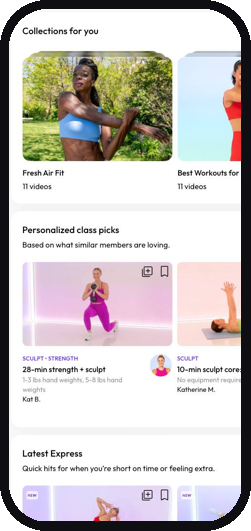
$24.99/month or $169.99/year · 7-day free trial · Streaming platform, on-demand only (live classes discontinued in 2024) · Strength, Pilates, barre, dance cardio, yoga, HIIT, meditation, bounce, ride, walk · Menopause Program and Age Well Collection · US and Canada only Personally tested: class library with resistance bands, dumbbells (3 lb to 20 lb depending on class type), ankle weights, mat · Menopause Program (two weeks of six) · Age Well Collection · strength with Natalie D. and Olivia T. · barre and sculpt with Kat B. · 10-minute Stretch for Joint Pain with Kat S. · meditation and breathwork · short audio courses · one month of daily 20 to 30 min sessions · Prices verified April 2026 via obefitness.com
Obé Fitness Review 2026: Quick Answer
Quick Verdict
Worth it for women over 40? Yes, for US and Canadian residents. Obé is one of the most enjoyable perimenopause-friendly fitness platforms I have tested in years, with outstanding filtering and a design that lifts mood. The caveats are real, though: it is not the platform for heavy progressive strength training, and it is not officially available outside the US and Canada.
Obé earns 7.5/10 after a month of daily testing by a woman in her 40s navigating perimenopause. The filtering system is one of the best I have used across close to 50 platforms. The signature 28-minute classes fit around a working-mother schedule. The menopause-specific content exists, is led by credible experts, and is well-produced (even if it is softer on clinical depth than a specialist platform like Pvolve).
What surprised me most was what the platform is like to open. It is colour-drenched, energetic and unapologetically optimistic, and that matters more than it sounds. After a month of 20-minute sessions with dumbbells between 3 lb and 20 lb depending on whether I was doing Pilates, barre or strength, my weight and measurements stayed exactly where I wanted them, which in perimenopause is a success in itself.
Start here: Sign up for the 7-day free trial on obefitness.com. Take the quiz, then filter for 20 to 30 minute strength and Pilates classes. Try 5 sessions before the trial ends.
Is Obé Fitness right for you?
Obé Fitness is strongest for perimenopause and menopause support (6.5 out of 10, against a 3.3 average across the 76 programmes scored) and weakest for building bone density (4.5 against 5.1).
| Question | Verdict | Rating | Score |
|---|---|---|---|
| How it suits a perimenopausal body | |||
| Is Obé Fitness good for pelvic floor problems?Based on pelvic floor support and low-impact design | Moderate, about the same as mostmost score 4.6/10 | 5.0 / 10 | |
| Is Obé Fitness genuinely built for perimenopause and menopause?Based on menopause programming, hormone awareness, education and expert credibility | Moderate, but better than mostmost score 3.3/10 | 6.5 / 10 | |
| Is Obé Fitness good for painful joints?Based on low-impact design and recovery provision | Strong, and better than mostmost score 6.2/10 | 7.5 / 10 | |
| Is Obé Fitness manageable when your energy is low?Based on recovery provision and mind-body support | Strong, and better than mostmost score 5.7/10 | 7.5 / 10 | |
| Is Obé Fitness good if you are new to strength training?Based on beginner on-ramp and mind-body support | Strong, and better than mostmost score 6.1/10 | 8.0 / 10 | |
| Is Obé Fitness good for building bone density?Based on bone loading and progressive strength | Low, about the same as mostmost score 5.1/10 | 4.5 / 10 | |
| Does Obé Fitness help with nutrition?Based on midlife nutrition support | Moderate, but better than mostmost score 4.1/10 | 5.0 / 10 | |
| How it performs as a product | |||
| Can you fit Obé Fitness into a busy week?Based on time efficiency | Strong, and better than mostmost score 7.6/10 | 10.0 / 10 | |
| Is Obé Fitness worth the money?Based on value for money | Strong, about the same as mostmost score 6.9/10 | 7.0 / 10 | |
Jump to Section
Obé Fitness Review 2026: Why I Tested It
I tested Obé Fitness for one month in 2026, in my 40s and navigating perimenopause, after fifteen years of testing close to 50 fitness platforms for women over 40. This is a review based on daily use, not a marketing summary. I came to the platform already-warm from Alo Moves, Pvolve and Apple Fitness+, not as a beginner looking for a first home workout routine.
I have a previous meniscus injury that still tells me when it disapproves, carry weight in my lower body in a way that does not respond easily to training, and notice the changes most women notice in their 40s: a softer middle, slower recovery, a body that rewards different choices than it did a decade ago. I train regularly. I was looking for variety, specifically for my next type of workouts suitable for women over 40 who already train but want to mix things up.
Obé kept coming up. I had seen it on Instagram for years, the neon-lit brand that looks nothing like the standard menopause fitness aesthetic. I wanted to see whether the substance behind the colour held up for someone at my life stage. I tested it for a month daily, using a friend’s US account (Obé is only available in the United States and Canada, which I will come back to). Here is what I found.
What Obé Fitness Actually Is
Obé Fitness (also commonly spelled “obe fitness” without the accent, pronounced “oh-bay,” short for “Our Body Electric”) is a women-focused fitness streaming platform founded in 2018 by Ashley Mills and Mark Mullett. Classes are filmed in a signature neon-lit Brooklyn studio called “the Box,” which is where the platform’s visual identity comes from.
The platform offers streaming access to over 16,000 on-demand classes according to Obé’s own FAQ,[1] with new classes released daily via a published drop schedule. One important thing to know up front, because older reviews will confuse you otherwise: Obé discontinued its live classes in 2024. The platform is now strictly on-demand. Many long-term users miss the accountability of a scheduled live class; I understand why, and I will come back to this.
Class types organise into four pillars:
- Cardio: HIIT, Dance HIIT, Dance Cardio, Boxing, Bounce (mini-trampoline), Jump, Ride, Step, Endurance, Run, Walk
- Strength: Sculpt, Pilates, Strength, Power, Barre
- Yoga: Vinyasa Yoga, Yoga Sculpt, Restorative Yoga, Breathwork, Meditation
- Activate/Recover: Warmup, Cool-down, Stretch, Foam Roll
Alongside the library you get a personalised plan driven by a sign-up quiz, structured programmes (Menopause Program, Age Well Collection, Gym Strong, BodyComp, Starter Pack, Sculpt Burn Repeat, Strength + Sweat and others), 7 to 14 day challenges, audio-only “Obé On the Go” classes, short audio courses on women’s health and nutrition, cycle tracking with cycle-synced suggestions, mood-based class recommendations, Apple Health integration, and a TV app. iOS users can download up to 30 classes for offline use; Android users cannot.
The Neon Question
The aesthetic deserves addressing up front, because it is the element most reviews and users react to first. Obé is colour-drenched: electric pink, vivid yellow, deep purple, acid green, each class tile on a different coloured backdrop, each instructor in matching bright activewear. I am aware some readers will find this too much. I was born in the early 80s, I grew up on aerobics instructors in leotards, and my response to it was immediate and physical. I wanted to move.
On days when the outdoor-filmed platforms I also train on, Alo Moves and Fit with Coco, were what I wanted, Obé felt wrong. On most other days, Obé felt like a party rather than a workout, in the best possible sense. When I think about some of the menopause-specific content I have tested elsewhere, where the aesthetic tips toward muted and resigned, I noticed the difference genuinely and daily.
Pressing play on a workout that is colour-drenched and led by a woman who is clearly enjoying herself does something useful at this life stage, when a lot of the information you encounter about your body is framed in the language of decline. I cannot quantify it, but after fifteen years and close to 50 platforms I will tell you that how a platform makes you feel about the task is at least half the outcome.
On most days, Obé felt like walking into a room that wanted me to have a good time. At a life stage when a lot of the information you encounter about your body is framed in the language of decline, that matters more than it sounds.
Nothing else about Obé matters if you do not respond to the look of it. I would encourage anyone considering it to spend two minutes on obefitness.com before reading another review. You will know within those two minutes whether the aesthetic is for you.
The Quiz and the Filter System
When you sign up, Obé runs a short quiz covering your fitness goals, preferred class types, habit-forming style (self-motivated vs needing check-ins), and wellness interests like meditation or cycle tracking. At the end, rather than funnelling you into one programme, it populates a personalised two-week schedule that refreshes as you go, and it opens the full library with suggested classes surfaced.
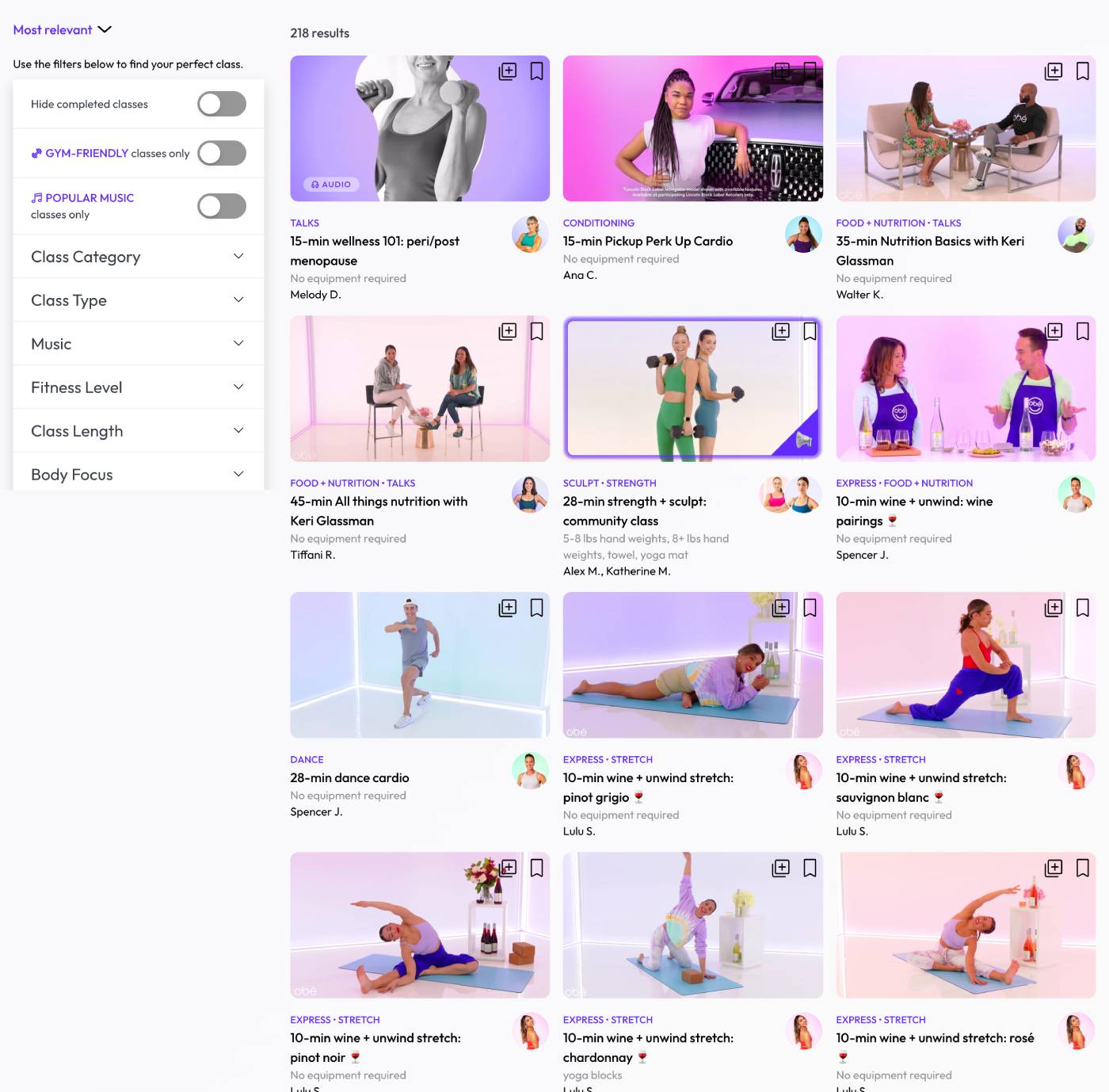
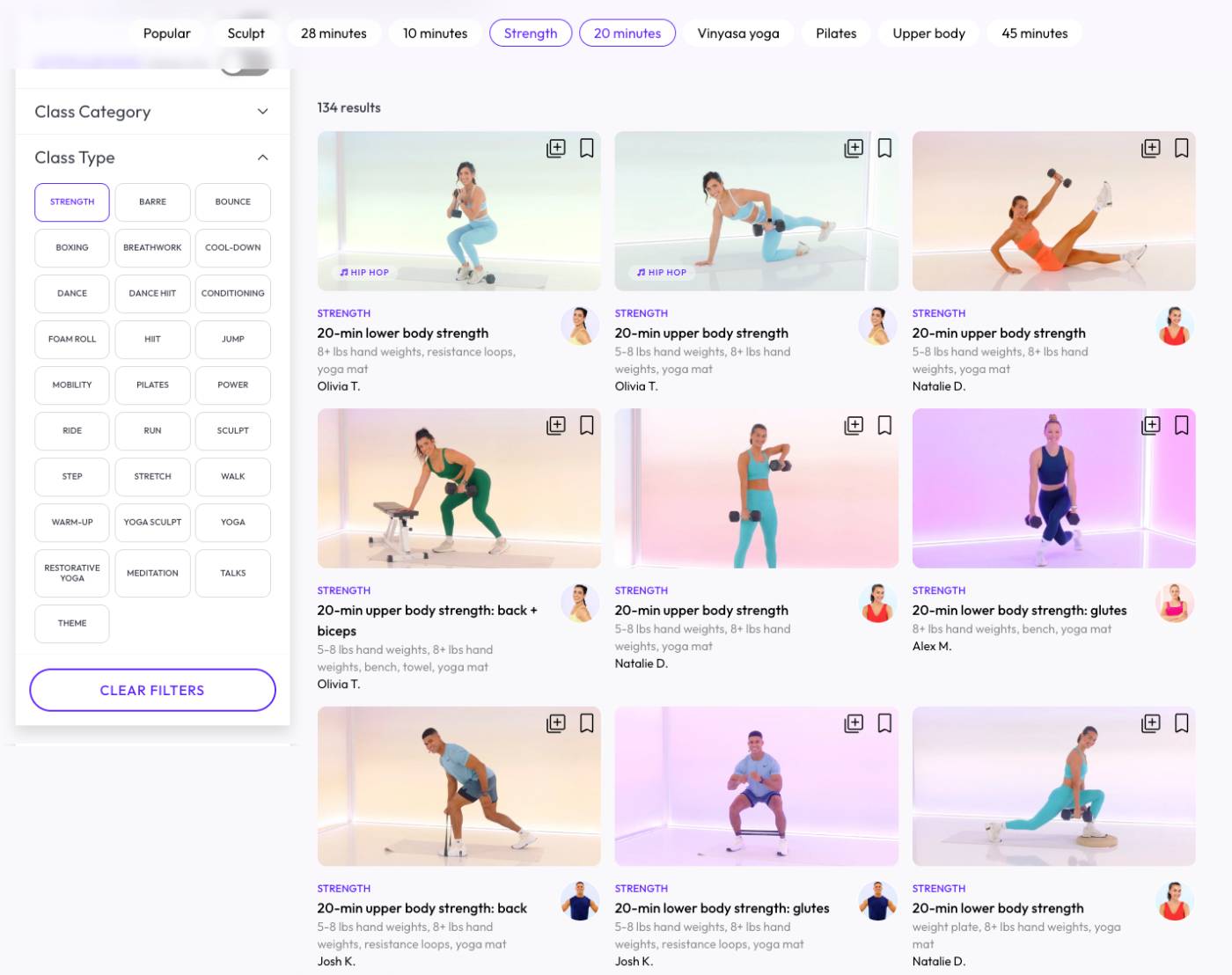
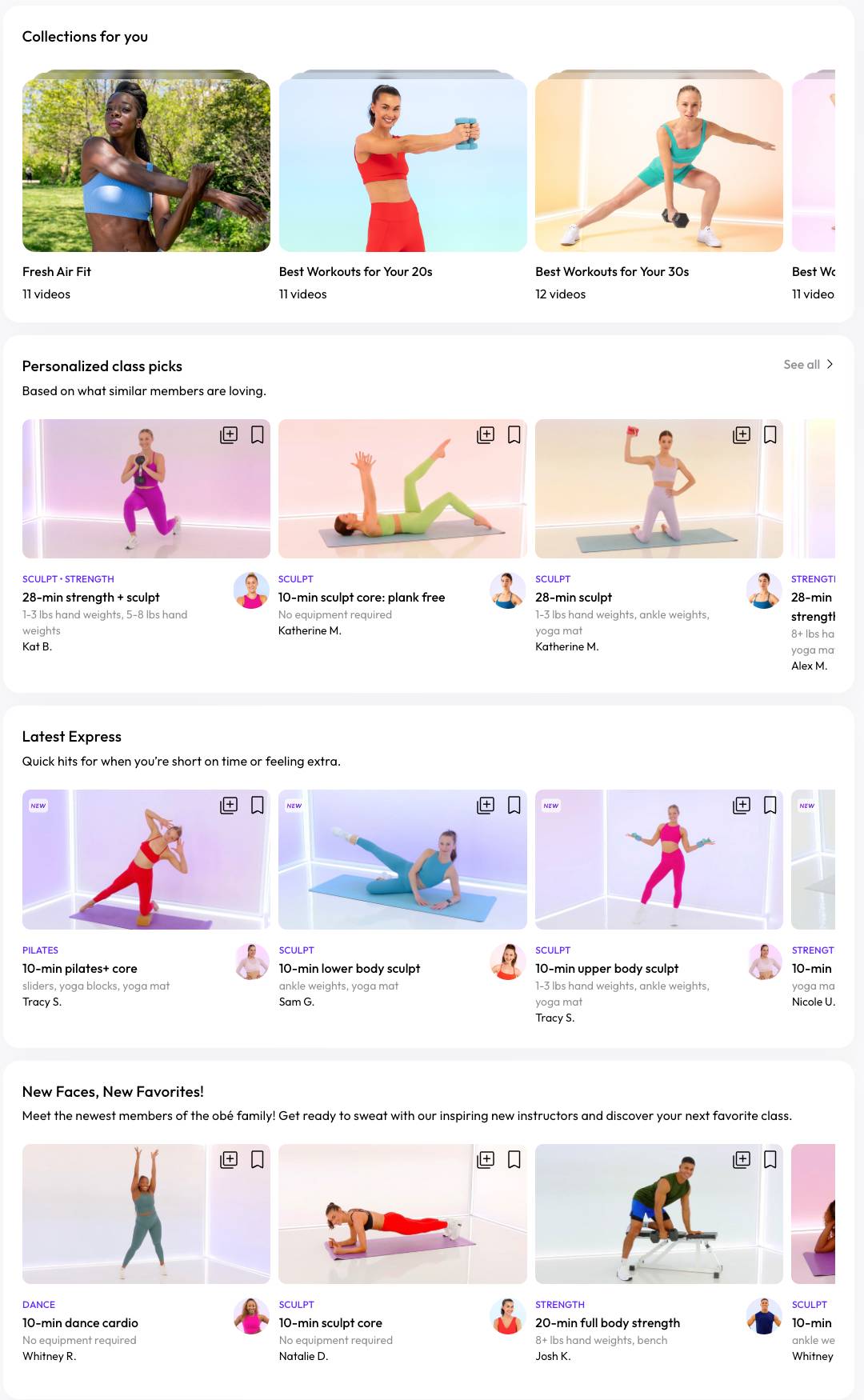
The filtering is where Obé excels. You can filter classes by class type, music style, duration, instructor, fitness level, class focus, body focus, impact level (high or low), equipment needed, release year, and fitness goal. Filters stack, so you can be precise: 20 to 30 minutes, low impact, strength, with dumbbells, intermediate level. After close to 50 platforms, I can tell you this is genuinely rarer than it should be. Most platforms give you three filter options and call it a feature. Obé gives you ten, and they work.
In practice this means finding exactly what you are in the mood for takes about ten seconds rather than ten minutes of scrolling. As a working mother of two navigating perimenopause, the class length filter alone is the feature that makes this platform work for me in a way that most others do not. I am not going to commit to 60-minute sessions at 6am and then feel guilty when life makes that unsustainable. Twenty to thirty minutes, most days, is something I do.
What I Actually Tested
Across a month of daily use I worked through strength classes with Natalie D. and Olivia T., barre and sculpt classes with Kat B., the Menopause Program for two of its six weeks, sampled the Age Well Collection, the 10-minute Stretch for Joint Pain with Kat S., several meditation and breathwork sessions, a few dance cardio classes, and a handful of the short audio courses on nutrition, protein and women’s cognitive health. I did one Wine and Stretch class with Lulu S. out of curiosity, which I will come back to.
Weight-wise I used dumbbells between 3 lb and 20 lb depending on what the class was asking for, which is the range I had been working with for a while before testing Obé. I did not buy any Obé-branded equipment; I used resistance loops, ankle weights and dumbbells I already owned. The goal for me at this point in perimenopause is maintenance rather than transformation.
After a month I maintained my weight and measurements exactly. That sounds small. In perimenopause it is not. Research on body composition trajectories in perimenopausal women shows consistent increases in fat mass and waist-hip ratio alongside decreases in skeletal muscle and protein levels even without specific interventions,[6] so holding the line is a real outcome, not a non-result.
After a month of daily 20 to 30 minute sessions on Obé, my weight and measurements stayed exactly where I wanted them. In perimenopause, that is a real outcome, not a null result.
One caveat up front: I did not test Obé’s personal training add-on (an additional paid one-to-one coaching service), the Ride classes (I do not have a bike), or the prenatal and postnatal programming. Where I have not tested something I will say so.
Strength with Natalie D. and Olivia T.
My first Obé class was Natalie D.’s 20-minute full-body strength training session, filmed on a light-purple lit set, and it set the tone for why Obé feels different. The session had a proper warmup and progressive intensity, and it left me challenged but not exhausted, which at 20 minutes is exactly the right outcome. Mid-class Natalie cued a curtsy lunge with a 30-second hold that genuinely lit up my thighs, and in the same breath she gave a specific note about knee positioning and told anyone with knee sensitivity to modify.
With a meniscus history I listen out for this. It was not the most detailed modification coaching I have heard, but it was proactive, not an afterthought. That is still a low bar many platforms fail to clear.
Olivia T.’s strength training and HIIT classes are more demanding. She leans into the “pick up the heavy weight” philosophy and her sessions are where I reached for 18 lb and 20 lb on compound lifts. She is also explicit about rest days and avoiding workout burnout, which is a sensible framing for women at our life stage where cortisol sensitivity increases.[3]
Barre and sculpt with Kat B.
I had done very little barre before Obé and the classes with Kat B. are the reason I will do more of it. Her sessions are mostly 28 minutes, often with resistance bands or ankle weights and 3 lb to 7 lb dumbbells, and the word “sculpt” on Obé is not used loosely. I finished her classes happy and pleasantly tired in specific small muscles I had not felt in years: the tiny stabilisers around the hips, the posterior glute medius, the deep abdominals.
I have a stubborn relationship with my lower body, which does not respond to training the way the textbooks promise, and Kat’s barre work was one of the few things in months that felt like it was reaching the muscles I keep trying to talk to.
Research on resistance training in middle-aged women shows that hypertrophy responses differ before and after menopause; pre-menopausal women see measurable increases in muscle mass, while post-menopausal women need higher training volumes and intensities to produce the same composition changes.[2] For someone in early perimenopause like me, consistent activation of under-used small stabilisers through barre work is exactly the kind of stimulus that makes a difference, and Kat’s classes delivered it.
If you have never tried barre, her 28-minute classes are one of the best starting points on the platform. A note for the knees: barre can be demanding on the front of the knee at certain angles. Kat cues small modifications. With my meniscus history I used a lower range of motion on deep pliés and it was fine.
The Menopause Program
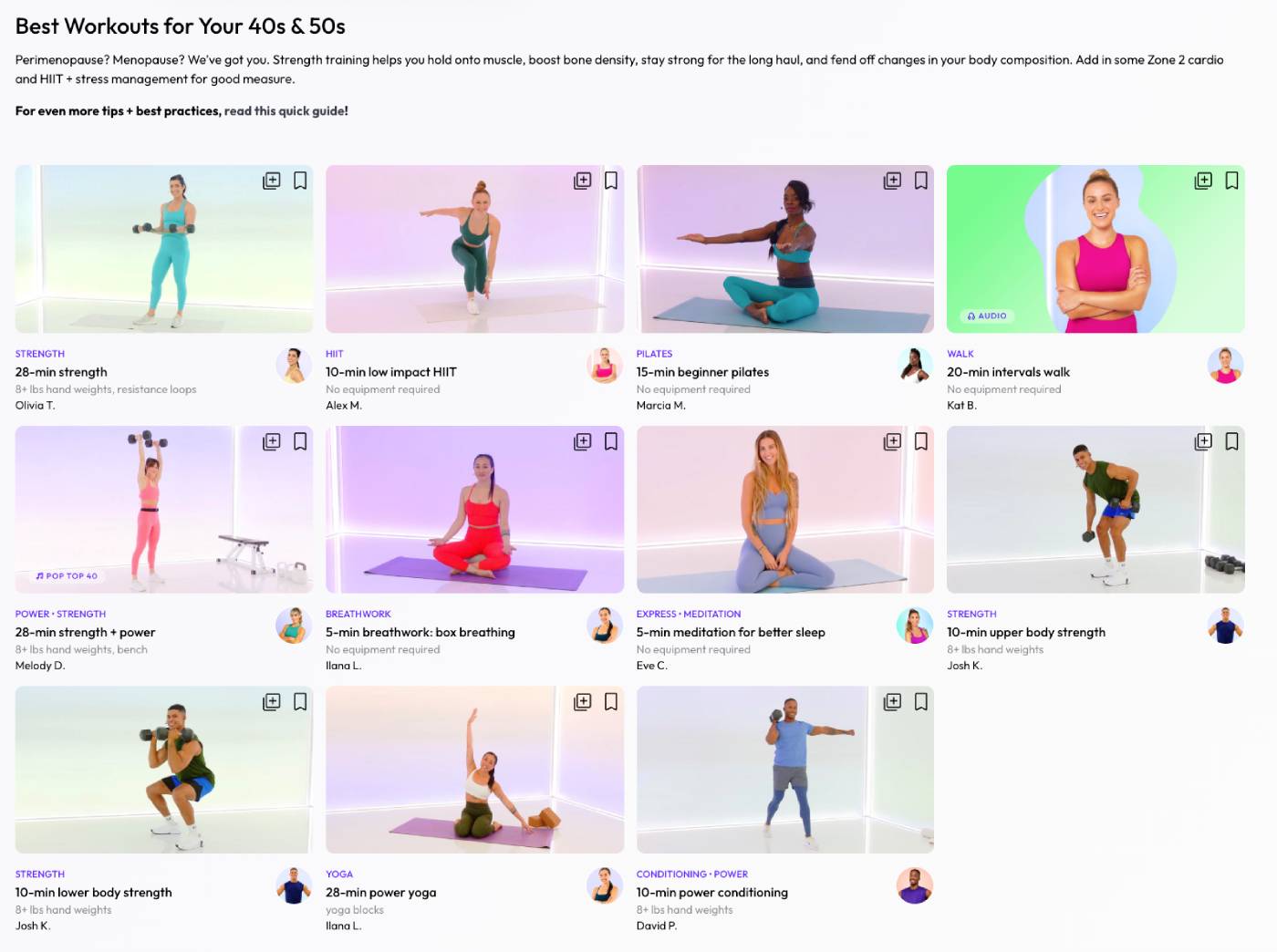
This is the part of the platform readers of this site will ask about most, so I want to give it proper space. The Menopause Program is a six-week structured programme led by Melody D., Obé’s director of programming and a Girls Gone Strong Women’s Health Coach, with classes from Kat B., Olivia T. and Alex across the weeks.
Structure is four sessions per week, sessions ranging from 5 to 45 minutes (most I did were around 30), alternating between cardio, strength, mobility, mindfulness, and short educational talks on stress management, sleep, metabolic changes in midlife, and nutrition.
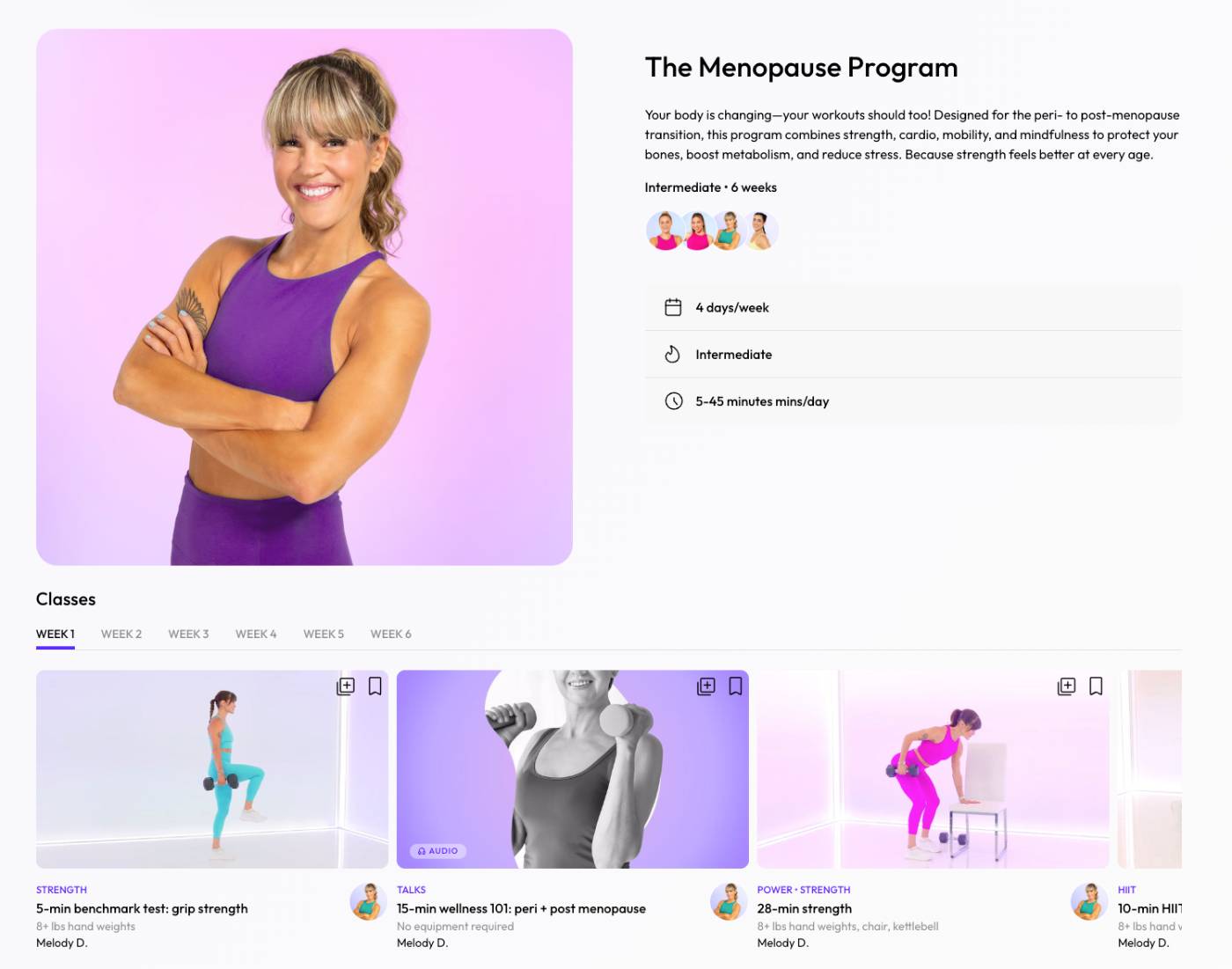
I completed two of the six weeks. The educational pieces are deliberately short (three to five minutes each) so you can actually fit them in. Fifteen-minute lectures on perimenopause are useless if you never press play because you do not have fifteen minutes. Obé’s approach is to give you a digestible summary and trust you to go deeper in the longer audio courses if you want to. I respect this design choice.
My assessment: the program is beautifully produced, motivating, and a reasonable entry point into menopause-aware training. But for someone who has trained for years and has some existing strength and stamina, the workouts themselves were not consistently challenging enough. I ended my first week feeling I had not done enough physical work. I found myself adding a 20 or 30 minute treadmill walk on program days.
The Menopause Program is beautifully produced and motivating. But for women who already train regularly, the workouts are not consistently challenging enough. It is a stronger fit for beginners and returners.
To test this reading I asked my mother in her late 60s, who does walking and Pilates and has never done serious weight training, to try the Menopause Program for a week. She loved it and said it felt exactly right for her fitness level.
So the program is not unchallenging, it is simply pitched at a beginner to intermediate audience. If you are returning to fitness in your forties or fifties after a long break, or if you are newer to strength work, this is your sweet spot. If you are already lifting regularly, you will outgrow it within weeks.
When I compare the depth of information to Pvolve’s Menopause Strong, Pvolve clearly wins on clinical rigour and progressive challenge. When I compare production, energy and motivational pull, Obé wins, and it is not close. It depends which deficit matters more to you at your stage.
The Age Well Collection
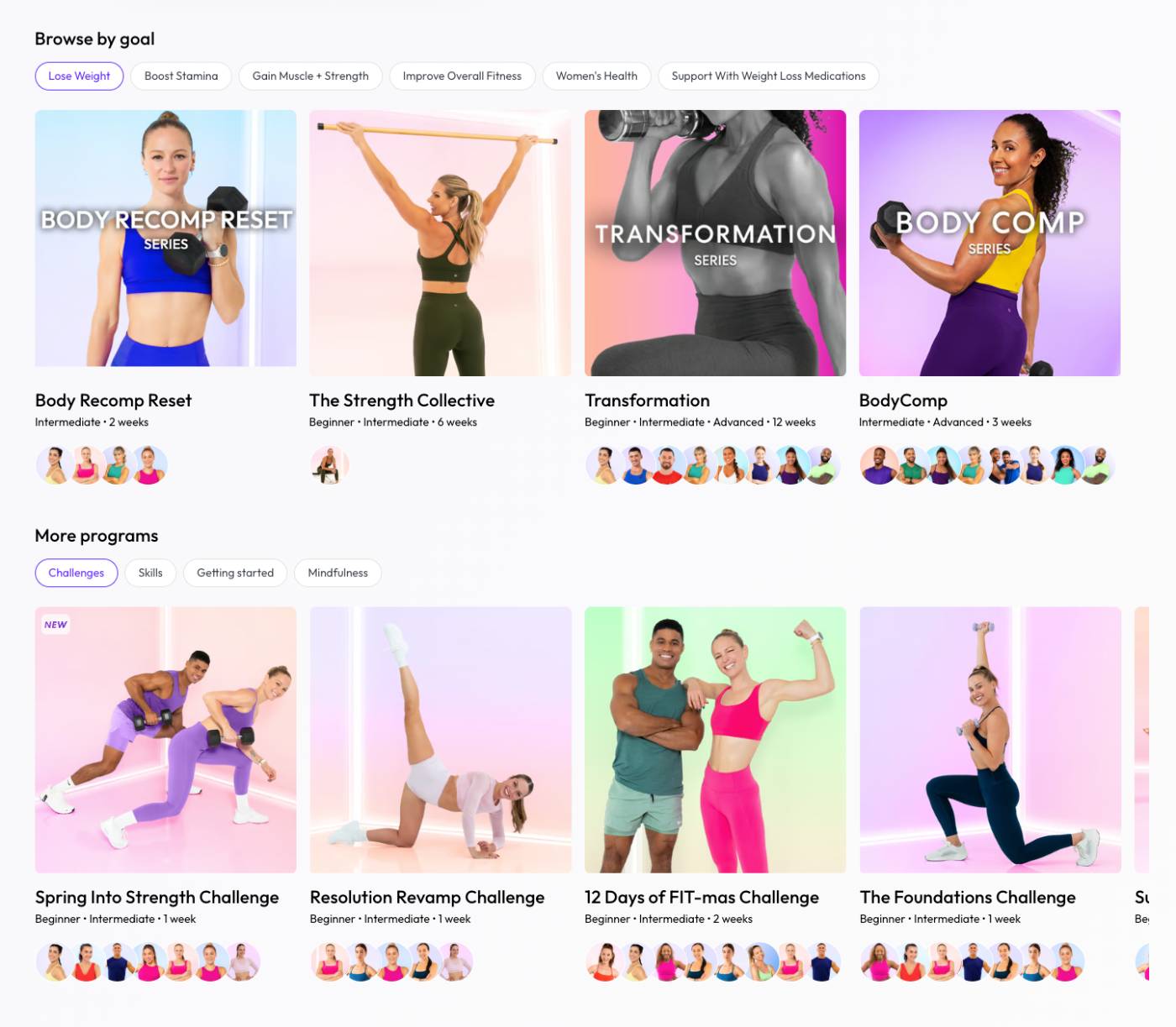
The Age Well Collection is the other piece worth knowing about. Designed for women in their 30s, 40s and beyond, it is structured as a progressive weekly series: three 45-minute classes pairing strength with yoga, plus one 20-minute Power conditioning session. Melody D.’s framing of this is sensible and aligns with the current evidence base. Strength supports bone density, metabolism and glucose regulation.[4] Yoga at the end of a heavier session down-regulates cortisol. Power work protects against the fast-twitch muscle fibre loss that accelerates in midlife.
For a woman who wants a single “just tell me what to do this week” structure for midlife, the Age Well Collection is a good pick. It is one of the cleaner mid-life training structures I have seen on a mass-market platform, and it benefits from being designed by someone who actually understands the physiology (Melody holds the Girls Gone Strong Women’s Health Coach certification and appears consistently on Obé’s expert content). I plan to come back to this collection more extensively in a separate post.
The 10-minute Stretch for Joint Pain with Kat S.
This class deserves its own section because it is the kind of short, specific programming that almost no platform builds properly, and because I tried it on a rest day after a full day of sitting, not as a post-workout cool-down, and it was exactly what my body needed. Gentle, short, specifically aimed at the joints that get cranky in perimenopause. This is the class I wish more platforms made: a ten-minute candid stretch for a body that sat too long, not a full yoga flow disguised as a recovery session.
With my meniscus history, a short targeted joint mobility session on non-training days is something I have been doing properly for a while, and finding a ready-made ten-minute version inside a platform I was already using felt like a genuine design win.
The evidence base on brief, intentional movement bouts (sometimes called “exercise snacks”) has grown considerably in the past two years; a systematic review and meta-analysis published in the British Journal of Sports Medicine found that short bursts of activity improve cardiorespiratory fitness and adherence compared with longer structured sessions in previously inactive adults.[5] The Obé 10-minute stretch is not technically an exercise snack, but the same principle applies: short, specific, repeatable sessions that fit into real life get done, and the ones that do not, do not.
Short Audio Courses and Nutrition
This is the part of Obé I did not expect to rate so highly. The audio courses are short, voice-only sessions you can listen to while walking or doing something else, and the ones I sampled on protein, nutrition for women and cognitive health were better than a lot of the longer-form content I have paid for elsewhere.
One example will make this concrete. I have always struggled to estimate how much protein I need in a day. Nutrition is a known weak point for me and something I am genuinely trying to improve. One short Obé course explained protein requirements for women in midlife and gave a simple estimation approach I now use when I prepare meals. I carry that knowledge into every kitchen decision, which is an outcome I cannot say for most fitness content I consume.
Protein needs for women in perimenopause are a well-established but under-communicated topic; Stanford’s Lifestyle Medicine team emphasises that protein and resistance training together are the intervention that matters most at this life stage, and that generic “eat less, move more” advice actively underserves women during menopause.[4]
What Obé does not offer: a prescriptive meal plan, food tracking, or calorie targets. If you want something that tells you what to eat, Obé is not that. What it offers is education, and for a woman trying to get better at feeding herself rather than being told what to eat, that is arguably the more useful format.
The meditation content deserves its own note. The sessions are short and longer, so everyone finds what they need: a few quick minutes when all you have is a few quick minutes, or half an hour when you want to properly drop in. This is not always the case on fitness platforms, where meditation is often an afterthought. On Obé it feels like it was designed by someone who actually meditates.
The wine classes
The two wine-themed sessions deserve a proper look, because they sit awkwardly on a “women’s wellness” platform and my reaction shifted as I thought about it. There is a Wine and Stretch class with Lulu S. that frames the drink as any drink of your choice, and a conversation between Spencer and the founder of Cupcake LightHearted, a low-calorie wine brand, which is clearly a paid partnership.
My first reaction was mild confusion: a wellness platform featuring wine? But sitting with it, I quite liked the candor of it. Women in midlife are told constantly to watch calories and alcohol, and a platform that acknowledges many of us enjoy a glass of wine without either sanctifying or demonising it felt more adult than the usual wellness script.
It is a paid promotion and disclosed by context rather than with a banner, which I would prefer to see more explicit, but I would rather a fitness app treat me as a grown woman who drinks occasionally than a patient to be managed. Your mileage will vary on this one.
Is Obé Good for Women Over 40?
This is the question the platform is most explicitly built to answer, because Obé markets itself as “fitness for women” rather than a unisex app with a women’s badge bolted on.
What it genuinely gets right for this age group
The platform’s energy and design are not a superficial detail, they are a feature. Women in perimenopause are constantly addressed in muted, apologetic language, and a platform that refuses that framing helps consistency in a real way. The perimenopause and menopause content is led by Melody D., who holds proper women’s health certifications rather than just “a trainer who reads about hormones.”
The six-week Menopause Program structure (four sessions weekly, mix of cardio, strength, mobility, mindfulness, education) matches the current evidence on exercise prescription through the menopause transition, which calls for a combination of endurance, strength and balance work.[7]
The class-length filter makes short sessions a first-class option rather than a watered-down alternative. This matters for adherence, which is the hardest part of the task at our life stage. The low-impact filter and the joint-aware cueing in strength classes make the platform genuinely usable for women with knee, back or joint concerns, which most of us have by our mid-40s.
The Age Well Collection and the cycle-synced class suggestions show that Obé has thought about the fact that a woman’s energy and recovery are not linear in perimenopause. Few platforms do this in a non-tokenistic way.
Where it has limits
If your primary goal is building significant muscle mass through heavy progressive overload, Obé’s strength library will take you part of the way but the loads are generally lower than a gym-based programme would use. This matters more than it sounds for perimenopausal women: the research on post-menopausal women specifically shows that hypertrophy gains require higher training volumes and intensities than the general recommendations,[2] and Obé’s strength classes are not designed to deliver that.
For women at my stage, where muscle mass retention is genuinely urgent, Obé works as a primary platform for maintenance (which was my goal) or as a supplement to heavier lifting (if your goal is hypertrophy).
The depth of menopause-specific clinical education is lighter than on specialist platforms. Pvolve has a University of Exeter clinical study behind its methodology, a clinical advisory board and a doctor-led component in its Menopause Strong programme.[3] Obé has a Women’s Health Coach-certified director of programming and sensible evidence-based framing, but it does not have the same clinical infrastructure. If you want the most medically-adjacent menopause programming in a streaming platform, Pvolve wins. If you want the most joyful, sustainable version that still takes your physiology seriously, Obé wins.
The summary
For a woman in her 40s or 50s who already trains, wants variety, responds to colour and energy, and whose goal is maintenance or modest progress rather than transformation, Obé is one of the best platforms on the market if you live in the US or Canada. It is not the deepest menopause-specific programming available, but it is the one most likely to keep you opening the app.
Is Obé Fitness safe if you have knee or back problems?
Yes, Obé Fitness is generally safe for women with knee or back problems, with caveats. The platform has an explicit low-impact filter across the whole library, and instructors cue knee and back positioning proactively in strength and Pilates classes. With my own previous meniscus injury, I used modifications on deep pliés and lower-body loading, and Natalie D. and Kat B. specifically cued knee safety during the classes I took. The dedicated 10-minute Stretch for Joint Pain class with Kat S. is a small but thoughtful addition for rest days.
That said, Obé is not physiotherapy-grade the way Pvolve’s dedicated knee stability series is. If you have an active injury or a recent surgery, start with the low-impact filter on, use the shorter classes, and check with a physio before doing high-impact options like Bounce or HIIT.
Is Obé Fitness good for building strength after 40?
Obé Fitness is good for maintaining strength and building foundational strength after 40, but not for maximum hypertrophy. I used dumbbells between 3 lb and 20 lb across my month of testing, and I maintained my weight and measurements exactly, which in perimenopause is a real outcome.[6] The strength programmes (Gym Strong, BodyComp, Strength + Sweat) use progressive structure with light to moderate loads.
However, the research on post-menopausal women shows that meaningful hypertrophy gains require higher training volumes and intensities than most general-audience strength classes provide.[2] If your goal is maintenance, general health and consistency, Obé’s strength training delivers. If your goal is building visible muscle mass or lifting heavy, supplement Obé with gym-based barbell work or consider a strength-specialist platform.
Is Obé Fitness for beginners or experienced exercisers?
Obé Fitness works for both beginners and experienced exercisers, but the Menopause Program specifically is pitched at beginners and returners. The broader library supports every level through the fitness level filter and the huge range of class types (from 5-minute stretches to 45-minute full-body strength). Experienced exercisers get variety, good instructor quality, and the filtering system that makes stacking or picking specific stimuli easy.
Beginners benefit from the Starter Pack programme, the quiz-driven personalised schedule, and the welcoming tone of the instructors. The one caveat is the Menopause Program: my mother in her late 60s (a Pilates and walking regular) loved it at her level; I, already training regularly, found it underchallenging within a week. Calibrate expectations by programme, not by the platform as a whole.
This is the perimenopause and menopause assessment, and it is separate from the overall score. Twelve things a programme either does for a midlife body or does not, each scored out of 10 with my reasoning next to it. Together they produce a single menopause fit score, and that becomes one of the nine categories in the overall scoring below.
How Obé Fitness Fits Perimenopause, Menopause & Beyond
Women Over 40 is our most important criterion, and here's the full breakdown behind it.
Obé Fitness is strongest for low-impact, mind-body support and beginner on-ramp, and weakest for pelvic floor and bone loading, in our menopause and midlife capability assessment for women over 40.
At a glance
| Capability | Score | Rating | Why |
|---|---|---|---|
| Right training for a midlife body | |||
| Low-impact | 8/10 | Strong | Explicit low-impact filter library-wide; joint-aware cueing. |
| Progressive strength | 5/10 | Some | Light-moderate loads; maintenance-oriented; plateaus for intermediates. |
| Bone loading | 4/10 | Minimal | Weight-bearing exists but loads too light for real osteogenic stimulus. |
| Recovery & deload | 7/10 | Strong | Strong recover pillar, mood-based rest; no true periodized deload. |
| Built for menopause | |||
| Menopause programming | 7/10 | Strong | Genuine 6-week Menopause Program + Age Well; underchallenging for trainers. |
| Pelvic floor | 2/10 | None | No dedicated pelvic-floor content. |
| Hormone awareness | 7/10 | Strong | Cycle tracking, cycle-synced suggestions, hormonal-health content. |
| Menopause education | 6/10 | Some | Short digestible talks + audio courses; lighter clinical depth. |
| Expert credibility | 6/10 | Some | Melody D. Girls Gone Strong Women's Health Coach; not clinical board. |
| Whole-woman support | |||
| Mind-body support | 8/10 | Strong | Strong meditation, breathwork, restorative yoga; joyful design. |
| Beginner on-ramp | 8/10 | Strong | Starter Pack, quiz schedule, welcoming; ideal for returners. |
| Midlife nutrition | 5/10 | Some | Education only (protein, women's nutrition audio); no meal plan. |
ScaleBest-in-classStrongSomeMinimalNone
What the sources say: All agree Menopause Program + Age Well are real and credentialled, but light on load/clinical depth vs Pvolve. No pelvic-floor; cycle-syncing science itself inconclusive.
These are evidence-informed suitability ratings, not clinical measurements. They combine exercise science with product-specific research and, where indicated, hands-on testing, alongside multi-source verification, and are approximate. Individual response varies. A starting point, not medical advice. How we score menopause fit
What the Research Actually Says
Because women over 40 are consistently sold fitness claims that are softer than the science, I want to be clear about what the current evidence supports for our age group. This matters for how you should read any platform’s menopause marketing, including Obé’s.
Resistance training is the most useful single intervention for body composition and strength in perimenopause. A 20-week controlled study on women aged 40 to 60 found that twice-weekly free-weight resistance training produced significant increases in squat and bench press 1-rep max across both pre- and post-menopausal groups, but hypertrophy responses differed markedly: pre-menopausal women saw measurable muscle mass increases, while post-menopausal women required higher volumes and intensities than the standard recommendations to produce the same composition change.[2]
Translation: lift weights, and in perimenopause and beyond, lift heavier than the general guidelines suggest.
Low-impact resistance training specifically benefits women aged 40 to 60. The University of Exeter’s randomised controlled trial on Pvolve (a platform I have also tested) compared its method against standard physical activity guidelines in 72 women aged 40 to 60, and found the resistance training group saw improvements in hip function, lower body strength, flexibility, balance and lean body mass across pre-, peri- and post-menopausal participants, suggesting the menopause transition does not limit the ability to benefit from appropriately-designed resistance training.[3]
This is a small study (n=72) funded by the platform it evaluated, which I want to be transparent about, but the finding that benefits extend across the transition is meaningful.
Weight maintenance is a valid success metric in perimenopause. A 2024 community-based prospective study of 2,760 perimenopausal women tracked nutritional status over one year and found statistically significant average increases in weight, fat mass and waist-hip ratio, alongside decreases in skeletal muscle mass and protein levels, even without intervention.[6] In other words, the default trajectory in perimenopause is gain fat, lose muscle. Holding your measurements steady through this period is an active intervention, not a lack of results.
Short, consistent sessions count. A 2025 systematic review and meta-analysis in the British Journal of Sports Medicine analysed 11 controlled trials covering 414 previously inactive adults and found that exercise snacks (brief bouts of five minutes or less, twice daily) improved cardiorespiratory fitness, with adherence rates of 83%, compared with 68% for longer moderate-intensity workouts and 63% for HIIT.[5] Obé’s short-class library and 5 to 10 minute stackables are aligned with this evidence, even if the platform does not position them in those terms.
Exercise recommendations through the menopausal transition. Published guidance from peer-reviewed exercise physiology literature recommends postmenopausal women combine endurance, strength and balance training, aiming for around 150 minutes of moderate activity per week alongside twice-weekly resistance sessions.[7] The NHS offers parallel guidance on strength and balance training for women over 40, emphasising the importance of consistency and low-impact options for joint longevity.[8]
Obé’s Menopause Program structure (four sessions weekly, mixing cardio, strength, mobility and mindfulness) matches this evidence reasonably well. The platform’s weakness, as I have said, is that the strength loading within that structure sits at the lower end of what the research suggests perimenopausal women need for meaningful hypertrophy. For maintenance and general health, the structure is appropriate. For visible body composition change at this life stage, you will likely need to supplement with heavier lifting.
Usability, Filtering and App Quality
The design is the thing that took me by surprise. I have covered the aesthetic above. The filtering, which is what actually makes the platform work day to day, I want to flag properly here. Note: users search both “Obé Fitness” and “obe fitness” without the accent, and the platform is the same product regardless of how you type it.
You can filter by class type, music style, duration, instructor, fitness level, class focus, body focus, impact level, equipment, release year and fitness goal. The filters stack, they load quickly (on iOS at least), and the categories are useful rather than vanity options. In a month of daily use I never opened Obé and failed to find exactly the class I wanted. That sounds small. Most platforms I have tested fail this test within a week.
A few usability caveats backed by consistent long-term user feedback:
- The Android app is materially behind iOS. Offline downloads are iOS-only. Android users frequently report stability issues in App Store and Google Play reviews. I tested on iOS and had a smooth experience; if you are on Android, take the free trial before committing to an annual plan.
- Casting to Apple TV is possible but inconsistent for some users. I did not have casting issues in my testing window.
- The app occasionally logs users out. It happened to me once in a month, enough to notice, not enough to frustrate.
- Themed classes (80s night, 90s pop) sometimes play with different music in on-demand replays due to music licensing. Across the industry, not unique to Obé.
Obé Equipment: Our Picks
Obé is deliberately low-friction. A large share of the library, cardio, dance, mobility and mindfulness, is pure bodyweight, and the rest needs only light kit. Across the sculpt, barre and strength classes I used light dumbbells (roughly 3 to 20 lb depending on the class), plus resistance loops, ankle weights and a mat I already owned, I never bought any Obé-branded equipment. If you’re starting from nothing, this is the whole list.
Exercise Mat
For barre, sculpt, Pilates and floor work; the one thing most classes use
$20 to $40
Light Dumbbells (3 to 20 lb)
Sculpt and strength classes, mostly light for high-rep toning; A light adjustable pair covers every class
~$65 to $80
Resistance Loops
Used in many sculpt and lower-body sessions; optional
~$15 to $25
Ankle Weights
For lower-body and Pilates-style work; optional
~$10 to $20
Bodyweight
A large part of the library, cardio, dance, mobility, mindfulness, needs no kit at all; no equipment needed
Free
A quick heads-up: some of the buy links above are Amazon affiliate links, so if you grab something through them I may earn a small commission, at no extra cost to you. I only ever point you to kit I’d happily use myself.
Obé Fitness specifications
- Free trial
- 7 days, or 30 days via a Guest Pass referral
- Cancellation
- cancel anytime; no refunds, access to period end
- Session length
- 5 to 60 min
- Who makes it
- obé (founders Mark Mullett + Ashley Mills, 2018); now published under Dear Media LLC; programming director Melody Davi (NASM), no clinician
- Still maintained
- Active; iOS v3.85.0 (2026-05-11)
- What is included
- On-demand classes: yesLive classes: yesRecovery content: yesMenopause education: partlyStructured programmes: yesMeditation: yesNutrition guidance: partly
- Women over 40
- Pelvic floor work: noMenopause clinician involved: noInjury modifications: partlyBone-health focus: partlyModified progressions: partlyCycle syncing: partlyPrenatal options: yes
- Devices and access
- Offline downloads: yesCasting to TV: yesSubtitles: noWearable sync: partly
- Support
- Clinical advisory board: noCommunity: yesSupplement upsell: no
- Last verified
- 12 August 2026
Pricing and Cancellation
Obé Fitness (or “obe fitness” if you are searching without the accent) streaming costs $24.99 per month or $169.99 per year (approximately $14.17 per month) in the United States, with a 7-day free trial. A credit card is required to start the trial. Obé is HSA/FSA eligible via Truemed in the US.
| Option | Price | Includes |
|---|---|---|
| Monthly (US/Canada) | $24.99/month | Full on-demand library (16,000+ classes), programmes, audio courses, cycle tracking, mood-based suggestions, TV and mobile apps |
| Annual (US/Canada) | $169.99/year (~$14.17/month) | As above, with significant saving over monthly |
| Personal Training add-on | Additional cost | One-to-one coaching with matched Obé trainer |
| Free trial | 7 days | Full library access; card required; cancel before end of trial to avoid charge |
Obé is not officially available in the UK or Europe. Residents outside the US and Canada can sign up if they have a US or Canadian credit card, but you are working around a geographic restriction rather than using a supported product. I tested via a friend’s US account. Frankly, this is one of my bigger frustrations with Obé: it is genuinely good, and I feel like women in other parts of the world are losing out on something they would enjoy. For UK and European readers, Alo Moves, Pvolve and Apple Fitness+ are fully supported alternatives.
A serious note on cancellation
This is the one area where I need to pass on user feedback directly, because it is consistent across Trustpilot, the Apple App Store and Highya and it is serious.[9] Multiple long-term users report that cancelling an Obé subscription is harder than it should be, with recurring complaints about being charged after cancelling, sometimes months later. Obé’s official documentation confirms that cancellation is done through your account settings on obefitness.com (not accessible in-app), and if you signed up via the Apple App Store or Google Play you must cancel through those stores directly.
My advice: if you subscribe, set a calendar reminder for a few days before any renewal date, cancel through the original sign-up channel, and check your bank statement the following month. This is sensible for any subscription and particularly worth saying for Obé given the pattern of complaints.
Will You Actually Stick With It?
Obé Fitness Weighted Scoring: How the 7.5/10 Was Calculated
Scoring methodology is here. Every score below pulls from the central HerDailyFit scoring system via shortcode, so updates to individual category scores or the weighted total appear everywhere automatically.
| Category | Weight | Score | Reasoning |
|---|---|---|---|
| Time Efficiency | 15% | 10 | The strongest scoring category and a core reason the platform works for women in midlife. Signature 28-minute classes with warm-up and cooldown baked in, a deep library of 5 to 10 minute stackables, and audio-only options. One of the best time-efficiency models I have tested across close to 50 platforms. |
| UX and Design | 8% | 9.5 | One of the best filtering systems I have tested: class type, length, instructor, body focus, impact, equipment, fitness goal, all filterable and fast. Design genuinely lifts mood. iOS experience is polished. Android app is materially behind (no offline downloads, frequent stability complaints). |
| Recovery Compatibility | 10% | 9 | Dedicated Activate/Recover pillar with meditation, breathwork and mood-based suggestions. Short and longer meditations so everyone finds what they need. 10-minute Stretch for Joint Pain with Kat S. is a small but thoughtful rest-day addition. Strong for a perimenopausal nervous system. |
| Joint Friendliness | 12% | 8 | Explicit low-impact filter across the whole library. Knee-aware cueing from Natalie D. and Kat B. during strength and barre classes. With my meniscus history I modified where needed and never felt unsafe. Not as rigorously joint-safe by design as Pvolve’s dedicated stability work. |
| Women Over 40 Specificity | 10% | 6 | Genuine menopause programming via the six-week Menopause Program and Age Well Collection, led by Melody D. (Girls Gone Strong Women’s Health Coach). Aesthetic and default content skew younger. Menopause depth is lighter than Pvolve’s clinical Menopause Strong, but the programming is credentialled and evidence-aligned. |
| Programme Structure | 12% | 7 | Plenty of programmes (Menopause Program, Age Well, BodyComp, Gym Strong, Strength Basics) plus a quiz-driven personalised two-week schedule. Intensity plateau comes quickly for intermediates. No long-term progress tracking beyond class completion. |
| Value for Money | 8% | 7 | $169.99 per year is fair; $24.99 per month is pricey compared to Apple Fitness+ ($9.99) and Peloton App+ ($13.99). 7-day free trial is short. Loss of live classes (2024) and cancellation friction reported across Trustpilot pull the score down. HSA/FSA eligible in the US via Truemed. |
| Muscle Potential | 18% | 6.5 | The weakness of the platform. Strength classes use light to moderate loads (I used 3 lb to 20 lb dumbbells) and are designed for maintenance, not serious progressive overload. Research on post-menopausal women shows hypertrophy requires higher volumes than general-audience classes deliver.[2] Supplement with heavier lifting if muscle mass is the goal. |
| Total | 7.5 / 10 | ||
Final Weighted Score
7.5 / 10
One of the most enjoyable fitness platforms tested for women in perimenopause: outstanding filtering, signature 28-minute classes, and a design language that lifts mood. Softer on heavy progressive strength and US/Canada only.
Obé Fitness Pros and Cons
Pros
- Design and energy lift mood; the platform I most looked forward to opening out of close to 50 tested
- Filtering system is one of the best I have used: class type, length, instructor, body focus, impact, equipment, fitness goal all filterable and fast
- Signature 28-minute class length plus plentiful 5 to 10 minute stackables, backed by evidence that short sessions improve adherence[5]
- Instructor quality is high across the board: Natalie D. and Olivia T. for strength, Kat B. for barre and sculpt, Melody D. for menopause and women’s health, Kat S. for stretch and mobility
- Menopause Program and Age Well Collection both led by credentialled experts and structurally aligned with current evidence[4]
- Joint-aware cueing in strength classes with explicit knee and back positioning notes; dedicated 10-minute Stretch for Joint Pain class useful on rest days
- Short audio courses on protein, nutrition for women and cognitive health are underrated and better than a lot of paid longer-form content
- Cycle syncing and mood-based class suggestions address non-linear energy in perimenopause
- Candid, non-puritanical approach to food and drink; no toxic diet culture language
- Annual price at ~$14.17/month fair for library size and production quality; HSA/FSA eligible
- iOS app polished; TV app works well for casting
- I maintained weight and measurements across a month of daily testing in my 40s in perimenopause, which is a real outcome against the baseline body composition trajectory in this life stage[6]
Cons
- Only available in the US and Canada; UK and European women locked out without workarounds
- Live classes discontinued in 2024; if scheduled live classes are important to you, Obé is no longer that product
- Menopause Program well-produced but not challenging enough for women who already train regularly; better fit for beginners or returners
- Strength training not designed for progressive overload with the loads research suggests perimenopausal women need for meaningful hypertrophy[2]
- Cancellation reported as difficult across user review aggregators, with post-cancellation billing complaints a recurring theme; cancel through original sign-up channel and monitor statements
- Android app materially behind iOS; offline download iOS-only; Android stability issues reported
- Monthly pricing at $24.99 is higher than Apple Fitness+ and several competitors; annual is better value
- Obé’s privacy policy permits sharing user data including cycle tracking information where legally required, which is worth knowing given the post-Roe landscape in the United States
- No prescriptive nutrition plan or meal guidance; education only (which I happen to prefer, but some readers will want more structure)
How Obé Compares to Similar Platforms
If you are deciding between women’s fitness platforms, here is how Obé Fitness (often spelled “obe fitness” without the accent in searches) sits against the four most likely alternatives. All scores are from personal testing on this site against the same weighted criteria.
| Feature | Obé | Pvolve | Alo Moves | Apple Fitness+ | Peloton App |
|---|---|---|---|---|---|
| Our score | 7.5 / 10 | 8.3 / 10 | 7.7 / 10 | 6.9 / 10 | 7.3 / 10 |
| Monthly price | $24.99/mo · $169.99/yr | $19.99/mo · $179.99/yr · equipment from $199 | $20/mo · $199/yr | $9.99/mo · $79.99/yr | $12.99/mo (App One) · $129/yr |
| Free trial | 7 days (card required) | 14 days | 14 days | 3 months with eligible Apple device | 30 days |
| Best for | Variety, joyful energy, short stackable sessions | Low-impact functional strength, deepest menopause programming | Yoga, Pilates, outdoor/natural aesthetic | Apple ecosystem users wanting low-cost variety | Progressive strength, cycling, running |
| Class library size | 16,000+ on-demand | 1,600+ on-demand | 3,000+ on-demand | 4,000+ on-demand | 30,000+ across disciplines |
| Session length | 5 to 60+ min; 28 min signature | 5 to 60+ min; 20 min common | 5 to 90 min; varied | 5 to 45 min | 5 to 90+ min |
| Low-impact filter | Yes, explicit | Low-impact by design throughout | Yes | Yes | Limited |
| Injury modifications | Cued verbally; inconsistent on-screen | Dedicated injury support series (knees, back, hips, shoulders) | Varies by class | Consistently shown on-screen | Varies |
| Perimenopause content | Menopause Program, Age Well Collection, cycle syncing, audio courses | Best in class: Menopause Strong, pelvic floor, endometriosis, clinical study | Limited | Limited | Limited |
| Progressive strength | Moderate (Gym Strong, BodyComp) | Moderate, joint-safe | Weak | Moderate | Strong |
| Coaching style | High-energy, warm, verbal throughout | Verbal throughout; demos alongside you | Calm, studio-style | Encouraging, professional | Performance-focused |
| Live classes | Discontinued 2024 (on-demand only) | Yes, live virtual studio | No | No | Yes |
| Nutrition included | Education only, no meal plan | Education + Sculpt 9 supplement (US) | None | Some mindfulness and meditation, no nutrition | None directly |
| Available in UK/Europe | No (US/Canada only) | Yes | Yes | Yes | Yes |
| Best suited to women aged | 35 to 55 wanting variety and joy | 35 to 65, perimenopause, joint issues | 30 to 55, yoga/Pilates focus | All ages in Apple ecosystem | 30 to 50, progressive strength/cardio focus |
Competitor prices approximate; verify on each platform’s website. Scores reflect our independent reviews, see each full review for methodology.
Obé vs Pvolve: Which Is Better for Women Over 40?
These two platforms are probably the most direct comparison for my audience, and the distinction is worth drawing out. Pvolve is the most clinically-grounded perimenopause-aware platform I have tested: a University of Exeter study behind its methodology,[3] a clinical advisory board of OB/GYNs and physical therapists, a doctor-led Menopause Strong programme, dedicated series for pelvic floor health and endometriosis, and a low-impact method designed around joint safety.
The learning curve is genuine; the movement vocabulary takes two weeks to absorb. Once it clicks, the stimulus is different from anything else in this space.
Obé is the most joyful, varied and sustainable fitness platform I have tested, with one of the best filtering systems across close to 50 platforms and a design language that lifts mood. The Menopause Program is well-produced and evidence-aligned, but it is lighter on clinical depth and less challenging for women already training regularly.
The verdict: if you want the deepest possible menopause-specific programming with clinical backing and you are willing to invest two weeks learning a new movement method, Pvolve is the stronger choice. If you want variety, joy, outstanding filtering, and a platform that makes it easy to train almost every day across a huge range of class types, Obé is the stronger choice, provided you live in the US or Canada.
I have tested both. Right now I would keep both subscriptions if I could only sign up for Obé legitimately, which I cannot, so Pvolve is my primary. If I lived in the US, I would run both in parallel: Pvolve for menopause-specific programming and joint work, Obé for everything else.
Obé Fitness FAQ
Obé Fitness (pronounced “oh-bay,” short for “Our Body Electric”) is a women-focused fitness streaming platform founded in 2018 by Ashley Mills and Mark Mullett. It offers 16,000+ on-demand classes across more than 20 class types (strength, Pilates, barre, HIIT, dance cardio, yoga, meditation, bounce and more), filmed in a signature neon-lit Brooklyn studio called “the Box.” Live classes were discontinued in 2024; the platform is now strictly on-demand, with new classes added daily. Obé is available in the United States and Canada only.
Yes, with caveats. Obé has dedicated content for women over 40 including a six-week Menopause Program and an Age Well Collection, both overseen by Melody D., Obé’s director of programming and a certified Women’s Health Coach. The content is well-produced and the platform’s energy is motivating. However, for women who already train regularly, the Menopause Program is not consistently challenging enough; it is a better fit for beginners or returners. For deeper menopause-specific programming with clinical backing, Pvolve’s Menopause Strong goes further.
Obé costs $24.99 per month or $169.99 per year (approximately $14.17 per month) in the United States and Canada, with a 7-day free trial. A credit card is required to start the trial. Obé is HSA/FSA eligible in the US via Truemed.
No, not officially. Obé is only available to residents of the United States and Canada, and a US or Canadian credit card is required to sign up. UK and European women have better, fully supported alternatives in Alo Moves, Pvolve and Apple Fitness+.
No. Obé discontinued live classes in 2024 and now operates as an on-demand platform only. New classes are released daily via a published “class drop schedule.” The library sits at 16,000+ classes according to Obé’s own FAQ.
It is good for building foundational strength and maintaining muscle in midlife through programmes like Gym Strong and BodyComp. It is not designed for serious progressive overload with heavier weights the way a gym-based programme would be. Research on resistance training in middle-aged women shows that post-menopausal women specifically need higher training volumes and intensities than general recommendations for meaningful hypertrophy, and Obé’s strength classes sit at the lower end of that range. For maintenance: yes. For building significant muscle mass: supplement with heavier lifting.
The six-week Menopause Program is well-produced and motivating, led by Melody D. (director of programming, Girls Gone Strong Women’s Health Coach), with classes from Kat B., Olivia T. and Alex across the weeks. Structure is four sessions weekly, sessions from 5 to 45 minutes, combining cardio, strength, mobility, mindfulness and short educational talks on stress, sleep, metabolic change and nutrition. In testing, the program was a strong fit for beginners and returners but underchallenging for women already training regularly.
User reviews across Trustpilot, the Apple App Store and other aggregators consistently report cancellation friction, including cases of being charged after cancelling. Obé requires cancellation through your original sign-up channel: obefitness.com account settings for web sign-ups, the App Store or Google Play for app sign-ups. Cancellation is not accessible within the Obé app itself. Set a calendar reminder before any renewal date and check your bank statement the following month.
Yes, but the Android app is materially behind iOS. Offline downloads are iOS-only, and Android users frequently report stability issues in App Store and Google Play reviews. If you are on Android, take the 7-day free trial before committing to an annual subscription.
Yes, Obé Fitness is worth it in 2026 if you live in the US or Canada, want variety and short workouts, and value a platform that lifts mood. After a month of daily testing, Obé scored 7.95/10, with outstanding filtering, a well-produced Menopause Program and Age Well Collection led by Melody D., and one of the strongest short-class libraries tested. It is not worth it for women whose primary goal is heavy progressive strength training (Pvolve goes further on clinical menopause depth), or for anyone outside the US and Canada without a US or Canadian credit card.
Final Verdict
One month of daily testing, using a friend’s US account. Dumbbells between 3 lb and 20 lb depending on class type, resistance loops and ankle weights I already owned, no Obé-branded equipment. I came in already-warm from other platforms (Alo Moves, Pvolve, Apple Fitness+), not as a beginner. I am in my 40s and navigating perimenopause.
What I found: Obé is one of the most enjoyable fitness platforms I have tested in years. The filtering is one of the best I have used across close to 50 platforms. The signature 28-minute class length and the shorter stackables are aligned with the current evidence on adherence and short-bout effectiveness.[5]
The instructor quality is high across the board. The Menopause Program and Age Well Collection are well-produced and led by properly credentialled experts. My weight and measurements stayed exactly where I wanted them across the month, which against the default body composition trajectory in perimenopause is a success in itself.[6]
Obé is for women in their 40s and 50s, living in the US or Canada, who already train regularly, want variety in 20 to 30 minute sessions, and want a platform that takes their physiology seriously while also being genuinely fun to press play on. Obé is not for women whose primary goal is heavy progressive strength training, women who want the most clinically-grounded menopause programming (Pvolve wins that), or anyone outside the US and Canada without a US or Canadian credit card.
The neon colour is not a gimmick. It is a design choice that matters more than it should, at a life stage when a lot of the information you encounter about your body is framed in the language of decline.
Score: 7.5 / 10
Sources and Further Reading
- Obé Fitness official FAQ, covering membership, class library size (16,000+), class types, cancellation policy and availability. Verified April 2026.
- Kappenstein, J. et al. (2023). “Resistance training alters body composition in middle-aged women depending on menopause: a 20-week controlled trial.” BMC Women’s Health. A 20-week intervention on 41 women aged 40 to 60 showing free-weight resistance training significantly increased 1-RM squat and bench press across both pre- and post-menopausal groups, but with hypertrophy responses exclusive to pre-menopausal women at standard recommendations. Post-menopausal women required higher training volumes (>6 to 8 sets/muscle/week) for the same composition change.
- University of Exeter (2025). “First-of-its-kind study shows resistance training can improve physical function during menopause.” Published in Medicine & Science in Sports & Exercise. RCT of 72 women aged 40 to 60 (pre-, peri- and post-menopausal, not on HRT), comparing 12 weeks of Pvolve resistance training against standard physical activity guidelines. Findings: significant improvements in lower body strength, flexibility, balance and lean mass across all groups.
- Stanford Lifestyle Medicine (2023). “Strength Training During Perimenopause.” Team-authored guidance article quoting exercise physiologist Stacy Sims PhD, MSc: “Breaking the stigma that women need to prioritise long, endurance exercises and exclusively body weight work because they offer little benefits for body composition or lean mass during this time. Instead, lifting heavy (whatever that means to you) will help most during this transitional period.”
- Rodríguez, M.Á. et al. (2025). “Effect of exercise snacks on fitness and cardiometabolic health in physically inactive individuals: systematic review and meta-analysis.” British Journal of Sports Medicine. Review of 11 RCTs covering 414 participants (69% women), finding short bursts of activity (5 minutes or less, twice daily) improved cardiorespiratory fitness with 83% adherence, compared with 68% for longer moderate-intensity workouts and 63% for HIIT.
- Wang, Y. et al. (2024). “One-year trajectories of nutritional status in perimenopausal women: a community-based multi-centered prospective study.” A community-based observational study of 2,760 perimenopausal women tracked over three six-month intervals, finding statistically significant increases in weight, fat mass and waist-hip ratio, alongside decreases in skeletal muscle, protein level and total body water without intervention.
- Mishra, N. et al. “Exercise beyond menopause: Dos and Don’ts.” Journal of Mid-life Health. Peer-reviewed guidance on exercise prescription through and after the menopause transition, emphasising combined endurance, strength and balance training totalling around 150 minutes of moderate activity weekly, alongside twice-weekly resistance sessions.
- NHS. “Exercise as you get older.” Official NHS guidance on strength and balance training for adults over 40, emphasising consistency and low-impact options for joint longevity.
- Obé Fitness customer reviews on Trustpilot. User review aggregator consulted April 2026 for patterns around cancellation experience, post-cancellation billing complaints, and long-term user sentiment. Referenced for the cancellation friction warning in this review.
Related Guides
What To Do Next
Not sure Obé is the right platform for you?
- → Take our 2-minute quiz for a personalised recommendation.
- → See our best workouts for perimenopause rankings.
- → Compare with our Pvolve review (the deepest menopause programming tested).
- → See how we score every programme using 8 weighted criteria.