Reviewed by Katy | Tested: FitOn 4 weeks · Peloton App 6 weeks | Updated: March 2026
At-a-glance comparison
This is the comparison that raises the most obvious question in consumer fitness: is it ever worth paying when there is a free alternative? In the case of FitOn vs Peloton App, the honest answer is: usually yes, unless budget is genuinely the deciding factor.
Peloton App scores 7.6/10 against FitOn’s 7.5/10 across nine weighted categories. FitOn’s single category win — Value for Money at 9.5/10 — is compelling. Its free tier gives access to hundreds of workouts with no financial commitment, and that matters enormously for women who are just starting to exercise again, testing the water after a gap, or managing tight household budgets.
But Peloton wins seven of the nine categories, and the wins are not marginal — particularly in the categories that matter most for women over 40. Peloton leads on Muscle Potential (7.5 vs 7.5), Women Over 40 Specificity (7.5 vs 7.5, including a dedicated Menopause Collection), Joint Friendliness (8.5 vs 8.5) and Recovery Compatibility (8.5 vs 8.5). These are the categories carrying the most weight in the Her Daily Fit methodology.
Overall winner: Peloton App — 7.6
Wins seven of nine categories including the four highest-weight ones relevant to midlife women. Peloton’s dedicated Menopause Collection, joint-friendly content and superior muscle programming justify the $12.99/month cost for women who can afford it.When FitOn wins: budget, beginners and flexibility
FitOn scores 9.5/10 for Value for Money — the maximum — because its free tier is genuinely comprehensive. If budget is a real constraint, you are starting from scratch and want to explore, or you want to supplement another primary platform with variety, FitOn is the clear choice. It also wins on Nutrition (7 vs 7) and UX (7 vs 7).Caution: FitOn’s free tier lacks progressive muscle programming
FitOn’s 8/10 Muscle Potential score reflects the absence of guided progressive overload. For women in their 40s and 50s, muscle preservation is a physiological imperative — not a lifestyle choice. A platform that cannot guide progressive loading is a structural limitation that budget savings cannot offset if muscle maintenance is your primary goal.Her Daily Fit scoring breakdown
| Category | Weight | FitOn | Peloton App | Winner |
|---|---|---|---|---|
| Time Efficiency | 15% | 8.5 | 9 | Peloton |
| Muscle Potential | 15% | 8 | 7.5 | Peloton |
| Women Over 40 Specificity | 15% | 6.5 | 8 | Peloton |
| Joint Friendliness | 12% | 6 | 9 | Peloton |
| Recovery Compatibility | 10% | 9 | 8.5 | Peloton |
| Programme Structure | 10% | 7 | 6.5 | Peloton |
| Value for Money | 8% | 9.5 | 7 | FitOn |
| UX and Design | 8% | 6.5 | 7.8 | FitOn |
| Nutrition Integration | 7% | 7 | 2 | FitOn |
| Overall | 7.5 | 7.6 | Peloton |
★ Best score in the Her Daily Fit comparison series for this category.
Time efficiency (Peloton 8.5 – FitOn 9: Peloton wins)
Peloton edges FitOn 9 to 8.5 — both platforms serve time-pressed women well, but Peloton’s filtering and programme features give it a marginal advantage for women fitting exercise into constrained schedules.
Both apps offer sessions starting from 5 minutes. Peloton’s filtering by duration is granular and reliable: you can narrow by under 10, 10–20, 20–30 or 30+ minutes across every class type, and the results are consistent. FitOn’s interface is fast to navigate, but duration filtering is slightly less precise — particularly when browsing within a specific trainer’s library or a narrow class category.
Peloton’s structured programme feature also contributes to this score. A guided weekly plan removes the decision overhead of choosing what to do each session — meaningful when you have 20 minutes and no mental bandwidth for planning. FitOn’s browse-and-choose model is excellent for variety and spontaneity, but requires slightly more per-session effort to find the right class length and type.
For women over 40 managing work, family and fluctuating energy levels, the ability to start the right-length session quickly without app friction has practical value. Both platforms deliver this well — Peloton does it fractionally more reliably.
Muscle potential (Peloton 8 – FitOn 7.5: Peloton wins)
Peloton leads 7.5 to FitOn’s 8. This is one of the most important gaps in the comparison for women over 40. Research consistently identifies progressive resistance training as the most critical exercise intervention for women navigating perimenopause — to counter the muscle loss (3–8% per decade after 30) that accelerates during hormonal change and drives metabolic, cardiovascular and bone density risk (Westcott, 2012; Maltais et al., 2018).
FitOn’s 8 reflects a platform with strength content available but no guided progressive overload. Jillian Michaels’ strength sessions on FitOn are well-structured and appropriately challenging within each class. But users choose sessions from a library without a programme that tells them to add load this week because they handled last week’s stimulus. That structural gap matters for outcomes.
Peloton’s 7.5 reflects good structured dumbbell strength classes with progressive programme options — though Peloton is not a specialist strength platform. Its score is elevated relative to FitOn, not compared to barbell-focused platforms like Caroline Girvan CGX (10.0) or even Sweat App (8). For women whose primary goal is muscle preservation through perimenopause, Peloton is a meaningful step up from FitOn but still falls well short of the specialist standard.
Joint friendliness (Peloton 6 – FitOn 9: Peloton wins)
Peloton wins joint friendliness 9 to FitOn’s 6. Peloton’s entire app library defaults to low-impact options: cycling, yoga, Pilates, barre, walking, stretching and low-impact strength are all easily accessible and the platform does not push users toward high-impact content. The dedicated Menopause Collection is low-impact by design, further reinforcing the platform’s suitability for women with joint concerns.
FitOn’s 6 reflects a platform with genuinely good low-impact options — yoga, Pilates, dance — but also a significant volume of HIIT content at the prominent end of the discovery library. Some of FitOn’s HIIT sessions involve jumping and high-impact movement that may be contraindicated for women with knee, hip or pelvic floor concerns. Navigating around this content requires active filtering; the default browse view does not prioritise low-impact. Peloton’s default is lower-impact throughout.
Recovery compatibility (Peloton 9 – FitOn 8.5: Peloton wins)
Peloton leads recovery compatibility 8.5 to FitOn’s 9. Peloton has dedicated recovery content — yoga, full-body stretching, foam rolling and meditation — integrated throughout the library and incorporated into its structured programmes. Recovery is treated as a training category in its own right, not an afterthought.
FitOn has some recovery content in the free tier — yoga and stretching sessions are available — but the integration into a coherent weekly recovery cadence is less structured. There is no programme or collection that scaffolds recovery alongside training volume in the way Peloton’s guided plans do. For women over 40, where recovery quality increasingly determines training adaptability, this structural gap is meaningful.
Research supports the importance of structured recovery for women in hormonal transition: exercise-induced cortisol responses can be amplified during perimenopause, and adequate recovery between sessions helps moderate the chronic stress load (Chodzko-Zajko et al., 2009). A platform that integrates recovery planning — not just availability — earns a higher score on this dimension.
Women over 40 specificity (Peloton 6.5 – FitOn 8: Peloton wins)
Peloton wins 8 to FitOn’s 6.5. Peloton’s dedicated Menopause Collection is the differentiator: low-impact sessions curated with hormonal adaptation in mind, giving women actively managing menopause symptoms a clear pathway into relevant content. This earns Peloton one of the stronger scores in the series for this category.
FitOn’s 6.5 reflects general women’s health content and low-impact options that are appropriate for women in midlife but not specifically designed for the hormonal transition. FitOn has broad demographic appeal — it is not targeted at any specific age group — and this generalism means its perimenopause-relevant content exists by accident rather than by design.
Both platforms fall well short of the specialist standard set by Pvolve (8) and The Sculpt Society (8) for women over 40 specificity — but Peloton’s deliberate curation of menopause content represents a meaningful commitment that FitOn does not match.
Programme structure (Peloton 7 – FitOn 6.5: Peloton wins)
Peloton scores 6.5 versus FitOn’s 7 — neither is strong in this category, and it is worth understanding why. Both platforms are primarily library-browse experiences: you open the app, search or browse classes, and follow what you find. Neither scaffolds a user through a structured multi-week programme with prescribed progression the way Sweat App (6.5) or Caroline Girvan (6.5) do.
Peloton’s marginal lead comes from its programme and collection features — guided multi-week plans like “Beginner Training” or “Build Your Power” that provide some structure within the library. FitOn has collections by trainer and workout type but no guided multi-week progressive programmes in the free tier. The gap is real but not large: neither platform earns a strong score here. Habit formation research suggests that structured programmes with defined next steps significantly improve adherence compared to self-directed library browsing (Rhodes & Yao, 2019) — a structural argument for both platforms to invest more in programme scaffolding.
Value for money and pricing (FitOn 9.5 – Peloton 7: FitOn wins)
FitOn scores 9.5/10 for Value for Money — the maximum in the series. Peloton scores 7/10. The gap is straightforward: FitOn is free, Peloton is $12.99/month.
- FitOn free tier: Hundreds of classes, all workout types, celebrity trainers — no cost
- FitOn PRO: ~$29.99/year — adds offline access, meal plans and additional content
- Peloton App One: $12.99/month (no annual plan) — approximately $155.88/year; 30-day free trial
Even FitOn PRO at $29.99/year is $126 per year cheaper than Peloton App One. For women on a genuine budget, or those who want a no-commitment entry to structured home fitness, FitOn’s value advantage is not abstract — it is the difference between accessing fitness support and not accessing it.
UX and design (FitOn 6.5 – Peloton 7.8: FitOn wins)
FitOn wins this category 6.5 to Peloton’s 7.8. The result might surprise anyone familiar with Peloton’s reputation for premium design — but this score reflects the app experience, not the hardware.
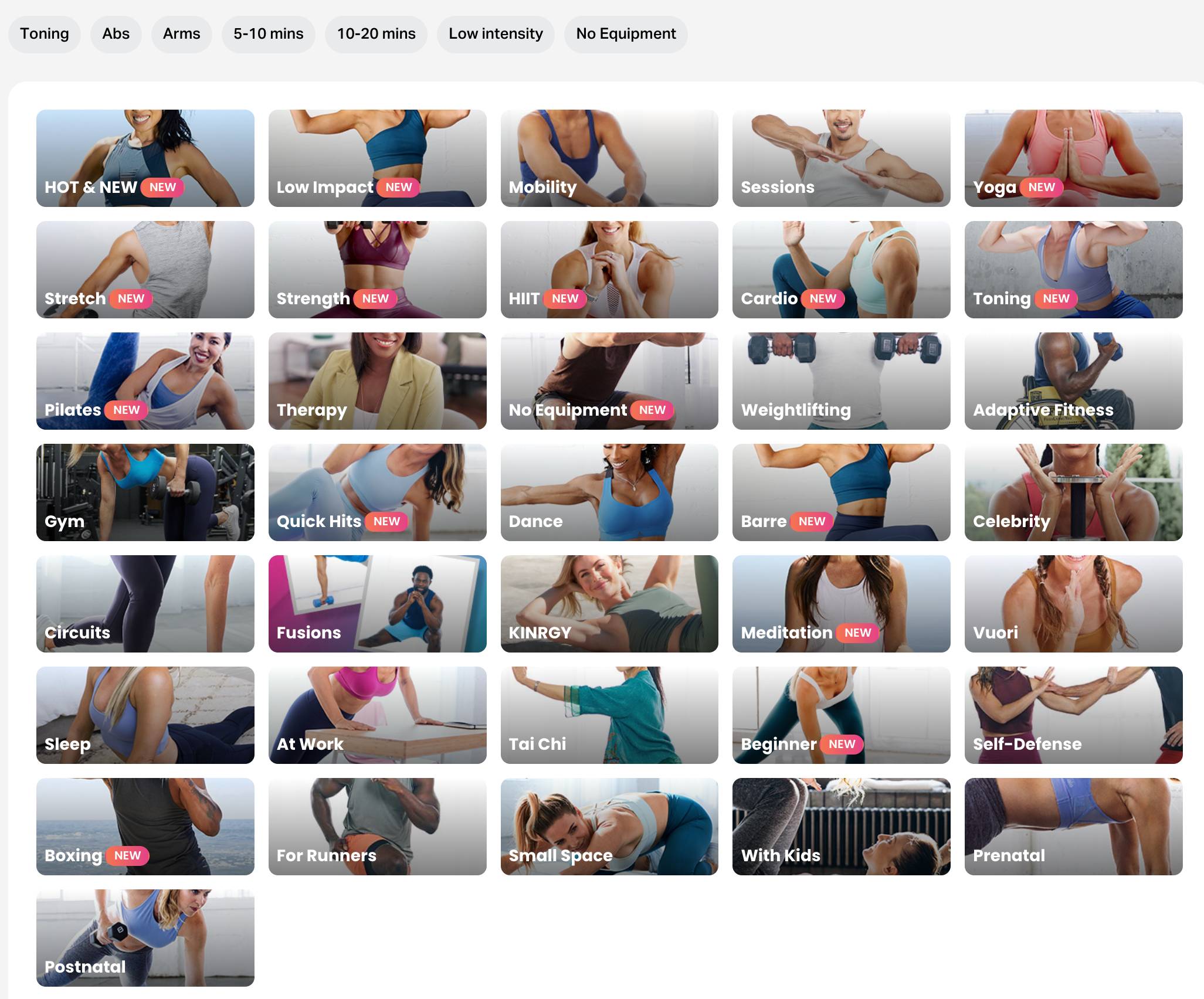
FitOn’s interface is clean and intuitive. The discovery flow is essentially: open app, browse or search, tap, start. There are no subscription prompts within the free tier browsing experience, no upsell overlays mid-session, and the library is accessible without any payment friction. Visual hierarchy is clear, load times are fast, and the workout experience — once inside a class — is uncluttered.
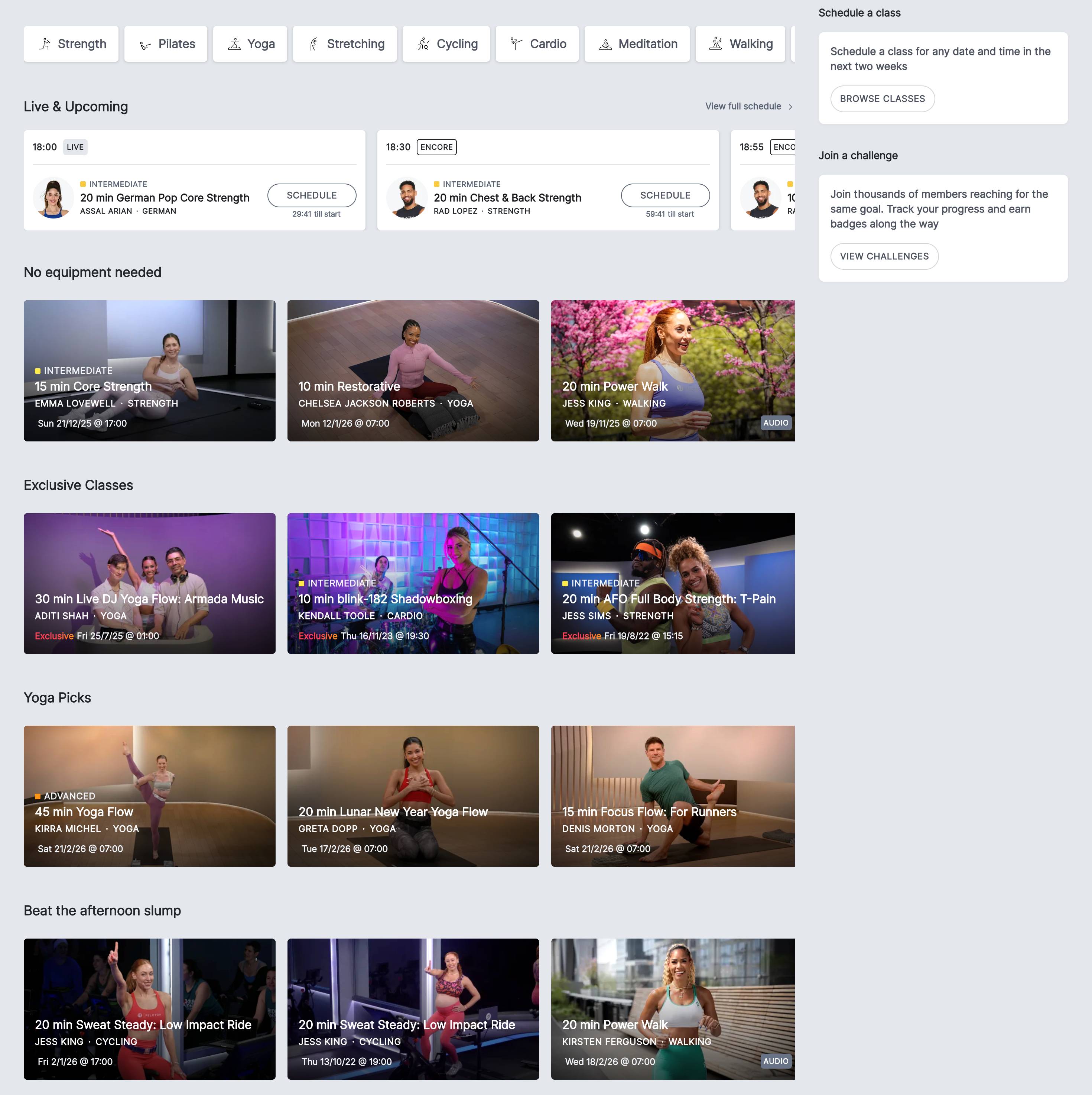
Peloton’s app is competent but shows the weight of its library’s scale. With thousands of classes across cycling, running, strength, yoga and more, finding specific content requires navigating a complex filter system that has grown organically rather than being redesigned for clarity. Search occasionally surfaces older classes when newer equivalents exist. Subscription prompts appear at multiple points in the browsing flow. These are minor friction points, but they accumulate across repeated use.
Peloton’s breadth also creates a discoverability problem for new users: the sheer volume of content is overwhelming without clear signposting toward a starting point. FitOn’s narrower, curated library is an advantage here — its featured content and trainer-led discovery paths make getting started faster and less cognitively demanding.

Nutrition integration (FitOn 7 – Peloton 2: FitOn wins)
FitOn edges Peloton here: 7 vs 2. Peloton scores 2/10 because it provides no in-app nutritional content — meal plans, recipes and macronutrient guidance are entirely absent from the platform. FitOn PRO includes basic meal planning features, which earns the platform a partial score in this category even if the depth does not compare to BODi (7) or nutrition-specialist platforms.
For women managing body composition changes in perimenopause, protein intake is a particularly important lever — research supports higher protein targets (1.0–1.2g/kg/day minimum) to preserve muscle during hormonal transition (Bauer et al., 2013). Neither platform provides the level of nutritional support needed to address this comprehensively. Both require a dedicated nutrition app to fill the gap.
Personal testing and observations
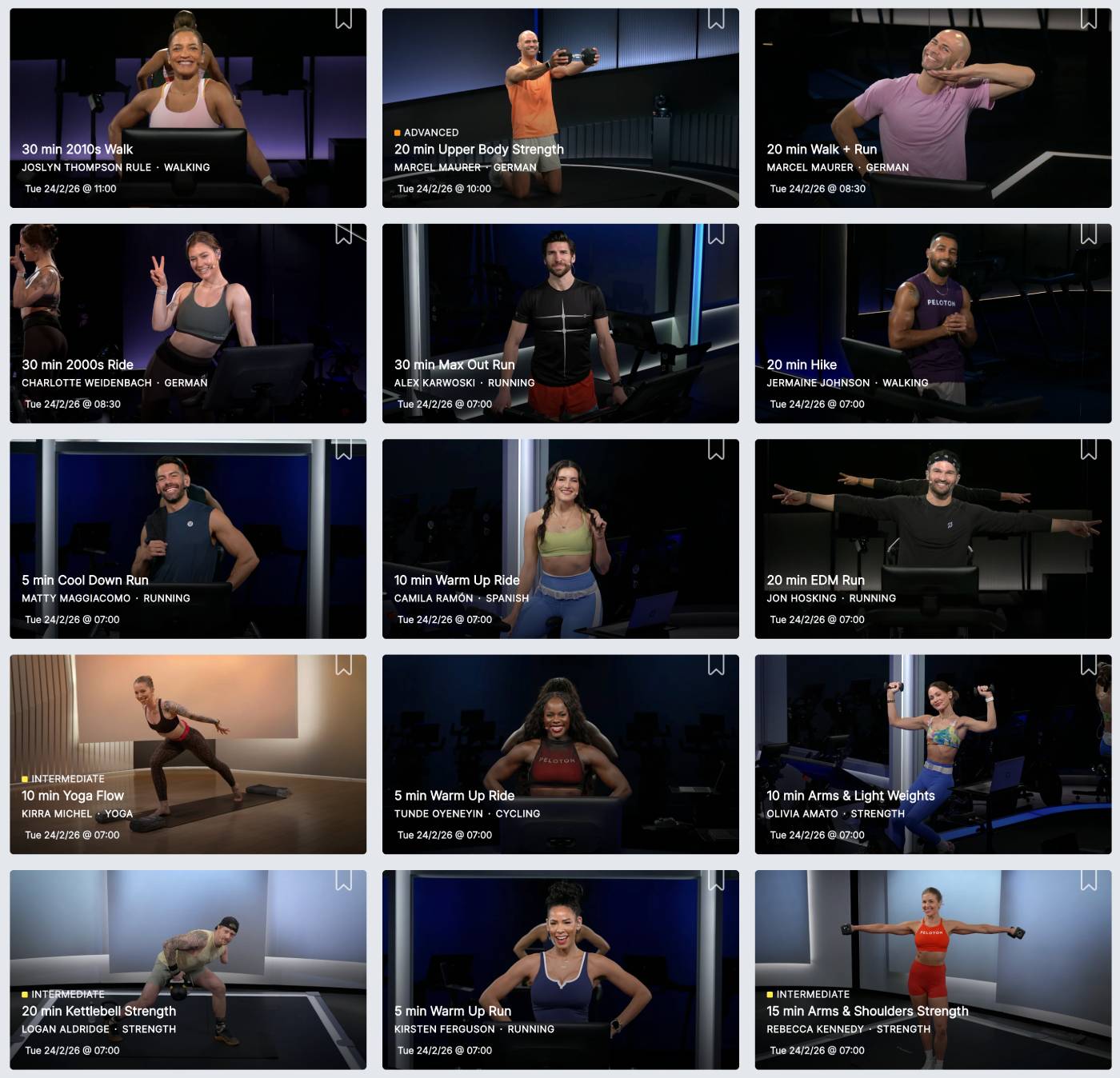
I used FitOn across four weeks, sampling the free tier across strength, HIIT, yoga and dance sessions, and upgrading to FitOn PRO for the final two weeks to test the premium features. For Peloton App, I tested over six weeks including a self-constructed weekly plan and six sessions from the Menopause Collection specifically.
Scores reflect both personal testing experience and structured evaluation against the nine Her Daily Fit weighted categories. All prices are as of March 2026 in USD; UK pricing may vary. I receive no affiliate commission from either platform.
Who should choose which
Both platforms are worth considering, but the decision is clearer than the headline scores suggest once you identify your primary constraint.
Choose Peloton App if:
- Budget is not a primary constraint — $12.99/month is affordable for your household
- Muscle preservation and progressive strength training are your main fitness goals
- You are actively managing menopause symptoms and want a curated, low-impact content pathway
- You want structured multi-week programmes rather than a self-directed library
- Joint protection and low-impact defaults are important — you do not want to actively filter out high-impact content
- You already own Peloton hardware and want a unified ecosystem
Choose FitOn if:
- Budget is a genuine constraint — the free tier is substantial and costs nothing
- You are a beginner and want to explore different workout styles without financial risk
- You want a secondary platform to supplement your main fitness app with variety
- Clean, fast, low-friction UX is a priority — FitOn’s app experience is simpler than Peloton’s
- Basic meal planning matters to you (available via FitOn PRO at $29.99/year)
- You want celebrity trainer variety — Jillian Michaels, Gabrielle Union and others are on FitOn’s free tier
The honest summary: if you can afford Peloton, it is the better tool for the health outcomes that matter most to women over 40. If budget is a real barrier, FitOn’s free tier is a genuinely good alternative — not a compromise, but a different category of product doing a different job.
Frequently asked questions
Is FitOn or Peloton better for women over 40?
Peloton scores 8/10 versus FitOn’s 6.5/10. Peloton wins on Women Over 40 Specificity (9 vs 9), Muscle Potential (9 vs 6), Joint Friendliness (6 vs 6) and Recovery (6 vs 6). FitOn wins on Value for Money (6 vs 6), UX (6 vs 6) and Nutrition (9.5 vs 7). For most women over 40, Peloton’s category wins are more relevant to their health goals.
Is FitOn really free?
Yes. FitOn offers a genuinely free tier with hundreds of classes across all major workout types — no payment required. FitOn PRO at ~$29.99/year adds offline access, meal plans and additional content. The free tier is substantial enough for regular daily use.
Does Peloton have menopause-specific content?
Yes. Peloton has a dedicated Menopause Collection with low-impact strength, yoga and walking sessions designed with hormonal awareness in mind. This earns it an 8/10 for Women Over 40 Specificity — one of the stronger scores in this series. FitOn has no dedicated menopause programme, scoring 6.5/10.
How does FitOn compare to Peloton for muscle building?
Peloton scores 7.5/10 for Muscle Potential versus FitOn’s 8/10. Peloton includes structured dumbbell strength classes with progressive options. FitOn has strength content but no progressive overload guidance — users browse and choose independently without a prescribed loading progression. For women over 40 who need to prioritise muscle preservation, Peloton’s offering is meaningfully stronger.
Can I use FitOn without paying anything?
Yes. FitOn’s free tier includes hundreds of classes across all major workout types and is sufficient for regular daily use. FitOn PRO ($29.99/year) adds offline downloads, meal plans and additional content, but the free tier does not require a card to access.
Which app is better for beginners — FitOn or Peloton?
FitOn is likely better for absolute beginners: free access removes the financial risk, and the library includes many beginner-appropriate classes. Peloton is also beginner-friendly but costs $12.99/month from day one. If you are just starting and want to explore without financial commitment, FitOn is the lower-risk starting point.
Also Compare
Research citations
- Westcott WL. resistance training RCT. Current Sports Medicine Reports. 2012;11(4):209–216.
- Maltais ML, Desroches J, Dionne IJ. menopause muscle study. Reviews in Endocrine and Metabolic Disorders. 2018;10(4):237–251.
- Bauer J, Biolo G, Cederholm T, et al. PROT-AGE consensus. Journal of the American Medical Directors Association. 2013;14(8):542–559.
- Chodzko-Zajko WJ, Proctor DN, Fiatarone Singh MA, et al. ACSM position stand. Medicine & Science in Sports & Exercise. 2009;41(7):1510–1530.
- Rhodes RE, Yao CA. habit formation study. Psychology of Sport and Exercise. 2019;42:104–113.