Reviewed by Katy · Daily Burn tested personally for one month (Basic plan). Peloton tested personally without Peloton hardware. Prices last verified March 2026.
Peloton and Daily Burn occupy different ends of the mainstream fitness platform spectrum – live accountability and the best menopause content collection at this price point against a 2,000+ workout library with real nutrition guidance and exceptional value. Neither is a perimenopause specialist in the way Pvolve or Burn360 is. The comparison is about which mainstream platform fits your training style, budget, and household better.
Overall Winner: Peloton (7.6)
Peloton wins on Time Efficiency (9 vs 9), Joint Friendliness (9 vs 9), Women Over 40 Specificity (8.5 vs 8.5), and Recovery Compatibility (8.5 vs 8.5). Its dedicated menopause collection – sessions built around perimenopause physiology rather than repurposed gentle classes – is the most developed of any mainstream platform reviewed here. Peloton App One at $12.99/month is also counterintuitively cheaper than Daily Burn Basic at $14.99/month on monthly billing.
The Case for Daily Burn (7.2)
Daily Burn wins on Value for Money (9 vs 6), UX and Design (6 vs 6), and Nutrition Integration (6 vs 6). Its 2,000+ workout library across every training style – strength, HIIT, dance, yoga, Pilates, barre, kickboxing, mobility – at $14.99/month serves households where different people need completely different things. The 72-week meal plan with custom portion guidance is something Peloton simply does not offer. On annual billing ($125.95/year), Daily Burn is the cheaper option.
At-a-glance: Daily Burn vs Peloton
| Feature | Daily Burn | Peloton |
|---|---|---|
| Monthly price | $14.99/month Basic | $12.99/month App One |
| Annual price | $125.95/year ($10.50/mo) | Not published |
| Free trial | 30-day money-back guarantee | 30-day free trial |
| Library size | 2,000+ workouts | Thousands across 15+ types |
| Live classes | No | Yes – with leaderboard |
| Menopause content | Women’s programmes; no dedicated menopause collection | Dedicated menopause collection |
| Nutrition | 72-week meal plans + recipes included | Blog/social only – nothing in-app |
| Equipment needed | Mat + dumbbells for strength; nothing for dance/yoga | None – phone, tablet, or computer sufficient |
| Device compatibility | iOS, Android, TV, Apple TV, Roku, Fire TV, browser | iOS, Android, Apple TV, Chromecast, Roku, Fire TV |
| Cancellation | Straightforward, no friction | Cancel link non-functional during testing – use app settings |
| Her Daily Fit score | 7.2 | 7.6 |
Full score breakdown
| Category | Weight | Daily Burn | Peloton | |||
|---|---|---|---|---|---|---|
| Time Efficiency | 15% | 7 | 9 | 15% | 9 | 9 ✓ |
| Women Over 40 Specificity* | 15% | 7.5 | 8 | 12% | 8.5 | 8.5 ✓ |
| Recovery Compatibility | 10% | 6.5 | 8.5 | 10% | 6.5 | 6.5 |
| Value for Money | 8% | 9 | 7 | 8% | 9.0 ✓ | 7.8 |
| Nutrition Integration | 7% | 6 | 2 | 100% | 7.2 | 7.6 |
*Women Over 40 Specificity: Peloton 8 – dedicated menopause collection, HSS joint rehab partnership, modification cues built into class. Daily Burn 7.5 – Fierce and Fit for Women programme, on-screen modifications, strong variety for mixed-age households. See the Her Daily Fit methodology for full scoring criteria.
Time efficiency (Peloton 7 – Daily Burn 9: Peloton wins)
Peloton’s 9 reflects one feature more than any other: Peloton IQ. You put in how long you have and which muscle groups you want to target, and the platform builds the session. For women managing time constraints – which covers most women in their 40s with full lives outside the gym – that friction removal matters more than it might sound. The session is ready before your motivation has time to negotiate. The class library also filters accurately by duration, and the 20-30 minute range is well-stocked across strength, yoga, pilates, barre, and low-impact cardio.
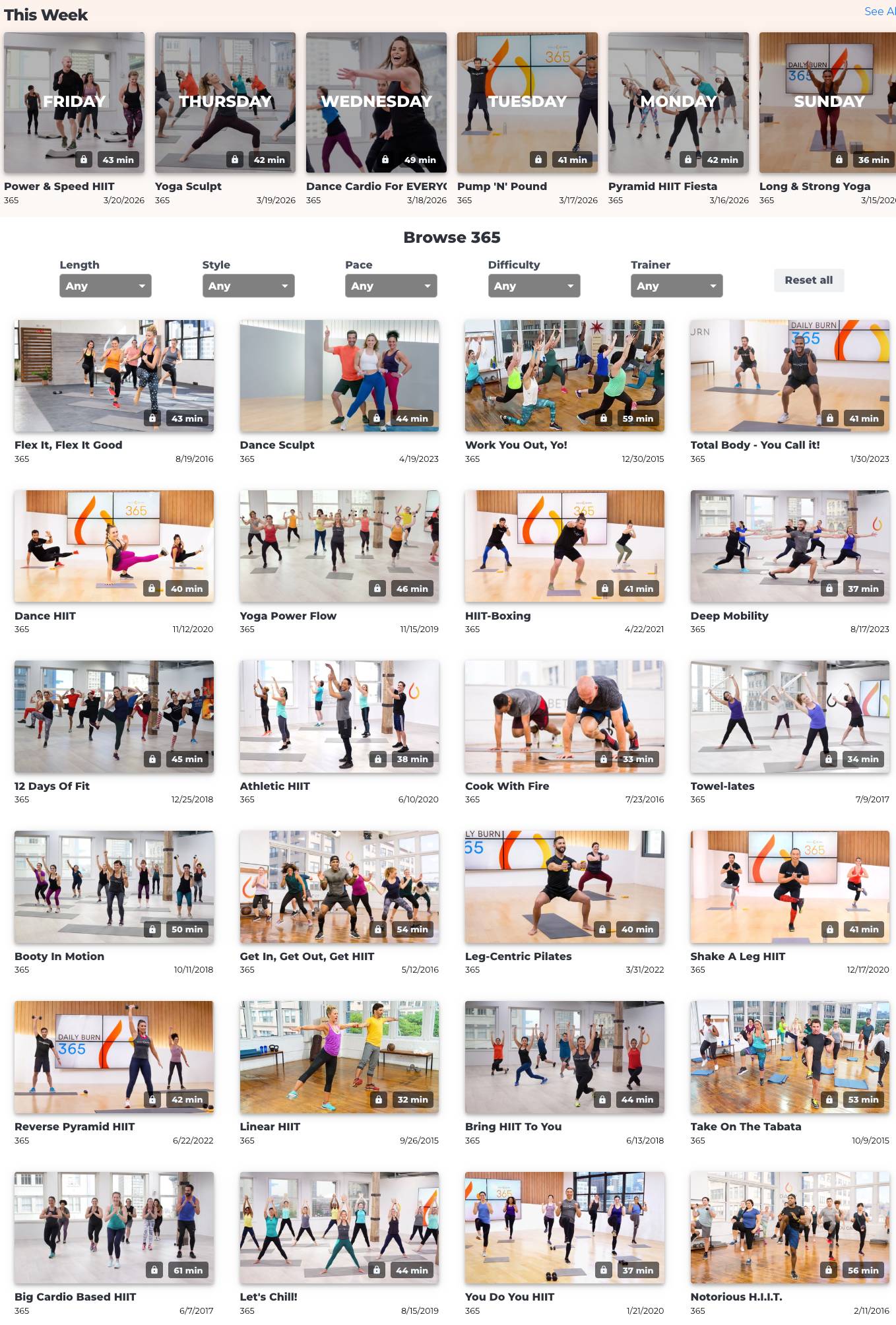
Daily Burn’s 7 is not a criticism of the content quality – Daily Burn has plenty of short sessions. It reflects the navigation: without an equivalent to Peloton IQ, the daily session decision requires more steps. Daily Burn 365 does solve this for consistent training – a new 30-minute workout goes live every day that you can follow without any decision-making. If Daily Burn 365 becomes your default, the time efficiency gap with Peloton narrows significantly. But for women who want the platform to build their session from their constraints, Peloton’s approach is more reliable.
Muscle potential (Peloton 5.5 – Daily Burn 7.5: Peloton wins)
Peloton’s 7.5 reflects a genuine strength library that goes beyond the low weights and high reps that many home fitness platforms default to. The strength content includes progressive dumbbell work, kettlebell classes, and resistance band sessions with instructors who cue load increases explicitly. The menopause collection includes load-bearing strength specifically because maintaining muscle mass through hormonal transition requires resistance, not just movement. For women over 40 whose primary concern is body composition – maintaining or building muscle as oestrogen declines – Peloton’s strength content is meaningfully more developed than Daily Burn’s.
Daily Burn’s 5.5 reflects a library where the strength content exists and works, but the ceiling is lower and the progressive overload is less guided. Fierce and Fit for Women – the programme to judge Daily Burn on for this demographic – combines strength and HIIT with modifications visible on screen throughout. Results from personal testing were real after one month. But the working weights stay lower and the progression guidance is less explicit than Peloton’s strength tracks. For women whose primary goal is muscle maintenance or building through perimenopause, Peloton is the stronger choice.
Women over 40 specificity (Peloton 7.5 – Daily Burn 8: Peloton wins)
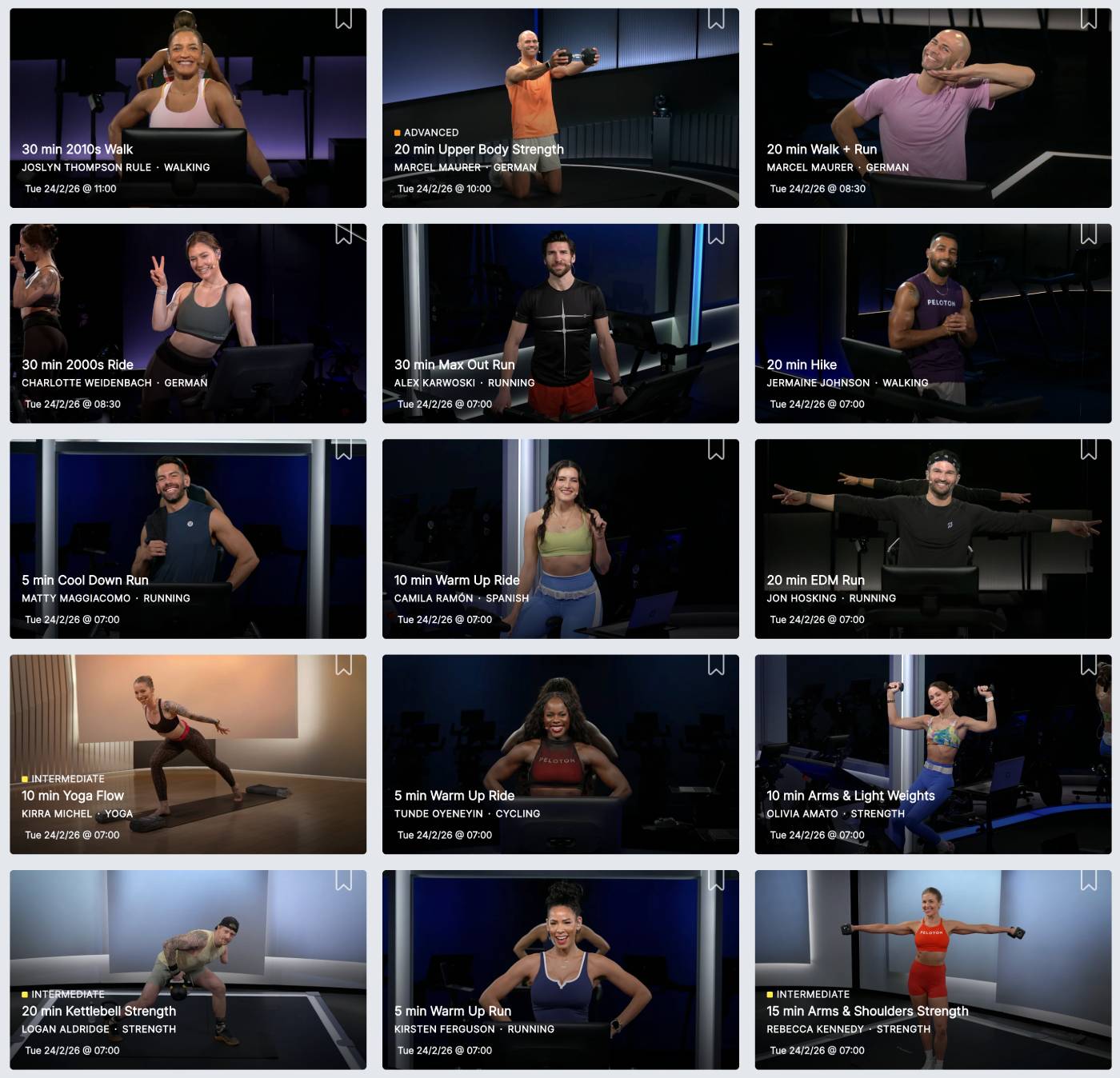
Peloton’s 8 is anchored almost entirely by the menopause collection – a curated set of sessions built around the physiological reality of perimenopause: reduced tolerance for sustained high cortisol, joint sensitivity, the need for load-bearing work without excessive impact. These are not repurposed gentle classes with a new label. They are sessions where the training intensity, duration, and format reflect an understanding of what perimenopausal physiology actually requires. Built-in, searchable, and well-designed. Peloton also has a Hospital for Special Surgery joint rehab partnership and modification cues integrated into class rather than bolted on – both of which reflect a genuine commitment to the demographic.
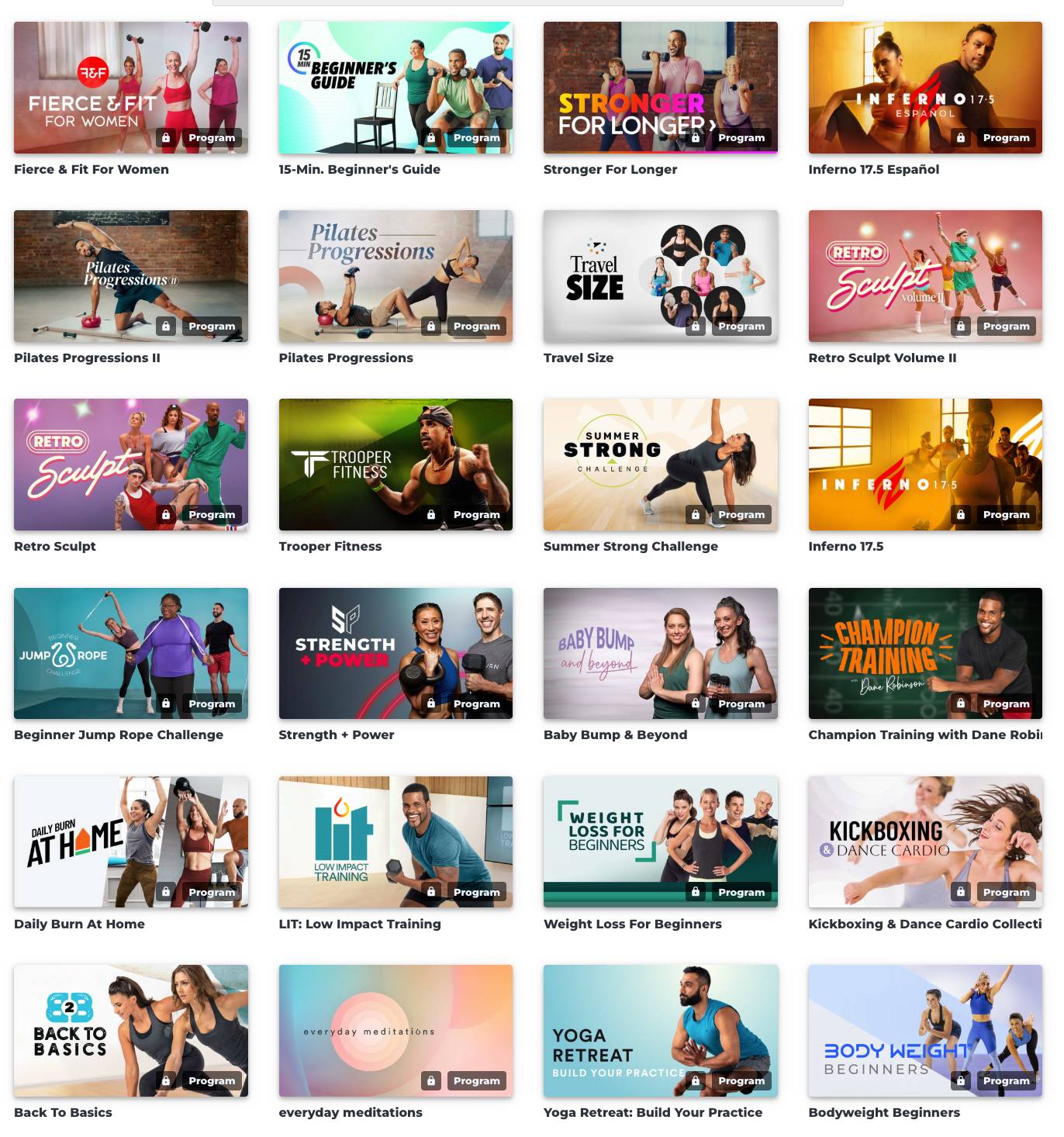
Daily Burn’s 7.5 reflects a platform that serves women over 40 well without being specifically designed for them. Fierce and Fit for Women is led by coach Amanda, designed for women in their late 30s and beyond, with three women working out alongside Amanda throughout and modifications visible on screen the whole time. For women who want strong general training with visible modification support, this is genuinely effective. The gap from Peloton’s 8.0 reflects the absence of a dedicated menopause collection – Daily Burn has excellent women’s content, but it is not specifically perimenopause-informed in the way Peloton’s dedicated collection is.
Joint friendliness (Peloton 8.5 – Daily Burn 9: Peloton wins)
Both platforms score highly here, and the 0.5-point gap is a quality distinction rather than a safety one. Peloton’s 9.0 reflects modification cues built directly into class – the instructor cues the lower-impact option as the standard option, not as a fallback you have to hunt for. The low-impact library is substantial: cycling, walking, yoga, barre, pilates, and bodyweight strength are all at full content quality and well-stocked within App One. During testing across one month with a history of a meniscus injury, I trained consistently without aggravating it – which is not something I can say about every platform.
Daily Burn’s 8.5 reflects a library where low-impact options exist across most training styles and the on-screen modifier system in Fierce and Fit for Women makes modifications visible throughout. The platform’s breadth means you can always find something appropriate for your body on a given day, even if the navigation to find it requires a manual search. For women with joint sensitivities who value variety, Daily Burn’s range of low-impact options is a strength – it is just less precisely curated for joint-specific needs than Peloton’s built-in modification system.
Recovery compatibility (Peloton 6.5 – Daily Burn 8.5: Peloton wins)
Peloton’s 8.5 reflects a platform where recovery is treated as part of training rather than an afterthought. The yoga, meditation, and mobility content are at full production quality within App One, and the menopause collection’s design around cortisol management means the intensity scheduling reflects an understanding of perimenopausal recovery needs. For women whose sleep quality varies, who experience energy crashes linked to hormonal fluctuation, or who find the 48-hour recovery windows of high-intensity training incompatible with daily life, Peloton’s low-impact diversity means you can train every day without accumulating fatigue.
Daily Burn’s 6.5 reflects stronger recovery support than many platforms of similar size offer, but less systematically integrated than Peloton. The HIIT-heavy sections of the library do carry higher recovery demands – not a problem if you programme around them, but a consideration if you’re navigating variable energy levels. Daily Burn 365 solves this partially by managing daily variety for you. For women who need explicit recovery support built into the training design, Peloton is the better choice.
Programme structure (tied 6.5 each)
The tie at 6.5 reflects a genuine equivalence in structured programming depth – both platforms are strong library-and-discovery tools, neither is a specialist in long-term programme architecture. Peloton IQ is the standout structural feature on the Peloton side: it removes the daily session decision by building from your constraints. The menopause collection provides a curated pathway for perimenopausal women that functions as informal programme guidance without being a named series with explicit progression milestones.
Daily Burn’s equivalent is Daily Burn 365 – a daily workout that functions as a structured programme simply by following along. Fierce and Fit for Women is a named series with consistent format. Neither platform offers the kind of named series with explicit weekly loading progression that Pvolve’s Progressive Weight Training or The Sculpt Society’s Midlife Movement Programme provide. For women who want a clear 8-12 week progressive programme with milestones, both platforms are less suited to that goal than the boutique specialist platforms reviewed elsewhere on this site.
UX and design (Daily Burn 9 – Peloton 7.8: Daily Burn wins)
Daily Burn’s 9 reflects exceptional device compatibility – iOS, Android, Apple TV, Roku, Fire TV, Chromecast, and browser, all with consistent quality – and an app design that makes the 2,000+ workout library genuinely navigable. The category and programme structure is clear, the search works reliably, and the platform does not hide its best content behind a tier upgrade. The 72-week meal plan is integrated cleanly alongside the training content rather than buried in a separate section. For households using multiple devices across multiple people with different needs, Daily Burn’s cross-platform consistency is a meaningful advantage.
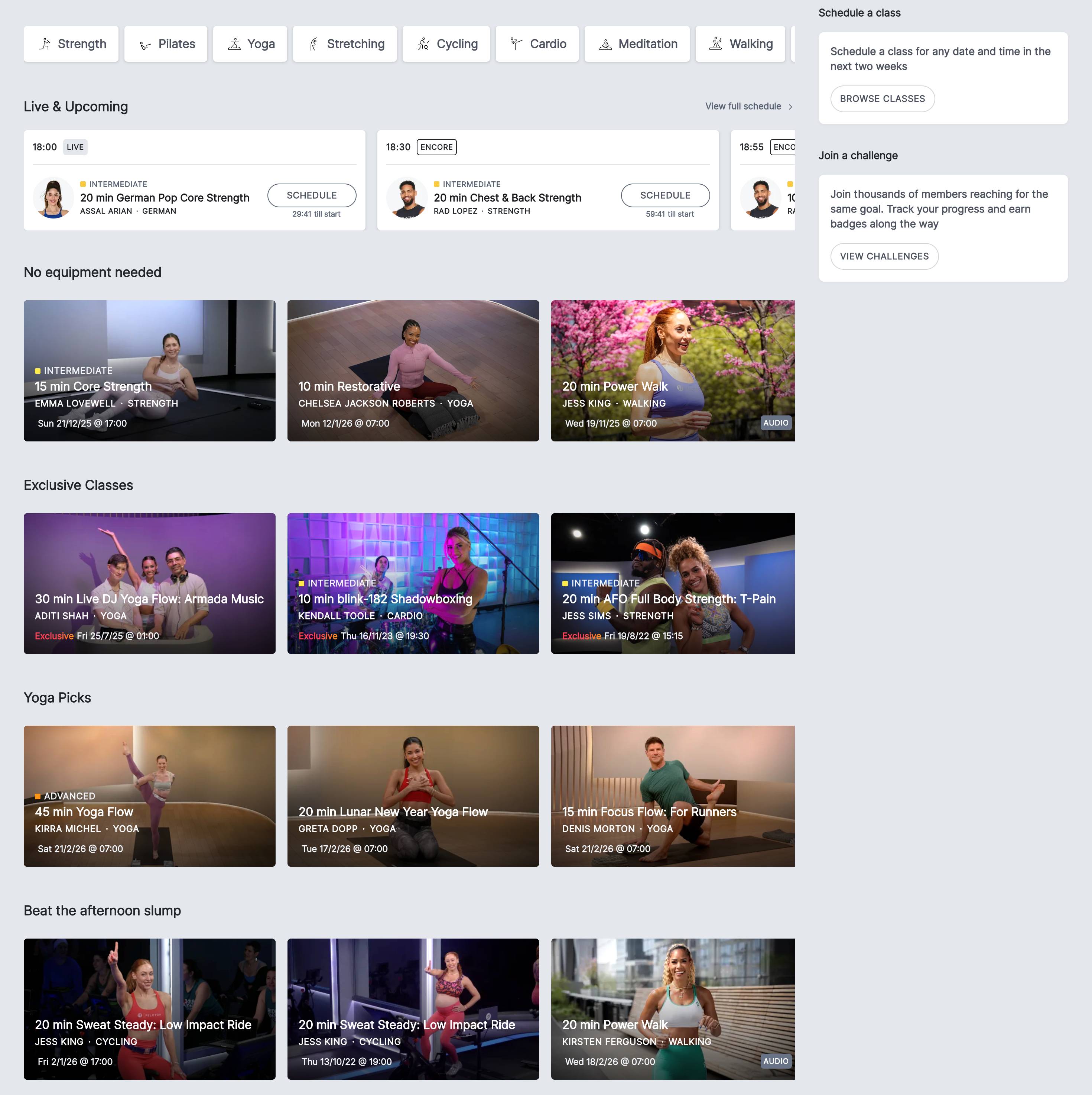
Peloton’s 7.8 reflects a high-quality app experience with one notable friction point: the cancel link was non-functional during testing. Tested more than once. If you sign up, go directly to app settings → account → membership to cancel – do not rely on the standard cancel link. Set a calendar reminder before day 30. Beyond that caveat, the Peloton app is well-built: Peloton IQ is genuinely useful, the class library filters reliably, and the live class experience – with leaderboard, output metrics, and instructor interaction – is the best of any platform reviewed here at this price point.
Nutrition integration (Daily Burn 6 – Peloton 2: Daily Burn wins)
Daily Burn’s 6 reflects a platform where nutrition is genuinely part of the subscription. Daily Burn Basic includes 72 weeks of meal plans with custom portion recommendations based on calorie needs, hundreds of recipes, and an optional human coaching add-on. The nutrition content sits alongside the workout content rather than being a separate product you buy elsewhere. For women over 40 who want a single subscription that covers both training and food guidance, Daily Burn is the clear winner on this dimension across every comparison reviewed on this site.
Peloton’s 2 reflects the reality that in-app nutrition content at Peloton is essentially absent. A blog, some recipe sharing on social media, and a named nutritionist – none of which are inside the app. For the platform that scores 8 on Women Over 40 Specificity and has a thoughtful menopause collection, the absence of hormone-aware nutrition guidance inside the platform is a notable gap. Perimenopausal nutrition – managing insulin sensitivity, anti-inflammatory eating, protein timing for muscle retention – is not something Peloton addresses. If nutrition guidance matters to your programme, Daily Burn is the only choice between these two.
Pricing (Peloton cheaper monthly; Daily Burn cheaper annual)
The comparison that surprises most people: Peloton App One at $12.99/month is cheaper than Daily Burn Basic at $14.99/month on monthly billing. That covers the full class library, the menopause collection, all strength, yoga, pilates, barre, and live non-cycling classes, plus Peloton IQ. No equipment needed beyond a phone or tablet.
On annual billing, Daily Burn wins: $125.95/year ($10.50/month effective) against a Peloton annual price that is simply not published. If you are committing for a year, Daily Burn is the better deal. If you are paying monthly – or if you want Peloton’s unlimited cycling content at App Plus ($24.99/month) – the pricing comparison shifts. For women over 40 training primarily with bodyweight, dumbbells, and low-impact cardio, App One is the relevant Peloton tier, and at $12.99/month it is cheaper than Daily Burn.
Both offer risk-free starts: Daily Burn’s 30-day money-back guarantee is one of the most generous in this space. Peloton’s 30-day free trial requires a card upfront and auto-renews – set a calendar reminder. Daily Burn cancels cleanly. Peloton’s cancel link was non-functional during testing; use app settings instead.
Personal testing and observations
Daily Burn testing
I tested Daily Burn for one month on the Basic plan, starting with the Fierce and Fit for Women programme before broadening across the library. I came in specifically for the strength content. Fierce and Fit is led by coach Amanda, designed for women in their late 30s and beyond, with three women working out alongside Amanda throughout – modifications are visible on screen the whole time. After one month rotating those sessions with other content, the test I trust more than the scale – feeling stronger and fitter in daily life – came through clearly.
The part I did not expect: I nearly skipped a dance class and did it anyway. It turned out to be one of the more enjoyable workouts I’ve done on any platform. That kind of happy accident is a feature of Daily Burn’s breadth – the library is large enough that you find things you would not have planned to try, and some of them stick. The 2,000+ workout library is not just a marketing number; it is a genuine variety that makes the subscription serve multiple people with different needs. I am going back to Fierce and Fit. I am also going back to that dance class.
Peloton testing
I went into Peloton ready to be underwhelmed – big brand, loud marketing, expensive hardware ecosystem not designed for me. What changed my assessment was the menopause collection. A curated set of sessions built around perimenopause physiology rather than repurposed gentle classes with a new label. I am in my early 40s, perimenopausal, with a history of a meniscus injury. I tested Peloton entirely without Peloton equipment, using my own non-Peloton treadmill for the running content. It worked completely.
Across a month of testing, I trained consistently without aggravating my knee – which is not something I can say about every platform. The modification cues in class are built in rather than bolted on; the instructor cues the lower-impact option as a normal option, not as something you need to hunt for. The Peloton IQ feature genuinely removes decision fatigue in a way I had not expected to value as much as I do. The cancel link caveat is real and annoying: go directly to app settings, not the standard cancel link.
Who should choose which
Choose Peloton if:
- Live class accountability is what keeps you consistent – no platform at this price point does it as well. The leaderboard, the scheduling, the sense of training alongside other people in real time are things Daily Burn simply does not replicate.
- You have perimenopause or menopause symptoms and want content built around that life stage. The menopause collection is the most developed of any mainstream platform reviewed here – designed around the physiology rather than re-labelled from the general library.
- You have joint limitations and need modification support integrated into class from the start. Peloton’s built-in modification cues and low-impact library breadth make daily joint-friendly training possible without retreating to beginner content.
- You want Peloton IQ to remove daily decision fatigue – put in your time and target, and the session is built. For women managing busy lives outside the gym, that friction removal has real value.
Choose Daily Burn if:
- Variety across workout styles is what keeps you motivated. If you go quiet when the workout has been the same format for six weeks, Daily Burn’s 2,000+ workout library across strength, HIIT, dance, yoga, Pilates, barre, kickboxing, and mobility is the platform for you.
- You want meal plans and nutrition guidance built into your membership. The 72-week meal plan with custom portion recommendations is something Peloton does not offer at any price tier. If food guidance alongside training matters, Daily Burn is the only choice between these two.
- You are managing a household with different fitness needs. One subscription covers a complete beginner who needs gentle movement, someone who wants to try dance fitness, and an experienced lifter wanting serious strength work – at a price that makes the per-person value exceptional.
- You prefer annual billing. At $125.95/year ($10.50/month effective), Daily Burn is genuinely hard to beat for what it delivers. Peloton does not publish an annual price.
FAQ: Daily Burn vs Peloton
Is Daily Burn or Peloton better for women over 40?
Peloton edges ahead overall, primarily on its dedicated menopause collection, stronger modification quality, and better muscle-building potential. The right answer depends on what you need. If live class accountability keeps you consistent, Peloton is the clear choice. If variety is what keeps you motivated, or you need the best value for a household with different fitness needs, Daily Burn’s library depth at $14.99/month is hard to match. Neither platform is a perimenopause specialist in the way Pvolve or Burn360 is – but Peloton has the most developed menopause content of any mainstream platform tested.
Which is cheaper, Daily Burn or Peloton?
On monthly billing, Peloton App One at $12.99/month is cheaper than Daily Burn Basic at $14.99/month. On annual billing, Daily Burn Basic at $125.95/year ($10.50/month effective) is the better deal – Peloton does not publish a discounted annual price. For most women over 40 training with dumbbells and bodyweight, App One covers everything relevant at Peloton, so the $12.99 monthly price is the fair comparison.
Can you use Peloton without the bike?
Yes. App One ($12.99/month) and App Plus ($24.99/month) give full access to the class library – strength, yoga, pilates, barre, live classes, and the menopause collection – on any phone, tablet, or computer. No Peloton hardware required. I tested it this way throughout, including using my own non-Peloton treadmill for the running content, and it worked completely.
Does Daily Burn or Peloton have better nutrition support?
Daily Burn, clearly. Daily Burn Basic includes 72 weeks of meal plans with custom portion recommendations, hundreds of recipes, and an optional human coaching add-on – all included in the $14.99/month subscription. Peloton has no in-app nutrition content. What exists is a blog and some recipe sharing on social media. Daily Burn scores 6/10 for Nutrition Integration; Peloton scores 2/10.
Does Peloton or Daily Burn have better menopause content?
Peloton, and it is not close. Peloton has a dedicated menopause collection built around perimenopause physiology – reduced cortisol tolerance, joint sensitivity, sustainable intensity – not repurposed gentle classes with a new label. Daily Burn has strong programmes for women in their late 30s and beyond but no menopause-specific collection. If perimenopause content is your primary need, Peloton is the answer.
Is Daily Burn or Peloton better for beginners?
Both work well for beginners but differently. Daily Burn 365 – a new beginner-accessible 30-minute workout every day – is one of the simplest starting points on any platform. Peloton IQ serves a similar function by building sessions from your available time and target muscle groups, removing decision fatigue. The difference: Peloton’s live classes add an accountability layer Daily Burn does not have. If you know from experience you’ll skip recorded workouts but show up for a scheduled live class, Peloton is the better habit-builder.
Also Compare
- Pvolve vs The Sculpt Society – the two highest Women Over 40 scores in the methodology; clinically grounded vs accessible dance-led
- Peloton vs BODi – live classes and menopause content vs structured calendar programming
- Daily Burn vs BODi – flexible 2,000+ workout library vs daily structured calendar
- Les Mills+ vs Peloton – BodyCombat and annual value vs live accountability and menopause content
Research Citations
- Maltais ML, Desroches J, Dionne IJ. Changes in muscle mass and strength after menopause. Journal of Musculoskeletal and Neuronal Interactions. 2009;9(4):186-197. menopause muscle study. (Cited for: progressive resistance training and muscle retention as oestrogen declines.)
- Hospital for Special Surgery. ACL Rehabilitation Programme in partnership with Peloton. HSS programme. (Cited for: Peloton’s joint rehab clinical partnership.)
- Woods NF et al. Cortisol levels during the menopausal transition and early postmenopause. Menopause. 2009. cortisol menopause study. (Cited for: cortisol and perimenopausal training intensity design.)
- World Health Organization. Physical activity guidelines for adults. WHO guidelines. (Cited for: general physical activity recommendations context.)
- Liao M et al. The musculoskeletal syndrome of menopause. Climacteric. 2024. menopause MSK study. (Cited for: oestrogen decline and joint tissue changes in perimenopause.)