Reviewed by Katy · Les Mills+ tested personally on a 30-day trial (BodyCombat and Les Mills Dance). Peloton tested personally without Peloton hardware. Prices last verified March 2026.
Inside Les Mills+ and Peloton
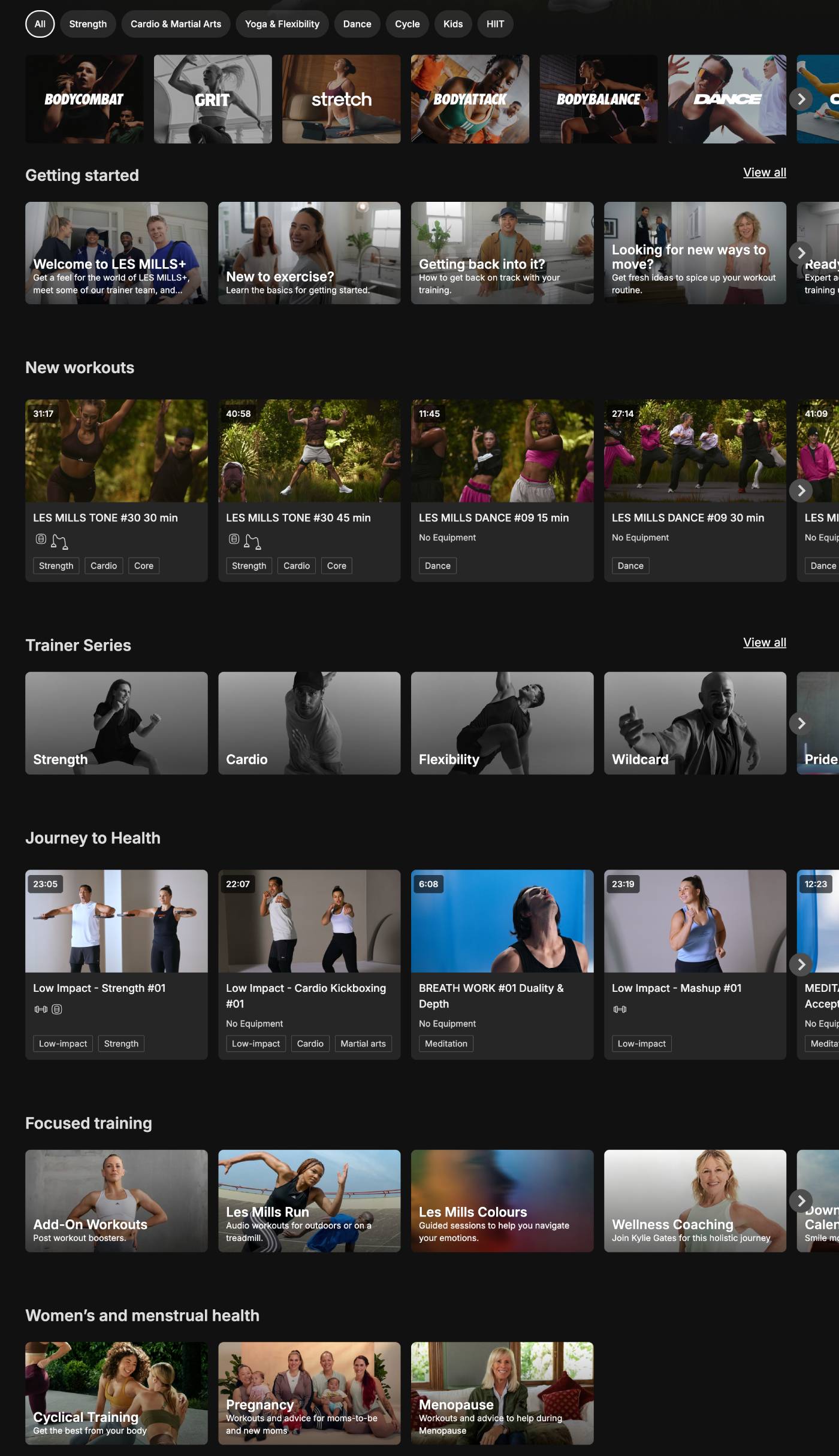
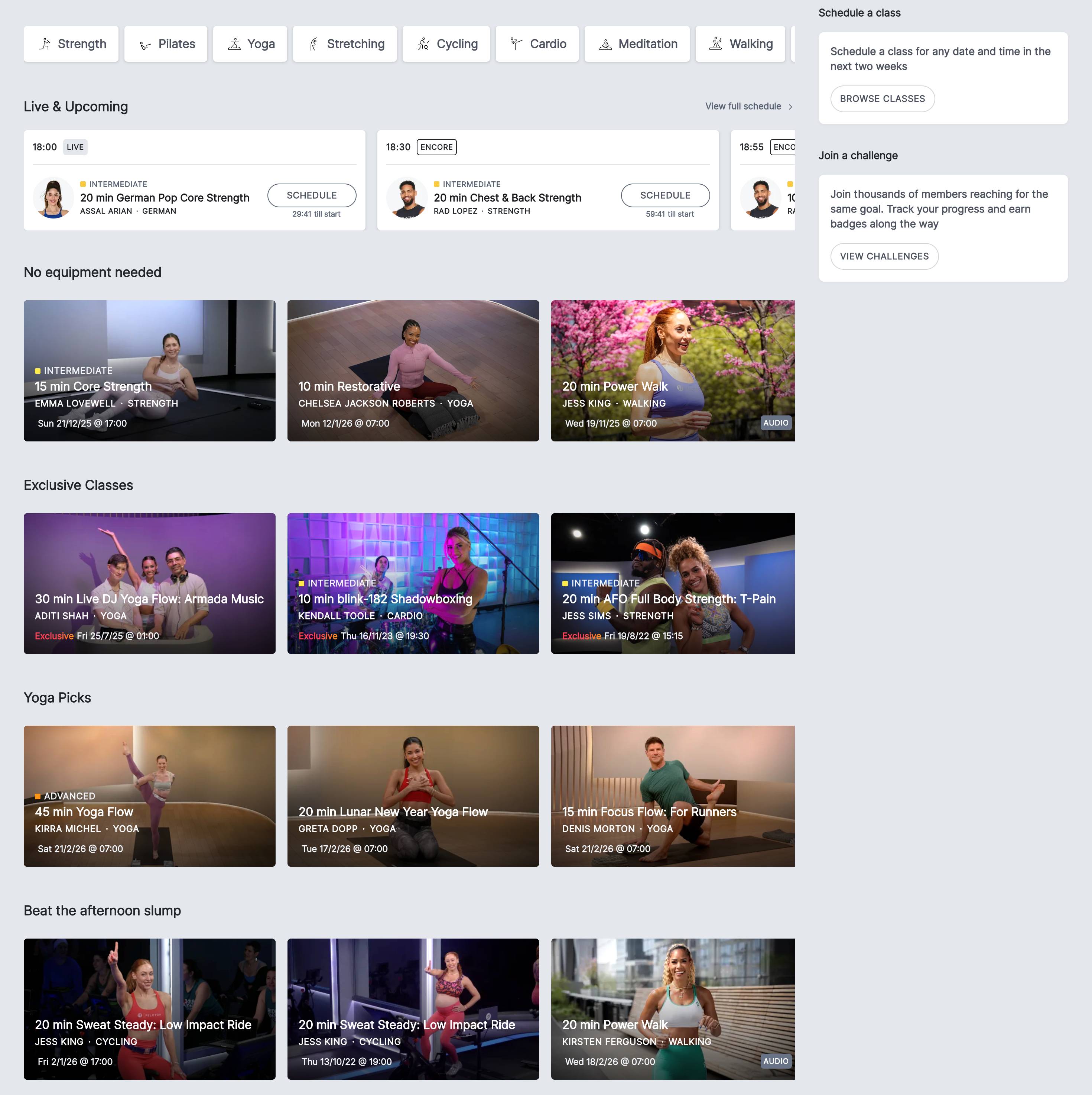
This comparison has a clear overall winner but a more nuanced secondary story. Peloton wins on almost every dimension that matters for women over 40 – menopause content, joint friendliness, time efficiency, recovery, programme structure, and UX. Les Mills+ wins on annual pricing and offers BodyCombat: martial arts fitness that genuinely has no equivalent at this price point anywhere else reviewed on this site. The decision is whether those two specific advantages outweigh Peloton’s systematic edge across everything else.
Overall Winner: Peloton (7.6)
Peloton wins on six of nine categories: Time Efficiency (9.0 vs 6.5), Women Over 40 Specificity (8.0 vs 4.5), Joint Friendliness (9.0 vs 5.5), Recovery Compatibility (8.5 vs 6.0), Programme Structure (6.5 vs 5.0), and UX and Design (7.8 vs 7.5). Its dedicated menopause collection – sessions built around perimenopause physiology rather than repurposed gentle classes – is the most developed of any mainstream platform reviewed here. The gap from Les Mills+ is significant across the criteria that matter most for this demographic.
The Case for Les Mills+ (6.1)
Les Mills+ wins on Value for Money (8.5 vs 7.0) and Nutrition Integration (4.5 vs 2.0). At $119.99/year ($10/month effective) for Premium – the plan worth having – it represents exceptional value for 2,000+ workouts across 20+ programmes. BodyCombat is genuinely unlike anything else reviewed at this price point: martial arts-inspired fitness that raises heart rate and passes time faster than almost anything else I’ve tested. Les Mills Dance is a strong moderate-intensity indoor cardio option. As an add-on alongside a more focused primary subscription, Les Mills+ has a strong case.
At-a-glance: Les Mills+ vs Peloton
| Feature | Les Mills+ | Peloton |
|---|---|---|
| Monthly price | $7.49 (Base) / $14.99 (Premium) | $12.99 (App One) / $24.99 (App Plus) |
| Annual price | $59.99/year Base · $119.99/year Premium | Not published |
| Free trial | 30 days (card required) | 30 days (card required) |
| Live classes | No | Yes – with leaderboard |
| Menopause content | 4 workouts in perimenopause section at testing | Dedicated menopause collection |
| Joint friendliness | BodyCombat is high impact; BodyBalance and dance are low impact | Excellent – low-impact options across every workout type |
| Unique content | BodyCombat (martial arts) – nothing comparable at this price | Live classes; menopause collection |
| Nutrition | Editorial articles + Fuel Reset programme | Blog and social media only – nothing in-app |
| Equipment needed | None for BodyCombat + dance; barbell for BodyPump | None – phone, tablet, or computer sufficient |
| Cancellation | Straightforward – My Account → Settings | Cancel link non-functional during testing – use app settings |
| Her Daily Fit score | 6.1 | 7.6 |
Full score breakdown
| Category | Weight | Les Mills+ | Peloton |
|---|---|---|---|
| Time Efficiency | 15% | 6.5 | 9.0 ✓ |
| Muscle Potential | 15% | 7.5 | 7.5 |
| Women Over 40 Specificity* | 15% | 4.5 | 8.0 ✓ |
| Joint Friendliness | 12% | 5.5 | 9.0 ✓ |
| Recovery Compatibility | 10% | 6.0 | 8.5 ✓ |
| Programme Structure | 10% | 5.0 | 6.5 ✓ |
| Value for Money | 8% | 8.5 ✓ | 7.0 |
| UX and Design | 8% | 7.5 | 7.8 ✓ |
| Nutrition Integration | 7% | 4.5 ✓ | 2.0 |
| Overall Score | 100% | 6.1 | 7.6 |
*Women Over 40 Specificity: Peloton 8.0 – dedicated menopause collection, HSS joint rehab partnership, modification cues built into class. Les Mills+ 4.5 – 4 workouts in perimenopause section at time of testing; insufficient for women actively managing this life stage. See the Her Daily Fit methodology for full scoring criteria.
Time efficiency (Peloton 9.0 – Les Mills+ 6.5: Peloton wins)
Peloton’s 9.0 is anchored by Peloton IQ: tell the platform how long you have and which muscle groups you want to target, and it builds the session before you have time to negotiate with yourself about whether to start. The class library also filters accurately by duration across all workout types, and the 20-30 minute range is well-stocked across strength, yoga, pilates, barre, and low-impact cardio. Live class scheduling provides natural session timing for users who want external structure to their week.
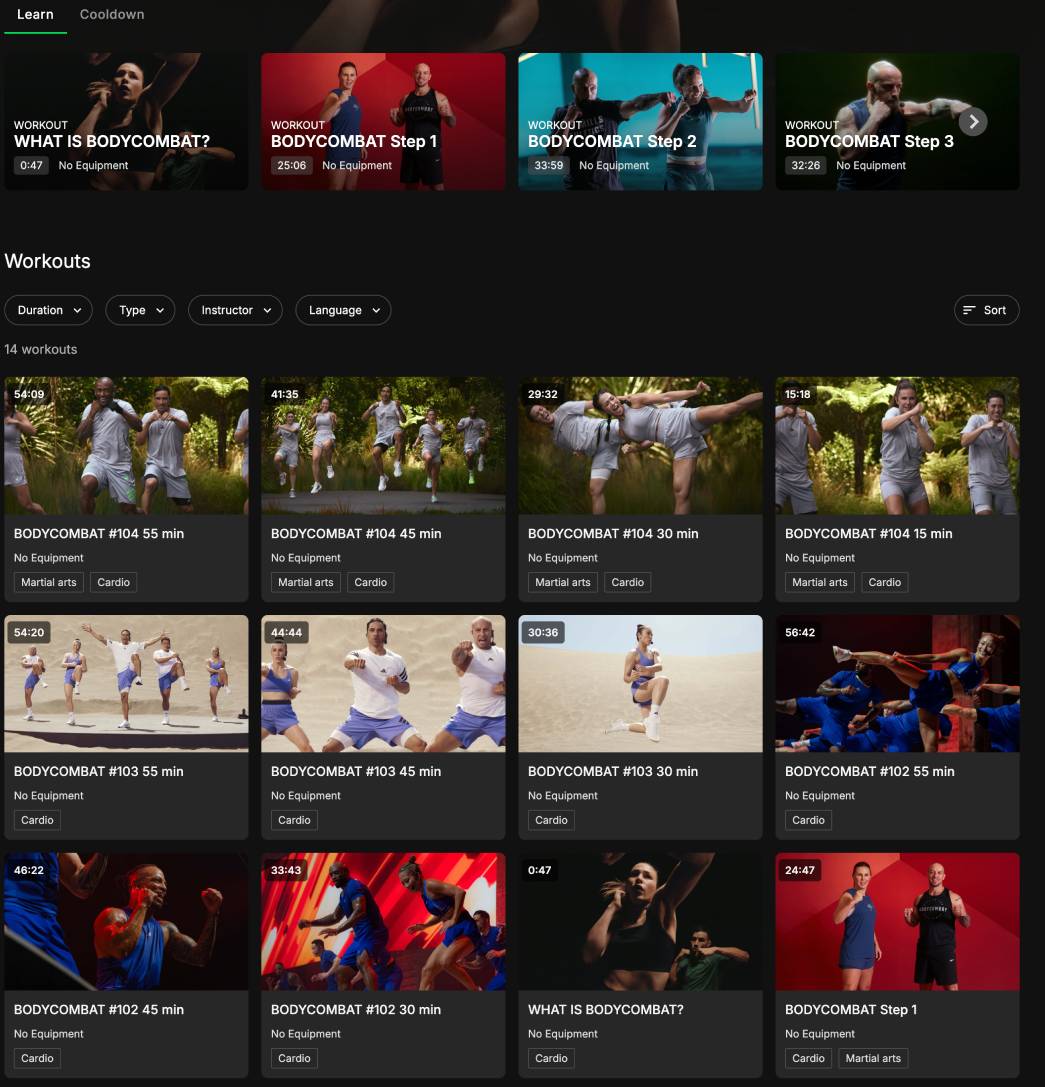
Les Mills+’s 6.5 reflects the platform’s navigation design: time filters are buried inside programme categories, which means you need to know you want BodyCombat before you can filter BodyCombat by length. For women building a consistent daily routine with variable available time, that extra decision step is more significant than it looks. The programmes themselves are fixed formats – BodyCombat runs around 55 minutes in its standard form, which is longer than most women over 40 want as a daily training session. Shorter versions exist but require deliberate navigation to find.
Muscle potential (tied 7.5 each)
The tie at 7.5 is accurate and reflects two different approaches to the same outcome. Peloton’s 7.5 comes from a genuine strength library with progressive dumbbell work, kettlebell classes, and resistance band sessions, with instructors who cue load increases explicitly. The menopause collection includes load-bearing strength specifically because maintaining muscle mass through hormonal transition requires resistance. For women whose primary goal is muscle maintenance or building through perimenopause, Peloton’s strength content provides a clear progressive pathway.
Les Mills+’s 7.5 comes primarily from BodyPump – the barbell-based strength programme that Les Mills built its gym reputation on. For women who own a barbell and weight plates, BodyPump provides genuine progressive loading with well-designed programmes. BodyCombat also builds real functional fitness, endurance, and upper body engagement through its martial arts sequences. The caveat: BodyPump requires equipment most home users don’t own. Without the barbell, Les Mills+’s strength options are more limited than Peloton’s dumbbell-based library. The tie assumes access to the full library; for dumbbell-only training, Peloton edges ahead.
Women over 40 specificity (Peloton 8.0 – Les Mills+ 4.5: Peloton wins)
This is the sharpest difference in the comparison and the one that most directly determines which platform belongs in the Her Daily Fit recommendation. Peloton’s 8.0 reflects a dedicated menopause collection – sessions designed around the physiological reality of perimenopause: reduced tolerance for sustained high cortisol, joint sensitivity, the need for load-bearing work without excessive impact. Not repurposed gentle classes with a new label; actual training sessions where the format, intensity, and duration reflect an understanding of perimenopausal physiology. Modification cues are built into class design rather than offered as a separate on-screen modifier you have to hunt for.
Les Mills+’s 4.5 reflects a gap that is difficult to explain given the platform’s scale. A global fitness brand with 2,000+ workouts and the resources to produce 20+ programme types had 4 workouts in its perimenopause and menopause section at time of testing. Four. For women actively managing this life stage – navigating joint sensitivity, energy variability, mood changes, and the need for hormone-aware training intensity – 4 workouts is not a serious answer. BodyBalance and Les Mills Dance are genuinely low-impact and appropriate for perimenopausal women, but they are not designed around hormonal physiology the way Peloton’s menopause collection is. The 3.5-point gap in this category tells the story of the comparison.
Joint friendliness (Peloton 9.0 – Les Mills+ 5.5: Peloton wins)
The joint friendliness gap is the second largest in the comparison, and it is directly caused by BodyCombat. The programme is built around jumping, fast direction changes, kicks, punches, and high-impact martial arts sequences. I tested it with a history of a meniscus injury and managed it by carefully modifying the jump sequences throughout – but that required active management every session, not passive confidence. The default BodyCombat experience is high impact. For women managing joint inflammation linked to declining oestrogen – a documented physiological reality of perimenopause[1] – that default is a meaningful limitation.
Peloton’s 9.0 reflects a platform where you can train daily without ever touching high impact, and where the alternative options are not compromises. Low-impact cycling, yoga, barre, pilates, and walking sit at full content quality within App One. BodyBalance and Les Mills Dance are low impact and appropriate – but they represent a small fraction of the Les Mills+ library. For women who need to build a consistent training habit around joint sensitivity, Peloton’s depth of low-impact options at full quality is not matched by Les Mills+ in its current form.
Recovery compatibility (Peloton 8.5 – Les Mills+ 6.0: Peloton wins)
Peloton’s 8.5 reflects a platform designed with recovery as part of training. The yoga, meditation, and mobility content are at full production quality within App One. The menopause collection’s design around cortisol management reflects an understanding that perimenopausal recovery operates differently to the standard fitness model – sustained high-intensity sessions raise cortisol in ways that can work against body composition goals and immune function during hormonal transition.[2] For women whose sleep quality varies or who experience energy crashes linked to hormonal fluctuation, Peloton’s low-impact diversity means consistent daily training without accumulated fatigue.
Les Mills+’s 6.0 reflects BodyCombat’s recovery demands. A standard BodyCombat session is physically demanding and requires genuine recovery time. BodyBalance provides excellent recovery support – yoga, Tai Chi, and Pilates fusion at real quality – and Les Mills Dance is moderate enough for active recovery. But the platform’s signature programme generates a recovery load that is incompatible with daily training for most women over 40, and the low-recovery alternatives lack the depth that Peloton’s equivalent library provides.
Programme structure (Peloton 6.5 – Les Mills+ 5.0: Peloton wins)
Neither platform excels at long-term programme architecture – both are primarily library-and-discovery tools rather than progressive series specialists. Peloton’s 6.5 reflects Peloton IQ as its structural standout: it removes the daily session decision by building from your constraints, which functions as informal programme guidance even without named series progression. The menopause collection provides a curated pathway for perimenopausal women. Peloton also runs challenge structures and instructor-guided programmes periodically that provide time-limited structure.
Les Mills+’s 5.0 reflects a library that is organised by programme category but lacks guided progression between sessions. BodyCombat releases quarterly new programme versions (“Les Mills releases”) that create a natural rhythm for gym users – but for home streaming, navigating between releases and understanding where you are in a progression requires prior familiarity with the Les Mills system. New users to Les Mills+ from home will find less clear guidance on where to start and what to do next than Peloton provides through IQ. For structured daily-plan guidance, neither platform competes with the boutique specialists (Pvolve, Burn360, The Sculpt Society) reviewed elsewhere on this site.
A closer look at Les Mills+
UX and design (Peloton 7.8 – Les Mills+ 7.5: Peloton wins)
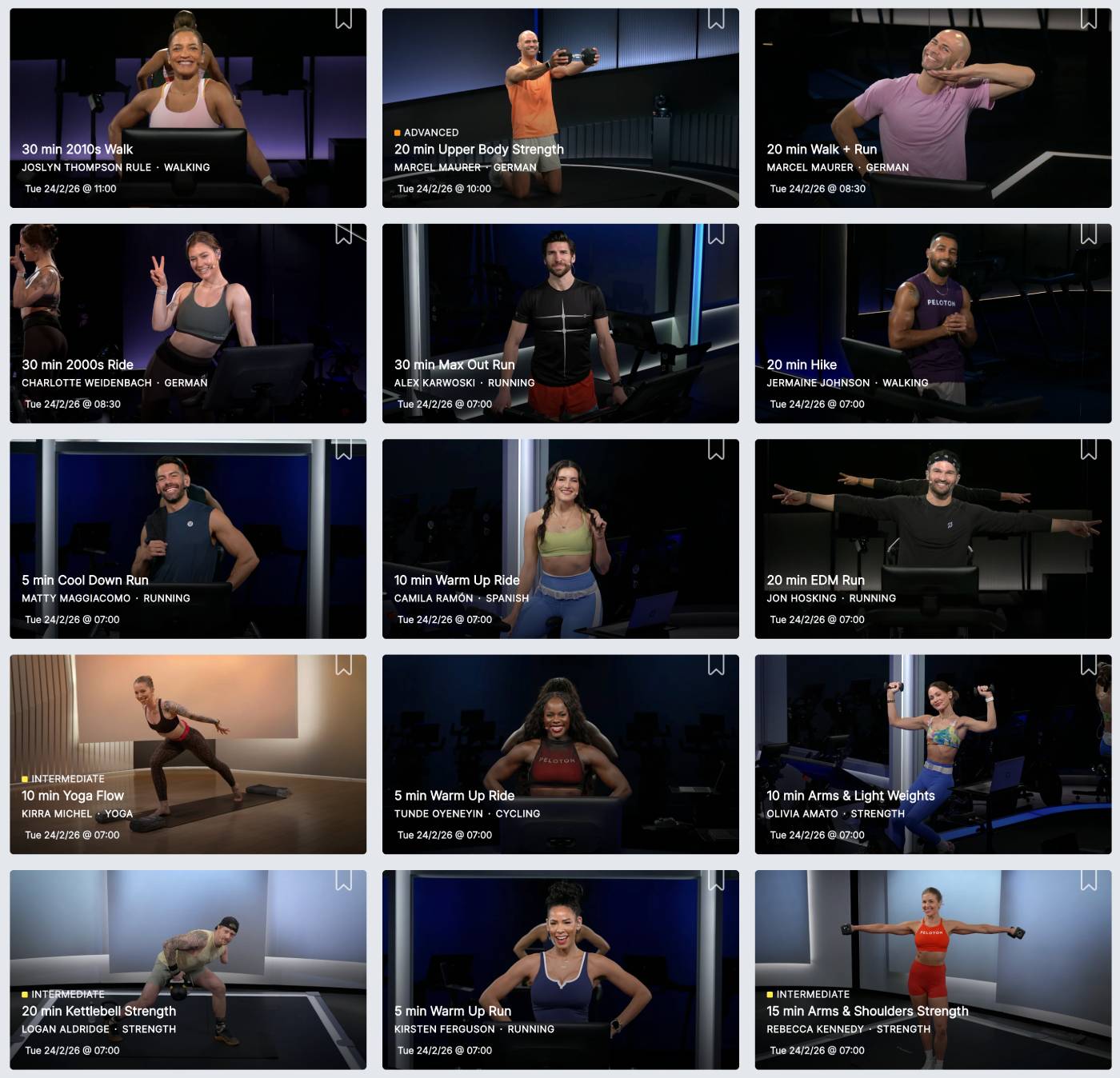
A narrow margin that reflects genuine quality on both sides. Peloton’s 7.8 reflects the best live class experience of any platform reviewed at this price point – the leaderboard, output metrics, and instructor interaction create a genuine sense of shared training that recorded-only platforms cannot replicate. Peloton IQ is well-integrated and genuinely useful. The class library filters reliably by duration, type, instructor, and difficulty. The caveat remains: the cancel link was non-functional during testing. Use app settings → account → membership to cancel, and set a reminder before day 30.
Les Mills+’s 7.5 reflects a well-built app with reliable streaming and good library organisation by programme category. Time and difficulty filters exist but are buried inside categories rather than accessible as top-level navigation. The global production quality of Les Mills content is evident – the instructors are at the top of their field, the music licensing is exceptional, and the filming quality is consistently high. The cancellation experience was clean and straightforward, which is more than can be said for Peloton. The 0.3-point gap is not a criticism of Les Mills+’s quality; it reflects Peloton IQ’s utility for women managing varied schedules.
A closer look at Peloton
Nutrition integration (Les Mills+ 4.5 – Peloton 2.0: Les Mills+ wins)
Les Mills+ wins this category, but neither score is a recommendation. Les Mills+ has genuinely well-written editorial nutrition content – articles covering anti-inflammatory eating, protein timing, and perimenopausal dietary considerations – alongside the Fuel Reset structured programme with weekly guidance and recipes. What it does not have is nutrition integrated with training, calorie guidance linked to activity, or anything specifically addressing hormonal dimensions of eating during perimenopause. The 4.5 reflects content that exists and is useful; it reflects genuine engagement with nutrition as a topic. It does not reflect a nutrition programme that competes with Daily Burn’s 72-week meal plan or Burn360’s Eat 360 system.
Peloton’s 2.0 reflects the reality that in-app nutrition content at Peloton is essentially absent. A blog and some recipe sharing on social media – nothing inside the app. Given that the menopause collection reflects genuine understanding of perimenopausal physiology, the absence of any hormone-aware nutrition guidance is a notable gap. If nutrition support matters to your programme alongside training, neither of these platforms is the right primary choice – look at Daily Burn (72-week meal plans) or Burn360 (integrated Eat 360 system).
Pricing (Les Mills+ cheaper annual; Peloton cheaper monthly)
Les Mills+ has a Base tier ($7.49/month or $59.99/year) that is the cheapest starting price in this comparison – but it limits you to around three workouts per programme, which is not enough to build a consistent habit. Premium ($14.99/month or $119.99/year) is the plan that unlocks everything: the full library, TV streaming, and downloads. If you subscribe to Les Mills+, Premium is the only tier worth having – and at $10/month on annual billing it is genuinely exceptional value for 2,000+ workouts across 20+ programmes from a world-class production team.
The counterintuitive pricing dynamic: on monthly billing, Peloton App One at $12.99/month is actually cheaper than Les Mills+ Premium at $14.99/month. On annual billing, Les Mills+ Premium at $10/month effective is cheaper, since Peloton does not publish an annual price. The decision between them on price alone depends entirely on whether you pay monthly or annually. Both offer 30-day free trials with a card required upfront. Les Mills+ cancels cleanly through the app. Peloton’s cancel link was non-functional during testing – use app settings instead, and set a calendar reminder before day 30.
Personal testing and observations
Les Mills+ testing
I tested Les Mills+ on a 30-day free trial, focusing on BodyCombat and Les Mills Dance – the two programmes most relevant for women over 40 who don’t own a barbell. I went into BodyCombat mildly curious and mildly apprehensive about my joints. The caution was warranted: I have a history of a meniscus injury and needed to actively modify the jump sequences throughout. The energy, however, was genuinely unlike anything else I’ve tested on any platform. The time passed faster than it should have, the heart rate went higher than expected, and I had the specific kind of tired afterwards that tells you something real happened. That is not nothing.
Les Mills Dance thoroughly surprised me. Lower intensity than BodyCombat – closer to a brisk walk or jog in effort – which makes it a genuine indoor cardio option for women who use outdoor walking as their moderate-intensity training and want an indoor equivalent. The choreography is accessible enough that you spend the session working rather than catching up. I enjoyed these sessions and would return to them. The perimenopause content gap was stark by comparison: 4 workouts in a dedicated section for women managing a life stage that Peloton addresses with a full curated collection. That gap is what the 4.5 score reflects.
Peloton testing
I went into Peloton expecting to be underwhelmed by a big marketing brand not designed for women like me. The menopause collection changed that assessment. A curated set of sessions built around perimenopause physiology rather than repurposed gentle classes. I am in my early 40s, perimenopausal, with a history of a meniscus injury. I tested Peloton entirely without Peloton equipment, using my own non-Peloton treadmill for the running content. It worked completely.
Across a month of testing, I trained consistently without aggravating my knee. The modification cues in class are built into the instruction rather than delivered by a separate on-screen modifier you have to track. Peloton IQ genuinely removes decision fatigue in a way I underestimated before testing it: put in the time you have and the muscle groups, and the session exists without negotiation. The cancel link caveat is real – I tested it twice and it did not work either time. App settings is the route; set a reminder before day 30.
Who should choose which
Choose Peloton if:
- Live class accountability is what keeps you consistent – no platform at this price point delivers that experience as well. The leaderboard, the scheduling, the sense of training with other people in real time are things Les Mills+ simply does not offer.
- You have perimenopause or menopause symptoms and want training built around that physiology. Peloton’s menopause collection is the most developed of any mainstream platform reviewed here. Les Mills+ had 4 workouts – not a serious answer for women actively managing this life stage.
- You have joint limitations and need training options that do not default to high impact. Peloton’s depth of low-impact content at full quality – cycling, yoga, barre, pilates, walking – is not matched by Les Mills+, whose signature content is BodyCombat.
- You want Peloton IQ to eliminate daily session decision fatigue – put in your time and muscle group targets, and the session is built. For women managing full lives outside the gym, that friction removal has real value.
Choose Les Mills+ if:
- BodyCombat genuinely appeals to you. Martial arts fitness at this price point exists nowhere else reviewed on this site. The energy is genuinely unlike anything else tested, and if that format resonates, it is an exceptional delivery of it.
- You already know Les Mills from the gym and want home access to programmes you’re familiar with. BodyPump, BodyBalance, and BODYCOMBAT are the same programmes with the same production quality.
- You want energetic indoor cardio that is not BodyCombat. Les Mills Dance is one of the better moderate-intensity indoor cardio options tested – accessible choreography, enjoyable format, appropriate intensity for perimenopausal training days when high intensity is not appropriate.
- Annual billing is the deciding factor. At $119.99/year ($10/month effective) for Premium, Les Mills+ is genuinely exceptional value for what it delivers.
Avoid Les Mills+ as a primary platform if:
You are actively managing perimenopause and need training designed around your hormonal health – 4 workouts is not sufficient. You have significant joint issues that make high-impact movement problematic – BodyCombat’s default format will not work for you. You are new to exercise and need clear daily programme guidance – the choreography learning curve and self-directed library are not beginner-friendly entry points.
FAQ: Les Mills+ vs Peloton
Is Les Mills+ or Peloton better for women over 40?
Peloton is the stronger choice for women over 40, and the gap is significant. Peloton has a genuine dedicated menopause collection (Les Mills+ had 4 perimenopause workouts at testing), scores 9.0 for joint friendliness against Les Mills+’s 5.5, and handles time efficiency and recovery far better. Les Mills+ wins on annual price value and offers BodyCombat if martial arts fitness is what you want – but as a primary platform for women over 40, Peloton is the better fit.
Which is cheaper, Les Mills+ or Peloton?
On monthly billing, Les Mills+ Premium ($14.99/month) is more expensive than Peloton App One ($12.99/month). On annual billing, Les Mills+ Premium at $119.99/year ($10/month effective) is cheaper – Peloton does not publish a discounted annual price. Les Mills+ Base at $59.99/year ($5/month) is cheaper still, but too limited for most users. If cost is the deciding factor, Les Mills+ annual billing wins clearly.
Is BodyCombat suitable for women with joint issues?
Approach with caution. BodyCombat involves significant jumping, fast direction changes, and high-impact movement. I have a history of a meniscus injury and managed it by carefully modifying jump sequences throughout – but the default format is high impact. If you have significant knee, hip, or ankle issues, Peloton is the substantially better choice: it scores 9.0 for joint friendliness and offers genuine low-impact options across every workout type at full content quality.
Does Les Mills+ or Peloton have better menopause content?
Peloton, clearly. Peloton has a dedicated menopause collection built around perimenopause physiology – reduced cortisol tolerance, joint sensitivity, sustainable intensity. Les Mills+ had 4 workouts in its perimenopause section at time of testing. For a global brand with 2,000+ workouts, that is not a serious offering for women actively managing this life stage. If perimenopause content is your priority, Peloton is the only choice between these two.
Can you use Peloton without the bike?
Yes. Peloton App One and App Plus give full access – the complete class library, live classes, the menopause collection – on any phone, tablet, or computer. No Peloton hardware required. I tested it entirely without any Peloton equipment. Dumbbells and a mat are useful for strength classes but not required to start.
Is Les Mills+ worth it alongside another fitness subscription?
Possibly yes – particularly for BodyCombat. At $119.99/year ($10/month) for Premium, it is affordable enough to run alongside a primary subscription. If you use a more focused programme (Burn360, Pvolve) for your main training and want high-energy martial arts or dance as an occasional outlet, Les Mills+ makes that possible. What it is not is a complete primary platform for women over 40 – the menopause content is insufficient and the joint-friendliness profile is limited by BodyCombat’s high-impact default.
Also Compare
- Pvolve vs The Sculpt Society – the two highest Women Over 40 scores in the methodology; clinically grounded vs accessible dance-led
- Peloton vs BODi – live classes and menopause content vs structured calendar programming
- Daily Burn vs Peloton – best variety and nutrition value vs best live accountability and menopause content
- Daily Burn vs Les Mills+ – flexible all-rounder vs martial arts and dance specialist
Research Citations
- Watt FE. Musculoskeletal pain and menopause. Post Reproductive Health. 2018;24(1):34-43. menopause joint pain study. (Cited for: oestrogen decline and joint inflammation in perimenopause.)
- Woods NF et al. Cortisol levels during the menopausal transition. Menopause. 2009. cortisol menopause study. (Cited for: cortisol management and perimenopausal training intensity design.)
- Maltais ML, Desroches J, Dionne IJ. Changes in muscle mass and strength after menopause. Journal of Musculoskeletal and Neuronal Interactions. 2009;9(4):186-197. menopause muscle study. (Cited for: progressive resistance training and muscle retention as oestrogen declines.)
- Liao M et al. The musculoskeletal syndrome of menopause. Climacteric. 2024. menopause MSK study. (Cited for: oestrogen decline and joint tissue changes.)
- Hospital for Special Surgery. ACL Rehabilitation Programme in partnership with Peloton. HSS programme. (Cited for: Peloton’s clinical joint rehabilitation partnership.)