Reviewed by Katy – Sweat tested personally across a 4-week period using the onboarding quiz and recommended programme across multiple content types. Form tested personally for 3 weeks, immediately following a 4-week Sculpt Society block. | Updated March 2026
Inside Sweat and FORM

At-a-glance comparison
| Feature | Sweat | Form |
|---|---|---|
| Her Daily Fit score | 7.4 / 10 | 7.7 / 10 |
| Monthly price | $24.99/month | $28/month |
| Annual price | $134.99/year (~$11.25/mo equiv.) | $180/year (~$15/mo equiv.) |
| Free trial | 7 days (all plans) | 7 days |
| Training styles | BBG, HIIT, strength, Pilates, yoga, running | Pilates, strength, sculpt, barre, HIIT, meditation |
| Perimenopause programme | None | None |
| Programme Structure score | 10.0 / 10 ★ | 8.5 / 10 |
| Time Efficiency score | 7.5 / 10 | 9.0 / 10 |
| UX and Design score | 9.5 / 10 ★ | 9.0 / 10 |
| Nutrition Integration score | 6.5 / 10 | 8.0 / 10 |
Her Daily Fit scoring breakdown
| Category | Weight | Sweat | Form | Winner |
|---|---|---|---|---|
| Time Efficiency | 15% | 7.5 | 9.0 | Form |
| Muscle Potential | 15% | 8.1 | 7.5 | Sweat |
| Women Over 40 Specificity | 15% | 6.5 | 5.5 | Sweat |
| Joint Friendliness | 12% | 6.5 | 6.5 | Tied |
| Recovery Compatibility | 10% | 8.0 | 8.0 | Tied |
| Programme Structure | 10% | 10.0 ★ | 8.5 | Sweat |
| Value for Money | 8% | 8.0 | 8.0 | Tied |
| UX and Design | 8% | 9.5 ★ | 9.0 | Sweat |
| Nutrition Integration | 7% | 6.5 | 8.0 | Form |
| Overall (weighted) | 100% | 7.4 / 10 | 7.7 / 10 | Sweat (by 0.1) |
The scoring arithmetic is telling: Sweat’s four category wins (Muscle, W40, Structure, UX) collectively generate just enough weighted advantage to overcome Form’s wins on the two highest-weight categories where it leads (Time Efficiency at 15%, Nutrition at 7%). Three tied categories at 30% combined weight contribute equally. The result is the narrowest margin of any comparison in the Her Daily Fit Stage 1 series.
Time efficiency (Form 9.0 – Sweat 7.5: Form wins)
Form’s 9.0 on time efficiency is one of its strongest scores, and it reflects a genuine strength of the boutique model: when a platform has a defined content library rather than 13,000+ sessions, each session is purposefully designed and clearly scoped in duration. Form’s sessions typically run 20–40 minutes for Pilates and sculpt content, with longer 35–45 minute sessions for strength work. Navigation is simple – the library is curated enough that finding the right session for today takes seconds rather than minutes.
Sweat’s 7.5 reflects the navigation overhead and duration variability of a 13,000+ workout library. For members who follow Sweat’s daily plan – which is genuinely excellent – the time efficiency is much better than 7.5 suggests. But many Sweat members do not consistently follow the daily plan, and for those who browse and select sessions manually, the pre-workout decision time is significant. Sweat’s range of 15–60+ minute sessions also makes time allocation harder to plan.
Muscle potential (Sweat 8.1 – Form 7.5: Sweat wins)
Sweat’s 8.1 reflects the muscular quality of its FIERCE programme (Kelsey Wells) and the diversity of strength-focused content across its library. For users who engage with Sweat’s strength programmes consistently, the progressive overload and variety of resistance approaches – barbells, dumbbells, resistance bands – create a real and varied muscle-building stimulus.
Form’s 7.5 reflects the Pilates-forward orientation of its method. The strength and sculpt content in Form is competent but secondary to the Pilates and mindfulness core of the platform. Sessions tend toward muscular endurance and control rather than progressive strength overload. For a user primarily motivated by visible muscle definition or functional strength gains, Form is less directly effective than Sweat’s dedicated strength programme options. Research consistently identifies progressive resistance training as the primary driver of lean mass development. resistance training RCT.
Women over 40 specificity (Sweat 6.5 – Form 5.5: Sweat wins)
Both scores are in the lower range for this category, and the 1.0-point gap reflects modest differences rather than a compelling advantage for either platform. Neither Sweat nor Form offers a dedicated perimenopause programme. Form’s 5.5 reflects the joint concerns raised by its HIIT content and the complete absence of perimenopause-targeted programming. Sweat’s 6.5 reflects the same absence of dedicated perimenopause content, but mitigated by the broader range of lower-impact options – yoga, Pilates, low-intensity strength – that a midlife woman can navigate to within the library.
Women for whom perimenopause is a primary fitness motivation should not choose between these two platforms for that reason. Both Sweat and Form are better characterised as high-quality general women’s fitness platforms that are usable for over-40 women who curate their own content, rather than platforms designed around the physiological needs of the perimenopause transition. menopause muscle loss. The physiological specificity this research describes is better addressed by platforms like Pvolve or The Sculpt Society that have built it into their programme methodology.
Joint friendliness (Both 6.5: Tied)
Both platforms score 6.5 on joint friendliness, reflecting a shared characteristic: both include content with meaningful impact or joint loading that is not systematically signposted or modifiable. Sweat’s BBG programmes include jump squats, burpees, and plyometric circuits. Form’s HIIT and barre content includes dynamic jumping movements that can stress sensitive joints. Neither platform applies a platform-wide low-impact policy or a consistent session-level impact indicator.
The tied score is appropriate. Users with established joint sensitivity will need to navigate both libraries carefully. Sweat’s yoga and Pilates content provides more comprehensive joint-safe options within the platform; Form’s challenge is that even its boutique content occasionally includes unexpected impact elements that require in-session modification.
Recovery compatibility (Both 8.0: Tied)
Both platforms earn 8.0 on recovery compatibility, reflecting well-managed training loads within their respective programme architectures. Sweat’s programmes include structured rest days, active recovery sessions, and weekly intensity variation. Form’s weekly curated schedules alternate session types and include lighter sessions. Both platforms are usable at moderate frequency without significant cumulative fatigue risk for users who follow the recommended programmes rather than adding additional sessions.
Programme structure (Sweat 10.0 – Form 8.5: Sweat wins)
Sweat’s perfect 10.0 remains the highest score in this category across the entire Her Daily Fit series, and the gap over Form (8.5) is meaningful – 1.5 points. Sweat’s adaptive daily plan, onboarding quiz, and in-workout timer create a programme environment that actively supports consistent training without requiring ongoing user initiative. The system removes friction between intention and action, which research identifies as a primary determinant of exercise habit formation. habit formation study.
Form’s 8.5 reflects excellent programme infrastructure for a boutique platform – weekly curated schedules, programme-level structure, and monthly new programme releases. But the architecture is primarily a library with guidance, rather than an adaptive daily plan system. For users who engage reliably with their own planning, Form’s approach is entirely sufficient. For users who benefit from the scaffolding of an automatic daily plan, Sweat’s 1.5-point advantage translates directly into better real-world adherence outcomes.
Value for money and pricing (Both 8.0: Tied)
| Plan | Sweat | Form |
|---|---|---|
| Monthly | $24.99/month | $28/month |
| Annual | $134.99/year | $180/year |
| Annual per month equiv. | ~$11.25/month | ~$15/month |
| Annual saving with Sweat | – | $45.01/year |
Both platforms earn 8.0 on value – an equal assessment that reflects two very different pricing and content propositions arriving at similar value delivery. Sweat provides 13,000+ workouts, best-in-series programme structure, and best-in-series UX for $134.99/year. Form provides a more focused boutique experience with superior nutrition content and better time efficiency for $180/year. Both are genuinely good value at their respective price points. The tied score is not a default – it is an honest assessment that both platforms justify their pricing relative to the quality they deliver.
A closer look at Sweat
UX and design (Sweat 9.5 – Form 9.0: Sweat wins)
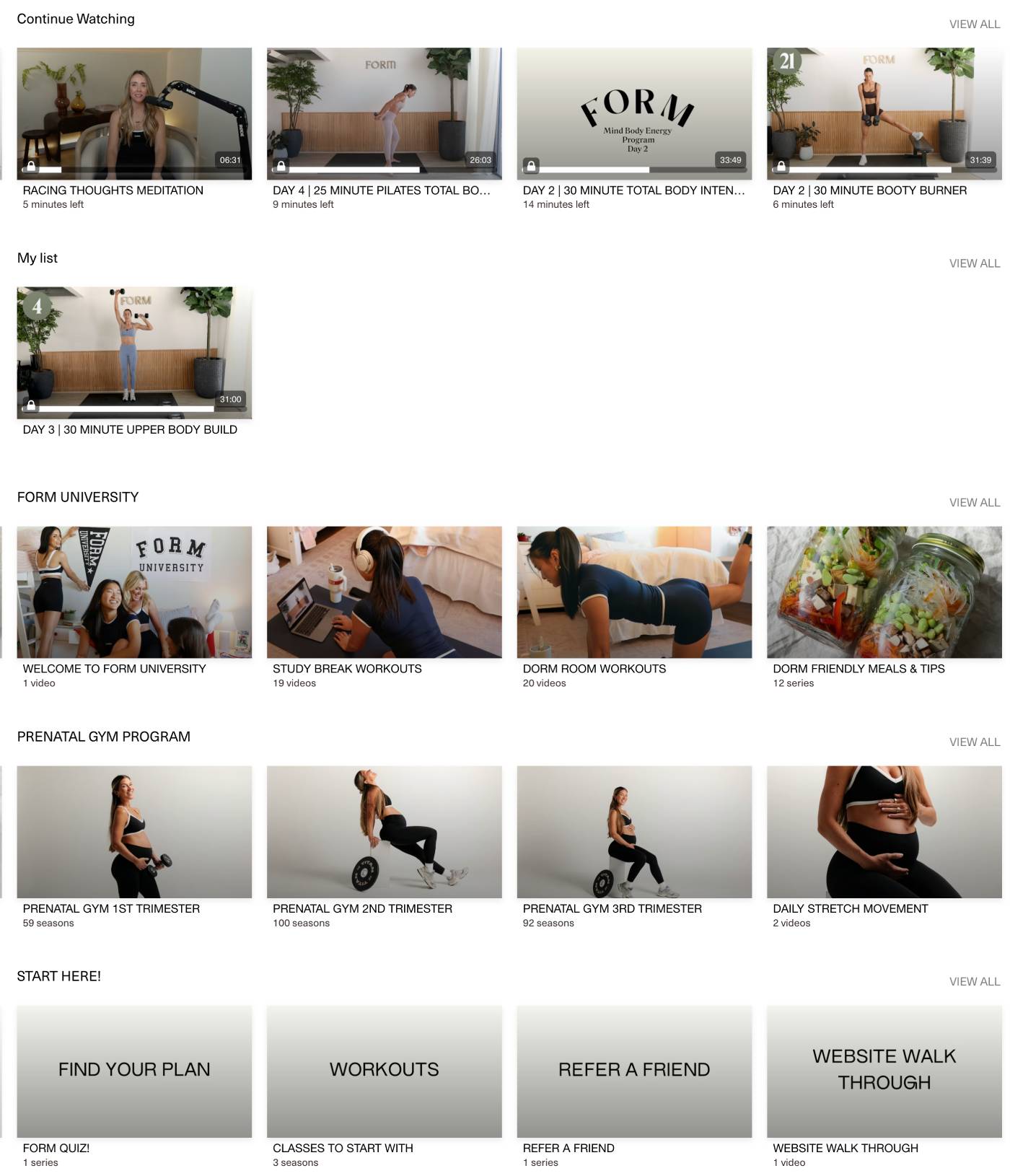
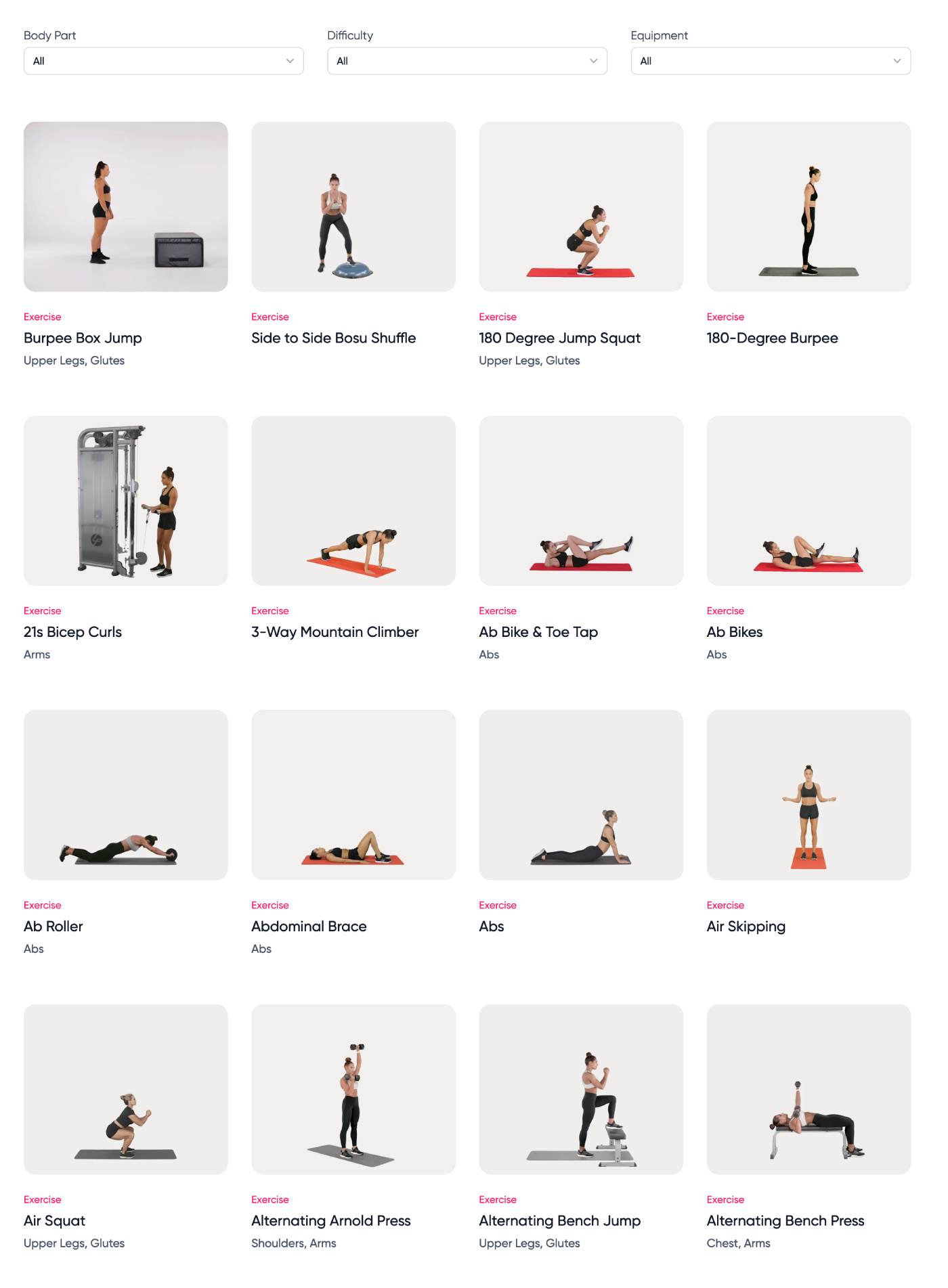
Both platforms are among the best-designed in the Her Daily Fit comparison series. The 0.5-point gap acknowledges that Sweat’s best-in-series score reflects genuinely superior technical infrastructure – the adaptive daily plan, in-workout timer, Apple Watch integration, and social features add functionality that Form, for all its visual quality, does not match. Form’s 9.0 represents the best boutique app design in the series – polished, intentional, and aesthetically premium. The difference is between a technically more capable system (Sweat) and a more carefully crafted visual and interactive experience (Form). Both are excellent; the choice between them is partly a matter of taste.
A closer look at FORM
Nutrition integration (Form 8.0 – Sweat 6.5: Form wins)
This is Form’s clearest category win, and it reflects a genuine strategic investment in nutritional content that Sweat has not matched. Form’s nutrition hub includes dietitian-approved recipes, structured meal plans, and nutritional guidance that is integrated into the platform as a core feature rather than an add-on. The quality and depth of the nutritional content is above the average for women’s fitness platforms.
Sweat’s 6.5 reflects nutritional content that exists but is oriented toward a general-audience fitness user. The recipe library is present and the meal guidance is functional, but it lacks the dietitian involvement and depth of Form’s offering. For women specifically seeking a fitness platform with credible nutritional support – particularly for managing perimenopause-related nutritional priorities – Form’s nutrition advantage may be the deciding factor. protein intake review.
Personal testing and observations
Sweat testing
I tested Sweat across a four-week period beginning with the onboarding quiz, which generated a daily plan across strength and Pilates content. The daily plan experience is consistently the strongest in class – the interface removes the decision of what to do today and replaces it with a clear, appropriately calibrated recommendation. The in-workout timer is particularly useful for the strength sessions, where managing rest intervals without a timer consistently results in either rushing or drifting. The social features and streaks are well-implemented engagement mechanisms that do not feel forced.
Form testing
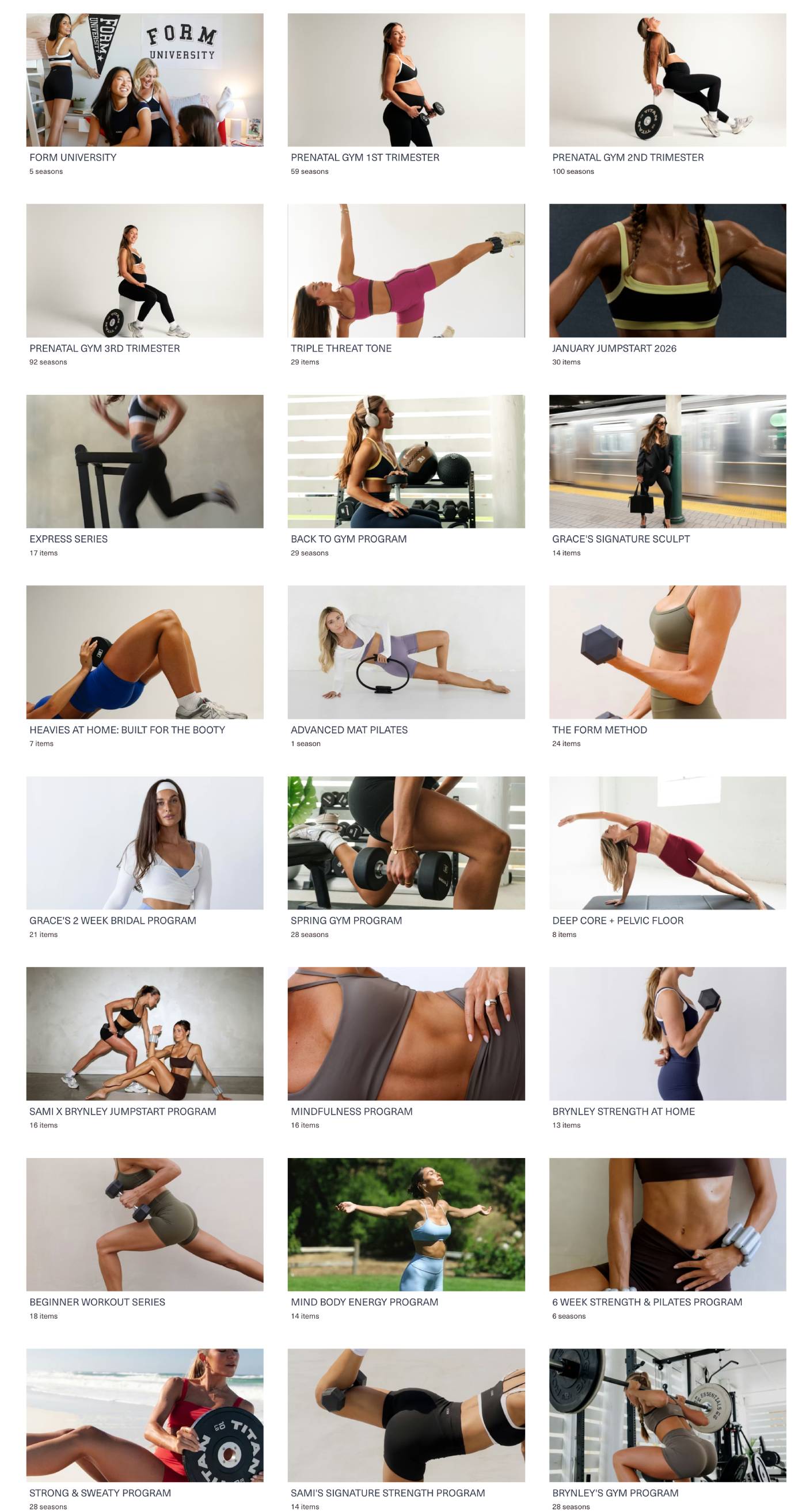
I tested Form for three weeks immediately following a four-week Sculpt Society block – a period that allowed direct contrast between the two platforms’ approaches. I came in at lower weights than usual: 6.5kg and 5kg (down from my normal 8.5kg) after a period of schedule disruption. I went in with the intention of rebuilding consistency rather than pushing hard. Form’s first impression in daily use is that it feels premium in a way that Sweat, despite its technical superiority, does not quite match. The typography, the video presentation, the session pacing – all of it communicates care in design. Two weeks in, I noticed my belly had flattened and I was looking forward to every session – which had not been true of my previous few weeks. The variety across Sami, Grace, Brynley and Calyn meant the library never felt repetitive. The nutrition hub is genuinely useful: three recipes used during the testing period were practical, well-produced, and appropriate for the training level.
The joint concern in Form’s HIIT-adjacent sessions was consistent with previous testing findings. Two sessions during the three-week period required self-directed modification. Neither was flagged as higher-impact in the session listing. For a user who approaches Form’s library with established joint awareness, this is manageable. For a user new to the platform relying on the session metadata to gauge appropriateness, the absence of systematic impact level indicators remains a gap.
Form’s nutrition hub distinguishes it from most platforms in this comparison series. The dietitian-approved labelling adds credibility, and the content is clearly produced for an active adult woman audience rather than repurposed from a general nutrition database.
Who should choose which
Choose Sweat if:
You want the best programme delivery infrastructure in the category – the adaptive daily plan and in-workout timer are genuinely best-in-class. You value maximum content variety across coaches and training styles. You are budget-conscious: at $134.99/year, Sweat saves you $45/year versus Form. You use Apple Watch or want deep Apple Health integration. You respond better to structured habit scaffolding than to self-directed content selection. You do not prioritise nutritional content as a core platform feature.
Choose Form if:
Time efficiency matters to you – Form’s consistently well-scoped session lengths and easy navigation are practical advantages for a busy week. You want a richer nutritional hub with dietitian-approved content integrated into your fitness platform. You value the premium boutique aesthetic of Form’s app design over Sweat’s technically superior but more utilitarian interface. You prefer a focused Pilates-and-strength approach over the breadth of Sweat’s multi-coach library. You are comfortable with self-directed content selection and do not need an adaptive daily plan.
Which Is Better for Women Over 50?
For women over 50, Sweat has a modest advantage over FORM. Sweat’s broader programme catalogue includes more options for lower-impact strength and yoga that suit post-menopausal training priorities. FORM’s content is solid but skews toward a younger, higher-intensity audience. That said, neither platform has invested heavily in over-50-specific content. Women over 50 should look within Sweat for its yoga and lighter resistance programmes, or consider a platform that more explicitly addresses menopause and post-menopausal training needs.
Frequently asked questions
Is Sweat or Form better overall?
Sweat wins by 0.1 point (7.8 vs 7.7) – the narrowest margin in the Her Daily Fit comparison series. Sweat wins four categories (Muscle Potential, Women Over 40, Programme Structure, UX) and Form wins two (Time Efficiency, Nutrition). Three categories are tied. At this margin, personal priorities should drive the decision more than the Her Daily Fit score differential.
Is Sweat or Form better for women over 40?
Sweat scores marginally higher (6.5 vs 5.5 on Women Over 40 Specificity) but neither platform is well-suited as a primary perimenopause resource – both lack dedicated perimenopause programmes. Women for whom hormonal health is the primary motivation should consider Pvolve (10.0), The Sculpt Society (9.5), Fit with CoCo (8.0), or Burn360 (9.0) instead.
Which is cheaper, Sweat or Form?
Sweat is cheaper: $134.99/year (~$11.25/month equivalent) vs Form’s $180/year (~$15/month equivalent). That is a $45 annual saving with Sweat. Both offer 7-day free trials. Both score equally on Value for Money (8.0) despite the price difference, reflecting that Form justifies its slightly higher price through its nutrition hub and boutique design quality.
Why does Form score higher on time efficiency than Sweat?
Form scores 9.0 vs Sweat’s 7.5. Form’s focused library means sessions are consistently well-scoped (20–40 minutes) and easy to find. Sweat’s 13,000+ session library introduces navigation overhead and session-length unpredictability for users not following the daily plan. Sweat users on the daily plan experience much better time efficiency in practice than the score suggests for self-directed browsing.
Does Sweat or Form have better nutrition content?
Form has better nutrition content: 8.0/10 vs Sweat’s 6.5/10. Form’s dietitian-approved recipes and meal plans are more deeply integrated and professionally validated than Sweat’s general-audience nutritional content. For women specifically seeking a fitness platform with credible nutritional guidance, Form’s advantage here may be the deciding factor.
Which has better UX, Sweat or Form?
Sweat has better UX on technical metrics (9.5 vs 9.0). Both are among the best-designed in the Her Daily Fit series. Sweat’s advantage comes from its adaptive daily plan, in-workout timer, and Apple Watch integration. Form’s 9.0 reflects premium boutique design quality – visually polished and intentionally crafted. The 0.5-point gap is real but both are excellent.
Research citations
- Westcott WL (2012). Resistance Training is Medicine: Effects of Strength Training on Health. Current Sports Medicine Reports, 11(4), 209–216. resistance training RCT.
- Maltais ML et al. (2018). Changes in Muscle Mass and Strength After Menopause. Journal of Cachexia, Sarcopenia and Muscle, 9(1), 1–13. menopause muscle loss.
- Rhodes RE et al. (2019). Habit and physical activity: Prediction, progression, and practice. Psychology of Sport and Exercise, 42, 69–79. habit formation study.
- Lonnie M et al. (2018). Protein for Life: Review of Optimal Protein Intake, Sustainable Dietary Sources and the Effect on Appetite in Ageing Adults. Nutrients, 10(3), 360. protein intake review.
- Chodzko-Zajko WJ et al. (2009). ACSM Position Stand: Exercise and Physical Activity for Older Adults. Medicine & Science in Sports & Exercise, 41(7), 1510–1530. ACSM position stand.