

Why strength training matters more after 40
Because the thing you are losing is specifically muscle, and specifically now.
The clearest evidence comes from the Study of Women’s Health Across the Nation. Greendale and colleagues, writing in JCI Insight in 2019, found that at the start of the menopause transition “rate of fat gain doubled, and lean mass declined”, with both continuing until roughly two years after the final period. Notably, they also found weight itself “climbed linearly during premenopause without acceleration” at the transition.
So the scale is the wrong instrument. Lean mass is falling while fat rises, and the total can stay almost unchanged while your body composition shifts underneath it.
The good news is that the countermeasure is well evidenced. In a systematic review and meta-analysis of sixteen studies, Ramos-Campo and colleagues, writing in the Journal of Aging and Physical Activity in 2022, found resistance training in middle-aged and older women produced increases in muscle mass and “a moderate and large favorable effect on arm, trunk, and lower limb strength”, with gains significantly greater than controls.
What separates a strength app from a workout app with weights in it?
One thing, and you can check it before you pay.
Does it make the weight go up? Progressive overload means systematically increasing the load, the reps or the difficulty over weeks. It is the mechanism by which muscle actually adapts. An app that hands you a different dumbbell class every day is giving you exercise, not a strength programme.
The practical test is whether the app knows what you lifted last time. If it does not record your load, it cannot progress it, and any progression is something you are doing yourself in a notebook.
This is why the ranking on this page looks unlike our other lists: it is dominated by apps built specifically around load tracking, and it leaves out several excellent platforms that most people would call strength apps. Sweat, Pvolve and BODi all score 7 for progressive strength and land just outside the eight, on a blend of 7.45 against 7.55 for the last programme in. They are good products. They are not the most progressive strength available to you, which is the only question this page asks.
How do the best strength training apps for women compare?
Eight programmes ranked on how much progressive strength each delivers, weighted 70%, blended with ease of use, weighted 30%. Overall is the weighted score across all nine criteria, which is why a programme can rank near the top here while scoring lower overall: this page deliberately ignores nutrition, menopause content and recovery, none of which is what you came for. All three scores update live from each programme’s own review.
| Rank | Programme | Progressive strength 70% | Ease of use 30% | Overall | Testing tier | Best for | Not ideal for | Price |
|---|---|---|---|---|---|---|---|---|
| 1 | Ladder | 9/10 | 9/10 | 6.9/10 | Sample tested | Coach-set weekly progression with load tracking, in the best app here | Android users, and anyone wanting recovery content | $29.99/mo |
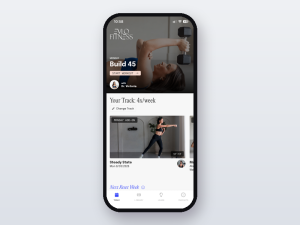
| 2 | Evlo Fitness | 9/10 | 8.5/10 | 8.0/10 | Fully tested | Building real muscle without loading your joints, every instructor a physical therapist | Anyone on a budget at $55.99 a month | $55.99/mo |
| 3 | Caroline Girvan | 9/10 | 7/10 | 7.6/10 | Fully tested | Serious structured strength, free on YouTube or $12.99 in the app | Beginners, and anyone needing menopause-specific coaching | Free or $12.99/mo |
| 4 | Fitbod | 9/10 | 6/10 | 5.8/10 | Sample tested | Lifters who know their form and want the load auto-progressed around their kit | Anyone who needs to be taught the movements | $15.99/mo |
| 5 | Flipping 50 | 8/10 | 8/10 | 7.8/10 | Data profile | Strength programmes staged separately for peri, meno and postmenopause | Anyone price sensitive at $69 a month | $69/mo |
| 6 | Centr | 8/10 | 8/10 | 7.4/10 | Sample tested | A polished all-rounder with real strength programming and a menopause track | Anyone wanting clinician-designed midlife content | $29.99/mo |
| 7 | trainwell | 8/10 | 8/10 | 6.9/10 | Data profile | A real human trainer writing and adjusting your plan around your body | Anyone who cannot justify $149 a month | $149/mo |
| 8 | Menovation | 8/10 | 6.5/10 | 7.7/10 | Fully tested | Real dumbbell loading inside a programme built entirely around menopause | Anyone wanting a large library or a polished interface | $28.99/mo |
The price column is worth reading across. Progressive strength is the one thing on this site that does not correlate with what you pay: the free option ranks third, and the $149 option ranks seventh.
Which strength training apps rank highest?
Ladder: built around progression rather than around classes
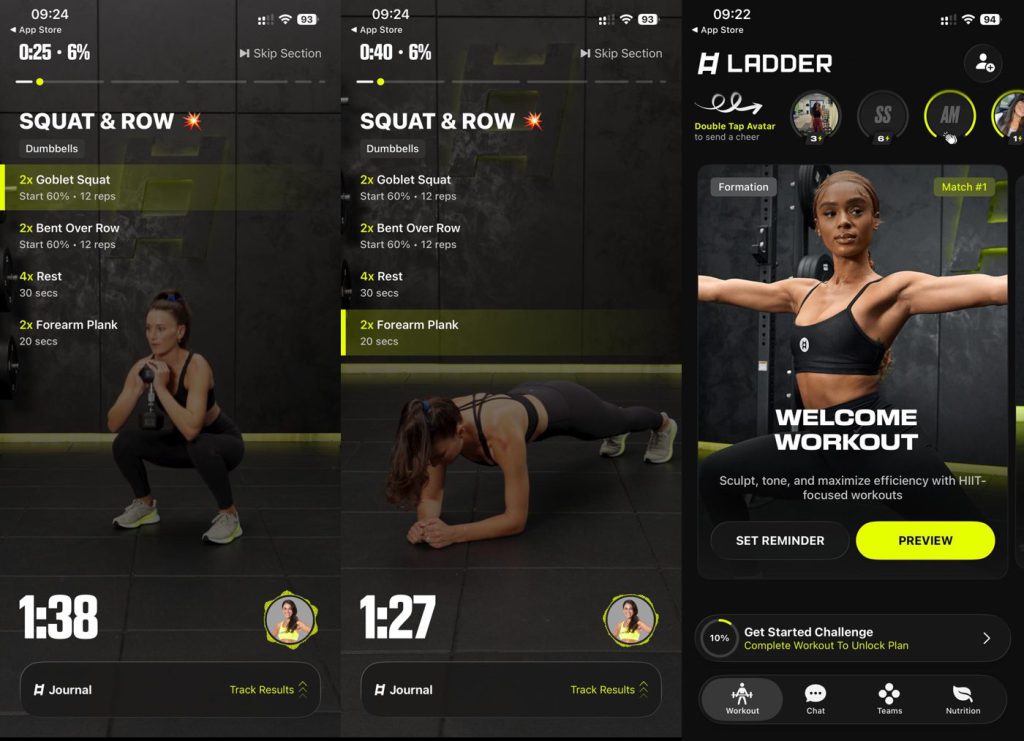
Coach-set weekly progression with load tracking, which is the mechanism this whole page is about
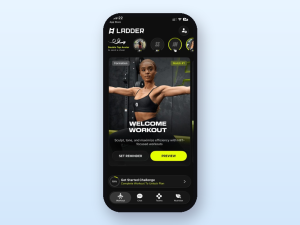
Ladder is a coach-led team strength app with named coaches and no clinicians on staff. Its programming is purpose-built for progressive overload: coaches set the week, you log your loads, and the weights move. It carries a Sample tested tier here rather than a full test.
Sampled by Katy Cole: Even before logging in I had a feeling Ladder is an app for building muscle, and that held up.
It ranks first because it scores top marks on both halves of the blend: the strongest progression model here, in the joint-best interface. Nothing else on the page does both.
Three things to weigh: it is iOS only, so Android users can stop reading. It is light on recovery content, which matters more in midlife than the app seems to think. And there is no menopause-specific programming at all. This is a strength app, judged as a strength app.
Best for: women who want their loads programmed and tracked by a coach, and who like the accountability of training alongside a team.
Cost: $29.99 a month for Pro, with higher tiers above that. The 7-day trial takes no card until it ends.
Evlo Fitness: the most muscle for the least joint stress
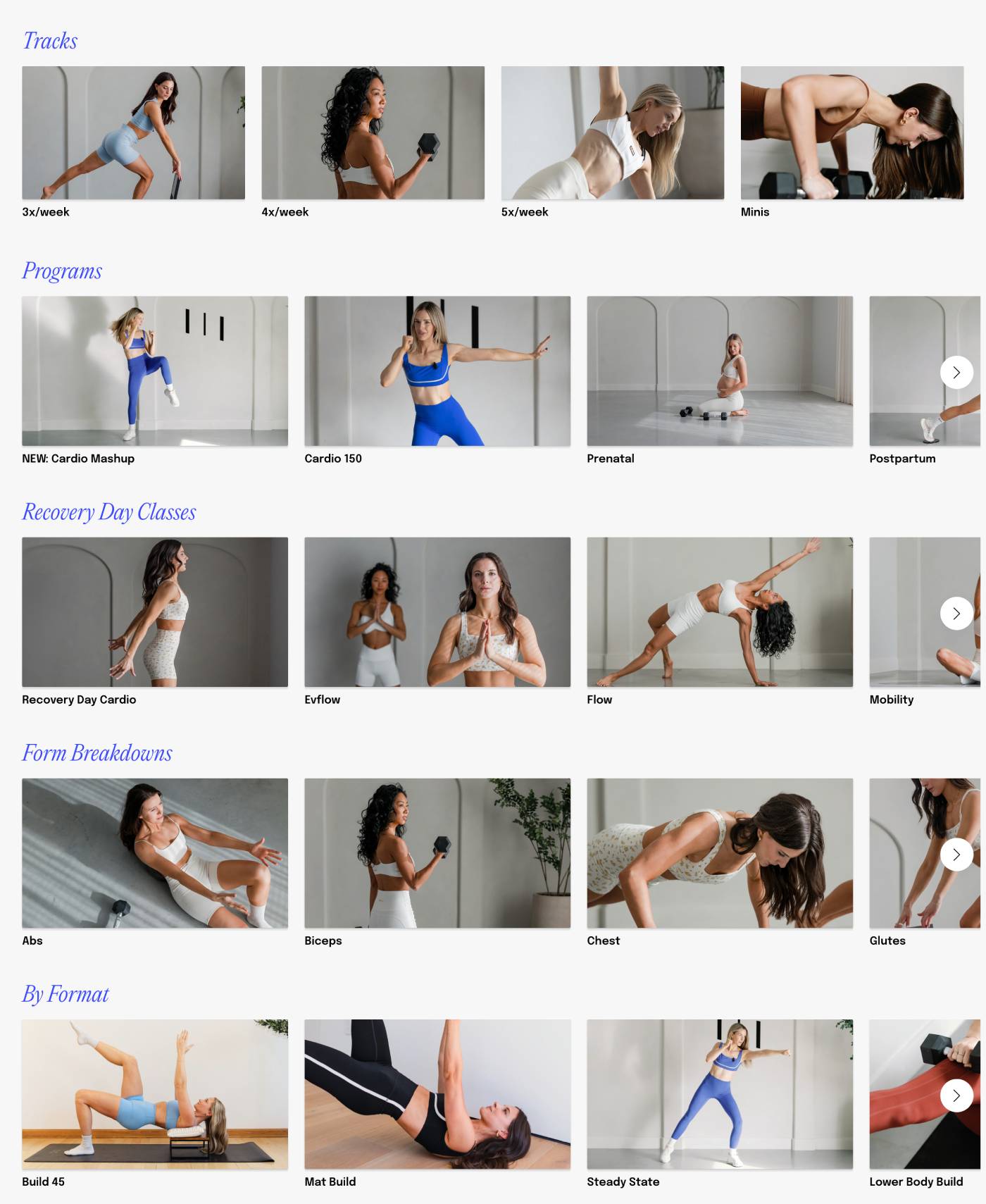
Every instructor holds a doctorate in physical therapy, and the training still takes you to failure
Evlo Fitness is led by Dr Shannon Ritchey, a doctor of physical therapy, and every instructor holds a DPT. The method uses resistance to failure with weight tracking, inside a joint-protective design with no jumping and no heavy axial loading.
That combination is the reason it is the only programme that appears near the top of both this page and our low-impact list. Most platforms trade one for the other.
Tested by Katy Cole: After 8 weeks I dropped 3 lb without changing my diet, felt soreness in muscles my usual training had stopped reaching, and came back stronger in my core and glutes than I had been in years. I later left to use shorter workouts with Burn360 and Caroline Girvan, then returned, because nothing else does what Evlo does for joint-friendly targeted muscle work.
The honest limitation: $55.99 a month is the second highest price on this page, and the sessions require attention rather than letting you drift through them.
Best for: women whose joints are the limiting factor but who refuse to give up on building muscle.
Cost: $55.99 a month with a 14-day free trial. The App Store still shows a legacy 7-day figure.
Caroline Girvan: the strongest free strength training anywhere
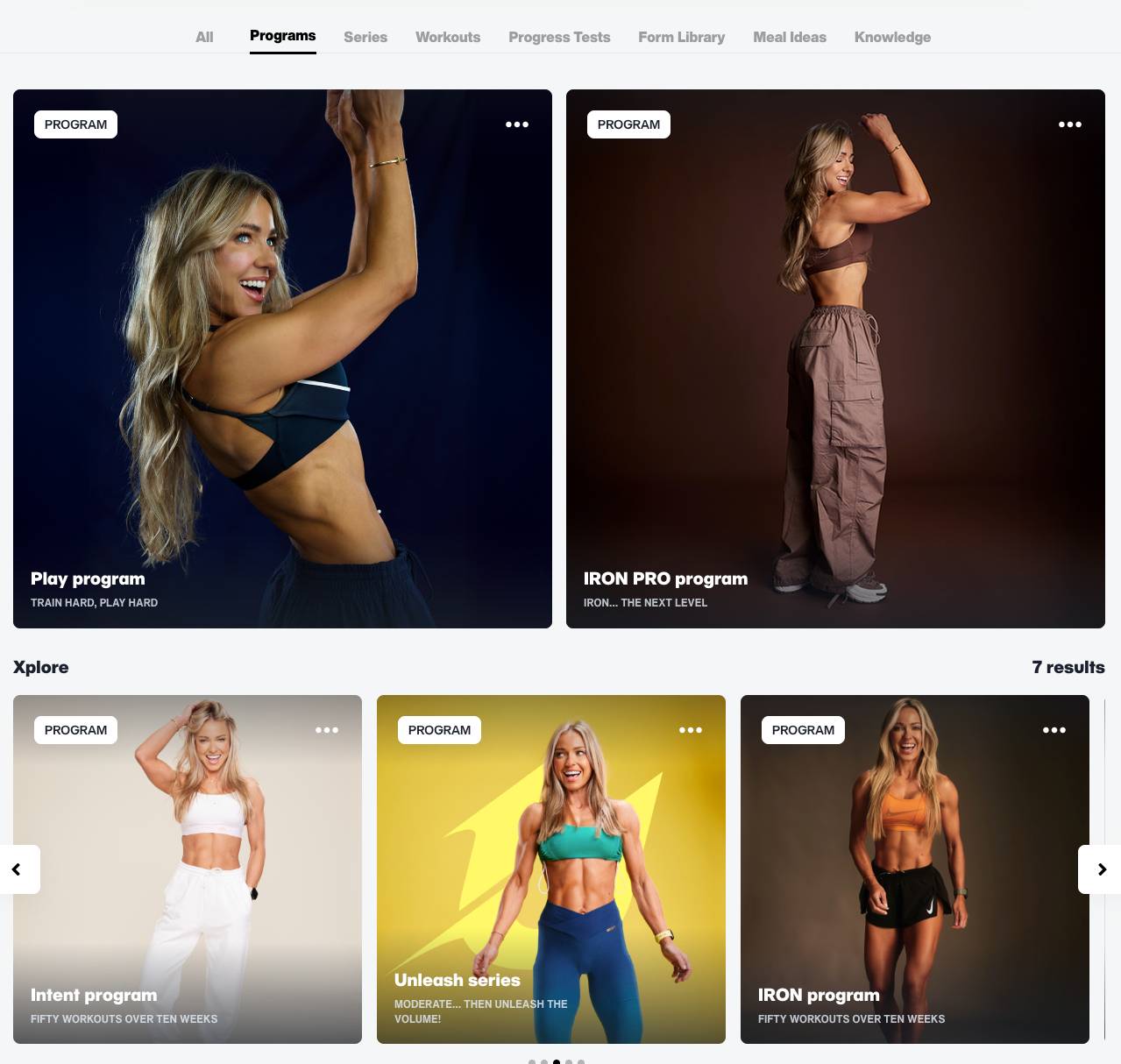
Genuinely structured progressive programmes, on YouTube, for nothing
Caroline Girvan is a certified personal trainer and MNU certified nutritionist with more than thirteen years in the field and around four million YouTube subscribers. Her programmes are properly structured blocks rather than standalone classes, which is what makes the free version genuinely usable as a strength plan.
Tested by Katy Cole: I went from 141 lb to 134 lb just by following her daily workouts consistently and eating healthily, with no restrictions.
There is no comparable free option in this category. If budget is the constraint, this is where the conversation should start rather than end.
Who should not start here: the programmes are demanding and the cueing assumes you already know the movements. There is also no menopause-specific coaching. If you are new to lifting, start somewhere gentler and come back to this in a few months.
Best for: women who already lift, or who are willing to learn fast, and who want serious programming at little or no cost.
Cost: free on YouTube. The CGX app is $12.99 a month, £9.99 in the UK, with a 14-day trial for new members.
Fitbod: the load is auto-progressed around whatever equipment you own
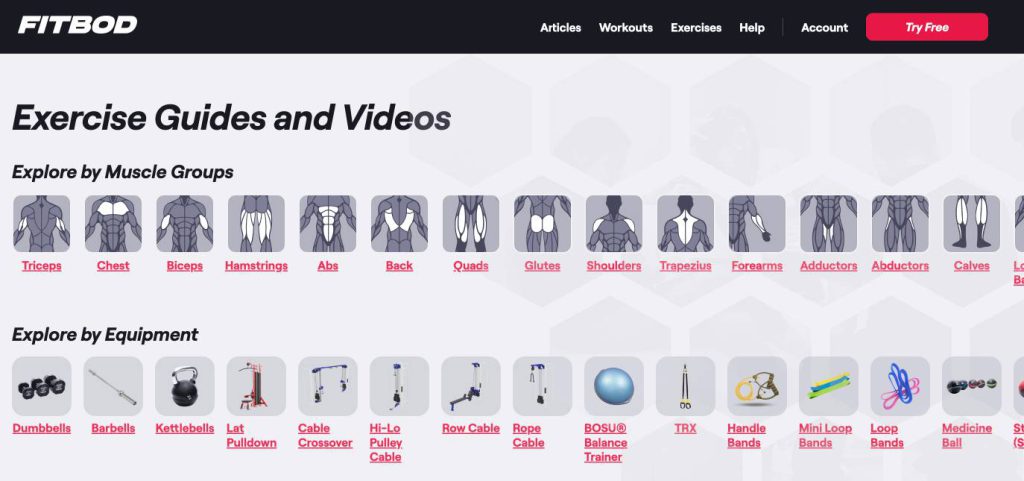
An algorithmic strength generator that adapts to your kit and your recovery, for those who already know form
Fitbod generates sessions and auto-progresses the load on them, adapting to the equipment you have and the muscles you have recently trained. Every exercise shows the muscles it targets.
Why its overall score is low, and why it still ranks fourth: Fitbod scores 5.8/10 overall, the lowest on this page. That number is dragged down by criteria this page deliberately ignores, chiefly the absence of any nutrition or menopause content. On the one thing you came here for, progressive strength, it scores 9/10, level with the top of the page. This is exactly the case the blended ranking exists to handle.
The honest limitation: it will not teach you the movements. The app assumes competent form and gives you a list, not a coach. If you would not be confident performing a Romanian deadlift unsupervised, this is the wrong choice.
Best for: women who already know how to lift and want the programming handled around whatever equipment they own.
Cost: $15.99 a month, with a legacy $12.99 promotional rate still appearing. There is a 7-day trial and a limited free tier.
Flipping 50: strength staged separately for each phase
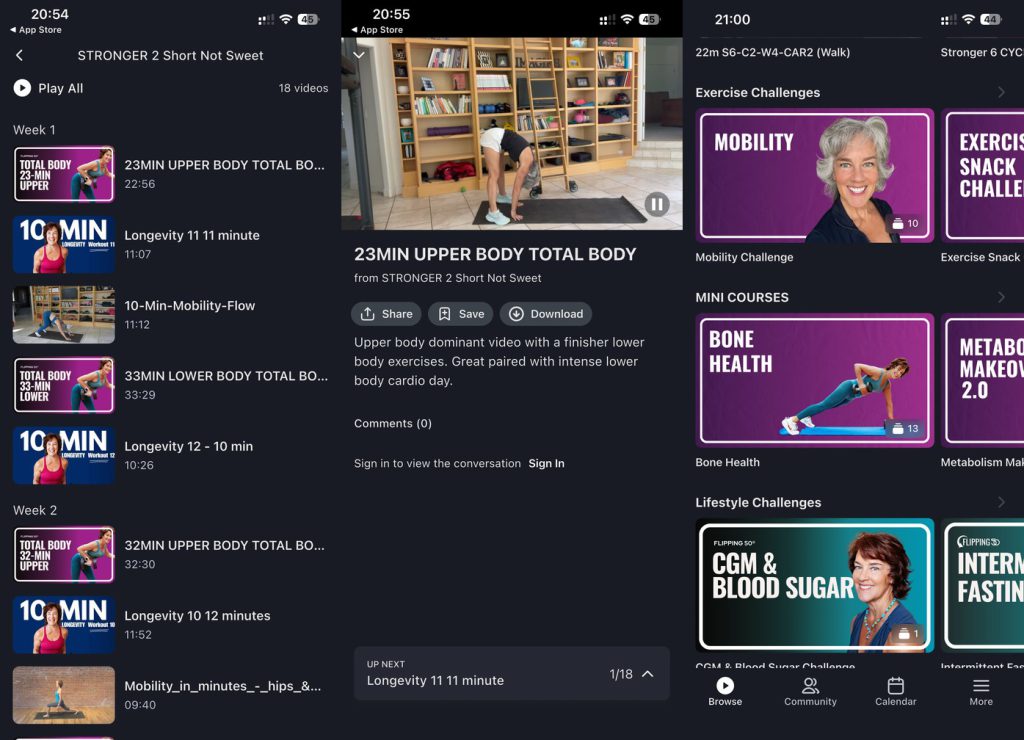
Twelve-week programmes built distinctly for perimenopause, menopause and postmenopause
Flipping 50 is built by Debra Atkinson, who holds an MS in exercise and sport psychology, a BS in exercise science and an NSCA CSCS. Her Medical Exercise Specialist credential is self-reported and the certifying body is not confirmed. It carries a Data profile tier here rather than a tested one.
I have not tested this one first hand. What follows comes from the research profile, not from using it. What earns it fifth place on a strength page is the staging: the twelve-week STRONGER programmes are built separately for each phase of the transition, drawn from research featuring menopausal women, alongside a bone-health course and loaded strength work. Most platforms treat the whole transition as one audience.
What a research profile cannot judge: whether the progression actually feels well calibrated in practice. At $69 a month this is the second most expensive option here, and a free trial is offered only occasionally with the length unstated, so you cannot easily look before you buy.
Best for: on the research, women who want strength as the method and would rather follow a plan built for their specific phase.
Cost: $69 a month or $549 a year on the website. Apple in-app annual is $649, and the site annual also renews at $649.
Centr: a polished all-rounder that takes strength seriously
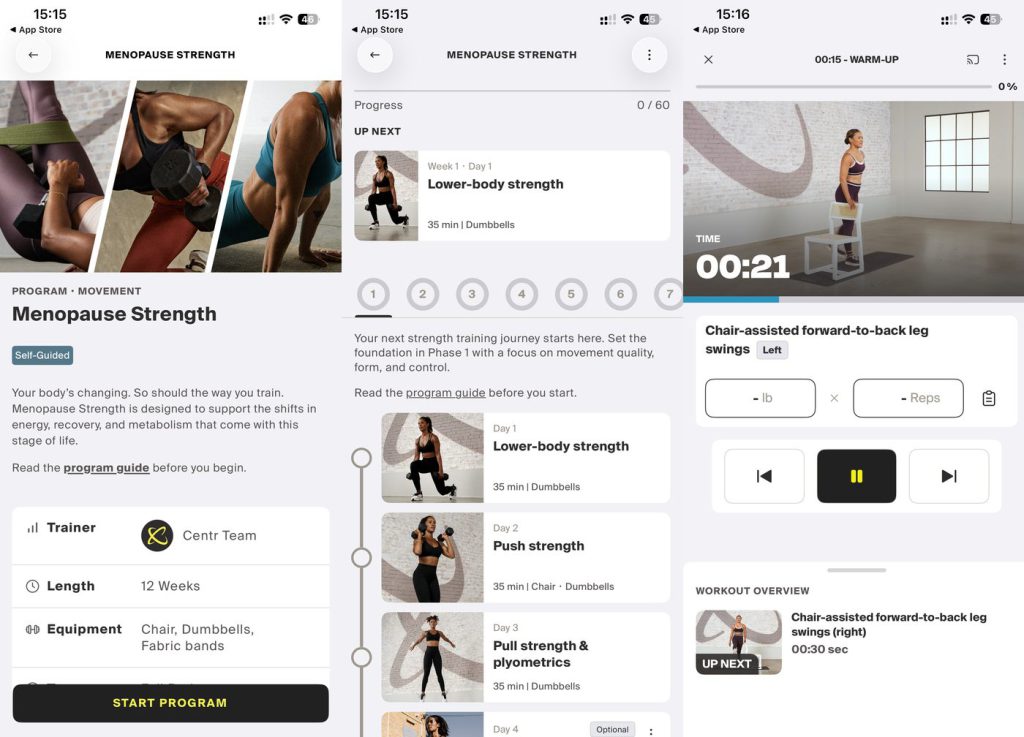
Real progressive programming inside an app most people would buy for other reasons
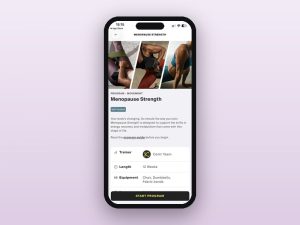
Centr is Chris Hemsworth’s platform, with head trainer Luke Zocchi and a broad roster. Its strength programming is more substantial than the celebrity framing suggests, and it carries a 12-week Menopause Strength programme, though that content is coach-designed rather than clinician-led.
Sampled by Katy Cole: I logged into Centr and it is a well-designed app with a huge range of programmes and workouts, including a dedicated Menopause Strength programme, which I liked.
The honest limitation: the menopause layer has no named clinician behind it, and the breadth that makes Centr appealing also means the strength work sits alongside a lot of other content competing for your week.
Best for: women who want one polished app covering strength, nutrition and mindfulness, without dropping to a maintenance-level programme.
Cost: $29.99 a month with a 7-day trial.
trainwell: a real human writing your programme
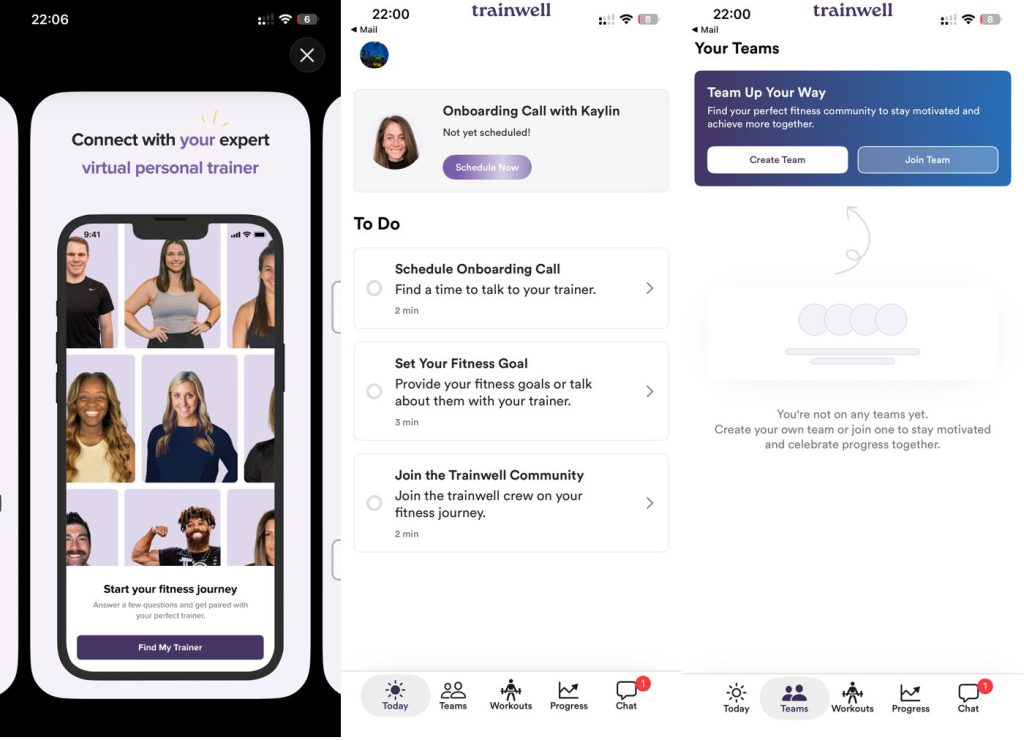
One-to-one remote personal training, which is a different product from everything else here
trainwell, rebranded from CoPilot in 2024, pairs you with a certified human trainer who builds and adjusts your plan. It carries a Data profile tier here rather than a tested one.
I have not tested this one first hand. What follows comes from the research profile, not from using it. What places it on a strength page is that a real trainer can tailor progression to a midlife body in a way no algorithm on this list attempts, adjusting for a bad knee, a poor sleep week or a symptom flare as it happens.
The obvious caveat is the price: $149 a month, billed in three-month increments, is five times the median subscription here and more than double the next most expensive. Whether one-to-one coaching is worth that against Ladder at $29.99 is a judgement about your budget and how much you need accountability, and it is not one a research profile can make for you. The 14-day free trial is unusually generous for the price point and is the right way to find out.
Best for: on the research, women who have tried self-directed apps and know that what they actually need is a person expecting them on Thursday.
Cost: $149 a month, billed in three-month increments, with a 14-day free trial.
Menovation: real loading inside a menopause-first programme
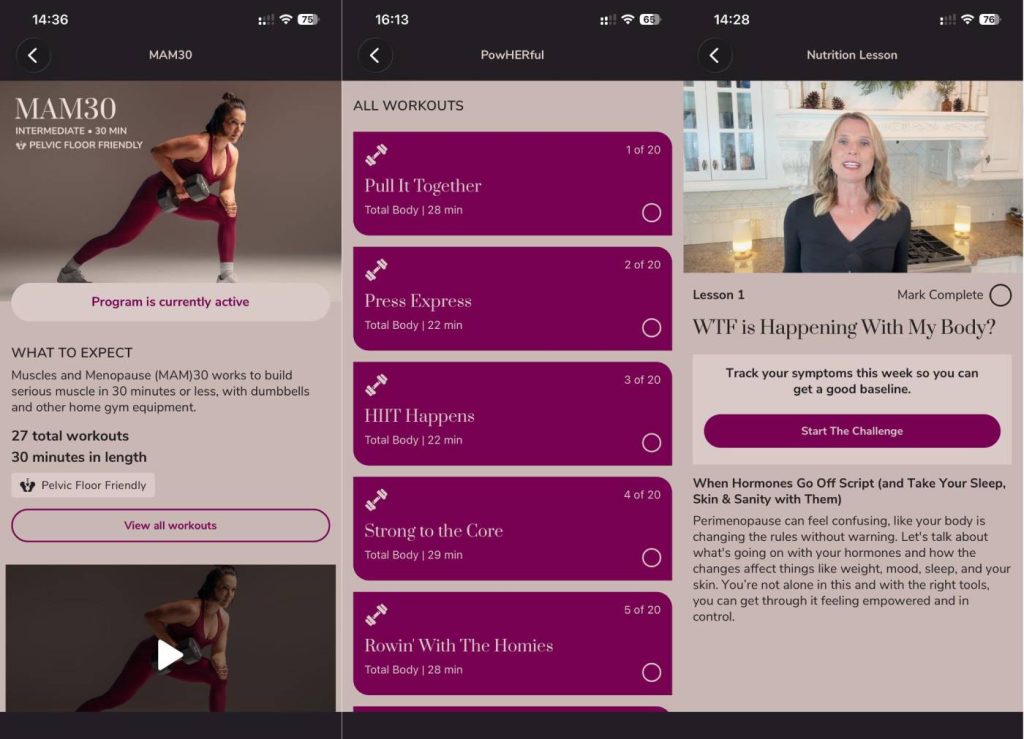
The only programme here where progressive strength and menopause programming are the same product
Menovation is led by Ashley Nowe, a Certified Menopause Coaching Specialist, with a company-reported clinician roster. Its PowHERful strength programme uses real dumbbell loading rather than the light weights that usually accompany menopause branding.
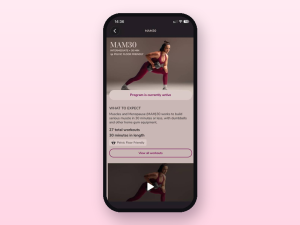
Tested by Katy Cole: The PowHERful programme with Kaitlin Heaney delivered real results over five weeks. I dropped from 141 lb to 136 lb and increased my weights from around 11 lb to 13 lb on upper body and 17 lb to 20 lb on lower body per hand. After six to eight weeks across PowHERful, MAM30 and the barre workouts, the educational content alone makes Menovation worth exploring.
Those numbers are the clearest evidence of progressive overload I recorded on any programme in this list, and they came from a platform most people would categorise as a menopause app rather than a strength app.
The honest limitation: the interface is dated and the library is still growing.
Best for: women who want to lift properly without leaving menopause programming behind.
Cost: $28.99 a month, $69.99 quarterly or $199.99 a year. The trial is 8 days at the checkout, although the homepage says 7.
Which strength app is right for you?
If you want progression handled for you, Ladder, provided you have an iPhone.
If your joints are the problem, Evlo Fitness.
If you want to spend nothing, Caroline Girvan, and be ready to work.
If you already lift and just want the programming, Fitbod at $15.99.
If you want strength and menopause programming together, Menovation.
If what you actually need is a person, trainwell, and use the 14 days to find out.
Whichever you choose, write down what you lifted. If you cannot answer that question in eight weeks’ time, the app is not progressing you, whatever it says on the tin.
How did we choose these eight strength apps?
Every programme in our library carries a progressive strength score, judged on whether the programme uses genuine progressive overload, whether loads are tracked, and how high the ceiling goes. Twenty-two of the 77 published programmes score 6.5 or above, our threshold here.
Those are ranked on that score, weighted 70%, blended with ease of use at 30%. The two are effectively independent, correlating at only r = 0.09, so the blend adds information rather than restating the same quality.
We deliberately did not rank on overall score. Overall includes nutrition, menopause content, recovery and value, and a woman searching for a strength app is not asking about those. That is why Fitbod ranks fourth on a 5.8/10 overall, and why several higher-scoring platforms are absent.
Three programmes just missed the cut on a blend of 7.45 against 7.55 for eighth place: Sweat, Pvolve and BODi, each scoring 7 for progressive strength. We would rather name them than let a close call look like a verdict.
Six of the eight I have used, three across a full test and three sampled. Flipping 50 and trainwell are assessed from published information only, are labelled as such, and carry no first-hand observation.
We buy our own subscriptions. Some links on this page earn a commission, which never affects a score or a position; scores are set in each programme’s own review before any page like this is built.
What research is this page based on?
- Greendale GA, Sternfeld B, Huang M, et al. Changes in body composition and weight during the menopause transition. JCI Insight, 2019.
- Ramos-Campo DJ, Andreu-Caravaca L, Carrasco-Poyatos M, Benito PJ, Rubio-Arias JÁ. Effects of Circuit Resistance Training on Body Composition, Strength, and Cardiorespiratory Fitness in Middle-Aged and Older Women: A Systematic Review and Meta-Analysis. Journal of Aging and Physical Activity, 2022.
Nothing on this page is medical advice. If you have a diagnosed condition or injury, check with your doctor or a physiotherapist before starting a loaded strength programme.
Frequently asked questions about strength training apps
Ladder, because it is built around progression rather than around classes: coaches set the week, you log your loads, and the weights move. Evlo Fitness is the pick if your joints are the limiting factor, as every instructor holds a doctorate in physical therapy and the method still takes muscles close to failure. Caroline Girvan is the strongest free option.
An app works provided it uses genuine progressive overload and tracks your loads. The practical test before you pay is whether the app knows what you lifted last time; if it does not record the load, it cannot progress it, and any progression is something you are doing yourself in a notebook. If what you actually need is accountability rather than programming, trainwell pairs you with a human trainer at $149 a month.
Strength improvements, meaning more reps or heavier weight, usually arrive within two to three weeks. Visible body composition change typically takes six to eight weeks of consistent training. In our own testing of Menovation's PowHERful programme, weights moved from around 11 lb to 13 lb on upper body and 17 lb to 20 lb on lower body across five weeks.
It is one of the best-supported interventions there is. Pooling sixteen studies in the British Journal of Sports Medicine in 2022, Momma and colleagues found muscle-strengthening activity was associated with a 10 to 17% lower risk of all-cause mortality, cardiovascular disease, total cancer, diabetes and lung cancer. Sá and colleagues reached similar conclusions for postmenopausal women specifically in Menopause in 2023. Discuss any new programme with your doctor if you have a diagnosed condition or injury.
Because this page deliberately ignores nutrition, menopause content, recovery and value, none of which is what someone searching for a strength app is asking about. Fitbod ranks fourth on a low overall score because its overall is dragged down by criteria irrelevant to this page, while on progressive strength it scores level with the top.
A pair of adjustable dumbbells is the practical minimum, and the range you need grows as you get stronger. A bench helps for several of the programmes here. Caroline Girvan's primary programmes assume barbell access for the heaviest work, though much of the library is dumbbell-based.
Where should you read next?
- Our full Evlo Fitness review, including the eight weeks behind its position here.
- Our full Caroline Girvan review, if the free route appeals.
- How we score, if you want to see how the nine criteria and the capability scores are built.