
£19.99/month or £119.99/year · 14-day free trial · Priced locally in £, €, $, CAD$ and AUD$ (USD fallback) · No dedicated perimenopause or menopause programme
FIIT Review 2026: Quick Answer
Quick Verdict
Worth it for women over 40 navigating perimenopause or menopause? Not as a primary platform: FIIT has no programme designed for this life stage, no in-class modifications when you need to scale a movement, and a video player without rewind or fast-forward, which becomes a significant problem given the cognitive symptoms (forgetfulness, attention difficulty) that affect up to 70% of women during the menopause transition.[4]
FIIT earns 6.2/10 after a 14-day Unlimited trial conducted by a woman in her 40s navigating perimenopause. The platform’s strengths (detailed filtering, named trainers, free Group Classes tier, body activity profile) are real but generic to a general-fitness audience. Its limitations for the HerDailyFit audience are specific and structural: no peri/menopause programming, no in-class modifications for the joint pain that affects more than 50% of women in the menopause transition,[9] and a UX that punishes the kind of forgotten-pause interruption that is quite frustrating when it happens.
Start here: if you are perimenopausal and want a programme designed for this life stage, look at Pvolve first. If you are an experienced exerciser without specific peri/meno needs or know how to structure your program to be aligned with your needs, FIIT’s 14-day trial is the lowest-risk way to evaluate the platform.
Is FIIT right for you?
FIIT is strongest for building bone density (5.5 out of 10, against a 5.1 average across the 77 programmes scored) and weakest for nutrition support (1.0 against 4.0).
| Question | Verdict | Rating | Score |
|---|---|---|---|
| How it suits a perimenopausal body | |||
| Is FIIT good for pelvic floor problems?Based on pelvic floor support and low-impact design | Low, and worse than mostmost score 4.6/10 | 3.5 / 10 | |
| Is FIIT genuinely built for perimenopause and menopause?Based on menopause programming, hormone awareness, education and expert credibility | Low, and worse than mostmost score 3.3/10 | 1.8 / 10 | |
| Is FIIT good for painful joints?Based on low-impact design and recovery provision | Low, and worse than mostmost score 6.2/10 | 4.0 / 10 | |
| Is FIIT manageable when your energy is low?Based on recovery provision and mind-body support | Low, and worse than mostmost score 5.7/10 | 3.5 / 10 | |
| Is FIIT good if you are new to strength training?Based on beginner on-ramp and mind-body support | Low, and worse than mostmost score 6.1/10 | 4.0 / 10 | |
| Is FIIT good for building bone density?Based on bone loading and progressive strength | Moderate, about the same as mostmost score 5.1/10 | 5.5 / 10 | |
| Does FIIT help with nutrition?Based on midlife nutrition support | Low, and worse than mostmost score 4.0/10 | 1.0 / 10 | |
| How it performs as a product | |||
| Can you fit FIIT into a busy week?Based on time efficiency | Strong, about the same as mostmost score 7.6/10 | 7.5 / 10 | |
| Is FIIT worth the money?Based on value for money | Moderate, and worse than mostmost score 6.9/10 | 6.0 / 10 | |
Jump to Section
Why I Tested FIIT
I tested FIIT for 14 days on its Unlimited free trial. I am a woman in my 40s navigating perimenopause, with a previous meniscus injury that still tells me when it disapproves, and the changes most women in this life stage notice: a softer middle, slower recovery, joints that need real attention. I train regularly. I was looking for variety, specifically a different mix of workouts suitable for women over 40 who already train but want to mix things up.
FIIT was not new to me. I tried it about 5 to 6 years ago, before any meniscus injury, and at that time I remember loving it. The trainers, the production, the boutique-studio energy. Coming back to it now, I wanted to see whether it still worked for me at this life stage. The workouts have not changed. My needs have. Possibly, it is more suitable for a younger audience than the one I belong to now, and that distinction shapes everything that follows.
I am a bit sad I did not continue. What stopped me is a specific UX choice, and it is worth explaining up front so the rest of the review makes sense.
Where I have not personally tested something (the AirBike, the rower, the postnatal Fiit Mum programme, anything that needed a tracker), I will say so.
What FIIT Actually Is
FIIT is a general-fitness streaming app, not a perimenopause or menopause programme. The platform was launched in 2018 by Daniel Shellard, Sammi Adhami, and Ian McCaig with the mission of bringing the experience of London boutique fitness studios into people’s homes.
The platform is filmed in a signature studio with coordinated LED lighting. According to FIIT, the app has reached more than 20 million workouts completed across 175+ markets since launch, with a 4.9/5 average across more than 45,000 App Store ratings.[1]
The platform offers more than 2,000 on-demand classes and 40+ training plans, organised into three pillars FIIT calls “studios”:
- Cardio: HIIT, Dance HIIT, Circuits, Combat, Endurance, Intervals, plus connected machine classes for treadmill, AirBike, bike and rower
- Strength: Bodyweight, Dumbbells, Kettlebells, Functional Strength, Push Pull, Abs and Core, plus HYROX-specific training
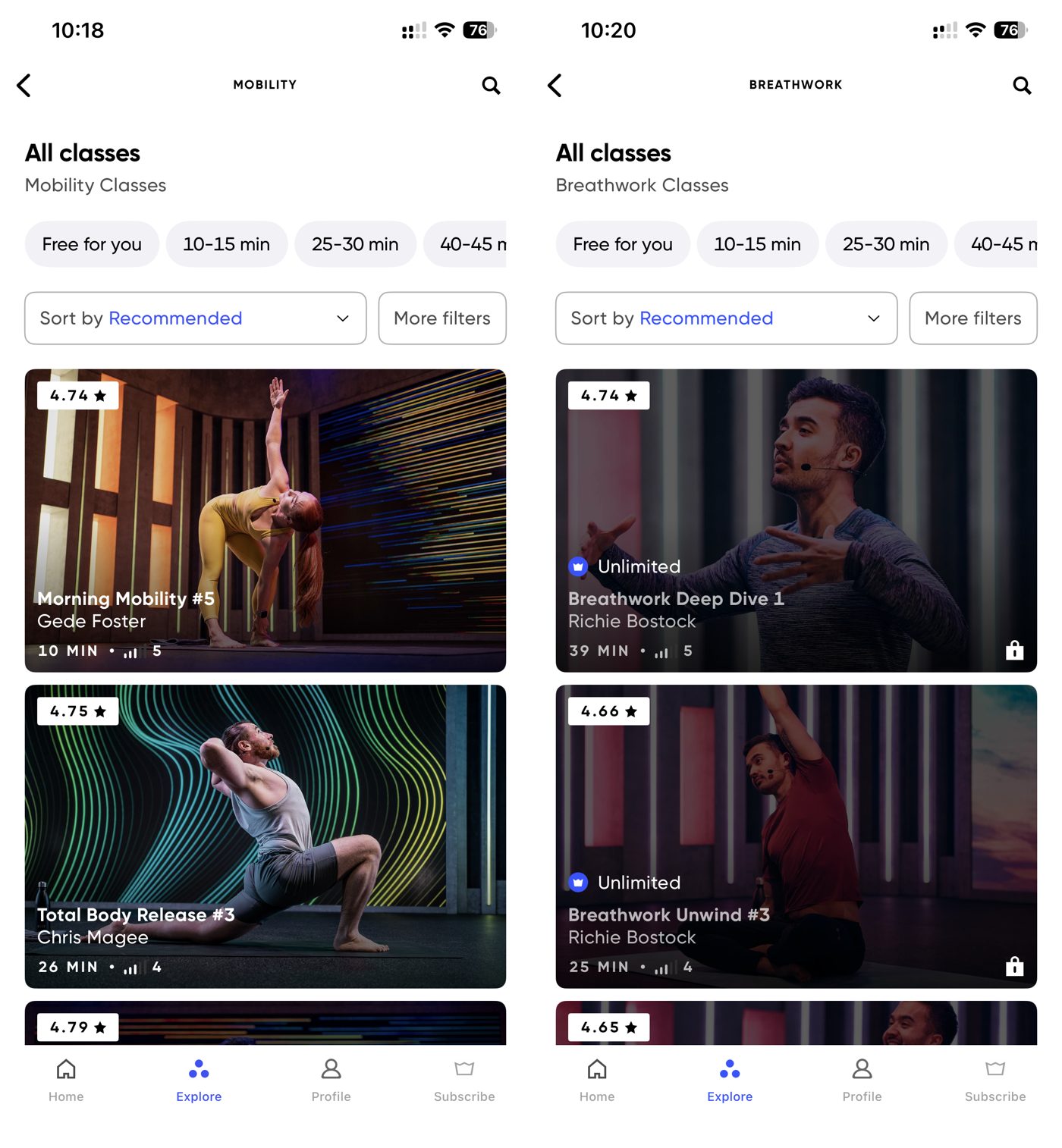
- Rebalance: Yoga (Vinyasa and Athletic), Pilates, Barre, Stretching, Mobility, Breathwork
Workouts run at 10, 25, 40 or 60 minutes. Most strength classes use timed intervals rather than rep counts, so you can scale weight without falling behind. FIIT has its own tracker (the FIIT Tracker 2.0) for live heart rate, calorie burn and rep counting, and the app integrates with 30+ other fitness trackers. As of 2026 the Unlimited subscription also includes complimentary digital subscriptions to Men’s Health and Women’s Health magazines.[1]
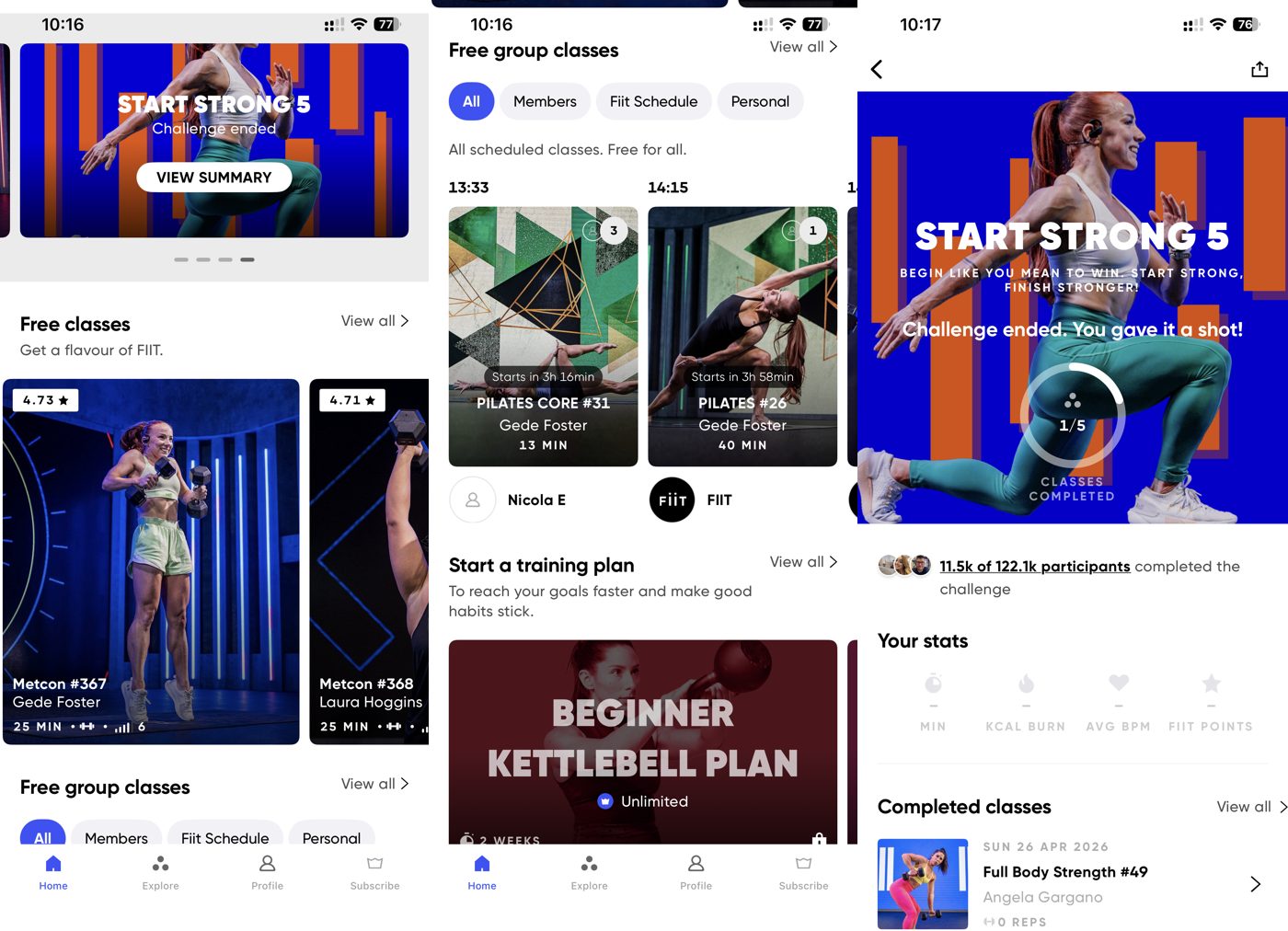
FIIT now offers a permanently free tier called Group Classes, with daily scheduled live classes and no card details required.
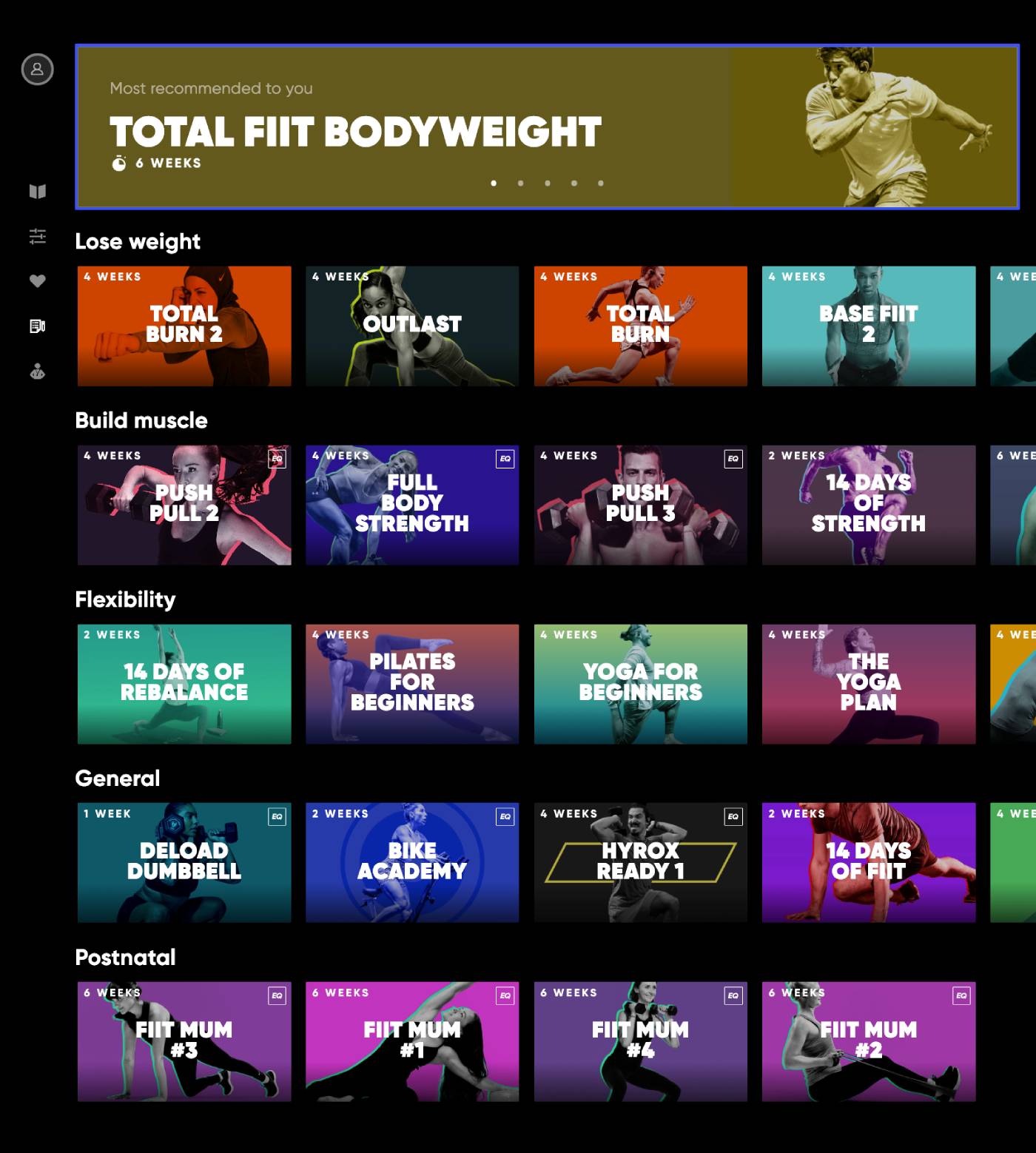
What this means for the HerDailyFit audience: the platform’s training plans are organised around general-fitness goals (fat loss, strength, running, yoga, bodyweight) and a 24-week postnatal Fiit Mum programme, but nothing designed for the specific physiology of perimenopause or menopause. Women in this life stage benefit most from programmes that account for declining estrogen’s effects on muscle, bone, joints and cognition,[9] and FIIT does not address any of these directly.
The Rewind Question
FIIT’s video player does not let you rewind, fast-forward, or scrub through a class. This is the thing that ended my trial.
Once a class starts, I cannot rewind or move forward through the video. You are committed to playing it from start to finish in real time. You can pause and resume, but you cannot move the playhead. According to FIIT’s own help centre, this is a deliberate design choice “to make sure you train safely and complete the warm up and cool downs. It also affects the tracking feature embedded into all classes.”[2]
The complaint appears across Google Play and Trustpilot reviews, often from users who otherwise like the app: they would have continued past the free trial except they could not preview classes or recover from mid-class interruptions.[3]
The frustration is two-pronged. First, you cannot preview a class before committing to it. Apple Fitness+ lets you scrub through a preview to see whether a workout is what you want. FIIT does not. There is a Class Breakdown panel below the video that lists the moves, which helps if you read text well, but if you are a visual person like me you want to see how the trainer cues something, what the pace looks like, whether the modifications are credible. The Class Breakdown gives you words. It does not give you the workout.
Second, and this is where it became a real problem: on three separate occasions during my trial, I was interrupted mid-workout. Once a delivery arrived, once my phone rang and I picked up, once there was a technical issue. On each occasion, I forgot to pause the app before dealing with the interruption. When I returned, the workout had progressed past where I had stopped, and there was no way to move back. I had to either start over or finish with my own routine. After the third occasion, I gave up on the platform.
This is the kind of thing that happens to anyone. Phones ring, deliveries arrive, kids interrupt, kettles boil. Most apps let you nudge the playhead back to where you were. FIIT does not, and the consequence is that an everyday interruption either ends your workout or forces you to restart it.
We are all adults and the platform should let us decide whether we will complete the warm-up and cool-down. Treating users as if they cannot be trusted to make good training decisions is a paternalistic UX choice in a paid app, particularly when alternatives like Apple Fitness+, Pvolve and Sculpt Society all let you scrub freely.
Filtering for Perimenopause-friendly Classes
Filtering matters in perimenopause because joint pain, energy levels and impact tolerance vary day to day during the menopause transition. More than 70% of women experience musculoskeletal symptoms during peri/menopause and approximately 25% are significantly disabled by them,[9] which means the ability to find a low-impact, joint-aware class on a difficult day is a meaningful feature.
FIIT’s filter system is detailed. You can filter by class type (HIIT, dumbbell, kettlebell, Pilates, yoga, mobility and many more), body part (arms, abs, legs, full body, glutes), duration (10, 25, 40, 60 minutes), equipment (bodyweight, dumbbells, kettlebells, AirBike, treadmill), level (entry, beginner, intermediate, advanced), trainer, and goal. The filters stack and load quickly. In my trial I was able to find a class matching exactly what I wanted to do, including filtering specifically for low-impact options when my knee was complaining.
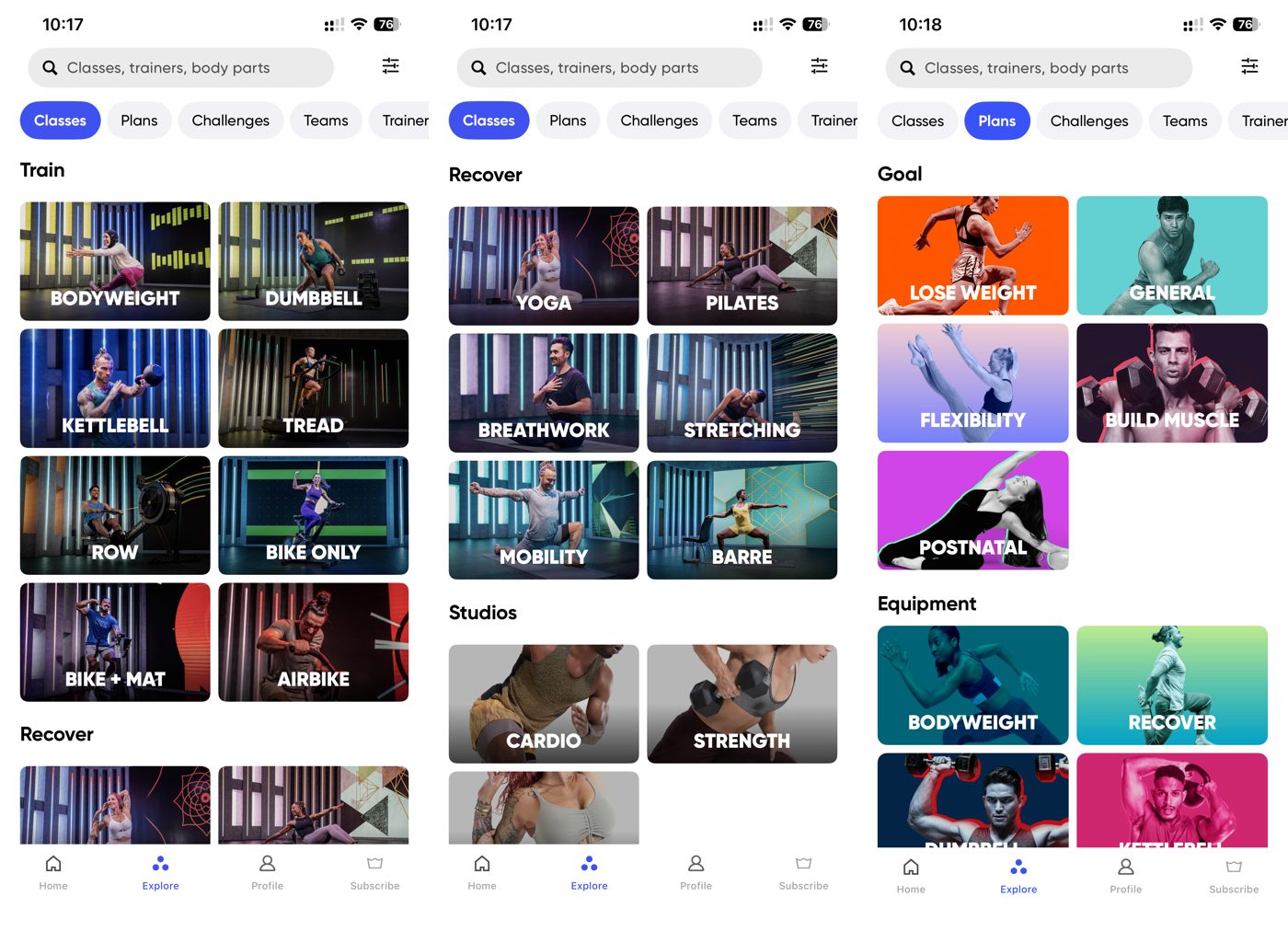
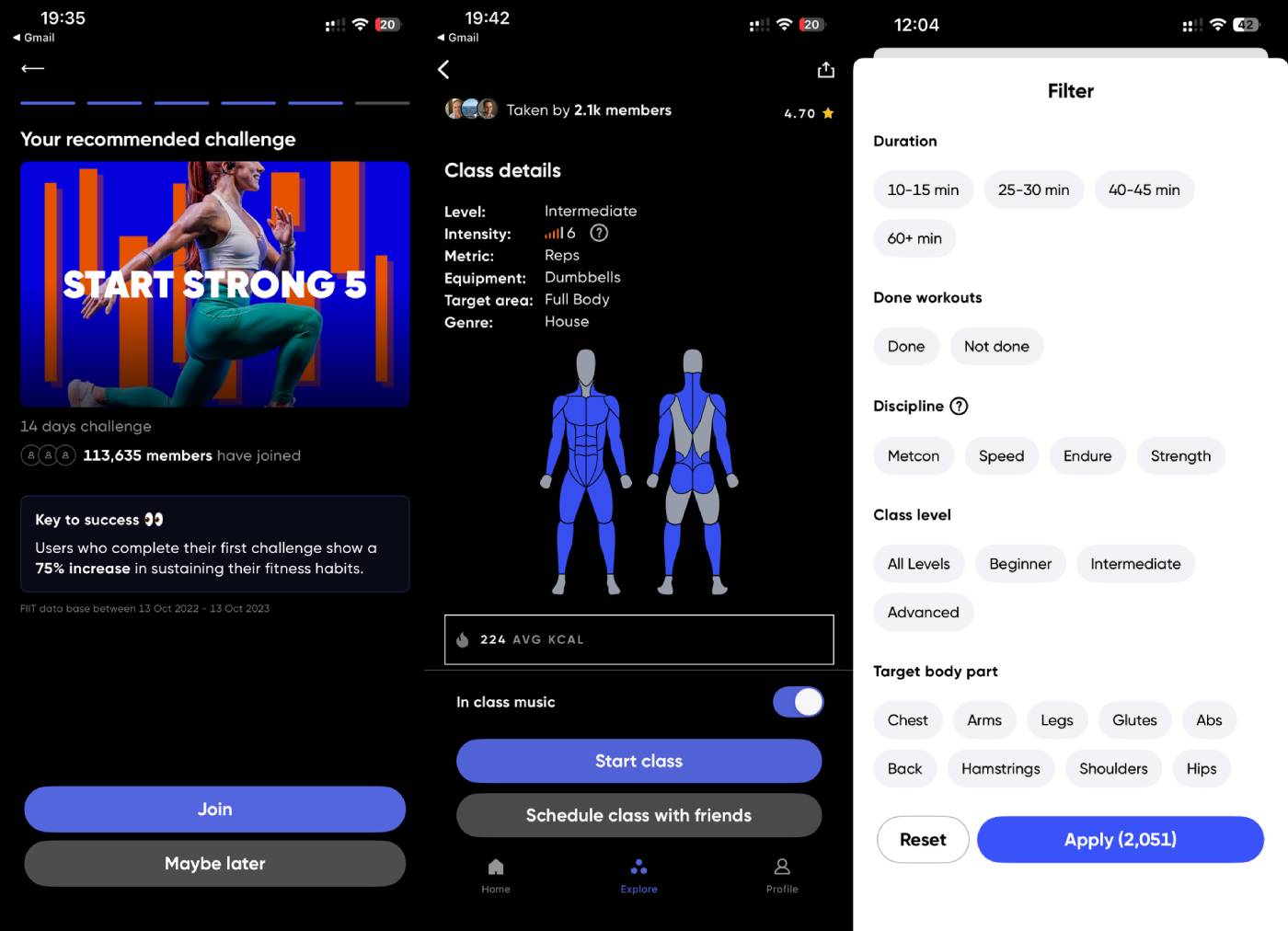
The class details panel before each workout shows average calorie burn, the body areas it targets shown on a body diagram, the intensity rating, the equipment needed, the trainer, and the music style. You can also choose whether to work out with music and see who is winning the leaderboard. I do not have a fitness tracker so I could not take part, but if you do and you are competitive, this is a fun gamification feature. For a perimenopausal user evaluating whether a class fits today’s energy and joint state, this is useful structured information.
You can also save videos to your favourites and follow them later, which makes self-built programmes easier to manage once you find classes that work.
What FIIT does not give you is a video preview. Apple Fitness+ shows a 30-second teaser of every workout before you start. FIIT shows you words. If you are following a structured plan, there is sometimes an intro or “what to expect” video at the start of the plan, but for individual classes outside a plan, you commit blind.
Combined with the no-rewind rule, this means the filter system is doing more work than it should: it has to predict not just whether the class type fits, but whether the pacing, music, and trainer voice will work for you on this day, because once you start you cannot move out of the section that does not.
Practical takeaway for perimenopausal users: the low-impact and joint-aware filtering is a genuine asset on days when musculoskeletal symptoms are present, but the absence of video preview combined with the no-rewind UX undermines what good filters could otherwise unlock.
This is the perimenopause and menopause assessment, and it is separate from the overall score. Twelve things a programme either does for a midlife body or does not, each scored out of 10 with my reasoning next to it. Together they produce a single menopause fit score, and that becomes one of the nine categories in the overall scoring below.
How FIIT Fits Perimenopause, Menopause & Beyond
Women Over 40 is our most important criterion, and here's the full breakdown behind it.
FIIT is strongest for progressive strength, low-impact and bone loading, and weakest for menopause programming, hormone awareness, menopause education, midlife nutrition, pelvic floor, recovery & deload, expert credibility, mind-body support and beginner on-ramp, in our menopause and midlife capability assessment for women over 40.
At a glance
| Capability | Score | Rating | Why |
|---|---|---|---|
| Right training for a midlife body | |||
| Low-impact | 5/10 | Some | Low-impact filter/Pilates/bike exist; library defaults mid-high HIIT. |
| Progressive strength | 6/10 | Some | Solid dumbbell/kettlebell studio; no structured overload tracking. |
| Bone loading | 5/10 | Some | Resistance + impact present; no bone-specific programming. |
| Recovery & deload | 3/10 | Minimal | Body-activity diagnostic only; no periodisation or deload. |
| Built for menopause | |||
| Menopause programming | 1/10 | None | No perimenopause/menopause programme. |
| Pelvic floor | 2/10 | None | Only postnatal + general Pilates; no peri/meno focus. |
| Hormone awareness | 1/10 | None | No cycle, readiness, or hormonal awareness. |
| Menopause education | 1/10 | None | Zero menopause education content. |
| Expert credibility | 4/10 | Minimal | Credentialed trainers; no menopause experts or study. |
| Whole-woman support | |||
| Mind-body support | 4/10 | Minimal | Breathwork/Pilates/yoga present; no structured meditation programme. |
| Beginner on-ramp | 4/10 | Minimal | Beginner classes, but fast pace, no rewind/mods hurt. |
| Midlife nutrition | 1/10 | None | No nutrition guidance. |
ScaleBest-in-classStrongSomeMinimalNone
What the sources say: Agree high-quality HIIT/cardio general app (praised by mainstream for general fitness); no peri/meno programming, no nutrition. Lower score reflects the women-40+ lens generic reviews never apply.
These are evidence-informed suitability ratings, not clinical measurements. They combine exercise science with product-specific research and, where indicated, hands-on testing, alongside multi-source verification, and are approximate. Individual response varies. A starting point, not medical advice. How we score menopause fit
What I Actually Tested
Over 14 days I worked through what felt like a representative sample of the FIIT library, with the explicit goal of testing whether the platform fits a woman in her 40s with a meniscus history. My setup at home: a mat, dumbbells (heavy and medium), a 2x2m space, my phone casting to a TV, a treadmill in the room, no fitness tracker.
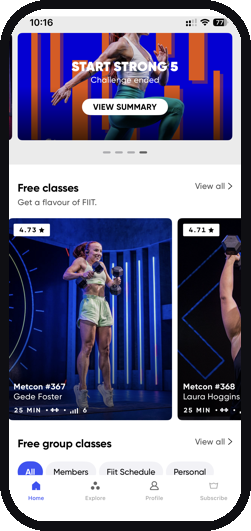
The recommended training plan I was given when I signed up was Bodyweight for Fat Loss. It did not appeal to me. I am not training for fat loss, I am training for strength and maintenance through perimenopause, and the recommendation suggested the onboarding quiz had not really understood what I needed. Rather than follow a plan that did not fit, I used the filter system to build my own programme: 2 strength sessions, 2 Pilates sessions, and 1 cardio session. I built this without truly understanding what would be in each video, which became its own problem.
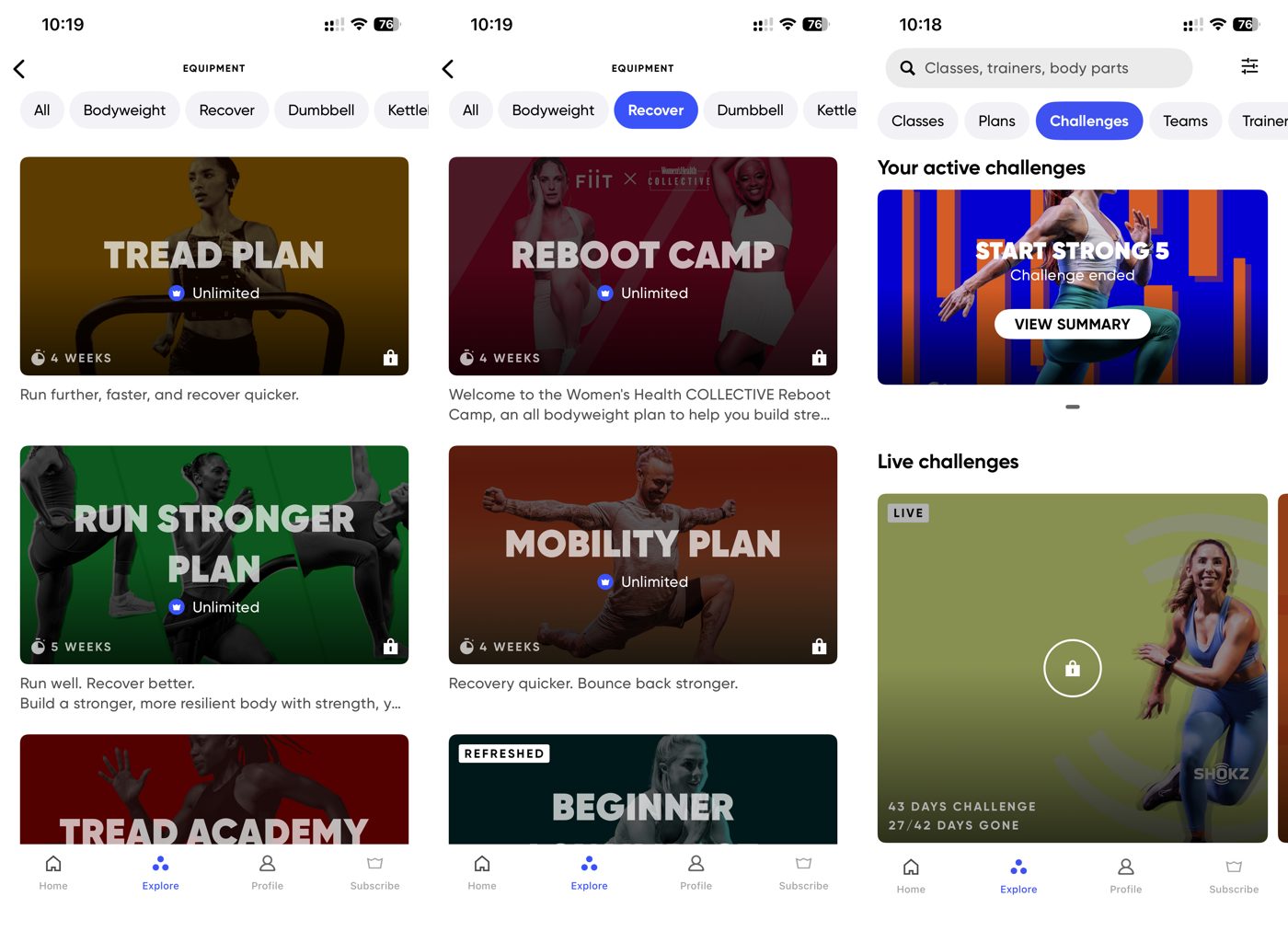
Sessions tested: Functional Strength with Gede Foster · full body strength with Angela Gargano · Pilates basics with Lottie Murphy · self-built mix of strength, Pilates and cardio · one treadmill workout · price verification April 2026 against fiit.tv.
One caveat up front: I did not test the AirBike or the rower (I do not have either piece of equipment), the kettlebell-heavy classes (I had dumbbells, not kettlebells), the postnatal Fiit Mum programme, the live leaderboard classes (I had no tracker), or any of the long 60-minute sessions. Where I have not personally tested something, I will say so.
What Equipment You Need for FIIT
Equipment priorities in perimenopause shift toward resistance training to combat the average 0.6% annual loss of muscle mass after menopause[9] and toward low-impact options when joint pain is present, which affects more than half of women in this life stage. FIIT spans a wide spectrum of equipment intensity, from bodyweight-only to fully connected gym setups. Below is what I actually used, what unlocks more of the library, and what is genuinely required to get value from the subscription.
Mat
From $25
Essential. Hundreds of bodyweight, Pilates, yoga and mobility classes are mat-only. For perimenopausal users with joint sensitivity, a thicker (8mm+) mat reduces hip and knee load.
Starter Dumbbells (up to 10 lb)
A light adjustable pair, a great starting point
~$65 to $80
Medium Dumbbells (up to 25 lb)
For steady progression as you get stronger
~$50 to $65
Advanced Dumbbells (up to 50 lb)
For serious strength and progressive overload; grows with you
~$350 to $430
2x2m floor space
Free
Required. FIIT explicitly recommends this minimum footprint for strength and HIIT work. Less than that and you will hit walls.
Kettlebells
$30 to $75 each
Optional but unlocks more. A whole kettlebell sub-library exists. I did not have one, so I substituted dumbbells where the swing patterns allowed. Useful for posterior chain work which counters the postural changes common in midlife.
Treadmill
$380 to $5,000+
Tested it. Treadmill walking and intervals are moderate-impact, which works for most women without active joint pain. One workout was enjoyable. The trainer voice and on-screen pace cues kept me moving.
AirBike
$760 to $5,500
Did not test. Not in my home setup. AirBike is genuinely low-impact (a benefit in peri/menopause) but the FIIT classes are reportedly high-intensity, which suits some users and not others.
Stationary Bike
$300 to 700
Did not test. Both bike and rower are low-impact options that protect joints during peri/menopause. If you already own one, FIIT’s bike and row classes mean you can swap a paid Peloton subscription for FIIT and use the same machine.
Recumbent Bike
Low-impact, joint-friendly option with back support and easy step-through
$550 to 900
Rower
Full-body low-impact cardio; FIIT has dedicated row classes
$80 to 300
FIIT Tracker or compatible HRM
$75 to $190
Did not test. Without a tracker, the live leaderboard, rep counting and live calorie burn don’t work. For midlife training where intensity tracking matters (for recovery and overtraining concerns), a tracker is genuinely useful.
A quick heads-up: some of the buy links above are Amazon affiliate links, so if you grab something through them I may earn a small commission – at no extra cost to you. I only ever point you to kit I’d happily use myself.
Bottom line on equipment for the HerDailyFit audience: A mat plus heavy and medium dumbbells gets you the most peri/meno-relevant value (resistance training plus mat-based mobility and Pilates). The connected machine equipment expands the library but is optional unless you already own one. None of the equipment, including FIIT’s branded gear, addresses the core gap: there is no peri/menopause programming on the platform regardless of what equipment you own.
Strength Classes

Gede Foster is FIIT’s Director of Fitness and Performance and the HYROX Global MC. It is a pleasure to work out with her. Her Functional Strength sessions have a clear structure: she explains what we are going to do, she previews the next move on the left-hand side of the screen, she keeps the energy high without being aggressive about it. Angela Gargano runs full body strength sessions in a similar style, and it is equally a pleasure to work out with her.
Both classes felt well-designed and I would happily return to either trainer weekly. The friction is the no-rewind rule. Even in well-cued sessions like Gede’s, I felt sometimes lost: because I could not move back through the video, if I missed a cue or wanted to re-check the form on the previous round, I could not. The next-move preview on the left of the screen helps, but it is not the same as being able to scrub back to what the trainer just showed.
Where the strength work falls short for me at this life stage is in the modifications. FIIT’s solution is to film classes at separate beginner, intermediate and advanced levels, which means you pick the level when you pick the class. In theory, this gives you control over difficulty.
In practice, the beginner version sometimes felt fine for me but I needed a modification for one specific area where I am stronger or where my meniscus does not approve. The advanced version sometimes felt right except for the parts where I needed to scale back due to my joint issues or fatigue. I needed mid-class modifications. FIIT does not show them.
Pvolve builds modifications into the choreography itself, with the trainer cueing alternatives in real time and a second mat-based version always visible. Sculpt Society does the same. FIIT is structured for a user who fits cleanly into a level. A woman in her 40s with prior injuries does not always fit cleanly into a level.
The other consequence of the no-rewind rule shows up in strength specifically. Because the pace is fast and you are committed to playing the video forward, I sometimes could not see exactly what we were going to do, evaluate whether I could do it, or work out whether I needed to modify before the move had already started.
One thing I noticed across the trial was about pacing and timing. The strength sessions are fast-paced and clearly effective: I felt them, my muscles were challenged, the workouts delivered. After fast-paced sessions in the days post-period I was sore in a way I actually enjoyed, because it told me I had worked.
The problem came in the week before my period. Doing the same fast-paced HIIT-leaning sessions in that window left me feeling flu-like, overly sore, and I couldn’t sleep. This is a documented pattern in perimenopause: the late luteal phase brings a pro-inflammatory shift, progesterone reduces sleep efficiency by suppressing REM and slow-wave sleep, and recovery capacity drops.[12] Peer-reviewed meta-analysis confirms DOMS varies across the cycle.[13]
What FIIT lacks is any guidance helping a perimenopausal user know when to push and when to pull back. Stacy Sims recommends perimenopausal women periodise around readiness, with up to two weeks of HIIT and heavy resistance followed by a recovery week of mobility and low-intensity work.[12] The sessions are good. The timing guidance is missing.
I returned to FIIT after my period and the experience was a bit different. I now choose the 25-minute strength sessions with finishers, where the main block is moderate-to-heavy resistance work and the last few minutes ramp up to higher intensity. The finishers are the part I look forward to most. They are short bursts of mid-to-high intensity that genuinely make me smile. There is something about that quick ramp at the end of a strength session that lands as a treat rather than a punishment.
The other thing I noticed: my brain fog improved on the days I did these short, finisher-led sessions. This is not just a feeling. A pilot study from the University of Brighton tested an acute bout of high-intensity interval exercise in overweight perimenopausal women and found significant improvements in mood and cognitive function immediately afterward.[14]
A separate 12-week HIIT pilot run by the University of British Columbia in perimenopausal women reported benefits for verbal episodic memory and brain myelin content over time.[15] The pattern I am living matches the pattern in the literature: short, structured bouts of higher intensity, balanced against the rest of the week, are good for the perimenopausal brain.
The personal protocol I landed on: 25-minute strength sessions with finishers two to three times a week in the post-period and follicular window, scaled back to mat Pilates and mobility in the late luteal phase. FIIT supports this if you build it yourself. It does not coach you into it, which is the structural gap.
Peri/meno takeaway: resistance training is the single most evidence-backed exercise for women over 40, with research showing significant 1-RM strength increases from twice-weekly free-weight training in 10 weeks.[6] FIIT delivers the resistance training itself but the absence of in-class modifications creates a real safety and accessibility gap for women with prior injuries or active musculoskeletal symptoms.[9]
Pilates Classes
Pilates classes with Lottie Murphy are super pleasant. I enjoyed the relaxing atmosphere and these were my favourite sessions of the trial. I opted for the basics rather than the more advanced flows, and the pairing of the relaxing screen lighting and Lottie’s calm voice gave the sessions a quality that felt closer to a private studio session than to the energetic studio aesthetic of the rest of the platform.
It is a pleasure to work out with Lottie. If FIIT had a peri or menopause programme led by Lottie Murphy, I would probably still be subscribed.
Peri/meno takeaway: Pilates is a low-impact, joint-protective form of resistance and stability work explicitly recommended by clinicians as part of managing the musculoskeletal symptoms of menopause.[10] FIIT’s Pilates library is a genuine asset for this audience, but it sits inside a general-fitness app rather than within a structured peri/meno programme, so you have to know to seek it out.
Building My Own Programme
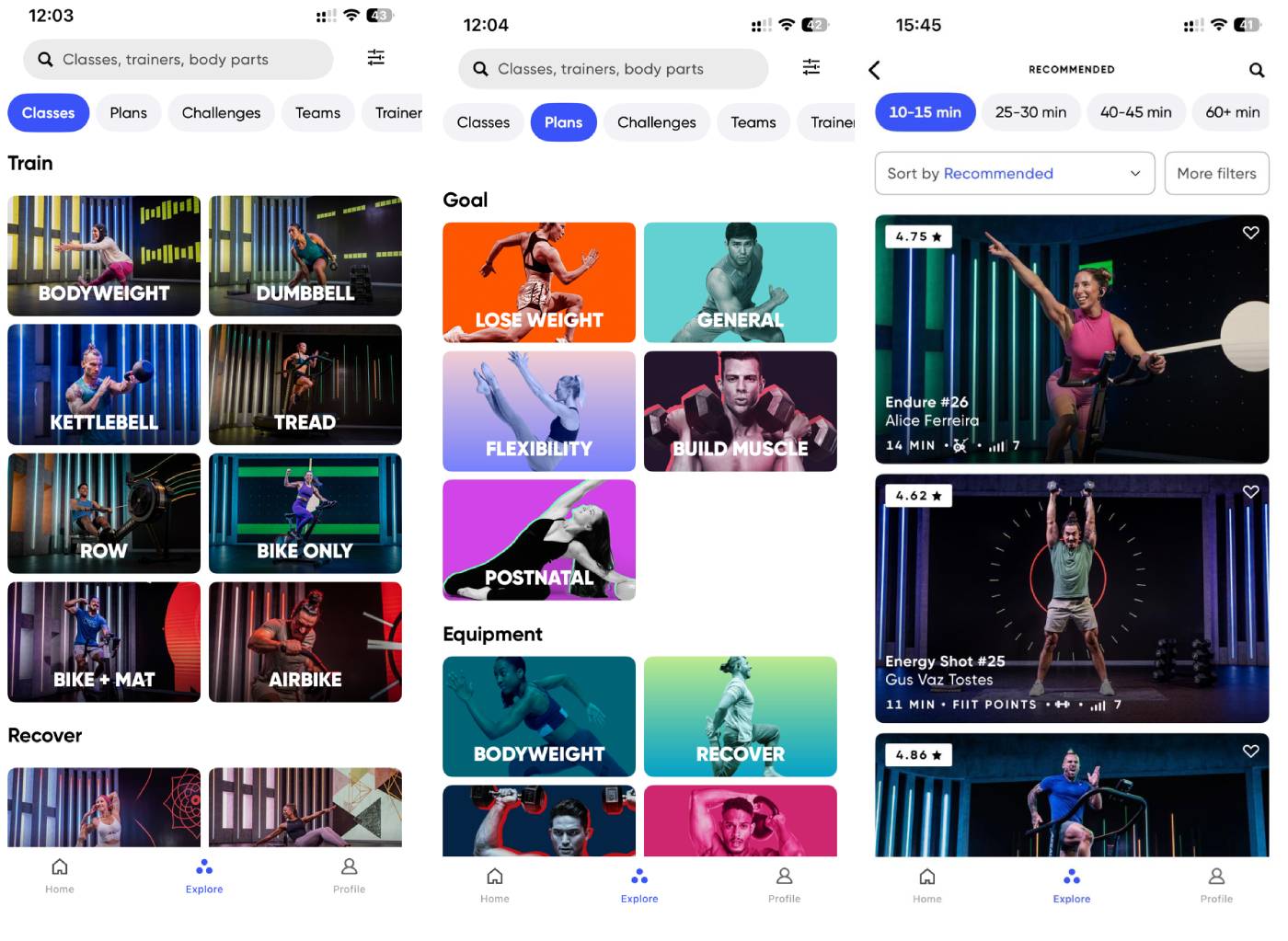
Because the recommended plan did not fit, I used the filter system to build my own week: 2 strength sessions, 2 Pilates sessions, 1 cardio session. The filters made this easy. The execution did not.
The problem with self-building is that you have to know what you are after. Without a video preview, I would commit to a class and then realise within the first five minutes that it was either too slow or too intense for what I needed that day, and because I could not skip ahead to see whether the pace shifted, I would either grit through or quit.
I quit mid-workout or after 25% of the video on more than one occasion to try a different one or finish with my own routine. That is not really why I would pay $25 a month for an app: to design my own workouts and then have to abandon them halfway through.
I do not need to pay for an app where I have to design my workouts. If you are an experienced person who knows what their body needs, the filter system plus the trainer roster makes self-building viable. If you are returning to fitness or navigating a life-stage shift, the lack of a programme designed for you is a real gap.
Peri/meno takeaway: programme structure matters more in midlife, not less. Cognitive load is a documented symptom of perimenopause,[4] and decision fatigue around what to train, when, and how hard erodes adherence. A platform that requires self-building defeats one of the core reasons women in this life stage benefit from structured programmes.
Connected Machine Workouts
I tried one treadmill workout and it was fun. The trainer’s voice and the on-screen pace cues kept me motivated, and the intensity was easy to adjust on the fly because you control the speed manually rather than following a fixed pace. If you have a treadmill at home, FIIT’s treadmill classes are a credible alternative to Peloton’s tread classes at a much lower price.
I did not test the AirBike, rower, or stationary bike classes because I do not have any of that equipment. FIIT’s connected machine library is one of the strongest of any home fitness platform; if you are a hybrid exerciser who mixes home and gym, this is a meaningful differentiator.
Peri/meno takeaway: low-impact aerobic exercise (walking, cycling, swimming, rowing) is consistently recommended by clinicians as part of managing menopause-related joint and muscle pain.[10] Bike, rower and AirBike workouts are good fits for this audience. Treadmill walking is acceptable; treadmill running is moderate to high impact and depends on individual joint state.
The Body Activity Profile
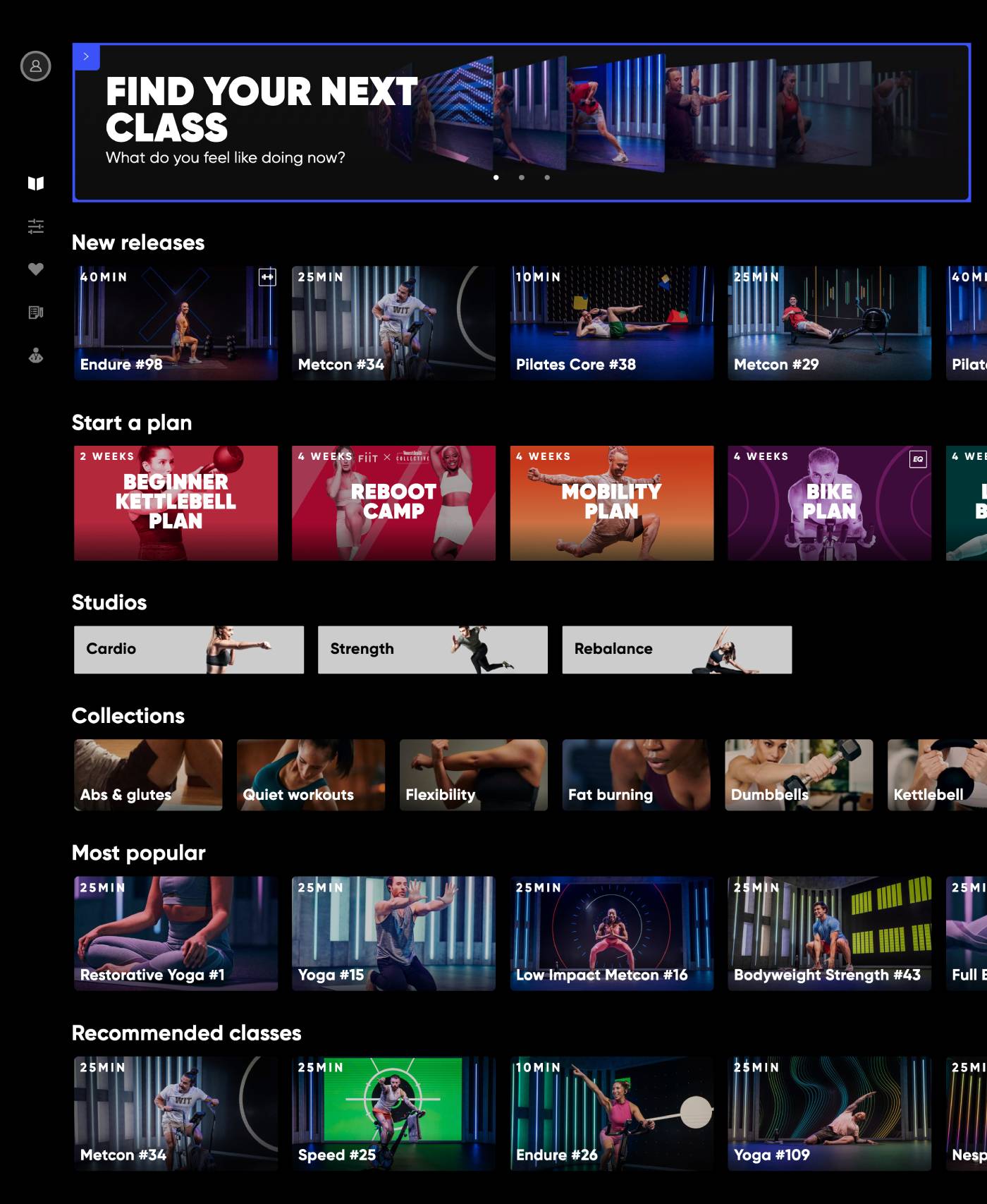
One feature I want to call out: the body activity summary in your profile. After every workout, FIIT logs which body areas you worked, what equipment you used, your duration, and your intensity. Over time this builds a picture of where your training is balanced and where it is skewed.
After two weeks of self-built sessions, I realised I had completely ignored my hamstrings and hips. Hips are something I do want to make strong because of my knee issues. Strong glutes and hamstrings reduce knee loading.
Peri/meno takeaway: hip and posterior chain training are particularly important in perimenopause because hip arthritis risk approximately doubles in women in this life stage compared to men.[9] The body activity profile surfaces this kind of gap in a useful way, but the platform does not act on the information for you (no programme adjustment, no targeted suggestions). It is a diagnostic feature, not a prescriptive one.
Nutrition, Meditation and Education
Three things FIIT does not include, and they matter more in perimenopause than at other life stages.
No nutrition content of any kind. No meal planning, no protein guidance, no perimenopause-specific eating support. For women over 40 who benefit from coordinated nutrition advice, particularly around protein intake to support resistance training and offset the 0.6% annual muscle mass loss after menopause,[9] this is a meaningful gap. Obé Fitness includes audio courses on women’s health and nutrition; FIIT does not.
No meditation programme. FIIT has Breathwork in the Rebalance studio, which is good, but breathwork and meditation are not the same thing. Some of the slower Pilates and yoga sessions were kind of meditation for me, but that is a personal happenstance, not a structured offering. If meditation matters to you (and stress management is consistently flagged as part of managing peri/menopause symptoms), you will need a separate app.
No perimenopause or menopause education. No articles, no videos, no expert content explaining what is happening to your body, why it is happening, and what to do about it. Apple Fitness+ has a Pregnancy and Menopause hub. Pvolve has a Menopause Strong programme co-designed with clinical advisors. FIIT has neither. Given that musculoskeletal syndrome of menopause was only formally named in 2024[9] and remains under-recognised by both patients and clinicians,[10] the absence of education content is a missed opportunity.
Is FIIT Good for Women Over 40?
What it gets right for this age group
FIIT’s strength offering is real. The dumbbell and kettlebell classes are programmed at an appropriate level for general fitness, the trainers are experienced, and the time-interval format means you can scale weight without falling behind. Resistance training has been shown to safely increase strength and lean mass in women aged 40 to 60, with significant 1-RM increases achievable in 10 weeks of twice-weekly training.[6] FIIT’s strength classes are positioned to deliver this.
The connected machine workouts are a practical strength for hybrid users. If you have a treadmill, AirBike, bike or rower, the FIIT library for these machines is one of the most extensive on a single platform, and low-impact options like the bike and rower are well-suited to peri/menopausal users with joint sensitivity.[10]
The filter system is detailed enough to support the kind of day-by-day decision-making that perimenopause requires. Filtering for low-impact, mat-based, or short-duration classes when symptoms are present is genuinely useful.
Where it has limits
The first limit is the absence of a perimenopause or menopause programme. FIIT has Fiit Mum (a 24-week postnatal programme) and structured plans for general fitness, fat loss, and strength building, but nothing designed for the specific physiology of perimenopause.
Pvolve has a dedicated Menopause Strong programme, and Pvolve’s underlying method has been validated in a University of Exeter randomised controlled trial that delivered measurable improvements in hip strength, dynamic balance, flexibility and lean body mass in women aged 40 to 60.[7] Obé Fitness has a six-week Menopause Program. Apple Fitness+ now includes a dedicated Pregnancy and Menopause hub. FIIT does not.
Some of FIIT’s workouts lean towards HIIT and fast pace, and while they are genuinely fun and challenging, doing high-intensity work in the late luteal phase (the days before bleeding) can produce flu-like systemic soreness and disrupt sleep in perimenopause.[12] With no readiness-based programming or cycle-phase awareness on the platform, self-built plans or fixed training plans easily fall out of sync with where your body actually is.
The second limit is in-class modifications. Postmenopausal women specifically need higher training volumes (more than 6 to 8 sets per muscle per week) than general resistance training recommendations to achieve hypertrophy and body composition change.[6] Achieving that volume safely with a meniscus history, or other common midlife joint issues, requires being able to scale individual exercises in real time. FIIT’s separate beginner and advanced versions are not the same thing as in-class modifications, and the gap shows up most when you are stronger in some areas than others.
The third limit is the no-rewind UX. The cognitive symptoms of perimenopause are real, common, and well-documented.[4] An app that requires perfect attention is harder to use precisely when many of its target users find attention harder to sustain.
The summary
For women in their 20s and 30s, FIIT is a reasonable general-fitness app. For women in their 40s who already train, who do not have specific peri or menopause needs, and who have the trackers and machines to access the full feature set, it is a credible option. For women whose primary need is a programme designed around perimenopause, with in-class modifications for joint issues and a UX that forgives interruptions, FIIT is not the right starting point. Pvolve is.
What the Research Says
Four findings from the published evidence base shape how I evaluate FIIT for the HerDailyFit audience. For deeper context on the underlying physiology, see our guide to exercise for perimenopause and menopause.
1. Musculoskeletal syndrome of menopause was formally named in 2024 and affects an estimated 70% of women in the menopause transition. A 2024 review published in the journal Climacteric introduced the term to describe the constellation of joint pain, muscle loss, bone density decline and inflammation that follows declining estradiol. Approximately 25% of affected women are significantly disabled by these symptoms.[9]
Harvard Health, summarising the same research, calls it “a newly recognized condition that links falling estrogen levels to widespread joint and muscle pain, stiffness, fatigue, and other symptoms.”[10] A fitness platform serving women in this life stage needs to account for these symptoms in programming, modifications and UX.
2. Resistance training is the most evidence-backed intervention for women over 40, but volume matters more after menopause. A 20-week controlled trial published in BMC Women’s Health on 41 healthy women aged 40 to 60 found that 10 weeks of free-weight resistance training (twice a week, 6 to 8 sets per muscle per week) produced significant 1-RM increases in all participants regardless of menopause status, but hypertrophy effects (increases in fat-free mass, muscle mass and muscle thickness) were observed only in pre-menopausal women.[6]
The authors concluded that to achieve hypertrophy and body composition change in post-menopausal women, larger training volumes are likely required. FIIT’s strength classes deliver volume that sits at the lower end of this range; if you are post-menopausal and serious about hypertrophy, you will need to supplement.
3. Low-impact, structured resistance training delivers measurable benefits during the menopause transition. A University of Exeter randomised controlled trial published in Medicine & Science in Sports & Exercise tested Pvolve’s 12-week low-impact whole-body resistance programme against standard exercise guidelines (150 minutes per week) in 72 pre-, peri-, and post-menopausal women aged 40 to 60.
The Pvolve group showed a 19% increase in hip function and lower body strength after 12 weeks, with significant improvements in dynamic balance, flexibility and lean body mass.[7] This is the only RCT I am aware of that has tested a fitness app’s resistance programme directly in a peri/menopausal population.
4. Cognitive symptoms during the menopause transition are well-documented and shape what good UX looks like for this audience. Subjective cognitive complaints during menopause are commonly described as brain fog, with forgetfulness, attention difficulties and slowed thinking the most frequently reported symptoms.[4] Harvard Health describes brain fog as a common but under-recognised menopause symptom, with research suggesting these cognitive shifts begin in perimenopause and commonly normalise post-menopause.[5] A fitness platform whose UX requires perfect attention to use without losing your place is one that disadvantages its perimenopausal users specifically.
Usability and App Quality
For perimenopausal users, a fitness app’s UX matters more than at other life stages because cognitive symptoms make recovery from interruptions harder, and joint sensitivity makes the ability to preview and modify classes more important.
The filter system is detailed. The class details panel before each workout is informative. The body activity profile is a thoughtful feature that helps users train smarter over time.
The video player is the pain point. No fast-forward, no rewind, no scrub bar. You can pause and resume, which works as long as you remember to pause before the interruption. If you forget, you lose your place. For an audience where forgetfulness is a documented symptom of the life stage,[4] this UX is materially harder to use than free-scrubbing alternatives.
App stability is mixed. FIIT scores 4.9/5 on the App Store and Google Play across more than 45,000 reviews, but Trustpilot tells a more uneven story, with multiple long-term users reporting recent bugs (the app crashing mid-routine on TVs, casting issues, login problems, occasional periods of “no new classes for weeks”).[8] In my own 14-day trial, I did not experience crashes, but I had one session where the app failed to advance past a particular class state, which was the third interruption that ended my testing.
Casting to a TV (Sky Q, Amazon Fire TV, Samsung Smart TVs) is officially supported and most users report it works well. Apple AirPlay support exists but reports suggest it can be flaky.
FIIT specifications
- Free trial
- 14 days (Play still says 30 day, stale; use 14)
- Cancellation
- Cancel anytime, ≥72h before renewal; no refunds after payment
- Session length
- 10, 25, 40, 60 min; plans 2 to 12 weeks
- Who makes it
- FIIT Limited (London, founded 2017); 40+ trainers (Adrienne Herbert, Gede Foster, Matt Roberts); no clinician/menopause specialist
- Still maintained
- Active; iOS v4.46.0 (2026-06-16), Play 2026-07-16
- What is included
- On-demand classes: yesLive classes: partlyRecovery content: yesMenopause education: noStructured programmes: yesMeditation: partlyNutrition guidance: no
- Women over 40
- Pelvic floor work: noMenopause clinician involved: noInjury modifications: partlyBone-health focus: noModified progressions: yesCycle syncing: noPrenatal options: no
- Devices and access
- Offline downloads: yesCasting to TV: yesSubtitles: noWearable sync: yes
- Support
- Clinical advisory board: noCommunity: yesSupplement upsell: no
- Last verified
- 12 August 2026
Pricing and Cancellation
FIIT offers a permanently free Group Classes tier plus two paid plans: Essential and Unlimited. Each paid plan is available monthly or annually, with a 14-day free trial.
| Plan | UK monthly | UK annual | What’s included |
|---|---|---|---|
| Free Group Classes | £0 | £0 | Daily scheduled group classes including connected machine, mat and Pilates. No card required. |
| Essential (paid) | £7.99 | £79.99 (£6.99/mo effective) | 200+ mat classes, 6 mat training plans, group classes, basic performance metrics. No connected machine classes. |
| Unlimited (paid) | £19.99 | £119.99 (£9.99/mo effective) | Full library: 2,000+ on-demand classes, 40+ training plans, Cardio + Strength + Rebalance + HYROX + connected machine, performance metrics with tracker, Men’s & Women’s Health magazine subscriptions. |
Prices verified against fiit.tv April 2026. FIIT prices locally in GBP, EUR, USD, CAD and AUD; visitors from unsupported regions are billed in USD as fallback.
The 14-day free trial requires card details up front and converts to a paid subscription automatically unless cancelled at least 72 hours before the trial ends. I signed up for the trial on the web, and it is not clear from the website where to cancel: the website does not show a cancellation option in account settings. FIIT’s official guidance is that you must download the iOS or Android app and cancel from Profile > Settings > Membership > Manage Membership.[1] Within the app, cancellation is straightforward.
Cancellation warning if you take the free trial
Two specific things to flag, both confirmed across multiple Trustpilot reviews:[8]
1. You cannot cancel from the website even if you signed up there. If you are reading this on a laptop, you will need to download the iOS or Android app to cancel.
2. The 72-hour cutoff before trial end catches many people. The 14-day trial does not give you 14 full days to decide; you have until day 11. Set a calendar reminder for day 10 or 11 of your trial.
What to do: when you start the trial, immediately add a “cancel FIIT” reminder to your phone for 72 hours before the trial ends. Cancel from inside the app, not the website.
Will You Actually Stick With FIIT?
Specific adherence risks for a perimenopausal woman over 40 considering FIIT, based on my testing.
Boredom Risk
2,000+ on-demand classes plus daily live Group Classes across HIIT, strength, Pilates, treadmill and rebalance studios. Even on a tight time budget, you would need months to exhaust the library.
Equipment Friction Risk
Mat plus 2x2m floor space is the entry bar. A pair of dumbbells unlocks most of the strength studio. Connected machines (treadmill, AirBike, rower, FIIT Tracker) are optional, not required. You can start the trial today with what is already in the room.
Learning Curve Risk
The filter system is detailed (class type, body area, time, equipment, level, trainer, goal) and powerful, but it takes a few sessions to set personal defaults. Self-building a programme also requires more user effort than a guided plan, and the recommendation engine misfired for me.
Motivation Gap Risk
No peri/menopause-specific programme means you have to self-curate every week. There are no in-class modifications when joints flare, no nutrition or community layer to keep you engaged outside workouts, and the subscription friction (cancel in-app, 72-hour pre-trial cutoff) makes leaving fiddly when motivation dips.
Cycle-phase Mismatch Risk
FIIT’s library leans HIIT and fast-paced. In perimenopause, doing high-intensity work in the late luteal phase (days before bleeding) can produce flu-like systemic soreness and disrupt sleep.[12] No readiness-based programming or cycle-phase awareness exists on the platform.
FIIT Weighted Scoring: How the 6.2/10 Was Calculated
Scoring methodology is here. Every score below pulls from the central HerDailyFit scoring system via shortcode, so updates to individual category scores or the weighted total appear everywhere automatically.
| Category | Weight | Score | Reasoning |
|---|---|---|---|
| Time Efficiency | 15% | 7.5 | Class options at 10, 25, 40 and 60 minutes with strong filtering by duration. The 25-minute slot fits a perimenopausal training schedule where energy fluctuates.[9] Daily live Group Classes give a consistent ritual, free with no card required. |
| Muscle Potential | 18% | 8 | Real strength studio with credible dumbbell, kettlebell and HYROX programming. Twenty-five-minute strength sessions with finishers are particularly well-suited to a perimenopausal training schedule and deliver genuine progressive overload. Training volume sits at the lower end of what postmenopausal hypertrophy research recommends,[6] so post-menopausal users may need to supplement with heavier lifting outside the platform. |
| Programme Structure | 12% | 6.5 | 40+ training plans across goals from fat loss to strength to running. The recommendation engine missed for me (Bodyweight for Fat Loss when I am training for strength in perimenopause). No peri/meno-specific plan exists. Self-building works for experienced exercisers. |
| Recovery Compatibility | 10% | 6.5 | Rebalance studio offers Pilates, yoga, mobility and breathwork; Lottie Murphy’s Pilates is the standout. No dedicated meditation programme. Pilates is clinically recommended for managing musculoskeletal symptoms of menopause.[10] |
| UX & Design | 8% | 6.5 | Production is high quality and the filter system is detailed. The video player blocks the score: no fast-forward, no rewind, no scrub. This UX choice disadvantages perimenopausal users specifically given the prevalence of cognitive symptoms in this life stage.[4] |
| Joint Friendliness | 12% | 6 | Beginner and advanced versions exist as separate classes rather than as in-class modifications, which is inadequate for women with active musculoskeletal symptoms common in peri/menopause.[9] Filtering for low-impact classes works. Adapting mid-workout for a meniscus or back issue does not. |
| Value for Money | 8% | 6 | £19.99/month or £119.99/year on Unlimited is fair for the production and trainer roster. The free Group Classes tier is generous. Cancellation friction (web sign-ups must be cancelled in-app, 72-hour pre-trial cutoff) and the absence of peri/menopause content drop the score. |
| Women Over 40 Specificity | 10% | 3.2 | No perimenopause or menopause programme and no peri/meno-specific nutrition guidance, which keeps the score from going higher.[9] Real strengths exist for this audience: 25-minute strength sessions with finishers fit a perimenopausal training schedule, and acute HIIT bouts have been shown to improve mood and cognitive function in this population.[14] Users without a structured plan still need to build their own. |
| Nutrition Integration | 7% | 2 | FIIT itself includes no in-app nutrition content (no meal plans, no protein guidance, no peri/menopause-specific eating support), but paid Unlimited subscribers unlock Women’s Health magazine access via FIIT Perks,[11] which carries general nutrition coverage. Protein intake of around 1.6 g/kg body weight per day is associated with better lean-mass retention during the menopause transition,[9] and FIIT leaves users to source that guidance elsewhere. |
| Total | 100% | 6.2 / 10 | |
Final Weighted Score: 6.2 / 10. FIIT’s standout categories are Time Efficiency (7.5/10) and Muscle Potential (8/10), reflecting the strength of 25-minute sessions with finishers as a peri/meno-friendly format. Programme Structure (6.5/10), Recovery Compatibility (6.5/10), Joint Friendliness (6/10), UX & Design (6.5/10), Value for Money (6/10) and Women Over 40 Specificity (3.2/10) sit in the middle: the platform delivers real benefit to this audience but lacks the structured peri/meno programming and in-class modifications that would push it higher. Nutrition Integration (2/10) is the lowest-scoring category, reflecting the absence of in-app nutrition content.
FIIT Pros and Cons
Pros
- Detailed filter system stacking by class type, body area, time, equipment, level, trainer and goal, useful for day-by-day decisions in peri/menopause when joint and energy state varies
- Named trainer roster: Gede Foster, Lottie Murphy, Angela Gargano, Adrienne Herbert, Cat Meffan, Laura Hoggins
- Boutique-studio production with coordinated LED lighting that creates workout atmosphere
- Generous free tier with daily Group Classes including connected machine workouts, no card required
- Class details panel showing average calorie burn, body areas targeted, intensity and equipment before you commit
- Body activity profile builds a picture over time of where your training is balanced or skewed
- Class duration options at 10, 25, 40 and 60 minutes match adherence-friendly bout lengths
- Connected machine workouts (treadmill, AirBike, bike, rower) include low-impact options well-suited to peri/menopausal joint sensitivity[10]
- Live leaderboard and rep counting if you have a tracker
- Strength studio delivers credible programming with dumbbells, kettlebells and HYROX-aligned sessions for general fitness goals[6]
- Lottie Murphy’s Pilates is high-quality and clinically aligned with peri/meno musculoskeletal symptom management[10]
- Available across mobile, tablet, desktop, Sky Q, Amazon Fire TV and Samsung TVs
- Unlimited plan now includes complimentary Men’s Health and Women’s Health digital subscriptions
Cons
- No fast-forward, no rewind, no scrub bar in the video player; you cannot preview a workout or recover your place after an unpaused interruption[2]
- This UX disadvantages perimenopausal users specifically given the prevalence of cognitive symptoms in the menopause transition[4]
- No perimenopause or menopause programme of any kind, the most significant gap for the HerDailyFit audience[7]
- No in-class modifications shown in real time; beginner and advanced versions exist as separate classes only, inadequate for women with active musculoskeletal symptoms[9]
- Recommended training plan from the onboarding quiz did not match my goals (Bodyweight for Fat Loss for someone training for strength in perimenopause)
- No nutrition content of any kind, no perimenopause-specific eating guidance to support the dietary needs of declining muscle mass[9]
- No structured meditation programme; breathwork exists but is not equivalent to a guided meditation library for stress management
- Web sign-ups cannot be cancelled on the website; you must download the iOS or Android app to cancel
- 72-hour cancellation cutoff before trial end is unusually long; many users miss the deadline and are charged
- Trustpilot reviews show consistent reports of cancellation friction and unexpected charges after free trials[8]
- Pace of classes can be too fast to evaluate movements before they begin, particularly without a video preview function
How FIIT Compares to Similar Platforms
| Platform | FIIT | Pvolve | Sculpt Society | Obé Fitness | Apple Fitness+ |
|---|---|---|---|---|---|
| Our score | 6.2 / 10 | 8.3 / 10 | 8.2 / 10 | 7.5 / 10 | 6.9 / 10 |
| Monthly price | £19.99 | $19.99 / £15.99 approx | $19.99 / £15.99 approx | $24.99 | £9.99 |
| Free trial | 14 days | 7 days | 7 days | 7 days | 1 month |
| Best for | Experienced exercisers, hybrid home/gym | Perimenopausal women | Women-led strength and barre | US/Canada women, dance cardio | Apple ecosystem users |
| Class library size | 2,000+ | 1,500+ | 1,200+ | 16,000+ | 5,000+ |
| Session length | 10/25/40/60 min | 15/30/45 min | 10/30/45 min | 5/28/45 min | 10/20/30/45 min |
| Low-impact filter | Yes | Yes (default) | Yes | Yes | Yes |
| Injury modifications | Limited (separate beg/adv) | Yes (in-class real time) | Yes (in-class real time) | Yes (in-class real time) | Yes (modifier shown throughout) |
| Perimenopause programme | None | Menopause Strong | None (postpartum only) | 6-week Menopause Program | Pregnancy and Menopause hub |
| Progressive strength | Yes (HYROX, dumbbells) | Yes (resistance bands, ankle weights) | Yes (light weights, ankle weights) | Yes (Gym Strong, BodyComp) | Yes (Strength + Core Strength) |
| Coaching style | Boutique-studio energy | Calm, technical, joint-aware | Warm, women-led | High-energy, neon-lit | Polished, inclusive |
| Live classes | Yes (free Group Classes daily) | Limited | No | No (discontinued 2024) | No |
| Nutrition included | No | No | No | Audio courses only | No |
| Available globally | Yes (GBP billing) | Yes (US-built, ships globally) | Yes (US-built, available globally) | No (US/Canada only) | Yes (with Apple device) |
| Best for women aged | 20s to 40s general fitness | 40 to 60+ peri/meno | 30s to 50s women-focused | 30s to 50s US/Canada | All ages, Apple users |
Comparison verified April 2026 against each platform’s official site. Pricing converts to local currency for international users on most platforms.
FIIT vs Pvolve: Head-to-head for Perimenopausal Women
This is the comparison that matters for the HerDailyFit audience, because Pvolve and FIIT both serve women in the broad category of “structured home fitness app with strong production” but they answer fundamentally different questions about who the platform is for.
Audience. FIIT is a general-fitness app aimed at people in their 20s, 30s and 40s who want a strong workout. Pvolve is a low-impact resistance method with a dedicated Menopause Strong programme, and the underlying Pvolve method has been tested in a University of Exeter randomised controlled trial on 72 women aged 40 to 60.[7] The audience overlap exists but the centre of gravity is different.
Modifications. FIIT offers separate beginner and advanced versions of classes. Pvolve builds modifications into the choreography in real time, with the trainer cueing alternatives and a second mat-based version always visible on screen. For a woman with prior injuries or active musculoskeletal symptoms,[9] this difference is the difference between a workable class and an unworkable one.
Programme structure. FIIT has 40+ training plans for goals like fat loss, strength, running, yoga and bodyweight. Pvolve has a peri/meno programme that the research evidence supports as effective for the specific physiology of this life stage.
UX. Pvolve allows free scrubbing through workouts, lets you preview classes properly, and does not punish forgotten pauses. FIIT does not.
Production and energy. FIIT wins here. The boutique-studio aesthetic, the music, the trainer charisma and the live leaderboard for competitive users all create an atmosphere that Pvolve, by design, does not try to replicate.
Price. FIIT at £19.99/month is comparable to Pvolve. Both have annual options that bring the effective monthly cost below £10.
The verdict: if your primary goal is training for and through perimenopause specifically, with a programme designed for this life stage and modifications that work for prior injuries, choose Pvolve. If you are an experienced exerciser in your 20s, 30s or early 40s without specific peri/meno needs, who values boutique-studio energy and a strong filter system, FIIT is a credible general-fitness option. The two platforms are not in competition for the same user, even though they look like they should be.
FIIT FAQ
FIIT is a fitness streaming app launched in 2018 with roots and a primary market in Britain, offering 2,000+ on-demand classes and 40+ training plans across three studios: Cardio, Strength and Rebalance. The platform is filmed in a London studio with coordinated LED lighting that recreates a boutique-gym feel, with named trainers including Gede Foster (Director of Fitness and Performance, also HYROX Global MC), Lottie Murphy, Adrienne Herbert, Cat Meffan and Laura Hoggins. FIIT is available globally on mobile, tablet, desktop and most major TV platforms, with localised billing in GBP, EUR, USD, CAD and AUD where supported. There is no dedicated programme for perimenopause or menopause.
Not as a primary platform for perimenopause. FIIT has no peri/menopause programme, no in-class modifications for the joint pain that affects more than 70% of women in the menopause transition, and a video player without rewind that disadvantages users experiencing the cognitive symptoms common in this life stage. For women over 40 who already train and do not have specific peri/meno needs, FIIT is a credible general-fitness option. For women whose primary need is a programme designed around perimenopause, Pvolve is the benchmark.
FIIT Unlimited costs £19.99 per month or £119.99 per year (£9.99 per month effective, billed annually). FIIT also offers a permanently free Group Classes tier with daily scheduled classes, no card details required. The Unlimited subscription includes complimentary digital subscriptions to Men’s Health and Women’s Health magazines. International users are billed in their local currency (GBP, EUR, USD, CAD or AUD) where supported, with USD as fallback.
Yes. FIIT is a global fitness app with roots and its primary market in Britain. The app is available worldwide through iOS, Android, Sky Q (UK), Amazon Fire TV, Samsung Smart TVs, and via web browser. International users are billed in their local currency where supported (GBP, EUR, USD, CAD, AUD), with USD as fallback for other regions. Since launch, FIIT reports more than 20 million workouts completed across 175+ markets.
Yes. FIIT runs daily scheduled Group Classes available free to all users including non-subscribers, no card required. Paid subscribers also get access to live leaderboard classes where you can compete in real time against other users (a fitness tracker is required to appear on the leaderboard). The free Group Classes tier is unusually generous and worth trying first to see whether the FIIT atmosphere works for you before paying for the Unlimited subscription.
Yes for general strength building, with caveats for postmenopausal users specifically. FIIT’s Strength studio includes credible dumbbell, kettlebell and HYROX programming with Gede Foster (Director of Fitness and Performance) leading much of it. Research on resistance training in middle-aged women shows that postmenopausal women specifically need higher training volumes than general recommendations for meaningful hypertrophy, and FIIT’s strength volume sits at the lower end of that range. For maintenance: yes. For significant body composition change post-menopause: supplement with heavier lifting.
No. FIIT does not have a perimenopause or menopause programme. The platform offers 40+ training plans across goals including fat loss, general fitness, strength, running and yoga, plus a 24-week postnatal Fiit Mum programme, but nothing designed for the specific physiology of perimenopause or menopause. Women looking for a peri/meno-specific programme should look at Pvolve’s Menopause Strong, Obé Fitness’s six-week Menopause Program, or Apple Fitness+’s Pregnancy and Menopause hub instead.
Cancellation is straightforward inside the iOS or Android app (Profile > Settings > Membership > Manage Membership) but cannot be done from the website even if you signed up on the web. This is the most consistent complaint pattern in FIIT Trustpilot reviews. The 14-day free trial requires cancellation at least 72 hours before the trial ends to avoid being charged, and refunds are not generally given once the renewal payment has been processed. Set a calendar reminder for day 11 of your trial and cancel from inside the app.
Yes. FIIT is available on iOS and Android with feature parity between the two, including the live leaderboard, training plans, body activity profile, and connected machine integration. Long-term Trustpilot reviews report occasional bugs (mid-routine crashes, casting issues, login problems) but these appear evenly distributed across iOS and Android. The free Group Classes tier is also available on both. If you are considering paying for Unlimited, take the 14-day free trial first to confirm stability on your specific device.
For women over 40 navigating perimenopause: not as a primary platform. FIIT has no peri/menopause programme, no in-class modifications, and a no-rewind UX that punishes interruptions and forgotten pauses, all of which matter more in a life stage where joint pain affects 70%+ of women and cognitive symptoms affect up to 70%. For experienced exercisers in their 20s, 30s and early 40s without specific peri/meno needs, FIIT is a credible general-fitness option with named trainers and one of the most detailed filter systems available. The free Group Classes tier is the lowest-risk way to evaluate the platform.
Final Verdict
I tested FIIT for 14 days on the Unlimited free trial, using dumbbells (heavy and medium) and a mat at home, plus one treadmill workout. I am a woman in my 40s navigating perimenopause, with a meniscus history that requires real attention to scaling, and the everyday cognitive load of perimenopause that includes occasional brain fog. I tested FIIT 5 to 6 years ago before any of these conditions existed and remember loving it; coming back to it now, the workouts have not changed and my needs have.
What I found: the design is fun and the workouts have good atmosphere. FIIT delivers a well-produced boutique-studio experience with a detailed filter system, a credible trainer roster, and one of the strongest connected machine libraries on any home fitness platform. The free Group Classes tier is unusually generous, and Pilates with Lottie Murphy was a pleasure I would happily go back to.
Once I went back to FIIT after my period and settled into a rhythm of 25-minute strength sessions with finishers, the experience changed. The finishers genuinely make me smile, and my brain fog noticeably lifts on the days I do them, which matches research on acute high-intensity interval exercise improving cognitive function in perimenopausal women.[14]
What stops me recommending it as a primary platform for the HerDailyFit audience: the absence of a perimenopause or menopause programme, the absence of in-class modifications when prior injuries or active musculoskeletal symptoms require scaling, and the no-rewind, no-fast-forward, no-preview video player that punishes the kind of forgotten-pause interruption that gets more common in midlife. Both musculoskeletal symptoms[9] and cognitive symptoms[4] affect a substantial proportion of women in the menopause transition, and a platform that does not address either is not the right starting point for this audience.
FIIT is for experienced exercisers in their 20s, 30s and 40s who like a strong workout, who appreciate named trainers and boutique-studio energy, and who can structure their own programme around their cycle and their joints, particularly women who enjoy short strength sessions with finishers, which I have come to genuinely love. FIIT is not for women new to training or new to perimenopause-aware programming who need a structured plan tailored to their life stage, in-class modifications when joints flare, and a UX that forgives interruptions, who should look at Pvolve or Obé Fitness first.
Score: 6.2 / 10
Sources and Further Reading
- FIIT (2026). Pricing and Membership Information. Available at: fiit.tv/pricing. Used for verification of current £19.99/month and £119.99/year pricing, 14-day trial terms, library size (2,000+ classes), training plan count (40+), and inclusion of Men’s Health and Women’s Health magazine subscriptions in the Unlimited tier.
- FIIT Help Centre (2026). Can I fast-forward / rewind a class? Available at: help.fiit.tv. Confirms FIIT’s deliberate design choice to disable scrubbing in the video player, attributed to ensuring users complete warm-ups and cool-downs and to support tracking feature accuracy.
- Google Play user reviews of FIIT: Workouts & Fitness Plans (2024 to 2026). Available at: play.google.com. Multiple users report the no-rewind UX as a reason for not continuing past the free trial, including the inability to preview classes and the inability to recover from mid-class interruptions.
- Zhu, C., Thomas, E.HX., Li, Q., Arunogiri, S., Thomas, N., Gurvich, C. (2023). Evaluation of the Everyday Memory Questionnaire-Revised in a menopausal population: understanding the brain fog during menopause. Menopause, 30(11), 1147-1156. DOI: 10.1097/GME.0000000000002256. PMID: 37788429. Available at: pubmed.ncbi.nlm.nih.gov. The introduction of the paper notes that up to 70% of women report attention and memory problems during menopause; the study itself analysed 417 women aged 40 to 60 and found that perimenopausal women had significantly higher memory retrieval complaints than pre- and post-menopausal women.
- Salamon, M. (2022). Menopause and brain fog: What’s the link? Harvard Health Publishing, Harvard Medical School (June 1, 2022). Available at: health.harvard.edu. Summarises menopause-related cognitive symptoms with reference to the SWAN longitudinal study, including the finding that perimenopausal women temporarily have trouble learning new information and that cognitive shifts often improve as women move past menopause.
- Isenmann, E., Kaluza, D., Havers, T., Elbeshausen, A., Geisler, S., Hofmann, K., Flenker, U., Diel, P., Gavanda, S. (2023). Resistance training alters body composition in middle-aged women depending on menopause: A 20-week control trial. BMC Women’s Health, 23, 526. DOI: 10.1186/s12905-023-02671-y. PMID: 37803287. Available at: pubmed.ncbi.nlm.nih.gov. 41 healthy women (mean age 52.0 ± 3.6 years) completed a 10-week control phase followed by 10 weeks of resistance training twice weekly with 6 to 8 sets per muscle per week. The study found that 1-RM strength increased in all participants regardless of menopause status, but hypertrophy effects (fat-free mass, muscle mass, muscle thickness) were observed exclusively in pre-menopausal women, with the authors concluding that larger training volumes are likely required for hypertrophy in post-menopausal women.
- University of Exeter (2025). First-of-its-kind study shows resistance training can improve physical function during menopause. Original study: Yokokawa Y, Stephens FB, et al. A Novel Low-Impact Resistance Exercise Program Increases Strength and Balance in Females Irrespective of Menopause Status. Medicine & Science in Sports & Exercise (2025). Available at: news.exeter.ac.uk. Full peer-reviewed article on PMC: PMC11801421. 12-week RCT on 72 pre-, peri-, and post-menopausal women aged 40 to 60 testing Pvolve’s proprietary low-impact resistance training programme (4 sessions per week) against standard physical activity guidelines, showing 19% increase in hip flexion/abduction strength, 21% increase in flexibility, 12% to 13% improvement in dynamic balance, and 2% increase in lean mass.
- Trustpilot user reviews of FIIT (2024 to 2026). Available at: uk.trustpilot.com/review/fiit.tv. Aggregated user feedback documenting cancellation friction, unexpected charges after free trials, and intermittent app stability issues, alongside positive feedback on customer service responsiveness and class quality.
- Wright, V.J., Schwartzman, J., Itinoche, R., Wittstein, J.R. (2024). The musculoskeletal syndrome of menopause. Climacteric, 27(5), 466-472. DOI: 10.1080/13697137.2024.2380363. Available at: tandfonline.com. Open-access full text on PMC: PMC12915535. Formally introduces the term “musculoskeletal syndrome of menopause” (MSM) to describe the constellation of joint pain, sarcopenia, bone density loss, inflammation and arthralgia driven by declining estradiol; reports 70% prevalence and 25% disability rate among women in the menopause transition.
- Solan, M. (2025). Musculoskeletal syndrome of menopause: When menopause makes you ache all over. Harvard Health Publishing, Harvard Medical School (December 2025). Available at: health.harvard.edu. Patient-facing summary of the Wright et al (2024) Climacteric paper, including clinical recommendations for low-impact resistance training, Pilates, yoga and walking as first-line management for menopause-related musculoskeletal symptoms.
- FIIT Help Centre. Introducing FIIT Perks. Available at: help.fiit.tv. Documents FIIT Perks programme available to paid Unlimited Monthly and Unlimited Annual subscribers, including Women’s Health and Men’s Health magazine subscriptions and partner discounts.
- Sims, S.T. (2025). The evolution of menstrual cycle training; Training during perimenopause. Available at: drstacysims.com. Stacy Sims, exercise physiologist and leading researcher on female-specific training, on the late luteal phase as a window of pro-inflammatory shift, reduced sleep efficiency (progesterone suppresses REM and slow-wave sleep), and reduced recovery capacity. Recommends perimenopausal women periodise around readiness with two weeks “on” (HIIT plus heavy resistance) followed by one week “off” focused on mobility and low-intensity aerobic work.
- Romero-Parra, N., Cupeiro, R., Alfaro-Magallanes, V.M., Rael, B., Rubio-Arias, J.A., Peinado, A.B., Benito, P.J. (2021). Exercise-Induced Muscle Damage During the Menstrual Cycle: A Systematic Review and Meta-Analysis. Journal of Strength and Conditioning Research, 35(2), 549-561. PMID: 33201156. Available at: pubmed.ncbi.nlm.nih.gov. Meta-analysis of 19 studies on eumenorrheic women confirming hormone fluctuations across the menstrual cycle affect exercise-induced muscle damage in terms of DOMS and strength loss; supports tailoring training loads or recovery periods to cycle phase.
- Kotopoulea-Nikolaidi, M., Watkins, E., Giannopoulou, I. (2019). Effects of High Carbohydrate vs. High Protein Pre-exercise Feedings on Psychophysiological Responses to High Intensity Interval Exercise in Overweight Perimenopausal Women. Frontiers in Nutrition, 5:141. DOI: 10.3389/fnut.2018.00141. Available at: pmc.ncbi.nlm.nih.gov. University of Brighton pilot study examining the acute effect of a single bout of high-intensity interval exercise on mood, cognitive function and blood pressure in overweight perimenopausal women, finding immediate post-exercise improvements in mood and cognitive function.
- Cirone, V., Boa Sorte Silva, N.C., Barha, C., Handy, T., Stein, R., Heath, S., Liu-Ambrose, T. (2024). Feasibility and Effects of High-Intensity Interval Training on Cognitive Function and Brain Health in Perimenopause. Innovation in Aging, 8(Suppl 1), 1132. DOI: 10.1093/geroni/igae098.3482. Available at: pmc.ncbi.nlm.nih.gov. University of British Columbia 12-week pilot of HIIT in perimenopausal women, reporting feasibility plus benefits for verbal episodic memory and myelin content; HIIT specifically addresses the “lack of time” barrier perimenopausal women report and may benefit cognitive function and myelin content.
Related Guides
What To Do Next
If FIIT did not feel like a fit for your life stage, here is where to look next:
- → Take the 2-minute quiz to find your best-fit platform
- → See our best workouts for perimenopause rankings
- → Read the Pvolve review, the strongest peri/menopause platform tested
- → See how we score platforms and what each category measures