$28/month or $180/year · 7-day free trial · hundreds of on-demand workouts and all programmes included · Dumbbells (I used 5–6.5kg), booty band and ankle weights recommended · No equipment required for many classes
Platform tested personally: The Form Method (14 days completed), Beginner Pilates series (7 days), mindfulness and meditation sessions tested · Prices verified March 2026
🗓️ Last updated: March 2026 · Pricing, features and programme availability verified against joinform.com
FORM Review 2026: Quick Answer
Women who want effective strength and Pilates workouts in 30 minutes or less; beginners to advanced; prenatal and postnatal women; anyone who wants variety across strength, sculpt, barre, Pilates and mindfulness in one app
You need injury-specific modifications or joint-protective programming; you want perimenopause or menopause-specific guidance; you want a very large on-demand library
~30 min for main programme workouts; 5–50 min range across the full library; meditation sessions 6–10 min
No equipment required for many classes; dumbbells (I used 5–6.5kg), booty band and ankle weights recommended for strength and sculpt sessions
Low to moderate: strength sessions are controlled; Pilates sessions are low impact; some HIIT options available for those who want more
Low to moderate; first few days may cause pleasant muscle soreness if you are returning after a break or trying new movement patterns
Low: clean design, easy navigation, good filter; one quirk: after completing the quiz on the website, the programme link comes via email rather than appearing on screen
Low: cancel in account settings before trial ends; auto-billing applies so set a reminder
$28/month or $180/year (~$15/month), good value for the content depth; available internationally including UK
7-day free trial, full access to all content; paid subscription required after
No refunds once billed. Cancel before your trial ends
None: nutrition is dietitian-approved, protein-focused recipes and meal plans; no calorie counting or restrictions
hundreds of on-demand classes; new content added weekly; monthly new programmes (7–30 days); quarterly challenges; offline download available
7.7 / 10
Quick Verdict
Worth it for women over 40? Yes, if you are healthy and want effective, varied workouts that actually fit into a busy life. FORM is not built specifically for perimenopause or menopause, but for many women in their 40s who are in good health and looking for strength, muscle and a sense of calm, it may be a better fit than a platform built around limitation.
I found FORM on Instagram through Sami Clarke and landed on the website first. The design stopped me before I even looked at a workout. Natural colours, plants, wood tones: it felt like a wellness brand that understood what calm looks like. I signed up, completed the quiz, and was recommended The Form Method, a 14-day strength programme. Two weeks later I had finished the full programme, tried the 7-day Beginner Pilates series, explored the meditation section, and my belly had gone flat. It is now my favourite workout app.
FORM does not offer perimenopause-specific guidance, injury modifications or joint-protective programming. If those are your priorities, it may not be enough on its own. But if you are a healthy woman in your 40s who wants effective 30-minute workouts, genuine variety across strength and Pilates, and a platform that feels good to open every day, this is worth your time and your trial.
Start here: Take the quiz on the website to get a programme recommendation. Then check your email for the programme link (it does not appear on screen after the quiz, which is the one UX quirk worth knowing about). If you are returning after a break, start with lighter weights than you think you need.
Jump to Section
Who Is Sami Clarke?
Who Is This For?
The Form Method (14 Days)
Other Programmes Tested
Full Programme Library
Mindfulness and Meditation
Nutrition
Equipment You Need
My Results
Good for Women Over 40?
vs Alternatives
Pricing 2026
Platform and App
Before Starting
Time Commitment
Will You Stick With It?
Full Scoring
Pros and Cons
FAQ
Why I Tried FORM: What I Was Looking For
I came to FORM differently to most platforms I review. I was not searching for something specific. I found Sami Clarke on Instagram, started watching her content, and when I landed on the FORM website I was sold before I had even looked at a workout. The design did it. Natural tones, wood, plants: a wellness feeling rather than a gym feeling. It sounds like a small thing but it is not. How a platform presents itself tells you something about how it thinks about its members.
I had just finished 4 weeks on The Sculpt Society and was in a more honest place than when I started. I had not been consistent with exercise in the weeks before: the usual combination of a busy household, kids bringing home every virus going, workouts slipping. I went into FORM at lower weights than my usual (6.5kg and 5kg, down from my normal 8.5kg) and with the intention of rebuilding consistency rather than pushing hard. That context matters for understanding what I got out of it.
FORM is now my favourite workout app. I want to say that upfront because the rest of this review also includes honest criticism, and I want those two things to sit alongside each other rather than one cancelling out the other.
Who Is Sami Clarke? The Founder and Lead Trainer
Sami Clarke is an LA-based certified trainer and the founder of FORM, which she launched after building a following through Instagram Live workouts during Covid. She holds certifications in Mat Pilates, ISSA Fitness and Somatic Healing, and her approach reflects all three: the workouts are physical but the philosophy is broader, with an emphasis on feeling strong and connected rather than simply looking a certain way.
She is the lead trainer on the platform but not the only one. FORM has four trainers, each with their own specialism. Grace Freyre leads barre-inspired sculpt, high-energy and music-driven. Brynley Joyner is a certified fitness trainer and sports nutritionist who leads the gym-based strength programmes. Calyn Brooke is a NASM-certified pre and postnatal specialist. The result is that the platform covers a wider range of styles and goals than any single trainer could manage.
Sami’s teaching style is the one I spent the most time with and the one that drew me to the platform. She sits in a comfortable middle: not clinical, not aggressively motivational. She tells you what you should be feeling and where, gives form cues throughout, and has a warmth that makes you want to come back. Other reviews consistently flag her voice and energy as a reason for long-term adherence, and I understand why.
Who Is FORM Best For, and Who Should Skip It?
FORM works best for women who want effective, varied workouts in around 30 minutes, without the decision fatigue of building their own programme. The weekly schedule is laid out for you. The programmes are structured. The variety across strength, Pilates, sculpt and barre means you are unlikely to get bored quickly.
It is a strong choice for beginners: the Beginner Pilates series is genuinely accessible, trainers explain everything clearly, and the quiz points you toward the right starting point. It is equally strong for intermediate exercisers who want to push themselves without going to a gym: The Form Method programme, which I completed, gave me real challenge and some satisfying muscle soreness in the first week.
Worth being clear about what FORM is not, because those gaps matter for some women. There is no perimenopause or menopause-specific content, no doctor-led education on hormonal health, and no symptom-based classes. If you are in perimenopause and that kind of specific guidance is important to you, TSS or Burn360 would serve you better. Similarly, FORM does not have dedicated injury modification tracks. There are filter options for equipment-free workouts, but no structured injury-safe programme the way TSS does. If you are managing joint issues or recovering from injury, you will need to self-direct more carefully here.
For healthy women in their 40s who are not dealing with significant injury or perimenopause symptoms, FORM offers a lot: variety, good structure, a beautiful platform to spend time in, and workouts that actually work. That is more than most apps deliver.
The Form Method: What to Expect from the 14-Day Programme
After completing the quiz, I was recommended The Form Method, described as the original FORM programme. I immediately liked it, and quickly understood why it is considered the signature offering.
The programme is 14 days long. That is short enough that finishing feels genuinely achievable. I cannot overstate how much this matters for consistency. A 4-week programme asks you to stay committed for a month. A 14-day programme asks you to stay committed for two weeks. That is a completely different psychological contract, and FORM uses it well.
Each session is around 30 minutes. The structure rotates across the week: full body days, lower body and glute-focused days, upper body days, and one rest day. I personally prefer full body training and was initially less excited about the split days, but the lower body and glute sessions won me over quickly. The exercises on those days are compound movements with more variety than I expected, and the glute work in particular reminded me of Burn360 in its thoroughness, though FORM has a wider range of movement patterns.
The exercises on full body days are compound movements I genuinely enjoyed, many of which were new to me. That novelty matters: when exercises feel new, your body has to work harder to coordinate them, and you feel it the next day. The first few days I had that pleasant post-workout soreness that tells you muscles have been challenged. By week two it had eased, which told me I was adapting.
I used 6.5kg for most exercises, dropping to 5kg on upper body work where I am less strong. If you are returning after a break, start lower than your instinct tells you. These are not slow sculpt sessions: the pace is moderate and the rep count is meaningful. I was working hard with 6.5kg in a way I was not expecting going in.
Why the 14-Day Format Works
Short enough to finish. Long enough to feel results. The 14-day structure removes the psychological drag of an open-ended commitment. You can see the end from the beginning, which makes showing up on day 9 much easier than it would be on day 23 of a 30-day programme. After finishing, you can repeat the programme with heavier weights: the exact same sessions become a different challenge if you add a kilogram or two.
The nutrition guide comes with the programme: a simple high-protein plan with recipes and a grocery list. On the website the programme materials download as a PDF, which is less elegant than in-app delivery. In the app, the nutrition content lives in a dedicated hub alongside recipes and meal plans, which is a much better experience. A note for anyone with dietary restrictions: I had one or two meals I could not follow due to my cholesterol diet, but the recipes are simple enough that feeding the ingredients to any AI assistant and asking for alternatives works well.
Other Programmes and Content I Tried
Beginner Pilates Series (7 days). I went into this having never been particularly drawn to Pilates, wanting to try something different after the Form Method. Seven days is exactly the right length for a trial. The sessions are bodyweight-focused with low weights where needed, plenty of stretching and a relaxation element that produces a different kind of tired than strength training: a pleasant lengthening feeling, a sense of your body having worked in a quieter way. I used to do callanetics years ago, which has a similar quality, and these sessions reminded me why that kind of work is worth including regularly even if it is not your primary training. I found them easy to follow, challenging without being overwhelming, and genuinely restorative.
If you are not drawn to Pilates, the Form Method is accessible enough for a true beginner: Sami explains and demonstrates everything clearly and you choose your own weights. You do not need the Pilates series first.
Advanced Classes. I tried a handful of the standalone advanced sessions when I wanted more intensity after the Form Method. These move at a noticeably faster pace and layer compound movements in ways that make familiar exercises feel harder. Worth exploring once you have finished a programme and want to stay on the platform without starting a new structured track.
Full Programme Library: What Is Available in 2026
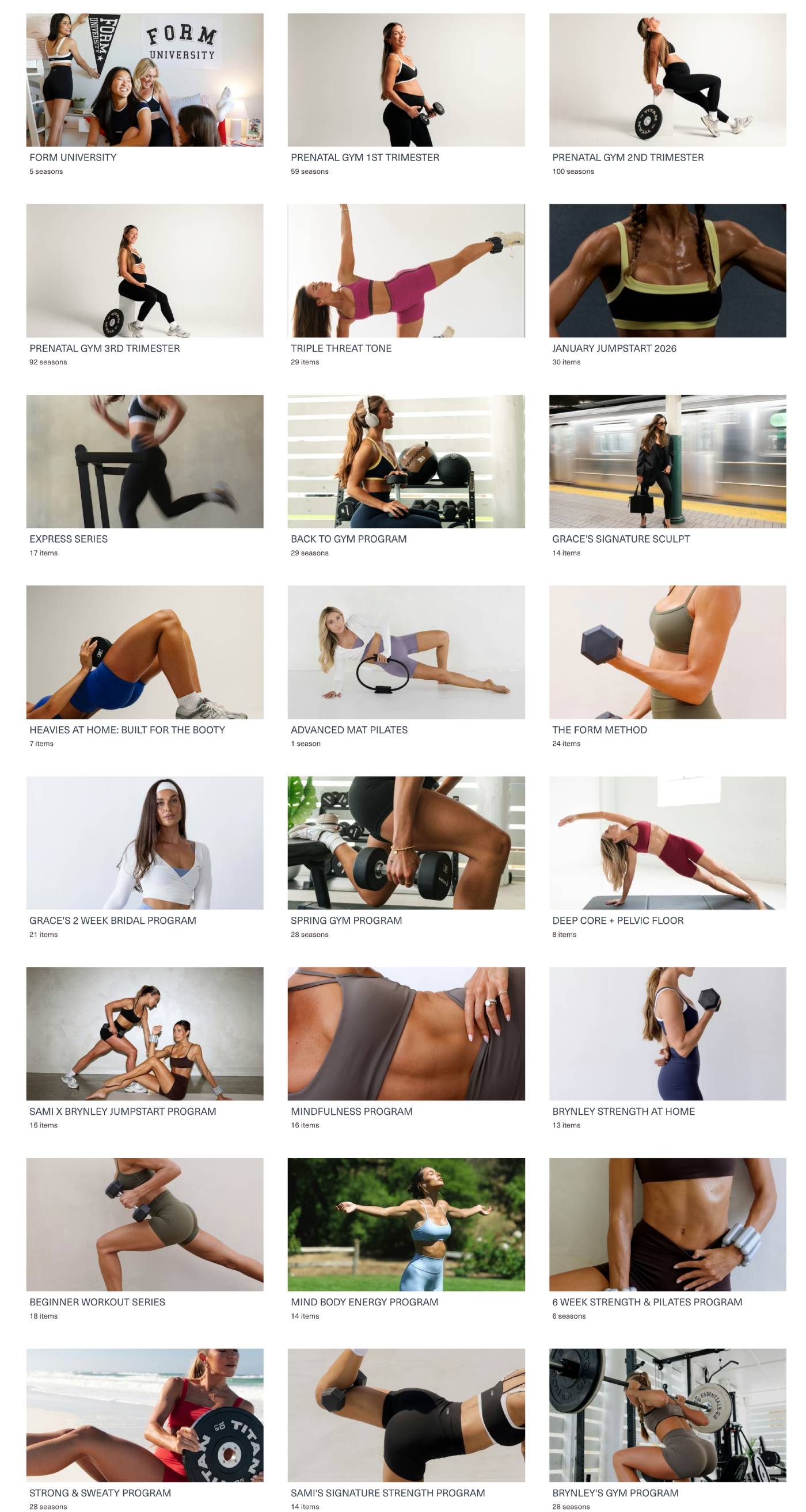
FORM launches a new programme every month, ranging from 7 to 30 days, and runs quarterly challenges with fresh workouts and recipes. The library sits at hundreds of on-demand classes, with new content added weekly.
By training style: Strength, Pilates, Pilates x Strength (hybrid), Sculpt, Barre (Grace Freyre), HIIT, Gym-based programmes (Brynley Joyner), and equipment-free options throughout.
By life stage and goal: Prenatal and postnatal (Calyn Brooke, NASM-certified pre and postnatal specialist), Bridal (14-day programme including a high-protein meal plan), Beginner (Pilates-focused, 7-day), Student programming, and general programmes for all levels.
By duration: Sessions range from 5 minutes (quickie burners) to 50 minutes (longer strength and gym sessions). The 30-minute sweet spot is where most of the library sits.
Four distinct weekly schedules are curated within the app: Pilates x Strength, Strength, Pilates, and Gym. These remove decision fatigue without locking you into a formal programme.
One honest note: the library is good but not enormous by the standards of platforms like BODi or DailyBurn. If you exhaust content quickly and need a very large back catalogue, this may become a limitation over time. For most women it will not be an issue, particularly with monthly new programmes, but it is worth knowing.
Mindfulness and Meditation: A Genuinely Good Section
The mindfulness section sits alongside the workouts and is easy to overlook if you are focused on physical training. I would encourage you not to overlook it, and not just because the sessions are good.
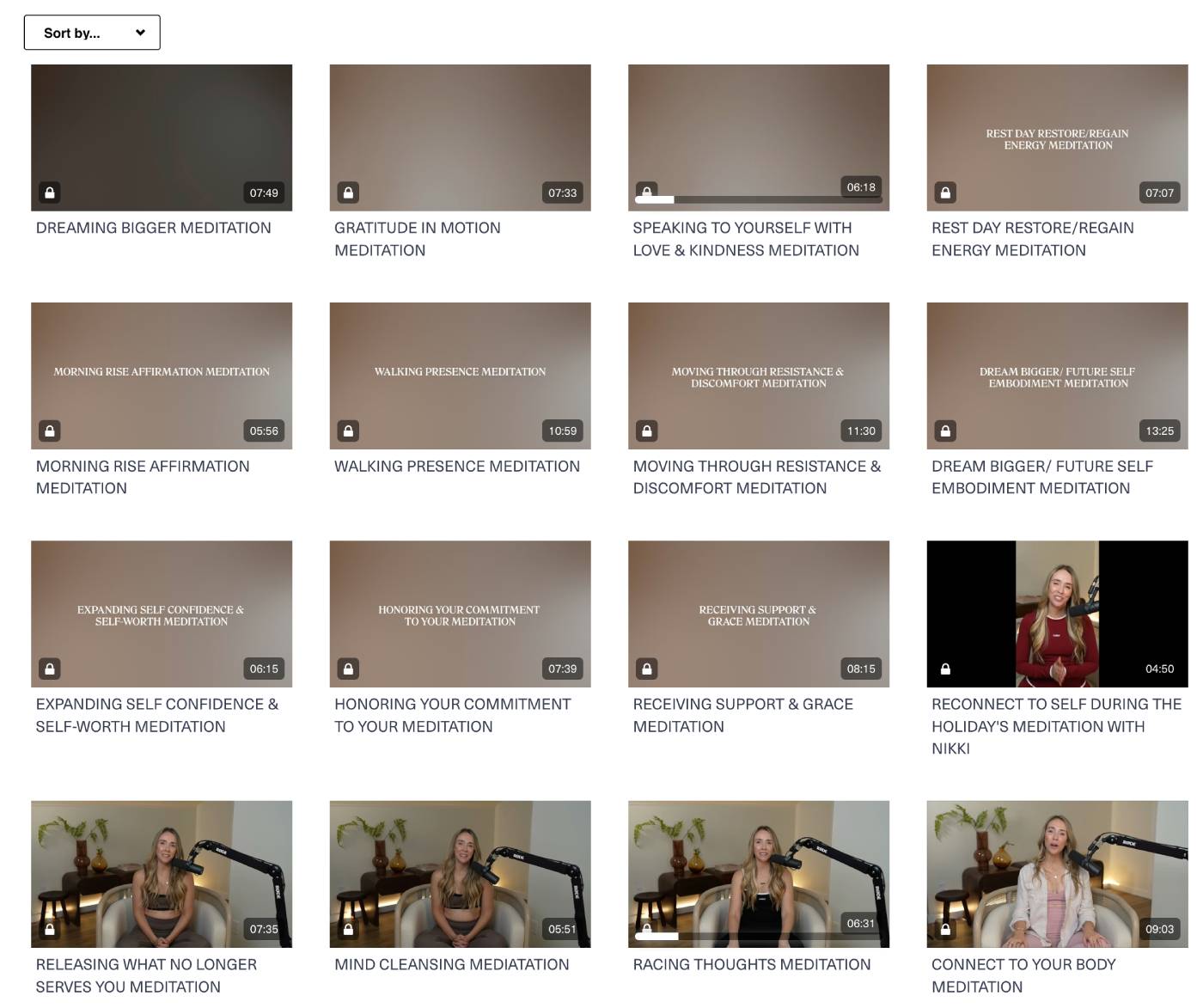
The meditation sessions are short: 6 to 10 minutes, which means they are easy to stack onto the end of a workout or use independently in the morning. The voice pacing and audio quality are both good, which matters more than it sounds: a poor-quality audio experience or a grating delivery style makes it impossible to settle.
Two sessions I particularly recommend: the Racing Thoughts meditation, which is useful on high-stress days when the usual mental chatter makes it hard to land in a workout, and the Dream Bigger / Future Self Embodiment meditation.
This second one is worth a specific mention, because it is not just a nice extra: it has real backing in psychology research. The meditation is a visualisation practice that invites you to picture a future version of yourself: who she is, how she moves, how she feels. Research published in Behaviour Research and Therapy found that mentally simulating engagement in future activities acts as a motivational amplifier, increasing both motivation and the likelihood of actually doing those activities. A separate study in PLOS One found that positive prospective mental imagery increases motivation and the probability that planned activities will be performed. This is not a mystical claim. It is applied psychology delivered in 10 minutes at the end of a workout.
The mindfulness content also includes affirmations, some of which are led by Roxie Nafousi, a bestselling author known for her work on self-worth and manifestation. These are optional and a matter of personal taste, but the section is richer than I was expecting from a fitness app.
Nutrition: Simple, Protein-Forward, and Practical
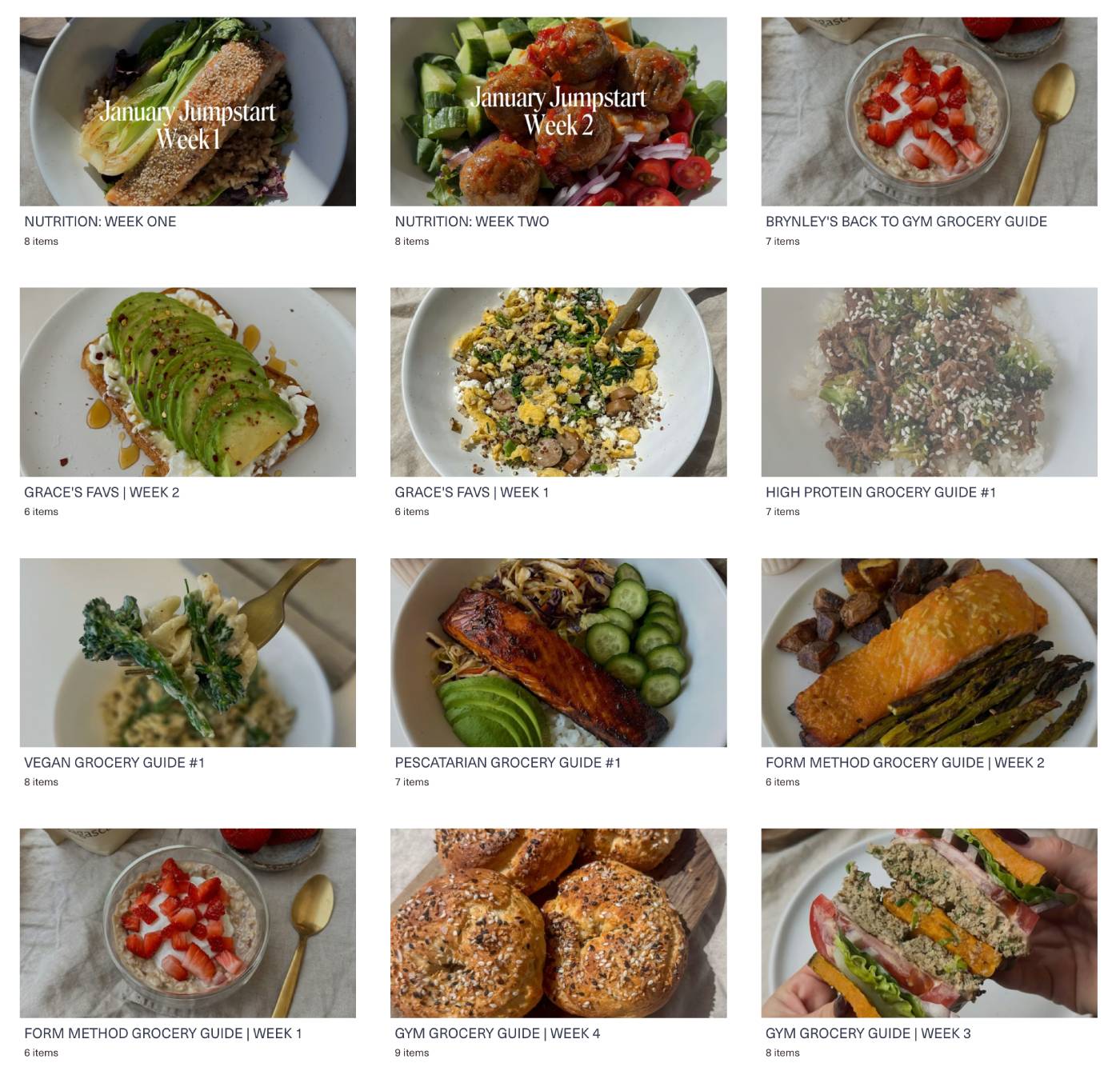
The nutrition approach at FORM is led by a registered dietitian and approved by Sami. It is protein-focused and deliberately simple: no calorie counting, no food rules, no complex macro targets. The recipes are practical enough that a busy household can actually use them, which is a higher bar than most fitness apps clear.
The grocery lists that come with programmes are straightforward and easy to shop from. I found myself making most of the meals without issue. On a couple of occasions I could not follow a recipe due to my cholesterol restrictions, but those instances were rare: the food is generally clean, low-inflammatory and varied enough that most dietary approaches can work with it.
After finishing the 14-day programme alongside the nutrition guide, I felt noticeably less bloated. I attribute that partly to the low-inflammatory quality of the food and partly to the consistency of the exercise itself. It is hard to separate the two, and I would not claim the food alone drove the result, but the combination worked.
The protein focus is also relevant for women over 40 specifically. Research consistently links low protein intake to accelerated muscle loss during and after perimenopause, alongside physical inactivity. A 2022 review in Current Perspectives in Sarcopenia identified sarcopenia risk factors. FORM’s nutrition approach addresses that directly, even if it does not frame it in those terms.
The nutrition hub in the app is the better experience compared to the website PDF download. In the app, recipes, meal plans and tips are integrated alongside the workouts rather than sitting in a separate document. New recipes are added weekly, and gut-friendly and meal-prep focused content is included alongside the standard recipe library.
What Equipment Do You Need?
No equipment is required for many classes, but for the strength and sculpt sessions you will get significantly more out of the workouts with dumbbells. I used 5kg and 6.5kg depending on the exercise. The FORM FAQ recommends starting with a booty band, 3–15 lb dumbbells and ankle weights to cover the full range of the library.
Dumbbells (starter: 3–5kg)
For most strength and sculpt sessions
~£10–£30
I used 5kg and 6.5kg
Booty Band
Recommended for sculpt and lower body sessions
~£5–£15
Optional but worth having
Ankle Weights
Used in some sculpt and Pilates sessions
~£10–£20
Optional for full library access
Yoga Mat
For Pilates and floor-based sessions
~£10–£30
Recommended for comfort
Pilates and bodyweight sessions need only a mat. The gym-based programmes led by Brynley Joyner require gym equipment: barbells, cable machines, benches. These are clearly labelled and filterable, so you will not accidentally start a session requiring kit you do not have.
FORM sells branded equipment in its shop. The quality looks good but equivalent items are available more cheaply elsewhere.
My Experience After 3 Weeks
I want to be honest about the context before I describe the results, because it changes how to read them. I came to FORM after a period of inconsistency: Covid and flu circulating through the family had disrupted my routine, and I was working back from less than ideal rather than pushing from a strong baseline. That is why I dropped to 6.5kg from my usual 8.5kg. I was not starting from strength; I was rebuilding it.
Over 14 days on the Form Method and 7 days on the Beginner Pilates series, I felt genuinely good again. The first few days of the Form Method produced that recognisable muscle soreness that tells you something has been asked of your body. By the second week that had eased, and I had a clear sense of returning to my previous level. By the end of three weeks I felt tighter, my belly had gone flat (I attribute this partly to the low-inflammatory food and partly to the consistency of movement), and I was looking forward to every session, which is the most honest measure of whether a platform is working.
The movements in the Form Method included enough variety that some exercises were genuinely new to me. New movement patterns mean your body works harder to coordinate them, and that novelty is part of what makes the programme effective even at modest weights.
What I came away thinking: these two weeks brought me back to my original strength and tightened things up. I could easily repeat the same programme with heavier weights now and it would be a different, harder experience. That repeatability is a genuine design strength.
An Honest Note on Returning After a Break
If you are coming back after a period of inconsistency, FORM is a good re-entry point. The sessions are challenging enough to feel like real training, but the 30-minute structure and clear instruction mean you are not overwhelmed. Start at weights that feel too easy on day one: the volume and variety will make up for it.
Is FORM Good for Women Over 40? The Honest Assessment
What Happens to Your Body in Perimenopause and Why It Matters for Exercise
FORM does not use the language of perimenopause. There is no doctor panel, no symptom-based classes, no hormonal health education. But the type of training FORM offers is directly relevant to the physiological changes happening in your 40s. Understanding that context helps you use the platform more deliberately.
From around age 40, oestrogen levels begin to fluctuate and gradually decline. This has a cascade of consequences for the musculoskeletal system. A 2024 review published in Climacteric introduced the concept of the musculoskeletal syndrome of menopause, describing how oestrogen decline affects bone, muscle, tendon, cartilage and adipose tissue simultaneously. Women can lose around 0.6% of muscle mass per year after menopause, and during perimenopause, bone mineral density can drop by an average of 10%. The same oestrogen receptors that regulate bone turnover also affect how muscle fibres are maintained and repaired.
The research is unambiguous on one point: resistance training is one of the most effective tools available to counter this. A 2023 meta-analysis in Osteoporosis International reviewed 80 studies and over 5,500 participants and confirmed a bone density benefits, with no significant difference between early and late postmenopausal status. A 2023 trial in BMC Women’s Health found that resistance training effects in middle-aged women aged 40–60.
FORM’s compound dumbbell sessions, structured weekly schedule and protein-forward nutrition approach address all three of the main modifiable risk factors for midlife muscle loss: physical inactivity, low protein intake and unstructured training. Not because FORM was designed for perimenopause specifically, but because good strength programming and good nutrition are good strength programming and nutrition regardless of why you need them.
Why Pilates Matters Specifically at This Life Stage
The Pilates content on FORM is not just a gentler option for lower-energy days. For women in perimenopause, there is a specific physiological case for including it alongside strength work.
High-intensity training raises cortisol, and in perimenopause, cortisol regulation becomes more difficult. elevated cortisol levels, and chronically elevated cortisol promotes abdominal fat deposition and disrupts sleep, both already-challenged by the hormonal transition. Pilates, by contrast, activates the parasympathetic nervous system, reduces cortisol and supports the rest-and-digest response. A clinical trial published in PMC found that an reduced menopausal symptoms in postmenopausal women, including mood, physical and sleep-related complaints. A 2025 randomised controlled trial in PMC similarly found improved symptom scores in postmenopausal women.
The controlled breathing central to Pilates also supports the pelvic floor, which weakens as oestrogen declines and can lead to bladder leakage and reduced core stability. This is rarely discussed on mainstream fitness platforms, and FORM does not address it explicitly, but a Pilates practice that emphasises core connection will support pelvic floor function as a natural consequence.
The Qualification That Matters
FORM has not been built with perimenopause in mind. There is no hormonal health content, no doctor panel, no symptom-based classes. If you are experiencing significant perimenopausal symptoms and want a platform that addresses them directly, you will need to look elsewhere for that layer. The Sculpt Society is the strongest option on that front.
What FORM does offer women in their 40s is effective strength training that builds and maintains muscle (critical as oestrogen declines), Pilates and recovery work that supports cortisol regulation and flexibility, a short session format that fits around the demands of midlife, and a nutrition approach that is anti-inflammatory and practical without being restrictive. And the mindfulness content, which at first glance seems like a nice extra, is doing meaningful work: stress management matters more in perimenopause than most fitness platforms acknowledge, and a 10-minute guided meditation is not trivial if it genuinely reduces cortisol and helps you sleep.
The second qualification: if you have joint issues or are recovering from injury, FORM does not have structured support for that. You can filter for equipment-free options and modify on the fly, but you will be doing that self-direction alone. Worth noting that oestrogen decline also affects tendon and ligament integrity, increasing injury risk in midlife. FORM is not the right platform if joint protection needs to be built into the programme design.
FORM vs Alternatives
| FORM | The Sculpt Society | Melissa Wood Health | Evlo | Burn360 | Jillian Michaels | FitOn | |
|---|---|---|---|---|---|---|---|
| Price | $28/month · $180/year | $24.99/month · $179.99/year | $9.99/month · $99.99/year | $55.99/month | $39.95 one-time + $29.95/month community | $19.99/month · $149.99/year | Free / $29.99/year Pro |
| Perimenopause programme | None | Dedicated 4-week programme with doctor panel | None | Method suits it; nothing labelled | Explicit hormonal methodology (HIRIT) | None | None |
| Training style | Strength, Pilates, sculpt, barre, HIIT, gym | Sculpt, strength, dance cardio, Pilates-inspired | Pilates, yoga, low-intensity sculpt | Targeted resistance, DPT-designed | Compound dumbbell, HIRIT | HIIT, bodyweight circuits | Mixed: everything |
| Trainer variety | 4 trainers: Sami Clarke, Grace Freyre, Brynley Joyner, Calyn Brooke | Megan Roup + rotating team | Melissa Wood only | Small team | Small team | Jillian + guests | Large roster |
| Impact level | Low to moderate: Pilates low, strength moderate, HIIT available | Low: controlled, joint-friendly throughout | Very low | Low: DPT-designed joint protection | Moderate | Moderate to high | Varies widely |
| Closest audience fit | Healthy women at any age wanting variety and results in 30 min | Perimenopausal women; beginners to intermediate | Mindful, gentle movement fans | Joint-sensitive women wanting clinical precision | Hormonal health focus, short sessions | Variety seekers, weight loss focus | Budget-conscious, variety |
| Injury safe programming | No dedicated injury track; equipment-free filter only | Dedicated ankle/leg injury and no-kneeling tracks | Very low intensity throughout | Joint-protective by design | Low-impact modifications | Low Impact Shred only | |
| Nutrition included | Dietitian-approved recipes, meal plans, grocery lists, in-app hub | Food Freedom Guide: RD-led, intuitive eating | RD recipes + macro guidance | Eat 360 plan included | Multiple meal plans, grocery lists | 500 recipes (Pro) | |
| Mindfulness included | Meditations, affirmations, future self visualisation | Meditation, recovery classes | Meditation, breathwork | Breathwork cool-downs built in | Mindfulness section | Meditation available | |
| Prenatal/postnatal | Dedicated trainer (Calyn Brooke, NASM pre/postnatal certified) | 40-week prenatal programme by trimester | |||||
| Offline download | |||||||
| Library size | hundreds of classes; good but not vast | 1,000+ classes | Smaller, curated | Smaller, curated | Moderate | Large | Very large |
| Free trial | 7-day free trial | 7-day free trial | 7-day free trial | 14-day free trial | $39.95 entry point | 7-day free trial | Free forever tier |
FORM Price 2026: What You Actually Pay
| Plan | Cost | Per month | What is included |
|---|---|---|---|
| Monthly | $28/month | $28 | Full access to hundreds of on-demand workouts, all programmes and monthly new programmes, weekly curated schedules, nutrition hub with dietitian-approved recipes and meal plans, guided meditations and affirmations, offline download. 7-day free trial on first signup |
| Annual | $180/year | ~$15/month | Everything in monthly. Saves ~$156 vs monthly billing. Annual members receive access to quarterly challenges with fresh workouts and recipes |
Cancellation and Billing Policy
The 7-day free trial gives full access to all content. Cancel in account settings before the trial ends and you will not be charged. No refunds are offered once billed. Set a calendar reminder for day 6 of your trial if you are unsure whether to continue.
The FORM App: Design, Navigation and Features
I want to start with the design, because it is genuinely unusual and worth naming. FORM’s visual identity uses natural tones: warm neutrals, plants, wood. It does not look like a fitness app. It looks like a wellness brand that has thought carefully about how it wants you to feel when you open it. That is not an accident and it is not superficial: the visual environment of a platform you open every day has an effect on whether you keep opening it.
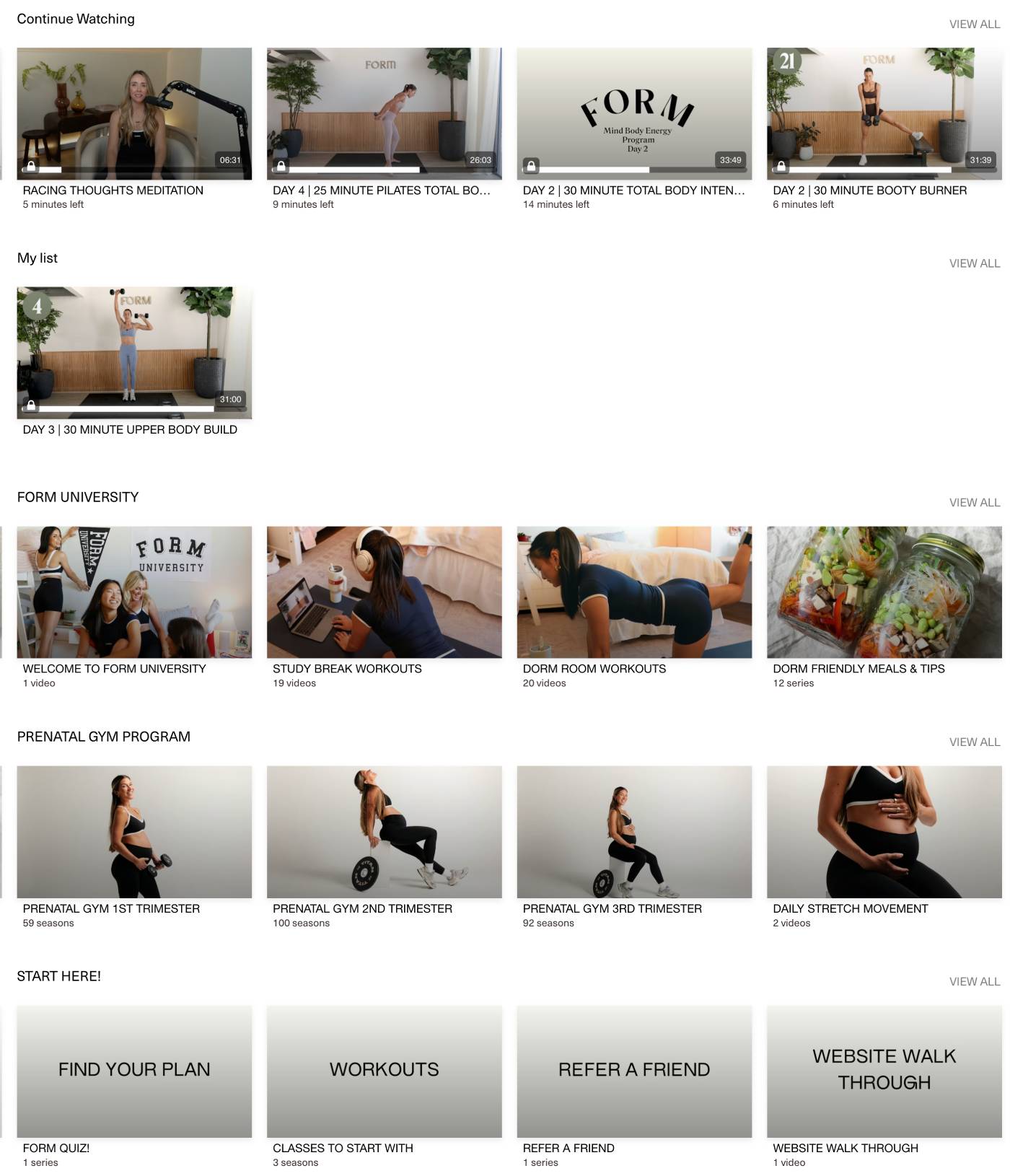
The navigation is clean and easy. Content is well-categorised across training style, trainer, duration and goal. The filter and search tool is genuinely good: you can filter by trainer, duration, workout type, body focus area, equipment and fitness level, which makes it easy to find a session that fits whatever you have available. If you have 15 minutes and no equipment, two taps and you have options.
One UX quirk worth flagging: after completing the quiz on the website, the programme recommendation does not appear on screen. It arrives in your email. This is genuinely easy to miss and a frustrating piece of friction at exactly the moment you are most motivated to start. Once you know to check your email, it is a non-issue, but it is worth knowing in advance.
The comparison to The Sculpt Society website is worth a brief mention: the design language is similar enough that if you visit both you will notice the family resemblance. Clean, warm, uncluttered. This reflects a shared understanding of what a certain kind of woman wants from a fitness platform. The colour choices and content focus are different, but the visual approach is in the same family.
App features worth knowing (verified March 2026):
Offline download: available on mobile. Download sessions for travel or locations without reliable WiFi.
Search and filter: filter by trainer, duration, workout type, body focus, equipment and fitness level. One of the better filtering tools in the category.
Weekly curated schedules: four ready-made weekly schedules (Pilates x Strength, Strength, Pilates, Gym) remove the decision of what to do each day without locking you into a formal programme.
Quarterly challenges: for members who want a shared-goal community context with fresh content.
The app is available on iOS, Android and web browser.
What to Know Before Starting: Practical Advice
Take the quiz first. It takes about two minutes and will recommend a programme based on your goals and preferences. Then check your email immediately: the programme link is delivered there, not shown on screen after the quiz.
Start lighter than you think you need to. The Form Method sessions are not slow sculpt: they are moderate-paced with meaningful volume. If you are returning after a break, this is especially relevant. I went in at 6.5kg and was glad I did. You can always add weight; starting too heavy makes finishing sessions harder and risks putting you off.
Try the meditation section. It is easy to skip past and easy to miss the value. The sessions are 6 to 10 minutes. They are worth your time, particularly the Racing Thoughts and Future Self meditations. The Future Self session has genuine backing in behavioural psychology: increases follow-through.
Use the filter tool once you have finished your programme. The quiz gets you started, but once you know the platform the filter is how you navigate. Filter by duration and body focus for day-to-day class selection.
The nutrition PDF works best in the app. If you access programme materials through the website, the nutrition guide downloads as a PDF. The in-app nutrition hub is a much better experience, with recipes, grocery lists and tips integrated alongside your workouts.
Set a trial cancellation reminder. The 7-day free trial converts to a paid subscription automatically. No refunds are given once billed, so set a reminder for day 6 if you are not certain you want to continue.
Time Commitment: Weekly Schedule and Session Length
| Option | Sessions/week | Session length | Weekly total |
|---|---|---|---|
| The Form Method (14-day programme) | 6 training + 1 rest | ~30 min | ~180 min |
| Beginner Pilates Series (7-day programme) | 6 training + 1 rest | 20–35 min | ~130–180 min |
| Weekly curated schedule (ongoing) | 5–6 | 20–40 min | ~120–200 min |
| Meditation add-on | Daily if wanted | 6–10 min | ~42–70 min additional |
| Quickie burners | Flexible | 5–15 min | As needed |
The 30-minute core session length is genuinely manageable as a full-time working mother of two. The sessions start when they say they will and end when they say they will: if it says 30 minutes, you are working for 30 minutes. That reliability matters when you are fitting workouts around a busy household.
Will You Actually Stick With It?
Boredom Risk
Four training styles, four trainers, monthly new programmes and quarterly challenges. The variety here is genuinely broad. I did three weeks of content and had not come close to exhausting what I wanted to try.
Decision Fatigue
The quiz gets you started. The curated weekly schedules handle ongoing planning. The structured programmes (14-day, 7-day) remove all decisions for their duration. You open the app and you have a session ready.
Content Exhaustion
The library is hundreds of classes, smaller than BODi or DailyBurn. For most women this will not be an issue, particularly with monthly new programmes. If you use the platform heavily for over a year you may begin to want more variety.
Motivation Gap
This is where FORM stands out. I looked forward to every session. The combination of a platform that is pleasant to open, a trainer whose style suits me, workouts that feel genuinely effective, and a 30-minute format that never feels like a burden adds up to something that is easy to return to.
FORM Weighted Scoring: How the 7.7/10 Was Calculated
| Category | Weight | Score | Weighted |
|---|---|---|---|
| Time Efficiency | 15% | 9.0 | 1.35 |
| Muscle Potential | 15% | 7.5 | 1.13 |
| Women Over 40 Specificity | 15% | 5.5 | 0.83 |
| Joint Friendliness | 12% | 6.5 | 0.78 |
| Recovery Compatibility | 10% | 8.0 | 0.80 |
| Programme Structure | 10% | 8.5 | 0.85 |
| Value for Money | 8% | 8.0 | 0.64 |
| UX and Design | 8% | 9.0 | 0.72 |
| Nutrition Integration | 7% | 8.0 | 0.56 |
| Total | 100% | 7.7 / 10 |
Highest scores: time efficiency (9.0) and UX/design (9.0), both reflecting the platform’s efficient 30-minute format and best-in-class visual identity. Recovery compatibility (8.0), programme structure (8.5) and nutrition (8.0) are strong. The two categories that pull the score down: women over 40 specificity (5.5, no perimenopause content) and joint friendliness (6.5, no injury-safe programming).
Final Weighted Score
7.7 / 10
Effective, varied 30-minute workouts with best-in-class design — limited by the absence of perimenopause-specific content and injury-safe programming
FORM Pros and Cons
Pros
- The most considered design and UX of any platform reviewed on this site: natural tones, warm visual identity, pleasant to open every day
- 30-minute sessions that actually fill the full 30 minutes: no padding, no preamble, efficient use of time
- Genuine variety across training styles: strength, Pilates, sculpt, barre, HIIT, gym-based, all within one subscription
- Four specialist trainers covering strength, sculpt/barre, gym training and pre/postnatal
- Monthly new programmes (7–30 days) keep content fresh and give structure without long-term commitment
- 14-day programme format is short enough to actually finish and easy to repeat with heavier weights
- Compound movements with variety: exercises that are new enough to challenge coordination and produce real muscle response
- Mindfulness section with genuinely good meditation content, including future self visualisation with behavioural psychology support
- Dietitian-approved nutrition: simple, protein-forward, practical recipes with grocery lists and in-app meal plans, directly relevant to reducing muscle loss risk in midlife
- Strong prenatal and postnatal programme led by NASM-certified specialist Calyn Brooke
- Excellent filter tool: search by trainer, duration, body focus, equipment and fitness level
- Offline download on mobile
- Weekly curated schedules remove daily decision fatigue without requiring a formal programme
- Quarterly challenges for members who want a shared-goal community context
Cons
- No perimenopause or menopause-specific content, no hormonal health education, no symptom-based classes
- No dedicated injury-safe programming: equipment-free filter exists but no structured track for joint issues or injury recovery
- Quiz result delivered by email rather than on screen: easy to miss and a frustrating piece of friction at the point of highest motivation
- Library smaller than BODi or DailyBurn: hundreds of classes is good but may feel limiting for very heavy users over time
- No warm-up or cool-down built into main workouts: you need to seek these out separately
- Gym-based programmes require gym equipment: clearly labelled, but worth knowing if you train at home only
- No refunds after billing: auto-billing at trial end; must cancel before next billing cycle
FORM FAQ: Common Questions Answered
FORM is a digital fitness platform founded by Sami Clarke, offering strength, Pilates, sculpt, barre, HIIT and gym-based workouts alongside guided meditations and a nutrition hub. It costs $28/month or $180/year, with a 7-day free trial. The library has hundreds of on-demand classes, monthly new programmes, and weekly curated schedules. Four trainers cover different training styles and life stages, including a dedicated pre/postnatal specialist.
Not specifically designed for it, but suitable for healthy women in perimenopause. FORM has no hormonal health education, no doctor-led content and no symptom-based classes. What it does offer is evidence-backed strength training (which supports bone density and muscle maintenance as oestrogen declines), low-impact Pilates (which research shows reduces cortisol and improves menopausal symptoms), a practical anti-inflammatory nutrition approach with adequate protein, and mindfulness content that supports stress management. For perimenopause-specific guidance, The Sculpt Society remains the strongest option on this site. If you are healthy and want a strong general fitness platform that serves your midlife physiology without centring on it, FORM works very well.
The evidence is consistent. A 2023 meta-analysis in Osteoporosis International reviewed 80 studies and found positive bone density effects, regardless of bone status or menopausal stage. A 2023 trial in BMC Women’s Health found counteracts muscle loss in women aged 40–60. Resistance training 2–3 times per week targeting different muscle groups remains the most effective non-hormonal intervention for sarcopenia prevention in midlife women.
$28/month or $180/year (approximately $15/month). A 7-day free trial is available with full access. Available internationally. No free tier after the trial ends.
Cancel in account settings before your trial period ends. If you signed up through the App Store, cancel through your device subscription settings. No refunds once billed. Set a reminder before your trial ends: billing is automatic.
The flagship 14-day programme led by Sami Clarke. Sessions are around 30 minutes, rotating across full body, lower body and glute focus, upper body and rest days. Compound dumbbell exercises, moderate pace, meaningful volume. Comes with a high-protein nutrition guide and grocery list. Can be repeated with heavier weights for increased challenge after completion.
No equipment is required for many classes. For strength and sculpt sessions, dumbbells (5–15 lbs recommended), a booty band and ankle weights will get the most from the library. Gym programmes require gym equipment. Pilates and bodyweight sessions need only a mat.
Yes. The Beginner Pilates series is a 7-day programme designed for those new to Pilates. The Form Method is accessible for fitness beginners too: trainers explain and demonstrate all movements clearly, and you choose your own weights. Start lighter than you think you need to.
Dietitian-approved, protein-focused recipes, weekly grocery lists, meal plans and gut-friendly content. New recipes added weekly. No calorie counting, no food restrictions. Access via the in-app hub (better experience) or downloadable PDF with programme materials on the website.
Yes. Guided meditations and affirmations, ranging from 6 to 10 minutes. Content includes sessions for racing thoughts, future self visualisation (backed by motivational imagery), and affirmations from Roxie Nafousi. Sessions can be done independently or stacked onto the end of a workout.
Yes, available internationally including the UK. Pricing is in USD; your bank will convert at the current exchange rate.
Yes, for a specific type of woman over 50. Form’s combination of Pilates, breathwork and mindfulness content is particularly well-suited to women over 50 managing stress alongside fitness goals. The slower tempo and controlled movement patterns protect joints, and the mindset content addresses cortisol management in a way most fitness apps ignore entirely. The platform is quieter and less motivational than high-energy alternatives like Burn360 or Sculpt Society – which is either a strength or a limitation depending on your preference. For women over 50 who want fitness that feels sustainable and calm rather than punishing, Form is a thoughtful choice.
Final Verdict
7.7 / 10
FORM earns its score by delivering something most fitness platforms do not: a genuinely enjoyable daily experience that produces real results, in 30 minutes, without requiring you to commit to a single training style or a long programme. The 14-day structure, the variety across Sami, Grace, Brynley and Calyn, the design that makes you want to open the app, the meditations that are actually worth doing: all of it adds up.
I came in after a period of inconsistency, at lower weights than usual, looking to rebuild. Two weeks later my belly was flat, I was looking forward to every session, and I had already planned which programme to do next. That is the most honest result I can give you.
The honest limitations: no perimenopause-specific guidance, no injury-safe programming, a library that is good but not vast. These are real gaps for some women, and they should steer those women elsewhere.
Worth it if you are a healthy woman in your 40s (or any age) looking for an effective, varied platform that fits into real life; you want strength and Pilates in one place; you value design and UX; you want short structured programmes rather than an open-ended library.
Not the right fit if you need perimenopause-specific guidance; you are managing joint issues or injury; you want a very large content library.
Uncomfortable truth: FORM does not know you are 45. It does not know about your hormones or your knee or your bad sleep. But it does know that you are a woman who wants to feel strong and move well in a limited amount of time. And for that, it delivers.
Sources & Further Reading
- Fausto-Sterling A et al. The musculoskeletal syndrome of menopause. Climacteric. 2024.
- Shojaa M et al. Exercise training and bone mineral density in postmenopausal women: updated systematic review and meta-analysis. Osteoporosis International. 2023.
- Isenmann E et al. Resistance training alters body composition in middle-aged women depending on menopause: a 20-week control trial. BMC Women’s Health. 2023.
- Sipilä S et al. Sarcopenia in menopausal women: current perspectives. Clinical Interventions in Aging. 2022.
- Kim SD. Effects of 8-week Pilates exercise programme on menopausal symptoms and lumbar strength in postmenopausal women. Journal of Physical Therapy Science. 2016.
- Yilmaz Akyuz E et al. Investigating the effects of Pilates exercises on menopausal symptoms and sexual dysfunction in postmenopausal women: randomised controlled trial. PMC. 2025.
- Renner F et al. Mental imagery as a motivational amplifier to promote activities. Behaviour Research and Therapy. 2019.
- Jons C et al. Physiological and subjective arousal to prospective mental imagery: a mechanism for behavioural change? PLOS One. 2023.
- FORM. Pricing and programme information. Verified March 2026.
- Personal testing: The Form Method (14 days), Beginner Pilates Series (7 days), mindfulness sessions. March 2026.
- Effects of mind-body exercise on perimenopausal and postmenopausal women: systematic review — PubMed (2024)
- Mind-body therapies for menopausal symptoms: systematic review — PMC (2010)
- Effects of yoga on menopausal symptoms and sleep quality: randomised controlled trial — PubMed (2022)
- Physical activity and exercise interventions on menopausal symptoms: overview of reviews — PubMed (2024)
- Menopause FAQs: understanding the symptoms — North American Menopause Society (NAMS)
- Exercise as you get older — NHS
- Preserve your muscle mass — Harvard Health Publishing
This review reflects personal testing experience. Pricing and features were verified in March 2026 and may have changed. Some affiliate links may be present. This site does not accept payment from platforms reviewed and all opinions are the reviewer’s own. Research citations are provided for informational purposes and do not constitute medical advice. Consult your GP or a specialist before beginning a new exercise programme.
Related Guides
What To Do Next
Not sure this is the right programme for you?
- → Take our 2-minute quiz for a personalised recommendation.
- → See our best workouts for perimenopause rankings
- → See how we score every programme using 9 weighted criteria.