Starting from $12.99/month (US) · £12.99/month (UK) · 30-day free trial · No equipment required
Platform tested personally · Menopause collection evaluated · Prices regularly verified
Peloton Review 2026: Quick Answer
Women 35–55 managing perimenopause, anyone needing live class accountability, joint-limited users who need real modification support
You train primarily via desktop, want progressive barbell strength, or need more structured coaching than a self-directed platform provides
20–45 min per session; 3–5 sessions per week = 60–225 min weekly
None for app — phone, tablet, or computer sufficient. Optional: Bike from ~$1,445, Tread from ~$2,495, Row from ~$3,195
Low to high — full spectrum available; low-impact and menopause-specific options confirmed
Low to moderate depending on class selection; menopause collection specifically designed for sustainable intensity
Low-Medium: clean app experience; programmes only available in app, not web browser
Cancel link non-functional during testing — use app settings or contact support directly
$12.99/mo App One · $24.99/mo App Plus · $9.99/mo Strength+ · $44/mo All-Access
£12.99/mo App One · £28.99/mo App Plus · £39/mo All-Access
30 days for App One and App Plus · 14 days for Strength+
None — no nutrition or supplement ecosystem
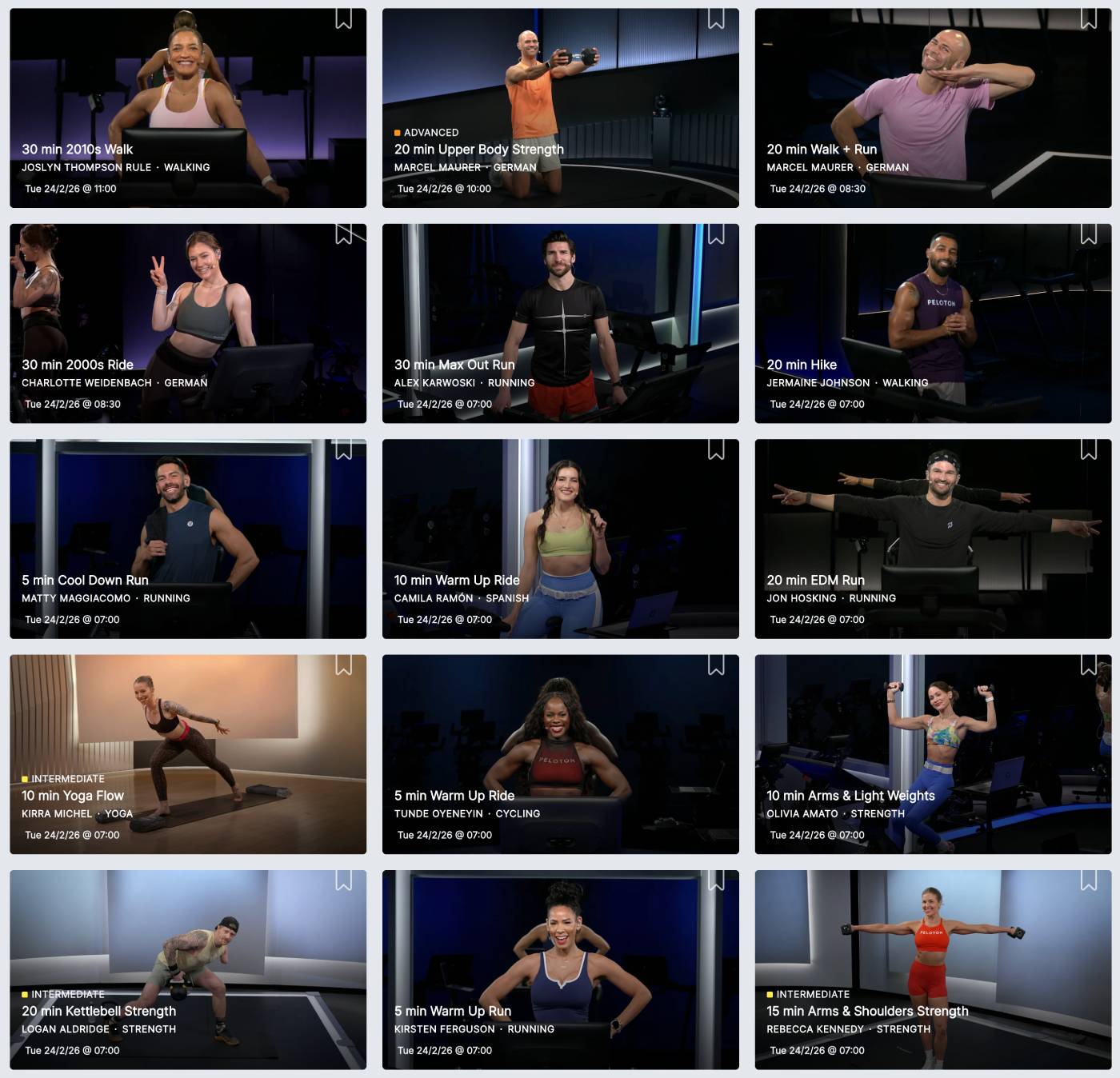
Thousands of classes across 15+ workout types; live and on-demand
7.6 / 10
Quick Verdict
Worth it for women over 40? Yes — especially if perimenopause content and live accountability matter to you.
Peloton earns its score on three things: a dedicated menopause content collection that is genuinely well-developed, instructor modification quality that works in practice, and live classes that create real accountability. At $12.99/month (App One) you get the menopause collection, all strength, yoga, pilates, barre, and live non-cycling classes. App Plus at $24.99/month adds unlimited cycling and treadmill content. No equipment required for the full app library.
Start here: If you have perimenopause symptoms, explore the Menopause Collection first. If live class accountability is what keeps you consistent, check the live schedule. If you have joint issues, the low-impact cycling, yoga, and barre options are your entry point. Use Peloton IQ to remove daily decision fatigue.
Jump to Section
I Wasn’t Expecting the Menopause Collection
I went into this test ready to be underwhelmed. Peloton is one of the most marketed fitness brands in the world, and in my experience, the louder the marketing, the thinner the substance for women who don’t fit the default “athletic 28-year-old” target.
What I found instead was a dedicated menopause content collection — not a single token class buried three menus deep, but an actual curated set of 20-minute sessions designed specifically around this life stage: low-impact rides, hikes, endurance work, bodyweight strength, and kettlebell. Built with the physiological reality of perimenopause in mind — reduced tolerance for sustained high cortisol, joint sensitivity, the need for load-bearing work without excessive impact.¹
That was unexpected. And it changed how I evaluated everything else.
I’m a woman in my early 40s — perimenopausal, working full-time with children, a history of a meniscus injury, and a training background in HIIT and dumbbells. I don’t own any Peloton equipment. I tested the platform by mixing and matching classes across strength, yoga, walking, and running — using my own treadmill for the cardio content, and a single pair of 7.5kg dumbbells for strength. Here is my honest assessment.
Who Is Peloton Actually For?
Before we get into the detail, the honest answer to whether Peloton is right for you comes down to three questions:
Do you need live class accountability? Peloton has genuine live classes with a leaderboard and real-time participants. If you know from experience that you’ll skip a recorded workout but you’ll show up for a scheduled class, this is worth paying for. No other platform at this price point does live classes as well.
Are you managing perimenopause or menopause symptoms? If yes, Peloton is currently the only mainstream platform with a proper content collection for this. That alone makes it worth serious consideration.
Do you have a meniscus injury, joint issues, or a need for low-impact options? The modification quality here is genuinely better than most competitors. Instructors cue modifications within the class, not as a separate modifier track you have to hunt for.
If none of those three apply to you, the price is harder to justify. At $24.99/month for App Plus, there are cheaper options that deliver comparable results for straightforward strength or cardio training.
What You Actually Get
The Platform at a Glance
Peloton launched in 2012 as a connected bike company and has since expanded into a full fitness ecosystem. The important thing to know is that you do not need the equipment. The app-only tiers give you access to thousands of classes across 15+ workout types without owning a bike, treadmill, or rower.
Available on: iOS, Android, web browser, Apple TV, Chromecast, Roku, and Amazon Fire TV.
Available in: US, UK, Canada, Australia, and Germany.
Class Library
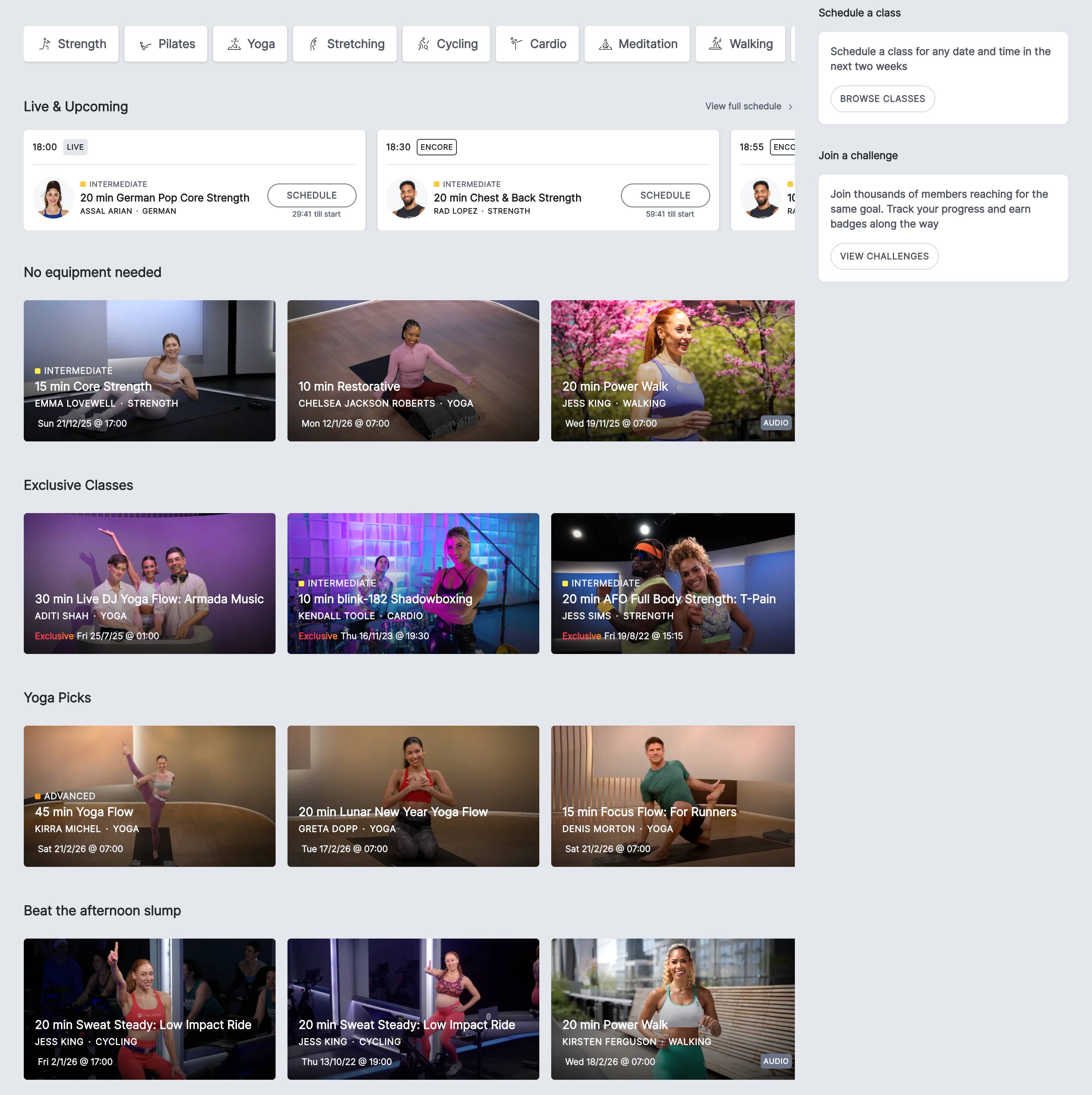
Thousands of on-demand and live classes across cycling, strength, yoga, running, boxing, rowing, meditation, barre, pilates, stretching, walking, outdoor, and more. Class durations run from 5 minutes to 60+ minutes — genuine 20-minute options confirmed across most workout types. A 30-minute moderate session burns approximately 180–350 kcal depending on bodyweight and intensity.³ For reference, the WHO recommends 150–300 minutes of moderate-intensity activity per week for adults⁴ — achievable on Peloton with 5–6 sessions at the lower end of the duration range.
Peloton IQ
The feature I found most useful. Peloton IQ builds custom workouts based on the duration you have available and the muscle groups you want to target. You put in your parameters; it assembles a session. For anyone managing time constraints — which is most women in their 40s with full-time work and family — this removes the daily decision-making friction that causes most people to skip workouts.
The Menopause Collection
20-minute sessions including low-impact ride, hike, endurance, bodyweight strength, and kettlebell. These are not repurposed gentle classes with a new label. They’re built around the specific training needs of women in this life stage — sustainable intensity, load-bearing without joint overload, and a pacing that doesn’t spike cortisol in a way that works against you.
For context: I tested these alongside my regular training and they sat appropriately in my week without leaving me either undertrained or wrecked the next day. That balance is harder to get right than it sounds.
Injury-Specific Content
Peloton has an ACL recovery programme developed in partnership with the Hospital for Special Surgery² — a credible collaboration. The content quality is solid. The problem is that it’s genuinely difficult to find through the standard navigation. If injury-specific content matters to you, search for it deliberately rather than expecting it to surface.
Instructor Quality & Modifications
High across the board. Instructors are experienced, the production quality is polished, and — critically — modification cues are built into the class rather than handled by a separate on-screen modifier. This is a meaningful practical difference when you’re managing a knee issue and can’t pause to find a workaround mid-session.
I mixed and matched rather than following a fixed programme, which gave me a realistic picture of what the library feels like in practice. The dumbbell strength classes were the most challenging — with a single pair of 7.5kg dumbbells, some classes pushed hard enough that I was working at my limit by the end. That’s not a complaint. It confirms the content is genuinely effective with basic equipment.
Equipment Reality: What You Actually Need
You do not need any Peloton hardware to get full value from the platform at App Plus tier. A phone, tablet, or computer is sufficient for the entire class library including live classes.
No Equipment (App Only)
Phone, tablet, or computer
£0
Full app library access
Light Dumbbells (2–4kg)
Yoga, barre, light strength
~£15–£35
Medium Dumbbells (6–10kg)
Strength and HIIT classes
~£35–£70
Workout Mat
Floor-based and yoga content
£15–£30
Peloton Bike
Cycling classes with performance metrics
~$1,445 / ~£1,295
Optional — not required for app
Peloton Tread
Running and walking with pace data
~$2,495 / ~£2,295
Optional — not required for app
Peloton Row
Rowing classes with stroke metrics
~$3,195 / ~£2,795
Optional — not required for app
If you already own or are considering the hardware:
| Equipment | Starting Price (US) | Starting Price (UK) | Best For |
|---|---|---|---|
| No equipment | $0 | £0 | Full app library, strength, yoga, running |
| Peloton Bike | ~$1,445 | ~£1,295 | Cycling classes with performance metrics |
| Peloton Tread | ~$2,495 | ~£2,295 | Running and walking with pace data |
| Peloton Row | ~$3,195 | ~£2,795 | Rowing classes with stroke metrics |
Good news: Most of the content most useful for women 40+ — low-impact cycling, yoga, barre, pilates, strength with modifications — requires either no equipment or dumbbells you may already own. I tested walking and running classes on a non-Peloton treadmill and it worked fine — the coaching translates completely.
Time Commitment & Weekly Volume
| Scenario | Sessions/week | Session length | Weekly total |
|---|---|---|---|
| Minimum effective | 3 | 20–30 min | 60–90 min |
| Recommended for results | 4–5 | 30–45 min | 120–225 min |
| WHO activity guideline target⁴ | 5 | 30 min moderate | 150 min |
| Including warm-up/cool-down | Add 5–10 min per session | ||
Realistic session time including setup, finding the class, and a cool-down: 30–50 minutes. The 20-minute classes are genuinely 20 minutes of work — factor in the surrounding time when planning your week.
Pricing & Which Plan Is Right For You
There are three app tiers plus a separate standalone strength app. Most reviews just list the prices — but the decision between App One and App Plus matters more than the $12 gap suggests.
| App One | App Plus | Strength+ | All-Access | |
|---|---|---|---|---|
| US price/month | $12.99 | $24.99 | $9.99 | $44.00 |
| UK price/month | £12.99 | £28.99 | US only | £39.00 |
| Free trial | 30 days | 30 days | 14 days | 30 days |
| Strength, yoga, pilates, barre, meditation, outdoor running | Unlimited | Unlimited | Strength only | Unlimited |
| Cycling, treadmill & rowing classes | 3/month only | Unlimited | Unlimited | |
| Live classes | ||||
| Peloton IQ workout generator | ||||
| Challenges & programmes | ||||
| Strength+ included free | — | |||
| Cadence monitor pairing | ||||
| Profiles | 1 | 1 | 1 | Up to 5 |
| Equipment required | None | None | None | Peloton hardware |
Which Plan Makes Sense For You
App One ($12.99/£12.99) is the right starting point if you don’t own a bike, treadmill, or rower. For most women 40+ without Peloton hardware, this covers the content that’s most relevant — the menopause collection, all strength classes, yoga, pilates, barre, live non-cycling classes, challenges, and Peloton IQ.
App Plus ($24.99/£28.99) makes sense if you want unlimited cycling or treadmill classes — either because you own or use non-Peloton equipment. It also includes Strength+ free, which adds $9.99 of value if you’d use it.
Peloton Strength+ ($9.99/month, US iOS only) is a completely separate app. No instructor, no music, no live classes — AI-generated strength workouts built around the equipment you actually have. Self-paced, pauseable, customisable. Free if you have App Plus or All-Access.
All-Access ($44/£39) is only relevant if you own a Peloton Bike, Tread, or Row. You cannot purchase All-Access without Peloton hardware.
The Honest Cost Position
App Plus at $24.99/£28.99 is more expensive than BODi (~$15/month on annual plan), Caroline Girvan (free on YouTube), and Apple Fitness+ ($9.99/month). App One at $12.99 is more comparable to Apple Fitness+ and reasonable for what it covers. What you’re paying the App Plus premium for is unlimited cycling and treadmill content, Strength+ inclusion, and cadence pairing — none of which matter if you’re training primarily with dumbbells and bodyweight at home.
Getting Started: Sign-Up, Onboarding & Support
Registration is straightforward. The 30-day free trial is offered prominently upfront and the cancellation policy is clearly stated before you commit. After sign-up, a personalisation questionnaire covers your goals, experience level, and preferences.
Cancellation Warning
The cancel link was not functioning when I tested it. I tested this more than once with the same result. If you sign up, don’t rely on the standard cancel link — go to app settings > account > membership, or contact support directly, and set a calendar reminder before day 30.
Customer support channels:
- Phone: 1-866-679-9129 (US), Monday–Sunday 9am–8pm ET
- Live chat: Available via support.onepeloton.com, 7 days a week
- Email: support@onepeloton.com
- In-app support: Available directly from the iOS and Android app
- Social media: @onepeloton on X responds to DMs
Will You Stick With It? The Adherence Question
Boredom Risk15+ workout types, thousands of classes, live and on-demand
Decision FatiguePeloton IQ removes daily decision-making; class stacking queues sessions
Accountability GapLive classes, leaderboard, community challenges, Club Peloton loyalty
What works in Peloton’s favour: Live classes create a different kind of commitment psychology than on-demand. Peloton IQ removes daily decision fatigue. Variety across 15+ workout types means the library doesn’t get stale. Community challenges with automatic progress tracking add external accountability.
Class Stacking: Queue up to 10 on-demand classes back-to-back into a custom playlist. The app auto-plays the next class. For anyone building a 40-minute workout from two shorter blocks, this removes the friction that causes people to skip the second class.
Outdoor audio classes: Available for walking and running — GPS-tracked with coaching audio through your phone. No Peloton hardware required.
Club Peloton: Launched October 2025 — a points-based loyalty programme with 11 levels across Bronze, Silver, and Gold tiers. Automatically enrolled as a paid member.
Peloton Personal Trainer: Launched February 2026 as a beta — pairs All-Access Members with a real certified personal trainer for 1:1 virtual coaching at $99.99/month additional. Currently invite-only, iOS and US only. Total cost with All-Access: $144/month.
Adherence Warning
Uncomfortable truth: Peloton’s breadth is both its strength and its dropout mechanism. Users who don’t engage with the live schedule or Peloton IQ, and who approach the platform as a passive browse-and-pick library, typically disengage within 6–8 weeks. The platform rewards users who commit to a structure. It doesn’t impose one.
Joint Load & Recovery: The 40+ Reality
This section doesn’t appear in most fitness platform reviews. It should.
Joint Safety: Strong
Low-impact availability: Genuine and accessible. The menopause collection, low-impact cycling, yoga, barre, pilates, stretching, and walking mean you have multiple daily options that don’t load joints beyond what women managing injury or hormonal changes can handle sustainably.
Modification quality: Better than most. Modification cues are in-class, not separate. For my meniscus specifically, I trained consistently without aggravation.
Cortisol management: Peloton’s breadth means you can deliberately build a training week that manages cortisol load — mixing higher-intensity work with genuinely restorative sessions. For women in perimenopause, cortisol regulation directly affects sleep, energy, and body composition.¹
Sleep sensitivity: High-intensity evening classes can disrupt sleep quality for perimenopausal women already managing sleep issues. The platform’s range of lower-intensity evening options — yoga, stretching, meditation — makes it possible to train later in the day without the cortisol spike that disrupts sleep onset.
Recovery between sessions: For women over 40, 48 hours between high-intensity sessions is a reasonable baseline. Peloton’s low-impact options make it possible to train daily without that recovery demand — alternating high and low intensity across the week rather than taking full rest days.
Is Peloton Good for Women Over 35? The Physiology Section
Most fitness platforms are built for a default user that isn’t you. Here is what the physiology actually means for this platform:
Oestrogen decline and muscle retention: Progressive resistance training becomes more important, not less, after 35. Peloton’s strength library supports this but doesn’t enforce progressive overload — you choose your own weights and it’s easy to stay comfortable rather than progress. Build in deliberate weight increases over time or results will plateau.¹
Recovery tolerance: Decreases with age and with hormonal fluctuation. The 20-minute class format is well-suited to days when a full session isn’t realistic.
Perimenopause fatigue: Real, variable, and not well-addressed by most fitness platforms. Peloton’s menopause collection acknowledges this directly. The 20-minute session format means you can train on difficult days without committing to 45 minutes you don’t have in the tank.
Joint inflammation risk: Lower-oestrogen states correlate with increased joint inflammation and injury risk.² Low-impact options and the in-class modification culture reduce this risk compared to platforms where high-impact is the default.
How Peloton Compares for Women 40+
| Peloton App Plus | BODi | Caroline Girvan | Apple Fitness+ | |
|---|---|---|---|---|
| US price/month | $24.99 | ~$15 (annual) | Free | $9.99 |
| Live classes | Limited | |||
| Menopause collection | Dedicated | Limited | ||
| Modification quality | High (in-class) | Medium | High | Medium |
| Structured programmes | App only | web + app | ||
| Equipment required | No | No | No | No |
| Injury-specific content | (hard to find) | Limited | ||
| Nutrition guidance | Shakeology ecosystem | |||
| Weekend support | Phone & chat 7 days | N/A | ||
| Data anchors / metrics | Output, HR, cadence |
Bottom line: Peloton wins on live classes, menopause content, and modification quality. BODi wins on structure and nutrition guidance. Caroline Girvan wins on progressive overload (and it’s free). Apple Fitness+ is the best value within the Apple ecosystem.
Who Peloton Is Best For
- Women 35–55 in perimenopause or menopause who want a platform that acknowledges their physiology
- Anyone for whom live class accountability is the difference between showing up and skipping
- Women managing joint limitations who need modification support built into class
- Users who want variety across multiple workout types without switching platforms
- Anyone who has tried YouTube fitness and found the lack of structure the problem
Who Should Skip Peloton
- Budget-focused users — at $24.99/month App Plus, cheaper effective alternatives exist
- Women who train primarily via desktop — the app-only programme restriction is a real usability gap
- Anyone wanting progressive barbell strength — Peloton’s strength content is dumbbell-based
- Anyone who prefers a coach-led, accountable relationship rather than self-directed scheduling
Peloton Weighted Scoring: How the 7.6/10 Was Calculated
Category Weight Score Weighted Time Efficiency 15% 9.0 1.35 Muscle Potential 15% 7.5 1.13 Women Over 40 Specificity 15% 8.0 1.20 Joint Friendliness 12% 9.0 1.08 Recovery Compatibility 10% 8.5 0.85 Programme Structure 10% 6.5 0.65 Value for Money 8% 7.0 0.56 UX and Design 8% 7.8 0.62 Nutrition Integration 7% 2.0 0.14 Total 100% 7.6 / 10
Scoring notes: Progressive Overload Clarity scores lower because Peloton does not guide weight progression. Value reflects the App Plus price point relative to alternatives. UX reflects the app-only programme restriction for desktop users.
Final Weighted Score
7.6 / 10
Strong platform with genuine menopause content and live accountability
Pros & Cons
Pros
- Dedicated menopause collection — the most developed of any mainstream platform tested
- Community challenges with automatic progress tracking
- Club Peloton loyalty programme — points, levels, rewards, automatically enrolled
- Class Stacking — queue up to 10 classes back-to-back
- Outdoor audio classes with GPS tracking
- Modification cues built into class, not an afterthought
- Peloton IQ removes daily decision friction
- Live classes with genuine accountability
- Genuine 20-minute options across most workout types
- 30-day free trial with transparent cancellation terms
- Injury rehabilitation content with Hospital for Special Surgery
- No equipment required for full app library
Cons
- Programmes available in app only — not web browser
- Cancel link non-functional during testing
- Injury content hard to navigate to
- App Plus expensive relative to alternatives without hardware
- No built-in nutrition guidance
- Progressive overload not guided — easy to plateau
- Personal Trainer add-on ($99.99/month extra) only for All-Access — total $144/month
Frequently Asked Questions
Yes, for the right user. App Plus gives you access to the full class library, live classes, and Peloton IQ without any hardware. If live accountability or the menopause collection are relevant to you, the app alone justifies the cost. If you want straightforward strength or cardio training, cheaper alternatives exist.
It is one of the strongest options currently available for this demographic. The dedicated menopause collection, in-class modification culture, and low-impact variety are all meaningfully better than most competitors. The lack of guided progressive overload is the main gap for women focused on muscle retention after 40.
App One is $12.99/month (£12.99 UK). App Plus is $24.99/month (£28.99 UK). All-Access is $44/month (£39 UK) but requires Peloton hardware. Strength+ is $9.99/month (US iOS only), free with App Plus. All app tiers include a 30-day free trial.
Yes. The app-only tiers work on any phone, tablet, or computer. Dumbbells are useful for strength classes but not required to start.
For self-directed users comfortable building their own schedule, YouTube (Caroline Girvan, for example) is free and high quality. Peloton is better if you need live class accountability, want menopause-specific content, or benefit from the Peloton IQ structure.
3–5 sessions per week is the realistic effective range, covering 60–225 minutes weekly. The WHO recommends 150–300 minutes of moderate activity per week for adults⁴. For women over 40, mixing higher and lower intensity across the week manages recovery and cortisol load better than daily high-intensity training.
Yes, selectively. Peloton’s Menopause Collection is one of the most substantial dedicated menopause content libraries of any fitness platform I reviewed – covering sleep, mood, joint health, pelvic floor and cardiovascular changes. The yoga and strength content is genuinely good for women over 50. The challenge is that cycling – Peloton’s dominant format – involves high-impact loading and is not always appropriate for women over 50 managing bone density or joint concerns. Women over 50 using the Peloton app rather than hardware will find strong value at $12.99-$24.99/month for the strength, yoga and menopause content alone, without needing to own the bike.
Final Verdict
7.6/10
Peloton earns its score on the strength of three things that matter specifically to women in their 40s: a menopause content collection that is genuinely well-developed, instructor modification quality that works in practice rather than just on paper, and live classes that create real accountability.
The price is real. At $24.99/£28.99 a month for App Plus, you’re paying a premium. The broken cancel link during testing is a flag that can’t be ignored. The app-only programme restriction is a genuine usability gap for desktop users. And progressive overload is not guided.
But if you’re in perimenopause and looking for a platform that understands your training needs, or if live class accountability is what has historically kept you consistent, Peloton is one of the strongest options available right now.
Best for: Women 35–55 managing perimenopause or menopause, anyone who needs live class accountability, and those with joint limitations who need proper in-class modification support.
Not ideal for: Budget-focused users, desktop-primary users, or anyone wanting guided progressive strength programming.
Sources & Further Reading
- Maltais ML, Desroches J, Dionne IJ. Changes in muscle mass and strength after menopause. Journal of Musculoskeletal and Neuronal Interactions. 2009;9(4):186–197.
- Hospital for Special Surgery. ACL Rehabilitation Programme in partnership with Peloton. hss.edu
- Ainsworth BE et al. Compendium of Physical Activities. Medicine & Science in Sports & Exercise. 2011;43(8):1575–1581.
- World Health Organization. Physical activity guidelines for adults. who.int/news-room/fact-sheets/detail/physical-activity. 2020.
- High-intensity interval training for health benefits and care of cardiac diseases — PMC (2019)
- HIIT effects on cardiorespiratory fitness and metabolic parameters in older adults: meta-analysis — PubMed (2021)
- Resistance training for postmenopausal women: systematic review and meta-analysis — PubMed (2022)
- Benefits and harms of digital health interventions promoting physical activity — PMC (2023)
- Physical activity and exercise interventions on menopausal symptoms: overview of reviews — PubMed (2024)
- Menopause FAQs: understanding the symptoms — North American Menopause Society (NAMS)
- Exercise as you get older — NHS
Related Guides
What To Do Next
Not sure this is the right programme for you?
- → Take our 2-minute quiz for a personalised recommendation.
- → See our best workouts for menopause rankings
- → See how we score every programme using 9 weighted criteria.