
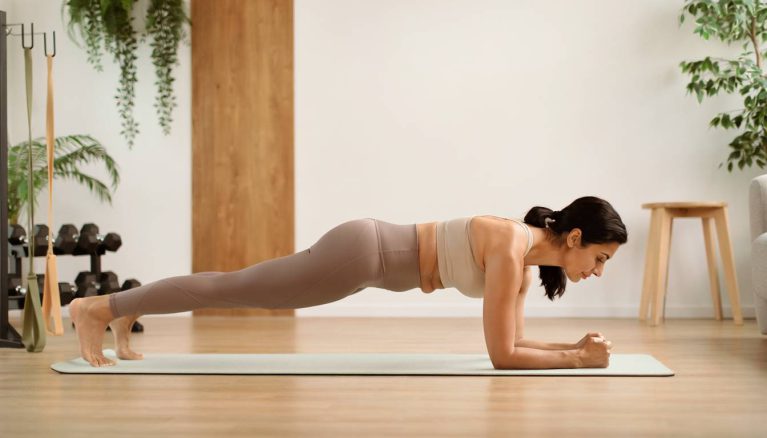
$9.99/month or $79.99/year (US) · £9.99/month or £79.99/year (UK) · 1 month free trial (3 months free with Apple device purchase) · Streaming platform · Strength, HIIT, Pilates, yoga, dance, treadmill, cycling, rowing, meditation and recovery library · Apple ecosystem (iPhone, iPad, Apple TV) · Personally tested: five weeks of structured daily use on iPhone, projected to TV and computer monitor · Custom four-week plan plus 3 Weeks of Strength programme · Dance, Pilates and treadmill sessions · No Apple Watch used during testing · Pricing verified April 2026
🗓️ Last updated: April 2026 · Pricing and features verified against apple.com/apple-fitness-plus
Apple Fitness+ Review 2026: Quick Answer
Quick Verdict
Apple Fitness+ is a paid streaming workout platform built around short, stackable sessions across strength, HIIT, Pilates, dance, yoga and more, scored 6.7/10 after five weeks of daily testing as a woman in her mid-forties navigating perimenopause, drawing on close to fifty platforms tested over fifteen years.
The standout is time efficiency. Most sessions run 10 to 30 minutes and stack back to back, which is why Time Efficiency scores 9. Every session has three trainers, one always showing modifications, making this one of the most reliable modification systems I have tested. I bought an iPad, got three months free, built my own week around it, and several weeks later I am still using it most days.
The workouts suit perimenopause and menopause well, Apple just hasn’t branded them that way. The gap is guidance, not content. Women Over 40 Specificity scores 4.5 because there is no peri or meno plan and no hormonal education, the kind of structure Pvolve and Owning Your Menopause provide. If you know what your body needs, the library delivers. If you do not, you are on your own. Nutrition Integration scores 0: no nutrition content at all.
Recommended for women over 40 who want short, high-quality workouts that fit around a genuinely busy life, and who already own Apple devices. Not the right fit if you want perimenopause-specific structure, nutrition support, or you are not in the Apple ecosystem.
Jump to Section
Apple Fitness+ Review 2026: Why I Tested It
I decided to test Apple Fitness+ after purchasing an iPad that came with three months free. No credit card commitment, no catch, just a free pass into a platform I had been curious about for a while. By this point I had been through a long rotation of fitness apps and I wanted to see whether Apple’s ecosystem play could compete with the dedicated platforms I had been testing.
I came to it shortly after spending time on Alo Wellness Club and with a lingering fondness for Fit With Coco, whose programme made me the strongest I have felt. The question I wanted to answer was simple: could Apple Fitness+ deliver enough structure and quality to justify paying after the trial, especially for a woman in perimenopause who does not own an Apple Watch?
What Is Apple Fitness+?
Apple Fitness+ is a subscription fitness and wellness service that offers thousands of on-demand workouts and meditations across more than twelve activity types. It launched in December 2020 as an Apple Watch companion, requiring the watch to use. In late 2022, Apple opened it to iPhone, iPad and Apple TV users without a watch, though the real-time metrics and personalised features still need one.
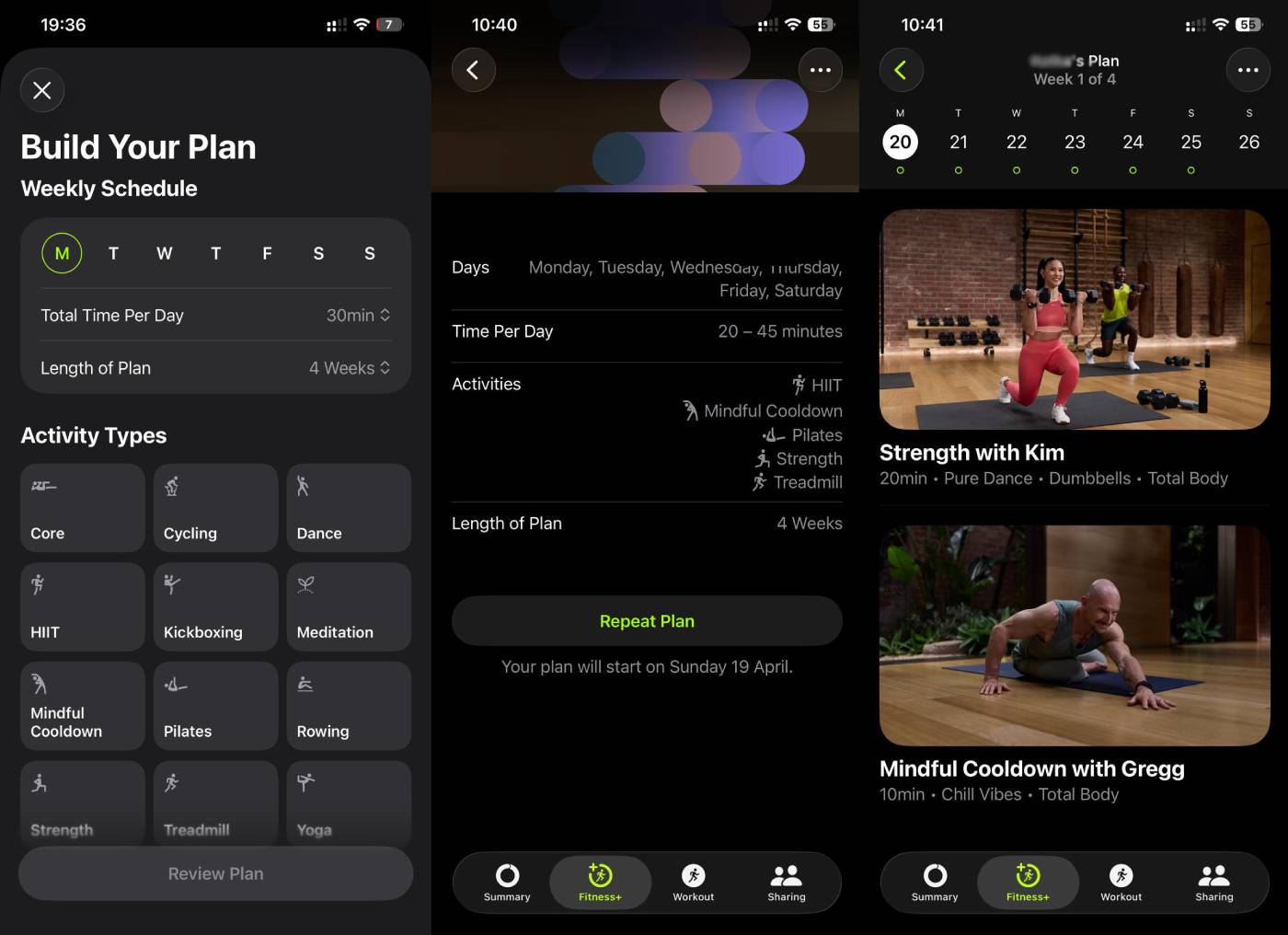
The activity types cover strength, HIIT, Pilates, yoga, dance, kickboxing, cycling, rowing, treadmill (walking and running), core, meditation and mindful cooldown. New sessions are added weekly. Structured multi-week programmes run alongside the single-session library, and you can also build your own custom plans.
If you pair it with an Apple Watch, you get real-time heart rate displayed on screen during workouts, calorie burn tracking, Activity Ring progress, heart rate zone indicators and the Burn Bar, which compares your effort against other people who have done the same session. Without the watch, you get the workouts and nothing else, which is exactly how I tested it.
Who Is Behind Apple Fitness+?
Apple Fitness+ is developed by Apple Inc. and led by Jay Blahnik, Apple’s VP of Fitness Technologies, who previously worked with Nike on training products. The trainer roster is Apple’s own, recruited specifically for the platform.
During my testing I worked with Sam and Kyle for strength (weeks 1 and 2 of 3 Weeks of Strength), Gregg and Jenn across other strength sessions, Jhon for dance (his Latin Grooves classes are a genuine highlight), and encountered Molly on the Strength for Older Adults sessions that my mum tested.
The trainers are not independent creators with their own followings in the way you see on Peloton. They are Apple employees, filmed in Apple’s purpose-built studio, and the production is polished. One thing worth noting is that at the start, end and sometimes during workouts, the trainers use American Sign Language, an inclusion detail I have not seen on any other platform.
What Makes Apple Fitness+ Different?
Three things set Apple Fitness+ apart from the forty-odd platforms I have tested.
First, the short-session stacking model. Most workouts run 10 to 30 minutes, and the platform is designed for you to pair them. A 20-minute strength session followed by a 10-minute mindful cooldown. A 10-minute core followed by a 20-minute Pilates.
For me, working full time with two school-aged children, pickups, after-school clubs, friends, driving around, fitting in a 20-minute workout is genuinely achievable in a way that a 45 to 60-minute commitment every day simply is not. This is the single biggest reason I kept coming back.
Second, the three-trainer format. Every session has one lead coach who explains and demonstrates, and two trainers following along. One of those two consistently shows modified versions: lower pace, less impact, easier on joints. This is not an occasional thing, it is baked into every class. For a woman over 40 with any joint considerations at all, having a visible modifier on screen at all times is more useful than a verbal “and if you need to modify, do X” that many platforms offer.
Third, the Apple Watch integration. I did not test with a watch, so I cannot review this from personal experience, but the metrics layer is the platform’s headline differentiator. Real-time heart rate on screen, calorie tracking, the Burn Bar comparing your effort to others, Activity Ring progress during the workout. If you own the watch, this is where the value proposition gets significantly stronger than what I experienced.
How Do You Get Started with Apple Fitness+?
Signup is through your Apple ID, either from the Fitness app on iPhone or iPad, or through the Apple TV. If you have bought a new Apple device recently, the three-month trial activates automatically. Otherwise, anyone can start a one-month free trial. You do need to enter payment details for the trial, which is a step up from Alo Wellness Club’s completely card-free signup, but standard for the industry.
Once inside, you land on a personalised home screen showing recommended workouts, new additions and any programme you are following. You can browse by activity type, by trainer, or by programme. The search field works and I used it when I wanted something specific, like finding Jhon’s dance classes or filtering strength sessions by duration.
One friction point: the filtering system. Apple offers filters for trainer, duration, and in some activity types, body focus (upper body, lower body, total body). But these are not consistent across all workout categories, and I found them less prominent than I expected.
I wanted to filter simultaneously by time, coach and body area, the way I can on some other platforms, and I could not always do that cleanly. For a company that prides itself on user experience, the filter design feels like an afterthought.
What Equipment Do You Need for Apple Fitness+?
Most sessions need minimal equipment. I used dumbbells (ranging from 9 lb to 20 lb during testing), resistance bands in various strengths, ankle weights, a kettlebell and a mat. A treadmill is useful for the walking and running sessions but you can substitute outdoor walks. Many sessions are fully bodyweight.
Starter Dumbbells (up to 10 lb)
A light adjustable pair to start with
~$65–$80
Great starting point
Medium Dumbbells (up to 25 lb)
For steady progression as you get stronger
~$50–$65
Needed as you progress
Advanced Dumbbells (up to 50 lb)
For serious strength and progressive overload
~$350–$430
Grows with you
Resistance Bands
Light through to heavy, used heavily in Pilates sessions
$10 to $25
Ankle Weights
For Pilates and lower body work
$10 to $20
Kettlebell
One 18 to 26 lb kettlebell for strength sessions
$20 to $40
Exercise Mat
Standard fitness or yoga mat
$15 to $30
Treadmill (optional)
For the walking and running sessions, substitute outdoor walks if you prefer
$300+
Not essential, outdoor walking works fine
What I Actually Tested
I tested Apple Fitness+ for five weeks of structured daily use. I am in my mid-forties, navigating perimenopause, with a previous meniscus injury and a schedule that realistically allows 20 to 30 minutes of training most days. I do not own an Apple Watch, so my testing reflects the platform experience without the metrics layer.
I built my own custom weekly plan for the first four weeks:
Monday: 20-minute strength training (full body) + 10-minute mindful cooldown. Tuesday: 45-minute treadmill session (varied between walking and jogging depending on energy) or a dance class. Wednesday: 20-minute strength training (full body) + 5-minute mindful cooldown. Thursday: 20-minute Pilates with resistance bands or another 20-minute strength session. Friday: 30-minute treadmill session or a dance class. Saturday: 20-minute HIIT. Sunday: Rest day, outdoor walk, or meditation.
I followed this schedule because I know myself. I have tried enough platforms to understand that I will stick to something short-term manageable that covers the bases: muscle-building sessions, cardio, and one HIIT day. After four weeks on my own plan, I moved into the 3 Weeks of Strength programme and followed it for five weeks (repeating weeks as I built up), alongside continued dance and treadmill sessions on alternate days.
I also sampled five sessions from the Strength Basics in 3 Weeks programme (to assess the beginner experience), several Pilates sessions with bands, multiple dance classes with Jhon (Latin Grooves), and walking treadmill sessions. I tried the Time to Walk audio stories with Mel B and Rita Ora during outdoor walks but they were not for me. I prefer to walk with music or in silence. My mum (68, regular walker and Pilates doer) tested the Workouts for Older Adults series at my request.
What Are the Apple Fitness+ Workouts Like?
Apple Fitness+ workouts are polished, short (10 to 30 minutes) and always feature three trainers on screen: a lead coach, one at full intensity, and one showing modifications throughout. Sessions are filmed in a clean, pleasant gym setting with excellent lighting, clear camera angles and good audio. It looks expensive, which it probably is.
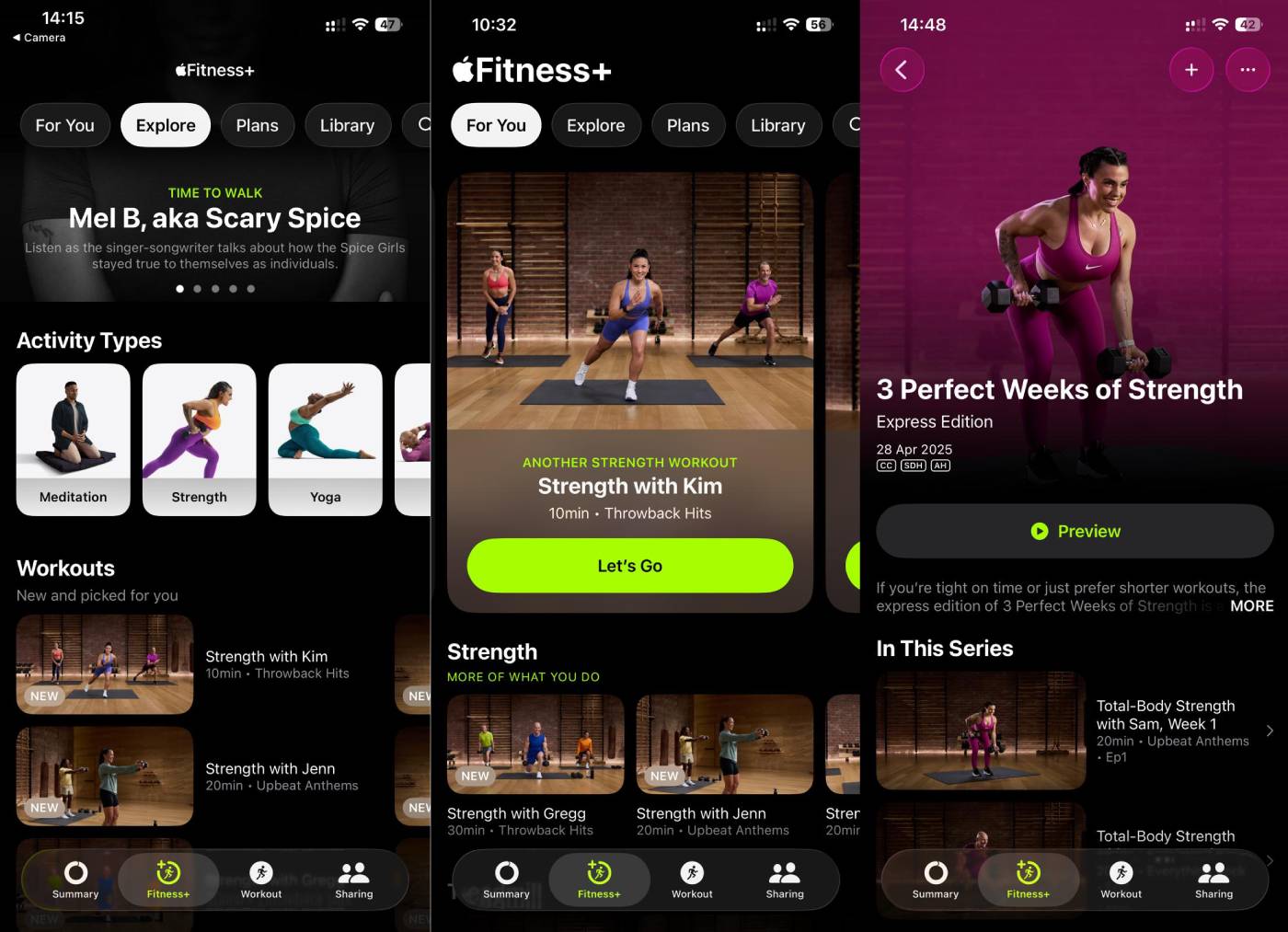
Every workout starts with a warm-up and ends with a cool-down baked into the runtime, which matters more for a body over 40 than it did at 25.
The three-trainer format is the platform’s structural superpower. The lead coach demonstrates and explains, the second trainer follows at full intensity, and the third consistently shows modifications: lower impact, slower pace, less range of motion.
This means you always have a visual reference for a less intense version, without the coach having to break their flow to describe it verbally. After testing platforms where modifications are an afterthought or mentioned once and forgotten, the consistency here stood out.
Workouts are overwhelmingly in the 10 to 30 minute range. Strength sessions tend to be 10, 20 or 30 minutes. HIIT is typically 10 to 20. Dance classes run about 20 minutes. Pilates sits at 10 to 20. Mindful cooldowns are 5 or 10 minutes.
You can stack sessions back to back, which is how the platform is clearly designed to be used. I almost always stacked: a 20-minute strength followed by a 10-minute cooldown, or a 20-minute Pilates followed by a 10-minute core. The stacking model is what makes this work for someone with my schedule.
You can choose your music genre for each workout, which is a nice touch. The coaches are high energy and the atmosphere is consistently positive. Sometimes, frankly, it feels a bit acted, a bit too upbeat, but that is a minor quibble and you get used to it. The energy is infectious rather than grating.
What Programmes Did I Test on Apple Fitness+?
I focused on 3 Weeks of Strength (the progressive overload programme), dance classes with Jhon, Pilates with resistance bands, treadmill sessions, the Strength Basics beginner programme, and asked my mum to test Workouts for Older Adults. Here is what each delivered.
3 Weeks of Strength (Progressive Overload)
This is where Apple Fitness+ genuinely delivered for me. The programme runs three weeks with progressive structure. Week 1 with Sam started at a faster pace with lighter weights (I used 9 lb and 13 lb dumbbells). Week 2 with Kyle slowed the tempo and increased the load. By week 3 I had added explosiveness to some movements and bumped my weights to 11 lb and 17 lb. Sam also leads some sessions with Gregg and Jenn across other strength blocks.
I ended up repeating the programme, running it for five weeks total because I had been inactive for about a month beforehand (two weeks of holidays with mostly walking, followed by a week of being ill, then the family getting sick). Coming back to dumbbells after that break, I dropped my weights from the 20 lb I had been using previously. My muscles were quite sore the first week after each session, which is exactly the response you expect when returning to resistance training after a break.
A note on the weight gain I experienced, because it is relevant for any woman over 40 starting or restarting strength training. My weight went up by 2 lb in the first week. By the end of five weeks it had dropped back down plus an extra 1 lb, so a net loss of 1 lb overall, and I was visibly more toned.
The initial gain is almost certainly water retention: when you create micro-tears in muscle fibres through resistance training, your body retains fluid around the damaged tissue as part of the repair process, and glycogen storage in newly-worked muscles binds with water, adding 1 to 3 lb temporarily.1 This is normal, it is a sign your body is adapting, and it resolves within a few weeks.
If you are a woman in perimenopause who already feels paranoid about the scale, know that an initial bump after starting strength training is your body doing exactly what it should.
For a complete beginner, these strength programmes are a genuinely good entry point. The Strength Basics in 3 Weeks programme covers foundational movements with detailed technique explanations. You can repeat it as often as needed, simply increasing weights each round.
For someone like me who has been training on and off for years, the sessions from 3 Weeks of Strength provided enough progressive overload to produce visible results in five weeks, even with a month of inactivity beforehand. I fixed my posture on a few movements after watching the basics sessions, which is a reminder that revisiting fundamentals is always worthwhile.
Dance Classes (Latin Grooves with Jhon)
I started my non-strength days with treadmill sessions, but once I tried the dance classes I was hooked. Jhon’s Latin Grooves sessions are 20 minutes of good music, high energy and a coach who makes you want to move. I click play and the time is over before I notice. I always finish energised and in a better mood than when I started, which is not something I say about many workouts. If you need a cardio option that does not feel like cardio, start here.
Pilates with Resistance Bands
The Pilates sessions with bands and ankle weights work different muscles than the strength training, or at least that is how it feels the next day. Research supports this: a study in the European Review of Aging and Physical Activity found that Pilates engages stabiliser muscles differently from traditional resistance training, and that adding elastic bands was more effective at increasing strength than Pilates without load.2
For me, these sessions complement the strength days rather than duplicating them, and they are a good fit for days when I want to train but do not want to pick up heavy dumbbells.
Treadmill Walking and Running
If you have a treadmill at home, the walking and running sessions are engaging enough that I sometimes forgot I was running. The coaches keep a good pace of conversation and motivation during the sessions. I alternated between walking days (when my energy was lower) and jogging. The sessions are fun but they are not the reason to subscribe. You can get a good treadmill walk from YouTube or Spotify. These are a nice bonus, not a differentiator.
Workouts for Older Adults
I asked my mum (68, regular walker, does Pilates) to test this category. Her verdict was mixed. The series has relatively few workouts, so not a great selection to keep someone engaged long-term. She enjoyed the Strength for Older Adults sessions with Molly but found the difficulty level too low overall. Having said that, it is definitely easy on your joints and if you starting over and you are not fit, this can be a great place to start and try out different types of workouts.
She told me she prefers dipping into the regular Workouts for Beginners library with light or no weights, which gives her a better workout. This matters for the Women Over 40 scoring: Apple’s age-specific content undershoots for women who are active but over 60, and significantly undershoots for women in their 40s and 50s who want peri-specific programming.
What Results Can You Expect from Apple Fitness+?
After five weeks on the strength programme plus supplementary dance, Pilates and treadmill sessions, I was visibly more toned, particularly through my arms and upper body. My weight went up 2 lb in week one and ended 1 lb below my starting weight, a pattern consistent with the water retention and glycogen storage that accompanies returning to strength training after a break.1
I did not change my nutrition during testing, so these observations come from training changes alone. The progressive overload was real: moving from 9-13 lb to 11-17 lb dumbbells over five weeks, with improved form on several movements after revisiting the basics sessions. My energy levels felt better on training days than rest days, which is a pattern I have noticed across other platforms too.
The more important result is adherence. I showed up nearly every day for five weeks. The short sessions meant I never had a “I do not have time today” excuse. Even on the busiest days, 20 minutes was possible – and I did the workouts few times at around 9pm as I could not fit them in earlier. For a woman in her forties juggling work and family, the programme that you actually do consistently beats the programme that is theoretically better but sits unwatched. Apple Fitness+ made showing up easy.
Is Apple Fitness+ Good for Women Over 40?
It is good, with a meaningful gap. The content itself serves women over 40 well despite not being designed or labelled for them. Progressive overload strength training, which the platform delivers through its structured programmes, is exactly what current research recommends for perimenopausal and menopausal women.
A 2023 systematic review found that strength exercises improve bone density, reduce menopause symptoms including hot flashes, and positively affect metabolic and hormonal changes during menopause.3 Stanford Lifestyle Medicine recommends two to three strength sessions per week for women in perimenopause, combined with moderate cardio and adequate recovery, emphasising training smarter rather than harder.4
My custom weekly plan (two to three strength sessions, one to two cardio or dance sessions, one HIIT, plus recovery) aligns well with this guidance. Apple Fitness+ makes building exactly this kind of week straightforward because the sessions are short enough to combine and the activity variety is broad enough to cover all bases.
A University of Exeter study showed that resistance training can improve physical function during menopause, with meaningful gains in leg and pelvic floor strength.5 A separate PLOS ONE study found that premenopausal women over 40 gained 2% muscle mass and lost 3% body fat after a 12-week resistance training programme.6
What is missing is any acknowledgement from the platform that this audience exists. No perimenopause category, no menopause filters, no hormone-aware programming, no educational content about training through this life stage.
The “Workouts for Older Adults” category is the closest nod, and it is both too basic and incorrectly targeted: most women aged 40 to 55 are not “older adults,” they are active women dealing with specific hormonal changes that affect how they should train. Apple has the content to serve this audience. It has not yet built the structure around it.
Does Apple Fitness+ Help with Perimenopause and Menopause?
Not directly. There is no dedicated perimenopause programme, no menopause-specific content, no coaches discussing hormonal changes, no pelvic floor series, no symptom management content. If dedicated, clinically-informed perimenopause programming is your primary requirement, Pvolve’s Menopause Strong or Owning Your Menopause are the better choices.
What Apple Fitness+ does offer perimenopausal women is an excellent content toolkit if you know what to do with it. The short-session stacking model suits the energy fluctuations of perimenopause. The meditation and mindful cooldown library supports sleep disruption and stress management. The three-trainer modification system means you can scale back on high-cortisol days without abandoning the session.
The progressive strength programmes address muscle and bone protection. But you have to assemble this yourself. Nobody on the platform is going to tell you “today is a high-cortisol day, try this instead.” If you are after that kind of guidance, look elsewhere.
Is Apple Fitness+ Good for Beginners?
Yes, and this is one of its stronger suits. The Strength Basics in 3 Weeks programme covers foundational movements with clear technique explanations at a manageable pace. The three-trainer format means beginners always have a lower-intensity visual reference. Session lengths of 10 to 20 minutes are not intimidating.
I sampled five sessions from the basics programme to assess it, and the explanations were detailed enough that I corrected my own form on a couple of movements after years of doing them slightly wrong.
There are also dedicated programmes for Workouts for Beginners, and the variety means a beginner can try strength, Pilates, dance and yoga without committing to a platform that only does one thing.
The only weakness is that the platform does not hold a beginner’s hand in terms of week-by-week progression the way a coach-led programme like Fit With Coco does. You can follow a 3-week programme, repeat it, and then move to the next one, but you are making those decisions yourself.
How Good Is the Apple Fitness+ App?
The app is clean, the design is pleasant and the content is genuinely easy to find most of the time. I used it primarily on my iPhone, projecting to my computer monitor and TV screen for a larger viewing experience.
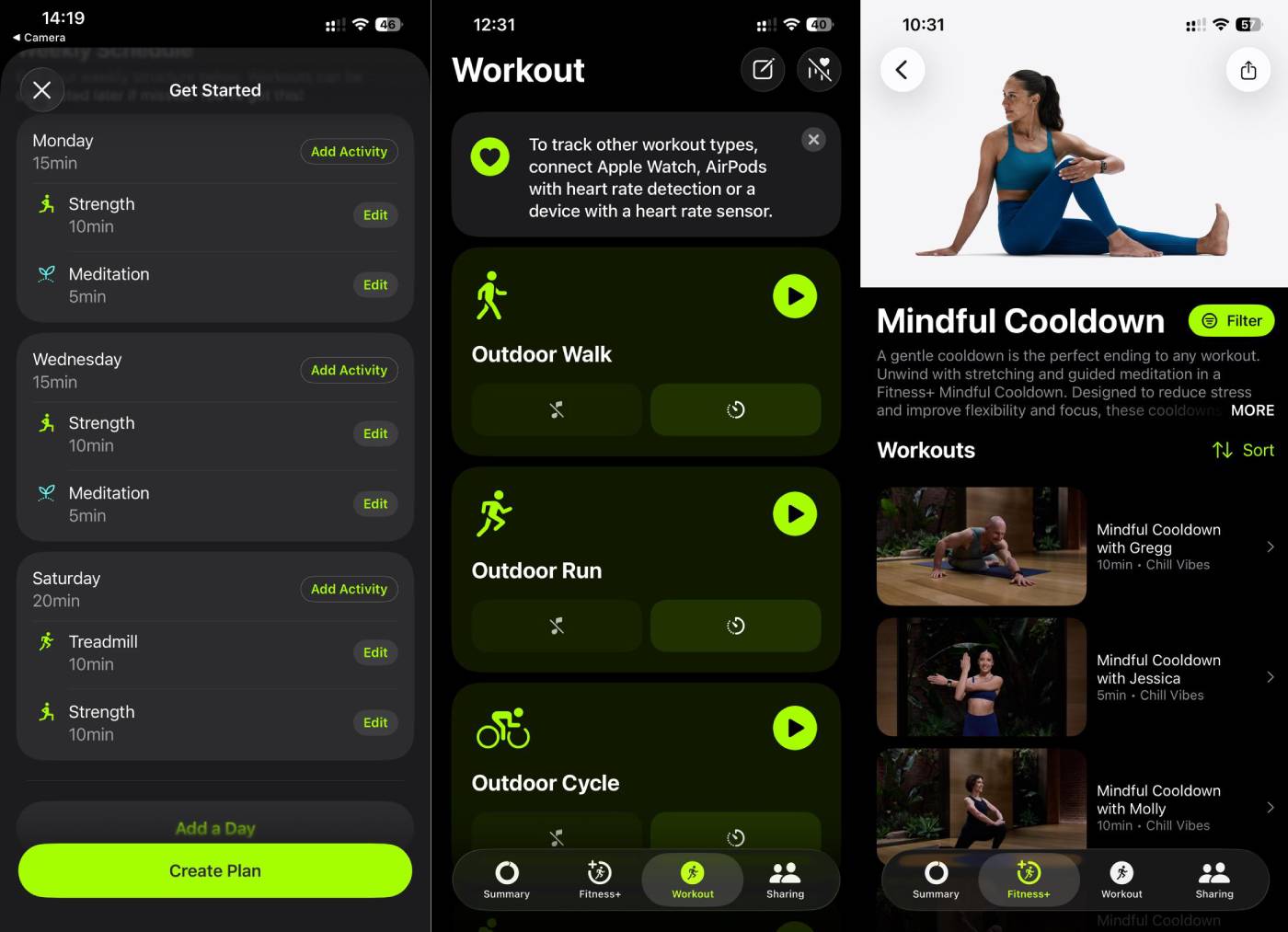
The projection worked well most of the time, but I had an intermittent issue where the screen would go black while the audio continued. The only fix was to stop the workout and restart it, which is mildly infuriating mid-session. This happened a handful of times across five weeks, enough to be annoying but not enough to derail the experience.
The app is available on iPhone, iPad and Apple TV. There is no Android version and no web app. If you are not in the Apple ecosystem, this platform does not exist for you, which is a significant limitation when competitors like Peloton, Les Mills+ and Alo Wellness Club work across all devices.
Filtering is the weakest part of the UX. Within each activity type you can filter by trainer, duration and sometimes body focus. But these sub-filters are not consistently available across all categories, and they are not as prominent in the interface as they should be.
I wanted to filter by time, coach and body area simultaneously and could not always do so. The search field works as a backup, but for a platform from the company that designed the iPhone, the browse experience should be smoother.
Workout tracking is built into the app: you can start tracking any session and it logs to your Apple Health data. For outdoor walks, you start tracking and can listen to stories or music through the Time to Walk and Time to Run features. Music selection per workout is a nice personalisation touch that few competitors offer.
How Much Does Apple Fitness+ Cost?
Apple Fitness+ costs $9.99 per month or $79.99 per year in the US, and £9.99 per month or £79.99 per year in the UK. Family sharing is included, so other household members on your Apple Family plan can use the same subscription. It is also bundled in the Apple One Premier plan.
New subscribers get one month free. If you buy a new iPhone, iPad, Apple Watch, Apple TV or Mac, you get three months free, which is how I started. No excuse not to try it if you are buying or already own an Apple product.
| Plan | US Price | UK Price | Notes |
|---|---|---|---|
| Monthly | $9.99/mo | £9.99/mo | Cancel anytime |
| Annual | $79.99/yr | £79.99/yr | Saves ~$40/£40 per year vs monthly |
| Apple One Premier | $37.95/mo | £36.95/mo | Includes Fitness+, Music, TV+, Arcade, News+, iCloud+ 2TB |
| Free trial | 1 month (anyone) · 3 months (new Apple device) | Credit card required | |
The value question depends heavily on your context. If you own an Apple Watch, the real-time metrics integration adds significant value that you cannot get from competing platforms. If you do not own the watch, as I do not, you are paying $9.99 a month for workouts without the headline feature.
Meanwhile, Alo Wellness Club offers a comparable breadth of strength, Pilates, HIIT and recovery content for free, with no card and no trial timer. FitOn offers a solid free tier too. For someone in my position, without the watch, the value case for paying after the trial is weaker than I expected.
Is Apple Fitness+ Easy to Stick With?
Yes, and this is one of the platform’s real strengths. I stuck with it for five weeks without once struggling to find time. The 10 to 30 minute session lengths remove the single biggest barrier to consistency: time. You do not need to block out an hour. You do not need to warm up separately (it is built in).
You can fit a session into a lunch break, between school pickups, or after the children are in bed. Stacking two short sessions gives you a complete workout in 30 minutes that covers both training and cooldown.
The content variety helps too. Between strength, dance, Pilates, treadmill, HIIT, meditation and yoga, I never opened the app and thought “there is nothing here for how I feel today.” If I was tired, I walked. If I was energised, I danced. If I wanted to lift, the strength programme was waiting. For a woman in perimenopause whose energy levels shift unpredictably from day to day, having that breadth inside one platform is genuinely practical.
Boredom Risk
LOW12+ activity types, new content weekly, music selection per workout. You would need months to exhaust the library.
Learning Curve Risk
LOWThree-trainer format makes every session easy to follow. Basics programmes for newcomers. Clean app design.
Equipment Friction Risk
LOWDumbbells and a mat cover most sessions. Many are bodyweight only. No proprietary equipment required.
Decision Fatigue Risk
MEDIUMLarge library without a daily prescription. Structured programmes help, but you are choosing your own week unless you follow one. Filters could be stronger.
Apple Fitness+ Weighted Scoring: How the 6.7/10 Was Calculated
| Category | Weight | Score | Reasoning |
|---|---|---|---|
| Time Efficiency | 15% | 9 | Strongest scoring category and the reason I kept coming back. The majority of sessions run 10 to 30 minutes, stacking two gives a complete workout in 30 minutes, and warm-up and cool-down are baked in. For a working parent fitting training around school runs, this is the best time-efficiency model I have tested on any platform at any price. |
| Muscle Potential | 15% | 7.5 | Real progressive overload in the 3 Weeks of Strength programme: I went from 9-13 lb to 11-17 lb dumbbells over five weeks and saw visible toning. Multiple strength programme options from basics to advanced. Ceiling is limited by the 3-week programme cycles, there is no long-term periodised plan spanning months, so you have to self-manage progression across programmes. |
| Women Over 40 Specificity | 15% | 4.5 | No perimenopause or menopause content. No hormonal education, no pelvic floor, no symptom-aware programming. “Workouts for Older Adults” is too basic for most women 40 to 55 and was not compelling even for my 68-year-old mum. The content genuinely serves women over 40 through its strength, modification and recovery offering, but nothing is designed or labelled for them. |
| Joint Friendliness | 12% | 8 | The dedicated modifier in every session is the standout. With my meniscus history I was able to follow every strength and Pilates session without knee pain by watching the modifier. Low-impact options across Pilates, yoga and walking. HIIT can be high-impact, but the modifier consistently shows gentler alternatives. |
| Recovery Compatibility | 10% | 7 | Meditation, mindful cooldown, yoga and gentle walking sessions all available. I used the 5 to 10 minute cooldowns almost daily after strength sessions. The recovery library is functional and good but does not reach the depth of Alo Wellness Club’s offering (sound baths, yoga nidra, breathwork, restorative yoga). Adequate rather than exceptional for a perimenopausal nervous system. |
| Programme Structure | 10% | 7.5 | Good range of ready-made programmes (Strength Basics in 3 Weeks, 3 Weeks of Strength, 3 Perfect Weeks of Pilates, and many more) plus build-your-own custom plans. Programmes are short cycles (typically 3 weeks), which is good for commitment but requires you to choose what comes next. No progress tracking beyond session completion. Filtering gaps make browsing the library harder than it should be. |
| Value for Money | 8% | 7 | Generous free trial (1 month standard, 3 months with Apple device purchase) and $9.99 per month is genuinely competitive compared to Peloton ($13.99), Les Mills+ ($14.99) and Fit With Coco ($19.99). Family sharing sweetens the deal further. Without an Apple Watch you lose the headline features (real-time metrics, Burn Bar, Activity Rings on screen), which dents the value slightly. Alo Wellness Club offers comparable breadth for free, but Apple’s modification system and session design are stronger. Fairly priced for what you get. |
| UX and Design | 8% | 7.5 | Clean app, pleasant design, high production values, music selection per workout. But: filtering is inconsistent across activity types, the platform is locked to Apple ecosystem (no Android, no web app), and I experienced intermittent screen blackouts when projecting from iPhone to TV, requiring a session restart. A polished surface with genuine UX gaps underneath. |
| Nutrition Integration | 7% | 0 | Nothing. No recipes, no meal plans, no macro tools, no calorie calculator, no nutrition education of any kind. This is a workout-only platform. For women over 40 trying to rebuild the eating side alongside training, a real gap, especially given that protein needs increase during perimenopause and managing nutrition becomes more important, not less. |
| Total | 100% | 6.7/10 |
Final Weighted Score
6.7/10
The best short-session stacking model I have tested for busy women over 40, held back by zero perimenopause content, no nutrition, and a value proposition that weakens significantly without an Apple Watch.
What Are the Pros and Cons of Apple Fitness+?
What Works
- Short, stackable sessions (10 to 30 minutes) are genuinely designed for busy schedules, the best time-efficiency model I have tested
- Three-trainer format with a dedicated modifier in every session makes modifications consistent and reliable
- Real progressive overload in the strength programmes, I went from 9-13 lb to 11-17 lb in five weeks with visible toning
- High production quality, pleasant gym setting, excellent audio and camera work
- Dance classes (particularly Jhon’s Latin Grooves) are a genuine cardio highlight that makes 20 minutes disappear
- Pilates with resistance bands and ankle weights complements strength days and targets stabiliser muscles differently
- Music selection per workout is a personalisation touch most competitors do not offer
- Beginner programmes with detailed technique explanations are strong enough that I corrected my own form after years of training
- Meditation and mindful cooldown library supports recovery and sleep
- Build-your-own custom plans plus ready-made programmes cover both self-directed and guided users
- Generous free trial (3 months with Apple device purchase, 1 month for anyone)
- American Sign Language used by trainers for accessibility, the only platform I have seen do this
What to Know Before Signing Up
- No perimenopause or menopause content at all: no dedicated programmes, no hormonal education, no symptom-aware workouts
- “Workouts for Older Adults” is too basic for active women 40 to 55 and has limited selection even for older users
- Apple ecosystem only: no Android app, no web app, excludes a significant portion of users
- Without an Apple Watch you lose real-time heart rate, Burn Bar, Activity Rings on screen, the platform’s headline features
- Filtering is inconsistent across activity types: cannot always combine trainer, duration and body focus simultaneously
- No nutrition content: no recipes, no meal plans, no macro tools
- $9.99 per month ongoing cost when comparable free alternatives exist (Alo Wellness Club, FitOn free tier)
- Programmes are short cycles (typically 3 weeks) with no long-term periodised planning
- No progress tracking beyond session completion: no streaks, no strength logs, no body metrics
- Screen blackout issues when projecting from iPhone to TV (intermittent but requires restarting the workout)
- Credit card required for free trial, unlike Alo Wellness Club’s completely card-free signup
- Community features are minimal: no forums, no challenges, no social interaction beyond Apple Watch sharing
How Apple Fitness+ Compares to Similar Platforms
| Apple Fitness+ | Alo Wellness Club | Peloton | Les Mills+ | Fit With Coco | FitOn | |
|---|---|---|---|---|---|---|
| HDF Score | 6.7/10 | 7.7/10 | 7.6/10 | 6.1/10 | 8.1/10 | 7.5/10 |
| Monthly price | $9.99 | Free | $13.99 | $14.99 | $19.99 | Free (Pro: $14.99) |
| Annual price | $79.99 | Free | $155.88 | $119.99 | $119.99 | Free (Pro: $59.99) |
| Free trial | 1 month (3 with device) | N/A (free) | 30 days | 7 days | 7 days | N/A (free tier) |
| Session length | 5 to 45 min | 5 to 60+ min | 5 to 90 min | 15 to 55 min | 15 to 50 min | 5 to 60 min |
| Injury modifications | Dedicated modifier every session | Instructor-dependent | Verbal cues mostly | Some shown | Shown for some exercises | Occasionally shown |
| Perimenopause content | None | SYNCD (cycle-based only) | None | None | None | None |
| Nutrition included | No | Yes (limited) | No | No | Yes (comprehensive) | Yes (Pro tier) |
| Programme structure | 3-week programmes + custom plans | Library-based, playlists | Programmes and classes | Programme-led | Coach-led 3-2-1 method | Programmes and classes |
| Equipment needed | Dumbbells, bands, mat | Dumbbells, bands, mat | Varies by class | Varies by class | Dumbbells, bands | Minimal to none |
| Devices | iPhone, iPad, Apple TV | iOS, Android, web, Apple TV | iOS, Android, web, TV apps | iOS, Android, web | iOS, Android, web | iOS, Android, web, TV apps |
| Best suited to | Apple ecosystem users wanting short, stackable sessions | Self-directed users wanting free breadth | Users wanting variety and live classes | Users wanting structured group fitness | Users wanting coach-led progressive plans | Budget-conscious beginners |
Pricing verified April 2026 against official sources.
How Apple Fitness+ Compares to the Closest Alternatives
| Criterion | Winner |
|---|---|
| Price | Alo Wellness Club (free) |
| Modifications | Apple Fitness+ (dedicated modifier every session) |
| Time efficiency | Apple Fitness+ (10-30 min stacking model) |
| Device support | Peloton / Les Mills+ (Android, web, TV apps) |
| Progressive coaching | Fit With Coco (coach-led 3-2-1 method) |
| Perimenopause content | Neither (try Pvolve) |
Apple Fitness+ vs Alo Wellness Club
This is the comparison that kept nagging me during testing. Alo Wellness Club offers a comparable breadth of strength, Pilates, HIIT and recovery content, with better filtering, deeper recovery options (sound baths, yoga nidra, breathwork) and no cost at all.
Apple Fitness+ wins on session design (the three-trainer format with a dedicated modifier is more reliable than Alo’s instructor-dependent modifications), time efficiency (the stacking model is tighter) and production polish. But the value gap is hard to ignore: one is free with no card, the other is $9.99 a month. If you do not own an Apple Watch, Alo is the harder platform to argue against.
Apple Fitness+ vs Peloton
Peloton offers a larger content library, live classes, stronger community features and broader device support including Android and web.
Apple Fitness+ is less expensive, has better modification visibility (dedicated modifier vs verbal cues), and the short-session stacking model is better designed for 20-minute windows. Peloton is the bigger platform. Apple Fitness+ is the more practical one for a time-pressed woman over 40 who needs to get in, train, and get out.
Apple Fitness+ vs Fit With Coco
Fit With Coco is the platform that made me the strongest I have felt, and I plan to go back to her. The coach-led 3-2-1 method with progressive programming is more structured than anything Apple offers, the nutrition component is comprehensive, and the personal coaching feel is in a different league.
Apple Fitness+ wins on variety (12+ activity types vs Coco’s focused library), session flexibility (shorter options, stacking) and the beginner entry path. If you want someone to tell you exactly what to do and push you, Fit With Coco. If you want to build your own week from excellent components, Apple Fitness+.
Apple Fitness+ vs Les Mills+
Les Mills+ is programme-led group fitness with high production values and a strong following. It works on Android and web, which Apple does not. Les Mills+ tends toward longer sessions and a more intense group fitness atmosphere.
Apple Fitness+ is more flexible in session length, has better modification visibility and broader activity variety. For women over 40 who want structured classes with a group fitness energy, Les Mills+. For women who want shorter, more adaptable sessions with stronger modification support, Apple Fitness+.
Apple Fitness+ vs FitOn
FitOn’s free tier is a strong alternative for budget-conscious users. It works across all devices including Android and web, which is a significant advantage.
Apple Fitness+ has higher production quality, more reliable modifications through the three-trainer system, and better structured programmes. If cost is the primary factor and you are not deep in the Apple ecosystem, FitOn. If you already own Apple devices and want to invest in a more polished experience, Apple Fitness+.
Is Apple Fitness+ Worth It?
For an Apple Watch owner who trains regularly: yes, comfortably. The real-time metrics, Activity Ring integration and Burn Bar add a layer of personalisation and motivation that no other platform replicates. Paired with the short-session stacking model and the consistent modification system, it is one of the better all-round home fitness platforms for women over 40 who own Apple hardware.
For someone like me, without the watch: it is worth trying on the free trial, and the content is genuinely good. But the ongoing $9.99 per month is harder to justify when I can get similar (not identical, but similar) workout quality from Alo Wellness Club for free.
What kept me coming back was the time efficiency model, the dance classes, and the progressive strength programmes. Whether that is worth $120 a year depends on whether those specific things matter more to you than the cost savings.
For a woman who wants perimenopause-specific programming: no. This is not the platform for that. Try Pvolve or Owning Your Menopause.
What Are the Most Common Apple Fitness+ Complaints?
From my testing and from what I have read across user forums: the Apple ecosystem lock-in is the most common frustration. No Android, no web app, which excludes a large portion of potential users.
The filtering limitations come up repeatedly, Apple Community threads include requests for better body-area filtering that have gone unanswered. The lack of progress tracking beyond session completion is a common ask. And the value proposition without an Apple Watch is a recurring theme: people want to know what they are paying for when the watch features are the headline and they do not own one.
My own addition to that list: the screen projection blackout issue. It happened enough times to be worth flagging. And the absence of any menopause or perimenopause content, while not a common general complaint, is a significant gap for the audience reading this review.
Is There an Apple Fitness+ Discount Code or Free Trial?
There is no discount code. The free trial options are: one month free for any new subscriber (credit card required), or three months free when purchasing a new Apple device (iPhone, iPad, Apple Watch, Apple TV or Mac).
Apple Fitness+ is also included in the Apple One Premier plan at $37.95/month (US) or £36.95/month (UK), which bundles Music, TV+, Arcade, News+, iCloud+ 2TB and Fitness+. If you already pay for several Apple services, the Premier bundle can make Fitness+ effectively free.
Apple Fitness+ FAQ
Apple Fitness+ works without an Apple Watch, but you lose the real-time heart rate display, Burn Bar, Activity Ring progress and personalised metrics on screen. I tested it for five weeks without a watch and the workouts are still high quality, but the value proposition weakens at $9.99 per month when free alternatives like Alo Wellness Club offer comparable workout depth. Score: 6.7 out of 10.
The content serves women over 40 well: progressive strength training, consistent modifications via a dedicated third trainer, short stackable sessions that fit busy schedules, and Pilates and recovery options. However, there is no perimenopause or menopause-specific programming, no hormonal education and no pelvic floor content. Women Over 40 Specificity scored 4.5 out of 10.
No. Apple Fitness+ has no dedicated perimenopause or menopause programming, no hormone-aware workout scheduling, and no educational content about training through menopause. The “Workouts for Older Adults” category exists but is too basic for most women aged 40 to 55. For perimenopause-specific platforms, consider Pvolve Menopause Strong or Owning Your Menopause.
Apple Fitness+ costs $9.99 per month or $79.99 per year in the US, and £9.99 per month or £79.99 per year in the UK. New subscribers get one month free. Buyers of a new Apple device (iPhone, iPad, Apple Watch, Apple TV, Mac) get three months free. Family sharing is included. It is also bundled in the Apple One Premier plan.
Not natively. Apple Fitness+ is only available on iPhone, iPad and Apple TV. There is no Android app, no web app and no Chromecast or Roku support. You can project or mirror from an iPhone or iPad to a TV using AirPlay, but I experienced intermittent screen blackout issues doing this. For reliable TV viewing, you need an Apple TV device.
It depends on priorities. Apple Fitness+ has better modification visibility (dedicated modifier in every session), shorter sessions that fit busier schedules, and costs less ($9.99 vs $13.99 per month). Peloton has a larger library, live classes, stronger community features and works on Android and web. Neither has perimenopause-specific content.
Yes. The structured strength programmes like 3 Weeks of Strength include progressive overload across the programme weeks, starting with lighter weights at faster pace and building to heavier, slower work with added complexity. I moved from 4-6kg to 5-7.5kg dumbbells over five weeks with visible toning results. Muscle Potential scored 7.5 out of 10.
No. Apple Fitness+ has no nutrition content at all: no recipes, no meal plans, no macro calculator, no calorie tracking, no nutritional education. This is purely a workout platform. Nutrition Integration scored 0 out of 10. For platforms that include nutrition support, consider Fit With Coco or the FitOn Pro tier.
Most sessions need dumbbells and a mat. Resistance bands and ankle weights are useful for Pilates. A treadmill is optional for walking and running sessions. Many sessions are bodyweight only. No proprietary equipment is required. I used dumbbells (4-9kg), resistance bands, ankle weights, a kettlebell, a mat and a treadmill during testing.
Yes. Apple Fitness+ is one of the better platforms for beginners. The Strength Basics in 3 Weeks programme covers foundational movements with detailed technique explanations. The three-trainer format means there is always a visual modifier showing an easier version. Sessions start at 10 minutes. Workouts for Beginners programmes are available across multiple activity types.
Final Verdict
I like Apple Fitness+ more than I expected to. The short-session stacking model is genuinely one of the best I have tested for fitting real training into a real life. The three-trainer modification format is the most reliable on any platform. The progressive strength programmes delivered visible results in five weeks. The dance classes with Jhon made me forget I was exercising. And the production quality is consistently high without being distracting.
But I tested it without an Apple Watch, and that changes the equation. Without the watch, you are paying $9.99 a month for workouts that compete with what Alo Wellness Club offers for free. The absence of any perimenopause content is a real gap for the audience I write for. No nutrition support means you are solving that piece elsewhere. And the Apple ecosystem lock-in means anyone without Apple hardware is simply excluded.
I will keep using it through my free trial. Whether I pay after that depends on whether I can justify the cost against free alternatives.
What I can tell you is that if you are a woman in your forties or fifties who owns Apple devices and wants something short, reliable and well-made to fit into a genuinely busy schedule, this is worth your free trial. If you also own an Apple Watch, it might be worth your subscription. And if you are after perimenopause-specific programming, keep looking, because Apple has not built that yet.
Sources
- Cleveland Clinic (2024). Gaining Weight After Working Out? Here’s Why. Micro-tears trigger inflammation and fluid retention; glycogen storage binds water, causing 1 to 3 lb temporary weight gain when starting or restarting strength training. health.clevelandclinic.org
- European Review of Aging and Physical Activity (2019). Pilates versus resistance training on trunk strength and balance adaptations in older women: a randomised controlled trial. Pilates engages stabiliser muscles differently from traditional resistance training; Pilates with elastic bands more effective at increasing muscular strength than without external load. PMC6859004
- International Journal of Environmental Research and Public Health (2023). The Efficacy of Strength Exercises for Reducing the Symptoms of Menopause: A Systematic Review. Strength training improves bone density, reduces hot flashes, and positively affects metabolic and hormonal changes during menopause. PMC9864448
- Stanford Lifestyle Medicine (2024). Strength Training During Perimenopause. Recommends 2 to 3 sessions per week; consistency over intensity; balanced routine prioritising strength, moderate cardio and recovery. lifestylemedicine.stanford.edu
- University of Exeter (2024). First-of-its-kind study shows resistance training can improve physical function during menopause. Participants demonstrated gains in leg and pelvic floor strength. news.exeter.ac.uk
- PLOS ONE (2023). Resistance training alters body composition in middle-aged women depending on menopause. Premenopausal women over 40 gained 2% muscle mass and lost 3% body fat after 12-week resistance training; positive effects on appetite-regulating hormones. PMC10559623
Pricing last verified April 2026 against apple.com. HerDailyFit does not accept payment from platforms in exchange for favourable reviews. All scores reflect the reviewer’s candid assessment using the site’s weighted methodology.
Affiliate disclosure: Some links in this review may be affiliate links. If you subscribe through one of these links, HerDailyFit may receive a small commission at no extra cost to you. This does not influence our scoring or editorial opinions. Our methodology and scoring criteria are published on our About page.
Medical disclaimer: This review is based on personal experience and should not replace professional medical advice. If you have health concerns, injuries or medical conditions, consult your doctor before starting any exercise programme. The reviewer has a previous meniscus injury and trains with medical clearance. Perimenopause and menopause affect every woman differently; what works for one may not suit another.
About this review
This review is part of the HerDailyFit platform review series, tested and written by Katy Cole. Scoring uses HerDailyFit’s weighted methodology with nine categories designed for women over 40. Editorial policy: no platform pays for placement or favourable scores. Read more about how we review.
Related Guides
What To Do Next
Not sure which platform is right for you?
Take the HerDailyFit Platform Quiz to get a personalised recommendation based on your goals, equipment, budget and life stage. Or browse the full platform rankings to compare scores side by side.