
Free with a free Alo Access account · No credit card required · Streaming platform · Strength, Pilates, HIIT, yoga and recovery library · Formerly Alo Moves (paywall removed December 2025) · Nutrition content included (Dr Amy Shah and Sakara) Personally tested: One month of daily use plus ongoing casual sessions · Multiple Roxie Jones and Bianca Melas programmes · SYNCD luteal phase · Lymphatic and sound bath sessions · Web and iOS app · Pricing verified April 2026
Alo Wellness Club Review 2026: Quick Answer
Quick Verdict
Alo Wellness Club is a free on-demand streaming platform for strength, Pilates, HIIT, yoga and recovery. I scored it 7.7 out of 10 after personal testing as a woman in her mid-forties navigating perimenopause, drawing on close to fifty platforms tested over fifteen years.
I came to it straight after a few weeks on Owning Your Menopause, expecting a one-week assessment. Several months later I am still logging in, which is the clearest thing I can tell you about a platform with no card gate. Production quality is high, the filters actually work, and the strength and Pilates libraries serve women over 40 better than many paid alternatives. Value for Money scores a full 10, the highest I have ever awarded in this category.
Three structural gaps pull the overall down. Women Over 40 Specificity comes in at 5.7 because there is no dedicated perimenopause programming: SYNCD is the closest offering and only helps if you still cycle. Programme Structure sits at 7 because progress tracking does not exist, so you save Playlists or schedule classes into Google Calendar. Nutrition Integration lands at 5.5 because there is no nutrition content at all. On the telly, Apple TV is the only supported option, with no Roku, Fire TV or Chromecast. Long-term free status also depends on Alo’s apparel strategy holding.
Recommended for women over 40 who want quality, options and the freedom to build their own week. Not the right fit if you want a prescriptive weekly plan or peri-specific structure.
Is Alo Wellness Club (Alo Moves) right for you?
Alo Wellness Club is strongest for value for money (10.0 out of 10, against a 6.9 average across the 77 programmes scored) and weakest for nutrition support (4.0 against 4.0).
| Question | Verdict | Rating | Score |
|---|---|---|---|
| How it suits a perimenopausal body | |||
| Is Alo Wellness Club good for pelvic floor problems?Based on pelvic floor support and low-impact design | Moderate, but better than mostmost score 4.6/10 | 6.0 / 10 | |
| Is Alo Wellness Club genuinely built for perimenopause and menopause?Based on menopause programming, hormone awareness, education and expert credibility | Low, but better than mostmost score 3.3/10 | 4.3 / 10 | |
| Is Alo Wellness Club good for painful joints?Based on low-impact design and recovery provision | Strong, and better than mostmost score 6.2/10 | 8.0 / 10 | |
| Is Alo Wellness Club manageable when your energy is low?Based on recovery provision and mind-body support | Strong, and better than mostmost score 5.7/10 | 8.5 / 10 | |
| Is Alo Wellness Club good if you are new to strength training?Based on beginner on-ramp and mind-body support | Strong, and better than mostmost score 6.1/10 | 8.0 / 10 | |
| Is Alo Wellness Club good for building bone density?Based on bone loading and progressive strength | Moderate, about the same as mostmost score 5.1/10 | 5.5 / 10 | |
| Does Alo Wellness Club help with nutrition?Based on midlife nutrition support | Low, about the same as mostmost score 4.0/10 | 4.0 / 10 | |
| How it performs as a product | |||
| Can you fit Alo Wellness Club into a busy week?Based on time efficiency | Strong, about the same as mostmost score 7.6/10 | 8.0 / 10 | |
| Is Alo Wellness Club worth the money?Based on value for money | Strong, and better than mostmost score 6.9/10 | 10.0 / 10 | |
Jump to Section
Alo Wellness Club Review 2026: Why I Tested It
I had tested close to fifty online fitness platforms by this point and I was in a particular mood when I arrived at Alo. I had spent few weeks on Owning Your Menopause, which I respect for its perimenopause knowledge but which felt, executionally, a bit gloomy and amateur in places. I wanted something fresher.
I had heard that Alo Moves had gone free and rebranded as Alo Wellness Club, and I was curious whether a free version of a platform I knew was premium would feel diminished or intact. I signed up for an account in about forty-five seconds, no credit card, and started training the same day. One month of daily use later I am still a member and still logging in for the occasional class, which should tell you something.
What Is Alo Wellness Club?
Alo Wellness Club is a free streaming fitness and wellness platform, available at wellnessclub.aloyoga.com and through the Alo Wellness Club app.
It is the free successor to Alo Moves, which was a paid subscription at around $12 per month from its rebrand of the Cody fitness app in 2017 until December 2025, when Alo dropped the paywall and folded the platform into Alo Access, their free loyalty programme.1 Since then the entire library has been free to anyone with an Alo Access account, no credit card at signup, no trial, no premium upgrade.
The platform offers over 4,000 on-demand classes and more than 300 structured programmes across strength, Pilates, HIIT, yoga, walking, meditation, breathwork, sound healing, recovery and nutrition. New content is added weekly. It is available across web, iOS, Android, Apple TV, Mac, Apple Vision Pro and Apple Watch.
Who Is Behind Alo Wellness Club?
Alo Wellness Club is operated by Alo Yoga, the Los Angeles-based apparel and wellness brand founded in 2007 by Danny Harris and Marco DeGeorge. The fitness platform began life as Cody in 2014, was acquired by Alo and relaunched as Alo Moves in 2017, and became Alo Wellness Club in December 2025.
The commercial logic of the rebrand is straightforward: Alo’s main business is apparel, and a free fitness platform is a powerful top-of-funnel asset for a clothing brand whose customers are fitness-minded.1 What sits in the instructor seat is more interesting than the corporate structure.
The roster includes Roxie Jones (certified personal trainer and fitness and nutrition coach, creator of BodyROX), Bianca Melas (accredited Pilates instructor and certified clinical naturopath, also known as Bianca Wise), Jade Morning (personal trainer with a physical therapy background), Annie Moves (certified yoga instructor with Mindfulness-Based Stress Reduction training), Kirat Randhawa (meditation expert studying contemplative training in psychology at Columbia), Sarah DiGiovanni (strength and posture, who leads the new Hourglass Method), plus established names like Ashley Galvin, Briohny Smyth, Dylan Werner, Tawny Janae and Emily Sferra.
Nutrition content comes from Dr Amy Shah, who is double board-certified and focuses on gut health, hormones and food sensitivities, and from Sakara, the whole-food nutrition company. What this means for a woman over 40 is not that Alo has a dedicated perimenopause advisory board (it does not) but that the people actually teaching you are well-credentialed, varied in style, and several of them have training in women-specific physiology.
What Makes Alo Wellness Club Different?
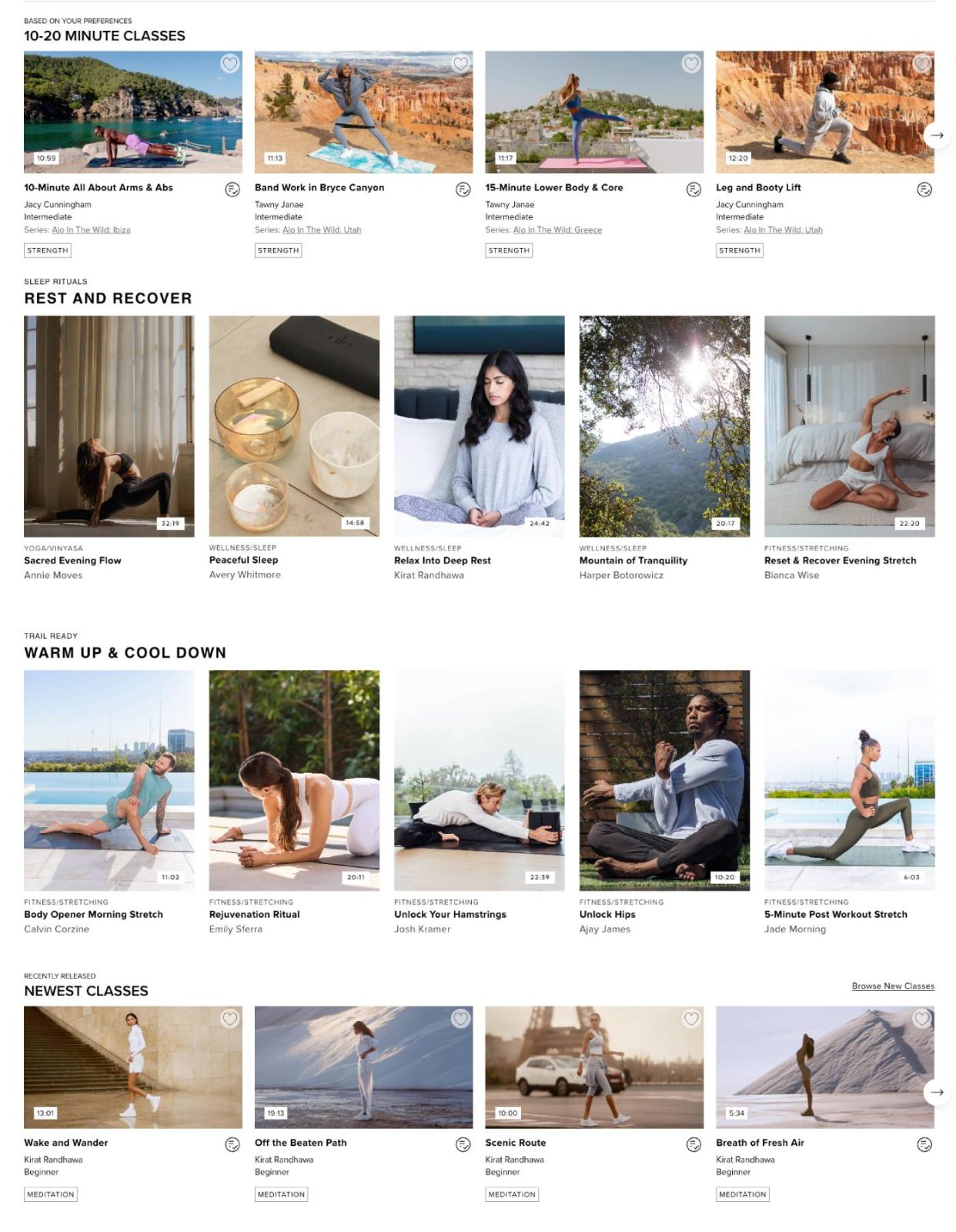
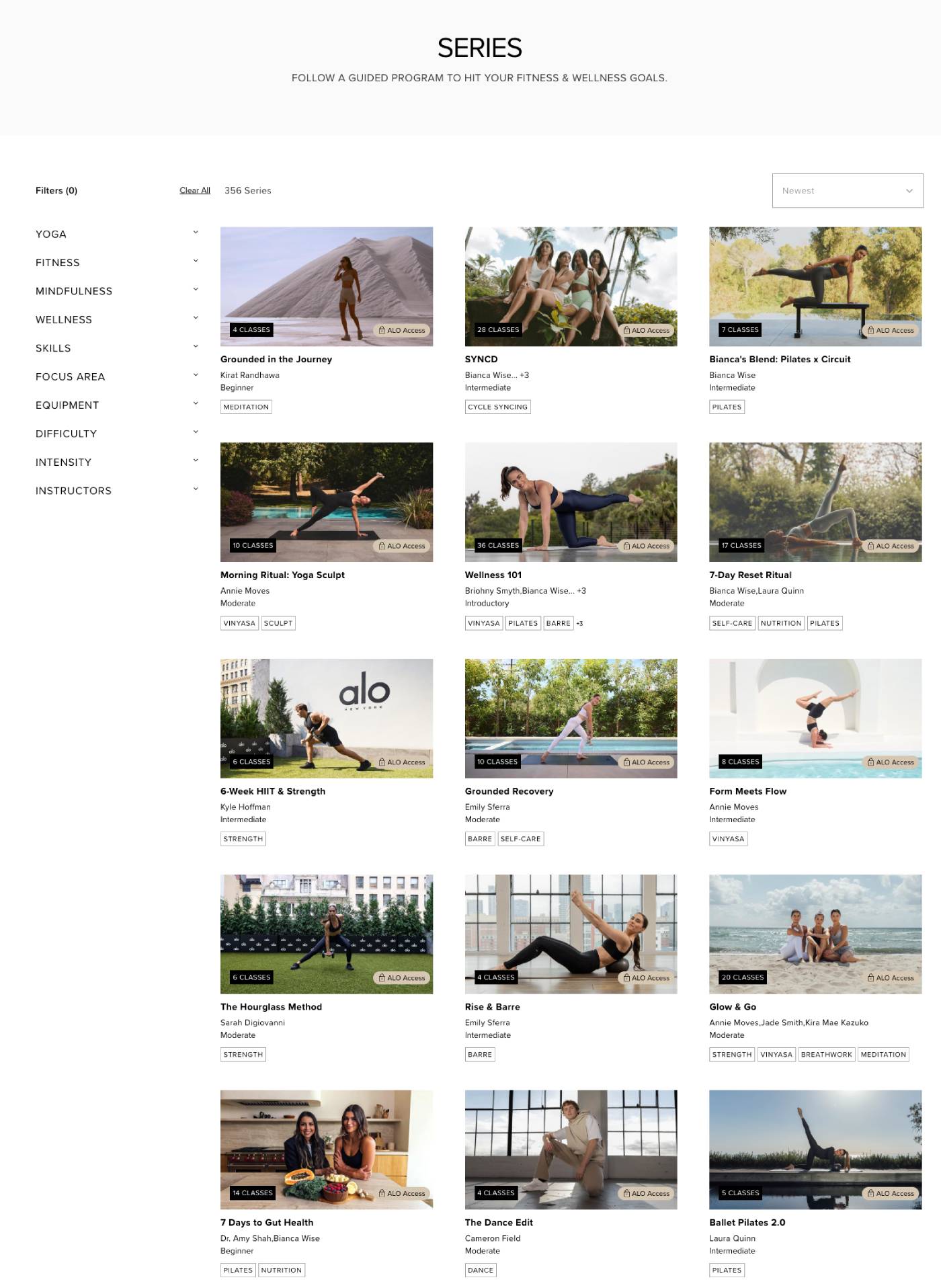
Alo does not have a proprietary method the way Pvolve has Functional Fitness or Fit with Coco has 3-2-1. What it has is breadth, curation and production quality. The way the library is organised is its method: every class is tagged by modality, equipment, duration, difficulty, focus area and instructor, and the filters are stackable.
The consequence is that you can, in under a minute, go from “I have twenty-five minutes, a kettlebell and a dodgy knee” to a list of classes that actually match. That is a different product from a structured method, and it is the right frame for evaluating Alo. The platform is not telling you what to do. It is giving you a very large, very well-filmed menu and trusting you to choose.
For a woman in her forties or fifties who knows roughly what she needs out of a week, that is liberating. For a woman who wants to open an app and press play on “Day 8, Week 3” with no thinking, this is not the right platform, which I come back to in the verdict.
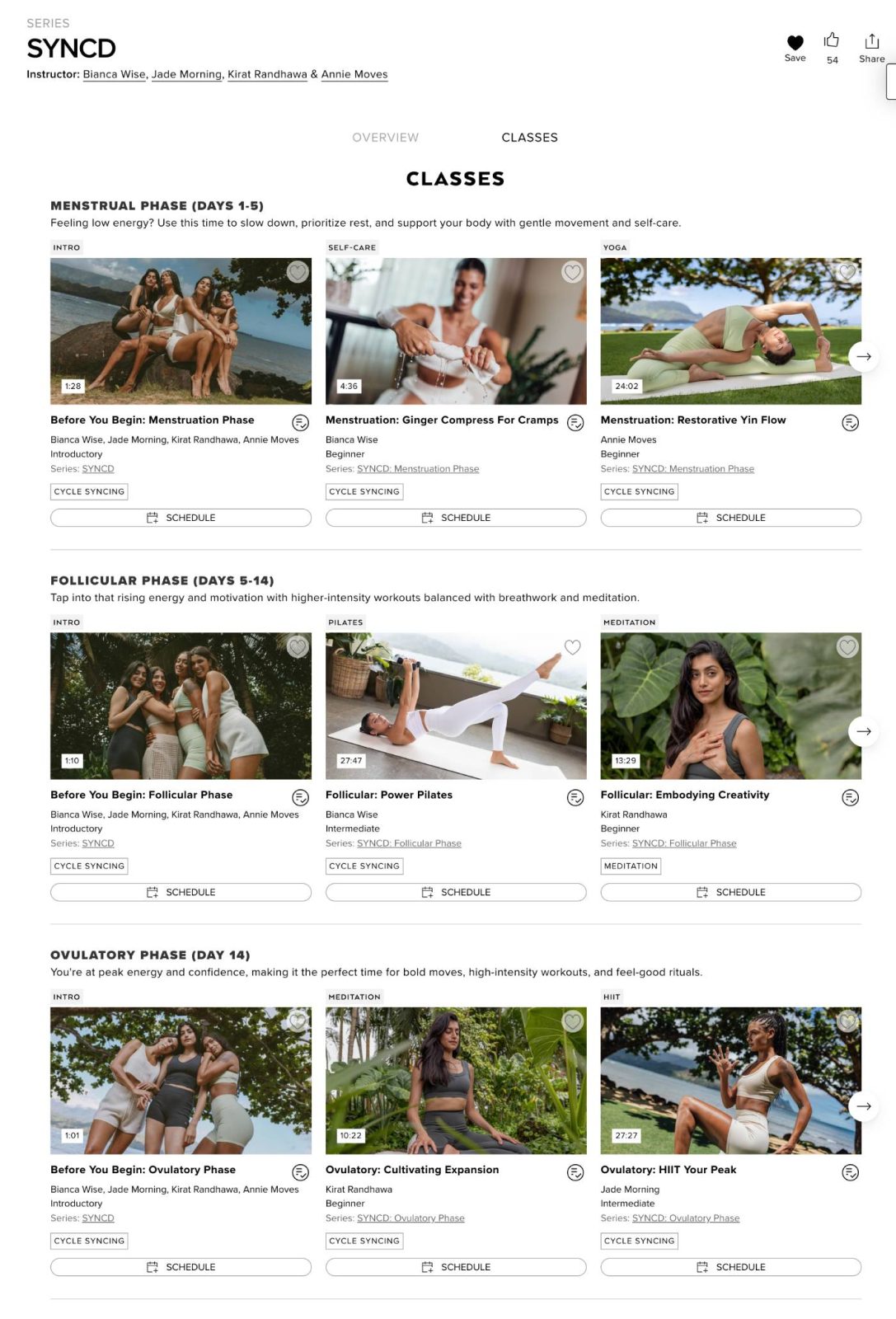
Within the library, Alo has built a small number of structured series that do carry method-like intent: SYNCD (cycle-phase programming), The Hourglass Method (four-week strength and posture with Sarah DiGiovanni), Nutrition Unfiltered (Dr Amy Shah’s nutrition series), and the 7-Day Reset Ritual (a spa-inflected wellness programme with Rosie Huntington-Whiteley and Chenot Palace Weggis).
These are where the platform comes closest to a programme feel, and I cover each in the programmes-tested section.
How Do You Get Started with Alo Wellness Club?
Signup is one of the lowest-friction I have tested. An email address creates an Alo Access account. No credit card, no payment details, no “free trial” countdown timer. You are inside the platform in under a minute.2 This is a genuine trust signal, most free platforms still ask for a card so they can auto-convert you at the end of a trial. Alo does not, because there is nothing to convert to. The onboarding itself is light.
There is no detailed intake questionnaire of the kind Fit with Coco uses to steer you into a programme. You land on a dashboard, you filter, you pick a class, you train. For experienced exercisers this is fine. For genuine beginners it can be a lot of library with very little hand-holding, which is where the beginner programmes and the weekly staff-picked classes become useful. On the website and the app the experience is consistent.
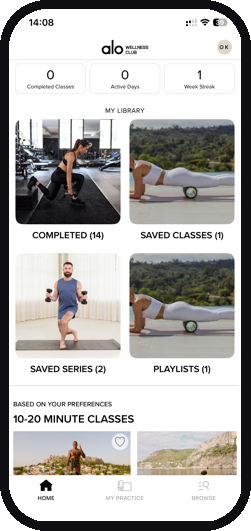
Filters live at the top of the Explore section and can be stacked. Bookmarking works. “Up Next” logic inside a series is well implemented. The one navigation point I want to flag is that nutrition content is buried. I stumbled on Dr Amy Shah’s Nutrition Unfiltered series by accident while hunting for a recovery class. Putting a Nutrition entry into top-level navigation would be an obvious fix.
What Equipment Do You Need for Alo Wellness Club?
Alo Wellness Club requires minimal equipment. Dumbbells, a kettlebell, a resistance band and a mat cover the majority of the library. A large number of classes are bodyweight only. No proprietary equipment is required.
Starter Dumbbells (up to 10 lb)
A light adjustable pair, a great starting point
~$65 to $80
Medium Dumbbells (up to 25 lb)
For steady progression as you get stronger
~$50 to $65
Advanced Dumbbells (up to 50 lb)
For serious strength and progressive overload; grows with you
~$350 to $430
Kettlebell
One 18 to 26 lb kettlebell covers most classes$20 to $40
Resistance Band
Looped and long-band variants both useful$10 to $20
Resistance Bands (door anchor)
For the occasional class that uses a band
Optional
Exercise Mat
Standard fitness or yoga mat$15 to $30
Pilates Ball
Small inflatable ball for weighted Pilates work$8 to $15
Bodyweight
Great for travel, the HIIT and yoga libraries are packed with bodyweight options
Plenty of classes need nothing at allFree
What I Actually Tested
I tested Alo Wellness Club intensively for one full month and I have continued to use it casually in the months since. My weekly pattern during intensive testing was roughly two strength sessions, one or two Pilates sessions, one HIIT session, and a 20 to 30 minute treadmill walk or outdoor walk on most days. On low-energy days I would substitute a lymphatic session or a restorative flow.
I trained primarily on a second computer monitor in my home office, with the iOS app as my phone-based browser when I was out and picking my next session. I am in my mid-forties, in perimenopause, with a previous meniscus injury now signed off by my doctor as no longer requiring specific modification. I work full time, I have family commitments, and I trained at the end of the day more often than the start.
These are the conditions under which I tested, which are close enough to the conditions most of the women reading this will train under. I did not meaningfully change my nutrition during testing. I want to be clear about that because it affects how I interpret any body composition observation I make.
What Are the Alo Wellness Club Workouts Like?
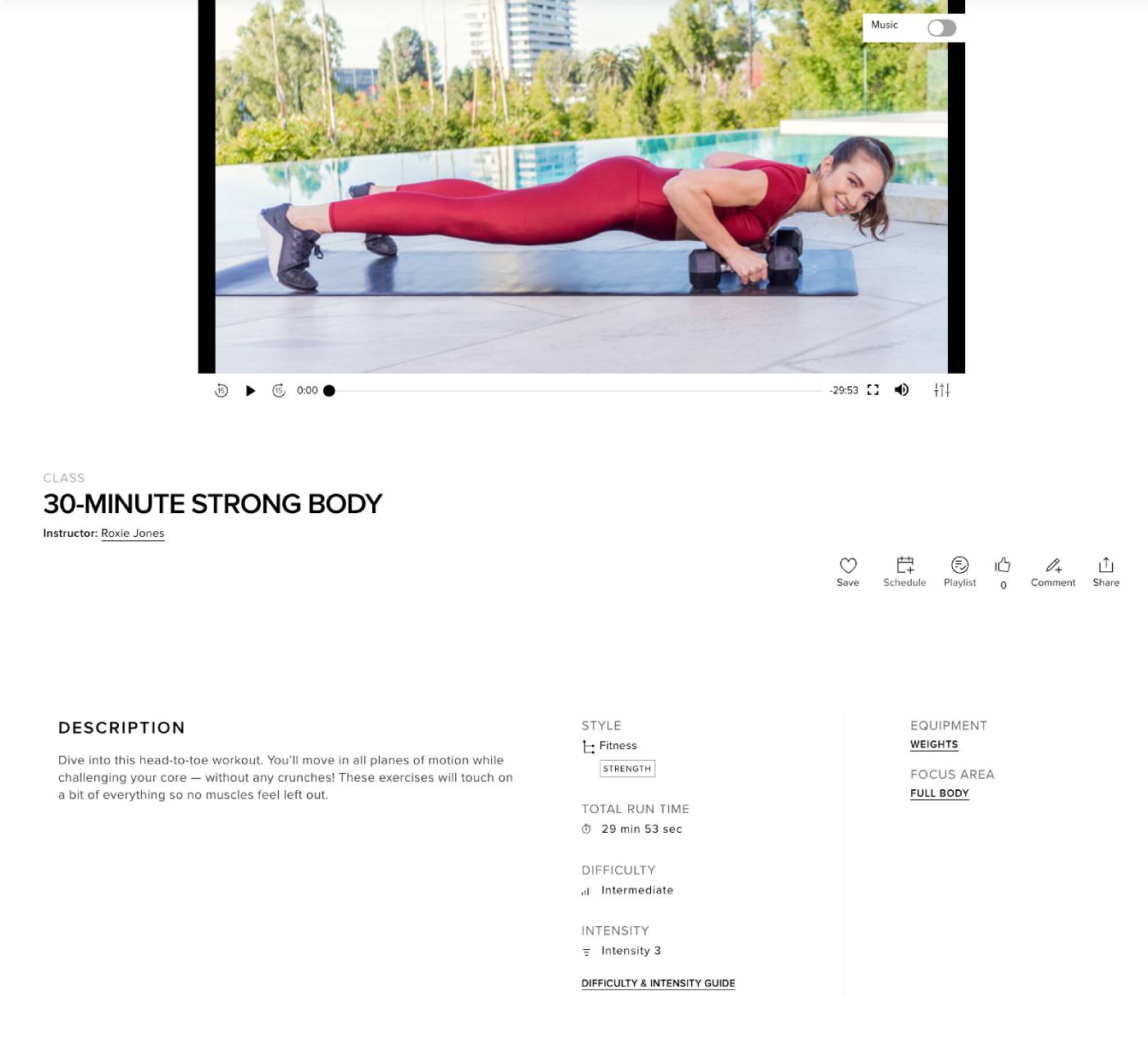
The first thing you notice is production quality. Classes are filmed in visually calm environments, often open spaces next to pools, in gardens, by the sea. Blue water, sky, greenery. Nothing is fighting for your attention.
For a woman in her forties who has spent years on fitness platforms where everything is shouting, the quiet aesthetic is not a cosmetic detail, it affects whether you want to press play tomorrow.2 The instructor voices are distinctive rather than interchangeable. Roxie Jones brings energy and the kind of atypical programming (Turkish get-ups, loaded carries, unilateral work) that keeps a library from feeling repetitive.
Her Summer Strong: Complete Body series genuinely challenged me and I felt it the next day, positively. The candid caveat with Roxie is her explosive HIIT. There are sessions where she throws in high-impact or plyometric work, and sometimes I was genuinely a bit angry by the end of those videos. I will either take the low-impact alternative she shows, skip that block, or swap the whole session for a treadmill walk.
I have been too sore too many times to play hero with my knee. If you have joint sensitivities, filter carefully within her catalogue, do not assume every Roxie class is joint-friendly. Bianca Melas is the reason I changed my mind about Pilates. Her Heavy Weight Pilates sessions are properly challenging.
Pilates with real load moves the modality from a flexibility class to a strength-endurance session, and that profile serves women over 40 well.3 Her Lymphatic Movement class is one I keep coming back to. I carry water retention in my lower body and this class is genuinely relaxing, sometimes I just do the short self-massage sequence she opens with and leave it there.
The HIIT library has a substantial bank of explicitly no-jump sessions. For anyone with meniscus history, knee issues or simply a preference for not pounding joints, this is useful. Dr Stacy Sims’ guidance for perimenopausal women is to keep intervals short, ideally around thirty seconds and no more than sixty, to get the metabolic benefit without the cortisol penalty,4 and Alo’s HIIT format broadly fits that profile.
Recovery is taken seriously, which is not a given on general wellness platforms. Lymphatic movement, restorative flows, contrast therapy protocols, guided stretching and sound healing are all easy to find.
The sound bath and breathwork content is genuinely good: Sound Bath for Sleep by Susy Markoe Schieffelin and the structured breathwork sessions, including 4-7-8 breathing, are the kind of nervous-system-down-regulation content that earns its place for perimenopausal readers who cannot sleep through the night.
Every session I tested included a warm-up and a cool-down baked into the runtime, which matters more for women in their forties than it did at twenty-five.
SYNCD, The Hourglass Method and the 7-Day Reset Ritual
SYNCD is a 24-session programme built around the four phases of the menstrual cycle (menstruation, follicular, ovulatory, luteal), delivered by Bianca Melas on Pilates, Kirat Randhawa on meditation, Annie Moves on yoga and Jade Morning on HIIT and strength. For women still cycling, including many in early perimenopause, it is the most relevant structured programming on the platform. I dipped into the luteal phase on my own low-energy days because that is where my cycle reliably sends me, and it was a good fit. Luteal: Intuitive Pilates Flow is a personal favourite because it still has enough load to feel like training rather than pure wind-down.
The candid caveat is that scientific consensus on cycle-phase-specific training is currently weak, recent systematic reviews do not support clear benefit from phase-matched programming over well-designed traditional training.5 That does not make SYNCD pointless, it makes it an option rather than a must-do.
The Hourglass Method is a Q1 2026 addition led by Sarah DiGiovanni, a four-week strength and posture programme and the kind of structured, progression-based content the platform historically lacked. I have dipped into it rather than followed it to the letter, and my candid flag is that some of the exercises are genuinely hard on the knees. If you have a meniscus history, arthritic knees or any joint sensitivity, go in ready to modify or skip. Do not assume the whole programme is joint-friendly just because the headline is strength and posture.
The 7-Day Reset Ritual is an Alo-meets-spa collaboration with Chenot Palace Weggis, fronted by Rosie Huntington-Whiteley. It is short, it is pretty, and it leans luxury-wellness rather than hormonal-context. If that is your thing, give it a go, but it is not peri-specific.
What Results Can You Expect from Alo Wellness Club?
Specific results are more useful than general enthusiasm. Over a month of testing, my weight stayed the same, which is worth naming because my nutrition was not good during that period. My trousers felt a little looser, particularly through the lower body where I reliably struggle to lose fat.
I am not going to attribute that to any single class or even to the platform, because training is a long game and I do not think four to six weeks of anything should be credited with body composition change. What I will say is that the mix of strength, weighted Pilates and daily walking sits comfortably inside what current guidance actually recommends for women in perimenopause, and I felt good doing it.
Where the platform did produce a visible, quick result was adherence. I showed up. The session lengths were realistic for a full working day with family on top, and the content was varied enough that I never opened the app to find nothing appealing. That is the clearest measure I have for whether a platform works in real life.
Muscle soreness was present after Roxie sessions and Bianca’s heavy Pilates in roughly equal measure, which is the right kind of soreness for a woman over 40 trying to protect muscle mass. I did not experience any knee pain from the classes I chose to do. That said, individual responses vary, this is not a medical assessment, and if you have any joint concerns, please consult your doctor before starting.
Is Alo Wellness Club Good for Women Over 40?
Yes, with an important qualifier. The platform is not labelled or designed for women over 40. There is no clinical advisory board, no perimenopause specialism, no feature that explicitly names this audience.
What it has is a library whose content profile happens to fit what women in their forties and fifties actually need: progressive strength, weighted Pilates, low-impact and no-jump options, short realistic sessions, and a deep recovery catalogue. The case for strength training at this life stage is well-evidenced.
Sarcopenia prevalence rises after menopause (7.43 percent in post-menopausal women versus 5.50 percent in pre-menopausal women), with lean body mass declining by roughly 0.5 percent per year through the transition.6 The ACSM 2026 Position Stand recommends resistance training two to three days per week at 60 to 80 percent of one-rep max, eight to twelve repetitions,7 and the British Menopause Society plus Women’s Health Concern similarly recommend 150 minutes per week of moderate endurance plus regular strength exercise.8 Alo Wellness Club makes hitting those targets realistic without you having to think about them explicitly.
Pilates at the right load specifically supports pelvic floor, core and postural integrity, all of which matter more after 40.9 Joint pain is common at this stage (roughly 50 percent of women experience arthralgia during the menopausal transition, driven partly by estrogen’s anti-inflammatory role),10 and the breadth of low-impact options in Alo’s library means you can actually train consistently without triggering joint flare-ups.
What is missing for this audience is dedicated perimenopause or menopause programming, and a structure that would help a peri- or post-menopausal woman organise her week across strength, impact, recovery and mobility without having to assemble it herself.
This is the perimenopause and menopause assessment, and it is separate from the overall score. Twelve things a programme either does for a midlife body or does not, each scored out of 10 with my reasoning next to it. Together they produce a single menopause fit score, and that becomes one of the nine categories in the overall scoring below.
How Alo Wellness Club Fits Perimenopause, Menopause & Beyond
Women Over 40 is our most important criterion, and here's the full breakdown behind it.
Alo Wellness Club is strongest for mind-body support, low-impact and recovery & deload, and weakest for menopause programming, menopause education, pelvic floor and midlife nutrition, in our menopause and midlife capability assessment for women over 40.
At a glance
| Capability | Score | Rating | Why |
|---|---|---|---|
| Right training for a midlife body | |||
| Low-impact | 8/10 | Strong | Deep no-jump yoga/Pilates/restorative; knee-safe. |
| Progressive strength | 6/10 | Some | Real loaded work (Hourglass, sculpt) but no overload plan/tracking. |
| Bone loading | 5/10 | Some | Some resistance/weighted Pilates; no impact or bone-specific loading. |
| Recovery & deload | 8/10 | Strong | Best-in-class recovery catalogue; no programmed training deload. |
| Built for menopause | |||
| Menopause programming | 3/10 | Minimal | No dedicated peri/meno programme; SYNCD only suits still-cycling women. |
| Pelvic floor | 4/10 | Minimal | Pilates aids core/pelvic floor incidentally; no dedicated programme. |
| Hormone awareness | 5/10 | Some | SYNCD cycle-phase (OB-GYN reviewed); not menopause-focused. |
| Menopause education | 3/10 | Minimal | No menopause education; only stray hormone-nutrition reads. |
| Expert credibility | 6/10 | Some | Strong credentialed instructors, board-certified nutritionist; no menopause board. |
| Whole-woman support | |||
| Mind-body support | 9/10 | Best-in-class | Best-in-class meditation, breathwork, sound baths, yoga nidra. |
| Beginner on-ramp | 7/10 | Strong | Beginner filters + 40+ starter series; self-directed, choice overload. |
| Midlife nutrition | 4/10 | Minimal | Nutrition-light; no meal plans, macros, or frameworks. |
ScaleBest-in-classStrongSomeMinimalNone
What the sources say: External confirms breadth/mind-body/beginner strength; SYNCD is cycle-sync (still-cycling women), not menopause. 40+/menopause angle thin in outside coverage; Time flags cycle-syncing as possibly faddish (matches HDF caveat).
These are evidence-informed suitability ratings, not clinical measurements. They combine exercise science with product-specific research and, where indicated, hands-on testing, alongside multi-source verification, and are approximate. Individual response varies. A starting point, not medical advice. How we score menopause fit
Does Alo Wellness Club Help with Perimenopause and Menopause?
Not directly. There is no dedicated perimenopause programme, no menopause category in navigation, and no content explicitly tagged for women in midlife. SYNCD is the closest thing, and it is cycle-based, so it is useful for perimenopausal women still cycling but less so for women further into the transition or post-menopause.
If dedicated, clinically-developed perimenopause programming is your primary requirement, Pvolve‘s Menopause Strong is the better choice, and Owning Your Menopause is the more specialist pick despite its weak production quality. What Alo does offer perimenopausal women, not as a label but as a content profile, is substantial.
A deep bank of low-impact strength for muscle and bone protection. Weighted Pilates for core and posture, which becomes more important as larger muscle performance becomes less reliable. A proper recovery library with sound baths and breathwork for sleep disruption, one of the most common and under-supported perimenopausal symptoms.
And nutrition content, if you can find it, that addresses gut health and hormones through Dr Amy Shah’s Nutrition Unfiltered series. The protein side is worth a short note because nutrition matters more during this transition.
Mayo Clinic and Harvard Health place elevated protein needs at 1.0 to 1.2 g per kg per day for perimenopausal women,11 Dr Stacy Sims recommends 40 to 60 grams post-exercise to counter anabolic resistance,12 and Dr Gabrielle Lyon argues for approximately 1 gram per pound of ideal body weight distributed across three meals.13 Dr Amy Shah’s protein content inside Alo covers the fundamentals well, though it is not peri-specific.
Is It Good for Beginners?
Yes, with caveats. The filter lets you restrict to beginner and low-intensity classes, there are plenty of short sessions, and several instructors offer modifications consistently. Bianca Melas and the yoga instructors in particular are strong for beginners. Roxie Jones’ strength work can be intense for a first-day exerciser, filter carefully. What Alo does not do is hold a beginner’s hand.
There is no structured onboarding programme that walks a new exerciser through progressive weeks. If you want to be told exactly what to do every day with no browsing, a linear platform like Burn360 or a coach-led one like Fit with Coco will suit you better. If you are the kind of beginner who wants to pick a class by name and see where it takes you, Alo is a generous entry point.
How Good Is the Alo Wellness Club App?
The app is clean and the web experience matches it. Both work well. The Explore section is where you spend most of your time, filters at the top, stackable, and they respond quickly. Bookmarking, saving to Playlist, and “Up Next” series logic all work as expected. The full list of ways to watch Alo Wellness Club:
- Web browser on desktop or laptop, at wellnessclub.aloyoga.com
- Tablet browser (iPad Safari tested)
- iPhone app (iOS 15 and up)
- Android app
- Apple TV native app (tvOS 9 and up)
- Mac app (macOS 12 and up, Apple Silicon)
- Apple Vision Pro app
- Apple Watch for certain playback controls
- AirPlay casting from Apple devices (reliability reported as patchy by some users)
What is not supported natively: Roku, Fire TV, Google TV, Chromecast, Samsung TV apps.14 If you do not have an Apple TV, the most reliable workaround is plugging a laptop into your television via HDMI. Classes can be downloaded for offline playback, which is confirmed on iOS and genuinely useful for travel, patchy WiFi or garden-office setups. Where the app shows its age against competitors is progress tracking.
There is no class history, no streaks, no automatic workout log, no weekly mileage display. Your only options for tracking what you have done are saving classes to a Playlist inside the app, or manually adding them to Google Calendar or Apple Calendar. Peloton and Apple Fitness+ give you a progress dashboard out of the box, Alo does not. There are no live classes. Everything is on-demand.
Community features are minimal, no comments, no challenges beyond the odd seasonal push, no instructor interaction. Alo is a library, not a club. Tracker integration is Apple-only. Apple Health and Apple Watch both sync. Fitbit, Garmin, Google Fit and Android Health Connect do not. For perimenopausal women increasingly making training decisions based on HRV, resting heart rate or sleep data, that matters.
Third-party reports note occasional video playback glitches, casting bugs and slow customer support.2 In my own testing I had no meaningful playback issues, but the reports are worth naming because I owe you the candid picture rather than just my picture.
How Much Does Alo Wellness Club Cost?
| Plan | Price | Notes |
|---|---|---|
| Alo Wellness Club (all access) | Free | Full library, all 4,000+ classes and programmes, no credit card at signup. Requires a free Alo Access account. |
| Previous pricing (for reference) | $12.99/month as Alo Moves | Paid until December 2025, when Alo removed the paywall and rebranded as Alo Wellness Club.1 |
The value-for-money answer is simple. You cannot score a free platform that is this polished, this broad and this well-produced anything other than ten. There is no upsell, no premium tier hidden behind the free layer, no in-app purchase wall. The entire library is available to anyone with an email address. The one caveat worth naming is that the long-term free status depends on Alo’s strategy holding.
The commercial logic for the free model is that Alo’s main business is apparel, and a free fitness platform is a powerful acquisition channel for a brand whose customers are fitness-minded. If that logic changes, the free status could change with it. For now, it is free, and for most women reading this it is worth using while it is.
Will You Actually Stick With It?
In my experience, mostly yes, with one candid qualifier. The session lengths and the aesthetic make it easy to show up. The catalogue is deep enough that you never run out of options. The production quality is high enough that pressing play does not feel like a chore. These are the mechanics of adherence and Alo gets most of them right. Where adherence risk genuinely exists is structure. Alo asks you to build your own week.
No plan, no linear programme, no coach assigning you Monday through Saturday. For some women that is liberating, for others it is exactly the barrier that made them stop training before. Know which type you are before you invest your time.
Alo Wellness Club Weighted Scoring: How the 7.7/10 Was Calculated
| Category | Weight | Score | Reasoning |
|---|---|---|---|
| Time Efficiency | 15% | 8 | Strong duration filtering from 5 to 60+ minutes; plenty of 20 to 30 minute options; on-demand library works around a real week with no live schedule dependency; pulling a session takes seconds once you know the filters. |
| Muscle Potential | 18% | 8 | Solid strength programming across bodyweight and loaded work; the Hourglass Method and sculpt series deliver real resistance; Pilates adds meaningful load for women over 40; ceiling limited by the absence of a dedicated progressive overload plan. |
| Women Over 40 Specificity | 10% | 5.7 | No dedicated perimenopause programming; SYNCD is the closest offering, and because it is cycle-based it only helps women who are still cycling, which rules out most women 45+; the strength, Pilates and recovery content genuinely serves women over 40 despite not being labelled for them. |
| Joint Friendliness | 12% | 8 | Large low-impact library across yoga, Pilates and restorative content; most strength sessions are knee-safe with a meniscus history in mind; on-screen modifications are inconsistent, so you self-regulate using the filter set rather than by instructor cue. |
| Recovery Compatibility | 10% | 8.5 | Deepest recovery library I have tested on any platform at any price: yoga nidra, sound baths, breathwork, gentle stretch, restorative yoga; sustainable daily training becomes possible; matches the demands of a perimenopause nervous system better than most paid alternatives. |
| Programme Structure | 12% | 7 | No weekly schedule, no progression path, no dedicated perimenopause pathway; progress tracking is non-existent, so you rely on Playlists or Google Calendar; breadth partly compensates but anyone wanting a prescriptive plan handed to them will struggle. |
| Value for Money | 8% | 10 | Genuinely free with no card gate, no paywall behind premium content, no trial timer, no upsell: the highest score I have ever awarded in this category; the caveat is that free status is underwritten by Alo’s apparel business rather than a subscription, so the model has to keep holding. |
| UX and Design | 8% | 8 | Clean app and web experience; filters actually return what you asked for, which is rare; Apple TV support is strong; no Roku, Fire TV or Chromecast drags an otherwise excellent UX score down; Playlists partly compensate for the missing scheduling layer. |
| Nutrition Integration | 7% | 5.5 | No nutrition content at all beyond occasional wellness reads; no recipes, no meal plans, no macro tools, no calorie calculator; the platform stays fitness and recovery only, which leaves a real gap for women over 40 trying to rebuild the eating side alongside training. |
| Total | 100% | 7.7 / 10 |
Final Weighted Score
7.7/10
The most generous free fitness platform I have tested, held back by the absence of dedicated perimenopause programming and any nutrition support.
What Are the Pros and Cons of Alo Wellness Club?
What Works
- Genuinely free, no credit card at signup, no trial trap, no hidden tier
- Production quality is high, classes are filmed in calm, visually pleasant environments
- Library is broad (4,000+ classes, 300+ programmes) with new content weekly
- Filters are stackable and actually useful, duration, equipment, instructor, focus area, difficulty
- Strength and weighted Pilates content serves women over 40 well
- Substantial no-jump and low-impact options for joint-sensitive users
- Instructor roster is distinctive, Roxie Jones, Bianca Melas, Kirat Randhawa, Jade Morning
- Recovery catalogue is strong, lymphatic, sound baths, breathwork, contrast therapy
- SYNCD cycle-phase series is thoughtful for women still cycling
- Nutrition content from Dr Amy Shah and Sakara, available though buried
- Offline downloads work on iOS, handy for travel and patchy WiFi
- Apple TV, Mac, Vision Pro and Apple Watch all supported natively
What to Know Before Signing Up
- No dedicated perimenopause or menopause programming
- Variety can tip into choice overload, you have to build your own structure
- No proper progress tracking, class history, streaks or completion log, only Playlists and Google Calendar as workarounds
- No live classes and effectively no community layer
- Apple Health and Apple Watch only, no Fitbit, Garmin or Google Fit integration
- No Roku, Fire TV, Chromecast, Google TV or Samsung TV apps, Apple TV only
- Nutrition is genuinely buried in navigation, not peri-specific, few recipes
- The Hourglass Method includes exercises that are hard on knees, not automatically joint-safe despite the strength-and-posture framing
- Roxie Jones’ HIIT sessions include plyometric and high-impact work, filter carefully if knees are a concern
- Occasional reports of playback glitches, casting bugs and slow support
- Long-term free status depends on Alo’s apparel strategy holding
How Alo Wellness Club Compares to Similar Platforms
If you are deciding between women’s fitness platforms, this is how Alo Wellness Club sits against the five most likely alternatives. All Her Daily Fit scores are from personal testing against the same weighted criteria.
| Feature | Alo Wellness Club | Peloton | Pvolve | The Sculpt Society | FitOn | Owning Your Menopause |
|---|---|---|---|---|---|---|
| Her Daily Fit score | 7.7 / 10 | 7.3 / 10 | 8.3 / 10 | 8.2 / 10 | 7.3 / 10 | 7.3 / 10 |
| Monthly price | Free | $24/mo | $19.99/mo · £14.99/mo | $24.99/mo | Free · Pro $9.99/mo | ~$29/mo |
| Annual price | Free | $239/yr | $179.99/yr | $179.99/yr ($15/mo) | Pro ~$80/yr | Varies |
| Free trial | N/A, free forever | 30 days | 14 days (card required) | 7 days | Free tier | Varies |
| Method | Broad library, no single method | Cycling, strength, yoga, Pilates, outdoor | Functional fitness, 3D movement | Dance cardio + low-impact sculpting | General fitness library | Menopause-specific strength and low-impact |
| Equipment | Dumbbells, kettlebell, band, mat, or bodyweight | Bike optional, dumbbells + mat for off-bike | Bundle recommended; bands + dumbbells work | Mat; light weights + ankle weights optional | Dumbbells + mat, bodyweight options | Dumbbells + mat |
| Session length | Under 10 min to 60+ min; plenty 15 to 30 min | 5 to 90 min | 5 to 60+ min; 20 min sessions plentiful | 5 to 50 min; most 20 to 30 min | 5 to 60+ min | 20 to 45 min |
| Injury modifications | Shown in-class, instructor dependent, no rehab tracks | Consistent modifications | Dedicated series for 6 body areas | Low-impact by design; beginner programme | Variable | Consistent, low-impact focus |
| Perimenopause content | SYNCD cycle-phase only; no dedicated peri/meno | None dedicated | Best in class: Menopause Strong, clinical study | Peri programme available | Small peri/meno category | Built entirely for peri/meno |
| Nutrition included | Dr Amy Shah + Sakara, buried in navigation | Limited | Not in streaming | Not included | Recipes included | Nutrition-light |
| Programme structure | 300+ series, no single linear plan | Programmes + classes + live | Menopause Strong + curate-your-own | Programmes + class library | Limited programmes | Menopause-focused programmes |
| Community / live | None; on-demand only | Best in class, live classes + leaderboard | Community included | 250,000+ member community | Community included | Minimal |
| TV support | Apple TV only, no Roku/Fire/Chromecast | Excellent across all major TVs | Good | Good | Good | Web-first |
| Best suited to | 38 to 55+, self-directed, free | Any age, structured + live community | 35 to 55, perimenopause, joint issues | 35 to 55, dance cardio, low-impact | Budget-conscious, general fitness | Peri/meno-specific needs |
Competitor prices verified April 2026 where possible. Verify on each platform’s website before purchase.
How Alo Wellness Club Compares to the Closest Alternatives
Five platforms come up most often when women are choosing between this and something else. Here is the short version of each comparison, based on personal testing of all of them.
Alo Wellness Club vs Peloton: Peloton is the best-produced, most polished, most community-driven all-round platform on the market, and at $24/month it is not outrageous for what you get. If you have or want a bike, Peloton’s off-bike content is also genuinely strong. Alo Wellness Club is free. That is the difference. If you do not want to pay, Alo gives you the broadest content library in the free category. If you want live classes, leaderboards and a structured on-rails experience, Peloton remains the benchmark.
Alo Wellness Club vs Pvolve: Different products for different needs. Pvolve’s Functional Fitness method is the best low-impact, joint-friendly method I have tested, and its Menopause Strong programme is the most clinically developed perimenopause content of any streaming platform. Alo is broader but less specialist. If perimenopause-specific programming is your primary requirement, Pvolve wins. If breadth, production quality and zero cost matter more, Alo wins.
Alo Wellness Club vs The Sculpt Society: The Sculpt Society leans into dance cardio and flowing movement and is one of the most enjoyable platforms to be on. Alo is more varied in modality but less of a single, recognisable feel. If you want joyful dance-inflected movement, Sculpt.If you want a full range including strength, Pilates, yoga and recovery under one roof, Alo.
Alo Wellness Club vs FitOn: Both are free. FitOn is ad-supported on its free tier and the production quality varies considerably. Alo is ad-free and production quality is consistently high. FitOn has a small peri/meno category, Alo does not. For a woman over 40 who wants a free platform, Alo is the stronger option by every measure except peri-specific labelling.
Alo Wellness Club vs Owning Your Menopause: OYM is built entirely for peri and menopausal women and has the clinical knowledge to back it up, but the execution is basic and the production feels amateur compared to Alo. If you want perimenopause knowledge woven through every session, OYM.
If you want a premium-feeling library that happens to work well for women over 40 without being explicitly about them, Alo. Many women, me included, end up using both.
Is Alo Wellness Club Worth It?
The platform is free. The question is not really “is it worth the money”, it is “is it worth your time”. On that question the answer is, for most women in their late thirties, forties and fifties, yes. The library is broad enough that you will find content that fits your body, your schedule and your preferences. The production quality is high enough that the experience is pleasant rather than tolerating.
The instructor roster is distinctive enough that you will have favourites inside a week. Where Alo is not worth your time is if what you actually need is prescription, not a menu. If you want to be told exactly what to do every day, with nutrition mapped alongside it, by a single coach whose voice you trust, Burn360 or Fit with Coco will serve you better.
If you want clinical perimenopause programming, Pvolve. If you want live community, Peloton. For everyone else, particularly anyone who has tried and quit paid platforms because they could not justify the cost or the structure did not suit their life, Alo is one of the most generous experiments currently running in the category. Create an account today, pick one class, press play.
It is the lowest-commitment fitness decision you will make this year.
Does Alo Wellness Club Work? Results Before and After
Based on personal testing and consistent patterns across other reviewers I have read: yes, with realistic expectations about what “working” means when the platform is a library rather than a programme. Alo Wellness Club produces results most reliably in three areas: adherence (showing up), general conditioning across strength and mobility, and recovery and sleep quality for anyone who uses the breathwork and sound content seriously.
My own before-and-after across a month of daily use plus casual ongoing use: weight stable (nutrition was not good, so this is a wash), trousers slightly looser through the lower body, noticeable improvement in how I moved and felt through my core thanks to Bianca’s weighted Pilates, and a genuine downshift in how keyed-up I felt in the evenings thanks to the sound bath and breathwork content.
Muscle soreness was present after most Roxie and heavy Pilates sessions, which is the right kind of soreness to feel at 45. What Alo does not produce, because it is not a programme, is the four-to-six-week progressive transformation that a method-driven platform like Fit with Coco can deliver when you actually follow it. That is a structural difference, not a platform failure.
What Are the Most Common Alo Wellness Club Complaints?
Searches for Alo Wellness Club complaints and Alo Moves reviews still surface consistent criticism worth naming. Here is what the negative side of the picture looks like. The most common complaint is the TV gap. No Roku, no Fire TV, no Chromecast, no Samsung TV, no Google TV. For anyone without an Apple household, this is a real friction point. AirPlay works but user reports describe it as inconsistent.
The practical workaround is an HDMI cable from laptop to television, which most people find acceptable but some find a dealbreaker. A second, smaller cluster of complaints concerns video playback glitches and casting bugs, with occasional reports of videos pausing every fifteen seconds or casting failing mid-session. In my own month of testing I did not experience these on either laptop or phone, but they are real enough to flag.
Customer support response times have drawn criticism from users with billing or account issues, particularly around the transition from paid Alo Moves to free Alo Wellness Club in December 2025. Some users reported being charged for membership after the rebrand or struggling to cancel pre-existing monthly subscriptions. Data and privacy handling is worth a transparent note.
Alo’s privacy policy confirms that health, wellness and physical activity data collected through the app can be shared with third parties and across the Alo brand family.15 This is not unusual for an apparel-linked wellness app but is worth naming for readers who are transparency-conscious. For everyone else, there are no reports of aggressive data selling or significant privacy concerns.
What is notably absent from the complaints picture: no widespread content-removal issues, no major billing dispute patterns since the free relaunch, and an App Store rating around 4.9 out of 5 across thousands of reviews. The positive-to-negative ratio heavily favours positive.
What’s Included in the Alo Wellness Club Nutrition Content?
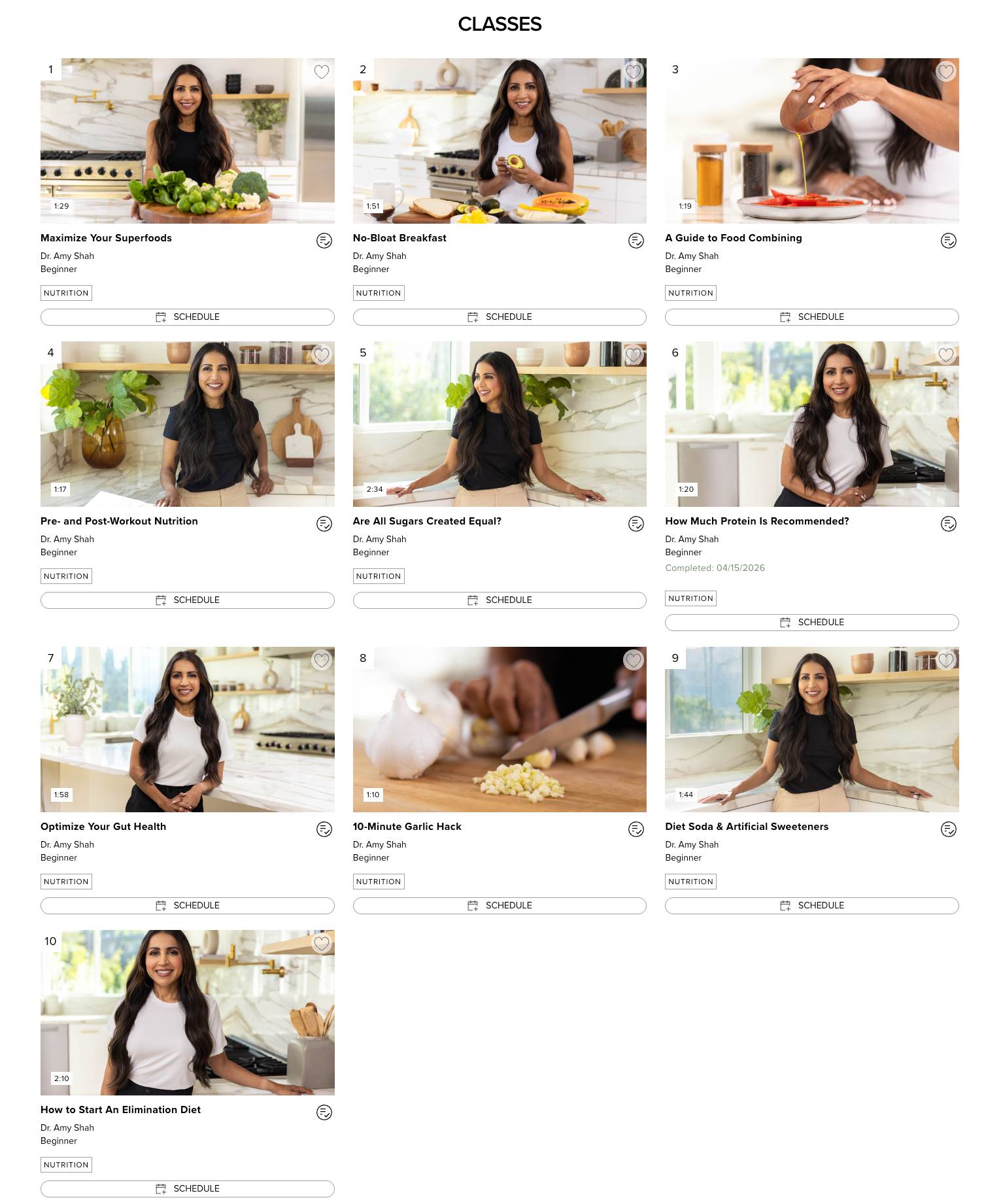
Nutrition on Alo Wellness Club is better than its navigation makes it look. Dr Amy Shah runs a series called Nutrition Unfiltered covering gut health, protein fundamentals, sugars and artificial sweeteners, food combining, elimination diet guidance, and pre and post-workout fuelling. She is double board-certified and her content is evidence-informed rather than wellness-anecdotal.
Sakara, the whole-food nutrition company co-founded by Danielle Duboise and Whitney Tingle, contributes nutrition content and recipes focused on microbiome and metabolic health. What is missing: macro calculators, personalised meal plans, perimenopause-specific nutrition frameworks, and prominence in navigation.
If you want comprehensive integrated nutrition alongside your training (Fit with Coco’s anti-inflammatory meal plans, Burn360’s macro-tracked approach), Alo is not that platform. If you want short, credible nutrition videos to watch between classes while you work on improving your eating, it is solid.
A practical note: most of Dr Amy Shah’s videos are in the 2 to 10 minute range, which is unusual for a wellness platform and one reason I actually watched them through. Longer nutrition modules on most platforms do not get watched, short ones do.
Why Use Alo Wellness Club Over Free YouTube Workouts?
The obvious question with any free platform is: why not YouTube? YouTube is also free, has more content, and works on every device ever made. Fair. Here is the actual answer. YouTube makes you curate. You search, you scroll, you get pulled into a recommendation loop, you spend ten minutes before your workout choosing what to do. Production quality is wildly uneven. Ads interrupt your sessions.
The algorithm serves you content that optimises for watch time, not for you. Alo Wellness Club is curated, ad-free, consistent in quality, and built around structured series rather than standalone uploads. For a woman in her forties or fifties with forty-five minutes of training time and zero appetite for browsing, that curation is the real product, not the workouts themselves.
The other angle is that Alo’s production quality is simply higher than the majority of free YouTube fitness content. The visual calm of most sessions, filmed in open spaces with good light, is not a small thing. It affects whether you come back tomorrow. Most free YouTube fitness sits in a different visual register, louder, busier, more aggressively produced.
For women in midlife who are training partly to manage stress load, the quieter experience matters.
Alo Wellness Club FAQ
Yes. Alo Wellness Club has been free to all Alo Access members since December 2025, when Alo rebranded the paid Alo Moves platform and removed the paywall. Signup requires only an email address, no credit card, no trial period. UK and US access confirmed.
They are the same platform at different points in time. Alo Moves was the paid version at around $12 per month. In December 2025, Alo removed the paywall and rebranded the app as Alo Wellness Club, making the full library free to anyone with a free Alo Access account.
It is suitable in the sense that it has plenty of low-impact strength, Pilates and recovery content that works well for women over 40. It is not perimenopause-specific. There is no dedicated menopause programming. The SYNCD cycle-phase series is the closest and is most useful if you are still cycling. For dedicated clinical perimenopause programming, Pvolve’s Menopause Strong is a better choice.
Only natively on Apple TV. There are no dedicated apps for Roku, Fire TV, Chromecast, Google TV or Samsung smart TVs. AirPlay casting from Apple devices works but users have reported mixed reliability. Plugging a laptop into a TV via HDMI is a reliable workaround for non-Apple households.
Not really. There is no class history, no streaks, no automatic workout log. You can save classes to a Playlist inside the app, or manually schedule sessions in Google Calendar or Apple Calendar. Apple Health and Apple Watch will record workout data if you start a session through them, but the app itself does not give you a progress dashboard.
Yes, but it is not prominent. Dr Amy Shah runs a series called Nutrition Unfiltered covering gut health, protein fundamentals, sugars and food sensitivities, and there is recipe content from Sakara. It is not perimenopause-specific and there are no macro calculators or personalised plans.
SYNCD is a 24-session series built around the four phases of the menstrual cycle (menstruation, follicular, ovulatory, luteal), delivered by Bianca Melas on Pilates, Kirat Randhawa on meditation, Annie Moves on yoga and Jade Morning on HIIT and strength. It is most useful for women still cycling and less relevant post-menopause.
Yes, the filter lets you restrict to beginner and low-intensity classes and there are plenty of short sessions. If you want to be told exactly what to do every day with no browsing, a linear platform like Burn360 or a coach-led one like Fit with Coco will suit you better.
YouTube is free but forces you to curate, scroll and dodge ads before you work out. Alo Wellness Club is curated, ad-free and built around structured series rather than one-off uploads, which saves time and decision energy. Production quality is also consistently higher than most free YouTube fitness content. For women over 40 with limited time, the curation is the real value.
Yes. The broad library of low-impact strength, Pilates, yoga and recovery content serves women over 50 well. Sound baths and breathwork for sleep are genuinely useful for managing perimenopausal and menopausal sleep disruption. The absence of dedicated menopause programming is a gap but the content profile works. Pvolve remains the more clinically developed option for women wanting menopause-specific structure.
Not automatically. The Hourglass Method is a four-week strength and posture programme with Sarah DiGiovanni, launched in Q1 2026. Some of the exercises are genuinely hard on the knees. If you have a meniscus history, arthritic knees or any joint sensitivity, go in ready to modify or skip movements rather than assuming the whole programme is joint-safe.
Both are free. FitOn is ad-supported on its free tier and production quality varies considerably. Alo Wellness Club is ad-free and production quality is consistently high. FitOn has a small peri/meno category, Alo does not. For a woman over 40 wanting a free platform, Alo is the stronger option on almost every measure except peri-specific labelling.
Final Verdict
I came to Alo Wellness Club straight after several months on Owning Your Menopause, expecting to assess it for a week and move on. A month of daily use later I am still a member, several months after testing started, and I still log in for the occasional class. That is unusual for me. Most free trials end the day the trial does. This one I kept.
What Alo Wellness Club is, in one line, is a platform that used to cost money and now does not, without noticeable compromise in the content itself. The library is broad, the production is high, the instructor roster is distinctive, the strength and weighted Pilates content serves women over 40 well, the recovery offering is genuinely strong, and the whole thing costs nothing.
The candid limitations are the absence of dedicated perimenopause programming, the non-existent progress tracking, the Apple-only TV situation, and the fact that you have to drive your own week because there is no single method to follow. Come on, it is free. If you have been telling yourself you need to get moving, I genuinely do not know what your excuse is now. Create the account today, pick one class, press play. That is all it takes.
Price · Final Weighted Score
Free · 7.7 / 10
Broad, high-production, free library held back by the absence of peri-specific programming and progress tracking
Sources
- Athletech News. Alo Makes Its Digital Fitness Platform Free for Everyone. December 2025. athletechnews.com/alo-digital-fitness-platform-free-for-everyone-alo-wellness-club
- Parade. I Tried Alo Wellness Club for 3 Weeks. parade.com/health/alo-wellness-club-app-review
- Kim S, Kim Y. Effects of 8-week Pilates exercise program on menopausal symptoms and lumbar strength and flexibility in postmenopausal women. Journal of Exercise Rehabilitation. 2016;12(3):247 to 251. PMC4934971.
- Sims S. Perimenopause training guidance: intervals short (30 seconds optimal, max 60 seconds). drstacysims.com/menopause
- Systematic review on menstrual cycle-based training, Frontiers in Sports and Active Living, 2023. frontiersin.org/journals/sports-and-active-living/articles/10.3389/fspor.2023.1054542
- NIH/PMC. Sarcopenia prevalence and lean body mass decline across menopausal transition. 2022. pmc.ncbi.nlm.nih.gov/articles/PMC9235827
- American College of Sports Medicine. 2026 Position Stand on Resistance Training Prescription. acsm.org/education-resources/trending-topics-resources/physical-activity-guidelines
- Women’s Health Concern and British Menopause Society. Exercise in Menopause factsheet. 2023. womens-health-concern.org/wp-content/uploads/2023/06/29-WHC-FACTSHEET-Exercise-in-menopause-JUNE2023-A.pdf
- Pilot study on Pilates for pelvic floor and urinary incontinence in perimenopausal women. 2025. researchgate.net/publication/398815122
- Mass General Brigham. Menopause and Joint Pain. 2024. massgeneralbrigham.org/en/about/newsroom/articles/menopause-and-joint-pain
- Mayo Clinic Press. How much protein do you really need after menopause? 2024. mcpress.mayoclinic.org/women-health/how-much-protein-do-you-really-need-after-menopause
- Sims S. Optimal protein intake for women. drstacysims.com/newsletters/articles/posts/optimal-protein-intake-for-women
- Lyon G. The Lyon Protocol. 2024. drgabriellelyon.com/wp-content/uploads/2024/01/The-Lyon-Protocol-Dr.-Gabrielle-Lyon.pdf
- Alo Wellness Club device support documentation. wellnessclub.aloyoga.com/support/devices/on-which-devices-can-i-watch-my-workouts
- Alo Yoga Privacy Policy. aloyoga.com/pages/privacy-policy
This review reflects personal testing experience. Free status and features were verified April 2026 and may have changed since publication. Verify current pricing and free tier terms at wellnessclub.aloyoga.com before signing up. Her Daily Fit does not accept payment from platforms reviewed and all opinions are the reviewer’s own. Research citations are provided for informational purposes only and do not constitute medical advice. Consult your GP or a qualified healthcare professional before beginning a new exercise programme.
Sources & Further Reading
- Sarcopenia and lean body mass across the menopausal transition, PMC (2022)
- HIIT effects in pre and post-menopausal women: meta-analysis, Physiological Reports (2023)
- Menstrual cycle-based training: systematic review, Frontiers (2023)
- Exercise in Menopause, Women’s Health Concern / British Menopause Society (2023)
- Menopause FAQs: understanding the symptoms, North American Menopause Society
- Exercise as you get older, NHS
- Exercise: 7 benefits of regular physical activity, Mayo Clinic
About this review: Every programme is personally tested by women over 40 and scored on 9 weighted criteria designed for this life stage. Read our editorial policy and affiliate disclosure. Reviewed by Katy.
Related Guides
What To Do Next
Not sure this is the right programme for you?
- → Take our 2-minute quiz for a personalised recommendation.
- → See our best workouts for perimenopause rankings
- → See our best workouts for women over 40 rankings
- → See how we score every programme using 9 weighted criteria.