
🗓️ Last updated: April 2026 · Pricing and features verified against owningyourmenopause.com
Owning Your Menopause Review 2026: Quick Answer
Quick Verdict
Worth it for women over 40? Yes for the menopause education, GP access and community – the most comprehensive wellness resource for perimenopause and menopause I have tested. The workouts are solid and effective but held back by basic video production that may affect your long-term motivation.
Owning Your Menopause earns 7.6/10 after approximately eight weeks of testing by a woman in her 40s navigating perimenopause. This is a platform I have genuinely mixed feelings about, and that candor matters. The educational resources on menopause are outstanding: specialist GP discussions, nutritionist advice, psychologist content, pelvic floor guidance, meditation, and even face yoga. The community includes direct GP chat access, which is something I have not seen on any other fitness platform. The recipes list full macros including protein content, which matters when you are trying to hit higher protein targets during perimenopause. Kate Rowe-Ham’s strength coaching is thorough and particularly excellent for beginners learning correct form. The candid caveats: the workout video production is noticeably basic compared to other platforms at this price point, with home-studio filming, limited lighting, no on-screen timers or next-exercise previews, and occasional framing issues that affected my motivation over time. The app can be slow to load and the calorie calculator produced repeated errors on my second attempt. Start here: Sign up for the 14-day free trial. Try the Beginner Strength course with Kate and explore the menopause education library. The workouts and the resources are effectively two products in one subscription.Jump to Section
Owning Your Menopause Review 2026: Why I Tested It
I came to Owning Your Menopause at a specific point in my fitness journey: shortly after fully recovering from a meniscus injury, roughly six to eight months ago, looking for something that would meet me where I was physically while also addressing the perimenopause symptoms I was navigating. The platform kept appearing in menopause wellness conversations, not just as a workout app but as a broader support system. Kate Rowe-Ham’s name comes up consistently in the UK menopause fitness space, and the promise of GP access within a fitness subscription was something I had not encountered elsewhere. I tested it across two periods: an initial stint of several weeks post-injury, and then more recently I logged back in for the trial to reassess with fresh eyes. Approximately eight weeks of use in total. What I found was a platform that genuinely surprised me in some areas and genuinely frustrated me in others, and both reactions are worth understanding before you subscribe.Who Is Kate Rowe-Ham?
Kate Rowe-Ham is a Level 3 qualified Personal Trainer, women’s health coach, and the founder of Owning Your Menopause. She qualified as a personal trainer while raising three children and entered perimenopause feeling unprepared for what was happening to her body, an experience that directly shaped the platform she went on to build. She launched the Owning Your Menopause app in 2022 with the goal of creating not just a workout library but a community built on evidence-based guidance and real-life relatability. Kate is the bestselling author of Owning Your Menopause: Fitter, Calmer, Stronger in 30 Days (published by Yellow Kite/Hachette), which includes a 30-day fitness plan with menu suggestions, movement goals and links to online videos. Her second book, The Longevity Solution: 21 Days to Health, Strength & Vitality, is published by Hodder in 2026. She also hosts the Owning Your Menopause podcast, where she interviews experts and shares practical advice for women navigating this stage of life. What comes through clearly is that Kate built this platform from personal experience rather than market research. You can feel that in how the content is structured: it addresses the confusion and isolation of perimenopause directly, not as a marketing angle but as the actual starting point.The Expert Team Behind the Platform
One of the strongest aspects of Owning Your Menopause is the range of specialists contributing content. This is not Kate working alone; there is a multidisciplinary team that gives the educational content real clinical weight.GPs and Menopause Specialists: Dr Katie Armstrong is a practising GP who trained with Dr Louise Newson (one of the UK’s most recognised menopause specialists), the British Menopause Society and the Royal College of Obstetrics and Gynaecology. Eloise is an NHS GP based in Southwest London with over a decade of experience and a specialism in women’s health as an advanced menopause specialist. Their presence means you are getting medical context from doctors who understand menopause specifically, not general practitioners giving generic advice.
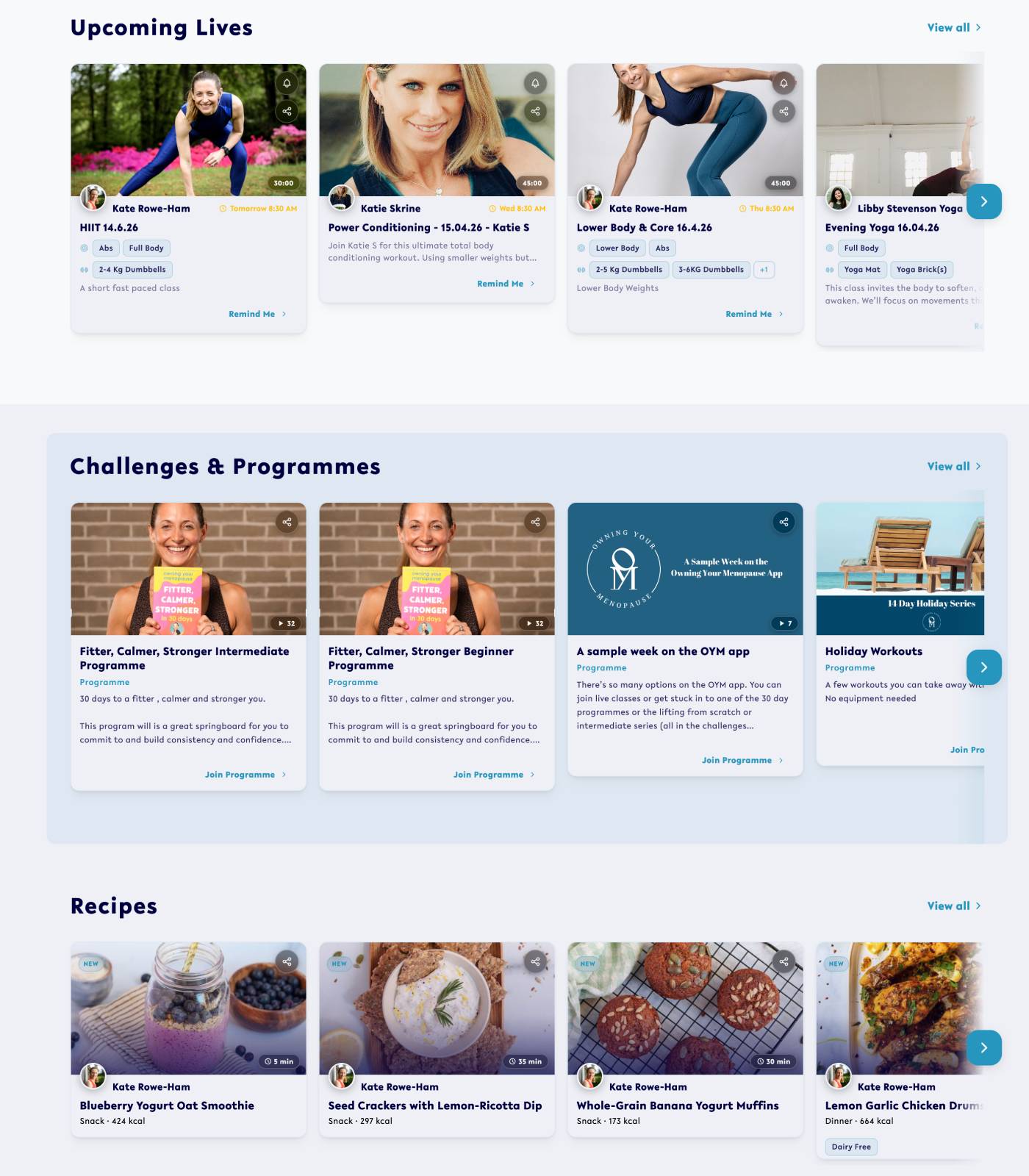
Nutrition: Katie is a fully qualified and registered Nutritional Therapist from the College of Naturopathic Medicine and also a Level 3 qualified Personal Trainer, bridging the gap between what you eat and how you train during menopause. She offers app members monthly interactive nutritional check-ins, runs information sessions with Kate on nutritional health in midlife, and also teaches a live Power Conditioning class on Wednesday mornings.
Fitness: Kate Rowe-Ham leads the majority of the strength content and runs multiple live workouts each week. Meera is a women’s health and menopause coach and Personal Trainer who teaches a live Superset Sweat class on Monday mornings and fills in for Kate as needed.
Yoga and Wellbeing: Libby is a yoga instructor specialising in women’s health, with certifications in prenatal, postnatal and menopause yoga plus specialist training in pelvic floor health and bone health. She teaches a live yoga class on Thursday evenings.
Cancer and Exercise: Sarah Newman is a Cancer and Exercise specialist and Breast Cancer Rehab Coach who founded Get Me Back to offer specialist fitness training for women affected by cancer. This is a genuinely thoughtful inclusion that I have not seen on other platforms in this space.
The breadth of this team is what makes the educational content feel substantive. You are not getting one trainer’s opinion on menopause repackaged across different videos. You are getting discussions between GPs, nutritionists, psychologists and coaches who each bring their own clinical expertise to the conversation.
Who Is Owning Your Menopause For?
This platform serves two overlapping but distinct audiences, and understanding which one you are determines how much value you will get from the subscription.If you primarily want menopause education, community and wellness support: This is the best platform I have tested. The depth of resources on symptoms, hormone health, nutrition, anxiety, sleep, pelvic floor, meditation and more is unmatched. The GP access alone is worth considering. If you are feeling confused or isolated by perimenopause and want a space where you feel understood and supported by qualified experts, this delivers.
If you primarily want a workout platform with high-production training videos: You will find effective workouts here, particularly at the beginner and intermediate level, but the video production quality sits below what competitors offer at the same price point. If polished visuals and on-screen workout guidance are what keep you motivated, the gap will become noticeable over time.
The ideal user is someone who values both and is willing to accept the production limitations in exchange for the unmatched menopause-specific content. That trade-off is real and it is worth being upfront about.
What I Actually Tested
Over approximately eight weeks across two testing periods, I worked through the following:Strength courses with Kate Rowe-Ham: Beginner Strength course (completed) and Intermediate Strength course (completed). These formed the core of my testing. I used 4–9 lb and 13 lb dumbbells, going lighter than my usual training weight because I was recovering from a meniscus injury at the time of my first testing period.
Educational content: Menopause wellness videos, GP discussions, nutrition advice, pelvic floor content, meditation sessions. I explored the face yoga content, which is genuinely unique among platforms I have reviewed.
Nutrition resources: Recipes, calorie calculator, macro information. Tested the calorie calculator twice (it worked the first time; produced repeated errors the second).
Community: Accessed primarily through the app. Browsed the GP chat feature.
Platform comparison: Used both the website and the app to compare functionality and navigation. Tested casting to a connected screen via WiFi.
What I did not test in depth: dance classes, yoga sessions, rebound classes, HIIT workouts or Pilates. My focus during both testing periods was exclusively on the strength programming because that is what I needed post-injury. The variety exists and I browsed it, but I cannot speak to the quality of those specific workout types from personal experience.
Strength Workouts With Kate Rowe-Ham
The strength content is where I spent my time and where I can give the most candid assessment. Kate leads the Beginner and Intermediate strength courses, and her coaching style is genuinely excellent for anyone learning or relearning proper form.What she gets right: Kate explains every exercise thoroughly. In the Beginner course especially, you learn not just what to do but why you are doing it and how to position your body correctly. For women returning to exercise after a break, recovering from injury, or starting strength training for the first time in perimenopause, this instructional quality is valuable. She will make your heart rate climb too; these are not gentle sessions despite the methodical pacing. The mix of upper body, lower body and full body workouts covers the basics well: squats, lunges, presses, rows, and compound movements that recruit multiple muscle groups.
What I noticed physically: The workouts made me sweat consistently. They are mostly standard strength training movements executed with good coaching, and they hit the sweet spot of being challenging without pushing you to your physical limits. Working with 4–9 lb and 13 lb dumbbells (lighter than my usual range due to my injury recovery), I maintained my existing muscle tone and actually noticed some definition returning around my core and belly area. I had been neglecting abdominal work and appreciated that belly-focused workouts were included in the programming. My weight stayed stable, which during perimenopause I count as its own achievement. For beginners, I believe these workouts will deliver real, visible results because the form coaching means you are actually recruiting the right muscles rather than compensating through momentum.
Session length: Most workouts sit around the 30-minute mark, which is a genuine sweet spot for busy women. There are also shorter sessions under 30 minutes for days when time is tight. The workouts are easy to fit into a full schedule and you do not need to block out an hour.
The progression from Beginner to Intermediate
The Beginner course builds a strong foundation. Kate’s explanations of posture and form are the kind of thing you would pay a personal trainer for in a one-to-one session. The Intermediate course steps up the intensity and assumes you understand the basics. The progression feels natural and well-structured. Where I think there is room to grow is beyond intermediate. For women who have been training for a while and want genuinely advanced programming, the strength library may feel limited compared to platforms that specialise purely in progressive overload and heavy lifting.What was missing: joint modifications
Because of my previous meniscus injury, I noticed the absence of alternative exercises displayed for joint issues or similar conditions. No modifications were shown on screen during the workouts. I already knew some alternatives from my own experience and applied them, but a woman dealing with knee, hip or shoulder issues for the first time would need to source modifications elsewhere. For a platform built specifically for perimenopausal and menopausal women, many of whom are dealing with increased joint stiffness and inflammation, this is a meaningful gap.Other Workout Types Available
Beyond the strength programming, the platform offers dance workouts, yoga, rebound classes, HIIT sessions and Pilates. I browsed these but did not test them in depth during my strength-focused testing period, so I will describe what is available rather than assess quality.The platform also has a structured live class schedule: Kate leads multiple live strength sessions throughout the week, Meera runs a Superset Sweat class on Monday mornings, Katie (the nutritionist and PT) teaches Power Conditioning on Wednesday mornings, and Libby leads yoga on Thursday evenings. All live sessions are recorded and available on-demand if you miss them.
The variety means you can cross-train within the platform without needing a separate subscription for yoga or dance cardio. For women who find pure strength training monotonous, having dance or rebound as an option on lighter days adds welcome variety. The yoga content is led by Libby, whose specialist certifications in menopause yoga and pelvic floor health suggest this is not generic yoga repackaged for a menopause audience.
The Video Production: An Candid Assessment
This is where I need to be straightforward, because it was the single biggest factor that affected my long-term engagement with the platform, and it is hard to talk about because you can see how much quality work has gone into the content itself.The workout videos are filmed in a home-studio setting. They are essentially homemade productions: Kate (or another trainer) working out at home with a camera set up, often with voiceover coaching. There is no professional lighting setup, no on-screen countdown timer showing time remaining for each exercise, no preview of the next movement coming up, and no multi-camera angles. The audio was sometimes difficult to hear clearly. On several occasions the camera framing showed only part of the trainer’s face, sometimes from the nose down, which I found genuinely distracting. I eventually started just listening to the audio without watching the screen during some sessions because the visual was pulling me out of the workout rather than keeping me in it.
I want to be careful with how I frame this because the effort and expertise behind the content is obvious. The workouts themselves are well-designed. Kate’s coaching cues are excellent. The exercise selection is smart for the target audience. But the way the content is packaged falls noticeably behind what other platforms deliver at a similar or lower price point. Platforms like Peloton, Les Mills+ and BODi set a standard for workout video production that includes professional lighting, multiple camera angles, on-screen timers, music integration, and clean studio environments. When you have experienced those, the visual quality here feels less energising.
Over time, this affected my motivation. The workouts themselves were making me feel good physically, making me sweat, keeping me toned. But I found myself less excited to press play, and eventually that contributed to me stepping away from the programme temporarily. Some women may prefer the home-studio aesthetic; it can feel more relatable and less intimidating than a polished studio production. That is a legitimate preference. But I found it harder to sustain the kind of visual energy that keeps you coming back day after day, and I suspect I am not alone in that.
The Menopause Education Library: Where This Platform Excels
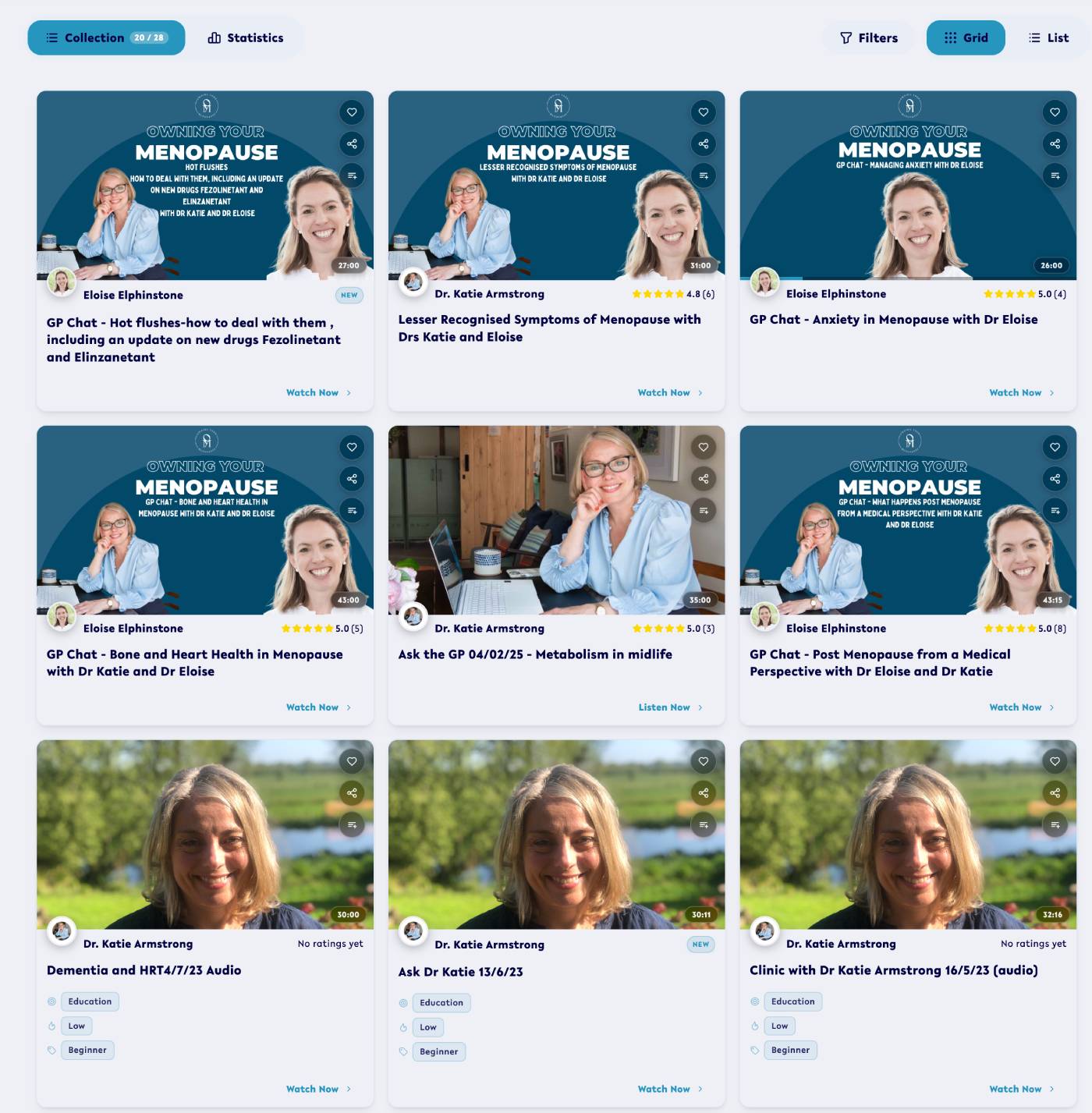
If the video production is the weakest point, the menopause education library is the strongest, and it is not even close to what any other fitness platform offers.The breadth of topics covered is remarkable. There are expert-led videos and discussions covering: hot flushes and night sweats, anxiety and mood changes during perimenopause, HRT (hormone replacement therapy) options and considerations, bone health and osteoporosis prevention, pelvic floor health and strengthening, nutrition for hormonal balance, sleep disruption and management, brain fog and cognitive changes, weight management during menopause, skin and hair changes, libido and intimate health, fibre intake and gut health, and more. You also have meditation sessions, face yoga classes (genuinely unique among fitness platforms I have reviewed, and an interesting addition for women concerned about the visible effects of hormonal changes), and content addressing the psychological and emotional dimensions of menopause.
The collections on menopause care include discussions with specialist GPs covering specific symptoms and practical advice on what to do about them. These are not surface-level overviews. Dr Katie Armstrong and Eloise bring genuine clinical depth to topics like when to consider HRT, how to talk to your GP about menopause symptoms, what dietary changes actually have evidence behind them, and how to manage anxiety without dismissing it as a phase.
What I would improve: Many of these educational videos are around 30 minutes long. For a busy woman who wants to understand a specific topic, that is a significant time investment. I would love to see transcriptions, key takeaway summaries, or navigation markers so you can jump to the section that interests you most. Shorter five to ten minute snapshot videos covering the essential points would also serve women who want the knowledge but cannot commit to a 30-minute watch on a weekday evening. The information is excellent; the delivery format could be more flexible.
Community and GP Access
The community is one of the genuinely standout features and is primarily accessible through the app rather than the website. It provides a supportive space where members share experiences, ask questions, and connect with women going through the same stage of life. What makes it exceptional is the clinical access. Dr Katie Armstrong, founder of Clinic 51 in West Sussex, runs a weekly Zoom clinic exclusively for OYM members where you can ask her anything about menopause, HRT, symptoms and treatment options. This goes well beyond a chat feature into structured, scheduled access with a menopause-specialist GP. Dr Katie and Eloise also run monthly information webinars together covering specific medical topics that affect women in midlife, with Q&A where you can submit questions in advance.For women who feel dismissed by their regular GP when raising menopause symptoms, or who cannot easily access a menopause specialist on the NHS, this feature alone could justify the subscription cost. It bridges a gap in healthcare access that is a genuine problem for many women in the UK.
I found the community welcoming and active. The tone is supportive without being saccharine. Women share frankly about what they are experiencing and the responses from both community members and the clinical team feel genuine rather than scripted.
Nutrition and Recipes
The nutrition offering combines expert dietary advice with a practical recipe library and a calorie calculator with macro targets.The recipes are broad, tasty, and genuinely useful. You can filter by preparation time, which I appreciated as someone who is not going to spend 45 minutes cooking after a workout. Each recipe lists everything you need to know: calories, protein, carbohydrates and fat, making it very easy to track your intake. Two recipes stood out for me personally: the high protein broccoli soup, which is incredibly easy to make and delivers over 20g of protein per serving (a real find for cold days), and the sweet berry cottage cheese bowl, which is a simple, high-protein breakfast option. During perimenopause, hitting adequate protein becomes increasingly important for maintaining muscle mass and supporting bone health, and I have personally struggled with this. Having the protein content prominently displayed on every recipe made it significantly easier to build meals around my targets.
The calorie calculator is designed to help you understand your energy needs and set macro targets. It worked for me the first time I used it and provided a reasonable calorie target with a recommended increase. However, on my second attempt, I wanted to double-check my targets after adjusting my activity level, and the calculator produced repeated errors. I was unable to get it to recalculate, which was frustrating. This appears to be a technical issue rather than a design flaw, but it needs fixing.
Nutrition education: Beyond the recipes and calculator, Katie (the qualified Nutritional Therapist) offers monthly interactive nutritional check-ins for app members and runs information sessions with Kate on all areas of nutritional health in midlife. The content covers how to eat during menopause, what specific nutrients matter and why, and how to adjust your diet as your hormonal profile changes. This is integrated thoughtfully with the broader menopause education library rather than sitting as a separate afterthought.
App vs Website: Which Is Better?
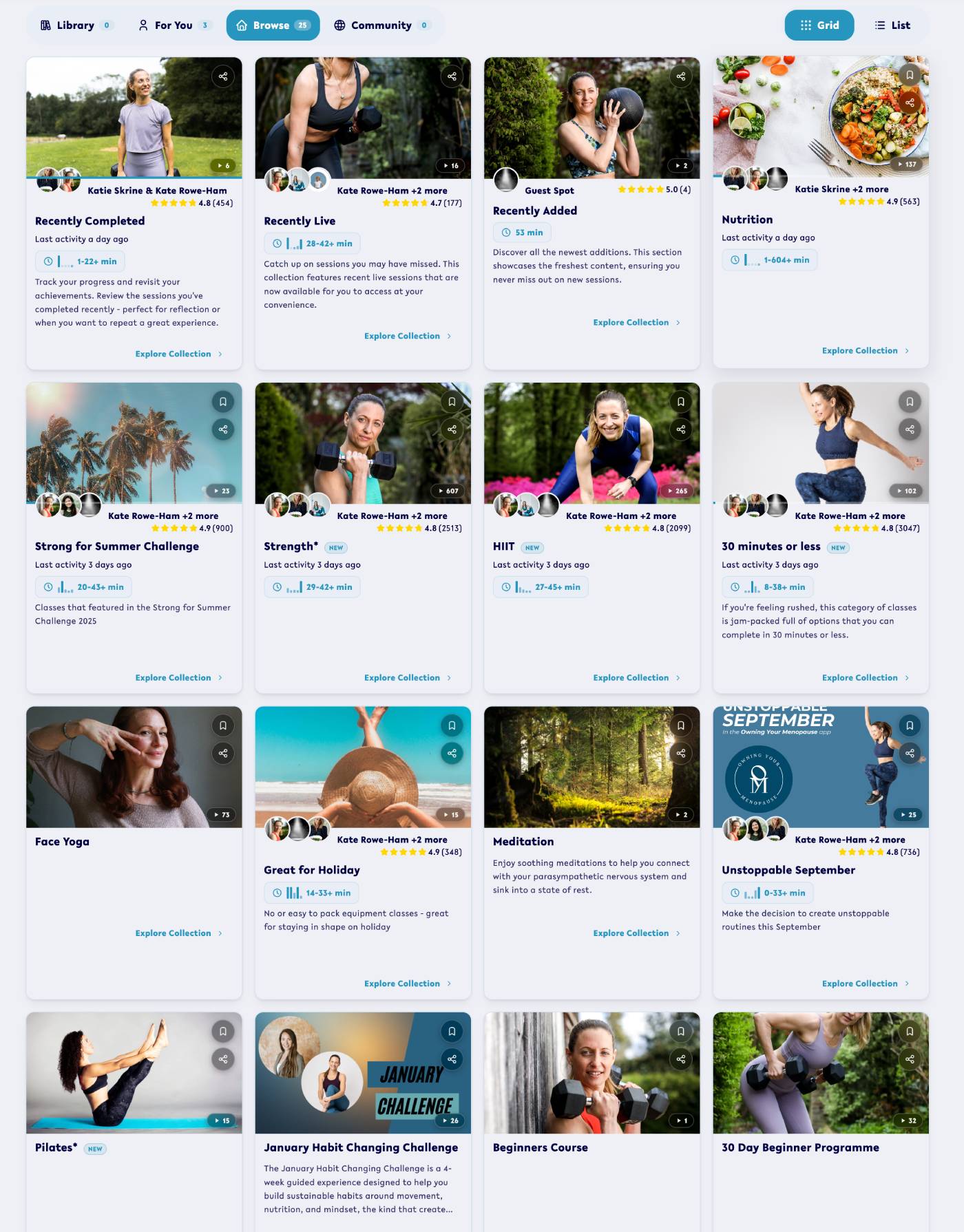
I tested both, and unusually for me (I normally prefer working out on a laptop with a large screen), I found the app to be the better experience overall.The website has a basic design but is relatively easy to navigate. The search area with filter labels lets you find what you are looking for without too many clicks. For watching workout videos, the website does the job, and you can cast videos to connected devices via WiFi if you prefer a larger screen, which works well.
The app has additional features that I could not easily find on the website, including the community (which is a significant feature to have app-exclusive) and the calorie calculator. The app interface felt more intuitive for browsing content and the layout worked well on a phone screen. The main drawback was loading speed: the app was noticeably slow during my second testing period, with content taking longer than expected to load and occasional lag when navigating between sections.
My recommendation: Use the app for community, nutrition tools and browsing. Cast to a larger screen for workouts if you prefer it. The casting feature works via WiFi to connected devices, which is a practical solution even if the website experience does not quite match the app.
Equipment You Need
Starter Dumbbells (up to 10 lb)
A light adjustable pair to start with
~$65–$80
Great starting point
Medium Dumbbells (up to 25 lb)
For steady progression as you get stronger
~$50–$65
Needed as you progress
Advanced Dumbbells (up to 50 lb)
For serious strength and progressive overload
~$350–$430
Grows with you
Exercise Mat
Useful for floor work, yoga and Pilates classes~$15–$40
Any standard exercise mat will work. Nothing platform-specific required.
Resistance Bands
Used in some classes for added resistance~$15–$30 for a set
Optional for many workouts. Useful if you want to add variety beyond dumbbells.
Mini Trampoline (Rebound)
Required for rebound classes only~$40–$125
Only needed if you plan to do the rebound workout classes. Not required for any other content on the platform.
A quick heads-up: some of the buy links above are Amazon affiliate links, so if you grab something through them I may earn a small commission – at no extra cost to you. I only ever point you to kit I’d happily use myself.
My Results After Eight Weeks
I trained primarily with the Beginner and Intermediate strength courses using 4–9 lb and 13 lb dumbbells. My starting point was recovery from a meniscus injury, so I deliberately went lighter than my usual training weight.Weight: Stayed stable. During perimenopause, where weight tends to creep up without deliberate effort, maintaining my weight without strict dieting felt like a genuine achievement.
Muscle tone: I maintained my existing tone throughout both testing periods. I noticed some new definition around my core and belly area, which surprised me because I had been neglecting abdominal work entirely. The inclusion of belly-targeted workouts in the programming addressed a gap in my training that I had not been motivated to fix on my own. Seeing some visible muscle tone there after the workouts was motivating and made me happy.
Energy and recovery: The workouts consistently left me feeling refreshed rather than depleted. They made me sweat but did not push me to the point of needing significant recovery time, which meant I could train on consecutive days without accumulating fatigue. This matters during perimenopause when recovery capacity changes and overtraining becomes counterproductive more quickly.
Where I plateaued: After several weeks, the combination of effective-but-standard workouts and basic video production led to decreased motivation. The physical results were there, but the experience of doing the workouts became less engaging over time. I stepped away from the platform, which is the plain truth of what happened. I plan to return specifically for the menopause education resources and nutrition content, but the workouts alone did not hold me long-term in the way that platforms with more polished production have.
Is Owning Your Menopause Good for Women Over 40?
What it genuinely gets right for this age group
The entire platform exists because of this age group, and that matters. This is not a general fitness app with a menopause module bolted on. Every piece of content has been created with perimenopausal and menopausal women as the primary audience. The GP access is transformative for women who feel unheard by the standard healthcare system. The educational content addresses every major menopause symptom with clinical depth. The community creates a genuine sense of being understood. Kate’s coaching in the Beginner course is exactly what women returning to exercise after years, an injury, or a health change need: patient, thorough, encouraging without being patronising. The workout intensity sits in the right zone for this audience: challenging enough to produce results, manageable enough to sustain. The recipes with visible macro counts support the increased protein needs that become critical during perimenopause for maintaining muscle mass and bone density.Where it has limits for this age group
The absence of injury modifications in the workout videos is a significant gap for a platform targeting women over 40, many of whom are dealing with joint issues, inflammation, and the musculoskeletal effects of declining oestrogen. The video production quality may disproportionately affect this audience because motivation and consistency are already harder to maintain when you are dealing with fatigue, mood changes, and the general disruption of perimenopause. A workout video needs to make you want to press play; production quality contributes to that in ways that are easy to underestimate.The candid summary
For women over 40 who want the most comprehensive menopause education and support available in a fitness platform, this is it. For women over 40 who are primarily motivated by high-production workout content, the gap between the educational quality and the video quality may frustrate you. The ideal approach may be using Owning Your Menopause for its unmatched resources, community and nutrition content, alongside another platform for daily workout videos.Exercise Intensity During Perimenopause: What the Research Says
One thing I noticed about Owning Your Menopause is that the workouts consistently made me sweat without pushing me to my absolute limits. This felt instinctively right, and the research supports why.During perimenopause, cortisol sensitivity increases and recovery capacity decreases as oestrogen levels fluctuate and decline. Research published in the journal Menopause and reviewed by NAMS shows that women with moderate to high physical activity levels experience less severe menopausal symptoms compared to inactive women. However, the relationship between exercise intensity and outcomes is nuanced. A systematic review in BMC Women’s Health found that both moderate-intensity and high-intensity exercise reduce menopausal symptoms, but moderate-intensity training showed lower perceived exertion while still delivering meaningful benefits. The current evidence-based recommendation for postmenopausal women is approximately two and a half hours of moderate aerobic activity per week, combined with strength training and balance work.
What this means practically is that the sweet spot for many perimenopausal women is consistent moderate-intensity training that builds strength and maintains muscle mass without creating excessive recovery demand. Extremely intense training can elevate cortisol further, which is already running higher during perimenopause, potentially worsening symptoms like sleep disruption, anxiety and weight gain around the midsection. Owning Your Menopause’s approach, workouts that make you work but do not push you to exhaustion, aligns well with this evidence base. It is not the only valid approach (some research shows HIIT can be effective for fat loss in perimenopausal women specifically), but for sustainable daily training that supports rather than stresses the body during this transition, the intensity calibration here is appropriate.
Owning Your Menopause Pricing 2026
Owning Your Menopause costs £16.99 per month or £80 for six months, with a 14-day free trial on both plans. Cancel before the 14 days are up if you do not wish to continue.| Option | Price | Includes |
|---|---|---|
| Monthly | £16.99/month | Full access: workouts, education library, community, GP webinars, nutrition, recipes |
| 6-month plan | £80 (~£13.33/month) | Same as monthly; 21% saving over monthly billing |
| Free trial | 14 days free | Full access to all features during the trial period |
Will You Actually Stick With It?
Owning Your Menopause Weighted Scoring: How the 7.6/10 Was Calculated
| Category | Weight | Score | Reasoning |
|---|---|---|---|
| Time Efficiency | 15% | 8 | 30-minute sweet spot for most workouts; shorter options available for busy days; easy to fit around work and family |
| Muscle Potential | 15% | 7 | Standard strength exercises with good form coaching; effective for beginners and maintaining tone; limited ceiling for advanced progression |
| Women Over 40 Specificity | 15% | 9.5 | Built entirely for perimenopause and menopause; GP access; expert team spanning GPs, nutritionists, psychologists; pelvic floor, face yoga, meditation; community with clinical support |
| Joint Friendliness | 12% | 6.5 | No alternative exercises or modifications shown on screen during strength workouts; however, the platform includes yoga, Pilates and low-impact options that are inherently joint-friendly; the gap is in the strength content specifically |
| Recovery Compatibility | 10% | 8 | Workouts produce a good sweat without pushing to exhaustion; sustainable daily training; appropriate intensity for perimenopause when recovery capacity decreases |
| Programme Structure | 10% | 7.5 | Clear beginner-to-intermediate progression with Kate; structured courses available; educational content well-organised by topic with specialist collections; variety of workout types (strength, yoga, Pilates, dance, HIIT, rebound) provides breadth |
| Value for Money | 8% | 7.5 | £16.99/month is mid-range; the combined value of workouts, education library, GP access, community and nutrition resources is strong; workout production quality reduces the pure fitness value |
| UX and Design | 8% | 5 | Video production noticeably basic: no timers, limited lighting, occasional framing issues; website design functional but plain; app slow to load; calorie calculator errors; casting via WiFi works well |
| Nutrition Integration | 7% | 8 | Recipes with full macro counts including protein; calorie calculator (when working); nutritionist-led educational content; food-first approach with no supplement pressure; filterable recipes by prep time |
Final Weighted Score
7.6 / 10
The most comprehensive menopause education and wellness platform tested – with effective workouts held back by basic video production
Owning Your Menopause Pros and Cons
Pros
- The most comprehensive menopause education library of any fitness platform tested, covering symptoms, HRT, nutrition, anxiety, pelvic floor, sleep, bone health and more
- Direct GP chat access and monthly GP-led webinars with menopause specialists – genuinely transformative for women who feel unheard by standard healthcare
- Expert team spanning GPs (including one trained with Dr Louise Newson), nutritionists, psychologists, yoga specialists and a cancer exercise specialist
- Kate Rowe-Ham’s form coaching in the Beginner course is excellent for women learning or returning to strength training
- Recipes with full macro counts including protein – practical and easy to follow for women trying to hit higher protein targets during perimenopause
- Workouts hit the 30-minute sweet spot with shorter options for busy days; easy to fit into a full schedule
- Workout intensity is well-calibrated: challenging enough to produce results, sustainable enough for daily training without excessive recovery demand
- Face yoga classes – a genuinely unique offering among fitness platforms I have reviewed
- Community is supportive, active and welcoming; feels like a genuine space rather than a marketing feature
- No proprietary equipment required; start with basic dumbbells you likely already own
- 14-day free trial is generous and gives enough time to explore both workouts and education library
- Can cast videos to connected devices via WiFi for a larger screen workout experience
- Filterable recipes by preparation time – practical for busy women
- Cancer and exercise content with Sarah Newman – a thoughtful inclusion not found on other platforms
Cons
- Video production quality is noticeably basic: home-studio filming, limited lighting, no on-screen timers or next-exercise previews, occasional framing issues showing only part of the trainer’s face
- The production gap compared to similarly priced competitors reduced my workout motivation over time, eventually contributing to stepping away from the platform
- No injury modifications or alternative exercises shown on screen during workouts – a significant gap for a menopause-focused platform where joint issues are common
- App can be slow to load, with noticeable lag when navigating between sections
- Calorie calculator produced repeated errors on second use and would not recalculate
- Educational videos are typically around 30 minutes with no transcriptions, key takeaway summaries, or navigation markers to jump to specific topics
- Community and calorie calculator appear to be app-exclusive, not easily accessible on the website
- Strength programming tops out at intermediate level; limited options for advanced lifters wanting progressive overload with heavier loads
- No shorter five to ten minute educational snapshot videos for women who want key information without a 30-minute commitment
- Website design is basic and functional but lacks the polish of competitor platforms
How Owning Your Menopause Compares to Similar Platforms
If you are deciding between women’s fitness platforms with menopause or wellness content, this is how Owning Your Menopause sits against the most likely alternatives. All scores are from personal testing on this site against the same weighted criteria.| Feature | Owning Your Menopause | Pvolve | The Sculpt Society | Menovation | FitOn |
|---|---|---|---|---|---|
| Our score | 7.6 / 10 | 8.7 / 10 | 8.6 / 10 | 7.9 / 10 | 7.5 / 10 |
| Monthly price | £16.99/mo · £80/6 mo | $19.99/mo · $179.99/yr | $24.99/mo · $179.99/yr | $28.99/mo · $199.99/yr | Free tier · $29.99/yr Pro |
| Free trial | 14 days | 14 days (card required) | 7 days | 8 days | Free tier available |
| Best for | Menopause education + community + GP access alongside workouts | Low-impact functional strength, clinical menopause programming | Dance cardio, low-impact toning, beginners | Menopause-specific strength, education and nutrition | Budget-friendly general fitness |
| Equipment required | Dumbbells and mat only | Bundle recommended ($199); bands + dumbbells for most | Mat and light weights | Dumbbells, mat, bands, Pilates ball | Minimal; bodyweight options |
| Session length | ~30 min; shorter options available | 5–60+ min; 20-min sessions plentiful | 20–45 min | 20–30 min | 10–45 min |
| Injury modifications | Not shown on screen | Yes + dedicated injury series | Low-impact options throughout | Modifications available | Some low-impact alternatives |
| Perimenopause content | Best-in-class education: GP access, specialist webinars, comprehensive symptom coverage, pelvic floor, face yoga | Strong: Menopause Strong programme, clinical study, pelvic floor series | Peri programme available | Strong: menopause-specific programmes, education library, nutrition lessons | None |
| Video production | Basic home-studio; no timers or next-exercise display | Professional studio; clean production | Professional studio; polished | Professional studio; good production | Professional studio; clean |
| GP / medical access | Yes – GP chat in community + monthly webinars | Clinical advisory board; no direct GP access | No | No direct GP access | No |
| Nutrition included | Recipes with macros, calorie calculator, nutritionist content | Not included in streaming | Not included | Nutrition lessons + meal guidance | Basic nutrition tips in Pro |
| Community | Active community with GP access – standout feature | Included | Included | Included | Limited |
Competitor prices approximate. Verify on each platform’s website. Scores reflect our independent reviews – see each full review for methodology.
Owning Your Menopause FAQ
Owning Your Menopause is a fitness and wellness platform created by Kate Rowe-Ham specifically for women in perimenopause and menopause. It combines live and on-demand workouts (strength, HIIT, yoga, dance, Pilates, rebound) with an extensive menopause education library, GP access, community support, and nutrition resources including recipes with full macro counts. The platform is available as both a website and a mobile app on iOS and Android. Kate is also the bestselling author of Owning Your Menopause: Fitter, Calmer, Stronger in 30 Days .
Owning Your Menopause costs £16.99 per month or £80 for six months (approximately £13.33 per month). Both plans include a 14-day free trial for new members. The subscription gives full access to all workouts, the menopause education library, community with GP access, nutrition resources and recipes.
Yes, and it is one of the better platforms for beginners specifically. Kate Rowe-Ham’s Beginner Strength course explains every exercise thoroughly, focusing on correct posture and form in a way that mimics the value of a personal training session. The exercises are standard strength movements (squats, lunges, presses) that are accessible without a fitness background. Light dumbbells of 2–4 kg are sufficient to start. The coaching style is patient and encouraging without being patronising.
Yes, and this is one of the platform’s most distinctive features. The community includes direct GP chat access where you can ask menopause-related medical questions. Dr Katie Armstrong also runs a weekly Zoom clinic for OYM members through her Clinic 51 practice, which goes beyond a simple chat feature into structured, scheduled clinical access. There are also monthly GP-led webinars where members can submit questions in advance. The medical team includes Dr Katie Armstrong (a GP trained with Dr Louise Newson, the British Menopause Society and the Royal College of Obstetrics and Gynaecology, and founder of Clinic 51 in West Sussex) and Eloise (an NHS GP specialising in women’s health and advanced menopause care).
The platform offers strength training (beginner and intermediate courses with Kate Rowe-Ham), HIIT, conditioning, yoga (with menopause-specialist instructor Libby), dance, rebound (mini trampoline), and Pilates. There are also dedicated wellness sessions including meditation, face yoga, and pelvic floor exercises. Most strength workouts are around 30 minutes, with shorter options available under 30 minutes.
The app offers some features that are not easily accessible on the website, including the community (with GP chat access) and the calorie calculator. The website is functional with search and filter labels for finding content. You can cast videos from the app to connected devices via WiFi for a larger screen experience. The app can be slow to load at times. For the most complete experience, use the app for community and nutrition tools, and cast to a big screen for workouts if you prefer.
Both platforms take menopause seriously, but they excel in different areas. Pvolve has higher video production quality, a clinical study behind its methodology, dedicated injury support series, and a unique functional movement method. It scores 8.7/10 on our criteria. Owning Your Menopause has broader and deeper menopause education (covering more symptoms, more specialist areas), direct GP access that Pvolve does not offer, a more active wellness community, and better nutrition integration with macro-counted recipes. It scores 7.6/10. If your priority is the workout experience, Pvolve is stronger. If your priority is understanding menopause comprehensively alongside your training, Owning Your Menopause is unmatched.
Yes. The platform is built for both perimenopausal and post-menopausal women, and the educational content covers the full spectrum of menopausal health. The GP access is particularly valuable for women over 50 who may be navigating HRT decisions, bone density concerns, or post-menopausal symptom management. The Beginner Strength course is accessible for women returning to exercise after a long break. The main caveat is the lack of on-screen injury modifications, which becomes more relevant as joint issues increase with age.
I tested this platform while recovering from a meniscus injury and was able to complete the strength courses by applying my own exercise modifications. However, the platform does not show alternative exercises or modifications on screen during workouts, which means you will need to know or research your own adaptations for movements like deep squats or lunges. If you have an active injury, consult your physiotherapist about specific modifications before starting. The workouts are generally moderate impact and not aggressive on joints, but the lack of visible modification options is a gap compared to platforms like Pvolve , which has dedicated injury support series.
Final Verdict
Eight weeks of testing across two periods. Beginner and Intermediate strength courses. 4–9 lb and 13 lb dumbbells. A meniscus injury that needed respecting. Here is where I landed: Owning Your Menopause is two things at once, and they are not equally strong. The menopause education, wellness resources, GP access and community are the best I have tested on any fitness platform. The depth is genuine. The expert team is qualified. The recipes are practical and protein-aware. The community makes you feel understood in a way that matters when perimenopause is making you question everything. And then there are the workouts. They are effective. Kate’s coaching, especially in the Beginner course, is excellent. The intensity is right. They made me sweat, kept me toned, and left me feeling refreshed rather than depleted. But the video production sits noticeably behind competitors at this price point, and over time that affected how motivated I felt to show up. I stepped away. I will come back for the resources, the nutrition content and the community, because nothing else matches them. Whether I come back for the workouts specifically depends on whether the production quality evolves. If you are a woman navigating perimenopause who wants to feel understood, educated and supported by qualified experts while also getting solid, manageable workouts, this platform delivers that in a way nothing else quite does. Just go in with realistic expectations about the video quality, and consider pairing it with a more polished workout platform if visual production is what keeps you pressing play. Score: 7.6 / 10Sources & Further Reading
- Owning Your Menopause – official website and platform
- Owning Your Menopause Expert Team
- High Physical Activity Level May Reduce Menopausal Symptoms – PMC (2019)
- Detrimental Changes in Health during Menopause: The Role of Physical Activity – PMC (2023)
- Exercise beyond menopause: Dos and Don’ts – PMC
- Effect of high intensity interval training on body composition in women before and after menopause – PubMed (2020)
- Exercise as you get older – NHS
- Understanding menopausal symptoms – North American Menopause Society
Related Guides
What To Do Next
Not sure this is the right programme for you?
- → Take our 2-minute quiz for a personalised recommendation.
- → See our best workouts for perimenopause rankings
- → See our best workouts for women over 40 rankings
- → See how we score every programme using 9 weighted criteria.