
Sweat App scores higher overall, 7.3 against 6.8, and is the stronger platform for building and keeping muscle and a structured programme. Daily Burn is the better pick if what you need most is joint-friendly training and value for money.
- Score 7.3 vs 6.8
- Both tested hands-on
Quick answer: Sweat App is the stronger overall platform for women over 40, scoring 7.3 against 6.8. It is ahead for building and keeping muscle, a structured programme and recovery between sessions. Daily Burn still wins for joint-friendly training, value for money and the app experience, so it is the better choice if that is your priority.
The two platforms
Same nine weighted categories, two different women. Here is who each one is built for.
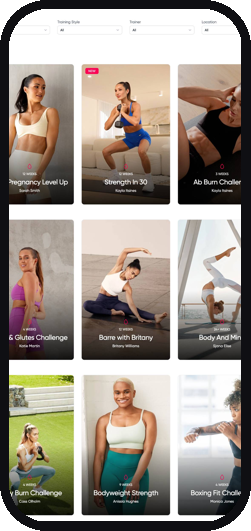
Sweat App
Winner
Leads this comparison on building and keeping muscle and a structured programme, scoring 8 against 5.5 on Muscle Potential.
- Moderate impact
- 15 to 30 min
Choose Sweat App if you:
- Want structured progressive strength programmes that log your weights and reps week over week
- Train at home with a full kit (dumbbells, kettlebells, bench) or at a gym
- Want to train under credentialled coaches (Kayla Itsines, Kelsey Wells, Stephanie Sanzo)
- Need a large active community for accountability (millions of users in-app)
- Want pregnancy and postnatal training certified by Kayla Itsines
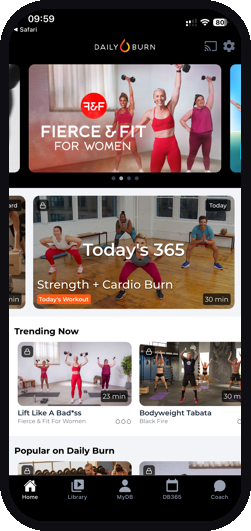
Daily Burn
Runner-up
Leads this comparison on joint-friendly training and value for money, scoring 8.5 against 6.5 on Joint Friendliness.
- Low impact
- 15 to 60 min
- Depends on workout
Choose Daily Burn if you:
- Want the lowest monthly cost ($14.99 Basic, $19.95 Premium)
- Need variety to stay consistent (dance, kickboxing and mobility alongside strength)
- Have a family or household with mixed fitness needs
- Want seated and accessibility content for limited-mobility training or injury recovery
- Cast between phone, smart TV, Apple TV, Roku, Fire TV or Chromecast
Quick answer
Quick answer: Sweat App wins narrowly overall at 7.3 versus Daily Burn at 6.8. The scores are close and the platforms serve different needs. Sweat wins on structured progressive strength programmes (Strength in 30 with Kayla Itsines, PWR with Kelsey Wells, BUILD with Stephanie Sanzo, LIFTING, FIERCE) with logged weights and reps that increase week over week, a community of millions of active users, and dedicated gym programmes for women training at full gyms. Daily Burn wins on price ($14.99 per month Basic versus $24.99 Sweat), library variety (2,000+ workouts across strength, HIIT, dance, kickboxing, yoga, Pilates, barre and mobility), the broadest device compatibility of any platform reviewed on this site, family-friendliness (one subscription for mixed-need households), and excellent injury and accessibility content including seated programmes. Neither platform has a dedicated perimenopause programme. The decision turns on whether you want structured progression (Sweat) or breadth and price (Daily Burn).
Inside Daily Burn and Sweat
Bottom line in 30 seconds
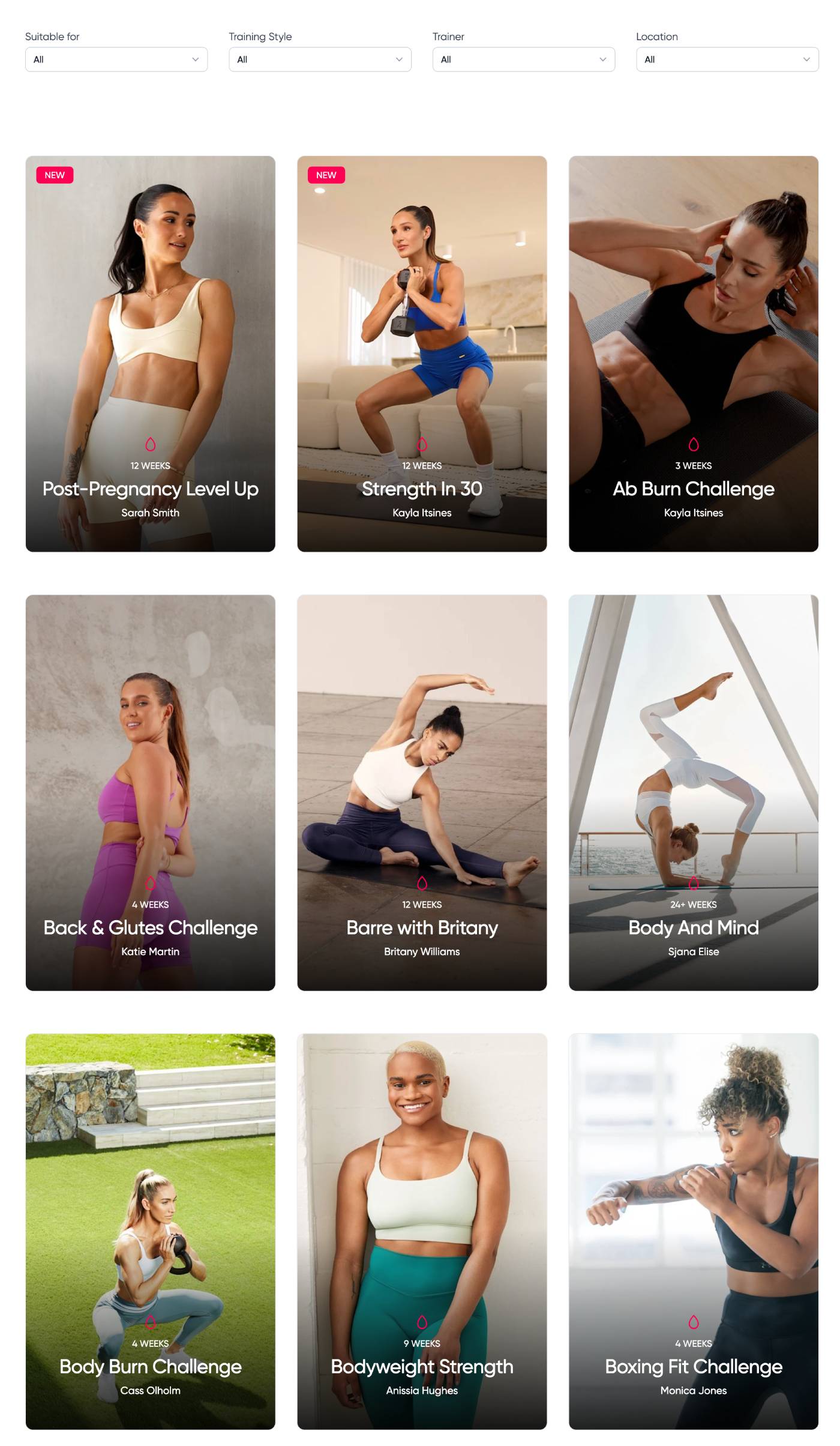
- Sweat App wins on structured progressive strength and community. 7.3 versus Daily Burn at 6.8. Strength in 30, PWR, BUILD, LIFTING and FIERCE are built on traditional periodisation with logged weights. The community of millions of active users in the in-app forum is the strongest tested at this price point. Dedicated gym programmes for women who train at full gyms. The right choice for women optimising for muscle and bone retention through perimenopause via structured strength.
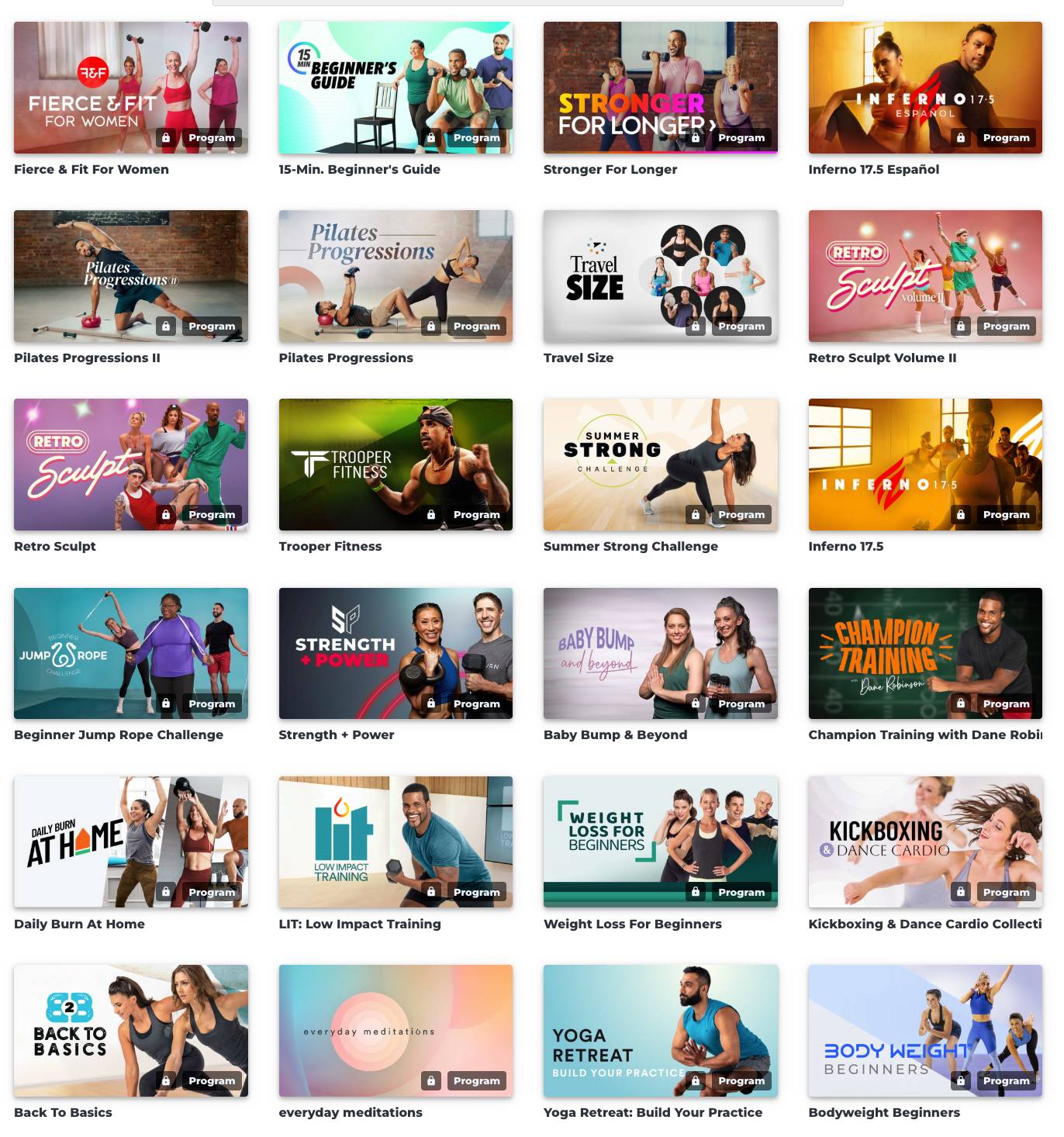
- Daily Burn wins on price, variety and family use. $14.99 per month Basic with 2,000+ workouts across strength, HIIT, dance, kickboxing, yoga, Pilates, barre and mobility. The 30-day trial is more generous than Sweat’s 7-day trial. Fierce and Fit for Women (Coach Amanda) is well-designed strength-and-HIIT for women in their late 30s and beyond. Excellent injury and accessibility content including seated programmes.
- Neither has dedicated perimenopause programming. Both serve general-fitness audiences with women-targeted content. For perimenopause-specific programming, look at Obe Fitness or Peloton. Between these two, choose based on whether structured progressive strength (Sweat) or breadth-and-price (Daily Burn) matches your goal.
Neither platform has dedicated perimenopause or menopause programming. Both work for general training during perimenopause but neither offers the structured menopause arc Obe Fitness, Peloton or Pvolve deliver. If perimenopause-specific content is essential, look elsewhere.
Sweat’s Strength in 30 is not low impact. Romanian deadlifts, lunges and squats with weight load the knees and hips. For joint-sensitive training on Sweat, use Low Impact with Kayla or Low Impact Strength with Chontel instead. Daily Burn has seated programmes and low-impact modifications across its broader library.
Quick yes or no comparison
| Feature | Daily Burn | Sweat App |
|---|---|---|
| Structured progressive strength programme | Fierce and Fit for Women (no logged progression) | Yes (Strength in 30, PWR, BUILD, LIFTING, FIERCE) |
| Logged weights and reps week over week | No | Yes |
| Dedicated gym programmes | No (home-focused) | Yes (PWR, BUILD, FIERCE gym versions) |
| Library variety (dance, kickboxing, etc.) | Yes (2,000+ workouts across every format) | Narrower format set |
| Daily new workout | Yes (Daily Burn 365) | No |
| Seated and accessibility programmes | Yes (excellent) | Low-impact options only |
| Pregnancy and postnatal content | Some | Yes (Kayla certified in pregnancy/postnatal exercise) |
| Family-friendly (mixed needs in one subscription) | Yes (one of the strongest tested) | Built for individual users |
| Community of millions in-app | General member forum | Yes (in-app forum, virtual challenges) |
| Dedicated perimenopause programme | No | No |
| Device compatibility breadth | Broadest tested (iOS, Android, Apple TV, Roku, Fire TV, Chromecast, browser) | iOS, Android, web |
| Human coaching add-on | Yes (separate price) | No |
| Annual plan | Yes ($125.95 Basic / $149.99 Premium) | Yes ($134.99) |
At a glance
| Daily Burn | Sweat App | |
|---|---|---|
| Monthly price | $14.99/mo Basic · $19.95/mo Premium | $24.99/mo |
| Annual price | $125.95/yr Basic · $149.99/yr Premium | $134.99/yr |
| Free trial / guarantee | 30 days (signup-route dependent) | 7-day free trial |
| Founder / brand | Daily Burn (independent) | Kayla Itsines (Australian) |
| Class library | 2,000+ workouts | Programme-driven (smaller standalone library) |
| Signature programmes | Fierce and Fit for Women, Stronger for Longer, Daily Burn 365, True Beginner | Strength in 30, PWR, BUILD, BBG, LIFTING, FIERCE, Low Impact |
| Trainer roster | Coach Amanda + general trainer team | Kayla Itsines, Kelsey Wells, Britany Williams, Cass Olholm, Stephanie Sanzo, Chontel |
| Workout types | Strength, HIIT, cardio, Pilates, yoga, barre, dance, kickboxing, mobility | Strength, HIIT, Pilates, yoga, barre, low-impact, pregnancy/postnatal |
| Logged progressive overload | No | Yes |
| Perimenopause programming | No dedicated programme | No dedicated programme |
| Personal testing | 1 month on Basic plan | 5+ weeks (trial + 1 month, plus 6 months in 2019) |
| Overall score | 6.8 / 10 | 7.3 / 10 |
Full scoring breakdown
| Category | Weight | Daily Burn | Sweat App | Winner |
|---|---|---|---|---|
| Time Efficiency | 15% | 7 | 7.5 | Sweat App |
| Muscle Potential | 15% | 5.5 | 8 | Sweat App |
| Women Over 40 Specificity | 15% | 4.4 | 4.7 | Sweat App |
| Joint Friendliness | 12% | 8.5 | 6.5 | Daily Burn |
| Recovery Compatibility | 10% | 6.5 | 7.5 | Sweat App |
| Programme Structure | 10% | 6.5 | 8 | Sweat App |
| Value for Money | 8% | 9 | 8 | Daily Burn |
| UX and Design | 8% | 9 | 8.5 | Daily Burn |
| Nutrition Integration | 7% | 6 | 6.5 | Sweat App |
| Overall | 100% | 6.8 | 7.3 | Sweat App |
Why these scoring categories matter more after 40
Three physiological changes during perimenopause shape what training should look like. Oestrogen decline accelerates loss of muscle and bone, which makes resistance training more important rather than less. Maltais 2009 documents the trajectory, and the 2022 systematic review on resistance training for postmenopausal women confirms structured progressive loading as the most effective intervention. Baseline cortisol elevates, which compresses recovery capacity. Tendon and ligament elasticity decreases, which Watt 2018 documents as a primary driver of musculoskeletal pain across the menopause transition.
Between Daily Burn and Sweat, the biggest gap sits on Muscle Potential (Sweat wins on structured progressive overload that the 2022 systematic review identifies as the most effective intervention). Daily Burn pulls back ground on Joint Friendliness (8.5 in the published review, reflecting strong seated and accessibility content), Value for Money (cheapest entry by some distance), and UX and Design (broadest device compatibility tested).
Time efficiency 7 vs 7.5
Daily Burn class lengths run from 15 minutes to over an hour. The 15-Minute Mobility sessions I tested in my first week were short and complete. Daily Burn 365 (a new 30-minute workout every day) gives a consistent slot for busy days. Fierce and Fit for Women sessions sit in the 25 to 45-minute window. The breadth across durations means you can match the session to the day.
Sweat sessions are typically 28 to 45 minutes for the structured strength programmes. Strength in 30 is exactly what the name suggests: 30-minute sessions, three to four times a week. The reliable session length is part of what makes the programme stick: you know what you are committing to.
Daily Burn wins on the duration range (15-minute through 60-minute options across more formats). Sweat wins on the predictable structure (30 minutes, three times a week, no surprises). For perimenopausal women managing variable energy, both work; Daily Burn is more flexible day-to-day, Sweat is more reliable across the week.
Muscle potential 5.5 vs 8
Muscle potential is where Sweat pulls ahead clearly.
Daily Burn’s strength content is dumbbell-based and well-coached. Fierce and Fit for Women with Coach Amanda is the standout, with three women working out alongside Amanda throughout (modifications visible from light to advanced loading in real time). The programme is genuinely challenging for women already lifting. The Muscle Potential score in the published Daily Burn review is 5.5, which reflects strong individual programme design without the platform-level structured progression that Sweat enforces. Daily Burn 365 and the broader library do not log weights or prompt progressive overload.
Sweat is built around structured progressive strength. Strength in 30 logs your weights and reps. The app shows your numbers from previous weeks. The expectation is that you add load over time. PWR (Kelsey Wells) and BUILD (Stephanie Sanzo) go significantly heavier and more advanced than Strength in 30. The dedicated gym programmes assume full gym access. The Muscle Potential score in the published Sweat review is 8.0, reflecting the structured progressive overload that the 2022 systematic review identifies as the most effective intervention for postmenopausal women.
The honest read: if muscle and bone retention through perimenopause is the primary training goal, Sweat’s structured programmes are the better choice. Daily Burn’s Fierce and Fit for Women is excellent within its design but the platform-level structure for progressive overload is not Daily Burn’s strength.
Why progressive overload matters more after 40
Progressive overload is the principle of gradually adding load over time. After 40, oestrogen decline accelerates muscle and bone loss, and a structured training response is the most effective counter. The 2022 systematic review on resistance training for postmenopausal women is clear: training works only if the load progresses. Sweat is built around this principle. Daily Burn supports strength training but does not enforce or log progression. Between the two specifically for muscle and bone retention, Sweat is the stronger platform.
Women over 40 specificity 4.4 vs 4.7
Both platforms score in the 6.5 to 7.5 range on this category, reflecting strong general-women-over-40 content without dedicated perimenopause framing.
Daily Burn has Fierce and Fit for Women (Coach Amanda), a strength-and-HIIT combination designed specifically for women in their late 30s and beyond. The 7.5 Women Over 40 Specificity score reflects this. The platform also has Stronger for Longer (slower-paced, more controlled strength) and excellent injury and accessibility content. None of this is menopause-specific. There is no perimenopause arc, no hormone-aware programming.
Sweat has dedicated low-impact programmes (Low Impact with Kayla, Low Impact Strength with Chontel) that work for joint-sensitive perimenopausal training. The Strength in 30 programme is open to all ages but not menopause-specific. Kayla Itsines is certified in pregnancy and postnatal exercise; the platform has expanded marketing imagery to include older trainers and women in their 40s and 50s. None of this is menopause-specific.
The honest read: both platforms work for women over 40 with the right programme selection. Daily Burn’s Fierce and Fit for Women is more explicitly women-over-40 targeted than any single Sweat programme. Sweat’s structured progressive strength is more important physiologically for muscle and bone retention. For perimenopause specificity, look elsewhere.
Joint friendliness 8.5 vs 6.5
Joint friendliness is one of Daily Burn’s strongest categories (8.5 in the published review). The platform has full seated workout programmes for limited mobility or injury recovery, low-impact modifications throughout most programmes, and dedicated recovery sessions. The breadth of low-impact options (yoga, Pilates, mobility, dance variations) gives daily alternatives when joints are unhappy.
Sweat has dedicated low-impact programmes (Low Impact with Kayla, Low Impact Strength with Chontel). The standard Strength in 30 programme is NOT low impact: Romanian deadlifts, lunges and squats with weight load the knees and hips. For joint-sensitive training, you have to deliberately choose the low-impact programmes. The honesty about this in the published review is useful.
Daily Burn wins this category cleanly on dedicated seated programmes and the breadth of low-impact formats. Sweat works for joint-sensitive training but requires programme selection rather than offering it across the standard library.
Recovery compatibility 6.5 vs 7.5
Daily Burn has dedicated recovery and mobility sessions across the library. The 15-Minute Mobility session helped clear a week of tension during my testing. The breadth of yoga and Pilates content gives recovery options across multiple formats. The 6.5 Recovery Compatibility score reflects competent but not standout recovery design.
Sweat has yoga, Pilates and dedicated low-impact programmes that support recovery between higher-intensity sessions. The platform does not lead on meditation or deep restorative content. For active recovery (yoga, low-impact strength), Sweat covers it.
Daily Burn edges ahead on recovery library breadth across formats. Sweat is sufficient for active recovery within the structured programme framework. Neither matches the depth of Obe Fitness’s audio meditations or Alo Wellness Club’s sound bath and yoga nidra library.
Programme structure 6.5 vs 8
Programme structure is the category where Sweat wins most clearly.
Daily Burn has structured programmes (Fierce and Fit for Women, Stronger for Longer, True Beginner, Daily Burn 365 as a daily anchor) plus a weekly schedule view. The 6.5 Programme Structure score reflects competent but not standout programme design. The library size means decision fatigue is a real risk after the first 30 days: with 2,000+ workouts and no enforced progression, drift to less structured browsing is common.
Sweat’s programme structure is the platform’s defining feature. The onboarding quiz recommends a programme based on goals and experience. Once selected, each day’s workout is laid out, your weights and reps log against previous sessions, and the 12-week arcs have clear endpoints. This is the strongest programme structure in the under-$30 category for women who want to be told what to do.
Sweat wins this category clearly. The structural integrity is what justifies the price premium over Daily Burn. For women who need a programme rather than a catalogue, Sweat is the stronger fit. For women who prefer to build their own training week from a library, Daily Burn works.
A closer look at Daily Burn
Value for money 9 vs 8
Daily Burn wins this category cleanly.
Daily Burn Basic is $14.99 per month or $125.95 per year. Premium is $19.95 per month or $149.99 per year. The 30-day free trial or money-back guarantee (depending on signup route) is more generous than Sweat’s 7-day trial. The 9.0 Value for Money score in the published Daily Burn review reflects how cleanly this stacks up at the content depth.
Sweat App is $24.99 per month or $134.99 per year. The annual at $134.99 works out to $11.25 per month equivalent, which is reasonable for the structured programme depth, but it is $10 per month more than Daily Burn Basic monthly. The 8.0 Value for Money score reflects fair pricing for the content depth but not exceptional value.
Monthly comparison: Daily Burn Basic at $14.99 is $10 per month cheaper than Sweat. Annual comparison: Daily Burn Basic at $125.95 is $9 per year cheaper than Sweat at $134.99; Daily Burn Premium at $149.99 is $15 per year more than Sweat annual. The 30-day Daily Burn trial is 23 days more generous than Sweat’s 7-day trial.
If price is the primary constraint, Daily Burn is the clear choice. The annual price gap is small enough at $9 per year (Daily Burn Basic vs Sweat) that the decision should rest on which platform’s strongest feature matches your training goal.
UX and design 9 vs 8.5
Both platforms score high on UX, for different reasons.
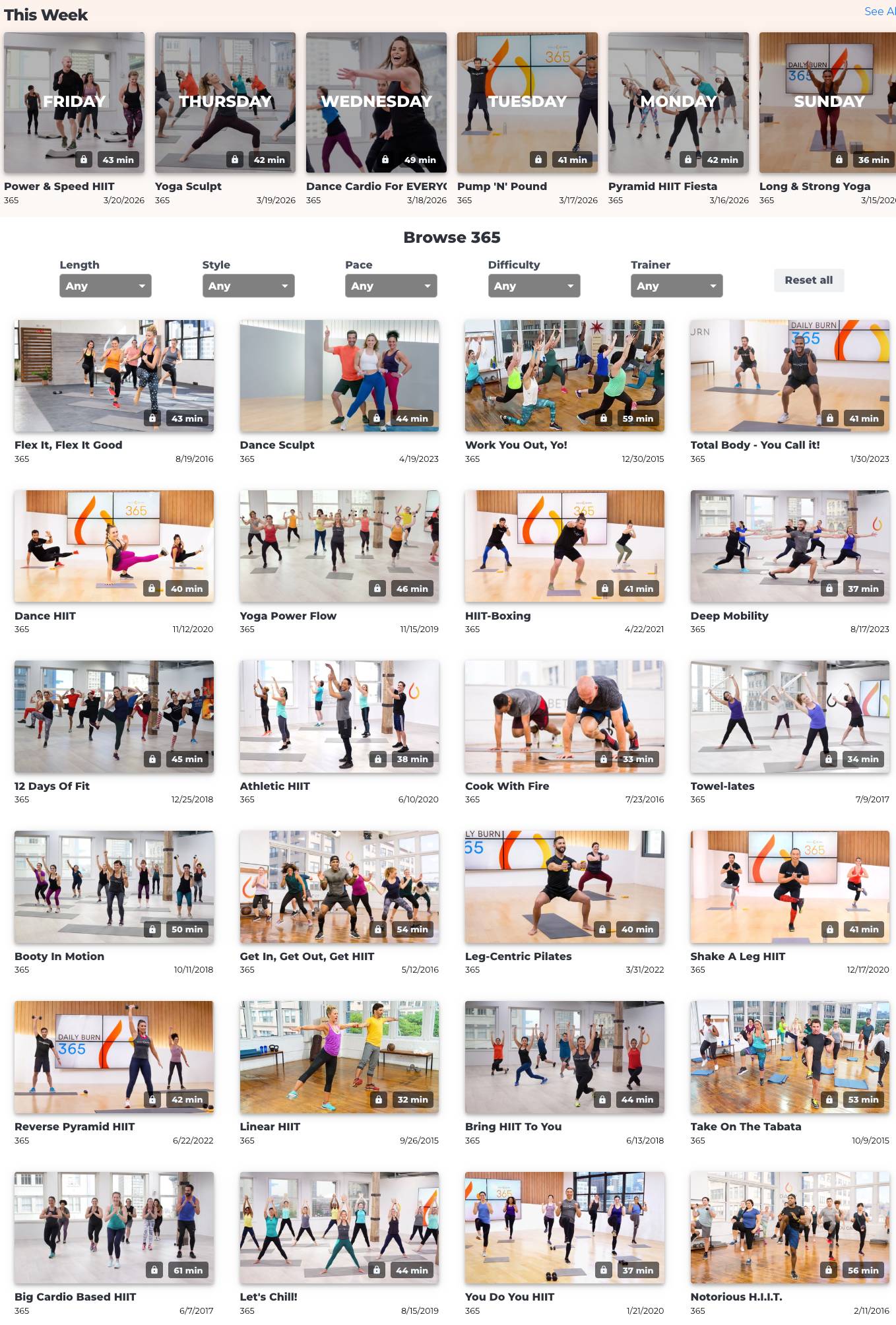
Daily Burn has the broadest device compatibility tested across any platform reviewed on this site: iOS, Android, smart TVs, Apple TV, Amazon Fire TV, Roku, Chromecast and any browser. The app is clean, fast, and the filtering by type, trainer, length and equipment is well-built. The 9.0 UX and Design score reflects this.
Sweat’s app is clean and the programme-driven structure means you do not need to make decisions every session. The onboarding quiz is fast and well-targeted. The 8.5 UX and Design score reflects a polished experience focused on the programme flow rather than library browsing.
Daily Burn wins on cross-device experience. Sweat wins on the cleaner programme-flow design. For users who switch between phone, TV and browser, Daily Burn is the more friction-free option. For users who want a structured programme flow on a single device, Sweat is competitive.
A closer look at Sweat App
Nutrition integration 6 vs 6.5
Both platforms include nutrition content with a light touch.
Daily Burn includes 72 weeks of meal plans with custom portion recommendations, plus access to hundreds of recipes. The optional human coaching add-on (priced separately) offers personalised guidance via text and video. The 6.0 Nutrition Integration score reflects useful but not standout nutrition design.
Sweat’s nutrition content is included in the standard subscription. The meal plans are competent and pitched at women training for strength and body composition. The 6.5 Nutrition Integration score reflects the same general-fitness framing rather than perimenopause-specific nutrition.
Neither platform offers perimenopause-specific nutrition (audio courses on protein for women over 40, hormone-aware nutrition framing). For that depth, Obe Fitness’s audio courses are the differentiated content. Between Daily Burn and Sweat specifically, this category does not differentiate them meaningfully. Daily Burn has the optional human coaching add-on which Sweat does not match.
Who wins for…
Best for structured progressive strength
Sweat App. Strength in 30, PWR, BUILD, LIFTING and FIERCE are built on traditional periodisation with logged weights. Daily Burn has solid strength content but no progressive logging.
Best for muscle and bone retention through perimenopause
Sweat App. The structured progressive overload is what the 2022 systematic review identifies as the most effective intervention for postmenopausal women.
Best for budget
Daily Burn. Basic at $14.99/month is $10/month cheaper than Sweat. The 30-day trial is more generous than Sweat’s 7-day trial.
Best for variety
Daily Burn. 2,000+ workouts across strength, HIIT, cardio, Pilates, yoga, barre, dance, kickboxing and mobility. Sweat’s format set is narrower (no dance, no kickboxing).
Best for families with mixed fitness needs
Daily Burn. The library breadth means one subscription suits a household with different goals and levels.
Best for community accountability
Sweat App. Millions of users in the in-app forum. The community is the strongest tested at this price point.
Best for women who train at a full gym
Sweat App. PWR, BUILD and FIERCE gym programmes assume full gym access. Daily Burn is home-focused.
Best for joint sensitivity and accessibility
Daily Burn. Full seated workout programmes for limited mobility, plus low-impact modifications throughout. Sweat has Low Impact programmes but requires programme selection.
Best for pregnancy and postnatal training
Sweat App. Kayla Itsines is certified in pregnancy and postnatal exercise. Sweat has dedicated content for this.
Best for cross-device experience
Daily Burn. The broadest device compatibility of any platform reviewed (iOS, Android, Apple TV, Roku, Fire TV, Chromecast, browser).
Best for human coaching
Daily Burn. The optional human coaching add-on (real coach via text and video, priced separately) is a feature Sweat does not match.
Best for trial generosity
Daily Burn. 30 days versus Sweat’s 7 days.
Best for women in their 60s and beyond
Daily Burn. The True Beginner programme and seated programming work as a gentle on-ramp. Sweat’s standard programmes can be too intense for this group; Low Impact with Kayla works but requires selection.
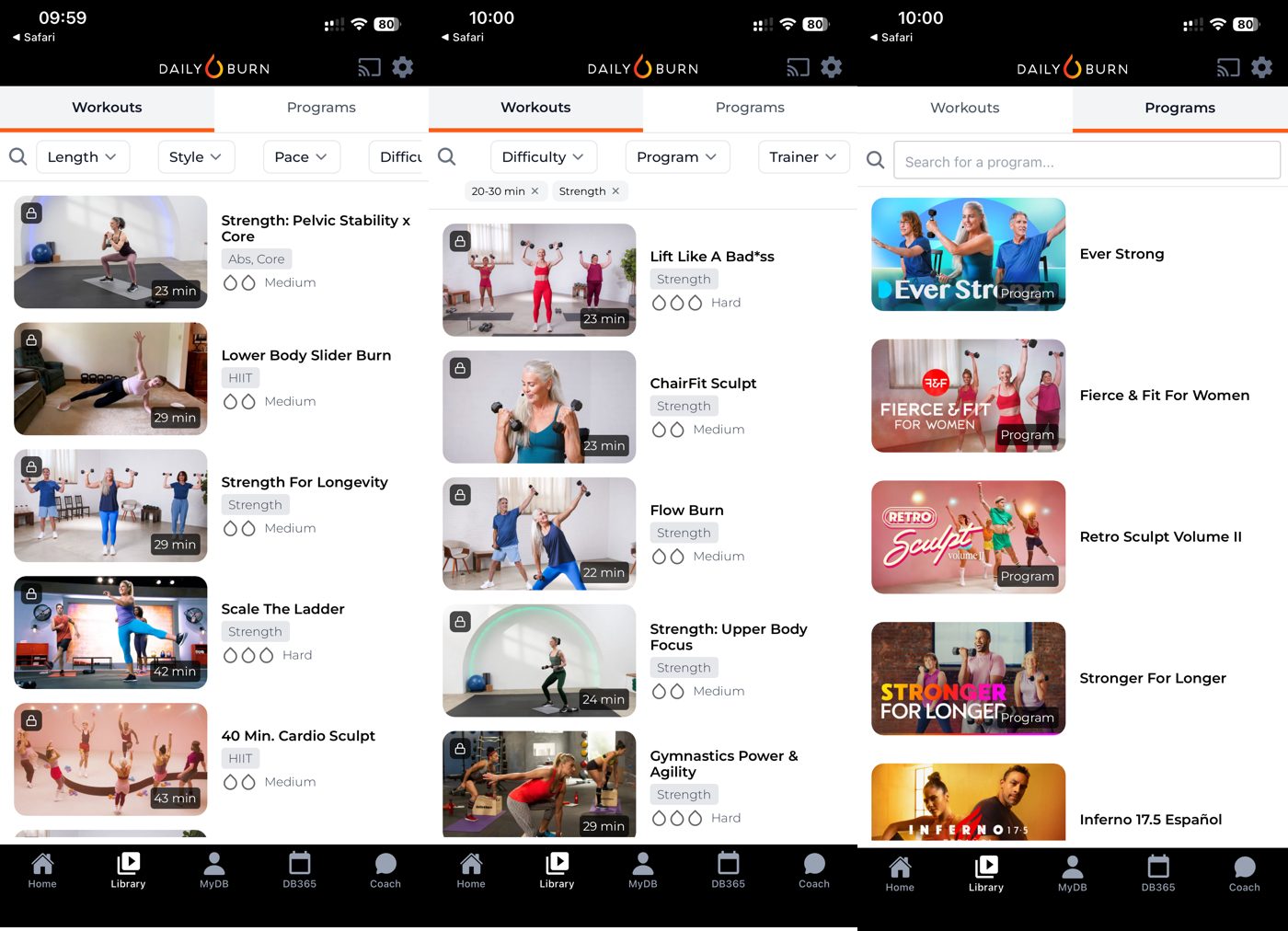
Screenshots from our full reviews
More screenshots: Daily Burn
See the full Daily Burn review for methodology and pricing.
More screenshots: Sweat
See the full Sweat review for methodology and pricing.
Decision tree for women over 40
Start here. Is structured progressive strength training (logged weights, programmes with 12-week arcs) your primary goal?
- Yes: Sweat App. Strength in 30 is the on-ramp. PWR and BUILD for heavier progression.
- No: continue.
Is budget the primary constraint (under $20/month)?
- Yes: Daily Burn Basic at $14.99/month or Premium at $19.95/month.
- No: continue.
Do you train at a full gym (leg press, cables, squat rack)?
- Yes: Sweat App. PWR, BUILD and FIERCE gym versions assume full equipment.
- No (home with dumbbells): either works; continue.
Do you have a household with mixed fitness needs (children, partner, multiple goals)?
- Yes: Daily Burn. One subscription, 2,000+ workouts, something for everyone.
- No: continue.
Do you need community accountability to stick with training?
- Yes: Sweat App. The in-app forum is the strongest tested at this price point.
- No: continue.
Default if multiple factors tied: Sweat for the higher overall score and structured progressive strength. Daily Burn for budget, variety and family use. Both work for general perimenopause-aware training; neither has dedicated perimenopause programming.
What I did not test
- The Daily Burn human coaching add-on. Priced separately. Plan to test in future.
- The full Daily Burn library beyond Fierce and Fit, Stronger for Longer, Dance & MOVE!, mobility, and Daily Burn 365 sampling.
- All Sweat programmes. Tested Strength in 30 and Pilates personally; previously used Sweat for six months in 2019.
- Sweat gym programmes (PWR, BUILD, FIERCE gym versions). Tested at home; not at a full gym.
- Long-term adherence beyond my test windows on either platform.
Personal testing and observations
Daily Burn testing
I tested Daily Burn for one month on the Basic plan. I came to the platform specifically for strength. What actually happened was I opened it, saw thousands of workouts across every type of exercise, and spent the first session orienting. My first week ended up rotating Dance & MOVE!, a 15-Minute Mobility session, Fierce and Fit for Women, and Stronger for Longer.
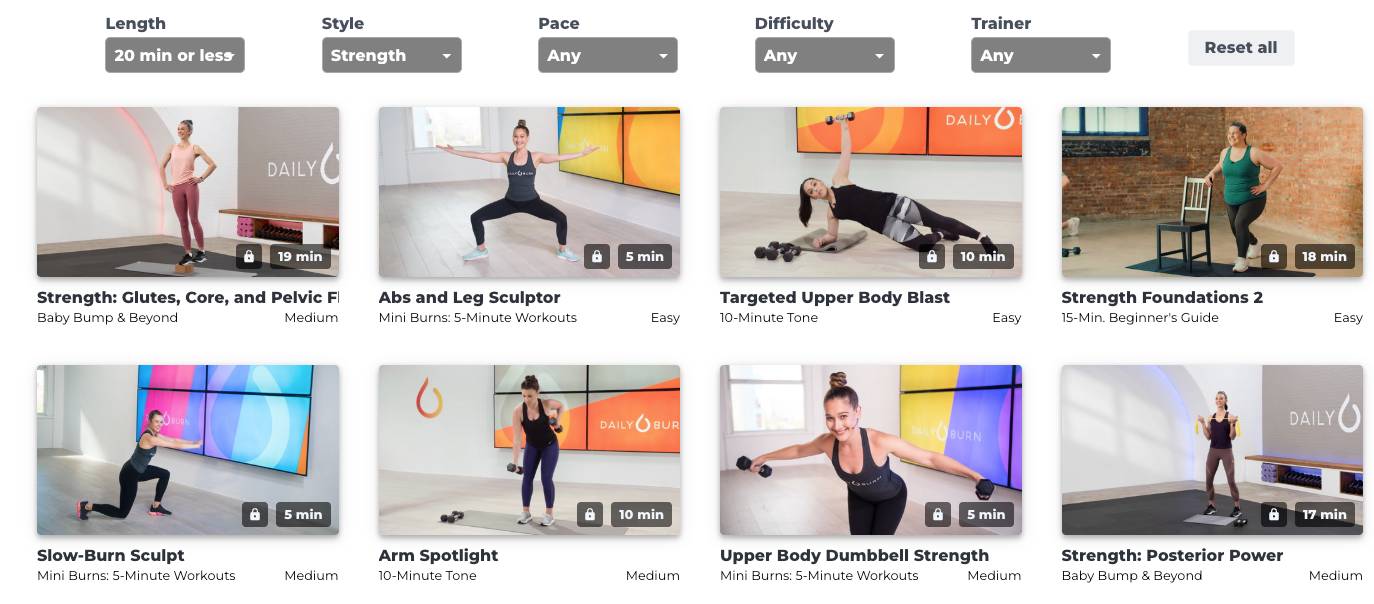
Fierce and Fit for Women was the standout. Coach Amanda’s strength-and-HIIT combination is designed specifically for women in their late 30s and beyond. Three women work out alongside Amanda throughout, which makes modifications visible in real time. After one month rotating Fierce and Fit with other workouts, I felt fitter and firmer just walking around. The dance classes were an unexpected highlight; the 15-Minute Mobility session sorted out a week of tension during a heavy work period. The platform itself: simple, clean, fast. Filtering by type, trainer, length and equipment is well-built. Works on every device tested.
Sweat App testing
I tested Sweat for over five weeks (the 7-day trial plus a full month of consistent training with Strength in 30) and I have used the app before, for about six months in 2019 when I was more focused on HIIT. Strength in 30 was led by Kayla Itsines and consists of 30-minute sessions three to four times a week with logged weights and reps. The progressive structure was the standout: I could see my numbers from previous weeks and the expectation was that I would add load over time.
The programme structure is the motivator. Seeing your numbers increase week over week over a 12-week block is a feedback loop that does not require an instructor to fill the silence. The community forum adds peer accountability without requiring social participation; you can read other women’s progress notes and feel less alone without ever posting yourself. For users for whom self-directed structure works, this is genuinely strong design.
The community was unusually active. The in-app forum connects you with millions of other users, and virtual challenges run regularly. The Sweat Community on social media is similarly engaged. For users where social accountability is the difference between sticking with training and not, this is a real feature that few platforms at this price point match. The community is also unusually long-tenured: many users have been with the platform since the original BBG days a decade ago.
The honest caveat on Strength in 30 specifically: it is not low impact. Romanian deadlifts, lunges and squats with weight load the knees and hips. With my previous meniscus injury I had to modify some lower-body loading deliberately. The 28-minute Pilates sessions worked well as active recovery. For joint-sensitive training on Sweat, the dedicated Low Impact with Kayla and Low Impact Strength with Chontel programmes are the better fit; Strength in 30 is not designed for joint accommodation. Cancellation was very easy (a few taps in app settings) with no friction.
Why platform structure matters more after 40
Decision fatigue is one of the under-discussed adherence challenges in perimenopause. Sleep is patchy. Cortisol is elevated. By the time you finish work and family responsibilities, the mental energy to choose a workout is genuinely depleted. A platform that tells you what to do today removes that friction. A platform that hands you 2,000 workouts and a search bar requires you to make a choice you may not have the bandwidth for.
Sweat solves this by giving you a programme. Strength in 30 means three 30-minute sessions per week, structured progressively. You do not choose what to do; you just open the app and do today’s session. Daily Burn solves this differently: Daily Burn 365 gives you a new 30-minute workout every day as a default, and the True Beginner programme provides a 30-day structured arc for newer trainers. Both approaches work, but they suit different temperaments. Women who prefer to be told what to do will adhere better to Sweat. Women who prefer to choose from a varied library will adhere better to Daily Burn. Honest self-assessment about which type you are before subscribing is more useful than a feature comparison.
Which is better for women over 50?
For women over 50, the answer depends on starting point and training history.
Women over 50 returning to training or new to structured exercise: Daily Burn. The True Beginner programme, seated programmes and Daily Burn 365 give gentle on-ramps. The 30-day trial is lower-risk than Sweat’s 7-day trial.
Women over 50 who already train regularly and want progressive strength: Sweat App Strength in 30 or Low Impact Strength with Chontel. The structured progressive overload is what the evidence identifies as the most effective intervention for muscle and bone retention through and beyond menopause.
Women in their 60s and 70s starting fresh: Daily Burn’s True Beginner is the gentler on-ramp. Sweat’s standard programmes can be too intense for this group; Low Impact with Kayla works but requires deliberate selection. For even gentler entry, Melissa Wood Health or BODi’s 4 Weeks for Every Body are softer than either platform.
Frequently asked questions
Is Daily Burn or Sweat better for women over 40?
Sweat App wins narrowly at 7.3 / 10 versus Daily Burn at 6.8 / 10. Sweat wins on structured progressive strength and community. Daily Burn wins on price, variety and family-friendliness. Neither has dedicated perimenopause programming.
Which is cheaper?
Daily Burn. Basic at $14.99/month is $10/month cheaper than Sweat at $24.99/month. The 30-day Daily Burn trial is more generous than Sweat’s 7-day trial.
Which has better strength training?
Sweat App. Strength in 30, PWR and BUILD are built on traditional periodisation with logged weights. Daily Burn has Fierce and Fit for Women (well-coached) but no progressive logging.
Which has more variety?
Daily Burn. 2,000+ workouts across strength, HIIT, dance, kickboxing, yoga, Pilates, barre and mobility. Sweat has a narrower format set.
Does either have a dedicated perimenopause programme?
No. Neither platform has a dedicated perimenopause programme. For that, look at Obe Fitness (US/Canada only) or Peloton.
Which is better for families?
Daily Burn. The library breadth means one subscription suits a household with mixed fitness needs.
Which has a stronger community?
Sweat App. Millions of users in the in-app forum. Daily Burn has a general community but less tightly connected.
Which is better for joint sensitivity?
Daily Burn. Full seated workout programmes and consistent low-impact modifications across the library. Sweat has Low Impact programmes but requires deliberate selection.
Research citations
- Maltais ML, Desroches J, Dionne IJ. Changes in muscle mass and strength after menopause. Journal of Musculoskeletal and Neuronal Interactions. 2009;9(4):186-197. PubMed.
- Watt FE. Musculoskeletal pain and menopause. Post Reproductive Health. 2018;24(1):34-43. doi: 10.1177/2053369118757537. SAGE.
- Resistance training for postmenopausal women: systematic review and meta-analysis. 2022. PubMed.
- Physical activity and exercise interventions on menopausal symptoms: overview of reviews. 2024. PubMed.
About this review
Reviewed by Katy Cole. Daily Burn tested personally for one month on the Basic plan, including Fierce and Fit for Women (Coach Amanda), Stronger for Longer, Dance & MOVE!, 15-Minute Mobility sessions and Daily Burn 365 sampling. Sweat App tested personally across five-plus weeks (7-day trial plus one full month) of Strength in 30 with Kayla Itsines and Pilates, with previous six-month use of the app in 2019. Prices verified against dailyburn.com and sweat.com in May 2026.
Katy is the lead reviewer at Her Daily Fit. Fifteen years personally testing online fitness platforms. Mid-forties, currently in perimenopause, UK-based. Every claim on this page is either personally tested or attributed to peer-reviewed research. See how we score every programme using 9 weighted criteria.
Medical disclaimer: The content on this page is for informational purposes only and is not medical advice. Consult your GP or a healthcare provider before beginning a new exercise programme, particularly if you are managing perimenopause, menopause, or any existing health condition or injury.
Compared with
Where these brands appear in our “Best for” rankings