

What does low impact actually mean, and what does it cost you?
Low impact means both feet are not leaving the floor at the same time. No jumping, no bounding, no landing. It is about force through the joints, not about effort or intensity.
That distinction gets lost constantly. A low-impact session can be extremely hard. A high-impact one can be trivially easy. The two words describe completely different things, and the marketing on most fitness apps blurs them on purpose.
Here is the part nobody selling you a low-impact programme wants to lead with. Removing impact removes a stimulus, and you have to put something back in its place. If a programme takes out the jumping and does not add loading, what is left is pleasant, joint-friendly and largely pointless for a body in its fifties that is losing muscle and bone.
That is why this page does not simply list low-impact apps. Twenty-seven of the programmes we review qualify. Ranking them by how low impact they are would be ranking them on a quality nearly all of them share.
What does the research say about low impact and strength?
Two findings do most of the work here, and they point in slightly different directions, which is the honest picture.
On muscle and strength, resistance training in this age group is well supported. In a systematic review and meta-analysis of sixteen studies, Ramos-Campo and colleagues, writing in the Journal of Aging and Physical Activity in 2022, found that circuit resistance training in middle-aged and older women produced “a moderate and large favorable effect on arm, trunk, and lower limb strength”, along with increases in muscle mass and cardiorespiratory fitness. None of that requires impact. It requires load.
Bone is the harder case, and it is where an honest low-impact page has to slow down.
The honest limit of low impact, and it matters after 50: in a meta-analysis of exercise and postmenopausal bone loss, Martyn-St James and Carroll, writing in the British Journal of Sports Medicine in 2009, concluded that “mixed loading exercise programmes combining jogging with other low-impact loading activity and programmes mixing impact activity with high-magnitude exercise as resistance training appear effective in reducing postmenopausal bone loss at the hip and spine”, while “other forms of impact exercise appear less effective”. The programmes that protected bone combined loading with some impact. If bone density is your specific concern, a purely low-impact programme has a ceiling, and the answer is usually to add loaded resistance work and to discuss impact with your doctor rather than to assume gentle is enough.
So the useful question is not which programme is the most low impact. It is which low-impact programme still loads you hard enough to be worth the hour.
How do the best low impact programmes compare?
Eight programmes that all qualify as genuinely low impact, ranked on how much progressive strength each delivers, weighted 70%, blended with ease of use, weighted 30%. Low impact is the qualifier, not the ranking: every programme here clears it. Overall is the weighted score across all nine criteria, which is why a programme can rank above another here while scoring lower overall. All four scores update live from each programme’s own review.
| Rank | Programme | Low impact qualifier | Strength 70% | Ease of use 30% | Overall | Testing tier | Best for | Not ideal for | Free trial |
|---|---|---|---|---|---|---|---|---|---|
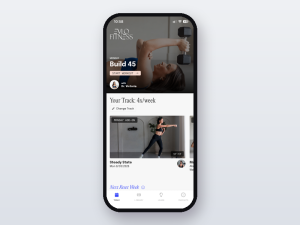
| 1 | Evlo Fitness | 9/10 | 9/10 | 8.5/10 | 8.0/10 | Fully tested | Joint-protective training that still takes muscles to failure | Anyone wanting long sessions or heavy barbell work | 14 days |
| 2 | Pvolve | 9/10 | 7/10 | 8.5/10 | 8.3/10 | Fully tested | Zero-impact functional strength with a clinical advisory board | Anyone unwilling to buy equipment | 14 days |
| 3 | Simply Strong | 8/10 | 8/10 | 5/10 | 6.6/10 | Sample tested | The most serious progressive overload on this page | Anyone who needs coaching cues and a polished app | 5 days |
| 4 | Fabulous50s | 8/10 | 6.5/10 | 7/10 | 7.6/10 | Sample tested | Free, made for over 50, with balance and mobility built in | Anyone wanting heavy loading or a structured plan | Free on YouTube |
| 5 | Fit With Coco | 8/10 | 6/10 | 8/10 | 7.9/10 | Fully tested | Low-impact strength and Pilates in one structured method | Anyone on a tight budget at $39.95 a month | 7 days, no card |
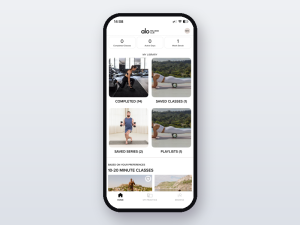
| 6 | Alo Wellness Club | 8/10 | 6/10 | 8/10 | 7.7/10 | Fully tested | A large, genuinely free library with real loaded sessions | Anyone who needs a plan and progress tracking | Free |
| 7 | Jessica Valant Pilates | 8/10 | 6/10 | 7.5/10 | 7.1/10 | Data profile | Joint-safe Pilates built by a licensed physical therapist | Anyone whose main goal is building muscle | 3 days |
| 8 | Obé Fitness | 8/10 | 5/10 | 9.5/10 | 7.5/10 | Fully tested | The most enjoyable app here, with the best low-impact filtering | Anyone past beginner who wants to keep progressing | 7 days |
Read that Strength column downwards and the point of the page becomes obvious. Every programme here spares your joints. What they give back in exchange varies by a factor of nearly two.
Which low impact programmes rank highest?
Evlo Fitness: joint-protective and genuinely progressive at the same time
The rare programme that removes the impact without removing the training
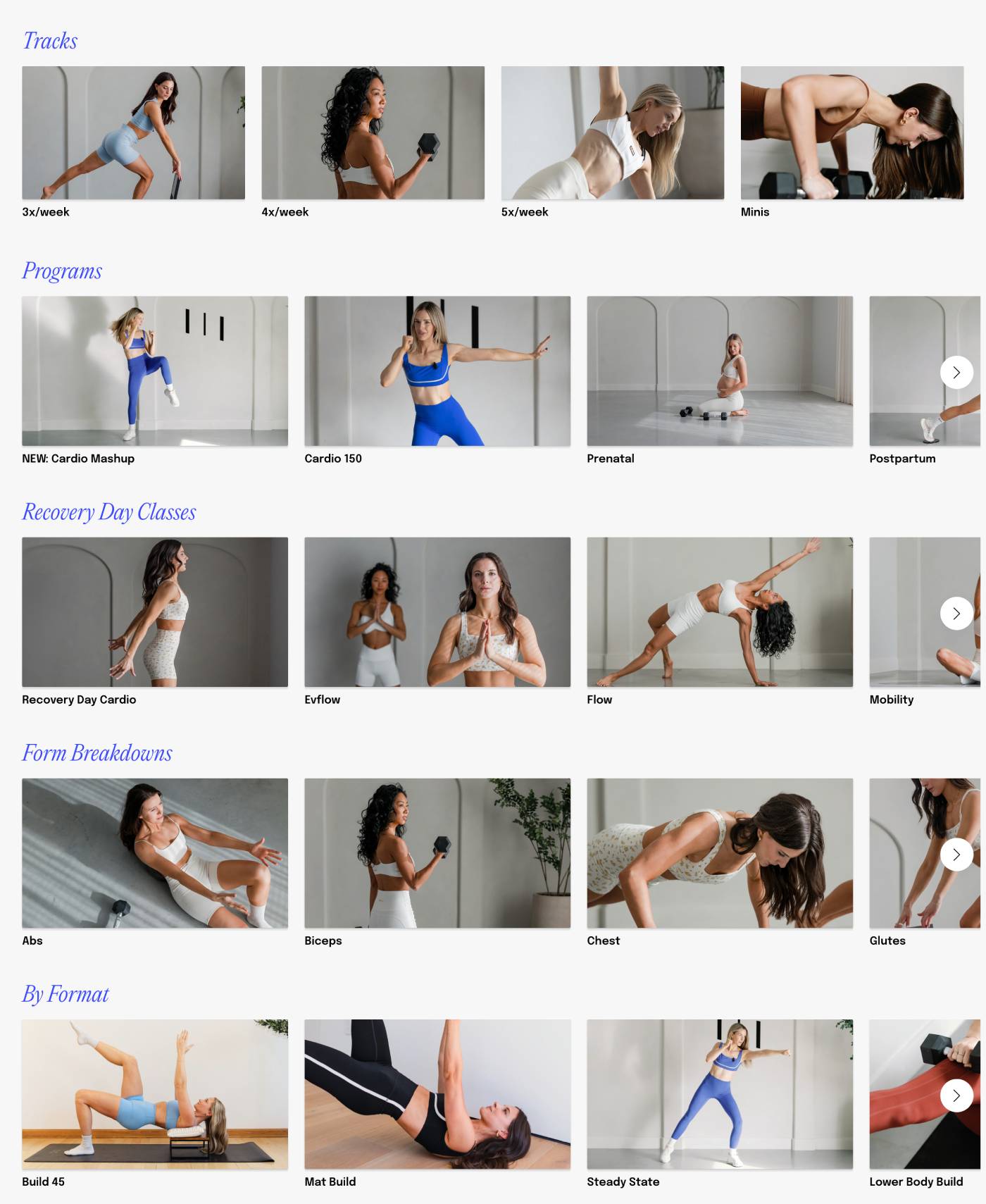
Evlo Fitness is built on a doctor of physical therapy’s joint-protective design: no jumping and no heavy axial loading, combined with resistance taken close to failure and weights you track session to session. That combination is why it ranks first, and it is much less common than the marketing across this category suggests.
Most programmes solve the joint problem by making the work easier. Evlo solves it by changing which tissues take the force while keeping the effort high.
Tested by Katy Cole: After 8 weeks I dropped 3 lb without changing my diet, felt soreness in muscles my usual training had stopped reaching, and came back stronger in my core and glutes than I had been in years. I later left for a period to use shorter workouts with Burn360 and Caroline Girvan, then returned, because nothing else does what Evlo does for joint-friendly targeted muscle work.
Leaving and coming back is the most useful thing I can tell you about it. Plenty of programmes hold your attention for eight weeks. Very few survive the comparison after you have gone and tried the alternatives.
The honest limitation: sessions are structured and demand attention, so this is not a browse-and-press-play library. If you want to open an app and be entertained, look further down this page.
Best for: women with a history of joint issues who still want to build real muscle, and who will follow a structure rather than pick classes at random.
Cost: $55.99 a month, second only to Jessica Valant Pilates on this page. The free trial is 14 days, though the App Store still shows a legacy 7-day figure.
Pvolve: zero impact, clinically studied, with a lower ceiling
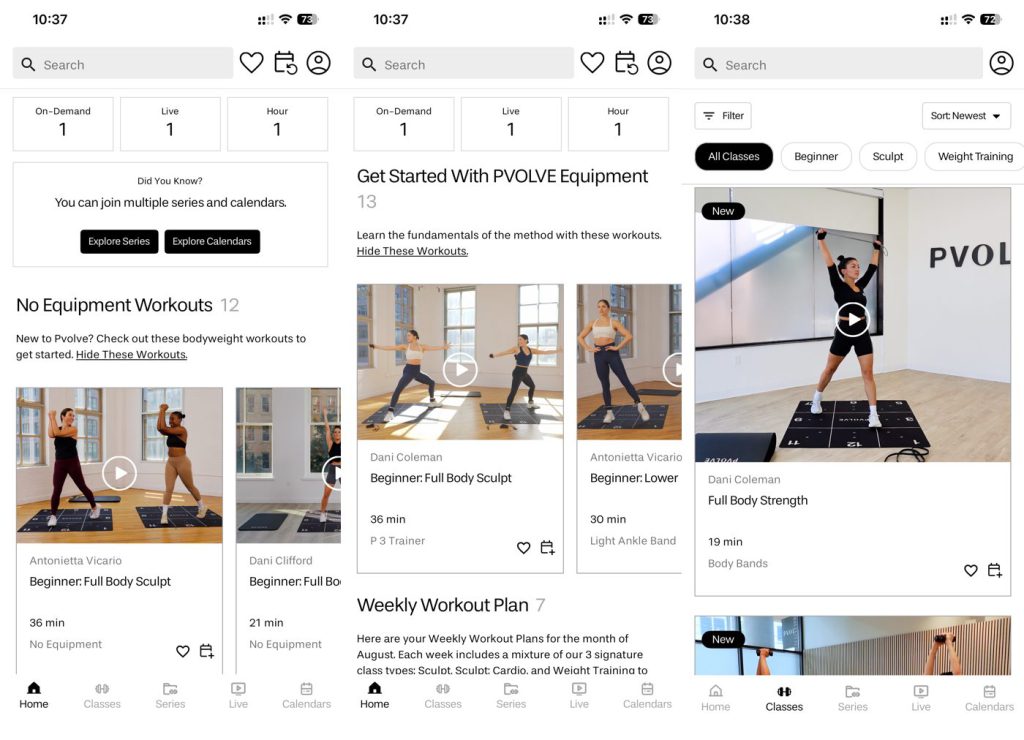
The most rigorously backed low-impact method here, provided you accept the equipment
Pvolve is zero-impact functional training with a clinical advisory board including Dr Amy Hoover, a doctor of physical therapy, and Dr Nima Alamdari, a muscle physiologist. Its progression is real, but as our review notes, the ceiling sits below barbell training.
It ranks second rather than first for exactly that reason. It is the safer method and the better-evidenced one; Evlo simply loads you harder.
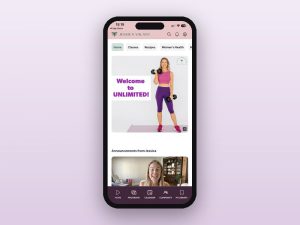
Tested by Katy Cole: I have done the high-intensity programmes, the HIIT blasts, the heavy lifting plans and the thirty-day challenges that promise everything and require sixty-minute sessions four times a week. At this point in my life, in my 40s, in early perimenopause, with a previous knee injury, two kids and a full-time job, I am a lot more precise about what I actually need versus what sounds appealing in a marketing email. Pvolve is what I landed on.
The honest limitation: the method leans on its own equipment, which adds real cost on top of the subscription, and loading stays light. If bone density is your main concern, read the caveat above again.
Best for: women who want the most carefully designed joint-safe method available and are willing to buy into the kit.
Cost: $24.99 a month, or $224.91 a year, about $18.74 a month. The 14-day trial asks for a card, so set a reminder for day 13.
Visit PvolveAffiliate link, opens pvolve.com. I earn a commission at no extra cost to you. Full disclosureSimply Strong: the hardest training here, in the weakest app
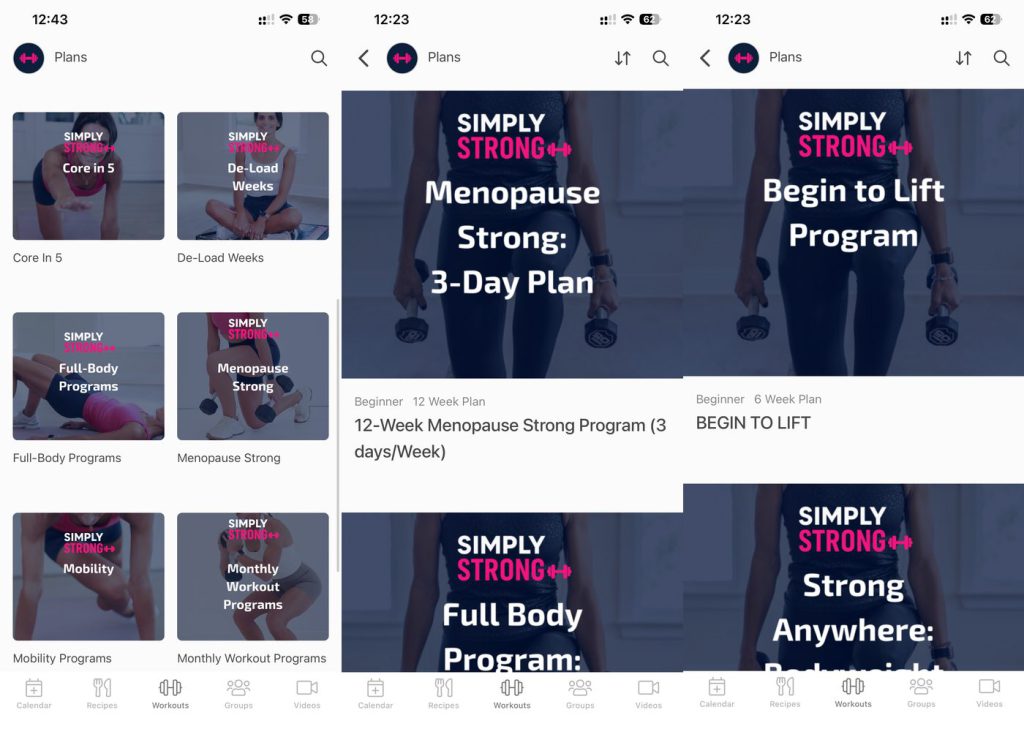
The strongest progressive overload on this page, and the clearest trade-off
Simply Strong is built by Tami Smith, a NASM-certified personal trainer and macro coach. Progressive overload is the core method, structured month to month with dumbbells and bands rather than plyometrics, which is what makes a genuinely strength-led programme also a joint-considerate one.
On training quality it outranks everything below it. On the experience of using it, it is the weakest here, and the blend is what drops it to third rather than first.
Sampled by Katy Cole: Once I was in, I got more and more curious: there is a lot of strength training and even a dedicated Menopause Strong track. But Tami demonstrates each move on a short video, silently, and that is a real minus for me. I like to be told how to do a movement, reminded about posture, and offered an easier or more joint-friendly option.
That silence is the whole problem in one detail. For a confident lifter it is irrelevant. For a woman restarting at 55 with a dodgy knee, being shown a movement without being coached through it is the difference between doing it and doing it safely.
Best for: women who already know how to lift, want serious progression without impact, and do not need to be talked through it.
Cost: $24.99 a month, with a 5-day free trial and a 50% first-month discount through the site quiz.
Fabulous50s: free, and actually built for this body
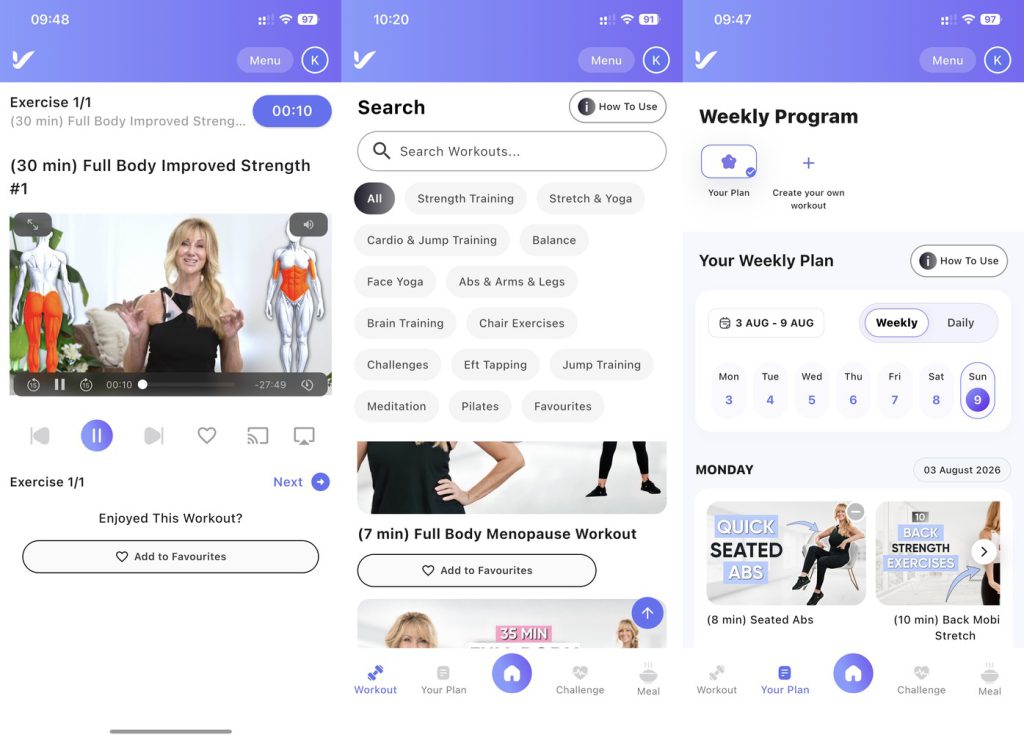
The only programme here designed for women over 50 from the start, and it costs nothing
Fabulous50s is Schellea Fowler’s library: a certified fitness instructor and personal trainer who also holds a Neuro Athletics Coach credential and specialises in exercise for older adults. It is low impact by design, with all-standing and chair options, and it includes balance and mobility work that the subscription apps on this page largely skip.
Balance deserves more attention than it gets. It is trainable, it declines with age, and almost no mainstream fitness app programmes it deliberately. This one does, and it is free on YouTube.
Sampled by Katy Cole: I did the 30-minute Full Body Improved Strength session, and if you assume anything labelled “50s” will be too gentle for a woman in her late 30s or 40s, you would be wrong. It is warm and unintimidating without being soft.
The honest limitation: loading stays light and progressive overload is limited, so this will maintain and improve you rather than transform your strength. The menopause content is education-led rather than clinician-led.
Best for: anyone over 50 restarting, anyone who wants balance and mobility included, and anyone who does not want to pay at all.
Cost: free on YouTube. The Fabulous50s Vitality app is $14.99 a month with a 14-day free trial.
Fit With Coco: low-impact strength and Pilates in one method
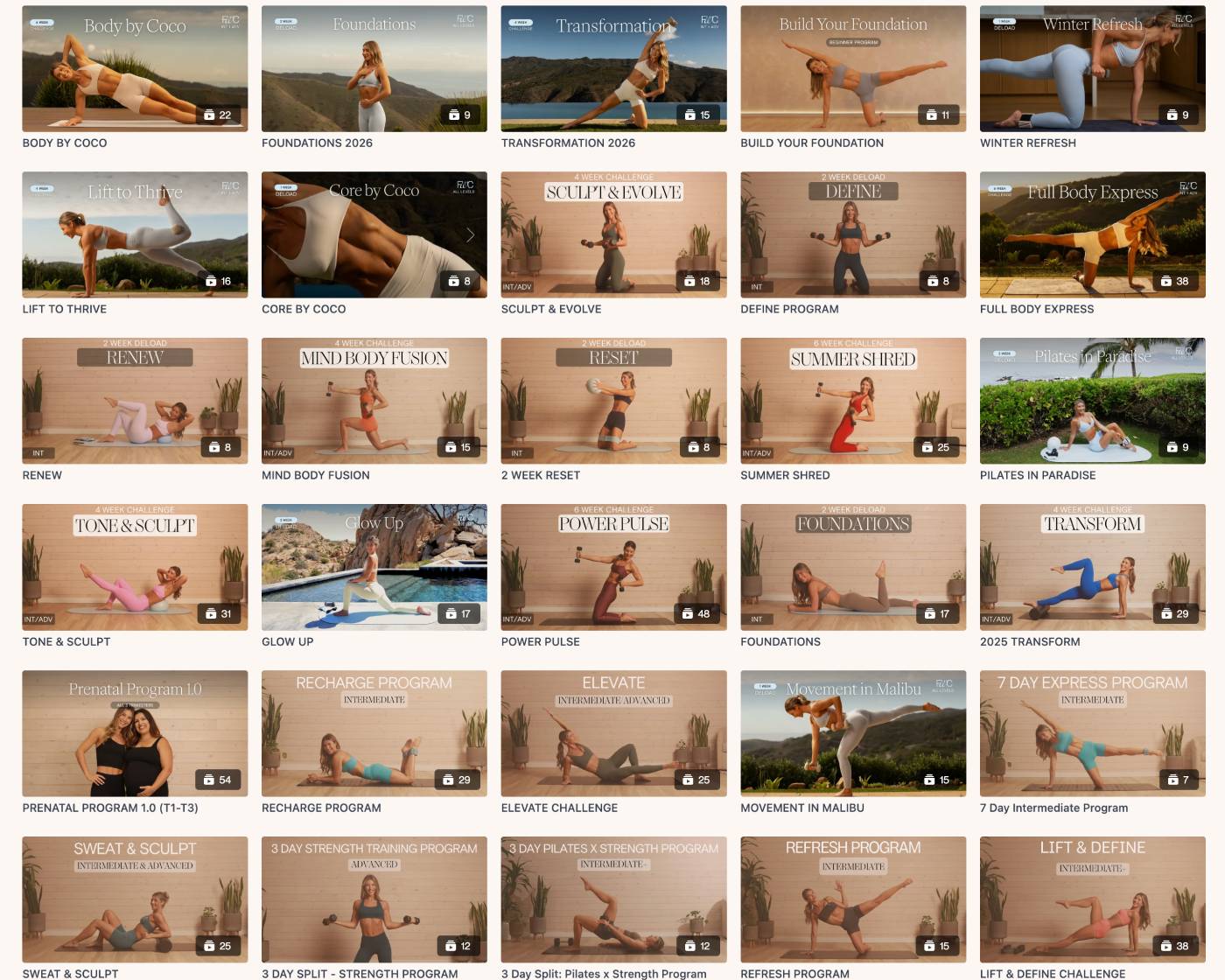
A structured 3-2-1 method that treats low impact as the design, not a modification
Fit With Coco runs an explicitly low-impact method combining strength and Pilates, with real four to six week progressions using moderate dumbbells. It is structured in a way most class libraries are not: you follow a programme rather than choose a class.
Tested by Katy Cole: After 7 weeks on the Full Body Express programme, my waist measurement dropped and I lost weight I had been carrying for a while. The Pilates days were not filler either. It showed up in how I was carrying myself and how I felt going into the strength sessions later in the week.
The honest limitation: at $39.95 a month it is one of the pricier options here, and there is no heavy periodisation, so the ceiling is moderate.
Best for: women who want strength and Pilates in one structured plan and will use it often enough to justify the price.
Cost: $39.95 a month. The 7-day trial needs no card, which is unusually generous.
Alo Wellness Club: a large free library with real loaded work
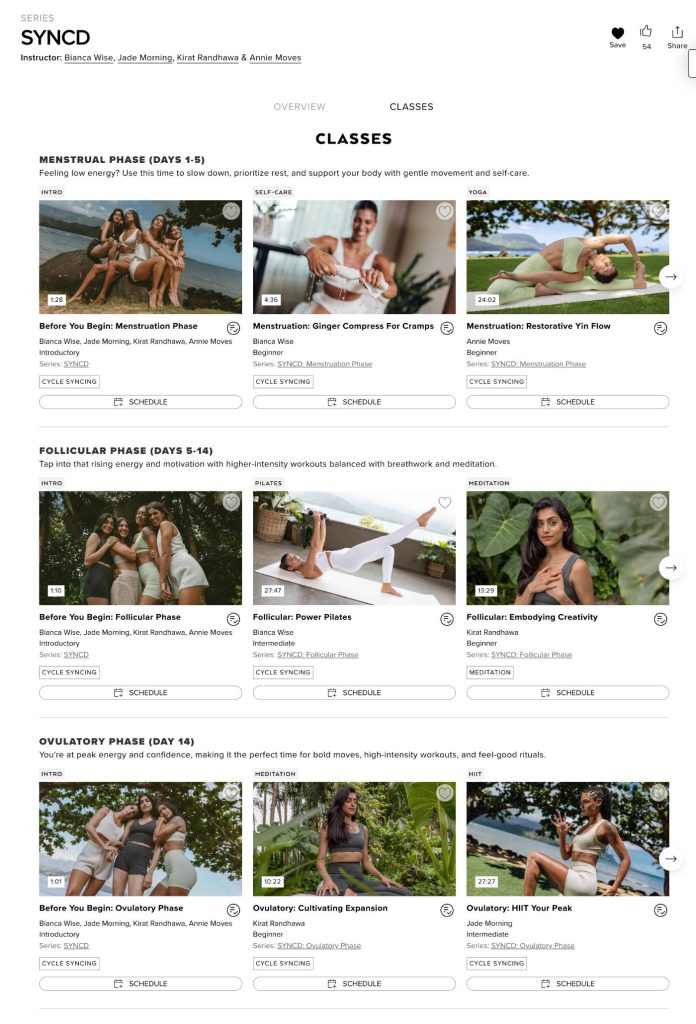
Genuinely free since late 2025, with more loaded strength content than free libraries usually carry
Alo Wellness Club became free with an Alo Access account, having previously cost $12.99 a month. It carries deep no-jump yoga, Pilates and restorative work alongside genuinely loaded sessions such as the Hourglass and sculpt series.
Free changes the calculation. A programme three points lower on strength than Evlo is a poor trade at $55.99 a month and an obvious one at nothing.
Tested by Katy Cole: The filtering is the best thing about it. You can, in under a minute, go from “I have twenty-five minutes, a kettlebell and a dodgy knee” to a list of classes that actually match. But for a woman who wants to open an app and press play on “Day 8, Week 3” with no thinking, this is not the right platform.
The gap: there is no progress tracking and no overload plan, so the progression has to come from you. There is also no dedicated perimenopause programming, and no verifiable named clinician behind the health claims. TV support is Apple only.
Best for: women who can self-direct, want a large library at no cost, and will supply their own structure.
Cost: free with an Alo Access account.
Jessica Valant Pilates: joint-safe Pilates from a licensed physical therapist
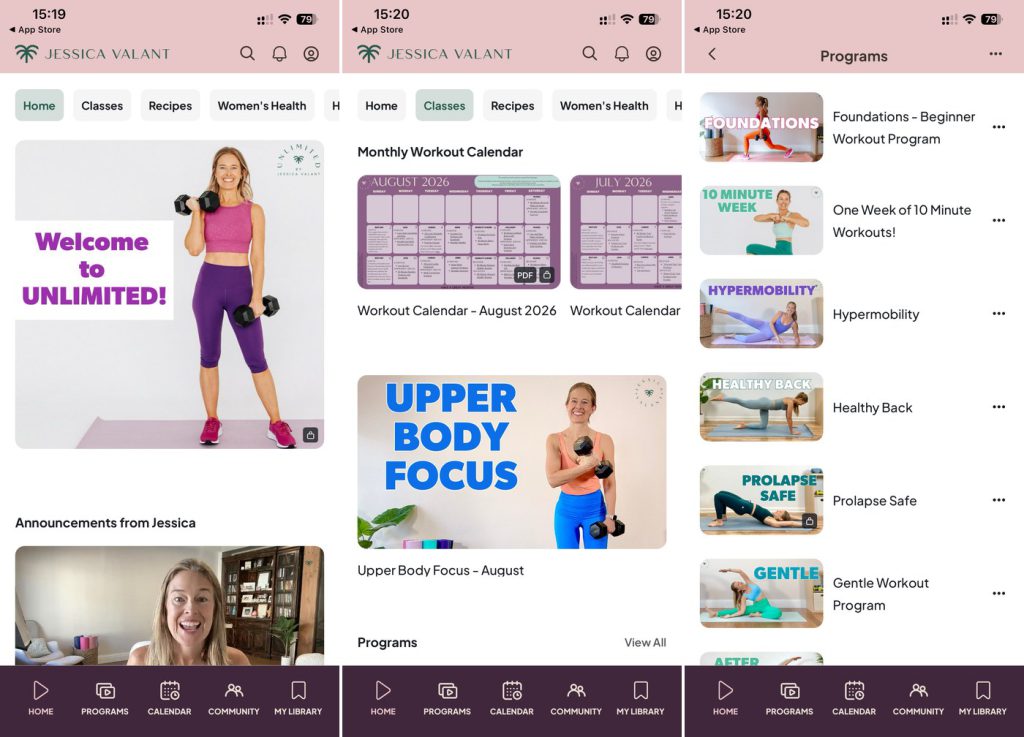
The strongest clinical credential on the page, with the lighter loading Pilates implies
Jessica Valant Pilates is led by Jessica Valant, MSPT, a licensed physical therapist with roughly 25 years in practice and a certification as a perimenopause and menopause specialist. The library is almost entirely low impact, with prolapse-safe and gentle programmes. It carries a Data profile tier on this list rather than a tested one.
I have not tested this one first hand. What follows comes from the research profile, not from using it. Its position here is a fair reflection of what it is: dumbbell Pilates, sculpt work and a weighted vest give real progression, but lighter than a dedicated strength plan. On a page ranking strength delivered, that places it seventh. On a page ranking clinical safety it would place first.
Best for: on the research, women managing joint issues or prolapse who want a clinician’s judgement built into every session, and who are not primarily trying to add muscle.
Cost: $59 a month, with no published annual price and a 3-month prepaid term at $149. The free trial is 3 days.
Obé Fitness: the nicest app here, and the lowest ceiling
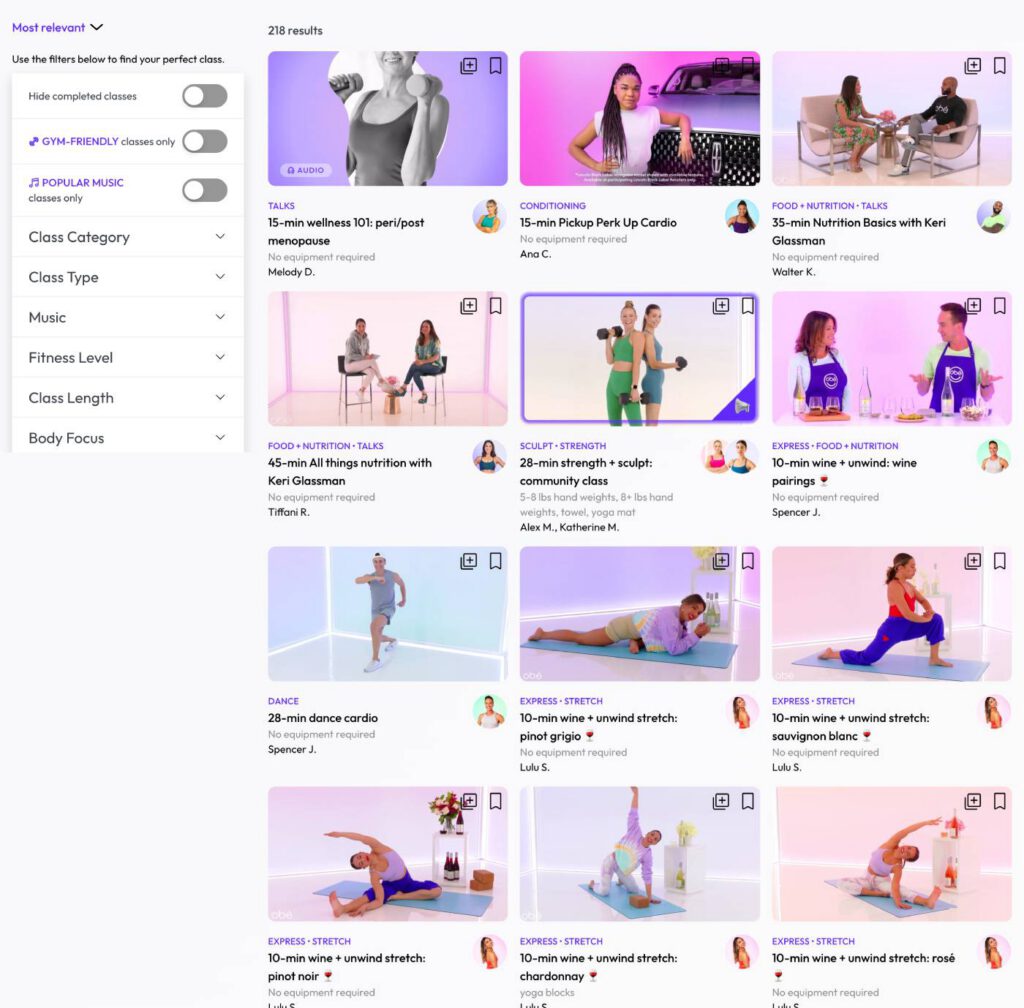
The best low-impact filtering on the page, attached to the lightest loading
Obé Fitness has an explicit low-impact filter across the whole library and joint-aware cueing throughout. It is also, by our scoring, the most pleasant app on this page to actually use.
It ranks eighth anyway, and that is the clearest illustration of what this page is for. Ranked on enjoyment it would win. Ranked on what it builds, its loads are light to moderate and maintenance-oriented, and our review notes it plateaus for intermediates.
Tested by Katy Cole: Obé is one of the most enjoyable perimenopause-friendly fitness platforms I have tested in years, with outstanding filtering and a design that lifts mood. After a month of 20-minute sessions with dumbbells between 3 lb and 20 lb, my weight and measurements stayed exactly where I wanted them. Maintenance is the honest word for it.
Best for: women who will not stick with anything they do not enjoy, and who are maintaining rather than building.
Cost: $24.99 a month on web and Apple alike. The trial is 7 days, or 30 days through a Guest Pass referral. US and Canada only.
Which low impact programme is right for you?
If you want the most muscle for the least joint stress, Evlo Fitness. It is the reason this page is ranked the way it is.
If you have a specific injury or want the most carefully designed method, Pvolve, budgeting for the equipment.
If you already lift and just want the impact gone, Simply Strong, and accept that the app will not coach you.
If you are restarting, or over 50 and want balance work included, Fabulous50s, which costs nothing.
If you want a big library for free and can self-direct, Alo Wellness Club.
If enjoyment is what keeps you consistent, Obé Fitness, knowing you are maintaining.
And whichever you pick, if bone density is the goal, treat the low-impact programme as your base and talk to your doctor about adding loading and impact on top.
How did we choose these eight low impact programmes?
Every programme in our library carries a low-impact capability score. Twenty-seven of the 77 published programmes score 8 or above, which is our threshold for genuinely low impact. That is the qualifier for this page, and it is where most low-impact lists stop.
Ranking twenty-seven programmes on a quality all twenty-seven share would produce an arbitrary order. So we pair it with a second score: how much progressive strength each one actually delivers, weighted 70%, blended with ease of use at 30%. Those two are close to independent of the low-impact score, which is what makes them useful for separating programmes rather than restating the qualifier.
Seven of the eight I have used, five of them across a full test and two sampled. Jessica Valant Pilates is assessed from published information only, is labelled that way on its card and in its section, and carries no first-hand observation.
We buy our own subscriptions. Some links on this page earn a commission, which never affects a score or a position; scores are set in each programme’s own review before any page like this is built.
What research is this page based on?
- Ramos-Campo DJ, Andreu-Caravaca L, Carrasco-Poyatos M, Benito PJ, Rubio-Arias JÁ. Effects of Circuit Resistance Training on Body Composition, Strength, and Cardiorespiratory Fitness in Middle-Aged and Older Women: A Systematic Review and Meta-Analysis. Journal of Aging and Physical Activity, 2022.
- Martyn-St James M, Carroll S. A meta-analysis of impact exercise on postmenopausal bone loss: the case for mixed loading exercise programmes. British Journal of Sports Medicine, 2009.
Nothing on this page is medical advice. If you have a diagnosed joint condition, osteopenia or osteoporosis, take the question of impact to your doctor or a physiotherapist before changing what you do.
Where should you read next?
- Our full Evlo Fitness review, including the eight weeks of testing behind its position here.
- Our full Pvolve review, including what the equipment actually costs.
- How we score, if you want to see how the nine criteria and the capability scores are built.
Frequently asked questions about low impact workouts
Both feet are not leaving the floor at the same time: no jumping, no bounding, no landing. It describes force through the joints, not effort. A low-impact session can be extremely hard and a high-impact one can be trivially easy, and most fitness marketing blurs the two.
Yes, if they load you. In a meta-analysis of sixteen studies in the Journal of Aging and Physical Activity in 2022, Ramos-Campo and colleagues found circuit resistance training in middle-aged and older women produced a moderate to large favourable effect on strength along with increases in muscle mass. None of that requires impact; it requires load. That is why this page ranks on strength delivered rather than on how low impact each option is.
This is the honest limit. In a meta-analysis in the British Journal of Sports Medicine in 2009, Martyn-St James and Carroll found the protocols that reduced postmenopausal bone loss combined loading with impact, while other forms of impact exercise were less effective. If bone is your specific concern, treat a low-impact programme as your base and discuss adding loading and impact with your doctor.
No. Evlo Fitness is entirely low impact and takes muscles close to failure with tracked loads. Several options on this page are demanding. Low impact describes what happens at your joints, not how hard you are working or how experienced you are.
Look at Pvolve first: it is zero-impact functional training with a clinical advisory board including a doctor of physical therapy. Evlo Fitness is the other strong option, where every instructor holds a doctorate in physical therapy. Check with your doctor or physiotherapist before starting if you have a diagnosed joint condition.
Three to five, with at least two of them loaded. Consistency matters more than any single session, which is why this page blends how much strength a programme delivers with how good it is to use. A programme you avoid opening delivers nothing.