
Evlo scores higher overall, 8.0 against 7.6, and is the stronger platform for nutrition guidance and perimenopause-specific programming. Caroline Girvan CGX is the better pick if what you need most is value for money and building and keeping muscle.
- Score 8.0 vs 7.6
- Both tested hands-on
Quick answer: Evlo is the better overall platform for perimenopausal and menopausal women managing joint sensitivity, scoring 8.0 versus Caroline Girvan CGX at 7.6. Evlo wins on joint friendliness (the highest score in the comparison series) because every trainer holds a Doctorate in Physical Therapy and exercise selection is clinically informed. Evlo also wins on recovery structure (Reset Weeks built in) and programme adaptation. Caroline Girvan wins on muscle potential (the highest in the comparison series) and on price (free on YouTube, $99.99/year on the CGX app). The choice for women over 40 comes down to whether your joints are healthy and your priority is muscle visibility, or whether you are managing joint history and need clinical exercise selection.
The two platforms
Same nine weighted categories, two different women. Here is who each one is built for.
Evlo
WinnerLeads this comparison on nutrition guidance and perimenopause-specific programming, scoring 7 against 4 on Nutrition Integration.
- Low impact
- 35 to 50 min
- Dumbbells at multiple
- No (14-day free trial)
Choose Evlo if you:
- Have a meniscus, knee, hip, back or shoulder injury history
- Have plateaued on HIIT or are struggling to recover from high-intensity training
- Want an adaptive daily plan built around your recovery state and equipment
- Want physical-therapist-led training with clinical exercise selection
- Can budget $55.99/month or $599/year and value PT-grade safety over price
Caroline Girvan CGX
Runner-upLeads this comparison on value for money and building and keeping muscle, scoring 9.5 against 6 on Value for Money.
- Low impact
- 30 to 50 min
- Dumbbells , mat, optional
- Yes (YouTube channel)
Choose Caroline Girvan if you:
- Want visible muscle tone and body composition change to counter perimenopausal muscle loss
- Have healthy joints with no significant injury history
- Enjoy a training challenge and can tolerate DOMS (delayed onset muscle soreness, the muscle ache that appears 24 to 48 hours after hard sessions)
- Are self-directed and do not need external accountability
- Want a free option (YouTube) or a low-cost app ($99.99/year)
Inside Caroline Girvan and Evlo
Bottom line in 30 seconds for women over 40
- Evlo wins overall (8.0 vs 7.6) on the strength of the highest joint friendliness score in the comparison series, the adaptive daily plan that respects perimenopause recovery capacity, and Reset Weeks built into programme structure. The right choice for perimenopausal women managing joint history, injury, or who have hit the wall on high-intensity training.
- Caroline Girvan wins on muscle. CGX scores 10 / 10 on muscle potential, the highest in the entire series. Three years of personal testing produced visible muscle tone and body composition change unmatched by any reviewed platform. The right choice for women over 40 with healthy joints whose priority is countering perimenopausal muscle loss.
- Price gap is enormous. Caroline Girvan: free on YouTube (600+ workouts), or $99.99/year on CGX. Evlo: $599/year. The price gap reflects what you are paying for: at Evlo, you are paying for Doctor of Physical Therapy-designed exercise selection that no other reviewed platform offers. For women without joint constraints, the saving on Caroline Girvan is significant. For women with joint history, Evlo’s price gates access to clinical safety that compounds over years of training.
These two platforms answer different questions women over 40 are actually asking. Caroline Girvan answers “how do I build visible muscle with dumbbells at home to counter what perimenopause is doing to my body composition”. Evlo answers “how do I train productively now that oestrogen decline has changed how my body recovers and tendons respond”. If you do not see your situation in one of these two questions, the comparison matters less than understanding which question describes you.
Quick yes/no comparison
| Feature | Caroline Girvan | Evlo |
|---|---|---|
| Free option available | Yes (YouTube channel) | No (14-day free trial) |
| Physical-therapist-designed exercise selection | No | Yes (every trainer is a DPT) |
| Adaptive daily plan | No (you pick the session) | Yes (built around your equipment and recovery) |
| Progressive multi-week strength programmes | Yes (Iron, Epic, Power) | Yes (Foundations, Build, Burn, Barre) |
| Reset Weeks built in | No | Yes (scheduled lower-volume periods) |
| Dedicated perimenopause programme | No | No |
| Dance, boxing or martial arts content | No (strength + HIIT only) | No (strength + barre + cardio adds) |
| Built-in nutrition guidance | No | Yes (recipes) |
| 20-minute session options | Limited (most are 30 to 50 min) | Limited (most are 45 to 50 min) |
| Annual plan available | Yes ($99.99) | Yes ($599) |
At-a-glance comparison
| Feature | Caroline Girvan | Evlo |
|---|---|---|
| Her Daily Fit score | 7.6 / 10 | 8.0 / 10 |
| Price (US) | CGX app $12.99/month or $99.99/year. YouTube free. | $55.99/month or $599/year |
| Free trial | 14 days (CGX). YouTube has no trial because it is free. | 14 days |
| Approach | Self-directed dumbbell strength with progressive programmes | Physical-therapist-designed daily plan, joint-safe by default |
| Trainer credentials | Caroline Girvan (personal trainer, 15+ million YouTube subscribers) | All trainers hold a Doctorate in Physical Therapy |
| Programme structure | Multi-week named programmes (Iron, Epic, Power) | Daily plan adapts to your equipment, recovery, progress |
| Session length | 30 to 50 min per session | 45 to 50 min on 4x/5x tracks; shorter on lower-frequency tracks |
| Equipment required | Dumbbells (5kg, 7.5kg, 9kg minimum range), mat | Dumbbells, bench, mat, resistance band, Pilates ball |
| Impact level | Low to moderate (dumbbell focus, optional HIIT) | Low to moderate (joint-safe by default) |
| Recovery demand | Moderate to high (expect DOMS, especially lower body) | Low to moderate (built around recovery) |
| Nutrition guidance | None | Recipes included |
| Women Over 40 Specificity | 3.7 / 10 | 6.6 / 10 |
Her Daily Fit scoring breakdown
| Category | Weight | Caroline Girvan | Evlo | Winner |
|---|---|---|---|---|
| Time Efficiency | 15% | 7 | 6.5 | Caroline Girvan |
| Muscle Potential | 15% | 10 | 9 | Caroline Girvan |
| Women Over 40 Specificity | 15% | 3.7 | 6.6 | Evlo |
| Joint Friendliness | 12% | 7 | 9.5 | Evlo |
| Recovery Compatibility | 10% | 7.5 | 9 | Evlo |
| Programme Structure | 10% | 9.5 | 8.5 | Evlo |
| Value for Money | 8% | 9.5 | 6 | Caroline Girvan |
| UX and Design | 8% | 7 | 8.5 | Evlo |
| Nutrition Integration | 7% | 4 | 7 | Evlo |
| Overall | 100% | 7.6 / 10 | 8.0 / 10 | Evlo |
The split is unusually clean. Caroline Girvan wins muscle potential, time efficiency, and value. Evlo wins joint friendliness, recovery, programme structure, UX, nutrition and women over 40 specificity. Evlo edges the overall by 0.3 points because its wins cluster on the categories that matter most for perimenopausal women managing the dual reality of needing to train hard enough to retain muscle while protecting joints that have lost some of their elasticity through oestrogen decline.
Joint friendliness: Evlo wins by the largest margin in the entire comparison series
Evlo’s 9.5 / 10 on joint friendliness is the highest score in the entire Her Daily Fit comparison series. For perimenopausal women managing joint sensitivity, this is the decisive category.
Why joint friendliness matters more during perimenopause and after
As oestrogen drops in perimenopause, tendons and ligaments (the bands of tissue that connect muscle to bone and bone to bone) lose some of their elasticity. Watt 2018 reviews the increased frequency of musculoskeletal pain and arthritis around menopause and the role of oestrogen deficiency in predisposing women to joint and tendon issues. This is not a reason to stop training; it is a reason to be more deliberate about how you load joints. For women with any joint history, the consequences of poor exercise selection compound year on year.
What “physical-therapist-designed” actually means in practice
Every Evlo trainer holds a Doctorate in Physical Therapy (DPT, the clinical qualification required to practice as a physical therapist in the US). This is not credential theatre. It changes the content in three specific ways.
First, exercises that physical therapists know aggravate common conditions are systematically replaced with lower-risk alternatives. Deep squats and bilateral lunges with anterior knee load on women with patellofemoral pain, for example, are replaced with hip-dominant movements that load the posterior chain instead. Single-arm overhead pressing patterns that strain rotator cuff structures in women with shoulder history are replaced with chest-supported alternatives. These substitutions are not random; they reflect what PTs see daily in clinic.
Second, the loading patterns deliberately distribute work across the joint capsule rather than concentrating it. The cumulative load over a training year matters more than the load in any single session.
Third, the cueing inside each session names what to avoid and why, not just what to do. The trainers explain which movements protect specific structures, which compensations to watch for, and which substitutions to make if you have a particular issue. This kind of in-session education does not exist on any other reviewed platform at any price.
Caroline Girvan’s joint profile
Caroline Girvan scores 7 / 10. This is good in absolute terms, not exceptional. The training is dumbbell-based and low to moderate impact, which is joint-considerate by default. The optional HIIT components can be high-impact. There is no PT-designed safeguard against exercises that aggravate specific joint conditions; the programmes assume you can train hard with no contraindications.
For women over 40 with healthy joints and no significant injury history, Caroline Girvan is fine and the joint profile is reasonable. For perimenopausal women with active meniscus, knee, hip, back or shoulder issues, Evlo is the meaningfully safer platform.
Muscle potential: Caroline Girvan wins because nobody else in the series scores higher
Caroline Girvan’s 10 / 10 is the highest muscle potential score in the entire comparison series. For perimenopausal women whose primary training goal is muscle retention through oestrogen decline, this matters.
What progressive overload means and why Caroline Girvan delivers it
Progressive overload is the principle of gradually adding load over time. In practice: going from 5kg dumbbells to 7.5kg over a few weeks, or doing one more repetition than last week, or slowing the lowering phase of a movement to make the muscle work harder without changing the weight.
Caroline Girvan’s programmes (Iron, Epic, Power, and others) are structured in multi-week arcs that deliberately progress load and intensity week by week. The video format prompts you to use a heavier dumbbell or push for more reps at specific points. You feel the progression because the programme demands it.
Why this matters more after 40: oestrogen decline accelerates loss of muscle and bone. Maltais 2009 documents the trajectory, and a 2022 systematic review on resistance training for postmenopausal women confirms training improves functional capacity and reduces symptoms. The catch is that resistance training only keeps working if the load progresses. Caroline Girvan’s programmes are built around exactly this principle and produce visible results in 8 to 12 weeks.
Why oestrogen decline changes how dumbbell strength training responds
Three specific physiological shifts during perimenopause change how the body responds to dumbbell strength training, and Caroline Girvan’s programmes are well-suited to working with these shifts rather than against them.
First, muscle protein synthesis (the rate at which your body converts dietary protein into new muscle tissue) becomes less efficient. The same training stimulus produces less new muscle than it did at 30. The implication is that the training stimulus needs to be higher to produce the same result. Caroline Girvan’s programmes deliver this higher stimulus through volume (multiple sets at meaningful intensity) and progressive load increases that compound over the programme arc.
Second, the anabolic window (the post-workout period when muscle protein synthesis is elevated) shifts. Women over 40 benefit more from protein consumption shortly after training than younger women do. Caroline Girvan does not address this directly through the platform, but the training intensity produces a clear hunger response after sessions that makes the timing intuitive.
Third, fast-twitch muscle fibres (the muscle fibres responsible for explosive movement) are preferentially lost during perimenopause and post-menopause. Caroline Girvan’s programmes include explosive movements and tempo variations that specifically target these fibres. Most platforms that train women over 40 default to slower controlled movements; Caroline Girvan deliberately preserves the fast-twitch work that this audience tends to lose first.
Evlo’s muscle potential is also strong with a different philosophy
Evlo scores 9 / 10, which is excellent in absolute terms. The philosophy is different from Caroline Girvan: Evlo builds muscle while explicitly protecting joints and managing recovery, rather than chasing maximum stimulus. Sessions are structured to deliver enough load for adaptation without crossing into the high-DOMS territory that Caroline Girvan treats as the norm.
The trade-off is that visible muscle change is slower on Evlo than on Caroline Girvan. The benefit is meaningfully lower injury risk and lower cumulative recovery cost, which matters more during perimenopause when recovery capacity is variable. For women whose joint history rules out the higher-stimulus Caroline Girvan approach, Evlo’s slower path is the right one.
What this means for your decision
If your perimenopause symptoms include joint aches or you have active injury history, Evlo’s slower, safer muscle building is the right choice. If your joints are healthy and your priority is visible body composition change, Caroline Girvan delivers it more reliably than any other reviewed platform. For perimenopausal women specifically, the question is rarely “which builds more muscle” in the abstract. It is “which builds more muscle while keeping my body intact across a training year.”
Recovery: Evlo wins on Reset Weeks and adaptive load
Evlo’s 9 / 10 on recovery is among the highest in the series. For perimenopausal women, this is one of the most undervalued advantages.
Why recovery matters more during perimenopause
Recovery capacity decreases through perimenopause. Sleep quality often declines (and the sleep that does happen can be lower quality due to night sweats, hormonal disruption). Baseline cortisol elevates. Training that exceeds recovery becomes counterproductive rather than additive.
What DOMS actually is and why it matters more in perimenopause
DOMS stands for delayed onset muscle soreness, the muscle ache that appears 24 to 48 hours after a hard training session and typically resolves within 72 hours. The mechanism is microscopic muscle damage: hard training creates tiny tears in muscle fibres, and the inflammatory response while those fibres repair is what produces the soreness. The damage is part of how strength training works. The repair process is what builds bigger and stronger muscle, supported by adequate protein intake and recovery.
The relevant point for perimenopausal women is that the inflammatory response to muscle damage is part of a broader cortisol and inflammation system. In a body that is already managing elevated baseline cortisol (a common feature of perimenopause), elevated inflammation (also common), and disrupted sleep (which is when most muscle repair happens), accumulating DOMS becomes a tax on a system that is already taxed. Younger women can absorb the inflammation cost of hard training because the rest of their system is in balance. Perimenopausal women often cannot.
This is why two equally hard training programmes can produce different long-term outcomes for women over 40. The programme that produces less DOMS while still driving adaptation is the more sustainable choice, even if the visible muscle change is slower.
Evlo’s structured recovery
Evlo includes Reset Weeks, scheduled lower-volume periods built into programme structure to allow recovery and prevent the cumulative fatigue that derails fitness programmes. The daily plan also calibrates session intensity to your recovery state on a rolling basis: if you have trained hard for several days, the platform reduces intensity automatically.
The Reset Week mechanic is worth describing in detail because it is unique among reviewed platforms. Halfway through an 8-week programme, the platform schedules a week where session volume drops to roughly half the working weeks. The exercises remain similar but the load is reduced and the rest periods are extended. The pattern is that you come into Reset Week feeling like you do not need it, train through it at lower volume, and come out the other side noticeably fresher. For perimenopausal women whose recovery capacity is variable, this kind of structured deload is what prevents the slow accumulation of training fatigue that often becomes the reason consistency slips at month three or four.
This adaptive recovery management is unique to Evlo among reviewed platforms. For perimenopausal women whose recovery capacity is more variable than at 30, it is genuinely useful and is the structural reason Evlo’s training is sustainable across a year in a way Caroline Girvan’s may not be.
Caroline Girvan’s recovery model
Caroline Girvan’s programmes are intense and DOMS-heavy by design. Walking downstairs the day after a heavy lower body session is an event. The platform’s training philosophy treats DOMS as part of the progress.
For some women this works long-term. For others, particularly those navigating sleep disruption and elevated baseline stress in perimenopause, it accumulates into burnout faster than the programme arc accounts for. The Caroline Girvan programme structure assumes you will recover fully between sessions. For women whose recovery between sessions is incomplete (due to perimenopausal sleep, stress, or general life load), the cumulative debt is real and the consequences appear at week six or seven of an 8-week programme rather than at week one.
I have trained on Caroline Girvan for three years. For me, the recovery cost has been manageable because my sleep is generally consistent, I have been training for years, and my baseline stress is relatively low. The pattern would be different for women whose perimenopause includes significant sleep disruption or for women coming back to training after a sedentary period. For those women, the cumulative DOMS becomes the reason they stop.
Women over 40 specificity: Evlo wins because its design philosophy assumes the perimenopause reality
Evlo takes the women-over-40 category not because it has a perimenopause-labelled programme (it does not), but because the design philosophy of the entire platform assumes the perimenopausal training reality.
What “designed for perimenopause without saying so” looks like
Three things on Evlo are perimenopause-aware even without being labelled. First, the exercise selection respects reduced tendon and ligament elasticity. Second, the Reset Weeks and adaptive load respect reduced recovery capacity. Third, the trainers explicitly reference the reality that women in their 40s and 50s have different needs from women in their 20s and 30s. The platform’s marketing speaks to women who have plateaued on high-intensity training, which is a common perimenopausal experience.
None of this is labelled “perimenopause”, but the design serves perimenopausal training needs systematically.
Caroline Girvan’s women-over-40 specificity
Caroline Girvan scores 3.7 / 10. The platform is general-audience strength training. Caroline herself is a woman in her early 40s, which is reflected in some of the cueing, but the programmes are not adapted to perimenopause. The training philosophy works for perimenopausal women with healthy joints whose primary goal is visible muscle, but the platform does not address perimenopause physiology explicitly.
Programme structure: Evlo wins on adaptive daily planning
Evlo’s daily plan is built around your equipment, your recovery state, and your progress through the platform. You open the app, today’s session is decided based on what you did yesterday, what equipment you have, and where you are in your current programme. This is closer to working with a PT-designed coach than to a class library.
For perimenopausal women whose brain fog makes daily decisions harder, the adaptive plan removes a real source of friction. The fact that the plan respects your recovery state means you do not need to second-guess whether today should be hard or easy; the platform decides based on your patterns.
Caroline Girvan’s structure is multi-week named programmes where each session is fixed but you choose which programme to follow and when. The structure is good once you commit to a programme; the gap is that you choose the next thing after each block ends.
Time efficiency: Caroline Girvan wins narrowly, neither is great for short sessions
Caroline Girvan sessions run 30 to 50 minutes. Evlo sessions run 45 to 50 minutes on the higher-frequency tracks. Neither is the right platform for perimenopausal women whose constraint is “I have 20 minutes today, that’s all”. For that constraint, Apple Fitness+ or Burn360 are better fits.
Caroline Girvan’s free YouTube library does contain some shorter sessions, which improves practical time efficiency for women who can substitute YouTube content into their training week. CGX app and Evlo are both built around longer commitments.
Value: Caroline Girvan wins decisively because the YouTube channel is free
Caroline Girvan’s 600+ workout YouTube library is free. The CGX app at $99.99/year adds structure and scheduling but the workouts themselves remain free. Evlo at $599/year is six times more expensive than CGX and there is no free tier.
The fair question for perimenopausal women is whether Evlo’s clinical depth justifies the price gap. For women with active injuries, significant joint history, or who have tried multiple platforms and ended up hurt, yes. The PT-designed exercise selection is not available elsewhere at any price, and the cost of injury (lost training time, medical bills, mental impact) exceeds the Evlo price for women in this position.
For women without those constraints, the price gap is harder to justify. Caroline Girvan at $99.99/year is six times cheaper and delivers the most effective muscle building of any reviewed platform.
Nutrition: Evlo wins narrowly because Caroline Girvan has none
Evlo includes recipes alongside the training. The content is functional and supports the platform’s overall philosophy. It is not a structured nutrition system like BODi’s Portion Fix; it is more of a recipe library.
Caroline Girvan has no nutrition content. For perimenopausal women rebuilding body composition through oestrogen decline, nutrition is a primary lever. Caroline Girvan focuses entirely on training; nutrition is your separate problem to solve.
Who wins for…
Who wins for perimenopausal women with joint history or active injury
Evlo decisively. 9.5 / 10 joint friendliness, every trainer is a DPT.
Who wins for visible muscle tone to counter perimenopausal muscle loss
Caroline Girvan. Highest muscle potential score in the series.
Who wins for the lowest price
Caroline Girvan. Free on YouTube; CGX app at $99.99/year is also significantly cheaper than Evlo.
Who wins for an adaptive daily plan that respects perimenopause recovery
Evlo. Plan adapts to your equipment, recovery state, and progress.
Who wins for women who have plateaued on HIIT in perimenopause
Evlo. The platform is built around the premise that high-intensity training stops working for many women, especially in perimenopause, and that smarter joint-safe loading produces better results.
Who wins for women who enjoy DOMS as a marker of progress
Caroline Girvan. Expect to be sore. The training philosophy treats DOMS as part of the work.
Who wins for short 20-minute sessions on time-poor perimenopause days
Neither. Both platforms are built around 30 to 50 minute commitments. For 20-minute sessions look at Apple Fitness+ or Burn360.
Who wins for nutrition
Evlo (marginally). Evlo includes recipes. Caroline Girvan has no nutrition content.
Who wins for women over 50 with healthy joints
Caroline Girvan. Progressive dumbbell strength is exactly what is needed to retain muscle after 50, when oestrogen baselines stabilise at lower values and muscle protein synthesis becomes less responsive. Caroline Girvan delivers it at an accessible price.
Who wins for women over 50 with knee, hip or back issues
Evlo. The clinical exercise selection is worth the price at this age, when the cost of injury compounds.
Who wins for beginners over 40
Evlo. The Foundations programme is designed for women new to structured strength training. Caroline Girvan’s free YouTube content is accessible but the CGX programmes assume some baseline strength training experience.
Who wins for women who hate choosing what to do each day
Evlo. Adaptive daily plan removes the decision.
Who wins for women who want bone density gains as well as muscle
Caroline Girvan if joints are healthy. The heavier loading patterns are more effective for bone density adaptation. Evlo prioritises joint safety which moderates the loading patterns relevant for bone density.
Who wins for postnatal women returning to fitness
Evlo. The PT-designed exercise selection respects pelvic floor and diastasis recti recovery. Caroline Girvan does not address postnatal training specifically.
Who wins for women whose perimenopause includes sleep disruption
Evlo. The cortisol-considerate intensity and Reset Weeks support recovery that perimenopausal sleep disruption already compromises.
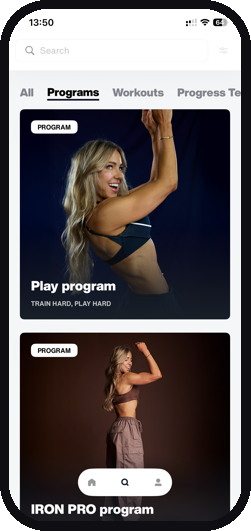
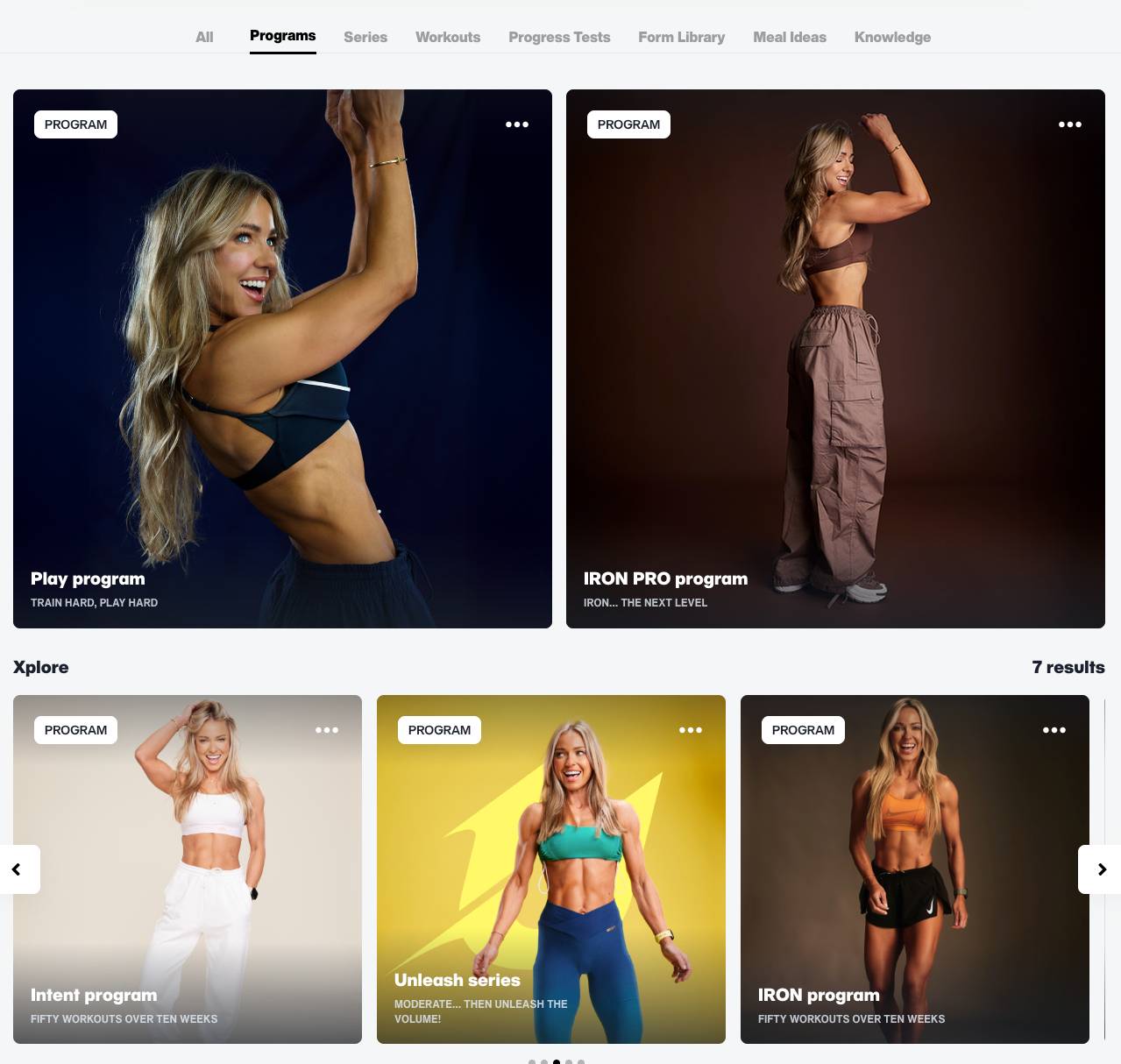
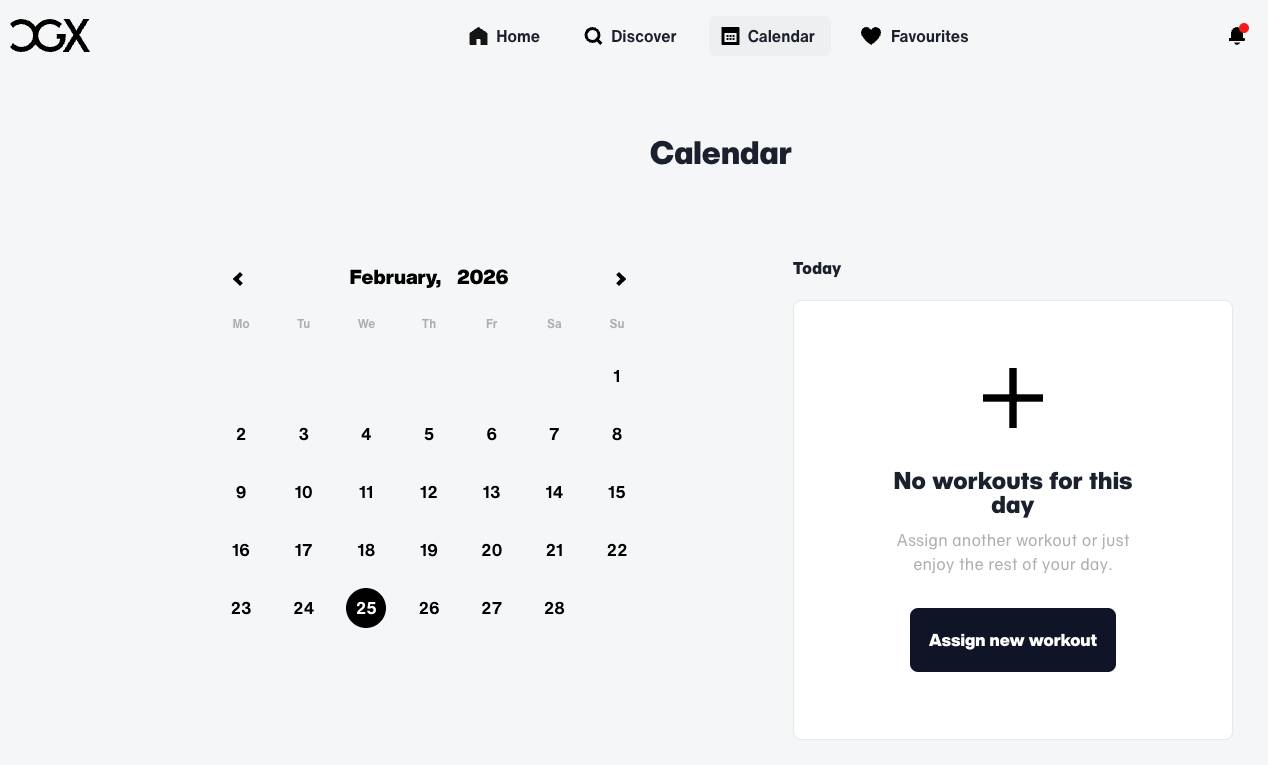
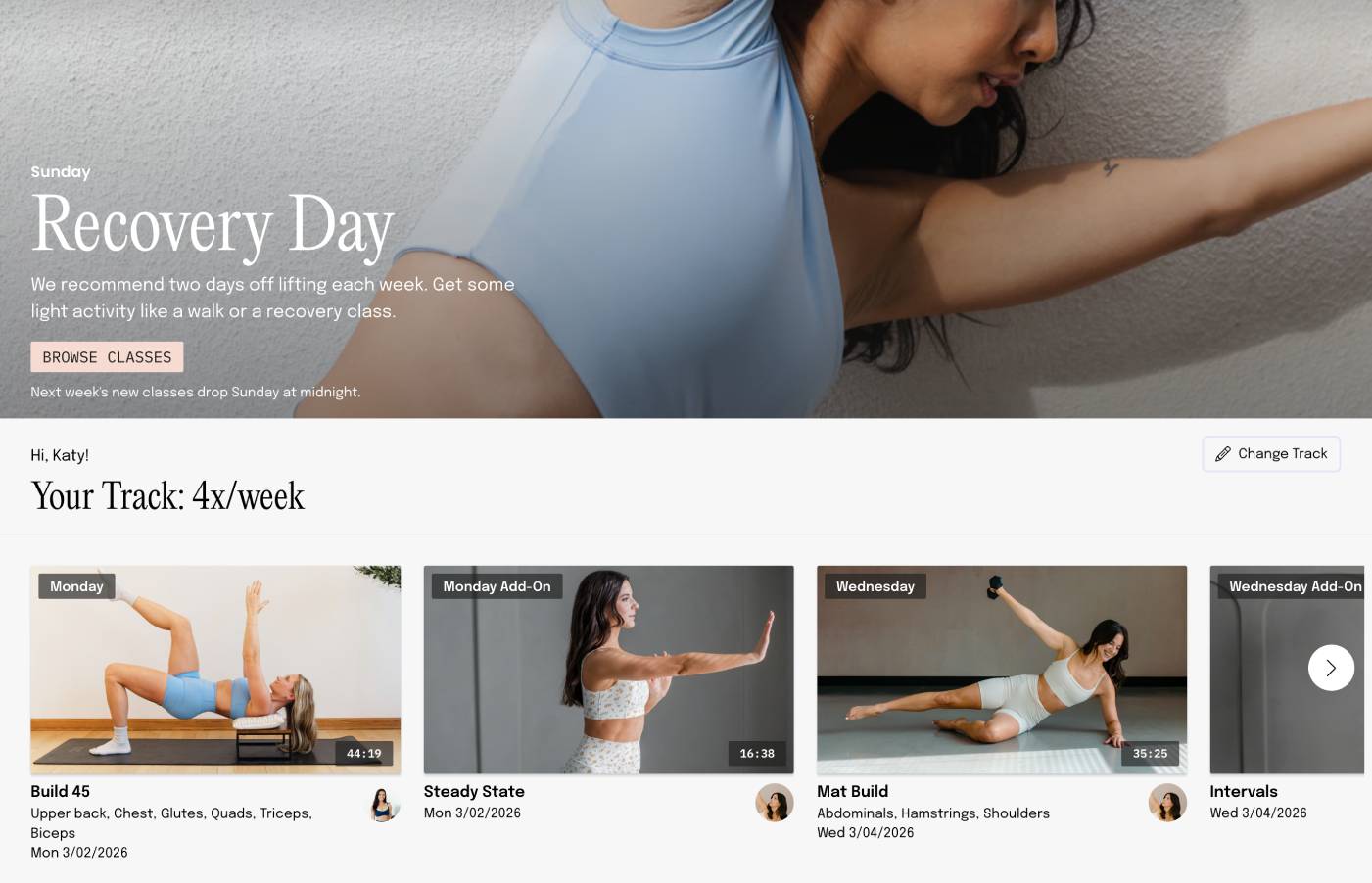
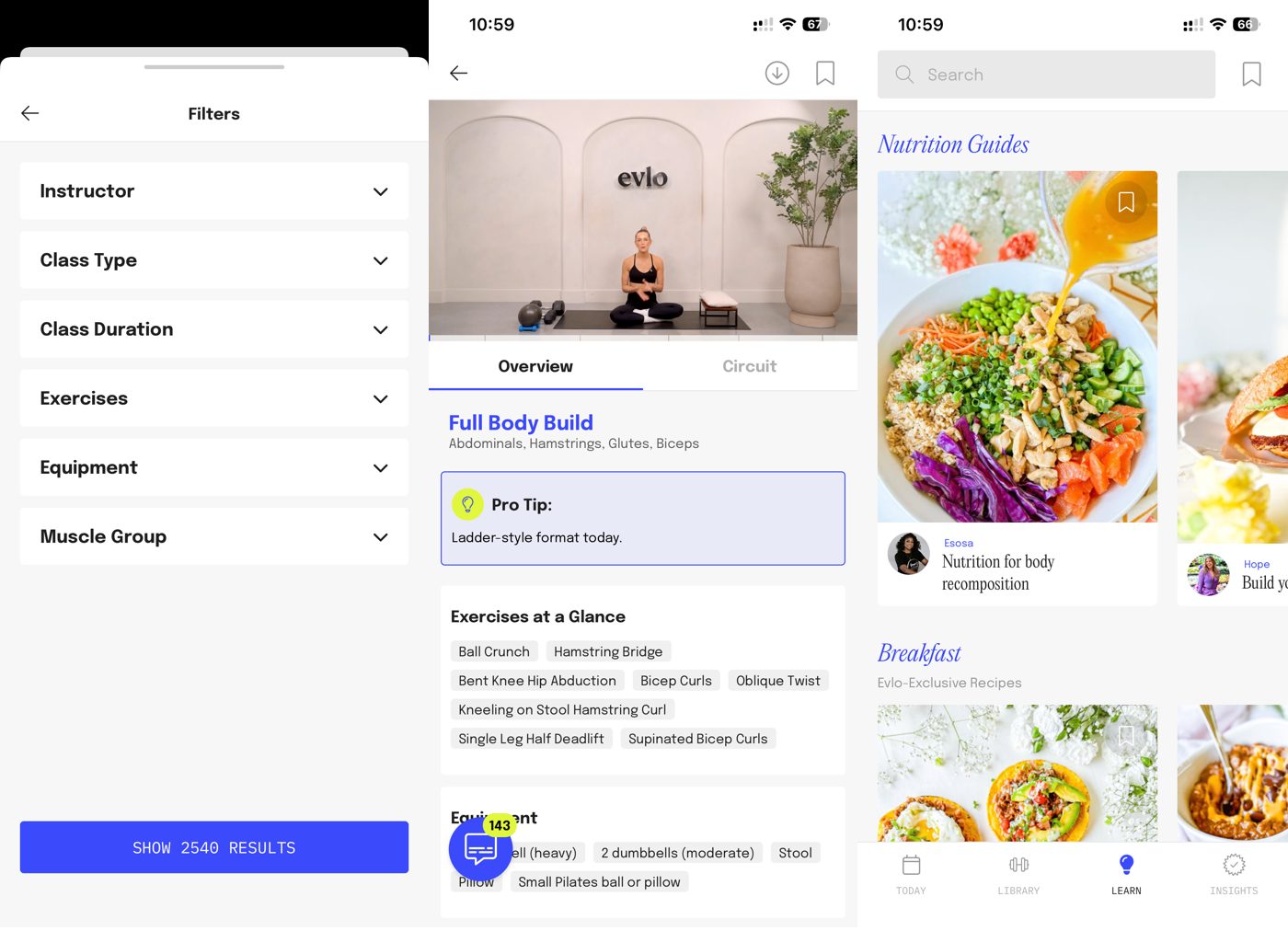
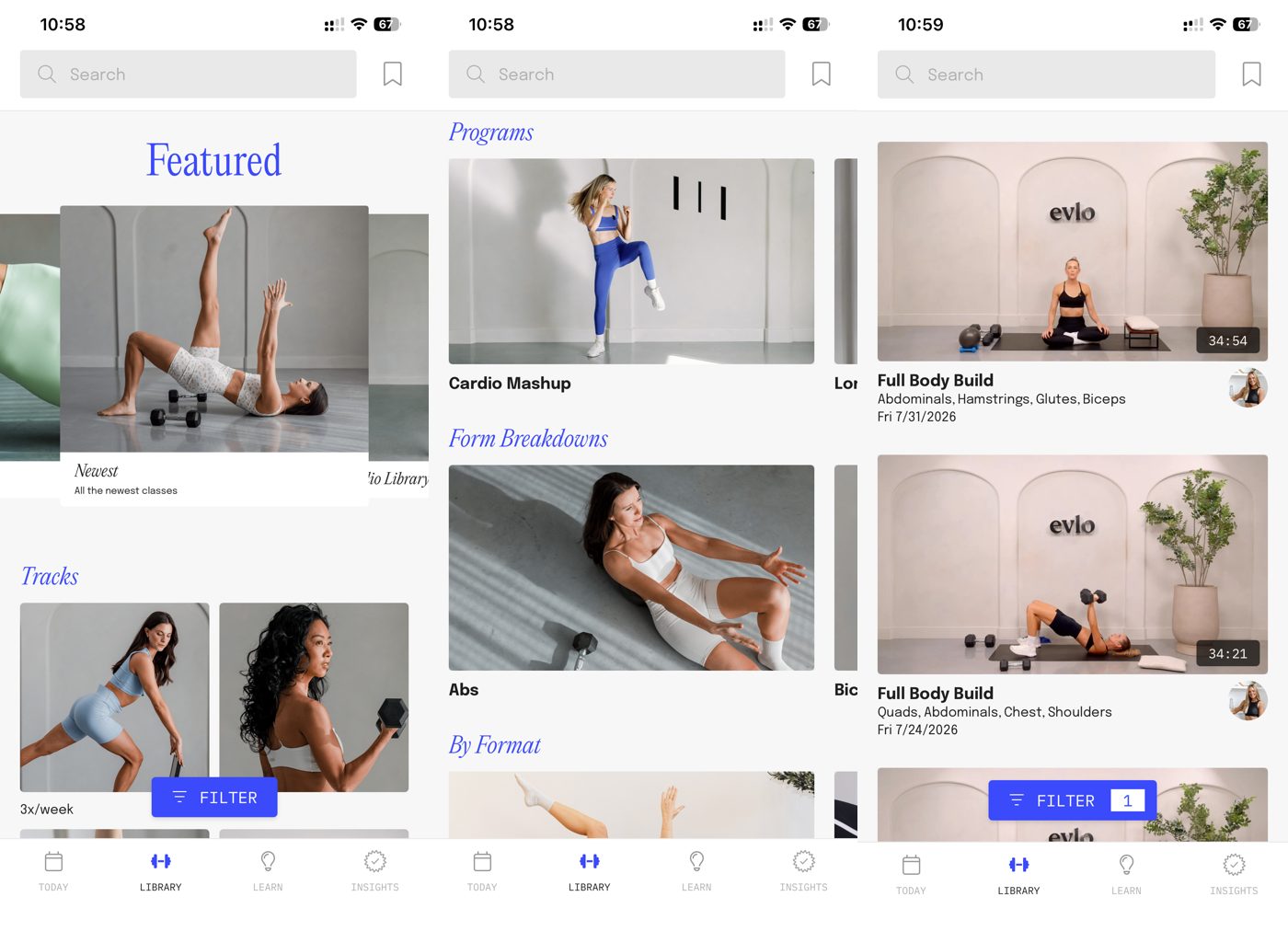
Screenshots from our full reviews
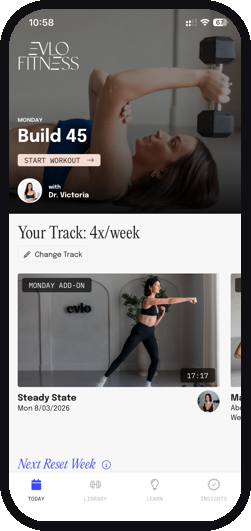
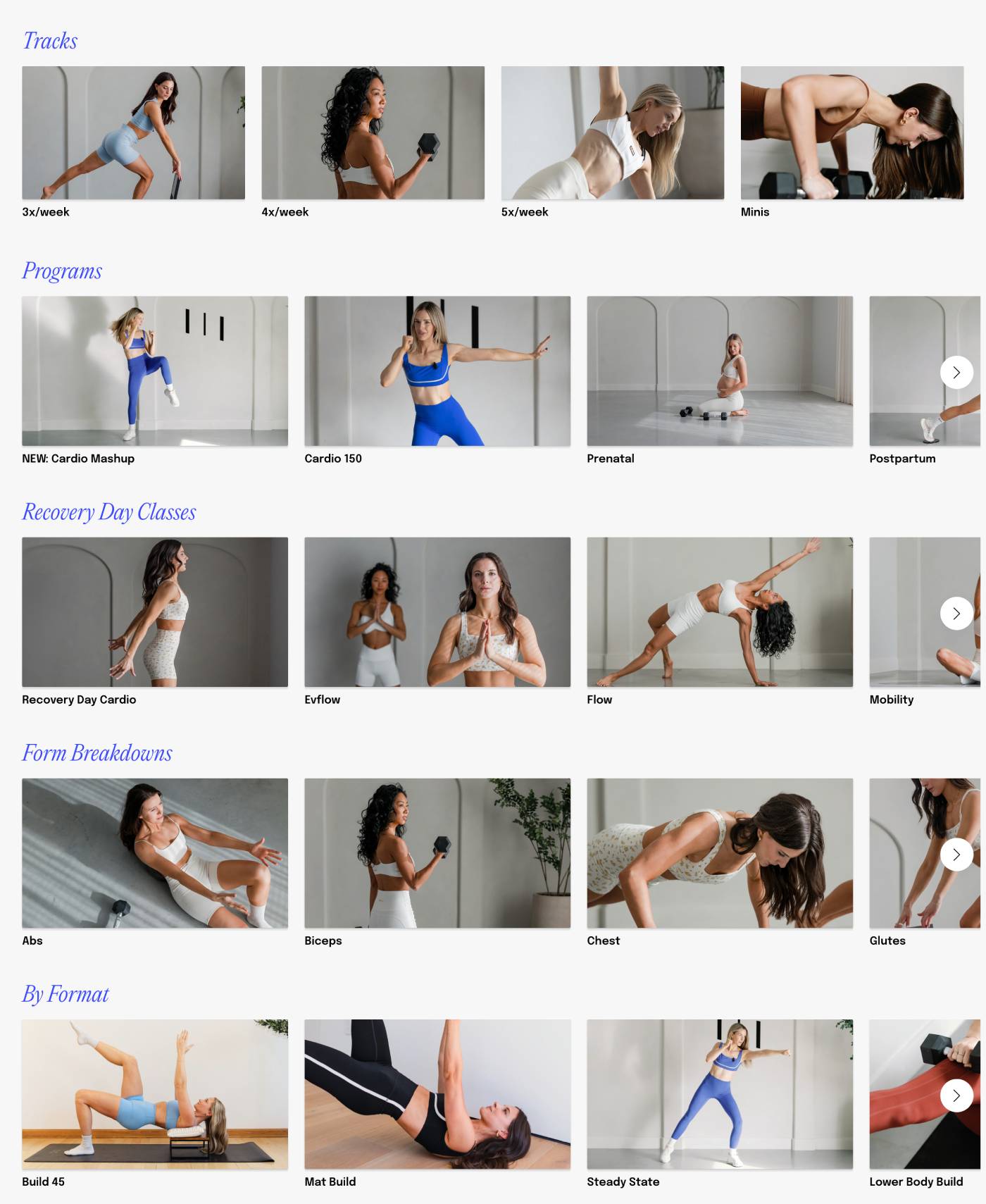
More screenshots: Evlo
See the full Evlo review for methodology and pricing.
Decision tree for women over 40
- Have a meniscus, knee, hip, back or shoulder injury: Evlo.
- Want visible muscle and have healthy joints: Caroline Girvan.
- Budget is zero: Caroline Girvan’s YouTube channel.
- Budget caps at $100/year: Caroline Girvan CGX ($99.99/year).
- Can budget $50-$60/month for PT-led training: Evlo.
- Want an adaptive daily plan: Evlo.
- Self-directed and prefer to pick your own programme blocks: Caroline Girvan.
- Have plateaued on HIIT or struggle to recover from high-intensity training: Evlo.
- Enjoy training hard and treating DOMS as progress: Caroline Girvan.
- Need 20-minute sessions: Neither. See Apple Fitness+ or Burn360.
- Postnatal or managing pelvic floor / diastasis recti: Evlo.
- Perimenopausal with sleep disruption: Evlo (recovery-aware structure).
- Postmenopausal with healthy joints, prioritising bone density: Caroline Girvan (heavier loading).
What I did not test
- Evlo’s full programme catalogue. I tested 8 weeks including a full Reset Week. Foundations programme completed. Build, Burn, Barre and cardio add-ons sampled. Not the full catalogue.
- Caroline Girvan’s full programme catalogue. Three years of testing covered multiple programmes but not all of the 30+ named programmes she has released.
- Caroline Girvan CGX app TV casting on Android. The TV casting has reported reliability issues on Android. I primarily tested on iOS and web.
- Evlo’s nutrition content depth beyond recipes. The recipe library is included but I did not follow a structured nutrition protocol from the platform.
- Long-term adherence on Evlo beyond 8 weeks.
Personal testing and observations
Caroline Girvan testing
I am a woman in my mid-forties, currently in perimenopause. I have tested Caroline Girvan for three years across multiple programmes. The free YouTube library was my entry point; CGX app testing started after the app launched. The training delivers what it promises: visible muscle tone and body composition change unmatched by any other reviewed platform. Over the three years, the change to my body composition through Caroline Girvan has been more visible than any other programme I have tested.
The trajectory by year is worth describing because it sets expectations. Year one (the first 12 months on the YouTube library): I picked sessions roughly daily, with no programme structure. The training was consistently challenging and DOMS was frequent. Visible change started appearing at month three: tighter arms first, then back, then legs. By the end of year one I was visibly more toned than I had been before starting. Year two (continuing on YouTube, starting CGX programmes): I committed to named programmes (Iron, Epic, Power) in 8 to 12 week blocks. The progressive structure produced the largest body composition gains of any year. My lifts increased steadily and the visible muscle definition continued building. Year three (CGX app exclusively): I rotated through programmes with the app structure managing my training week. Year three was about maintaining the gains from year two rather than continuing to add visible muscle.
The trade-off has consistently been DOMS. The day after a heavy lower body session, walking downstairs is an event. For me this has always been manageable. I am consistently active, sleep reasonably well most nights, and have always tolerated intense training. The pattern would be different for women who arrive at the platform after a sedentary period or who are managing significant perimenopause sleep disruption. For those women, the cumulative recovery cost can become a limiting factor in a way it would not have been at 30.
The other thing to note about Caroline Girvan in the perimenopausal context: the platform does not adapt to your recovery state. If you have had a poor sleep week, the next session is still whatever the programme has scheduled. For women whose perimenopause includes irregular sleep patterns, this rigidity can become the reason consistency slips. I have managed this by skipping or substituting sessions deliberately when my recovery was clearly insufficient, but doing this requires self-knowledge that newer trainees may not have.
Evlo testing
I tested Evlo across 8 weeks including a full Reset Week. Foundations programme completed, Build, Burn, Barre and cardio add-ons sampled, nutrition recipes tested. The clinical depth is immediately evident from the cueing inside sessions. The trainers explain what a movement protects, what it does to the joint, what to substitute if you have a specific issue. No other reviewed platform comes close on this dimension.
The Reset Week was the surprise. Halfway through the 8 weeks the platform schedules a lower-volume week to allow accumulated fatigue to dissipate. The pattern is that you come into Reset Week feeling like you do not need it, train through it at lower volume, and come out the other side noticeably fresher. For perimenopausal women whose recovery capacity is variable, this kind of structured deload is genuinely valuable. Caroline Girvan does not have an equivalent.
The price is the main barrier. At $55.99/month or $599/year, Evlo costs more than most home-fitness subscribers will pay. The value is real for women managing injury or those who have plateaued on HIIT, but the price gates access to a population that does not need the clinical depth.
Which is better for women over 50?
For women over 50, the answer depends on joint history.
Healthy joints: Caroline Girvan. Progressive dumbbell strength is exactly what is needed to retain muscle and bone density after 50, when oestrogen baselines stabilise at lower values. Caroline Girvan delivers it at an accessible price ($99.99/year on CGX, free on YouTube). The daily challenge psychology suits women who have been training for decades.
Joint history or active injury: Evlo. The PT-designed exercise selection becomes more valuable, not less, with age. Bone density work is supported through joint-safe loading patterns. The price is justified when the alternative is risking an injury that derails training entirely. For women over 50 with knee replacement, hip resurfacing, or active back pain history, Evlo is currently the strongest reviewed option.
Frequently asked questions
Is Caroline Girvan or Evlo better for women over 40?
Evlo is the stronger choice for perimenopausal women managing joint sensitivity, scoring 8.0 / 10 versus Caroline Girvan CGX at 7.6 / 10. Evlo is designed by physical therapists with the highest joint-friendliness score in the comparison series. Caroline Girvan is the stronger choice for women whose primary goal is visible muscle tone, with the highest muscle potential score in the series.
Is Caroline Girvan available for free?
Yes. Caroline Girvan has 600+ free workouts on YouTube. The CGX app at $12.99/month or $99.99/year adds programme structure but the workouts themselves remain free on YouTube. Evlo is paid only at $55.99/month or $599/year with a 14-day free trial.
Why is Evlo so expensive?
Every Evlo trainer holds a Doctorate in Physical Therapy. The exercise selection is clinically informed in a way no other reviewed platform matches. For perimenopausal women with active injuries or joint history, Evlo’s price reflects access to PT-designed training. For everyone else, the price is hard to justify against sub-$15 alternatives.
Which builds more muscle, Caroline Girvan or Evlo?
Caroline Girvan by a clear margin. CGX scores 10 / 10 on muscle potential, the highest in the series. Evlo scores 9 / 10, excellent but with a joint-protective philosophy that produces slower visible change.
Is Evlo good for perimenopausal women with knee or hip injuries?
Yes. Evlo scores 9.5 / 10 on joint friendliness, the highest in the entire comparison series. Every trainer is a Doctor of Physical Therapy. For perimenopausal women managing reduced tendon and ligament elasticity, Evlo is the strongest reviewed option.
Does Caroline Girvan or Evlo have a perimenopause programme?
Neither has a perimenopause-labelled programme. Caroline Girvan suits perimenopausal women with healthy joints well in practice. Evlo’s joint-considerate, recovery-aware philosophy naturally suits perimenopausal training needs even without the explicit label. For dedicated perimenopause programming see BODi’s Belle Vitale or Peloton’s Menopause Health Collection.
What is DOMS and why does Caroline Girvan cause more of it?
DOMS is delayed onset muscle soreness, the muscle ache that appears 24 to 48 hours after a hard training session. Caroline Girvan’s programmes are intense by design. The training philosophy treats DOMS as a marker of progress. For perimenopausal women whose sleep is already disrupted and baseline stress is elevated, accumulating DOMS can become a limiting factor. Evlo’s joint-safe philosophy produces less DOMS by design.
Research citations
- Maltais ML, Desroches J, Dionne IJ. Changes in muscle mass and strength after menopause. Journal of Musculoskeletal and Neuronal Interactions. 2009;9(4):186-197. PubMed.
- Watt FE. Musculoskeletal pain and menopause. Post Reproductive Health. 2018;24(1):34-43. doi: 10.1177/2053369118757537. SAGE.
- Resistance training for postmenopausal women: systematic review and meta-analysis. 2022. PubMed.
About this review
Reviewed by Katy Cole. Caroline Girvan tested personally for three years across multiple programmes (free YouTube plus CGX app). Evlo tested personally across 8 weeks including a full Reset Week, with the Foundations programme completed and Build/Burn/Barre/cardio add-ons sampled. Prices verified against carolinegirvan.com and evlofitness.com in May 2026.
Katy is the lead reviewer at Her Daily Fit. Fifteen years personally testing online fitness platforms. Mid-forties, currently in perimenopause, UK-based. Every claim on this page is either personally tested or attributed to peer-reviewed research. See how we score every programme using 9 weighted criteria.
Medical disclaimer: The content on this page is for informational purposes only and is not medical advice. Consult your GP or a healthcare provider before beginning a new exercise programme, particularly if you are managing perimenopause, menopause, or any existing health condition or injury.
Compared with
Where these brands appear in our “Best for” rankings