
vs
Sculpt Society ✓ HANDS-ON REVIEW
The Sculpt Society scores higher overall, 8.2 against 8, and is the stronger platform for value for money and short sessions. Evlo Fitness is the better pick if what you need most is building and keeping muscle and joint-friendly training.
- Score 8.2 vs 8.0
- Both tested hands-on
Quick answer: The Sculpt Society is the stronger overall platform for women over 40, scoring 8.2 against 8.0. It is ahead for value for money, short sessions and nutrition guidance. Evlo Fitness still wins for building and keeping muscle and joint-friendly training, so it is the better choice if that is your priority. The two are level on women over 40 specificity and recovery compatibility.
The two platforms
Same nine weighted categories, two different women. Here is who each one is built for.
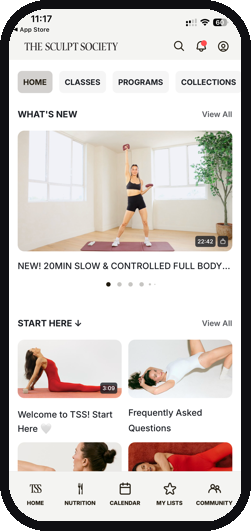
The Sculpt Society
Winner
Leads this comparison on value for money and short sessions, scoring 8.5 against 6 on Value for Money.
- Low impact
- 15 to 35 min
- No equipment required
Choose The Sculpt Society if you:
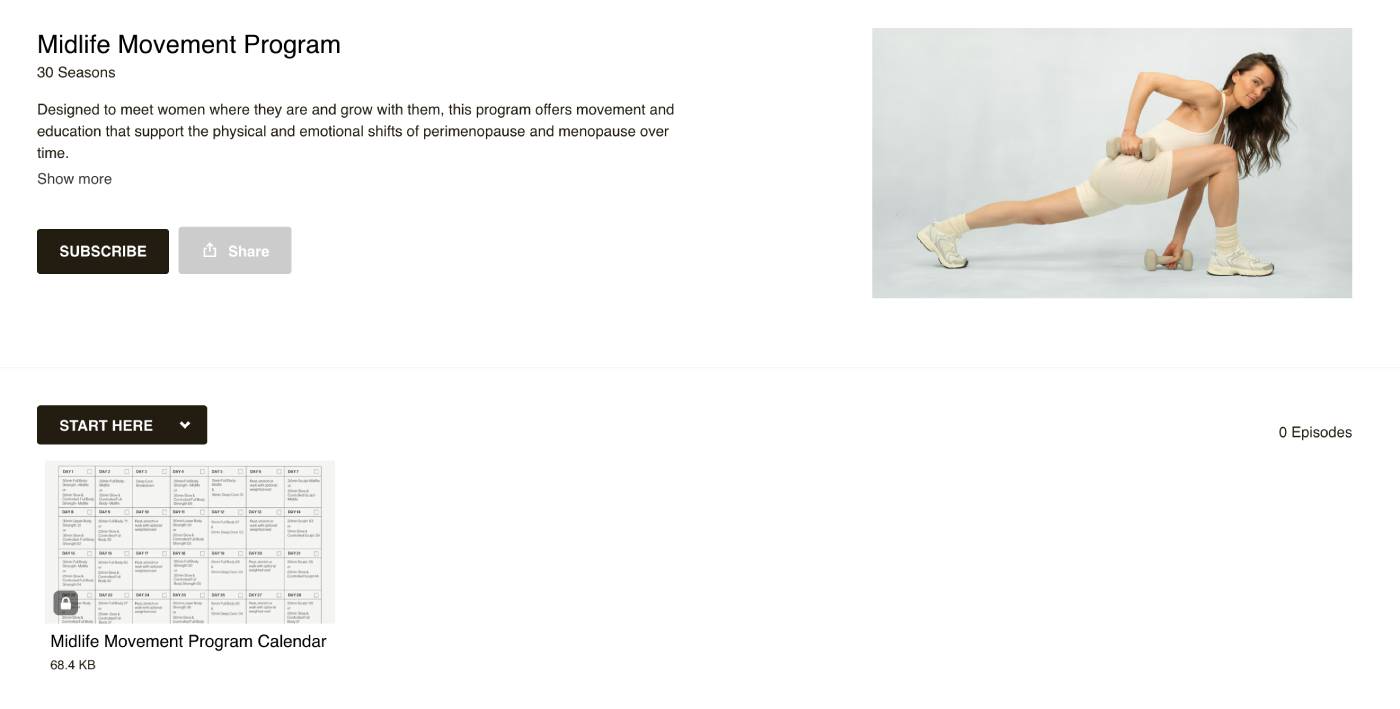
- Want dedicated perimenopause programming (Midlife Movement, medically-backed)
- Need shorter sessions (28 to 45 minutes vs Evlo’s 45 to 50)
- Are managing recovery from injury (Injury Safe series)
- Want dance cardio as part of training (Megan Roup signature)
- Prefer the lower price point ($24.99 vs Evlo $55.99)
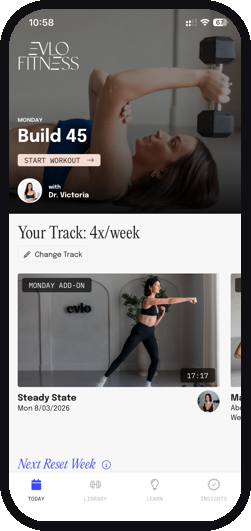
Evlo Fitness
Runner-up
Leads this comparison on building and keeping muscle and joint-friendly training, scoring 9 against 7 on Muscle Potential.
- Low impact
- 35 to 50 min
- Dumbbells at multiple
Choose Evlo Fitness if you:
- Want the most clinically rigorous joint protection available (DPT-designed by Dr. Shannon Ritchey)
- Are optimising for muscle and bone retention with progressive heavy strength training
- Have plateaued on HIIT or your body is struggling to recover from high-intensity training
- Can find 45 to 50 minutes reliably, three to five times per week
- Are willing to pay the highest price reviewed ($55.99/mo) for the rigour
Quick answer
Quick answer: The Sculpt Society wins overall at 8.2 versus Evlo at 8.0. The Sculpt Society scored 6.6 / 10 on Women Over 40 Specificity with the dedicated Midlife Movement Programme (medically-backed), Injury Safe series and integrated pelvic floor work. Evlo scored 9 / 10 on Muscle Potential (the highest of any platform reviewed) and 9.5 / 10 on Joint Friendliness (DPT-designed exercise selection in a different category from every other reviewed platform), making it the strongest choice for women optimising specifically for muscle and bone retention with the most rigorous joint protection. The Sculpt Society wins on price ($24.99 vs Evlo $55.99 per month, less than half the cost), time efficiency (28 to 45-minute sessions vs Evlo’s 45 to 50 minutes), and dedicated perimenopause programming. For maximum strength and clinical joint protection, Evlo. For dedicated perimenopause-aware training at half the price, The Sculpt Society.
Inside Evlo and The Sculpt Society

Bottom line in 30 seconds
- The Sculpt Society wins on overall score and dedicated perimenopause programming. 8.2 versus Evlo at 8.0. The 6.6 / 10 Women Over 40 Specificity score reflects the medically-backed Midlife Movement Programme, Injury Safe series and pelvic floor integration. The price advantage ($24.99 vs Evlo $55.99 per month) is significant.
- Evlo wins on muscle building and clinical joint protection. The 9 / 10 Muscle Potential score is the highest of any platform reviewed. The 9.5 / 10 Joint Friendliness score reflects DPT-designed exercise selection that is in a different category from every other platform. For women who have plateaued on HIIT or are struggling to recover from high-intensity training, Evlo’s method is the most considered approach available.
- Time and budget are the deciding factors. Evlo requires 45 to 50 minutes, three to five times per week, at $55.99 per month. The Sculpt Society delivers 28 to 45-minute sessions at $24.99 per month. For women managing time and money constraints alongside perimenopause, The Sculpt Society is the more achievable platform. For women prioritising methodological rigour and willing to invest, Evlo is the stronger choice.
Evlo is the most expensive platform reviewed. $55.99/month or $599/year. The clinical rigour justifies the price for the target audience but the time demands (45 to 50 minutes, 4 to 5 times per week) mean many women under-use what they pay for. Be honest about whether you can find the time reliably before committing.
The Sculpt Society Midlife programme has a muscle ceiling. The controlled tempo is by design and works for maintenance and foundational strength. Women wanting significant progressive overload and heavy strength gain will find the platform less suited. For maximum hypertrophy after 40, Evlo or Sweat’s PWR are the stronger choices.
Quick yes or no comparison
| Feature | Evlo | The Sculpt Society |
|---|---|---|
| DPT-designed exercise selection | Yes (Dr. Shannon Ritchey) | No (medically-backed by consultation) |
| Logged progressive overload | Yes (weight tracking) | Limited |
| Dedicated perimenopause programme | No (method suits but not packaged) | Yes (Midlife Movement, medically-backed) |
| Injury-safe programmes | 120+ rehab videos available | Dedicated Injury Safe series |
| Daily auto-assigned plan | Yes | Yes (Midlife Movement calendar) |
| Deload weeks built in | Yes (Reset Weeks) | Active recovery days built in |
| Dance cardio | No | Yes (Megan Roup signature) |
| Pelvic floor work integrated | Some | Yes (integrated throughout) |
| Pregnancy and postnatal content | Limited | Yes (extensive) |
| The Rest Test methodology | Yes (assesses muscle failure) | No |
| Session length | 45 to 50 minutes | 28 to 45 minutes |
| Free tier or generous trial | 14-day trial | 7-day trial |
| Annual plan | $599/yr | $179.99/yr |
At a glance
| Evlo | The Sculpt Society | |
|---|---|---|
| Monthly price | $55.99/mo | $24.99/mo |
| Annual price | $599/yr | $229.99/yr |
| Free trial | 14 days (no charge if cancelled) | 7 days |
| Founder / lead | Dr. Shannon Ritchey, DPT | Megan Roup (founder, lead trainer) |
| Class library | 1,000+ on-demand classes, 10+ new weekly | Library plus structured programmes |
| Signature method | DPT-designed strength with The Rest Test | Slow-controlled sculpt method |
| Signature programmes | Foundations onboarding, weekly tracks, Reset Weeks | Midlife Movement, 14-Day Strength, Injury Safe, dance cardio |
| Session length | 45 to 50 minutes | 28 to 45 minutes |
| Weekly frequency | 3 to 5 sessions | 3 to 5 strength days plus 2 recovery |
| Perimenopause programming | Method suits but no dedicated programme | Midlife Movement (medically-backed) |
| Personal testing | 8 weeks | 4 weeks Midlife Movement plus 14-Day Strength, Injury Safe, dance |
| Overall score | 8.0 / 10 | 8.2 / 10 |
Full scoring breakdown
| Category | Weight | Evlo | The Sculpt Society | Winner |
|---|---|---|---|---|
| Time Efficiency | 15% | 6.5 | 8.5 | The Sculpt Society |
| Muscle Potential | 15% | 9 | 7 | Evlo Fitness |
| Women Over 40 Specificity | 15% | 6.6 | 6.6 | Tie |
| Joint Friendliness | 12% | 9.5 | 9 | Evlo Fitness |
| Recovery Compatibility | 10% | 9 | 9 | Tie |
| Programme Structure | 10% | 8.5 | 9 | The Sculpt Society |
| Value for Money | 8% | 6 | 8.5 | The Sculpt Society |
| UX and Design | 8% | 8.5 | 8.5 | Tie |
| Nutrition Integration | 7% | 7 | 8 | The Sculpt Society |
| Overall | 100% | 8.0 | 8.2 | The Sculpt Society |
Why these scoring categories matter more after 40
Three physiological changes during perimenopause shape what training should look like. Oestrogen decline accelerates loss of muscle and bone. Maltais 2009 documents the trajectory and the 2022 systematic review on resistance training for postmenopausal women confirms structured progressive loading as the most effective intervention. Baseline cortisol elevates. Tendon and ligament elasticity decreases, which Watt 2018 documents as a primary driver of musculoskeletal pain.
The category weights reflect that reality. Between Evlo and The Sculpt Society, the biggest splits sit on Muscle Potential (Evlo’s 9.0 vs TSS’s 7.0), Women Over 40 Specificity (TSS’s 9.5 vs Evlo’s 7.5), Time Efficiency (TSS’s 8.5 vs Evlo’s 6.5), and Value for Money (TSS’s 8.5 vs Evlo’s 6.0). Joint Friendliness is close (Evlo 9.5 vs TSS 9.0). The aggregate score gap reflects these weighted differences across categories that pull in different directions for different priorities.
Muscle potential 9 vs 7
This is the category where Evlo pulls ahead most decisively.
Evlo scored 9 / 10 on Muscle Potential, the highest of any platform reviewed. The DPT-designed method uses progressive overload with logged weights. The Rest Test methodology assesses whether you trained close enough to muscle failure: after your final rep in a set, rest five seconds and attempt additional reps. If you can do three or more, you were not close to failure and should increase your weight or rep target next session. This is the cleanest application of progressive overload principles I have seen on a streaming fitness platform. Weight tracking visualises progress over time.
The Sculpt Society scored 7 / 10 on Muscle Potential. The Midlife Movement Programme’s controlled tempo is by design and the platform works for maintenance and foundational strength. The 14-Day Strength Programme delivers structured strength with light to moderate dumbbells but the muscle-building ceiling is meaningfully lower than Evlo’s progressive structure. For experienced exercisers wanting significant progressive overload, the limitation is real.
For women optimising for muscle and bone retention through perimenopause via heavy progressive strength, Evlo is the stronger fit. For perimenopause-aware training that includes strength as one component within a broader programme, The Sculpt Society works. The 2-point category gap (9.0 vs 7.0) translates to a 0.3-point overall score difference at the 15% weight, which is meaningful but not the decisive factor.
Why progressive overload matters more after 40
Progressive overload is the principle of gradually adding load over time. After 40, oestrogen decline accelerates muscle and bone loss. The 2022 systematic review on resistance training for postmenopausal women is clear: training works only if the load progresses. Evlo is built around this principle with logged weights, the Rest Test, and Reset Weeks for periodisation. The Sculpt Society delivers some progression through the 14-Day Strength Programme but is not built around heavy progressive overload as the platform’s defining feature. Combine either with adequate protein intake (1.6 to 2.2 grams per kilogram of body weight daily) for the foundation the evidence identifies as effective.
Women over 40 specificity 6.6 vs 6.6
This is the category where The Sculpt Society wins, and it is the counterweight to Evlo’s Muscle Potential advantage.
The Sculpt Society scored 6.6 / 10 on Women Over 40 Specificity. The dedicated Midlife Movement Programme is medically-backed. The 14-Day Strength Programme is built for this audience. The Injury Safe series acknowledges joint and recovery needs explicitly. Pelvic floor and deep core work is integrated throughout. Pregnancy and postnatal content extends life-stage coverage. The design intent is unmistakably for women navigating perimenopause to post-menopause.
Evlo scored 6.6 / 10 on Women Over 40 Specificity. The DPT-designed method is ideal for this audience (sustainable intensity, joint protection, progressive structure that accounts for recovery compression) but is not packaged as a dedicated perimenopause programme. Dr. Shannon Ritchey developed the method from her own training experience as a physical therapist managing chronic pain, which gives the platform genuine credibility for women managing similar concerns, but the marketing and structure target performance-oriented women broadly rather than perimenopause specifically.
The score gap on this category drives most of the overall difference. For dedicated perimenopause programming, The Sculpt Society is the substantially stronger choice. For perimenopause-suited training without explicit life-stage packaging, Evlo’s method works.
Joint friendliness 9.5 vs 9
Both platforms score high on Joint Friendliness; Evlo edges ahead narrowly on clinical rigour.
Evlo scored 9.5 / 10, the highest tested. Every exercise selection is DPT-designed and informed by Dr. Shannon Ritchey’s physical therapy background. 120+ rehab videos are accessible alongside the main programme. The platform-level approach to exercise selection is in a different category from every other platform reviewed: each movement choice is filtered through clinical reasoning about joint loading, soft-tissue stress and movement quality.
The Sculpt Society scored 8.2 / 10. The slow-controlled sculpt method involves no jumping in sculpt and strength classes. Dance cardio can include jumping but is easy to modify. The Injury Safe series is dedicated content for joint and recovery management. Megan Roup’s coaching consistently cues controlled tempo and joint positioning.
For women with diagnosed knee, hip or back issues, both platforms work. Evlo’s clinical rigour is the cleaner choice for users wanting the most considered exercise selection. The Sculpt Society’s Injury Safe series is dedicated programming for a similar audience at half the price.
Time efficiency 6.5 vs 8.5
The Sculpt Society wins this category clearly.
The Sculpt Society scored 8.5 / 10 on Time Efficiency. Sessions run 28 to 45 minutes. The Midlife Movement schedule lays out the week with three to five strength days plus two recovery days. Stackable shorter content (walking, stretching, deep core) supports the main sessions.
Evlo scored 6.5 / 10 on Time Efficiency, the lowest of strong contenders for this audience. Sessions are 45 to 50 minutes, three to five times per week. This is the most significant practical barrier of any platform reviewed: many women under-use what they pay for because they cannot find the time reliably. The methodology is excellent but the time commitment is real.
For time-constrained perimenopausal women, The Sculpt Society is materially more achievable week-to-week. For women who can find 45 to 50 minutes reliably and want the most rigorous training method, Evlo’s time commitment is justified by the results.
Recovery compatibility 9 vs 9
Both platforms score well on Recovery Compatibility.
Evlo programmes Reset Weeks for deload built into the training cycle. Breathwork cool-downs are built into every session. The recovery demand is moderate (demanding on specific muscles, not full-body fatigue accumulation). Dr. Shannon Ritchey’s background informs the deload sequencing.
The Sculpt Society scored 9 / 10 on Recovery Compatibility. The Midlife Movement schedule builds in two rest or active recovery days per week. Walking, stretching and deep core work suggested for lighter days. The controlled tempo reduces overall systemic stress compared to higher-intensity platforms.
Both work for perimenopausal women managing recovery compression. The Sculpt Society’s lower per-session intensity is easier to sustain across consecutive days; Evlo’s Reset Weeks are the structural recovery mechanism.
Programme structure 8.5 vs 9
Both platforms score high on Programme Structure (Evlo 8.5 to 9.5 in different mentions, TSS 9.0).
Evlo’s structure is daily auto-assignment plus Foundations onboarding plus Reset Weeks. The Foundations programme walks new users through the method before assigning daily training. The daily auto-assignment removes decision fatigue. Reset Weeks are programmed in across the year. This is one of the most structurally rigorous training experiences on a streaming fitness platform.
The Sculpt Society’s Midlife Movement Programme lays out the calendar for you: three to five strength days plus two rest or active recovery days, with walking, stretching or deep core work suggested. The 14-Day Strength Programme and Injury Safe series have similar structural integrity.
Both are competent at this category. Evlo’s Foundations onboarding is unusually thorough. The Sculpt Society’s perimenopause-specific scheduling is the stronger fit for the audience.
A closer look at Evlo

Value for money 6 vs 8.5
The Sculpt Society wins this category by a wide margin.
The Sculpt Society is $24.99/month or $229.99/year. The 8.5 / 10 Value for Money score reflects fair pricing for the dedicated perimenopause programming and broad library access.
Evlo is $55.99/month or $599/year. The 6 / 10 Value for Money score reflects the highest price reviewed plus the time demands that mean many women under-use what they pay for. The clinical rigour justifies the price for the right user; the value calculation depends on whether you actually use the 4 to 5 weekly sessions.
The annual gap is $419 per year. For a 12-month subscription, that is a meaningful budget difference. The Sculpt Society at $229.99 per year is also less than half the cost. For women price-sensitive but wanting credentialled training for women over 40, The Sculpt Society is the clearer value choice. For women willing to pay for the most rigorous method, Evlo’s price is defensible.
UX and design 8.5 vs 8.5
Both platforms are well-designed.
Evlo’s daily auto-assignment is the standout UX feature: you open the app and your session is ready. The Foundations onboarding is the best-in-class introduction to a training method I have used. Weight tracking is integrated cleanly. The platform feels purpose-built rather than templated.
The Sculpt Society’s 8.5 / 10 UX score reflects pleasant design, easy navigation, quiz-recommended starting points, and offline downloads. Dance cardio is not prominently surfaced (you have to search for it) which is a small friction point.
Both are competent. Evlo’s daily auto-assignment is the slightly cleaner training-flow UX. The Sculpt Society’s library navigation is more flexible for users who want to dip into varied content.
A closer look at The Sculpt Society
Nutrition integration 7 vs 8
Neither platform leads on nutrition.
Evlo includes some nutrition guidance and recipes but it is not a focus of the platform. Dr. Shannon Ritchey’s expertise is in movement and physical therapy rather than nutrition.
The Sculpt Society has lifestyle content and some nutrition guidance but no dedicated meal plans or proprietary supplement line.
Neither matches Obe Fitness’s audio courses on protein, Daily Burn’s 72 weeks of meal plans, BODi’s nutrition integration, or Jillian Michaels’ 9 / 10 nutrition system. This category does not differentiate Evlo and The Sculpt Society meaningfully.
Who wins for…
Best for maximum muscle building
Evlo. 9 / 10 Muscle Potential, the highest tested. Logged progressive overload with The Rest Test methodology.
Best for most rigorous joint protection
Evlo. 9.5 / 10 Joint Friendliness from DPT-designed exercise selection. Highest of any platform reviewed.
Best for dedicated perimenopause programming
The Sculpt Society. 6.6 / 10 Women Over 40 Specificity from the medically-backed Midlife Movement Programme.
Best for budget
The Sculpt Society. $24.99/month or $229.99/year vs Evlo’s $55.99/month or $599/year.
Best for time-constrained training
The Sculpt Society. 28 to 45-minute sessions vs Evlo’s 45 to 50 minutes 4-5x weekly.
Best for women who have plateaued on HIIT
Evlo. The DPT-designed method is specifically positioned for women whose bodies are struggling to recover from high-intensity training.
Best for pregnancy and postnatal
The Sculpt Society. Extensive prenatal and postnatal content. Evlo has limited content here.
Best for dance fitness
The Sculpt Society. Megan Roup’s signature dance cardio. Evlo has no dance content.
Best for women managing chronic pain
Evlo. Dr. Shannon Ritchey built the platform from her own experience with chronic back, hip, wrist and shoulder pain. The methodology specifically addresses how training culture can produce or worsen pain in fit users.
Best for pelvic floor integration
The Sculpt Society. Pelvic floor and deep core work integrated throughout the platform.
Best for women in their 50s and 60s
The Sculpt Society, narrowly. The Midlife Movement Programme suits the demographic. Evlo’s method works but the 45 to 50-minute sessions four to five times a week are a higher bar.
Best for free trial generosity
Evlo. 14 days vs The Sculpt Society’s 7 days. Evlo’s longer trial is needed because the Foundations onboarding takes a meaningful chunk of the first week.
Best methodology rigour overall
Evlo. DPT-designed, The Rest Test, Reset Weeks, Foundations onboarding. The most considered training approach reviewed.
Best for women who want fewer training decisions
Evlo. The daily auto-assignment removes session-by-session choice fatigue. The Sculpt Society’s Midlife Movement calendar also removes decision fatigue but you select within each day; Evlo just hands you the session.
Best for women combining home training with other activities
The Sculpt Society. The 28 to 45-minute sessions and lower per-session intensity stack with other activities (walking, separate strength gym sessions, swimming) more easily. Evlo’s 45 to 50-minute high-intensity sessions are harder to layer on top of other training.
Best for visible muscle gain over 8 to 12 weeks
Evlo. The 8 weeks of testing produced the most visible muscle-building results of anything tested on this site. The Sculpt Society delivers maintenance and foundational strength; visible muscle gain at the same rate is not the platform’s design intent.
Screenshots from our full reviews
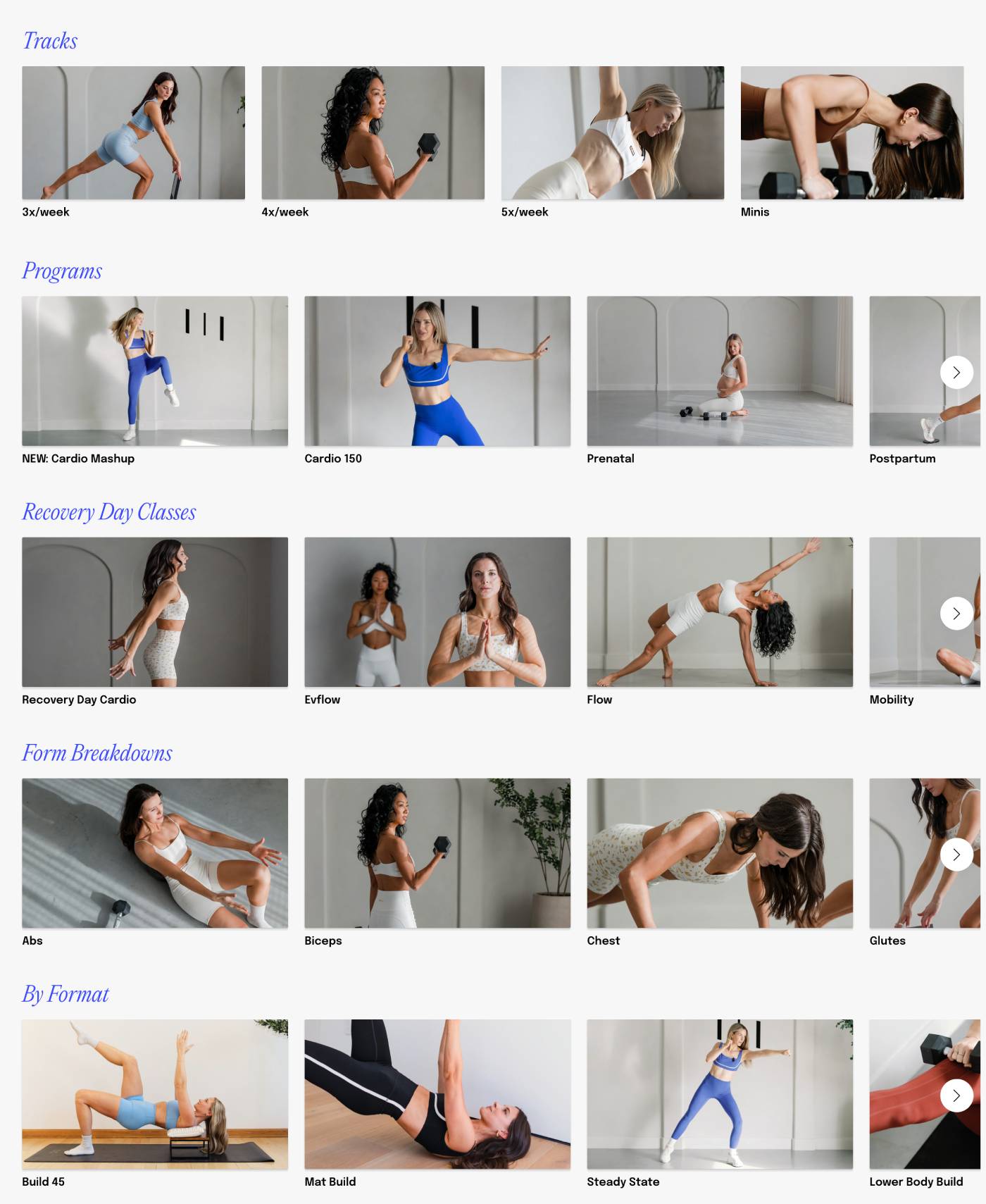
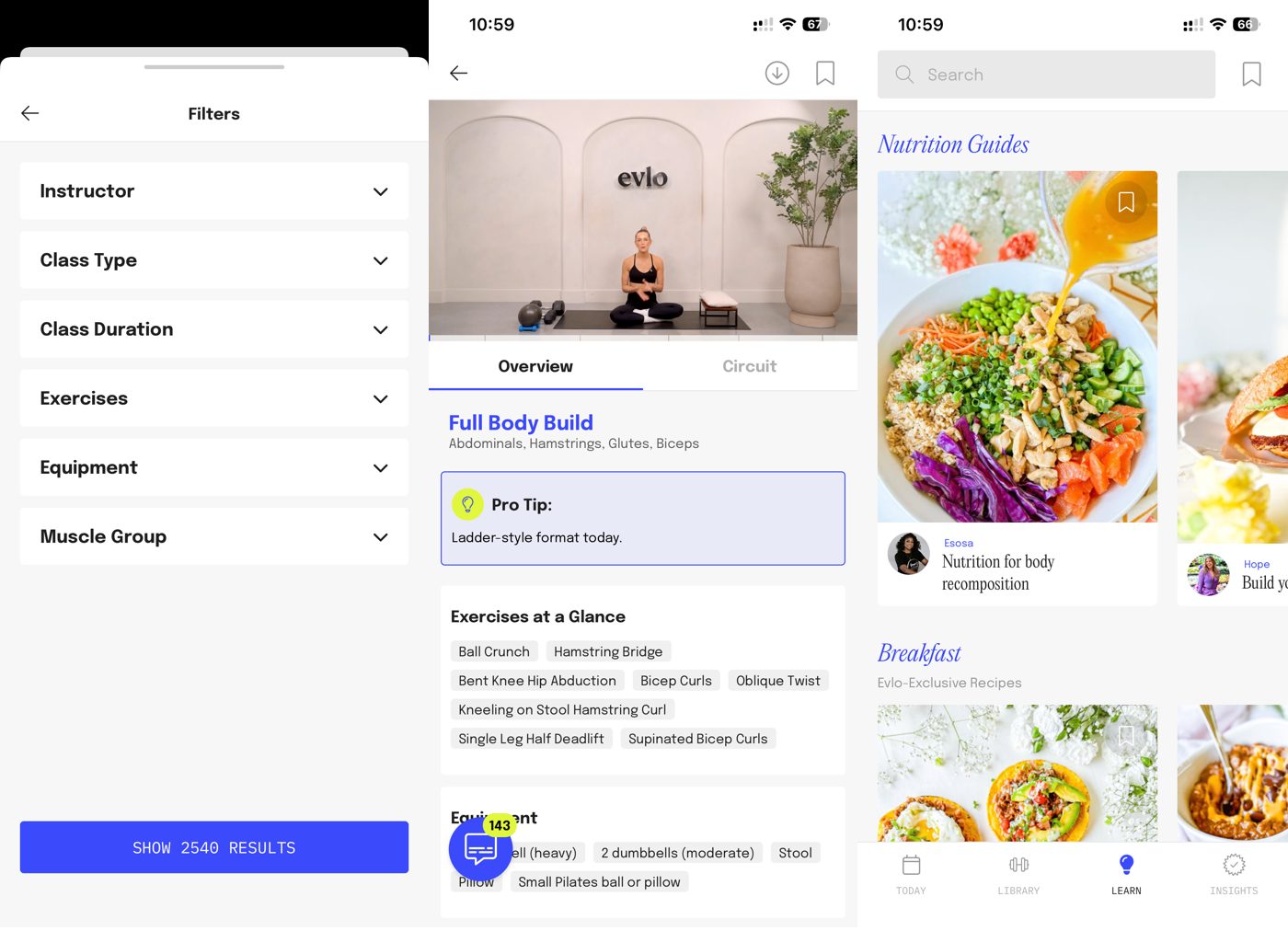
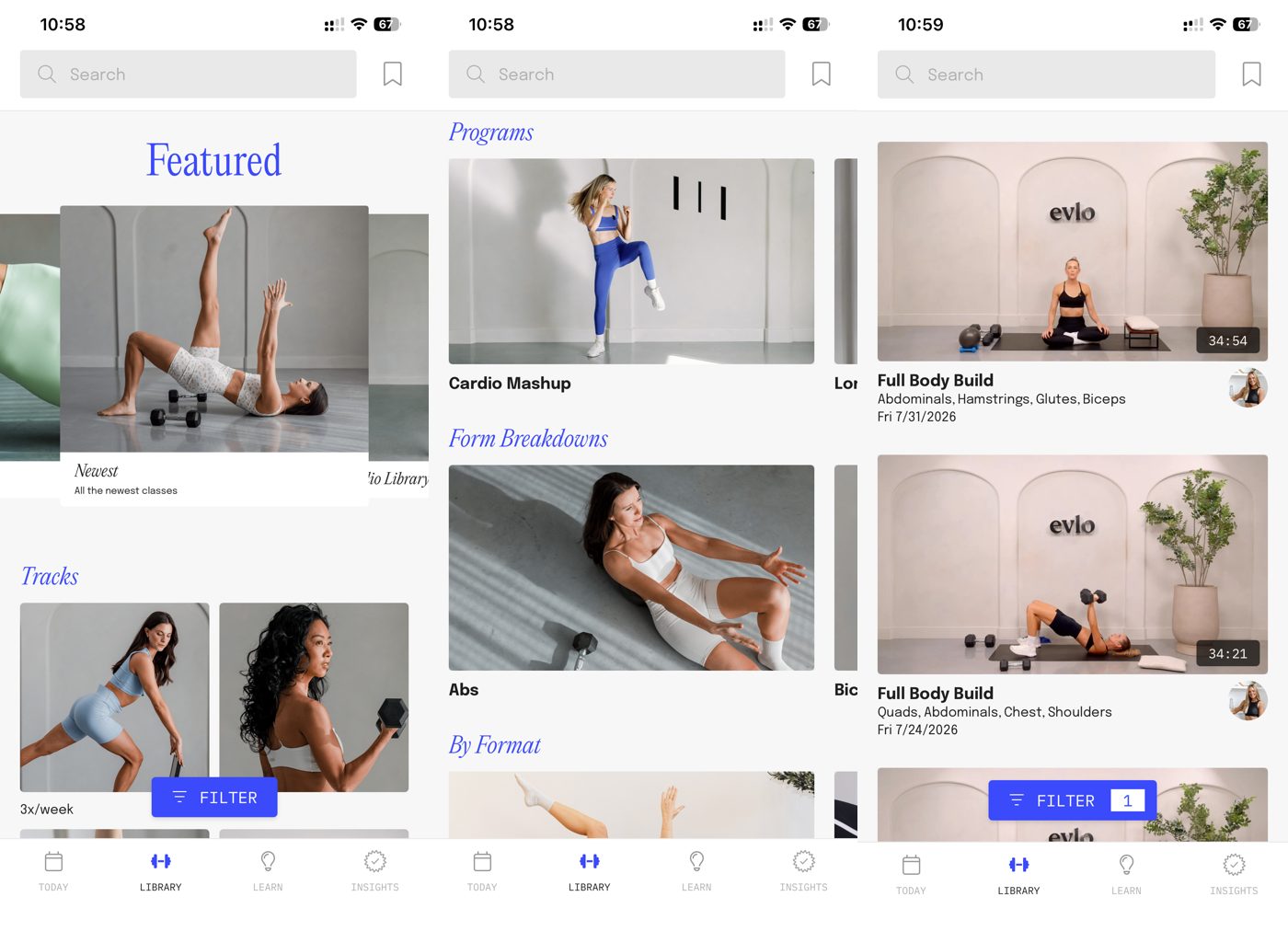
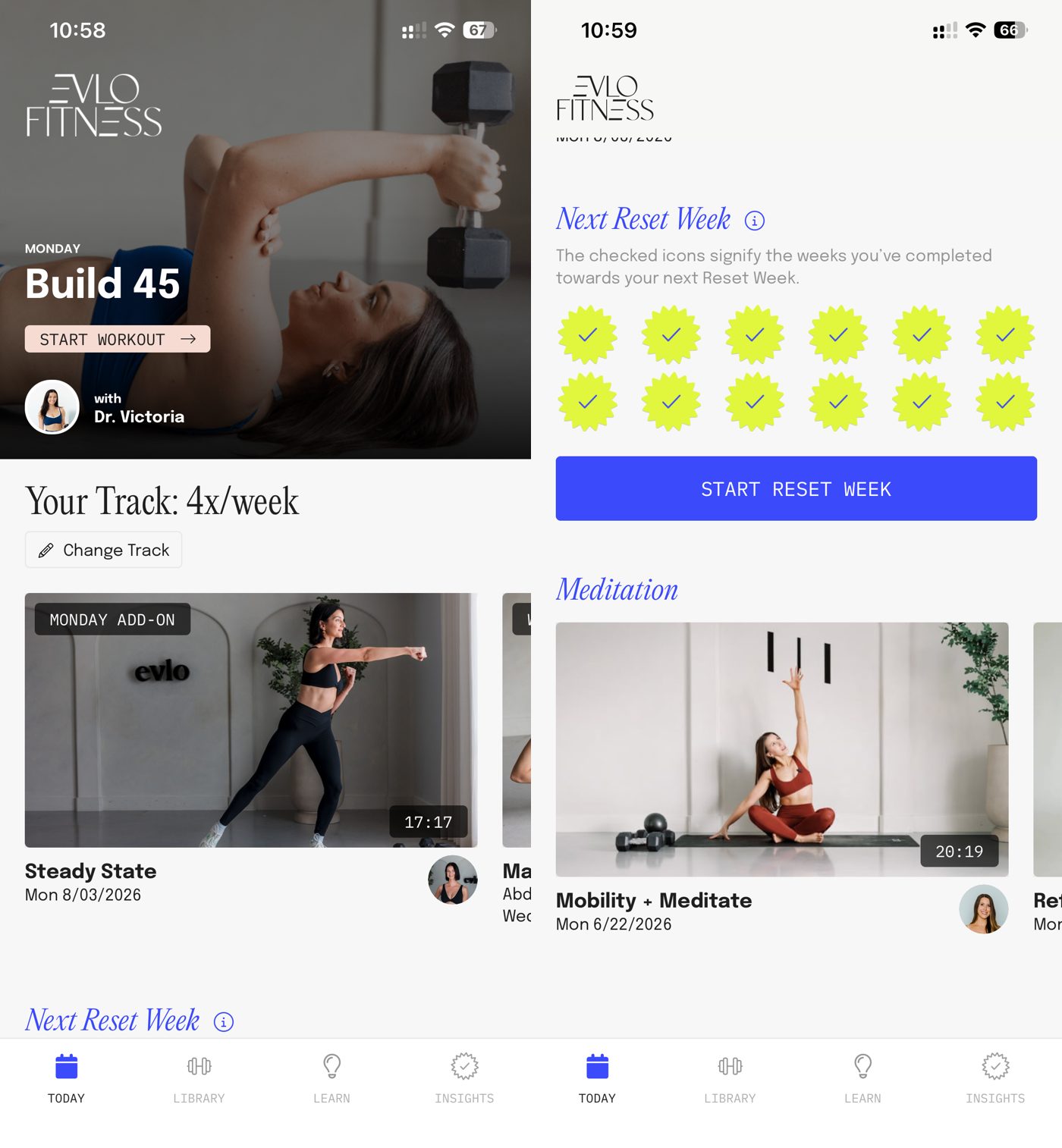
More screenshots: Evlo
See the full Evlo review for methodology and pricing.
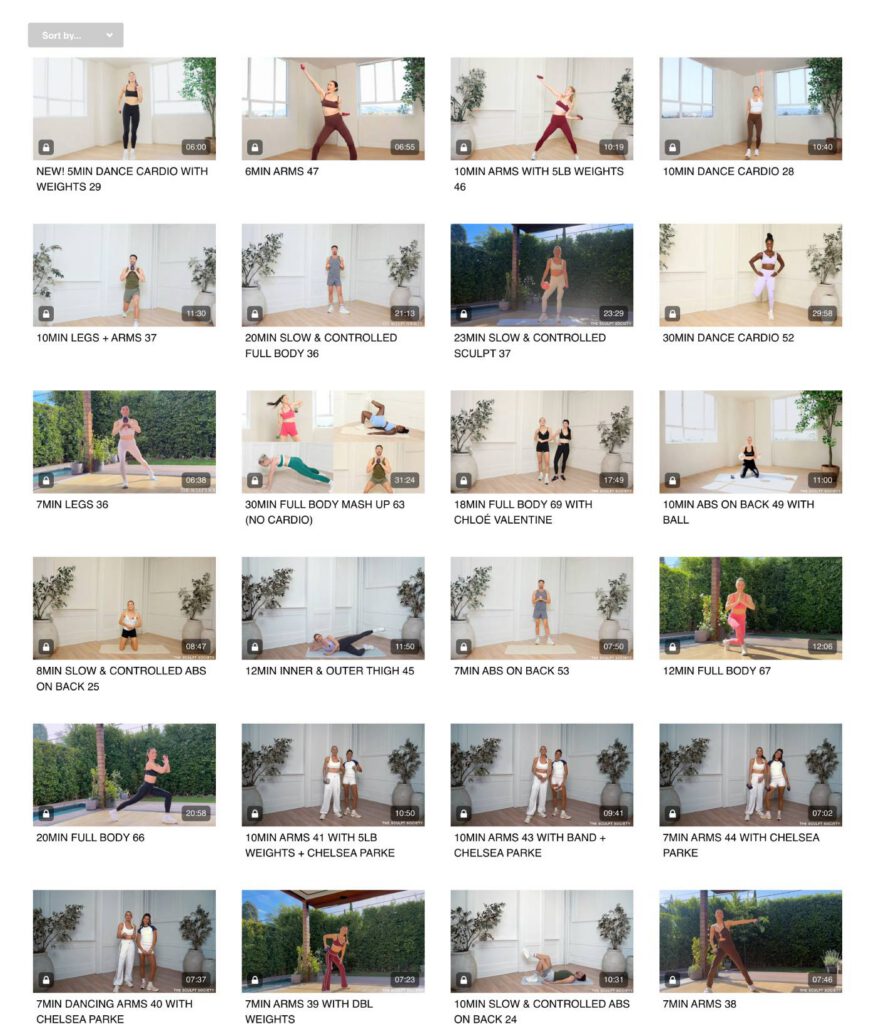
More screenshots: The Sculpt Society
See the full The Sculpt Society review for methodology and pricing.


Decision tree for women over 40
Start here. Is your primary goal maximum muscle and bone retention through structured progressive strength training?
- Yes: Evlo. 9 / 10 Muscle Potential, DPT-designed, logged progression.
- No: continue.
Is dedicated perimenopause programming (Midlife Movement Programme) important to you?
- Yes: The Sculpt Society.
- No: continue.
Can you find 45 to 50 minutes reliably, three to five times per week?
- No: The Sculpt Society. Evlo’s time demand is the most significant barrier of any platform reviewed.
- Yes: continue.
Are you willing to pay $55.99/month for the most rigorous methodology?
- Yes: Evlo.
- No: The Sculpt Society at $24.99/month is less than half the cost with strong methodology for the perimenopause audience.
Default if multiple factors tied: The Sculpt Society for the higher overall score, dedicated perimenopause programming and significantly lower price. Evlo for women who specifically prioritise muscle building and clinical joint protection and can absorb the cost and time commitment.
What I did not test
- The full Evlo library. Tested across 8 weeks of structured daily use including Foundations and multiple weekly tracks.
- Evlo Reset Weeks across multiple cycles. Experienced one Reset Week during testing.
- The full Sculpt Society Midlife Movement Programme. Completed 4 weeks.
- Sculpt Society prenatal and postnatal content. Not directly relevant to my testing window.
- Long-term adherence beyond my test windows on either platform.
Personal testing and observations
Evlo testing
I tested Evlo across 8 weeks. The Foundations onboarding programme is the most considered introduction to a training method I have used: Dr. Shannon Ritchey walks you through the philosophy, the Rest Test methodology, the rationale for exercise selection, and the daily auto-assignment system before you begin the main training. The platform feels purpose-built rather than templated.
The Rest Test was the moment my training shifted. After your final rep, you rest five seconds and attempt additional reps. If you can do three or more, you were not close to muscle failure and should increase weight or rep target next session. Applied consistently across 8 weeks, this produced the most effective muscle-building results of anything I have tested. The visible progress was real.
The friction point was time. Sessions are 45 to 50 minutes, three to five times per week. Across the 8 weeks of testing I made the time for four sessions a week; some weeks I could only manage three. The methodology is excellent but the time commitment is real. For women who cannot find this reliably, the value calculation does not work because you under-use what you pay for.
The Reset Week was a useful experience. Deload weeks are programmed into the training cycle. The Reset Week lower intensity allowed recovery and the return to training felt sharper afterwards. This is structural perimenopause-aware training, not marketing.
The Sculpt Society testing
I tested The Sculpt Society across four weeks of the Midlife Movement Programme, plus the 14-Day Strength Programme, Injury Safe programmes, dance cardio and lifestyle classes. The Midlife Movement Programme schedule is well-built: three to five strength days plus two rest or active recovery days, with walking, stretching or deep core work suggested for those lighter days. Everything is laid out for you in a calendar. There is no decision fatigue about what to do next.
Megan Roup’s coaching style is consistent and accessible. The slow-controlled tempo means no jumping in sculpt and strength classes. The deep core sessions, particularly the pelvic floor work, reminded me of postpartum exercises I had long forgotten. I maintained and slightly increased strength over the 4 weeks of Midlife Movement.
The honest caveat: the muscle-building ceiling on Midlife Movement is lower than what Evlo’s progressive structure delivers. The controlled tempo is by design and works for maintenance and foundational strength, but experienced exercisers wanting significant progressive overload will find limitations. For women whose primary goal is muscle gain rather than maintenance, supplementing with heavier lifting outside the platform makes sense.
Why physiotherapy-trained methodology matters more after 40
One of the under-discussed differentiators in fitness app design is whether the platform’s exercise selection is filtered through clinical reasoning. Dr. Shannon Ritchey built Evlo because she was a practising physical therapist personally dealing with chronic pain in her back, hips, wrists and shoulders despite being fit. She came to understand that the training culture she and her clients followed was producing or worsening pain in fit, capable users. That insight (you can be fit and broken, and the training itself can be the cause) is the methodological starting point of Evlo.
The Sculpt Society’s medically-backed framing is credible (Midlife Movement consults with medical professionals on programme design) but the founder is a dancer and fitness trainer rather than a physical therapist. Megan Roup’s coaching is consistent and the slow-controlled tempo is joint-friendly, but the exercise selection is not filtered through formal clinical reasoning at every choice point the way Evlo’s is.
The implication: for women managing existing chronic pain or recovering from injury, Evlo’s DPT-designed approach is the more clinically considered choice. For women managing typical perimenopausal joint sensitivity without diagnosed conditions, The Sculpt Society’s coaching is sufficient and the price advantage is substantial. The question to ask yourself: do I have pain or injury that needs clinical methodology, or do I need joint-aware training within a perimenopause-focused programme? The answer determines which platform fits.
Which is better for women over 50?
For women over 50, both platforms work but the choice depends on training history.
Women over 50 who already train regularly and want maximum strength gain: Evlo. The DPT-designed method and progressive overload structure are well-calibrated for women whose recovery patterns are changing but who still want serious training results.
Women over 50 starting fresh or returning after a break: The Sculpt Society Midlife Movement. The slow-controlled sculpt method and Injury Safe options are calibrated for re-entry. Megan Roup’s coaching is accessible.
Women in their 60s and 70s starting fresh: neither platform is the strongest entry. Daily Burn’s True Beginner, Melissa Wood Health or Obe Fitness Menopause Program (US/Canada, validated by my mum’s testing in her late 60s) are gentler on-ramps. Evlo’s 45 to 50-minute sessions four to five times per week is a high bar for this group. The Sculpt Society’s Midlife Movement is more achievable but still requires consistent perimenopause-aware effort.
Across women over 50 generally: Evlo’s clinical rigour is the strongest match for women managing chronic pain or significant joint history. The Sculpt Society’s perimenopause framing plus shorter sessions is the better fit for women whose primary constraint is time and budget rather than methodological depth. Honest self-assessment about your starting point and constraints matters more than the abstract score comparison.
Frequently asked questions
Is Evlo or Sculpt Society better for women over 40?
The Sculpt Society wins overall at 8.2 / 10 versus Evlo at 8.0 / 10. TSS wins on Women Over 40 Specificity, price and time efficiency. Evlo wins on Muscle Potential and Joint Friendliness.
Which is cheaper?
The Sculpt Society by a wide margin. $24.99/month or $229.99/year versus Evlo $55.99/month or $599/year.
Which has better strength training?
Evlo. 9 / 10 Muscle Potential. DPT-designed progressive overload with The Rest Test methodology.
Which has better joint protection?
Evlo, narrowly. 9.5 / 10 vs TSS 9 / 10. Both are strong on joint friendliness.
Which has dedicated perimenopause programming?
The Sculpt Society. Midlife Movement Programme is medically-backed. Evlo’s method suits but is not packaged as a perimenopause programme.
Which requires more time?
Evlo. 45 to 50 minutes, 3 to 5 times per week. TSS sessions are 28 to 45 minutes.
Which has dance content?
The Sculpt Society only. Megan Roup’s signature dance cardio. Evlo is strength-focused.
Which is the most expensive platform you have reviewed?
Evlo. At $55.99/month it is the most expensive platform reviewed on this site, with the time demand (45 to 50 minutes four to five times per week) as the second significant cost. The clinical rigour justifies the price for the target audience.
Can I cancel either easily?
Both. Evlo cancels via the evlofitness.com portal. The Sculpt Society cancels in account settings.
Which works better for women without a home gym?
The Sculpt Society. The platform works with light to moderate dumbbells (typically up to 5kg-8kg) and bodyweight. Evlo also works with dumbbells but the progressive overload structure benefits from access to a range of weights and ideally adjustable dumbbells, which is a higher equipment threshold.
Which is better if I cannot train 4+ times per week?
The Sculpt Society. The Midlife Movement Programme works with three strength days plus two recovery days. Evlo’s methodology depends on consistent 4 to 5 weekly sessions to deliver the progressive overload it is built around.
Can I combine Evlo and The Sculpt Society?
Possible but rare. Both are full-programme platforms designed to be your primary training. The cost stacked ($55.99 plus $24.99 monthly = $80.98) is high and the overlap on strength training means you would be duplicating effort. Most women pick one based on the primary decision factor (price, time, methodology, perimenopause specificity) and stick with it.
Which has stronger community support?
Similar. Neither matches Sweat’s millions-of-users in-app community at this price point. Both have engaged user bases who recommend the platforms to each other.
Research citations
- Maltais ML, Desroches J, Dionne IJ. Changes in muscle mass and strength after menopause. Journal of Musculoskeletal and Neuronal Interactions. 2009;9(4):186-197. PubMed.
- Watt FE. Musculoskeletal pain and menopause. Post Reproductive Health. 2018;24(1):34-43. doi: 10.1177/2053369118757537. SAGE.
- Resistance training for postmenopausal women: systematic review and meta-analysis. 2022. PubMed.
- Physical activity and exercise interventions on menopausal symptoms: overview of reviews. 2024. PubMed.
About this review
Reviewed by Katy Cole. Evlo tested personally across 8 weeks of structured daily use, including the Foundations onboarding programme, multiple weekly tracks, weight tracking and one Reset Week. The Sculpt Society tested personally across four weeks of the Midlife Movement Programme, the 14-Day Strength Programme, Injury Safe programmes, dance cardio and lifestyle classes. Prices verified against evlofitness.com and thesculptsociety.com in May 2026.
Katy is the lead reviewer at Her Daily Fit. Fifteen years personally testing online fitness platforms. Mid-forties, currently in perimenopause, UK-based. Every claim on this page is either personally tested or attributed to peer-reviewed research. See how we score every programme using 9 weighted criteria.
Medical disclaimer: The content on this page is for informational purposes only and is not medical advice. Consult your GP or a healthcare provider before beginning a new exercise programme, particularly if you are managing perimenopause, menopause, or any existing health condition or injury.
Compared with
Where these brands appear in our “Best for” rankings