
Apple Fitness+ scores higher overall, 6.9 against 6.2, and is the stronger platform for joint-friendly training and short sessions. FIIT is the better pick if what you need most is nutrition guidance and building and keeping muscle.
- Score 6.9 vs 6.2
- Trial: 1 month vs 14 days
- Both tested hands-on
Quick answer: Apple Fitness+ is the better overall platform for perimenopausal and menopausal women, scoring 6.9 versus FIIT at 6.2. Apple Fitness+ wins on the on-screen modifier in every session, the 10 to 30 minute stackable session format, family sharing across up to 5 household members, and roughly half the monthly price. FIIT wins on Android compatibility, detailed filtering, free Group Classes, live leaderboard classes with a tracker, and locally-priced billing across GBP, EUR, CAD and AUD. Neither has a perimenopause programme; for that specifically, look at Pvolve, BODi Belle Vitale or Peloton’s Menopause Health Collection.
The two platforms
Same nine weighted categories, two different women. Here is who each one is built for.
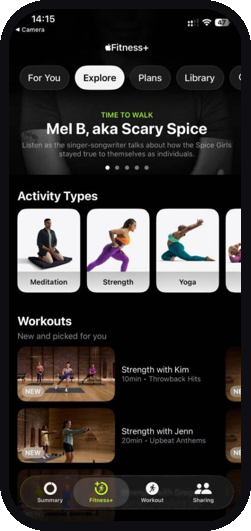
Apple Fitness+
WinnerLeads this comparison on joint-friendly training and short sessions, scoring 8 against 6 on Joint Friendliness.
- High impact
- 5 to 45 min
- Dumbbells, resistance
Choose Apple Fitness+ if you:
- Want sessions of 10 to 30 minutes that stack together into a complete workout
- Already use Apple devices (iPhone, iPad, Apple TV) and would benefit from family sharing
- Want the lowest monthly price ($9.99 vs FIIT at $19.99)
- Have joint history and need an on-screen modifier showing lower-impact alternatives in real time
- Are a beginner or returner who wants clear technique explanations in short blocks
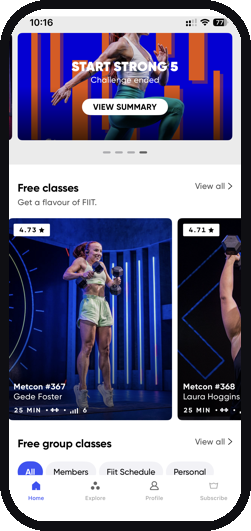
FIIT
Runner-upLeads this comparison on nutrition guidance and building and keeping muscle, scoring 2 against 0 on Nutrition Integration.
- High impact
- 10 to 60 min
- Mat and 2x2m space minimum
- Yes (daily free Group Classes)
Choose FIIT if you:
- Use Android or are not in the Apple ecosystem
- Want live classes with a leaderboard and tracker for accountability
- Are an experienced exerciser without specific perimenopause needs
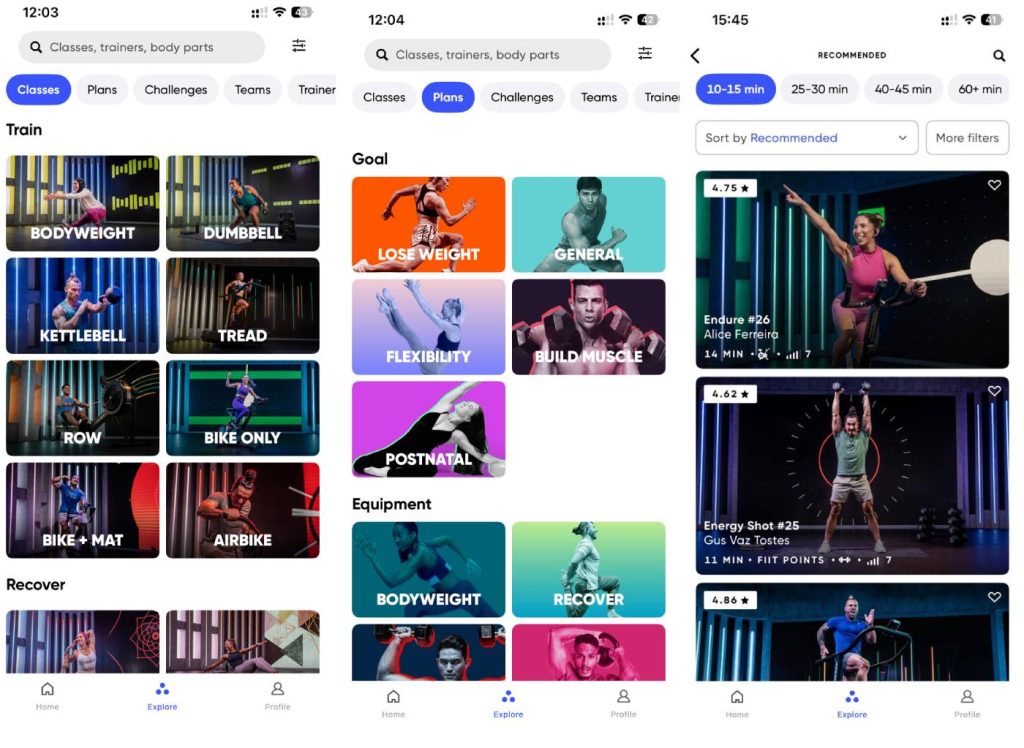
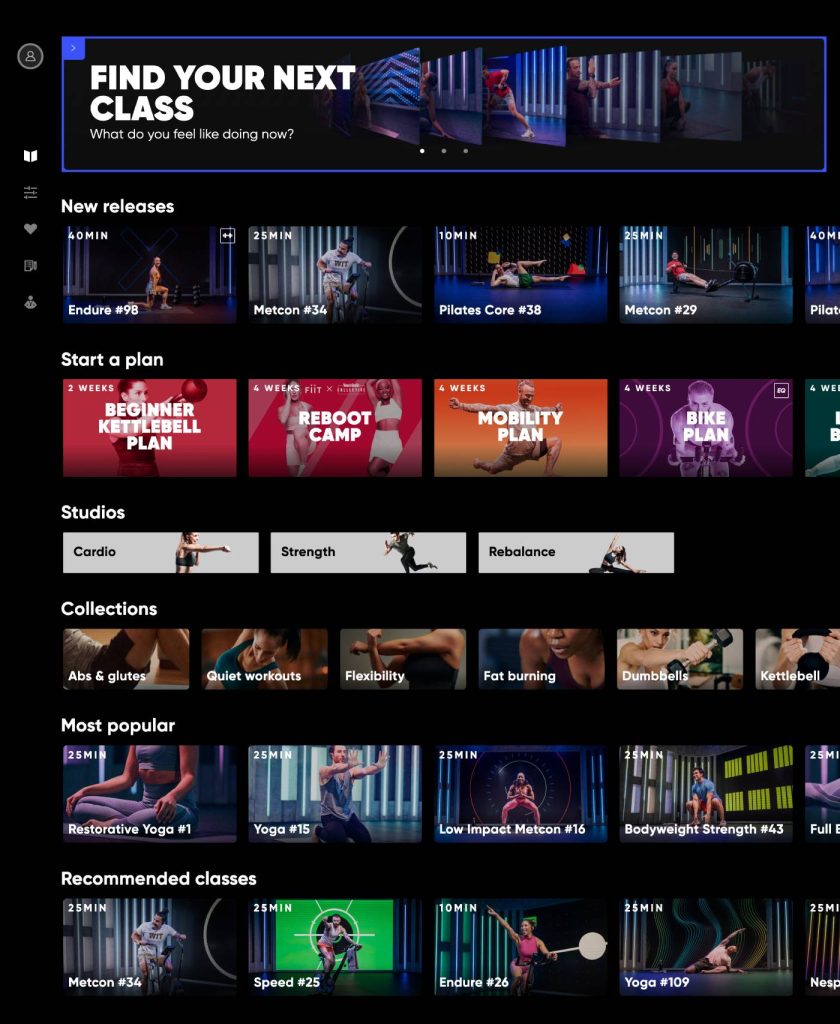
- Want detailed filtering by type, length, equipment, level, trainer, body area, goal
- Want locally-priced billing in GBP, EUR, CAD or AUD rather than USD
Inside Apple Fitness+ and FIIT
Bottom line in 30 seconds for women over 40
- Apple Fitness+ wins overall (6.9 vs 6.2) on the on-screen modifier in every session, the 10 to 30 minute stackable format, family sharing, and the lower price. For perimenopausal women whose joints have lost some elasticity, the in-session modifier alone is the structural advantage that tips the comparison.
- FIIT wins for Android users and live class fans. The platform is built for experienced exercisers who want a general fitness app with strong filtering and live leaderboard classes. The library skews toward HIIT and mid-to-high impact content, which is the wrong default for perimenopausal joints but is what FIIT is best at.
- Neither has perimenopause content. Both are general fitness platforms. For dedicated perimenopause programming look at Pvolve, BODi’s Belle Vitale, or Peloton’s Menopause Health Collection.
FIIT is a general-fitness app, not a perimenopause platform. The published FIIT review explicitly notes the library skews mid-to-high impact and in-class modifications are rarely shown. For perimenopausal women with reduced tendon and ligament elasticity (a documented consequence of oestrogen decline), this is the wrong default. Apple Fitness+’s three-trainer format with an always-on-screen modifier solves exactly this problem.
Quick yes/no comparison
| Feature | Apple Fitness+ | FIIT |
|---|---|---|
| Dedicated perimenopause programme | No | No |
| On-screen modifier in every session | Yes (three-trainer format) | No (separate beginner and advanced classes) |
| Live classes | No | Yes (daily Group Classes + leaderboard sessions) |
| Android app | No | Yes |
| Web browser support | No | No (app only) |
| Annual pricing plan | Yes ($79.99) | Yes ($119.99 or £119.99) |
| Family sharing | Yes (up to 5) | No |
| Free trial | 1 month (3 with new Apple device) | 14 days |
| Free tier available | No | Yes (daily free Group Classes) |
| Local currency billing | Yes (Apple region default) | Yes (GBP, EUR, USD, CAD, AUD) |
| Video rewind / fast-forward inside class | Yes | No |
| Apple Watch metrics on screen | Yes (with watch) | No |
At-a-glance comparison
| Feature | Apple Fitness+ | FIIT |
|---|---|---|
| Her Daily Fit score | 6.9 / 10 | 6.2 / 10 |
| Price (US) | $9.99/month or $79.99/year | $19.99/month or $119.99/year |
| Price (UK) | £9.99/month or £79.99/year | £19.99/month or £119.99/year (£9.99/month effective on annual) |
| Free trial | 1 month standard (3 with new Apple device) | 14 days (cancel at least 72 hours before trial ends) |
| Ecosystem | iPhone, iPad, Apple TV only | iOS, Android, smart TVs |
| Approach | Stackable short-session library with on-screen modifier | Boutique-studio energy library with live leaderboard sessions |
| Session length | 5 to 45 min, designed to stack | 10, 25, 40 or 60 minutes; 25-minute most useful |
| Perimenopause content | None labelled | None |
| Modification quality | Three trainers on screen with consistent modifier | Beginner and advanced versions as separate classes; mid-class scaling rare |
| Equipment needed | Dumbbells, bands, mat (optional) | Mat and 2x2m space minimum; dumbbells unlock most strength studio |
| Live classes | None | Daily free Group Classes plus live leaderboard sessions |
| Library size | 1,000+ workouts and meditations | 2,000+ on-demand classes plus 40+ training plans |
| Real-time heart rate metrics on screen | Yes (Apple Watch required) | Yes (via supported tracker) |
| Cancellation | Apple ID settings, straightforward | Web sign-ups must cancel via app; cancel 72 hours before trial ends |
| Women Over 40 Specificity | 4.3 / 10 | 3.2 / 10 |
Her Daily Fit scoring breakdown
| Category | Weight | Apple Fitness+ | FIIT | Winner |
|---|---|---|---|---|
| Time Efficiency | 15% | 9 | 7.5 | Apple Fitness+ |
| Muscle Potential | 15% | 7.5 | 8 | Tied |
| Women Over 40 Specificity | 15% | 4.3 | 3.2 | Apple Fitness+ |
| Joint Friendliness | 12% | 8 | 6 | Apple Fitness+ |
| Recovery Compatibility | 10% | 7 | 6.5 | Apple Fitness+ |
| Programme Structure | 10% | 7.5 | 6.5 | Tied |
| Value for Money | 8% | 7 | 6 | Apple Fitness+ |
| UX and Design | 8% | 7.5 | 6.5 | Tied |
| Nutrition Integration | 7% | 0 | 2 | Tied (both zero) |
| Overall | 100% | 6.9 / 10 | 6.2 / 10 | Apple Fitness+ |
Apple Fitness+ wins five categories outright and ties on four. FIIT does not win any category outright in this comparison. The 0.3-point overall gap reflects how Apple Fitness+’s structural advantages (on-screen modifier, family sharing, lower price, more reliable joint friendliness) all sit on the perimenopause-relevant categories, while FIIT’s strengths (Android compatibility, live leaderboard classes, local currency billing) are operational rather than perimenopause-aligned.
Joint friendliness: Apple Fitness+ wins decisively on per-session modifier
This is the category where the structural difference between these two platforms matters most for perimenopausal women.
Why joint friendliness matters more during perimenopause
As oestrogen drops in perimenopause, tendons and ligaments (the bands of tissue that connect muscle to bone and bone to bone) lose some of their elasticity. Watt 2018 documents the increased frequency of musculoskeletal pain and arthritis around menopause and the role of oestrogen deficiency in predisposing women to these conditions. The implication is that perimenopausal women should be more deliberate about loading patterns, particularly high-impact loading from jumping or repeated impact through knees and hips.
For women with any joint history (meniscus, knee, hip, back, shoulder), this matters more. The published FIIT review notes that joint pain affects more than 50% of women in the menopause transition, which makes a platform’s modification quality more than a nice-to-have.
Apple Fitness+’s structural advantage: the on-screen modifier in every class
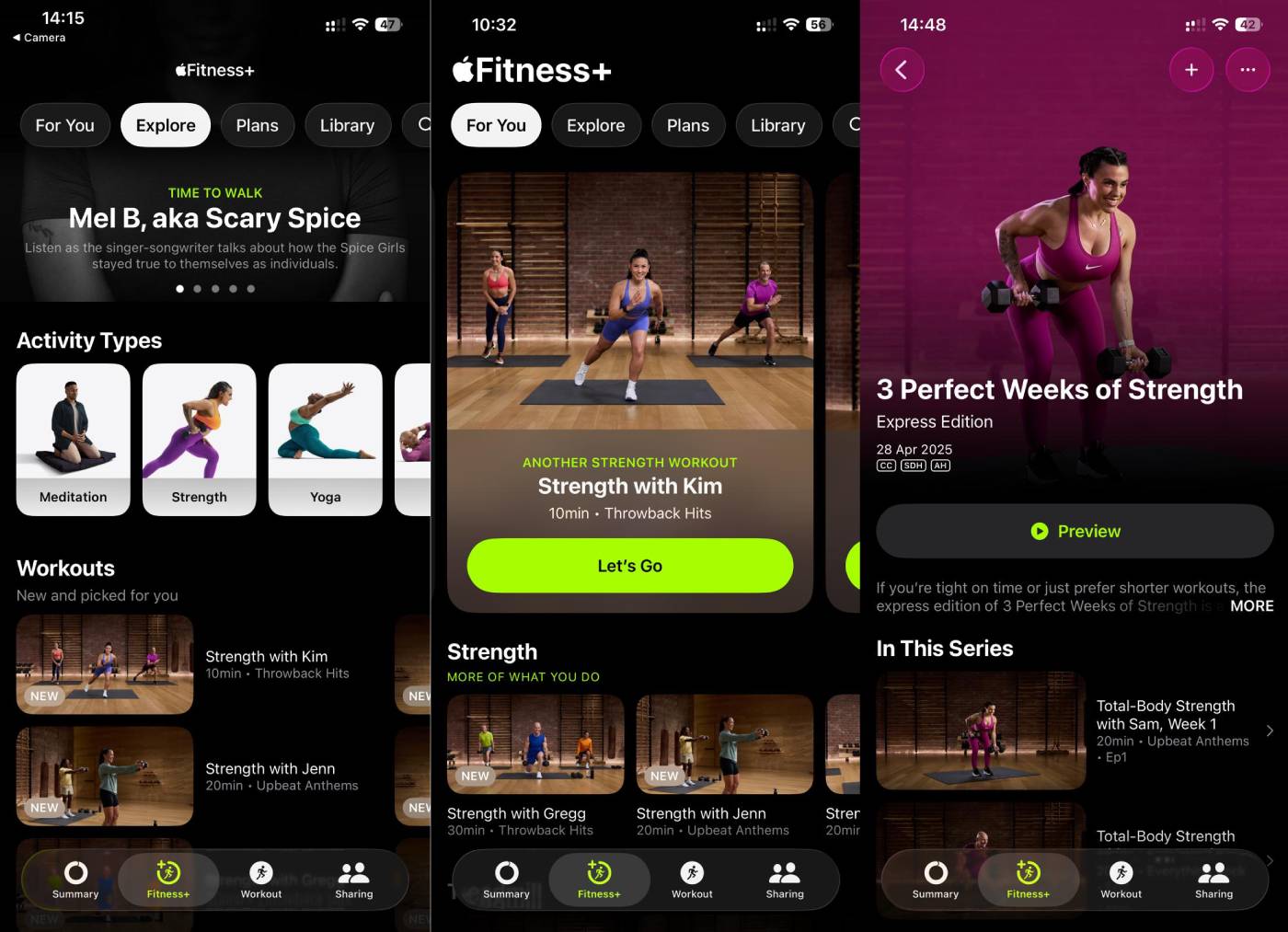
Every Apple Fitness+ class has three trainers on screen: a lead coach who explains and demonstrates, one trainer at full intensity, and one consistently showing modifications throughout (lower pace, less impact, easier on joints). This is the most consistent modifier system tested across forty-plus platforms.
The practical difference for perimenopausal joints is what this looks like in real time. On most platforms, the instructor might say “modification: step rather than jump” once at the start of a sequence and never reference it again. The user has to remember and self-direct. On Apple Fitness+, the third trainer is physically performing the lower-impact version of the move for the full duration. If you start the session at full intensity and a movement starts to twinge a knee mid-set, you simply shift your eyes to the modifier and follow her instead. No pausing, no searching for an alternative track.
FIIT’s modification approach
FIIT scores 6 / 10. The platform has beginner and advanced versions of many classes as separate sessions. Mid-class modification scaling rarely happens within a single session. The published review notes the pace is fast and in-class modifications are rarely shown.
The practical problem for perimenopausal women is that if you start a FIIT class at the advanced version and need to dial back partway through, the platform does not give you that pathway naturally. You either grit through the harder version (risking joint aggravation) or stop the session and restart the beginner version (which most people do not do). Apple Fitness+ removes this decision entirely.
What this means for your decision
For perimenopausal women with any joint history, Apple Fitness+’s on-screen modifier is the safer default. For experienced exercisers without joint issues who can self-direct intensity, FIIT’s approach works. The published FIIT review is explicit: the platform is designed for experienced exercisers without specific perimenopause needs.
Perimenopause programming: neither has dedicated content, Apple Fitness+ is the safer general fit
Both platforms are general-fitness apps without perimenopause programming. The decision becomes about which general platform suits perimenopausal training reality better.
What perimenopause-aware training requires
Three physiological changes during perimenopause shape what training should look like. Oestrogen decline accelerates loss of muscle and bone. Maltais 2009 documents the trajectory and a 2022 systematic review on resistance training for postmenopausal women confirms structured progressive loading as the most effective intervention. Baseline cortisol elevates, making sustainable intensity more important than maximum intensity. Tendon and ligament elasticity decreases, making joint-safe loading more important.
A platform that suits perimenopause without having dedicated programming for it will work if its defaults align with these realities. A platform whose defaults pull toward high-intensity and high-impact training will work against you.
Why Apple Fitness+ defaults align better with perimenopause
Apple Fitness+ has the on-screen modifier in every session showing lower-impact alternatives. The stackable 10 to 30 minute format respects perimenopausal energy patterns where 45-minute commitments may not be sustainable on poor-sleep days. The library balances strength, Pilates, yoga and dance alongside HIIT rather than defaulting to high-intensity content.
None of this is perimenopause-specific. It is general fitness done in a way that does not actively work against perimenopausal training reality.
Why FIIT’s defaults work against perimenopause
The FIIT library skews toward HIIT and mid-to-high impact content. The coaching pace is fast. In-class modifications rarely happen. The video player lacks rewind and fast-forward, which becomes a practical problem given the cognitive symptoms (forgetfulness, attention difficulty) that affect a significant portion of women during the menopause transition. The platform’s published review describes it directly: not designed for perimenopause as a primary audience.
FIIT is a good general fitness platform. It is not the wrong choice for an experienced exerciser without perimenopause needs. For perimenopausal women specifically, the platform’s defaults pull in the wrong direction.
What this means for your decision
For perimenopausal women who want a dedicated programme, neither platform delivers. Look at Pvolve (Menopause Strong), BODi (Belle Vitale), or Peloton (Menopause Health Collection). Between Apple Fitness+ and FIIT specifically, Apple Fitness+’s defaults work with perimenopausal training reality where FIIT’s work against it.
Time efficiency: Apple Fitness+ wins on stacking design
Time efficiency for perimenopausal women is about more than session length. It is about how the platform respects unpredictable training windows.
Why short stackable sessions matter more for perimenopausal women
The “ideal” 45-minute workout assumes a level of free time and energy that most women in their 40s with full-time work and family do not have. Perimenopause adds variable energy across the cycle (or what is left of it), poor-sleep mornings from night sweats, and the cognitive load of symptom management. The training window that actually exists is often 20 to 30 minutes, not 45 to 60. The platform that respects this constraint wins.
Stacking, specifically, matters because perimenopausal energy is not consistent within a day either. Some mornings you have 30 minutes of energy; some mornings you have 12. A platform that lets you commit to a short block and stack a second if you have it produces more consistent weekly volume than a platform built around fixed-length sessions.
Apple Fitness+’s stacking advantage
Apple Fitness+ scores 9 / 10. Every session is 10 to 30 minutes. The stacking design (the app auto-queues the next session) means a 20-minute strength block plus a 10-minute mindful cooldown gives you a complete workout in 30 minutes, with warm-up and cool-down baked into the runtime. For working mothers fitting training around school runs, this is the most practical time-efficiency design tested across forty-plus platforms.
The structural strength is that you can commit to one 20-minute session, and if you have energy left, the app suggests the next stack. If you do not, you stop. The decision is made at the end of the session, not at the start, which matches how perimenopausal energy actually behaves.
FIIT’s session structure
FIIT scores 7.5 / 10. Sessions run 10, 25, 40 or 60 minutes. The published review notes that 25-minute classes are the most useful slot. The 2,000+ class library plus 40+ training plans gives breadth. The structural difference from Apple Fitness+ is that stacking is not the explicit design pattern. You pick a class, you complete it, you decide what is next.
The 25-minute session length is a reasonable default but it is a fixed commitment. If you sit down expecting 25 minutes and your energy or schedule cuts short at 15, you have an incomplete session. On Apple Fitness+ a 15-minute session is a complete unit by design.
What this means for your decision
For perimenopausal women who train in predictable 25-minute single sessions, FIIT works well. For women whose actual training window varies between 15 and 35 minutes day to day and who benefit from stacking shorter sessions together, Apple Fitness+’s explicit stacking design is more accommodating. The variability of perimenopausal energy generally favours the more flexible stacking approach.
Value: Apple Fitness+ wins on price and household sharing
This is one of the categories where Apple Fitness+’s structural advantages compound for perimenopausal households.
Apple Fitness+’s pricing in perimenopausal household context
$9.99/month or $79.99/year (£9.99/month or £79.99/year UK). Family sharing across up to 5 household members through Apple Family. Apple One Premier at $37.95/month bundles Apple Fitness+ with iCloud+, Music, TV+ and Arcade.
For perimenopausal women with families, the household economics matter. One $79.99/year subscription covers a partner training for general fitness, a teenager doing dance, a grandparent in the Workouts for Older Adults, and the perimenopausal woman herself. Per-person cost drops to roughly $20/year for a household of four, which makes the Apple Fitness+ proposition unusually strong from a budget perspective.
FIIT’s pricing
$19.99/month or $119.99/year US. £19.99/month or £119.99/year UK (£9.99/month effective on annual). Locally priced in EUR (€19.99/€119.99), CAD ($29.99/$199.99) and AUD ($29.99/$199.99). 14-day free trial. The local currency billing is a real advantage for women in Canada, Australia, or the eurozone who would otherwise pay USD with exchange rate exposure.
FIIT has a free tier: daily free Group Classes. This is worth noting for women who want to evaluate the platform before committing. The free tier is genuinely usable rather than a marketing teaser, which gives FIIT an unusual value proposition at the entry level.
The fair comparison
Apple Fitness+ at $79.99/year is roughly two-thirds the price of FIIT at $119.99/year. Add Apple Family Sharing and the per-household cost gap widens further. For women in regions where FIIT prices locally and Apple Fitness+ does not bill predictably, FIIT can be the more transparent choice. For the US, UK and most major markets, Apple Fitness+ is meaningfully cheaper for solo users and dramatically cheaper for households.
Nutrition integration: neither has anything meaningful
Both platforms score at the bottom of the comparison series on nutrition. Neither has meal plans, recipe libraries, macro tools or structured nutritional guidance.
Why nutrition matters more after 40
Oestrogen decline changes body composition (the ratio of fat to muscle in your body) even when training is consistent. Adequate protein intake becomes more important to support muscle protein synthesis, which itself becomes less efficient with reduced oestrogen. Blood sugar regulation through meal structure also becomes more relevant as perimenopause progresses.
What this means for your decision
If nutrition support is a priority alongside training, neither platform is the right fit. For perimenopausal women rebuilding the eating side alongside training, BODi’s Portion Fix container system is a structured nutrition framework included in the BODi subscription. Pair Apple Fitness+ or FIIT with a separate nutrition approach if body composition is a primary goal.
Programme structure: tied, both are library-shaped with short-cycle programmes
Both platforms have programme content but the structure is similar in shape.
Why decision-removal matters more in perimenopause
Perimenopause includes cognitive changes most women describe as brain fog: reduced executive function, harder mornings, more friction with routine decisions. Add this to a full-time job and household logistics and the daily question “what should I train” becomes a real reason workouts get dropped. The platform that removes the most decisions across the longest time horizon wins on adherence.
Apple Fitness+’s 3-week cycles
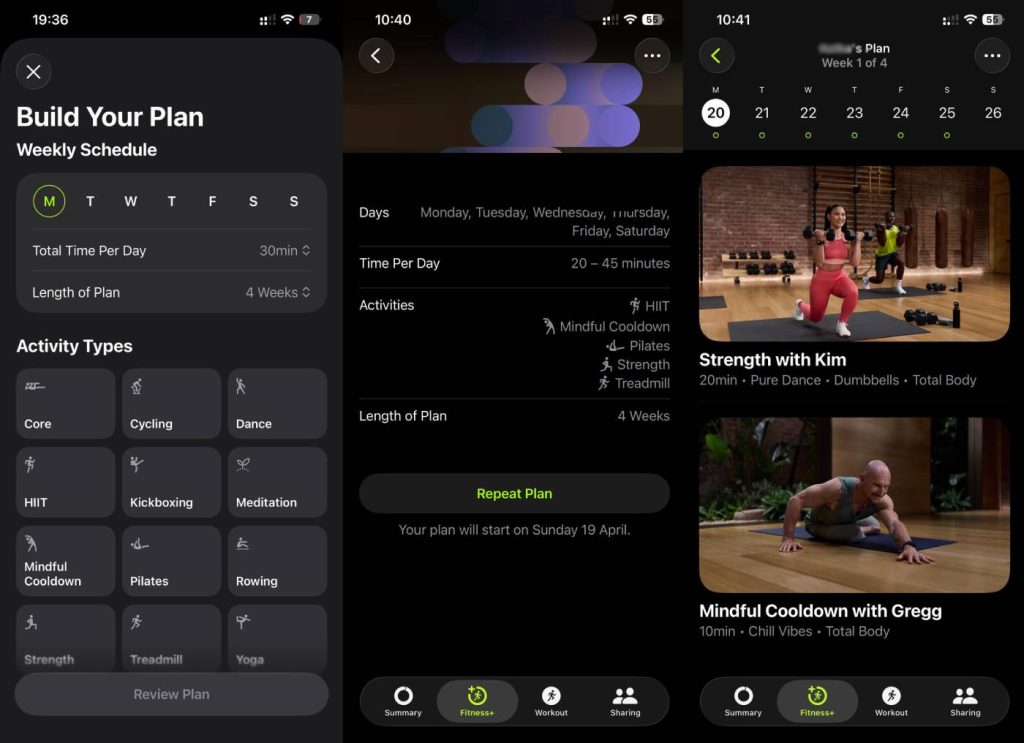
Apple Fitness+ scores 7.5 / 10. Strength Basics in 3 Weeks, 3 Weeks of Strength, 3 Perfect Weeks of Pilates, plus build-your-own custom plans. The 3-week cycles are short enough that finishing feels achievable and long enough that progression is real. The gap is what happens at the end of three weeks: you choose your own continuation. For self-directed women this works; for women whose mental energy is stretched, the recurring “what comes next” decision every three weeks is exactly the friction the platform is otherwise trying to remove.
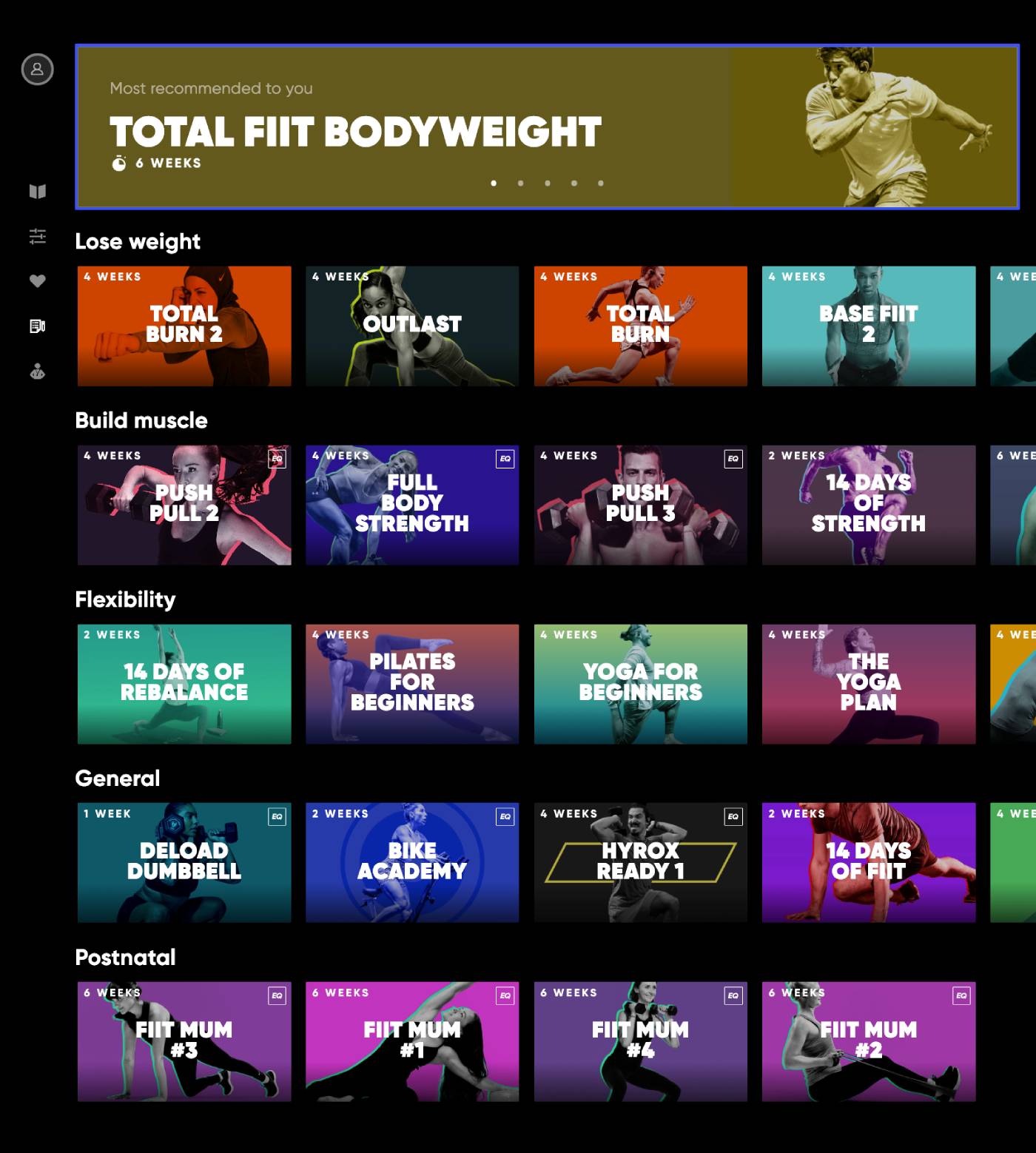
FIIT’s training plans
FIIT scores 6.5 / 10. The platform has 40+ training plans alongside the 2,000+ on-demand library. The plans give multi-week structure. The published review notes the plans are good but not perimenopause-aware. FIIT also allows you to build your own programme from the class library, which works for self-directed exercisers but adds decision-load for women whose brain fog makes that harder.
For perimenopausal women whose brain fog makes daily decisions harder, either platform’s structured programmes reduce the daily “what do I do” decision. Neither delivers the multi-month perimenopause-aware progression that BODi LIIFT4 or The Sculpt Society’s Midlife Movement do, and for the most decision-removed perimenopause experience neither is the right primary choice.
Muscle potential: tied, both deliver short-cycle strength content
Both platforms have strength content. The differences are in coaching style and progression structure.
Why progressive overload matters more after 40
Progressive overload is the principle of gradually adding load over time. In practice this looks like going from 4kg dumbbells to 5kg, then 6kg over a few weeks. Or doing one more repetition than last week. After 40, oestrogen decline accelerates loss of muscle and bone. Maltais 2009 documents the trajectory. The 2022 systematic review on resistance training for postmenopausal women is clear: training works only if the load progresses. The same 4kg shoulder press for a year stops producing change after the first few weeks.
Apple Fitness+’s short-cycle progression
Apple Fitness+ scores 7.5 / 10. The 3 Weeks of Strength programme produces visible progression inside three weeks. During my testing, I went from 4kg/6kg dumbbells in week 1 to 5kg/7.5kg by week 3 with explosiveness added on some movements. The structured 3-week programmes are the part of the platform that produced visible toning for me. The ceiling is the 3-week cycle: there is no long-term plan that progresses over multiple months in stages.
FIIT’s strength studio
FIIT scores 8 / 10. The strength studio is well-developed and the 40+ multi-week training plans provide structured progression for experienced exercisers. The platform allows you to build your own programme from the class library, which is a real advantage for self-directed exercisers who know how to programme their own progression. The structural gap for perimenopausal women is that the strength content assumes some baseline experience; coming to FIIT fresh, the strength sessions can feel under-cued for technique.
What this means for your decision
Neither platform is a heavy-progressive-strength platform. For perimenopausal women whose primary goal is significant muscle building during the oestrogen decline window, see Caroline Girvan CGX or BODi LIIFT4 instead. For muscle retention through short-cycle programming, Apple Fitness+ is the gentler entry; for muscle work alongside multi-week structured plans, FIIT works if you have prior training experience.
Recovery: Apple Fitness+ wins on integrated meditation
Recovery is more important during perimenopause than at any prior life stage, and the platform that builds recovery into the daily training pattern wins this category for the perimenopausal audience.
Why recovery matters more after 40
Recovery capacity decreases through perimenopause for several compounding reasons. Sleep quality often declines partly from night sweats and partly from broader hormonal disruption. Baseline cortisol (the stress hormone your body produces under load) tends to elevate. Muscle protein synthesis, the process by which damaged muscle tissue is rebuilt stronger between sessions, becomes less efficient with reduced oestrogen. Training that exceeds recovery becomes counterproductive rather than additive: cortisol stays elevated, sleep deteriorates further, and the training stimulus that should be building you up starts breaking you down.
For women in their 40s and 50s, building in restoration is structural rather than optional. The platform that makes restoration easy to use wins.
Apple Fitness+’s recovery library
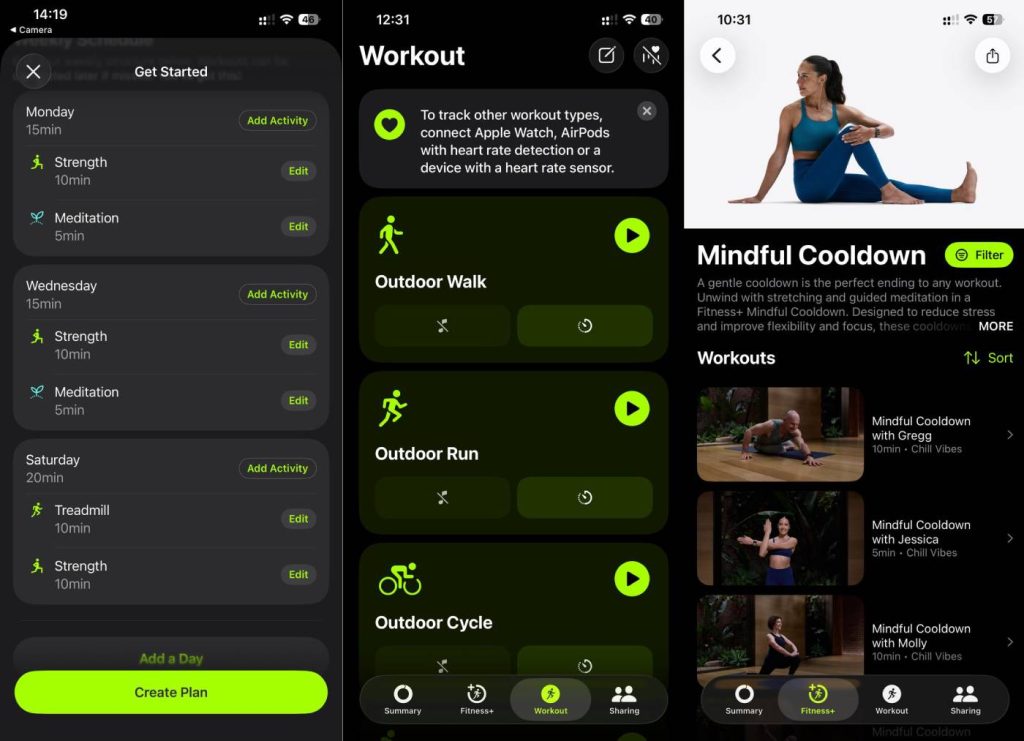
Apple Fitness+ scores 7 / 10. The recovery library includes meditation, mindful cooldown, yoga and gentle walking. Mindful cooldowns from 5 to 10 minutes integrate well with the stacking session model: a 20-minute strength block plus a 5-minute mindful cooldown gives you both training and recovery in a single 25-minute session. During my testing I used the 5 to 10 minute cooldowns almost daily after strength sessions, which is unusual for me on most platforms where recovery content is something I have to remember to use separately.
FIIT’s recovery content
FIIT scores 6.5 / 10. The published review notes FIIT has limited nutrition, meditation and education content. The platform is primarily a training platform with restorative content as a smaller addition. The recovery content exists but is not integrated into the training flow the way Apple Fitness+’s mindful cooldowns are. For perimenopausal women who need restoration baked into the daily pattern, Apple Fitness+’s integration is more reliable.
UX and design: tied with different gaps
Both platforms have meaningful UX gaps for perimenopausal women, and they cancel each other out differently.
Apple Fitness+’s UX
Apple Fitness+ is locked to the Apple ecosystem. iPhone, iPad, Apple TV. No Android, no web app, no Mac app. If you live inside Apple, the integration is seamless. If you do not, you cannot use it at all. During testing, intermittent screen blackouts occurred when projecting from iPhone to TV, requiring a session restart. Filtering across activity types is inconsistent, which made the library harder to browse than it should have been for a platform built around stacking short sessions.
FIIT’s UX
FIIT’s app is available on iOS and Android. The published review notes some long-term users report bugs and crashes. The video player lacks rewind and fast-forward, which is a meaningful gap for women dealing with perimenopausal cognitive symptoms (forgetfulness, attention difficulty) who may need to replay a movement cue. Web sign-ups cannot be cancelled on web; you must download the app to cancel.
The rewind issue specifically is worth flagging because it interacts badly with perimenopause. If you miss what an instructor said because your attention drifted during a hot flash or you forgot to pause when a child interrupted, you cannot go back. You either guess at the movement or sit through the rest of the cue. On Apple Fitness+ standard video controls let you go back ten seconds. This is the kind of small UX detail that compounds across a training year.
What this means for your decision
For perimenopausal women on Apple devices who tolerate occasional screen blackout issues, Apple Fitness+’s UX is the more reliable choice. For perimenopausal women on Android, FIIT is the only option but the rewind gap is a real practical limitation.
Who wins for…
Who wins for women managing perimenopause symptoms
Apple Fitness+. Neither has dedicated perimenopause content but Apple Fitness+’s defaults work with perimenopausal training reality where FIIT’s work against it.
Who wins for women on Android
FIIT. Apple Fitness+ is Apple-only. For Android users this is the decisive factor.
Who wins for the lowest monthly price
Apple Fitness+. $9.99/month vs FIIT at $19.99/month.
Who wins for households sharing one subscription
Apple Fitness+. Family sharing across up to 5 household members. FIIT has no family sharing.
Who wins for joint-friendly daily browsing
Apple Fitness+. On-screen modifier in every session. FIIT library skews mid-to-high impact.
Who wins for live class accountability
FIIT. Daily Group Classes plus live leaderboard sessions with tracker. Apple Fitness+ has no live classes.
Who wins for free tier access
FIIT. Daily free Group Classes are available without subscription. Apple Fitness+ has no free tier.
Who wins for women in Canada, Australia or the eurozone
FIIT (marginally). Local currency billing in CAD, AUD and EUR. Apple Fitness+ bills in Apple’s regional currency which usually works but FIIT’s local pricing is more predictable.
Who wins for short stackable sessions
Apple Fitness+. 10 to 30 minute sessions designed to stack. FIIT’s 25-minute classes are good but not designed for stacking.
Who wins for experienced exercisers
FIIT (for general fitness without peri needs). The platform is built for experienced exercisers. Apple Fitness+ is more beginner-accessible.
Who wins for true beginners over 40
Apple Fitness+. The three-trainer format makes beginners comfortable. FIIT’s fast pace and minimal in-class modifications are not beginner-friendly.
Who wins for women with active joint history
Apple Fitness+ decisively. The on-screen modifier solves the problem FIIT’s library structure creates.
Who wins for video control during sessions
Apple Fitness+. Standard video controls including rewind and fast-forward. FIIT lacks both, which is a practical issue for perimenopausal cognitive symptoms.
Who wins for women who want clinical credibility
Neither. Both are general fitness platforms without clinical advisory boards or peer-reviewed studies. For clinical credibility on perimenopause look at Pvolve.
Who wins for women over 50
Apple Fitness+ (marginally). The on-screen modifier and the calmer default content suit over-50 training better than FIIT’s HIIT-skewed library.
Who wins for value per household
Apple Fitness+. Family sharing widens the gap.
Screenshots from our full reviews
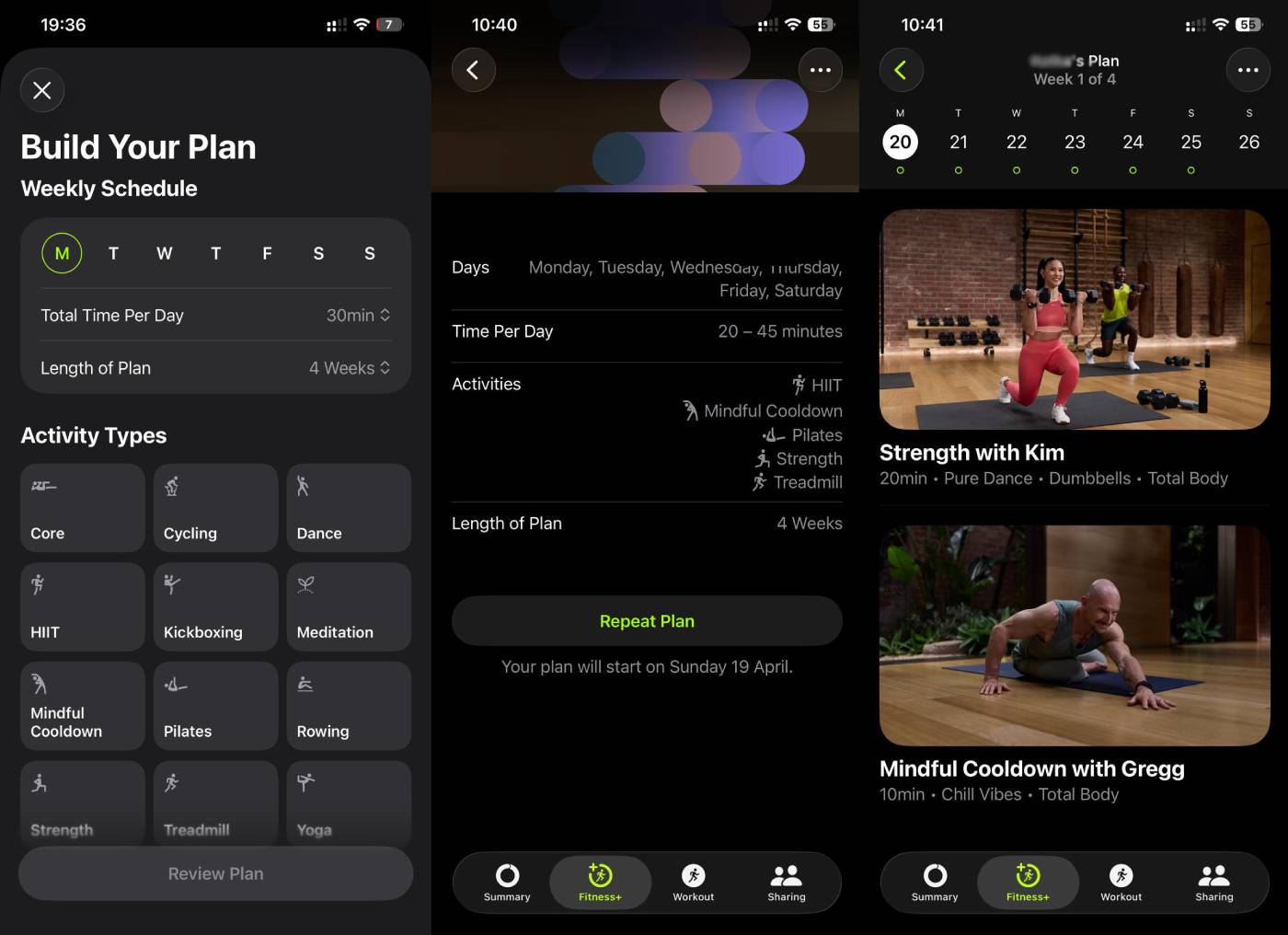
More screenshots: Apple Fitness+
See the full Apple Fitness+ review for methodology and pricing.

Decision tree for women over 40
- You are on Android: FIIT (Apple Fitness+ is Apple-only).
- You want live class accountability: FIIT (Apple Fitness+ has no live classes).
- You want a free tier to try before committing: FIIT (daily Group Classes free).
- Budget caps at $10/month: Apple Fitness+ ($9.99).
- Your household has multiple Apple users: Apple Fitness+ family sharing.
- You have joint history: Apple Fitness+ (on-screen modifier in every session).
- You want short stackable sessions for unpredictable training windows: Apple Fitness+.
- You are an experienced exerciser without perimenopause needs: FIIT (designed for this audience).
- You are a beginner over 40: Apple Fitness+ (the three-trainer format is more accessible).
- You want a perimenopause-specific platform: Neither. See Pvolve, BODi Belle Vitale, or Peloton’s Menopause Health Collection.
- You need local currency billing in CAD, AUD or EUR: FIIT.
- You have perimenopausal cognitive symptoms and rely on rewinding video: Apple Fitness+ (FIIT’s player lacks rewind).
What I did not test
- Apple Watch integration with Apple Fitness+. Tested without an Apple Watch.
- FIIT beyond the 14-day trial. The published FIIT review is based on the 14-day Unlimited free trial.
- FIIT connected machine workouts (the platform supports some smart equipment integration).
- Every Apple Fitness+ programme. Tested 3 Weeks of Strength, sampled Strength Basics, Pilates with bands, dance with Jhon, treadmill walking.
- FIIT live class experience on full subscription. Tested on trial only.
- Long-term adherence beyond five weeks for Apple Fitness+.
Personal testing and observations
Apple Fitness+ testing
I am a woman in my mid-forties, currently in perimenopause, working full-time with two children and training daily. I tested Apple Fitness+ over five weeks of structured daily use on iPhone projected to TV. No Apple Watch. I ran the 3 Weeks of Strength programme, sampled dance classes (Latin Grooves with Jhon), Pilates with bands and ankle weights, and treadmill walking. I also asked my mum (68) to test the Workouts for Older Adults category for an honest second perspective.
Coming back from a month of inactivity, I dropped from 9kg dumbbells to 4kg/6kg in week 1. By week 3 I was at 5kg/7.5kg with explosiveness added on some movements. My weight went up 1kg in the first week, which is normal: when resistance training creates micro-tears in muscle fibres, your body holds onto extra water around the damaged tissue while it repairs, and glycogen in newly-worked muscles binds with water, adding 0.5 to 1.5kg temporarily. By the end of five weeks the scale was down by a net 0.5kg with visible toning.
The standout was the three-trainer format with a consistent modifier on screen. With my meniscus history I followed every strength and Pilates session without knee pain. The dance classes (Latin Grooves with Jhon) made 20 minutes disappear in a way HIIT never does for me. The gap was guidance: nothing labelled or structured for perimenopause, no hormonal education, no symptom-aware programming. The Workouts for Older Adults series my mum tested had too few sessions and the difficulty was too low; she switched to the regular Workouts for Beginners library with light weights and got a better workout.
FIIT testing
I tested FIIT for 14 days on the Unlimited free trial. As a woman in my 40s navigating perimenopause with a previous meniscus injury, I came to the platform looking for the same things I look for on every reviewed platform: clear modifications, sensible joint loading, programming that respects perimenopausal training reality.
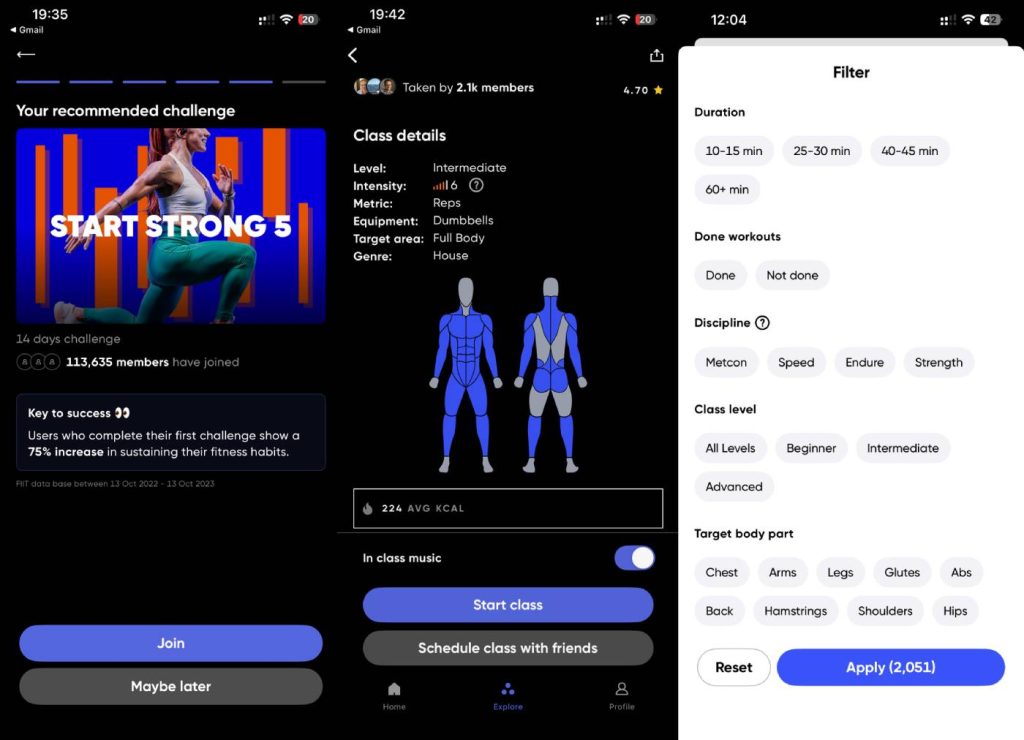
FIIT did not deliver that. The library skews mid-to-high impact. The coaching pace is fast. In-class modifications rarely happen. The video player lacks rewind and fast-forward, which became a practical problem on the days when perimenopausal cognitive symptoms meant I needed to replay a movement cue and could not. The platform is well-built for what it is: a general fitness app with a strong filtering system, named trainers, and live leaderboard classes for the audience it serves. That audience is experienced exercisers without specific peri or menopause needs.
The strengths I noticed were genuine. The filtering is detailed: type, length, equipment, level, trainer, body area and goal. The body activity profile (built around supported trackers) gives meaningful feedback. The free Group Classes tier is unusual for a paid platform and is the kind of value-add that lowers the friction of trying the platform before committing. Live leaderboard sessions provide accountability some women find motivating. For an experienced exerciser without perimenopause needs and on Android (Apple Fitness+ is not available), FIIT is reasonable.
The cancellation friction was real. Web sign-ups must be cancelled in the app, not on the web. I tested the trial cancellation pathway to confirm: download the app, log in, find the membership settings, cancel. This works but it is the kind of friction that exists because the platform benefits from people forgetting to cancel.
For me as a perimenopausal woman managing joint history, FIIT was the wrong default platform. The 14-day trial was the right amount of time to confirm this; I did not continue with paid subscription. The platform is not bad; it is just not built for the Her Daily Fit audience.
Which is better for women over 50?
For women over 50, Apple Fitness+ is the marginally better fit between these two platforms.
Apple Fitness+ for women over 50
The on-screen modifier in every session and the calmer default content suit over-50 training better than FIIT’s HIIT-skewed library. The 10 to 30 minute stackable format accommodates the recovery-aware training pattern that women over 50 typically need. The “Workouts for Older Adults” category on Apple Fitness+ is the weakest part of the platform for this audience (too basic, incorrectly targeted), but the broader Apple Fitness+ library serves over-50 women well when you filter past the Older Adults category and use the general strength, Pilates and yoga content directly.
FIIT for women over 50
FIIT at 50+ is appropriate only for experienced exercisers who have been training at intensity throughout their 40s and want continued challenge. The platform was not designed for an over-50 starting point and the in-class modification gaps that affect perimenopausal women in their 40s become more limiting at 50 and beyond. For active over-50 women returning to fitness or starting fresh, neither platform is the right primary choice; look at The Sculpt Society or Pvolve instead.
Women over 60 starting fresh
Neither platform is right. Both assume baseline fitness and existing motor control. For women in their 60s starting fresh, Melissa Wood Health or BODi’s 4 Weeks for Every Body programme are more appropriate entry points.
Frequently asked questions
Is Apple Fitness+ or FIIT better for women over 40?
Apple Fitness+ is the stronger choice for perimenopausal and menopausal women, scoring 6.9 / 10 versus FIIT at 6.2 / 10. Apple Fitness+ has the on-screen modifier in every session, the 10 to 30 minute stackable session format, family sharing across up to 5 household members, and is roughly half the price of FIIT. FIIT has detailed filtering, free Group Classes and Android support, but the library skews toward HIIT and high-impact content that is wrong for perimenopausal joints by default.
Does FIIT have a perimenopause programme?
No. FIIT has no dedicated perimenopause or menopause programme. The platform is a general-fitness app aimed at experienced exercisers. Apple Fitness+ also has no perimenopause programme but its defaults work better with perimenopausal training reality.
Is Apple Fitness+ cheaper than FIIT?
Yes. Apple Fitness+ is $9.99/month or $79.99/year. FIIT is $19.99/month or $119.99/year US, or £19.99/month or £119.99/year UK. Apple Fitness+ is roughly half the monthly price and family sharing across up to 5 household members widens the gap further.
Which has better modifications for joint issues?
Apple Fitness+ by a clear margin. Every Apple Fitness+ session has three trainers on screen with one consistently showing modifications throughout. FIIT has beginner and advanced versions as separate classes but mid-class scaling rarely happens.
Can FIIT be used outside the Apple ecosystem?
Yes. FIIT has both iOS and Android apps. Apple Fitness+ is Apple-ecosystem only with no Android app.
Does FIIT have live classes?
Yes. FIIT has daily free Group Classes plus live leaderboard sessions with a tracker. Apple Fitness+ has no live classes at all.
Is FIIT good for women over 40 starting fresh?
No, not as a primary platform. FIIT is built for experienced exercisers and the library skews toward HIIT and mid-to-high impact content. For women over 40 coming fresh to home fitness, Apple Fitness+ or The Sculpt Society are more appropriate starting points.
Research citations
- Maltais ML, Desroches J, Dionne IJ. Changes in muscle mass and strength after menopause. Journal of Musculoskeletal and Neuronal Interactions. 2009;9(4):186-197. PubMed.
- Watt FE. Musculoskeletal pain and menopause. Post Reproductive Health. 2018;24(1):34-43. doi: 10.1177/2053369118757537. SAGE.
- Resistance training for postmenopausal women: systematic review and meta-analysis. 2022. PubMed.
About this review
Reviewed by Katy Cole. Apple Fitness+ tested personally across five weeks of structured daily use on iPhone projected to TV (no Apple Watch), including the 3 Weeks of Strength programme, dance, Pilates and treadmill content. FIIT tested personally across the 14-day Unlimited free trial including strength classes, Pilates, and the body activity profile setup. Prices verified against apple.com/apple-fitness-plus and fiit.tv in May 2026.
Katy is the lead reviewer at Her Daily Fit. Fifteen years personally testing online fitness platforms. Mid-forties, currently in perimenopause, UK-based. Every claim on this page is either personally tested or attributed to peer-reviewed research. See how we score every programme using 9 weighted criteria.
Medical disclaimer: The content on this page is for informational purposes only and is not medical advice. Consult your GP or a healthcare provider before beginning a new exercise programme, particularly if you are managing perimenopause, menopause, or any existing health condition or injury.
Compared with
Where these brands appear in our “Best for” rankings