
Peloton scores higher overall, 7.3 against 6.2, and is the stronger platform for joint-friendly training and perimenopause-specific programming. FIIT is the better pick if what you need most is building and keeping muscle.
- Score 7.3 vs 6.2
- Both tested hands-on
Quick answer: Peloton is the stronger overall platform for women over 40, scoring 7.3 against 6.2. It is ahead for joint-friendly training, perimenopause-specific programming and recovery between sessions. FIIT still wins for building and keeping muscle, so it is the better choice if that is your priority. The two are level on programme structure and nutrition integration.
The two platforms
Same nine weighted categories, two different women. Here is who each one is built for.
Peloton
Winner
Leads this comparison on joint-friendly training and perimenopause-specific programming, scoring 9 against 6 on Joint Friendliness.
- Low impact
- 20 to 45 min
- None for app
- Yes (US, Canada, Australia, Germany)
Choose Peloton if you:
- Are managing perimenopause or menopause and want a dedicated content collection built around the physiology
- Have a current or previous knee, hip or ACL injury and want credentialled rehab content (HSS partnership)
- Need in-class modification cues throughout every session (not optional, not rare)
- Want a video player you can scrub, rewind and fast-forward through (FIIT does not allow this)
- Want live class accountability with a leaderboard at the breadth Peloton offers
FIIT
Runner-up
Leads this comparison on building and keeping muscle, scoring 8 against 7.5 on Muscle Potential.
- High impact
- 10 to 60 min
- Mat and 2x2m space minimum
- Yes (global, localised billing)
Choose FIIT if you:
- Want UK-native billing in pounds and the cheapest annual commitment (£119.99/year, £9.99 per month effective)
- Want a permanently free tier (Group Classes) with no card required to try the platform
- Train primarily strength and have a good gym kit at home (dumbbells, kettlebells, bench)
- Enjoy boutique-studio energy and named trainers from the London fitness scene
- Want HYROX-aligned conditioning content (Gede Foster’s Functional Strength sessions)
Quick answer
Quick answer: Peloton wins overall at 7.3 versus FIIT at 6.2. Peloton takes the score on the dedicated Menopause Collection (20-minute sessions covering low-impact ride, hike, endurance, bodyweight strength and kettlebell), the Hospital for Special Surgery ACL recovery programme, in-class modification cueing built into every class, and a video player that lets you scrub and rewind. FIIT wins on UK-native pricing (£19.99 per month or £119.99 per year), a permanently free Group Classes tier with no card required, and a genuinely strong strength studio led by Gede Foster (FIIT Director of Fitness and Performance and HYROX Global MC). The structural gaps with FIIT for the women-over-40 audience: no dedicated perimenopause or menopause programme, in-class modifications rarely shown, and a video player with no rewind, fast-forward or scrub bar.
Inside FIIT and Peloton
Bottom line in 30 seconds
- Peloton wins on perimenopause-specific design. 7.3 versus FIIT at 6.2. The Menopause Collection sits inside the subscription as 20-minute sessions built around perimenopausal physiology. Modification cues are built into every class. The HSS ACL recovery programme is clinically credentialled. The video player allows scrub and rewind, which matters for users managing the cognitive symptoms perimenopause and menopause routinely produce.
- FIIT wins on price and on UK-native experience. £19.99 per month or £119.99 per year (£9.99 per month effective) is cheaper than Peloton App One at £12.99 per month over 12 months (Peloton has no annual plan). FIIT’s permanently free Group Classes tier with daily live classes is unmatched in the UK fitness app market. Gede Foster’s Functional Strength content (HYROX Global MC) is genuinely strong for women who already train.
- The structural gaps with FIIT for this audience. No dedicated perimenopause or menopause programme. In-class modifications rarely shown (the coaching style is boutique-studio energy at fast pace, designed for general-fitness audiences). Video player without rewind or fast-forward. For perimenopausal users specifically, these gaps cost FIIT this comparison.
FIIT video player has no rewind, fast-forward or scrub bar. You can pause and resume only. For perimenopausal users managing the cognitive symptoms (forgetfulness, attention difficulty) that affect a substantial portion of women during the menopause transition, this is a meaningful UX gap. Peloton allows full scrubbing through any class.
Peloton’s cancel link was non-functional during testing. If you sign up, do not rely on the standard cancel link. Go to app settings, account, membership, or contact support directly. Set a calendar reminder before day 30 of the free trial.
Quick yes or no comparison
| Feature | FIIT | Peloton |
|---|---|---|
| Dedicated perimenopause programme | No | Yes (Menopause Collection) |
| Credentialled injury rehab | No | Yes (HSS ACL programme) |
| In-class modifications | Rarely shown | Built into every class |
| Video player rewind / fast-forward | No | Yes |
| Live classes | Yes (daily Group Classes) | Yes (leaderboard, real-time) |
| Permanently free tier | Yes (Group Classes, no card) | No (30-day trial only) |
| Annual plan | Yes (£119.99/yr Unlimited) | No (monthly only on App tiers) |
| UK-native pricing | Yes (£ pricing, UK-built) | Yes (£12.99 / £28.99) |
| Hardware option | No (app only) | Yes (Bike, Tread, Row) |
| Equipment required | Mat plus 2x2m space minimum | None for App tiers |
| HYROX-aligned content | Yes (Gede Foster) | Limited |
| Available outside UK | Yes (global, localised billing) | Yes (US, Canada, Australia, Germany) |
At a glance
| FIIT | Peloton | |
|---|---|---|
| UK monthly price | £19.99/mo (Unlimited) | £12.99/mo (App One) · £28.99/mo (App Plus) |
| UK annual price | £119.99/yr (£9.99/mo effective) | No annual plan |
| US monthly price | $19.99/mo · $119.99/yr | $15.99/mo (App One) · $28.99/mo (App Plus) |
| Free tier | Yes (Group Classes, no card) | No |
| Free trial | 14 days | 30 days |
| Geography | Global (localised billing in GBP, EUR, USD, CAD, AUD) | US, UK, Canada, Australia, Germany |
| Class library | 2,000+ on-demand · 40+ training plans | Thousands across 15+ workout types |
| Studios / pillars | Three: Cardio, Strength, Rebalance | 15+ workout types |
| Class lengths | 10, 25, 40, 60 minutes | 5 to 60+ minutes |
| Perimenopause programming | None dedicated | Menopause Collection (20-min low-impact) |
| Modification cueing | Rarely shown | Built into class |
| Video player UX | No rewind, fast-forward or scrub | Full scrubbing |
| Personal testing | 14 days on Unlimited free trial | Mixed sessions across strength, yoga, walking, running |
| Overall score | 6.2 / 10 | 7.3 / 10 |
Full scoring breakdown
| Category | Weight | FIIT | Peloton | Winner |
|---|---|---|---|---|
| Time Efficiency | 15% | 7.5 | 9 | Peloton |
| Muscle Potential | 15% | 8 | 7.5 | FIIT |
| Women Over 40 Specificity | 15% | 3.2 | 6 | Peloton |
| Joint Friendliness | 12% | 6 | 9 | Peloton |
| Recovery Compatibility | 10% | 6.5 | 8.5 | Peloton |
| Programme Structure | 10% | 6.5 | 6.5 | Tie |
| Value for Money | 8% | 6 | 7 | Peloton |
| UX and Design | 8% | 6.5 | 7.8 | Peloton |
| Nutrition Integration | 7% | 2 | 2 | Tie |
| Overall | 100% | 6.2 | 7.3 | Peloton |
Why these scoring categories matter more after 40
Three physiological changes during perimenopause shape what training should look like. Oestrogen decline accelerates loss of muscle and bone, which makes resistance training more important rather than less. Maltais 2009 documents the trajectory, and the 2022 systematic review on resistance training for postmenopausal women confirms structured progressive loading as the most effective intervention. Baseline cortisol elevates, which compresses recovery capacity. Tendon and ligament elasticity decreases, which Watt 2018 documents as a primary driver of musculoskeletal pain across the menopause transition. Add to that the cognitive symptoms (forgetfulness, attention difficulty) that affect a substantial portion of women during the menopause transition, and the platform UX itself becomes part of how usable it is.
That physiological reality is why these scoring categories weight what they do. Time Efficiency at 15% reflects that women over 40 have less margin for sessions that overrun. Muscle Potential at 15% reflects the muscle-loss curve that becomes urgent rather than optional after 40. Women Over 40 Specificity at 15% reflects whether the platform is built for this physiology or treats it as an edge case. Joint Friendliness at 12% reflects that decreased ligament elasticity makes platforms with rare modification cueing a higher injury risk after 40 than they were at 30.
Between FIIT and Peloton, the biggest gaps sit on Women Over 40 Specificity, Joint Friendliness (FIIT’s modification gap), and UX and Design (FIIT’s video player limitation). Peloton’s dedicated perimenopause content and modification culture pull ahead in three of the four highest-weighted categories. FIIT pulls back ground on Muscle Potential (Gede Foster’s strength content is excellent) and on price.
Time efficiency 7.5 vs 9
FIIT’s class length structure is 10, 25, 40 or 60 minutes, with 25-minute classes positioned as the most useful slot. The 25-minute Functional Strength sessions with Gede Foster (typically with a finisher built in) sit in the right time-budget zone for perimenopausal women managing energy and schedule constraints. The 10-minute classes work as add-ons for mobility, abs or quick activation.
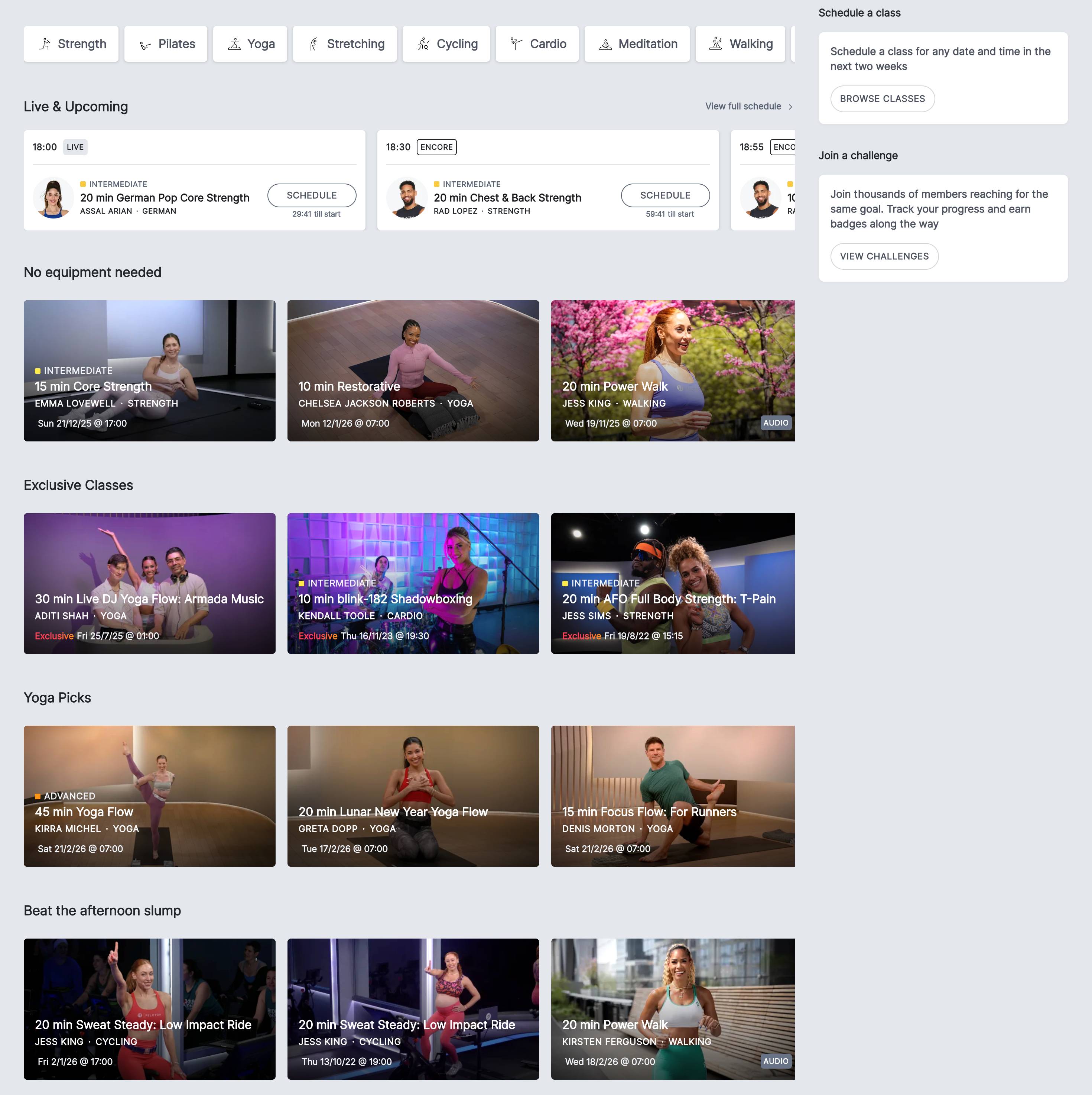
Peloton’s class durations run from 5 minutes to 60+, with genuine 20-minute options across most workout types. Peloton IQ builds custom workouts based on the duration you have available and the muscle groups you want to target, which removes daily decision-making in a way FIIT’s filter-and-pick browsing does not. Class Stacking lets you queue up to 10 classes back-to-back into a custom playlist.
The honest practical difference: on a 30-minute slot, FIIT’s 25-minute class plus a 5-minute mobility add-on works cleanly. Peloton’s IQ generator builds the same total time around your preferences without manual stacking. Both deliver time-efficient sessions; Peloton’s IQ removes one tap of decision-making. The friction point on FIIT is the video player limitation, which adds time invisibly: if you miss a cue and want to rewind, you cannot, so you either guess the movement or stop the class entirely.
Muscle potential 8 vs 7.5
Muscle potential is where FIIT pulls ahead, and the reason is the credentialling of the strength content. Gede Foster, FIIT’s Director of Fitness and Performance and the HYROX Global MC, leads Functional Strength sessions with clear progressive structure: she explains what we are going to do, previews the next move on the left of the screen, and her cueing assumes you are training to build, not just to move. The strength studio also includes Push Pull, Abs and Core, Kettlebells, HYROX-specific training, and full-body strength with Angela Gargano.
Peloton’s strength content is dumbbell-based and not optimised for progressive overload at the same level. The instructor quality is high. Modification cueing is excellent. But guided progressive structure (this week add 1kg, this week add a rep) is not how Peloton’s main strength library is built. Peloton Strength+ (a separate AI-generated strength app, $9.99/mo US iOS only, free with App Plus) lets you log weights and reps with progressive structure, which closes some of the gap but only for App Plus subscribers in the US on iOS.
The honest read: for women already lifting and wanting structured strength progression, FIIT’s Gede Foster content is the stronger pull. For women newer to strength training or wanting maintenance plus broader cross-training, Peloton works. Both share the same broader gap on women over 40 strength specifically: neither prompts the heavier loading that the 2022 systematic review identifies as necessary for meaningful hypertrophy after menopause. Add a logged barbell or heavier kettlebell routine outside the platform if visible body composition change is the goal.
Why progressive overload matters more after 40
Progressive overload is the principle of gradually adding load over time. After 40, oestrogen decline accelerates muscle and bone loss, and a structured training response is the most effective counter. The 2022 systematic review on resistance training for postmenopausal women confirms structured loading works only if the load progresses. FIIT’s strength studio offers a clearer path here than Peloton’s main app because the trainer credentialling (HYROX, performance-coaching background) is more strength-aligned. Peloton wins on injury rehab and modification depth. For women optimising for strength gain specifically, FIIT has a slight content edge. For women optimising for overall perimenopause health (joints, recovery, cardio, mood), Peloton’s broader collection wins.
Women over 40 specificity 3.2 vs 6
This is the category where Peloton wins most clearly, and it matters for this site’s audience.
FIIT has no dedicated perimenopause or menopause programme. The platform’s strengths (detailed filtering, named trainers, free Group Classes tier, body activity profile) are real but generic to a general-fitness audience. There is no menopause collection, no perimenopause-aware programming arc, no women’s health audio content, no hormone-aware curation. For perimenopausal users specifically, this is a structural gap.
Peloton’s Menopause Collection is a curated set of 20-minute sessions covering low-impact ride, hike, endurance, bodyweight strength and kettlebell, built specifically around perimenopausal physiology (reduced tolerance for sustained high cortisol, joint sensitivity, the need for load-bearing work without excessive impact). The collection sits inside the standard App One subscription at no additional cost. The HSS ACL recovery programme adds clinically credentialled rehab content for women with joint history. Modification cues are built into every class.
The score gap on this category alone explains a significant portion of the overall gap. If perimenopause-specific design is what you are looking for, Peloton is the stronger platform between these two. FIIT works for women over 40 who want a strong general-fitness platform with named UK trainers and do not need menopause-specific content; FIIT does not work as a perimenopause-targeted choice.
What menopause-specific programming should include
Current evidence on exercise prescription for the menopause transition calls for a combination of endurance training (cardiovascular health, mood regulation), structured resistance training (muscle and bone retention), balance and mobility work (fall prevention, joint health), and stress-regulation modalities (cortisol management, sleep). A 2024 overview of reviews on physical activity and menopausal symptoms confirms this combination delivers the strongest symptom-management outcomes.
Peloton’s Menopause Collection checks the relevant boxes (endurance, strength, low-impact options, mindfulness via the broader meditation library). FIIT covers endurance, strength and rebalance through its three studios but not packaged for perimenopause specifically. The packaging matters: it removes the decision-making burden of building your own menopause programme from a general library.
Joint friendliness 6 vs 9
Joint health is one of the under-discussed parts of perimenopause. Decreased oestrogen reduces tendon and ligament elasticity. Watt 2018 documents how this drives musculoskeletal pain across the menopause transition. For women with existing knee, hip, shoulder or back issues, joint-aware platform choice matters more after 40 than before.
FIIT’s joint-friendliness is the weakest part of the platform for this audience. The coaching style is boutique-studio energy at fast pace. In-class modifications are rarely shown. When a movement does not work for your body, you have to know your own modifications in advance or you push through (which is exactly what perimenopausal joints do not want). For experienced lifters with good movement knowledge, this is workable. For women returning to training or managing a fresh diagnosis, it is a real gap.
Peloton’s joint-friendliness is genuine and accessible. The Menopause Collection, low-impact cycling, yoga, barre, pilates, stretching and walking content mean multiple daily options that do not load joints beyond what women managing injury or hormonal changes can handle sustainably. Modification cues are built into class. With my own previous meniscus injury, I trained consistently across the testing period without aggravation. The Hospital for Special Surgery ACL recovery programme gives clinically credentialled rehab content FIIT does not have.
Peloton wins this category clearly. For women with any joint history or active sensitivity, Peloton’s in-class modification culture and HSS rehab content are the differentiators. FIIT works if you already know your modifications and the strength studio’s intensity suits you; for the broader perimenopausal audience, the joint-awareness gap pulls FIIT’s score down.
Recovery compatibility 6.5 vs 8.5
Recovery compatibility is about whether the platform supports training when energy, sleep and stress are variable, which is the baseline state of perimenopause for many women.
FIIT’s Rebalance studio covers Pilates, yoga and mobility, and the Lottie Murphy Pilates content is well-produced. The Rebalance library is competent but not deep on dedicated restorative content (sound bath, yoga nidra, breathwork). The integration with the rest of the platform is good (you can stack a Rebalance class with a Strength session in the same training day). For women who already know what restorative content they need, FIIT delivers; for women who want a deep, curated recovery library, the gap is real.
Peloton has a deep yoga, stretching and meditation library that supports recovery between higher-intensity sessions. The breadth means you can deliberately build a training week that manages cortisol load. Sleep-sensitive content (evening yoga, wind-down meditation) is available without searching. The Menopause Collection itself includes restorative sessions calibrated for perimenopausal recovery needs.
Peloton wins this category narrowly. The Menopause Collection’s restorative content (calibrated for perimenopausal recovery) is the differentiator FIIT does not match. Both platforms work for women already self-directed on recovery; Peloton works better for women who want it built into the perimenopause-specific programming.
Programme structure 6.5 vs 6.5
Programme structure is whether the platform tells you what to do each day, or whether you build your own plan.
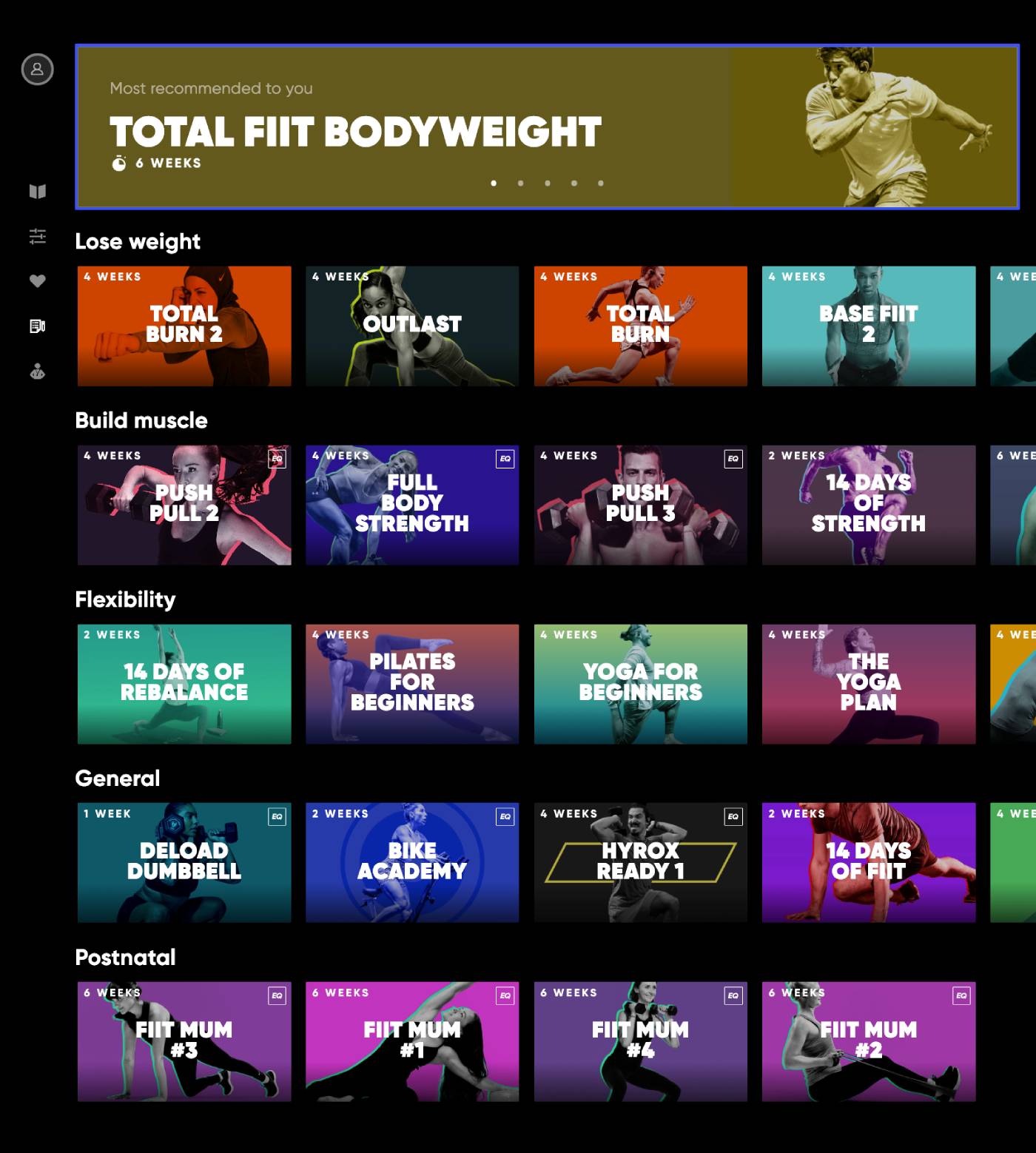
FIIT has 40+ training plans across the three studios (Cardio, Strength, Rebalance) plus body activity tracking via the optional tracker. The plans are competent and varied. The structural gap for this site’s audience: no plans built specifically for perimenopause or menopause. You can use the filtering to select Pilates plus low-impact cardio plus rebalance to approximate a perimenopause-friendly week, but FIIT does not assemble that for you.
Peloton’s programme structure has the same general weakness (the Menopause Collection sits more as a curated library than a weekly structured arc), but the live class schedule and Peloton IQ create accountability and decision-removal that FIIT does not match at the same scale. Class Stacking lets you queue up to 10 classes back-to-back. Peloton IQ generates a workout for the time and muscle groups you specify.
The honest read: neither platform offers a true structured 6-week perimenopause arc (Obe Fitness wins that comparison cleanly). Between FIIT and Peloton specifically, Peloton edges ahead on structure-enabling features (IQ, Class Stacking, live class schedule) and on the Menopause Collection’s curation. FIIT works if you already know how to structure your own week.
A closer look at FIIT
Value for money 6 vs 7
FIIT Unlimited costs £19.99 per month or £119.99 per year (£9.99 per month effective). US pricing is $19.99/month or $119.99/year. EUR is €19.99/€119.99. CAD is $29.99/$199.99. AUD is $29.99/$199.99. Visitors from unsupported regions are billed in USD as fallback. The 14-day free trial requires a card; cancel at least 72 hours before trial ends to avoid charges. FIIT also has a permanently free Group Classes tier (daily scheduled live classes, no card required).
Peloton App One is $15.99/month US or £12.99/month UK with a 30-day free trial. App Plus is $28.99/month US or £28.99/month UK. There is no annual plan on either App tier. Over 12 months, Peloton App One UK totals £155.88; FIIT Unlimited annual at £119.99 is £35.89 cheaper. On monthly commitment, Peloton App One at £12.99 is cheaper than FIIT Unlimited at £19.99.
The cleanest value position: FIIT Unlimited annual is the cheapest commitment for women who will use the platform for 12 months. Peloton App One monthly is the cheapest entry for women who want maximum flexibility. FIIT’s free Group Classes tier is the strongest free option (Peloton has no permanently free tier). If perimenopause-specific content is not a requirement and price is, FIIT wins on annual. If perimenopause content is the priority, Peloton’s content premium justifies the higher annualised cost.
UX and design 6.5 vs 7.8
This is where FIIT’s biggest practical limitation lives, and where Peloton wins most clearly.
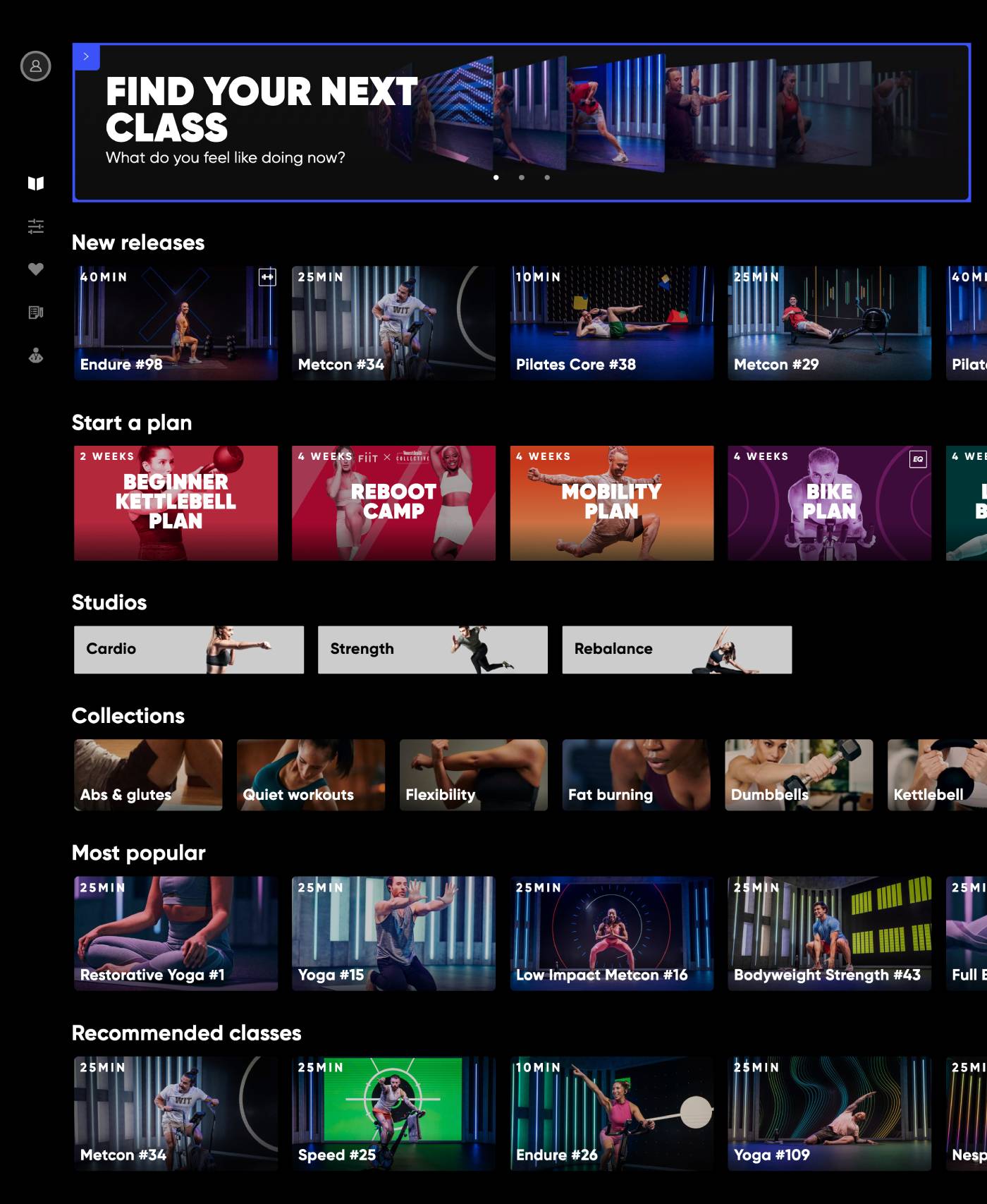
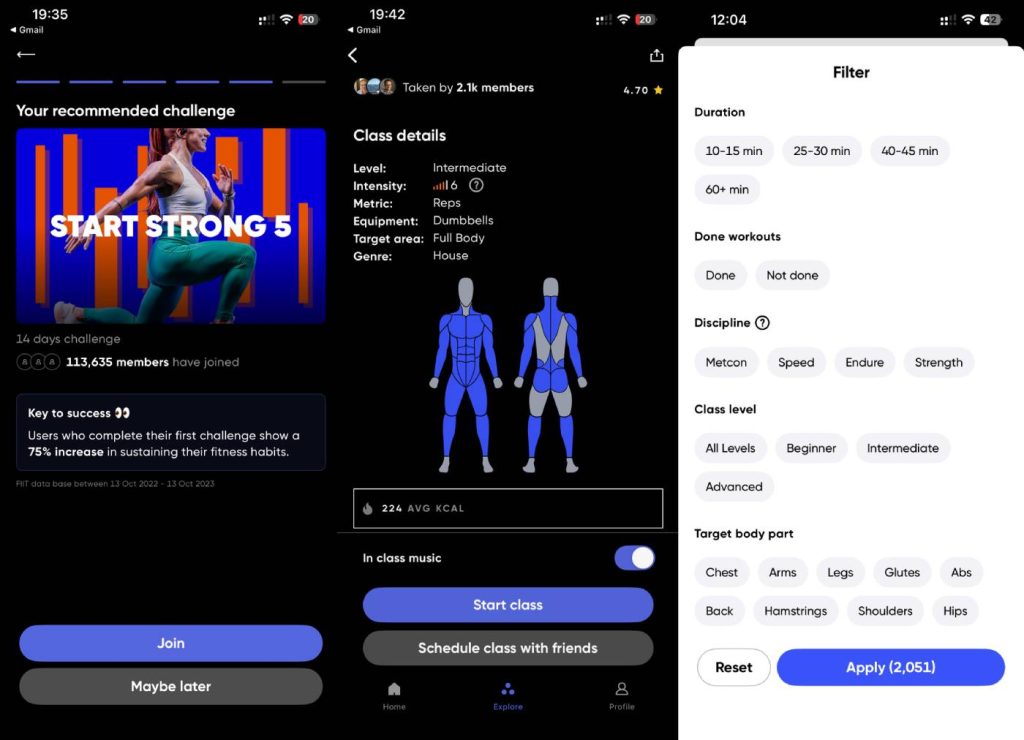
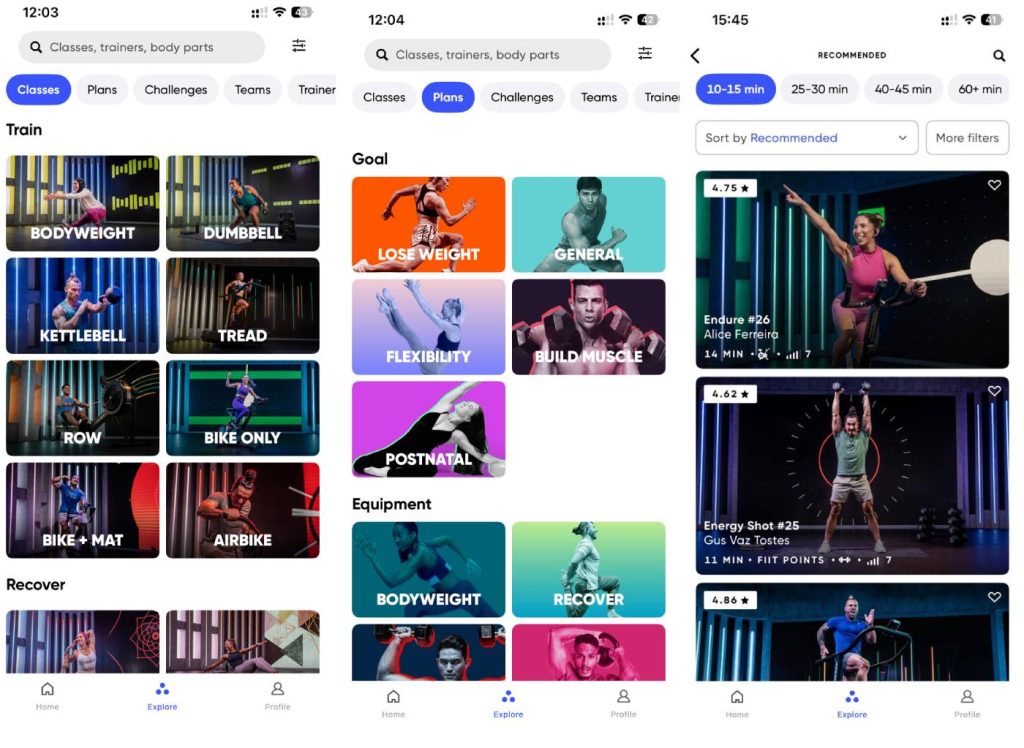
FIIT’s filtering is detailed (by type, length, equipment, level, trainer, body area, goal) and the trainer roster is well-curated. The boutique-studio aesthetic with coordinated LED lighting recreates a London-fitness-club feel that some users will love. The video player, however, does not allow rewind, fast-forward or scrub through a class. You can pause and resume only. For perimenopausal users managing cognitive symptoms (forgetfulness, attention difficulty), this is a significant gap. If you miss a cue, you cannot go back to it. The Class Breakdown panel below the video lists the moves, which helps if you read text well during training (most people do not).
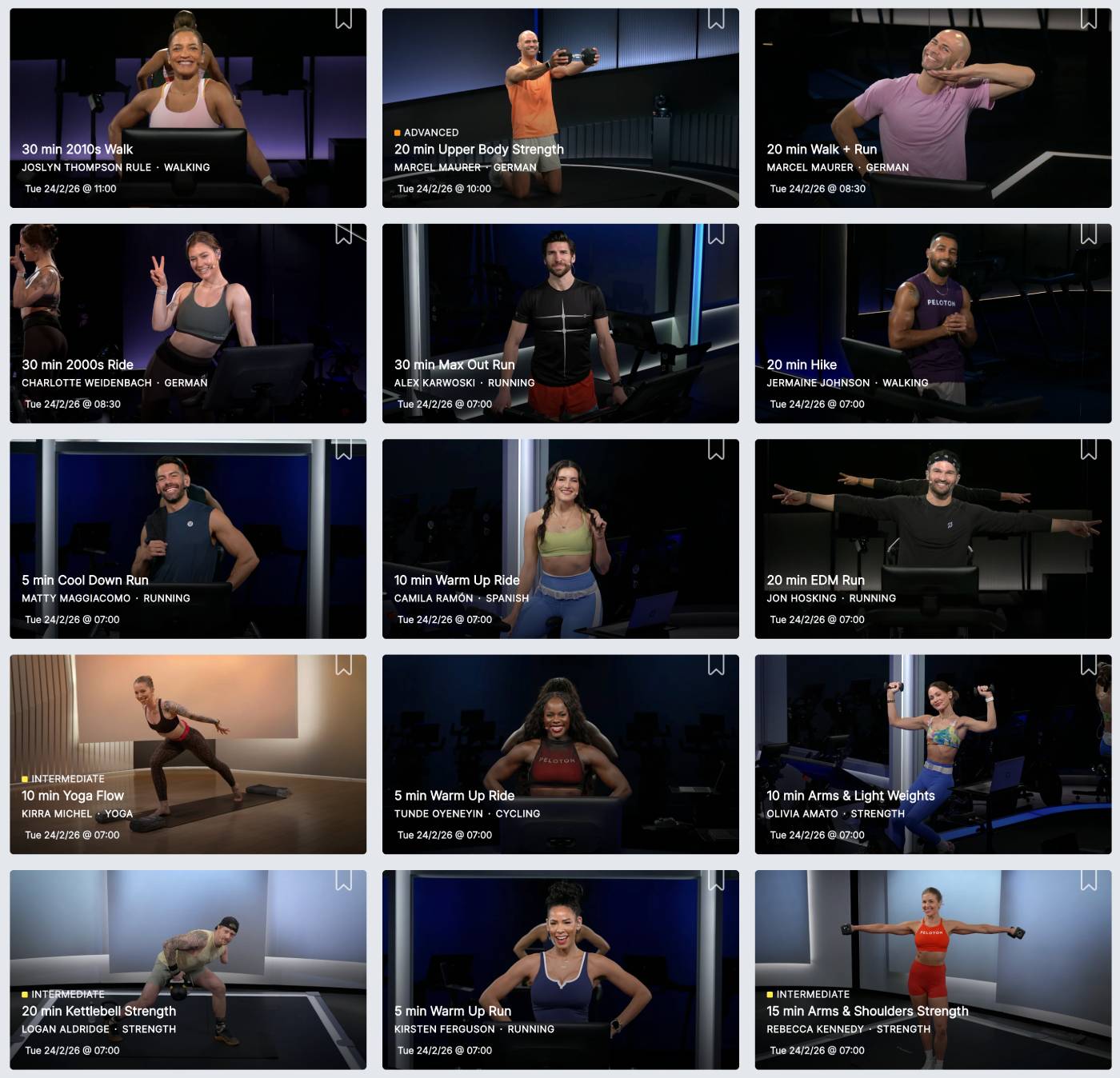
Peloton’s video player allows full scrubbing. If you missed the cue for a movement, you can rewind. If a section is not relevant to you, you can fast-forward. The app navigation is competent and the live class scheduling is genuinely useful for accountability. Class library filtering by type, instructor, length and class type is solid (though Obe Fitness still wins on filter depth across impact and equipment). Programmes are only available in the app, not the browser, which is a usability gap for desktop-primary users but not as fundamental as FIIT’s video-player limitation.
Peloton wins this category. FIIT’s filter quality is competitive; the video player limitation costs FIIT meaningful UX score points specifically for the perimenopausal audience.
A closer look at Peloton
Nutrition integration 2 vs 2
Nutrition integration is a small category by weight (7%) but a real gap on both platforms.
FIIT has no dedicated nutrition content. No audio courses on protein, no menopause-specific nutrition framing, no integration with a nutrition tracking platform. Particularly around protein intake to support resistance training, which becomes more important after 40 to offset menopausal muscle loss, this is a meaningful gap.
Peloton also has no built-in nutrition guidance. No audio courses, no protein content, no menopause-specific nutrition framing inside the platform. The advantage of that gap: no supplement pressure, no upsell to a proprietary nutrition product. The disadvantage: if you want education on protein and nutrition for women over 40 bundled with your training subscription, you will not find it on either platform.
Both score low on this category. For perimenopausal women who want nutrition content bundled into their training subscription, Obe Fitness (which has audio courses on protein, nutrition for women and cognitive health) is the stronger third-platform alternative. Between FIIT and Peloton specifically, this category does not differentiate them.
Who wins for…
Best for perimenopause specifically
Peloton. The Menopause Collection is a curated set of 20-minute sessions covering low-impact ride, hike, endurance, bodyweight strength and kettlebell, built specifically around perimenopausal physiology. FIIT has no dedicated perimenopause or menopause programme.
Best for women in their 50s and 60s
Peloton. The Menopause Collection extends naturally into post-menopause concerns. Joint-friendly content runs across yoga, barre, pilates, walking and low-impact cycling. The HSS ACL recovery programme adds credentialled rehab content. FIIT’s boutique-studio energy and rare modification cueing work less well for over-50 women returning to training or managing fresh joint diagnoses.
Best for budget
FIIT annual at £119.99/year (£9.99/month effective) is cheaper than Peloton App One UK at £12.99/month over 12 months. FIIT’s permanently free Group Classes tier is also the strongest free option. For monthly flexibility, Peloton App One at £12.99/month is the cheaper monthly entry. For commitment, FIIT wins.
Best for live class accountability
Tie. Both offer live classes with real-time participation. Peloton’s library is broader. FIIT’s free Group Classes tier is more generous on price.
Best for strength training
FIIT narrowly. Gede Foster (Director of Fitness and Performance, HYROX Global MC) leads Functional Strength sessions with clear progressive structure. The strength studio also covers Push Pull, Abs and Core, Kettlebells and HYROX-specific training. Peloton’s main strength library is dumbbell-based and less progressively structured. Peloton Strength+ (US iOS only) closes some of the gap with AI-generated logged strength workouts.
Best for joint and injury management
Peloton. The Hospital for Special Surgery ACL recovery programme is clinically credentialled. In-class modification cueing is built into every session. FIIT’s coaching style does not show modifications routinely.
Best for UK-native pricing
Tie. FIIT is built in the UK and priced in pounds (£19.99/mo Unlimited, £119.99/yr). Peloton also offers UK pricing (£12.99 App One, £28.99 App Plus). For UK readers, both are priced natively without currency conversion.
Best for women with cognitive symptoms (brain fog)
Peloton. The video player allows rewind, fast-forward and scrub. FIIT’s video player does not. For women managing the cognitive symptoms common during the menopause transition, the ability to go back to a cue you missed matters more than it sounds.
Best for working women with limited time
Peloton on Peloton IQ generated sessions. FIIT on 25-minute Functional Strength with built-in finishers. Both deliver in the 25 to 30-minute window. Peloton’s IQ removes one tap of decision-making.
Best for free trial
Peloton. 30 days versus FIIT’s 14 days. (FIIT’s permanently free Group Classes tier is a different proposition: no time limit but no paid-tier content.)
Best for international women outside the US and UK
FIIT narrowly on availability. FIIT is available globally with localised billing in GBP, EUR, USD, CAD and AUD, plus USD fallback for unsupported regions. Peloton is available in US, UK, Canada, Australia and Germany. For women in regions Peloton does not directly support, FIIT is more accessible.
Best for hardware integration
Peloton by default if you own or are considering Peloton hardware (Bike, Tread, Row). FIIT supports connected machine classes for treadmill, AirBike, bike and rower but does not have proprietary hardware to upgrade into.
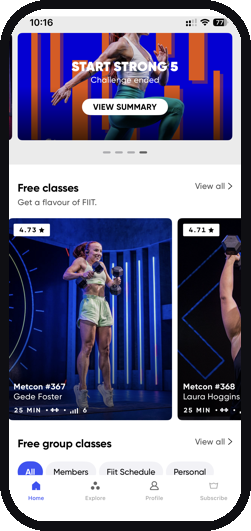
Screenshots from our full reviews

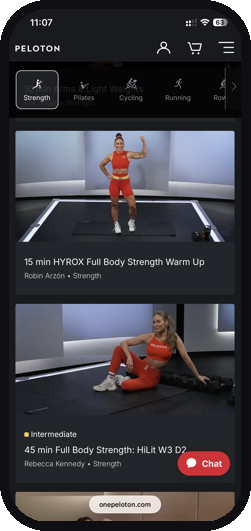
More screenshots: Peloton
See the full Peloton review for methodology and pricing.
Decision tree for women over 40
Start here. Is perimenopause-specific content important to you?
- Yes: Peloton. The Menopause Collection is the clearest fit. FIIT has no dedicated perimenopause programme.
- No (you want general fitness with strong strength content): continue.
Do you have a current or previous knee, hip or ACL injury you are managing?
- Yes: Peloton. The HSS ACL recovery programme and in-class modification cueing are the differentiators. FIIT’s coaching rarely shows modifications.
- No: continue.
Is strength training your primary focus and you already know your modifications?
- Yes: FIIT. Gede Foster’s Functional Strength content is excellent and the strength studio depth (Push Pull, Kettlebells, HYROX) is strong.
- No: continue.
Is price the primary constraint?
- Annual commitment OK: FIIT Unlimited annual at £119.99/year (£9.99/month effective) is the cheapest commitment of the two. The free Group Classes tier is the cheapest test of either platform.
- Monthly only: Peloton App One at £12.99/month is the cheapest monthly entry.
Do you manage cognitive symptoms (brain fog, attention difficulty) and need to be able to rewind a class?
- Yes: Peloton. The video player allows full scrubbing. FIIT does not.
- No: either works on this criterion.
Default if multiple factors tied: Peloton for the perimenopause-targeted audience this site serves. FIIT for women who want a UK-native general-fitness platform with strong strength content and either do not need or do not want menopause-specific framing.
What I did not test
- The FIIT AirBike, rower, or connected-machine integration. I tested without a tracker.
- The full FIIT Fiit Mum postnatal programme. Not relevant to my testing window.
- Any 60-minute FIIT sessions. I tested 10, 25 and 40-minute classes.
- Peloton hardware (Bike, Tread, Row). I tested the app on a non-Peloton treadmill and a single pair of 7.5kg dumbbells.
- Peloton Personal Trainer 1:1 coaching. Currently invite-only beta, iOS US only, $99.99/month additional.
- Long-term adherence beyond my test windows on either platform.
Personal testing and observations
FIIT testing
I tested FIIT for 14 days on its Unlimited free trial. I am a woman in my 40s navigating perimenopause, with a previous meniscus injury that still tells me when it disapproves. Sessions tested: Functional Strength with Gede Foster, full body strength with Angela Gargano, Pilates basics with Lottie Murphy, a self-built mix of strength, Pilates and cardio, and one treadmill workout.
Gede Foster’s Functional Strength sessions were the standout. The structure is clear: she explains what we are going to do, she previews the next move on the left of the screen, and her cueing assumes you are training to build. The Pilates basics with Lottie Murphy were well-produced. The filtering across studios (Cardio, Strength, Rebalance) is detailed and useful.
The friction point that ended my trial was the video player. FIIT does not let you rewind, fast-forward or scrub through a class. You can pause and resume only. For an audience where cognitive symptoms (forgetfulness, attention difficulty) are common during the menopause transition, this is a meaningful gap. There were classes where I missed a cue, wanted to go back ten seconds, and could not. The Class Breakdown panel below the video lists the moves but does not substitute for being able to rewind to a specific moment in the actual demonstration.
The second friction was the rarity of in-class modifications. Gede Foster’s strength sessions assume a competent baseline and the pace is fast. For experienced lifters this is fine; for women managing fresh injury or returning to training, modification cueing is what makes a session usable, and FIIT does not lead with it.
Peloton testing
I tested Peloton by mixing and matching classes across strength, yoga, walking and running, using my own treadmill for the cardio content and a single pair of 7.5kg dumbbells for strength. I do not own any Peloton hardware. I tested across the Menopause Collection (low-impact ride, hike, endurance, bodyweight strength, kettlebell), strength classes, yoga, walking and running content.
What I did not expect: a dedicated menopause content collection that is not a single token class buried three menus deep, but an actual curated set of 20-minute sessions designed specifically around this life stage. The Menopause Collection sat appropriately in my week without leaving me either undertrained or wrecked the next day, which is harder to get right than it sounds.
The instructor quality and modification cueing were high. Modification cues are built into the class rather than handled by a separate on-screen modifier, which matters when you are managing a knee issue and cannot pause to find a workaround mid-session. With my meniscus, I trained consistently without aggravation. The dumbbell strength classes were the most challenging; with a single pair of 7.5kg dumbbells, some classes pushed hard enough that I was working at my limit by the end. The video player allows full scrubbing, which I used routinely to go back to a cue I had missed.
The standout friction point: the cancel link was not functional during testing. I tested this more than once with the same result. If you sign up, do not rely on the standard cancel link. Go to app settings, account, membership, or contact support directly, and set a calendar reminder before day 30.
Which is better for women over 50?
For women over 50, Peloton wins more clearly than it does for women in their early 40s.
The Menopause Collection extends naturally into post-menopause concerns. The joint-friendly content across yoga, barre, pilates, walking and low-impact cycling means daily options that suit over-50 training. The Hospital for Special Surgery ACL recovery programme adds credentialled rehab content for women with knee history. In-class modification cueing matters more after 50 because joint sensitivity is more common; FIIT’s rare modification cueing is a bigger gap at this life stage than at 42.
The case for FIIT for women over 50 is narrower: experienced lifters who already know their modifications and want Gede Foster’s strength content with UK-native billing. For that specific user, FIIT works. For the broader over-50 audience returning to training, managing diagnosed joint issues, or wanting menopause-specific programming, Peloton is the clearer fit.
Women in their 60s and 70s starting fresh: neither platform is the strongest entry point. Look at Melissa Wood Health or BODi’s 4 Weeks for Every Body for gentler on-ramps. Obe Fitness Menopause Program is also a strong option for US and Canadian women in this group (verified by my own mum’s testing in her late 60s).
Frequently asked questions
Is FIIT or Peloton better for women over 40?
Peloton wins overall at 7.3 / 10 versus FIIT at 6.2 / 10. Peloton’s dedicated Menopause Collection, HSS ACL recovery programme, in-class modification culture and full video player scrubbing make it the stronger platform for perimenopausal women. FIIT wins on UK-native annual pricing, free Group Classes tier, and Gede Foster’s Functional Strength content.
Is FIIT good for perimenopause?
FIIT has no dedicated perimenopause or menopause programme. The platform’s strengths are real but generic to a general-fitness audience. For perimenopausal users specifically, Peloton’s Menopause Collection and modification culture are the stronger fit.
Which is cheaper?
FIIT Unlimited annual at £119.99 per year (£9.99 per month effective) is the cheapest commitment. Peloton App One at £12.99 per month UK has no annual plan; over 12 months that totals £155.88. FIIT also has a permanently free Group Classes tier that Peloton does not match.
Does FIIT have a free version?
Yes. FIIT offers a permanently free Group Classes tier with daily scheduled live classes and no card details required. It is the most generous free tier in the UK fitness app market.
Which has a better video player?
Peloton. FIIT’s video player does not allow rewind, fast-forward or scrub through a class. Peloton allows full scrubbing. For perimenopausal users managing cognitive symptoms, the difference matters.
Which has live classes?
Both. Peloton’s live class library is broader. FIIT’s free Group Classes tier is more generous on price (no card required).
Which is stronger for strength training?
FIIT, narrowly. Gede Foster (FIIT Director of Fitness and Performance, HYROX Global MC) leads Functional Strength sessions with clear progressive structure. Peloton Strength+ (US iOS only) closes some of the gap with AI-generated logged strength workouts but is limited in availability.
Is FIIT available outside the UK?
Yes. FIIT is available globally with localised billing in GBP, EUR, USD, CAD and AUD, plus USD fallback for unsupported regions. Peloton is available in the US, UK, Canada, Australia and Germany.
Research citations
- Maltais ML, Desroches J, Dionne IJ. Changes in muscle mass and strength after menopause. Journal of Musculoskeletal and Neuronal Interactions. 2009;9(4):186-197. PubMed.
- Watt FE. Musculoskeletal pain and menopause. Post Reproductive Health. 2018;24(1):34-43. doi: 10.1177/2053369118757537. SAGE.
- Resistance training for postmenopausal women: systematic review and meta-analysis. 2022. PubMed.
- Physical activity and exercise interventions on menopausal symptoms: overview of reviews. 2024. PubMed.
- Hospital for Special Surgery. ACL Rehabilitation Programme in partnership with Peloton. hss.edu.
About this review
Reviewed by Katy Cole. FIIT tested personally across 14 days on the Unlimited free trial, including Functional Strength with Gede Foster, full body strength with Angela Gargano, Pilates basics with Lottie Murphy, a self-built mix of strength, Pilates and cardio, and one treadmill workout. Peloton tested personally across mixed sessions covering the Menopause Collection (low-impact ride, hike, endurance, bodyweight strength, kettlebell), strength classes, yoga, walking and running content, using a non-Peloton treadmill and 7.5kg dumbbells. Prices verified against fiit.tv and onepeloton.com in May 2026.
Katy is the lead reviewer at Her Daily Fit. Fifteen years personally testing online fitness platforms. Mid-forties, currently in perimenopause, UK-based. Every claim on this page is either personally tested or attributed to peer-reviewed research. See how we score every programme using 9 weighted criteria.
Medical disclaimer: The content on this page is for informational purposes only and is not medical advice. Consult your GP or a healthcare provider before beginning a new exercise programme, particularly if you are managing perimenopause, menopause, or any existing health condition or injury.
Compared with
Where these brands appear in our “Best for” rankings