
vs
Sculpt Society ✓ HANDS-ON REVIEW
The Sculpt Society scores higher overall, 8.2 against 7.3, and is the stronger platform for nutrition guidance and a structured programme. Peloton is the better pick if what you need most is short sessions and building and keeping muscle.
- Score 8.2 vs 7.3
- Trial: 30 days vs 7 days
- Both tested hands-on
Quick answer: The Sculpt Society is the stronger overall platform for women over 40, scoring 8.2 against 7.3. It is ahead for nutrition guidance, a structured programme and value for money. Peloton still wins for short sessions and building and keeping muscle, so it is the better choice if that is your priority. The two are level on joint friendliness.
The two platforms
Same nine weighted categories, two different women. Here is who each one is built for.
The Sculpt Society
Winner
Leads this comparison on nutrition guidance and a structured programme, scoring 8 against 2 on Nutrition Integration.
- Low impact
- 15 to 35 min
- No equipment required
- Global with USD pricing
Choose The Sculpt Society if you:
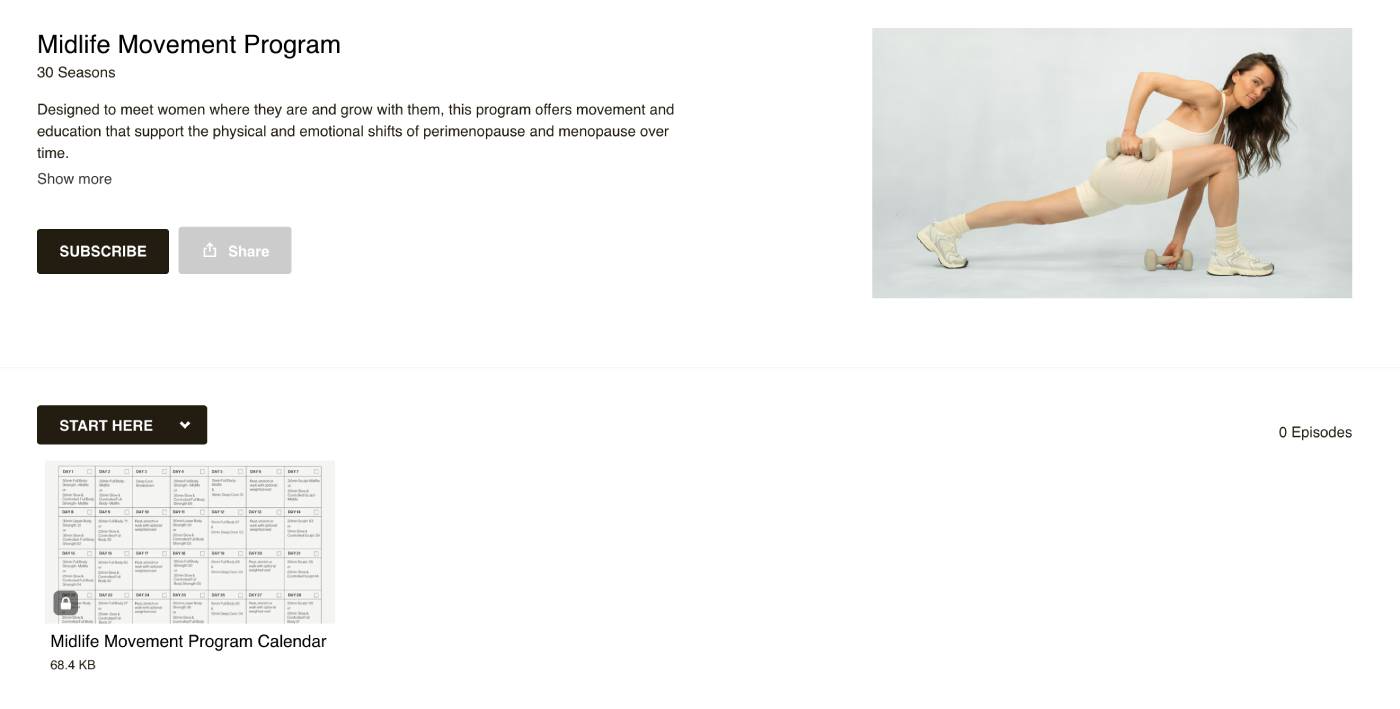
- Want a dedicated perimenopause programme with structured weekly calendar (Midlife Movement)
- Value pelvic floor and deep core work integrated throughout the platform
- Are managing or recovering from injury (Injury Safe series)
- Want dance cardio as a core training format (Megan Roup signature)
- Prefer the lower annual cost ($179.99/year vs Peloton App One $191.88 over 12 months)
Peloton
Runner-up
Leads this comparison on short sessions and building and keeping muscle, scoring 9 against 8.5 on Time Efficiency.
- Low impact
- 20 to 45 min
- None for app
- US, UK, Canada, Australia, Germany
Choose Peloton if you:
- Want live class accountability with leaderboard and real-time participation
- Need broad workout-type variety (cycling, treadmill, running, rowing, plus strength/yoga/barre)
- Have a knee or hip injury and want clinically credentialled rehab content (HSS ACL programme)
- Want the cheapest monthly entry point ($15.99 App One)
- Already own or are considering Peloton hardware (Bike, Tread, Row)
Quick answer
Quick answer: The Sculpt Society wins overall at 8.2 versus Peloton at 7.3, a meaningful 1-point gap. The Sculpt Society scored 6.6 / 10 on Women Over 40 Specificity with the dedicated Midlife Movement Programme (medically-backed), Injury Safe series, 14-Day Strength Programme and integrated pelvic floor work. Megan Roup’s slow-controlled sculpt method delivers structured perimenopause-aware training in a way Peloton’s Menopause Collection (a curated library) does not match. Peloton wins on workout-type variety (cycling, treadmill, running, rowing alongside strength, yoga and barre), live class accountability with leaderboard and real-time participation, the Hospital for Special Surgery ACL recovery programme, and broader geographic availability. For dedicated perimenopause programming, The Sculpt Society. For variety plus live class accountability, Peloton.
Inside Peloton and The Sculpt Society
Bottom line in 30 seconds
- The Sculpt Society wins on dedicated perimenopause programming. 8.2 versus Peloton at 7.3. The 6 / 10 Women Over 40 Specificity score reflects the medically-backed Midlife Movement Programme as a structured weekly calendar. The Injury Safe series and integrated pelvic floor work are platform-defining features for the audience.
- Peloton wins on variety and live class accountability. Thousands of workouts across 15+ types including cycling, treadmill, running, rowing alongside strength, yoga and barre. Live classes with leaderboard create real accountability. The Hospital for Special Surgery ACL recovery programme adds credentialled rehab content. Broader geographic reach (US, UK, Canada, Australia, Germany).
- Peloton App One at $15.99/month is the cheapest entry, but The Sculpt Society annual at $229.99 is the cheapest 12-month commitment. Peloton has no annual plan on App tiers; 12 months of App One totals $191.88, which is $11.89 more than The Sculpt Society annual.
Peloton’s cancel link was non-functional during testing. Do not rely on the standard cancellation link. Go to app settings, account, membership, or contact support directly. Set a calendar reminder before day 30 of the free trial.
Peloton’s Menopause Collection is a curated library, not a structured weekly programme. The 20-minute sessions (low-impact ride, hike, endurance, bodyweight strength, kettlebell) are well-designed but you pick what to do each day. The Sculpt Society’s Midlife Movement Programme gives you a defined weekly calendar to follow. For women who want decision-removal alongside perimenopause-aware training, The Sculpt Society is the cleaner fit.
Quick yes or no comparison
| Feature | Peloton | The Sculpt Society |
|---|---|---|
| Dedicated structured perimenopause programme | Menopause Collection (library, not weekly arc) | Yes (Midlife Movement Programme) |
| Pelvic floor work integrated throughout | Limited | Yes |
| Live classes with leaderboard | Yes (signature feature) | No |
| Cycling and treadmill content | Yes (extensive) | No |
| Rowing content | Yes | No |
| Dance cardio | Limited | Yes (Megan Roup signature) |
| Credentialled injury rehab | Yes (HSS ACL programme) | Yes (Injury Safe series) |
| Pregnancy and postnatal content | Limited | Yes (extensive) |
| Annual plan | No (monthly only on App tiers) | Yes ($179.99/yr) |
| Free trial | 30 days | 7 days |
| Hardware option | Yes (Bike, Tread, Row) | No |
| Geography | US, UK, Canada, Australia, Germany | Global with USD pricing |
| Class Stacking / Peloton IQ | Yes | No |
At a glance
| Peloton | The Sculpt Society | |
|---|---|---|
| Monthly price | $15.99/mo App One · $28.99/mo App Plus | $24.99/mo |
| Annual price | No annual on App tiers | $229.99/yr |
| UK price | £12.99/mo App One · £28.99/mo App Plus | USD-priced |
| Free trial | 30 days | 7 days |
| Founder / brand | Peloton Interactive (since 2012) | Megan Roup (founder, lead trainer) |
| Class library | Thousands across 15+ workout types | Library plus structured programmes |
| Signature programmes | Menopause Collection, HSS ACL recovery, Peloton IQ, Class Stacking | Midlife Movement, 14-Day Strength, Injury Safe, dance cardio |
| Live classes | Yes (daily, leaderboard) | No (on-demand only) |
| Perimenopause programming | Menopause Collection (curated library) | Midlife Movement (medically-backed weekly arc) |
| Personal testing | Mixed sessions across strength, yoga, walking, running | 4 weeks Midlife Movement plus 14-Day Strength, Injury Safe, dance |
| Overall score | 7.3 / 10 | 8.2 / 10 |
Full scoring breakdown
| Category | Weight | Peloton | The Sculpt Society | Winner |
|---|---|---|---|---|
| Time Efficiency | 15% | 9 | 8.5 | Peloton |
| Muscle Potential | 15% | 7.5 | 7 | Peloton |
| Women Over 40 Specificity | 15% | 6 | 6.6 | The Sculpt Society |
| Joint Friendliness | 12% | 9 | 9 | Tie |
| Recovery Compatibility | 10% | 8.5 | 9 | The Sculpt Society |
| Programme Structure | 10% | 6.5 | 9 | The Sculpt Society |
| Value for Money | 8% | 7 | 8.5 | The Sculpt Society |
| UX and Design | 8% | 7.8 | 8.5 | The Sculpt Society |
| Nutrition Integration | 7% | 2 | 8 | The Sculpt Society |
| Overall | 100% | 7.3 | 8.2 | The Sculpt Society |
Why these scoring categories matter more after 40
Three physiological changes during perimenopause shape what training should look like. Oestrogen decline accelerates loss of muscle and bone. Maltais 2009 documents the trajectory and the 2022 systematic review on resistance training for postmenopausal women confirms structured progressive loading as the most effective intervention. Baseline cortisol elevates. Tendon and ligament elasticity decreases, which Watt 2018 documents as a primary driver of musculoskeletal pain.
The category weights reflect that reality. Between Peloton and The Sculpt Society, the biggest splits sit on Women Over 40 Specificity (TSS’s 9.5 vs Peloton’s 8.0), Programme Structure (TSS’s 9.0 vs Peloton’s 6.5), and Time Efficiency (Peloton’s 9.0 vs TSS’s 8.5). The aggregate gap of approximately 1 point reflects these weighted differences across categories where the platforms approach the audience differently.
Women over 40 specificity 6 vs 6.6
This is where The Sculpt Society pulls ahead most clearly.
The Sculpt Society scored 6.6 / 10 on Women Over 40 Specificity. The dedicated Midlife Movement Programme is medically-backed and explicitly designed for perimenopausal and menopausal women. The 14-Day Strength Programme is built for this audience. The Injury Safe series acknowledges joint and recovery needs explicitly. Pelvic floor and deep core work is integrated throughout. Pregnancy and postnatal content extends life-stage coverage. The design intent is unmistakably for women navigating perimenopause to post-menopause.
Peloton scored 6 / 10 on Women Over 40 Specificity. The Menopause Collection is genuine perimenopause content: 20-minute sessions covering low-impact ride, hike, endurance, bodyweight strength and kettlebell, built around perimenopausal physiology. The format is curated library rather than structured weekly arc. The HSS ACL recovery programme adds joint-specific credibility. The platform is more accommodating to perimenopause than most general-fitness platforms but less explicitly structured than The Sculpt Society’s Midlife Movement.
For dedicated perimenopause programming with a defined weekly calendar, The Sculpt Society is the substantially stronger choice. For perimenopause content within a much broader catalogue that also covers cycling, treadmill, running and rowing, Peloton works.
Programme structure 6.5 vs 9
The Sculpt Society wins this category clearly.
The Sculpt Society scored 9 / 10 on Programme Structure. Midlife Movement is a defined weekly calendar: three to five strength days plus two rest or active recovery days, with walking, stretching or deep core work suggested. Everything is laid out for you. The 14-Day Strength Programme and Injury Safe series have similar structural integrity.
Peloton scored 6.5 / 10 on Programme Structure. Programmes exist (the Menopause Collection sits more as a curated library than a weekly schedule). Peloton IQ builds custom workouts based on your inputs. Class Stacking lets you queue up to 10 classes back-to-back. The live class schedule creates accountability that compensates for the weaker structural scaffolding. For women who want a programme rather than a catalogue, the gap is meaningful.
The 2.5-point category gap (9.0 vs 6.5) translates to a 0.25-point overall score difference at the 10% weight. This is part of the overall gap but not the largest contributor. The structural difference matters most for women who specifically want to be told what to do each day.
Time efficiency 9 vs 8.5
Peloton wins this category narrowly.
Peloton scored 9 / 10 on Time Efficiency, the highest in the published Peloton review. Class durations run from 5 minutes to 60+ with genuine 20-minute options across most workout types. Peloton IQ builds custom workouts based on available time and target muscle groups. Class Stacking queues up to 10 classes back-to-back. The breadth of duration options is the differentiator.
The Sculpt Society scored 8.5 / 10 on Time Efficiency. Sessions are 28 to 45 minutes. The Midlife Movement schedule fits the available time week-to-week. Stackable shorter content (walking, stretching, deep core) supports the main sessions.
Both work for time-constrained perimenopausal women. Peloton’s IQ generator removes one tap of decision-making for ad-hoc sessions. The Sculpt Society’s calendar removes decision-making at the programme level. For users who train within a defined programme arc, TSS works; for users who train ad-hoc around variable schedules, Peloton works.
Muscle potential 7.5 vs 7
Both platforms hit similar ceilings on Muscle Potential; Peloton edges ahead narrowly.
Peloton’s strength content is dumbbell-based and not optimised for progressive overload at the highest level. Peloton Strength+ (a separate AI-generated strength app, $9.99/mo US iOS only, free with App Plus) lets you log weights and reps with progressive structure. The main app’s strength content sits at the maintenance-not-hypertrophy level.
The Sculpt Society scored 7 / 10 on Muscle Potential. The Midlife programme’s controlled tempo is by design. The 14-Day Strength Programme delivers structured strength with light to moderate dumbbells but the ceiling is lower than heavy compound lifting.
Neither matches Evlo, Sweat’s PWR/BUILD, or Pvolve’s Progressive Weight Training for maximum hypertrophy. For maintenance and foundational strength, both work. For visible body composition change, supplement either with heavier lifting outside the platform.
Why progressive overload matters more after 40
Progressive overload is the principle of gradually adding load over time. After 40, oestrogen decline accelerates muscle and bone loss. The 2022 systematic review on resistance training for postmenopausal women is clear: training works only if the load progresses. Neither Peloton nor The Sculpt Society is the maximum-hypertrophy choice. For women whose primary goal is muscle and bone retention through perimenopause, both platforms would benefit from being paired with a dedicated heavier strength practice.
Joint friendliness 9 vs 9
Both platforms score 9 / 10 on Joint Friendliness.
Peloton’s joint-friendliness comes from in-class modification cueing built into every session. The Menopause Collection plus low-impact cycling, yoga, barre, pilates, stretching and walking content mean multiple daily options that do not load joints beyond what perimenopausal users can sustain. The HSS ACL recovery programme is the credentialled rehab differentiator.
The Sculpt Society’s 8.2 / 10 reflects the slow-controlled sculpt method with no jumping in sculpt and strength classes. Dance cardio can include jumping but is easy to modify. The Injury Safe series is dedicated content for joint and recovery management. Megan Roup’s coaching consistently cues controlled tempo and joint positioning.
Both are strong. Peloton’s HSS partnership is the cleaner choice for users with diagnosed ACL or knee injuries seeking clinically credentialled rehab. The Sculpt Society’s slow-tempo baseline is the more sustainable approach across consecutive training days.
Recovery compatibility 8.5 vs 9
Both platforms support recovery; The Sculpt Society edges ahead on integrated programme-level recovery.
Peloton has a deep yoga, stretching and meditation library that supports recovery between higher-intensity sessions. The breadth means you can deliberately build a training week that manages cortisol load. Sleep-sensitive content (evening yoga, wind-down meditation) is available without searching.
The Sculpt Society scored 9 / 10 on Recovery Compatibility. Recovery is built into the Midlife Movement Programme as active recovery days with walking, stretching or deep core work suggested. The schedule lays out recovery days alongside training days, so you do not have to make decisions about when to rest.
Both work. Peloton’s recovery library is larger; The Sculpt Society’s recovery integration with programme structure is cleaner. For women who want recovery sequenced into a structured training plan, The Sculpt Society. For women who want a deep recovery library to dip into on rest days, Peloton.
A closer look at Peloton
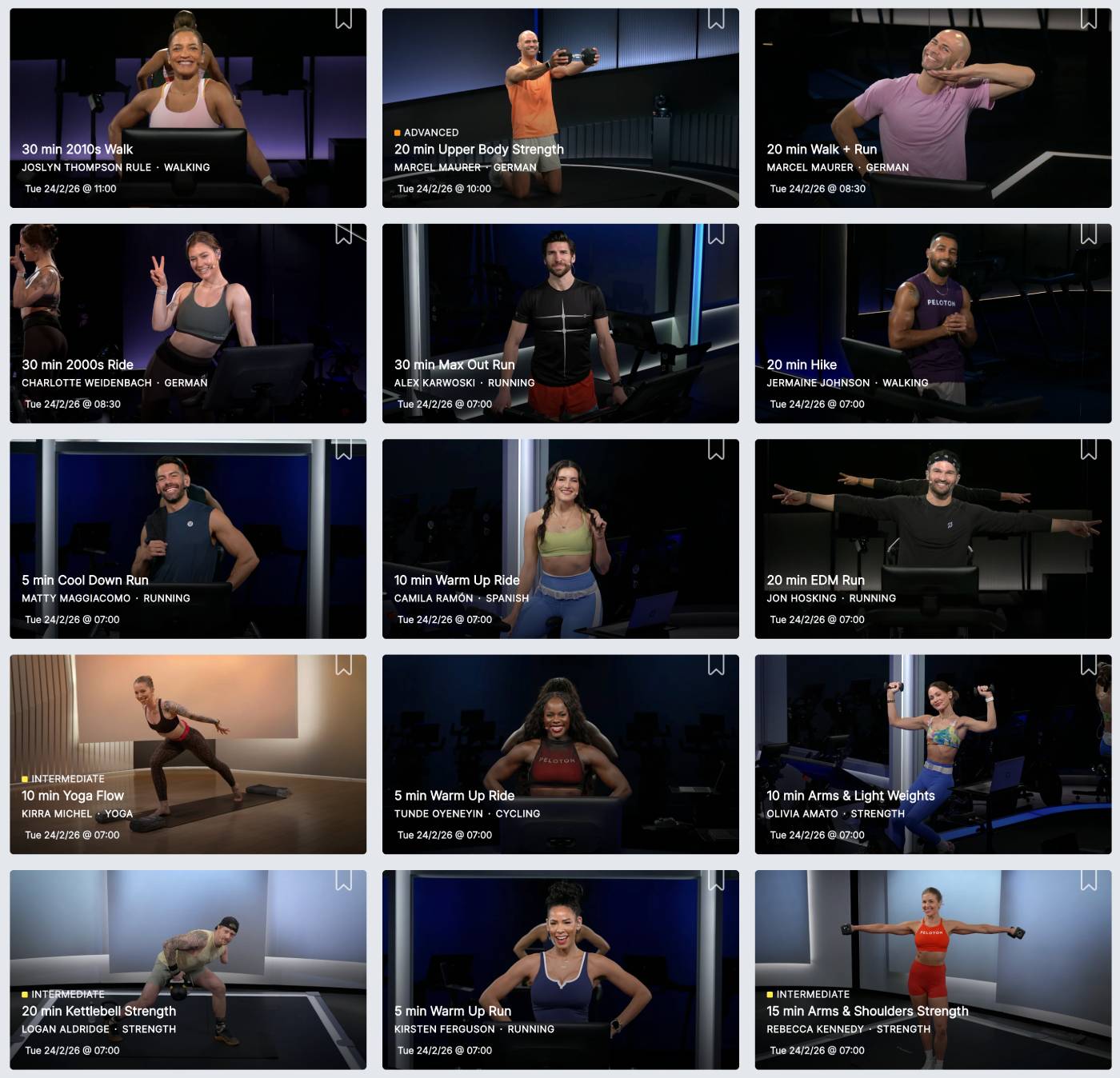
Value for money 7 vs 8.5
The Sculpt Society wins on annual commitment; Peloton App One wins on monthly flexibility.
Peloton App One at $15.99/month (£12.99/month UK) is the cheapest monthly entry. App Plus at $28.99/month is the most expensive of the three direct app subscriptions. There is no annual plan on either App tier.
The Sculpt Society is $24.99/month or $229.99/year ($15/month equivalent on annual). The 7-day free trial requires a card.
Over 12 months: Peloton App One totals $191.88, The Sculpt Society annual is $229.99 ($11.89 cheaper). On monthly flexibility, Peloton App One is the cheaper option ($9 less per month). For users committing to 12 months, The Sculpt Society annual is the better value; for users wanting maximum flexibility, Peloton App One monthly.
UX and design 7.8 vs 8.5
Both platforms have polished UX.
Peloton’s app is clean, navigation is competent, live class scheduling is genuinely useful for accountability. Class library filtering by type, instructor, length and class type is solid (though Obe Fitness still wins on filter depth across impact and equipment). Programmes are only available in the app, not the browser, which is a genuine usability gap for desktop-primary users.
The Sculpt Society scored 8.2 / 10 on UX. The app is pleasant, navigation is easy, the quiz recommends a starting point, and offline downloads are available. Works on iOS, Android, web and Apple TV.
Both are competent. Peloton wins on live class integration and Peloton IQ. The Sculpt Society wins on cross-device consistency without the browser-vs-app gap.
A closer look at The Sculpt Society
Nutrition integration 2 vs 8
Neither platform leads on nutrition.
Peloton has no built-in nutrition guidance. No meal plans, no protein content, no menopause-specific nutrition framing. The advantage of that gap: no supplement pressure, no upsell.
The Sculpt Society has lifestyle content and some nutrition guidance but no dedicated meal plans or proprietary supplement line.
Neither matches Jillian Michaels’ 9 / 10 nutrition system, BODi’s 9 / 10 Nutrition Integration, Obe Fitness’s perimenopause audio courses, or Daily Burn’s meal plans. This category does not differentiate Peloton and The Sculpt Society meaningfully.
Who wins for…
Best for dedicated perimenopause programming
The Sculpt Society. Midlife Movement Programme is medically-backed and structured. Peloton’s Menopause Collection is a library, not a structured arc.
Best for live class accountability
Peloton. The signature feature with leaderboard and real-time participation. The Sculpt Society does not offer this.
Best for cycling, treadmill or rowing at home
Peloton. Dedicated content for all three formats. The Sculpt Society does not have this content.
Best for dance cardio
The Sculpt Society. Megan Roup’s signature format. Peloton has limited dance content.
Best for joint and injury management
Peloton, narrowly, via the HSS ACL recovery programme. The Sculpt Society for general joint-aware programming via Injury Safe series.
Best for pelvic floor work
The Sculpt Society. Integrated throughout the platform.
Best for pregnancy and postnatal
The Sculpt Society. Extensive prenatal and postnatal content. Peloton has limited content here.
Best for budget on monthly
Peloton App One. $15.99/month (£12.99/month UK).
Best for budget on annual
The Sculpt Society. $229.99/year is $11.89 less than 12 months of Peloton App One.
Best for workout-type variety
Peloton. Thousands of workouts across 15+ workout types.
Best for working women with limited time
Peloton, narrowly, via Peloton IQ for ad-hoc custom workouts. The Sculpt Society for structured weekly programming.
Best for international availability
Peloton, narrowly. US, UK, Canada, Australia and Germany with locally supported pricing. The Sculpt Society works internationally but is USD-priced.
Best for women in their 50s and 60s
The Sculpt Society. The Midlife Movement Programme and slow-controlled sculpt method suit this demographic. Peloton’s Menopause Collection works but requires programme selection rather than offering a structured arc.
Best for women who travel and want consistent training
Peloton. The breadth of equipment-free workouts plus Time to Walk and Time to Run audio coaching works in hotel rooms or outdoors anywhere. The Sculpt Society’s bodyweight content works too but the platform is less travel-optimised.
Best for instructor brand loyalty
The Sculpt Society. Megan Roup is the platform. If you have followed her work and connect with her coaching, the platform delivers consistently around her style. Peloton’s roster is broader and less brand-anchored to a single trainer.
Best for women who already cycle outdoors and want indoor cycling
Peloton. The cycling content is the platform’s heritage strength. The Sculpt Society has no cycling content.
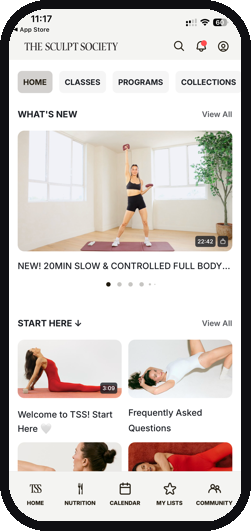
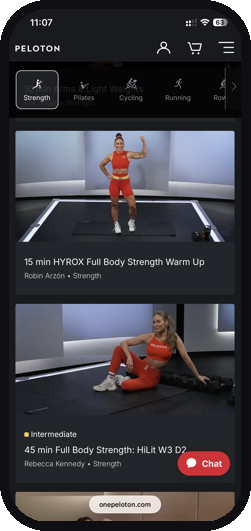
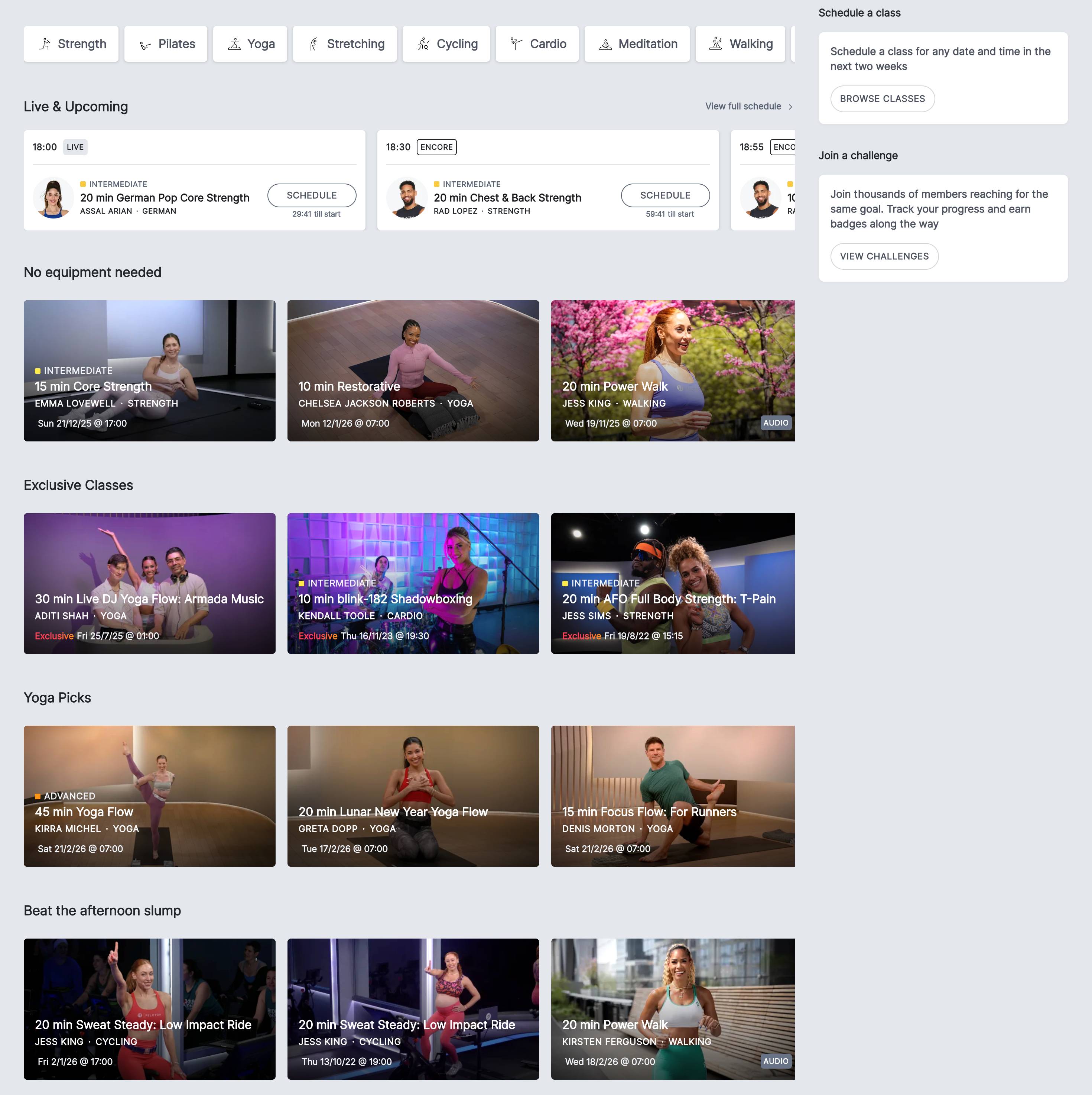
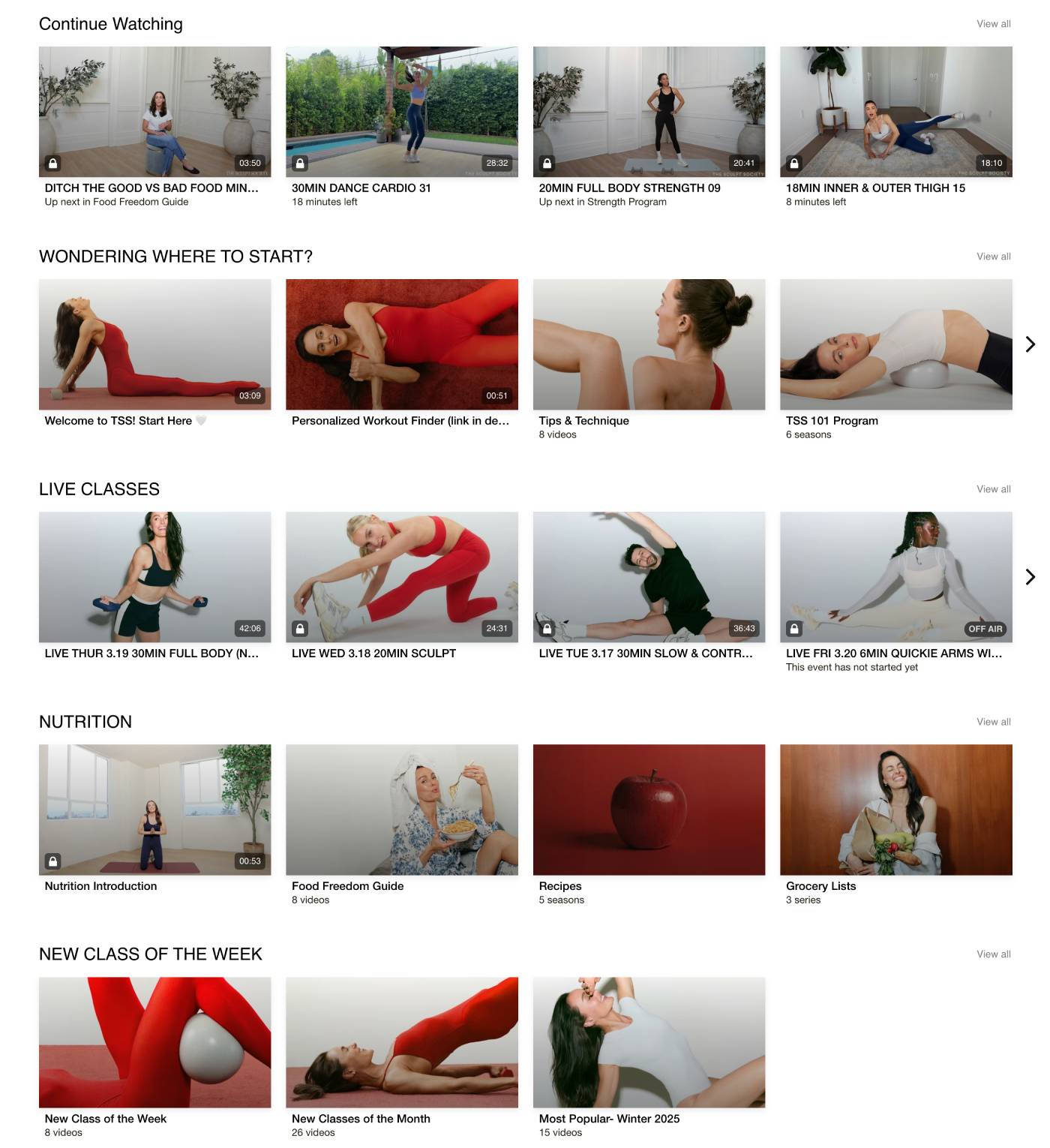
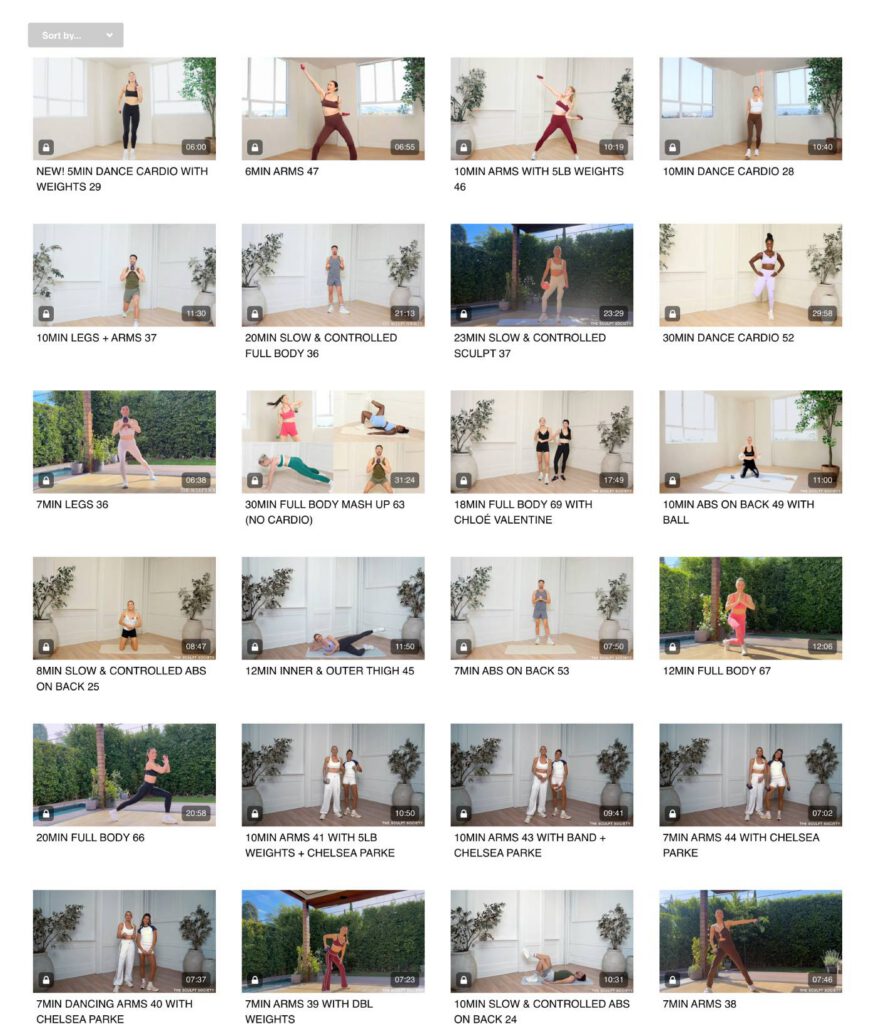
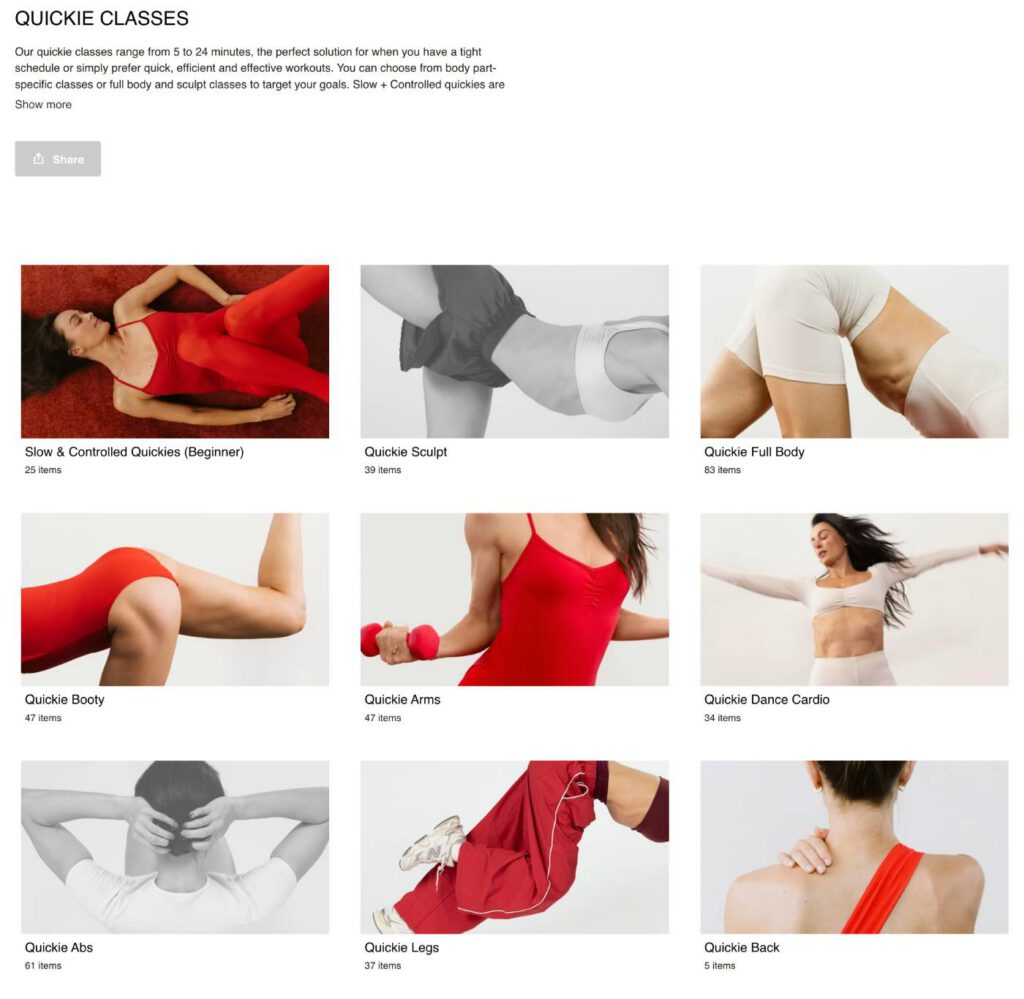
Screenshots from our full reviews
More screenshots: Peloton
See the full Peloton review for methodology and pricing.
More screenshots: The Sculpt Society
See the full The Sculpt Society review for methodology and pricing.

Decision tree for women over 40
Start here. Do you want a structured weekly perimenopause programme with a defined calendar?
- Yes: The Sculpt Society. Midlife Movement Programme is the clearest fit.
- No: continue.
Does live class accountability with leaderboard help you train consistently?
- Yes: Peloton. The signature feature The Sculpt Society does not match.
- No: continue.
Do you want cycling, treadmill or rowing content as part of your training?
- Yes: Peloton. The Sculpt Society does not have this content.
- No: continue.
Do you have a diagnosed knee or hip injury you are rehabbing?
- Yes (especially ACL): Peloton. The HSS ACL recovery programme is credentialled.
- No (general joint sensitivity): continue.
Is dance cardio important to your training?
- Yes: The Sculpt Society. Megan Roup’s signature format.
- No: continue.
Default if multiple factors tied: The Sculpt Society for the higher overall score and dedicated perimenopause programming. Peloton for variety and live class accountability.
What I did not test
- Peloton hardware (Bike, Tread, Row). I tested the app on a non-Peloton treadmill and 7.5kg dumbbells.
- Peloton Personal Trainer 1:1 coaching. Currently invite-only beta, iOS US only, $99.99/month additional.
- The full Peloton Menopause Collection. Sampled key sessions.
- The full Sculpt Society Midlife Movement Programme. Completed 4 weeks.
- Sculpt Society prenatal and postnatal content. Not directly relevant to my testing window.
- Long-term adherence beyond my test windows on either platform.
Personal testing and observations
Peloton testing
I tested Peloton by mixing and matching classes across strength, yoga, walking and running, using my own treadmill for the cardio content and a single pair of 7.5kg dumbbells for strength. I do not own any Peloton hardware. I have a previous meniscus injury and have trained across HIIT and dumbbell formats for years. I tested across the Menopause Collection (low-impact ride, hike, endurance, bodyweight strength, kettlebell), strength classes, yoga, walking and running content.
What I did not expect: a dedicated menopause content collection that is not a single token class buried three menus deep, but an actual curated set of 20-minute sessions designed specifically around this life stage. The Menopause Collection sat appropriately in my week without leaving me either undertrained or wrecked the next day.
The instructor quality and modification cueing were high. Modification cues are built into the class rather than handled by a separate on-screen modifier, which matters when you are managing a knee issue and cannot pause to find a workaround mid-session. With my meniscus, I trained consistently without aggravation. The standout friction point: the cancel link was not functional during testing.
The Sculpt Society testing
I tested The Sculpt Society across four weeks of the Midlife Movement Programme, plus the 14-Day Strength Programme, Injury Safe programmes, dance cardio and lifestyle classes. The Midlife Movement Programme schedule is well-built: three to five strength days plus two rest or active recovery days, with walking, stretching or deep core work suggested for those lighter days. Everything is laid out for you in a calendar.
Megan Roup’s coaching style is consistent and accessible. The slow-controlled tempo means no jumping in sculpt and strength classes. The deep core sessions, particularly the pelvic floor work, reminded me of postpartum exercises I had long forgotten. I maintained and slightly increased strength over the 4 weeks of Midlife Movement.
The honest caveat: the muscle-building ceiling on Midlife Movement is lower than what Peloton’s broader strength catalogue plus Strength+ delivers. The controlled tempo is by design and works for maintenance and foundational strength. For maximum hypertrophy, supplement with heavier lifting outside the platform.
Why coaching style affects adherence after 40
Perimenopause produces variable nervous-system states. Some days you can absorb Peloton’s high-energy instructor delivery and it lifts you. Other days you cannot, and that same delivery wears you out. Megan Roup’s calmer, more measured coaching on The Sculpt Society is the kind of voice you can listen to on hard days without it adding stress. Peloton’s instructor energy is broader and louder, which suits women who use external energy to overcome inertia and is less suitable for women who want training to feel calming.
Honest self-assessment about which voice helps you train consistently matters more than the feature comparison. If you have abandoned platforms because the instructor energy felt like too much, The Sculpt Society is the gentler choice. If you have stayed on platforms because the instructor energy got you going, Peloton works.
Why structured weekly programming matters more after 40
Decision fatigue is one of the under-discussed adherence challenges in perimenopause. Sleep is patchy. Cortisol is elevated. By the time you finish work and family responsibilities, the mental energy to choose a workout is genuinely depleted. A platform that tells you what to do today removes that friction. A platform that hands you thousands of workouts and a search bar requires you to make a choice you may not have the bandwidth for.
The Sculpt Society solves this for the perimenopause audience with the Midlife Movement Programme: a defined weekly schedule with three to five strength days plus two recovery days, walking and deep core suggestions for lighter days, and a calendar that shows you what comes next. Peloton solves it differently with Peloton IQ (AI-generated workouts based on your time and target muscles), Class Stacking (queue up to 10 classes), and the live class schedule. Both approaches work but they serve different temperaments.
Women who prefer to be told what to do each day in a perimenopause-specific framework will adhere better to The Sculpt Society. Women who prefer to choose from a varied library with smart defaults built around the live class schedule will adhere better to Peloton. Honest self-assessment about which type you are before subscribing matters more than the feature comparison.
Why live class accountability matters more after 40
One of the things that surprised me across the platforms I have tested is how different the adherence picture looks when live classes are part of the offer. Live classes create a different kind of commitment psychology than on-demand. Knowing that a session is happening at 7am on Tuesday and that other women are showing up at the same time creates a small social pressure that on-demand content does not replicate.
For perimenopausal women who know from experience that they will skip a recorded workout but will show up for a scheduled class, this matters. Peloton’s live class library is one of the largest in the streaming category and the leaderboard with real-time participation is the closest thing to a group-fitness class atmosphere reproduced at home. The Sculpt Society does not match this. The platform’s on-demand-only structure works for self-motivated users but does not provide the external accountability some women need to actually train.
If you have tried to follow on-demand programmes in the past and consistently drifted away after 4 to 6 weeks, the live class structure on Peloton is worth real consideration. If you adhere well to self-directed training and want the perimenopause-specific design, The Sculpt Society is the cleaner choice. Match the accountability style to your history, not to which platform sounds more appealing.
Which is better for women over 50?
For women over 50, The Sculpt Society is narrowly the stronger choice.
The Midlife Movement Programme extends naturally beyond perimenopause into post-menopause concerns. The Injury Safe series is more important after 50 than at 42 because joint sensitivity and recovery patterns become more variable. Megan Roup’s slow-controlled tempo is well-calibrated for over-50 training.
Peloton works for women over 50 via the Menopause Collection plus joint-friendly content across yoga, barre, pilates, walking and low-impact cycling. The HSS ACL recovery programme is relevant if there is knee history. The platform is selectively useful but requires programme selection rather than offering a structured arc.
For women in their 60s and 70s starting fresh, neither platform is the strongest entry. Daily Burn’s True Beginner, Melissa Wood Health or Obe Fitness Menopause Program (US/Canada, validated by my mum’s testing in her late 60s) are gentler on-ramps.
Honest framing for over-50 training generally: muscle and bone retention is the primary physiological priority and both platforms support the relevant work without being maximum-hypertrophy choices. The Sculpt Society Midlife Movement is the cleaner perimenopause-to-post-menopause arc. Peloton’s broader catalogue plus live class accountability suits women who want training variety and find consistent attendance easier with scheduled live commitments. Match the platform to your adherence pattern, not to abstract score advantages.
Frequently asked questions
Is Peloton or Sculpt Society better for women over 40?
The Sculpt Society wins at 8.2 / 10 versus Peloton at 7.3 / 10. TSS wins on dedicated perimenopause programming. Peloton wins on variety and live classes.
Which is cheaper?
Peloton App One on monthly ($15.99 vs $24.99). The Sculpt Society on annual ($229.99 vs Peloton’s $191.88 over 12 months of App One).
Which has better perimenopause content?
The Sculpt Society. Midlife Movement Programme is medically-backed and structured. Peloton’s Menopause Collection is curated library.
Which has live classes?
Peloton only. Leaderboard accountability.
Which has better joint protection?
Both score 9 / 10. Peloton’s HSS ACL programme for diagnosed injury. TSS’s Injury Safe series and slow-tempo method for general perimenopausal joints.
Can I use Peloton without hardware?
Yes. App One and App Plus work fully without any Peloton hardware (a phone, tablet or computer is sufficient).
Does Sculpt Society have cycling content?
No. The Sculpt Society focuses on sculpt, dance cardio, strength and Midlife Movement.
Which has more workout variety?
Peloton. Thousands of workouts across 15+ types including cycling, treadmill, running, rowing, walking, outdoor, strength, yoga, barre, pilates and meditation. The Sculpt Society is more focused on sculpt, dance cardio, strength and Midlife Movement.
Can I use both platforms at once?
Possible but rarely optimal. Total cost stacked is $40.98 to $53.98 per month. Most women pick one based on the primary decision factor and stick with it. If you wanted both, the cleanest use case is Sculpt Society as your primary perimenopause programming plus Peloton App One ($15.99) for cycling and treadmill content.
Which is better for HSA/FSA eligibility?
Neither advertises HSA/FSA eligibility on App tiers. Obe Fitness (HSA/FSA via Truemed) is the cleaner choice if this matters to you in the US.
Which is better for international women on tight budgets?
Peloton App One UK at £12.99/month is the cheapest entry. Alo Wellness Club (free) is the absolute cheapest option but a different category.
Which has better instructor consistency?
The Sculpt Society. Megan Roup leads consistently across the platform. Peloton has a large instructor roster which is variety to some and inconsistency to others.
Is The Sculpt Society Midlife Movement clinically backed?
Yes, the Midlife Movement Programme is described as medically-backed. The platform consults with medical professionals on programme design. This is less rigorously academic than Pvolve’s University of Exeter clinical study but is more methodology rigour than most fitness platforms offer.
How long is the Peloton Menopause Collection?
Each session is 20 minutes. The collection covers low-impact ride, hike, endurance, bodyweight strength and kettlebell. There is no defined number of sessions per week; you pick what to do from the collection.
Research citations
- Maltais ML, Desroches J, Dionne IJ. Changes in muscle mass and strength after menopause. Journal of Musculoskeletal and Neuronal Interactions. 2009;9(4):186-197. PubMed.
- Watt FE. Musculoskeletal pain and menopause. Post Reproductive Health. 2018;24(1):34-43. doi: 10.1177/2053369118757537. SAGE.
- Resistance training for postmenopausal women: systematic review and meta-analysis. 2022. PubMed.
- Hospital for Special Surgery. ACL Rehabilitation Programme in partnership with Peloton. hss.edu.
About this review
Reviewed by Katy Cole. Peloton tested personally across mixed sessions covering the Menopause Collection, strength classes, yoga, walking and running content, using a non-Peloton treadmill and 7.5kg dumbbells. The Sculpt Society tested personally across four weeks of the Midlife Movement Programme, 14-Day Strength Programme, Injury Safe programmes, dance cardio and lifestyle classes. Prices verified against onepeloton.com and thesculptsociety.com in May 2026.
Katy is the lead reviewer at Her Daily Fit. Fifteen years personally testing online fitness platforms. Mid-forties, currently in perimenopause, UK-based. Every claim on this page is either personally tested or attributed to peer-reviewed research. See how we score every programme using 9 weighted criteria.
Medical disclaimer: The content on this page is for informational purposes only and is not medical advice. Consult your GP or a healthcare provider before beginning a new exercise programme, particularly if you are managing perimenopause, menopause, or any existing health condition or injury.
Compared with
Where these brands appear in our “Best for” rankings