
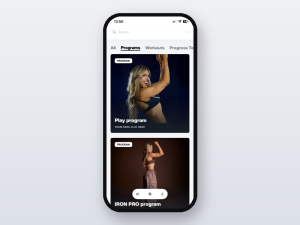
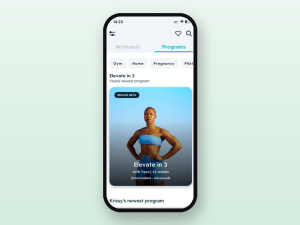
What counts as low-impact strength training?
Low-impact strength training is resistance training performed with both feet on the floor, with no jumping, landing or running. The strength stimulus comes from load on the muscle through dumbbells, resistance bands or proprietary tools, not from ground reaction force on the joints.
A heavy goblet squat is low impact. A box jump is not. A dumbbell row with both feet planted is low impact. A burpee, even at light intensity, is not.
The phrase “low impact” is often used loosely. Some apps market “low-impact cardio” that is essentially HIIT without the jumps. That lowers impact but does very little for strength.
Other apps market “light resistance” programmes with 1kg pink dumbbells and call them strength training. Neither is what this guide is about.
The American College of Sports Medicine (ACSM) defines resistance training as exercise using muscular contractions against external resistance to improve strength, power, hypertrophy or muscular endurance. Whether that contraction happens against a dumbbell, a band, a kettlebell or a Pvolve P.ball, the underlying adaptation is the same.
According to Dr Brad Schoenfeld, the leading researcher in muscle hypertrophy, the primary driver of muscle growth is progressive mechanical tension applied to muscle tissue over time. His 2017 systematic review in the Journal of Strength and Conditioning Research showed wider rep ranges (5 to 30 reps) produce equivalent hypertrophy when total volume is matched.
That is what makes low-impact strength training a real option rather than a compromise. A well-programmed session with moderate weight and 8-15 reps can drive the same adaptation as a heavier, lower-rep session, provided the working sets are taken close to failure.
How does training change for women over 40 in perimenopause and menopause?
Three things change at midlife that make joint-protective strength training the higher-yield choice. Cartilage thins, oestrogen drops and bone density falls, and sarcopenia starts earlier than most women realise.
Cartilage thins, particularly after menopause. Articular cartilage loses water content and proteoglycan density with age, and the drop accelerates around the menopause transition.
According to The British Menopause Society and The Menopause Society (formerly NAMS), joint pain is a recognised symptom cluster of perimenopause and menopause. Not because the joints themselves are inflamed but because oestrogen withdrawal affects connective tissue and pain processing.
Programmes that hammer the joints (jumping HIIT, plyometric burpees, repeat sprints) become a worse trade for marginal cardiovascular gain. Dr Mary Claire Haver, a board-certified gynaecologist and author of The New Menopause, makes this case repeatedly: midlife joint pain is often a soft-tissue problem dressed up as a wear-and-tear problem.
This part is personal for me. The meniscus injury a couple of years ago changed how I read every programme. Anything that asks me to land repeatedly is now a bad trade, no matter how good the cardiovascular benefit looks.
Oestrogen drops and bone density falls. Women may lose roughly 10% of bone mass in the years around menopause and another 1-2% per year afterwards, according to Royal Osteoporosis Society guidance.
The countermeasure published by The Menopause Society, ACSM and the Royal Osteoporosis Society is resistance training. The LIFTMOR trial (Watson et al. 2018) demonstrated significant improvements in bone mineral density at the femoral neck and lumbar spine in postmenopausal women with osteopenia and osteoporosis.
Layne and Nelson’s landmark 1999 review in Medicine and Science in Sports and Exercise established resistance training as a preventive intervention for postmenopausal bone loss long before the heavier-protocol trials. The principle has held ever since.
Sarcopenia starts earlier than most women realise. Lean muscle mass declines from roughly age 30 and accelerates after 50.
Janssen et al. (2002) estimated the prevalence of sarcopenia at around 24% of women aged 65-70 and rising sharply afterwards. The European Working Group on Sarcopenia in Older People (Cruz-Jentoft et al. 2010) established the consensus definition still used today: a progressive, generalised loss of skeletal muscle mass, strength and function.
Strength training is the only documented intervention that reverses it. The intervention itself does not have to be impact-heavy to work. What it has to be is consistent and progressive.
What should women over 40 prioritise in low-impact strength training?
Five priorities matter most: bone-density loading, movement quality before load, pelvic floor awareness, parallel cardiovascular work and recovery quality. Below is how each translates to weekly programming.
Bone density loading, without impact where possible. Postmenopausal women lose bone fastest in the femoral neck (hip) and lumbar spine (lower back). The strongest evidence for protecting these sites comes from progressive resistance training that loads them directly.
Romanian deadlifts, goblet squats, dumbbell back squats and overhead presses all load these structures through muscle contraction. The 2017 Exercise and Sports Science Australia (ESSA) position statement (Beck et al.) endorsed progressive high-magnitude resistance training as the most effective non-pharmacological stimulus for skeletal adaptation in older adults.
Movement quality before load progression. Women returning to strength training after years away, or training around joint history, benefit from earning the movement pattern first.
A controlled bodyweight squat is a better stimulus than a sloppy goblet squat with 12kg. The first six weeks of any new strength programme should prioritise mechanics and consistency. Progressive load comes after.
Pelvic floor awareness on the way to heavier loading. Postnatal women, women with diastasis recti history, and any woman experiencing menopause-related pelvic floor changes should integrate transverse abdominis activation before progressing to maximal-effort loading.
I tested mainstream postnatal programmes extensively across two pregnancies and found most of them lacking on this specific point. The Sculpt Society and Pvolve build pelvic floor awareness in by default. Caroline Girvan and FORM expect you to bring your own pelvic floor practice. EvolveYou varies by trainer.
Cardiovascular fitness as a parallel priority, not a swap-out. Strength training does not replace cardio. According to the British Heart Foundation, cardiovascular risk in women rises in the decade following menopause as the protective effect of oestrogen is removed.
Brisk walking, one to two sessions of slightly higher-intensity work alongside your strength sessions covers the cardiovascular base. Strength training drives the muscle, joint and bone outcomes that the cardio cannot.
Recovery becomes load. In perimenopause, sleep variability and cortisol sensitivity make recovery quality more important than at 30.
A perfectly programmed strength session in a sleep-deprived body is not the same stimulus it would be in a rested one. Dr Mary Claire Haver discusses this in The New Menopause in the context of cortisol-conscious training. Three good sessions a week is more useful than five sessions you cannot recover from.
Which low-impact strength training programmes score highest?
Pvolve scores highest overall (8.3), with the best Joint Friendliness score on this list. Caroline Girvan CGX (7.6) sits at the heavy end of low impact for women whose priority is bone density. The Sculpt Society (8.2), FORM (7.6) and EvolveYou (6.1) cover sculpt, Pilates-strength and library-style routes respectively.
| Programme | Score | Joint friendliness | Why it suits low-impact strength | Not Ideal For | Price / month | Trial |
|---|---|---|---|---|---|---|
| Pvolve | 8.3 | 9 | Band tension, no compressive load | Women wanting pure heavy dumbbell work | $24.99/mo | 14 days |
| Evlo Fitness | 8.0 | 9.5 | DPT-designed targeted resistance, joint-protective by design | Women with under 30 min per session | $55.99/mo | 14 days |
| Sculpt Society | 8.2 | 9 | Light dumbbells + ankle weights, sculpt format | Women wanting heavy compound lifts | $24.99/mo | 7 days |
| FORM | 7.6 | 6.5 | Pilates-strength hybrid, slow tempo | Women wanting pure hypertrophy | From $24.99/mo | 7 days |
| Caroline Girvan | 7.6 | 7 | Heavier dumbbell cycles, all landed | Women who need a coach to specify loads | Free / ~$4/mo app | Free |
| EvolveYou | 6.1 | 5 | Library platform, band and at-home tracks | Women wanting one curated method | $19.99/mo | 7 days |
Scores pulled live via shortcodes. Discuss any new training programme with your doctor or physiotherapist, particularly with a joint history or osteoporosis risk.
How does joint load actually compare across these programmes?
Knee, spine and shoulder load vary widely even across “low impact” programmes. Pvolve sits at the bottom of the load range (band tension, no compression). Caroline Girvan’s dumbbell cycles sit at the high end of low impact (heavy load, but landed). The Sculpt Society, FORM and EvolveYou band tracks occupy the middle.
This table is the wedge I wish someone had put in front of me when I was rebuilding after my meniscus injury. The values are relative (1 = minimal, 5 = high) based on my testing and observation, not lab measurement.
| Modality | Knee load | Spine load | Shoulder load | Impact | Notes |
|---|---|---|---|---|---|
| Pvolve | 1-2 | 1-2 | 1-2 | None | Band tension, no compressive load. Safest after knee surgery. |
| The Sculpt Society (sculpt) | 2 | 1-2 | 2 | None | Mat-based with light weights. Skip the dance cardio if impact is the concern. |
| FORM | 1-2 | 2 | 2-3 | None | Slow tempo, light-to-moderate dumbbells. Some Pilates positions load shoulder. |
| Caroline Girvan EPIC / IRON | 3-4 | 3-4 | 3-4 | None | Heavy dumbbell work, all landed. Spine loaded through load, not impact. |
| EvolveYou At Home with Bands | 1-2 | 1-2 | 1-2 | None | Band-based tracks, low compressive load. |
| HIIT class (typical) | 4-5 | 3 | 3 | High | Jumps, burpees, plyometrics. Often contraindicated post-meniscus. |
| Barbell back squat | 3-4 | 4-5 | 3 | None | Highest spine load of any strength modality. Form-dependent. |
| Walking | 2 | 1 | 1 | Low | Useful adjunct, not a strength stimulus. |
None of the five programmes in this guide involve jumping, landing or running. The variation is in load size, not impact type.
How do the best low-impact strength programmes compare?
1. Pvolve, Score: 8.3
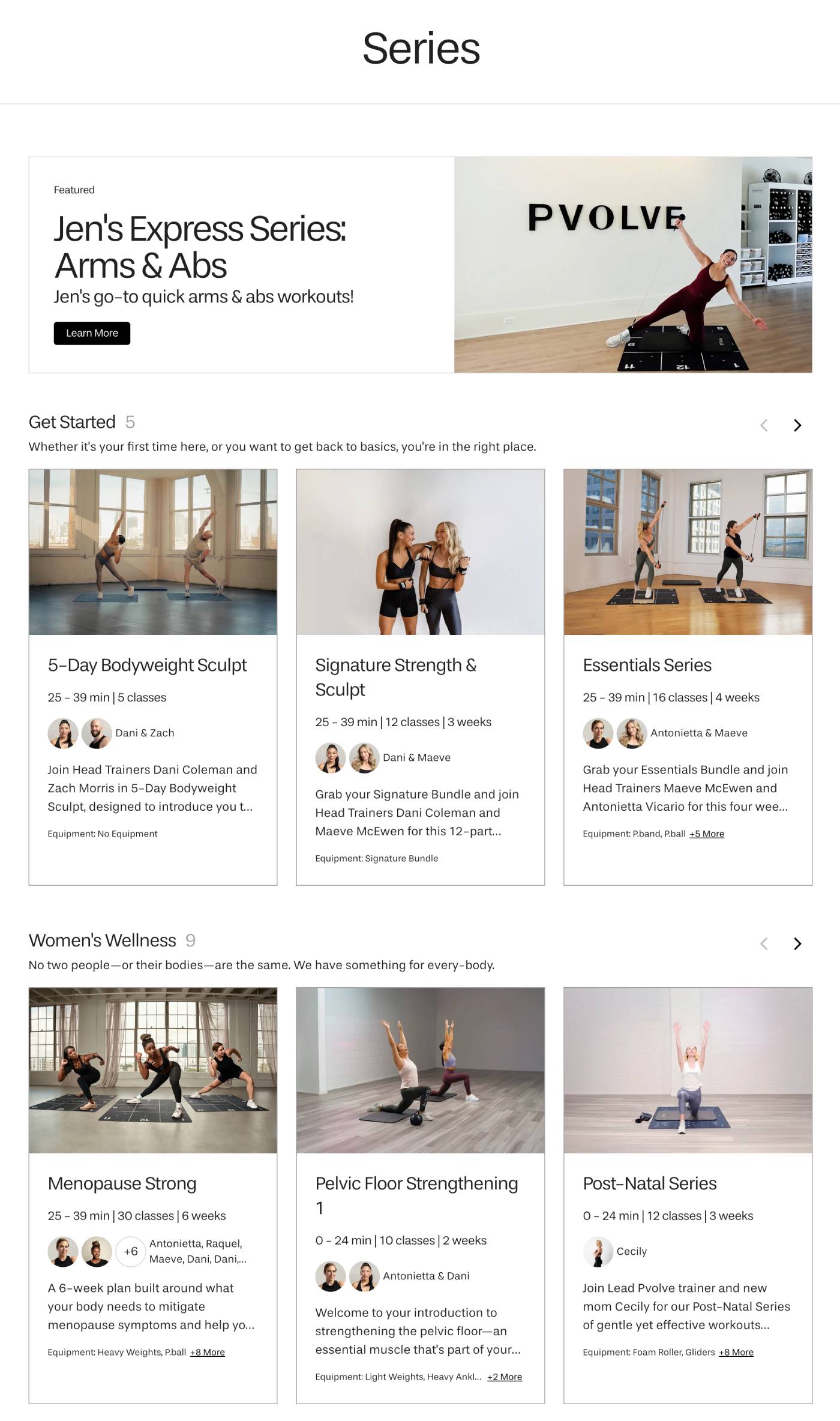
Engineered around tension rather than compression, the closest a streaming programme gets to physiotherapy-grade joint protection while still building visible muscle.
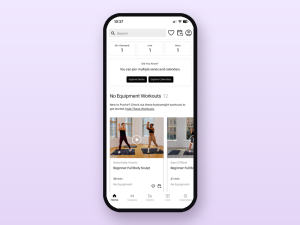
Pvolve is the only programme reviewed where the entire method was designed around joint protection rather than retrofitted as a “low-impact mode” within a broader catalogue. Band tension drives muscular adaptation. The proprietary tools (P.ball, P.band, gliders, P3 trainer) create the eccentric and stability loading that band work alone cannot deliver.
This score reflects low-impact strength criteria: joint friendliness, smart progressive resistance, and women-over-40 specificity. Women who want pure barbell-style hypertrophy will rate it lower on muscle potential.
Pvolve was founded by Rachel Katzman, New York-based, and developed with input from physiotherapists and a clinical advisory board. The brand has been associated publicly with Jennifer Aniston, but the method itself stands on its own.
Classes layer proprietary tools over functional movement patterns: hip hinges, single-leg work, lateral bands, controlled adduction. Progressive resistance comes from increasing band thickness and accumulating volume rather than from heavier weight.
What separates Pvolve from generic “low-impact” content is that the muscular work is genuine. By the end of a 35-minute lower body class, the glutes and inner thigh are properly worked.
Resistance band tension produces an ascending strength curve (hardest at the end of the range). That makes it particularly useful for end-range strength in joints that have lost stability, including post-meniscus knees and post-partum hips.
Verdict: I tested Pvolve over two months of daily 20-minute sessions, using resistance bands and dumbbells I already owned. I did not buy the Pvolve equipment bundle. Filtering for 16-25 minutes with bands and dumbbells returned 297 classes, which is more content than I will get through this year.
I started weight work at 5kg upper body and 6.5kg lower body. I am now at 6.5kg upper and 8.5kg lower. That is a genuine progression across two months of 20-minute sessions, which is more than I expected. I assumed Pvolve would be too gentle. It is harder than it looks. I was counting the last few reps on movements that by all rights should have felt manageable.
Running up the stairs the other day I felt noticeably less wobbly, which sounds small but is not. My arms and core look more defined. My legs carry fat in a way that makes visible muscle hard to see, but I feel stronger in them. The knee stability series reduced stiffness I had been carrying without realising. Where Pvolve falls short is maximum hypertrophy load. If your goal is to keep adding heavy dumbbells, this will plateau you. That is the trade for the joint friendliness, and for many women it is the right trade.
Ideal for: Women rehabilitating from a knee, hip or back issue who still want a genuine strength stimulus. Women in early postnatal recovery with clearance. Women in perimenopause whose joints have started to protest at higher-impact loading.
Cost: $24.99/month or $224/year (US); £14.99/month UK via Healf. Proprietary tool bundle one-off around $150-200. 14-day free trial.
Trade-off: The proprietary kit is a real one-off cost. The method tops out below where heavy dumbbell programming continues to load, so women chasing maximum hypertrophy will hit a ceiling Pvolve does not aim to break through.
Start the 14-day free trialAffiliate link, opens pvolve.com. I earn a commission at no extra cost to you. Full disclosure
2. Evlo Fitness, Score: 8.0
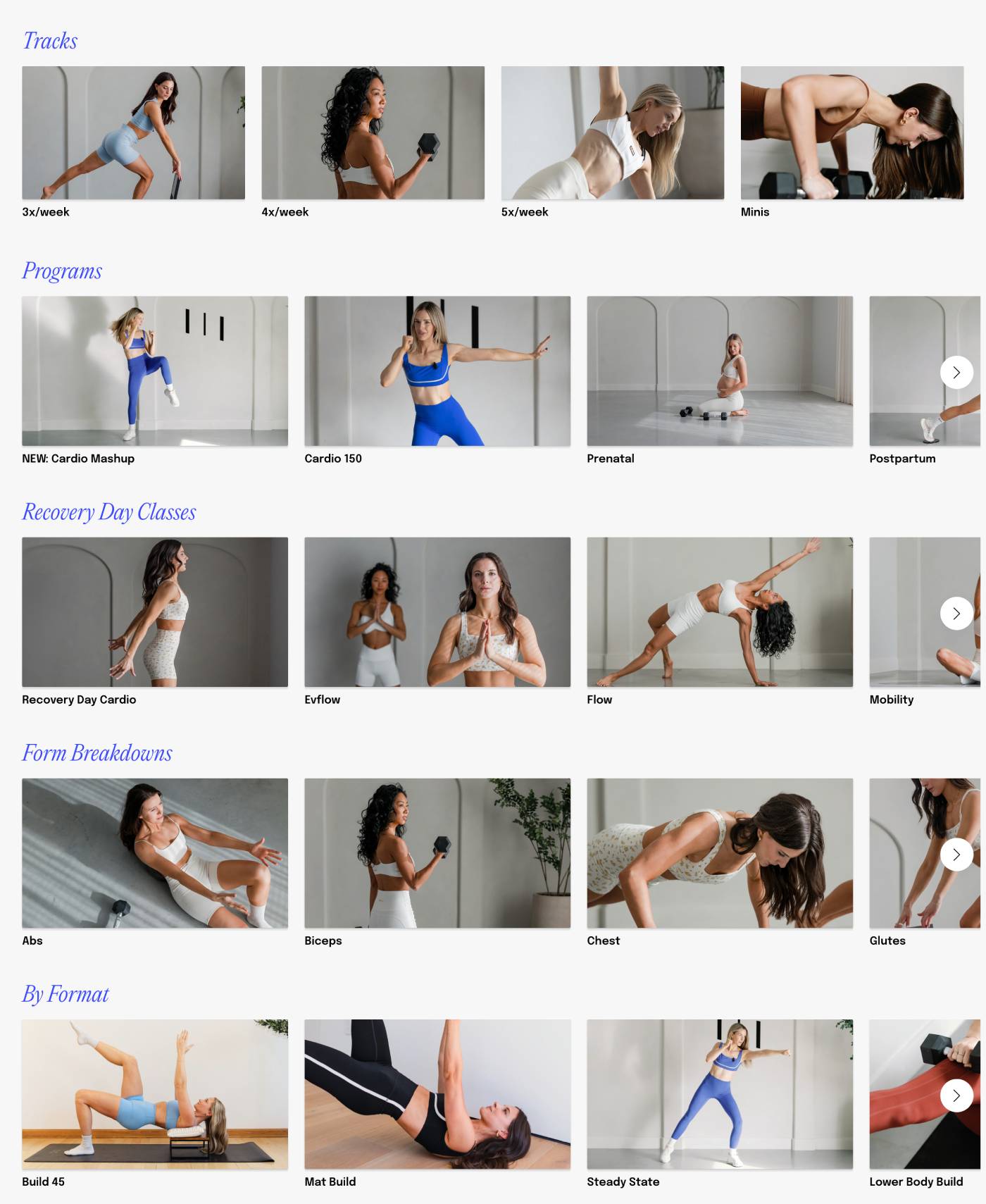
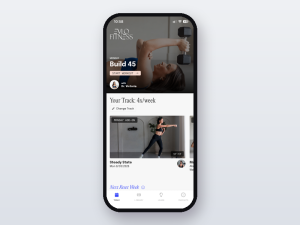
The most clinically rigorous joint-protective strength platform tested. Evlo was founded by Dr Shannon Ritchey, a Doctor of Physical Therapy, and built around a single explicit principle: every exercise is chosen based on how it loads the target muscle relative to joint stress. Sessions run 35-50 minutes across Foundations (entry programme) and Build (Upper and Lower Body) tracks.
For women over 40 who want a low-impact strength platform built on physiotherapy logic rather than fitness-industry defaults, Evlo is the strongest pick alongside Pvolve.
This score reflects Evlo’s position as the most clinically rigorous joint-protective strength platform tested. The DPT-led methodology, the deliberate joint-stress framing of every movement and the structured Foundations-to-Build progression collectively make it the right pick for women who want clinical-grade joint protection without giving up real strength training.
The DPT-designed methodology is the platform’s structural advantage. Every exercise selection has been filtered through joint-stress logic before it reaches the programme: which muscle is being loaded, what joint position that movement requires, and whether the joint load is necessary for the muscular adaptation. The result is a session that does the muscular work without the collateral joint load that conventional strength programmes accumulate over years. For women in perimenopause whose joints have started to protest at higher-impact loading, this kind of filtering is more meaningful than a generic “low-impact” label.
The 35-50 minute session length is the trade-off. Pvolve runs 20-30 minutes; Evlo asks for 45-50 minutes most days. For women whose binding constraint is time, this is the consideration that determines whether Evlo is realistic or not. The Foundations programme is the right entry; the Build (Upper and Lower Body) tracks add a structured progression once you have completed the foundation.
Verdict: I tested Evlo for 8 weeks across Foundations and Build (Upper and Lower Body), using dumbbells from 4kg to 7kg per hand. After the first week of Foundations I could feel my core, inner thighs, and glutes working in a way I had not felt on heavier compound programmes. After a lower body Build session I was cooked in my glutes and hamstrings; the soreness pattern was different from what dumbbell-led strength platforms produce.
Across the eight weeks I saw visible glute and hamstring change and my upper arms showed visible definition change. The trade-off is real: 45-50 minutes per session is the biggest commitment in the low-impact category. Boredom risk is moderate (the content variety is narrower than Pvolve or Sculpt Society), decision fatigue is very low (the programme structure is clear), and the time barrier is the single biggest threshold to clear.
For women over 40 who can reliably find 45-50 minutes per session and who want a low-impact strength platform built on physiotherapy logic, Evlo is the right pick. For women whose time constraint pushes session length under 30 minutes, Pvolve fits better.
Ideal for: Women rehabilitating from knee, hip, lower back or shoulder history who want clinical-grade joint protection without giving up strength training. Women who tolerate 45-50 minute sessions four times per week. Women who already understand strength training principles and want a physiotherapy-led methodology layered on top.
Cost: $55.99/month. 14-day free trial.
Trade-off: 45-50 minutes per session is the biggest commitment in the low-impact category. Content variety is narrower than Pvolve or Sculpt Society. Price is the highest in this guide.
3. The Sculpt Society, Score: 8.2
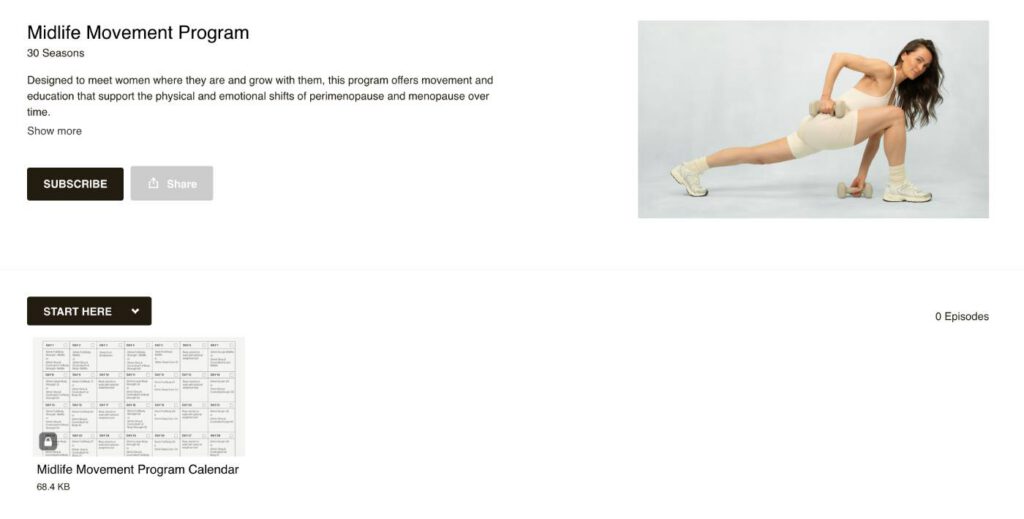
Light-dumbbell sculpt programming with ankle weights and controlled tempo. Low impact by structural design, with enough variety to keep adherence high over months.
The Sculpt Society’s sculpt format combines light dumbbells (typically 1-3kg) and ankle weights (1kg) with controlled tempo and high reps. The muscular adaptation comes from time under tension and accumulated volume rather than load.
This score reflects sculpt-style low-impact resistance training. Women comparing this to heavy dumbbell programmes will rate it lower on raw load.
The Sculpt Society was founded by Megan Roup, NYC-based, a former professional dancer. The platform launched in 2017.
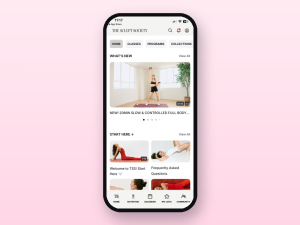
Classes follow a consistent template: warm-up sequence, focused upper-body or lower-body work, core finisher. Roup releases new classes regularly within a calendar structure that builds across the week.
The app surfaces programme tracks that sequence classes intentionally rather than as a random library. Sculpt classes are explicit about which muscle groups are targeted. The dance cardio classes sit separately and are not low impact, so skip those if impact is the concern.
For a woman over 40 returning to movement, or working through a hip or knee issue, this is exactly the right entry point. The cues are friendly without being patronising and the equipment requirements are minimal.
Verdict: Within minutes of landing on The Sculpt Society app, I spotted dedicated sections for midlife support, injury-safe workouts and no-kneeling classes. That alone told me this platform had actually thought about who it was building for.
I completed the 4-week Midlife Movement Programme, dipped into the 14-Day Strength Programme, tested the injury-safe classes, discovered the lymphatic massage class in the Lifestyle section (now a regular part of my week) and eventually found the dance cardio through the search bar. I was not expecting to enjoy the app as much as I did.
I increased my weights from 7.5kg to 8.5kg over the 4 weeks and could have pushed harder. If you are already at an intermediate to advanced level, the default pace of the Midlife programme may feel slow. But that is a calibration issue, not a flaw in the platform. For anyone at the beginning of their perimenopausal journey, this is exactly where to start.
Ideal for: Women returning to movement after a long pause. Postpartum women with clearance. Women in early perimenopause whose first instinct is “I want to feel strong but not wrecked.”
Cost: $24.99/month or $179.99/year. 7-day free trial.
Trade-off: Light dumbbells and ankle weights cannot drive the same load progression as a 15-20kg goblet squat. For women whose strength goal is genuinely heavier, this is the starting programme, not the destination.
4. FORM, Score: 7.6
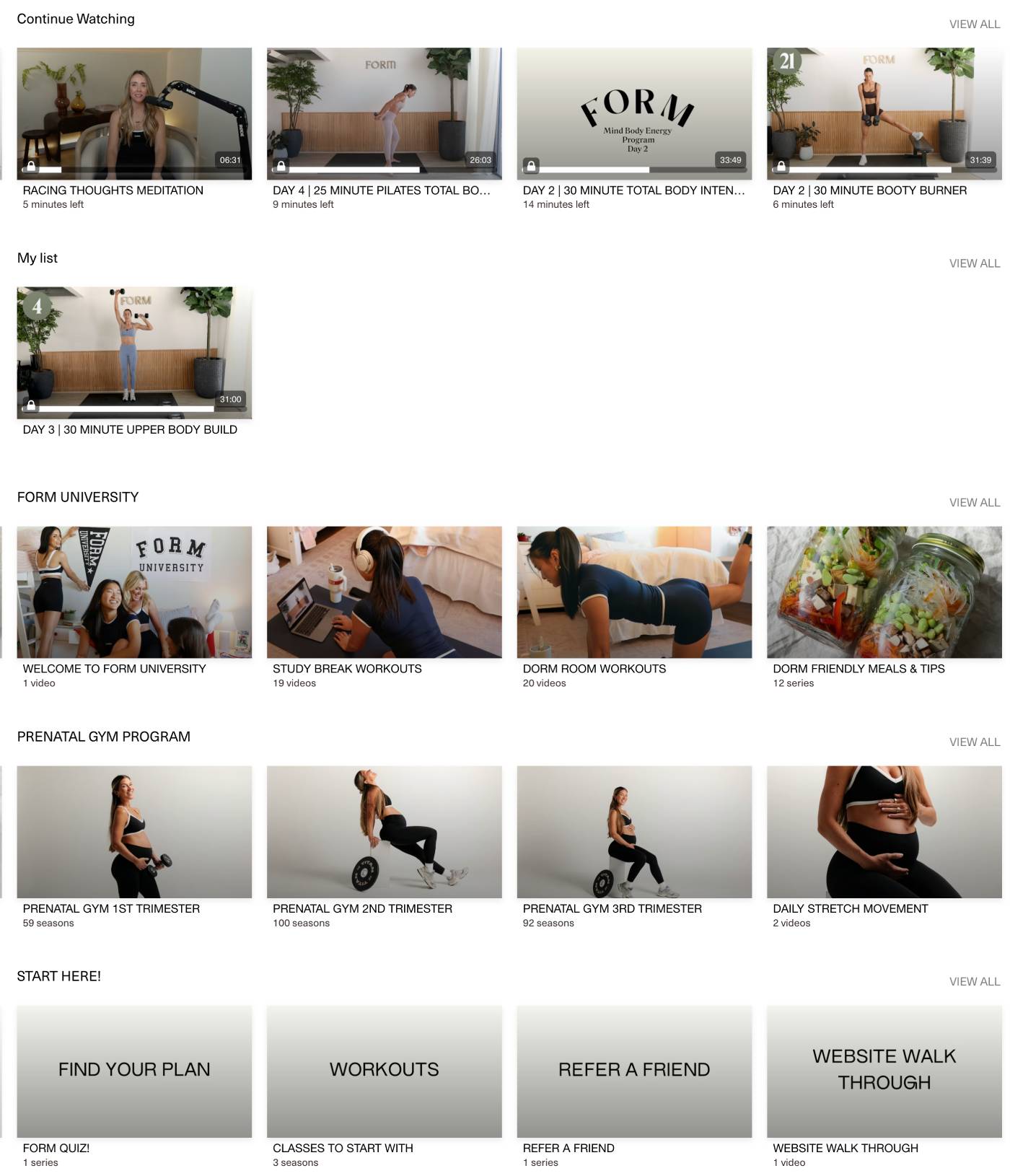
Pilates-strength hybrid with controlled tempo and slightly heavier loading than pure sculpt. The best programmed bridge between mat Pilates and dumbbell strength.
FORM sits in the space between traditional Pilates and dumbbell strength training. Classes use light to moderate dumbbells (typically 2-5kg) with the controlled tempo of Pilates and the compound movement pattern of strength training.
This score reflects FORM’s positioning as a Pilates-strength bridge: more loading than pure Pilates, more controlled tempo than pure dumbbell strength.
FORM was founded by Sami Clarke, US-based, with Pilates-influenced programming threaded through breath and recovery content.
Squats, hip hinges, rows, presses and core work appear in most sessions. They are executed slowly with deliberate breath, time under tension, and form cues that come from a Pilates lineage rather than a powerlifting one.
The combination works particularly well for women over 40. The slow tempo lengthens time under tension at moderate loads, which Schoenfeld’s 2017 systematic review shows produces equivalent hypertrophy to heavier-load lower-rep work when total volume is matched.
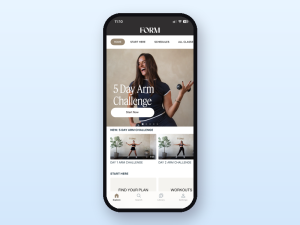
Sessions are structured into clear blocks: breath, mobility, strength, core, recovery. The calendar makes it easy to follow a balanced week without thinking about programming yourself.
The app also includes longer recovery and breathwork content, which sets a different tone from most fitness apps. The vibe is “considered movement” rather than “crush yourself.” That fit matters in perimenopause.
Verdict: I found FORM on Instagram through Sami Clarke and landed on the website first. The design stopped me before I even looked at a workout. Natural colours, plants, wood tones. It felt like a wellness brand that understood what calm looks like.
I signed up, completed the quiz, and was recommended The Form Method, a 14-day strength programme. Two weeks later I had finished the full programme, tried the 7-day Beginner Pilates series, explored the meditation section, and my belly had gone flat. It is now my favourite workout app.
FORM does not offer perimenopause-specific guidance or dedicated joint-protective programming. For women in good health in their 40s looking for varied, effective, calm sessions, the trade is right. Pair it with one heavier dumbbell session a week if bone density is a stated concern.
Ideal for: Women in perimenopause sensitive to cortisol load and sleep disruption. Women who want Pilates-style movement quality with enough loading to drive muscular adaptation. Women new to dumbbell work who would benefit from slow, cued execution.
Cost: $24.99/month or $179.99/year. 7-day free trial.
Trade-off: The dumbbell load tops out modestly. Women whose strength goal is to lift considerably heavier will eventually need a separate heavier session per week to keep progressing.
5. Caroline Girvan CGX, Score: 7.6
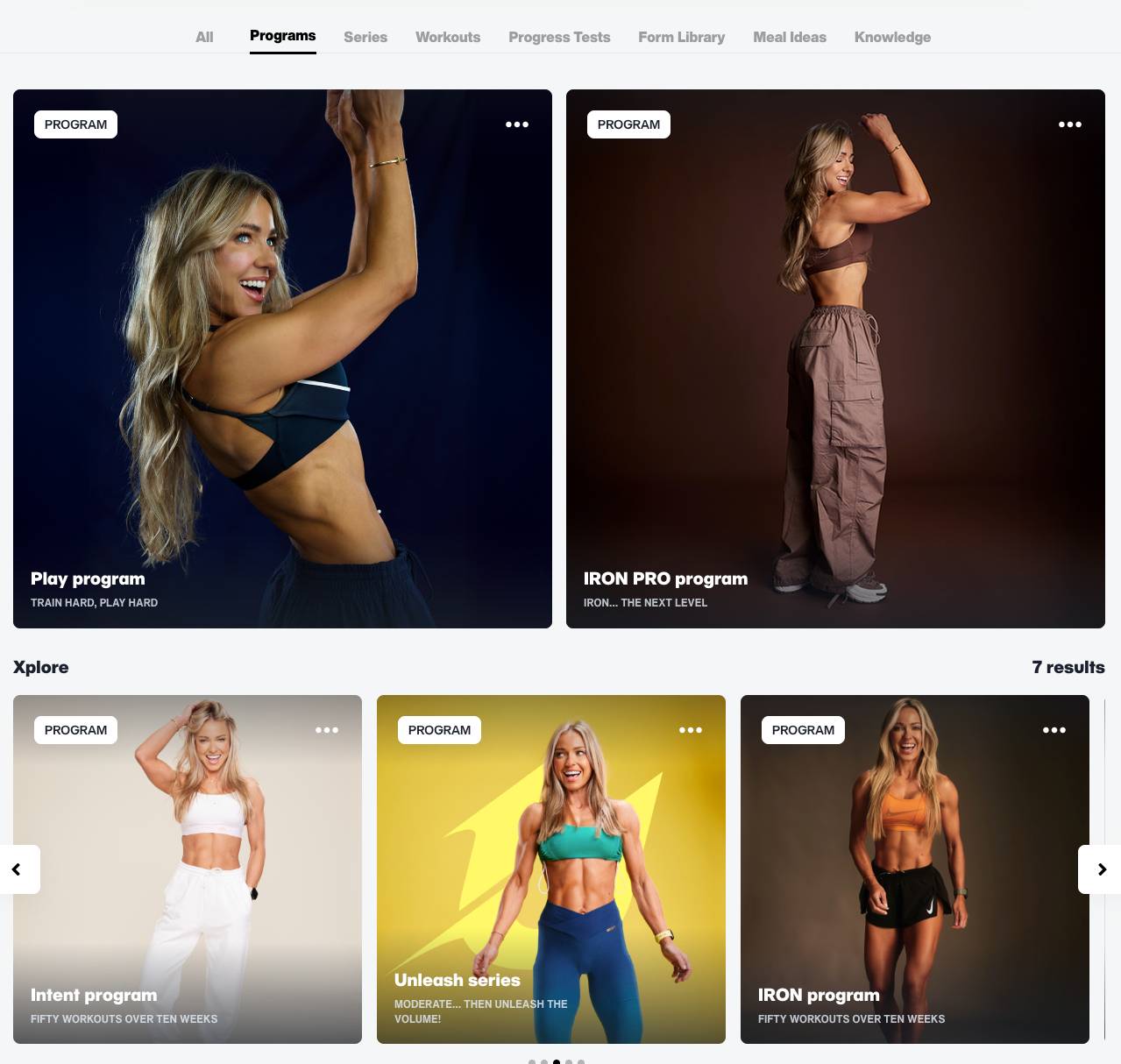
Heavy dumbbell programming without a single jump. The strongest answer to the bone-density question on this list, with proven progressive overload across multi-week cycles.
Caroline Girvan is the case that “low impact” does not have to mean light. Her signature programmes (EPIC, EPIC II, FUEL, IRON) are 4-5 week cycles built around compound dumbbell movements: back squats, front squats, Romanian deadlifts, bent-over rows, overhead presses, bench presses.
This score reflects strength training fundamentals: progressive overload, compound dumbbell selection, and free or near-free access. Joint Friendliness sits lower than Pvolve because the loads are heavier, but the absence of impact is absolute.
Caroline Girvan is a Northern Irish trainer with a YouTube channel over 5 million subscribers. The dedicated CGX app adds automated programme tracking.
Every session is landed (both feet on the floor, no jumping, no plyometrics) but every session is also genuinely loaded. The progressive overload is structural rather than negotiated by you. Within each cycle the weekly template stays consistent and load or volume increases week by week.
This matters for the bone density piece. The LIFTMOR trial used heavy resistance training (5 reps at near-maximum load) and showed significant improvements in bone mineral density at the femoral neck and lumbar spine.
Caroline Girvan’s dumbbell programming is the closest free or near-free home approximation of that protocol. Dr Stacy Sims, in Next Level, argues that women in midlife specifically need heavier loading rather than the “lift light, do more reps” stereotype that has persisted in women’s fitness marketing.
Verdict: I have been training with Caroline Girvan’s programmes for about three years, on and off, and I keep returning. Not because I have not tried anything else (this site exists because I test everything) but because when I want real results, this is where I come back.
I went from 64kg to 61kg just by following her daily workouts consistently and eating healthily, with no restrictions. No calorie counting, no elimination diet. I tightened up significantly. My legs, where I store fat, looked noticeably more toned. Visible muscle definition appeared across shoulders, arms, and back.
Over three years of returning to her workouts across multiple programmes (EPIC, FUEL, IRON, plus the free Iron Series on YouTube), my consistent experience has been visible toning alongside genuine strength gains. The 64kg to 61kg weight change is part of it, but the more significant shift was how my body composition changed. Caroline Girvan delivers what matters most: visible results. Progressive overload is built into the programme structure, and the workouts are genuinely challenging.
Ideal for: Women in perimenopause and menopause whose bone density is a stated concern. Women with adjustable dumbbells (or a range from 5-22kg) who want the most rigorous progressive programming at low impact.
Cost: Free on YouTube. CGX app approximately $3.99-4.99/month for programme tracking.
Trade-off: Sessions are 30-60 minutes with no shorter versions for the flagship cycles. The format is self-directed, which suits women who want ownership and frustrates women who want a coach to tell them exactly what to do.
6. EvolveYou, Score: 6.1
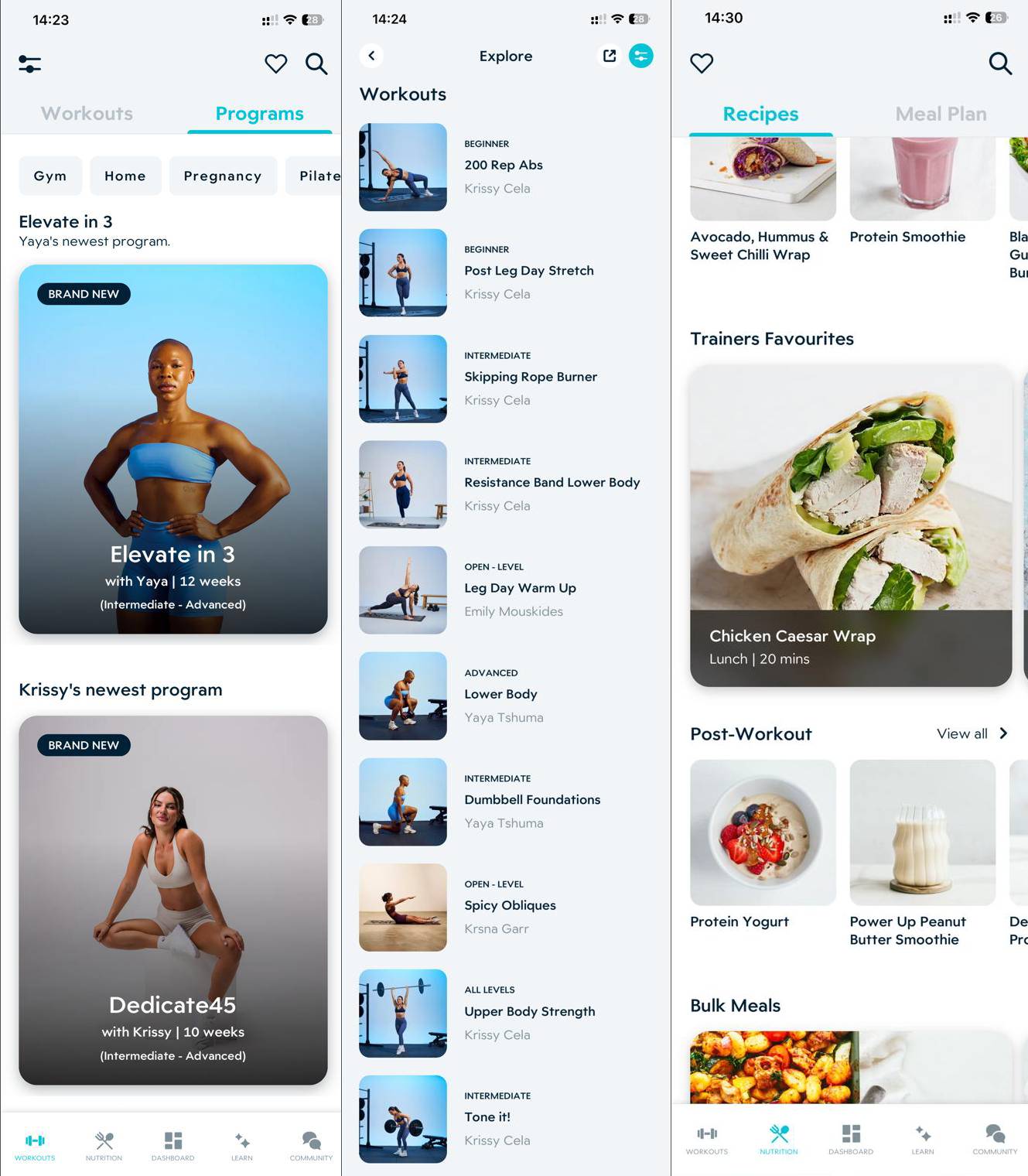
Library-style app with multiple trainers and a strong band-based low-impact track. Useful for variety, less useful if you want one curated programme.
EvolveYou is a different shape from the other four. Where Pvolve, Sculpt Society, FORM and Caroline Girvan each have one coherent method, EvolveYou is a library where individual trainers have built their own programmes.
This score reflects EvolveYou’s position as a multi-programme library, filtered strictly to the band and at-home low-impact tracks. The wider library includes higher-impact programmes outside this guide’s scope.
EvolveYou is UK-founded and was originally launched by Krissy Cela. It is now a multi-trainer platform with separate programmes per trainer.
For low-impact strength, the relevant tracks are the band-based programmes and the At Home with Bands category. Trainers have built structured progressions specifically without barbell access and without impact.
The advantage of the library model is breadth: you can shift between trainers depending on what your body wants in a given week. The disadvantage is decision fatigue and consistency.
Without committing to one trainer’s programme cycle and following it through, the progressive overload mechanism gets diluted. The platform addresses this through trainer-led programme tracks of 4-8 weeks with clear progression models.
Verdict: I found EvolveYou through Krissy Cela on Instagram. She trains for strength, and that is the kind of training I have been gravitating toward. I went through the quiz, got recommended 45-60 minute strength programmes, and quickly realised those sessions would not fit into a realistic week as a working mother of two with a packed after-school schedule.
For women who train at a gym, EvolveYou is excellent. The gym-based programmes are thorough, structured and include equipment guidance that most apps do not offer. For home-only trainers in their 40s managing limited time, joint issues or perimenopausal symptoms, it is a less natural fit.
The trainer variation is real. The best band-based and at-home programmes on the platform are well-structured. The weaker ones default to high reps and lighter resistance. Honest warning: the billing practices need a clear understanding before you sign up. Cancel through the platform directly rather than through the App Store.
Ideal for: Women who like variety and prefer choosing between several trainers rather than committing to a single method. Women travelling or training in changing environments where band-based work is the most practical option.
Cost: $19.99/month or $109.99/year. 7-day free trial.
Trade-off: The library breadth is the platform’s strength and its weakness. Programmes vary in quality and progression rigour. Women who want a single committed method should pick from Pvolve, Sculpt Society, FORM or Caroline Girvan instead.
Which low-impact strength programme is right for you?
You have a knee, hip or back issue and want maximum joint protection
START WITH: Pvolve
The 14-day free trial gives access to the full library. Start with the Beginner Bundle classes to learn the proprietary tools before moving to programme tracks. Talk to your physiotherapist if you have an active injury.
You are returning to movement after a long pause or postpartum, with clearance
START WITH: The Sculpt Society
The sculpt classes are the right entry level. 30 minutes, light dumbbells, ankle weights, no learning curve. Pick one of the Programme tracks rather than browsing the library.
You want Pilates-style controlled movement with more loading than mat Pilates delivers
START WITH: FORM
Sami Clarke’s structured weekly programming makes it easy to follow without thinking. Particularly useful if you are sensitive to cortisol or sleeping badly.
You want progressive heavy dumbbell strength training without a single jump
START WITH: Caroline Girvan EPIC
Free on YouTube. Start with EPIC I and follow it for the full 5-week cycle before switching programmes. Add the CGX app subscription only if you want automated load tracking.
You want variety and prefer a library to a single committed method
START WITH: EvolveYou
Filter to band-based and At Home tracks. Pick one trainer’s programme and follow it for at least six weeks before jumping to another.
Where is the evidence still evolving?
The honest answer to “is low-impact strength training enough on its own for bone density” is mostly yes, with a caveat. The strongest published bone-density protocol combines heavy resistance training with impact-based loading. Pure low-impact strength likely protects bone density adequately for most women, but the maximal protocol pairs strength with some form of impact.
The LIFTMOR trial (Watson et al. 2018) used heavy resistance training (5 reps at near-maximum load) combined with impact-based loading (jumping chin-ups, drop landings). It showed significant improvements in bone mineral density at the femoral neck and lumbar spine.
The LIFTMOR-M trial in men (Harding et al. 2020) showed similar effects. What is genuinely uncertain is how much of the bone benefit came from the heavy load versus the impact component.
Wolff’s Law, the principle that bone adapts to applied stress, suggests both signals matter. The Royal Osteoporosis Society guidance and the ESSA position statement (Beck et al. 2017) both endorse a combined approach of progressive resistance training plus targeted impact loading for women at risk.
Stacy Sims, in Next Level, argues the same case: women in midlife specifically need both heavy lifting and short-burst impact loading for full bone protection.
The practical implication. If bone density is your stated concern, build a week that combines low-impact strength (any of the five programmes here) with a separate intentional impact stimulus. A few minutes of walking with short hops. A low-volume jump set on safe days, with clearance. Or simply not avoiding stairs and brisk walking.
The second open question is whether band-based resistance (the Pvolve approach) drives equivalent bone adaptation to dumbbell or barbell load. The mechanical loading at the joint is genuinely different.
Band tension produces a less compressive load profile. That is great for joint protection and uncertain for bone density. There is no published RCT directly comparing band-based versus dumbbell strength training for bone outcomes in midlife women.
If I were designing my own week from scratch today, knowing my meniscus history, I would run two Caroline Girvan-style heavy dumbbell sessions per week, two Pvolve sessions, and a separate short impact stimulus on one of the heavier lifting days. That combination is not what any single programme on this list delivers as a single product. It is what the research seems to support.
Frequently Asked Questions
Low impact strength training is resistance work where both feet stay on the floor and there is no jumping, landing or running. The strength stimulus comes from load on the muscle through dumbbells, resistance bands or proprietary tools, not from ground reaction force on the joints. A heavy goblet squat, a Romanian deadlift with dumbbells, a banded glute bridge and a Pvolve-style adduction sequence are all low impact strength training. A burpee or jump squat is not, even at light intensity.
Strength training is low impact by default when performed with weights and controlled execution. Dumbbells, barbells, kettlebells, machines and resistance bands all qualify as low impact because both feet typically stay grounded. Strength training only becomes high impact when plyometric movements are added, which is a coaching choice rather than a strength training requirement. The vast majority of strength training programmes for women over 40 are low impact.
Yes. The 2017 systematic review and meta-analysis by Schoenfeld and colleagues in the Journal of Strength and Conditioning Research found equivalent muscle growth across rep ranges from 5 to 30 when total training volume was matched. Low impact strength training using moderate weights at higher reps to near-failure produces the same hypertrophy as heavier weights at lower reps. Caroline Girvan’s dumbbell programmes, Pvolve’s band-based work and FORM’s Pilates-strength sessions all drive measurable muscle adaptation when followed consistently.
For most women, yes for muscle and largely yes for bone density. The clearest evidence base (the LIFTMOR trial, Watson et al. 2018) combined heavy resistance training with impact-based loading, so the strongest published protocol includes both stimuli. Pure low impact strength training with moderate-to-heavy load such as Caroline Girvan’s dumbbell cycles likely protects bone density adequately for most women in midlife. Women with established osteopenia or osteoporosis should consider pairing low impact strength training with a separate short impact stimulus, on clearance from their doctor.
Pvolve scored highest for women with knee history because the method uses band tension and proprietary tools to drive muscular adaptation without compressive load through the knee joint. The Sculpt Society sculpt classes and FORM also score well for knee safety because the loading is light and the movement patterns are controlled. Caroline Girvan’s dumbbell programmes are heavier and require more confidence in knee mechanics. Always discuss any new training programme with your doctor or physiotherapist if you have a knee injury history.
Two to four sessions per week is the practical range supported by current evidence. A minimum of two resistance training sessions per week per muscle group is required to drive hypertrophy and strength adaptation, with three sessions producing meaningfully better outcomes. For women over 40, three to four sessions weekly supports the bone density and sarcopenia priorities specific to midlife. Spread sessions to allow 48-72 hours of recovery per muscle group.
A set of adjustable dumbbells covering roughly 5-22kg is the most useful single investment for women planning to progress over several years. Resistance bands (a set with light, medium and heavy resistance) add band-based training and travel portability. For Pvolve, the proprietary kit is a one-off purchase of approximately $150-200. For The Sculpt Society and FORM, dumbbells and ankle weights are sufficient. For Caroline Girvan’s heavier cycles, the dumbbell range needs to grow upward as you progress.
Pvolve and The Sculpt Society score highest for women over 50 in our evaluation. Pvolve’s band-based method is the safest entry point for women with joint history or returning to movement. The Sculpt Society’s sculpt classes deliver controlled progressive resistance without intimidation. Caroline Girvan’s programmes work well for active women over 50 already comfortable with dumbbell training.