



Why is building muscle after 50 different?
Three biological changes make muscle building harder after 50: anabolic resistance, slower protein synthesis, and accelerated sarcopenia. All three are reversible. None of them mean you cannot build muscle. They mean the protocol that worked at 30 needs to change.
Anabolic resistance is the term for the reduced muscular response to a given dose of training and protein in older adults. Burd and colleagues documented the phenomenon: the same workout and the same protein dose produce a smaller hypertrophy signal in older muscle than in younger muscle. The countermeasures are heavier loading and more protein. Not less of both.
Protein synthesis rates slow with age. The window during which a meal stimulates muscle protein synthesis narrows. The practical implication is that protein intake needs to be spread across the day in 4-5 doses of 25-40g rather than concentrated in one large dinner. Dr Mary Claire Haver recommends approximately 1g of protein per pound of bodyweight (roughly 2.2g per kg) for women in midlife.
Sarcopenia accelerates after 50. The European Working Group on Sarcopenia in Older People (Cruz-Jentoft et al. 2010) established sarcopenia as a clinical condition driven primarily by inactivity. The same paper made clear that progressive resistance training reverses it. Strength training is the only documented intervention that does so.
The implication is consistent across all three changes. Train heavier, eat more protein, do it more consistently. Not lighter. Not less.
How do you build muscle effectively after 50?
Build muscle after 50 with progressive heavy resistance training (3-4 sessions per week), compound dumbbell or barbell movements, and protein intake of approximately 1g per pound of bodyweight per day. That is the protocol that overcomes anabolic resistance and reverses sarcopenia.
Heavy is relative. For a woman new to strength training over 50, heavy might mean 5-8kg dumbbells for compound movements. For a woman with three years of consistent training, heavy is 10-20kg dumbbells or barbell work at 60-80% of one-rep maximum. The principle is the same: the load should produce genuine fatigue by the last rep of each set.
Schoenfeld’s 2017 systematic review and meta-analysis showed equivalent hypertrophy across rep ranges from 5 to 30 when total training volume is matched. The implication for women over 50 is encouraging: you do not have to lift in the 1-5 rep range to build muscle. Working sets of 8-15 reps to genuine fatigue produce the same hypertrophy stimulus.
Compound movements deliver the most adaptation per minute. Squats, hinges, presses, pulls, and their variations should form the foundation. Isolation movements (bicep curls, lateral raises) work as accessories but should not replace the compound lifts.
Frequency matters. Schoenfeld’s 2016 meta-analysis on training frequency showed that training each muscle group at least twice per week produces meaningfully more hypertrophy than once per week. For practical women over 50, this translates to 3-4 sessions per week using full-body or upper/lower splits, rather than five sessions covering one muscle group each.
What should women over 50 prioritise to build muscle?
Five priorities matter most: progressive heavy loading, compound movements, consistent frequency, adequate protein intake, and recovery quality. Each one is non-negotiable for muscle building at this life stage.
Progressive heavy loading. The programme needs to add load or volume across the weeks. Doing the same workout with the same weights for six months produces minimal continued adaptation. Progressive overload is the mechanism.
Compound movement selection. Squats, hinges, presses, pulls. The bone density argument supports compound work too, since the LIFTMOR-aligned heavy loading at the femoral neck and lumbar spine drives the same adaptation.
Consistent frequency. Three sessions per week is the practical floor. Four is the practical target. Five sessions starts to push against recovery limitations for many women over 50. Adherence beats intensity: three sessions you keep doing for two years beats five you abandon after six weeks.
Adequate protein intake. The published guidance from Burd 2012 and subsequent work by Phillips, Wolfe and Bauer is consistent: women over 50 building muscle need 1.2-2.2g of protein per kg of bodyweight per day, spread across 4-5 meals each containing 25-40g of protein.
Recovery quality. Sleep matters. Stress management matters. Dr Mary Claire Haver argues that midlife women specifically benefit from cortisol-conscious training because elevated cortisol blunts the anabolic response to training. Three good sessions a week sustained for years beats five exhausting sessions you cannot recover from.
A 3-day strength week for building muscle after 50
Three sessions, dumbbells only, built around the compound movements that drive the most muscle for the least time. Run it for eight weeks, increasing the weight whenever the last two repetitions stop being genuinely hard.
| Day | Movements | Sets and reps | The cue that matters |
|---|---|---|---|
| Monday, lower | Goblet squat, Romanian deadlift, split squat, calf raise | 3 x 8 to 10 | Depth over weight on the squat. If your heels lift, go lighter or elevate them. |
| Wednesday, upper | Floor press, single-arm row, overhead press, bicep curl | 3 x 8 to 10 | Row to the hip, not the chest, and keep the shoulder down. |
| Friday, full body | Deadlift, push-up, step-up, farmer carry | 3 x 8, carry 40 m | The carry is not a filler. Grip and trunk strength predict a lot at this age. |
Rest a day between sessions. Walk on those days if you want to. Nothing here needs a gym: one pair of adjustable dumbbells covers all of it.
Progression rule, and it is the only one you need: when you can complete all three sets at the top of the rep range with two reps still in reserve, increase the weight next session and drop back to the bottom of the range.
Eat about 25 to 30 g of protein within a few hours of each session, and hit your daily target on the days between. Training without the protein is the most common reason eight weeks produces nothing.
Which programmes score highest for building muscle after 50?
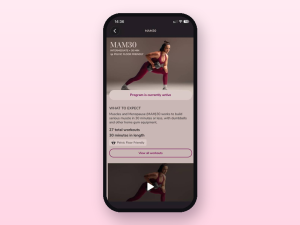
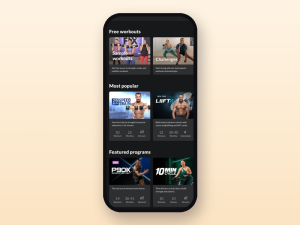
Seven programmes combine genuine progressive loading with real nutrition support. Flipping 50 ranks first, followed by Menovation, BODi, Centr, Betty Rocker, WarriorBabe and Simply Strong.
This list changed substantially in August 2026. The earlier version ranked on training quality alone, which put Caroline Girvan first and produced almost the same list as our strength training page. Building muscle after 50 is a different question from training hard: it is a protein question at least as much as a programming one, and gating on nutrition support changed five of the six picks.
How do the best programmes compare?
| Rank | Programme | Nutrition support | Meno fit 70% | Ease of use 30% | Review score * | Length | Cost |
|---|---|---|---|---|---|---|---|
| 1 | Flipping 50Data profile | Phase-staged, protein-led | 8 | 8 | 7.8 | 20 to 40 min | $69/mo |
| 2 | MenovationFully tested | Best nutrition education here | 7.6 | 6.5 | 7.7 | 20 to 30 min | $28.99/mo |
| 3 | BODiFully tested | Full portion-based system | 6.3 | 8.5 | 8.0 | 20 to 45 min | $22.99/mo |
| 4 | CentrSample tested | Meal plans plus mindfulness | 5.7 | 8 | 7.4 | 20 to 40 min | $29.99/mo |
| 5 | Betty RockerSample tested | Whole-food, women-focused | 6.9 | 5 | 6.9 | 15 to 40 min | $37/mo |
| 6 | WarriorBabeData profile | Macro coaching, one to one | 5.1 | 5 | 6.3 | 30 to 60 min | $1,497 and up |
| 7 | Simply StrongSample tested | Solid nutrition guidance | 4.5 | 5 | 6.6 | 20 to 35 min | $24.99/mo |
* Review score is the programme’s overall rating across all nine criteria we score, the number on its review page. The rank comes from how well it suits women over 40, weighted 70%, blended with ease of use, weighted 30%. Qualifying at all requires both progressive loading and real nutrition support, which is a separate test described at the bottom.
A price warning on WarriorBabe, which ranks sixth. This is high-ticket one-to-one coaching, not an app subscription. The Blueprint is around $1,497 and VIP coaching runs from roughly $2,000 to $6,000 depending on term, with the price disclosed only on a sales call. The coaching genuinely builds muscle and teaches nutrition properly. It is not comparable to a $29 subscription and we would not want anyone booking a call without knowing that.
Flipping 50: programming staged for your phase, with the protein side handled
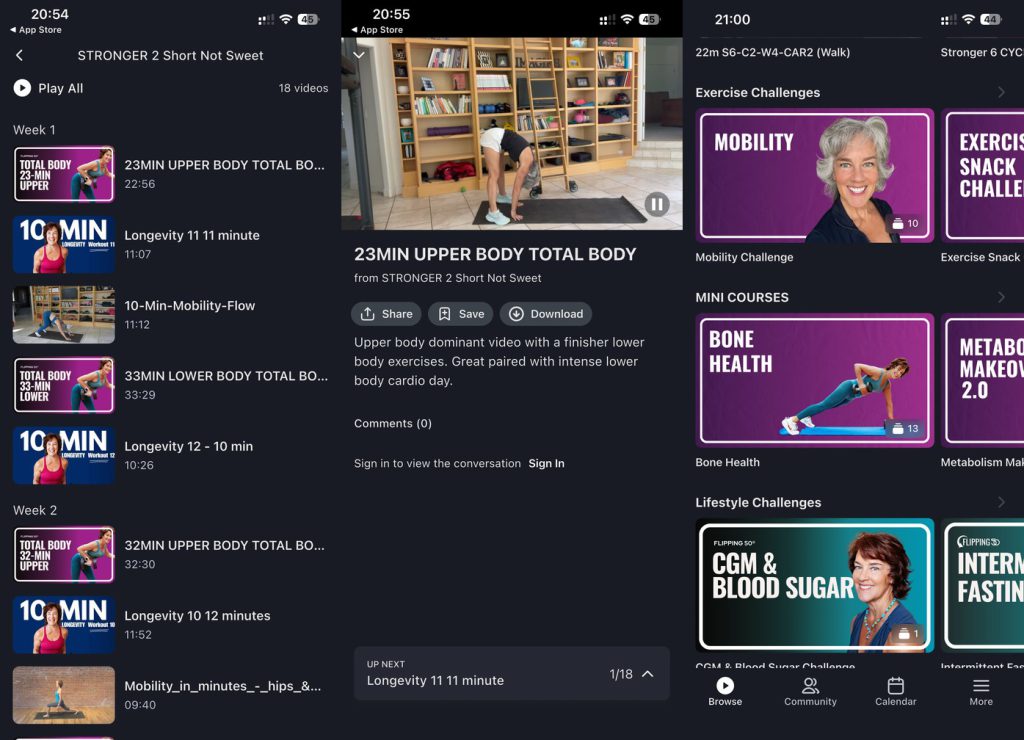
Twelve-week progressive blocks written separately for perimenopause, menopause and postmenopause
Flipping 50 comes from Debra Atkinson, CSCS, and is one of very few programmes treating the three menopause phases as different training problems, with a pelvic floor track alongside and recovery as a named pillar.
This is a data profile, not a tested review. We have not run the programme first hand, so there is no personal testing note here. The published information shows properly staged progressive programming and unusually explicit protein and recovery guidance. What we cannot verify is how the coaching feels across a full twelve weeks.
What a week looks like: three progressive strength sessions from the block for your phase, walking on the days between, and the protein target treated as non-negotiable rather than optional.
The honest limitation: $69 a month is by far the most expensive subscription here, with no reliable free trial, for a programme we have not tested. Treat the ranking as best fit on paper.
Cost: $69 a month, or $549 a year on the website.
Menovation: the best explanation of why the protein matters
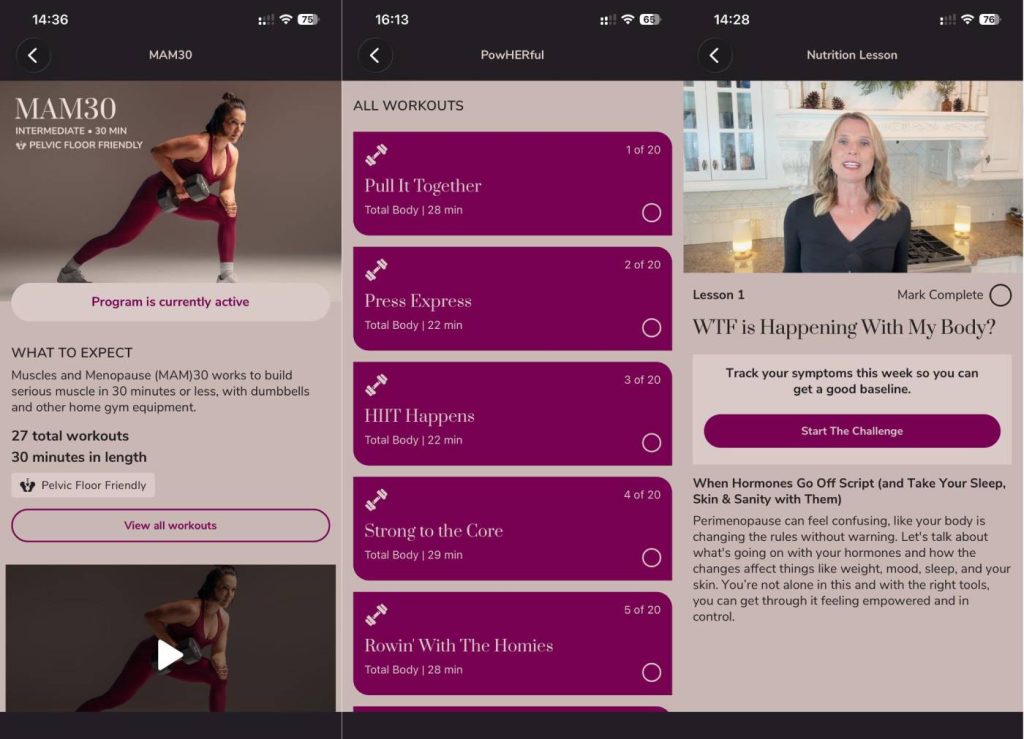
Real dumbbell loading with education and nutrition lessons that are worth the subscription alone
Menovation was built around peri and menopause rather than adapted to them, and pairs 20 to 30 minute sessions with genuine dumbbell loading and the strongest nutrition teaching on this page.
Tested by Katy Cole: the education modules are the part I still think about. Understanding why the training that worked at 35 stopped working, and why protein intake becomes the limiting factor rather than effort, changed more about how I train than any single programme did.
What a week looks like: three strength sessions with dumbbells you increase when the last two reps stop being hard, plus one nutrition module a week treated as part of the programme rather than an extra.
The honest limitation: a dated interface and a library still growing. Best teacher here, not the best product.
Cost: $28.99 a month, $69.99 quarterly, or $199.99 a year. Eight days free at the checkout.
BODi: the most complete nutrition system, attached to the wrong default library
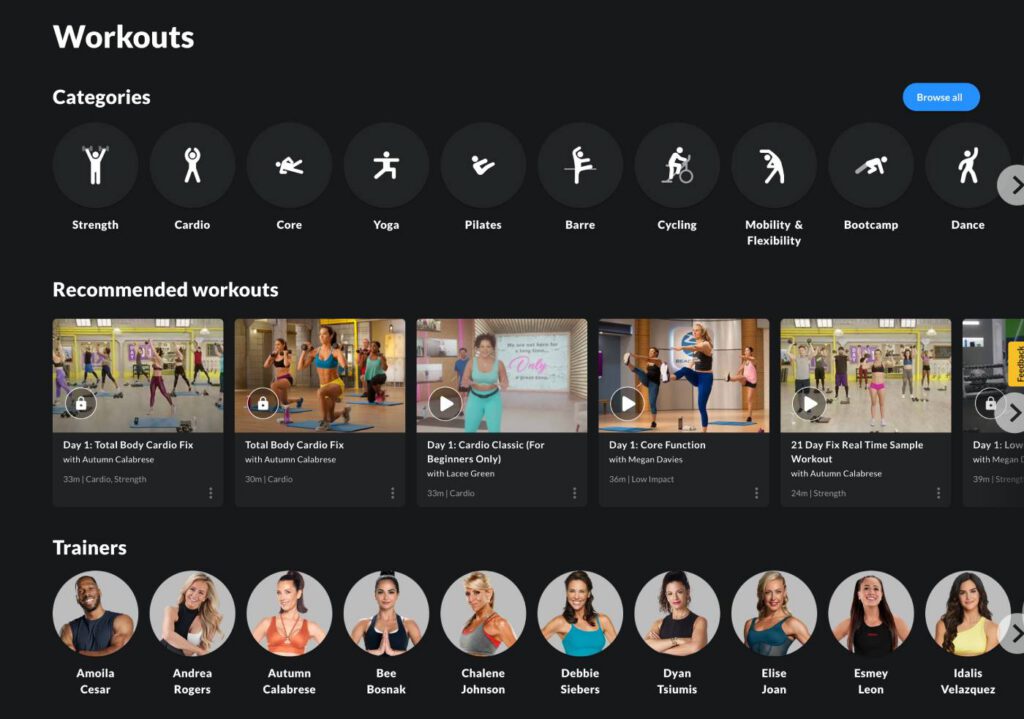
Belle Vitale plus portion-based nutrition is the combination that ranks it here
BODi has the most complete nutrition system of anything we review, which matters more on this page than anywhere else on the site.
Tested by Katy Cole, several months across four programmes: I completed 28 days and lost 3 lb, saw noticeably tighter arms and legs, and felt meaningfully more energy by week two. The container-based nutrition system drove most of that result, not the exercise. That is precisely the point this page is making.
The caveat: the mainstream library skews jump-heavy with poor joint modifications. Run Belle Vitale and the nutrition system, and ignore the home-screen recommendations.
Cost: $22.99 a month, or $179 a year with a $119 first-year promotion running. Seven-day trial on monthly plans only.
Centr: strong on all three sides, clinician-led on none
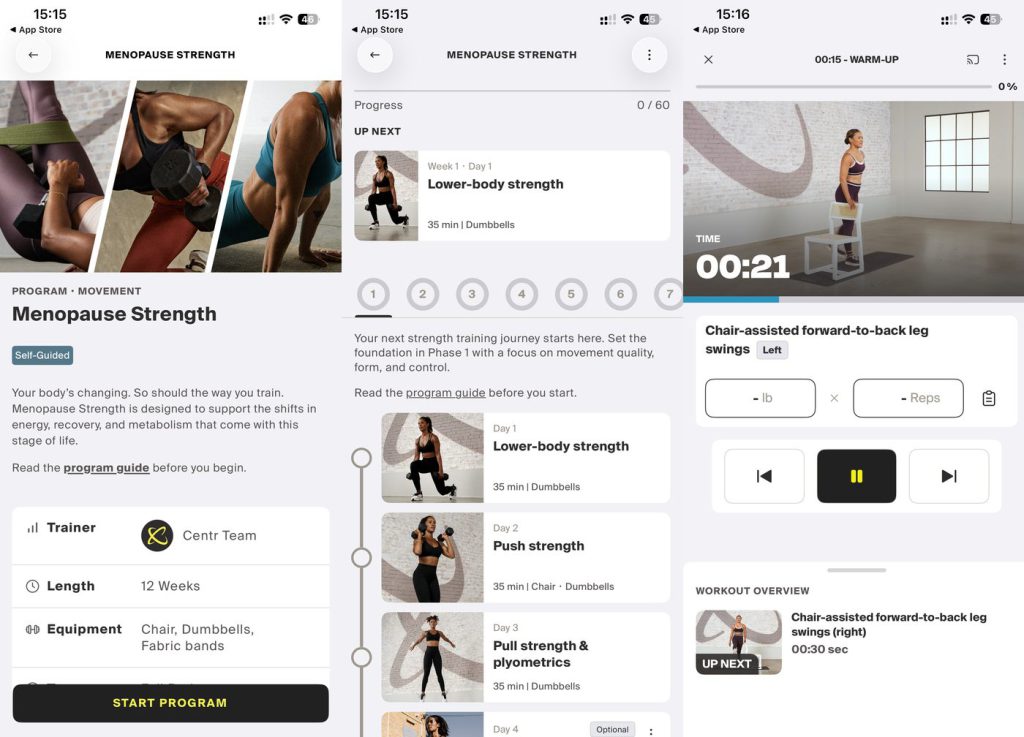
Strength, nutrition and mindfulness together, with a 12-week menopause strength programme
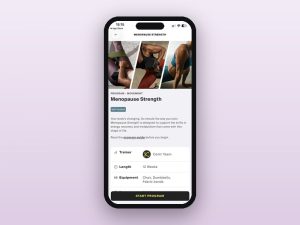
Centr covers training, meal plans and recovery in one polished product, including a dedicated 12-week menopause strength programme.
Sample tested. We worked through a sample rather than running a full block. The production quality and the breadth are the strengths; the menopause content is coach-designed rather than clinician-led, which is a real distinction when the subject is midlife physiology.
What a week looks like: follow the 12-week menopause strength programme and use the meal plans rather than treating nutrition as separate.
The honest limitation: $29.99 a month with no annual pricing published, and moderate impact throughout.
Cost: $29.99 a month. Seven-day trial.
Betty Rocker: whole-food nutrition for women who do not want macros
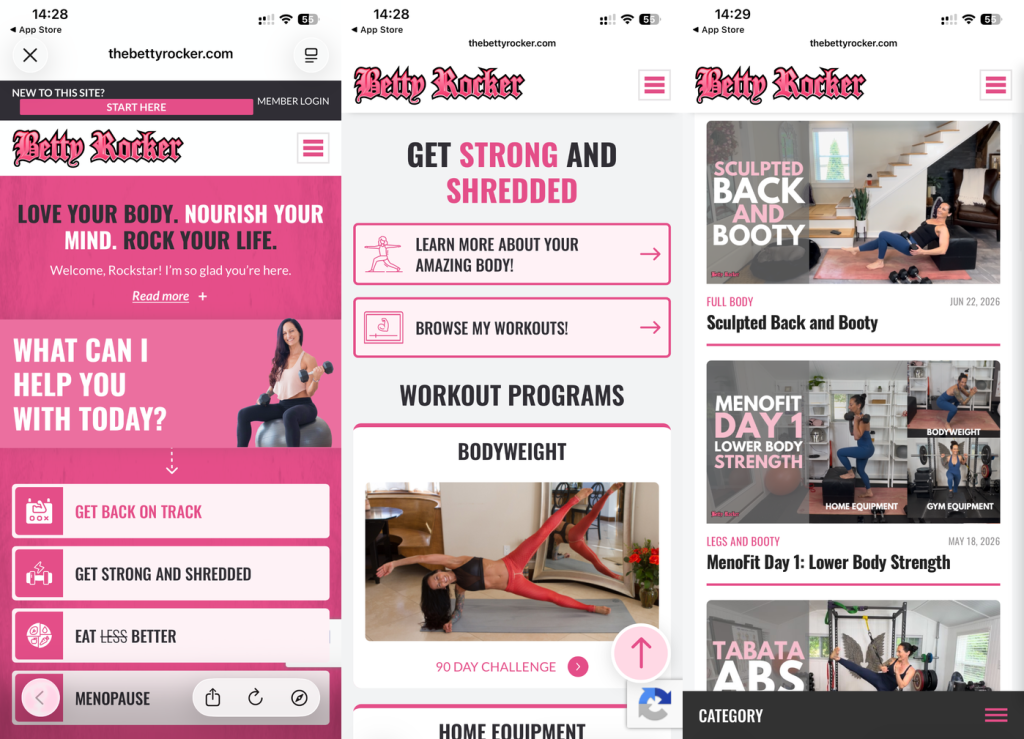
Home strength plus a whole-food approach, with a genuine perimenopause education slant
Betty Rocker pairs women-focused home strength work with whole-food nutrition rather than macro tracking, which suits people for whom counting is the thing that makes them quit.
Sample tested. We sampled the membership rather than running a full block. The perimenopause education is real, and it is coach-led rather than clinician-backed.
The honest limitation: it cross-sells supplements, which is worth knowing before you join, and the trial is 30 days for $1 rather than free. At $37 a month standard it is the second most expensive subscription here, though it is frequently promoted at $29.
Cost: $37 a month or $348 a year, often discounted to $29 and $290.
WarriorBabe: macro coaching that works, at a price most people should think hard about
Strength-forward one-to-one coaching built around macros, and genuinely expensive
WarriorBabe is high-ticket coaching rather than an app. It teaches nutrition properly and it does build muscle, with some midlife awareness in the programming.
This is a data profile, not a tested review. We have not been coached by WarriorBabe. What the published information shows is strength-forward macro-based coaching with real muscle-building intent. What we cannot verify is coaching quality, which is the entire product at this price.
The honest limitation: the Blueprint is around $1,497 and VIP coaching runs from about $2,000 to $6,000, disclosed only on a sales call. There is no pelvic floor work and no clinical menopause programming. If you want macro coaching, a registered dietitian may cost less and carry a clinical qualification.
Cost: $1,497 and up. One cheap digital product, The Macro Method, is a one-off $27.
Simply Strong: real loading and real bone potential, in a dated app
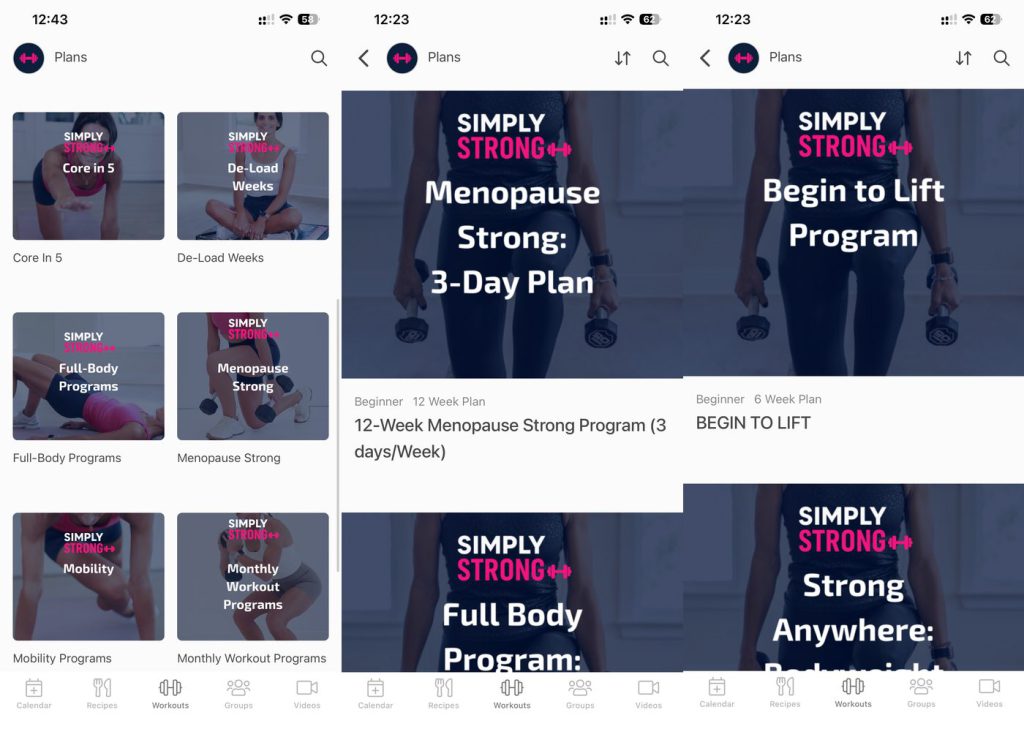
The most straightforwardly progressive option here, with solid nutrition guidance attached
Simply Strong is a genuinely progressive strength app with sensible nutrition guidance and real bone loading potential, at a mid-range price.
Sample tested. We sampled the app rather than running a full block. The programming is the strength: it progresses properly rather than shuffling workouts.
The honest limitation: no menopause or pelvic floor content at all, and a dated interface. It ranks last on midlife fit rather than on training quality.
Cost: $24.99 a month, with a five-day free trial and 50% off the first month via their quiz.
Which one is right for you?
If you want programming staged for your exact phase and price is not the constraint, Flipping 50, knowing we have not tested it first hand.
If you want to understand what you are doing and why, Menovation at $28.99 a month. This is the pick for most women.
If nutrition is the part you have never solved, BODi, running Belle Vitale only.
If you want training, food and recovery in one polished app, Centr.
If counting macros is what makes you quit, Betty Rocker and its whole-food approach.
If you want the cleanest progressive programming and do not need menopause content, Simply Strong at $24.99 a month.
How much protein do you actually need after 50?
This is the number that decides whether your training works, and most women over 50 are well under it.
Muscle protein synthesis becomes less responsive with age, a phenomenon usually called anabolic resistance: the same meal produces a smaller building signal at 55 than it did at 30. The practical consequence is that the protein intake that used to be adequate no longer is, and that training harder does not compensate.
- Aim for roughly 1.6 g of protein per kg of body weight per day, which for a 70 kg woman is about 112 g. Higher intakes have not reliably shown extra benefit for muscle in the research, so this is a target rather than a floor to exceed.
- Spread it across the day. Roughly 25 to 30 g per meal produces a better response than the same total eaten mostly at dinner, which is how most people eat.
- Breakfast is where most women lose the most. A typical cereal or toast breakfast delivers under 10 g. Fixing that one meal often closes half the gap on its own.
- Resistance training is what makes the protein useful. Neither works properly without the other, which is the entire reason this page gates on both.
If you have kidney disease or another condition affecting protein handling, this is a conversation for your doctor rather than a target to adopt from a fitness page.
Can you build muscle after 50 at all?
Yes, and the evidence is clearer than the pessimism around it suggests. What changes is the margin for error, not the possibility.
The loss is real and it is measurable. Greendale and colleagues tracked women through the transition and found loss of lean mass and gain in fat mass across the menopause transition, published in JCI Insight in 2019. That is the process you are pushing back against, and it happens whether or not the scales move.
Progressive resistance training is the intervention. The European consensus on sarcopenia identifies progressive resistance training as the primary countermeasure for age-related muscle loss. Not activity in general, not cardio: loading that increases over time.
The weights do not have to be heavy, but the effort does. Schoenfeld and colleagues found low and high loads both build muscle when sets are taken close to failure. If your joints no longer tolerate heavy dumbbells, that finding is the one that matters most to you: take lighter sets closer to hard rather than abandoning loading.
Short sessions are enough. Ramos-Campo and colleagues found circuit resistance training improved body composition, strength and cardiorespiratory fitness in middle-aged and older women. Twenty to thirty minutes, done properly, is not a compromise.
And bone comes along with it, if you add impact. Martyn-St James and Carroll found that combining impact with high-magnitude resistance work reduced postmenopausal bone loss more effectively than either alone.
How did we rank these seven?
Qualifying requires two things, and that is what makes this page different from our strength training list. A programme has to score at least 7 on progressive strength and at least 6 on midlife nutrition support. Twenty-one programmes clear the first test; seven clear both.
That second test is not a technicality. After 50, protein intake is the binding constraint for a large share of women, and a programme that trains you well while ignoring what you eat is solving half the problem. It is also why this list differs from our strength training picks, which rank on training quality alone.
The ranking is midlife fit, weighted 70%, blended with ease of use at 30%. The gate handles the muscle-building requirement, so ranking on it again would restate the gate.
Caroline Girvan is the notable exclusion. She carries the highest muscle-building score we give and has no nutrition side. On any page about training she belongs near the top; on this one, the missing half is the half most women get wrong.
Three of the seven I have tested or sampled myself, three more were sampled, and Flipping 50 and WarriorBabe are data profiles built from published information. Each section says which.
We buy our own subscriptions. Some links on this page earn a commission, which never affects a score or a position.
Where is the evidence still evolving on building muscle after 50?
Three open questions matter most. First, the optimal protein dose per meal for women over 50 specifically. Second, whether women in midlife benefit from creatine supplementation. Third, how much frequency really matters above the proven floor of 2 sessions per muscle group per week.
On protein dosing, the consensus broadly supports 25-40g of high-quality protein per meal across 4-5 meals per day for women over 50. The upper end of that range may be more relevant for women whose total daily protein target sits around 100-130g (approximately 1g per pound of bodyweight for women 100-130 lbs). What is less certain is whether women specifically need higher per-meal doses than men of the same bodyweight. The published research has not directly tested this.
On creatine, the published evidence in older adults supports modest benefits for muscle mass, strength and recovery from training. A 3-5g daily dose is well-tolerated. The benefits in women specifically are less well-studied than in men, but the safety profile is excellent. Discuss with your GP before starting any supplement.
On frequency, Schoenfeld’s 2016 meta-analysis showed twice-weekly frequency per muscle group as the documented floor. Whether 3-4 sessions per muscle group per week produces meaningfully better outcomes than 2 sessions per week, when total volume is matched, is an active research question. For practical purposes, 3-4 full-body or upper/lower sessions per week is the right operating point for women over 50.
If I were designing my own week from scratch today to build muscle after 50, knowing my joint history and my perimenopause physiology, I would run three Caroline Girvan-style heavy dumbbell sessions per week, one Pvolve session for single-leg and core work, two 30-minute walks at zone 2, and one rest day. Plus 100-130g of protein per day across 4-5 meals. That combination is not what any single programme on this list delivers as a single product. It is what the muscle-building research seems to support.
Frequently Asked Questions
Yes. The published research is consistent: women over 50 who begin progressive resistance training achieve significant gains in lean muscle mass, strength and bone density regardless of when they start. The mechanism is anabolic: training stimulates muscle protein synthesis, which builds new muscle tissue. The protocol that works after 50 is heavier load, higher protein intake (approximately 1g per pound of bodyweight per day), and consistent frequency (3-4 sessions per week). Anabolic resistance and slower protein synthesis at this life stage are real, but they make the protocol harder, not impossible.
Flipping 50 is our top pick for building muscle after 50. It pairs 12-week progressive strength programmes staged for your menopause phase with the protein and nutrition side that decides whether the training works, and that pairing is what this page ranks on. After 50 you cannot build muscle on training alone, so a programme with no nutrition support will underdeliver whatever its workouts look like. Menovation is the best tested pick at $28.99 a month, for real dumbbell loading plus the strongest nutrition education here. BODi is the best value with a full nutrition system, running Belle Vitale rather than the mainstream library. Centr is the best all-rounder, with a 12-week menopause strength programme. Whichever you pick, the training that drives hypertrophy in midlife is progressive heavy resistance work in structured cycles rather than a rotating set of unrelated sessions.
Three to four sessions per week is the practical range. The 2016 Schoenfeld meta-analysis on training frequency showed that hitting each muscle group at least twice per week produces meaningfully more hypertrophy than once per week. For most women over 50, this translates to three full-body sessions or four upper/lower split sessions per week. Five sessions starts to push against recovery limitations. The right operating point depends on sleep quality, stress and protein intake; three sessions per week sustained for two years beats five sessions you abandon after six weeks.
Approximately 1g of protein per pound of bodyweight per day, spread across 4-5 meals each containing 25-40g of high-quality protein. For a woman weighing 130 pounds, that translates to approximately 130g of protein per day, or roughly 30g per meal across four meals. The published guidance from Burd 2012 and subsequent work supports the higher end of this range for women over 50 specifically, because anabolic resistance reduces the muscle’s response to a given protein dose. Dr Mary Claire Haver and Dr Stacy Sims both endorse this target. Discuss any major dietary change with your GP or a registered nutritionist.
Heavy enough that the last rep of each set is genuinely hard. Schoenfeld’s 2017 systematic review showed equivalent hypertrophy across rep ranges from 5 to 30 when total volume is matched. Most women over 50 do well at 8-15 reps with weights that produce real fatigue by the last rep. Twelve reps that you could have done 25 of is not a real stimulus. Twelve reps where rep 13 would not have happened is. For practical guidance: if you can comfortably do 20+ reps with a given weight, the weight is too light. Increase the load.
Anabolic resistance is the reduced muscular response to training and protein in older adults. The same workout and the same protein dose produce a smaller hypertrophy signal in older muscle than in younger muscle. The countermeasures, documented across the published research, are heavier loading (to drive a stronger training signal), higher protein intake (to overcome the dose-response shift), and consistent frequency (to repeat the stimulus often enough to accumulate adaptation). Anabolic resistance does not prevent muscle growth in women over 50. It changes the protocol required to drive it.
Strength gains appear within 2-3 weeks of consistent training. Visible muscle mass changes typically take 6-12 weeks. Measurable hypertrophy (assessed via body composition scans) requires 12-24 weeks of progressive training combined with adequate protein intake. Lean mass gains are slower in midlife than at 30 because protein synthesis rates are lower, but the adaptation mechanism still works. Stick with the programme through week 12 minimum before evaluating muscle-mass outcomes. Sleep quality, protein intake and consistency all accelerate the timeline.
The published evidence in older adults supports modest benefits from creatine supplementation for muscle mass, strength and recovery from training. A 3-5g daily dose is well-tolerated and has an excellent safety profile. The benefits in women specifically are less well-studied than in men, but the underlying mechanism (creatine increases ATP availability for muscular contraction) does not differ by sex. Discuss with your GP before starting any supplement, particularly if you have kidney concerns or are taking other medications.
Yes. What changes is the margin for error, not the possibility. The European consensus on sarcopenia identifies progressive resistance training as the primary countermeasure for age-related muscle loss, and Schoenfeld and colleagues found low and high loads both build muscle when sets are taken close to failure. The two things that decide whether it works are loading that increases over time and enough protein.
Around 1.6 g per kg of body weight a day, which is about 112 g for a 70 kg woman, spread across meals at roughly 25 to 30 g each rather than concentrated at dinner. Breakfast is where most women fall short: a typical cereal or toast breakfast delivers under 10 g, and fixing that one meal often closes half the gap. If you have kidney disease, discuss protein targets with your doctor.
Either works if the last two repetitions are genuinely hard. Schoenfeld and colleagues found low and high loads both build muscle when sets are taken close to failure, which is good news if your joints no longer tolerate heavy weights. Take lighter sets closer to hard rather than abandoning loading altogether.