

Why is walking the most important cardio for women over 50?
Walking is the most accessible Zone 2 cardiovascular work, has the strongest mortality-reduction evidence of any single activity, and is the only cardio modality that genuinely sustains across decades. For women over 50 specifically, walking is not a beginner placeholder while waiting for something harder. It is the primary tool, supported by some of the strongest published evidence in the exercise literature.
The mortality-reduction evidence for walking is unusually strong. Lee and colleagues (2019) in JAMA Internal Medicine followed older women (mean age 72) for over four years. Women averaging 4,400 steps per day had significantly lower mortality than those averaging 2,700 steps. The benefit continued to rise up to about 7,500 steps per day, then plateaued. The famous 10,000 step target turned out to be a marketing slogan from a Japanese pedometer launched in the 1960s, not a research finding. For most women over 50, 7,500 steps most days is the right operating point.
The Hupin and colleagues (2015) meta-analysis in the British Journal of Sports Medicine looked specifically at older adults and found that even low doses of moderate-to-vigorous physical activity, well below the 150-minutes-per-week threshold, reduced all-cause mortality. The dose-response curve favours something over nothing more strongly than premium-over-budget. For women over 50, the message is straightforward: start walking, even briefly, even imperfectly. The mortality benefit kicks in well before the WHO target.
For women over 50 specifically, walking delivers four documented benefits. Cardiovascular protection through Zone 2 work, which preserves vascular health and protects against the leading cause of death in women over 65. Metabolic benefit through fat oxidation at sustainable intensity, which matters most in the perimenopausal window when insulin sensitivity declines. Cognitive benefit through the same exercise mechanisms the Northey 2018 systematic review identified as the most effective single intervention for cognitive function in adults over 50. And joint-friendly stimulus that does not punish cartilage or connective tissue.
The treadmill, indoor or outdoor walking, weighted walking, incline walking and Power Walk content all qualify. The platform you choose matters less than the consistency of the practice. The single most predictive factor for long-term outcomes is showing up most days for years, not optimising any single session. For women already managing workouts during menopause or workouts during perimenopause, walking is the modality that holds the whole protocol together when other training inevitably gets disrupted.
How should women over 50 use walking and treadmill workouts?
Walk most days at conversational pace for 30-60 minutes, supplement with 1-2 incline or interval sessions per week, and combine walking with 2-3 resistance training sessions per week. That structure delivers the cardiovascular, metabolic and longevity benefits the published research consistently supports for women in midlife.
The Zone 2 conversational pace is the foundation. You should be able to hold a sentence-long conversation throughout the walk without becoming breathless. For most women over 50, this corresponds to a comfortable 5-6km/h on a flat treadmill, or a brisk outdoor walking pace. The intensity feels sustainable rather than challenging. The total weekly time commitment of 30-60 minutes most days adds up to roughly 200-400 minutes per week, which sits within the World Health Organisation guidance of 150-300 minutes of moderate aerobic activity for adults over 50.
The interval and incline sessions add the higher-intensity cardiovascular stimulus that maintains VO2 max. One or two sessions per week of treadmill walking at 8-12% incline, or interval work alternating Zone 2 and Zone 4 paces, delivers the cardiovascular adaptation that plateau Zone 2 work alone does not. VO2 max declines roughly 10% per decade after 50 without intervention, and the higher-intensity work is what slows that decline. Peloton’s Power Zone Walk programmes structure this directly across 4-5 week progressive cycles.
The resistance training is non-negotiable, even on a walking-led programme. Walking alone, even at high volume, does not preserve muscle mass or drive bone density adaptation in postmenopausal women. The Cruz-Jentoft sarcopenia consensus identifies progressive resistance training as the documented intervention for skeletal muscle preservation, distinct from cardiovascular work. The combined walking-plus-resistance protocol is what produces the body composition, bone density and functional outcomes the over-50 research consistently supports. For the resistance side, pair walking with Caroline Girvan, Pvolve or BODi LIIFT4. For a wider low-impact cardio framework that complements walking, the related guide covers cycling, dance and other joint-friendly modalities.
The schedule that works most reliably is something like this: four Zone 2 walks of 30-45 minutes during the week (any combination of treadmill, outdoor, audio-led), one interval or incline session, one longer outdoor walk of 60+ minutes at the weekend, and 2-3 resistance sessions slotted around the walking. That is roughly the protocol most published longevity-focused frameworks for women over 50 converge on.
What should women over 50 prioritise in a walking programme?
Five priorities matter most: structured Zone 2 walking, occasional incline or interval work, resistance training pairing, joint-aware pacing, and adherence over decades. Each priority addresses a documented physiological reality of walking-led training in midlife.
Structured Zone 2 walking. 30-60 minutes most days at conversational pace. Outdoor or indoor, treadmill or pavement, audio-led or video-led. Peloton’s Power Walk classes provide structured pacing and coaching for women who benefit from prescribed targets; Apple Fitness+’s Time to Walk delivers an audio-led alternative for women who prefer to leave the screen at home. Pure unstructured walking works equally well for women who prefer flexibility. The structural variable that matters is consistency, not platform.
Occasional incline or interval work. 1-2 sessions per week of treadmill walking at 8-12% incline, or Zone 4 intervals on a flat treadmill. The higher-intensity work maintains VO2 max, which declines roughly 10% per decade after 50 without intervention. The intervals should feel hard during the work portion and recoverable in the rest portion. Peloton’s Power Zone Walk classes structure this directly; Apple Fitness+’s Treadmill workouts library covers it with shorter formats.
Resistance training pairing. 2-3 resistance sessions per week using compound dumbbell or band movements. Walking alone does not preserve muscle or drive bone density adaptation in postmenopausal women. Pair walking with Pvolve, Caroline Girvan, BODi LIIFT4 or Burn360 for the strength component. The combined protocol is what produces the body composition outcomes that walking alone cannot.
Joint-aware pacing. For women over 50 with knee, hip or lower back history, the pace and incline matter more than the duration. A 30-minute walk at comfortable pace beats a 60-minute walk that aggravates a joint. Soft surfaces (treadmill belt, grass, woodland trails) generally feel better than concrete pavement. Good shoes matter more than people think; replace every 500-800km. A simple test: if your knees or hips ache for more than an hour after the walk, the pace, incline or surface needs adjusting.
Adherence over decades. The walking practice you keep doing at 70 outperforms any aggressive protocol you abandon at 53. The mortality benefit in Lee 2019 came from sustained walking habits, not from peak intensity. The single most predictive factor for long-term outcomes is showing up most days for years. Walking is the activity that uniquely supports decades-long adherence: low injury risk, low equipment requirement, low motivational cost, and compatible with almost any life circumstance.
Which platforms score highest for walking and treadmill workouts?
Peloton scored highest overall (7.6) for its Power Walk content, Power Zone Walk programmes, and treadmill running and walking classes that work on any treadmill. Apple Fitness+ (6.7) follows with the Time to Walk audio series plus a dedicated Treadmill workouts library. Daily Burn (7.2) features walking-focused classes alongside Stronger for Longer. FitOn (7.5) offers free walking content with no card required. BODi (8.1) includes walking inside Belle Vitale and the Walk Off the Pounds legacy.
| Programme | Score | Walking and treadmill method | Equipment | Time commitment | Price / month | Trial |
|---|---|---|---|---|---|---|
| Peloton | 7.6 | Power Walk, Power Zone Walk, Outdoor Walks, treadmill running | Any treadmill / outdoors | 20-60 min, 4-6 sessions/wk | $15.99/mo App One | 30 days |
| Apple Fitness+ | 6.7 | Time to Walk audio + Treadmill workouts library | Treadmill / headphones / outdoors | 10-45 min, 4-6 sessions/wk | $9.99/mo or $79.99/yr | 1 month (3 with Apple device) |
| Daily Burn | 7.2 | Walking classes, dance cardio, 15-Min Mobility | Any treadmill / floor | 15-45 min, 4-6 sessions/wk | $7.49-14.99/mo | 30 days |
| FitOn | 7.5 | Free walking classes, cardio variety, programmes | Any treadmill / floor | 10-45 min, 4-6 sessions/wk | Free / $29.99/yr Pro | Free tier (no card) |
| BODi | 8.1 | Walk Off the Pounds, walking inside Belle Vitale | Floor walking / treadmill | 30-45 min, 4-5 sessions/wk | $179/year | 14 days |
Scores pulled live via shortcodes. Pricing verified May 2026. Discuss any new training programme with your doctor before starting, particularly if you have cardiovascular disease, osteoarthritis, joint replacement history or any pre-existing health condition.
How do the best walking and treadmill workouts compare?
1. Peloton – Score: 7.6
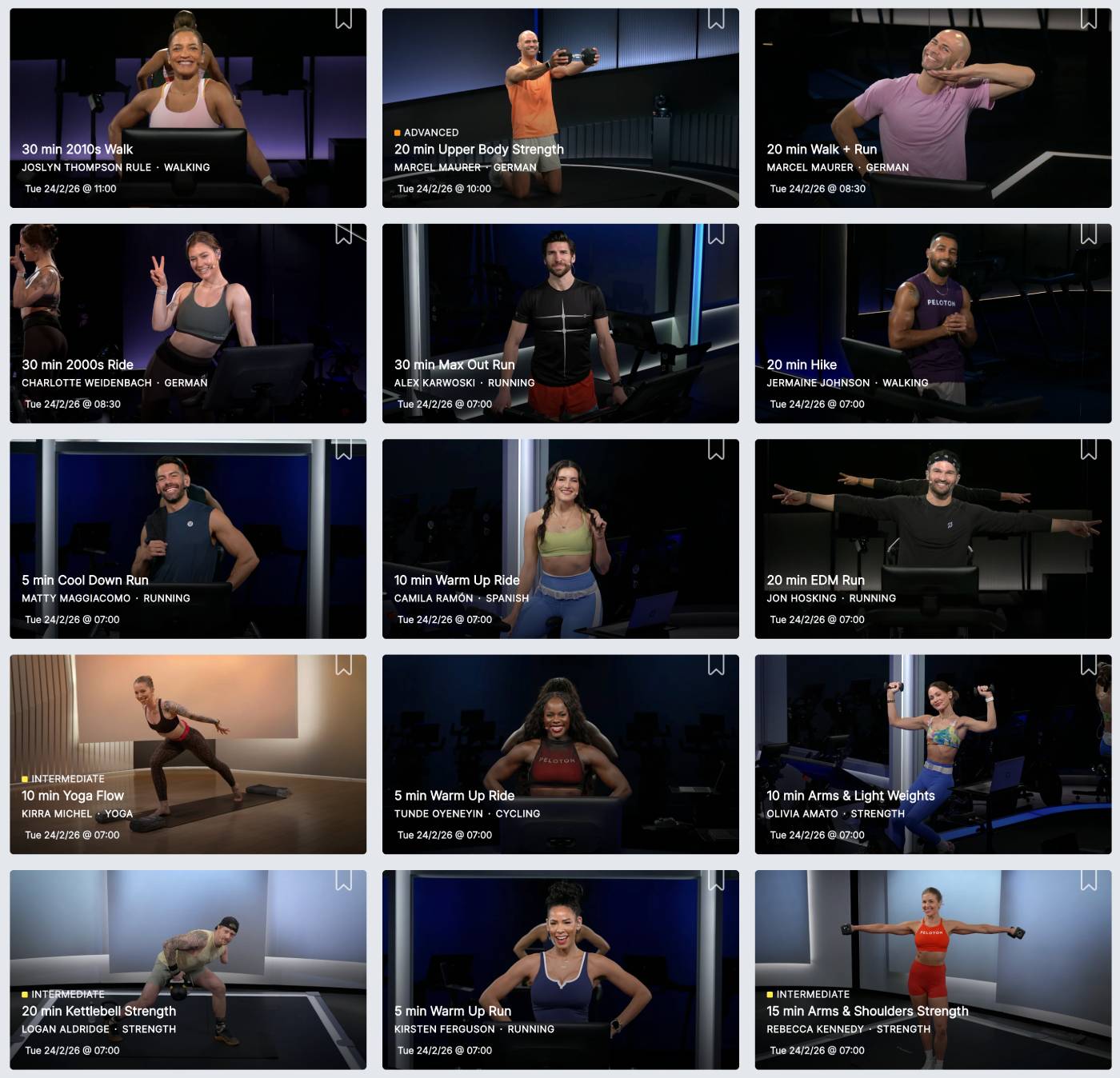
The most developed structured-walking library tested. Power Walk classes deliver coached walking sessions with pace and incline targets. Power Zone Walk programmes structure interval and Zone 2 work across 4-5 week progressive cycles. Outdoor Walk classes work without a treadmill at all, using audio-led coaching for outdoor walking. Treadmill running classes cover faster work for women who run alongside walking.
The platform works on any treadmill: Peloton equipment is not required. App One at $15.99/month unlocks the walking content plus the menopause collection, strength, yoga, pilates and barre. The 30-day free trial is the longest in the major platforms tested.
This score reflects Peloton’s cardiovascular depth, which is the relevant dimension for a walking and treadmill article. For walking-led training in women over 50, the Power Walk and Power Zone Walk programmes are the strongest tested option in any price bracket.
The Power Walk programming is the platform’s standout asset for women over 50. Coached walking with pace and incline targets makes Zone 2 work concrete rather than abstract. The instructor coaching covers form (cadence, posture, foot strike), pacing strategy and the music programming that keeps the session engaging across 30-45 minutes. Camila Ramon, Olivia Amato and Robin Arzon all run regular Power Walk classes that suit different intensity preferences. The variety means the format does not become repetitive across months of consistent use.
The Power Zone Walk programmes are the platform’s most structured option. They run as multi-week progressive blocks (typically 4-5 weeks) with intervals across Zone 2, Zone 3 and Zone 4 paces. The structure removes the guesswork of self-directed interval work and produces the VO2 max maintenance that Zone 2 alone does not. For women over 50 specifically, this is the closest the industry gets to a true cardiovascular periodisation tool in an app format.
The menopause collection, revamped March 2026 with Respin Health, adds menopause-specific programming alongside the walking content. The collection is built on protocols drawn from over 100 published studies, which is more clinical depth than most platforms publish. For women specifically wanting menopause-aware walking content rather than just generic walking, the collection is a meaningful differentiator at this price point.
Verdict: I am a woman in my mid-40s, perimenopausal, working full-time with children, with a history of a meniscus injury and a training background in HIIT and dumbbells. I do not own any Peloton equipment. I tested the platform by mixing and matching classes across strength, yoga, walking and running, using my own treadmill for the cardio content and a single pair of 7.5kg dumbbells for strength.
I tested walking and running classes on a non-Peloton treadmill and it worked completely. The coaching translates without friction. The Power Walk classes specifically delivered a structured Zone 2 session in a way that pure unstructured walking did not. Pace targets, incline instructions and music programming kept me engaged across the 30-45 minute sessions in a way that felt qualitatively different from the slog of self-directed treadmill time.
For women over 50 specifically, Peloton App One is the most developed walking platform tested. The Power Walk content, the Power Zone Walk programmes, the Outdoor Walk classes and the menopause collection together deliver a complete walking-led cardiovascular protocol. Pair with a resistance programme (Caroline Girvan, Pvolve or BODi LIIFT4) for the full over-50 protocol.
Highest-scoring for: Women over 50 who want structured Zone 2 walking with coaching. Women with a treadmill (Peloton or otherwise). Women who appreciate live class accountability. Women who benefit from the menopause collection alongside walking content.
Cost: $15.99/month App One (includes walking, menopause, strength, yoga, pilates, barre). $28.99/month App+ (adds unlimited cycling). 30-day free trial.
Trade-off: The cycling content is locked behind the App+ tier at $28.99/month. The strength content is less progressive than dedicated strength platforms. The cancellation friction is real; cancel directly through the app.
2. Apple Fitness+ – Score: 6.7
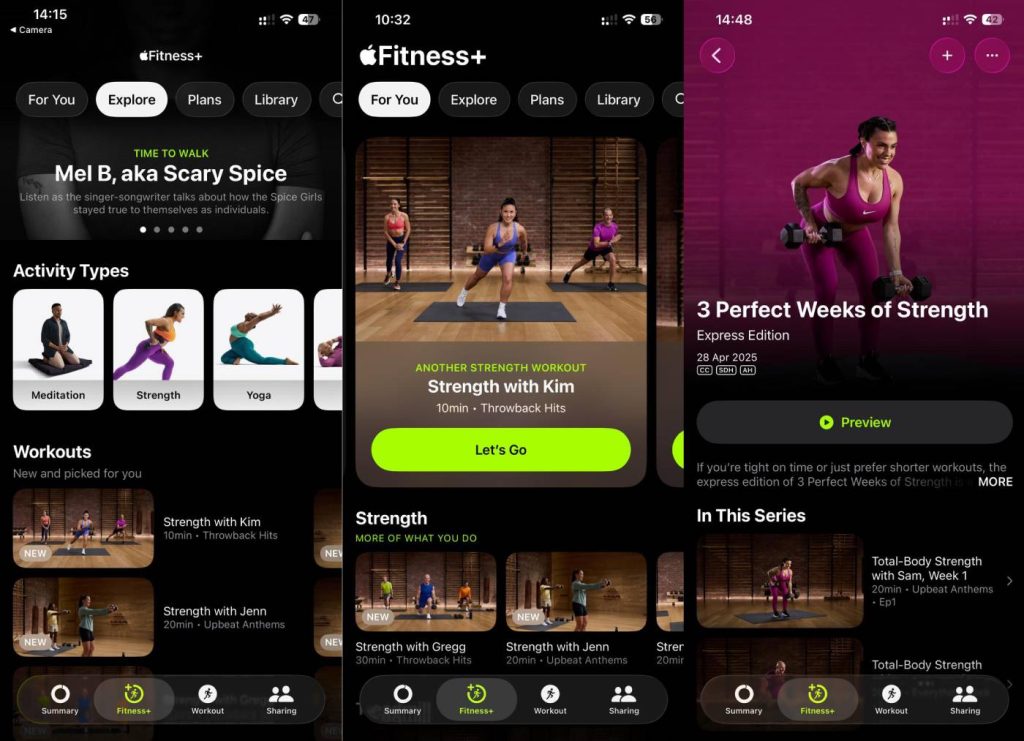
The only platform tested that delivers a dedicated celebrity-led walking audio series alongside a full treadmill workouts library. Time to Walk is Apple’s outdoor walking audio: famous guests share stories during a walk, no screen needed, just headphones. The Treadmill workouts library covers structured indoor walking and running with on-screen coaching. Apple Fitness+ runs $9.99/month or $79.99/year, with a 1-month free trial (3 months free with a new Apple device purchase).
For women over 50 whose primary cardio is walking and who already sit inside the Apple ecosystem, this is one of the strongest options tested in the sub-$15/month bracket.
This score reflects Apple Fitness+’s position as the only mainstream platform with both a dedicated outdoor walking audio series (Time to Walk) and a full Treadmill workouts library. The combination covers indoor and outdoor walking in one subscription at a sub-$10/month price point.
Time to Walk is the platform’s distinctive asset for the over-50 audience. Episodes run 25-40 minutes and feature a celebrity or notable guest sharing personal stories while walking. The audio-only format means no screen, just headphones, and the walk pace is set by the listener rather than the guest. For women who find structured pace-target walks (Peloton Power Walk) too prescriptive, or who want walking that doubles as podcast time, Time to Walk is a different and complementary format. Episodes are released weekly, and the back catalogue is several years deep at this point.
The Treadmill workouts library covers structured indoor walking and running. Sessions run from 10-minute warm-ups through to 45-minute incline pyramid workouts. The format is the standard Apple Fitness+ on-screen coaching with three trainers, one always showing modifications. For women over 50 who want guided indoor walking without committing to Peloton’s premium price, the Apple library is the cheaper alternative.
The short stackable session format is the platform’s wider strength. Most sessions run 10-30 minutes; the platform encourages stacking 2-3 short sessions when you have time, or taking one short session when you do not. The format suits the unpredictable schedule most women over 50 work around. For walking specifically, stacking a 20-minute Treadmill workout with a 10-minute Mindful Cooldown produces a complete 30-minute session that fits any day.
Verdict: Apple Fitness+ is a paid streaming workout platform built around short, stackable sessions across strength, HIIT, Pilates, dance, yoga and more, plus a dedicated walking and treadmill library. I tested it for five weeks of daily use as a woman in my mid-forties navigating perimenopause, drawing on close to fifty platforms tested over fifteen years. I projected iPhone content to a TV and computer monitor across the testing period, completed a custom four-week plan and the 3 Weeks of Strength programme, and mixed in dance, Pilates, treadmill, walking, cycling and rowing sessions.
The standout is time efficiency. Most sessions run 10 to 30 minutes and stack back to back. Every session has three trainers, one always showing modifications, making this one of the most reliable modification systems I have tested. I bought an iPad, got three months free, built my own week around it, and several weeks later I am still using it most days. The Time to Walk series specifically pulled me into outdoor walking on days I would otherwise have skipped: hearing a celebrity describe their life while you walk is a low-friction way to keep the walk going for 35 minutes when you might otherwise have stopped at 20.
For women over 50 whose primary cardio is walking, this is the strongest sub-$15/month option I have tested. The Time to Walk series covers outdoor walking, the Treadmill workouts cover indoor walking, and the wider library (strength, Pilates, mobility) handles the rest of the protocol. The honest caveats: Apple ecosystem only (iPhone, iPad, Apple TV; no Android, no Roku, no Fire TV), strongest with an Apple Watch for heart rate integration but workable without one, and cancellation has to happen inside Apple device settings rather than on the web. Family sharing is included, and the subscription is also bundled inside Apple One Premier.
Highest-scoring for: Women over 50 whose primary cardio is walking. Women already inside the Apple ecosystem. Women with an Apple Watch who value heart rate integration. Women who want short stackable sessions around an unpredictable schedule.
Cost: $9.99/month or $79.99/year. 1 month free trial. 3 months free with a new Apple device purchase. Family sharing included. Also included in Apple One Premier.
Trade-off: Apple ecosystem only (no Android, no Roku, no Fire TV). Cancellation has to happen inside Apple device settings rather than on the web. No menopause-specific programming. The walking content, while strong, is not as structurally periodised as Peloton’s Power Zone Walk programmes.
3. Daily Burn – Score: 7.2

The platform with the most variety across walking, dance cardio and functional strength at the cheapest premium subscription price. Walking-focused classes sit alongside the Stronger for Longer longevity programme, 15-Minute Mobility for joint range of motion, and Fierce and Fit for Women for the resistance complement. Annual pricing at $7.49/month is the lowest in this list for a paid subscription.
The 30-day free trial is the longest in this category, tied with Peloton. The platform is broader than menopause-specific but works well for women over 50 who want walking variety alongside other modalities.
This score reflects Daily Burn’s position as the broadest cardiovascular variety platform at the cheapest paid subscription tier. Walking content sits alongside dance cardio, functional strength and mobility work, which suits women over 50 who want modality variety rather than a single specialism.
The walking classes work on any treadmill or for outdoor practice with the audio coaching. The intensity range covers Zone 2 sustained work through to interval-style sessions. For women who find pure walking monotonous, the dance cardio classes (Dance & MOVE!) provide a low-impact alternative that still delivers cardiovascular benefit without raising intensity into cortisol-spiking territory.
Stronger for Longer is the platform’s strongest longevity-focused complement. It addresses the resistance training need that walking alone does not. For women over 50 building a walking-led week, pair daily walking with 2-3 Stronger for Longer sessions per week for the complete protocol. The 15-Minute Mobility programme adds the joint-care work that supports walking adherence by keeping ankles, hips and the thoracic spine moving freely.
The annual subscription at $89.88 ($7.49 per month equivalent) is the price worth paying. The monthly tier at $14.99 is double the cost and undermines the platform’s value proposition. The 30-day free trial is generous by category standards and lets you complete one of the shorter programmes before any money changes hands. For more on this kind of low-cost approach to fitness apps, the best budget fitness app guide covers the wider sub-$15/month category.
Verdict: My first week of testing Daily Burn ended up looking nothing like my plan. I started with Dance & MOVE! just to try it. Then did a 15-Minute Mobility session. Then found Fierce and Fit for Women, which is the programme I came back to again and again and the one I would genuinely recommend to any woman in her late 30s or beyond who wants results without messing around.
By the end of week one I was rotating between Fierce and Fit, Stronger for Longer, and the dance classes I had not expected to enjoy as much as I did. The walking classes I tried sat alongside the rest of the library rather than dominating it: useful as a Zone 2 option on days when I wanted variety, but not the platform’s deepest single offering.
For women over 50 building a walking-led cardiovascular week, Daily Burn is the platform that supports variety at the cheapest paid tier. Pair walking content with Stronger for Longer (the resistance complement) and the dance cardio classes provide the cross-training that prevents walking boredom. The 30-day free trial gives enough time to assess fit before committing to the annual plan.
Highest-scoring for: Women over 50 who want walking content alongside dance cardio and functional strength. Women who benefit from a 30-day free trial. Women who prefer variety to specialism. Women whose binding constraint is budget rather than menopause-specific curation.
Cost: from $7.49/month (12-month plan) to $14.99/month (3-month plan). 30-day free trial.
Trade-off: Daily Burn does not offer the structured Power Walk and Power Zone programming that Peloton does, or the Time to Walk audio series that Apple Fitness+ offers. The walking content is good but not the platform’s primary specialism. For women specifically wanting deep walking-led training, Peloton or Apple Fitness+ is the right primary pick.
4. FitOn – Score: 7.5
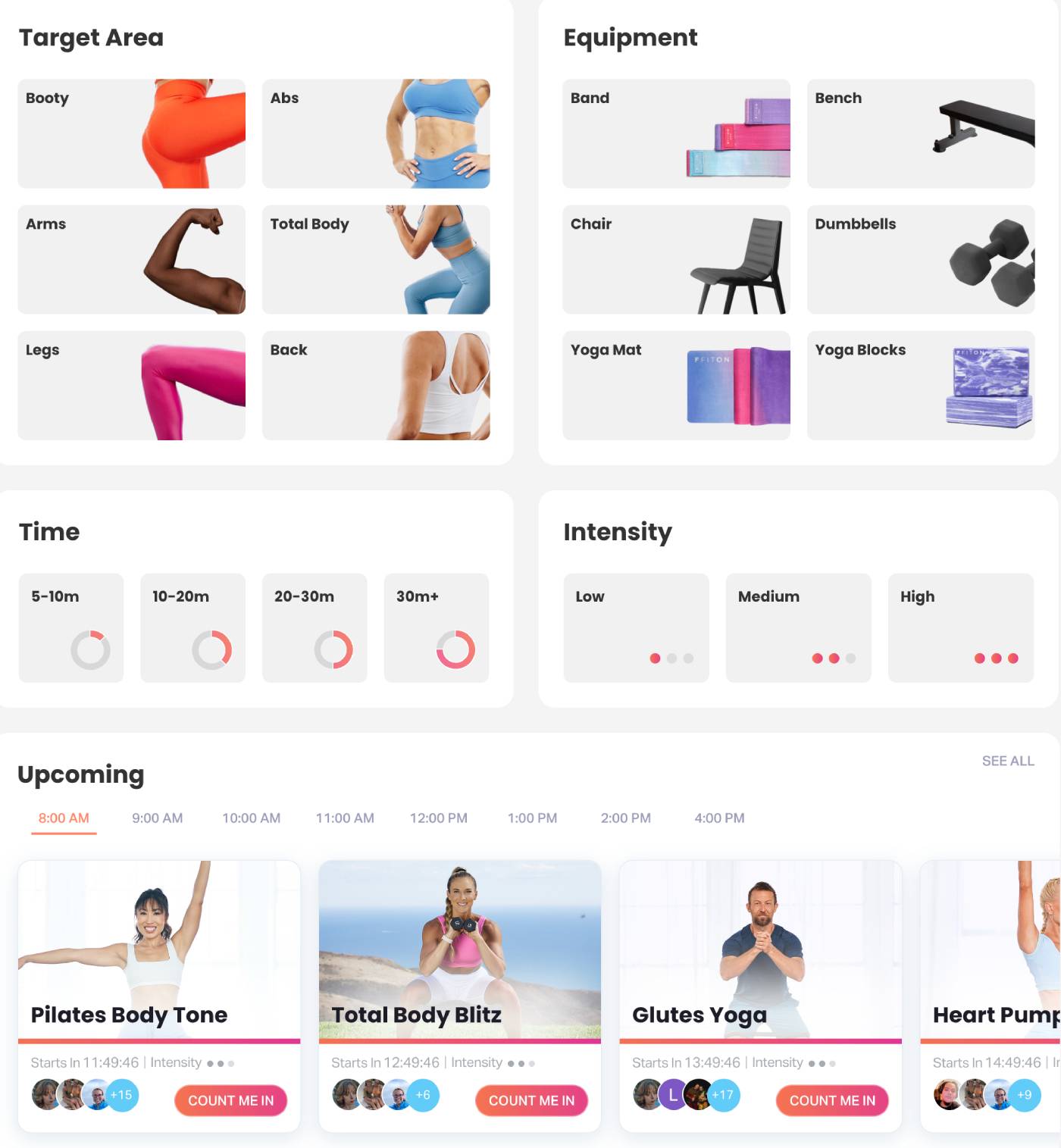
The most accessible free option for walking content. The free tier includes walking workouts, cardio variety and basic programmes with no credit card required at signup. The Pro tier at $29.99/year adds personalised programmes, meal plans and music integration.
FitOn is not specifically built for women over 50, but the free tier accessibility and the walking content variety make it a reasonable starting point for women who want to test walking-led training without subscription commitment.
This score reflects FitOn’s position as the most accessible free option. The free tier walking content is real and useful, though less structured than Peloton’s Power Walk programmes or Apple Fitness+’s Treadmill workouts library.
The free tier includes a wider library than most free fitness apps. Walking classes, basic cardio, beginner strength and mobility content all sit in the free tier. The platform monetises through the Pro subscription and through partnerships rather than aggressive paywalls. For women over 50 testing walking-led training before committing to a paid platform, FitOn is the lowest-risk entry point because no card is required at signup.
The walking content itself works on any treadmill or outdoors. The classes are not as structured as Peloton’s Power Walk programmes or Apple Fitness+’s curated treadmill library, but the variety and the free access make them a useful complement to a paid platform or a standalone option for women on a tight budget. The Pro tier at $29.99 per year unlocks personalised programming and meal plans for women who want progressive structure.
Verdict: FitOn is not new to me. I used the app approximately five years ago and recently returned to test it for three months. I came into this second round already fit, which means my observations reflect the platform from the perspective of someone with an existing base, not a beginner encounter.
I tested on both web and mobile. I used the free tier for part of the testing period and upgraded to Pro to verify what the premium features actually deliver. I tested multiple workouts across different categories: circuit training, Double Duty Strength, Ultimate Sculpt, CrossFit Hindsight, Pilates, zumba-style cardio, walking sessions and guided meditation.
For women over 50 specifically using FitOn for walking content, the free tier accessibility is the key advantage. The walking classes work on any treadmill or outdoors. The Pro tier adds value for women who want nutrition tracking integrated, but the free tier alone covers the walking-led cardiovascular need. For a long-term primary platform, Peloton or Apple Fitness+ delivers deeper walking-specific content. For a free entry point or a backup option, FitOn is the right pick.
Highest-scoring for: Women over 50 testing walking-led training without subscription commitment. Women on a tight budget. Women who want a backup option alongside a primary paid platform. Women who want to sample multiple modalities (walking, Pilates, strength, meditation) inside one free library.
Cost: Free tier (with ads, no card required). $29.99/year Pro (no ads, advanced features) or $9.99/month.
Trade-off: The walking content is less structured than Peloton’s Power Walk programmes or Apple Fitness+’s Treadmill workouts library. The free tier includes advertising. For women wanting deep walking-led programming with coaching, Peloton or Apple Fitness+ remains the primary pick.
5. BODi – Score: 8.1
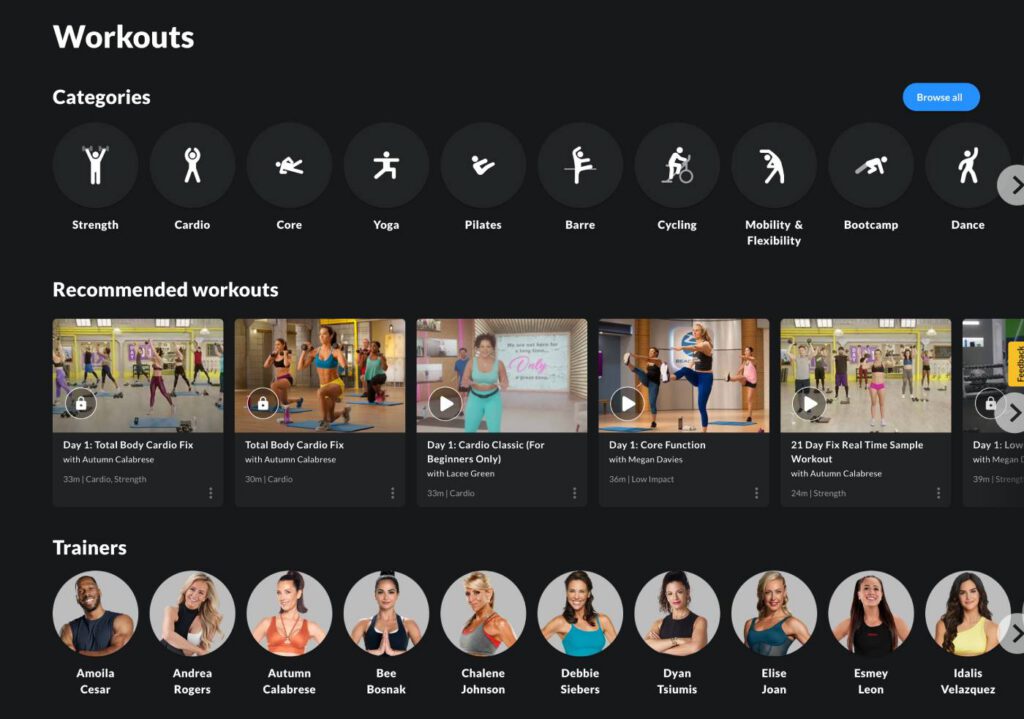
The legacy fitness platform with Walk Off the Pounds (Leslie Sansone’s classic walking programme) in the library, plus walking content integrated into Belle Vitale (the 12-week menopause programme). BODi membership at $179/year unlocks 140+ programmes including LIIFT4, 21 Day Fix and the wider library, with clinical validation of Belle Vitale by James LaValle.
For women over 50 who want walking content alongside a comprehensive training-plus-nutrition system with menopause-aware structure, BODi covers the broadest scope of any platform on this list.
This score reflects BODi’s broad library and integrated nutrition tools. The walking content sits inside Belle Vitale and the Walk Off the Pounds legacy programmes, which suits women over 50 wanting structured walking inside a wider training framework with menopause-specific curation.
Walk Off the Pounds is Leslie Sansone’s original indoor walking programme. The format is walk-in-place at various intensities, often combined with light strength movements. The aesthetic is dated, but the format works for women over 50 who do not have a treadmill or who want indoor walking content during winter months. It is one of the longest-running indoor walking programmes still in active distribution, which is worth something.
Belle Vitale includes walking as part of its 12-week menopause-aware structure. The walking content is integrated with strength, mobility and recovery work, which is the right framing for the over-50 protocol. For women who want walking inside a complete menopause-aware system rather than as a standalone modality, BODi delivers the integration most platforms ignore. The programme was clinically validated by James LaValle, which adds curation depth that the cheaper platforms in this list cannot match.
Verdict: Over several months I worked through four programmes on BODi: 21 Day Fix, LIIFT4, 4 Weeks for Every Body, and Belle Vitale (digital). I am an active woman in my mid-40s, working full-time with children, with a training background in HIIT and dumbbells and a recent history of meniscus injury.
After 21 Day Fix I moved straight to LIIFT4. The structure is properly strength-focused: classic dumbbell lifts targeting one muscle group per session. Four days per week is harder to sustain than you expect when you have a packed week, but the format itself works. Belle Vitale was a different texture: a 12-week menopause-aware programme that combined walking, strength, mobility and nutrition into a single curated arc.
For women over 50 using BODi for walking content specifically, Belle Vitale includes walking sessions as part of the 12-week menopause programme structure. Walk Off the Pounds is the dated-but-functional indoor walking option. For women who want walking inside a comprehensive system rather than a standalone walking platform, BODi works. For women whose primary need is structured walking depth, Peloton or Apple Fitness+ is the better single pick.
Highest-scoring for: Women over 50 who want walking content inside a complete training-plus-nutrition system. Women looking for value: $179/year unlocks Belle Vitale, LIIFT4 and 140+ other programmes. Women who appreciate having both indoor walking (Walk Off the Pounds) and menopause-integrated walking (Belle Vitale) in one membership.
Cost: $179/year (US) or £179/year (UK). 14-day free trial.
Trade-off: The walking content is less developed than Peloton’s Power Walk programmes or Apple Fitness+’s Time to Walk plus Treadmill workouts. The wider BODi library leans high-impact and aspirational; filter aggressively. The membership model includes upsell pressure to additional Beachbody products.
Worth checking next: Pvolve for the resistance side
Pvolve does not deliver walking content, but it is the resistance complement most walking-led weeks need. Walking alone, even at high volume, does not preserve muscle mass or drive bone density adaptation in postmenopausal women. The Pvolve Menopause Strong programme covers the multi-planar resistance work that pairs naturally with a walking-led cardiovascular week, and the Knee Stability series specifically supports the joint integrity that walking demands.
For women building a complete over-50 protocol, the typical structure is: four to six walking sessions per week (mix of Peloton Power Walk, Apple Time to Walk, outdoor and treadmill) plus three 20-30 minute Pvolve sessions per week. The cost stacks at around $40/month for the combination, but most women over 50 will not need both year-round. Run the walking platform consistently, and bring Pvolve in for 8-12 week blocks when bone density, balance or pelvic floor work is the focus. Read the full Pvolve review for the resistance side of the protocol.
Which walking and treadmill workout for women over 50 is right for you?
You want the most developed structured walking platform with Power Walk content and coached intervals
START WITH: Peloton App One
30-day free trial. Filter by Power Walk content and Power Zone Walk programmes. Mix three Zone 2 Power Walks with one weekly Power Zone Walk programme session for the cardiovascular protocol. Pair with a resistance programme from Pvolve, BODi or Caroline Girvan.
You want an outdoor walking audio series plus indoor treadmill content, and you already use Apple devices
START WITH: Apple Fitness+
1-month free trial (3 months free with a new Apple device). $9.99/month or $79.99/year. Use Time to Walk for outdoor walking three times per week, supplement with two Treadmill workouts indoors, and stack a 10-minute Mindful Cooldown or short strength session on busy days. Best with an Apple Watch.
You want walking content alongside dance cardio and functional strength at the cheapest paid tier
START WITH: Daily Burn
30-day free trial. Run Stronger for Longer as the resistance complement and rotate walking classes with Dance & MOVE! for cardiovascular variety. Lock in the $7.49/month annual plan only if you actually used the platform during the trial.
You want to test walking-led training without subscription commitment
START WITH: FitOn (free tier)
Free tier with no card required. Use walking content alongside the free cardio and beginner strength classes. Upgrade to Pro at $29.99/year only if the personalised programming and ad-free experience justify the cost.
You want walking inside a complete training-plus-nutrition system with menopause-aware programming
START WITH: BODi Belle Vitale
14-day free trial. Run the 12-week Belle Vitale programme. The integrated 2B Mindset nutrition framework addresses the eating side. Walk Off the Pounds covers indoor walking on rainy days.
Where is the evidence still evolving on walking and treadmill training?
Three open questions matter most. First, the optimal step target for women over 50 specifically (Lee 2019 showed the benefit plateaus around 7,500 steps, but the dose-response curve at higher volumes is less clear in postmenopausal women specifically). Second, the relative cardiovascular benefit of incline walking versus interval walking versus running for women in midlife. Third, the role of weighted walking (rucking) in postmenopausal bone density adaptation.
On step targets, the Lee 2019 JAMA Internal Medicine study identified 4,400 steps as the threshold below which mortality risk rises, with continued benefit up to about 7,500 steps and a plateau thereafter. The Hupin 2015 meta-analysis extended the message: even low doses of moderate activity reduce mortality in older adults, well below the WHO 150-minutes-per-week threshold. The famous 10,000-step target turned out to be a marketing slogan from a Japanese pedometer launched in the 1960s, not a research finding. For most women over 50, aiming for 7,500 steps most days is the right operating point.
On incline versus interval versus running, the published evidence supports all three for cardiovascular adaptation, but the relative benefits depend on individual circumstances. For women with knee, hip or back history, incline walking at 8-12% delivers the cardiovascular stimulus of running without the impact load. For women without joint history who enjoy running, occasional running sessions add variety and impact load that benefits bone density. For most women over 50, a mix of Zone 2 walking, occasional incline work and rare running suits both physiology and preference.
On weighted walking (rucking), preliminary evidence suggests it adds bone density signal beyond unweighted walking, but the research base in postmenopausal women specifically is limited. Dr Mary Claire Haver recommends a 4-6kg weighted vest in The New Menopause as part of her broader bone density framework, building from light starting weights (2-4kg) and progressing gradually. The added load increases stimulus to the spine, hips and femoral neck. Stacy Sims’s Next Level covers similar territory, framing weighted walking as one of several Zone 2 plus impact protocols for women in midlife. Discuss with a physiotherapist if you have any spinal or shoulder history, particularly with diagnosed osteopenia or osteoporosis.
If I were designing a walking-led week for women over 50, knowing the published research, I would suggest six walking sessions per week (four Zone 2 walks of 30-45 minutes, one incline or Power Zone Walk session, one outdoor Sunday walk of 60+ minutes), three resistance sessions per week (Pvolve, Caroline Girvan or Burn360), and one short balance session. Plus 7,500+ steps most days, 100-130g of protein and 7+ hours of sleep. That combination is what the longevity research supports for sustained training across decades.
Frequently Asked Questions
Peloton scored highest in our 2026 evaluation for walking and treadmill workouts. The Power Walk classes deliver coached structured walking, Power Zone Walk programmes structure interval work, Outdoor Walk classes work without any equipment, and the menopause collection adds menopause-aware programming. App One at $15.99/month covers all walking content. Apple Fitness+ at $9.99/month is the strongest sub-$15 alternative thanks to the Time to Walk audio series and Treadmill workouts library. Daily Burn covers walking alongside dance cardio. FitOn is the best free option. BODi covers walking inside Belle Vitale.
Aim for approximately 7,500 steps most days. The Lee 2019 JAMA Internal Medicine study of older women showed mortality risk falling sharply between 2,700 and 4,400 steps, with continued benefit to about 7,500 steps and a plateau thereafter. The famous 10,000-step target turned out to be a marketing slogan from a Japanese pedometer in the 1960s, not a research finding.
Yes, especially for women already inside the Apple ecosystem. Apple Fitness+ is the only mainstream platform that combines a dedicated celebrity-led walking audio series (Time to Walk) with a full Treadmill workouts library. $9.99/month or $79.99/year with a 1-month free trial (3 months with a new Apple device). Apple ecosystem only (no Android, no Roku, no Fire TV) and cancellation inside Apple device settings.
Walking is excellent cardiovascular work but is not sufficient as a complete exercise programme. The World Health Organisation recommends combining aerobic activity, muscle-strengthening activity and balance training for adults over 50. Walking 30-60 minutes most days delivers the cardiovascular component well; to get the muscle, bone and balance benefits, women over 50 need to combine walking with 2-3 resistance training sessions per week and dedicated balance work.
Peloton’s Power Walk classes are the strongest structured treadmill walking programming tested. The classes work on any treadmill. Apple Fitness+’s Treadmill workouts library is the strongest sub-$15/month alternative. For most women over 50, the right operating point is 30-45 minute Zone 2 sessions most days, supplemented by one or two incline walking sessions at 8-12% incline per week.
Conversational pace for Zone 2 sessions and breath-shortened pace for interval sessions. The Zone 2 conversational pace corresponds to a comfortable 5-6km/h on a flat treadmill or a brisk outdoor walking pace where you can hold a sentence-long conversation throughout. For interval work, the higher-intensity portions should feel hard enough that talking becomes difficult, with rest portions back at conversational pace.
Incline walking at 8-12% incline delivers the cardiovascular stimulus of running without the impact load on knees, hips and lumbar spine. For women over 50 with any joint history, incline walking is generally the better option. For women without joint history who enjoy running, occasional running sessions add variety and impact load that benefits bone density.
Preliminary evidence suggests weighted walking adds bone density signal beyond unweighted walking. Dr Mary Claire Haver recommends weighted vests of 4-6kg for menopausal women in The New Menopause as part of her broader bone density framework. Starting weights should be light (2-4kg) and progress gradually. Discuss with a physiotherapist if you have any spinal or shoulder history before starting weighted walking.