




Why menopause belly happens, and why it is not your fault
Something specific changes, and it is measurable.
In the Study of Women’s Health Across the Nation, Greendale and colleagues, writing in JCI Insight in 2019, found that at the start of the menopause transition “rate of fat gain doubled, and lean mass declined”, and that both continued until about two years after the final period. Then the finding almost nobody quotes: weight itself “climbed linearly during premenopause without acceleration” at the transition.
Read those together and the experience makes sense. The scale is not moving faster than it was. Your body composition is changing underneath it: more fat, less muscle, the same number. That is why the same clothes fit differently at the same weight, and it is why weighing yourself is close to useless as a measure of what is happening.
The underlying mechanism is oestrogen. Reviewing the physiology, Maltais and colleagues, in the Journal of Musculoskeletal and Neuronal Interactions in 2009, describe menopause as associated with a decline in oestrogen that “increases visceral fat mass, decreases bone mass density, muscle mass, and strength”. Visceral fat, specifically. Not just more fat, but more of it stored around the organs.
Why crunches will not work, and the study that settled it
This is the most important thing on this page, so it is worth stating without hedging.
In a randomised controlled trial, Vispute and colleagues, writing in the Journal of Strength and Conditioning Research in 2011, had one group perform seven abdominal exercises, two sets of ten repetitions, five days a week for six weeks, while diet was held constant. The result: “there was no significant effect of abdominal exercises on body weight, body fat percentage, android fat percentage, android fat, abdominal circumference, abdominal skinfold and suprailiac skinfold measurements”.
Six weeks of dedicated ab work, thirty-five sessions, and no change in abdominal fat by any measure. Spot reduction is not a thing. Any programme selling you a “menopause belly blaster” is selling you the one approach that has been directly tested and found not to work.
What that does not mean: core work is still worth doing. It builds the muscle underneath, it supports your back, and it matters for pelvic floor function. It simply will not remove the fat sitting on top of it, and no amount of it will. Judge a programme on whether it loads your whole body and supports how you eat, not on how many ab tracks it has.
What actually changes your midsection after 40
Three things, in this order.
Defend the muscle. Lean mass is the thing actively declining, and resistance training is the countermeasure. In a meta-analysis of sixteen studies, Ramos-Campo and colleagues, in the Journal of Aging and Physical Activity in 2022, found circuit resistance training in middle-aged and older women produced increases in muscle mass and “a moderate and large favorable effect on arm, trunk, and lower limb strength”. Sá and colleagues, in Menopause in 2023, reached the same conclusion for postmenopausal women specifically.
Exercise does reach visceral fat, even without dieting. In a systematic review and meta-analysis, Vissers and colleagues, writing in PLoS One in 2013, examined the effect of exercise on visceral adipose tissue without caloric restriction, noting that reducing visceral fat “potentially plays a pivotal role in the treatment of the metabolic syndrome”. This is the more useful target than the mirror: visceral fat is the health-relevant kind.
Eat enough protein to hold onto what you build. The PROT-AGE position paper, Bauer and colleagues in the Journal of the American Medical Directors Association in 2013, states plainly that “older adults need more dietary protein than do younger adults”. Training without the protein to support it is half a plan, which is exactly why this page requires nutrition support to qualify at all.
And a note on the framing, because it matters. Stiegler and Cunliffe, writing in Sports Medicine in 2006, reviewed the role of diet and exercise in maintaining fat-free mass during weight loss. Aggressive restriction costs you muscle, which is the one thing you are already losing. Losing weight quickly and losing muscle are not separable outcomes; they are usually the same outcome.
How do the best programmes for menopause belly compare?
Eight programmes that all offer real midlife nutrition support, ranked on how much progressive strength each delivers, weighted 70%, blended with ease of use, weighted 30%. Nutrition is the qualifier rather than the ranking, because every programme here already clears it. Overall is the weighted score across all nine criteria. All four scores update live from each programme’s own review.
| Rank | Programme | Strength 70% | Ease of use 30% | Nutrition qualifier | Overall | Testing tier | Best for | Cost |
|---|---|---|---|---|---|---|---|---|
| 1 | Flipping 50 | 8/10 | 8/10 | 8/10 | 7.8/10 | Data profile | Strength staged for your phase, with protein-forward education | $69/mo |
| 2 | Centr | 8/10 | 8/10 | 7/10 | 7.4/10 | Sample tested | Dietitian-built meal plans alongside real strength programming | $29.99/mo |
| 3 | Menovation | 8/10 | 6.5/10 | 8/10 | 7.7/10 | Fully tested | The most midlife-specific nutrition education here, with real dumbbell loading | $28.99/mo |
| 4 | BODi | 7/10 | 8.5/10 | 8/10 | 8.0/10 | Fully tested | A structured eating plan built around blood sugar, if you pick workouts carefully | $22.99/mo |
| 5 | Simply Strong | 8/10 | 5/10 | 7/10 | 6.6/10 | Sample tested | The most serious progressive overload here, with macro guidance | $24.99/mo |
| 6 | FORM | 6/10 | 9/10 | 6.5/10 | 7.6/10 | Fully tested | Dietitian-approved plans in the easiest app to stick with | $28/mo |
| 7 | Betty Rocker | 7.5/10 | 5/10 | 7.5/10 | 6.9/10 | Sample tested | Explicit protein targets of 30 to 40g a meal | $37/mo |
| 8 | Fabulous50s | 6.5/10 | 7/10 | 7.5/10 | 7.6/10 | Sample tested | Free workouts with weekly meal plans and a shopping list | Free, app $14.99 |
One programme qualified and was deliberately left off. WarriorBabe scores well on both strength and macro coaching and would have ranked sixth. It is excluded because its commercial model is a four-figure, quote-gated programme sold through a sales call, with a no-refund policy and a hard-sell funnel. On a page that women arrive at feeling anxious about their bodies, we are not comfortable ranking that. The training is credible; the way it is sold is the problem.
Which programmes rank highest?
Flipping 50: strength staged for your phase, with the nutrition to match
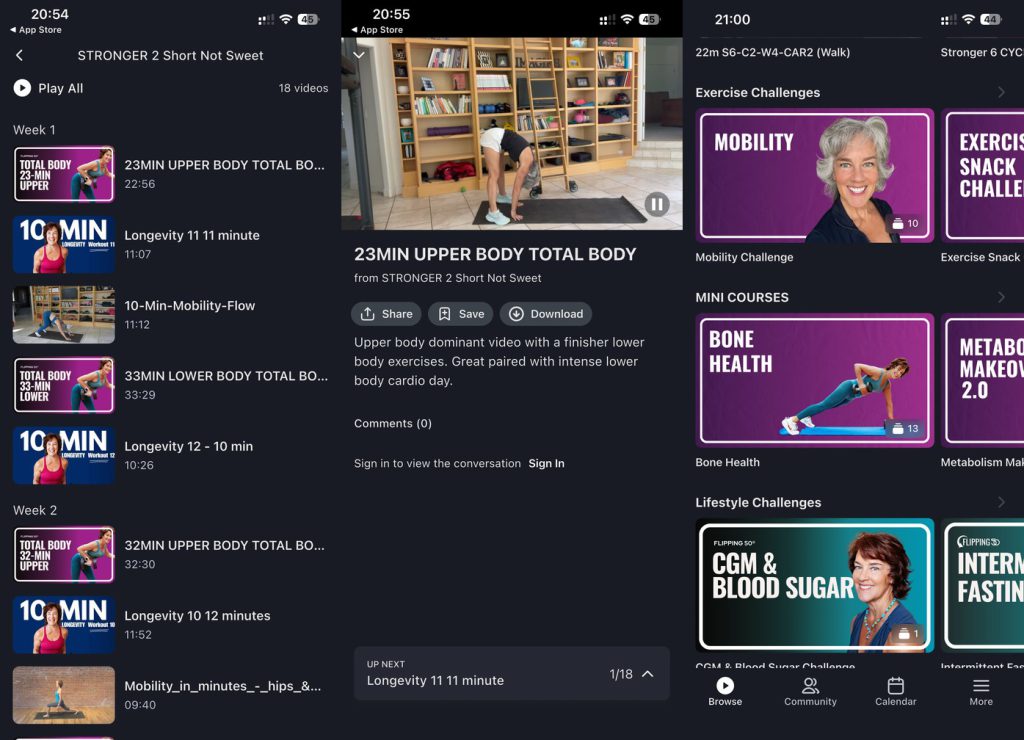
The only programme here that separates perimenopause, menopause and postmenopause into different plans
Flipping 50 is built by Debra Atkinson, MS in exercise science with an NSCA CSCS. Its twelve-week STRONGER programmes are staged separately for each phase of the transition, and the nutrition side is protein-forward with menopause-vetted recipes. It carries a Data profile tier here rather than a tested one.
I have not tested this one first hand. What follows comes from the research profile, not from using it. What puts it first is that it scores at the top of this page on both halves of the problem: real progressive loading, and nutrition written for this life stage rather than adapted to it.
What a research profile cannot tell you, and the cost: at $69 a month this is the most expensive option here by a wide margin, no dietitian is confirmed behind the nutrition, and a supplement line is upsold. There is no dependable free trial, so you cannot look before you buy.
Best for: on the research, women who want their training and eating both built around the phase they are actually in.
Cost: $69 a month, or $549 a year on the website.
Centr: dietitian-built plans next to real strength programming
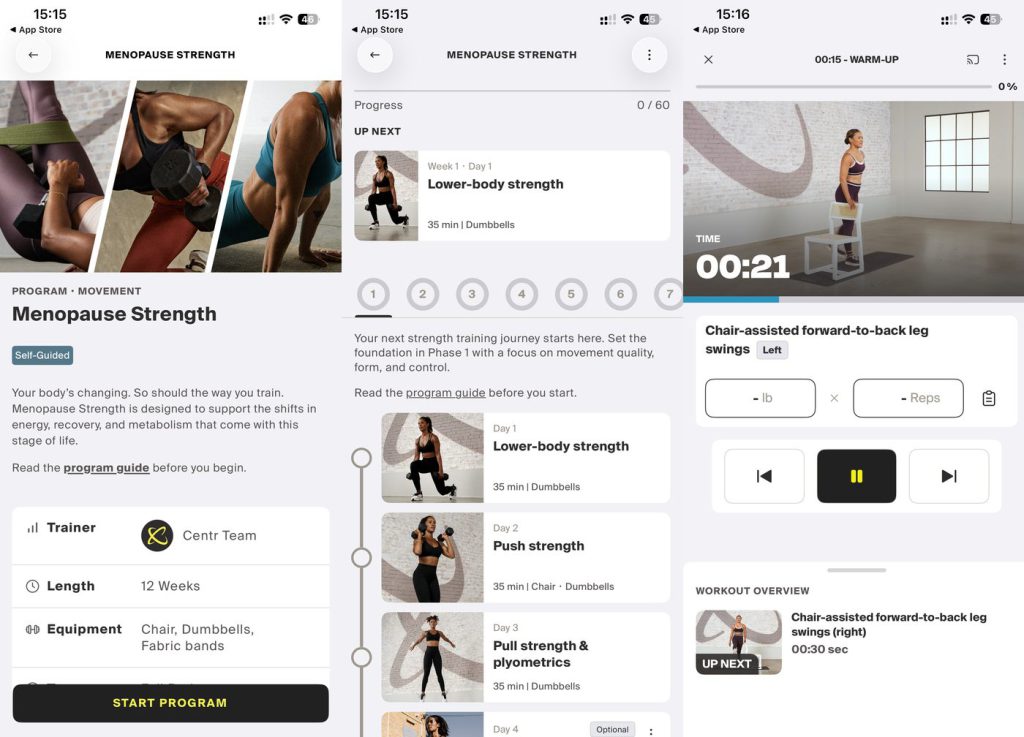
The most credentialed nutrition team on this page, in a genuinely polished app
Centr pairs structured meal plans from a credentialed sports dietitian with strength programming that is more substantial than the celebrity framing suggests, plus a 12-week Menopause Strength programme.
Sampled by Katy Cole: I logged into Centr and it is a well-designed app with a huge range of programmes, including a dedicated Menopause Strength programme, which I liked. I could not stick with Owning Your Menopause myself because of the low video quality, and Centr’s polish clearly wins there.
The honest limitation: the menopause layer is coach-designed rather than clinician-led, and the nutrition is built for general fitness rather than for midlife specifically.
Cost: $29.99 a month with a 7-day trial.
Menovation: the most midlife-specific food education here
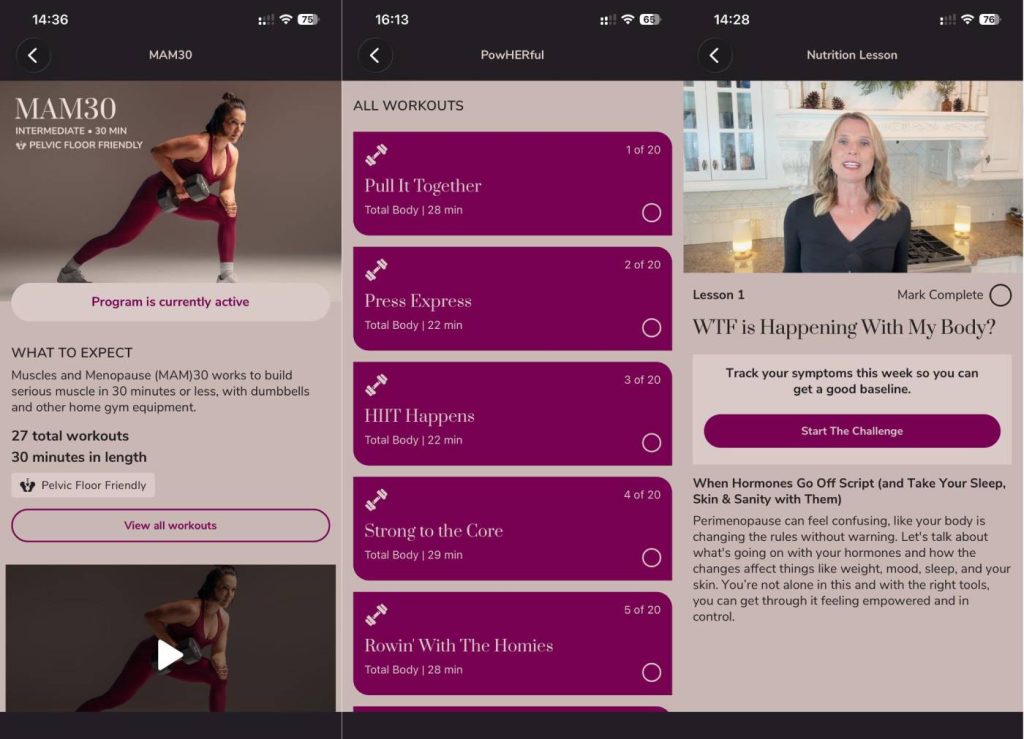
Around thirty nutrition lessons written for perimenopause, alongside real dumbbell loading
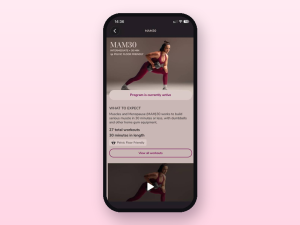
Menovation is led by Ashley Nowe, a Certified Menopause Coaching Specialist, with a company-reported clinician roster. It carries 287 or more midlife recipes with meal plans and a set of nutrition lessons built specifically for this life stage.
Tested by Katy Cole, 6 to 8 weeks: The roughly thirty nutrition lessons on perimenopause are some of the most complete, practical information I have found on this topic, and I have spent a lot of time looking. The PowHERful programme delivered real results over five weeks: I dropped from 141 lb to 136 lb and moved from around 11 lb to 13 lb on upper body and 17 lb to 20 lb on lower body per hand.
Those weight numbers are worth reading carefully in the context of this page. The five pounds is the least interesting part. The loads going up is what was actually changing the body composition.
The honest limitation: the interface is dated and the library is still growing.
Cost: $28.99 a month, $69.99 quarterly or $199.99 a year. The trial is 8 days at the checkout, although the homepage says 7.
BODi: a structured eating plan, and workouts to choose carefully
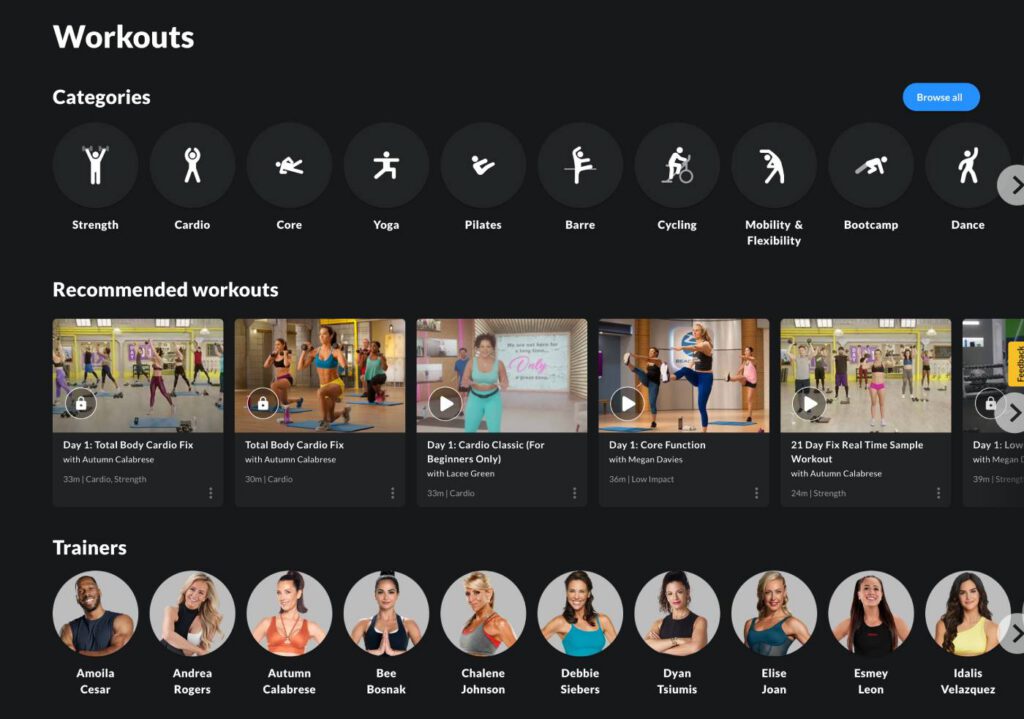
The strongest nutrition framework here, attached to a library that needs picking through
BODi carries the portion-control container system plus meal plans tied to specific programmes, and in Belle Vitale a dedicated hormone programme. Our review describes the eating plan as anti-inflammatory and protein-focused with an emphasis on blood sugar stability.
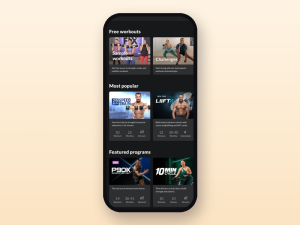
Tested by Katy Cole, several months across four programmes: I worked through 21 Day Fix, LIIFT4, 4 Weeks for Every Body and Belle Vitale. I completed 28 days and lost 3 lb, saw noticeably tighter arms and legs, and felt meaningfully more energy by week two. The colour-coded container nutrition system drove the majority of that result, not the exercise alone.
The caveat that matters on this page: the mainstream library skews jump-heavy with poor joint modifications, which is the opposite of what most women over 40 need. Belle Vitale is the exception. Buy this for the nutrition framework and choose the workouts deliberately.
Cost: $22.99 a month standard, with a 7-day trial on monthly plans only.
Simply Strong: the hardest training on this page
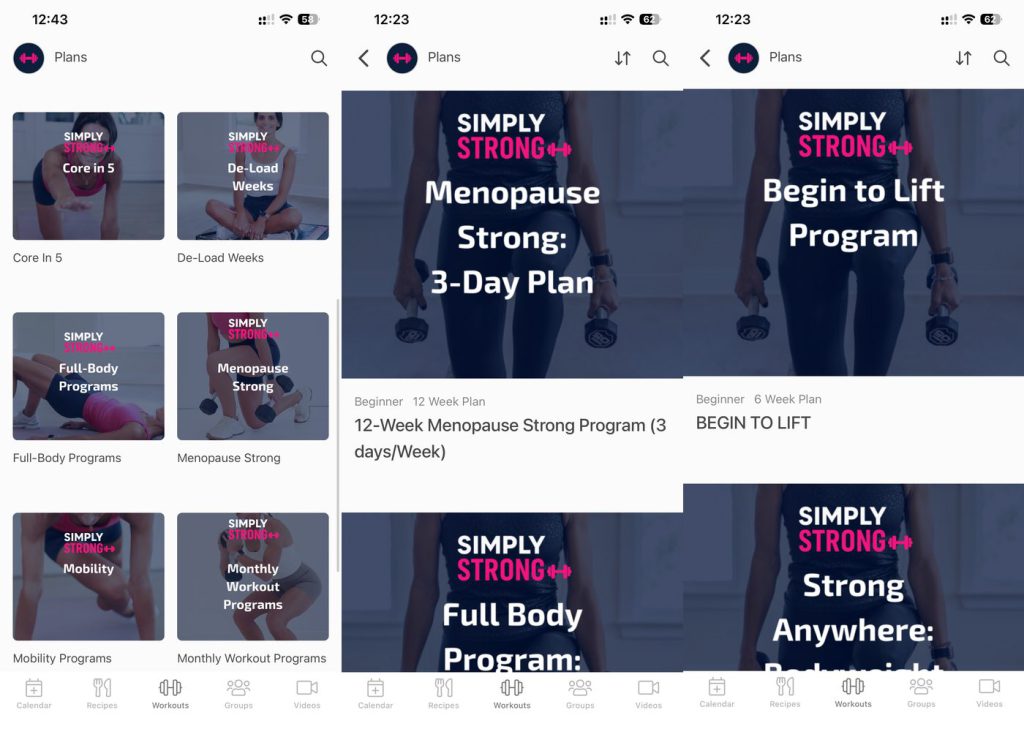
Progressive overload as the core method, with macro guidance alongside
Simply Strong is built by Tami Smith, a NASM-certified personal trainer and macro coach. Progressive overload is the method rather than a feature, structured month to month with dumbbells and bands.
Sampled by Katy Cole: There is a lot of strength training and even a dedicated Menopause Strong track. But Tami demonstrates each move on a short video, silently, and that is a real minus for me. I like to be told how to do a movement and offered an easier option.
The honest limitation: the app scores lowest here for ease of use, and it will not coach you through the movements.
Cost: $24.99 a month with a 5-day trial.
FORM: the easiest to actually stick with
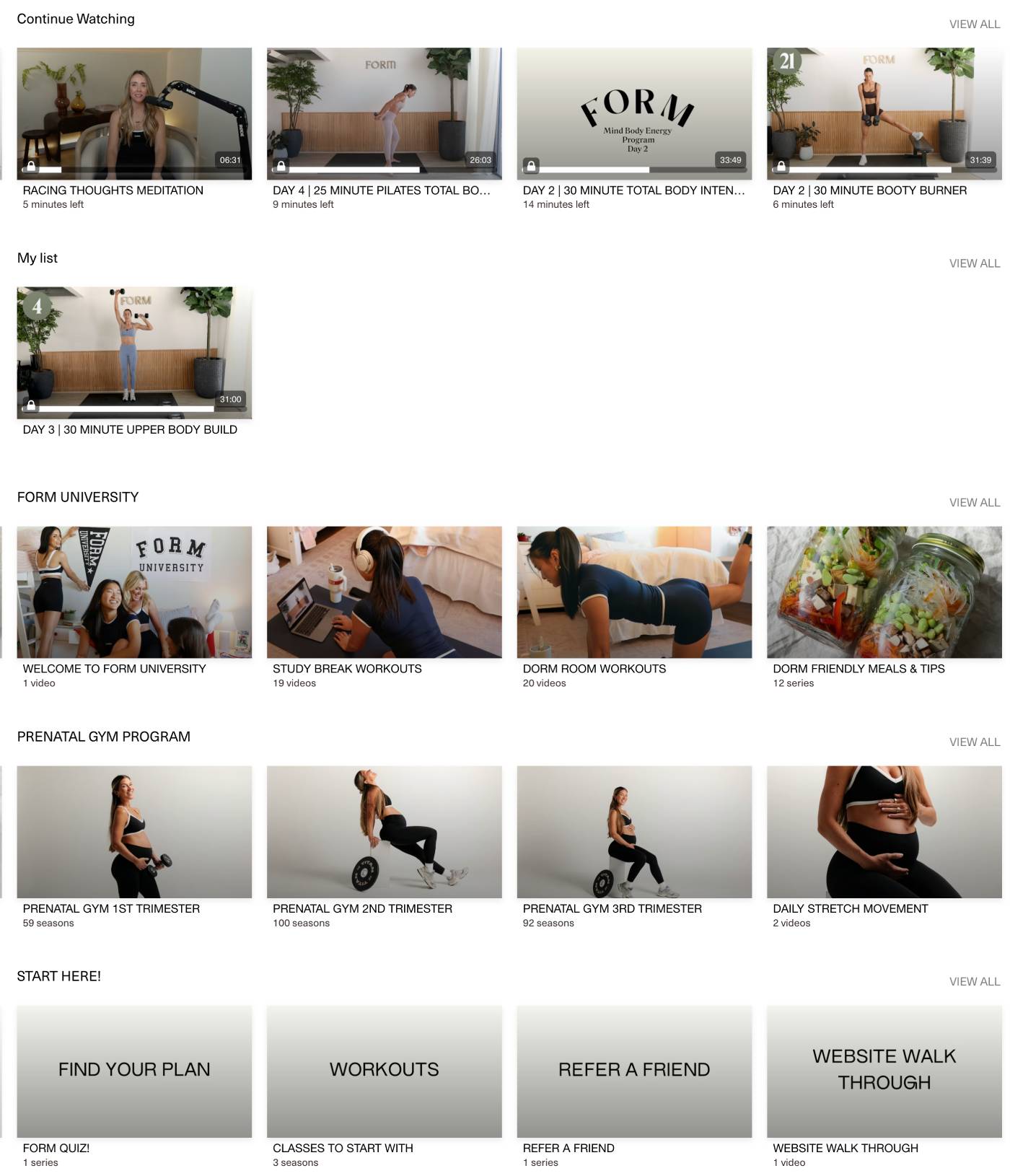
Dietitian-approved plans in the best-designed app on this page
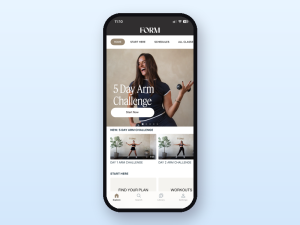
FORM pairs low-impact Pilates and strength with dietitian-approved, protein-forward meal plans and grocery lists. It scores highest here for ease of use, which matters more than it sounds when the thing you are changing takes months.
Tested by Katy Cole, 2 weeks: I completed the full programme, tried the 7-day Beginner Pilates series, explored the meditation section, and my belly had gone flat. A note for anyone with dietary restrictions: I had one or two meals I could not follow because of my cholesterol diet, but the recipes are simple enough that swapping ingredients is straightforward.
The honest limitation: loading is deliberately gentle and there is no menopause-specific content, so it will do less for lean mass than the options above it.
Cost: $28 a month with a 7-day trial giving full access.
Betty Rocker: explicit protein targets
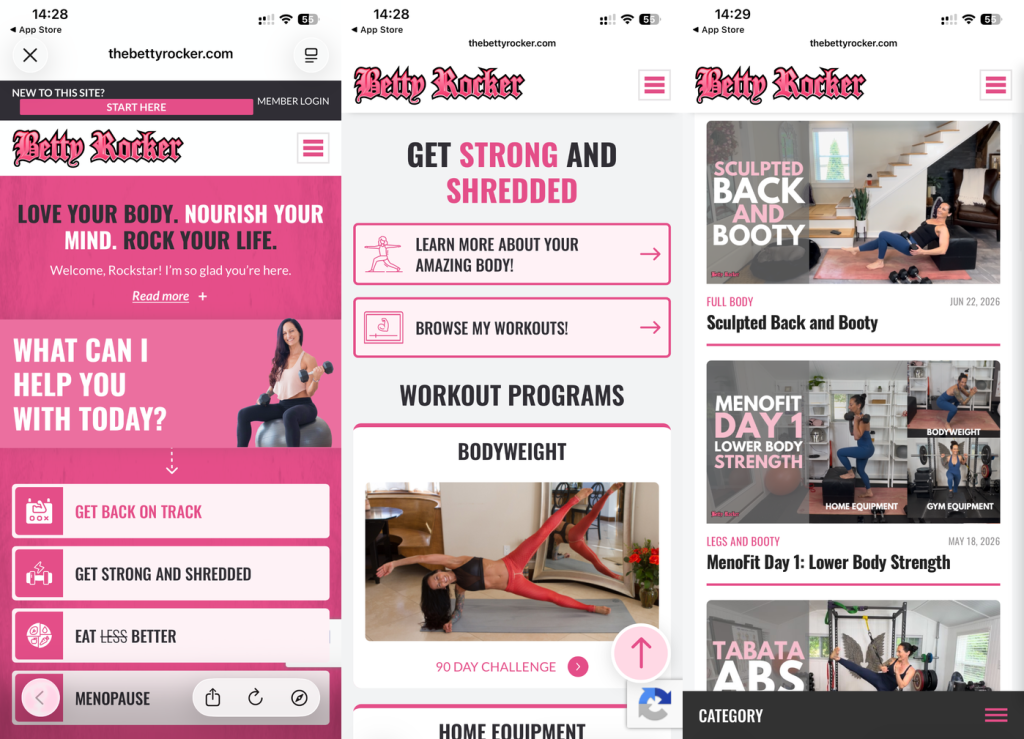
Whole-food eating with real numbers attached, and a perimenopause slant
Betty Rocker is Bree Argetsinger’s membership. She holds C.H.E.K. exercise coach and ISSA nutrition credentials and is not a clinician. The nutrition targets 30 to 40g of protein a meal with a high-fibre emphasis, which is the most concrete guidance on this page.
Sampled by Katy Cole: The content is genuinely rich, but the site is busy: lots of programmes, lots of places to scroll, and even going in deliberately I felt a little overwhelmed. I moved from the app to the desktop site, where finding things was easier.
Two things to know: the membership cross-sells supplements, which deserves a sceptical eye on any programme whose nutrition advice sits beside a shop. And the trial is not free: it is 30 days for $1, which is a payment, not a look around.
Cost: $37 a month, frequently promoted at $29.
Fabulous50s: free workouts with the week already planned
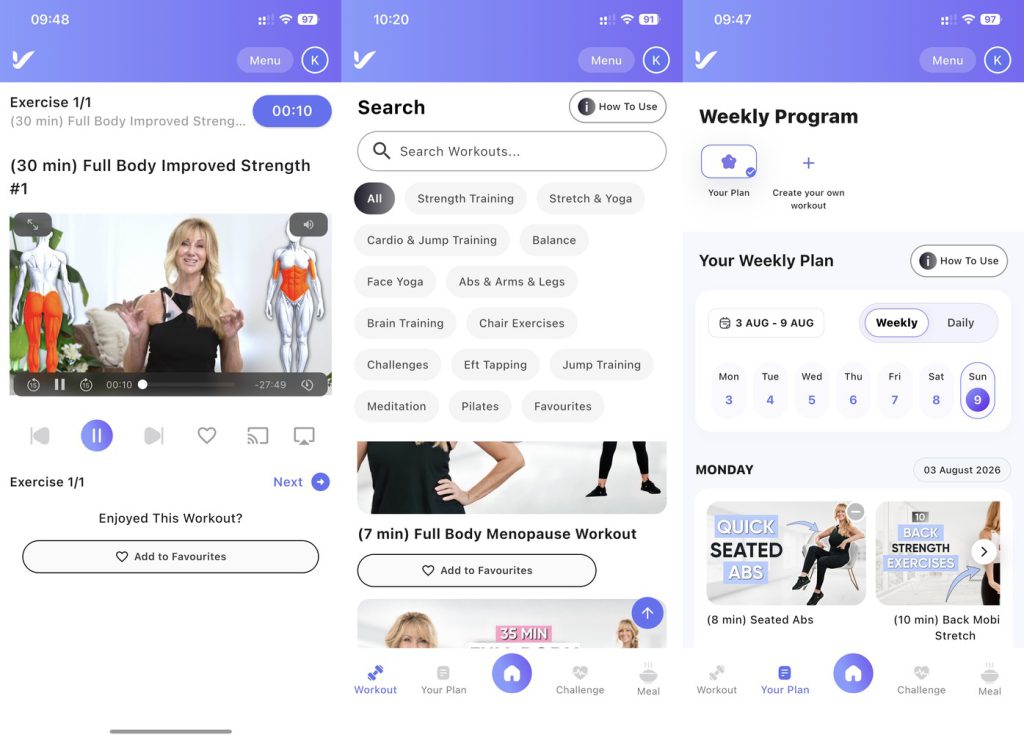
Structured weekly meal plans with macros and a shopping list, at no cost for the training
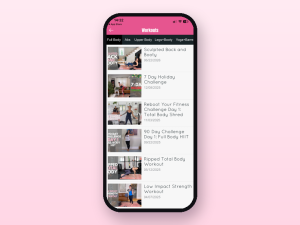
Fabulous50s is Schellea Fowler’s library, built for an over-50 body from the start. The Vitality app carries structured weekly meal plans with macros and a ready-made shopping list.
Sampled by Katy Cole, 14-day trial: If you assume anything labelled “50s” will be too gentle for a woman in her late 30s or 40s, you would be wrong. I used the app properly on the trial that comes with the annual plan.
The honest limitation: loading stays light with limited progressive overload, which is why it ranks eighth on a page about defending muscle.
Cost: free on YouTube; the Vitality app is $14.99 a month with a 14-day trial.
Which one is right for you?
If you want food and training built for this life stage, Menovation, and forgive the interface.
If you want a polished app and professional meal plans, Centr at $29.99.
If the eating plan is the part you need most, BODi, choosing workouts carefully.
If you already lift and want to go harder, Simply Strong.
If sticking with it is your real obstacle, FORM.
If you want to spend nothing on training, Fabulous50s.
Whichever you pick, measure it by the weights going up and how your clothes fit, not by the scale. The research is clear that the scale is the least informative thing changing about your body right now.
How did we choose these eight?
The qualifier is nutrition. Body composition is not built by training alone, so a programme has to offer genuine midlife nutrition support to appear here at all. Nineteen of our 77 published programmes score 6 or above on that measure.
The ranking is progressive strength, weighted 70%, blended with ease of use at 30%. Strength is the lever that acts on the specific thing menopause is taking from you, which is lean mass. The two measures are close to independent, correlating at r = 0.17, so the blend adds information rather than restating one score twice.
We did not rank on abdominal or core content, because the evidence says it would not help. See the Vispute trial above.
One qualifying programme, WarriorBabe, was deliberately excluded on commercial grounds and is named above rather than quietly dropped.
Six of the eight I have used, three across a full test and three sampled. Flipping 50 is assessed from published information only and is labelled that way, carrying no first-hand observation.
We buy our own subscriptions. Some links on this page earn a commission, which never affects a score or a position.
What research is this page based on?
- Vispute SS, Smith JD, LeCheminant JD, Hurley KS. The effect of abdominal exercise on abdominal fat. Journal of Strength and Conditioning Research, 2011.
- Greendale GA, Sternfeld B, Huang M, et al. Changes in body composition and weight during the menopause transition. JCI Insight, 2019.
- Maltais ML, Desroches J, Dionne IJ. Changes in muscle mass and strength after menopause. Journal of Musculoskeletal and Neuronal Interactions, 2009.
- Vissers D, Hens W, Taeymans J, et al. The effect of exercise on visceral adipose tissue in overweight adults: a systematic review and meta-analysis. PLoS One, 2013.
- Ramos-Campo DJ, Andreu-Caravaca L, Carrasco-Poyatos M, et al. Effects of Circuit Resistance Training on Body Composition, Strength, and Cardiorespiratory Fitness in Middle-Aged and Older Women. Journal of Aging and Physical Activity, 2022.
- Sá KMM, da Silva GR, Martins UK, et al. Resistance training for postmenopausal women: systematic review and meta-analysis. Menopause, 2023.
- Stiegler P, Cunliffe A. The role of diet and exercise for the maintenance of fat-free mass and resting metabolic rate during weight loss. Sports Medicine, 2006.
- Bauer J, Biolo G, Cederholm T, et al. Evidence-based recommendations for optimal dietary protein intake in older people: the PROT-AGE position paper. Journal of the American Medical Directors Association, 2013.
Nothing on this page is medical advice. If you have a diagnosed condition, are considering a significant change of diet, or have concerns about weight change, speak to your doctor or a registered dietitian.
Frequently asked questions about menopause belly
You can change your body composition, but not by targeting your belly. In a randomised controlled trial in the Journal of Strength and Conditioning Research in 2011, Vispute and colleagues found six weeks of dedicated abdominal exercise, five days a week, produced no significant effect on abdominal fat, abdominal circumference or body fat percentage. What does work is defending lean mass with progressive resistance training and eating enough protein to support it.
Because composition changes faster than weight. In the Study of Women's Health Across the Nation, Greendale and colleagues reported in JCI Insight in 2019 that at the start of the transition the rate of fat gain doubled and lean mass declined, while weight climbed at much the same rate as before. Same number on the scale, different body underneath it. Oestrogen decline also shifts where fat is stored, toward visceral fat around the organs.
Progressive resistance training, not abdominal work. It is the only thing that directly addresses the lean mass you are losing, and a meta-analysis by Ramos-Campo and colleagues in 2022 found it produced increases in muscle mass and a moderate to large favourable effect on strength in middle-aged and older women. Exercise also reaches visceral fat specifically, even without dieting, per a systematic review by Vissers and colleagues in PLoS One in 2013.
Be careful. Stiegler and Cunliffe, writing in Sports Medicine in 2006, reviewed diet and exercise for maintaining fat-free mass during weight loss: aggressive restriction costs you muscle, which is the one thing already declining. Losing weight fast and losing muscle are usually the same outcome. Prioritise protein, which the PROT-AGE position paper says older adults need more of than younger adults, and let the training do the composition work.
Strength moves within two to three weeks; visible composition change usually takes six to eight. In testing Menovation over five weeks the scale moved five pounds, but the more meaningful change was the weights going up, from around 11 lb to 13 lb on upper body and 17 lb to 20 lb on lower body. Judge progress by what you can lift, not by the scale.
Yes, just not for fat loss. Core training builds the muscle underneath, supports your back and matters for pelvic floor function, all of which are worth having. It simply will not remove the fat sitting on top of it. Treat it as part of a whole-body programme rather than the centrepiece.
Menovation if you want the food education as well as the training, Centr if you want a polished app with dietitian-built plans, or Fabulous50s if you want to spend nothing on the workouts. All three qualify on real midlife nutrition support, which is the entry requirement for this page.
Where should you read next?
- Our full Menovation review, including the nutrition lessons and the five weeks of testing.
- Best strength training apps, if you want to go harder on the loading.
- Best workout apps with meal plans, if the eating side is your priority.
- How we score, including how the capability scores are built.