Does exercise actually reduce hot flashes?
No, and we are going to be direct about this because most of the internet is not. The best available evidence does not show that exercise reduces the frequency or intensity of hot flushes and night sweats. This page exists anyway, and the rest of it explains why.
The Cochrane review of exercise for vasomotor menopausal symptoms pooled five randomised trials covering 733 women and concluded that evidence was insufficient to show whether exercise is an effective treatment for vasomotor menopausal symptoms. Comparing exercise with no active treatment across three trials and 454 women, it found no difference between groups in the frequency or intensity of symptoms.
The largest single trial since then was blunter. Daley and colleagues, publishing in BJOG in 2015, concluded that exercise is not an effective treatment for hot flushes and night sweats, and stated explicitly that, contrary to clinical guidance at the time, women should not be advised that exercise will relieve their vasomotor symptoms.
Why this page is called what it is. We used to title it “best workout for hot flashes”, which implies a treatment claim the evidence does not support. It is now about workouts that address hot flashes, meaning training that is comfortable and manageable while you are having them, and that targets the things exercise genuinely does improve. That distinction is not pedantry. It is the difference between an honest page and a misleading one.
What exercise does reliably help with in menopause is a real and substantial list: sleep, mood, body composition, bone density, balance and cardiovascular risk. Greendale and colleagues documented loss of lean mass and gain in fat mass across the menopause transition, and that is a problem exercise genuinely solves. Martyn-St James and Carroll found that combining impact with high-magnitude resistance work reduced postmenopausal bone loss. Those benefits are worth having whether or not your flushes change at all.
And there is a second-order effect worth naming. Hot flushes are responsible for some, though not all, of the sleep disturbance reported during menopause, and poor sleep makes everything about this life stage harder to cope with. Exercise has good evidence behind it for sleep quality. Improving how you sleep around the flushes is not the same as stopping them, and it is not nothing either.
If hot flushes are seriously affecting your life, that is a conversation for your doctor. Effective hormonal and non-hormonal treatments exist, and a menopause-trained clinician is the right person to weigh them with you. We are a fitness site and we are not going to summarise treatment options for you. Choosing a fitness app instead of that conversation is the wrong trade, and no page on this site should encourage it.
What is actually happening during a hot flash?
A hot flush is a thermoregulatory event, not a heat event. The distinction matters for training, because it explains why a cool room helps more than a light workout does.
Freedman, reviewing the mechanisms in the Journal of Steroid Biochemistry and Molecular Biology in 2014, describes hot flushes as small rises in core body temperature acting within a greatly narrowed thermoneutral zone, the range between the sweating and shivering thresholds.
He is explicit that this narrowing is due in part, but not entirely, to oestrogen depletion, with elevated central sympathetic activation also responsible.
Within that narrowed range a very small temperature rise, the sort that would normally pass unnoticed, is read as overheating and triggers a full cooling response: skin vessels dilate, you flush, you sweat, and you often feel cold afterwards as the response overshoots.
The training implication follows directly: you are not avoiding heat in general, you are avoiding small temperature rises that now cross a threshold which used to sit further away.
That is why ambient temperature, airflow and clothing do more for training comfort than choosing a gentler workout, and why a hard session in a cool room is often more comfortable than a gentle one in a warm room. Freedman notes in the same review that peripheral cooling ameliorates hot flushes, which is the mechanism behind that advice.
It also explains the night sweats. Core temperature falls as you fall asleep and rises in the second half of the night, which is why flushes cluster in the early hours and why the resulting broken sleep, rather than the flush itself, is usually what makes the next day hard.
What this does not explain is why exercise has not been shown to help. Regular exercise improves thermoregulation in general, which is why researchers expected a benefit and designed trials to find one. They did not find it. That gap between a plausible mechanism and a null result is a reasonable summary of where this field currently is, and it is why we are careful about what this page claims.
This is a description of current understanding, not medical advice, and hot flushes have other causes worth ruling out. Thyroid disease, some medications and, less commonly, other conditions can produce similar symptoms. If yours started suddenly, are severe, or come with other symptoms, see your doctor rather than assuming menopause.
How do you train comfortably during hot flashes?
The practical problem is not whether to exercise. It is that getting hot makes a flush more likely and more uncomfortable, so the training has to be arranged around that. What follows is not evidence-based symptom treatment; it is the accumulated practical answer to a real problem.
- Train in the coolest part of your day. For most women that is early morning. If you flush worst in the evening, do not put your session there.
- Keep the room cool and moving. A fan pointed at you does more for training comfort than any programme choice on this page.
- Choose formats you can pause. On-demand beats live for exactly this reason: a flush passes in a few minutes and a class that waits for you is worth more than one that does not.
- Layers, and a cold drink within reach. Obvious, routinely forgotten.
- Prefer shorter sessions when you are flushing frequently. Two 15-minute sessions are more achievable than one 40-minute one on a bad week, and the training effect is similar.
- Do not abandon strength work. The instinct is to retreat entirely to gentle movement. Strength training is the part with the strongest evidence behind it for what menopause actually does to your body, so keep two sessions a week even if you shorten them.
What about breathing exercises? Paced breathing is often recommended for hot flushes and the evidence is weak. A randomised trial in Obstetrics and Gynecology in 2015 found that device-guided slow-paced respiration produced only modest improvements in frequency and severity, and was significantly less effective than simply listening to music. Several programmes here include breathwork, and it may help you feel calmer during a flush. Treat that as a reasonable thing to try rather than a proven intervention.
Which workouts are most comfortable during hot flashes?
Eight low-impact programmes rank highest for training comfortably while you are having hot flushes. Alo Wellness Club leads, followed by Melissa Wood Health, Yoga With Adriene, FORM, Down Dog, Flipping 50, Lindywell and Fabulous50s.
Read that heading carefully, because it is doing precise work. These are not ranked on reducing hot flushes, because nothing reliably does. They are ranked on being comfortable, pausable and manageable when your body is already struggling to regulate its temperature: low impact, short sessions, breath and recovery content, and a body-heat load you control.
How do the best low-impact programmes compare?
| Rank | Programme | Why it suits a flushing day | Mind-body 70% | Ease of use 30% | Review score * | Length | Cost |
|---|---|---|---|---|---|---|---|
| 1 | Alo Wellness ClubFully tested | Deep restorative library, free, filter by length | 9 | 8 | 7.7 | 15 to 30 min | Free |
| 2 | Melissa Wood HealthFully tested | Calmest platform here, 10-minute options | 9 | 8 | 6.9 | 10 to 30 min | $14.95/mo |
| 3 | Yoga With AdrieneSample tested | Free, warm, easy to stop and restart | 9 | 8 | 6.8 | 5 to 60 min | Free; app $12.99/mo |
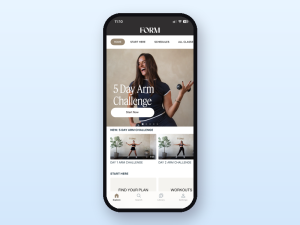
| 4 | FORMFully tested | Keeps strength work in, at low intensity | 8 | 9 | 7.6 | 20 to 30 min | $28/mo or $180/yr |
| 5 | Down DogSample tested | You set length and intensity precisely | 8 | 9 | 6.0 | 10 to 90 min | $12.99/mo or $99.99/yr |
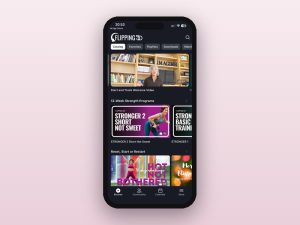
| 6 | Flipping 50Data profile | Keeps real strength work, menopause-staged | 8 | 8 | 7.8 | 20 to 40 min | $69/mo |
| 7 | LindywellData profile | Breathwork integrated throughout | 8 | 8 | 6.9 | 5 to 45 min | About $29/mo or $199/yr |
| 8 | Fabulous50sSample tested | Free, short, genuinely over-50 audience | 8 | 7 | 7.6 | 5 to 40 min | Free; app $14.99/mo |
* Full review score is the programme’s overall rating across all nine criteria we score, the number on its review page. The rank comes from mind-body support, weighted 70%, blended with ease of use, weighted 30%, among low-impact programmes only. It measures comfort and manageability, not symptom relief, and it is a different question from which programme is best for midlife overall. For that, see our menopause picks.
Most of these will not build your bones, and that matters. Six of the eight are light-loading yoga, Pilates or mobility platforms, chosen here for comfort. Only FORM and Flipping 50 keep meaningful strength work in the picture. If hot flushes are your immediate problem, start here; do not let this page become your whole training plan, because the thing menopause does to bone and muscle needs load and none of the top three provides it.
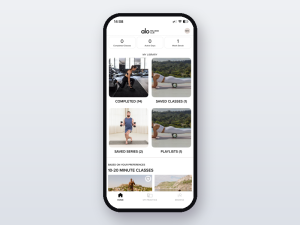
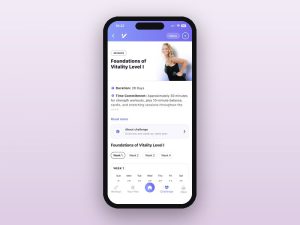
Alo Wellness Club: the deepest restorative library, and it costs nothing
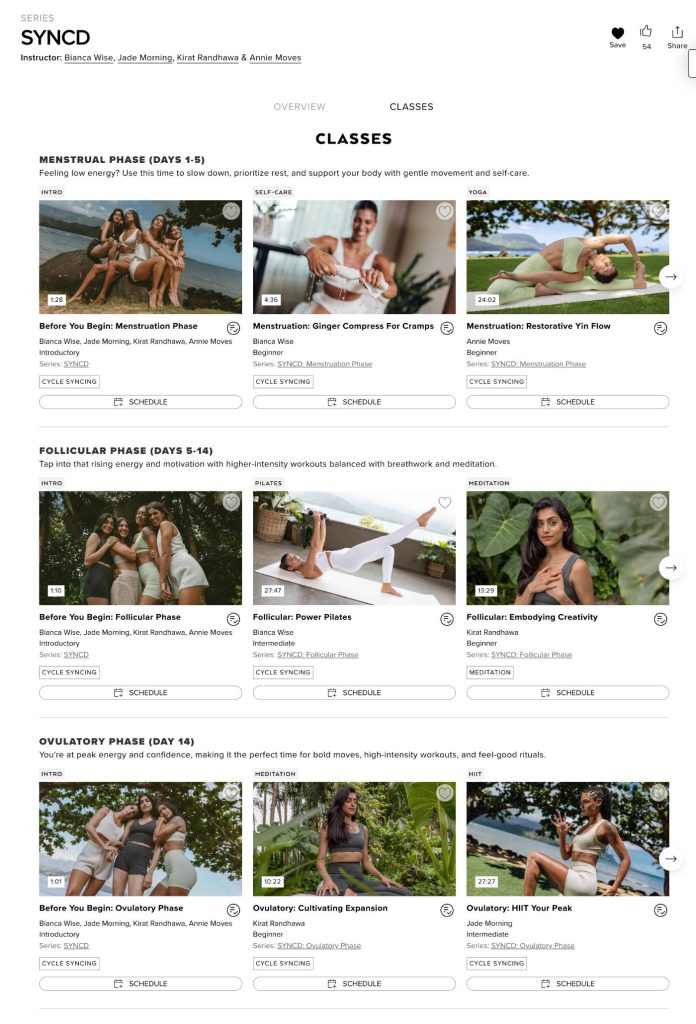
Free since late 2025, with genuinely good yin, restorative and breath content alongside everything else
Alo Wellness Club became free with an Alo Access account, and its restorative and yin content is the best free library of its kind. On a day when you are flushing every hour, being able to filter to fifteen minutes of floor-based restorative work is worth more than any programme structure.
Tested by Katy Cole, one month intensively: I have carried on using it casually since. The filtering is the standout: under a minute from “I have twenty-five minutes and I feel terrible” to a class that actually fits.
The honest limitation: no perimenopause programming, no progress tracking and no overload plan. It is a library, not a programme, and progression has to come from you.
On a flushing week: filter to 15 to 20 minute restorative or yin sessions and treat them as the floor rather than the goal. Add one strength session from elsewhere when you can. The library is deep enough that you will not run out of gentle options.
Cost: free with an Alo Access account.
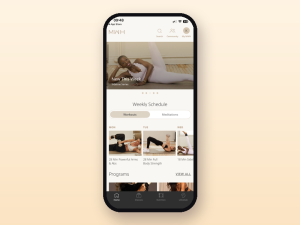
Melissa Wood Health: the calmest thing on this site
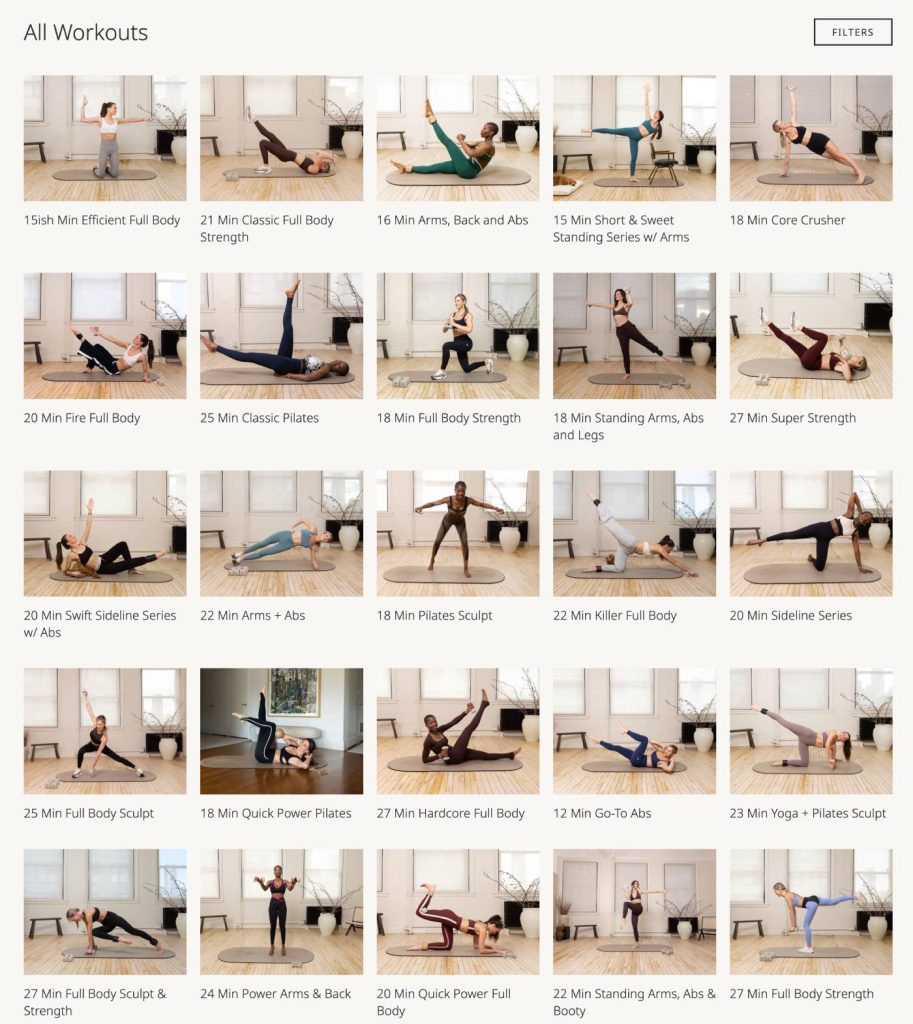
Ten-minute options and a pace that never asks you to push
Melissa Wood Health combines low-intensity mat flow with meditation, and the ten-minute sessions are the point: on a bad night’s sleep after a bad night of flushing, ten minutes is what is achievable.
Tested by Katy Cole: the surprise was getting sore from movements I had not found hard before, which says something about how specific the positions are even at low intensity.
The honest limitation: very light loading does little for strength or bone, and there is no menopause content at all. Pair it with strength work rather than replacing strength work with it.
On a flushing week: the 10-minute sessions, daily, done in the coolest part of your morning. This is the platform to use when the realistic choice is between ten minutes and nothing.
Cost: $14.95 a month or $134.99 a year. Seven-day trial on both plans.
Yoga With Adriene: free, warm, and easy to abandon halfway through
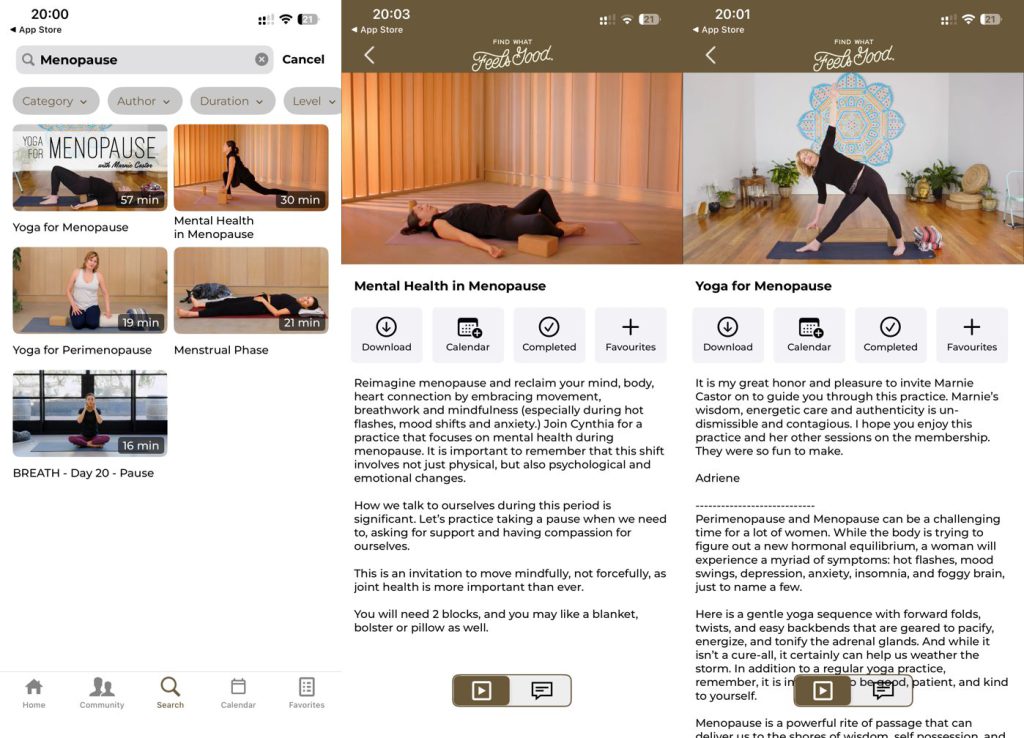
The most forgiving library here, which is exactly the quality that matters on a flushing day
Yoga With Adriene is free on YouTube, sessions run from 5 to 60 minutes, and the tone never makes stopping early feel like failure. When a flush arrives mid-session, that matters more than production values.
Sample tested. We worked through a sample of the library rather than a full programme. What is clear: exceptional warmth and accessibility, and a range of session lengths that covers almost any state you might be in.
The honest limitation: no strength or bone loading and no menopause programming whatsoever. This is recovery and stress content, and it is excellent at that and nothing else.
On a flushing week: pick by how you feel rather than following a series, and stop when you need to. Nothing in the coaching makes ending early feel like a failure, which is the specific quality that keeps people going through a bad month.
Cost: free on YouTube. The Find What Feels Good app is $12.99 a month or $129.99 a year, with a seven-day trial.
FORM: keeps the strength work in, at an intensity you can handle
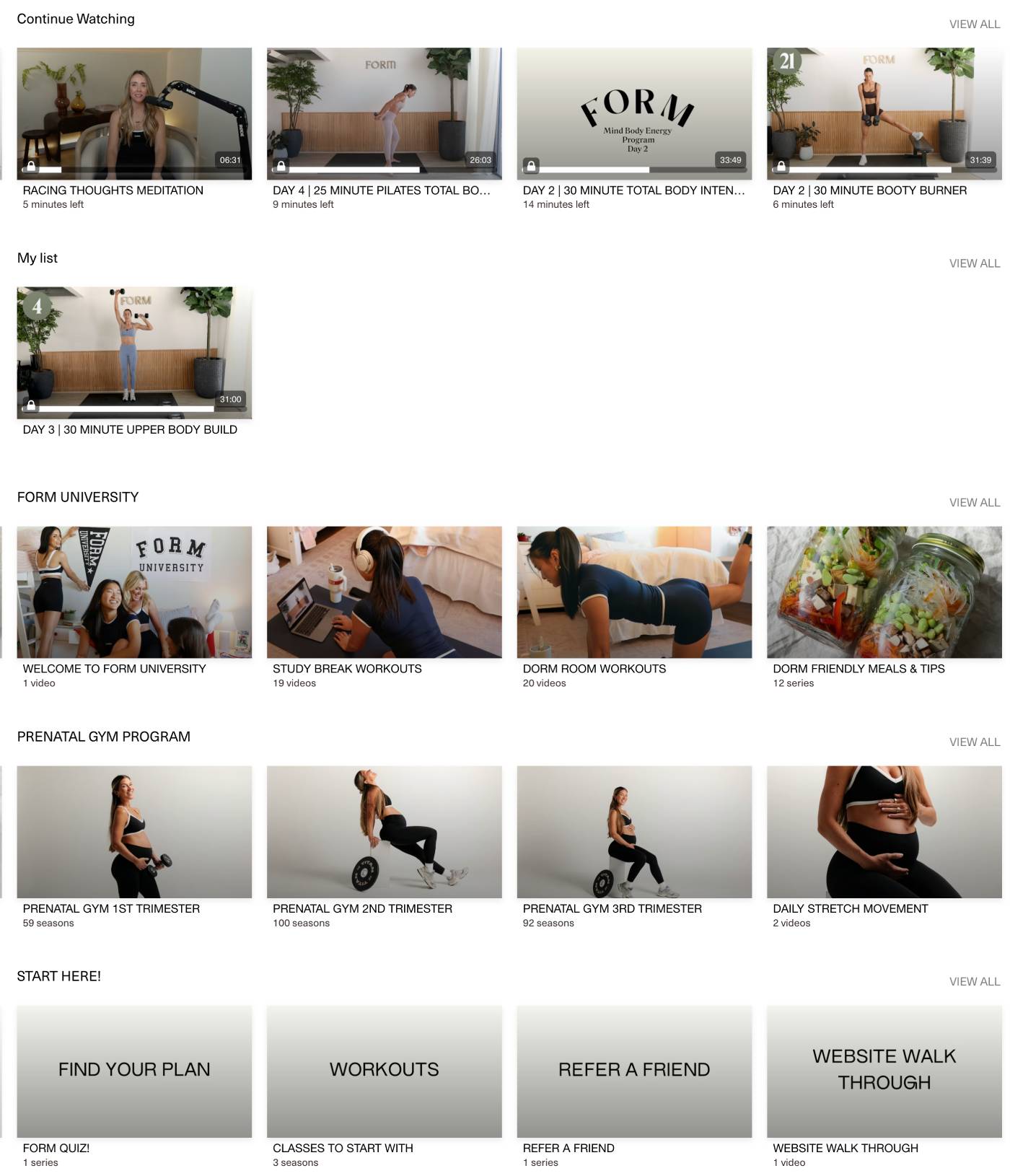
The highest-ranked programme here that does not ask you to give up loading
FORM pairs low-impact Pilates with actual strength work and an explicit anti-burnout ethos, plus a mindfulness section that addresses stress recovery. It is the compromise option: comfortable enough for a flushing week, structured enough to still be training.
Tested by Katy Cole: FORM is the platform I have spent the most time with. The 20 to 30 minute sessions are the right length to actually complete, and the community around it is genuinely supportive rather than performative.
The honest limitation: no menopause content, and loading is still light by strength-training standards. It is the best of these eight at keeping you training, not a replacement for a dedicated strength programme.
On a flushing week: keep two strength sessions and swap the rest for the Pilates and mindfulness content. This is the platform on this page that lets you reduce without stopping training altogether.
Cost: $28 a month or $180 a year on the site. Apple in-app pricing differs at $144.99 a year. Seven-day full-access trial.
Down Dog: you set the length and the intensity, every time
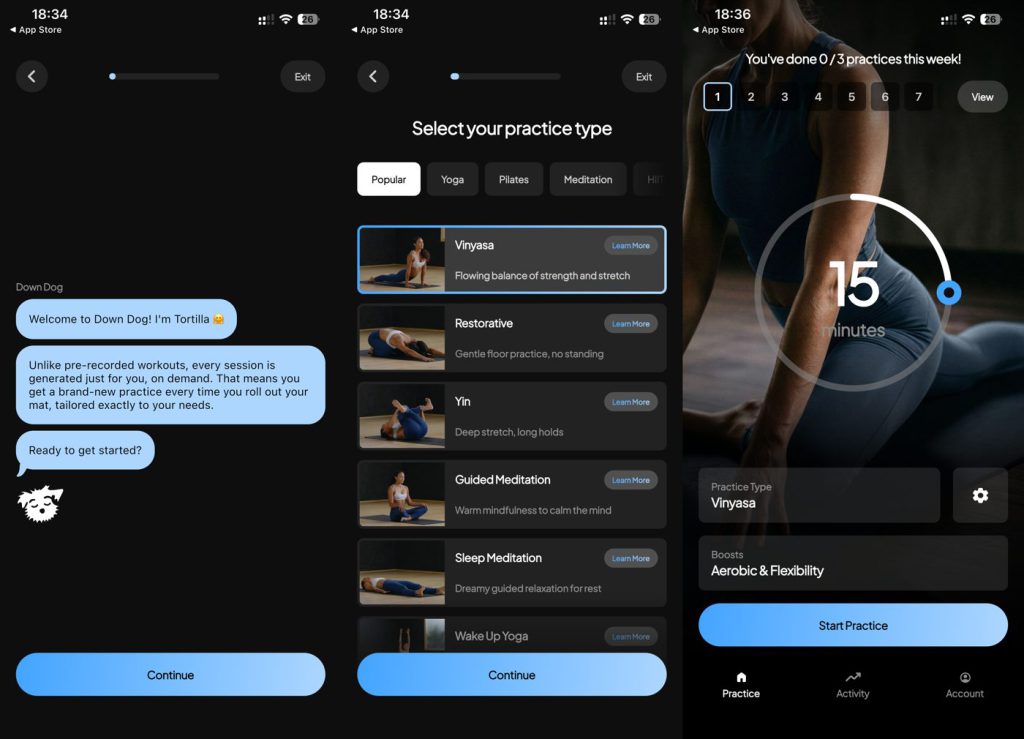
The most configurable app here, which is the feature that matters when no two days are the same
Down Dog generates a session to your specification: length anywhere from 10 to 90 minutes, and an intensity you choose. On a week where some days are fine and others are not, that beats a fixed programme.
Sample tested. We sampled the app rather than running a full programme. The generation engine is genuinely good and the design is the best of any yoga app we have looked at.
The honest limitation: no strength or bone loading, no menopause programming, and the vendor does not publish its trial length or its cheaper website price, which is irritating.
On a flushing week: set a shorter length and a lower intensity each morning rather than committing in advance. Fifteen minutes at low intensity on a bad day, forty on a good one, from the same app.
Cost: $12.99 a month or $99.99 a year on Apple. The vendor says buying direct is cheaper but does not publish that price.
Flipping 50: the one that keeps real strength work on the table
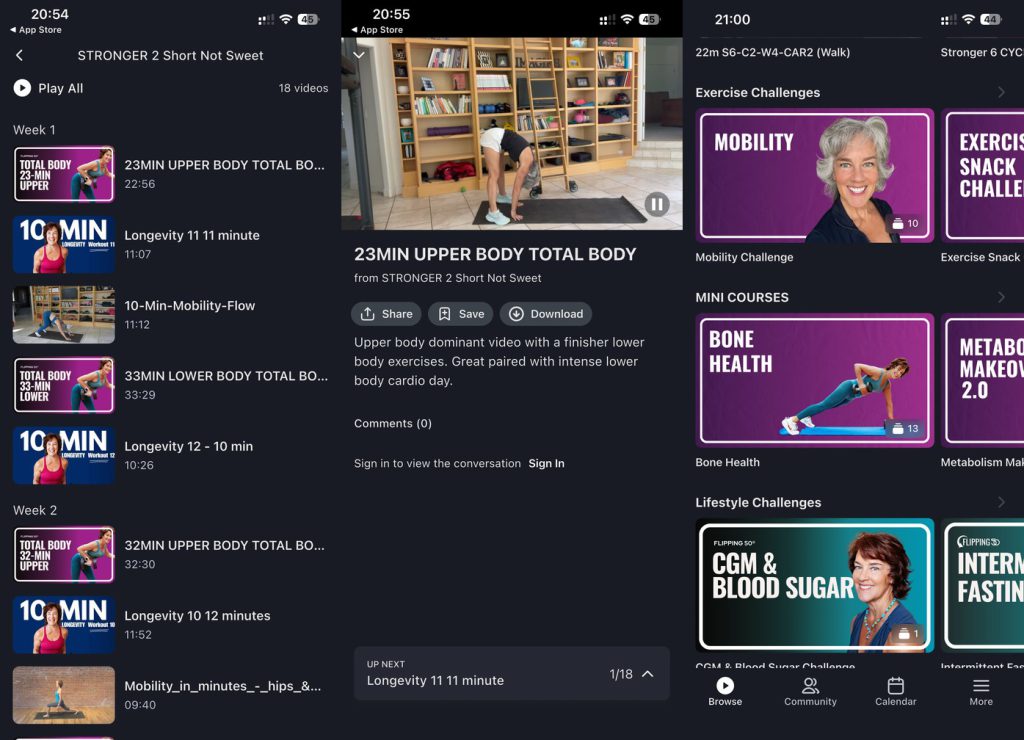
Menopause-staged progressive programming, low impact, at a price that has to be justified
Flipping 50 is the only programme here with progressive strength work staged separately for perimenopause, menopause and postmenopause, at low impact throughout, with recovery treated as a named pillar.
This is a data profile, not a tested review. We have not run it first hand. What the published information shows is properly staged programming from Debra Atkinson, CSCS, and a strong recovery philosophy. What we cannot verify is how it feels over a full twelve weeks.
The honest limitation: $69 a month with no reliable free trial, for a programme we have not tested. It ranks sixth here on comfort measures while being arguably the most useful for what menopause actually does to your body.
On a flushing week: follow the programme for your phase and shorten sessions rather than skipping them. The method’s own position is that most midlife women train too much, which makes it unusually easy to scale down without feeling you have failed.
Cost: $69 a month or $549 a year on the website.
Lindywell: breathwork treated as part of the method
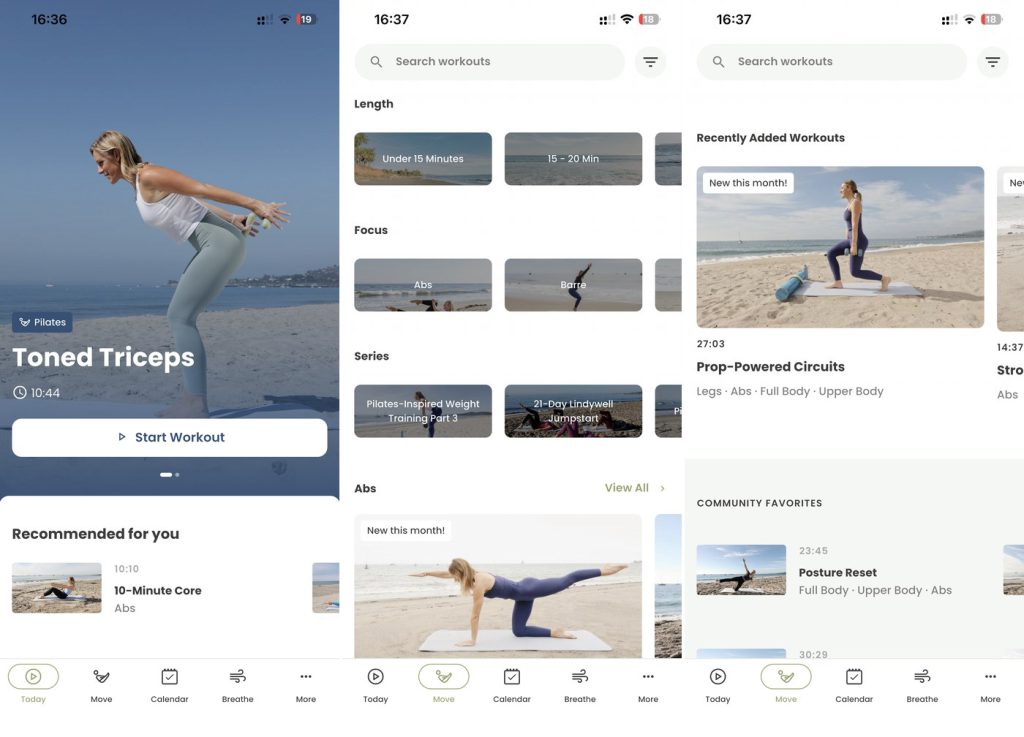
Pilates and breathing together, with a tone built around removing guilt
Lindywell integrates breathwork throughout rather than bolting it on, with sessions from 5 to 45 minutes and dietitian-backed nutrition alongside.
This is a data profile, not a tested review. We have not run it first hand. The published information shows short sessions, integrated breathwork and a grace-over-guilt approach that suits a difficult phase.
The honest limitation: light loading limits strength and bone, and there is no clinician-led menopause content.
On a flushing week: use the breathwork on its own on the worst days, and the 5 to 15 minute Pilates sessions on the rest. The tone is built for exactly this kind of stop-start month.
Cost: about $29 a month or $199 a year. Fourteen-day trial.
Fabulous50s: free, short, and made by someone your age
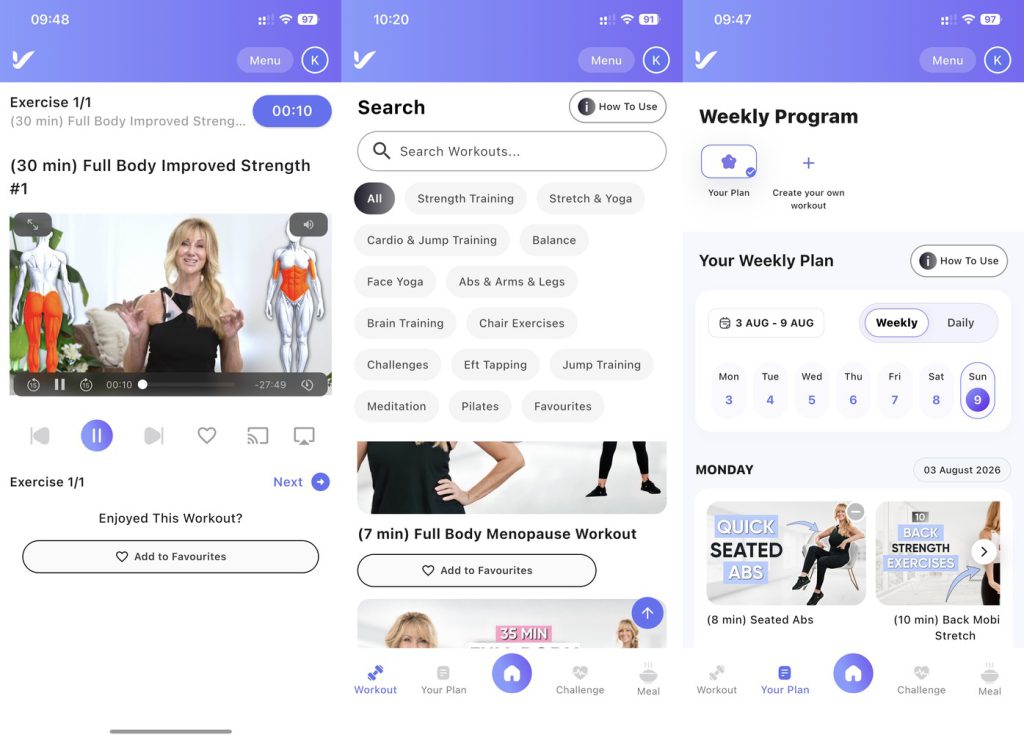
Low-impact strength, mobility and balance with no intensity pressure anywhere in it
Fabulous50s is Schellea Fowler’s free YouTube library, aimed squarely at women over 50, with sessions from 5 to 40 minutes and no HIIT.
Sample tested. We worked through a sample of the free sessions. Consistently low impact, warm coaching, and genuine attention to balance alongside light strength.
The honest limitation: loading stays light and the menopause approach is education-led rather than clinician-led.
On a flushing week: the 5 to 20 minute sessions, three or four times, keeping the balance work in. Free, so there is no financial pressure to perform during a month when you cannot.
Cost: free on YouTube. The Vitality app is $14.99 a month with a 14-day trial.
Which of these is right for you?
If you want to spend nothing, Alo Wellness Club for restorative depth, or Yoga With Adriene for warmth.
If ten minutes is all you have on a bad day, Melissa Wood Health.
If you do not want to give up strength training, FORM, or Flipping 50 if budget allows.
If no two days are the same, Down Dog, and set the intensity each morning.
If breathing through it is what helps you most, Lindywell.
And if hot flushes are genuinely disrupting your life, see your doctor about treatment options. That is the single most useful sentence on this page.
How do you keep training through a bad month?
The hardest part of hot flushes is not any individual flush. It is the accumulation: broken sleep, then low energy, then missed sessions, then the feeling that you have lost the habit entirely. Breaking that chain matters more than any programme choice.
Lower the bar rather than the frequency. If four sessions a week is not happening, do not drop to two. Do four ten-minute ones. Frequency is what preserves the habit; duration is what you sacrifice. Women who drop frequency during a bad month often do not restart for a season.
Decide the night before, not in the morning. After a night of broken sleep, the decision you make at 6am is not a reliable one. Pick the session in advance and make it small enough that your worst self will still do it.
Protect the strength sessions above everything else. If something has to go, let it be the cardio or the yoga. Strength work is where the evidence is strongest for what menopause actually does to muscle and bone, and it is the thing that is hardest to rebuild once lost.
Expect it to be uneven and plan for that. Vasomotor symptoms fluctuate over months and years. A month where you train three times a week and a month where you manage six sessions in total are both normal, and the second is not a failure of discipline.
Do not add a new programme during a bad month. The instinct when things are going badly is to change something, and starting a new platform requires exactly the energy you do not have. Change platforms when you feel good, not when you feel terrible.
What is worth tracking, and what is not
Worth tracking: the number of sessions you complete in a week, the weights and repetitions on your strength work, and roughly how you slept. Three things, all free, all responsive within weeks.
Worth tracking if hot flushes are disrupting your life: when they happen, roughly how many, and what you were doing. Not because a pattern will let you fix them, but because that record is genuinely useful in a conversation with your doctor, who will otherwise be working from your memory of a bad fortnight.
Not worth tracking: your weight. Body composition shifts through the menopause transition without the scales moving, so weighing yourself here produces noise and discouragement rather than information.
Treat wearable recovery scores carefully. Broken sleep from night sweats will make almost any recovery metric look poor, and being told you are unrecovered every morning for a month is demoralising and not actionable. Use them as monthly trends if at all.
How did we rank these eight?
Who wrote this. Katy Cole, mid-40s, currently in perimenopause, with a meniscus injury history. I am not a doctor, personal trainer or menopause specialist. Everything here comes from personally testing close to fifty fitness platforms over fifteen years and reading the published research, and none of it is medical advice.
We rank on comfort, not on symptom relief, because ranking on symptom relief would require evidence that does not exist.
To qualify, a programme has to be low impact. Raising core temperature is the practical problem here, so anything jump-heavy or sustained high intensity is excluded regardless of how good it is. Twenty-nine of our 77 programmes qualify.
To rank, we use mind-body support, weighted 70%, blended with ease of use, weighted 30%. Mind-body support measures breath, recovery and restorative content; ease of use decides whether you can find the right fifteen-minute session when you feel terrible. The two are close to independent, correlating at r = 0.47.
We deliberately do not rank this page on menopause fit, which is what most of our other pages use. Doing so would produce a list of the best midlife programmes generally, which is a different question, already answered on our menopause page, and it would quietly imply these programmes do something about hot flushes. They do not.
Four of the eight I have tested or sampled myself. Flipping 50 and Lindywell are data profiles built from published information, and Yoga With Adriene, Down Dog and Fabulous50s were sample tested. Each section says which.
We buy our own subscriptions. Some links on this page earn a commission, which never affects a score or a position.
Where is the evidence still evolving on exercise and hot flashes?
Three open questions matter most. First, whether any specific exercise modality reliably reduces hot flash frequency (the published evidence to date shows mostly indirect benefit via sleep and mood, not direct VMS reduction). Second, the role of weighted vest walking and other Mary Claire Haver-style interventions in vasomotor symptom management (clinical experience is positive but trial-level evidence is still building). Third, the optimal yoga style and dose for parasympathetic activation and VMS impact.
On modality-specific VMS reduction, the MsFLASH network of trials (Sternfeld 2014 aerobic, Newton 2014 yoga) showed mostly indirect benefits via sleep, mood and physical function rather than direct reduction in hot flash frequency. A Cochrane review of exercise for vasomotor symptoms reached a similar conclusion: the evidence does not support exercise as a primary treatment for hot flashes, but it does support exercise as part of the broader management framework.
On weighted vest walking specifically, Dr Mary Claire Haver recommends 4-6kg weighted vests for menopausal women as a bone density and metabolic intervention. Whether weighted walking modulates vasomotor symptoms directly is unclear; the bone density evidence is stronger than the VMS evidence. The cautious operating point is to use weighted walking for the documented bone benefit and treat any VMS effect as a bonus rather than a primary aim.
On yoga dose, the Newton 2014 study used a 12-week intervention with two 90-minute classes per week plus daily home practice. Shorter or less frequent yoga may produce smaller effects. For women with hot flashes specifically, the cautious operating point is two or three 20-45 minute slow-breath restorative yoga sessions per week, plus brief daily breathwork practice (5-10 minutes). Alo Wellness Club and Peloton both deliver the dose at the upper end; FORM, Melissa Wood Health and the meditation libraries inside the broader platforms cover the daily breathwork.
A hot-flash-aware week, built from the programmes on this page:
- Two strength sessions, shortened rather than skipped on a bad week. FORM or Flipping 50 keep real loading in the picture.
- Three walks of 30 to 45 minutes, in the coolest part of your day.
- Two restorative sessions from Alo Wellness Club or Yoga With Adriene, both free.
- One full rest day.
Alongside that, the unglamorous things that make the most difference: a cool sleeping environment, enough protein, and not training in a warm room. None of this is claimed to reduce flushes. It is how to keep training while you have them.
Frequently Asked Questions
The published evidence does not support exercise as a primary treatment that stops hot flashes. The MsFLASH network of trials (Sternfeld 2014 aerobic, Newton 2014 yoga) showed mostly indirect benefits via sleep, mood and physical function rather than direct reduction in hot flash frequency. A Cochrane review reached a similar conclusion. What exercise does deliver is better sleep, lower stress, more stable cortisol and improved body composition, all of which reduce the impact of hot flashes even when they still occur. For persistent or severe vasomotor symptoms, discuss treatment with a menopause-trained clinician, including whether menopause hormone therapy may be appropriate for you.
No workout has been shown to reduce hot flushes, so we do not rank on that. Ranked on comfort while flushing, Alo Wellness Club comes first: a deep restorative library, filterable by session length, and free
High-intensity sessions can trigger or worsen hot flashes through two mechanisms. First, they raise core body temperature significantly, which directly compounds the thermoregulatory instability that causes vasomotor symptoms. Second, they spike cortisol, which is itself a documented hot flash trigger. The MsFLASH research did not test HIIT specifically, but the broader cortisol-and-thermoregulation literature supports caution. The right operating point for women with active hot flashes is one HIIT session per week maximum, 20 minutes or less, in a cool environment, with adequate cool-down before returning to a warm space. For women whose hot flashes worsen during or after high-intensity sessions, dropping HIIT for several weeks while sleep and recovery rebuild is reasonable.
For hot flash impact reduction specifically, the published evidence on yoga is slightly stronger than on strength training: Newton and colleagues (2014) in the MsFLASH network found that 12 weeks of yoga improved sleep and mood in women with vasomotor symptoms, which sits in the record as the strongest positive signal for any movement-based intervention in women with VMS. But strength training delivers benefits yoga does not, including muscle preservation, bone density adaptation and metabolic protection. The optimal week for women with hot flashes includes both: 2-3 strength sessions per week (Pvolve, Sculpt Society Midlife Movement) plus 2-3 restorative yoga sessions (Anna Greenberg on Peloton, Alo Wellness Club). Strength supports the structural integrity women need; yoga supports the vagal-tone work that reduces vasomotor symptom impact.
Yes, fully free since December 2025. Alo dropped the paywall on what was previously Alo Moves (a paid subscription at around $12/month from 2017 onwards) and rebranded the platform as Alo Wellness Club. No credit card required at signup, no trial timer, no premium upgrade tier. For hot flashes specifically, the relevant content is the deep yoga, breathwork, sound bath and lymphatic library, which is broader than any standalone yoga library inside a multi-modality fitness platform. Long-term free status depends on Alo's apparel strategy holding, but as of May 2026 there is no payment required and no plan announced to reintroduce one. Only Apple TV works for living-room streaming (no Roku, Fire TV or Chromecast).
Listen to your body. Mild flashes during exercise are generally fine to continue through; pause, drink cool water, slow the pace, and resume when the flash subsides. Severe flashes (significant dizziness, nausea, rapid heart rate beyond normal exercise response) warrant stopping the session, cooling down, and considering whether the exercise itself contributed. Hot environments compound flashes; if a session triggers a severe flash, move to a cooler space before continuing. For women whose hot flashes are clustered around exercise specifically, switching to morning sessions in cool environments often reduces the problem. Discuss persistent exercise-triggered flashes with a menopause-trained clinician.
Morning or midday is generally better than evening for women with active hot flashes. Two reasons. First, ambient temperature is lower in the morning, which reduces the thermal load on top of the exercise itself. Second, hot flashes often cluster in the evening and overnight, and exercise close to bedtime can compound the heat and cortisol patterns that drive both flashes and sleep disruption. The cautious operating point is to complete training sessions at least 3-4 hours before sleep. Save the restorative yoga, breathwork or meditation for the evening (Anna Greenberg on Peloton, Alo Wellness Club restorative, Melissa Wood Health meditation library); that work supports sleep rather than disrupting it. For shift workers or women whose only training window is evening, prioritise cooler indoor environments and lower-intensity work.
The bone density evidence for weighted vest walking is meaningful; the hot flash evidence is limited. Dr Mary Claire Haver recommends 4-6kg weighted vests for menopausal women as a bone density and metabolic intervention. Whether weighted walking directly modulates vasomotor symptoms is unclear; the bone density and lean mass benefits are stronger than any direct VMS effect. The cautious operating point is to use weighted walking for the documented bone benefit and treat any hot flash effect as a bonus rather than a primary aim. Start with a light vest (2-4kg) and progress gradually. Walk in cooler environments to avoid compounding thermal load. Discuss with a physiotherapist if you have any spinal or shoulder history before starting.
No. The Cochrane review of exercise for vasomotor menopausal symptoms pooled five randomised trials covering 733 women and found evidence insufficient to show that exercise is an effective treatment. Daley and colleagues, in BJOG in 2015, went further and concluded that women should not be advised that exercise will relieve vasomotor symptoms. Exercise does reliably help with sleep, mood, body composition, bone and balance, which are worth having regardless.
Low-impact work you can pause, in a cool room, at the coolest time of your day. Alo Wellness Club, Melissa Wood Health and Yoga With Adriene rank highest on comfort in our assessment, and the first and third are free. Keep two strength sessions a week even if you shorten them, because strength work is what addresses the bone and muscle changes menopause actually causes.
No. Getting hot can make a flush more likely and more uncomfortable, which is a reason to change when, where and how you train rather than whether. Train in the coolest part of the day, use a fan, choose on-demand sessions you can pause, and prefer two shorter sessions to one long one on a bad week.
The evidence is weak. The Cochrane review found no difference between exercise and yoga in the frequency or intensity of vasomotor symptoms across two trials. Yoga may help you feel calmer during a flush and it has better evidence behind it for sleep and stress. Treat it as reasonable to try rather than a proven intervention.
Hormone therapy has strong evidence behind it for vasomotor symptoms, and effective non-hormonal medications exist for women who cannot or prefer not to take it. That is a conversation for your doctor. This is a fitness site and we are not going to pretend a subscription substitutes for medical care.