
Subscription only, sold as multi-month bundles from about $34.99 for 3 months up to about $79.99 for a year, with a 14-day money-back guarantee rather than a free trial · an AI Coach that personalises every workout · known for tough, high-intensity bodyweight HIIT, plus weights, running and a Mindset audio coach · session lengths from about 15 to 45 minutes · from Freeletics GmbH, Munich, since 2013 · Bodyweight by default, with dumbbells or a barbell for the weights work.
Researched from: official site and app store listings (verified August 2026) · Apple App Store, Google Play and Trustpilot · a walk through the app’s onboarding and preferences (screenshots our own) · independent reviews · peer-reviewed exercise and menopause science · Not workout-tested (no free trial). Testing status: Data profile.
How this profile is different. We walked through the Freeletics onboarding and preferences ourselves, and the screenshots here are our own, but we could not complete a workout because Freeletics has no free trial, only a 14-day money-back guarantee, so this stays a research-based Data Profile rather than a hands-on review. It is built from the official pages, the app, aggregated user reviews and the science, scored only where the evidence reliably supports it, and where a rating genuinely needs completed workouts we say so. One thing to know up front: Freeletics is high-intensity by heritage and has no menopause-specific programming, so for this audience it is a capable general training app rather than a midlife specialist. This is education, not medical advice; speak to your clinician, especially about HRT or existing conditions.
Freeletics Data Profile 2026: Quick Answer
Data profile: research-based, not personally tested. Hands-on score pending.
Women who already train, want an efficient, well-structured AI plan for strength and HIIT, and are comfortable with higher intensity and impact
You want low-impact, joint-friendly or menopause-specific training, a gentle beginner on-ramp, or a simple monthly plan; Freeletics is intense by default and has no menopause content
An AI-coaching app that builds a personalised plan across bodyweight HIIT, weights, running and mindset audio, and adapts as you train
About 15 to 45 minutes, plus short 5 to 20 minute mindset audio
Bodyweight by default; dumbbells or a barbell for the weights journeys
High by default, with burpees, jump squats and plyometrics; it can be nudged lower but there is no dedicated low-impact mode
Weak. Real strength potential if you use the weights journeys, but high-impact by default, no menopause programming, no pelvic-floor track and no hormone content
None. The AI Coach generates workouts on demand
iOS and Android, with an Apple Watch app and Apple Health sync
Subscription in 3, 6 and 12-month bundles, about $34.99 to $79.99 for the training plan, more for the training and nutrition bundle; frequent discounts, so the price you see varies
A limited free tier of about 34 bodyweight workouts; the AI Coach itself is paid, and there is a 14-day money-back guarantee rather than a free trial
Cancel via the App Store or Google Play at least a day before renewal; users report auto-renewal and refund complaints, so set a reminder
Neutral; makes no medical claims and is silent on menopause
Very active, with near-weekly updates and new training journeys
6.2 / 10
Quick Verdict
Worth it for women over 40? Only if you already train and want intensity; no as a low-impact or menopause tool.
Freeletics earns 6.2/10 on our research-based evaluation. As a general training app it is genuinely capable: the AI Coach builds a well-structured, personalised plan, the sessions are efficient, and the weights journeys can build real strength if you use and progress them. The problem for our audience is fit, not quality. It is high-intensity by heritage, built around burpees, jump squats and plyometrics, and although the onboarding lets you choose Traditional Strength over HIIT, rank your equipment and exclude specific exercises, there is no dedicated low-impact mode and you cannot reshuffle a session once it is generated, which matters for a joint-sensitive or returning body. There is no menopause programming, no pelvic-floor work and no hormone content, its default intensity is demanding for a beginner, and it has a steady stream of auto-renewal and billing complaints. Start here: consider it only if you already train and want a hard, efficient plan, use the weights journeys, set a cancellation reminder, and choose a low-impact, menopause-aware option if joints or the transition are your priority.
Is Freeletics right for you?
Freeletics is strongest for building bone density (6.0 out of 10, against a 5.1 average across the 77 programmes scored) and weakest for pelvic floor problems (2.0 against 4.6).
| Question | Verdict | Rating | Score |
|---|---|---|---|
| How it suits a perimenopausal body | |||
| Is Freeletics good for pelvic floor problems?Based on pelvic floor support and low-impact design | Low, and worse than mostmost score 4.6/10 | 2.0 / 10 | |
| Is Freeletics genuinely built for perimenopause and menopause?Based on menopause programming, hormone awareness, education and expert credibility | Low, and worse than mostmost score 3.3/10 | 2.0 / 10 | |
| Is Freeletics good for painful joints?Based on low-impact design and recovery provision | Low, and worse than mostmost score 6.2/10 | 4.0 / 10 | |
| Is Freeletics manageable when your energy is low?Based on recovery provision and mind-body support | Moderate, about the same as mostmost score 5.7/10 | 5.0 / 10 | |
| Is Freeletics good if you are new to strength training?Based on beginner on-ramp and mind-body support | Low, and worse than mostmost score 6.1/10 | 4.5 / 10 | |
| Is Freeletics good for building bone density?Based on bone loading and progressive strength | Moderate, but better than mostmost score 5.1/10 | 6.0 / 10 | |
| Does Freeletics help with nutrition?Based on midlife nutrition support | Low, about the same as mostmost score 4.0/10 | 4.0 / 10 | |
| How it performs as a product | |||
| Can you fit Freeletics into a busy week?Based on time efficiency | Strong, about the same as mostmost score 7.6/10 | 8.0 / 10 | |
| Is Freeletics worth the money?Based on value for money | Moderate, and worse than mostmost score 6.9/10 | 6.0 / 10 | |
Jump to Section
What Freeletics Actually Is
Freeletics is an AI-coaching fitness app from the Munich company Freeletics GmbH, running since 2013. Its heart is the Coach, which builds a personalised plan from your goal, fitness level, available time and equipment, then adapts each session to your feedback: tell it a workout was too hard, or that you only have 15 minutes, or that you have no equipment, and it adjusts. It became famous for tough bodyweight HIIT, the burpee-and-jump-squat style of training with named benchmark workouts, and it has since broadened into weights and gym journeys, running and cardio, mobility and recovery sessions, and a Mindset audio coach for habits, stress, sleep and focus. Nutrition guidance exists but sits in a separate Freeletics Nutrition app, available through the pricier training and nutrition bundle.
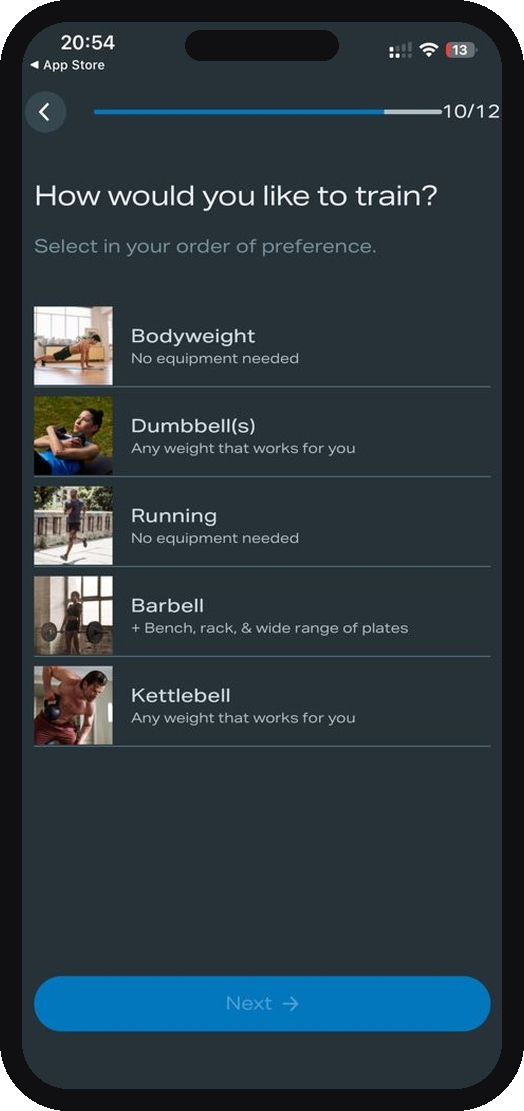
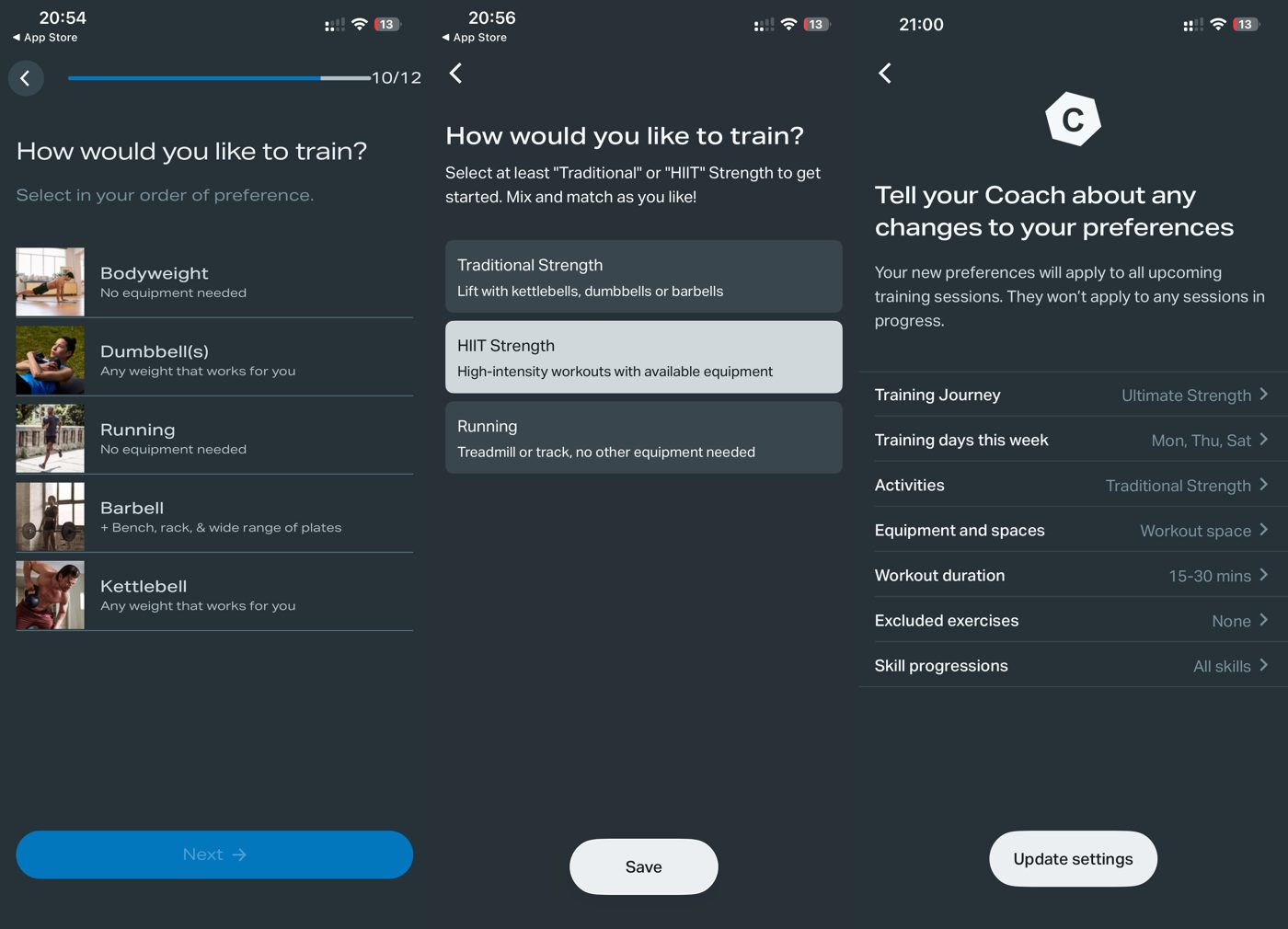
For this audience it is worth being precise about what Freeletics is, because its strengths and its heritage pull in different directions. The AI programming is genuinely strong, and the weights journeys mean it can build the muscle and, if you load heavily enough, support the bone that matter in midlife. But the brand grew up around high intensity, and that heritage still shows: burpees, jump squats and plyometrics feature heavily, and there is no dedicated low-impact or joint-friendly mode. The onboarding does give you real control over the setup, letting you choose Traditional Strength over HIIT, rank your equipment from bodyweight to dumbbells, barbell and kettlebell, set your workout duration and days, and exclude specific exercises you want to avoid, and those preferences apply to upcoming sessions. What you cannot do is reshuffle a session once it has been generated, and reviewers still find the default demanding for a beginner. There is no menopause or perimenopause programming, no pelvic-floor work and no hormone awareness anywhere in the app. Read it as a capable, efficient general training app that suits someone who already trains and wants intensity, rather than a low-impact or menopause-specific tool.
Who Is Behind Freeletics? Credibility
Freeletics is built by Freeletics GmbH, a Munich company founded in 2013, and its Coach is refined against behavioural data from tens of millions of users, which the company describes as being equipped with the latest research. That scale and data-driven iteration are a real asset for general fitness programming, and the app is polished and well maintained. The limit for a menopause audience is that the expertise is institutional and anonymous rather than named and verifiable: there are no named sports scientists, physiologists, physiotherapists or clinicians publicly attached to the program, and there is no menopause specialist, women’s-health clinician or advisory board. Read Freeletics as a credible mass-market performance product, rather than a source of menopause or medical guidance, and note that its framing is performance-focused rather than the weight-neutral, midlife-affirming tone some women prefer.
Content and Features
At a glance: a strong, adaptive AI training engine with real strength potential, efficient sessions and a mindset coach. For our audience the trade-offs are the high-impact default, the lack of any menopause or low-impact track, and the billing model.
| Format | An AI Coach that generates personalised workouts on demand and adapts to your feedback; no live classes. |
| Disciplines | Bodyweight HIIT and calisthenics, weights and gym, running and cardio, mobility and recovery, plus Mindset audio. |
| Menopause / perimenopause | None. No menopause programming, education or hormone content. |
| Prenatal and postnatal | None found. |
| Pelvic floor | None found. |
| Recovery and mind | Some. Mobility and recovery sessions plus a Mindset audio coach for stress, sleep and habits, though the default training is intense. |
| Nutrition | Available, but in a separate Freeletics Nutrition app through the pricier training and nutrition bundle, not integrated. |
| Strength | Genuine weights, dumbbell and barbell journeys with AI load progression, alongside the bodyweight work. |
| Impact | High by default: burpees, jump squats and plyometrics. It can be nudged lower, but there is no dedicated low-impact mode. |
| Structure | An AI Coach plus 30 training journeys with progression, one of the platform’s real strengths. |
| Control and coaching | Preferences let you set your training style, equipment, days, duration and excluded exercises, plus how-to videos; you cannot reshuffle a session in progress, and there is no live coaching. |
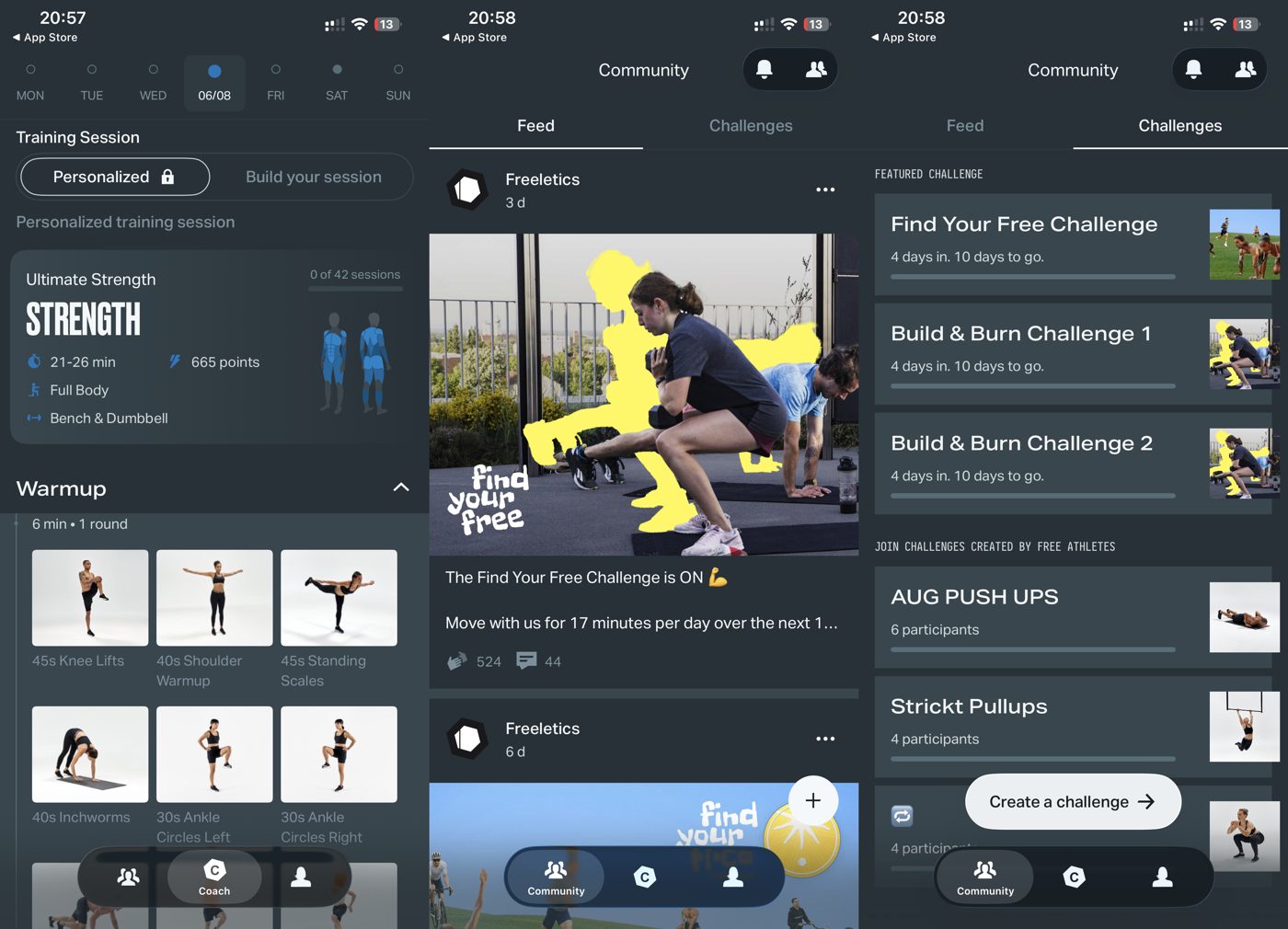
| Community | Yes. A community feed and time-limited challenges, though no live or in-person element. |
What Equipment Do You Need for Freeletics?
Not much to start. The bodyweight journeys need nothing but a mat and space, which is part of the appeal, though that same bodyweight-and-jumping style is what makes the default high-impact. The part that matters most for a midlife body is the weights work, and for that you want dumbbells, ideally an adjustable pair so you can keep adding load as you get stronger, which is what actually protects muscle and bone. If you train in a gym, the weights journeys will use barbells and machines too.
Recommended spec examples. These picks are curated by specification and feature fit, not personally lab-tested for long-term durability. Prices are examples; verify before buying.
Adjustable dumbbells
~$73
For the weights journeys. The signature workouts are bodyweight, but the Traditional and Ultimate Strength journeys need dumbbells; adjustable saves space.
Exercise mat
~$20 to $40
Recommended. For the bodyweight HIIT, calisthenics and mobility sessions.
Bottom line on equipment: you can start with just a mat, but a pair of adjustable dumbbells is what lets Freeletics build strength and support bone, and it is the more midlife-appropriate route than the high-impact bodyweight default.
How We Scored Freeletics: the 6.2 / 10 Breakdown
Research-based scores on our 9 weighted criteria. Because this is a Data Profile rather than a hands-on test, each score carries a confidence level. Women Over 40 is our most heavily weighted menopause criterion, and its full 12-capability breakdown follows in the next section.
| Category | Weight | Score | Reasoning (confidence) |
|---|---|---|---|
| Time Efficiency | 15% | 8 | Short, high-density sessions that adapt to the time you have. (confidence: high) |
| Muscle Potential | 18% | 7 | Real HIIT and weights journeys with AI load progression give genuine strength potential if you use them. (confidence: high) |
| Women Over 40 Specificity | 10% | 3.6 | High-impact default and no menopause content pull this down, despite the strength potential; full breakdown below. (confidence: medium) |
| Joint Friendliness | 12% | 4 | High-impact plyometrics by default and no dedicated low-impact mode; a real weakness for this audience. (confidence: high) |
| Recovery Compatibility | 10% | 6 | Mobility, recovery sessions and the Mindset coach help, but the default intensity and limited deload control offset it. (confidence: medium) |
| Programme Structure | 12% | 8 | The AI Coach and 30 training journeys with progression are a genuine strength. (confidence: high) |
| Value for Money | 8% | 6 | Capable, but multi-month lock-in, a thin free tier and auto-renewal complaints weigh on the value. (confidence: medium) |
| UX and Design | 8% | 6 | Polished and well rated, with useful preference controls; held back by no in-session reshuffle and recurring billing friction. (confidence: medium) |
| Nutrition Integration | 7% | 5 | A real nutrition coach, but in a separate app behind the pricier bundle, not integrated. (confidence: high) |
Is Freeletics Good for Women Over 40?
For some, yes, but with real caveats, and for many others it is the wrong tool. If you already train, enjoy intensity and want an efficient, well-structured plan, Freeletics delivers: the AI Coach is a genuinely strong programmer, the sessions are time-efficient, and the weights journeys can build the strength that protects a midlife body. Its Mindset audio coach adds a useful layer for stress, sleep and habits. For a fit, experienced woman who wants a hard, adaptive plan and is happy to steer it toward weights, it can work well.
Who it suits, and what is missing. The gaps matter a lot for this site. First, impact. Freeletics leans high-intensity, built around burpees, jump squats and plyometrics, and there is no dedicated low-impact or joint-friendly mode. The setup does help: you can choose Traditional Strength over HIIT, rank your equipment and exclude specific exercises in the preferences, which lets you steer away from the most jarring movements for upcoming sessions, though we could not test how low-impact those sessions actually feel, and you cannot reshuffle a session once it is generated. Second, the on-ramp is steep: the default training is demanding, and a deconditioned or returning body may find it too much. Third, menopause. There is no perimenopause or menopause programming, no pelvic-floor work and no hormone content, so it is a general performance app, not a menopause solution. It suits an already-active woman who wants intensity and structure; it is a weak choice for someone whose priority is low-impact training, a gentle start or menopause-specific support.
What the wider picture shows. Reviewers rate the workouts and the Coach highly, but the recurring frustrations map straight onto our concerns: the training is intense and hard to scale down granularly, one real review describes an old injury aggravated by a movement that could not be swapped out, and there is a steady drumbeat of complaints about auto-renewal and refunds on the multi-month plans. Read Freeletics as an effective general training app that a fit, experienced woman over 40 could use with the weights journeys and a low-jumping setting, while a woman who wants low-impact, joint-friendly or menopause-aware training will be better served elsewhere.
This is the perimenopause and menopause assessment, and it is separate from the overall score. Twelve things a programme either does for a midlife body or does not, each scored out of 10 with my reasoning next to it. Together they produce a single menopause fit score, and that becomes one of the nine categories in the overall scoring below.
How Freeletics Fits Perimenopause, Menopause & Beyond
Women Over 40 is our most important criterion, and here's the full breakdown behind it.
Freeletics is strongest for progressive strength, bone loading and recovery & deload, and weakest for menopause programming, pelvic floor, hormone awareness, menopause education, low-impact, expert credibility, beginner on-ramp and midlife nutrition, in our menopause and midlife capability assessment for women over 40.
At a glance
| Capability | Score | Rating | Why |
|---|---|---|---|
| Right training for a midlife body | |||
| Low-impact | 3/10 | Minimal | High-impact by design (burpees, jump squats, plyometrics), with no dedicated low-impact mode; the Coach can be nudged to avoid jumping, but it is a workaround. |
| Progressive strength | 7/10 | Strong | Genuine weights, dumbbell and barbell journeys with AI load progression, real progressive overload if the user chooses them. |
| Bone loading | 5/10 | Some | The weights journeys can load bone, but only if selected and progressed; the signature bodyweight HIIT under-loads it. |
| Recovery & deload | 5/10 | Some | Mobility and recovery sessions plus a Mindset coach help, but recovery is generic and the default intensity is high. |
| Built for menopause | |||
| Menopause programming | 1/10 | None | No perimenopause or menopause programming, cycle awareness or symptom-phase adaptation. |
| Pelvic floor | 1/10 | None | No pelvic-floor, prenatal or postnatal content. |
| Hormone awareness | 1/10 | None | No hormone or cycle awareness anywhere in the product. |
| Menopause education | 2/10 | None | The Mindset audio touches stress and sleep generically, with no menopause-specific education. |
| Expert credibility | 4/10 | Minimal | A data-driven in-house team across tens of millions of users, but no named sports scientists, clinicians or menopause advisory board. |
| Whole-woman support | |||
| Mind-body support | 5/10 | Some | A real Mindset audio coach for habits, stress, sleep and recovery, though not menopause-specific. |
| Beginner on-ramp | 4/10 | Minimal | Demanding default training and limited control to scale single exercises, despite a free tier and adaptivity. |
| Midlife nutrition | 4/10 | Minimal | A capable nutrition coach, but in a separate app behind the pricier bundle, and not midlife-specific. |
ScaleBest-in-classStrongSomeMinimalNone
What the sources say: Research-based (no hands-on testing; browsed onboarding and preferences), derived from the official pages, the app store listings and user reviews.
These are evidence-informed suitability ratings, not clinical measurements. They combine exercise science with product-specific research and, where indicated, hands-on testing, alongside multi-source verification, and are approximate. Individual response varies. A starting point, not medical advice. How we score menopause fit
What the sources say: scores combine the official pages, the app store and user reviews. Progressive strength and structure scored well because the weights journeys and AI programming are real strengths. The built-for-menopause group scored low because there is no menopause programming, education, hormone or pelvic-floor content, and low-impact scored low because the platform is high-impact by design. The strength and bone benefit is genuine but conditional on choosing the weights journeys and progressing the load.
These are evidence-informed suitability ratings, not clinical measurements. They combine exercise science with published-feature analysis and multi-source verification, and are approximate. Individual response varies. A starting point, not medical advice. How we score menopause fit.
What the Research Says: Freeletics’ Approach Checked
Freeletics can deliver real benefits, with two conditions that matter for a midlife body: how you scale the intensity, and whether you actually load the weights. Its HIIT has a robust upside, since high-intensity interval training significantly improves cardiorespiratory fitness in midlife and older women.[1] Exercise across modalities also counters the body-composition shift of midlife, increasing muscle and reducing fat, waist circumference and visceral fat, with resistance work best for muscle.[2] And resistance training can even ease menopausal symptoms, with one trial finding it cut moderate to severe hot flushes by around 44 percent.[3] This is where Freeletics’ weights journeys are a genuine asset, provided you use them rather than staying with bodyweight HIIT.
The conditions are impact and load. For bone, the biggest gains come from progressive heavier loading: in the LIFTMOR trial, high-intensity resistance and impact training improved bone density in postmenopausal women, whereas light exercise did not, and reviews confirm bone responds to higher mechanical loads.[4][5] Freeletics’ bodyweight default does not supply that, so the bone benefit depends on the weights journeys and real progression. On impact, the evidence is reassuring but conditional: plyometric and impact training is safe and even beneficial for older adults when it is age-adapted and progressed gradually from lower intensities, rather than done at unmodified maximal effort.[6] That is the opposite of Freeletics’ hard-charging default, which is why a deconditioned or joint-sensitive woman needs to scale it down deliberately. Adherence is the other caution: while many people tolerate HIIT, drop-out is higher when the time commitment is greater and the training is unsupervised, which is the app-delivered setting here.[7] Used sensibly, with the weights journeys and a gradual build, Freeletics can help; used at its intense default from a standing start, it is easy to overdo.
What Users Report: Verified Sentiment
Rating snapshot: people rate the workouts highly and the billing much lower, and that split is the story. On the Apple App Store Freeletics holds about 4.6 stars from roughly 22,000 ratings, and on Google Play, the larger sample, it sits around 4.1 to 4.2 from about 250,000 reviews on more than 10 million installs. On Trustpilot, which tends to collect billing and company complaints, it averages around 3.5 from roughly 3,000 reviews. The gap of about a full star between the app stores and Trustpilot is driven almost entirely by auto-renewal, refund and cancellation disputes on the multi-month plans, not by the training, so we present them separately rather than blended.
Consistently praised
- Effective, challenging workouts that get results.
- The AI Coach and its personalisation and adaptivity.
- Adapts to the time and equipment you have.
- Clear structure and progression through the training journeys.
Consistently criticised
- Auto-renewal, refund and hard-to-cancel complaints on multi-month plans.
- Too intense or high-impact for beginners and returning bodies.
- You cannot reshuffle a session once it is generated, though preferences let you exclude exercises beforehand.
- Repetitive burpees, and losing progress if you stop mid-workout.
Source and credibility note: figures were read from the Apple App Store and Google Play live, with the Trustpilot score search-aggregated because the page did not render directly (August 2026). The Google Play 4.1 to 4.2 on a large base is the truest typical-user number; the Apple 4.6 skews positive; the Trustpilot 3.5 is the billing-trust signal specifically. No menopause or women-40-plus breakdown exists in the review corpus, so that lens is inferred, though real reviews about injury aggravation and inability to modify exercises support the joint-and-intensity concern.
Devices, Platforms and App
Freeletics runs on iOS and Android, with an Apple Watch app to control workouts and syncing to Apple Health. It is a modern, well-maintained app with frequent updates, high-definition how-to videos and a polished interface, and it is an Apple Editors’ Choice. The practical catch for our audience is not the hardware but the training model: the Coach generates each session on demand, and reviewers note you cannot easily modify a single exercise without regenerating the whole workout, and that stopping mid-session can lose your progress. For a woman over 40 managing joints or easing back in, that lack of granular control is worth testing within the 14-day money-back window before you commit to a multi-month plan.
Freeletics specifications
- Free trial
- No free trial; 14-day money-back guarantee. A substantial free tier exists with 34 bodyweight workouts
- Cancellation
- auto-renew (3/6/12-mo terms); cancel via account, ~24h before renewal
- Session length
- ~15 to 50 min (AI-set to your time)
- Who makes it
- Freeletics GmbH (Munich); AI-driven Coach, sports-science input; no named clinician
- Still maintained
- Active; app v26.31.0 (rel 2026-08-10), id 654810212
- What is included
- On-demand classes: yesLive classes: noRecovery content: partlyMenopause education: noStructured programmes: yesMeditation: partlyNutrition guidance: partly
- Women over 40
- Pelvic floor work: noMenopause clinician involved: noInjury modifications: partlyBone-health focus: partlyModified progressions: yesCycle syncing: noPrenatal options: no
- Devices and access
- Offline downloads: partlyCasting to TV: partlySubtitles: noWearable sync: yes
- Support
- Clinical advisory board: noCommunity: partlySupplement upsell: no
- Last verified
- 12 August 2026
Freeletics Price 2026: What You Actually Pay
| Plan | Cost | Includes |
|---|---|---|
| Free tier | $0 | About 34 bodyweight workouts and the exercise library; the AI Coach itself is not included. |
| Training Coach | About $34.99 to $79.99 per bundle | The AI Coach and all training journeys, sold as 3, 6 or 12-month bundles that auto-renew. |
| Training and Nutrition Bundle | About $49.99 to $89.99 per bundle | Adds the separate Freeletics Nutrition app and its nutrition coach. |
| Money-back guarantee | 14 days | A refund guarantee rather than a free trial; the AI Coach is behind the subscription. |
Cancellation and Billing
This is the part to plan around. Freeletics is sold as multi-month bundles that auto-renew, and it runs frequent, aggressive discounts, so the onboarding price is often well below the renewal price, and two people can pay very different amounts. There is a 14-day money-back guarantee rather than a free trial. Reviewers report a recurring pattern of auto-renewal with no reminder, a cancellation option that is hard to find, and refused refunds, and its Trustpilot profile is weighted toward these billing complaints. Practical steps: subscribe through the App Store or Google Play so cancellation sits in your own account settings, cancel at least a day before the period ends, set a calendar reminder for the renewal date, and keep a confirmation. Prices were checked in August 2026; confirm the current figure at checkout.
Will You Actually Stick With It?
The default training is demanding and high-impact, which can overwhelm a beginner or returning body.
High-impact moves feature by default; you can exclude them and pick a strength focus in the preferences, but the style still skews intense.
The AI Coach and weights journeys progress you, so results keep coming if you stay consistent.
Multi-month auto-renewals and refund complaints mean you need to manage the subscription carefully.
Freeletics Pros and Cons
Pros
- A genuinely strong AI Coach with real personalisation and progression
- Efficient, time-flexible sessions from 15 to 45 minutes
- Real strength potential through the weights and gym journeys
- Broad content: bodyweight, weights, running and a Mindset audio coach
- Polished, well-rated app with how-to videos and an Apple Watch app
- A limited free tier to try the style
Cons
- High-impact by default, with no dedicated low-impact or joint-friendly mode
- No menopause programming, pelvic-floor work or hormone content
- Demanding default intensity, and no way to reshuffle a session once generated
- Auto-renewal, refund and cancellation complaints on multi-month plans
- Nutrition is a separate app behind a pricier bundle
- No free trial, only a 14-day money-back guarantee
- No named experts, clinician or menopause advisory board
How Freeletics Compares to Similar Platforms
If you are deciding between structured, app-based training platforms, this is how Freeletics sits against the alternatives. Scores come from our independent reviews and update automatically as each is scored; Pvolve is included as the menopause-built contrast.
| Feature | Freeletics | Sweat | Peloton | FitOn | Pvolve |
|---|---|---|---|---|---|
| Our score | 6.2 / 10 (research) | 7.3 / 10 | 7.3 / 10 | 7.3 / 10 | 8.3 / 10 |
| Monthly price | Subscription bundles ~$34.99 to $79.99 | ~$24.99/mo (verify) | ~$12.99 to $44/mo (verify) | Free tier · ~$29.99/yr Pro (verify) | $24.99/mo · equipment from $199 |
| Free option | Limited free tier; 14-day money-back | 7-day trial | App tiers | Generous free tier | 14-day trial (card required) |
| Best for | Already-active women wanting intense, efficient AI training | Structured women’s strength and Pilates | Studio-style cycling and classes | Free, varied at-home workouts | Low-impact functional strength, menopause, joints |
| Impact level | High by default | Moderate | Moderate to high | Low to moderate | Low by design |
| Progressive strength | Yes, via the weights journeys | Yes, programme-guided | Yes | Some, light weights | Yes, functional |
| Programme structure | AI Coach and 30 journeys | Structured programs | Structured classes and plans | Some programs | Guided programs |
| Perimenopause content | None | Minimal | Some women’s-health content | Minimal | Best in class: Menopause Strong, pelvic floor |
| Beginner on-ramp | Demanding | Approachable | Approachable | Very approachable | Gentle by design |
| Best suited to | Fit, experienced women who want intensity and structure | Women wanting structured strength | Cycling and studio-class fans | Women wanting free, varied home workouts | Women ~35+, perimenopause, joint issues |
Competitor prices are approximate; verify on each platform’s website. Scores reflect our independent reviews. See each full review for methodology.
Freeletics vs Sweat: Which Is Better for Women Over 40?
This is a useful pairing because both are structured, app-based strength and conditioning platforms, but they are built for different people. Sweat is designed by and for women, with guided programs that progress you through strength and Pilates in a more approachable, less punishing way, and a community built around the same goals. It suits a woman who wants structured strength with a gentler on-ramp and a women-centred feel.
Freeletics is the more intense, more performance-driven option: its AI Coach is a genuinely strong programmer and its weights journeys can build real strength, but its default is high-impact bodyweight HIIT that is harder to scale down, and it has no women-specific or menopause-specific framing. It is the better pick if you already train hard and want an efficient, adaptive plan; Sweat is the better pick if you want structured strength that meets a midlife body where it is. Neither is a fully menopause-specialised system. For intense, adaptive training, Freeletics; for approachable structured strength for women, Sweat; and for genuine low-impact menopause programming and pelvic-floor work, a purpose-built option such as Pvolve goes further than either.
If Freeletics Is Not Right for You: Best Alternatives
Freeletics has strong AI coaching and real weights journeys, but it is high-impact by default and not menopause-built. If that is your sticking point, here is where our other reviews point:
- Best for menopause-specific design: Pvolve stays low impact and joint friendly with clinically informed menopause programming.
- Best structured strength for women: EvolveYou gives progressive lifting with clear muscle targeting, minus the jumping.
- Best free, filterable low-impact library: FitOn lets you pick low-impact strength and mobility from a big free library.
Freeletics FAQ
Freeletics is an AI-coaching fitness app from Munich, running since 2013. Its Coach builds a personalised plan from your goal, level, time and equipment and adapts to your feedback. It is known for tough bodyweight HIIT and also offers weights and gym journeys, running and cardio, mobility and recovery, and a Mindset audio coach. Nutrition sits in a separate Freeletics Nutrition app through a bundle.
Freeletics is subscription only, sold as 3, 6 and 12-month bundles that auto-renew, with the training plan roughly $34.99 to $79.99 a bundle and the training and nutrition bundle roughly $49.99 to $89.99, though it runs frequent discounts so the price you see varies. There is a limited free tier of about 34 bodyweight workouts and a 14-day money-back guarantee rather than a free trial. Confirm the current figure at checkout.
Only with caveats. If you already train and want intense, efficient AI coaching, its weights journeys can build real strength. But it is high-impact by default, with burpees, jumps and plyometrics and no dedicated low-impact mode, it is demanding for beginners, and it has no menopause programming, pelvic-floor work or hormone content. A woman who wants low-impact, joint-friendly or menopause-aware training will be better served by a purpose-built option.
It can be. The default leans intense and high-impact, and reviewers find it demanding for beginners. The onboarding does let you steer it, though: you can choose Traditional Strength over HIIT, rank your equipment and exclude specific exercises, and set your workout duration and days, all of which apply to upcoming sessions. There is still no dedicated low-impact mode and no way to reshuffle a session once it is generated, so a deconditioned or joint-sensitive body needs to set it up carefully and build gradually.
It can, if you use the weights journeys and progress the load. Freeletics offers dumbbell, barbell and gym journeys with AI load progression, and the evidence is clear that muscle and bone respond to heavier, progressive resistance. Its signature bodyweight HIIT does not provide that loading, so choose the weights journeys and add weight over time for the muscle and bone benefit, rather than relying on the bodyweight default.
For a fit, experienced woman who wants intense, efficient, well-structured AI coaching, Freeletics is a capable app, especially through its weights journeys. It is a weak choice if your priority is low-impact or joint-friendly training, a gentle start or menopause-specific support, and the multi-month billing and auto-renewal complaints are a real caveat to manage. This is a research-based Data Profile; a hands-on test is still to come.
Final Verdict
Research Score: 6.2 / 10 · Hands-on Score: pending
Freeletics is a capable, well-built general training app that happens to be the wrong specialisation for much of our audience. Its AI Coach is a genuinely strong programmer, its sessions are efficient, and its weights journeys can build real strength and, with enough load, support bone. But it leans high-intensity, with no dedicated low-impact mode and no way to reshuffle a session once generated (though the preferences do let you pick a strength focus and exclude exercises), its on-ramp is demanding for a beginner, it has no menopause programming, pelvic-floor work or hormone content, and it carries a steady stream of auto-renewal and billing complaints. That is why the score lands in the middle: a strong product, but a poor menopause fit.
Freeletics is for already-active women who want intense, efficient, adaptive training and are happy to steer it toward weights and a lower-impact setting. Freeletics is not for women whose priority is low-impact or joint-friendly training, a gentle start, or menopause-specific support, who would be better served by an approachable structured-strength app such as Sweat and, for menopause, a purpose-built option such as Pvolve.
Testing Status
Research profile complete (official site, App Store, Google Play and Trustpilot, user reviews, peer-reviewed exercise and menopause science). Hands-on testing: pending. When we test it, first-person notes, real screenshots, adherence and a Hands-on Score are added to this same page, moving it to Sample-tested then Fully tested. How we score and profile.
Sources and Further Reading
- Cai, L. et al. (2026). Effects of high-intensity interval training on cardiopulmonary fitness and physical function in middle-aged and elderly women: a systematic review and meta-analysis. Frontiers in Physiology. Available at: pmc.ncbi.nlm.nih.gov. HIIT significantly improved VO2max in middle-aged and older women.
- Khalafi, M. et al. (2023). The effects of exercise training on body composition in postmenopausal women: a systematic review and meta-analysis. Frontiers in Endocrinology. Available at: pmc.ncbi.nlm.nih.gov. Exercise increased muscle and reduced fat mass, waist circumference and visceral fat, with resistance best for muscle.
- Berin, E. et al. (2019). Resistance training for hot flushes in postmenopausal women: a randomised controlled trial. Maturitas. Available at: maturitas.org. A 15-week resistance program cut moderate to severe hot flushes by about 44 percent.
- Watson, S.L. et al. (2018). High-intensity resistance and impact training improves bone mineral density and physical function in postmenopausal women: the LIFTMOR randomized controlled trial. Journal of Bone and Mineral Research. Available at: pubmed.ncbi.nlm.nih.gov. Heavier, high-intensity loading improved bone density; light exercise did not.
- Kumar, S. et al. (2025). Exercise for postmenopausal bone health: can we raise the bar? Current Osteoporosis Reports. Available at: pmc.ncbi.nlm.nih.gov. Bone-building needs high-magnitude loading; low-to-moderate exercise yields minimal change.
- Vetrovsky, T. et al. (2019). The efficacy and safety of lower-limb plyometric training in older adults: a systematic review. Sports Medicine. Available at: pubmed.ncbi.nlm.nih.gov. Impact training improved strength, bone and function without raising injuries when age-adapted and gradually progressed.
- Reljic, D. et al. (2019). Prevalence and predictors of dropout from high-intensity interval training in sedentary individuals: a meta-analysis. Scandinavian Journal of Medicine and Science in Sports. Available at: onlinelibrary.wiley.com. Drop-out was low overall (about 18 percent) and was predicted by a greater time commitment rather than by exercise intensity.
This is a research-based Data Profile, not a hands-on review. Pricing and features were verified August 2026 and may have changed. Some affiliate links may be present. This site does not accept payment from platforms reviewed. Education, not medical advice; speak to your clinician, especially about HRT or existing conditions.
Related Guides
What To Do Next
- → Take our 2-minute quiz for a personalised recommendation.
- → See our best workouts for perimenopause rankings.
- → Compare with our Sweat review and see how we score every programme.