
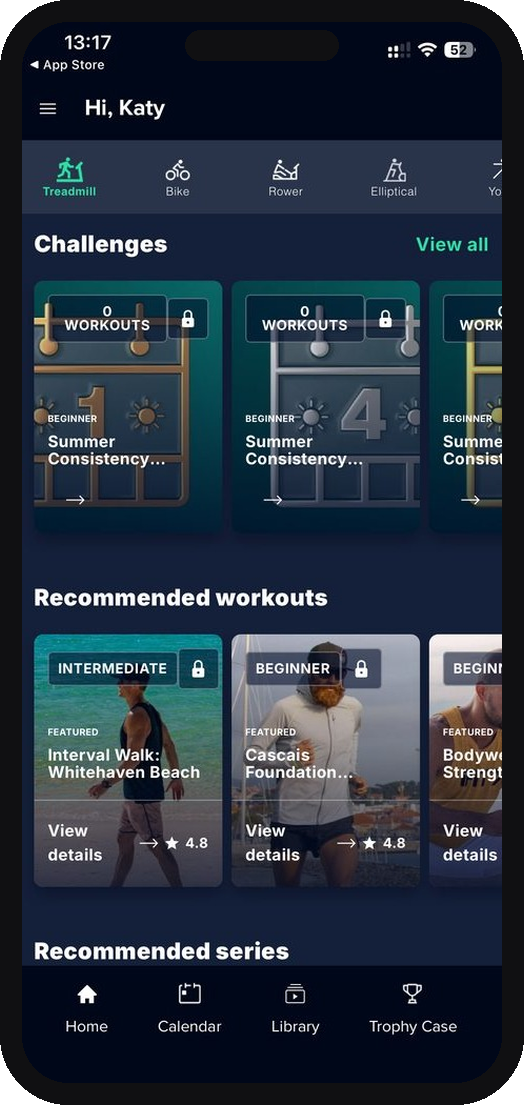
$15/month app-only (Train) or $39/month (Pro) · No usable free trial · A trainer-led, machine-connected fitness platform with 10,000+ scenic workouts across treadmill, bike, rower, elliptical, strength, yoga, Pilates and mind · From iFIT Health & Fitness, the company behind NordicTrack, ProForm and Freemotion · App-only or with a compatible machine.
Researched from: official site and pricing (verified August 2026) · Apple App Store, Google Play and Trustpilot · the free app catalogue (browsed, not tested; workouts are paywalled) · independent reviews · peer-reviewed exercise and menopause science · Not personally tested. Testing status: Data profile.
How this profile is different. We have not completed a paid iFit membership. This is a research-based Data Profile built from the official pages, the app catalogue, aggregated user reviews and the science, scored only where the evidence reliably supports it. iFit gates its full library behind a paid subscription with no meaningful free trial, so we browsed the app rather than testing workouts. Where a rating genuinely needs hands-on use, we say so. This is education, not medical advice; speak to your clinician, especially about HRT or existing conditions.
iFit Data Profile 2026: Quick Answer
Data profile: research-based, browsed the app catalogue, not personally tested (workouts are paywalled). Hands-on score pending.
Women who want engaging, scenic low-impact cardio (walks, hikes, rides) and variety across one polished app, especially NordicTrack or ProForm owners
You want menopause-specific programming, or your priority is progressive strength and bone loading rather than cardio
A trainer-led, machine-connected platform with 10,000+ workouts across treadmill, bike, rower, elliptical, strength, yoga, Pilates and mind
5 to 60+ min, huge range
App-only on a mat, or an iFIT-compatible machine for the auto-adjust experience
Low to moderate (walking and yoga to running and HIIT)
Not menopause-built: no menopause programming, pelvic-floor, hormone or education content anywhere
Yes, plus 10,000+ on-demand
iOS, Android, web, TV apps (Roku, Apple TV, Fire TV) and machine consoles; wearable HR
Train $15/month ($144/year); Pro $39/month ($396/year, up to 5 users)
No usable free trial; a card is required and it auto-renews
Auto-renews; cancellation friction is a common complaint (Trustpilot 1.9)
Neutral (silent on menopause medicine)
Active and updated (parent company had funding and layoff turbulence, but the app is current)
6.4 / 10
Quick Verdict
Worth it for women over 40? As an engaging low-impact cardio platform, yes; as a menopause tool, no.
iFit earns 6.4/10 on our research-based evaluation. It is one of the most polished and genuinely enjoyable platforms in this space: scenic Global Workouts filmed worldwide make treadmill and indoor time far less tedious, the trainer roster is strong, and the low-impact walks, hikes, yoga and Pilates suit a midlife body well. The key points for this site are three. It is not menopause-built: there is no menopause programming, pelvic-floor, hormone or education content anywhere. It is cardio-first, so bone and strength gains depend on you deliberately choosing the strength content rather than following scenic runs. And commercially it is awkward: there is no usable free trial, and billing and cancellation are the dominant user complaints. Start here: if you own a NordicTrack or ProForm machine it is the natural choice; app-only, weigh it against options with a real trial.
Is iFit right for you?
iFIT is strongest for painful joints (8.0 out of 10, against a 6.2 average across the 77 programmes scored) and weakest for perimenopause and menopause support (1.5 against 3.3).
| Question | Verdict | Rating | Score |
|---|---|---|---|
| How it suits a perimenopausal body | |||
| Is iFIT good for pelvic floor problems?Based on pelvic floor support and low-impact design | Moderate, about the same as mostmost score 4.6/10 | 5.0 / 10 | |
| Is iFIT genuinely built for perimenopause and menopause?Based on menopause programming, hormone awareness, education and expert credibility | Low, and worse than mostmost score 3.3/10 | 1.5 / 10 | |
| Is iFIT good for painful joints?Based on low-impact design and recovery provision | Strong, and better than mostmost score 6.2/10 | 8.0 / 10 | |
| Is iFIT manageable when your energy is low?Based on recovery provision and mind-body support | Strong, and better than mostmost score 5.7/10 | 7.5 / 10 | |
| Is iFIT good if you are new to strength training?Based on beginner on-ramp and mind-body support | Strong, and better than mostmost score 6.1/10 | 7.0 / 10 | |
| Is iFIT good for building bone density?Based on bone loading and progressive strength | Low, and worse than mostmost score 5.1/10 | 4.0 / 10 | |
| Does iFIT help with nutrition?Based on midlife nutrition support | Low, about the same as mostmost score 4.0/10 | 4.0 / 10 | |
| How it performs as a product | |||
| Can you fit iFIT into a busy week?Based on time efficiency | Strong, about the same as mostmost score 7.6/10 | 7.5 / 10 | |
| Is iFIT worth the money?Based on value for money | Moderate, and worse than mostmost score 6.9/10 | 5.5 / 10 | |
Jump to Section
What iFit Actually Is
iFit is a trainer-led, machine-connected fitness platform from iFIT Health & Fitness (formerly ICON Health & Fitness), the company that owns NordicTrack, ProForm and Freemotion. It offers more than 10,000 on-demand workouts plus live classes across treadmill, walking and hiking, running, cycling, rowing, elliptical, strength, yoga, Pilates, HIIT, barre and meditation, led by a roster of over 180 trainers. Its signature is Global Workouts: sessions filmed in real locations worldwide, from Yosemite hikes to beach interval walks, with the trainer guiding you through the terrain. On an iFIT-compatible machine, SmartAdjust automatically changes your speed, incline or resistance to match what is on screen, so the scenery and the effort move together.
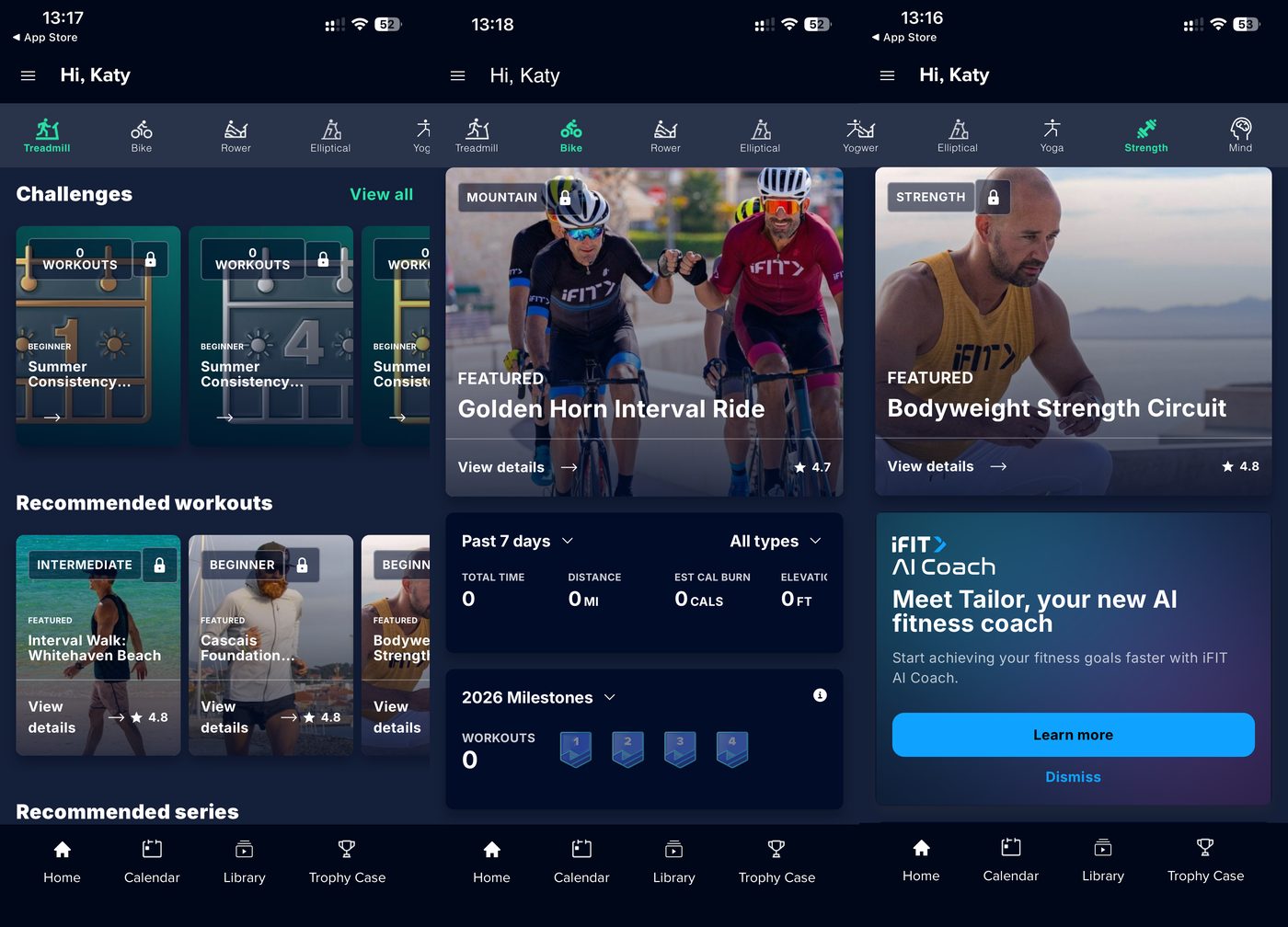
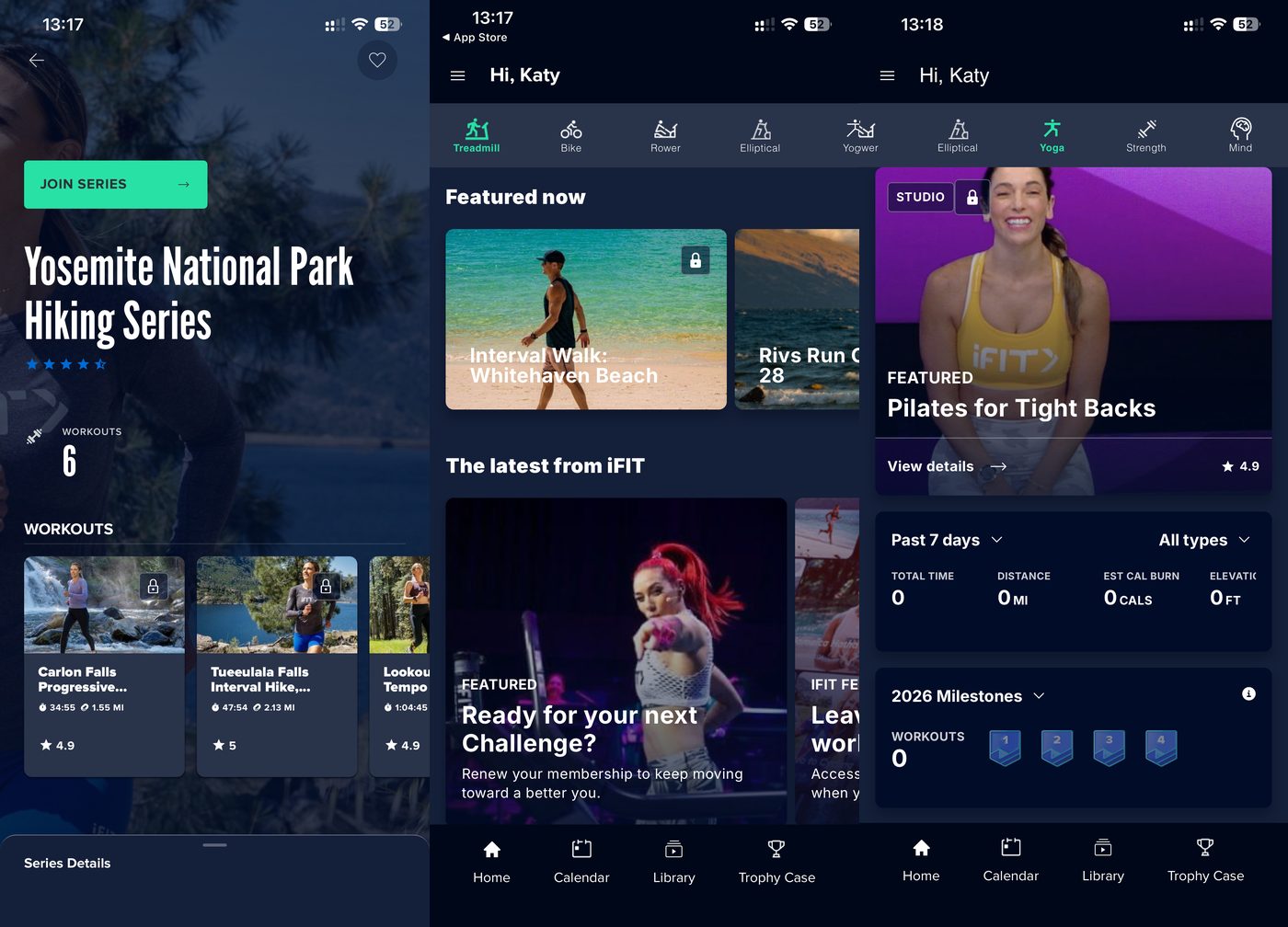
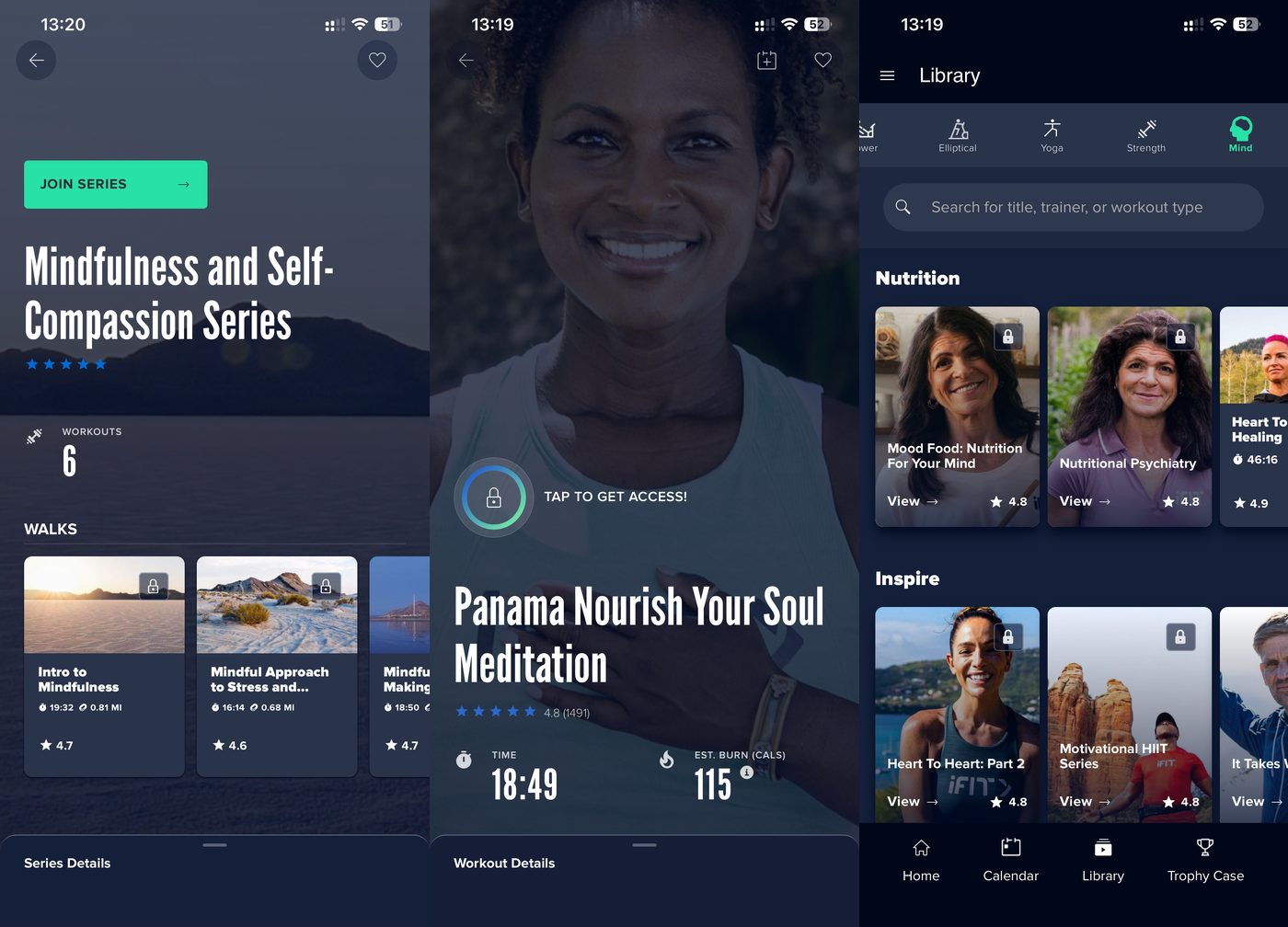
One thing to understand before you subscribe: iFit is really two products. App-only (the Train plan) lets you follow the video workouts on a phone, tablet or TV, on a mat or on any equipment you already own, but with no automatic control. The full experience, where the machine drives itself to match the trainer, only works on iFIT-family hardware. A handful of other brands (Reebok, Weider and Matrix) also build iFIT-connected machines, but it does not integrate with Peloton, Bowflex or Echelon, which run their own apps.
Who Is Behind iFit? Credibility
iFit is made by iFIT Health & Fitness, a large connected-fitness company whose hardware brands (NordicTrack, ProForm, Freemotion) are widely sold. Its trainers include elite athletes, world champions and experienced coaches, and the production values are high. What it does not have is a clinical layer: there is no medical or menopause advisory board, no pelvic-floor physiotherapist or dietitian shaping the programming. That matters for how you read the health framing on this site. iFit is a credible, well-resourced general fitness platform, not a source of menopause-specific or medical guidance. It is also worth knowing the company has been through financial turbulence in recent years (a sharp valuation cut, layoffs and a withdrawn public offering), though the product itself remains live and actively updated in 2026.
Content and Features
At a glance: a broad, polished, genuinely engaging general platform with best-in-class scenic cardio and strong mind-body content. But it is cardio-first, and there is no menopause programming, pelvic-floor or hormone content of any kind.
| Format | Trainer-led video, on-demand and live; auto-adjusting machine control (SmartAdjust) on iFIT hardware, or manual follow-along app-only. |
| Scenic Global Workouts | Yes, the standout feature. Walks, hikes, runs and rides filmed worldwide with trainer narration. |
| Disciplines | Treadmill, walking, hiking, running, cycling, rowing, elliptical, strength, yoga, Pilates, HIIT, barre, meditation. |
| Menopause / perimenopause | None found on any official page or in the app catalogue. |
| Pelvic floor / hormone content | None found. |
| Strength | Present, but cardio-first: follow-along strength and bodyweight circuits rather than a progressive-overload lifting programme. |
| Recovery and mind | Strong. Stretching, mobility, recovery, meditation and mindfulness content. |
| Nutrition | Partial. Nutrition and mood-food content plus supplement perks, but no structured meal plans or macro tracking. |
| AI Coach | iFIT AI Coach (Tailor) sets and tracks goals through in-app messaging. |
| Community | Challenges, leaderboards and studio perks; no strong dedicated in-app community forum. |
What Equipment Do You Need for iFit?
It depends which version you use. App-only, you can follow many classes with nothing but a mat, and the strength, yoga and Pilates sessions use light dumbbells you may already own. A Bluetooth heart-rate monitor unlocks ActivePulse, which keeps you in a target zone. The catch is that iFit is designed around cardio machines, and the automatic incline and resistance control only works on an iFIT-compatible treadmill, bike, rower or elliptical, which is a much larger investment.
Recommended spec examples. These picks are curated by specification and feature fit, not personally lab-tested for long-term durability. Prices are examples; verify before buying.
Exercise mat
iFit works on any machine or none; a mat covers the floor strength, yoga and Pilates follow-alongs.~$20 to $40
Adjustable dumbbells
Adds real load to the strength and bodyweight circuits, which are otherwise cardio-first.~$73
Heart-rate tracker
iFit is heart-rate led (ActivePulse); a tracker or chest strap lets you follow the zones without an iFit machine.from ~$93
Bottom line on equipment: app-only, a mat and light dumbbells cover most floor classes; the full auto-adjusting experience needs an iFIT-compatible machine, which is the real cost of entry.
How We Scored iFit: the 6.4 / 10 Breakdown
Research-based scores on our 9 weighted criteria. Because this is a Data Profile rather than a hands-on test, each score carries a confidence level, and aspects that genuinely need long-term use are scored cautiously and flagged. Women Over 40 is our most heavily weighted menopause criterion, and its full 12-capability breakdown follows in the next section.
| Category | Weight | Score | Reasoning (confidence) |
|---|---|---|---|
| Time Efficiency | 15% | 7.5 | Huge range from 5 minute sessions to full-length runs; easy to find a short workout. (confidence: high) |
| Muscle Potential | 18% | 5 | Strength content exists but is cardio-first and follow-along, not progressive-overload lifting. (confidence: medium) |
| Women Over 40 Specificity | 10% | 4.2 | Good low-impact cardio and mind-body, but no menopause layer at all; full breakdown below. (confidence: high) |
| Joint Friendliness | 12% | 8 | Excellent low-impact range: scenic walks, elliptical, cycling, yoga and Pilates, no jumping required. (confidence: high) |
| Recovery Compatibility | 10% | 7.5 | Strong stretching, mobility, recovery and meditation content. (confidence: medium) |
| Programme Structure | 12% | 7.5 | Multi-week Series, challenges and an AI Coach give real structure across a big library. (confidence: high) |
| Value for Money | 8% | 5.5 | $15 app-only is fair for the library, but no free trial, billing friction and hardware lock-in temper it. (confidence: medium) |
| UX and Design | 8% | 7 | Highly polished and immersive; some Android reliability complaints, and we browsed rather than tested long-term. (confidence: medium) |
| Nutrition Integration | 7% | 5 | Nutrition and mood-food content plus supplement perks, but no structured meal plans or macros. (confidence: medium) |
| Total | 100% | 6.4 / 10 | Research Score; hands-on score pending. |
Is iFit Good for Women Over 40?
As a general fitness platform, iFit is a good fit for a woman over 40, and arguably one of the more enjoyable options. Its low-impact cardio is genuinely strong: scenic walks, hikes, cycling and elliptical sessions are joint-friendly, endlessly varied and easy to sustain, and walking-based cardio has real evidence behind it for midlife body composition and heart health. The yoga, Pilates, mobility and meditation content supports balance, flexibility and stress. If the barrier to exercise for you is boredom, iFit answers that better than almost anything else.
Who it suits, and what is missing. Where it falls short for this site is twofold. First, it is not menopause-specific in any way: there is no perimenopause or menopause programming, no menopause education, no pelvic-floor work, no hormone or symptom guidance, and no clinician involved. Second, it is cardio-first. Midlife guidance prioritises progressive strength and heavier loading to protect muscle and bone, and while iFit has strength content, it is follow-along rather than a structured lifting progression, so those specific gains depend on you deliberately programming the strength sessions rather than following the scenic runs that the app pushes hardest.
What the wider picture shows. iFit markets immersion, world-class trainers and variety, and the review record broadly agrees the content and coaching are excellent. It is a capable, motivating general platform that a woman over 40 can use very well for low-impact cardio and mind-body work, especially if she owns a compatible machine. It is simply not a menopause tool, and it works best paired with a dedicated strength habit and, if menopause support is the priority, with guidance from elsewhere.
This is the perimenopause and menopause assessment, and it is separate from the overall score. Twelve things a programme either does for a midlife body or does not, each scored out of 10 with my reasoning next to it. Together they produce a single menopause fit score, and that becomes one of the nine categories in the overall scoring below.
How iFIT Fits Perimenopause, Menopause & Beyond
Women Over 40 is our most important criterion, and here's the full breakdown behind it.
iFIT is strongest for low-impact and mind-body support, and weakest for menopause programming, pelvic floor, hormone awareness, menopause education, expert credibility, progressive strength, bone loading and midlife nutrition, in our menopause and midlife capability assessment for women over 40.
At a glance
| Capability | Score | Rating | Why |
|---|---|---|---|
| Right training for a midlife body | |||
| Low-impact | 9/10 | Best-in-class | Scenic walks, hikes, elliptical, cycling, yoga and Pilates; outstanding low-impact range, no jumping required. |
| Progressive strength | 4/10 | Minimal | Strength and bodyweight circuits exist but cardio-first and follow-along, not progressive-overload lifting. |
| Bone loading | 4/10 | Minimal | Running and hiking give some weight-bearing impact, but no bone-density-specific or heavy-loading protocol. |
| Recovery & deload | 7/10 | Strong | Strong stretching, mobility and recovery content plus a large low-intensity base. |
| Built for menopause | |||
| Menopause programming | 1/10 | None | No menopause or perimenopause programming anywhere in the catalogue. |
| Pelvic floor | 1/10 | None | No dedicated pelvic-floor content. |
| Hormone awareness | 1/10 | None | No cycle-syncing or hormone-phase programming. |
| Menopause education | 1/10 | None | Mind and nutrition library exists, but no menopause-specific education. |
| Expert credibility | 3/10 | Minimal | Elite trainers and athletes, general fitness only; no clinician, pelvic PT or menopause specialist. |
| Whole-woman support | |||
| Mind-body support | 8/10 | Strong | Yoga, Pilates, meditation, mindfulness and a dedicated Mind section. |
| Beginner on-ramp | 6/10 | Some | Beginner-to-advanced content, challenges and AI Coach, but the vast library can overwhelm and there is no 40+ on-ramp. |
| Midlife nutrition | 4/10 | Minimal | Nutrition and mood-food content plus supplement perks, but no structured or menopause-tailored nutrition. |
ScaleBest-in-classStrongSomeMinimalNone
What the sources say: Research-based (browsed the app catalogue; workouts paywalled, not tested), derived from the official pages, the app store and Trustpilot record, and independent reviews.
These are evidence-informed suitability ratings, not clinical measurements. They combine exercise science with product-specific research and, where indicated, hands-on testing, alongside multi-source verification, and are approximate. Individual response varies. A starting point, not medical advice. How we score menopause fit
What the sources say: scores combine the official pages, the app catalogue we browsed, the app store and Trustpilot record, and independent reviews. The “built for menopause” group scored at the floor because no primary source shows any menopause, pelvic-floor or hormone content, and iFit does not appear in menopause-fitness roundups, where the dedicated players are the likes of Pvolve. Low-impact and mind-body scored high because both are core, verifiable strengths.
These are evidence-informed suitability ratings, not clinical measurements. They combine exercise science with published-feature analysis and multi-source verification, and are approximate. Individual response varies. A starting point, not medical advice. How we score menopause fit.
What the Research Says: iFit’s Approach Checked
The training iFit centres on is well supported for midlife women. Walking-based aerobic exercise, its signature, produces modest but consistent improvements in body composition in peri and postmenopausal women.[1] Aerobic exercise more broadly improves cardiometabolic health and helps offset the rise in cardiovascular risk after menopause,[2] and large cohort data show women gain more cardiovascular and mortality benefit per minute of activity than men, reaching near-maximal benefit at a very achievable dose.[3] The yoga, Pilates and mobility content is worthwhile too, supporting the balance and lower-body strength that underpin fall resilience, though trial evidence on fall prevention specifically in older women is mixed.[4] And exercise reliably helps sleep and mood through the menopause transition, even where its effect on hot flushes is inconsistent.[5]
The caveat that matters most for our audience is this. The biggest gains for midlife muscle and bone come from progressive resistance training and heavier loading, not cardio.[6] Menopause guidance specifically recommends two or more strength sessions a week alongside aerobic work.[7] iFit can deliver this, but only if you actively choose and progress the strength content; passively following the scenic runs and walks the app promotes will build cardiovascular fitness without meaningfully loading bone or driving strength adaptation. Read iFit as excellent cardio and mind-body that needs a deliberate strength habit bolted on.
What Users Report: Verified Sentiment
Rating snapshot: the picture is genuinely split. On the Apple App Store iFit holds about 4.7 stars from roughly 70,000 ratings, a large and robust base, but on Google Play the current app sits at about 3.3 from around 12,000 to 16,000 ratings, and on Trustpilot it is rated “Poor” at about 1.9 from roughly 1,568 reviews. That gap is the story: the content is loved, the commercial and technical operation is where trust breaks.
Consistently praised
- Scenic Global Workouts, the single most-praised feature, make indoor cardio far less tedious.
- Trainer quality and warmth, with many named coaches singled out.
- Huge variety across cardio, strength, yoga, Pilates and mind in one app.
- Low-impact and beginner-friendly options, with older users reporting real progress.
Consistently criticised
- Billing and cancellation: trials that auto-convert, difficulty cancelling, auto-renewal and refused refunds.
- Customer service: long hold times and unanswered emails, especially over charges.
- App and equipment reliability: crashes, search and favourites breaking, and connection failures (drags the Android score).
- Ecosystem lock-in and the 2025 Train and Pro repricing.
Source and credibility note: figures were read from the Apple App Store and Google Play (dated August 2026) and Trustpilot, with complaint boards such as PissedConsumer and SmartCustomer corroborating the billing theme. App-store averages skew positive and are lifetime-cumulative, hiding recent dips, while Trustpilot and complaint boards skew negative because they are grievance venues, so the real experience sits between them. A stale legacy Google Play listing at 1.7 stars still exists and can mislead; the current listing is the one cited here. The content is widely loved; the recurring, well-documented risk is the subscription and support experience, not the workouts.
Devices, Platforms and App
iFit runs on iOS and Android, on the web, on TV apps for Roku, Apple TV and Fire TV, and on the built-in consoles of NordicTrack, ProForm and Freemotion machines. It supports heart-rate training through ActivePulse and syncs with Strava, Garmin and Apple Health. A big-screen TV app is the natural way to follow floor workouts. We did not find clear documentation of offline downloads or subtitles, so if either matters to you, check before subscribing. The main platform point to understand is the ecosystem: the automatic incline and resistance control that makes iFit special only works on iFIT-family hardware, so app-only members get the videos but not the auto-adjust experience.
iFit specifications
- Free trial
- Free trial (~30-day, often bundled with equipment), confirm current app-only trial on ifit.com
- Cancellation
- cancel anytime at ifit.com/cancel; non-refundable, active to cycle end
- Session length
- ~10 to 60 min
- Who makes it
- ICON Health & Fitness / iFIT (parent of NordicTrack/ProForm); trainer-led, no named clinician
- Still maintained
- Active; iFIT Workouts app v3.9.0 (rel 2026-08-06), id 1274601042
- What is included
- On-demand classes: yesLive classes: partlyRecovery content: yesMenopause education: noStructured programmes: yesMeditation: partlyNutrition guidance: partly
- Women over 40
- Pelvic floor work: noMenopause clinician involved: noInjury modifications: partlyBone-health focus: noModified progressions: partlyCycle syncing: noPrenatal options: partly
- Devices and access
- Offline downloads: partlyCasting to TV: yesSubtitles: partlyWearable sync: yes
- Support
- Clinical advisory board: noCommunity: partlySupplement upsell: no
- Last verified
- 12 August 2026
iFit Price 2026: What You Actually Pay
| Plan | Cost | Includes |
|---|---|---|
| Free tier | None | No permanent free tier and no usable free trial; a card is required and it auto-renews. |
| iFIT Train | $15/month or $144/year (US) | 1 user; app-only on phone, tablet, TV and Bluetooth iFIT-ready equipment without a built-in screen. |
| iFIT Pro | $39/month or $396/year (US) | Up to 5 users; required for machines with built-in touchscreens; adds Workout Creator and streaming. |
Cancellation and Billing
iFit requires card details up front and auto-renews unless you cancel in advance. Recurring-billing and difficulty-cancelling complaints are the most common grievance across Trustpilot and consumer boards, so cancel through your account settings well before renewal and keep a record. UK pricing is sold through iFIT and retailers (iFIT Pro is around £349/year); confirm the current figure at checkout, since regional pricing varies.
Will You Actually Stick With It?
Scenic Global Workouts and 10,000+ sessions are the app’s whole point; boredom is the problem it solves best.
The library is enormous; challenges and the AI Coach help, but it can be a lot to navigate.
The full experience effectively needs an iFIT machine, and there is no trial to test the fit first.
Recurring app and connection complaints, especially on Android, can interrupt a routine. Needs hands-on to confirm.
iFit Pros and Cons
Pros
- Best-in-class scenic, immersive low-impact cardio that beats boredom
- Huge variety across cardio, strength, yoga, Pilates and mind in one app
- Strong, well-produced trainer roster
- Excellent joint-friendly options: walks, hikes, elliptical, cycling, yoga
- Genuine mind-body content: meditation, mindfulness, mobility and recovery
- Auto-adjusting SmartAdjust and ActivePulse on iFIT machines
- Live classes plus a very large on-demand library
- Works on phone, tablet, web, TV apps and machine consoles
Cons
- No menopause, perimenopause, pelvic-floor or hormone content at all
- Cardio-first, so bone and strength gains depend on you self-programming
- No usable free trial; a card is required and it auto-renews
- Billing and cancellation are the dominant user complaints (Trustpilot 1.9)
- Auto-adjust experience is locked to iFIT-family hardware
- Android reliability complaints; no clinician or menopause specialist
- No structured nutrition or meal planning
How iFit Compares to Similar Platforms
If you are deciding between machine-connected and immersive fitness platforms, this is how iFit sits against the alternatives women most often weigh it against. Scores come from our independent reviews and update automatically as each is scored; Pvolve is included as the menopause-built contrast.
| Feature | iFit | Peloton | Les Mills+ | Daily Burn | Pvolve |
|---|---|---|---|---|---|
| Our score | 6.4 / 10 (research) | 7.3 / 10 | 6.2 / 10 | 6.8 / 10 | 8.3 / 10 |
| Monthly price | $15 (Train) to $39 (Pro) | ~$12.99 to $44/mo (verify) | ~$14.99/mo (verify) | ~$19.99/mo (verify) | $24.99/mo · equipment from $199 |
| Free trial | None usable | Yes (app tiers) | 30 days | 30 days | 14 days (card required) |
| Best for | Scenic, immersive low-impact cardio and variety | Studio-style cycling and all-round classes | Structured group-fitness programmes | Quick daily varied workouts | Low-impact functional strength, menopause, joints |
| Equipment | App-only or iFIT machine | App-only or Peloton machine | Minimal or gym | Minimal | Bundle recommended; bands and dumbbells work |
| Low-impact range | Best in class (scenic walks, hikes, yoga) | Good | Good | Some | Excellent, by design |
| Perimenopause content | None | Some (women’s health content) | None | None | Best in class: Menopause Strong, pelvic floor |
| Coaching style | Verbal, immersive, auto-adjust on machines | Verbal, studio energy | Choreographed, verbal | Verbal, circuit-led | Verbal throughout, demos alongside |
| Nutrition | Partial content, no meal plans | Limited | None | Basic | Not in streaming |
| App Store rating | 4.7 iOS · 3.3 Android · 1.9 Trustpilot | 4.9 iOS | 4.8 iOS | 4.8 iOS | ~4.9 (Streaming app) |
| Best suited to | Women wanting engaging low-impact cardio, machine owners | Cycling and studio-class fans | Group-fitness devotees | Time-pressed variety seekers | Women ~35+, perimenopause, joint issues |
Competitor prices are approximate; verify on each platform’s website. Scores reflect our independent reviews. See each full review for methodology.
iFit vs Peloton: Which Is Better for Women Over 40?
These two are the obvious pairing: both are premium, machine-connected platforms with a strong app-only option, and both are more general fitness than menopause-specific. The difference is character. Peloton is studio energy: its strength is class-based cycling, running and all-round workouts with a charismatic instructor and a competitive, community feel, and its app tiers come with a genuine free trial. It suits a woman who is motivated by the buzz of a class and a leaderboard.
iFit is the opposite mood: calm, scenic and exploratory. Instead of a studio, you are walking a beach or hiking Yosemite while the machine adjusts to the terrain. For a woman over 40 who finds indoor cardio a grind and wants it to feel like an escape rather than a competition, iFit is the more engaging choice, and it leans more naturally low-impact. The trade-offs are its lack of a free trial and its billing reputation. For neither platform is menopause the point; if that is your priority, a purpose-built option such as Pvolve goes much further than either.
If iFit Is Not Right for You: Best Alternatives
iFit is best-in-class for scenic low-impact cardio, but it is cardio-first with no menopause programming. If that is your sticking point, here is where our other reviews point:
- Best for menopause-specific design: Pvolve adds clinically informed, low-impact strength and menopause programming.
- Best guided cardio plus strength variety: Peloton matches the polished cardio and adds strength and a menopause collection.
- Best budget streaming variety: Les Mills+ offers a broad class library, including strength, at a lower price.
iFit FAQ
iFit is a trainer-led fitness platform from iFIT Health & Fitness, the company behind NordicTrack, ProForm and Freemotion. It offers over 10,000 on-demand and live workouts across treadmill, walking, hiking, cycling, rowing, elliptical, strength, yoga, Pilates and meditation, filmed in scenic locations worldwide. On a compatible machine it auto-adjusts your incline and resistance to match the trainer.
In the US, iFIT Train is $15 per month or $144 per year for one user (app-only), and iFIT Pro is $39 per month or $396 per year for up to five users and machines with built-in screens. There is no usable free trial, a card is required, and it auto-renews. UK Pro pricing is around £349 per year; verify the current figure at checkout.
Not a usable one. iFit no longer offers a standalone free app trial; historically a 30-day membership came only with an equipment purchase. To sign up you must enter card details and the membership auto-renews, and the full library is locked behind the paywall. This is a genuine downside compared with rivals that let you try before you pay.
No, but it helps. App-only, you can follow the videos on a phone, tablet or TV, on a mat or on any equipment you own, with manual adjustment. The automatic incline and resistance control only works on iFIT-family machines (NordicTrack, ProForm, Freemotion, plus some Reebok, Weider and Matrix models). It does not integrate with Peloton, Bowflex or Echelon.
As a general platform, yes: its low-impact scenic cardio, yoga and Pilates suit a midlife body and beat boredom. But it is not menopause-built. There is no perimenopause or menopause programming, no pelvic-floor work, no hormone content and no menopause education, and it is cardio-first, so strength and bone gains depend on you choosing the strength sessions. It is a capable general platform rather than a menopause tool.
Cancellation and billing are iFit’s most common complaints, and its Trustpilot score is low at about 1.9 as a result. The membership auto-renews and a card is required up front. Cancel through your account settings well before your renewal date, keep a confirmation, and check your statement, since users report auto-renewal and refund difficulties.
For a woman who wants engaging, scenic low-impact cardio and variety, especially if she owns a NordicTrack or ProForm machine, iFit is one of the most enjoyable platforms available and reasonable value at $15 app-only. It is a weaker choice if your priority is progressive strength, or if you want menopause-specific programming, and the lack of a free trial and the billing reputation are real caveats. This is a research-based Data Profile; a hands-on test is still to come.
Final Verdict
Research Score: 6.4 / 10 · Hands-on Score: pending
iFit is one of the most polished and genuinely engaging general fitness platforms in this space. Its scenic Global Workouts make low-impact cardio something to look forward to, the trainers are excellent, and the yoga, Pilates and mind content give a woman over 40 a lot to work with, which earns it a solid research-based score. For this site’s audience the plain picture is that it is a general, cardio-first platform, not a menopause programme: there is no menopause, pelvic-floor or hormone content, strength is follow-along rather than progressive, and the lack of a free trial plus the billing reputation are real friction points.
iFit is for women who want enjoyable, varied low-impact cardio and mind-body work, especially NordicTrack or ProForm owners. iFit is not for women whose priority is progressive strength and bone loading, or menopause-specific programming, who would be better served by a dedicated strength habit and a purpose-built option such as Pvolve.
Testing Status
Research profile complete (official site, app catalogue browsed, App Store, Google Play and Trustpilot, independent reviews, peer-reviewed exercise and menopause science). Hands-on testing: pending. Because iFit has no usable free trial, we browsed the app rather than completing workouts. If we test a paid membership, first-person notes, real screenshots, adherence and a Hands-on Score are added to this same page, moving it to Sample-tested then Fully tested. How we score and profile.
Sources and Further Reading
- Ma, D., Wu, L., He, Z. (2016). Effects of walking on body composition in perimenopausal and postmenopausal women: a systematic review and meta-analysis. Menopause. Available at: pubmed.ncbi.nlm.nih.gov. Walking improved body weight, BMI and body fat in midlife women.
- Huynh, E. et al. (2024). The effects of aerobic exercise on cardiometabolic health in postmenopausal females: a systematic review and meta-analysis. Women’s Health. Available at: journals.sagepub.com. Aerobic exercise improves cardiometabolic markers and helps offset post-menopause cardiovascular risk.
- Ji, H. et al. (2024). Sex differences in the association of physical activity with all-cause and cardiovascular mortality. Journal of the American College of Cardiology. Available at: jacc.org. Women gained more mortality benefit per minute of activity than men.
- Systematic review of RCTs (2025). The effects of yoga on fall-related physical functions for older women. Healthcare (MDPI). Available at: pmc.ncbi.nlm.nih.gov. Review of RCTs; effects on balance, gait and lower-limb strength were inconsistent, with no definitive fall-prevention effect shown in older women.
- Randomised controlled trial (2025). Effects of exercise training on vasomotor symptoms and quality of life in postmenopausal women. BMC Women’s Health. Available at: link.springer.com. Combined aerobic and resistance training improved symptoms, sleep, mood and quality of life.
- Systematic review and meta-analysis (2025). Optimal resistance training parameters for improving bone mineral density in postmenopausal women. Journal of Orthopaedic Surgery and Research. Available at: link.springer.com. The strongest bone gains come from progressive and heavier resistance loading, not cardio.
- International Menopause Society (2025). IMS recommendations on women’s midlife health and menopause. Climacteric. Available at: tandfonline.com. Recommends aerobic activity plus two or more weekly resistance sessions for midlife women.
This is a research-based Data Profile, not a hands-on review. Pricing and features were verified August 2026 and may have changed. Some affiliate links may be present. This site does not accept payment from platforms reviewed. Education, not medical advice; speak to your clinician, especially about HRT or existing conditions.
Related Guides
What To Do Next
- → Take our 2-minute quiz for a personalised recommendation.
- → See our best workouts for perimenopause rankings.
- → Compare with our Peloton review and see how we score every programme.