
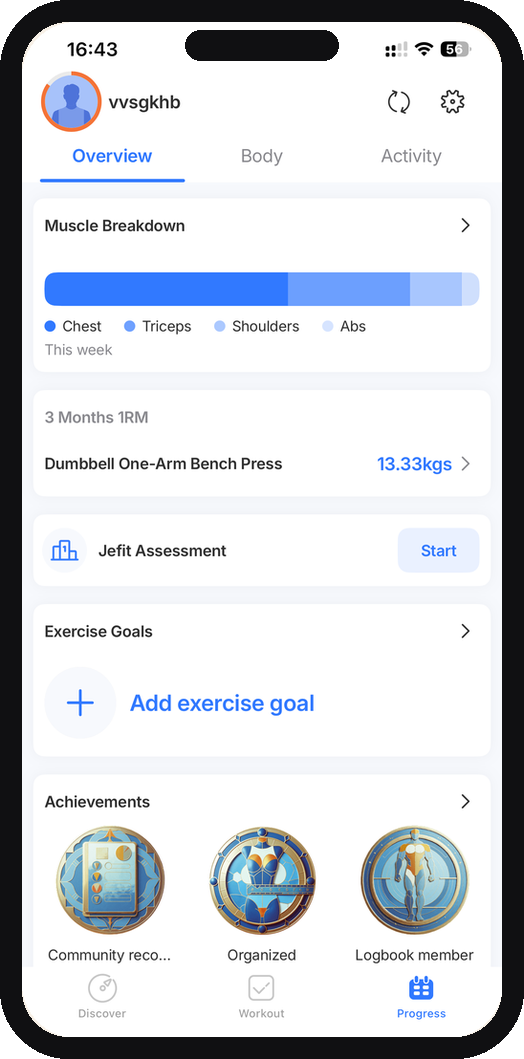
The strength-training tracker and planner from Jefit (jefit.com): a powerful workout logger with a 1,400-plus exercise library, custom and prebuilt routines, 1RM and progress analytics, an AI progressive-overload feature and a genuinely useful free tier · an excellent tool for building strength and bone at midlife · but a self-guided logger, not guided classes, with no menopause content and a serious-lifter feel. The right stimulus, if you can program it yourself.
How this profile is different. This is a research-based data profile, not a hands-on test. It draws on Jefit’s official information, app-store listings, current pricing, verified user reviews and the exercise science, then scores the app on our standard criteria. Where we describe a feature, that reflects published information, not a personal trial. This is education, not medical advice; check with your clinician before starting a new programme, especially with joint, pelvic-floor or heart concerns.
Jefit Review 2026: Quick Answer
Research-based data profile: assessed from official sources, pricing, user reviews and the science, not personally tested
Women 40+ who already know how to lift and want a powerful, low-cost way to plan, log and progress strength training
You want guided video classes, menopause or pelvic-floor content, or hand-holding as a beginner
A self-guided strength tracker and planner: exercise library, routines, logging, 1RM and analytics, with a free tier and Elite
About 30 to 60 minutes, set by your own routine
Gym or home free weights; dumbbells, a barbell or a bench, with some bodyweight options
Low-impact resistance training, depending on the exercises you choose
Precise progressive overload, 1RM and volume tracking, structured routines and a strong free tier
Excellent: it is built to log and progress the loaded training that protects midlife muscle and bone
Weak: no menopause, hormone or pelvic-floor content anywhere, and a serious-lifter feel
iOS and Android, web, Apple Watch and Wear OS, with Apple Health and Strava sync
A free tier, or Elite at $12.99 a month or $69.99 a year
The free tier is usable indefinitely; a paid trial is not clearly advertised
6.5 / 10
Quick Verdict
Worth it for women over 40? If you already lift and want to plan and progress it well, yes, and the free tier is excellent. But it is a logger, not a coach, with no menopause content, so for perimenopause or menopause it is a tool rather than a plan.
Jefit earns 6.5/10 on our research-based evaluation. As a strength-training tool it is genuinely strong: a 1,400-plus exercise library with video demonstrations, prebuilt and fully custom routines, precise set, rep and weight logging, automatic 1RM tracking, detailed volume and muscle-balance analytics, and a 2026 AI feature that suggests your next load for progressive overload. Much of that is free, and progressive strength is exactly what a midlife body needs for muscle and bone.
Where it is limited for our audience. Jefit is self-guided: it assumes you can program or pick a routine, so it offers little hand-holding for a beginner, and it is a logger rather than guided video classes. There is no menopause, hormone or pelvic-floor content, the community and content skew male and bodybuilding-oriented, and reviews note interface clutter and occasional sync bugs. Choose it if you are comfortable running your own strength training and want a powerful, low-cost way to track and progress it, and add menopause-specific guidance separately.
Is Jefit right for you?
Jefit is strongest for building bone density (8.5 out of 10, against a 5.1 average across the 105 programmes scored) and weakest for starting strength training (3.0 against 6.1).
| Question | Verdict | Rating | Score |
|---|---|---|---|
| How it suits a perimenopausal body | |||
| Is Jefit good for pelvic floor problems?Based on pelvic floor support and low-impact design | Low, and worse than mostmost score 4.7/10 | 3.3 / 10 | |
| Does Jefit include perimenopause and menopause education and programming?Based on programming, education, hormone awareness and credibility | Low, and worse than mostmost score 3.2/10 | 1.6 / 10 | |
| Is Jefit good for painful joints?Based on low-impact design and recovery provision | Moderate, and worse than mostmost score 6.1/10 | 5.0 / 10 | |
| Is Jefit manageable when your energy is low?Based on recovery provision and mind-body support | Low, and worse than mostmost score 5.6/10 | 3.3 / 10 | |
| Is Jefit good if you are new to strength training?Based on beginner on-ramp and mind-body support | Low, and worse than mostmost score 6.1/10 | 3.0 / 10 | |
| Is Jefit good for building bone density?Based on bone loading and progressive strength | Strong, and better than mostmost score 5.1/10 | 8.5 / 10 | |
| Does Jefit help with nutrition?Based on midlife nutrition support | Low, and worse than mostmost score 3.6/10 | 2.5 / 10 | |
| How it performs as a product | |||
| Can you fit Jefit into a busy week?Based on time efficiency | Moderate, and worse than mostmost score 7.5/10 | 6.5 / 10 | |
| Is Jefit worth the money?Based on value for money | Strong, and better than mostmost score 6.9/10 | 8.5 / 10 | |
Jump to Section
Who Is Behind It
Content and Features
Equipment You Need
Full Scoring
Good for Women Over 40?
Menopause and Midlife Fit
What the Research Says
What Users Report
Devices and App
Pricing 2026
Will You Stick With It
Pros and Cons
How It Compares
vs Caliber
Best Alternatives
FAQ
Verdict
Assessment Status
Sources
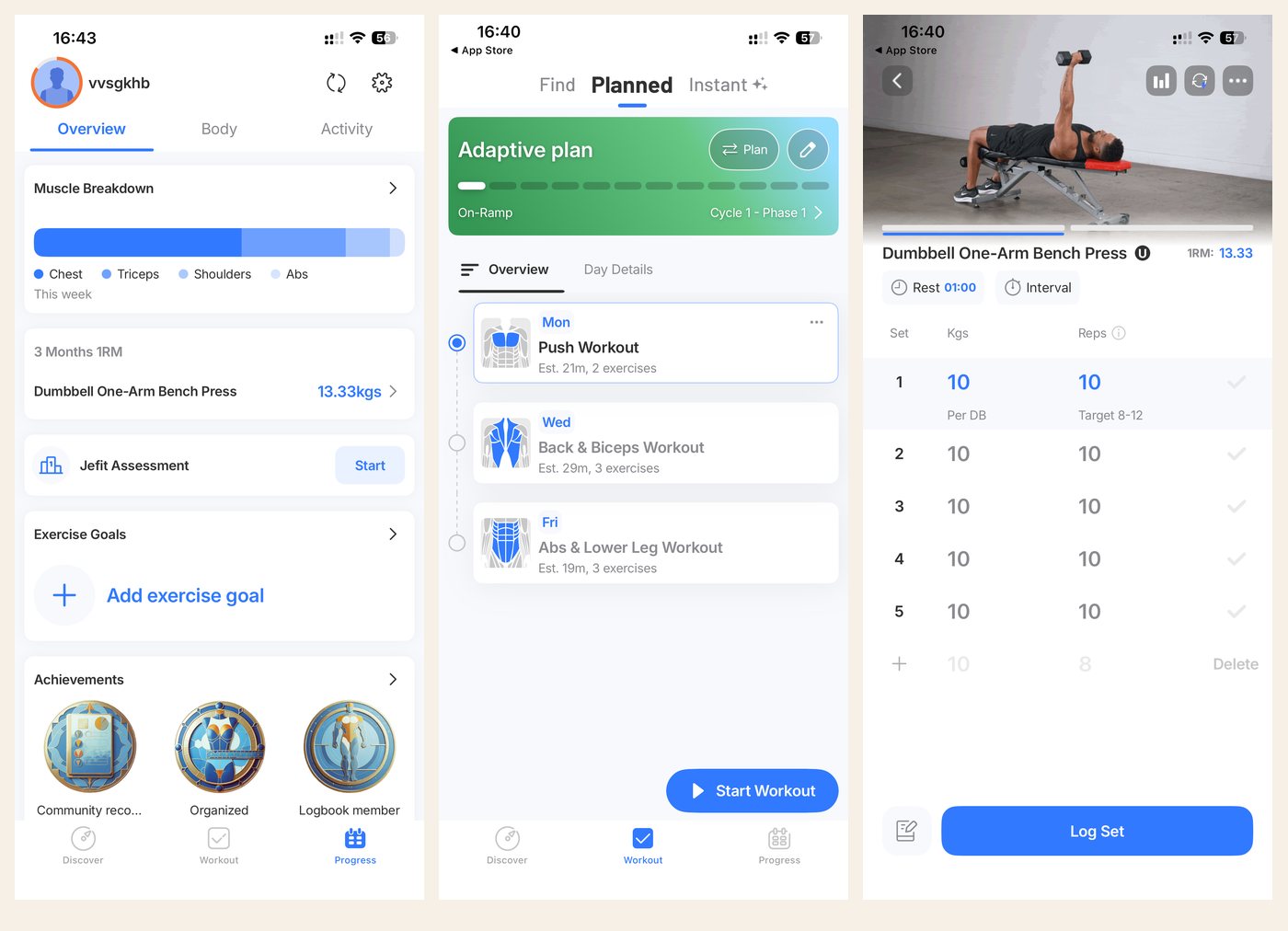
What Jefit Actually Is
Jefit, at jefit.com, is a strength-training workout tracker, planner and logger. Its job is to help you plan a routine, record every set, rep and weight, and see your progress over time, built around a library of more than 1,400 exercises with video demonstrations, prebuilt programmes and a full custom-routine builder. As one reviewer it quotes puts it, Jefit is best described as a sets-and-reps counter, so it is a self-guided tool rather than an app of instructor-led video classes.
Which product this is. This is the Jefit strength-tracking app from Jefit Inc., on iOS, Android and the web, and it has been developed since around 2010 and is actively updated. In 2026 it added adaptive-AI features, including an AI plan that adjusts week to week and a progressive-overload system that reads your past logs to suggest your next weight and reps, though this is algorithmic rather than a human coach. The adaptive plan even asks up front about injured muscles or joints and eases you in with an on-ramp before moving through structured mesocycle phases, and you can also build an instant workout from your time, equipment and target muscles.
For this audience it helps to be clear about what it is and is not. Jefit is one of the better strength-training tools you can use, and progressive loaded training is exactly what a midlife body needs to protect muscle and bone. What it is not is a menopause product or a guided programme: there is no perimenopause, hormone or pelvic-floor content, it assumes you can program yourself, and the feel is bodybuilding-oriented. Read it as a powerful strength logger to pair with your own knowledge or a guided plan, not a menopause programme.
Who Is Behind Jefit? Credibility
Jefit is made by Jefit Inc., a long-established, privately held company based in Santa Clara, California, and led by its founder. It has been going since around the start of the last decade, is one of the most downloaded strength-tracking apps, and describes its method in terms of progressive overload and mesocycle science. Its routines come from a mix of its community and in-house expert plans.
How to read that credibility. As a strength-tracking tool, Jefit is trustworthy: the exercise library, form demonstrations and progression mechanics are sound, and it has a long track record. What it does not do is name the certified trainers or coaches behind its expert plans, and there is no clinical or menopause advisory disclosed anywhere, nor any women’s-health or pelvic-floor expertise. For our audience that means a capable, well-built strength tool, but not menopause-specific or clinically grounded design, and the responsibility for programming it safely and appropriately sits with you.
Content and Features
At a glance: a powerful strength tracker, a 1,400-plus exercise library, prebuilt and custom routines, precise logging, 1RM and analytics, an AI progressive-overload feature and a strong free tier. Capped for our audience by no menopause content, a self-guided design that assumes you can program, and a serious-lifter feel.
| Format | A self-guided strength tracker and planner: exercise library, routines, logging and analytics. Not instructor-led classes. |
| Class types | Resistance training you build yourself, from barbell, dumbbell, kettlebell, machine and bodyweight exercises. |
| Session length | About 30 to 60 minutes, set by your own routine. |
| Midlife strengths | Precise progressive overload, 1RM and volume tracking, structured routines, a muscle-recovery chart and an AI overload feature. |
| Strength and bone | Excellent: it is built to log and progress the loaded training that protects midlife muscle and bone. |
| Impact and joints | Low-impact resistance training, though exercise selection and safety are down to you. |
| Menopause programming | None: no menopause, hormone or pelvic-floor content anywhere. |
| Nutrition | Minimal and generic; nothing midlife-specific. |
| Devices | iOS and Android, web, Apple Watch and Wear OS, with Apple Health and Strava sync. |
What Equipment Do You Need for Jefit?
Jefit is built around free weights and machines, so it suits a gym, but it also lets you filter by the equipment you have and train at home, and it includes bodyweight options. For a midlife body chasing muscle and bone, the useful things to own are a set of adjustable dumbbells you can progress, a mat, and, if you have space, an adjustable bench. Because Jefit is all about logged progressive overload, weights you can make heavier over time are the point.
Recommended spec examples. These picks are curated for convenience by specification and feature fit, not personally lab-tested for long-term durability. Prices are examples; verify before buying.
Adjustable dumbbells (light)
A light adjustable pair to begin logging and progressing.~$73
Adjustable dumbbells (heavier)
One pair that scales to 52 lb for real strength and bone loading.~$399
Adjustable bench
Adds pressing and incline work as you progress.~$88
Exercise mat
For floor, core and accessory work at home.~$45
A quick heads-up: some of the buy links above are Amazon affiliate links, so if you grab something through them I may earn a small commission, at no extra cost to you. I only ever point you to kit I would happily use myself.
Bottom line on equipment: a set of adjustable dumbbells, a bench and a mat cover home use, and heavier weights over time are exactly what Jefit is built to help you progress.
How We Scored Jefit: the 6.5 / 10 Breakdown
Scores on our 9 weighted criteria, from our research-based assessment. Women Over 40 is our menopause-fit criterion, and its full 12-capability breakdown follows in the next section.
| Category | Weight | Score | Confidence | Reasoning |
|---|---|---|---|---|
| Time Efficiency | 15% | 6.5 | Med | A rest timer, supersets and fast logging keep sessions efficient, though you set the length and logging adds a little overhead. |
| Muscle Potential | 18% | 9 | High | Logged sets, reps and weight, 1RM tracking and a huge exercise library directly drive progressive overload. |
| Women Over 40 Specificity | 10% | 3.9 | Low | A great midlife stimulus, but no menopause tailoring or guidance; full breakdown below. |
| Joint Friendliness | 12% | 5.5 | Med | Resistance work is generally joint-kind, but exercise selection is user-driven with no low-impact guidance. |
| Recovery Compatibility | 10% | 5 | Med | It tracks volume and has a muscle-recovery chart, but no built-in deload or midlife recovery programming. |
| Programme Structure | 12% | 8.5 | High | Prebuilt routines plus a full builder and structured progression logging are a genuine standout. |
| Value for Money | 8% | 8.5 | High | A genuinely strong free tier, and Elite is inexpensive next to guided-class subscriptions. |
| UX and Design | 8% | 6 | Med | Powerful but data-dense and can feel complex, with ads on free and some paywalled analytics. |
| Nutrition Integration | 7% | 2.5 | Med | Minimal, generic food logging, with nothing midlife-specific. |
| Total | 100% | 6.5 / 10 | Research Score. |
Is Jefit Good for Women Over 40?
As a strength-training tool, it is one of the better ones you can pick, and much of it is free. Progressive resistance training is the single most important thing most women can do in midlife to protect muscle, bone and metabolic health, and Jefit is built precisely to plan, log and progress it: record your lifts, watch your 1RM and volume climb, and let the AI feature nudge your next load. For a woman who already trains, that is genuinely valuable.
Who it suits, and what is missing. It suits a woman who is comfortable running her own strength training and wants to do it deliberately and track progress. What is missing is guidance and midlife design: it assumes you know how to program, so a beginner gets little hand-holding, and there is no menopause, hormone or pelvic-floor content, no structured deload or recovery for midlife needs, and a bodybuilding-oriented feel. It is a logger, not a coach, and not a set of follow-along classes.
What the wider picture shows. Jefit is a powerful, low-cost strength tool that delivers exactly the right stimulus for a midlife body, but none of the menopause-specific framing, and it rewards people who already know their way around a gym. The best way to use it is as your training log and progression engine, paired with your own knowledge, a coach or a guided programme, and with menopause and pelvic-floor considerations handled separately.
How Jefit Fits Perimenopause, Menopause and Beyond
Our capability breakdown of how well Jefit suits women across perimenopause, menopause and post-menopause. Women Over 40 is our menopause-fit criterion, and this is the full breakdown behind the Women Over 40 row above.
Jefit is strongest for progressive strength and bone loading, and for structured programming; it is weakest on any menopause, hormone, pelvic-floor or mind-body support, in our menopause and midlife capability assessment.
| At a glance | Score |
|---|---|
| Right training for a midlife body | 6.8 / 10 |
| Menopause education and programming* | 1.5 / 10 |
| Whole-woman support | 2.8 / 10 |
This is the perimenopause and menopause assessment, and it is separate from the overall score. Twelve things a programme either does for a midlife body or does not, each scored out of 10 with my reasoning next to it. Together they produce a single menopause fit score, and that becomes one of the nine categories in the overall scoring below.
How Jefit Fits Perimenopause, Menopause & Beyond
Women Over 40 is our most important criterion, and here's the full breakdown behind it.
Jefit is strongest for progressive strength and bone loading, and weakest for menopause programming, pelvic floor, hormone awareness, menopause education, mind-body support, midlife nutrition, expert credibility and beginner on-ramp, in our menopause and midlife capability assessment for women over 40.
At a glance
What the app teaches about perimenopause and/or menopause, not whether the training suits a midlife body.
| Capability | Score | Rating | Why |
|---|---|---|---|
| Right training for a midlife body | |||
| Low-impact | 5.5/10 | Some | Strength work is generally low-impact, but the app enforces nothing and gives no low-impact routing or joint-sparing guidance. |
| Progressive strength | 9/10 | Best-in-class | Its core purpose: log sets, reps and weight, track 1RM and drive week-over-week progressive overload precisely. |
| Bone loading | 8/10 | Strong | Enables and tracks loaded resistance training with progression, the right bone stimulus, though not framed for bone health. |
| Recovery & deload | 4.5/10 | Minimal | A rest timer and muscle-recovery chart exist, but there is no built-in deload, fatigue tracking or recovery programming. |
| Menopause education and programming* | |||
| Menopause programming | 1/10 | None | No perimenopause or menopause-specific routines, phasing or symptom-aware programming anywhere. |
| Pelvic floor | 1/10 | None | No pelvic-floor training, cueing or content of any kind. |
| Hormone awareness | 1/10 | None | No hormone-cycle or menopause awareness in programming or education. |
| Menopause education | 1.5/10 | None | General strength and exercise info exists, but no menopause or midlife-specific educational content. |
| Expert credibility | 3/10 | Minimal | Established, exercise-science-informed brand with form demos, but no named trainer or women's-health credentials. |
| Whole-woman support | |||
| Mind-body support | 2/10 | None | Purely a training logger; no stress, mindfulness, sleep or mind-body support. |
| Beginner on-ramp | 4/10 | Minimal | Prebuilt routines and exercise demos help, but real value needs knowing how to program or pick a plan. |
| Midlife nutrition | 2.5/10 | None | Only basic generic food logging; no midlife or menopause nutrition guidance. |
ScaleBest-in-classStrongSomeMinimalNone
* What the app teaches and programmes around menopause, not whether the training suits a midlife body. Many programmes that score low here are still a good fit, they simply never use the word. A high score is not proof either: a few menopause videos added to a general library lifts this score without changing the training.
These are evidence-informed suitability ratings, not clinical measurements. They combine exercise science with product-specific research and, where indicated, hands-on testing, alongside multi-source verification, and are approximate. Individual response varies. A starting point, not medical advice. How we score menopause fit
What the sources say: scores combine the platform’s features, user sentiment and the science. Jefit does very well on progressive strength and bone loading, the training a midlife body most needs, and on structured programming. It scores low on the built-for-menopause and whole-woman measures because it has no menopause, hormone or pelvic-floor content, no mind-body support and a design that assumes you can program yourself, so it sits well below purpose-built menopause platforms even though its core strength tracking is genuinely midlife-appropriate.
These are evidence-informed suitability ratings, not clinical measurements. They combine exercise science with programme research and multi-source verification, and are approximate. Individual response varies. A starting point, not medical advice. How we score menopause fit.
What the Research Says: Jefit Checked
Jefit’s two levers are exactly right for midlife. Its core purpose is progressive resistance training and self-monitoring, and both have good evidence for women over 40. In postmenopausal women with low bone mass, heavy, progressive resistance and impact training improved bone density and function where lighter exercise did not,[1] which matters because lean muscle falls and fat rises across the menopause transition.[2] Jefit is built to plan and progress precisely that kind of training.
Load and tracking both count. For strength, heavier loads produce greater gains, though muscle can grow across a range of loads taken close to failure, so Jefit’s emphasis on logging and adding load over time is well founded.[3] And self-monitoring is one of the best-evidenced behaviour-change tools: interventions that include tracking, combined with goals and feedback, are markedly more effective at sustaining activity, which is exactly what a good logging app supports.[4] Muscle-strengthening activity is also linked to lower mortality, with benefit around 30 to 60 minutes a week.[5]
What Jefit does not give you. There is even a menopause-symptom angle to strength training: a small trial found progressive resistance training reduced hot flushes in postmenopausal women.[6] But Jefit provides the training tool, not the menopause-specific guidance to apply it that way, and it offers no symptom, hormone or pelvic-floor support. So the fair reading is that Jefit’s underlying method, tracked progressive strength, is strongly evidence-based for midlife women, while the app itself adds no menopause-specific design on top.
What Users Report: Verified Sentiment
Rating snapshot: Jefit rates highly on the Apple App Store, around 4.8 out of 5 from tens of thousands of ratings, and more moderately on Google Play, around 4.5 from a larger pool past 5 million installs, so a fair blended read is roughly 4.5 to 4.6. Trustpilot and other sites have too few reviews to be meaningful, so we do not cite them. The audience skews strongly male and toward serious and bodybuilding-oriented lifters.
What users praise and criticise. The praise is consistent: the exercise library and customisation are best-in-class, the logging and progress analytics are detailed and useful, the free tier is unusually generous, and many people stay for years. The fair criticisms are interface clutter and churn from frequent updates, occasional sync and data-loss bugs, some missing power-user features like different weights per set, and pressure to upgrade to Elite, with ads on the free tier. To its credit, the developer responds to most critical reviews.
Consistently praised
- A best-in-class exercise library and customisation.
- Detailed, useful logging and progress analytics.
- An unusually generous free tier.
- Long-term stickiness; people stay for years.
Consistently noted
- Interface clutter and churn from frequent updates.
- Occasional sync and data-loss bugs.
- Pressure to upgrade to Elite, and ads on free.
- No menopause content, and a serious-lifter feel.
Source and credibility note: ratings were checked in 2026 across the Apple App Store and Google Play and can change; the iOS and Android scores differ, so we give a blended read. Trustpilot and similar have too few reviews to be representative. No menopause-specific sentiment was found, and the audience skews male and serious-lifter, so suitability for our readers is inferred from features, not from user reports.
Devices and App
Jefit runs on iPhone and Android, on the web through your account dashboard, and on an Apple Watch and Wear OS watches, with live syncing of sets and heart rate on Wear OS and integration with Apple Health and Strava. That makes it easy to log at the gym from your wrist and review your progress later on a bigger screen.
A couple of practical notes. Jefit is a tracking app, not a streaming-class product, so there is no follow-along video class or TV app; the videos are short exercise demonstrations, which feature male models, in keeping with the app’s male-leaning feel. Some reviewers report the interface has grown cluttered and that syncing between watch and phone can be flaky, so if reliable logging is critical, it is worth a careful try on the free tier first. Offline use is not clearly confirmed on the official pages.
Jefit specifications
- Last verified
- 12 August 2026
Jefit Price 2026: What You Actually Pay
| Plan | Cost | Notes |
|---|---|---|
| Basic | Free | Free and custom routines, 1,400+ exercises with instructions, logging and history, community. |
| Elite (monthly) | $12.99/mo | Adaptive AI coach, advanced analytics, ad-free, Watch app and video demonstrations. |
| Elite (annual) | $69.99/yr | Works out much cheaper per month. |
Cost and Cancellation
Jefit’s free tier is genuinely capable and free to keep. Elite costs $12.99 a month or $69.99 a year in US dollars, unlocking the AI coach, advanced analytics, an ad-free experience, watch support and video demonstrations. A free trial of Elite is not clearly advertised on the official pages, so do not assume one. Subscriptions auto-renew and you can cancel anytime, generally at least 24 hours before renewal, through the app store you subscribed on or your Jefit account. Prices are in US dollars and were checked in 2026; confirm the current figures before subscribing.
Not sure Jefit is the right programme for you?
Answer a few questions about your goals, schedule and fitness level, and get matched with programmes that fit.
Will You Actually Stick With It?
For the right person, Jefit is very sticky, and the reviews bear that out, with many users saying they have logged with it for years. Self-monitoring is one of the most reliable ways to sustain a habit, and Jefit turns each session into logged progress you can see, with charts, 1RM records and a muscle-balance view that make consistency rewarding. The strong free tier also means there is no barrier to keeping going.
The risks to sticking with it are complexity and fit. The interface is data-dense and has grown busier over time, which can feel like friction, and if you do not already enjoy tracking, the logging overhead may wear thin. There is also no coaching to keep a beginner on track. If you like data, already train, and want to progress deliberately, Jefit supports consistency well; if you want to be guided or prefer a simpler, follow-along experience, it may frustrate.
Jefit Pros and Cons
Pros
- Built to plan and progress the strength training midlife needs
- A 1,400-plus exercise library with video demonstrations
- Precise logging, 1RM tracking and detailed analytics
- An unusually generous free tier and low-cost Elite
- An AI progressive-overload feature and structured routines
Cons
- No menopause, hormone or pelvic-floor content
- Self-guided, with little hand-holding for beginners
- A logger, not guided video classes, and a serious-lifter feel
- Interface clutter and occasional sync bugs
- Ads on free and pressure to upgrade to Elite
How Jefit Compares
Here is how Jefit sits against the four alternatives women most often weigh it against, including Pvolve as the strongest menopause-built contrast. Scores come from our own reviews on the same weighted criteria.
| Feature | Jefit | Caliber | Boostcamp | EvolveYou | Pvolve |
|---|---|---|---|---|---|
| Our score | 6.5 / 10 | 7.3 / 10 | 7.2 / 10 | 6.1 / 10 | 8.3 / 10 |
| Monthly price | Free · Elite $12.99/mo · $69.99/yr | Free · Plus $12/mo · $72/yr · 1-to-1 coaching: price after consultation | Free · Pro $14.99/mo · $59.99/yr | $22.99/mo · $119.99/yr | $24.99/mo · $224.91/yr |
| Free trial | Free tier; Elite trial: confirm at signup | Free tier; trial: confirm at signup | Free tier; 7 days on annual Pro only | 7 days, annual plan only | 14 days |
| Best for | Planning and tracking your own strength training | Progressive strength with optional human coaching | Ready-made, proven strength programmes | Structured, guided strength for women | Low-impact functional strength, menopause, joint health |
| Equipment required | Any: gym, home or bodyweight; routines built around your kit | Gym, home or bodyweight | Mostly gym or barbell; some dumbbell and home plans | Gym, home or dumbbells | None to Pvolve kit; bands and dumbbells cover most classes |
| Session length | About 30 to 60 min, set by your routine | About 30 to 60 min, set by your plan | Set by programme; 2 to 6 days a week | Varies by programme | 10 to 70 min |
| Injury modifications | Not built in; exercise choice is down to you | Exercise swaps; coach adjusts in Premium | Exercise swaps; Pro asks about injuries | Equipment swaps; no injury programme | Yes + dedicated injury series |
| Perimenopause content | None | None | None | None (pre and postnatal, cycle content only) | Very strong: Menopause Strong, pelvic floor |
| Coaching style | Self-guided logging; Elite adds an AI coach | Self-guided, or a 1-to-1 human coach (Premium) | Self-guided with form videos | Coach-led programmes with audio cues and follow-along video | Video-led classes, verbal cues throughout |
| Nutrition included | No | Targets in Plus; full plan with coaching | No | Yes: recipes, macros, meal plans | Not in streaming |
| Community | Included in the free tier | Workout Circles | Community programmes; no in-app forum | In-app forum and challenges | Live virtual classes |
| App Store rating (US) | 4.8 (46,900+ ratings) | 4.8 (6,000+ ratings) | 4.9 (10,500+ ratings) | 4.8 (19,700+ ratings) | 4.9 (9,800+ ratings) |
| Best suited to | Women in peri, meno and postmenopause who already know how to lift | Women who want strength training with accountability | Women who want proven gym plans, free | Women who want structure plus nutrition | Women who want menopause-built, joint-friendly training |
Prices and US App Store ratings checked on each platform’s official site in October 2026 and change often, so verify before you subscribe. Scores reflect our independent reviews, see each full review for methodology.
Jefit vs Caliber: Which Is Better for Women Over 40?
These two suit different levels of self-direction. Jefit is a pure strength tracker and planner: you build or pick a routine, and it logs and progresses it superbly, with an AI overload feature, at a very low price. Caliber is also strength-focused but adds more guidance, including a generous free tier with a plan builder and an optional human coach who writes your programme and checks in, which suits someone who wants accountability rather than to program alone.
For women over 40 the choice is about how much guidance you want. If you already know how to train and just want the best tool to plan, log and progress it, Jefit is excellent and cheaper. If you would rather be guided, or want a coach to keep you accountable and adjust things, Caliber is the stronger fit. Neither is menopause-specific, so whichever you choose, add menopause and pelvic-floor guidance, and if you want that built in, a purpose-built option like Pvolve alongside.
If Jefit Is Not Right for You: Best Alternatives
If you want more guidance, ready-made programmes, or menopause-specific design, these published alternatives pair or compare well.
Similar programmes we partner with
Close to Jefit, if it is not quite right for you
These are not part of this review’s score. Each shares a goal or training style with Jefit, and each is worth a look if it is closer to what you need.

A science-based strength app with a generous free tier, progressive programming and optional human coaching. Strong for midlife muscle and bone, but n…
A well-structured AI coach app with genuine strength progression, but a high-impact default that is hard on midlife joints, no menopause programming,…
Affiliate links, at no extra cost to you. I buy my own subscriptions and a commission never moves a score or a position. Full disclosure.
Jefit FAQ
Jefit (jefit.com) is a strength-training workout tracker, planner and logger. It helps you plan a routine, record every set, rep and weight, and track progress over time, built around a library of more than 1,400 exercises with video demonstrations, prebuilt programmes and a full custom-routine builder, plus 1RM tracking, analytics and a 2026 AI progressive-overload feature. It is a self-guided tool rather than an app of instructor-led video classes.
As a strength-training tool it is one of the better ones, because it is built to plan, log and progress the loaded training that protects midlife muscle and bone. The caveats are that it is self-guided, so it assumes you can program yourself and offers little beginner hand-holding, and it has no menopause, hormone or pelvic-floor content, no structured recovery for midlife needs, and a bodybuilding-oriented feel. So it works as a powerful strength tool paired with your own knowledge or a guided plan, not as a menopause programme.
Jefit has a genuinely useful free tier with routines, the exercise library, logging and community. Jefit Elite costs $12.99 a month or $69.99 a year in US dollars, unlocking an AI coach, advanced analytics, an ad-free experience, watch support and video demonstrations. A free trial of Elite is not clearly advertised, so do not assume one. Subscriptions auto-renew and you can cancel anytime, generally at least 24 hours before renewal. Verify current prices before subscribing.
Primarily a tracker and planner. Jefit is best described as a sets-and-reps logger with a large exercise library and routine builder, so you either build your own routine or choose a prebuilt one, then log and progress it. In 2026 it added adaptive-AI features that suggest your next load and adjust a plan week to week, but that is algorithmic rather than a human coach. If you want a person writing your programme and checking in, a coaching app like Caliber is a better fit.
No. Jefit is a general, gender-neutral strength-tracking app with no menopause, perimenopause, hormone-phase or pelvic-floor programming, and no disclosed clinical or women’s-health advisory. Its value for midlife women is the training principle it enables, progressive strength, not any menopause-specific guidance. For menopause-specific design, a purpose-built option like Pvolve is a better fit, used alone or alongside Jefit.
For a woman who already lifts and wants a powerful, low-cost way to plan, log and progress strength training, yes, and the free tier makes it low-risk to try. It is a weaker choice if you want guided video classes, menopause-specific programming, or hand-holding as a beginner, because it is a self-guided logger with a serious-lifter feel and no menopause content. On our research-based evaluation, Jefit is an excellent strength tool best paired with your own knowledge or a guided plan.
Final Verdict
Research Score: 6.5 / 10 · Research-based data profile
Jefit is a powerful, low-cost strength-training tool that does one thing very well: it helps you plan, log and progress loaded training, which is exactly what a midlife body needs for muscle and bone. The exercise library, tracking and analytics are excellent, the free tier is generous, and the AI overload feature is a useful addition.
Jefit is for women who already lift, or are willing to learn, and want a precise, affordable way to program and track their strength. It is not for women who want guided video classes, menopause-specific programming, pelvic-floor or hormone content, or beginner hand-holding, because it is a self-guided logger with a serious-lifter feel and none of that midlife-specific design. The best way to use it is as your training log and progression engine, paired with your own knowledge, a coach or a guided plan, and with menopause and pelvic-floor needs handled separately. As a research-based profile, this reflects official information, pricing, user reports and the science, not a hands-on test.
Assessment Status
Research-based data profile: this profile is based on Jefit’s official information, app-store listings, current pricing, verified user reviews and the exercise science, scored on our standard criteria. It is not a hands-on test, and no personal-testing claims are made. If we test the app hands-on in future, we will upgrade this to a sample-tested review on the same page. How we score and test.
Sources and Further Reading
- Watson, S.L. et al. (2018). High-Intensity Resistance and Impact Training Improves Bone Mineral Density and Physical Function in Postmenopausal Women With Osteopenia and Osteoporosis: The LIFTMOR Randomized Controlled Trial. Journal of Bone and Mineral Research, 33(2), 211 to 220. DOI 10.1002/jbmr.3284. Available at: pubmed.ncbi.nlm.nih.gov. Heavy, progressive resistance and impact training improved bone density and function in postmenopausal women where lighter exercise did not.
- Greendale, G.A. et al. (2019). Changes in body composition and weight during the menopause transition. JCI Insight, 4(5), e124865 (Study of Women’s Health Across the Nation). DOI 10.1172/jci.insight.124865. Available at: pubmed.ncbi.nlm.nih.gov. Fat mass rose and lean mass fell across the menopause transition (observational cohort).
- Schoenfeld, B.J. et al. (2017). Strength and hypertrophy adaptations between low- versus high-load resistance training: a systematic review and meta-analysis. Journal of Strength and Conditioning Research, 31(12), 3508 to 3523. DOI 10.1519/JSC.0000000000002200. Available at: pubmed.ncbi.nlm.nih.gov. Higher loads produced greater strength gains, while muscle size grew across loading ranges when sets were taken close to failure.
- Michie, S. et al. (2009). Effective techniques in healthy eating and physical activity interventions: a meta-regression. Health Psychology, 28(6), 690 to 701. DOI 10.1037/a0016136. Available at: pubmed.ncbi.nlm.nih.gov. Self-monitoring, especially combined with goal-setting and feedback, was among the most effective behaviour-change techniques for activity.
- Momma, H. et al. (2022). Muscle-strengthening activities are associated with lower risk and mortality in major non-communicable diseases: a systematic review and meta-analysis of cohort studies. British Journal of Sports Medicine, 56(13), 755 to 763. DOI 10.1136/bjsports-2021-105061. Available at: pubmed.ncbi.nlm.nih.gov. Muscle-strengthening activity was associated with a 10 to 17% lower risk of all-cause mortality and major disease, peaking around 30 to 60 minutes a week (observational).
- Berin, E. et al. (2019). Resistance training for hot flushes in postmenopausal women: a randomised controlled trial. Maturitas, 126, 55 to 60. DOI 10.1016/j.maturitas.2019.05.005. Available at: pubmed.ncbi.nlm.nih.gov. Fifteen weeks of progressive resistance training reduced hot flushes versus controls in a small single-centre trial.
This is a research-based data profile, not a hands-on test. Pricing and features were verified in 2026 and may have changed. Some affiliate links may be present. This site does not accept payment from platforms reviewed. Education, not medical advice; check with your clinician before starting a new programme, especially with joint, pelvic-floor or heart concerns.
Related Guides
What To Do Next
- → Take our 2-minute quiz for a personalised recommendation.
- → See our best workouts for women over 40 rankings.
- → Compare with our Caliber review and see how we score every programme.