
$19.99 per month or $119.99 per year, with a permanent free tier and a 7 day trial on the annual plan. All prices in USD. In app purchase pricing differs from the website, including a weekly option priced to be confused with the monthly equivalent.
Sample tested, one week of my own use · Three strength sessions, one treadmill top-up and a couple of walks, on the Shape programme · All screenshots are my own · Prices regularly verified
Sample testedSHRED App Review 2026: Quick Answer
Quick Verdict
Worth it if you are in your late thirties or older, or anywhere in perimenopause or menopause? Yes. I downloaded SHRED expecting a bodybuilding app and I was wrong. What I found was a genuinely good strength platform with an AI coach that told me how to adapt the training to my knees and my life stage, and a class library far broader than anything SHRED advertises about itself. If you are training through perimenopause or menopause and what you actually need is the strength side solved properly, this does that.
The strength case is real and it was the reason I kept going. I filled in a questionnaire about my goals and my equipment, was put on the Shape programme, and could set sessions to about twenty minutes and stack a second block when I wanted more.
What I did not expect is what happened when I started asking. The workouts felt too easy, so I asked how to make them harder and got a specific answer about pausing at the bottom of each rep. I asked about protein timing, about modifying for my knee, and about what to do in perimenopause, and got useful answers to all of it in seconds. That is the finding. SHRED has no menopause content, and it still handled my menopause question better than several apps that sell themselves on exactly that.
Where to start: use the free tier first, it is permanent rather than a trial. If you subscribe, take the annual plan and read the billing section below, because there is a weekly option priced at the same number as the advertised monthly rate.
Try the permanent free tier before you pay for anything.
- Price
- $19.99/mo or $119.99/yr
- Free trial
- Permanent free tier, 7 day trial on the annual plan
- Note
- Deleting your account does not stop billing
Is SHRED right for you?
SHRED fits if you: want real progressive strength training rather than a toning programme · are in your late thirties or beyond, or anywhere in perimenopause or menopause · train in different places, at home, in a garage gym or at a full gym · want short sessions you can stack · already have menopause care in place and need the training part solved.
Look elsewhere if you: want menopause education, hormone-phase programming or pelvic floor workouts built in · want meal plans or nutrition tracking · would rather the adaptation was already in the product than something you have to request · use Android as your main phone · want a named human coach accountable for your programme.
Jump to Section
What SHRED Actually Is
SHRED is a strength training app made by Shred Labs, LLC, built around coach-designed programmes that adapt to your equipment and your schedule, with an AI coach layered on top and a large studio class library alongside. It launched in November 2018 and is actively developed.
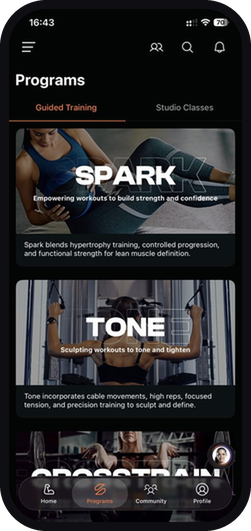
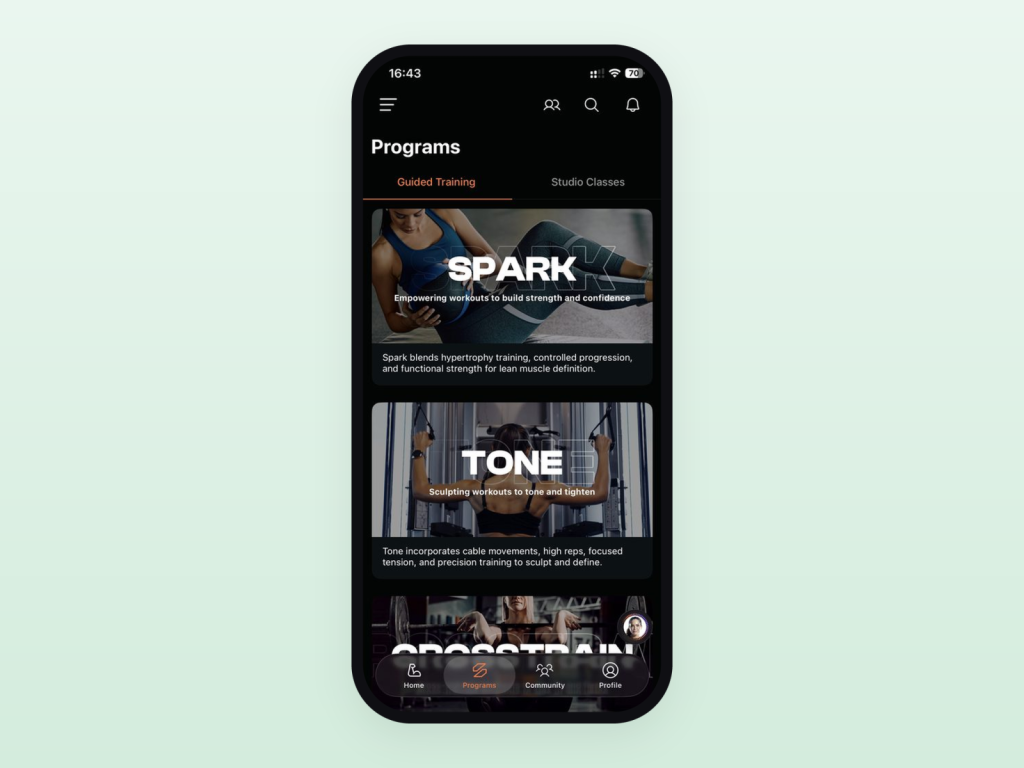
Setting it up takes a few minutes. You answer a questionnaire about your goals, your experience and what equipment you can get to, and it puts you on a programme. Mine was Shape, described as full-body strength work to sculpt and empower, using dumbbells and a loop band. You are not locked into it: the guided programmes include Spark, Tone, Crosstrain and Form, and you can switch.
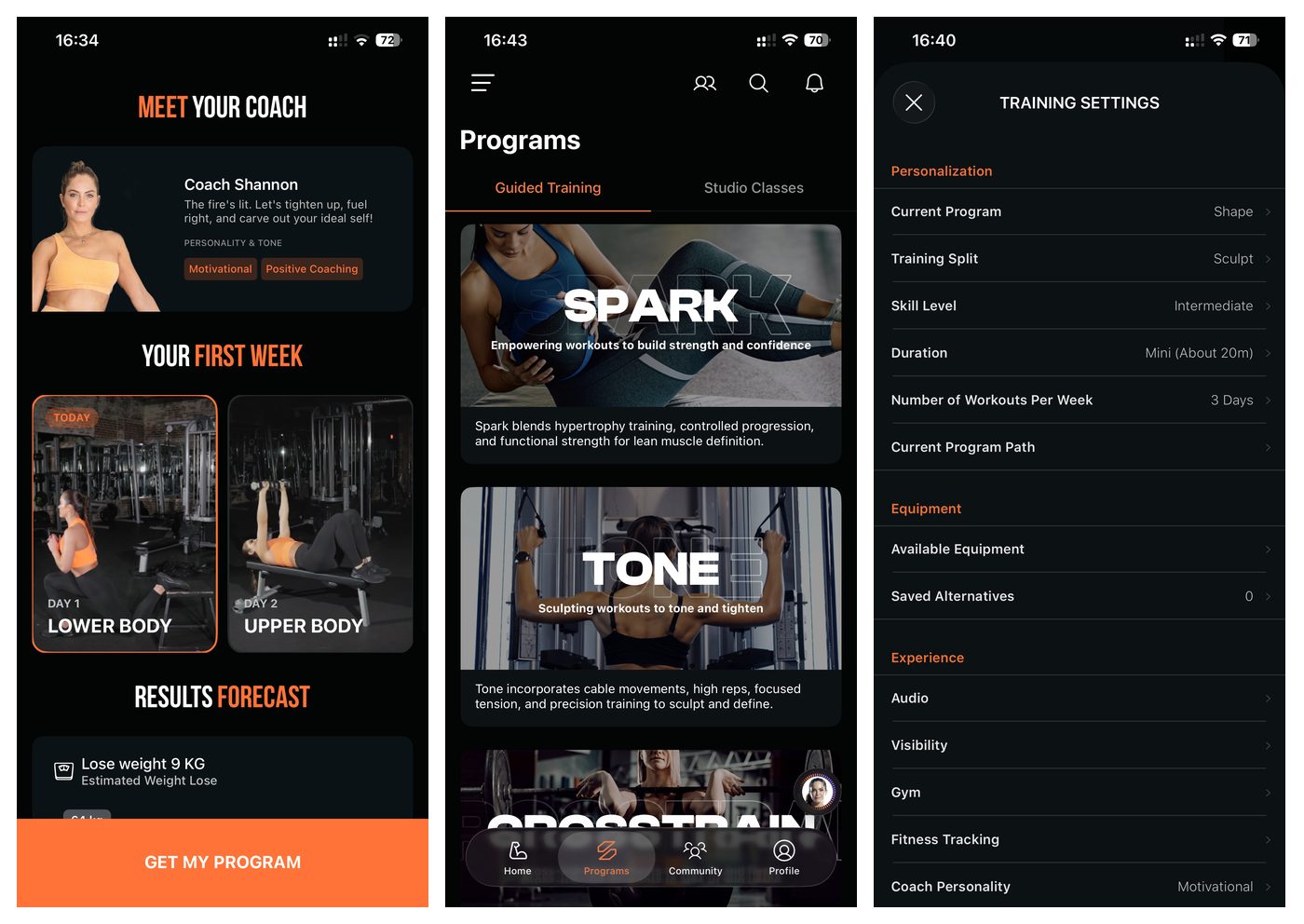
Two settings matter more than the rest. Duration lets you pick roughly twenty minute sessions, which is what I used, and the app will happily give you a second block if you want more, so the sessions stack rather than forcing you into an hour. Number of workouts per week sets the rhythm; I ran three.
One thing to flag from that first screen. Before I had trained once, SHRED forecast that I would lose 9kg, labelled “Estimated Weight Lose”. A specific weight projection made before the app knows anything about how you train is marketing, not a prediction, and the typo suggests nobody reviewed it.
What My Week Was Like
Three strength sessions, one treadmill top-up and a couple of walks, and by the end of it I had decided to subscribe.
The Shape sessions were a mix of dumbbell and bodyweight strength work, laid out as circuits with rounds. Each movement came with a video and a written cue from Coach Shannon explaining what to do and what to watch for, which is the difference between following along and actually knowing whether you are doing it right. You log your weight and reps as you go.
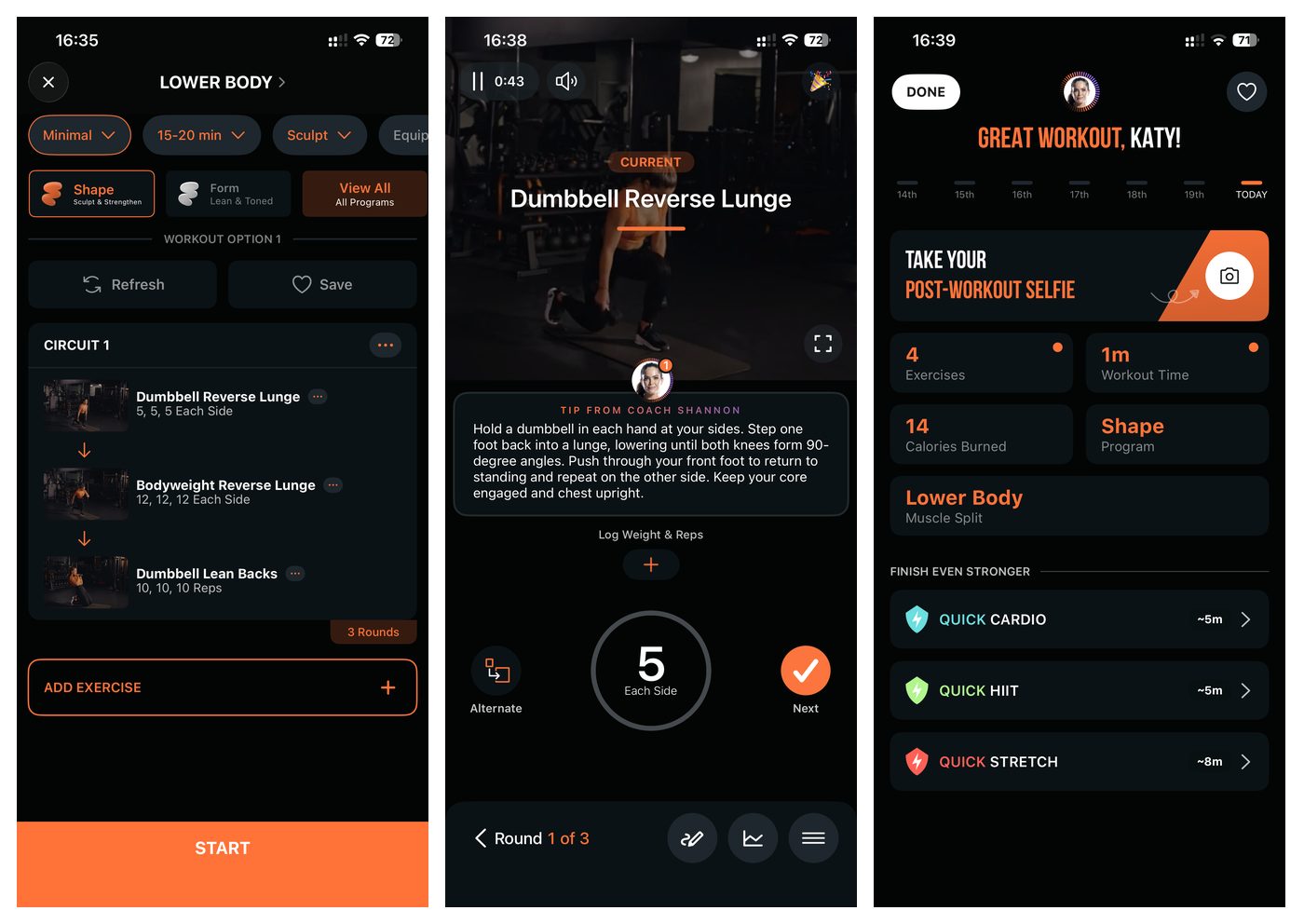
The part I did not expect to like as much as I did comes at the end. When you finish, the app offers a Quick Cardio, Quick HIIT or Quick Stretch top-up, around five to eight minutes each. I took the cardio once and got a treadmill circuit with intervals and timed sprints. It turns a twenty minute strength session into a complete one without any planning on my part.
My assessment of the volume: three strength sessions, one treadmill session and a couple of walks was enough. I did not feel I was missing anything.
The AI Coach, and Why It Changes the Assessment
SHRED has no menopause content, and its AI coach answered my perimenopause question anyway. That gap between what a product contains and what it can do on request is the most interesting thing about this app, and it is not something you can see from the outside.
At first I did not realise what the coach was. I was following the programme and ignoring the chat. Then the workouts started feeling too easy, so I asked how to make them harder.
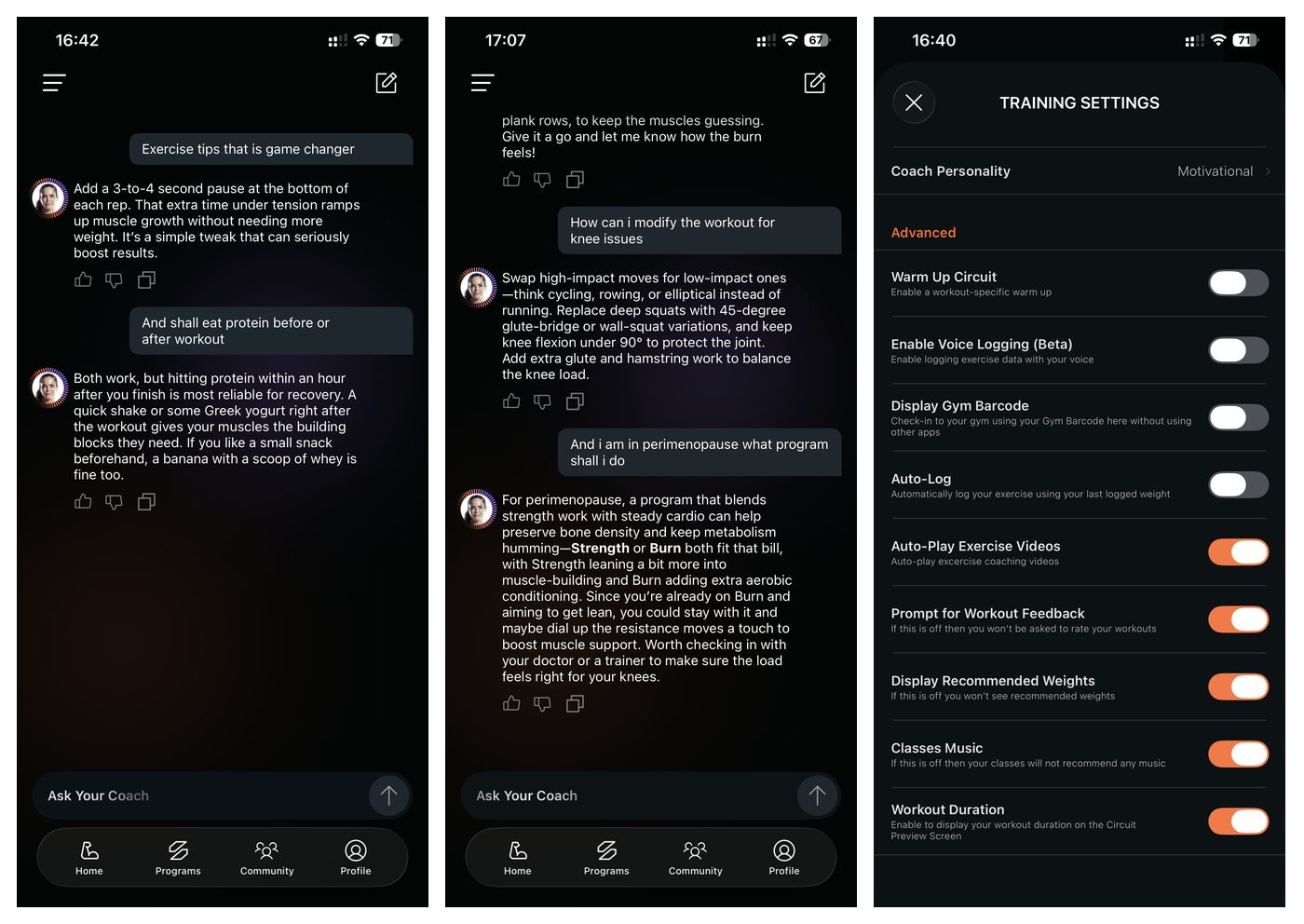
What came back was specific rather than generic: add a three to four second pause at the bottom of each rep, because the extra time under tension increases the training stimulus without needing more weight. That is a real coaching answer, and it is the kind of thing that normally requires a person.
So I kept asking. On protein timing it recommended getting protein in within an hour of finishing, with a shake or Greek yoghurt, and said a banana with whey beforehand was fine too. On my knees it gave me joint-angle guidance: swap high-impact movements for cycling, rowing or the elliptical, replace deep squats with forty-five degree glute bridge or wall squat variations, keep knee flexion under ninety degrees, and add glute and hamstring work to balance the load around the joint.
Then I asked what programme I should be doing in perimenopause. It recommended blending strength work with steady cardio to support bone density, named two specific programmes that fit, suggested I could stay on what I was doing and increase the resistance work, and told me to check with my doctor or a trainer that the load was right for my knees.
Being precise about what this is. The coach is a language model, not a clinician, and it should be read that way. It gets real credit for referring me to a doctor rather than pretending otherwise, and the training advice it gave me was sound and matched what the evidence supports for midlife women.2 But it also reached for loose phrasing like keeping your metabolism humming, which is the sort of thing this site does not say, and its answers are only as good as the question you think to ask.
You can also set the coach’s personality, which I found more useful than it sounds, and it is genuinely fast. If you do not have time to go and research how to adapt a programme around your knees and your hormones, getting a short answer you can act on immediately is worth a great deal.
The limitation is structural and it matters. This only works if you know what to ask. A woman who does not know that perimenopause changes her recovery, or that pelvic floor symptoms are worth raising, will never think to ask, and SHRED will never tell her. An app with a menopause programme puts that information in front of her. SHRED waits to be asked. For me that was a good trade. For a woman earlier in working out what is happening to her body, it would not be.
Who Is Behind SHRED
SHRED names no coach anywhere on its website, in either app store listing or in its own code, and names a dozen of them inside the app. The product is considerably better than its own marketing admits.
The company was founded in 2018 in Los Angeles by Charlie Hale, Casey Adkisson and a personal trainer named Adam Summer. Hale is co-founder and chief executive, with no fitness or clinical credential stated in any source. The public-facing site promises programmes “hand-built by elite coaches” and never names one, and its coaches page is a business waitlist inviting outside trainers to license SHRED’s AI.
Inside the app the picture is different. Shannon Decker fronts the Strong programme and the AI coach carries her name and face. The studio classes credit Raneir Pollard, Tarra Green, Arielle Creager, Michael Kahn, Tatiana Kovaleva, Ashley Guarrasi and Coach Vic, among others, each attached to their own series.
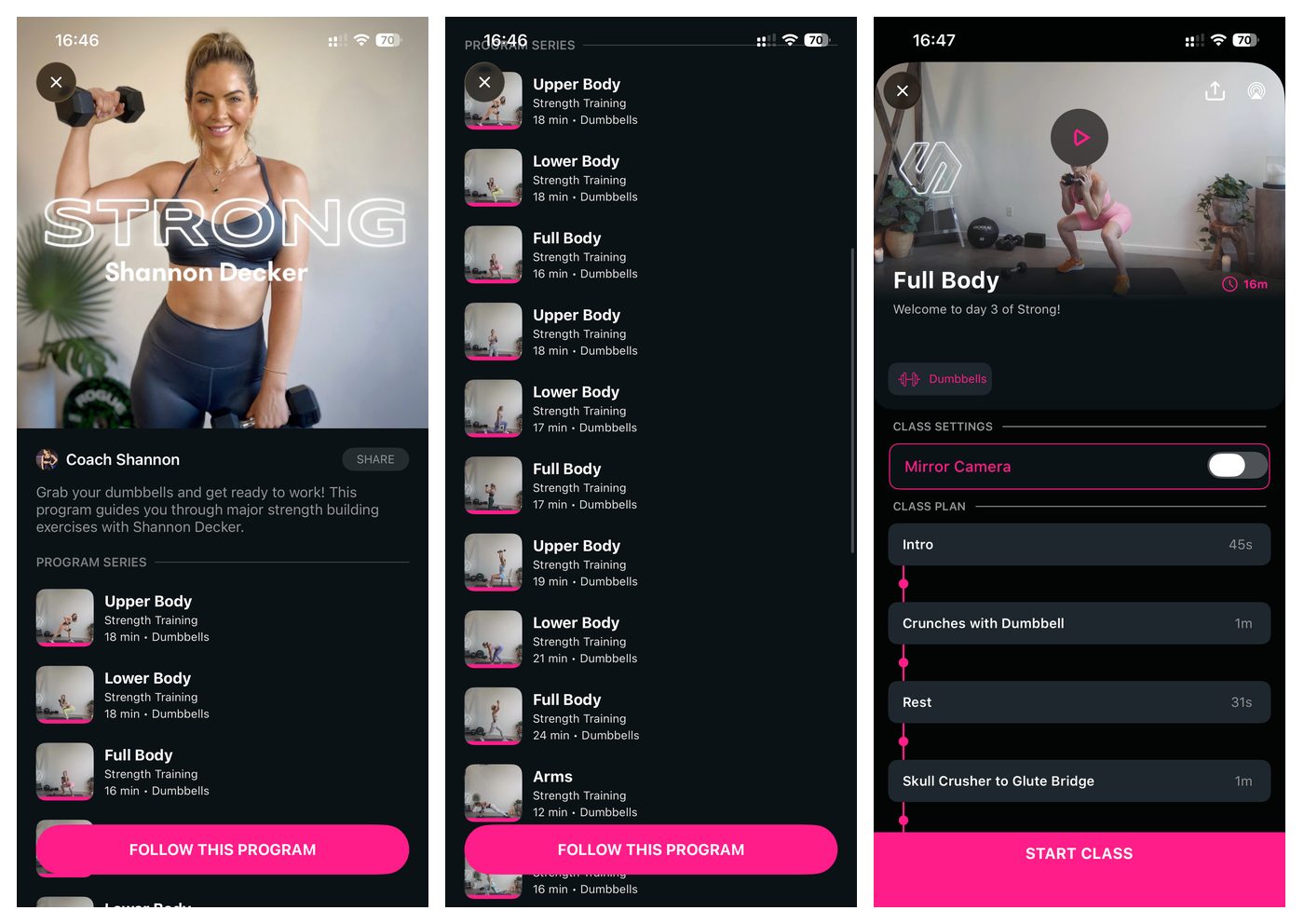
What is still missing is credentials. The coaches are named but no certification, qualifying body or clinical background is stated for any of them, and there is no medical or scientific advisory board. So the position is a middle one: these are real, identifiable people leading the training, and you cannot check what any of them is qualified in.
The Programmes
The guided programmes are the structured path, and they run from beginner to advanced strength training without you having to plan anything.
| Programme | What it is |
|---|---|
| Shape | Glute and core-focused strength with scalable full body work, using dumbbells and a loop band. This is what I was put on |
| Spark | Hypertrophy training, controlled progression and functional strength |
| Tone | Cable movements, high reps, focused tension and precision work |
| Crosstrain | Functional movements, powerful lifts and high intensity circuits |
| Form | Low-impact Pilates to sculpt, strengthen and align |
Form deserves a flag for this audience. A dedicated low-impact Pilates track is exactly what a woman with joint concerns or a pelvic floor that objects to jumping needs as an entry point, and it is not something SHRED mentions anywhere in its public marketing.
Each programme is adjustable for session length and how many days a week you train, and switching between them takes a couple of taps. The strength work uses logged loads and progresses as you get stronger, which is the mechanism that actually matters for muscle and bone in midlife.5
The Studio Classes
The class library is much broader than the strength programmes suggest, and browsing it was the point where I started making a list of things to try.
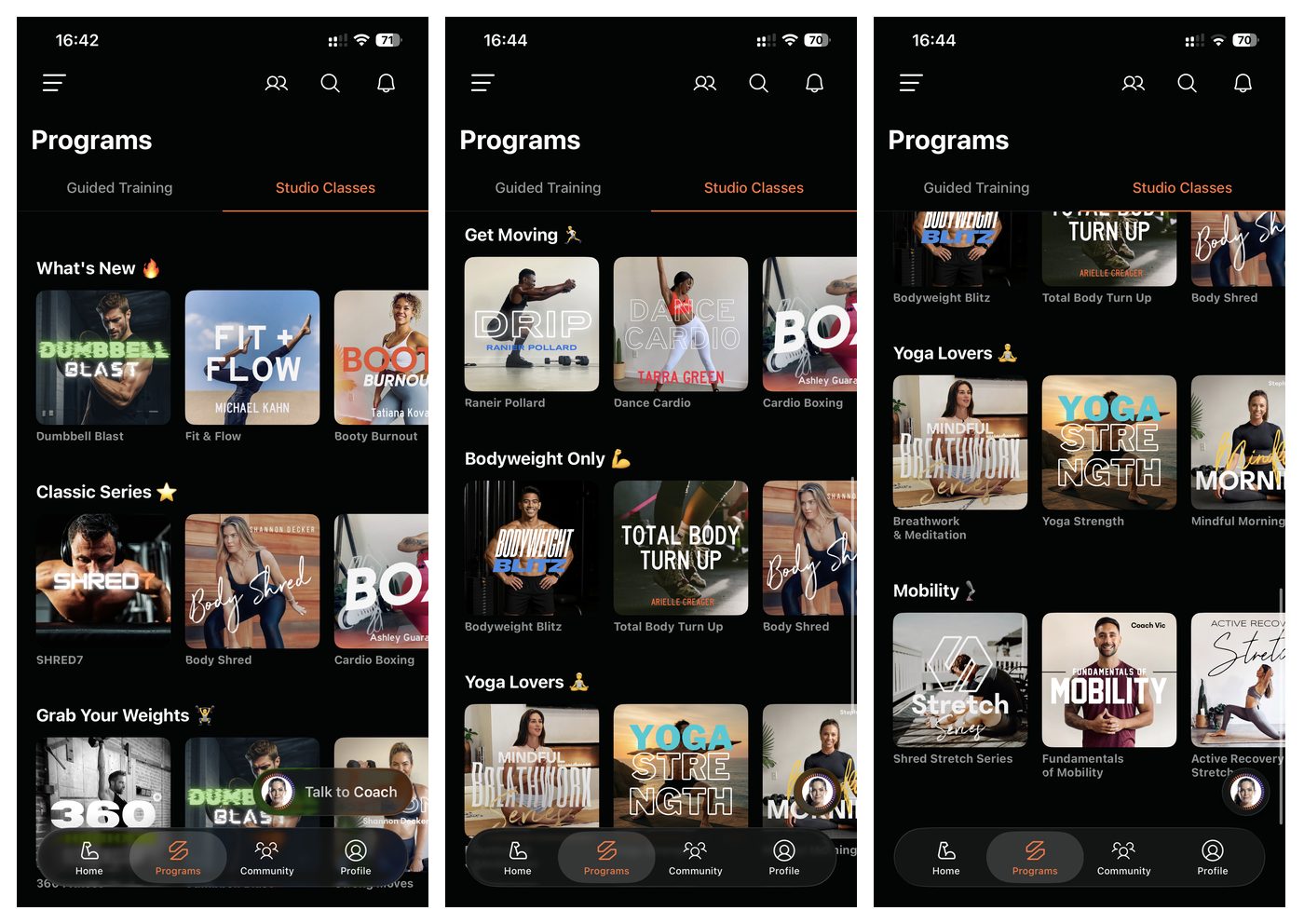
The categories run to strength training, yoga, sculpt, stretch, dance cardio, boxing and mobility, organised into named series. Yoga Lovers includes a Breathwork and Meditation series and a Mindful Morning series. Mobility includes Fundamentals of Mobility, a Shred Stretch Series and Active Recovery Stretch. Bodyweight Only covers the days you have no equipment.
That matters for scoring, because it is the difference between a pure lifting app and something you can use on a week when lifting is not what you need. Recovery, mobility and mind-body work all exist here, and none of it is visible from SHRED’s store listing.
Content and Features
| Feature | Available | Detail |
|---|---|---|
| Guided strength programmes | Yes | Shape, Spark, Tone, Crosstrain and Form, adjustable for duration and weekly frequency |
| Progressive overload | Yes | Logged loads, AI weight recommendations, and the coach will tell you when to increase |
| Low impact option | Yes | Form is a low-impact Pilates programme, and the coach gives low-impact substitutions on request |
| Studio classes | Yes | Strength, yoga, sculpt, stretch, dance cardio, boxing and mobility, 12 to 24 minutes |
| Meditation and breathwork | Yes | A Breathwork and Meditation series and a Mindful Morning series under Yoga Lovers |
| Recovery and mobility | Yes | Fundamentals of Mobility, Shred Stretch Series, Active Recovery Stretch, plus a Quick Stretch top-up |
| Cardio top-ups | Yes | Quick Cardio and Quick HIIT offered after every session, around five minutes each |
| Warm-up | Optional | A Warm Up Circuit toggle exists in Training Settings. It was switched off by default on my account |
| Form coaching | Yes | Video plus a written cue for each movement explaining what to watch for |
| AI coach | Yes | Answers training, nutrition, modification and life-stage questions. Personality is adjustable |
| Human coach assigned | No | Coaches lead classes and programmes. Nobody is assigned to you |
| Menopause programming | No | No programmes, videos or podcasts. The AI coach answers questions when asked |
| Pelvic floor | No | No workouts. The coach gave advice on request |
| Nutrition | No | No meal plans, macro tracking or food logging. The coach answers nutrition questions |
| Community | Yes | Friend challenges, gym leaderboards, a live workout feed. Opt-out available |
| Supplement shop | Yes | Own-brand store, a top level nav item on every page |
What Equipment You Need for SHRED
Nothing, and the flexibility here is one of its real strengths. The questionnaire asks what you have access to, with options running from bodyweight only through a minimal dumbbell setup to a garage gym or a full commercial gym, and it builds the programme around your answer. I ran it on a minimal setup.
Adjustable dumbbells
The single most useful purchase for Shape or Spark at home. Adjustable pairs let you increase load when the coach tells you to, without buying a rack of fixed weights.
~$60
Heavy adjustable dumbbells
For more advanced lifters on Spark or Crosstrain, where the coach keeps pushing the load up. One pair adjusts up to about 50 lb.
~$350 to $430
Loop band
Named in the Shape programme description. Cheap, and it does the glute work the programme is built around.
~$15 to $25
Kettlebell
One moderate bell covers the hinge and carry work in the conditioning programmes and in Crosstrain.
~$40
Exercise mat
Needed for Form, the yoga classes and the stretch and mobility series, all of which are floor based.
~$22
Heavier resistance bands
A stronger set for when the loop band stops being a challenge on the glute and lower body work.
~$15 to $25
Adjustable bench
Opens up presses, rows and step-ups at home. The garage gym and full gym presets use one.
$60 to $120
Treadmill
For the Quick Cardio top-ups. The one I took was a treadmill circuit with intervals and timed sprints.
~$300+
Stationary bike
A low-impact way to do the cardio top-ups, and the swap the coach suggested for high-impact moves when I asked about my knees.
~$300 to $550
Tip: start on the free tier with whatever you already own. The questionnaire will build around it, and you will learn quickly whether the interface suits you before spending anything on either the subscription or the kit.
Equipment links may be affiliate links. We earn a small commission at no extra cost to you.
How We Scored SHRED: the 6.9 / 10 Breakdown
| Category | Weight | Score | Weighted |
|---|---|---|---|
| Time Efficiency | 15% | 8.0 | 1.20 |
| Muscle Potential | 18% | 9.0 | 1.62 |
| Women Over 40 Specificity | 10% | 4.8 | 0.48 |
| Joint Friendliness | 12% | 7.0 | 0.84 |
| Recovery Compatibility | 10% | 6.0 | 0.60 |
| Programme Structure | 12% | 7.5 | 0.90 |
| Value for Money | 8% | 6.5 | 0.52 |
| UX and Design | 8% | 7.0 | 0.56 |
| Nutrition Integration | 7% | 2.0 | 0.14 |
| Total | 100% | 6.9 / 10 |
Scoring notes
Muscle potential (9) is the highest score here and it is earned. Logged loads, genuine progressive overload, hypertrophy programmes, full barbell support for anyone in a gym, and a coach that tells you when to increase weight.
Time efficiency (8) reflects the twenty minute sessions and the fact that they stack. A short session that can become a longer one on demand solves a real midlife problem better than a fixed hour.
Joint friendliness (7) rose substantially on testing. Form is a low-impact Pilates track, strength work is low impact by nature, and the coach produced specific joint-angle guidance for knees within seconds of being asked. It is not higher because none of that is signposted: you have to find Form, or know to ask.
Women over 40 (4.8) is the composite of the twelve capabilities. The menopause group still averages 2 out of 10, because answering a question is not programming, and there is no education, no pelvic floor work and no hormone-phase structure. That group is what holds an otherwise strong app down.
Nutrition (2) stays low deliberately. The coach gives sensible answers on protein timing, and there is no tracking, no targets and no meal planning, while a supplement shop sits in the main navigation.
Final tested score: 6.9 / 10
A strong strength app that adapts to midlife properly, through its coach rather than through built-in menopause content.
Is SHRED Good for Women Over 40?
Better than it has any right to be, and better than several apps that are sold on exactly this.
What it gets right starts with the training itself. The strength work is compound, progressive and properly loaded, which is what the evidence supports for holding onto muscle and bone through the menopause transition.25 The sessions are short enough to actually happen. The equipment flexibility means it works whether you are in a spare room or a gym. And the coach will adapt any of it around a joint problem or a life stage the moment you raise it.
What it does not have is equally clear, and I want to be precise because the distinction matters. There are no menopause programmes. There are no educational videos or podcasts about perimenopause. There are no pelvic floor workouts. There is no nutrition support. None of that exists as content, and if you want to be taught about what is happening to your body, this is not where you will learn it.
The question is how much that matters, and my answer after a week is: less than I expected, because the coach fills the gap for anyone who knows what to ask. I got a programme recommendation for perimenopause, knee modifications with a specific flexion limit, pelvic floor advice and protein guidance, all in the time it would have taken me to open a search engine. For a woman with limited time and a reasonable idea of what she needs, that is genuinely valuable.
The caveat is the one in the section above. It only works if you ask, and the women who most need menopause-aware training are often the ones who do not yet know what to ask for.
How SHRED Fits Perimenopause, Menopause and Beyond
How SHRED Fits Perimenopause, Menopause & Beyond
Women Over 40 is our most important criterion, and here's the full breakdown behind it.
SHRED is strongest for progressive strength, and weakest for menopause education, menopause programming, pelvic floor, hormone awareness, expert credibility and midlife nutrition, in our menopause and midlife capability assessment for women over 40.
At a glance
What the app teaches about perimenopause and/or menopause, not whether the training suits a midlife body.
| Capability | Score | Rating | Why |
|---|---|---|---|
| Right training for a midlife body | |||
| Low-impact | 7/10 | Strong | Form is a dedicated low-impact Pilates programme and strength work is low impact by nature. The coach gives low-impact substitutions on request. The conditioning programmes are not low impact and none of this is signposted. |
| Progressive strength | 9/10 | Best-in-class | Logged loads, AI weight recommendations, hypertrophy programming, barbell support and a coach that tells you when to increase. The strongest thing in the app. |
| Bone loading | 7/10 | Strong | Heavy compound loading is available across bodyweight, minimal, garage gym and full gym presets. No impact protocol and no bone-specific programming. |
| Recovery & deload | 5/10 | Some | Fundamentals of Mobility, Shred Stretch Series, Active Recovery Stretch and a Quick Stretch top-up. No deload structure observed, and one week cannot confirm one. |
| Menopause education and programming* | |||
| Menopause programming | 3/10 | Minimal | No menopause programmes. The coach named two programmes that suit perimenopause when asked, which is a recommendation rather than programming. |
| Pelvic floor | 3/10 | Minimal | No pelvic floor workouts. The coach gave advice when asked. |
| Hormone awareness | 3/10 | Minimal | The coach answered a perimenopause question soundly, tied it to bone density and referred to a doctor on load. No product-level awareness. |
| Menopause education | 1/10 | None | None. No articles, videos or podcasts, and the word does not appear on the website or either store listing. |
| Expert credibility | 3/10 | Minimal | Twelve named, identifiable coaches lead the programmes and classes. No certification or qualifying body is stated for any of them and there is no clinical advisory board. |
| Whole-woman support | |||
| Mind-body support | 6/10 | Some | Breathwork and Meditation series, Mindful Morning series, yoga and boxing in the class library. |
| Beginner on-ramp | 6/10 | Some | Questionnaire-led setup, programmes that scale beginner to advanced, video plus written form cues, and a permanent free tier. The warm up circuit is off by default. |
| Midlife nutrition | 3/10 | Minimal | No tracking, targets or meal plans, and a supplement shop in the main navigation. The coach handled protein timing well on request. |
ScaleBest-in-classStrongSomeMinimalNone
What the sources say: Scores come from one week of hands-on use on iPhone in September 2026: three Shape sessions, one treadmill top-up and several coach conversations, plus verification of pricing, terms and both store listings and 250 sampled user reviews. Long-term progression, deload structure and the Android build are outside what one week can judge.
* What the app teaches and programmes around menopause, not whether the training suits a midlife body. Many programmes that score low here are still a good fit, they simply never use the word. A high score is not proof either: a few menopause videos added to a general library lifts this score without changing the training.
These are evidence-informed suitability ratings, not clinical measurements. They combine exercise science with product-specific research and, where indicated, hands-on testing, alongside multi-source verification, and are approximate. Individual response varies. A starting point, not medical advice. How we score menopause fit
What the Research Says: SHRED’s Claims Checked
The training modality SHRED delivers has good evidence behind it for women in midlife, and the app itself has never been tested.
On resistance training, a 2024 systematic review and meta-analysis of twelve randomised trials in healthy postmenopausal women found significant improvements in lower body strength, upper body strength and cardiorespiratory fitness against controls, on roughly three sessions a week.2 That is the protocol I ran.
The picture for muscle size is more nuanced and worth knowing before you start. A 20 week controlled trial found strength increased significantly in every group regardless of menopause status, but fat-free mass and muscle thickness increased only in the pre-menopausal women.3 A separate randomised trial found higher volume produced more lean mass but no additional strength.4 So expect to get stronger. Visible muscle gain after menopause is harder and is not a failure on your part.
On bone, the LIFTMOR trial remains the strongest evidence: eight months of twice weekly supervised high intensity resistance and impact training improved lumbar spine bone mineral density by 2.9% against a 1.2% loss in controls.5 A 2021 meta-analysis of 53 trials found intensity matters at the spine, but that high intensity was not superior at the femoral neck, a null the authors attribute to low statistical power.6 Both were supervised in person, which SHRED is not.
On the AI coach, the position to hold is that auto-regulated load prescription is a studied method that performs comparably to a fixed percentage-based plan rather than better than one,7 and the evidence base for AI-driven exercise technology is small and short-term.8 The coach was useful to me. That is my experience, not a trial result.
The Royal Osteoporosis Society recommends both impact and muscle-strengthening exercise, advises building up gradually, says anyone with a history of multiple or spinal fractures should check with a doctor or physiotherapist first, and states that exercise is not a replacement for osteoporosis medication.9
What Users Report: Verified Sentiment
My week was good. The wider review record is more mixed, and the split runs along platform lines.
| Measure | Rating | Sample, checked September 2026 |
|---|---|---|
| App Store, lifetime | 4.82 | 40,384 ratings |
| Google Play, lifetime | 4.52 | 1,940 ratings |
| Google Play, newest written reviews | 3.37 | 150 reviews |
| Google Play, last six months | 3.12 | 41 reviews |
The gap between the star rating and the written reviews is partly structural. Most App Store ratings come from in-app prompts that collect a tap with no text and tend to fire after a good moment, while written reviews take effort and take it disproportionately from people who are annoyed. We found no evidence of purchased reviews and the developer has not used a version reset to bury old ones.
What the written record does show, in our sample of the 150 newest Google Play reviews coded in September 2026, is that crashes and freezing account for 40 of the 71 negative reviews, and that reviewers switching from iPhone to Android report the Android build missing progress tracking, health integration and the AI chat at the same price. Billing complaints account for 10 of the 33 negative reviews in our sample of 100 App Store reviews, the pattern being charges landing during a trial.
I tested on an iPhone and had none of these problems. If Android is your main phone, weigh that review record more heavily than my week.
SHRED Specifications
| Specification | Detail |
|---|---|
| Platform | Native mobile app only. No web app, no Apple TV, no Mac |
| Devices | iPhone and iPad from iOS 17, Apple Vision, Apple Watch from watchOS 10, Android |
| Session length | Adjustable. I ran about 20 minutes and stacked when I wanted more. Studio classes run 12 to 24 minutes |
| Frequency | Set in the app. I ran three strength sessions a week plus one cardio top-up |
| Equipment | None required. Presets for bodyweight, minimal, garage gym and full gym |
| Wearables and health | Apple Watch and Apple Health. No Garmin or Fitbit, and Android health sync is undocumented |
| Casting and subtitles | No casting or subtitles documented, which is a gap on a video-led product |
| Languages | Seven |
| Impact level | Your choice. Strength and Form are low impact, the conditioning programmes are not |
| Difficulty | Beginner to advanced. The programmes scale in both directions |
| WHO guideline for context | 150 to 300 minutes moderate activity weekly, plus muscle strengthening for all adults1 |
SHRED Price 2026: What You Actually Pay
$19.99 per month or $119.99 per year on the website, with a permanent free tier and a 7 day trial on the annual plan. All figures USD. SHRED publishes no GBP pricing.
| Plan | Price | What you get |
|---|---|---|
| Free | $0 forever | Limited library, basic tracking, standard demos. No personalised programming and no AI progression. The terms limit it to the Classic workout style |
| Annual | $119.99 per year | Full access. Marketed as $9.99 per month, though the arithmetic is $10.00. Includes the 7 day trial |
| Monthly | $19.99 per month | Full access. No trial on the website, though the App Store purchase list contains a Free Trial Monthly SKU, so in-app terms may differ |
| Weekly, in-app only | $9.99 per week | Not shown on the public pricing page. Works out at $519.48 a year |
| Occupational discount | Up to 30% off | Military, first responders, medical professionals, teachers and students, on emailed proof |
Check the billing period before you tap. SHRED markets its annual plan as “just $9.99 per month”. There is also a live in-app purchase called SHRED UNLIMITED (WEEKLY) priced at $9.99, which does not appear on the public pricing page. At $9.99 a week you would pay $519.48 a year against $119.99. Same number on the button, more than four times the cost.
The in-app list also contains SKUs at $12.99 monthly and $99.99 yearly, below the advertised prices, and SHRED does not disclose why. Google Play declares its purchase range as $9.99 to $99.99, which excludes $119.99, so the Android annual may top out lower. Treat the advertised prices as a ceiling.
Cancellation and Billing
Cancelling is self-service on every route, with one trap SHRED documents itself.
Cancel through whichever platform you signed up on: Apple settings, the Play Store subscriptions screen, or the Stripe login for web subscribers. Auto-renewal must be switched off at least 24 hours before the period ends.
SHRED’s own FAQ states: “Please note that deleting your account does NOT stop your recurring payments.” Uninstalling the app and deleting your account is not cancelling. The terms also state that “subscription fees paid are non-refundable” and that you will “not be eligible for a prorated refund”, so there is no money-back guarantee.
Will You Actually Stick With It?
SHRED Pros and Cons
What works
- An AI coach that gave specific, useful answers on knee modifications, perimenopause, protein timing and when to increase load
- Genuine progressive overload with logged weights, not a toning programme
- Twenty minute sessions that stack when you want more
- Form, a dedicated low-impact Pilates programme, which SHRED never advertises
- Works for bodyweight, a minimal setup, a garage gym or a full gym, and the questionnaire builds around it
- Cardio, HIIT and stretch top-ups offered at the end of every session
- Named coaches leading classes and programmes, with video and written form cues
- Broad class library: strength, yoga, sculpt, stretch, dance, boxing, mobility, breathwork and meditation
- A permanent free tier, so you can test the interface for nothing
- Up to 30% off for teachers, students, medical staff, military and first responders
What does not
- No menopause programmes, educational videos or podcasts. The coach answers, but only if you ask
- No pelvic floor workouts, on a platform where the coach will discuss pelvic floor on request
- No nutrition tracking, targets or meal plans, but a supplement shop in the main menu
- No certification or qualification stated for any of the named coaches, and no clinical advisory board
- The website, store listings and code name no coach at all, so the product looks far worse from outside than it is
- A $9.99 weekly SKU that is not on the public pricing page
- Deleting your account does not stop the billing, by SHRED’s own admission
- No money-back guarantee, and fees are non-refundable and not prorated
- Android is materially worse than iOS at the same price, and recent Play sentiment is falling
- A 9kg weight loss forecast presented before you have trained once
- The warm up circuit is off by default
How SHRED Compares
| SHRED | Fitbod | Ladder | Sweat | Caliber | |
|---|---|---|---|---|---|
| Our score | 6.9 | 5.8 | 6.9 | 6.9 | 7.3 |
| Menopause fit | 4.8 | 3.2 | 3.6 | 4.5 | 4.7 |
| Muscle potential | 9 | 8 | 9 | 7 | 9 |
| Joint friendliness | 7 | 5 | 5 | 6.5 | 7 |
| Nutrition | 2 | 0 | 5 | 6.5 | 7 |
| Monthly price | $19.99 | $15.99 | $29.99 | $24.99 | About $12 on Caliber Plus |
| Annual price | $119.99 | $95.99 | $179.99 | $134.99 | About $72 on Caliber Plus |
| Permanent free tier | Yes | No | No | No | Yes |
| AI coach you can question | Yes | No | No | No | No |
| Assigned human coach | No | No | Yes, named coaches | Yes, named trainers | Yes, accredited coach |
| Low impact track | Yes, Form | No | No | Limited | Varies |
| Perimenopause content | None built in | None | None | Limited | None |
| Best suited to | A confident lifter who will ask questions and trains in changing places | A confident lifter who wants the purest strength planning engine | Someone who wants credentialled humans behind the programme | A beginner who wants structure and short dumbbell sessions | Someone who wants one to one coaching accountability |
SHRED against Fitbod, the closest comparison
Both are AI-led strength apps with no menopause content. Fitbod is the purer planning engine and it is cheaper. SHRED gives you coach-built multi-week programmes rather than reactive session generation, a class library covering yoga, mobility and breathwork, a low-impact Pilates track, a permanent free tier, and a coach you can actually ask things. On a week of use the coach is what separates them, and it is why SHRED now scores meaningfully higher for this audience.
SHRED FAQ
Better than expected, and better than several apps marketed at this age group. The strength training is compound and progressive, which is what supports muscle and bone through the menopause transition, sessions can be set to around twenty minutes, and there is a low-impact Pilates programme called Form. The AI coach gave specific knee modifications and a perimenopause programme recommendation when asked. Against that, there are no menopause programmes, no educational content, no pelvic floor workouts and no nutrition support. It scores 4.8 out of 10 on menopause fit against 6.9 out of 10 overall.
No built-in content. There are no menopause programmes, videos or podcasts, and the word does not appear on SHRED’s website or either store listing. What it does have is an AI coach that answers menopause questions on request. Asked what programme suits perimenopause, it recommended blending strength with steady cardio to support bone density, named two programmes that fit, and advised checking the load with a doctor. That is useful if you know to ask, and it is not the same as menopause-aware programming.
$19.99 per month or $119.99 per year on SHRED’s website, which works out at $10.00 a month. There is a permanent free tier at $0 and a 7 day trial on the annual plan. In-app purchase prices differ and include options at $12.99 monthly and $99.99 yearly, plus a weekly option at $9.99 that is not shown on the public pricing page and works out at $519.48 a year.
It can be. Form is a dedicated low-impact Pilates programme, and the strength programmes are low impact by nature. The conditioning programmes are not. The AI coach also gives specific low-impact substitutions when asked, including swapping high-impact work for cycling or rowing and keeping knee flexion under ninety degrees. None of this is signposted, so you have to find Form or know to ask.
It is a chat coach inside the app that answers training, nutrition and modification questions, with an adjustable personality. In a week of testing it gave a specific technique answer for making workouts harder, protein timing guidance, joint-angle modifications for knees, and a programme recommendation for perimenopause, each in seconds. It is a language model rather than a clinician, and it did refer to a doctor on the load question. Its usefulness depends entirely on knowing what to ask it.
There is a genuinely permanent free tier, not just a trial. It gives a limited workout library, basic tracking and standard exercise demonstrations, with no personalised programming and no AI progression. SHRED’s terms limit the free tier to the Classic workout style only, which is narrower than the pricing page suggests.
Cancel through whichever platform you signed up on. On iPhone: Settings, your name, Subscriptions, select SHRED, cancel. On Android: Play Store, profile icon, Subscriptions, select SHRED, cancel. Web subscribers log in at login.shred.app. Turn auto-renewal off at least 24 hours before your period ends. Important: SHRED states that deleting your account does not stop your recurring payments, so uninstalling is not cancelling.
They are entirely different companies. SHRED is made by Shred Labs, LLC at shred.app and is an AI-led strength training app. V Shred is a separate fitness brand at vshred.com run by V Shred LLC. There is also a third company, Shred Apps, LLC, with a near-identical name. Reviews for all three circulate together in search results, so check which product a review is actually about.
Final Verdict
6.9 / 10
I came to SHRED expecting a bodybuilding app and left it with a subscription. The strength training is the real thing, the sessions fit around a life, and the AI coach turned out to be the feature that made the difference, adapting the programme around my knees and my life stage faster than I could have researched it myself.
The gap is that none of that adaptation sits in the programmes themselves, it sits in the coach. And two commercial practices still count against it: a weekly subscription priced at the same number as the advertised monthly rate and hidden from the public pricing page, and an app that confirms in its own FAQ that deleting your account will not stop it charging you.
Best for: women from their late thirties onwards, whether that is late premenopause, perimenopause, menopause or after it, who want proper strength training, train in varied places, and have menopause care and nutrition handled elsewhere.
Not ideal for: anyone who wants menopause education or pelvic floor work built into the programmes, anyone who needs nutrition support, and anyone whose main device is an Android phone.
Open the coach chat in your first session. It is where SHRED earns its score.
- Price
- $19.99/mo or $119.99/yr
- Free trial
- Permanent free tier, 7 day trial on the annual plan
Testing Status
Sample tested. I used SHRED for one week on an iPhone: three strength sessions on the Shape programme, one treadmill top-up and a couple of walks, plus time in the class library and several conversations with the AI coach. All screenshots on this page are my own. Scores are based on that week plus verification of pricing, terms, store listings and 250 sampled user reviews. One week is a real test and it is not a long one, so anything about long-term progression, deload structure or how the library grows is beyond what I can tell you yet. If I train on it for longer this page will be updated and re-scored rather than replaced.
Sources and Further Reading
- Bull FC, Al-Ansari SS, Biddle S, et al. 2020. World Health Organization 2020 guidelines on physical activity and sedentary behaviour. British Journal of Sports Medicine 54(24):1451 to 1462. doi.org/10.1136/bjsports-2020-102955
- González-Gálvez N, Moreno-Torres JM, Vaquero-Cristóbal R. 2024. Resistance training effects on healthy postmenopausal women: a systematic review with meta-analysis. Climacteric 27(3):296 to 304. doi.org/10.1080/13697137.2024.2310521
- Isenmann E, Kaluza D, Havers T, et al. 2023. Resistance training alters body composition in middle-aged women depending on menopause: a 20 week control trial. BMC Women’s Health 23:526. doi.org/10.1186/s12905-023-02671-y
- Nascimento de Oliveira-Júnior G, de Sousa JFR, Carneiro MADS, et al. 2022. Resistance training volume enhances muscle hypertrophy, but not strength, in postmenopausal women: a randomized controlled trial. Journal of Strength and Conditioning Research 36(5):1216 to 1221. doi.org/10.1519/JSC.0000000000003601
- Watson SL, Weeks BK, Weis LJ, et al. 2018. High-intensity resistance and impact training improves bone mineral density and physical function in postmenopausal women with osteopenia and osteoporosis: the LIFTMOR randomized controlled trial. Journal of Bone and Mineral Research 33(2):211 to 220. doi.org/10.1002/jbmr.3284
- Kistler-Fischbacher M, Weeks BK, Beck BR. 2021. The effect of exercise intensity on bone in postmenopausal women (part 2): a meta-analysis. Bone 143:115697. doi.org/10.1016/j.bone.2020.115697
- Hickmott LM, Chilibeck PD, Shaw KA, Butcher SJ. 2022. The effect of load and volume autoregulation on muscular strength and hypertrophy: a systematic review and meta-analysis. Sports Medicine Open 8:9. doi.org/10.1186/s40798-021-00404-9
- Gabarron E, Larbi D, Rivera-Romero O, Denecke K. 2024. Human factors in AI-driven digital solutions for increasing physical activity: scoping review. JMIR Human Factors 11:e55964. doi.org/10.2196/55964
- Royal Osteoporosis Society. Exercise for bones. theros.org.uk (accessed September 2026)
- Romeo A, Edney S, Plotnikoff R, et al. 2019. Can smartphone apps increase physical activity? Systematic review and meta-analysis. Journal of Medical Internet Research 21(3):e12053. doi.org/10.2196/12053
Related Guides
What To Do Next
Start on the free tier. It is permanent rather than a trial, so you can see whether the interface and the programmes suit you before paying anything.
If you subscribe, take the annual plan and check the billing period on the purchase screen, because of the weekly option described above.
And whatever you decide, open the coach chat in your first session. It is the difference between a good general strength app and one that adapts to you, and nothing in the app tells you that.