
The paid app from Bodybuilding.com, with a large library of real, structured strength and hypertrophy programmes for the gym or home, an exercise-video database and a solid weight and rep tracker · a serious muscle and bone builder, with far more for women than the name suggests · but no menopause, joint-injury or beginner modifications · Dumbbells or a barbell and a mat.
How I tested this. I downloaded BodyFit and spent time exploring its programmes and trying its workouts, including the women’s and home, minimal-equipment options, using the exercise videos and logging my weights and reps. This is a sample-tested review based on that hands-on trial plus research into the app, its programmes and pricing. This is education, not medical advice; check with your clinician before starting a strength programme, especially with a joint injury or pelvic-floor or heart concerns, and consider a qualified coach for form if you are new to lifting.
BodyFit Review 2026: Quick Answer
Sample tested: downloaded and trialled the app, tried the women’s and home programmes, plus research
Women who know their way around lifting and want a serious, affordable strength library for the gym or home
You need joint-injury or beginner modifications, menopause or pelvic-floor programming, or a holistic, guided plan
A paid strength and bodybuilding app: 2,500-plus workouts across 100-plus programmes, with a tracker
Whatever the programme calls for, typically 30 to 60 minutes, self-paced
Depends on the programme; gym or home options, many workable with dumbbells and minimal kit
Low-impact, as strength training is, but with no modifications for existing joint injuries
Its core strength: real progressive strength and hypertrophy programming, which builds muscle and bone
Far more than the name suggests: plenty of women’s programmes for gym or home, with clear posture cues
The right kind of training for a midlife body, but no menopause, hormone or pelvic-floor content
None: self-directed, with exercise videos and posture cues but no live coaching or modifications
iOS, Android and web; no Apple Watch or Health integration
$9.99 a month or $49.99 a year, with a 7-day free trial
A 7-day free trial; no permanent free tier
6.4 / 10
Quick Verdict
Worth it for women over 40? If you know what you are doing with weights, yes, it is a serious, affordable way to build strength. But it is not a holistic or perimenopause or menopause plan, and it has no modifications for joint injuries or beginners.
BodyFit earns 6.4/10 in this sample-tested review. My first surprise was that, despite the name, it is absolutely not just for men: there are plenty of programmes written for women, to do at the gym or at home with minimal equipment. Some come with a whole-programme video, others use short exercise clips you click through, and every exercise explains the posture and what to do, with a tracker that logs your weights and reps so you can see your progress. On the thing that matters most for a midlife body, building strength, it is genuinely serious: real progressive programming from credible coaches, which is exactly what protects muscle and, over time, bone density.
Where it is limited for our audience. The gaps are real. There are no alternatives for people with joint issues, which I noticed straight away with an old meniscus injury, and no gentler beginner options within a programme, so you are expected to know how to adapt. There is no perimenopause or menopause programme, no pelvic-floor work and no real nutrition, and while there is a shop, it is protein powders and supplements. The app also has a bodybuilding focus throughout and some reported bugs. Use it if you are confident with lifting and want a strong, cheap strength library, and plan to mix in your own low-impact and recovery work, because this is the strength piece, not the whole plan.
Is Bodybuilding.com App and BodyFit right for you?
BodyFit by Bodybuilding.com is strongest for building bone density (7.5 out of 10, against a 5.1 average across the 77 programmes scored) and weakest for starting strength training (3.5 against 6.1).
| Question | Verdict | Rating | Score |
|---|---|---|---|
| How it suits a perimenopausal body | |||
| Is BodyFit by Bodybuilding.com good for pelvic floor problems?Based on pelvic floor support and low-impact design | Low, about the same as mostmost score 4.6/10 | 4.5 / 10 | |
| Is BodyFit by Bodybuilding.com genuinely built for perimenopause and menopause?Based on menopause programming, hormone awareness, education and expert credibility | Low, and worse than mostmost score 3.3/10 | 2.0 / 10 | |
| Is BodyFit by Bodybuilding.com good for painful joints?Based on low-impact design and recovery provision | Strong, and better than mostmost score 6.2/10 | 7.0 / 10 | |
| Is BodyFit by Bodybuilding.com manageable when your energy is low?Based on recovery provision and mind-body support | Low, and worse than mostmost score 5.7/10 | 4.0 / 10 | |
| Is BodyFit by Bodybuilding.com good if you are new to strength training?Based on beginner on-ramp and mind-body support | Low, and worse than mostmost score 6.1/10 | 3.5 / 10 | |
| Is BodyFit by Bodybuilding.com good for building bone density?Based on bone loading and progressive strength | Strong, and better than mostmost score 5.1/10 | 7.5 / 10 | |
| Does BodyFit by Bodybuilding.com help with nutrition?Based on midlife nutrition support | Low, and worse than mostmost score 4.0/10 | 2.0 / 10 | |
| How it performs as a product | |||
| Can you fit BodyFit by Bodybuilding.com into a busy week?Based on time efficiency | Strong, about the same as mostmost score 7.6/10 | 7.0 / 10 | |
| Is BodyFit by Bodybuilding.com worth the money?Based on value for money | Strong, about the same as mostmost score 6.9/10 | 7.0 / 10 | |
Jump to Section
What BodyFit and the Bodybuilding.com App Actually Are
A quick note on the name, because it can be confusing: the app you download from the store is called the Bodybuilding.com Fitness App, and BodyFit is the paid membership inside it, the subscription that unlocks the full programme library. So if you are looking for it, search for Bodybuilding.com, and BodyFit is the premium tier you sign up for. It is built around a large library of structured workout programmes, said to include over 2,500 workouts across more than a hundred multi-week plans, plus a workout tracker that logs your sets, reps and weights, and an exercise database with demonstration videos. You choose a programme, follow it session by session, and the app shows you each exercise and records your numbers so you can track your progress over time. It runs on iOS, Android and the web, though notably not on the Apple Watch, and there are store perks like member pricing on supplements.
For this audience it helps to be clear about what it is and is not. It is a serious, affordable strength and bodybuilding library, and, contrary to what the name suggests, it has plenty of programming for women, for the gym or for home with minimal equipment, which makes it a genuinely useful strength tool for a midlife body. What it is not is a guided, holistic or tailored programme: there is no menopause, hormone or pelvic-floor content, no real nutrition beyond a supplement shop, no coaching, and no modifications for joint injuries or beginners within a programme. Read BodyFit as a strong, cheap strength engine for someone who knows how to lift, rather than a supported midlife plan.
Who Is Behind BodyFit? Credibility
BodyFit comes from Bodybuilding.com, which has been a major fitness retailer and content hub since the late 1990s, and its credibility rests largely on the coaches and athletes who create its programmes. These include genuinely well-credentialed names, most notably Jim Stoppani, who holds a PhD in exercise physiology, alongside popular coaches and athletes such as Kris Gethin, Hannah Eden, Jamie Eason Middleton, whose LiveFit programme has long been a beginner-friendly favourite among women, and others. The programmes themselves are proper, structured, progressive plans rather than random workouts, which is a real strength.
How to read that credibility. On the training, BodyFit is trustworthy: experienced coaches, including a PhD, designing structured progressive programmes is exactly what you want for building strength. What it is not is a clinical, medical or menopause-aware brand: it is a bodybuilding and supplement business, with the aesthetics-focused culture and supplement marketing that come with that, and no clinicians, pelvic-health specialists or hormone-aware coaches involved. The company has also changed ownership several times over the years, so we do not pin down its current owner here. Trust the strength programming; do not expect midlife-specific guidance.
My Experience: What It Was Actually Like
Not what I expected. I admit I assumed Bodybuilding.com would be a men’s, muscle-magazine sort of app, and it absolutely is not. There are tons of workouts and programmes written for women, and you can choose to train at the gym or at home with minimal equipment, which immediately made it feel more usable than I expected. The programmes are properly structured, and it was easy to find one that suited how and where I wanted to train.
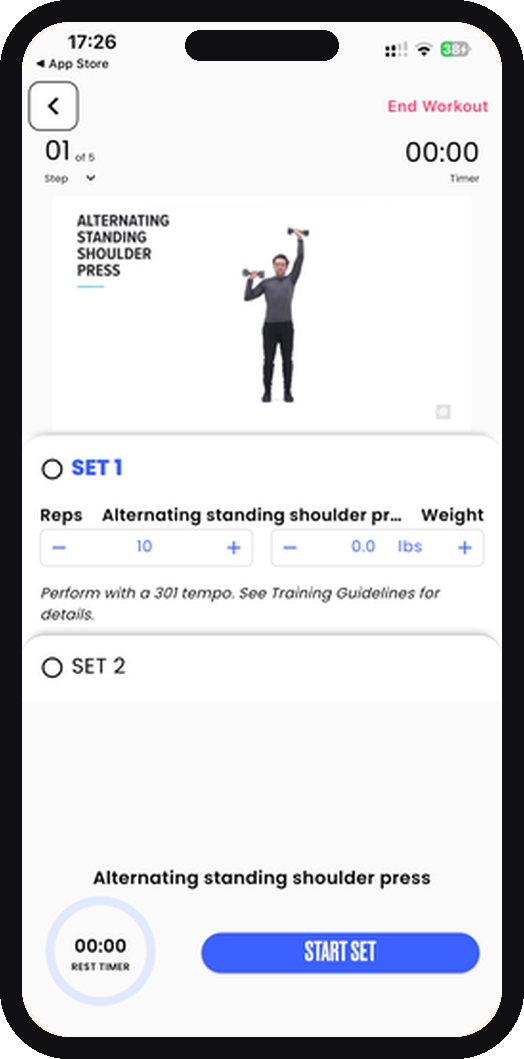
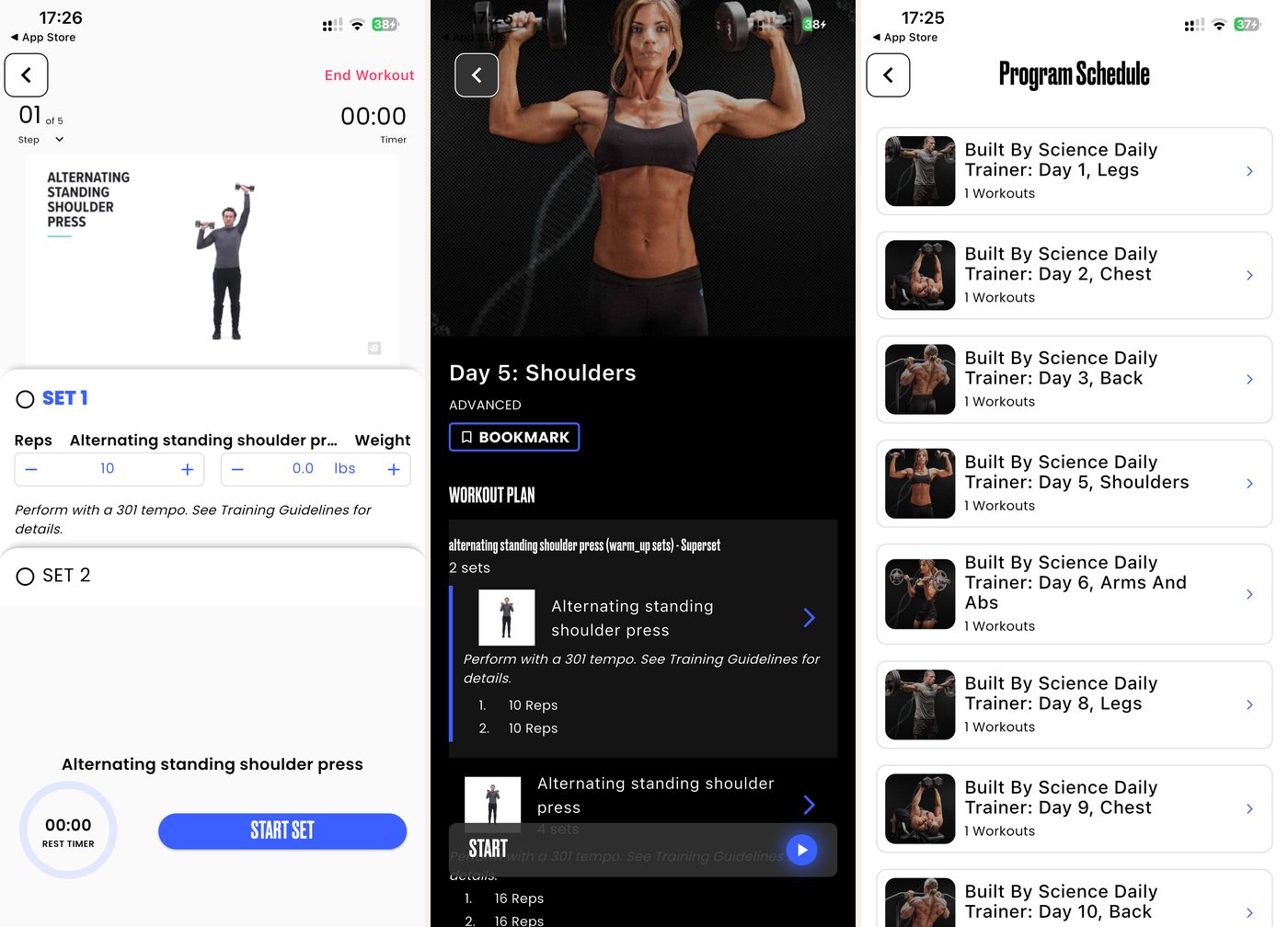
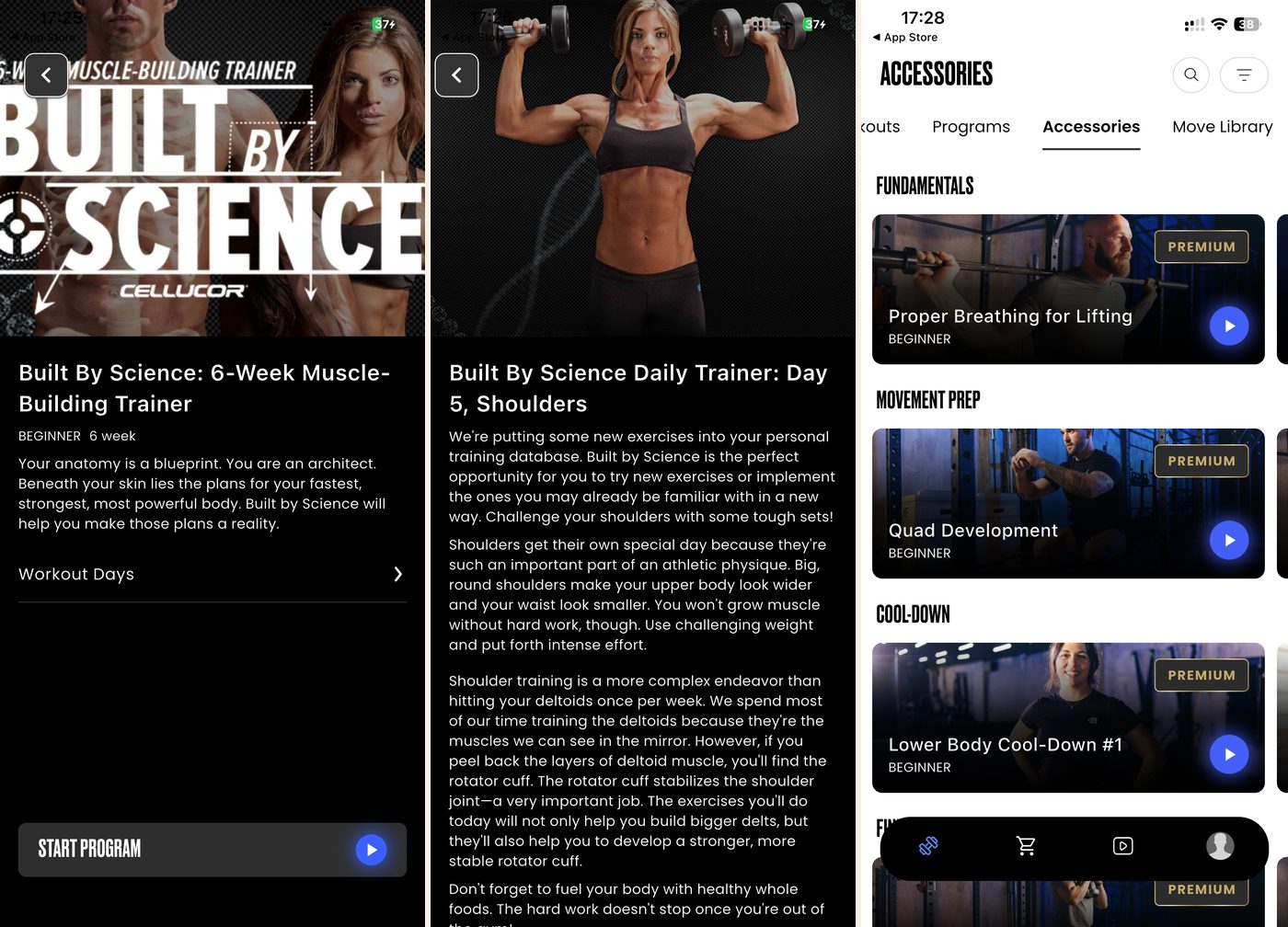
How the workouts work. The format varies in a good way. Some workouts come with a whole-programme video that walks you through what to do, and others use short video clips of each exercise that you click through, tapping next to move on. Either way, they explain the posture and what to do for each move, sometimes with a tempo to follow and a written note on the day’s training, which I appreciated, and you log your weights and reps as you go, with a rest timer, so you can measure your progress. There is even an accessories section with warm-up, movement-prep and cool-down clips. As a way to follow a serious strength plan and actually track your lifts, it does the job well.
What frustrated me. The big miss for me was the lack of options. There are no alternatives for people with joint issues, and with a previous meniscus injury I immediately wanted a way to swap or modify certain exercises, which simply is not there. There are also no gentler beginner alternatives built into a programme, so you are expected to already know how to adapt things yourself. And there is no perimenopause or menopause programme, so if you want a holistic plan built around a midlife body, this is not it. There is no real nutrition either, and while there is a shop, it is protein powders and supplements. My real takeaway is that if you know what you are doing, this is a serious bodybuilding app that will build muscle and, over time, bone density, but you will have to mix it yourself with low-impact work, recovery and whatever else you need.
Content and Features
At a glance: a large, affordable library of real progressive strength programmes for gym or home, with exercise videos, posture cues and a solid tracker, and far more for women than the name implies. Capped for our audience by no joint-injury or beginner modifications, no menopause or pelvic-floor content, no nutrition, a supplement-focused culture and some app bugs.
| Format | A paid app with 2,500-plus workouts across 100-plus structured programmes, a tracker and an exercise-video database, on iOS, Android and web. |
| Programmes | Strength, hypertrophy, fat loss, powerlifting, beginner and at-home plans, including plenty written for women, from coaches like Jim Stoppani and Jamie Eason. |
| Strength and bone | Its core strength: real progressive strength and hypertrophy training, the right stimulus for building muscle and bone. |
| Equipment | Gym or home options, with many programmes workable using dumbbells and minimal kit. |
| How workouts run | Some with a whole-programme video, others with short exercise clips you click through; each explains posture, and you log weights and reps. |
| Modifications | A real gap: no alternatives for joint injuries and no gentler beginner options within a programme. |
| Women over 40 / menopause | No menopause, hormone or pelvic-floor programming, though there is genuine women’s and home programming. |
| Nutrition | No real nutrition guidance; the shop is protein powders and supplements. |
| Coaching | None: self-directed, with videos and posture cues but no live coaching or form feedback. |
What Equipment Do You Need for BodyFit?
It depends on the programme you pick, which is one of BodyFit’s strengths: you can filter for gym plans that use barbells and machines, or home plans that need little more than a set of dumbbells and a mat. For training at home, a good adjustable set of dumbbells will run most of the home and women’s programmes, and because the whole point is progressive overload, weights that let you keep adding load are the most useful thing to own.
For a midlife body, dumbbells are the single most valuable purchase, because protecting muscle and bone comes down to lifting progressively heavier over time, and adjustable ones cover the widest range in the least space.
Recommended spec examples. These picks are curated for convenience by specification and feature fit, not personally lab-tested for long-term durability. Prices are examples; verify before buying.
Exercise mat
For the floor, core and accessory work at home.Recommended
Medium Dumbbells (up to 25 lb)
A versatile starting range for the home programmes.~$50 to $65
Advanced Dumbbells (up to 50 lb)
For heavier, progressive strength as you get stronger.~$350 to $430
A quick heads-up: some of the buy links above are Amazon affiliate links, so if you grab something through them I may earn a small commission, at no extra cost to you. I only ever point you to kit I would happily use myself.
Bottom line on equipment: a barbell and rack suit the gym plans, or adjustable dumbbells and a mat for the home ones.
How We Scored BodyFit: the 6.4 / 10 Breakdown
Scores on our 9 weighted criteria, from a sample-tested trial plus research. Women Over 40 is our menopause-fit criterion, and its full 12-capability breakdown follows in the next section.
| Category | Weight | Score | Reasoning |
|---|---|---|---|
| Time Efficiency | 15% | 7 | Self-paced and flexible, with a fast, useful weight and rep tracker. |
| Muscle Potential | 18% | 8 | Its core strength: real progressive strength and hypertrophy programmes from credible coaches. |
| Women Over 40 Specificity | 10% | 4.2 | The right training for a midlife body and real women’s programming, but no menopause content and no joint or beginner modifications; full breakdown below. |
| Joint Friendliness | 12% | 7 | Strength training is low-impact, but there are no modifications for existing joint injuries. |
| Recovery Compatibility | 10% | 6 | Some programmes include deloads, but it is self-directed and not menopause-aware. |
| Programme Structure | 12% | 8 | A large, well-organised library of structured, progressive programmes with a tracker. |
| Value for Money | 8% | 7 | Very good: a big library and exercise database for about $5 to $10 a month. |
| UX and Design | 8% | 5 | A useful tracker and video database, though users report bugs and there is no Watch or Health sync. |
| Nutrition Integration | 7% | 2 | No real nutrition guidance; the shop is supplements. |
| Total | 100% | 6.4 / 10 | Tested Score. |
Is BodyFit Good for Women Over 40?
On the most important thing, yes, and more than you might expect. The training a woman over 40 needs most is progressive strength work, because it is what protects the muscle and bone the menopause transition erodes, and BodyFit is full of exactly that, from credible coaches, at a low price. Crucially for our audience, it is not a men-only app: there are plenty of programmes written for women, for the gym or for home with minimal equipment, each exercise explains the posture, and the tracker makes it easy to keep progressing your weights. If you already lift, or are confident learning, it is a genuinely useful strength tool.
Where it falls short, and what to pair it with. The gaps matter for a midlife body. There are no modifications for joint issues, which I ran into at once with an old meniscus injury, and no gentler beginner options within a programme, so you have to know how to adapt. There is no menopause, hormone or pelvic-floor programming, no nutrition, and the culture is bodybuilding and supplement-focused, which will not suit everyone. So while the strength training is ideal, the support and the midlife-specific pieces are absent, and you are on your own for form and for working around any injury.
What the wider picture shows. BodyFit is well liked and affordable, and its strength programming is sound and genuinely open to women, so as a strength engine it is a strong, cheap option. But it is a bare, self-directed tool rather than a guided midlife plan, so read it as the strength part of your routine, and pair it with the low-impact movement, recovery and, if you need it, the pelvic-floor or menopause-specific support it does not provide, plus some coaching on form if you are newer to lifting or working around an injury.
How BodyFit Fits Perimenopause, Menopause and Beyond
Our capability breakdown of how well BodyFit suits women across perimenopause, menopause and post-menopause. Women Over 40 is our menopause-fit criterion, and this is the full breakdown behind the Women Over 40 row above.
BodyFit is strongest, by a distance, for progressive strength, bone loading and joint-friendly training, which is the single most important thing for a midlife body; it is weakest on menopause and hormone programming, pelvic floor, nutrition, and any joint-injury or beginner modification, in our menopause and midlife capability assessment.
| At a glance | Score |
|---|---|
| Right training for a midlife body | 7.3 / 10 |
| Built for menopause | 1.8 / 10 |
| Whole-woman support | 3.0 / 10 |
This is the perimenopause and menopause assessment, and it is separate from the overall score. Twelve things a programme either does for a midlife body or does not, each scored out of 10 with my reasoning next to it. Together they produce a single menopause fit score, and that becomes one of the nine categories in the overall scoring below.
How BodyFit by Bodybuilding.com Fits Perimenopause, Menopause & Beyond
Women Over 40 is our most important criterion, and here's the full breakdown behind it.
BodyFit by Bodybuilding.com is strongest for low-impact and progressive strength, and weakest for menopause programming, pelvic floor, hormone awareness, menopause education, mind-body support and midlife nutrition, in our menopause and midlife capability assessment for women over 40.
At a glance
| Capability | Score | Rating | Why |
|---|---|---|---|
| Right training for a midlife body | |||
| Low-impact | 8/10 | Strong | Strength training is low-impact and joint-friendly when done well, but there are no modifications for existing joint injuries. |
| Progressive strength | 8/10 | Strong | Its core strength: a large library of real, structured, progressive strength and hypertrophy programmes from credible coaches, with a solid weight and rep tracker. |
| Bone loading | 7/10 | Strong | Heavier, progressive resistance programmes provide a genuine bone-loading stimulus, though many assume gym access. |
| Recovery & deload | 6/10 | Some | Some programmes include deloads and there are cool-down accessories, but it is self-directed and not menopause-aware. |
| Built for menopause | |||
| Menopause programming | 1/10 | None | No menopause or perimenopause programming. |
| Pelvic floor | 1/10 | None | No pelvic-floor content. |
| Hormone awareness | 1/10 | None | No hormone education or programming. |
| Menopause education | 1/10 | None | No menopause-specific education (per-workout writeups are bodybuilding-focused). |
| Expert credibility | 5/10 | Some | Programmes from credible coaches and athletes including Jim Stoppani PhD, but a bodybuilding and supplement brand, not clinical or menopause-aware, with limited in-programme customization. |
| Whole-woman support | |||
| Mind-body support | 2/10 | None | A bare training tool with a bodybuilding and supplement-shop culture and no mind-body or community support. |
| Beginner on-ramp | 5/10 | Some | Beginner programmes (e.g. Jamie Eason LiveFit), exercise videos, posture cues and warm-up accessories exist, but it is self-directed with no coaching and no modifications for joint issues or gentler beginner alternatives within a programme. |
| Midlife nutrition | 2/10 | None | No real nutrition guidance; the shop is protein powders and supplements. |
ScaleBest-in-classStrongSomeMinimalNone
These are evidence-informed suitability ratings, not clinical measurements. They combine exercise science with product-specific research and, where indicated, hands-on testing, alongside multi-source verification, and are approximate. Individual response varies. A starting point, not medical advice. How we score menopause fit
What the sources say: scores combine the sample-tested trial, the app and its programmes, independent coverage and the science. BodyFit scores near the top for the right training for a midlife body, because progressive strength is exactly what protects muscle and bone, and it has real women’s and home options. It scores very low on the built-for-menopause and whole-woman measures because there is no menopause, hormone or pelvic-floor programming, no nutrition, no coaching, and no modifications for joint injuries or beginners, so it is a strong training engine rather than a supported midlife plan.
These are evidence-informed suitability ratings, not clinical measurements. They combine exercise science with hands-on testing and multi-source verification, and are approximate. Individual response varies. A starting point, not medical advice. How we score menopause fit.
What the Research Says: BodyFit Checked
The training BodyFit delivers is about as well supported as anything in this field. Progressive resistance training improves strength and physical function in older adults, which is the whole basis of the programmes it hosts,[1] and for bone specifically, heavier, progressive resistance and impact training improves bone density and physical function in postmenopausal women with low bone mass, as in the LIFTMOR trial.[2] That matters because across the menopause transition body composition shifts, with fat mass rising and lean mass falling, so protecting muscle with exactly this kind of training is a priority.[3]
Where the caveat lies. The evidence supports the training, not the absence of guidance. Progressive overload works best when the load is right and the form is sound, and BodyFit gives you the programme and posture cues but not coaching or injury modifications, so getting your technique checked and choosing a programme that matches your experience matters, especially if you are working around a joint issue. For menopause specifically, strength is one essential piece, but it sits best alongside the pelvic-floor, recovery and low-impact work that BodyFit does not provide.
What Users Report: Verified Sentiment
Rating snapshot: BodyFit is generally well rated on the App Store, holding around 4.6 stars when read in 2026, though the exact count is hard to confirm, and its Android rating appears lower on a less certain listing, so we treat that with low confidence. The clearest signal is that people value the size and quality of the programme library and the simplicity of the tracker.
What users praise and criticise. The praise is consistent: a huge library of proven programmes, an excellent, simple weight and rep tracker, a big exercise-video database, famous trainers, and strong value at roughly five to ten dollars a month, with several reviewers saying it gave them the confidence to train properly. The fair criticisms line up with my own experience and the wider reviews: app bugs such as workouts not saving, freezing or crashing, no offline mode, limited ability to swap exercises within a programme, weak progress trends, no Apple Watch or Health sync, and a bodybuilding and supplement-focused feel, with some long-time users feeling the paid app is a step down from the old free version. On the record, the company had a data breach in 2019 and layoffs in 2020, which are worth knowing but do not affect the workouts.
Consistently praised
- A huge library of real, proven strength programmes.
- Plenty of women’s and home, minimal-equipment options.
- An excellent, simple weight and rep tracker for progressive overload.
- A big exercise-video database, and strong value for the price.
Consistently noted
- No modifications for joint injuries or beginners.
- No menopause, pelvic-floor or nutrition content.
- App bugs, no offline mode, and no Watch or Health sync.
- A bodybuilding and supplement-focused culture.
Source and credibility note: the iOS rating was read in 2026 and the exact count is unconfirmed; the Android figure is low-confidence, so we do not lean on it, and no rating is used in our structured data. Sentiment is drawn from app-store reviews and independent coverage. Figures can change, so treat them as a snapshot.
Bodybuilding.com App and BodyFit specifications
- Free trial
- 7-day free trial (one per 12-month period; auto-renews, non-refundable once charged)
- Cancellation
- 7-day trial then auto-renew; cancel anytime, ends at cycle end; no refunds
- Who makes it
- BodyFit by Bodybuilding.com, owned by The Najafi Companies / Omni Retail Enterprises (app publisher: Dynamo Group LLC); programs by various trainers/athletes; no clinician
- Still maintained
- Active; Bodybuilding.com - Fitness App v5.3.4 (rel 2026-08-03), id 1389506691
- What is included
- On-demand classes: yesLive classes: noRecovery content: partlyMenopause education: noStructured programmes: yesMeditation: noNutrition guidance: partly
- Women over 40
- Pelvic floor work: noMenopause clinician involved: noInjury modifications: partlyBone-health focus: yesModified progressions: yesCycle syncing: noPrenatal options: no
- Devices and access
- Offline downloads: partlyCasting to TV: partlySubtitles: noWearable sync: partly
- Support
- Clinical advisory board: noCommunity: yesSupplement upsell: partly
- Last verified
- 13 August 2026
BodyFit Price 2026: What You Actually Pay
| Plan | Cost | Notes |
|---|---|---|
| Free trial | 7 days free | Full access; you pick a plan up front, and it auto-renews unless you cancel during the trial. |
| Monthly | $9.99 a month | The full programme library, tracker, exercise videos and member store perks. |
| Annual | $49.99 a year | About $4.17 a month, the best value. |
Cost and Cancellation
BodyFit costs $9.99 a month or $49.99 a year, which is about $4.17 a month, with a 7-day free trial. You choose a plan when you start the trial and it auto-renews unless you cancel during the trial, so set a reminder if you are only trying it out. There is no permanent free tier, and the old free version of the app has effectively gone. Membership also includes store perks like member pricing on supplements. Prices were checked in 2026 and can change, so confirm at sign-up.
BodyFit Pros and Cons
Pros
- Real, structured progressive strength, the best training for midlife muscle and bone
- Far more for women than the name suggests, for gym or home
- Clear posture cues, exercise videos and a simple, useful tracker
- Affordable, at about $5 to $10 a month with a free trial
- Programmes from credible coaches, including a PhD
Cons
- No modifications for joint injuries or gentler beginner options
- No menopause, hormone or pelvic-floor programming, and no nutrition
- Self-directed, with no live coaching or form feedback
- App bugs, no offline mode, and no Apple Watch or Health sync
- A bodybuilding and supplement-focused culture and store
How BodyFit Compares
Here is how BodyFit stacks up against the alternatives women most often weigh it against. Scores come from our own reviews; apps we have not scored yet are marked and update automatically once reviewed.
| Feature | BodyFit | Boostcamp | EvolveYou | Pvolve | Sweat |
|---|---|---|---|---|---|
| Our score | 6.4 / 10 | 7.2 / 10 | 6.1 / 10 | 8.3 / 10 | 7.3 / 10 |
| Monthly price | $9.99/mo · $49.99/yr | Free · Pro $14.99/mo | ~$14.99/mo | $24.99/mo · equipment from $199 | ~$19.99/mo |
| Style | Structured strength and bodybuilding | Programme library and tracker | Guided women’s strength | Functional strength, menopause-built | Women’s strength and HIIT |
| Progressive strength | Yes, a large proven library | Best in class, proven programmes | Yes, guided | Functional, lighter | Yes, structured |
| Guided or self-directed | Self-directed, no coaching | Self-directed, no coaching | Guided app | Guided app | Guided app |
| Menopause programming | None | None | Minimal | Yes, menopause-built | Some |
| Best suited to | Women confident with lifting wanting an affordable strength library | Women happy to run a proven programme free | Women wanting guided app strength | Women ~35+ wanting menopause-built strength | Women wanting structured strength and HIIT |
BodyFit vs Boostcamp: Which Is Better for Women Over 40?
These two are natural rivals: both are self-directed strength apps built around a library of proven programmes and a tracker, for someone who wants to lift and follow a plan themselves. Boostcamp is free at its core, with a very clean, well-regarded logging experience and a large library including a beginner and at-home lane. BodyFit is paid, at about five to ten dollars a month, and its edge is the exercise-video database, the whole-programme videos and the depth of named-coach programming, including plenty for women, though it carries a more bodybuilding and supplement-focused feel and some app bugs.
For women over 40 the choice is mostly cost, polish and content style. If you want the cleanest free tool and are happy without video walkthroughs, Boostcamp is exceptional value and hard to beat. If you want the demonstration videos, the coach-led programme depth and do not mind paying a little and ignoring the supplement side, BodyFit is a strong, affordable option. Neither offers menopause, pelvic-floor or joint-injury modifications, so whichever you choose, treat it as the strength engine and add low-impact, recovery and any midlife-specific support yourself, plus form coaching if you need it.
Best Alternatives to BodyFit
If you want strength with more guidance, or the menopause and joint-friendly support BodyFit lacks, these published options pair or compare well.
BodyFit FAQ
BodyFit is the paid membership app from Bodybuilding.com. It is built around a large library of structured workout programmes, said to include over 2,500 workouts across more than a hundred multi-week plans, plus a workout tracker that logs your sets, reps and weights, and an exercise database with demonstration videos. Programmes come from credible coaches and athletes, including Jim Stoppani PhD and Jamie Eason, and cover strength, hypertrophy, fat loss and beginner plans for the gym or home. It runs on iOS, Android and web.
For the training itself, yes, and more than the name suggests: there are plenty of women’s and home programmes, and progressive strength is exactly what protects midlife muscle and bone. The caveats are significant, though. There is no perimenopause or menopause programming, no pelvic-floor work and no nutrition, and, importantly, no modifications for joint injuries or gentler beginner options within a programme. So it is a strong strength tool for a confident lifter, best paired with low-impact, recovery and any menopause-specific support you need.
No. Despite the Bodybuilding.com name, BodyFit has plenty of programmes written for women, which you can do at the gym or at home with minimal equipment, and famous women’s programmes like Jamie Eason’s LiveFit. The culture and marketing do lean towards bodybuilding and aesthetics, and there is a supplement shop, but the actual training library is genuinely usable and useful for women, including women over 40 who want to build strength.
Yes, this is its core strength. BodyFit offers real, structured, progressive strength and hypertrophy programmes from credible coaches, which is the gold standard for building muscle, and heavier progressive resistance is also what best supports bone density at midlife. The main caveats are that it is self-directed with no coaching, some flagship programmes assume gym access, and there are no modifications for joint injuries, so form and any injury workarounds are on you.
BodyFit costs $9.99 a month or $49.99 a year, which is about $4.17 a month, with a 7-day free trial. You pick a plan when you start the trial and it auto-renews unless you cancel during it, so set a reminder if you are only trying it out. There is no permanent free tier, and membership includes store perks such as member pricing on supplements. Prices were checked in 2026 and can change.
For a woman who is confident with lifting and wants a serious, affordable strength library for the gym or home, yes, and the exercise videos, posture cues and tracker make it easy to follow and progress. It is a weaker choice if you need joint-injury or beginner modifications, menopause or pelvic-floor programming, nutrition, or a guided, holistic plan. This is a sample-tested review, and BodyFit is best used as the strength part of your routine, mixed with your own low-impact and recovery work.
Final Verdict
Tested Score: 6.4 / 10 · Sample tested, downloaded and trialled
BodyFit surprised me. I expected a men’s, muscle-magazine app, and instead found a serious, affordable strength library with genuinely lots of programming for women, for the gym or for home with minimal equipment, clear posture cues and a tracker that makes progressing your lifts easy. On the single most important thing for a midlife body, building strength and, over time, bone density, it delivers real, structured, coach-designed progression, which many gentler programmes do not.
BodyFit is for women who are confident with weights and want a strong, cheap strength library they can run themselves, at the gym or at home. It is not for women who need joint-injury or beginner modifications, menopause or pelvic-floor programming, nutrition, or a guided, holistic plan, because none of that is here, and there are no built-in alternatives if, like me, you are working around an injury. The best way to use it is as the strength engine of your routine, mixed with your own low-impact movement and recovery, and with some coaching on form if you are newer to lifting. As a sample-tested trial this is my considered first impression rather than a long-term test.
Testing Status
Sample tested: this review is based on downloading and trialling the app and trying its programmes and workouts, alongside research into BodyFit, its content, pricing and sentiment. It is a considered first impression rather than a long-term test. How we score and test.
Sources and Further Reading
- Liu, C.J. & Latham, N.K. (2009). Progressive resistance strength training for improving physical function in older adults. Cochrane Database of Systematic Reviews. Available at: pubmed.ncbi.nlm.nih.gov. Progressive resistance training improved strength and physical function in older adults.
- Watson, S.L. et al. (2018). High-intensity resistance and impact training improves bone mineral density and physical function in postmenopausal women with low bone mass: the LIFTMOR randomized controlled trial. Journal of Bone and Mineral Research, 33(2), 211 to 220. DOI 10.1002/jbmr.3284. Available at: pubmed.ncbi.nlm.nih.gov. Heavier, progressive resistance and impact training improved bone density and function.
- Greendale, G.A. et al. (2019). Changes in body composition and weight during the menopause transition. JCI Insight (Study of Women’s Health Across the Nation). Available at: pubmed.ncbi.nlm.nih.gov. The rate of fat-mass gain roughly doubled while lean mass declined across the menopause transition.
This is a sample-tested review based on a hands-on trial. Pricing and features were verified in 2026 and may have changed. Some affiliate links may be present. This site does not accept payment from platforms reviewed. Education, not medical advice; check with your clinician before starting a strength programme, especially with a joint injury, and consider a qualified coach for form if you are new to lifting.
Related Guides
What To Do Next
- → Take our 2-minute quiz for a personalised recommendation.
- → See our best workouts for perimenopause rankings.
- → Compare with our Boostcamp review and see how we score every programme.