
Free tier available · Premium about $19.99 to $23.99/month or $59.99 to $69.99/year (dynamic quiz-funnel pricing) · Body Scan and Nutrition Guide are separate paid add-ons · No equipment required to start
Research-based, not personally tested · Assessed from the official app, methodology pages, app-store data and peer-reviewed evidence · Prices regularly verified
Zing Coach Review 2026: Quick Answer
Self-directed women ~35+ who want a smart, flexible plan that adapts to their equipment, schedule and progress; anyone who likes data such as a body scan and progress tracking; home or gym training at any level
You want menopause-specific programming, pelvic-floor or bone-focused work, a human coach, or a weight-neutral approach without body-composition framing
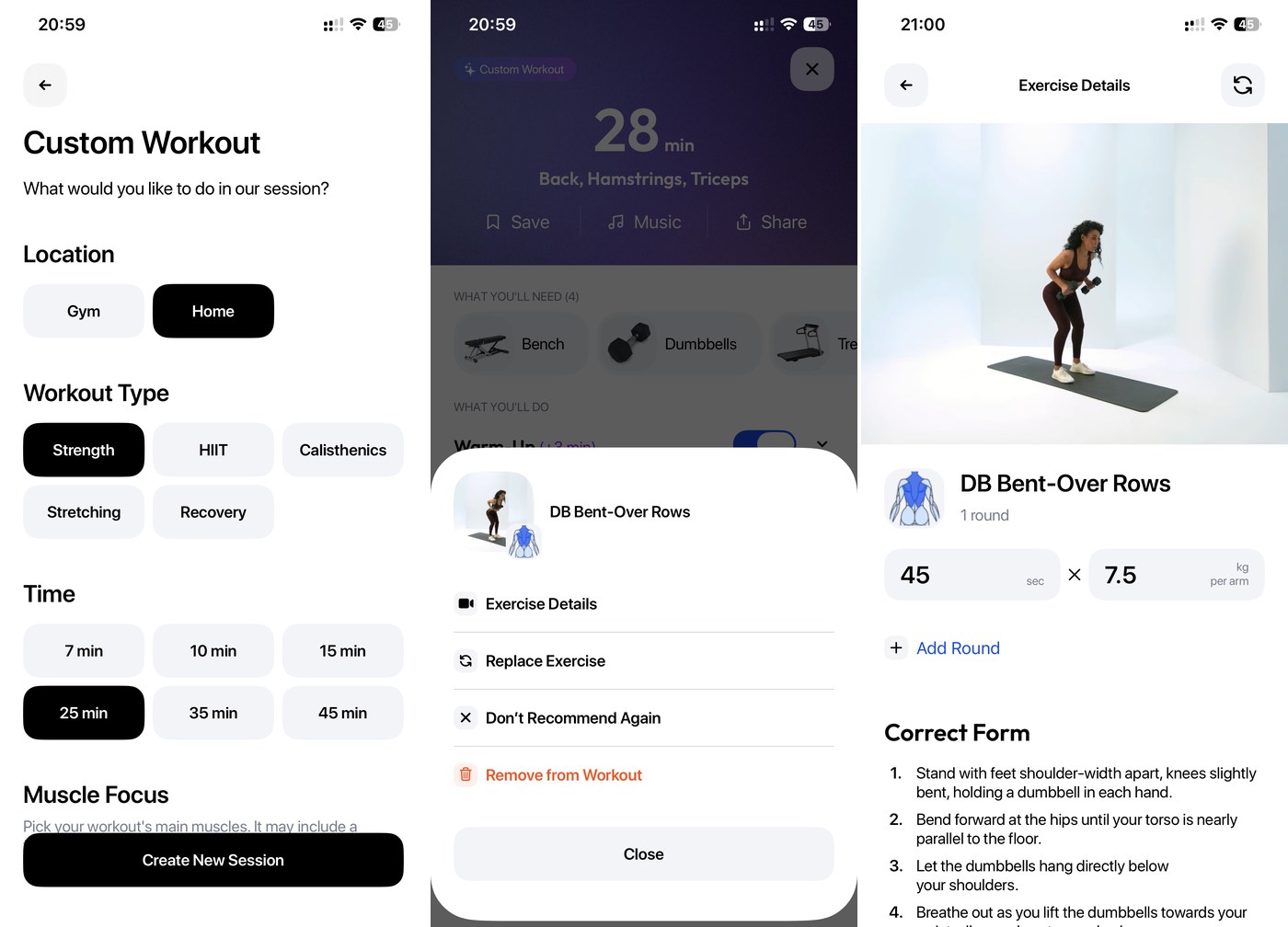
An AI personal-training app that generates and adapts your own strength, cardio and mobility plan, with a camera-based body scan and a fitness-age estimate
7 to 45 minutes, user-selectable; the plan adapts to the time you have; roughly 3 to 5 sessions per week
None to start; adapts up to dumbbells, a barbell or full gym. A pair of adjustable dumbbells is the most useful home upgrade
Variable: low-impact stretch and recovery through higher-impact HIIT, adjustable
AI-generated, no human coach. A named advisory panel (an exercise physiologist and a GP) informs the general method, but no menopause specialist
None: no menopause education, hormone or phase guidance, pelvic-floor or symptom content
Low: iOS, Android and web, Apple Watch and Apple Health sync, AirPlay to a TV. Some users report the AI does not always advance loads
Cancel via your app store; uninstalling does not cancel. Trustpilot complaints centre on billing and refunds, so read the terms and diarise renewal
Free tier; premium from about $19.99/month (dynamic)
Annual about $59.99 to $69.99/year
AI Body Scan report about $22.99; full Nutrition Guide is a separate purchase, both on top of premium
Limited free tier; the full adaptive plan needs premium
30-day guarantee on direct purchases under conditions; EU and EEA 14-day withdrawal; 48-hour window on body reports
None: no supplement ecosystem. The upsell is the paid Body Scan and Nutrition Guide add-ons
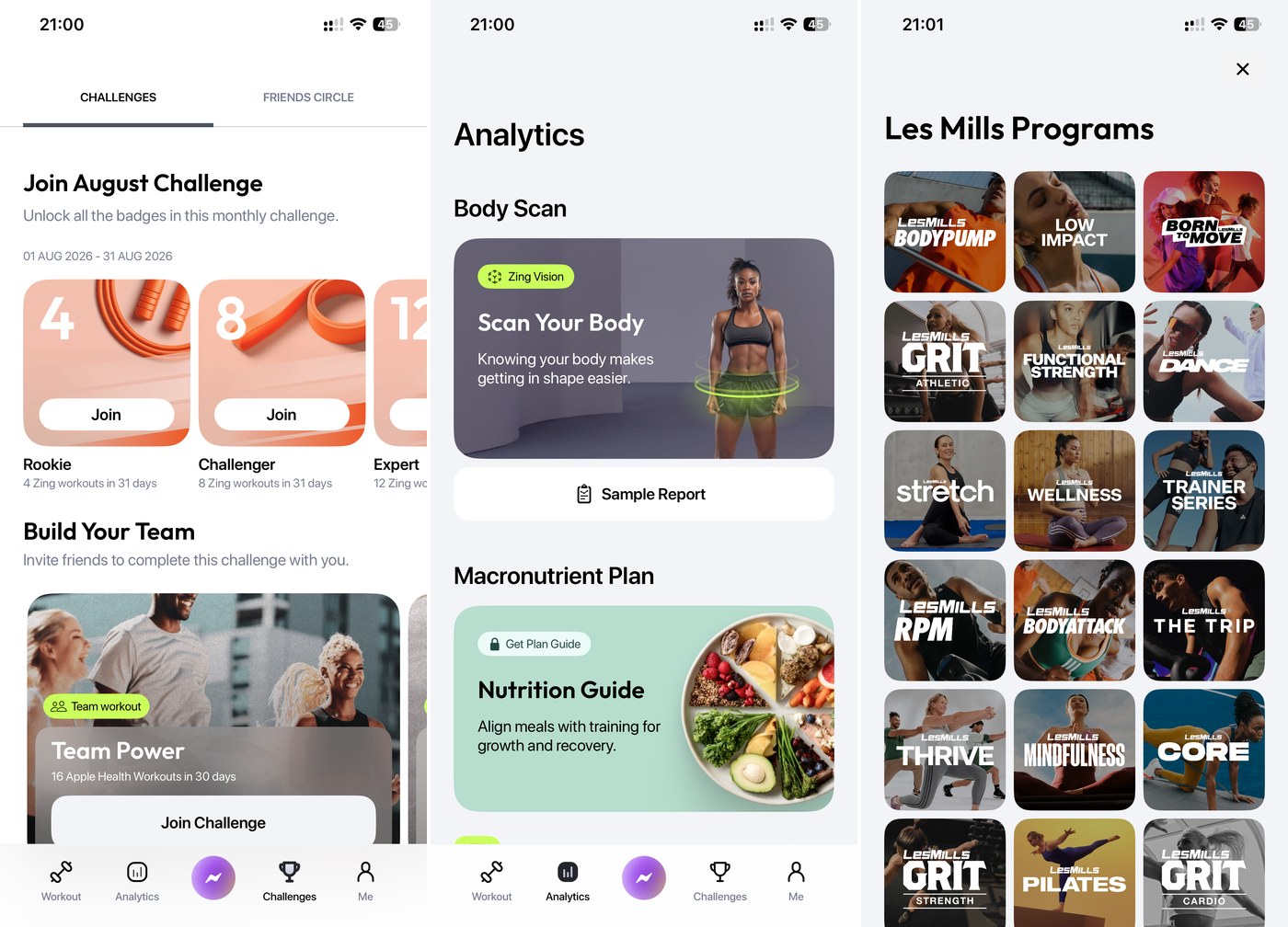
Almost 500 exercises, adaptive plans, monthly challenges and a large Les Mills library added in 2026
3.5 / 10
5.7 / 10
Quick Verdict
Worth it for women over 35 / 40? A qualified yes, if you want a flexible general plan and not menopause programming.
Zing Coach earns 5.7 / 10 on our research-based evaluation. The training engine is genuinely good: it adapts strength, cardio and mobility to your equipment, time and level, and progressive resistance work is exactly what protects muscle and bone through the menopause transition.12 The catch is that Zing treats age as one input in a general algorithm rather than a reason to design differently. There is no menopause education, no hormone or pelvic-floor content, and the coach is software, not a person. Add a quiz-funnel paywall with dynamic pricing and a run of billing complaints, and this is a strong general tool that midlife women should choose deliberately.
Where to start: use the free tier first to see whether the plan and interface suit you. Read the subscription terms carefully before upgrading, because pricing is dynamic and the Body Scan and Nutrition Guide are separate paid add-ons. If your real goal is menopause-specific programming, look at a purpose-built platform instead, and we name the strongest below.
Is Zing Coach right for you?
Zing Coach is strongest for building bone density (5.5 out of 10, against a 5.1 average across the 77 programmes scored) and weakest for value for money (5.0 against 6.9).
| Question | Verdict | Rating | Score |
|---|---|---|---|
| How it suits a perimenopausal body | |||
| Is Zing Coach good for pelvic floor problems?Based on pelvic floor support and low-impact design | Low, and worse than mostmost score 4.6/10 | 3.0 / 10 | |
| Is Zing Coach genuinely built for perimenopause and menopause?Based on menopause programming, hormone awareness, education and expert credibility | Low, and worse than mostmost score 3.3/10 | 1.6 / 10 | |
| Is Zing Coach good for painful joints?Based on low-impact design and recovery provision | Moderate, and worse than mostmost score 6.2/10 | 5.0 / 10 | |
| Is Zing Coach manageable when your energy is low?Based on recovery provision and mind-body support | Low, and worse than mostmost score 5.7/10 | 4.5 / 10 | |
| Is Zing Coach good if you are new to strength training?Based on beginner on-ramp and mind-body support | Moderate, and worse than mostmost score 6.1/10 | 5.0 / 10 | |
| Is Zing Coach good for building bone density?Based on bone loading and progressive strength | Moderate, about the same as mostmost score 5.1/10 | 5.5 / 10 | |
| Does Zing Coach help with nutrition?Based on midlife nutrition support | Low, and worse than mostmost score 4.0/10 | 2.5 / 10 | |
| How it performs as a product | |||
| Can you fit Zing Coach into a busy week?Based on time efficiency | Strong, about the same as mostmost score 7.6/10 | 7.0 / 10 | |
| Is Zing Coach worth the money?Based on value for money | Moderate, and worse than mostmost score 6.9/10 | 5.0 / 10 | |
Jump to Section
Who Is Behind It
Who Is Zing Best For?
Good for Women Over 40?
How the AI Method Works
Content & Features
Nutrition
Devices & Platform
What the Research Says
What Users Report
Zing Coach Price 2026
Time Commitment
Will You Stick With It?
Equipment You Need
vs Alternatives
Full Scoring
Pros & Cons
FAQ
What Zing Coach Is
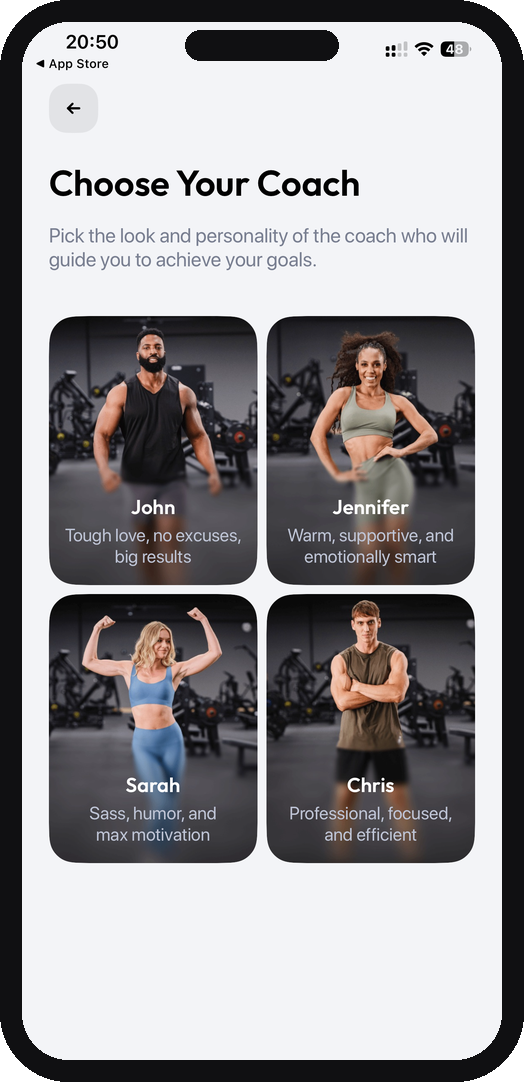
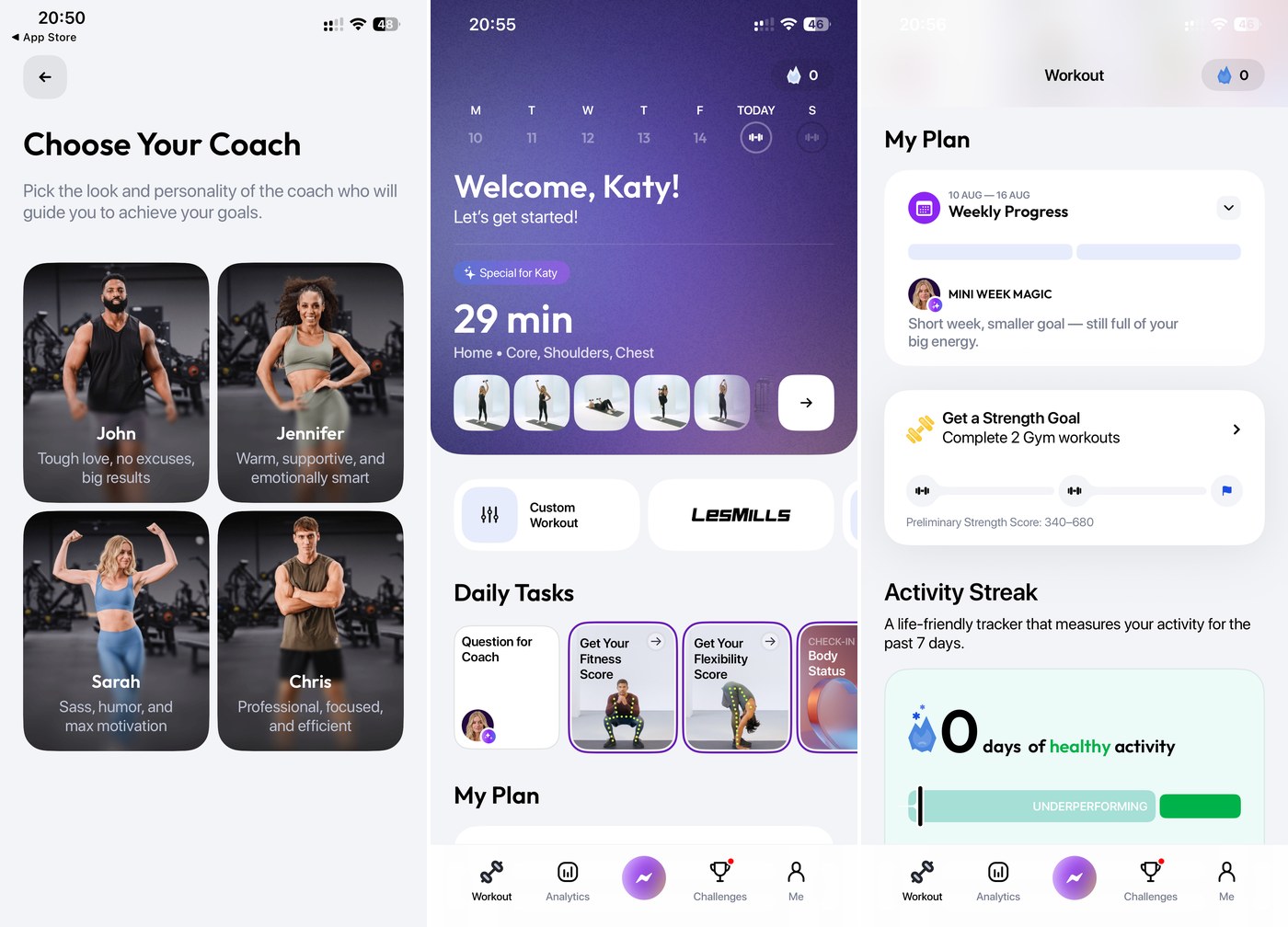
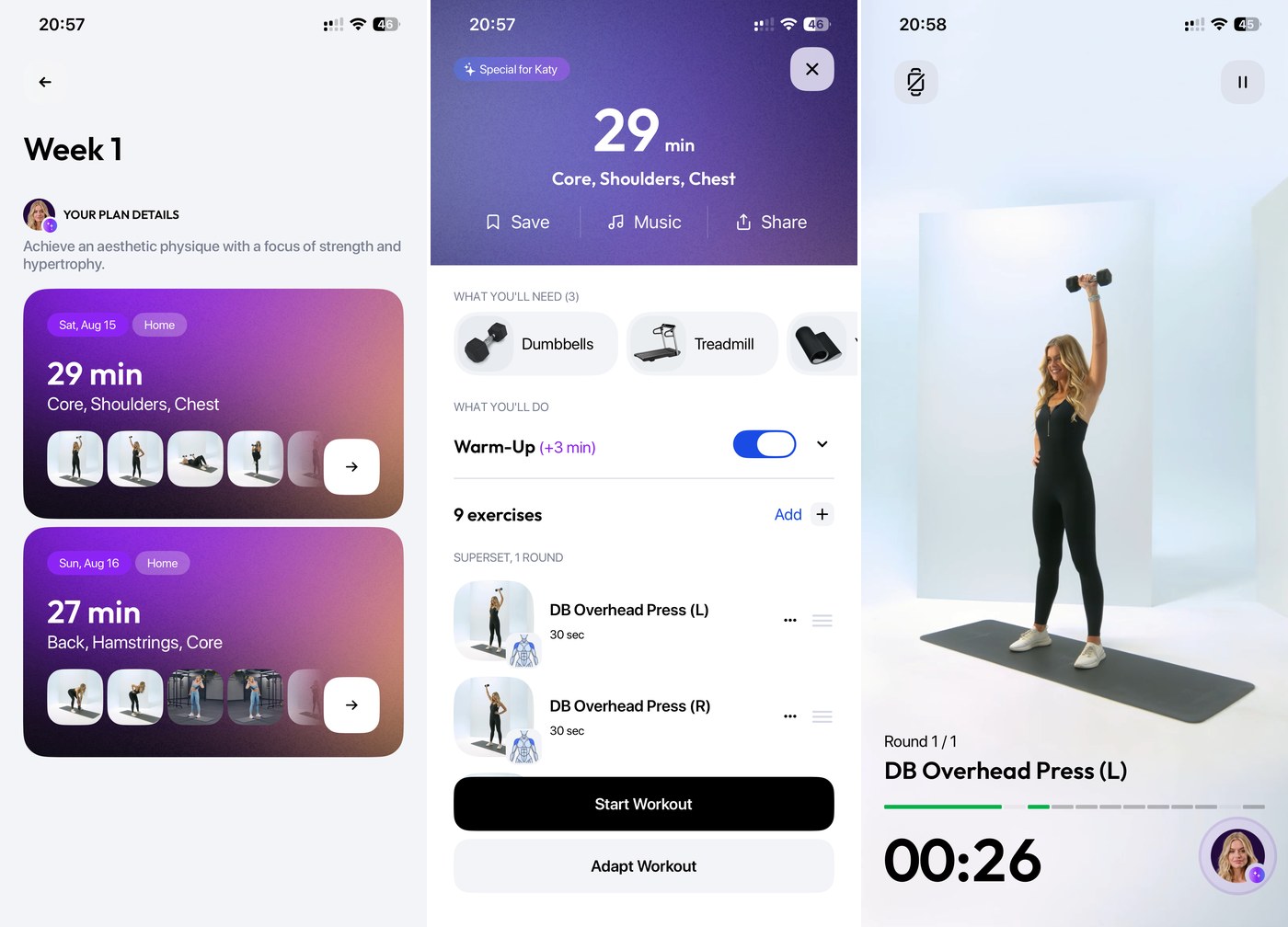
Zing Coach is an AI-powered personal-training app that generates and adapts a workout plan around you. You start with an onboarding quiz about your goals, training background, available equipment and schedule, and the algorithm assembles a plan spanning strength, HIIT, stretching and recovery. As you log sessions and rate your energy, mood and sleep, the plan adjusts intensity and exercise selection. That is the core promise: a programme that reshapes itself instead of a library you navigate alone. It runs on iPhone, Android and a web portal, and in March 2026 it added a large Les Mills+ content library, bringing branded classes and low-impact formats into the catalogue.
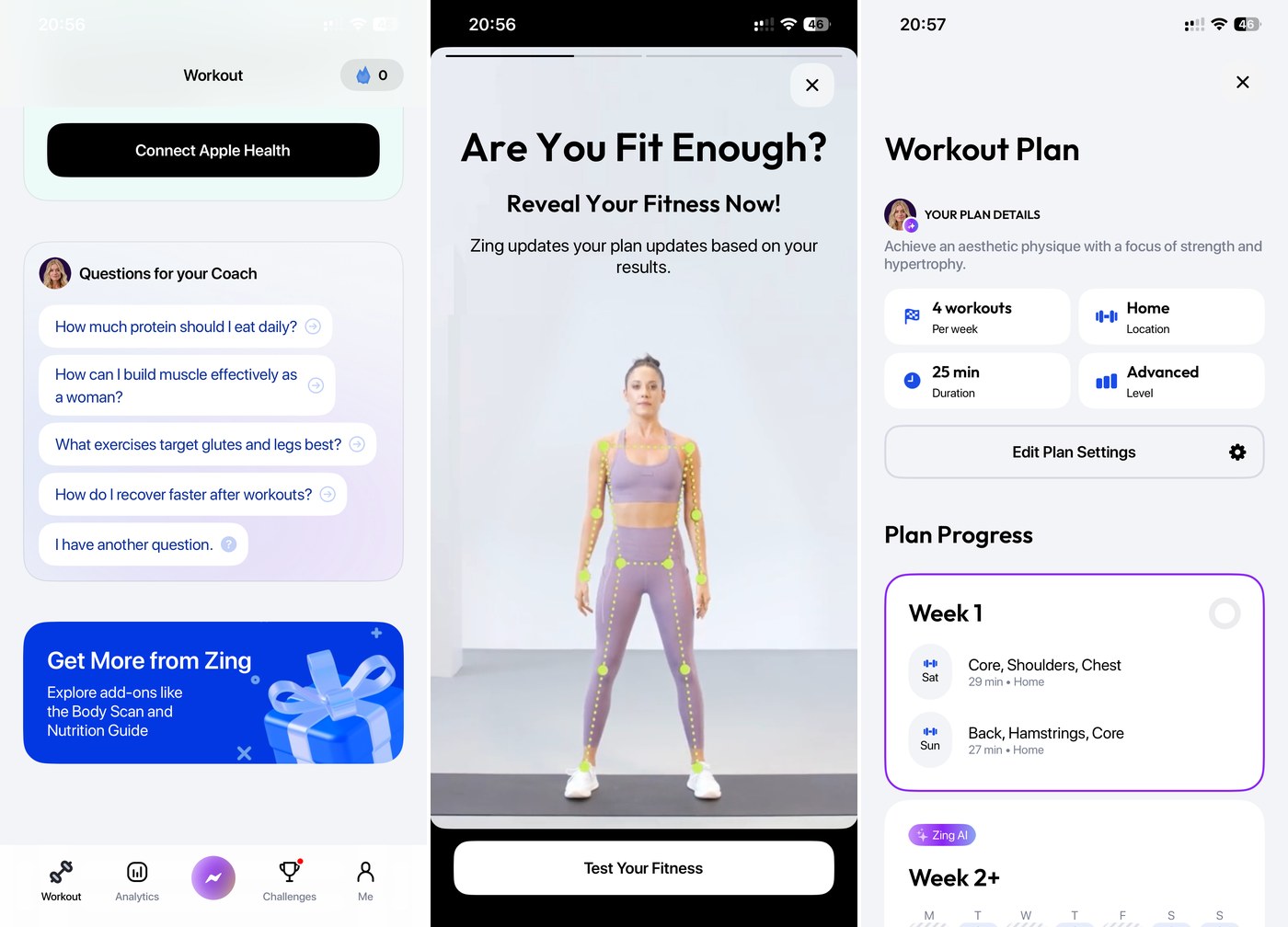
Its signature feature is the AI Body Scan, branded Zing Vision, which estimates body composition from two smartphone photos using a model the company says was trained on DEXA data. It pairs that with a fitness test, a flexibility test, a Strength Score and a fitness-age style figure, plus real-time form tracking through the phone camera and an AI chat coach with selectable personalities.
To place the product accurately: Zing is a general fitness app aimed at weight loss, muscle and overall conditioning, marketed to a broad audience rather than to midlife women specifically. Nothing about the onboarding, the plan logic or the content is designed around perimenopause or menopause, and that single fact shapes the rest of this profile.
Who Is Behind It
Zing Coach is made by Zing Coach Inc, a venture-backed technology company founded in 2021. The named co-founders are Tanya Parfenyuk, chief executive, who comes from a health and fitness product background, and Walter Gjergja, chief wellness officer, a Shaolin-trained coach. The company reports more than a million users and has raised Series A funding, and it ships updates almost weekly, so this is an actively developed product rather than an abandoned one.
The point that matters most here is that the coaching is delivered by an algorithm, not a person. Zing does publish a named advisory panel with real credentials, including Jacky Forsyth PhD, an exercise physiologist who specialises in sport, exercise and women’s wellbeing, and Dr Andrew Belaveshkin, a doctor in preventative medicine. Listing qualified advisers is more transparency than many AI fitness apps offer.
No menopause credential, and no human coach
There is no menopause specialist on the team, no clinical menopause credential embedded in the product, and no human coach building or supervising your plan. The advisers inform the general method; they do not translate into menopause-specific programming, symptom guidance or the individual oversight a woman managing HRT, a prolapse or a heart condition might want. For anything beyond general training, treat Zing as a tool, not a clinician.
Who Is Zing Best For, and Who Should Skip It?
Zing is built around adaptability, and that design choice runs through the onboarding, the plan logic and the pricing.
If you want a plan that decides for you, Zing is a strong fit. Rather than choosing classes from a library, you get a single adaptive plan that flexes to your equipment, the time you have and how you are recovering. For a self-directed woman who knows she wants to train but does not want to programme it herself, that is genuinely useful.
If you like data and feedback, the body scan, fitness age, Strength Score and daily check-ins give you numbers to track. Used as a motivational trend rather than a diagnosis, they can help you stay consistent.
If you train at home with minimal kit, the plan starts at bodyweight and scales up as you add dumbbells or a barbell, so you are not forced to buy equipment to begin.
If you want training built for menopause, this is not the right app. There is no menopause education, no hormone or phase guidance, no pelvic-floor content and no clinician. A general algorithm that accepts an older age as an input is not the same as programming designed for this life stage, and if that is your priority you will be better served elsewhere.
Is Zing Coach Good for Women Over 40?
On the training itself, Zing does a lot right for a midlife body. It puts progressive resistance training front and centre, which is the intervention with the strongest evidence for preserving bone density and muscle after menopause,12 and it can dial workouts down to lower-impact options when you ask. It scales from a nervous beginner to an advanced lifter, and its mix of interval and steady cardio is a reasonable way to protect cardiorespiratory fitness, which matters more as the protective effect of oestrogen falls away.3
What the training gets right for a midlife body
Progressive dumbbell and barbell work, adjustable intensity, low-impact options and a genuine beginner on-ramp are all appropriate for women over 40. The methods underneath Zing are the ones the evidence supports for muscle, bone and cardiometabolic health in this age group. If you simply need a structured plan to follow, the raw ingredients are sound.
Where it falls short is everything around the training. There is no menopause education to explain why strength and bone loading matter more now, no hormone or phase awareness, no pelvic-floor content, and no human coach to adjust for symptoms, injuries or confidence. The body-scan and fitness-age framing also lean towards body composition and quick results, which will not suit every woman and can sit badly with anyone who has had enough of diet-culture messaging.
The wider picture: Zing is a good general tool, not a menopause solution. If you value flexibility and a low cost per session and you are comfortable steering yourself, it can serve you well. If you want your training built around perimenopause or menopause, with education, pelvic-floor work and clinical grounding, a purpose-built platform will serve you better.
The capability breakdown below scores Zing against what the research says midlife and menopausal women benefit from. It is strongest on the training-mechanics group and close to empty on the group that captures whether a programme is actually built for menopause.
This is the perimenopause and menopause assessment, and it is separate from the overall score. Twelve things a programme either does for a midlife body or does not, each scored out of 10 with my reasoning next to it. Together they produce a single menopause fit score, and that becomes one of the nine categories in the overall scoring below.
How Zing Coach Fits Perimenopause, Menopause & Beyond
Women Over 40 is our most important criterion, and here's the full breakdown behind it.
Zing Coach is strongest for progressive strength, beginner on-ramp and low-impact, and weakest for menopause programming, pelvic floor, hormone awareness, menopause education, midlife nutrition, expert credibility and mind-body support, in our menopause and midlife capability assessment for women over 40.
At a glance
| Capability | Score | Rating | Why |
|---|---|---|---|
| Right training for a midlife body | |||
| Low-impact | 5/10 | Some | Can be told to go low-impact and offers mobility and home options, but nothing is purpose-built as joint-sparing; it is a filter, not a design principle. |
| Progressive strength | 6/10 | Some | Genuine adaptive strength plans with progression are a core strength, though users report weights do not always auto-advance. |
| Bone loading | 5/10 | Some | Resistance training inherently loads bone, but there is no explicit bone-density or osteoporosis programming or intent. |
| Recovery & deload | 5/10 | Some | Daily AI check-ins on sleep and energy give loose auto-regulation, but no structured deload tied to a midlife body. |
| Built for menopause | |||
| Menopause programming | 1/10 | None | No menopause-specific programming; a general engine that accepts an older age as an input. |
| Pelvic floor | 1/10 | None | No pelvic-floor or continence content found. |
| Hormone awareness | 1/10 | None | No hormone, cycle or menopause-phase guidance. |
| Menopause education | 1/10 | None | No menopause education in-app or in the marketing. |
| Expert credibility | 3.5/10 | Minimal | Real named advisers including a women’s exercise physiologist and a GP, which beats a faceless AI, but no menopause qualification and delivery is algorithmic, not expert-coached. |
| Whole-woman support | |||
| Mind-body support | 4/10 | Minimal | Some wellness framing, a motivation-psychology adviser and mood and energy check-ins, but light and generic. |
| Beginner on-ramp | 6/10 | Some | A strong onboarding quiz and adaptive difficulty make it genuinely approachable for a nervous beginner. |
| Midlife nutrition | 2.5/10 | None | Nutrition is peripheral: calorie and macro targets only, no midlife or menopause-specific guidance and no food logging. |
ScaleBest-in-classStrongSomeMinimalNone
What the sources say: Scored from the official site and methodology pages, app-store listings, the Help Center and refund policy, third-party reviews and peer-reviewed evidence (Aug 2026); hands-on pending.
These are evidence-informed suitability ratings, not clinical measurements. They combine exercise science with product-specific research and, where indicated, hands-on testing, alongside multi-source verification, and are approximate. Individual response varies. A starting point, not medical advice. How we score menopause fit
How Zing’s AI Method Works
Zing’s method is adaptive programming: instead of a fixed plan, an algorithm builds and continually adjusts your training from your inputs and your logged sessions. In principle this is a sensible way to keep training appropriate as your capacity changes week to week, which is a real advantage for a midlife body that does not recover the way it did at 30.
Adaptive coaching: what the evidence supports, and what it does not
App-based coaching and self-monitoring can produce a modest, genuine increase in physical activity, but the effect is strongest in the first few months and tends to fade after that.7 So the adaptive engine is a plausible way to stay consistent, not a guarantee. It is also worth being clear that Zing’s specific algorithm has not been independently validated; what the evidence supports is the general approach, not the brand’s particular model.
The body scan and fitness age deserve the same realism. The science underneath a fitness age is genuine, but non-exercise models that estimate cardiorespiratory fitness are accurate at population level while carrying roughly 10 to 15 percent error for any individual,8 and a photo-based body-composition estimate is an approximation, not a DEXA scan. Treat Zing’s numbers as motivational feedback and a trend line, not diagnostics.
Content and Features
Zing is feature-rich for a general training app, and thin in exactly the areas this audience needs most. The table separates what is included from what is missing, because for a midlife woman the gaps, hormone-phase awareness, pelvic-floor work and menopause education, matter as much as the workout library.
| Feature | Included? | Notes |
|---|---|---|
| On-demand workouts | Yes | Almost 500 exercises plus a Les Mills library |
| Adaptive AI plan | Yes | Core feature; adjusts to progress, energy and equipment |
| Live classes | No | No scheduled live sessions |
| Recovery and mobility | Yes | Stretching, a flexibility test and fatigue tracking |
| Meditation and mindfulness | Partial | Some Les Mills mind-body content; not a core feature |
| Nutrition guidance | Partial | Calorie and macro targets; the full Nutrition Guide is a paid add-on; no food logging |
| Menopause education | No | None found on the site, app or Help Center |
| Pelvic-floor content | No | None found |
| Cycle or hormone-phase programming | No | None found |
| Symptom or cycle tracking | Partial | Daily energy, mood and sleep check-ins; no menopause symptom tracking |
| Structured programmes and challenges | Yes | Personalised plan plus monthly challenges |
| Community | Yes | Large in-app community and challenges |
| Clinical advisory board | Partial | Named advisers including a PhD and a GP; not a clinical care board |
Nutrition
Nutrition is peripheral to Zing rather than a core pillar. Premium includes calorie and macro targets, and the AI chat coach will answer food questions, but there is no built-in food or calorie logging, and the full Nutrition Guide is a separate paid add-on rather than part of the subscription. For a midlife woman, protein needs rise with age and matter for holding on to muscle, so a workout app that treats nutrition as an upsell is a real limitation. If structured eating support is a priority, an app with an integrated meal-plan system will serve you better.
Devices and Platform
Zing is a phone-first app with useful extras. It runs on iPhone (iOS 17 and later), Android and a web portal, and it has an Apple Watch app that syncs with Apple Health, so sessions and activity flow into the wider health picture on your wrist. The Les Mills classes can be cast to a TV over AirPlay, which helps for follow-along work in the living room, and the interface is available in five languages. Offline access is not clearly documented, so if training without a signal matters to you, confirm it at signup. For a woman who moves between a phone, a watch and occasionally a TV, the setup is flexible, and the near-weekly update cadence suggests the platform is being actively maintained.
What the Research Says
The training methods Zing uses are well supported for midlife women, even though Zing itself never connects them to menopause. Progressive and even higher-intensity resistance training improves bone mineral density and physical function in postmenopausal women, and does so safely under supervised technique, as the LIFTMOR trial showed.1 Resistance training also builds and preserves muscle in this group, with higher training volume producing more muscle while strength gains come readily even at lower volume.2 Both interval and moderate-intensity cardio improve cardiorespiratory fitness in older women, so Zing’s mix of HIIT and steady work is reasonable, though the evidence does not make HIIT uniquely superior.3
The picture is more mixed for menopause symptoms, and it is important not to overclaim. Exercise improves some quality-of-life domains for women with menopausal symptoms but not others, so it is not a blanket fix.4 It can reduce insomnia severity, although the evidence for improving overall sleep quality is weaker.5 For hot flushes and night sweats, the most authoritative review concludes there is insufficient evidence that exercise is an effective treatment.6 Any suggestion that a general fitness app relieves vasomotor symptoms is unsupported, and Zing sensibly makes no such claim.
The wider health bodies agree on the direction of travel: strength work at least twice a week and regular activity are core recommendations for women as they age.910 Zing delivers the strength and activity; what it does not deliver is any of the menopause-specific layer.
What Users Report
Store ratings are high, but an independent complaint platform tells a rougher story, and the gap is the point. On the Apple App Store, Zing holds about 4.8 out of 5 from around 31,000 US ratings and 4.6 from about 3,500 UK ratings. On Google Play it sits near 4.7 from several thousand reviews, with a large install base. On Trustpilot, however, it scores around 3.5 out of 5 from roughly 350 to 380 reviews, with close to a third at one star. Store ratings capture engaged in-app users; the independent site captures the billing experience, which is where the frustration collects.
What users praise: the personalisation and adaptive plans, the AI body scan, which even some critics single out, the clean interface and easy onboarding, and the value compared with a human trainer.
What users criticise: billing and cancellation is the dominant complaint, including charges after a cancelled trial, double-charged annual plans and refund disputes. Some feel the AI is shallow and does not truly adapt session to session, which chimes with the evidence that app-driven engagement tends to wane after the first months.7 Others question the body-scan accuracy in poor lighting, note gaps in the exercise library and the lack of custom-exercise logging, and report occasional bugs. There is very little midlife or menopausal women’s voice in the public record, so we treat suitability for this audience as an open question rather than a settled strength.
Zing Coach specifications
- Free trial
- Free tier (limited); a time-limited trial may be offered depending on funnel - confirm length at signupSource: https://www.zing.coach
- Cancellation
- Cancel through your app store subscription settings or by emailing [email protected]. Uninstalling the app does not cancel it. Store purchases follow Apple and Google refund rules. Direct purchases are generally non-refundable, though a 30-day money-back option applies under conditions, namely no visible results after seven workouts in seven consecutive days. Body reports carry a 48-hour window, and EU and EEA customers have a 14-day right of withdrawal.Source: https://www.zing.coach/refund-policy
- Session length
- 7 to 45 min (user-selectable; Les Mills sessions longer)Source: App Store listing
- Who makes it
- Zing Coach Inc, founded in Delaware in 2021 by Tanya Parfenyuk (CEO) and Walter Gjergja (Chief Wellness Officer). The advisory panel includes Jacky Forsyth PhD, a women’s exercise physiologist, and Dr Andrew Belaveshkin, a GP. Coaching is AI-generated rather than delivered by a human coach, and there is no menopause-specific clinical credential behind the programming.Source: https://www.zing.coach
- Still maintained
- Actively developed (v1.126, Aug 2026); Les Mills library added Mar 2026; PSG partnership
- What is included
- On-demand classes: yesLive classes: noRecovery content: yesMenopause education: noStructured programmes: yesMeditation: partlyNutrition guidance: partly
- Women over 40
- Pelvic floor work: noMenopause clinician involved: noInjury modifications: partlyBone-health focus: partlyModified progressions: partlyCycle syncing: noPrenatal options: no
- Devices and access
- Offline downloads: noCasting to TV: yesSubtitles: partlyWearable sync: yes
- Support
- Clinical advisory board: partlyCommunity: yesSupplement upsell: partly
- Last verified
- 15 August 2026
Zing Coach Price 2026: What You Actually Pay
Zing is free to download, with a limited free tier, and a premium subscription behind a quiz-funnel paywall. Because pricing is dynamic and varies by funnel, promotion and profile, two people can be shown different numbers, so treat the figures below as indicative and confirm your exact price at signup.
| Plan | Cost | Notes |
|---|---|---|
| Free tier | $0 | Limited access; the full adaptive plan needs premium |
| Weekly | Confirm at signup | Exists; figure not publicly fixed |
| Monthly | About $19.99 to $23.99 | Dynamic; several price points appear |
| Quarterly | About $34.99 | 3-month plan |
| Annual | About $59.99 to $69.99 | Best value per month if you commit |
| Body Scan report (add-on) | About $22.99 | Separate one-time purchase, on top of premium |
| Nutrition Guide (add-on) | Paid; confirm at signup | Locked behind a separate purchase |
Read before you subscribe: dynamic pricing and stacked paywalls
Two things to go in with eyes open. First, pricing is set by a quiz funnel, so the number you see is dynamic and can differ from someone else’s. Second, two headline features sit behind further payments even after you subscribe to premium: the AI Body Scan report (about $22.99) and the full Nutrition Guide are each a separate purchase. Combined with the billing and refund complaints on Trustpilot, this is the part of Zing to approach carefully. Read the checkout, and factor the add-ons into the true cost.
Trial and refunds: a free trial may be offered depending on the funnel, so confirm the length at signup. Store purchases follow Apple and Google refund rules. Direct purchases are generally non-refundable, but Zing offers a 30-day money-back guarantee under specific conditions (no visible results after completing at least seven workouts in seven consecutive days), a 48-hour window on body-composition reports, and the statutory 14-day withdrawal right in the EU and EEA. Cancel through your app store subscription settings or by contacting Zing; uninstalling the app does not cancel a subscription.
Time Commitment: Weekly Schedule and Session Length
| Scenario | Sessions/week | Session length | Weekly total |
|---|---|---|---|
| Typical adaptive plan | 4 | 20 to 30 min | 80 to 120 min |
| Short-on-time setting | 3 to 4 | 7 to 15 min | 30 to 60 min |
| Higher-volume weeks | 5 | 30 to 45 min | 150 to 225 min |
| WHO activity guideline target | 5 | 30 min moderate, plus 2 strength days | 150 min |
Because you choose your session length and the plan adapts, Zing flexes easily around a busy life, and a typical week sits comfortably within the WHO activity guideline of 150 minutes plus two strength sessions.9 The strength emphasis is the part that matters most for a midlife body, so the useful question is not whether you can hit the minutes but whether you push the loads.
Will You Actually Stick With It?
Boredom RiskThe plan adapts and rotates, with almost 500 exercises, monthly challenges and a Les Mills library to draw on
Decision FatigueThe AI decides the session for you each day, which removes the what-should-I-do-today barrier
Motivation FadeApp-driven engagement often wanes after the first few months,7 and a general plan with no menopause context can start to feel generic
The consistency question
Zing is built to keep you engaged, with daily check-ins, challenges, a chatty AI coach and a large community, and near-weekly updates. The research backs the general idea that app-based coaching lifts activity, with the important caveat that the boost is strongest in the first three months.7 If you are self-motivated and happy to steer your own training, you will likely keep going; if you need a plan that understands this life stage, motivation may fade sooner. The billing friction some users describe is a separate drag on goodwill worth weighing.
What Equipment Do You Need for Zing Coach?
Adjustable dumbbells
The single most useful buy for progressive strength at home; the plan scales as you add load
~$25 to $50
Exercise mat
Cushions floor work, stretching and recovery; kinder on the joints
~$20 to $45
Resistance bands
Handy for warm-ups, mobility and travel, and for scaling exercises up or down
~$15 to $30
A quick heads-up: some of the buy links above are affiliate links, so if you buy through them we may earn a small commission, at no extra cost to you. We only point to kit worth owning.
Zing needs no equipment to start, and adapts up to dumbbells, a barbell or full gym machines, so the barrier to beginning is genuinely low.
Zing Coach vs Pvolve, FitOn and Caroline Girvan
Zing assessed on a research basis from the official app, methodology pages and store data. Competitor prices and ratings are approximate; verify each on the platform before subscribing.
| Feature | Zing Coach | Pvolve | FitOn | Caroline Girvan |
|---|---|---|---|---|
| Our score | 5.7 | 8.3 | 7.3 | 7.6 |
| Monthly price (approx) | ~$19.99 to $23.99 (dynamic) | ~$14.99 | Free; Pro ~$8.33/mo annual | ~$13.99 |
| Free trial | Free tier; trial varies by funnel | Free trial | Large free library | Free on YouTube |
| Best for | Adaptive AI plans | Menopause-built movement | Budget variety | Structured strength |
| Equipment required | None up to full gym | Bands and light kit | Minimal | Dumbbells |
| Session length | 7 to 45 min | 20 to 45 min | 5 to 45 min | 30 to 45 min |
| Injury modifications | Adaptive, not guided | Yes, joint-aware | Some | Limited |
| Perimenopause content | None | Extensive | Some | None labelled |
| Pelvic floor | No | Yes | Limited | No |
| Coaching style | AI, no human | Instructor-led | Instructor-led | Caroline-led |
| Nutrition included | Paid add-on | Limited | Some | No |
| Community | Yes | Yes | Yes | Yes |
| App Store rating (approx) | ~4.8 | ~4.8 | ~4.8 | varies |
| Best suited to | Self-directed all levels | Midlife, joint-aware | Budget-conscious | Confident lifters |
Zing Coach vs FitOn
These are the two most similar choices, and they split on price and personalisation. FitOn gives you a very large library of instructor-led classes with a genuinely useful free tier, so your cost per workout can be close to zero and every session is led by a real coach. Zing gives you a single adaptive plan that adjusts to your equipment and progress, plus a body scan and fitness-age tracking, but at a higher and less predictable price, and the coaching is software. Neither is menopause-built, so if you want variety, real instructors and the lowest cost, choose FitOn; if you want a structured, adaptive plan that decides for you, choose Zing.
Zing Coach Weighted Scoring: How the 5.7 / 10 Was Calculated
Scores are evidence-informed, on our 9 weighted criteria, with a confidence tag per row because this is a research-based profile rather than a hands-on test. See how we score for the full method and weightings.
This is the overall score, and it asks a broader question: how good is this programme, full stop. Nine categories, each weighted by how much it matters to a woman in perimenopause or beyond, which is why Muscle Potential counts for more than Value for Money. The Women Over 40 Specificity row is the perimenopause and menopause fit score from the twelve capabilities above, carried through.
| Category | Weight | Score | Weighted |
|---|---|---|---|
| Time Efficiency | 15% | 7.0 | 1.05 |
| Muscle Potential | 18% | 6.5 | 1.17 |
| Women Over 40 Specificity | 10% | 3.5 | 0.35 |
| Joint Friendliness | 12% | 5.5 | 0.66 |
| Recovery Compatibility | 10% | 5.5 | 0.55 |
| Programme Structure | 12% | 6.5 | 0.78 |
| Value for Money | 8% | 5.0 | 0.40 |
| UX and Design | 8% | 6.5 | 0.52 |
| Nutrition Integration | 7% | 3.0 | 0.21 |
| Total | 100% | 5.7 / 10 |
Scoring notes: time efficiency and programme structure rate well because the adaptive plan genuinely flexes to your schedule, equipment and progress. Muscle potential is solid, since progressive resistance is at the core, though some users report loads do not always advance on their own. Value is held back by dynamic pricing, paid add-ons and billing complaints. The women-over-40 score is capped by the absence of menopause features rather than by poor training, and joint friendliness, recovery, UX and nutrition are marked low-confidence, the rows most likely to move once the app is used over time.
Final Weighted Score
5.7 / 10
A capable general AI fitness app with a genuinely adaptive engine, but no menopause programming and a paywall to watch
Zing Coach Pros and Cons
Pros
- Genuinely adaptive plan that flexes to your equipment, time and level
- Progressive resistance at the core, which the evidence supports for a midlife body12
- Fast, approachable onboarding for beginners through to advanced
- A named advisory panel including a women’s exercise physiologist and a GP
- Low barrier to start: no equipment needed, free tier to try
- Flexible across iPhone, Android, web, Apple Watch and AirPlay to a TV
- Large exercise library plus a Les Mills content collection, actively updated
Cons
- No menopause education, hormone guidance or pelvic-floor content
- The coach is an algorithm, not a human, and there is no menopause credential
- Quiz-funnel paywall, dynamic pricing and stacked paid add-ons
- Body-composition and fitness-age framing leans towards quick results
- Some users feel the AI does not truly adapt session to session
- Nutrition is thin and gated, with no food logging
- Billing and refund complaints on independent review sites
Zing Coach FAQ
Not specifically. Zing Coach is a general AI fitness app with no menopause education, hormone or phase guidance, or pelvic-floor content, and no menopause credential on the team. The strength and cardio training it delivers is well supported for midlife women in general terms, but the app is not designed around menopause. For that, a purpose-built platform such as Pvolve is a better fit.
Zing is free to download with a limited free tier. Premium is dynamic and varies by funnel, but indicative prices are about $19.99 to $23.99 a month, roughly $34.99 a quarter and $59.99 to $69.99 a year. The AI Body Scan report (about $22.99) and the full Nutrition Guide are separate paid add-ons on top of premium. Because pricing changes by promotion and profile, confirm your exact price at signup.
No. The coaching is generated by an algorithm, not a human trainer. Zing lists a named advisory panel including an exercise physiologist and a GP who inform the general method, but no person builds or supervises your individual plan, and there is no menopause specialist.
Treat both as motivational estimates, not clinical measurements. The body scan estimates composition from two photos and depends on good lighting, and the fitness-age concept rests on fitness-estimation models that carry roughly 10 to 15 percent error for any individual. They are useful for tracking a trend, not for a precise reading.
Regular exercise may ease insomnia severity for some women, but the evidence for improving overall sleep quality is weaker, and the most authoritative review finds insufficient evidence that exercise treats hot flushes. Zing has no menopause-specific content, so do not expect it to target these symptoms directly. Speak to your GP about persistent symptoms.
If you want a flexible general plan that adapts to you and you are happy to self-direct, yes, it can work well and the free tier makes it low-risk to try. If you want training designed around perimenopause or menopause, with pelvic-floor and clinical grounding, a purpose-built platform is the better choice.
You can cancel any time through your app store subscription settings or by contacting Zing, but uninstalling the app does not cancel a subscription. Some users report billing and refund disputes, so check the renewal date and terms carefully, and cancel through the correct channel before the next charge.
No. You can start with no equipment at all, and the plan adapts up to dumbbells, a barbell or full gym machines. A pair of adjustable dumbbells is the most useful upgrade if you want to build strength for a midlife body.
Final Verdict
5.7 / 10
Zing Coach is a strong general AI fitness app that is not built for menopause. The adaptive training engine, flexible equipment options and quick onboarding are genuine strengths, and the methods it uses, progressive resistance and mixed cardio, are exactly what the evidence supports for a midlife body.123 It is transparent about its advisers and actively maintained, and the free tier makes it low-risk to try.
The gaps are the ones that matter most to this audience. There is no menopause education, no hormone or pelvic-floor content, an algorithm instead of a coach, thin and gated nutrition, and a quiz-funnel paywall with stacked add-ons that draws billing complaints. None of that makes it a bad app; it makes it a general one.
Best for: self-directed women ~35+ who want a flexible, adaptive plan, like training data, and are comfortable steering themselves.
Not ideal for: women who want menopause-specific programming, pelvic-floor or bone work, a human coach, integrated nutrition, or a weight-neutral approach.
Testing status: scores are evidence-informed and provisional; a hands-on score is pending. If we trial the app over time, we will upgrade this page with first-person notes and a hands-on score.
Sources & Further Reading
- Watson SL, et al. (2018). High-Intensity Resistance and Impact Training Improves Bone Mineral Density and Physical Function in Postmenopausal Women (LIFTMOR). Journal of Bone and Mineral Research. doi.org/10.1002/jbmr.3284
- Oliveira Junior GN, et al. (2022). Resistance Training Volume and Muscle Hypertrophy in Postmenopausal Women. Journal of Strength and Conditioning Research. pubmed.ncbi.nlm.nih.gov/32569127
- Ballesta-Garcia I, et al. (2020). High-Intensity Interval Circuit Training and Cardiorespiratory Fitness in Middle-Aged and Older Women. International Journal of Environmental Research and Public Health. ncbi.nlm.nih.gov/pmc/articles/PMC7084372
- Nguyen TM, et al. (2020). Exercise and Quality of Life in Women with Menopausal Symptoms: Systematic Review and Meta-Analysis. International Journal of Environmental Research and Public Health. ncbi.nlm.nih.gov/pmc/articles/PMC7579592
- Qian J, et al. (2023). Effects of Exercise on Sleep in Menopausal Women: Systematic Review and Meta-Analysis. Frontiers in Medicine. pubmed.ncbi.nlm.nih.gov/37181372
- Daley A, et al. (2014). Exercise for Vasomotor Menopausal Symptoms. Cochrane Database of Systematic Reviews. pubmed.ncbi.nlm.nih.gov/25431132
- Romeo A, et al. (2019). Can Smartphone Apps Increase Physical Activity? Systematic Review and Meta-Analysis. Journal of Medical Internet Research. pubmed.ncbi.nlm.nih.gov/30888321
- Nes BM, et al. (2011). Estimating VO2peak from a Non-Exercise Prediction Model (the HUNT Study). Medicine & Science in Sports & Exercise. pubmed.ncbi.nlm.nih.gov/21502897
- World Health Organization (2020). Physical activity guidelines: adults aged 18 to 64. who.int/news-room/fact-sheets/detail/physical-activity
- Menopause and exercise: staying active through the transition. North American Menopause Society (The Menopause Society). menopause.org
Related Guides
What To Do Next
Not sure this is the right programme for you?
- → Take our 2-minute quiz for a personalised recommendation.
- → See our best workouts for perimenopause rankings.
- → See our best workouts for women over 40 rankings.
- → Compare menopause-built options in our Pvolve profile.
- → See how we score every programme using 9 weighted criteria.