Fitbod scores higher overall, 5.8 against 5.7, and is the stronger platform for building muscle and value for money. Zing Coach is the better pick if what you need most is a plan that adapts to you and joint-friendly training.
Quick answer
- Fitbod 5.8 vs Zing Coach 5.7
- Free tier vs $15.99 a month
- Muscle 8 vs 6.5, Fitbod
- Joints 5.5 vs 5, Zing Coach
- Bone loading 8.5 vs 5, Fitbod
- Menopause programming 1 vs 0
Fitbod finishes ahead on one row, and it is the row that carries the most weight. Muscle Potential is 8 against 6.5 at 18% of the model, and the two capability rows beneath it run the same way: progressive strength 9 out of 10 against 6, bone loading 8.5 against 5. It also wins Programme Structure 7 against 6.5 and Value for Money 6.5 against 5. Time Efficiency and Recovery Compatibility are tied.
Zing Coach wins more of the table and still finishes behind, which is the most interesting thing here. It takes four of the nine weighted criteria, including Joint Friendliness 5.5 against 5, UX and Design 6.5 against 6, Women Over 40 Specificity 3.5 against 3.2 and Nutrition Integration 3 against 0. On the twelve midlife capability rows it leads eight against three. Fitbod records a zero on five of those rows; Zing Coach records none.
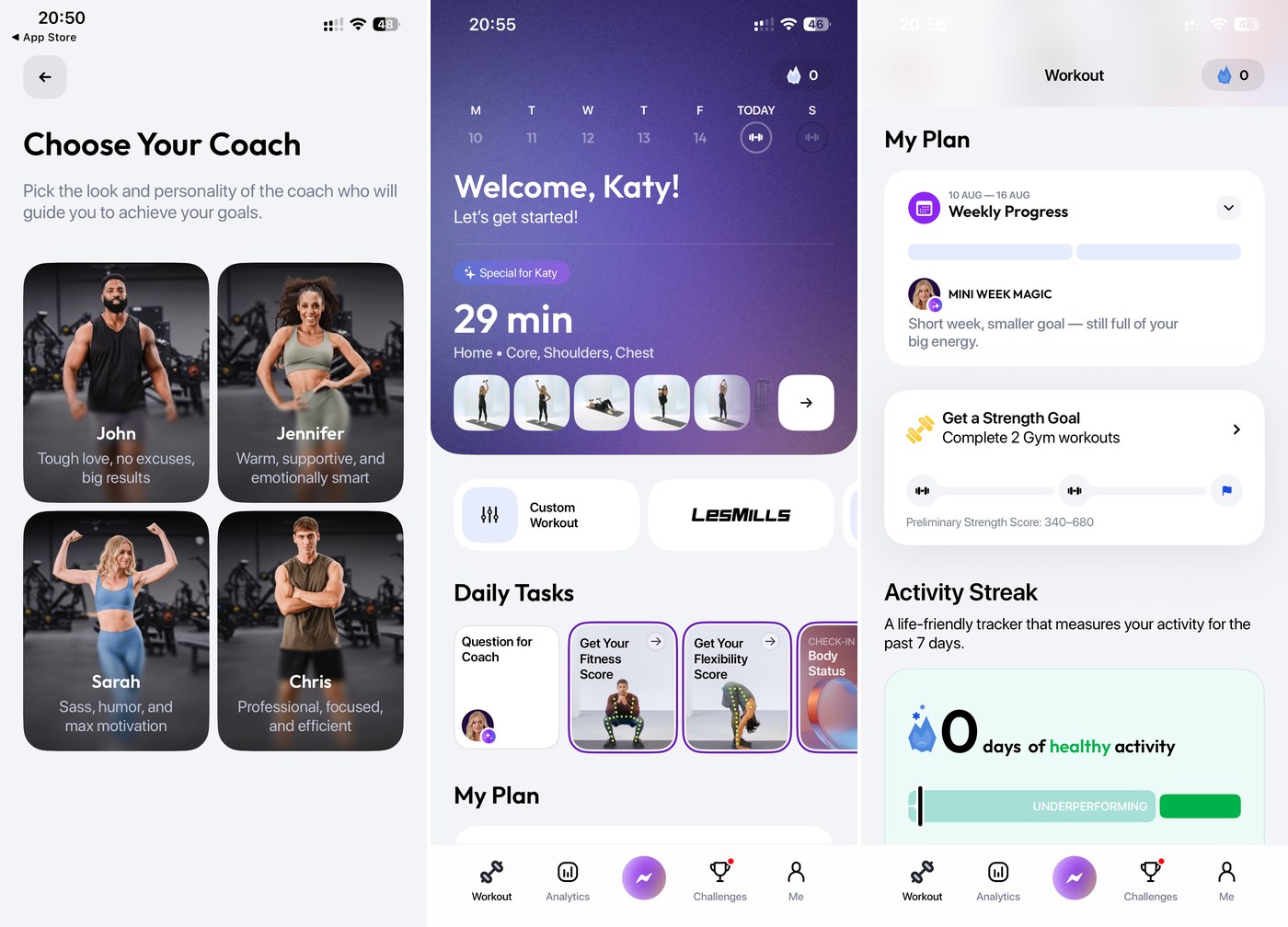
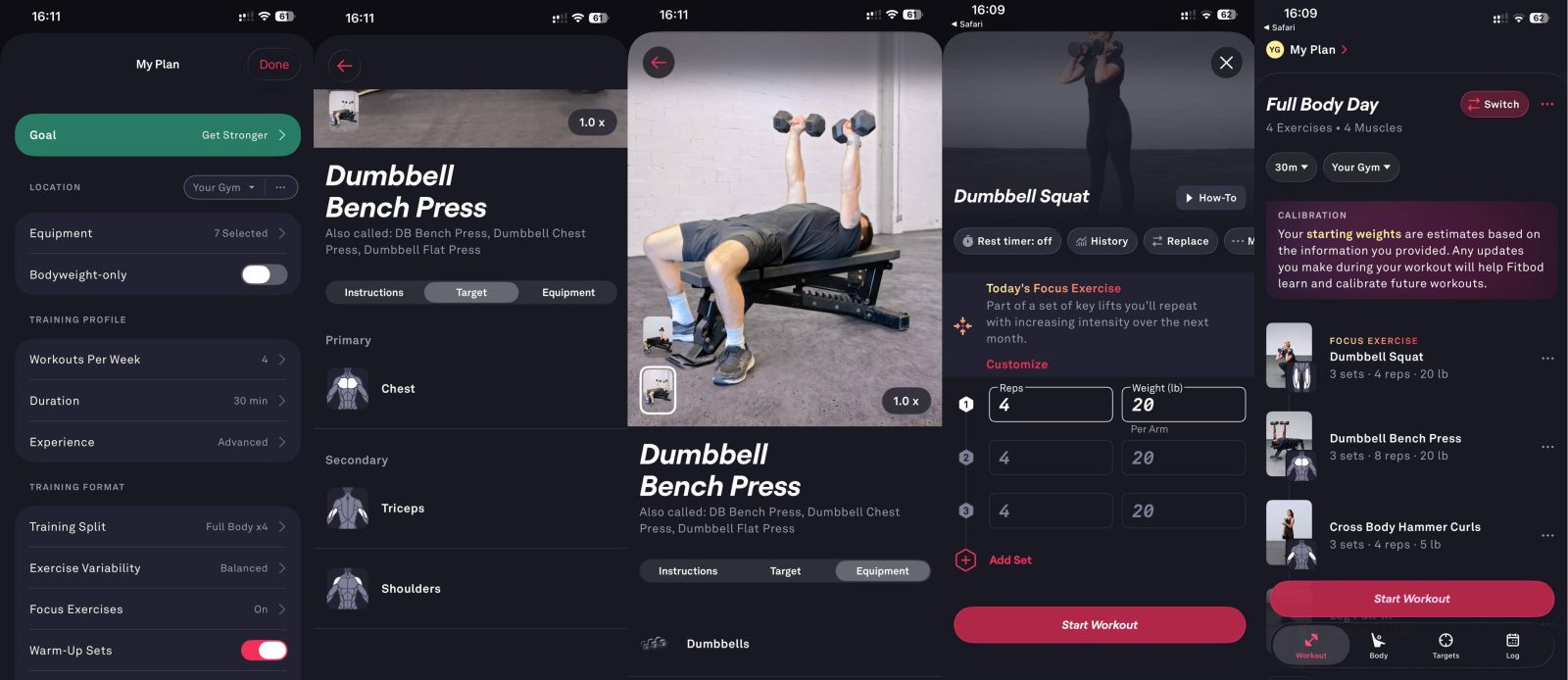
Only one of these two has been used, and it is not the one with the wider midlife profile. Fitbod was sample tested: downloaded, onboarding walked through, sample sessions generated, and the screenshots on its review are our own. Zing Coach is a research-based data profile with no workout completed on it. Its assessment rests on published material rather than on use, and the methods section below sets out exactly what that material was. So every Zing Coach number on this page describes what the product contains rather than how it performs in a real week, and its own profile flags joint friendliness, recovery, the interface and nutrition as the rows most likely to move once someone trains on it.
Fitbod if lifting is the point, if you want the load raised for you, and if you would rather pay one clear price than work out what a quiz funnel has decided you should pay. Zing Coach if you want one adaptive plan covering strength, intervals, stretching and recovery, if you like a body-composition number to track, and if you will read the checkout before agreeing to anything. Neither has menopause programming, pelvic-floor work or hormone guidance, so neither is the answer if that is the search you started with.
Zing Coach vs Fitbod: the two platforms
Two algorithms with different ambitions: one wants to be your whole plan, the other wants to be your best set.
Zing Coach
Runner-up
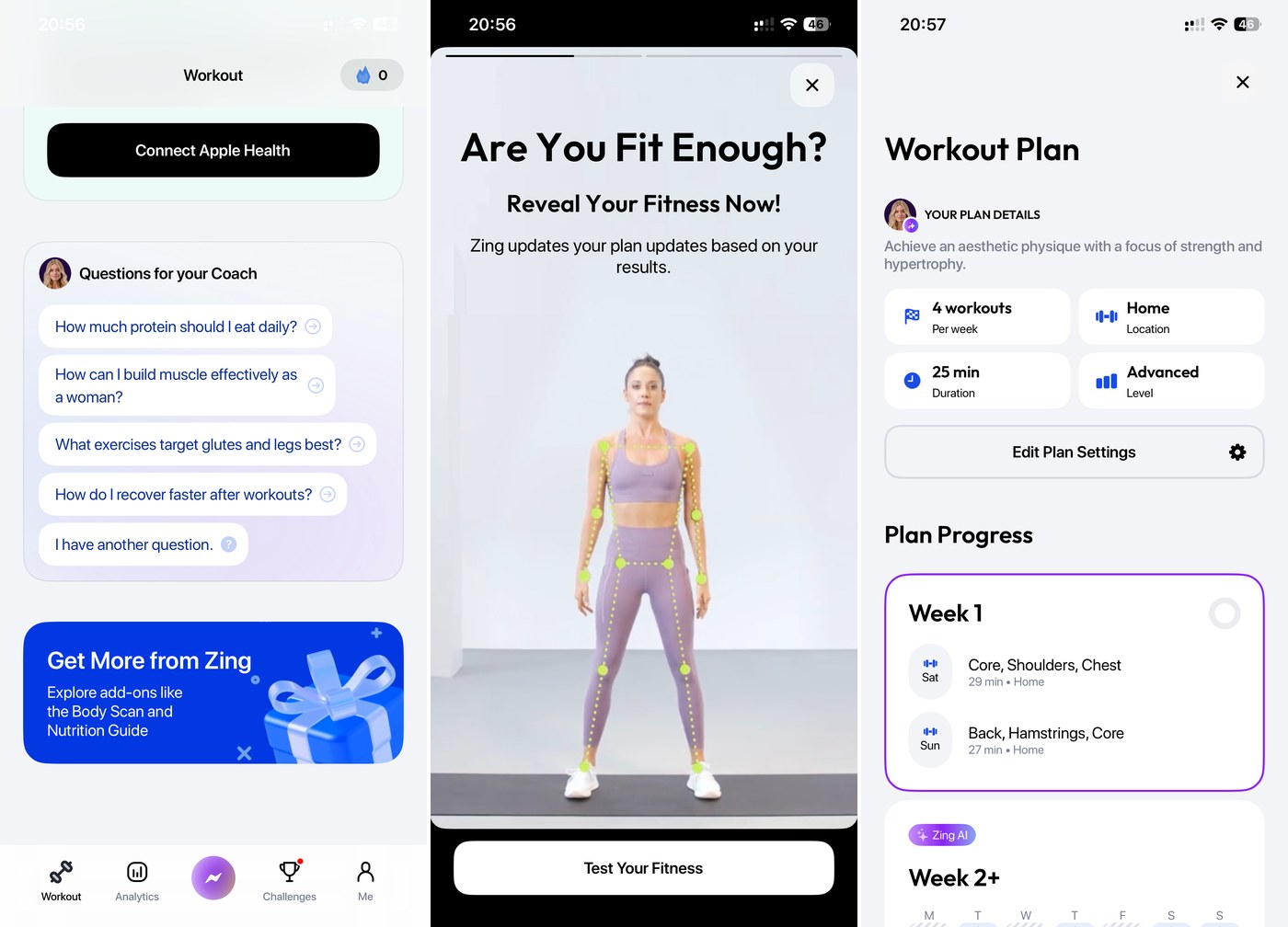
An AI personal-training app that generates and continually adapts a single plan across strength, HIIT, stretching and recovery from your quiz answers and your logged sessions, with an AI Body Scan, a fitness test, a Strength Score and a Les Mills content library.
- 7 to 45 min
- Low-impact 5/10
- Mind-body 4/10
- Free tier
- Not tested
Choose Zing Coach if you:
- Want one adaptive plan instead of a library
- Want cardio, mobility and stretching alongside lifting
- Like tracking a body-composition trend
- Are starting with no equipment at all
- Will read a dynamic-pricing checkout carefully
Fitbod
Winner
An AI strength generator that builds each lifting session around your goal, level and available equipment, then progresses the load as you log your sets. A planner and a logger rather than a follow-along class.
- 30 to 60 min
- Progressive strength 9/10
- Bone loading 8.5/10
- 7-day trial
- Sample tested
Choose Fitbod if you:
- Came for progressive lifting and nothing else
- Want the load raised without being asked
- Move between a gym, a home setup and travel
- Want one published price rather than a quiz-funnel one
- Are happy to plan your own gentle days
How we scored this, and why one column is weaker evidence
Both platforms went through the same nine weighted criteria and the same twelve capability scores, and only one of them has been opened. Muscle Potential carries 18%, Time Efficiency 15%, Joint Friendliness and Programme Structure 12% each, Women Over 40 Specificity and Recovery Compatibility 10%, Value for Money and UX and Design 8%, and Nutrition Integration 7%.
The tester, and what she covered. Katy is a woman in her early 40s, perimenopausal, working full-time with children, with a previous meniscus injury. On Fitbod she worked through the onboarding flow, generated sample sessions, browsed the workout and programme library and went through the exercise guide library, and the screenshots on that review are her own. That is a hands-on look rather than a completed multi-week test, so the Fitbod ratings that depend on long-term use are provisional too.
Zing Coach was assessed on a research basis, with no workout completed. The material behind it is the official app and methodology pages, the Help Center and refund policy, app-store and Trustpilot data, third-party reviews and the peer-reviewed literature. That is enough to describe the feature set, the pricing structure, the advisory panel and the pattern of user complaints accurately, and it is not enough to tell you how a session feels or whether the adaptation is any good in week six.
The published profile is candid about which rows are softest for that reason, marking joint friendliness, recovery, the interface and nutrition as low-confidence and most likely to move once someone trains on the app. We have carried that caution forward here rather than presenting the two columns as equally solid.
The disagreement at the heart of this comparison
The higher overall score and the wider midlife fit are in different columns, and the reason is arithmetic rather than judgement.
Zing Coach wins four of the nine weighted criteria to Fitbod’s three, with two tied. It wins eight of the twelve midlife capability rows to Fitbod’s three. On a straight count of rows, it is ahead in both tables. It still finishes behind, because Muscle Potential carries 18% of the model, more than any other criterion, and Fitbod wins it by a wide margin while most of Zing Coach’s wins are narrow ones on lightly weighted rows.
That is the model working as designed rather than a fault in it. Progressive resistance work is the intervention with the strongest evidence behind it for a woman after 40, which is why it carries the heaviest weight, and an app that does it better deserves to finish ahead of one that does a little of everything. Watson and colleagues found in the LIFTMOR trial that heavier, high-intensity resistance and impact training improved bone density and physical function in postmenopausal women, where light exercise did not to the same degree.1
The practical translation is a question rather than a ranking. If you know you want to lift and you want the loading handled well, the overall score is telling you the truth. If what you actually need is a plan that covers cardio and mobility and stretching and will go easy on your knees, the capability table is the more useful half of this page and it points the other way.
Muscle and bone: Fitbod, decisively
Fitbod wins Muscle Potential, 8 against 6.5, with progressive strength capability 9 out of 10 against 6 and bone loading 8.5 against 5. This is the widest criterion gap on the page and the reason for the result.
Fitbod exists for this. It selects exercises, sets, reps and target weights from your logged history and from which muscles it judges to be recovered, then escalates them, and it will do the same around a full gym, a dumbbell pair or nothing at all. Progression on custom workouts is manual, which is a fair complaint, and the automatic weight suggestions can be inaccurate until the app has learned your numbers, which is another. Neither undoes the mechanism.
Zing Coach puts adaptive strength plans at its core and progresses them, and its own profile names the weak point: users report that weights do not always advance on their own. Resistance training inherently loads bone, and there is no explicit bone-density or osteoporosis programming or intent behind it, which is why the bone row sits mid-scale rather than high.
The evidence points at volume and load rather than at the presence of a strength tab. Oliveira Junior and colleagues found that higher resistance-training volume produced more muscle in postmenopausal women, while strength gains came readily even at lower volume.2 On that reading, the platform that keeps adding sets and weight has the advantage for muscle, and the one that sometimes leaves the load where it was does not. Our best workouts to build muscle after 50 ranking covers the platforms that progress load deliberately.
Perimenopause and menopause fit: one point is not a feature
Zing Coach wins Women Over 40 Specificity, 3.5 against 3.2, and the capability rows behind it are the clearest illustration on this site of a win that means very little.
Zing Coach scores 1 out of 10 on menopause programming, 1 on pelvic floor, 1 on hormone awareness and 1 on menopause education. Fitbod scores 0 on all four. That is four wins in the table and no practical difference in the app, because a single point on this scale records the absence of a claim rather than the presence of content. Zing Coach is a general engine that accepts an older age as an input; Fitbod does not ask about menopause at all.
Expert credibility is the one row where the difference is real, 3.5 out of 10 against 3. Zing Coach Inc, founded 2021, publishes a named advisory panel including Jacky Forsyth PhD, an exercise physiologist specialising in women and wellbeing, and Dr Andrew Belaveshkin in preventative medicine. Listing qualified advisers is more transparency than most AI fitness apps offer. It is also not the same as a menopause credential, and there is no menopause specialist and no human coach building or supervising your plan. Fitbod, launched 2015, is algorithm-driven with no named clinician or menopause expertise behind it either.
Mind-body support is 4 out of 10 against 1, which is the widest midlife gap between them. Zing Coach has daily mood and energy check-ins, some wellness framing and a motivation-psychology adviser, described in its own profile as light and generic. Fitbod is pure lifting with no mind-body, stress or sleep content whatsoever.
What the evidence does and does not support
It is worth being precise here, because general fitness apps are often recommended to women expecting symptom relief. A Cochrane review by Daley and colleagues concluded that the evidence is insufficient to call exercise an effective treatment for hot flushes and night sweats.5 Neither platform claims otherwise, and neither should be bought on that expectation. What both deliver is the training itself, and the training is worth having on its own terms.
Adaptive plan against generated session: the result is not the obvious one
Fitbod wins Programme Structure, 7 against 6.5, which is a surprising result for the app that markets adaptation hardest.
Zing Coach is built around a single plan that reshapes itself. You start with an onboarding quiz covering goals, training background, available equipment and schedule, and the algorithm assembles a plan spanning strength, HIIT, stretching and recovery. As you log sessions and rate your energy, mood and sleep, the plan adjusts its intensity and its exercise selection. In principle that is a sensible way to keep training appropriate for a body whose capacity moves week to week, and it is a real advantage over a static library.
The reservation is whether the adaptation is as deep as the marketing. Some users feel the AI is shallow and does not truly adapt session to session, and the algorithm has not been independently validated, so what the evidence supports is the general approach rather than this particular model. Romeo and colleagues found that smartphone apps produce a modest genuine increase in physical activity, with the effect strongest in the first months and fading afterwards.3 An adaptive engine is a plausible way to stay consistent, not a guarantee of it.
Fitbod claims less and delivers it more reliably. It generates one session at a time, and its own review is clear about the boundary: there is no library of ready-made workouts to tap and play, you build the session or swap body parts yourself and then log your weights, because at heart it is a tracking app. Nobody using it is expecting a plan for the month, so nobody is disappointed by not getting one.
The body scan, the Strength Score and the fitness age
Zing Coach carries a whole measurement layer that Fitbod has no equivalent for, and it should be read as feedback rather than as data about your health.
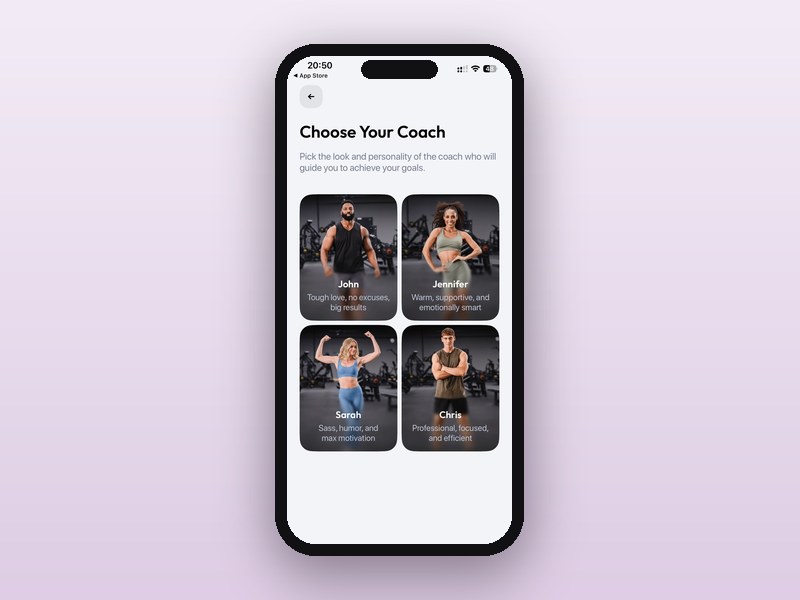
The signature feature is the AI Body Scan, branded Zing Vision, which estimates body composition from two smartphone photos using a model the company says was trained on DEXA data. Around it sit a fitness test, a flexibility test, a Strength Score and a fitness-age style figure, plus real-time form tracking through the phone camera and an AI chat coach with selectable personalities. For a woman who stays consistent because she can see a line moving, that is genuinely motivating.
Two cautions belong with it. A photo-based body-composition estimate is an approximation rather than a clinical scan, and its accuracy in poor lighting is one of the more common user complaints. The fitness-age concept rests on non-exercise prediction models, and Nes and colleagues reported that those models are accurate at population level while carrying roughly 10 to 15 percent error for any individual.4 Read the numbers as a trend line, not a verdict.
There is a second consideration for this audience that has nothing to do with accuracy. Body-composition scanning and fitness-age framing lean toward appearance and quick results, and that lands badly for some women, particularly anyone who has had enough of diet-culture messaging. Fitbod’s narrower scope is quietly an advantage there: it measures what you lifted and nothing about your body. The full Body Scan report is also about $22.99 as a separate add-on on top of premium, so the feature you may be signing up for is not included in the subscription.
Joint friendliness: Zing Coach wins, on a low bar
Zing Coach wins, 5.5 against 5, with low-impact capability 5 out of 10 against 4. Both numbers sit around the middle, and neither platform is designed to spare a joint.
Zing Coach can be told to go low-impact and it offers mobility and home options, but nothing in it is purpose-built as joint-sparing: it is a filter rather than a design principle. The Les Mills library it added in March 2026 widened that, bringing branded classes and some low-impact formats into the catalogue, which is a meaningful improvement on a general AI engine that previously had none.
Fitbod is not inherently gentle either. It generates lifting, and joint safety depends on which exercises you keep or exclude. What it gives you instead of a low-impact mode is control: swap any movement, save a dumbbell-only profile, and the generator follows you without ever suggesting the change itself.
This is a criterion where the untested column deserves the most scepticism, and the Zing Coach profile marks it low-confidence for exactly that reason. Being told a plan can go low-impact is not the same as feeling what it produces when you ask. If a joint is currently setting your terms, our best low-impact workouts for women over 50 ranking is the more useful page.
Value for money: Fitbod wins, and one price is knowable
Fitbod wins Value for Money, 6.5 against 5, and this is as much about how the two are sold as about what they cost.
| Plan | Zing Coach | Fitbod |
|---|---|---|
| Free tier | Yes, limited; the full adaptive plan needs premium | 3 free workouts |
| Monthly | About $19.99 to $23.99, dynamic | $15.99 a month |
| Quarterly | About $34.99 | Not sold quarterly |
| Annual | About $59.99 to $69.99 | $95.99 a year, about $8 a month |
| Paid add-ons | Body Scan report about $22.99, Nutrition Guide extra | None |
| Trial | Varies by funnel, confirm the length at signup | 7 days, card required, auto-renews |
On the annual plans Zing Coach is the cheaper subscription, and it still loses the criterion. The reason is that the number is not fixed. Pricing is set by a quiz funnel, so it is dynamic and can differ from what the woman next to you is shown, several price points appear, and two headline features sit behind further payments after you have already subscribed. A price you cannot know in advance is worth less than a price you can.
The refund terms are unusually detailed and worth knowing before you commit. Zing Coach offers a 30-day money-back guarantee under specific conditions, requiring no visible results after completing at least seven workouts in seven consecutive days, a 48-hour window on body-composition reports, and the statutory 14-day withdrawal right in the EU and EEA. Store purchases follow Apple and Google rules, direct purchases are generally non-refundable, and uninstalling the app does not cancel a subscription.
Fitbod is the plainer deal at $15.99 a month or $95.99 a year, about $8 a month on the annual plan, with 3 free workouts plus a 7-day free trial that requires a card and auto-renews. Its own billing friction is real: cancelling does not refund the current period, direct-site refunds run only to about 10 days, and App Store purchases are redirected to Apple. Our best free and budget workout apps ranking covers what else the money could buy.
Recovery: tied, by two different mechanisms
Tied at 5.5 each, with recovery and deload capability 6 out of 10 to Fitbod against 5.
Fitbod handles recovery structurally. Its muscle-fatigue heatmap tracks which muscles it judges to be recovered and steers the next session toward them, which keeps a week from stacking the same tissue twice. There are no programmed deload weeks, so the escalation continues until you stop it, and there is nothing to do on a day when you want to move without training.
Zing Coach handles it conversationally. Daily check-ins on sleep and energy feed loose auto-regulation, and there is stretching, a flexibility test and fatigue tracking alongside. What it does not have is a structured deload tied to a midlife body, and the depth of that auto-regulation is precisely the thing a research-based assessment cannot confirm.
So the tie is fair and it is a tie at a modest level. Neither platform will notice that this week is a write-off. Our low-cortisol workouts for perimenopause guide covers platforms built around that problem.
UX and design: Zing Coach wins, and one of these columns has been touched
Zing Coach wins UX and Design, 6.5 against 6, and this is the win that deserves the heaviest asterisk on the page.
Zing Coach is feature-rich and flexible. It runs on iPhone, Android and a web portal, has an Apple Watch app that syncs with Apple Health, casts the Les Mills classes to a television over AirPlay, ships in five languages and updates almost weekly. Users praise the clean interface and the easy onboarding. Offline access is not clearly documented, so confirm it at signup if training without a signal matters to you.
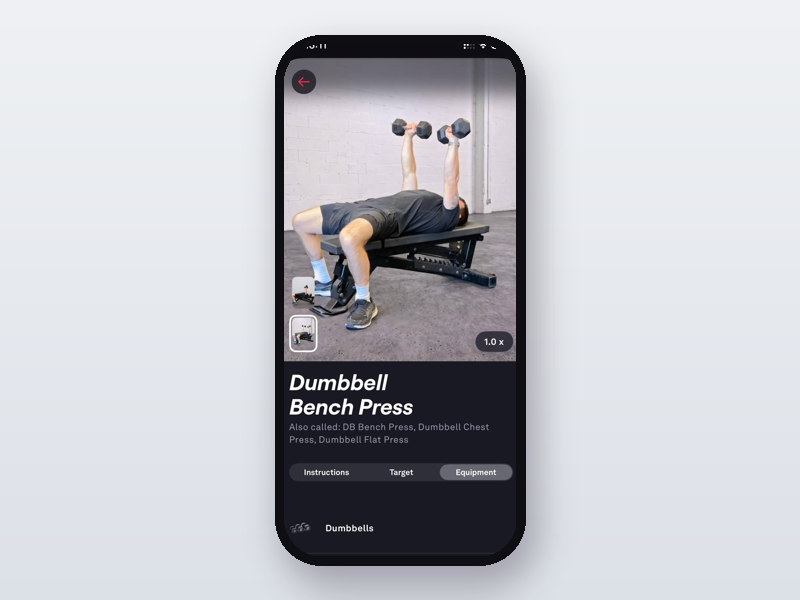
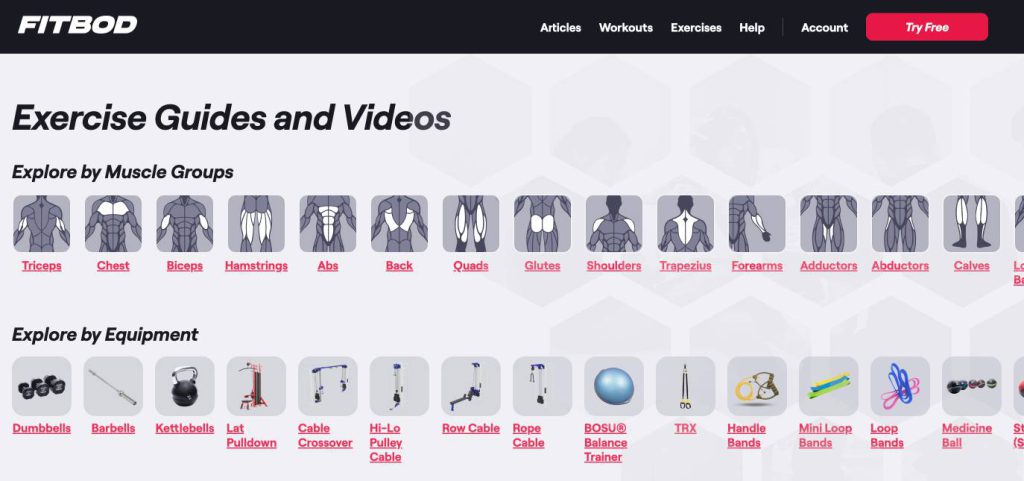
Fitbod is often called the benchmark for strength-app design and ease of use is what its reviewers name first, so this is a narrow gap between two well-built products. Its limits are the ones a strength tool chooses: each exercise has a short silent video of someone performing the move, with written form cues underneath, and there is no voice coaching. The touch Katy Cole did like is that every exercise shows the muscles it targets, which makes the exercise guide library genuinely usable by muscle group and by equipment.
The asterisk is simple. One of these interface scores comes from time inside the app and the other comes from screenshots, store listings and other people’s reviews, and the Zing Coach profile marks its interface score as low-confidence for that reason.
Nutrition: Zing Coach wins a contest with one entrant
Zing Coach wins Nutrition Integration, 3 against 0, with midlife nutrition capability 2.5 out of 10 against 0.
Zing Coach premium includes calorie and macro targets and an AI chat coach that will answer food questions. What it does not include is food or calorie logging, and the full Nutrition Guide is a separate paid purchase rather than part of the subscription. Its own profile is blunt that nutrition is peripheral and gated, which for a midlife woman is a real limitation given how much protein intake matters for holding on to muscle.
Fitbod has nothing at all: no targets, no logging, no education. Nutrition carries the smallest weight in the model at 7%, so the row costs it less than it looks. If structured eating support is a priority for you, our best workout apps with meal plans ranking is a better place to start than either of these.
Time efficiency: tied, and both suit a compressed week
Tied at 7 each, and the tie hides two quite different shapes.
Zing Coach sessions run roughly 7 to 45 minutes, and the published weekly totals stretch from about 30 minutes on a short-on-time setting of 7 to 15 minutes per session up to a higher-volume week of 150 to 225 minutes. That flexibility is one of its stronger arguments: a plan that shrinks rather than collapses is a plan you can keep on a bad week. Fitbod sessions are user-set and typically land between 30 and 60 minutes, shaped by how much you ask for and how long you rest.
For a woman training around work and children, either works, and the useful question is not whether you can find the minutes but whether the minutes you find are loaded enough to matter. Our 20-minute workouts for perimenopause guide covers the shorter end of the field.
Equipment and space needed at home
Both start from nothing, and both improve enormously with one purchase.
Zing Coach needs no equipment to begin and scales up to dumbbells, a barbell or full gym machines, so the barrier to starting is genuinely low. Fitbod builds around whatever you have, saving several profiles from a full gym down to a home dumbbell setup, travel kit or bodyweight only, and regenerating the workout to match, which is one of the most-praised things about it.
On either, the purchase that changes the outcome is an adjustable dumbbell pair, because a fixed light pair stops providing a stimulus once you have adapted to it, and adding volume and load is what the muscle evidence rewards.2 Neither platform needs proprietary hardware, a machine or a dedicated room. Our best workouts for postmenopause ranking covers options with different kit requirements.
Starting from scratch: a tie that flatters neither
Beginner on-ramp ties at 6 out of 10, and the two get there by opposite routes.
Zing Coach has a strong onboarding quiz and adaptive difficulty, which makes it approachable for a nervous beginner: you answer questions, a plan appears, and it starts where you are. The free tier means you can see the shape of it before paying anything.
Fitbod removes the decision instead of easing the entry. It tells you what to lift and shows a demo animation, which is reassuring on a gym floor, and its own review is candid about the limit: as a beginner you are unlikely to stop and read a paragraph on how to hold a squat, so the form guidance is thin exactly where a newer lifter needs it most. Its review points a beginner or a woman in perimenopause toward a more guided programme, which is an unusually direct thing for a product page to say.
The fair summary is that Zing Coach is easier to start and Fitbod is easier to keep doing once you know the movements. Once you are confident with them, Fitbod is genuinely good for progressive overload, and you will still need to build your own sessions for rest days or lower-impact days.
Zing Coach pros and cons
Zing Coach scores 5.7. It is strongest on short sessions and weakest on nutrition guidance.
Pros
- Joint Friendliness 5.5 against 5 and low-impact 5 out of 10 against 4.
- UX and Design 6.5 against 6, across iPhone, Android, web, Apple Watch and AirPlay, updated almost weekly.
- Nutrition Integration 3 against 0.
- Mind-body support 4 out of 10 against 1, and expert credibility 3.5 against 3 on a published advisory panel.
- One adaptive plan covering strength, intervals, stretching and recovery.
- Sessions from about seven minutes up.
- A free tier, and no equipment needed to start.
Cons
- Muscle Potential 6.5 against 8, with progressive strength 6 out of 10 against 9 and bone loading 5 against 8.5.
- Programme Structure 6.5 against 7, and users who feel the adaptation is shallow.
- Value for Money 5 against 6.5, on quiz-funnel pricing with stacked paid add-ons.
- Billing and refund complaints on independent review sites.
- No menopause education, hormone guidance or pelvic-floor content.
- No human coach.
- And nobody here has trained on it.
Fitbod pros and cons
Fitbod scores 5.8. It leads on building and keeping muscle and trails on nutrition guidance.
Pros
- Muscle Potential 8 against 6.5 at 18% of the model, leading on progressive strength at 9 out of 10 against 6 and on bone loading at 8.5 against 5.
- Programme Structure 7 against 6.5.
- Value for Money 6.5 against 5, on one published price of $15.99 a month with no add-ons.
- Recovery and deload 6 out of 10 against 5, on a muscle-fatigue heatmap.
- Equipment profiles for a gym, home, travel or bodyweight.
- And it was actually used.
Cons
- Joint Friendliness 5 against 5.5 and UX and Design 6 against 6.5.
- Nutrition Integration 0, meaning none.
- Zero on menopause programming, pelvic floor, hormone awareness, menopause education and midlife nutrition.
- Mind-body support 1 out of 10.
- No voice coaching, no cardio, no mobility, no community.
- Manual progression on custom workouts, and early weight suggestions that can be inaccurate.
Quick yes/no comparison
| Feature | Zing Coach | Fitbod |
|---|---|---|
| Free tier | Yes, limited | Yes, 3 free workouts |
| A published, fixed price | No, dynamic quiz-funnel pricing | Yes |
| Paid add-ons on top of the subscription | Yes, the Body Scan report and Nutrition Guide | No |
| One adaptive plan rather than a session at a time | Yes | No |
| Automatic load progression | Partly, users report it does not always advance | Yes, on generated workouts |
| Cardio and intervals | Yes | No, lifting only |
| Stretching and mobility | Yes | No |
| Body-composition estimate | Yes, from two photos, a paid add-on | No |
| Human coach | No, an algorithm | No, an algorithm |
| Named advisers with credentials | Yes, an exercise physiologist and a doctor | No |
| Menopause or perimenopause programming | No | No |
| Pelvic floor content | No | No |
| Nutrition guidance | Partly, targets only, the full guide costs extra | No |
| Cast to a television | Yes, over AirPlay | Not assessed |
| Was it tested hands-on | No, research-based only | Yes, a hands-on look |
Zing Coach vs Fitbod at a glance
| Zing Coach | Fitbod | |
|---|---|---|
| Overall score | 5.7 | 5.8 |
| How it was assessed | Data profile, research-based. Assessed from the official app, methodology pages, app-store data and peer-reviewed evidence, with no workout completed | Sample tested, downloaded and explored hands-on with our own screenshots |
| Cost | Free tier; premium about $19.99 to $23.99 a month or $59.99 to $69.99 a year | $15.99 a month or $95.99 a year |
| How the price is set | Dynamic quiz-funnel pricing, several price points appear | One published price |
| Trial | Varies by funnel, so confirm the length at signup | 3 free workouts plus a 7-day free trial, card required |
| Session length | Roughly 7 to 45 minutes, weekly totals from about 30 up to 150 to 225 minutes | User-set, roughly 30 to 60 minutes |
| What it gives you | One adaptive plan across strength, HIIT, stretching and recovery | A generated lifting session, logged as you go |
| Signature feature | The AI Body Scan, plus a fitness test and a Strength Score | A muscle-fatigue heatmap and automatic load progression |
| Who is behind it | Zing Coach Inc, founded 2021, with named advisers, no human coach | Fitbod, launched 2015, algorithm-driven, no named clinician |
| Menopause content | None | None |
| Equipment | None needed to start, scales to dumbbells, a barbell or a gym | Anything from a full gym to bodyweight, saved as profiles |
| Known live issue | Billing and cancellation complaints, add-ons behind the paywall | Manual progression on custom workouts, refunds routed to Apple |
| How we assessed it | Research-based, no workout completed | Sample tested, downloaded and explored hands-on |
Zing Coach vs Fitbod: the full scoring breakdown
Zing coach wins four of the nine weighted criteria and fitbod wins three, with two tied. The overall scores sit close together, 5.8 against 5.7, and the winner is the platform that lost the row count, because the row it won is the heaviest one in the model.
| Criterion | Weight | Zing Coach | Fitbod | Winner |
|---|---|---|---|---|
| Muscle Potential | 18% | 6.5 | 8 | Fitbod |
| Time Efficiency | 15% | 7 | 7 | Tied |
| Joint Friendliness | 12% | 5.5 | 5 | Zing Coach |
| Programme Structure | 12% | 6.5 | 7 | Fitbod |
| Women Over 40 Specificity | 10% | 3.5 | 3.2 | Zing Coach |
| Recovery Compatibility | 10% | 5.5 | 5.5 | Tied |
| Value for Money | 8% | 5 | 6.5 | Fitbod |
| UX and Design | 8% | 6.5 | 6 | Zing Coach |
| Nutrition Integration | 7% | 3 | 0 | Zing Coach |
| Overall | 100% | 5.7 | 5.8 | Fitbod |
The twelve capability scores
Zing coach wins eight of the twelve capability scores and fitbod wins three, with one tied. The widest gaps run in opposite directions: progressive strength 9 out of 10 to Fitbod against 6, and bone loading 8.5 against 5, against mind-body support 4 to Zing Coach against 1 and midlife nutrition 2.5 against 0. Fitbod records a zero on five rows; Zing Coach records a one on four of the same rows, which is a difference in bookkeeping more than in content.
| Capability | Zing Coach | Fitbod | Winner |
|---|---|---|---|
| Low-impact | 5 | 4 | Zing Coach |
| Progressive strength | 6 | 9 | Fitbod |
| Bone loading | 5 | 8.5 | Fitbod |
| Recovery & deload | 5 | 6 | Fitbod |
| Menopause programming | 1 | 0 | Zing Coach |
| Pelvic floor | 1 | 0 | Zing Coach |
| Hormone awareness | 1 | 0 | Zing Coach |
| Menopause education | 1 | 0 | Zing Coach |
| Expert credibility | 3.5 | 3 | Zing Coach |
| Mind-body support | 4 | 1 | Zing Coach |
| Beginner on-ramp | 6 | 6 | Tied |
| Midlife nutrition | 2.5 | 0 | Zing Coach |
Who wins for…
Who wins for building muscle
Fitbod, comfortably. Muscle Potential 8 against 6.5, with progressive strength 9 out of 10 against 6.
Who wins for bone density
Fitbod. Bone loading 8.5 out of 10 against 5, because it escalates the load rather than waiting for you to.1
Who wins for painful joints
Zing Coach, on a low bar. 5.5 against 5 and low-impact 5 out of 10 against 4, and neither is purpose-built to spare a joint.
Who wins for one plan covering everything
Zing Coach. Strength, intervals, stretching and recovery in a single adaptive plan; Fitbod does lifting only.
Who wins on a knowable price
Fitbod. Value for Money 6.5 against 5, on one published figure with no add-ons.
Who wins for the lowest entry cost
Zing Coach. A free tier plus no equipment needed, so you can see the plan before paying anything.
Who wins for a short week
A tie at 7. Zing Coach shrinks a session to about seven minutes; Fitbod expects you to shorten it yourself.
Who wins for the app itself
Zing Coach, with a caveat. UX and Design 6.5 against 6, though only one of those scores comes from using the product.
Who wins for perimenopause and menopause
Neither. Menopause programming 1 out of 10 against 0, and one point is not a feature.
Who wins for pelvic floor
Neither. 1 out of 10 against 0. There is no pelvic-floor content on either platform.
Who wins for stress and mood support
Zing Coach. Mind-body support 4 out of 10 against 1, on check-ins and wellness framing that its own profile calls light.
Who wins on evidence
Fitbod, because it was used. Zing Coach is a research-based profile, so its column describes the product rather than the experience.
Decision tree for women over 40
You want to lift and get stronger. Fitbod, for Muscle Potential 8 against 6.5 and a generator that keeps raising the load.
You want cardio, mobility and lifting in one plan. Zing Coach, which is the only one of the two that does more than strength.
You want to spend nothing to find out. Zing Coach, whose free tier shows you the shape of the plan without a card.
You want to know exactly what you will pay. Fitbod, at $15.99 a month with no add-ons behind the subscription.
You own no equipment at all. Zing Coach, which starts at bodyweight and scales up as you add kit.
You train in a gym some weeks and at home in others. Fitbod, for the saved equipment profiles.
You would rather not be given a body-composition number. Fitbod, which measures your lifting and nothing about your body.
Your priority is bone. Fitbod, and add impact work elsewhere if it suits you, because neither platform programmes it.
Perimenopause is why you are looking. Neither, and a purpose-built platform instead of both.
What we did not test
One column here rests on time in the app and the other rests entirely on documents.
No workout was completed on Zing Coach. The AI Body Scan was not run, the Les Mills library inside Zing was not sampled, and the adaptive plan over time was not experienced, which is the single most important gap because adaptation is the whole proposition. Everything on this page about how Zing Coach trains comes from the research basis described in the methods section, and its column should be read as a description rather than a verdict. Its own profile marks joint friendliness, recovery, the interface and nutrition as the rows most likely to move once someone uses it.
On Fitbod the limits are narrower. No full multi-week programme was run, so long-term weight-suggestion accuracy is untested, which is the specific thing its reviewers complain about. The custom workout builder was not used and the Apple Watch app was not assessed, so the manual-progression complaint attached to custom workouts is reported from the review corpus rather than reproduced here.
Neither platform was assessed against an injury, a symptomatic week or a return after a long break, and nothing on this page should be read as a claim about results over months on either.
Which is better for women over 50?
Fitbod, and the case gets stronger with every year
The argument for progressive loading does not soften with age, it sharpens. Fitbod is the platform here that keeps escalating without being reminded, and the bone evidence is specific that the response comes from heavier work rather than from light exercise.1 Pair it with your own gentler days, because it will not supply them, and add a mobility habit from somewhere else.
Zing Coach, if variety is what keeps you going
At 50 the thing that ends a training habit is usually monotony or a week that goes wrong, and a single plan covering strength, intervals, stretching and recovery is easier to stay inside than a lifting-only tool. The free tier makes that low-risk to test. The condition is that you push the loads yourself, because the reported weakness is exactly that the app does not reliably escalate them for you.
What we would actually suggest
Try the Zing Coach free tier first, since it costs nothing and will tell you quickly whether an adaptive plan suits how you think about training, and read the checkout carefully before upgrading. If what you find is that you mostly want to lift, Fitbod is the cheaper and better tool for that, and it is the one we have actually opened. If your training is being shaped by symptoms rather than by preference, look at a menopause-built platform instead of either, and our Evlo vs Pvolve comparison is a reasonable starting point.
Frequently asked questions
Is Zing Coach or Fitbod better for women over 40?
The two overall scores sit close together, 5.8 for Fitbod against 5.7 for Zing Coach, and they disagree with the detail underneath them. Zing Coach takes four of the nine weighted rows and eight of the twelve midlife capability rows. Fitbod wins three criteria and three capabilities, but one of its three is Muscle Potential, 8 against 6.5, which carries 18% of the model, and that single row is why it finishes ahead. If you want the strongest lifting engine, Fitbod. If you want the wider fit for a midlife body, Zing Coach, on a low bar.
Which one builds more muscle and bone?
Fitbod, and not narrowly. Muscle Potential is 8 against 6.5, on a bone loading row of 8.5 out of 10 against 5 and a progressive strength row of 9 against 6. It chooses your loads from your logged history and raises them, while Zing Coach users report that weights do not always advance on their own. Oliveira Junior and colleagues found that higher resistance-training volume produced more muscle in postmenopausal women, while strength gains arrived readily even at lower volume,2 so the platform that keeps pushing the volume and the load has the advantage for muscle.
Is Zing Coach designed for menopause?
No. Zing Coach is a general AI fitness app with no menopause education, no hormone or phase guidance and no pelvic-floor content, and there is no menopause credential on the team. Its own profile puts it plainly: age is one input in a general algorithm rather than a reason to design differently. What it does have is a single point on four capability rows where Fitbod has zero, which is why it wins the midlife comparison here. Menopause programming is 1 out of 10 against 0.
How much do Zing Coach and Fitbod cost?
Fitbod is the simpler answer: $15.99 a month, or $95.99 for a year, which comes to about $8 a month. You get 3 free workouts plus a 7-day free trial that requires a card and auto-renews. Zing Coach has a free tier, with premium about $19.99 to $23.99 a month or $59.99 to $69.99 a year on dynamic quiz-funnel pricing, so two people can be shown different numbers, and the Body Scan report is about $22.99 as a separate add-on on top. Value for Money is 6.5 against 5.
Can you trust the body scan and the fitness age?
Treat both as motivational estimates rather than measurements. The AI Body Scan estimates body composition from two smartphone photos using a model the company says was trained on DEXA data, and its accuracy in poor lighting is a recurring user complaint. The fitness-age idea rests on non-exercise prediction models, and Nes and colleagues reported that such models are accurate at population level while carrying roughly 10 to 15 percent error for any individual.4 Fitbod offers nothing comparable, which is neither a gap nor a feature, only a different scope.
Which is gentler on the joints?
Zing Coach, 5.5 against 5, with low-impact capability 5 out of 10 against 4. Neither is a low-impact platform. Zing Coach can be told to go low-impact and offers mobility and home options, though nothing in it is purpose-built as joint-sparing, and the Les Mills library it added in March 2026 brought some low-impact formats with it. Fitbod is not inherently gentle either: it generates lifting, and joint safety depends on which exercises you keep or exclude, though the swap and the equipment profile give you real control over that.
Which one plans my week?
Fitbod wins Programme Structure, 7 against 6.5, which is the opposite of what most people expect from an adaptive AI app. Zing Coach builds a single plan that reshapes itself as you log sessions and rate your energy, mood and sleep, which is genuinely appealing in principle. The reservation, and the reason the score sits where it does, is that some users feel the AI does not truly adapt from session to session. Fitbod plans nothing beyond today, but what it does plan it plans reliably.
Which has better nutrition support?
Zing Coach, 3 against 0, which is a win by default because 0 means none at all. Zing Coach premium includes calorie and macro targets and an AI chat coach that will answer food questions, but there is no food logging and the full Nutrition Guide is a separate paid purchase rather than part of the subscription. Midlife nutrition capability is 2.5 out of 10 against 0. Fitbod has no nutrition content of any kind and does not claim to.
Will exercise help my hot flushes on either app?
Neither app targets vasomotor symptoms and the evidence does not support expecting them to. Daley and colleagues concluded in a Cochrane review that there is insufficient evidence that exercise is an effective treatment for vasomotor menopausal symptoms.5 Neither platform makes such a claim, which is to their credit. If hot flushes or night sweats are what you are trying to manage, that is a conversation for your GP rather than a reason to choose between two general training apps.
How much did you actually test each platform?
Unequally, and it changes how much weight each column deserves. Fitbod was sample tested: it was downloaded, the onboarding walked through, sample generated sessions produced and the exercise guide library explored, with our own screenshots. Zing Coach was not used. Its assessment is a research-based data profile: the official app and its methodology pages, the published refund terms, store and Trustpilot records, independent reviews and the science. Every Zing Coach score describes what the product contains, not how it felt to train on.
Which is easier to cancel?
Fitbod, and neither is friction-free. Fitbod auto-renews, cancelling does not refund the current period, direct-site refunds run only to about 10 days, and App Store purchases are redirected to Apple, which its reviewers find frustrating. Zing Coach draws heavier complaints: billing and cancellation is the dominant theme in its independent reviews, including charges after a cancelled trial and refund disputes, and uninstalling the app does not cancel a subscription. Cancel through your app-store settings on either, and read the terms before you subscribe to Zing Coach in particular.
Which one would you actually recommend?
Fitbod, if the reason you are shopping is progressive strength, because it is the better and cheaper engine for exactly that and it is the one we have used. Zing Coach if you want one adaptive plan covering strength, intervals, stretching and recovery, you like training data, and you will read the checkout carefully before you agree to anything. Neither is built for the menopause transition, and if that is your priority the right move is to look at a purpose-built platform instead of choosing between these two.
Research citations
- Watson SL, Weeks BK, Weis LJ, Harding AT, Horan SA, Beck BR. High-intensity resistance and impact training improves bone mineral density and physical function in postmenopausal women: the LIFTMOR randomized controlled trial. Journal of Bone and Mineral Research. 2018;33(2):211–220. PubMed. (Cited for: heavier, high-intensity resistance and impact training improved bone density and physical function, where light exercise did not to the same degree.)
- Oliveira Junior GN, de Sousa JFR, Carneiro MAS, et al. Resistance training volume and muscle hypertrophy in postmenopausal women. Journal of Strength and Conditioning Research. 2022. PubMed. (Cited for: higher training volume produced more muscle in postmenopausal women, while strength gains arrived readily even at lower volume.)
- Romeo A, Edney S, Plotnikoff R, et al. Can smartphone apps increase physical activity? Systematic review and meta-analysis. Journal of Medical Internet Research. 2019. PubMed. (Cited for: app-based coaching produced a modest genuine increase in physical activity, strongest in the first months and fading afterwards.)
- Nes BM, Janszky I, Vatten LJ, Nilsen TIL, Aspenes ST, Wisløff U. Estimating VO2peak from a non-exercise prediction model: the HUNT study. Medicine and Science in Sports and Exercise. 2011. PubMed. (Cited for: non-exercise models estimating cardiorespiratory fitness are accurate at population level while carrying roughly 10 to 15 percent error for any individual.)
- Daley A, Stokes-Lampard H, Thomas A, MacArthur C. Exercise for vasomotor menopausal symptoms. Cochrane Database of Systematic Reviews. 2014. PubMed. (Cited for: insufficient evidence that exercise is an effective treatment for vasomotor menopausal symptoms.)
This page compares fitness platforms. It is not medical advice. Katy is a woman who has trained through perimenopause, not a clinician. Any training observations described are one person’s recorded experience, not an expected result or a general pattern. If you have a diagnosed condition, an injury, or symptoms that concern you, speak to a qualified healthcare professional before changing how you train.
About this comparison
Compiled by Katy Cole for Her Daily Fit. The two platforms were not assessed to the same depth. Fitbod was sample tested and the methods section above lists what that covered. Zing Coach is a research-based data profile built from published sources rather than from use, with no workout completed on it, so its column describes what the product contains rather than how it performs in use. Both were scored on the same nine weighted criteria and the same twelve capability scores, which is why one platform can win more rows than the other and still finish behind it. Prices were verified against official sources in 2026 and may differ if there has been a recent change; Zing Coach sets its prices through a quiz funnel, so the figure you are shown at signup may not match the figures published here, and two people can be quoted differently on the same day. Scores are pulled live from each programme’s own assessment. Her Daily Fit earns nothing from either platform.