
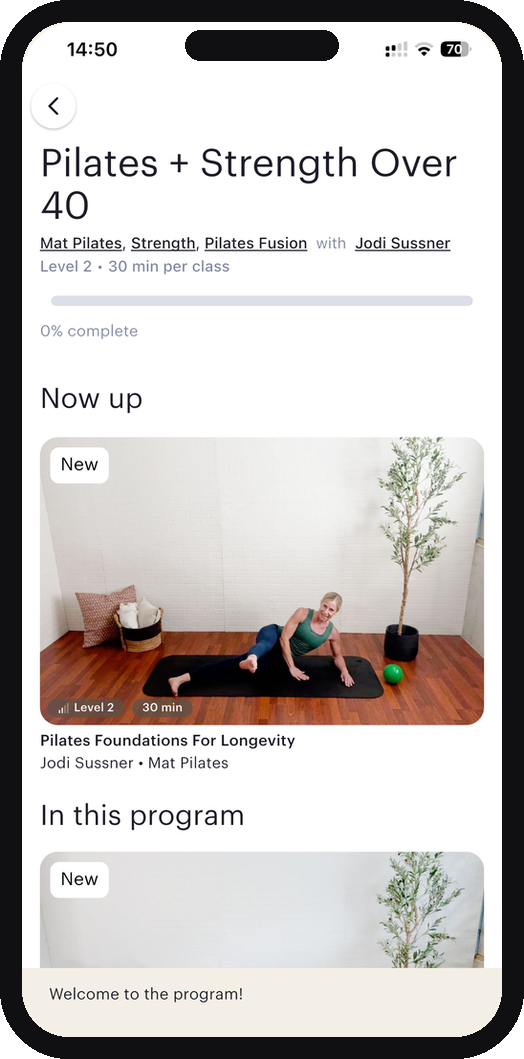
The deep, calming yoga, Pilates and meditation platform from Glo (glo.com, formerly YogaGlo) that also carries genuine strength and real over-40 content: a new Pilates + Strength Over 40 series, menopause support, pelvic-floor and osteoporosis-aware classes, meditative walks and a huge library · wonderful for joints, core, stress and midlife nerves · but yoga and Pilates first, so the strength is lighter and you have to search for it. Calm and joint-kind, with real menopause care, if not the heaviest strength.
How I tested this. This is a fully-tested review. I used Glo consistently for about 8 weeks, doing Pilates on my low-impact days and strength training on my strength days, and worked through its yoga, Pilates, strength, menopause, pelvic-floor, walking and meditation content, including the new Pilates + Strength Over 40 series. The scores and findings below reflect that hands-on use. This is education, not medical advice; check with your clinician before starting a new programme, especially with joint, pelvic-floor or heart concerns.
Glo Review 2026: Quick Answer
Fully-tested: 8 weeks of consistent use, mixing Pilates on low-impact days and strength on strength days
Women 40+ who want calming, joint-friendly yoga and Pilates with real menopause, pelvic-floor and core content, plus some strength
Your main goal is heavy progressive strength or a single guided menopause plan, rather than a deep pick-your-own library
A large yoga, Pilates, meditation, walking and strength streaming app with a new Pilates + Strength Over 40 series
About 10 to 60 minutes, from quick 10-minute resets to 60-minute classes
A mat, blocks, a small Pilates ball and a range of dumbbells; stackable weights help because Pilates needs lighter loads than strength
Mostly low-impact and joint-friendly, with some mixed-impact active-aging classes for bone
Calming atmosphere, joint-friendly movement, real pelvic-floor, core, menopause and active-aging content, and a beginner-friendly onramp
Real but light-to-moderate and search-dependent; add heavier loading for serious muscle and bone
Genuinely good: a dedicated Over 40 series, menopause support, pelvic-floor and active-aging classes, though not a single structured plan
iOS, Android, web, Apple TV, Apple Watch and Mac, with downloads and casting
About $30 a month or $245 a year, with a 7-day free trial
A 7-day free trial, then it auto-renews; cancel anytime, but charges are not refunded
6.8 / 10
Quick Verdict
Worth it for women over 40? Yes, and more than I expected. For calming, joint-friendly movement with real perimenopause and menopause content, Glo is genuinely good, as long as you know it is yoga and Pilates first, with strength as a strong supporting act.
Glo earns 6.8/10 after 8 weeks of testing. It is a deep, beautifully calm library of yoga, Pilates, meditation and walking, and the more I dug, the more midlife gold I found: a new Pilates + Strength Over 40 series with Jodi Sussner that explains every movement and why it matters for pelvic floor and joints, a Menopause Support programme, Active Aging classes built for muscle and bone, pelvic-floor strength classes, chair Pilates and meditative walks. Jeni Del Pozo’s functional strength challenged me even at my usual weights, especially a curtsy lunge to three directions. After sessions I felt energised and relaxed at once, which is exactly what my perimenopause nerves needed.
Where it is limited for our audience. Glo is a yoga and Pilates platform first, so the strength is real but light-to-moderate, and the best content is search-dependent rather than served as one guided plan. Over 8 weeks I maintained muscle rather than built it, which is a win in midlife but tells you it is not a heavy-loading tool. There is no medical or menopause advisory board, no meaningful nutrition, and it is premium priced. Choose it if you want calm, joint-kind, menopause-aware movement, and add heavier dumbbells and a structured strength plan for real muscle and bone.
Is Glo right for you?
Glo is strongest for pelvic floor problems (8.0 out of 10, against a 4.7 average across the 105 programmes scored) and weakest for nutrition support (2.0 against 3.6).
| Question | Verdict | Rating | Score |
|---|---|---|---|
| How it suits a perimenopausal body | |||
| Is Glo good for pelvic floor problems?Based on pelvic floor support and low-impact design | Strong, and better than mostmost score 4.7/10 | 8.0 / 10 | |
| Does Glo include perimenopause and menopause education and programming?Based on programming, education, hormone awareness and credibility | Moderate, but better than mostmost score 3.2/10 | 6.0 / 10 | |
| Is Glo good for painful joints?Based on low-impact design and recovery provision | Strong, and better than mostmost score 6.1/10 | 7.5 / 10 | |
| Is Glo manageable when your energy is low?Based on recovery provision and mind-body support | Strong, and better than mostmost score 5.6/10 | 7.5 / 10 | |
| Is Glo good if you are new to strength training?Based on beginner on-ramp and mind-body support | Strong, and better than mostmost score 6.1/10 | 8.8 / 10 | |
| Is Glo good for building bone density?Based on bone loading and progressive strength | Low, about the same as mostmost score 5.1/10 | 4.5 / 10 | |
| Does Glo help with nutrition?Based on midlife nutrition support | Low, and worse than mostmost score 3.6/10 | 2.0 / 10 | |
| How it performs as a product | |||
| Can you fit Glo into a busy week?Based on time efficiency | Strong, about the same as mostmost score 7.5/10 | 7.5 / 10 | |
| Is Glo worth the money?Based on value for money | Strong, about the same as mostmost score 6.9/10 | 7.5 / 10 | |
Jump to Section
My Experience
Who Is Behind It
Content and Features
Closer Look at the Content
Equipment You Need
Full Scoring
Good for Women Over 40?
Menopause and Midlife Fit
What the Research Says
What Users Report
Devices and App
Pricing 2026
Will You Stick With It
Pros and Cons
How It Compares
vs Pvolve
Best Alternatives
FAQ
Verdict
Testing Status
Sources
What Glo Actually Is
Glo, at glo.com and formerly known as YogaGlo, is a large on-demand streaming platform for yoga, Pilates, meditation, breathwork, walking and fitness, including strength. It carries more than 12,000 classes from over 60 teachers, plus more than 90 structured multi-class programmes, and classes run from about 5 minutes to 90 minutes. It has been going since 2008 and is actively developed, and it streams on phones, tablets, computers and televisions. Tellingly for our readers, its home screen lets you explore by focus, and the categories now include Menopause, Aging well, Stress and anxiety, Sleep and Recovery, so midlife is a first-class filter rather than an afterthought.
Which product this is. This is Glo, the yoga and Pilates app from Glo Digital, once called YogaGlo, not to be confused with other apps and brands using similar names. It is a broad wellbeing library rather than a single guided programme, and over the last year it has leaned noticeably into midlife: healthy ageing, menopause, longevity and strength now sit alongside its deep yoga roots.
For this audience it helps to be clear about what it is and is not. Glo is a genuinely calming, joint-friendly, education-rich platform with real menopause, pelvic-floor and active-aging content, which is more than most yoga apps offer. What it is not is a heavy-strength or single-plan menopause programme: the strength is real but lighter, the best content rewards searching, and there is no clinical or menopause advisory board. Read it as a deep, calming, midlife-aware movement library to build your own week from, paired with heavier strength.
My Experience Testing Glo Over 8 Weeks
The more I dug, the more midlife gold I found. Glo is deep, and its best over-40 content is not always front and centre, so I discovered a lot only when I went searching. Over 8 weeks I built my own week from it, Pilates on my low-impact days and strength on my strength days, and kept finding things: pelvic-floor and core classes, chair Pilates, yoga for beginners, knee and joint-friendly options, meditative walks as short as 15 to 20 minutes, and a lot of meditation, which is a big part of the app.
The strength is better than a yoga app suggests. I loved Jeni Del Pozo’s functional strength sessions; some had small modifications or new moves, so even keeping my usual heavier dumbbells they still challenged me, especially a curtsy lunge to three directions. She explains the moves and the right posture throughout. As you get stronger you do need heavier dumbbells for progressive overload, and I would strongly recommend owning several weights or a stackable set, because the Pilates classes often need much lighter loads than strength moves like squats and lunges.
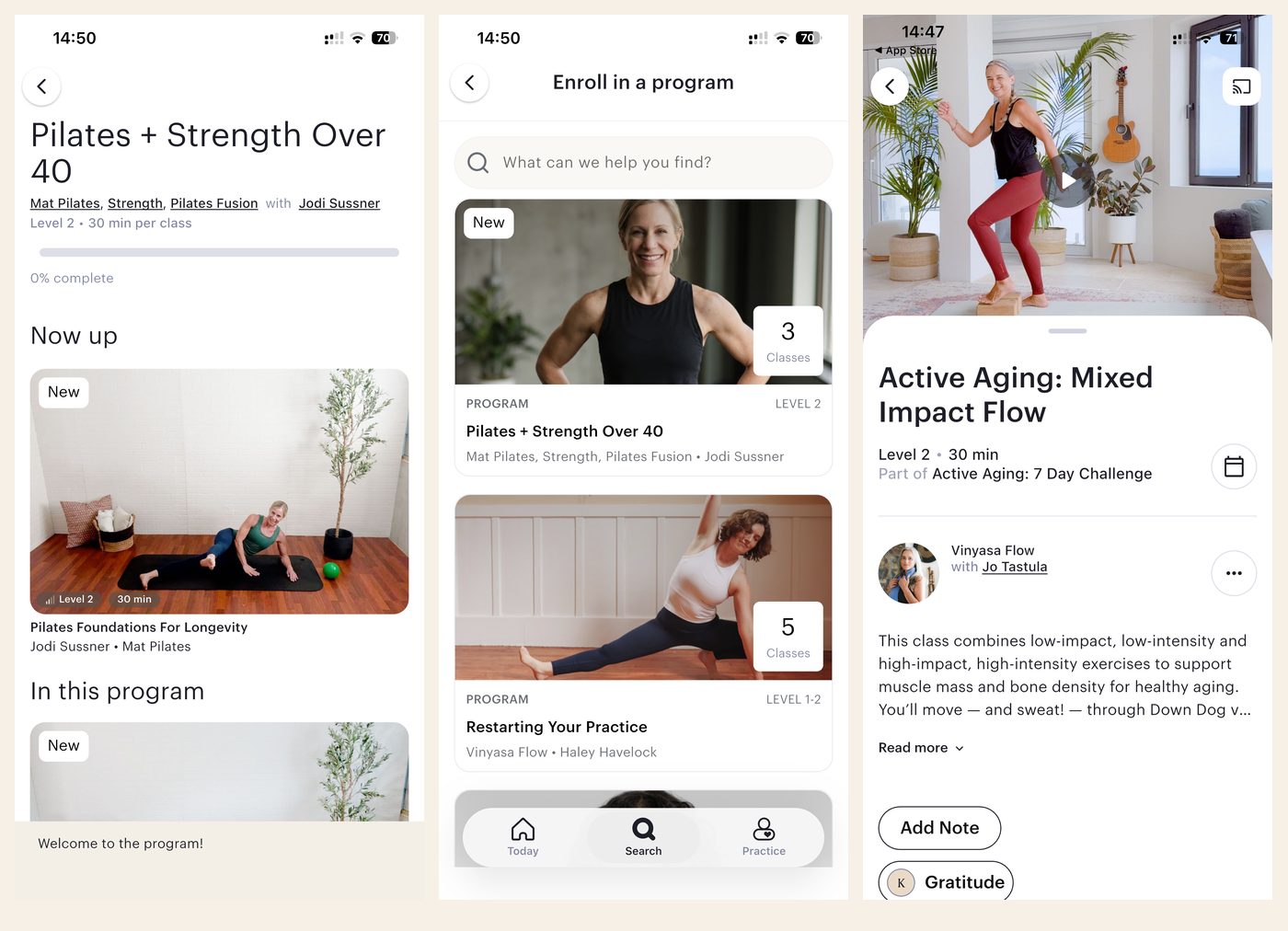
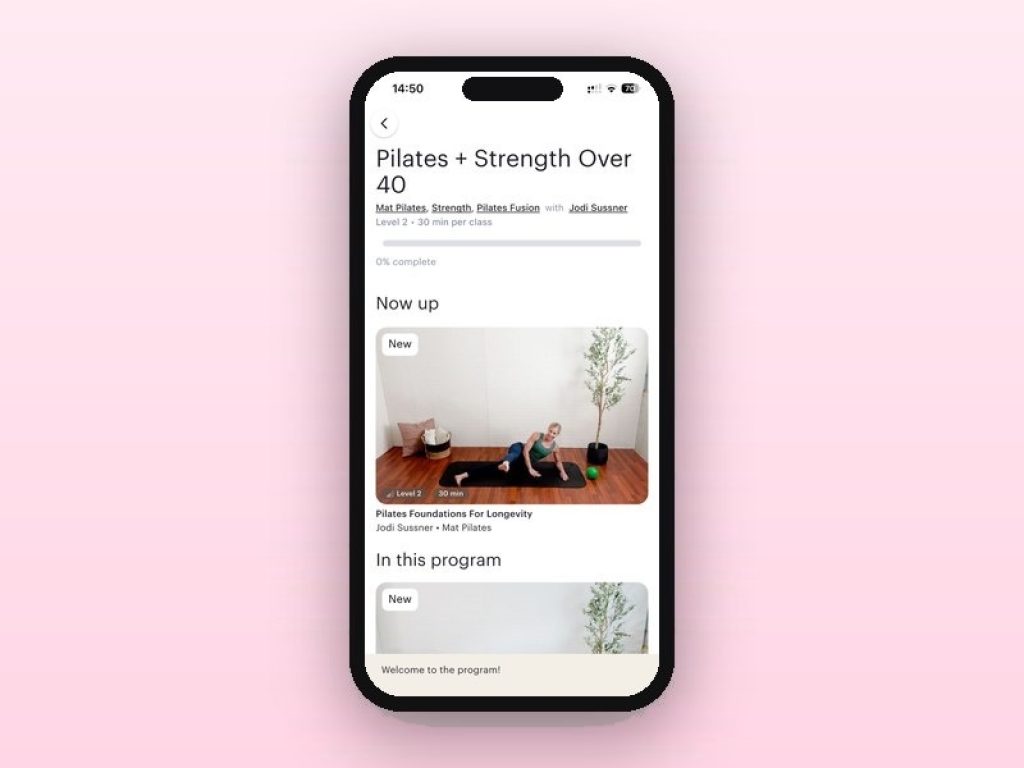
The new Pilates + Strength Over 40 series is a real highlight. In my last week of testing I found a new series, Pilates + Strength Over 40 with Jodi Sussner, and the three classes I tried were excellent. It mixes low-impact and strength days, which is exactly what we need, and Jodi explains every movement and the reasoning behind it, stressing what matters for the pelvic floor and joints. I am usually drawn to more energetic workouts, but this was so well taught that I finished feeling energised and relaxed at the same time, and it still felt like a proper workout.
What it did for me, and where it stops. I came to Glo already training consistently, so I did not see muscle growth, but I maintained it, which at midlife is a genuine win, and I had noticeably calmer days around these workouts than with my HIIT and strength apps. I feel more mobile and stretched, and my core feels tighter and stronger. I focused a lot on core and pelvic floor here, and there is real menopause content on balancing the nervous system, muscle maintenance and joint health, plus a yoga-for-hot-flushes session that I found deeply relaxing even if I cannot say it changed my symptoms. I would like a bit more strength for the over-40 space, but Glo is a yoga and Pilates app first, and if you search there is a good strength library too. It is not as focused as Flipping 50 or Pvolve, but it has big strengths, and the calm, positive atmosphere it creates is genuinely important for my perimenopause nerves.
Who Is Behind Glo? Credibility
Glo’s strength is its teachers, and the roster is deep and well regarded: names like Elena Brower, Jason Crandell, Annie Carpenter and Jo Tastula, alongside the instructors most relevant to this review. The new Pilates + Strength Over 40 series is led by Jodi Sussner, a master Pilates trainer and strength coach with around 30 years of experience, NSCA and NASM certifications and a Master’s in Human Performance and Exercise Science, whose stated focus is muscle, bone density, pelvic-floor health and joints for women navigating ageing, a strong fit for this audience. The functional strength I enjoyed comes from Jeni Del Pozo, an Equinox-certified Pilates and fusion teacher with a deep library of around 200 classes and more than 18 years of dance and movement behind her. The dedicated Menopause Support programme is taught by Elena Brower, a master teacher with more than 25 years of experience, and the platform even carries short education lectures aimed squarely at this audience, such as Amy Ippoliti’s Lifting Weights For Healthy Aging.
How to read that credibility. The teaching quality is high, and instructors like Sussner bring real exercise-science depth and explain the why behind each movement, which builds trust. What Glo does not have is clinical oversight: there is no medical or menopause advisory board, and no menopause-society credentialing behind the content. So the menopause and pelvic-floor material is thoughtfully taught by qualified instructors, but it is movement guidance, not clinical care, and Glo is upfront that it is a practice library rather than a medical programme.
Content and Features
At a glance: a huge, calming library of yoga, Pilates, meditation, breathwork, walking and strength, with a genuine over-40 series, menopause support, pelvic-floor, active-aging and chair options, deep filters and a beginner onramp. Capped for our audience by light-to-moderate strength, search-dependent discovery, no nutrition and no clinical oversight.
| Format | A large on-demand streaming library of single classes and multi-class programmes; annual members also get live workshops. |
| Class types | Yoga, Pilates, meditation, breathwork, walking, barre and strength or fitness, including a Pilates + Strength Over 40 series. |
| Class length | About 10 to 60 minutes in practice, with options from roughly 5 to 90 minutes. |
| Midlife strengths | Calming atmosphere, joint-friendly movement, pelvic-floor and core work, menopause and active-aging content, chair options and a beginner onramp. |
| Strength and bone | Real but light-to-moderate, using bodyweight, light weights and a small ball; add heavier loading for bone. |
| Impact and joints | Mostly low-impact and very joint-friendly, with some mixed-impact active-aging classes for bone. |
| Menopause programming | Genuine: a Pilates + Strength Over 40 series, Menopause Support, menopause restorative, pelvic-floor and active-aging classes, though not one single guided plan. |
| Nutrition | Essentially none. |
| Devices | iOS, Android, web, Apple TV, Apple Watch and Mac, with offline downloads and casting. |
A Closer Look at Glo’s Menopause and Over-40 Content
Because Glo is so deep, the midlife material is easy to miss, so here is a specific map of what is actually there, the parts I used and the parts worth searching out. This is the content that lifts Glo above a generic yoga app for our audience.
The Pilates + Strength Over 40 series
This is the newest and most on-point addition: a short, structured programme of three roughly 30-minute classes with Jodi Sussner, blending mat Pilates, strength and Pilates fusion, with a small stability ball and light weights. The three sessions are Pilates Foundations For Longevity, Functional Strength, and Full Circle: Pilates + Strength, and the stated aim is to build muscle, improve posture and balance, support healthy joints and develop deep core stability. I did the first three classes and found them genuinely well taught, with Jodi explaining each movement and why it matters for the pelvic floor and joints, so I finished feeling both worked and calmer.
The Menopause Support programme
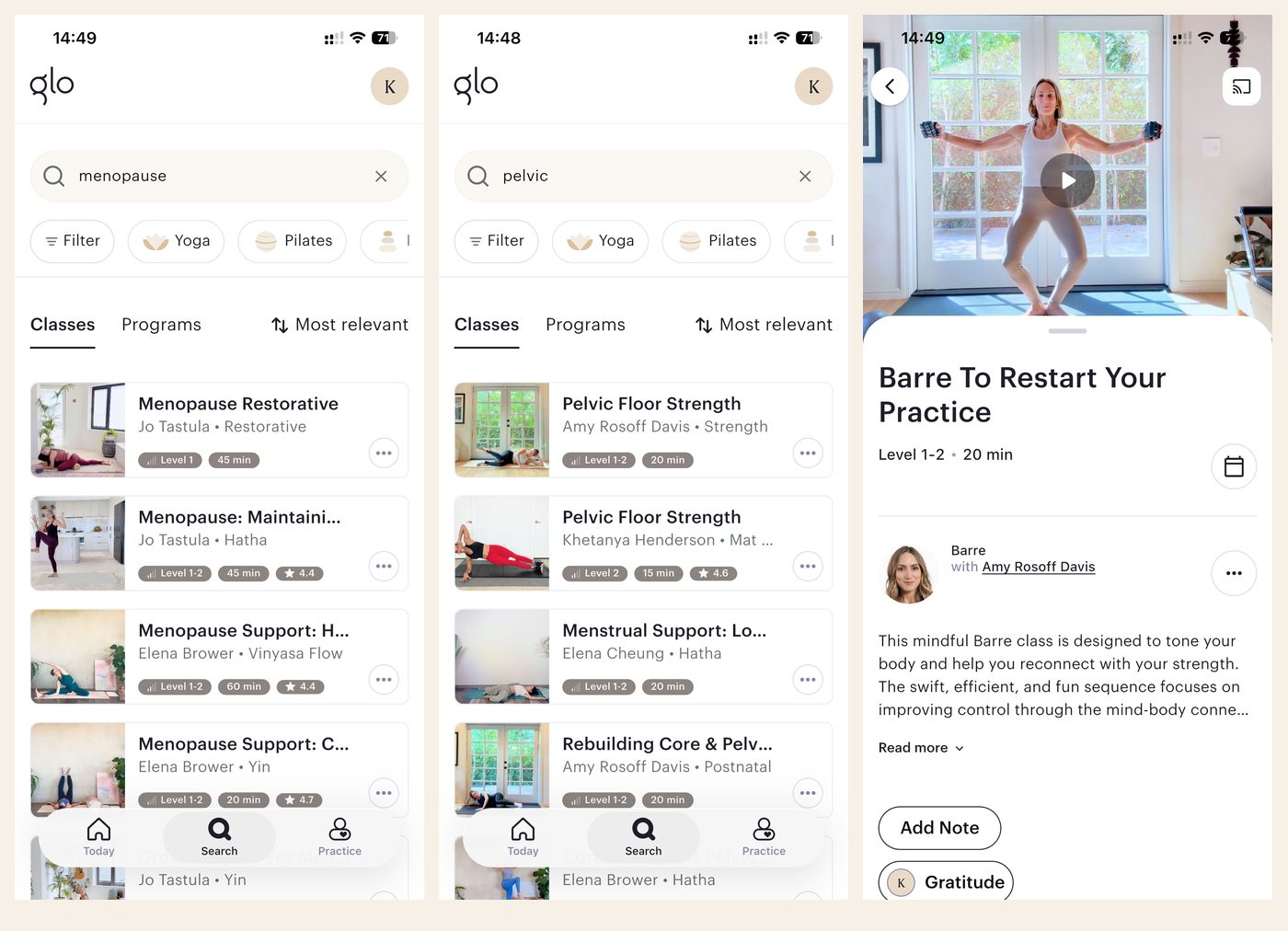
Separately there is a dedicated Menopause Support programme with Elena Brower, a set of classes built around restorative yoga, breathwork and yoga nidra, with named sessions such as Cooling Practice, Hormone Balance, Hormonal Harmony, Yoga Nidra For Sleep and Lower Back Love, using props like a block, bolster, blanket and chair. It is squarely aimed at the things midlife women search for, thermoregulation and hot flushes, sleep, and a calmer nervous system. It is restorative rather than strength-building, so read it as symptom-soothing support, not the loading side of the equation.
Pelvic floor, core and joint-friendly work
Searching pelvic floor surfaces real, dedicated classes, including Pelvic Floor Strength sessions from Amy Rosoff Davis and Khetanya Henderson, alongside core-focused Pilates and gentle, joint-aware options like chair Pilates and knee-friendly modifications. For an audience where pelvic floor and joints are front of mind, having these as named, findable classes rather than vague promises is a real strength, and the evidence below is a reminder to prioritise the deliberate pelvic-floor sessions.
Active aging and bone
For the bone and muscle side, Glo carries Active Aging content, including a short mixed-impact challenge with Jo Tastula that deliberately combines lower and higher-impact movement to support muscle mass and bone density. It is still bodyweight and light-load work rather than heavy loading, so it helps and signals the right intent, but it is not a substitute for progressive strength training, which is why I pair Glo with heavier dumbbells.
Walking, meditation and education
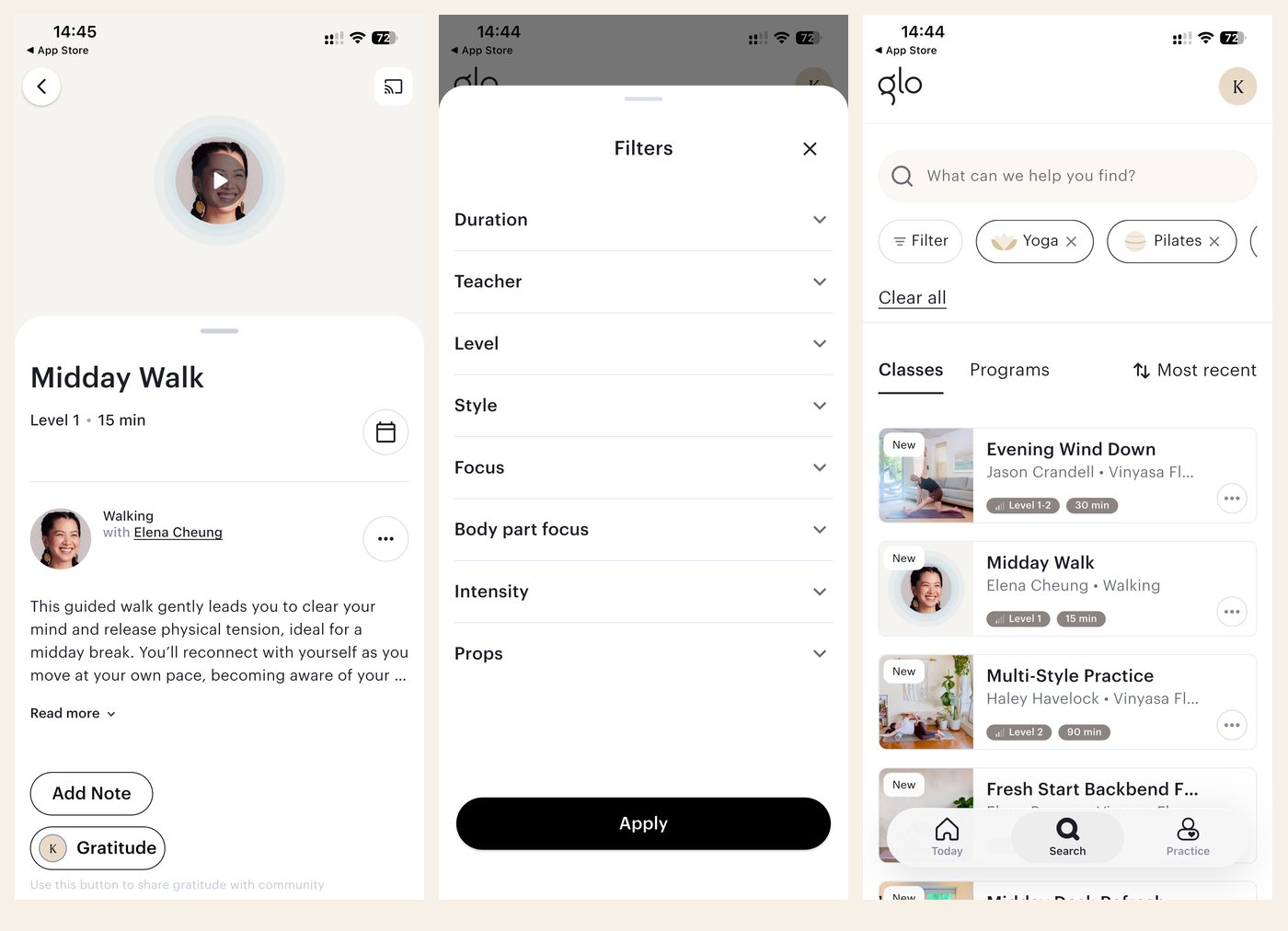
Rounding it out are guided meditative walks of around 15 to 20 minutes, such as Elena Cheung’s Midday Walk, a deep meditation and breathwork library that is a genuine standout for stress, and short education lectures aimed at this life stage, including Amy Ippoliti’s Lifting Weights For Healthy Aging and Elena Brower’s Starting A Practice At 40+. These are the pieces that make Glo feel like it understands midlife, even if you have to go looking for them.
What Equipment Do You Need for Glo?
Glo is a low-equipment, home-friendly app. For the yoga you want a mat and a couple of blocks; for the Pilates and strength you want a small Pilates ball and, importantly, a range of dumbbells. This was one of my clearest takeaways from testing: the Pilates classes often call for much lighter weights than the strength classes, so a stackable or adjustable set that covers light through heavier is far more practical than a single pair, and it lets you keep adding load as you get stronger.
Recommended spec examples. These picks are curated for convenience by specification and feature fit, not personally lab-tested for long-term durability. Prices are examples; verify before buying.
Exercise mat
A cushioned base for yoga, Pilates and floor work.~$45
Adjustable dumbbells (light)
Light adjustable weights for the Pilates and fusion classes.~$73
Adjustable dumbbells (heavier)
One pair that scales heavier for real strength and bone loading.~$399
Small Pilates ball
Used in the Over 40 and core Pilates classes.~$9
A quick heads-up: some of the buy links above are Amazon affiliate links, so if you grab something through them I may earn a small commission, at no extra cost to you. I only ever point you to kit I would happily use myself.
Bottom line on equipment: a mat, a small Pilates ball, blocks and a range of dumbbells cover Glo; stackable weights are the smart buy because Pilates needs lighter loads than strength.
How We Scored Glo: the 6.8 / 10 Breakdown
Scores on our 9 weighted criteria, from 8 weeks of hands-on testing. Women Over 40 is our menopause-fit criterion, and its full 12-capability breakdown follows in the next section.
| Category | Weight | Score | Confidence | Reasoning |
|---|---|---|---|---|
| Time Efficiency | 15% | 7.5 | High | Flexible 10 to 60 minute classes fit a busy midlife day, with quick resets when time is short. |
| Muscle Potential | 18% | 5.5 | High | Real strength and functional classes exist, but they are light-to-moderate, so I maintained rather than built muscle. |
| Women Over 40 Specificity | 10% | 6.2 | High | Genuine over-40, menopause, pelvic-floor and active-aging content; full breakdown below. |
| Joint Friendliness | 12% | 9 | High | Mostly low-impact, with chair and knee-friendly options; I felt more mobile and pain-free over 8 weeks. |
| Recovery Compatibility | 10% | 8.5 | High | Deep restorative, breathwork and meditation left me calmer and more relaxed than my HIIT and strength apps. |
| Programme Structure | 12% | 6.5 | Med | The Over 40 series is well structured, but overall you assemble your own week by searching rather than following one plan. |
| Value for Money | 8% | 7.5 | Med | A deep, high-quality library across many disciplines is strong value, even if premium priced. |
| UX and Design | 8% | 7.5 | Med | Polished and pleasant with excellent filters, though the best over-40 content is search-dependent. |
| Nutrition Integration | 7% | 2 | High | Essentially no nutrition or midlife-eating guidance. |
| Total | 100% | 6.8 / 10 | Tested Score. |
Is Glo Good for Women Over 40?
Yes, and in ways that genuinely surprised me. Beyond its deep yoga and Pilates, Glo has built out real midlife content: a Pilates + Strength Over 40 series, a Menopause Support programme, Active Aging classes that deliberately mix impact for muscle and bone, pelvic-floor strength classes, chair Pilates and gentle meditative walks. For joints, core, stress and sleep it is excellent, and the calm it creates is a real benefit when perimenopause has your nervous system on edge.
Who it suits, and what is missing. It suits a woman who wants calming, joint-friendly movement with menopause and pelvic-floor content, and who is happy to build her own week from a big library, whether she is an experienced mover or a beginner using the onramp. What is missing is heavy, progressive strength: the strength here is real but light-to-moderate, the best content is search-dependent rather than delivered as one plan, and there is no nutrition or clinical oversight. Over 8 weeks I maintained muscle rather than built it, which tells the story.
What the wider picture shows. Glo is one of the better yoga and Pilates apps for midlife because it takes menopause, pelvic floor and active aging seriously and teaches the reasoning behind the movement. It is not as tightly focused as a purpose-built menopause-strength programme, and you should add heavier dumbbells and a structured strength plan for real muscle and bone. Used that way, for calm, mobility, core, pelvic floor and menopause support, it is a lovely, genuinely helpful part of a midlife routine.
How Glo Fits Perimenopause, Menopause and Beyond
Our capability breakdown of how well Glo suits women across perimenopause, menopause and post-menopause. Women Over 40 is our menopause-fit criterion, and this is the full breakdown behind the Women Over 40 row above.
Glo is strongest for low-impact, joint-friendly movement, mind-body support and pelvic-floor and menopause content; it is weakest on heavy bone loading and structured hormone-phase programming, in our menopause and midlife capability assessment.
| At a glance | Score |
|---|---|
| Right training for a midlife body | 6.0 / 10 |
| Menopause education and programming* | 6.2 / 10 |
| Whole-woman support | 6.5 / 10 |
This is the perimenopause and menopause assessment, and it is separate from the overall score. Twelve things a programme either does for a midlife body or does not, each scored out of 10 with my reasoning next to it. Together they produce a single menopause fit score, and that becomes one of the nine categories in the overall scoring below.
How Glo Fits Perimenopause, Menopause & Beyond
Women Over 40 is our most important criterion, and here's the full breakdown behind it.
Glo is strongest for low-impact, mind-body support and beginner on-ramp, and weakest for midlife nutrition, bone loading and hormone awareness, in our menopause and midlife capability assessment for women over 40.
At a glance
What the app teaches about perimenopause and/or menopause, not whether the training suits a midlife body.
| Capability | Score | Rating | Why |
|---|---|---|---|
| Right training for a midlife body | |||
| Low-impact | 9/10 | Best-in-class | Core identity is low-impact yoga and Pilates with chair and modified options; near-zero joint stress across the library. |
| Progressive strength | 5/10 | Some | Real strength and functional classes (Jeni Del Pozo, Jodi Sussner) exist but are light-to-moderate and search-dependent, not auto-progressed by load. |
| Bone loading | 4/10 | Minimal | Active Aging mixed-impact and osteoporosis-aware content exists, but training is bodyweight/light-weight, not the heavy loading bone needs. |
| Recovery & deload | 6/10 | Some | Deep restorative, breathwork and meditation support recovery, though there is no formal periodised deload structure. |
| Menopause education and programming* | |||
| Menopause programming | 6/10 | Some | Dedicated Pilates + Strength Over 40 series plus Menopause Support and Active Aging content, but menopause is a rich layer, not one guided plan. |
| Pelvic floor | 7/10 | Strong | Genuine dedicated Pelvic Floor Strength classes and a strong core focus, well taught within the Over 40 and Pilates content. |
| Hormone awareness | 4/10 | Minimal | Some hot-flush and stress-cycle content, but little explicit hormone-phase or symptom-driven programming. |
| Menopause education | 7/10 | Strong | Education-rich and instructor-explained (why each move helps joints and pelvic floor), though lighter on clinical hormone depth. |
| Expert credibility | 7/10 | Strong | Credible instructors, including Jodi Sussner (NSCA/NASM, MSc); trustworthy teaching but no medical or menopause advisory board. |
| Whole-woman support | |||
| Mind-body support | 9/10 | Best-in-class | Standout calming atmosphere plus deep meditation, breathwork and meditative walks; excellent for perimenopause nerves. |
| Beginner on-ramp | 8.5/10 | Strong | Yoga for beginners, chair Pilates, 10-minute options and clear cues make it easy to start, for guided or self-directed users. |
| Midlife nutrition | 2/10 | None | Effectively no meaningful nutrition or midlife-eating guidance. |
ScaleBest-in-classStrongSomeMinimalNone
* What the app teaches and programmes around menopause, not whether the training suits a midlife body. Many programmes that score low here are still a good fit, they simply never use the word. A high score is not proof either: a few menopause videos added to a general library lifts this score without changing the training.
These are evidence-informed suitability ratings, not clinical measurements. They combine exercise science with product-specific research and, where indicated, hands-on testing, alongside multi-source verification, and are approximate. Individual response varies. A starting point, not medical advice. How we score menopause fit
What the sources say: scores combine 8 weeks of hands-on testing, the platform’s content, user sentiment and the science. Glo does very well on low-impact joint-friendly movement, mind-body and recovery support, and on genuine pelvic-floor, menopause and active-aging content taught with clear reasoning. It scores lower on heavy bone loading and hormone-specific programming because the strength is light-to-moderate and the menopause content is a rich layer rather than one structured, clinically supervised plan, so it sits below purpose-built menopause-strength platforms while clearly beating a generic yoga app.
These are evidence-informed suitability ratings, not clinical measurements. They combine exercise science with programme research and multi-source verification, and are approximate. Individual response varies. A starting point, not medical advice. How we score menopause fit.
What the Research Says: Glo Checked
Yoga and meditation help the way Glo is strongest. For menopausal symptoms, yoga has some evidence for modestly easing hot flushes and improving wellbeing, though the certainty is low and it is generally no better than other exercise, so it is calming and supportive rather than a proven treatment.[1] Mindfulness and meditation, a big part of Glo, have a genuine signal for reducing stress in midlife women, if weaker and less consistent effects on anxiety and depression.[2] That matches my experience: calmer, more relaxed days, which matters in perimenopause.
Pilates supports the things I felt improve. In postmenopausal women, mat Pilates has been shown to improve balance, flexibility and lower-body function,[3] and yoga can improve back function about as well as other exercise.[4] On the pelvic floor, one important caveat: the evidence shows that deliberate, targeted pelvic-floor muscle training is the active ingredient, and Pilates helps most when it includes explicit pelvic-floor work rather than general core movement alone.[5] Glo’s dedicated pelvic-floor classes are therefore the ones to prioritise.
The real counterpoint on bone and muscle. For building bone and muscle in menopause, the strongest stimulus is heavy, progressive resistance and impact training, which improved bone density in postmenopausal women where lighter exercise did not.[6] That matters because lean muscle falls and fat rises across the menopause transition.[7] Glo’s light-to-moderate strength maintains and supports, which is real and worthwhile, but it is not the heaviest loading, so pairing it with progressive dumbbell work is the sensible approach, exactly as I did.
What Users Report: Verified Sentiment
Rating snapshot: Glo rates very highly on the Apple App Store, around 4.9 out of 5 from roughly 32,000 ratings, more mixed on Google Play at about 3.8 to 4.3 past 100,000 installs, and poorly on Trustpilot, around 2 out of 5, though from a very small sample dominated by billing complaints. The story in that spread is real: iOS users are very happy, Android users hit more bugs, and the loudest off-store complaints are about billing rather than the classes themselves.
What users praise and criticise. The praise, consistent over many years, is overwhelmingly about teacher quality and the breadth and calm of the library, with many reviewers saying the instructors are the reason they stay. The fair criticisms are billing and refund friction, in particular the annual charge and no partial refunds, more app bugs on Android, content that can be hard to discover among thousands of classes, and a premium price. Notably, Glo’s strong 2026 push into menopause and strength is not yet echoed much in user reviews, which still centre on yoga, so the midlife positioning is real in the app but newer than the review base.
Consistently praised
- Outstanding teacher quality across yoga, Pilates and meditation.
- A huge, varied library with a calming atmosphere.
- Strong value versus studio classes for many members.
- Excellent filters and short-to-long class options.
Consistently noted
- Billing, auto-renew and refund friction, especially the annual charge.
- More app bugs on Android than iOS.
- The best content can be hard to discover without searching.
- Premium price, and no meaningful nutrition.
Source and credibility note: ratings were checked in 2026 across the Apple App Store, Google Play and Trustpilot and can change. The Trustpilot sample is tiny and skews to billing disputes, so it overstates dissatisfaction with the classes; the iOS versus Android split is real. Menopause-specific user testimony is still thin because the midlife content is recent. My own findings come from 8 weeks of hands-on use.
Devices and App
Glo is a polished, mature platform. It runs on iPhone and iPad, Android, the web, Apple TV, Apple Watch and Mac, so you can practise on a phone, a laptop or the television, and it supports offline downloads for practising without wifi and AirPlay casting. The library is huge and the filters, by duration, teacher, level, style, focus, body part, intensity and props, are genuinely useful for finding the right class.
A couple of practical notes. Because the catalogue is so large, discovery is the main friction: the strongest over-40 and menopause content often surfaces best through search and the focus categories rather than the home screen, so it rewards a little digging. Subtitles and captions are not clearly confirmed on the official pages, and TV support beyond Apple TV is less certain, so if either matters to you it is worth checking before subscribing.
Glo specifications
- Free trial
- 7 days
- Last verified
- 12 August 2026
Glo Price 2026: What You Actually Pay
| Plan | Cost | Notes |
|---|---|---|
| Monthly | $30/mo | The flexible plan. |
| Annual | $245/yr | Works out around $20 a month; annual members also get live workshops. |
| Free trial | 7 days | A 7-day free trial, then it auto-renews. |
Cost and Cancellation
Glo is premium priced: about $30 a month or $245 a year in US dollars, with a 7-day free trial (prices via Apple can differ slightly, and a quarterly option exists there). Plans auto-renew, and you can cancel anytime in Account Settings on glo.com, with access continuing to the end of your paid period, but note that charges are not refunded once taken, and several user complaints centre on the annual renewal, so set a reminder before it renews. If you subscribed through Apple or Google, cancel through them. Prices were checked in 2026; confirm the current figures before subscribing.
Try Glo’s yoga, Pilates and menopause library for yourself.
- Free trial
- 7 days
Will You Actually Stick With It?
Over 8 weeks I found Glo easy to keep coming back to, and the reason is the atmosphere. The calm, positive tone, the short 10 to 20 minute options for busy or low-energy days, and the sheer variety mean there is always something that fits, whether you want a strength session, a Pilates class, a meditative walk or a wind-down meditation. For a midlife routine that needs to flex around energy and stress, that flexibility is a real adherence advantage.
The flip side is that you have to drive it yourself. Because Glo is a library rather than one guided plan, sticking with a balanced week takes a little intention, and the best over-40 content rewards searching. Following the Pilates + Strength Over 40 series or the Active Aging challenge gives you more structure if you want it. If you enjoy choosing your own practice and value calm and variety, consistency comes easily; if you need to be told exactly what to do each day, add one of its programmes as your backbone.
Glo Pros and Cons
Pros
- Deep, calming library of yoga, Pilates, meditation and walking
- Genuine over-40 content: a Pilates + Strength Over 40 series, menopause support, pelvic floor and active aging
- Very joint-friendly, with chair and beginner options
- Excellent teachers who explain the reasoning behind movements
- Flexible 10 to 60 minute classes and strong filters
Cons
- Strength is light-to-moderate, not heavy progressive loading
- The best content is search-dependent rather than one guided plan
- No nutrition, and no clinical or menopause advisory board
- Premium price and billing or refund friction
- More app bugs on Android than iOS
How Glo Compares
Here is how Glo stacks up against the alternatives women most often weigh it against, including the strongest menopause-built option as a contrast. Scores come from our own reviews; prices and ratings are approximate, so verify on each platform.
| Feature | Glo | Pvolve | The Pilates Class | Pilates Anytime | Yoga with Kassandra |
|---|---|---|---|---|---|
| Our score | 6.8 / 10 | 8.3 / 10 | 6.2 / 10 | 6.4 / 10 | 6.6 / 10 |
| Monthly price | $30/mo · $245/yr | $24.99/mo · equipment from $199 | ~$29/mo | ~$24/mo | ~$14/mo |
| Free trial | 7 days | 7 to 14 days | 14 days | 15 days | Free tier on YouTube |
| Style | Yoga, Pilates, meditation, walking, some strength | Functional strength, menopause-built | Pilates and mind-body | Pilates library | Yoga, calming |
| Strength focus | Light-to-moderate, search-dependent | Moderate, progressive, functional | Light | Light-to-moderate | Minimal |
| Perimenopause content | Genuine, across several series | Yes, menopause-built | Some | Yes, a menopause playlist | Some |
| Best suited to | Women wanting calm, joint-friendly, menopause-aware variety | Women 40 to 55 wanting menopause-built strength | Women wanting a calm Pilates flow | Women wanting a deep Pilates library | Women wanting affordable calming yoga |
Glo vs Pvolve: Which Is Better for Women Over 40?
These two answer different needs. Pvolve is a menopause-built strength system: structured, progressive, low-impact functional training with a dedicated menopause programme developed with a clinical advisory board, plus pelvic-floor and joint-friendly work, usually with its own equipment. Glo is a broad, calming yoga, Pilates, meditation and walking library with genuine over-40 and menopause content and lighter strength, and it is a place to build your own varied week rather than follow one plan.
For women over 40 the choice is by priority. If your main goal is protecting muscle and bone with progressive, clinically informed strength, Pvolve is the stronger fit. If you want calm, joint-friendly, menopause-aware movement across yoga, Pilates and meditation, with real pelvic-floor and active-aging content and a wonderful atmosphere, Glo is genuinely good and, in my testing, a pleasure to keep up. Many women would do well with both: Glo for calm, mobility, core and pelvic floor, and a progressive strength programme like Pvolve, plus heavier dumbbells, for the bone and muscle work Glo does not fully cover.
If Glo Is Not Right for You: Best Alternatives
If you want heavier menopause-specific strength, a deeper Pilates library, or a lower-cost option, these alternatives pair or compare well.
Glo FAQ
Glo (glo.com, formerly YogaGlo) is a large on-demand streaming app for yoga, Pilates, meditation, breathwork, walking and fitness, including strength. It has more than 12,000 classes from over 60 teachers, plus structured multi-class programmes, with classes from about 5 to 90 minutes. It streams on iOS, Android, web, Apple TV, Apple Watch and Mac, and it is a broad practice library rather than a single guided plan.
Yes, more than most yoga apps. In testing it had genuine midlife content: a Pilates + Strength Over 40 series with Jodi Sussner, a Menopause Support programme, Active Aging classes built for muscle and bone, pelvic-floor strength classes, chair Pilates and meditative walks, all taught with clear reasoning. It is excellent for joints, core, pelvic floor, stress and sleep. The caveat is that the strength is light-to-moderate, the best content is search-dependent, and there is no clinical oversight or nutrition, so pair it with heavier progressive strength.
Glo costs about $30 a month or $245 a year in US dollars, with a 7-day free trial; prices via Apple can differ slightly and a quarterly option exists there. Plans auto-renew and you can cancel anytime in Account Settings, with access to the end of the paid period, but charges are not refunded once taken, so set a reminder before the annual renewal. Verify the current price before subscribing.
Glo has real strength and functional classes, including a Pilates + Strength Over 40 series and Active Aging classes, but they use bodyweight, light weights and a small ball, so they are light-to-moderate rather than heavy progressive loading. Over 8 weeks of testing I maintained muscle rather than built it. For building bone and muscle in menopause the strongest stimulus is heavier progressive resistance, so the best approach is to use Glo for its strengths and add heavier dumbbells and a structured strength plan alongside.
Yes. Searching in the app surfaces dedicated Pelvic Floor Strength classes, a Menopause Support programme and menopause restorative classes, plus Active Aging content for muscle and bone and a Pilates + Strength Over 40 series that stresses pelvic-floor and joint health. The evidence suggests targeted pelvic-floor training is the active ingredient, so prioritise the dedicated pelvic-floor classes. Note that Glo has no clinical or menopause advisory board, so this is well-taught movement guidance, not medical care.
For a woman who wants calming, joint-friendly, menopause-aware movement across yoga, Pilates, meditation and walking, yes. After 8 weeks of testing it left me calmer, more mobile and stronger in the core, and its over-40, pelvic-floor and menopause content is genuinely useful. It is a weaker choice if your main goal is heavy progressive strength or a single structured menopause plan, because the strength is lighter, the content is search-dependent and it is premium priced. Best used for calm and mobility, paired with heavier strength for muscle and bone.
Final Verdict
Tested Score: 6.8 / 10 · Fully-tested over 8 weeks
Glo is a deep, calming, beautifully taught yoga and Pilates platform that has quietly become genuinely menopause-aware, and 8 weeks with it left me calmer, more mobile and stronger in the core. The Pilates + Strength Over 40 series, the Menopause Support and Active Aging content, the pelvic-floor classes and the meditative walks are real midlife value, and Jeni Del Pozo’s functional strength still challenged me. For joints, core, stress and perimenopause nerves, it is a lovely thing to have.
Glo is for women who want calming, joint-friendly, menopause-aware movement across yoga, Pilates, meditation and walking, and who are happy to build their own week from a big library. It is not for women whose main goal is heavy progressive strength or a single structured menopause plan, because the strength is light-to-moderate, the best content is search-dependent, and it has no nutrition or clinical oversight. The best way to use it is for calm, mobility, core, pelvic floor and menopause support, paired with heavier dumbbells and a progressive strength plan for the muscle and bone it does not fully load. As a fully-tested review, this reflects 8 weeks of consistent hands-on use.
Visit GloAffiliate link, opens glo.com. I earn a commission at no extra cost to you. Full disclosureTesting Status
Fully-tested review: this review is based on about 8 weeks of consistent hands-on use, mixing Pilates on low-impact days and strength on strength days, across Glo’s yoga, Pilates, strength, menopause, pelvic-floor, walking and meditation content, including the Pilates + Strength Over 40 series, alongside pricing, user sentiment and the exercise science, scored on our standard criteria. How we score and test.
Sources and Further Reading
- Cramer, H., Peng, W. & Lauche, R. (2018). Yoga for menopausal symptoms: a systematic review and meta-analysis. Maturitas, 109, 13 to 25. DOI 10.1016/j.maturitas.2017.12.005. Available at: pubmed.ncbi.nlm.nih.gov. Yoga eased menopausal symptoms versus no treatment, but against active exercise only a modest benefit for vasomotor symptoms remained; certainty is low.
- Liu, H. et al. (2023). The effects of mindfulness-based interventions on anxiety, depression, stress, and mindfulness in menopausal women: a systematic review and meta-analysis. Frontiers in Public Health, 10, 1045642. DOI 10.3389/fpubh.2022.1045642. Available at: pubmed.ncbi.nlm.nih.gov. Mindfulness significantly reduced perceived stress in menopausal women, with non-significant effects on anxiety and depression.
- García-Garro, P.A. et al. (2020). Effectiveness of a Pilates training program on cognitive and functional abilities in postmenopausal women. International Journal of Environmental Research and Public Health, 17(10), 3580. DOI 10.3390/ijerph17103580. Available at: pubmed.ncbi.nlm.nih.gov. A 12-week mat-Pilates programme improved flexibility, balance and lower-limb function in postmenopausal women.
- Wieland, L.S. et al. (2017). Yoga treatment for chronic non-specific low back pain. Cochrane Database of Systematic Reviews, 1, CD010671. DOI 10.1002/14651858.CD010671.pub2. Available at: pubmed.ncbi.nlm.nih.gov. Yoga produced small-to-moderate improvements in back function versus non-exercise controls, with little difference versus other exercise.
- Torelli, L. et al. (2016). Effectiveness of adding voluntary pelvic floor muscle contraction to a Pilates exercise program: an assessor-masked randomized controlled trial. International Urogynecology Journal, 27(11), 1743 to 1752. DOI 10.1007/s00192-016-3037-1. Available at: pubmed.ncbi.nlm.nih.gov. Adding explicit pelvic-floor contractions to Pilates improved pelvic-floor strength more than Pilates alone, so targeted training is the active ingredient.
- Watson, S.L. et al. (2018). High-Intensity Resistance and Impact Training Improves Bone Mineral Density and Physical Function in Postmenopausal Women With Osteopenia and Osteoporosis: The LIFTMOR Randomized Controlled Trial. Journal of Bone and Mineral Research, 33(2), 211 to 220. DOI 10.1002/jbmr.3284. Available at: pubmed.ncbi.nlm.nih.gov. Heavy, progressive resistance and impact training improved bone density and function in postmenopausal women where lighter exercise did not.
- Greendale, G.A. et al. (2019). Changes in body composition and weight during the menopause transition. JCI Insight, 4(5), e124865 (Study of Women’s Health Across the Nation). DOI 10.1172/jci.insight.124865. Available at: pubmed.ncbi.nlm.nih.gov. Fat mass rose and lean mass fell across the menopause transition (observational cohort).
This is a fully-tested review based on about 8 weeks of consistent hands-on use. Pricing and features were verified in 2026 and may have changed. Some affiliate links may be present. This site does not accept payment from platforms reviewed. Education, not medical advice; check with your clinician before starting a new programme, especially with joint, pelvic-floor or heart concerns.
Related Guides
What To Do Next
- → Take our 2-minute quiz for a personalised recommendation.
- → See our best workouts for perimenopause rankings.
- → Compare with our Pvolve review and see how we score every programme.