
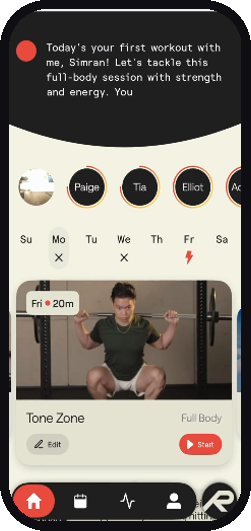
$19.99/month after a 7-day free trial (3 and 12-month plans discounted) · An AI voice-guided personal trainer that adapts in real time and counts your reps · iOS only · Made by Ray Fitness Systems Researched from: official site (rayfit.com) and App Store (verified July 2026) · App Store reviews · peer-reviewed midlife exercise science · Downloaded and explored hands-on; the screenshots here are our own. Testing status: Data profile.
How this profile is different. We have not personally completed Ray. This is a research-based Data Profile built from official sources, aggregated user reviews and the science, scored only where published information reliably supports it. This is education, not medical advice; speak to your clinician, especially about HRT or existing conditions.
Ray Review 2026: Quick Answer
Quick Verdict
Worth it for women over 40? As a way to actually stay consistent, yes; as a menopause tool, no. Ray is a genuinely welcoming AI trainer that plans your week, coaches you by voice, counts your reps and adapts when you are tired, injured or short on time, which is exactly what gets returners moving again. But it is a general adaptive trainer with no menopause programming, pelvic-floor work, hormone awareness or nutrition, and it is iOS only.
Ray earns 6.2/10 on our hands-on evaluation. Its strength is adherence: the voice guidance, automatic rep counting and real-time adaptation remove the decisions that stop busy midlife women from training, and it is designed to programme around injuries and low-energy days. What it does not do is anything menopause-specific, which for this site’s audience is the key question. Think of it as one of the friendlier ways for a woman over 40 to rebuild a strength habit, not a programme built for the menopause transition.
Start here: use the 7-day free trial to see whether the voice-coached, zero-decision format suits you, and have a dumbbell set to hand to unlock the most.
Is Ray right for you?
Ray is strongest for building bone density (6.0 out of 10, against a 5.1 average across the 77 programmes scored) and weakest for nutrition support (1.0 against 4.0).
| Question | Verdict | Rating | Score |
|---|---|---|---|
| How it suits a perimenopausal body | |||
| Is Ray good for pelvic floor problems?Based on pelvic floor support and low-impact design | Low, and worse than mostmost score 4.6/10 | 2.5 / 10 | |
| Is Ray genuinely built for perimenopause and menopause?Based on menopause programming, hormone awareness, education and expert credibility | Low, and worse than mostmost score 3.3/10 | 1.8 / 10 | |
| Is Ray good for painful joints?Based on low-impact design and recovery provision | Moderate, about the same as mostmost score 6.2/10 | 5.5 / 10 | |
| Is Ray manageable when your energy is low?Based on recovery provision and mind-body support | Low, and worse than mostmost score 5.7/10 | 4.5 / 10 | |
| Is Ray good if you are new to strength training?Based on beginner on-ramp and mind-body support | Moderate, about the same as mostmost score 6.1/10 | 5.5 / 10 | |
| Is Ray good for building bone density?Based on bone loading and progressive strength | Moderate, but better than mostmost score 5.1/10 | 6.0 / 10 | |
| Does Ray help with nutrition?Based on midlife nutrition support | Low, and worse than mostmost score 4.0/10 | 1.0 / 10 | |
| How it performs as a product | |||
| Can you fit Ray into a busy week?Based on time efficiency | Strong, about the same as mostmost score 7.6/10 | 8.0 / 10 | |
| Is Ray worth the money?Based on value for money | Strong, about the same as mostmost score 6.9/10 | 7.0 / 10 | |
Jump to Section
What Ray Actually Is
Ray is an AI personal-trainer app from Ray Fitness Systems. Instead of a class library, it plans your week, coaches you through each session by voice, counts your reps using your phone camera, and adapts in real time when you tell it how you feel. You can talk to it in plain language (“I only have 20 minutes,” “I am travelling this week,” “let us switch it up”) and it rebuilds the workout around your time, equipment, energy and any injuries. It runs on iOS only, works from bodyweight up to a full gym, and positions itself as a hands-free, judgment-free trainer for people who struggle to stay consistent, with a clear lean toward women over 40 returning to strength training.
Content and Features
At a glance: a genuinely adaptive AI strength trainer with voice coaching and camera-based rep counting. But nothing menopause-specific, no nutrition, and iOS only.
| Format | AI-planned strength sessions, voice-coached in real time. Not follow-along video classes. |
| Adaptivity | Strong. Adjusts load and exercises for your time, equipment, energy and injuries as you go. |
| Rep tracking | Automatic rep counting via phone camera (computer vision), with progress logged for you. |
| Progression | Adaptive progressive strength; the plan learns from your feedback and performance. |
| Menopause / pelvic / hormone | None. |
| Menopause education | Marketing blog articles on women over 40; no in-app menopause education. |
| Nutrition | None. |
| Platform | iOS only. |
What Equipment You Need for Ray
Whatever you have. Ray adapts from bodyweight only up to a full gym, so you can start with nothing, though the company recommends a set of dumbbells to unlock the widest range of exercises. Because it counts reps with your phone camera, you also need somewhere to prop your phone so it can see you.
Bodyweight only
Ray adapts to bodyweight, so you can start with nothing.
Free
Starter Dumbbells (up to 10 lb)
A light adjustable pair, a great starting point
~$65 to $80
Medium Dumbbells (up to 25 lb)
For steady progression as you get stronger
~$50 to $65
Advanced Dumbbells (up to 50 lb)
For serious strength and progressive overload; grows with you
~$350 to $430
A quick heads-up: some of the buy links above are Amazon affiliate links, so if you grab something through them I may earn a small commission, at no extra cost to you. I only ever point you to kit I’d happily use myself.
Bottom line on equipment: a dumbbell pair and a way to prop your iPhone get the most from Ray; bodyweight-only still works.
How We Scored Ray: the 6.2 / 10 Breakdown
Our overall score is a weighted average of nine criteria. Because this is a hands-on look rather than a full multi-week test, these reflect what we saw in the app plus published information. Women Over 40 is our most heavily weighted menopause criterion, and its full 12-capability breakdown follows in the next section.
| Category | Weight | Score | Reasoning |
|---|---|---|---|
| Time Efficiency | 15% | 8 | Adapts to “I only have 20 minutes”; built around a busy schedule. |
| Muscle Potential | 18% | 7 | Adaptive progressive strength with automatic rep counting. |
| Women Over 40 | 10% | 3.7 | Welcoming for returners over 40, but no menopause features; full breakdown below. |
| Joint Friendliness | 12% | 6 | Programmes around injuries and restrictions, though it is general strength, not low-impact by design. |
| Recovery Compatibility | 10% | 6 | Adjusts load in real time when you say you are tired, but no structured deload. |
| Programme Structure | 12% | 7 | Plans your week and adapts session to session. |
| Value for Money | 8% | 7 | $19.99/month for trainer-style coaching, far below a human trainer. |
| UX and Design | 8% | 8 | Hands-free voice coaching and rep counting; well-liked, though a newer app. |
| Nutrition Integration | 7% | 0 | None. |
| Overall | 100% | 6.2 / 10 | Research Score; hands-on score pending. |
Is Ray Good for Women Over 40?
For getting a woman over 40 to actually train consistently, Ray is genuinely good: the voice coaching, automatic rep counting and real-time adaptation remove the planning and self-consciousness that stop many returners, and it programmes around injuries and low-energy days. Its own marketing leans hard into this audience, and progressive strength is the highest-value training after 40. Where it falls short for this site is menopause specificity: there is no menopause programming, no pelvic-floor work, no hormone or symptom awareness, no menopause education and no nutrition, and it is iOS only. It is a welcoming general strength trainer a midlife woman can use well, not a menopause programme.
How It Fits Perimenopause, Menopause & Beyond
Our capability breakdown of how well this program suits women across perimenopause, menopause and post-menopause. Women Over 40 is our most important criterion for this site, and this is the full breakdown behind the Women Over 40 row in the scoring table above.
This is the perimenopause and menopause assessment, and it is separate from the overall score. Twelve things a programme either does for a midlife body or does not, each scored out of 10 with my reasoning next to it. Together they produce a single menopause fit score, and that becomes one of the nine categories in the overall scoring below.
How Ray Fits Perimenopause, Menopause & Beyond
Women Over 40 is our most important criterion, and here's the full breakdown behind it.
Ray is strongest for beginner on-ramp, and weakest for pelvic floor, menopause programming, hormone awareness, midlife nutrition, menopause education, expert credibility and mind-body support, in our menopause and midlife capability assessment for women over 40.
At a glance
| Capability | Score | Rating | Why |
|---|---|---|---|
| Right training for a midlife body | |||
| Low-impact | 5/10 | Some | |
| Progressive strength | 7/10 | Strong | |
| Bone loading | 5/10 | Some | |
| Recovery & deload | 6/10 | Some | |
| Built for menopause | |||
| Menopause programming | 1/10 | None | |
| Pelvic floor | 0/10 | None | |
| Hormone awareness | 1/10 | None | |
| Menopause education | 2/10 | None | |
| Expert credibility | 3/10 | Minimal | |
| Whole-woman support | |||
| Mind-body support | 3/10 | Minimal | |
| Beginner on-ramp | 8/10 | Strong | |
| Midlife nutrition | 1/10 | None | |
ScaleBest-in-classStrongSomeMinimalNone
What the sources say: Verified live in July 2026: rayfit.com is active, the App Store listing is current, and the site carries a 2026 Ray Fitness Systems copyright, so the product has not been acquired or closed. Facts and pricing were taken from the official site and the App Store. Ray is a general AI adaptive trainer marketed heavily to women over 40 rather than a menopause-specific product, so the built-for-menopause scores reflect a verified absence of menopause features. It is a newer app with a smaller public review base, so sentiment here is directional and we do not quote a precise rating.
These are evidence-informed suitability ratings, not clinical measurements. They combine exercise science with product-specific research and, where indicated, hands-on testing, alongside multi-source verification, and are approximate. Individual response varies. A starting point, not medical advice. How we score menopause fit
What the Research Says: Ray’s Claims Checked
The core Ray delivers, adaptive progressive strength with real coaching cues, is exactly what the evidence favours for midlife women. Progressive resistance training builds and preserves muscle and, with sufficient load, supports bone in postmenopausal women,[1] and adherence is usually the real barrier, so a tool that removes decisions and keeps you consistent has genuine value. Automatic rep counting and load adjustment are reasonable ways to support good progression.
What the evidence cannot vouch for is a menopause claim, because Ray does not structurally make one. The strongest bone results use heavier, progressive loading,[2] which Ray can move toward in a gym setup but does not prescribe or supervise, and there is no hormone-phase programming, pelvic-floor work or symptom awareness. So Ray is a capable adaptive strength trainer that a midlife woman can use well, best paired with separate pelvic-floor and, if needed, menopause-specific guidance.
What Users Report: Verified Sentiment
Rating snapshot: Ray is a newer app, so its public review base is smaller than the big platforms and we do not quote a precise average to avoid overstating a small sample. Available App Store reviews are positive, and notably include older beginners: one reviewer describes being 56 and appreciating how the app talks you through each workout, and others praise it programming around their injuries and the “push one button and go” simplicity.
Commonly noted positives
- Voice coaching and zero-decision simplicity that keeps people consistent.
- Automatic rep counting and real-time adaptation to energy and injuries.
- Judgment-free tone that suits nervous returners, including over-50s.
Commonly noted limits
- iOS only; no Android.
- No menopause, pelvic-floor or nutrition content.
- Newer app with a smaller review base than established platforms.
Source and credibility note. Ray is confirmed live and independently operating (rayfit.com active, App Store listing current, Ray Fitness Systems, 2026). It is an AI-driven product with no named clinician or women’s-health or menopause expert, so the menopause read is a verified absence of features rather than a judgement on the training. Because it is newer, sentiment is directional; verify the exact App Store rating and review count at publish. Sources: official site, App Store.
Ray specifications
- Free trial
- 7-day (full app access)
- Cancellation
- free trial then auto-renew via App Store
- Session length
- user-set preferred length, adjusts on the fly
- Who makes it
- Ray Fitness Systems Inc., co-founders Colin Raney (CEO; ex-CMO of PillPack; became a certified PT) + Rich Miner (Android co-founder); no clinician
- Still maintained
- Active; iOS-only; Ray: AI Personal Trainer app v1.1.27 (rel 2026-08-11), id 6474633735
- What is included
- On-demand classes: yesLive classes: noRecovery content: partlyMenopause education: noStructured programmes: yesMeditation: noNutrition guidance: no
- Women over 40
- Pelvic floor work: noMenopause clinician involved: noInjury modifications: partlyBone-health focus: partlyModified progressions: yesCycle syncing: noPrenatal options: no
- Devices and access
- Offline downloads: partlyCasting to TV: noSubtitles: noWearable sync: partly
- Support
- Clinical advisory board: noCommunity: partlySupplement upsell: no
- Last verified
- 12 August 2026
Ray Price 2026: What You Actually Pay
Ray costs $19.99/month after a 7-day free trial, with discounts on the 3-month and 12-month plans. The company frames this against a human personal trainer, which typically costs far more.
| Plan | Price | Notes |
|---|---|---|
| Monthly | $19.99/month | After a 7-day free trial |
| 3-month | Discounted | Lower per-month than monthly; confirm current price |
| 12-month | Discounted | Best per-month value; confirm current price |
Cancellation and Billing
Ray is an App Store subscription that auto-renews and is cancelled through your Apple subscription settings, not the app. Turn off auto-renew before the 7-day trial ends and check your statement. Because it is a newer app, confirm the exact current plan prices on the live App Store listing.
Ray Pros and Cons
Pros
- Genuinely adaptive AI trainer with voice coaching and real-time adjustment
- Automatic rep counting via camera; progress logged for you
- Removes decisions and self-consciousness, which helps returners stay consistent
- Programmes around injuries, energy and time
- Good value versus a human trainer
Cons
- iOS only; no Android
- No menopause programming, pelvic-floor work or hormone awareness
- No nutrition, and not inherently low-impact
- AI-driven with no clinician or women’s-health expertise
- Newer app with a smaller review base
How Ray Compares
| Feature | Ray | Pvolve | Menovation |
|---|---|---|---|
| Our score | 6.2 / 10 | 8.3 / 10 | 7.7 / 10 |
| Menopause programming | None | Menopause Strong + clinical study | Menopause-built + clinical panel |
| Progressive strength | Strong (AI-adaptive) | Moderate, low-impact | Strong (heavy dumbbells) |
| Pelvic floor | None | Dedicated series | Dedicated PT programming |
| Platform | iOS only | iOS, Android, web | iOS, Android |
| Best for | Consistency: a voice trainer that removes decisions | Low-impact functional strength + clinical depth | Menopause-built strength + pelvic + tracking |
Ray FAQ
Is Ray good for women over 40?
Yes for staying consistent: the voice coaching, automatic rep counting and real-time adaptation remove the decisions that stop many returners, and it programmes around injuries and low energy. But it has no menopause, pelvic-floor or hormone features, so it is a welcoming general strength trainer rather than a menopause programme.
Is Ray free?
No, but there is a 7-day free trial. After that, plans start at $19.99 per month, with discounts on the 3-month and 12-month options. Confirm the current prices on the App Store.
Does Ray work on Android?
No. At the time of writing Ray is iOS only. If you use an Android phone, you will need a different app.
How does Ray count reps?
It uses your phone camera and computer vision to count your reps automatically and log your progress, so you can focus on the movement. You need to prop your phone where it can see you.
Is Ray good for menopause?
It has no menopause-specific content: no hormone-phase programming, pelvic-floor work, symptom guidance or menopause education. Its adaptive strength is genuinely useful during menopause, but for dedicated menopause programming, Pvolve or Menovation go much further.
How do I cancel Ray?
Cancel through your Apple subscription settings (Settings, your name, Subscriptions), not inside the app. Turn off auto-renew before the 7-day trial ends to avoid being charged, and check your statement.
Does Ray adapt to injuries?
Ray is designed to program around injuries and lets you flag how you feel so it can adjust the load, and users report it working around theirs. That said, how well any app modifies for a specific injury is worth testing yourself, especially if you have something like a knee or shoulder issue, and it is sensible to clear it with a clinician or physio first.
Is Ray worth it in 2026?
For a woman over 40 on iOS whose main barrier is consistency, and who wants a voice-guided trainer that removes the decisions, it can be well worth the trial, and it is good value against a human trainer. It is not worth it if you want menopause programming, pelvic-floor work or nutrition, or if you use Android. This is a hands-on look (sample tested); a full multi-week test is still to come.
Final Verdict
Research Score: 6.2 / 10 · research-based; score provisional
Ray is one of the friendlier ways for a woman over 40 to rebuild a strength habit: an adaptive AI trainer that coaches by voice, counts reps and adjusts to your energy, time and injuries, which genuinely helps consistency. Its honest limits are that it has no menopause programming, pelvic-floor work, hormone awareness or nutrition, it is iOS only, and it is a newer app with a smaller review base.
Ray is for women over 40 on iOS whose barrier is staying consistent and who want a voice-guided, decision-free trainer. Ray is not for women who want menopause-specific programming, pelvic-floor work or Android support, in which case Pvolve or Menovation is the better fit.
Testing Status
Research profile complete (official site, App Store, peer-reviewed science). Hands-on testing: pending. A free-trial run would confirm the voice-coaching quality, the camera rep counting and how the adaptation feels, and move this to Sample-tested. How we score menopause fit.
Sources and Further Reading
- Resistance training for postmenopausal women: a 2022 systematic review and meta-analysis (PubMed). Supports progressive strength for midlife muscle and metabolic health.
- Watson, S.L. et al. (2018). LIFTMOR trial, Journal of Bone and Mineral Research. Heavier progressive loading plus impact improves bone density in postmenopausal women.
- NHS: Strength exercises. Recommends muscle-strengthening activity at least twice a week for adults.
This is a research-based Data Profile, not a hands-on review. Pricing and features were verified July 2026 and may have changed. Some affiliate links may be present. This site does not accept payment from platforms reviewed. Education, not medical advice.
Related Guides
What To Do Next
- → Take our 2-minute quiz for a personalised recommendation.
- → Compare with our Pvolve review (menopause-built low-impact strength).
- → See how we score menopause fit.