
Permanent free tier available · Premium about $25/month, $50/quarter or $140/year (UK about £19.99/£39.99/£102.99 via the App Store) · No time-limited trial; 14-day money-back guarantee on paid plans · No equipment required to start
Research-based, not personally tested · Assessed from the official app and site, app-store data, creator credentials and peer-reviewed evidence · Prices regularly verified
Team Body Project Review 2026: Quick Answer
Women over 40 at any level who want accessible, joyful low-impact home workouts on a budget; total beginners returning to exercise; anyone who values a real free tier and follow-along coaching on the TV
You want menopause-specific programming, pelvic-floor or hormone-phase content, heavy progressive loading, or a tracked meal-plan system built into the app
A follow-along home-workout membership with one of the deepest low-impact and standing catalogues anywhere, a FIT 4 FIFTY plan, an IN-TEN-SITY dumbbell strength series and a Real Start on-ramp for beginners
5 to 60 minutes, you choose; the catalogue spans quick Walk and Talk sessions to full workouts; roughly 4 to 6 sessions per week on the structured plans
None to start; many plans are bodyweight or standing-only. A pair of adjustable dumbbells unlocks the IN-TEN-SITY strength work
Variable, with an unusually deep low-impact and standing-only range, plus higher-impact HIIT when you want it
Warm, encouraging follow-along coaching from Daniel and Alexandra Bartlett and a team of certified coaches; not a live or one-to-one human coach, and no menopause specialist
None: no menopause education, hormone or phase guidance, pelvic-floor or symptom content. FIT 4 FIFTY is age-appropriate training, not menopause programming
Low: iOS, Android and web, plus Apple TV, Roku, Fire TV and Android TV apps, casting and offline downloads for follow-along on the big screen
Low: cancel any time, with a permanent free tier to fall back on and a 14-day money-back guarantee on paid plans
Free tier; premium from $25/month
Annual about $140/year, or $50 a quarter
A genuine permanent free membership, not just a trial; premium unlocks the full catalogue and structured plans
14-day money-back guarantee on paid plans; no time-limited trial because the free tier is permanent
None: no supplement ecosystem and no aggressive upsell. Nutrition guides and e-books are the only extras
A very large library of workouts and structured programmes, from Real Start and The Journey to FIT 4 FIFTY and IN-TEN-SITY, actively added to
4.8 / 10
6.9 / 10
Quick Verdict
Worth it for women over 35 / 40? A clear yes on value and accessibility, as long as you are not expecting menopause programming.
Team Body Project earns 6.9 / 10 on our research-based evaluation. It is one of the most accessible and best-value home-workout memberships we have profiled: a permanent free tier, low paid pricing, and one of the deepest low-impact and standing-only catalogues anywhere, wrapped in warm follow-along coaching that works beautifully on a TV.1 The training itself is well suited to a midlife body, with a FIT 4 FIFTY plan and an IN-TEN-SITY dumbbell series that add real structure. The catch is that Team Body Project is a general fitness membership, not a menopause platform. There is no menopause education, no hormone or pelvic-floor content, and the founders are experienced fitness coaches rather than clinicians. So this is a strong general choice that midlife women should pick for what it is.
Where to start: use the permanent free tier first to see whether the coaching style and low-impact classes suit you. If you enjoy it, the annual plan is genuinely low cost, and the 14-day money-back guarantee limits the risk. If your real goal is menopause-specific programming, look at a purpose-built platform instead, and we name the strongest below.
Is Team Body Project right for you?
Team Body Project is strongest for value for money (8.5 out of 10, against a 6.9 average across the 105 programmes scored) and weakest for training on low energy (5.0 against 5.6).
| Question | Verdict | Rating | Score |
|---|---|---|---|
| How it suits a perimenopausal body | |||
| Is Team Body Project good for pelvic floor problems?Based on pelvic floor support and low-impact design | Moderate, about the same as mostmost score 4.7/10 | 5.0 / 10 | |
| Does Team Body Project include perimenopause and menopause education and programming?Based on programming, education, hormone awareness and credibility | Low, about the same as mostmost score 3.2/10 | 3.3 / 10 | |
| Is Team Body Project good for painful joints?Based on low-impact design and recovery provision | Strong, and better than mostmost score 6.1/10 | 7.0 / 10 | |
| Is Team Body Project manageable when your energy is low?Based on recovery provision and mind-body support | Moderate, about the same as mostmost score 5.6/10 | 5.0 / 10 | |
| Is Team Body Project good if you are new to strength training?Based on beginner on-ramp and mind-body support | Moderate, about the same as mostmost score 6.1/10 | 6.5 / 10 | |
| Is Team Body Project good for building bone density?Based on bone loading and progressive strength | Moderate, about the same as mostmost score 5.1/10 | 5.8 / 10 | |
| Does Team Body Project help with nutrition?Based on midlife nutrition support | Low, about the same as mostmost score 3.6/10 | 3.0 / 10 | |
| How it performs as a product | |||
| Can you fit Team Body Project into a busy week?Based on time efficiency | Strong, about the same as mostmost score 7.5/10 | 8.0 / 10 | |
| Is Team Body Project worth the money?Based on value for money | Strong, and better than mostmost score 6.9/10 | 8.5 / 10 | |
Jump to Section
Who Is Behind It
Who Is It Best For?
Good for Women Over 40?
How the Method Works
Content & Features
Nutrition
Devices & Platform
What the Research Says
What Users Report
Team Body Project Price 2026
Time Commitment
Will You Stick With It?
Equipment You Need
vs Alternatives
Full Scoring
Pros & Cons
FAQ
What Team Body Project Is
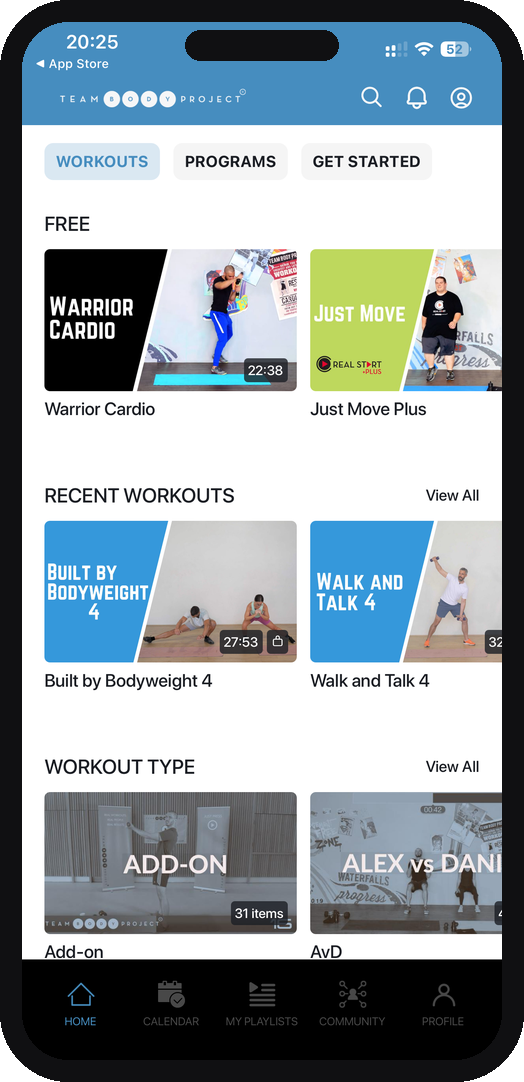
Team Body Project is a follow-along home-workout membership built around accessible, encouraging, low-impact training for all ages and sizes. Instead of an algorithm or a class marketplace, you get a large library of coach-led workouts and structured programmes that you follow in real time, from quick Walk and Talk sessions to full strength and cardio workouts. The signature strength is breadth of low-impact and standing-only content, which makes it unusually welcoming to beginners and to anyone protecting their joints.
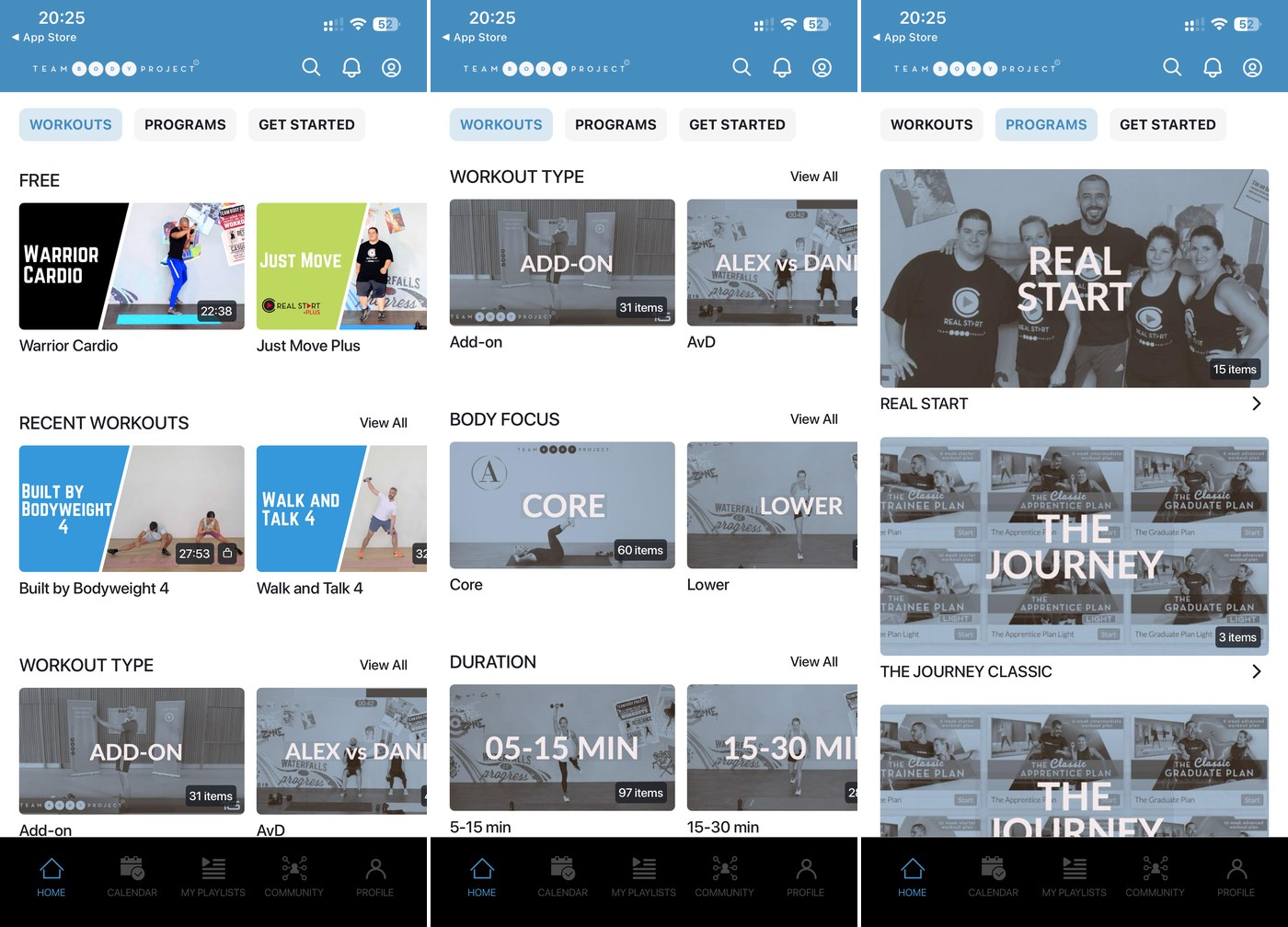
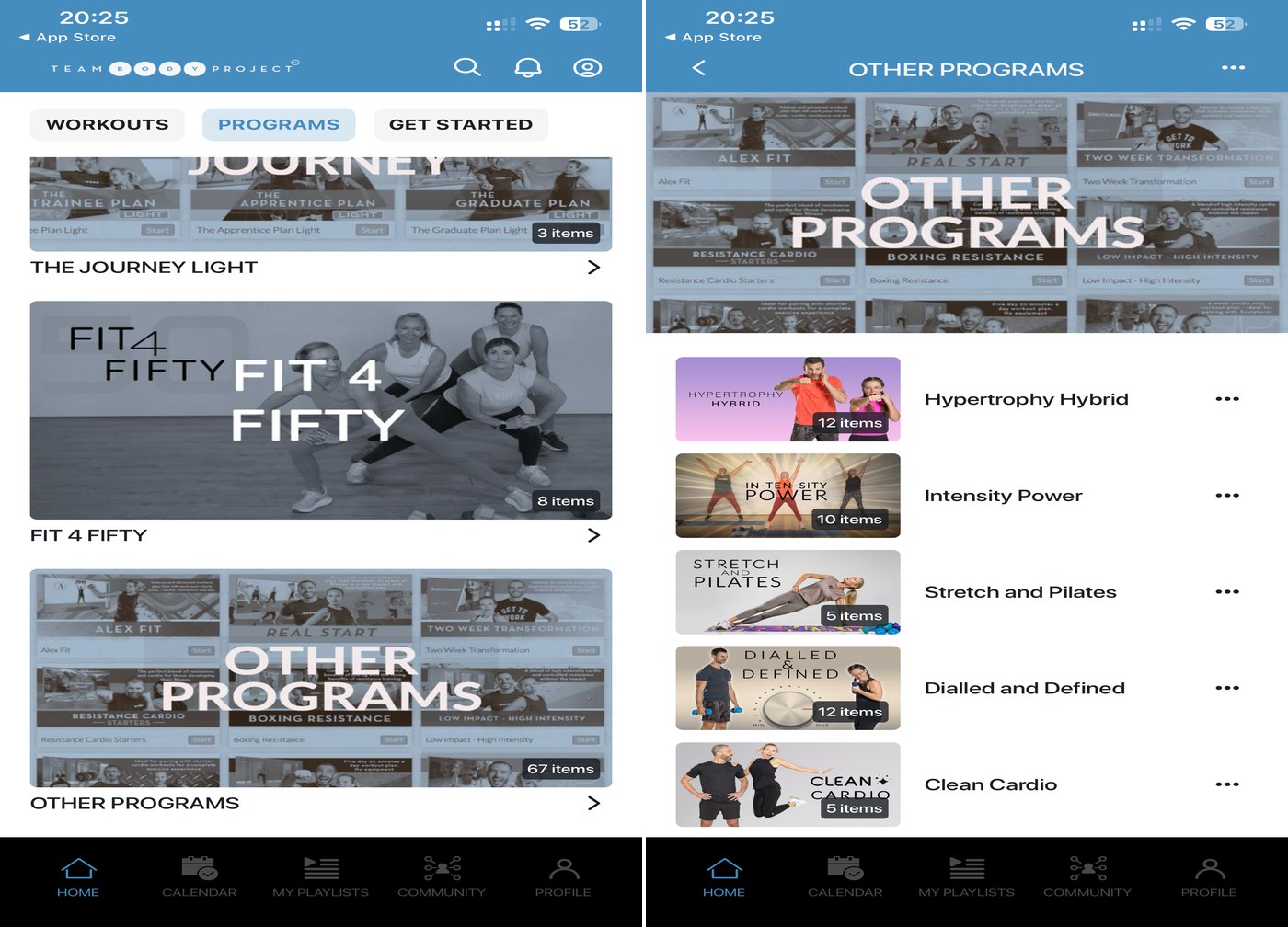
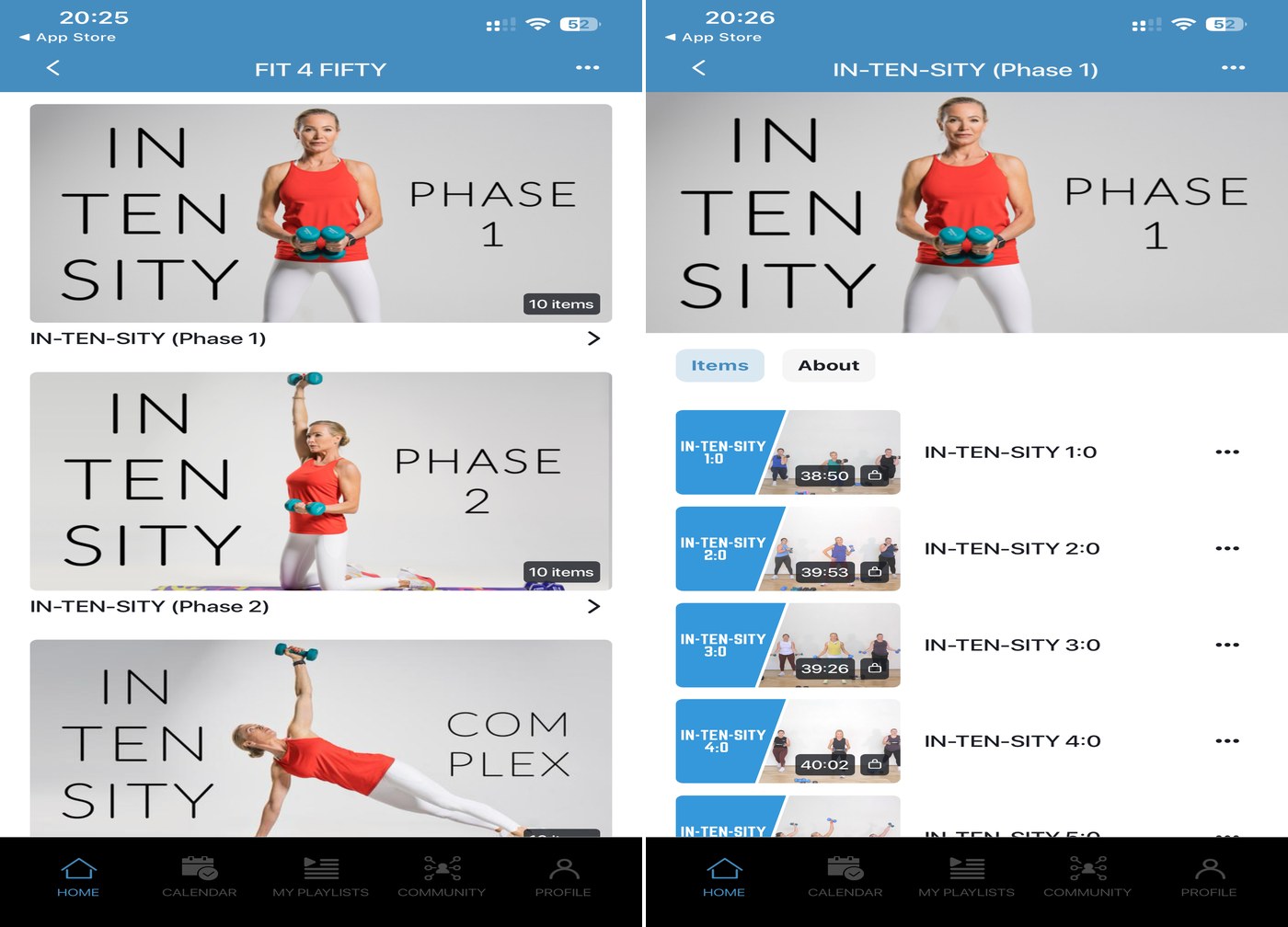
The catalogue is organised into named programmes that give the membership real shape. Real Start is a gentle on-ramp for people returning to exercise, The Journey is a progressive plan, FIT 4 FIFTY targets the over-fifties, and IN-TEN-SITY is a phased dumbbell strength series. A Classic Fitness Test and a Low Impact Fitness Test help you pick an appropriate level, and easy filters let you sort by duration, body focus and impact. It runs on phones, tablets and the web, and, unusually for this price, on Apple TV, Roku, Fire TV and Android TV, so the living-room follow-along experience is a core part of the product.
To place the product accurately: Team Body Project is a general fitness membership aimed at making movement approachable and affordable for a very broad audience, not a platform designed around perimenopause or menopause. Nothing in the programmes, the coaching or the content is built around hormones or menopause symptoms, and that single fact shapes the rest of this profile.
Who Is Behind It
Team Body Project is run by Body Project Systems Ltd and led by its founders, Daniel and Alexandra Bartlett. Daniel Bartlett is a certified personal trainer, former gym owner and life coach with around 20 years in the industry, and he fronts most of the coaching alongside Alexandra and a team of qualified coaches. The same coaches run the free Body Project channel on YouTube, which has around 1.7 million subscribers, and the paid membership reports over 275,000 members, so this is an established brand with a large and engaged following rather than a new launch.
The coaching voice is the product’s real asset: warm, patient and inclusive, with an explicit all-ages, all-sizes ethos that lands well with women returning to exercise. The app itself is built on the VidApp white-label platform, but the brand, coaching and programming are proprietary to Body Project Systems Ltd.
Certified coaches, not clinicians, and no menopause programming
Daniel and Alexandra Bartlett are experienced, certified fitness coaches; Daniel is a personal trainer and life coach, not a physical therapist, doctor or menopause specialist. There is no clinical or menopause credential embedded in the product, no hormone or pelvic-floor content, and no one on the team qualified to guide a woman managing HRT, a prolapse or a heart condition. FIT 4 FIFTY is age-appropriate training, not menopause education. For anything beyond general training, treat Team Body Project as a well-made fitness membership, not a clinician.
Who Is Team Body Project Best For, and Who Should Skip It?
Team Body Project is built around accessibility and value, and that runs through the coaching, the low-impact catalogue and the pricing.
If you want affordable, joint-friendly workouts you can do at home, this is one of the strongest picks around. The low-impact and standing-only range is genuinely deep, the free tier is permanent, and the paid plans are cheap.
If you are a beginner or returning after a break, the Real Start programme, the fitness tests and the encouraging coaching are an exceptional on-ramp, with no assumption that you are already fit.
If you like following along on the TV, the Apple TV, Roku, Fire TV and Android TV apps, plus casting and offline downloads, make the living-room experience a core feature rather than an afterthought.
If you want training built for menopause, this is not the right membership. There is no menopause education, no hormone or phase guidance, no pelvic-floor content and no clinician. An age-targeted plan such as FIT 4 FIFTY is welcome, but it is not the same as programming designed around this life stage, and if that is your priority you will be better served elsewhere.
Is Team Body Project Good for Women Over 40?
Short answer: yes for accessible, joint-friendly training and value, but not as a menopause solution. On the training itself, Team Body Project does a lot right for a midlife body. Its low-impact depth means you can train hard while protecting your joints, and its dumbbell strength work through IN-TEN-SITY provides progressive resistance, the intervention with the strongest evidence for preserving bone density and muscle after menopause.12 Its mix of interval and steady cardio is a reasonable way to protect cardiorespiratory fitness, which matters more as the protective effect of oestrogen falls away.3
What the training gets right for a midlife body
Deep low-impact options, a real beginner on-ramp, dumbbell strength progression and a genuine standing-only range are all appropriate for women over 40. The methods underneath Team Body Project are the ones the evidence supports for muscle, bone and cardiometabolic health in this age group. If you simply need an approachable, structured plan to follow, the raw ingredients are sound, and the low-impact focus is a real strength.
Where it falls short is everything around the training. There is no menopause education to explain why strength and bone loading matter more now, no hormone or phase awareness, no pelvic-floor content, and no clinician to adjust for symptoms or medical history. Be precise about loading, too: dumbbell strength is genuinely useful, but home-dumbbell weights are lighter than the heavy resistance and impact loading that drives the largest bone gains, so treat the strength work as bone-supportive rather than bone-maximising.1
The wider picture: Team Body Project is a very good general tool, not a menopause solution. If you value accessibility, low cost and joint-friendly movement and you are comfortable steering yourself, it can serve you well. If you want your training built around perimenopause or menopause, with education, pelvic-floor work and clinical grounding, a purpose-built platform will serve you better.
The capability breakdown below scores Team Body Project against what the research says midlife and menopausal women benefit from. It is strong on low-impact accessibility and the beginner on-ramp, and close to empty on the group that captures whether a programme is actually built for menopause.
This is the perimenopause and menopause assessment, and it is separate from the overall score. Twelve things a programme either does for a midlife body or does not, each scored out of 10 with my reasoning next to it. Together they produce a single menopause fit score, and that becomes one of the nine categories in the overall scoring below.
How Team Body Project Fits Perimenopause, Menopause & Beyond
Women Over 40 is our most important criterion, and here's the full breakdown behind it.
Team Body Project is strongest for beginner on-ramp and low-impact, and weakest for pelvic floor, hormone awareness, menopause education, midlife nutrition, menopause programming and mind-body support, in our menopause and midlife capability assessment for women over 40.
At a glance
What the app teaches about perimenopause and/or menopause, not whether the training suits a midlife body.
| Capability | Score | Rating | Why |
|---|---|---|---|
| Right training for a midlife body | |||
| Low-impact | 8/10 | Strong | One of the deepest low-impact and standing-only catalogues anywhere, plus Walk and Talk and a Low Impact Fitness Test. |
| Progressive strength | 6/10 | Some | The IN-TEN-SITY dumbbell series and resistance programmes give real progression, though loads are home-dumbbell level. |
| Bone loading | 5.5/10 | Some | Dumbbell strength and impact options provide a bone-supportive stimulus, lighter than heavy resistance and impact loading. |
| Recovery & deload | 6/10 | Some | Stretch, Pilates and mobilisation support recovery, but there is no formal deload or periodisation. |
| Menopause education and programming* | |||
| Menopause programming | 4/10 | Minimal | FIT 4 FIFTY and Longevity target the age group, but this is age-appropriate training, not a menopause-labelled or phased programme. |
| Pelvic floor | 2/10 | None | No dedicated pelvic-floor content. |
| Hormone awareness | 2/10 | None | No hormone or HRT content and no phase-based programming. |
| Menopause education | 2/10 | None | No dedicated menopause or symptom education. |
| Expert credibility | 5/10 | Some | Experienced certified coaches (PT plus life coach; 20 years), but no clinical or menopause qualification. |
| Whole-woman support | |||
| Mind-body support | 4/10 | Minimal | Stretch, Pilates and mobilisation cover the recovery side, but there is no standalone meditation. |
| Beginner on-ramp | 9/10 | Best-in-class | Exceptional: the Real Start programme, 100% low-impact and standing plans, a fitness test and an all-ages, all-sizes ethos. |
| Midlife nutrition | 3/10 | Minimal | Nutrition guides, e-books and recipes, but no tracked meal-plan system. |
ScaleBest-in-classStrongSomeMinimalNone
What the sources say: Scored from the official app and site, Katy's app screenshots, app-store data and peer-reviewed evidence (Aug 2026); hands-on pending.
* What the app teaches and programmes around menopause, not whether the training suits a midlife body. Many programmes that score low here are still a good fit, they simply never use the word. A high score is not proof either: a few menopause videos added to a general library lifts this score without changing the training.
These are evidence-informed suitability ratings, not clinical measurements. They combine exercise science with product-specific research and, where indicated, hands-on testing, alongside multi-source verification, and are approximate. Individual response varies. A starting point, not medical advice. How we score menopause fit
How the Team Body Project Method Works
Short answer: real-time follow-along coaching, organised into structured programmes you choose and progress at your own pace. Rather than an adaptive algorithm, Team Body Project gives you coach-led sessions you do in real time, grouped into named plans such as Real Start, The Journey, FIT 4 FIFTY and IN-TEN-SITY. You pick a level with the fitness tests, then work through a programme, self-regulating intensity as you go. For a midlife body, the value is in the low-impact breadth and the sense of doing the session with a coach, which many women find far easier to sustain than training alone.
Follow-along coaching: what the evidence supports, and what it does not
App-based and coach-led home programmes can produce a modest, genuine increase in physical activity, but the effect is strongest in the first few months and tends to fade after that.7 So the encouraging coaching and structured plans are a plausible way to stay consistent, not a guarantee. It is also worth being clear about progression: the plans are phased and self-regulated rather than individually periodised, so you decide when to add load or step up impact. That flexibility suits many women, but it means the responsibility for progressive overload sits with you.
The absence of a formal deload or periodisation deserves the same realism. Stretch, Pilates and mobilisation sessions cover recovery, but there is no built-in deload week or long-term periodised plan, so if you want structured recovery cycles you will need to manage them yourself.
Content and Features
Short answer: deep on-demand and low-impact content and structured programmes, thin on menopause-specific and nutrition features. The table separates what is included from what is missing, because for a midlife woman the gaps, hormone-phase awareness, pelvic-floor work and menopause education, matter as much as the workout library.
| Feature | Included? | Notes |
|---|---|---|
| On-demand workouts | Yes | A very large library, with an unusually deep low-impact and standing range |
| Structured programmes | Yes | Real Start, The Journey, FIT 4 FIFTY and the IN-TEN-SITY dumbbell series |
| Live classes | No | Coaching is follow-along on demand, not scheduled live sessions |
| Recovery and mobility | Partial | Stretch, Pilates and mobilisation; no formal deload or periodisation |
| Meditation and mindfulness | No | No standalone meditation content |
| Nutrition guidance | Partial | Guides, e-books and recipes; no tracked meal plan or food logging |
| Menopause education | No | None found on the site or app |
| Pelvic-floor content | No | None found |
| Cycle or hormone-phase programming | No | None found |
| Symptom or cycle tracking | No | No menopause symptom tracking |
| Beginner on-ramp | Yes | Real Start, fitness tests and 100% low-impact and standing options |
| Community | Yes | Large community and challenges, plus the free YouTube following |
| Clinical advisory board | No | Experienced certified coaches, but no clinical or menopause board |
Nutrition
Short answer: light nutrition support, useful but not a system. Nutrition is peripheral to Team Body Project rather than a core pillar. Premium includes nutrition guides, e-books and recipes, which are helpful for general eating guidance, but there is no tracked meal-plan system, no food or calorie logging, and no personalised nutrition programme. For a midlife woman, protein needs rise with age and matter for holding on to muscle, so a workout membership that treats nutrition as reading material is a real limitation. If structured eating support is a priority, an app with an integrated meal-plan system will serve you better.
Devices and Platform
Short answer: one of the most flexible living-room setups at this price. Team Body Project runs on iPhone, Android and a web portal, and, unusually, on dedicated Apple TV, Roku, Fire TV and Android TV apps, so following along on the big screen is a first-class experience rather than a workaround. You can cast from your phone and download sessions for offline use, which helps when the signal is poor or you are travelling. There is no dedicated wearable app, so if watch-based heart-rate or activity sync matters to you, confirm your setup. For a woman who trains in the living room and wants a large, clear picture to follow, the platform coverage here is a genuine strength.
What the Research Says
Short answer: the training methods are well supported for midlife women, though Team Body Project never frames them around menopause. Progressive and even higher-intensity resistance training improves bone mineral density and physical function in postmenopausal women, and does so safely under supervised technique, as the LIFTMOR trial showed; the practical caveat is that home-dumbbell loads are lighter than the heavy loading used in that research.1 Resistance training also builds and preserves muscle in this group, with higher training volume producing more muscle while strength gains come readily even at lower volume.2 Both interval and moderate-intensity cardio improve cardiorespiratory fitness in older women, so a mix of low-impact HIIT and steady work is reasonable, though the evidence does not make HIIT uniquely superior.3
The picture is more mixed for menopause symptoms, and it is important not to overclaim. Exercise improves some quality-of-life domains for women with menopausal symptoms but not others, so it is not a blanket fix.4 It can reduce insomnia severity, although the evidence for improving overall sleep quality is weaker.5 For hot flushes and night sweats, the most authoritative review concludes there is insufficient evidence that exercise is an effective treatment.6 Any suggestion that a general fitness membership relieves vasomotor symptoms is unsupported, and Team Body Project sensibly makes no such claim.
The wider health bodies agree on the direction of travel: strength work at least twice a week and regular activity are core recommendations for women as they age.89 Team Body Project delivers the strength and activity, and its low-impact depth makes hitting those targets realistic; what it does not deliver is any of the menopause-specific layer.
What Users Report
Short answer: strongly liked, with praise centred on accessibility, coaching and value. On the Apple App Store, Team Body Project holds about 5.0 out of 5 from roughly 945 US ratings, a small but positive sample, and the free Body Project YouTube channel has built a following of around 1.7 million with a highly engaged community. The paid membership reports over 275,000 members. Because we have not tested the app hands-on, we treat this sentiment as directional rather than definitive.
What users praise: the warm, encouraging coaching from Daniel and Alexandra Bartlett, the depth of low-impact and standing-only options, the all-ages, all-sizes ethos, the genuine free tier and low price, and the ease of following along on a TV.
What users criticise: the public record is thinner than for larger apps, so we hold some judgements lightly. The recurring themes are that nutrition is light and there is no tracked meal plan, that progression is self-regulated rather than guided, and that there is no menopause-specific content for women who come looking for it. As with most home-workout memberships, the evidence suggests engagement can wane after the first months unless the coaching keeps you coming back.7 There is very little explicit menopausal women’s voice in the public record, so we treat suitability for that specific need as an open question rather than a settled strength.
Team Body Project specifications
- Free trial
- No time-limited trial; permanent free membership + 14-day money-back guarantee on paid plansSource: https://teambodyproject.com/payment/
- Cancellation
- Cancel any time; 14-day money-back guarantee on paid plansSource: https://teambodyproject.com/payment/
- Session length
- 5 to 60 minSource: https://teambodyproject.com
- Who makes it
- Daniel Bartlett (certified PT, gym owner, life coach, ~20 yrs) and Alexandra Bartlett, plus qualified coaches; ~1.7M YouTube; over 275,000 members. NOT clinical/menopause-qualified.Source: https://teambodyproject.com
- Still maintained
- Actively developed; app on VidApp white-label; ~1.7M YouTube ("Body Project")
- What is included
- On-demand classes: yesLive classes: noRecovery content: partlyMenopause education: noStructured programmes: yesMeditation: noNutrition guidance: partly
- Women over 40
- Pelvic floor work: noMenopause clinician involved: noInjury modifications: partlyBone-health focus: partlyModified progressions: partlyCycle syncing: noPrenatal options: no
- Devices and access
- Offline downloads: yesCasting to TV: yesSubtitles: partlyWearable sync: no
- Support
- Clinical advisory board: noCommunity: yesSupplement upsell: no
- Last verified
- 15 August 2026
Team Body Project Price 2026: What You Actually Pay
Short answer: a permanent free tier, then low-cost premium with a best-value annual plan. Team Body Project is free to use at a genuine, permanent free tier, with a premium membership that is inexpensive by category standards. The website prices in USD; UK prices come from the App Store in-app purchase, so confirm your exact local charge at signup.
| Plan | Cost | Notes |
|---|---|---|
| Free tier | $0 | Permanent free membership; premium unlocks the full catalogue and plans |
| Monthly | About $25 (UK about £19.99) | Full access, cancel any time |
| Quarterly | About $50 (UK about £39.99) | 3-month plan; cheaper per month than monthly |
| Annual | About $140 (UK about £102.99) | Best value per month if you commit |
Read before you subscribe: currency and where you buy
Two small things to go in with eyes open. First, the website prices in USD only, while UK and other local prices come through the App Store in-app purchase, so the number you are charged can differ from the dollar figure; confirm your exact local price at checkout. Second, remember the free tier is permanent, so there is rarely any need to rush into a paid plan: try the coaching and the low-impact classes for free, and upgrade only when you know it suits you. The 14-day money-back guarantee on paid plans is a further safety net.
Trial and refunds: there is no time-limited trial, because the free membership is permanent. Paid plans come with a 14-day money-back guarantee, and store purchases also follow Apple and Google refund rules. You can cancel any time through your app store subscription settings; because the free tier remains, cancelling premium simply drops you back to free rather than locking you out entirely.
Not sure Team Body Project is the right programme for you?
Answer a few questions about your goals, schedule and fitness level, and get matched with programmes that fit.
Time Commitment: Weekly Schedule and Session Length
| Scenario | Sessions/week | Session length | Weekly total |
|---|---|---|---|
| Typical structured plan | 4 | 20 to 40 min | 80 to 160 min |
| Short-on-time setting | 4 to 5 | 5 to 15 min | 30 to 60 min |
| Higher-volume weeks | 6 | 40 to 60 min | 240 to 360 min |
| WHO activity guideline target | 5 | 30 min moderate, plus 2 strength days | 150 min |
Because you choose your session length and the catalogue spans quick Walk and Talk sessions to full workouts, Team Body Project flexes easily around a busy life, and a typical week sits comfortably within the WHO activity guideline of 150 minutes plus two strength sessions.8 The strength emphasis is the part that matters most for a midlife body, so the useful question is not whether you can hit the minutes but whether you keep adding load through the IN-TEN-SITY work.
Will You Actually Stick With It?
Boredom RiskA very large library across low-impact, standing, HIIT, strength and Pilates, plus new content and challenges, keeps sessions varied
Decision FatigueStructured programmes such as Real Start and FIT 4 FIFTY decide the path for you, so you are not choosing from scratch each day
Motivation FadeHome-workout engagement often wanes after the first few months,7 and a general plan with no menopause context can start to feel generic
The consistency question
Team Body Project is built to keep you coming back, with warm coaching, an inclusive ethos, structured programmes and a large community. The research backs the general idea that coach-led home programmes lift activity, with the caveat that the boost is strongest in the first three months.7 If you respond to encouraging follow-along coaching and value low-impact accessibility, you will likely keep going; if you need a plan that understands this life stage, motivation may fade sooner. The permanent free tier and low price make it easy to keep the habit alive even in quieter weeks.
What Equipment Do You Need for Team Body Project?
Adjustable dumbbells
The single most useful buy for the IN-TEN-SITY strength work; add load as you get stronger
~$25 to $50
Exercise mat
Cushions floor work, Pilates, stretching and recovery; kinder on the joints
~$20 to $45
Resistance bands
Handy for warm-ups, mobility and travel, and for scaling exercises up or down
~$15 to $30
A quick heads-up: some of the buy links above are affiliate links, so if you buy through them we may earn a small commission, at no extra cost to you. We only point to kit worth owning.
Team Body Project needs no equipment to start, with many bodyweight and standing-only plans, and adds dumbbells and a mat for the strength and floor work, so the barrier to beginning is genuinely low.
Team Body Project vs FitOn, Pvolve and Caroline Girvan
Team Body Project assessed on a research basis from the official app, site and store data. Competitor prices and ratings are approximate; verify each on the platform before subscribing.
| Feature | Team Body Project | FitOn | Pvolve | Caroline Girvan |
|---|---|---|---|---|
| Our score | 6.9 | 7.3 | 8.3 | 7.6 |
| Monthly price (approx) | ~$25 (free tier) | Free; Pro ~$8.33/mo annual | ~$14.99 | ~$13.99 |
| Free option | Permanent free tier | Large free library | Free trial | Free on YouTube |
| Best for | Accessible low-impact value | Budget variety | Menopause-built movement | Structured strength |
| Equipment required | None up to dumbbells | Minimal | Bands and light kit | Dumbbells |
| Session length | 5 to 60 min | 5 to 45 min | 20 to 45 min | 30 to 45 min |
| Low-impact depth | Exceptional | Some | Good, joint-aware | Limited |
| Perimenopause content | None | Some | Extensive | None labelled |
| Pelvic floor | No | Limited | Yes | No |
| Coaching style | Follow-along, coach-led | Instructor-led | Instructor-led | Caroline-led |
| TV apps | Apple TV, Roku, Fire TV, Android TV | Yes | Some | YouTube on TV |
| Nutrition included | Guides only | Some | Limited | No |
| App Store rating (approx) | ~5.0 | ~4.8 | ~4.8 | varies |
| Best suited to | Over-40 beginners, budget, low-impact | Budget-conscious | Midlife, joint-aware | Confident lifters |
Team Body Project vs FitOn
These are the two strongest budget choices, and they split on coaching style and content shape. FitOn gives you a very large library of instructor-led classes with a genuinely useful free tier, so your cost per workout can be close to zero across a wide variety of formats. Team Body Project gives you warm, consistent follow-along coaching from the same voices, an unusually deep low-impact and standing catalogue, structured programmes such as Real Start and FIT 4 FIFTY, and first-class TV apps, with its own permanent free tier. Neither is menopause-built, so if you want maximum variety and the lowest possible cost, choose FitOn; if you want an accessible, encouraging low-impact membership with structured plans and a great living-room experience, choose Team Body Project.
Team Body Project Weighted Scoring: How the 6.9 / 10 Was Calculated
Scores are evidence-informed, on our 9 weighted criteria, with a confidence tag per row because this is a research-based profile rather than a hands-on test. See how we score for the full method and weightings.
This is the overall score, and it asks a broader question: how good is this programme, full stop. Nine categories, each weighted by how much it matters to a woman in perimenopause or beyond, which is why Muscle Potential counts for more than Value for Money. The Women Over 40 Specificity row is the perimenopause and menopause fit score from the twelve capabilities above, carried through.
| Category | Weight | Score | Weighted |
|---|---|---|---|
| Time Efficiency | 15% | 8.0 | 1.20 |
| Muscle Potential | 18% | 6.0 | 1.08 |
| Women Over 40 Specificity | 10% | 4.8 | 0.48 |
| Joint Friendliness | 12% | 8.0 | 0.96 |
| Recovery Compatibility | 10% | 6.5 | 0.65 |
| Programme Structure | 12% | 8.5 | 1.02 |
| Value for Money | 8% | 8.5 | 0.68 |
| UX and Design | 8% | 8.0 | 0.64 |
| Nutrition Integration | 7% | 3.0 | 0.21 |
| Total | 100% | 6.9 / 10 |
Scoring notes: value, programme structure and joint friendliness rate highly because a permanent free tier, low pricing, structured plans and an exceptionally deep low-impact catalogue are genuine strengths. Time efficiency and UX score well thanks to short-session options and the strong TV apps. Muscle potential is solid rather than top, since dumbbell loading is lighter than heavy resistance work, and recovery is marked medium because there is no formal deload. The women-over-40 score is capped by the absence of menopause features rather than by poor training, and nutrition is the weakest area, with guides but no tracked meal plan.
Final Weighted Score
6.9 / 10
A hugely accessible, best-value low-impact home-workout membership, but no menopause programming and thin nutrition
Team Body Project Pros and Cons
Pros
- A genuine, permanent free tier and low-cost paid plans; excellent value
- One of the deepest low-impact and standing-only catalogues anywhere
- Exceptional beginner on-ramp with Real Start and two fitness tests
- Dumbbell strength progression through the IN-TEN-SITY series, which the evidence supports for a midlife body12
- Warm, encouraging coaching with an all-ages, all-sizes ethos
- First-class living-room experience: Apple TV, Roku, Fire TV, Android TV, casting and offline
- Large, engaged community and a free 1.7M YouTube following from the same coaches
Cons
- No menopause education, hormone guidance or pelvic-floor content
- Founders are certified coaches, not clinicians or menopause specialists
- Dumbbell loads are home-level, lighter than the heavy loading that most builds bone
- Nutrition is thin: guides and recipes, but no tracked meal plan or logging
- No formal deload or periodisation; progression is self-regulated
- No dedicated wearable app or symptom tracking
- Website prices in USD only, so confirm your local charge at signup
Similar programmes we partner with
Close to Team Body Project, if it is not quite right for you
These are not part of this review’s score. Each shares a goal or training style with Team Body Project, and each is worth a look if it is closer to what you need.
A polished UK studio-style HIIT, strength and yoga app with great variety and a motivating community, but HIIT-leaning with weak recovery, a modest be…
A well-structured AI coach app with genuine strength progression, but a high-impact default that is hard on midlife joints, no menopause programming,…
Clinically studied low-impact functional training with a dedicated menopause programme and pelvic floor content, backed by an OBGYN advisory board. Eq…
A huge, well-produced workout and nutrition library with a dedicated hormone programme in Belle Vitale. Strong value, but the mainstream library skews…
Affiliate links, at no extra cost to you. I buy my own subscriptions and a commission never moves a score or a position. Full disclosure.
Team Body Project FAQ
Not specifically. Team Body Project is a general home-workout membership with no menopause education, hormone or phase guidance, or pelvic-floor content, and its founders are certified fitness coaches rather than clinicians. The low-impact training and dumbbell strength work it delivers are well supported for midlife women in general terms, and the FIT 4 FIFTY plan is age-appropriate, but the membership is not designed around menopause. For that, a purpose-built platform such as Pvolve is a better fit.
There is a genuine, permanent free tier. Premium is about $25 a month, $50 a quarter or $140 a year, with UK prices of roughly £19.99, £39.99 and £102.99 through the App Store. The website prices in USD only, so confirm your exact local charge at signup. Paid plans come with a 14-day money-back guarantee.
Yes. Unlike apps that offer only a short trial, Team Body Project has a permanent free membership, and the same coaches also run the free Body Project channel on YouTube. Premium unlocks the full catalogue and structured programmes, but you can train for free indefinitely, which makes it low-risk to try.
The founders are Daniel and Alexandra Bartlett. Daniel is a certified personal trainer, former gym owner and life coach with around 20 years of experience, and they coach alongside a team of qualified coaches. They are experienced fitness professionals, not physical therapists, doctors or menopause specialists, so treat the membership as a well-made fitness product rather than clinical guidance.
Regular exercise may ease insomnia severity for some women, but the evidence for improving overall sleep quality is weaker, and the most authoritative review finds insufficient evidence that exercise treats hot flushes. Team Body Project has no menopause-specific content, so do not expect it to target these symptoms directly. Speak to your GP about persistent symptoms.
If you want accessible, joint-friendly low-impact workouts, a real beginner on-ramp and excellent value, yes, it works well and the permanent free tier makes it low-risk to try. If you want training designed around perimenopause or menopause, with pelvic-floor and clinical grounding, a purpose-built platform is the better choice.
Yes, and it is a real strength. There are dedicated apps for Apple TV, Roku, Fire TV and Android TV, plus casting from your phone and offline downloads, so the follow-along experience is designed for the living-room big screen rather than being a workaround.
No. You can start with no equipment at all, and many plans are bodyweight or standing-only. A pair of adjustable dumbbells is the most useful upgrade if you want to follow the IN-TEN-SITY strength series and build strength for a midlife body, and a mat helps for floor and Pilates work.
Final Verdict
6.9 / 10
Team Body Project is a hugely accessible, best-value home-workout membership that is not built for menopause. The permanent free tier, low pricing, exceptional low-impact depth, encouraging coaching and first-class TV apps are genuine strengths, and the methods it uses, dumbbell strength and mixed low-impact cardio, are exactly what the evidence supports for a midlife body.123 It has a large, engaged following and an all-ages, all-sizes ethos that suits women returning to exercise.
The gaps are the ones that matter most to this audience. There is no menopause education, no hormone or pelvic-floor content, certified coaches rather than clinicians, thin nutrition with no tracked meal plan, and dumbbell loading that is lighter than the heavy work that most builds bone. None of that makes it a weak membership; it makes it a general one that happens to do accessibility and value better than almost anyone.
Best for: women over 40 at any level who want accessible, joint-friendly low-impact workouts, a real beginner on-ramp and excellent value, and who like following along on a TV.
Not ideal for: women who want menopause-specific programming, pelvic-floor or hormone-phase work, heavy progressive loading, a human clinician, or an integrated meal-plan system.
Testing status: scores are evidence-informed and provisional; a hands-on score is pending. If we trial the app over time, we will upgrade this page with first-person notes and a hands-on score.
Sources & Further Reading
- Watson SL, et al. (2018). High-Intensity Resistance and Impact Training Improves Bone Mineral Density and Physical Function in Postmenopausal Women (LIFTMOR). Journal of Bone and Mineral Research. doi.org/10.1002/jbmr.3284
- Oliveira Junior GN, et al. (2022). Resistance Training Volume and Muscle Hypertrophy in Postmenopausal Women. Journal of Strength and Conditioning Research. pubmed.ncbi.nlm.nih.gov/32569127
- Ballesta-Garcia I, et al. (2020). High-Intensity Interval Circuit Training and Cardiorespiratory Fitness in Middle-Aged and Older Women. International Journal of Environmental Research and Public Health. ncbi.nlm.nih.gov/pmc/articles/PMC7084372
- Nguyen TM, et al. (2020). Exercise and Quality of Life in Women with Menopausal Symptoms: Systematic Review and Meta-Analysis. International Journal of Environmental Research and Public Health. ncbi.nlm.nih.gov/pmc/articles/PMC7579592
- Qian J, et al. (2023). Effects of Exercise on Sleep in Menopausal Women: Systematic Review and Meta-Analysis. Frontiers in Medicine. pubmed.ncbi.nlm.nih.gov/37181372
- Daley A, et al. (2014). Exercise for Vasomotor Menopausal Symptoms. Cochrane Database of Systematic Reviews. pubmed.ncbi.nlm.nih.gov/25431132
- Romeo A, et al. (2019). Can Smartphone Apps Increase Physical Activity? Systematic Review and Meta-Analysis. Journal of Medical Internet Research. pubmed.ncbi.nlm.nih.gov/30888321
- World Health Organization (2020). Physical activity guidelines: adults aged 18 to 64. who.int/news-room/fact-sheets/detail/physical-activity
- Menopause and exercise: staying active through the transition. North American Menopause Society (The Menopause Society). menopause.org
Related Guides
What To Do Next
Not sure this is the right programme for you?
- → Take our 2-minute quiz for a personalised recommendation.
- → See our best workouts for perimenopause rankings.
- → See our best workouts for women over 40 rankings.
- → Compare menopause-built options in our Pvolve profile.
- → See how we score every programme using 9 weighted criteria.