
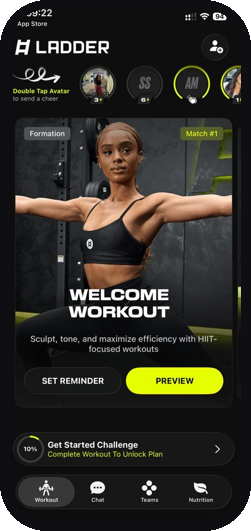
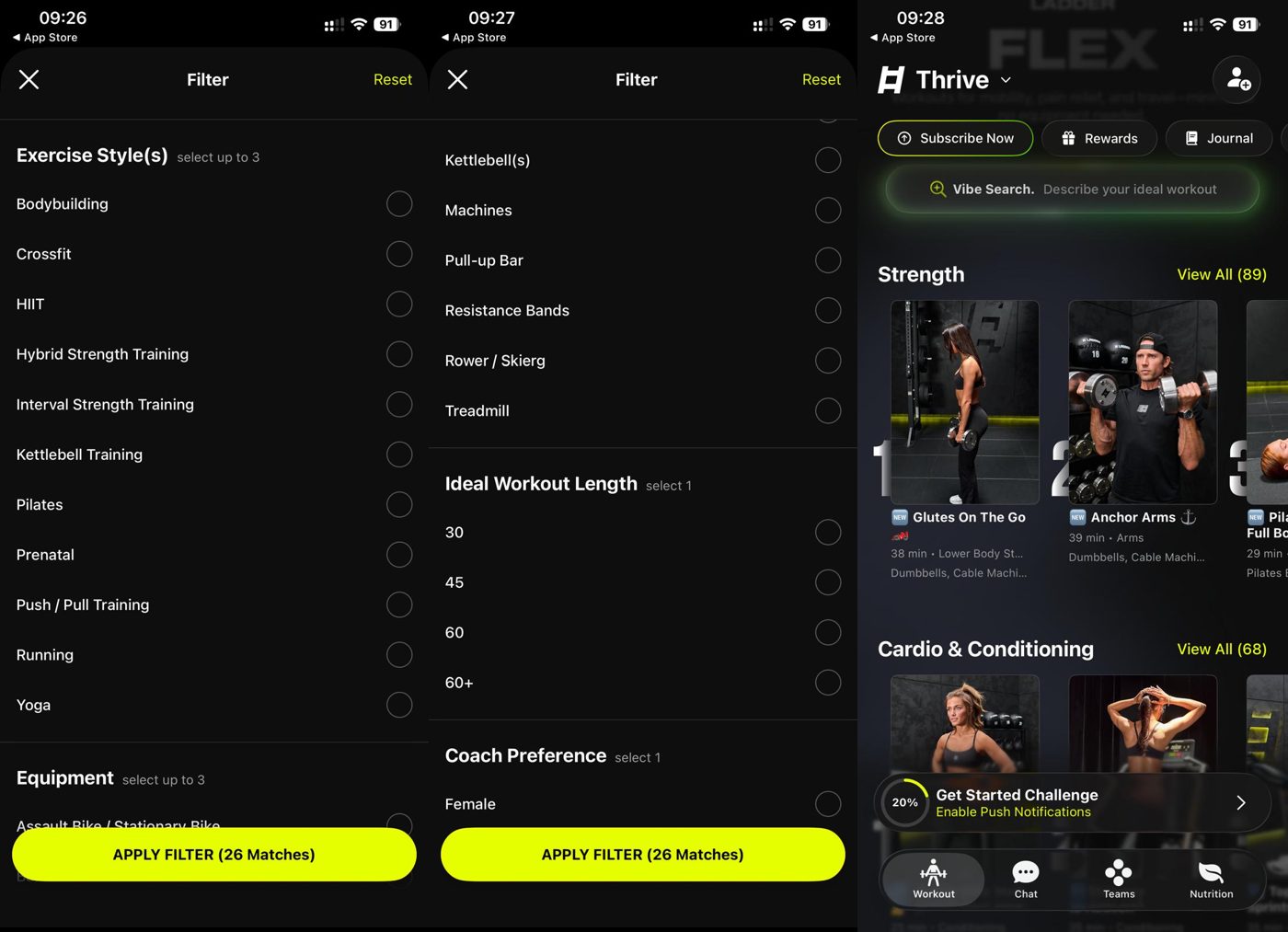
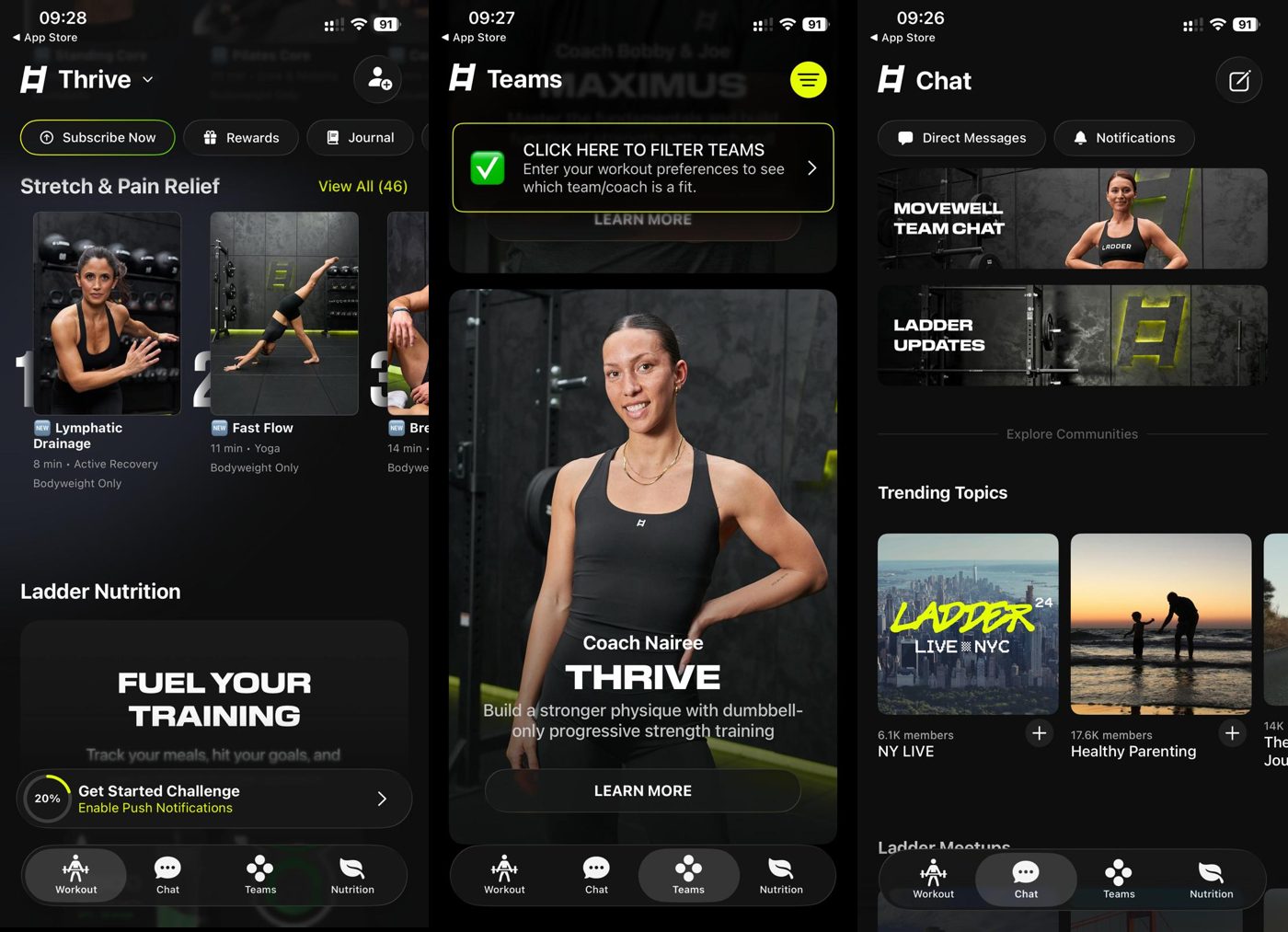
$29.99/month or $179.99/year · 7-day free trial (no card) · Coach-led, team-based progressive strength plans · iOS-primary, syncs Apple Watch · Global Researched from: official site (joinladder.com) and App Store (verified July 2026) · App Store reviews · independent reviews · peer-reviewed menopause exercise science · Downloaded and explored hands-on; the screenshots here are our own. Testing status: Sample tested.
How we reviewed this. We downloaded Ladder and spent time inside the app: we went through onboarding, explored the interface and the workout and programme library, tried sample sessions, and the screenshots here are our own. This is a hands-on look rather than a full multi-week test, so any rating that depends on long-term use is marked provisional. This is education, not medical advice; speak to your clinician, especially about HRT or existing conditions.
Ladder Review 2026: Quick Answer
Quick Verdict
Worth it for women over 40? As a strength tool, yes; as a menopause tool, no. Ladder is an excellent coach-led strength app with genuine progressive overload and a strong community, and progressive strength is exactly what a midlife body needs. But every team follows the same plan regardless of symptoms, there is no menopause programming, pelvic-floor work or hormone content, and the popular “40+” association comes from TikTok users, not a Ladder feature.
Ladder earns 6.9/10 on our hands-on evaluation. Its strength programming and design are outstanding, which is why it is so well rated. For this site’s audience, the honest picture is that it is a very good general strength app a woman over 40 can use well, not a programme built for the menopause transition, and its group model means the plan does not adapt to your individual recovery or symptomatic weeks.
Start here: use the 7-day trial (no card needed) to see whether a team plan suits you, and pick a team that matches your experience level.
Is Ladder right for you?
Ladder is strongest for building bone density (8.0 out of 10, against a 5.1 average across the 77 programmes scored) and weakest for perimenopause and menopause support (1.0 against 3.3).
| Question | Verdict | Rating | Score |
|---|---|---|---|
| How it suits a perimenopausal body | |||
| Is Ladder good for pelvic floor problems?Based on pelvic floor support and low-impact design | Low, and worse than mostmost score 4.6/10 | 2.5 / 10 | |
| Is Ladder genuinely built for perimenopause and menopause?Based on menopause programming, hormone awareness, education and expert credibility | Low, and worse than mostmost score 3.3/10 | 1.0 / 10 | |
| Is Ladder good for painful joints?Based on low-impact design and recovery provision | Low, and worse than mostmost score 6.2/10 | 4.5 / 10 | |
| Is Ladder manageable when your energy is low?Based on recovery provision and mind-body support | Low, and worse than mostmost score 5.7/10 | 4.0 / 10 | |
| Is Ladder good if you are new to strength training?Based on beginner on-ramp and mind-body support | Low, and worse than mostmost score 6.1/10 | 4.5 / 10 | |
| Is Ladder good for building bone density?Based on bone loading and progressive strength | Strong, and better than mostmost score 5.1/10 | 8.0 / 10 | |
| Does Ladder help with nutrition?Based on midlife nutrition support | Low, and worse than mostmost score 4.0/10 | 3.0 / 10 | |
| How it performs as a product | |||
| Can you fit Ladder into a busy week?Based on time efficiency | Strong, about the same as mostmost score 7.6/10 | 8.0 / 10 | |
| Is Ladder worth the money?Based on value for money | Strong, about the same as mostmost score 6.9/10 | 7.0 / 10 | |
Jump to Section
What Ladder Actually Is
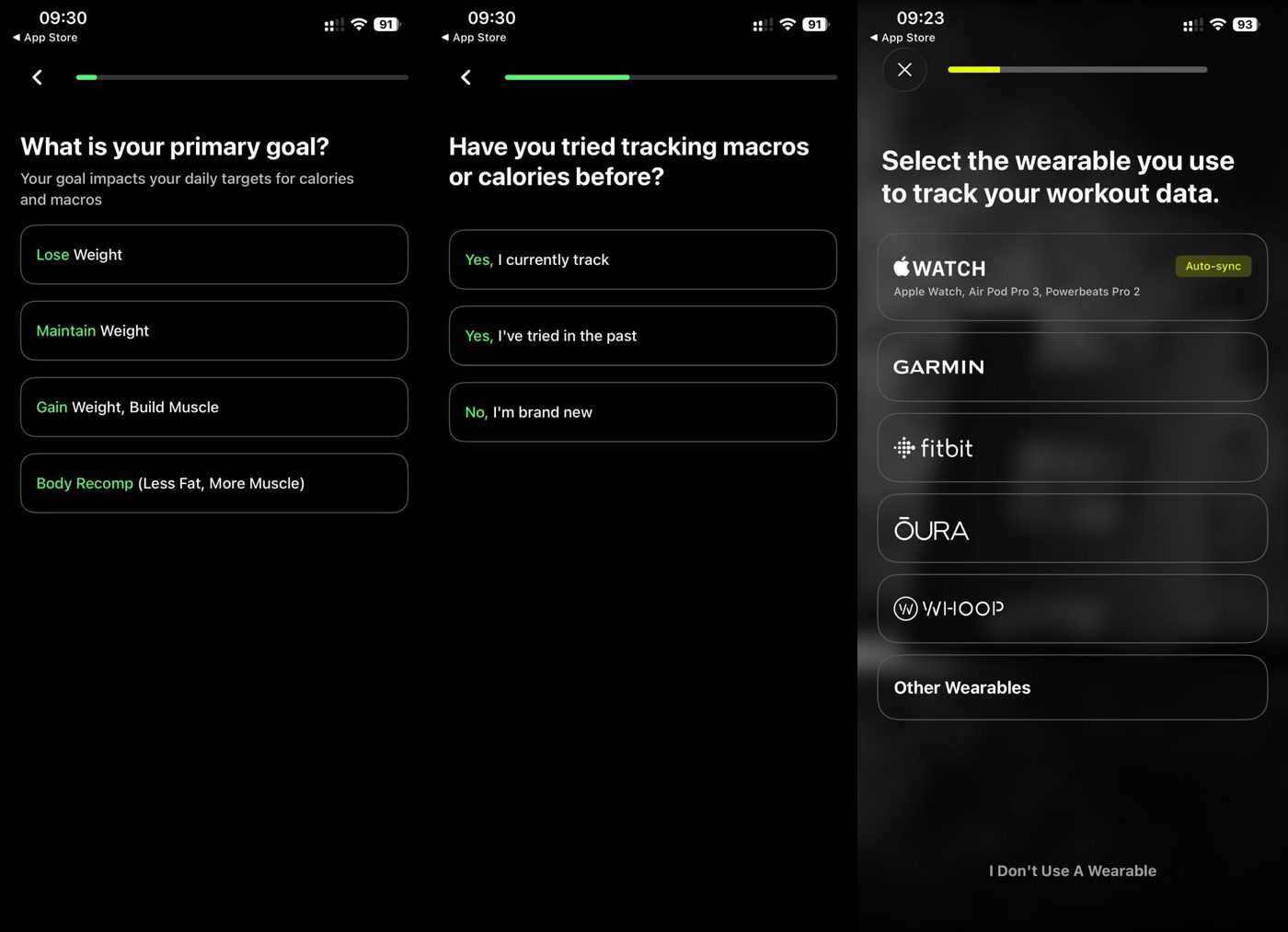
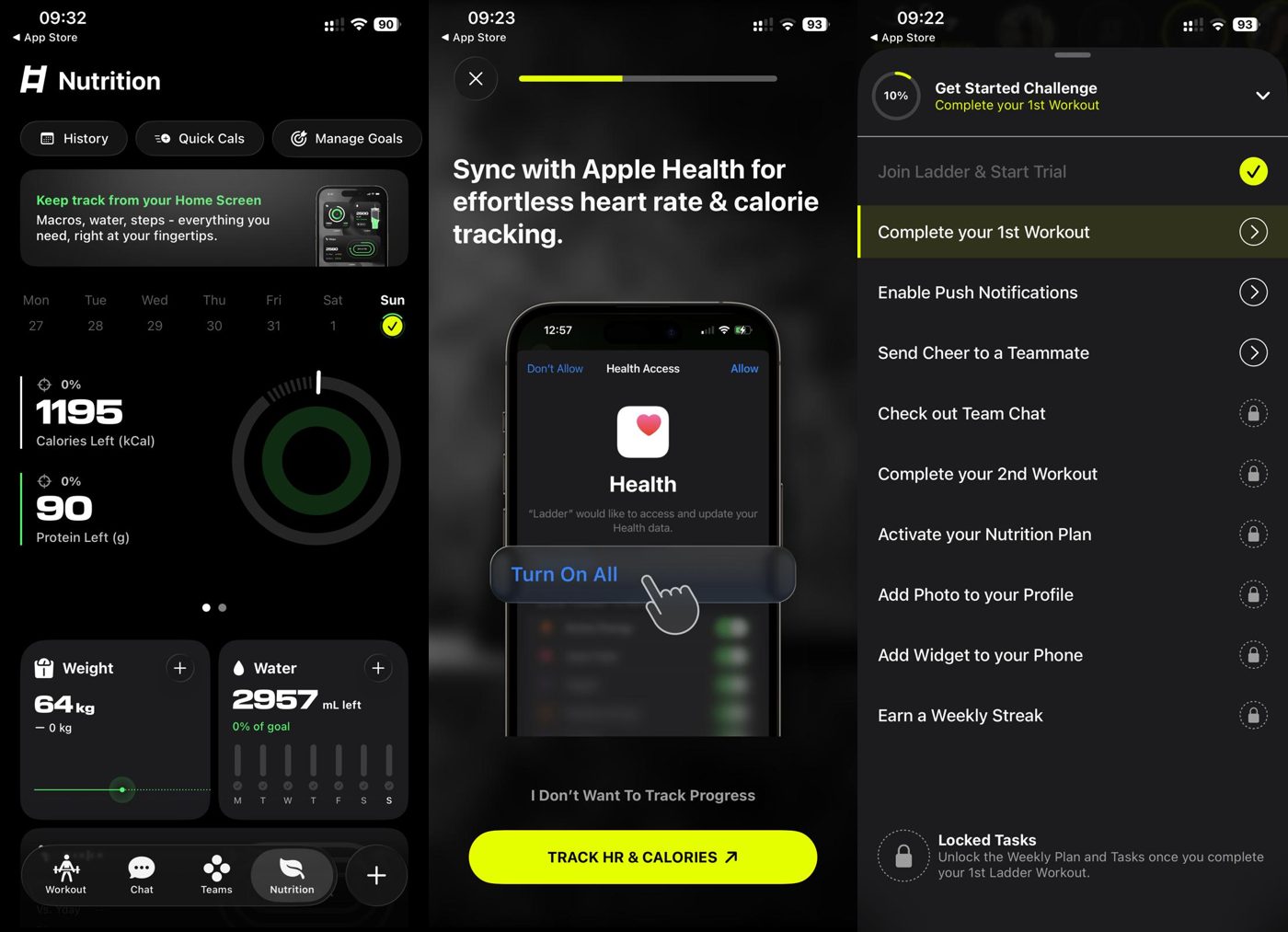
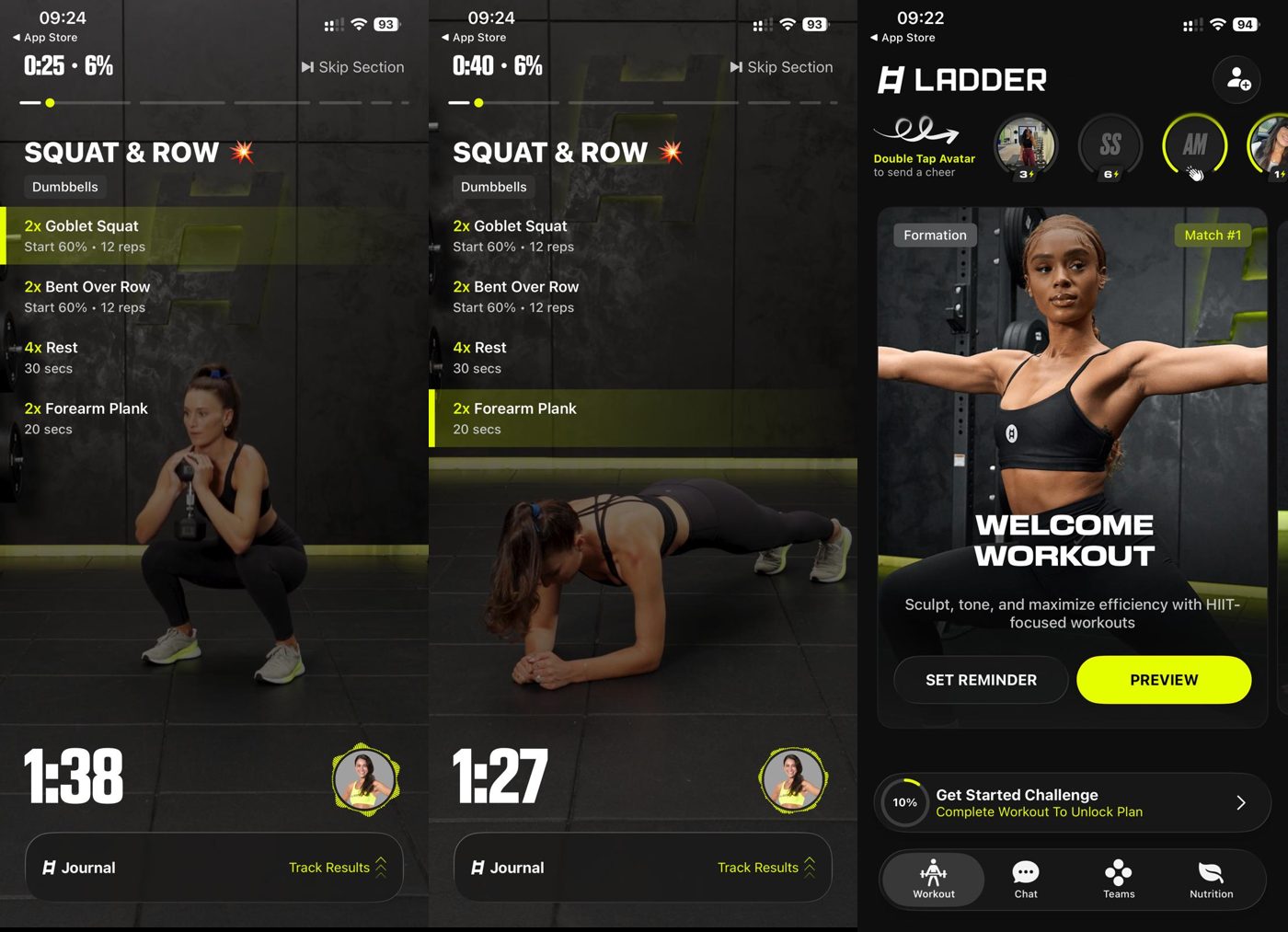
Ladder is a coach-led, team-based strength-training app. You take a quiz, get matched to a coach and a “team” (each with a distinct style, from functional bodybuilding to HIIT to Pilates), and every week your coach releases a new block of workouts that everyone on the team follows together, with in-ear audio coaching, video demos and load tracking. Its core competency is genuine progressive overload with clear splits, and it markets itself as a leading strength app, with Apple recognition and a large funding round behind it. It is iOS-primary and syncs with Apple Watch, Apple Health and music services.
Content and Features
At a glance: excellent progressive strength programming and design. But no menopause features, and fixed team plans that do not adapt to individual recovery.
| Format | Coach-programmed weekly team plans, followed together, with audio coaching and demos. |
| Progression | Excellent. Purpose-built progressive overload with set, rep and load tracking. |
| Recovery | Scheduled rest days, but fixed plans do not adapt to your individual recovery or symptoms. |
| Menopause / pelvic / hormone | None. |
| Menopause education | None. |
| Nutrition | New AI macro, calorie and protein tracking; generic, no registered dietitian. |
| Mind-body | Team community and some yoga or Pilates teams, but no dedicated midlife stress or sleep content. |
| Impact | Some low-impact and mobility teams, but core teams are loaded strength and HIIT. |
What Equipment You Need for Ladder
It depends on the team. Most strength teams assume access to dumbbells, and some to a fuller gym, while a few teams are more minimal or bodyweight-friendly. An adjustable dumbbell pair covers a lot of the home-based teams and lets you keep progressing load, which is the point of the programming.
Recommended spec examples. These picks are curated for convenience by specification and feature fit, not personally lab-tested for long-term durability. Prices are examples; verify before buying.
Starter Dumbbells (up to 10 lb)
A light adjustable pair, a great starting point
~$65 to $80
Medium Dumbbells (up to 25 lb)
For steady progression as you get stronger
~$50 to $65
Advanced Dumbbells (up to 50 lb)
For serious strength and progressive overload; grows with you
~$350 to $430
Kettlebell
For swings and loaded carries.
Optional
Adjustable bench
Unlocks presses, rows and step-ups.
Optional
A quick heads-up: some of the buy links above are Amazon affiliate links, so if you grab something through them I may earn a small commission – at no extra cost to you. I only ever point you to kit I’d happily use myself.
Bottom line on equipment: an adjustable dumbbell pair gets real value from most home teams; heavier teams want a fuller gym.
How We Scored Ladder: the 6.9 / 10 Breakdown
Our overall score is a weighted average of nine criteria. Because this is a hands-on look rather than a full multi-week test, these reflect what we saw in the app plus published information. Women Over 40 is our most heavily weighted menopause criterion, and its full 12-capability breakdown follows in the next section.
| Category | Weight | Score | Reasoning |
|---|---|---|---|
| Time Efficiency | 15% | 8 | Efficient 30 to 45 minute sessions. |
| Muscle Potential | 18% | 9 | Excellent progressive, coach-programmed strength. |
| Women Over 40 | 10% | 3.6 | Strong strength but no menopause features; full breakdown below. |
| Joint Friendliness | 12% | 5 | Some low-impact teams, but core teams are loaded and HIIT. |
| Recovery Compatibility | 10% | 4 | Fixed team plans with no individual recovery adaptation. |
| Programme Structure | 12% | 9 | Weekly coach programming with tracked progression. |
| Value for Money | 8% | 7 | About $15 a month on the annual plan. |
| UX and Design | 8% | 9 | Polished, Apple-recognised design. |
| Nutrition Integration | 7% | 5 | New generic AI macro tracking, with no dietitian. |
| Overall | 100% | 6.9 / 10 | Our Score; hands-on score pending. |
Is Ladder Good for Women Over 40?
On the training that matters most after 40, progressive strength, Ladder is genuinely strong: it programmes real progressive overload with expert coaching, which is the single best-evidenced thing a midlife woman can do for muscle and bone.[3] Where it falls short for this audience is everything menopause-specific and individual. There is no menopause programming, pelvic-floor work, hormone awareness or education, the group plans are symptom-agnostic and do not adapt to your recovery, and the widely-shared “great for perimenopause” idea comes from TikTok users rather than any feature Ladder actually offers. It is a strong general strength app, not a menopause programme.
What I found using it. Even before logging in I had a feeling Ladder is an app for building muscle, and that held up. I was welcomed by a short video of a coach explaining how it works, which I liked, and then it recommended a programme based on my age and goals. The coaches come across as high energy and genuinely confident and professional, and it honestly made me want to train with them. I only looked around rather than running a full programme, but you can see this is built for progressive strength. I also liked the nutrition side: you can track your macros in the same app, which for me replaces paying separately for something like MyFitnessPal.
Who it suits, and what I missed. For a perimenopausal or menopausal woman who wants to build and keep muscle and protect bone density, this genuinely has a place. My reservation is the intensity: the programmes I looked at could feel like a lot for us, with longer sessions and not much recovery between them if you follow them exactly. Ladder does let you swap sessions, dial the intensity down and take active rest days, so it is not rigid, but you have to know to do that. So I would point it at women who already understand how to structure their own training and want Ladder for the muscle-building days, rather than a beginner who wants to be told exactly how much to rest.
What others found too. Independent reviews back this up: Ladder pairs you with a coach and a team based on your goals, runs progressive six-week strength cycles, and in late 2025 added built-in macro and calorie tracking at no extra cost. Reviewers praise the coaching and structure and note the plans give you something to do most days with active rest built in, which is powerful but intense, exactly the balance I felt.
How It Fits Perimenopause, Menopause & Beyond
Our capability breakdown of how well this program suits women across perimenopause, menopause and post-menopause. Women Over 40 is our most important criterion for this site, and this is the full breakdown behind the Women Over 40 row in the scoring table above.
This is the perimenopause and menopause assessment, and it is separate from the overall score. Twelve things a programme either does for a midlife body or does not, each scored out of 10 with my reasoning next to it. Together they produce a single menopause fit score, and that becomes one of the nine categories in the overall scoring below.
How Ladder Fits Perimenopause, Menopause & Beyond
Women Over 40 is our most important criterion, and here's the full breakdown behind it.
Ladder is strongest for progressive strength, and weakest for pelvic floor, hormone awareness, menopause education, menopause programming, expert credibility, midlife nutrition, recovery & deload and mind-body support, in our menopause and midlife capability assessment for women over 40.
At a glance
| Capability | Score | Rating | Why |
|---|---|---|---|
| Right training for a midlife body | |||
| Low-impact | 5/10 | Some | Some low-impact/mobility/yoga/Pilates teams, but core teams are loaded strength and HIIT. |
| Progressive strength | 9/10 | Best-in-class | Purpose-built for progressive overload with weekly coach progression and load tracking; a genuine strength. |
| Bone loading | 7/10 | Strong | Heavy progressive resistance supports bone loading, though never framed for bone health. |
| Recovery & deload | 4/10 | Minimal | Scheduled rest days, but fixed plans do not adapt to recovery and no explicit deload weeks verified. |
| Built for menopause | |||
| Menopause programming | 1/10 | None | No menopause-specific programming; teams identical regardless of hormonal status. |
| Pelvic floor | 0/10 | None | No pelvic-floor training. |
| Hormone awareness | 0/10 | None | No cycle or hormone-phase awareness. |
| Menopause education | 0/10 | None | No menopause education content. |
| Expert credibility | 3/10 | Minimal | Reputable strength coaches, but no clinicians or menopause/women's-health expertise. |
| Whole-woman support | |||
| Mind-body support | 4/10 | Minimal | Team community and some yoga/Pilates, but no dedicated midlife stress, sleep or mindfulness. |
| Beginner on-ramp | 5/10 | Some | Onboarding quiz, welcome workouts and beginner teams, but many programmes pitched intermediate. |
| Midlife nutrition | 3/10 | Minimal | New generic AI macro/protein tracking, not tailored to midlife or menopause, no dietitian. |
ScaleBest-in-classStrongSomeMinimalNone
What the sources say: Sources: official joinladder.com pages (features, pricing, team structure, verified Jul 2026), App Store listing (~4.9, 100k+ ratings), BusinessWire press releases, independent reviews (Bustle, Parade, ExercisePick, Cora). No dedicated menopause, pelvic-floor, hormone or clinical-credibility evidence found on official or independent sources; Group 2 reflects verified absence. The "40+/perimenopause" relevance is user-generated (TikTok), not a Ladder feature; Team Vitality is confirmed general functional bodybuilding. Unverified "Pro+/Elite" tiers excluded.
These are evidence-informed suitability ratings, not clinical measurements. They combine exercise science with product-specific research and, where indicated, hands-on testing, alongside multi-source verification, and are approximate. Individual response varies. A starting point, not medical advice. How we score menopause fit
What the Research Says: Ladder’s Claims Checked
Progressive resistance training is a strong, evidence-aligned stimulus for midlife women, so Ladder’s core is well supported. Progressive strength training reliably builds and preserves muscle and, with sufficient load, supports bone in postmenopausal women,[1][4] and the strongest bone results use heavier, progressive loading,[2] which Ladder’s loaded teams can move toward. So the training principle it delivers is exactly right for muscle and bone.
What the science does not endorse is a menopause claim, because Ladder does not make one. There is no hormone-phase programming, no pelvic-floor work and no symptom-aware adaptation, and the fixed group model means the plan will not adjust for a heavy-symptom or low-energy week. That is not a failing of a strength app; it just means the menopause-specific value is essentially absent and should be scored that way.
What Users Report: Verified Sentiment
Rating snapshot: Ladder is very highly rated on iOS, about 4.9 stars from roughly 100,000 or more ratings, and has earned Apple recognition. Google Play data is limited because the app is iOS-primary.
Consistently praised
- Clean, intuitive design and polished experience.
- Expert programming with real progressive overload.
- Strong community and accountability from the team model.
Consistently criticised
- Expensive, especially the monthly plan.
- One-size-fits-team plans do not adapt to individual recovery or symptoms.
- Not personalized 1-on-1; nutrition is generic.
Source and credibility note. Ladder’s coaches are reputable strength professionals, but there are no clinicians, pelvic-health specialists or menopause experts, and Group 2 scores reflect a verified absence of menopause features rather than missing data. The “40+” and “perimenopause” association is user-generated on TikTok, not a Ladder feature; its popular Team Vitality is confirmed as general functional bodybuilding, not menopause-designed. Sources: official site, App Store, independent reviews.
Ladder specifications
- Free trial
- 7 days, no card until after trial
- Cancellation
- Cancel anytime; ≥3 business days before renewal, via app or email
- Session length
- ~25 to 45 min (many 30 to 40)
- Who makes it
- Ladder Technologies (Austin, TX); named coaches (Lauren Kanski, Jennifer Jacobs, Bobby Maximus, etc.); no clinicians
- Still maintained
- Active; iOS v4.8.0 (2026-06-01)
- What is included
- On-demand classes: yesLive classes: noRecovery content: partlyMenopause education: noStructured programmes: yesMeditation: noNutrition guidance: yes
- Women over 40
- Pelvic floor work: noMenopause clinician involved: noInjury modifications: yesBone-health focus: partlyModified progressions: yesCycle syncing: noPrenatal options: partly
- Devices and access
- Offline downloads: noCasting to TV: noSubtitles: yesWearable sync: yes
- Support
- Clinical advisory board: noCommunity: yesSupplement upsell: no
- Last verified
- 12 August 2026
Ladder Price 2026: What You Actually Pay
Ladder costs $29.99/month or $179.99/year (about $15/month), with a 7-day free trial that does not require a card upfront.
| Plan | Price | Notes |
|---|---|---|
| Monthly | $29.99/month | Change team twice a month |
| Annual | $179.99/year | About $15/month; all teams, unlimited changes |
| Free trial | 7 days | No card required upfront |
Cancellation and Billing
Subscriptions auto-renew and are cancelled through your app-store subscription settings. The 7-day trial does not ask for payment details upfront, which is user-friendly, but set a reminder before it converts. Some third-party pages mention higher “Pro+” or “Elite” tiers that are not on the official pricing page, so treat those as unverified.
Ladder Pros and Cons
Pros
- Excellent coach-led progressive strength programming
- Real load tracking and clear training splits
- Strong community and accountability
- Polished design and Apple Watch integration
- Good annual value and a no-card free trial
Cons
- No menopause programming, pelvic-floor work or hormone content
- Fixed team plans do not adapt to individual recovery or symptoms
- Core teams are loaded strength and HIIT, not low-impact
- Pricey monthly; nutrition is generic with no dietitian
- The “40+” reputation is user-driven, not a real feature
How Ladder Compares
Here is how Ladder stacks up against the alternatives women most often weigh it against. Scores come from our own testing; apps we have not scored yet are marked and update automatically once reviewed.
| Feature | Ladder | Fitbod | CoPilot | Peloton | Caliber | Future |
|---|---|---|---|---|---|---|
| Our score | 6.9 / 10 | 5.8 / 10 | 6.9 / 10 | 7.3 / 10 | Not yet scored | Not yet scored |
| Monthly price | $29.99/mo · $179.99/yr | $15.99/mo · $95.99/yr | $149 per 3 months (~$50/mo) | $12.99/mo App One (App+ $28.99) | Free; Plus $72/yr; 1-on-1 from $200/mo | $149 to $199/mo ($99 first month) |
| Free trial | 7-day, no card | 3 free workouts + 7-day | 14-day (incl. trainer call) | No standard trial (promos) | Free tier / 7-day | No trial (full refund after 1 mo) |
| Best for | Coach-programmed team strength | AI-progressed strength around your equipment | 1:1 human personal training | Cardio-led classes + some strength | Free logging or paid 1-on-1 | Premium 1:1 human coaching |
| Equipment | Dumbbells or gym | Bodyweight, dumbbells or gym | Your available equipment | Optional bike/tread; works with dumbbells | Gym or home | Your available equipment |
| Session length | ~30 to 45 min | User-set (30 to 60 min) | Trainer-set | 5 to 45+ min classes | User or coach-set | Trainer-set |
| Injury modifications | Limited | Exercise swaps | Trainer-adapted | Class-dependent | Coach-guided (Premium) | Trainer-adapted |
| Perimenopause support | None | None | None specific | Menopause collection (some) | None | None specific |
| Coaching style | Team coach + in-ear audio | Algorithm only | Dedicated 1:1 human trainer | Verbal class instruction | 1-on-1 human (Premium) | Dedicated 1:1 trainer, daily texts |
| Nutrition | Some | None | Partial | Some | With Premium | Guidance |
| Community | Teams | None | None | Yes | Community | None |
| Best suited to | Structured strength + team motivation | Equipment-flexible home or gym lifters | Those wanting a real human coach | Cardio-led, all levels | Free loggers or 1-on-1 clients | Those wanting a premium human coach |
Ladder FAQ
As a strength tool, yes. It programmes genuine progressive overload with expert coaching, which is the best-evidenced exercise for muscle and bone after 40. But it has no menopause, pelvic-floor or hormone features, and the team plans do not adapt to your individual recovery, so it is a strong general strength app rather than a menopause programme.
It has no perimenopause-specific content. The popular association comes from TikTok users, not a Ladder feature, and its plans are symptom-agnostic. The progressive strength is genuinely useful during perimenopause, but for dedicated programming, Pvolve or Menovation go much further.
$29.99 per month or $179.99 per year (about $15 per month), with a 7-day free trial that does not require a card upfront.
Not individually. Everyone on a team follows the same weekly plan, with scheduled rest days but no personalized recovery adaptation. If you want a plan that adjusts to symptomatic or low-energy weeks, a more adaptive option is a better fit.
For a woman over 40 who already trains and wants expert progressive strength programming with community, yes, and the annual plan is decent value. It is not worth it if you want menopause programming, pelvic-floor work or individualized recovery. This is a hands-on look (sample tested); a full multi-week test is still to come.
No. Ladder is a paid subscription at $29.99 per month or $179.99 per year, but it does offer a genuine 7-day free trial that does not ask for a card upfront, so you can try it without being charged. If you do not cancel before the trial ends, it converts to a paid plan, so set a reminder.
Because Ladder bills through the App Store, you cancel in your device subscription settings (on iPhone: Settings, your name, Subscriptions) rather than inside the app. Cancel before the 7-day trial ends to avoid the first charge, since subscriptions auto-renew until you switch them off.
It can be. Coaches offer form demos and lighter dumbbell options, and the weekly plan removes the guesswork, which suits a motivated beginner. The main thing to weigh is the team model: everyone follows the same shared, progressive plan, so if the competitive or social side feels off-putting, or you want a very gentle on-ramp, a simpler app may suit you better at first.
Final Verdict
Our Score: 6.9 / 10 · hands-on look; long-term score provisional
Ladder is an excellent coach-led strength app with genuine progressive overload, polished design and a strong community, and progressive strength is the most valuable thing a midlife woman can train. That earns it a fair overall score. But it is not a menopause product: no programming, pelvic floor, hormone awareness or education, and fixed group plans that do not adapt to your individual recovery.
Ladder is for women over 40 who want expert, progressive strength programming and community and will handle the menopause-specific side themselves. Ladder is not for women who want menopause programming, pelvic-floor work or adaptive recovery, in which case Pvolve or Menovation is the better choice.
Testing Status
Hands-on look complete (downloaded, explored, our own screenshots) (official site, App Store, independent reviews, peer-reviewed science). Full multi-week test: pending. A trial run would confirm the team-matching, programming quality and how the plans feel week to week, and move this to fully tested. How we score menopause fit.
Sources and Further Reading
- Resistance training for postmenopausal women: a 2022 systematic review and meta-analysis (PubMed). Supports progressive strength for midlife muscle and metabolic health.
- Watson, S.L. et al. (2018). LIFTMOR trial, Journal of Bone and Mineral Research. Heavier progressive loading plus impact improves bone density in postmenopausal women.
- NHS. Menopause and perimenopause: things you can do. Recommends weight-bearing and resistance exercise alongside 150 minutes of weekly activity for women around menopause.
- Harvard Health Publishing. Strength training builds more than muscles. Progressive strength training helps slow bone loss and can build bone, offsetting age-related decline.
This is a hands-on look (sample tested), not a completed multi-week review. Pricing and features were verified July 2026 and may have changed. Some affiliate links may be present. This site does not accept payment from platforms reviewed. Education, not medical advice.
Related Guides
What To Do Next
- → Take our 2-minute quiz for a personalised recommendation.
- → Compare with our Pvolve review (menopause-built low-impact strength).
- → See how we score menopause fit.