


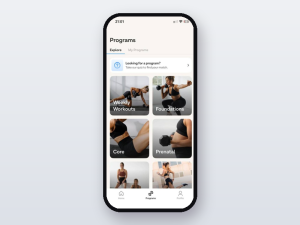

What does a pelvic floor app actually do?
It coaches pelvic floor muscle training, usually shortened to PFMT. That means learning to contract the muscles that support the bladder, bowel and uterus, learning to fully release them again, and then repeating that work in progressively harder positions over a period of months.
The release half matters as much as the squeeze, and it is the half most apps skip. A pelvic floor that cannot relax is not a strong one, and training it harder can make symptoms worse rather than better.
The reason this lands on a midlife site is that symptoms cluster here. In a cohort study of midlife women in northern California, mean age 48, Jones and colleagues, writing in the Journal of Women’s Health in 2016, reported that 72% experienced nocturia at least once a night and 50% reported urinary incontinence at least once a week.
Half of the women in that sample were leaking weekly. Most of them will never mention it to anyone.
What does the research actually say about training the pelvic floor?
More than you might expect, and it is unusually consistent.
The foundational evidence is a Cochrane systematic review. Dumoulin, Cacciari and Hay-Smith, writing in the Cochrane Database of Systematic Reviews in 2018, concluded that “we can be confident that PFMT can cure or improve symptoms of stress urinary incontinence and all other types of urinary incontinence”, and that it “could be included in first-line conservative management programmes for women”.
That is a strong statement by Cochrane’s standards, and it is the reason clinical guidelines put this work first rather than last.
The UK’s National Institute for Health and Care Excellence is explicit about the dose. NICE guideline NG123 says clinicians should “offer a trial of supervised pelvic floor muscle training of at least 3 months’ duration as first-line treatment to women with stress or mixed urinary incontinence”. For symptomatic prolapse at POP-Q stage 1 or 2, NICE suggests supervised training for at least 16 weeks.
Three months is the number to hold on to. Nothing on this page will do anything useful in a fortnight.
The question that decides whether an app is a reasonable purchase is whether unsupervised training works at all. On that, Kharaji and colleagues, in a 2023 systematic review and meta-analysis in the International Urogynecology Journal, concluded that “supervised and unsupervised PFMT programs can both be effective in treating women’s UI if training sessions and regular reassessments are provided”.
Read that conditional clause carefully, because it is the whole argument of this page. Unsupervised training works when there is real instruction and someone checks your progress. An app that delivers structured teaching and reassessment is doing the thing the evidence supports. An app that fires a daily notification saying “time for your kegels” is not.
The honest caveat, and no app on this page solves it: before recommending supervised training, NICE advises clinicians to “undertake routine digital assessment to confirm pelvic floor muscle contraction”. That is a physical examination, and it exists because a substantial share of women contract incorrectly when told to, often bearing down instead of lifting. No app can check this. If you have prolapse symptoms, pain, or you have been training for three months with no change, see a pelvic health physiotherapist. An app is a good way to do the work; it is not a way to find out whether you are doing it right.
How do the best pelvic floor apps compare?
Eight programmes with real pelvic floor content, ranked on how much of it each contains and how good each is to use, weighted 70/30. Pelvic floor and ease of use are the two scores the ranking is built from. Overall is the weighted score across all nine criteria, which is why a programme can rank above another here while scoring lower overall. All three update live from each programme’s own review.
| Rank | Programme | Pelvic floor 70% | Ease of use 30% | Overall | Testing tier | Best for | Not ideal for | Free trial |
|---|---|---|---|---|---|---|---|---|
| 1 | Pvolve | 9/10 | 8.5/10 | 8.3/10 | Fully tested | Pelvic floor work you will actually keep doing, because it is inside the strength programme | Anyone unwilling to buy equipment | 14 days |
| 2 | Jessica Valant Pilates | 9/10 | 7.5/10 | 7.1/10 | Data profile | Prolapse-aware training built by a licensed physical therapist | Anyone who wants heavy loading, or a long trial before paying | 3 days |
| 3 | MUTU System | 9/10 | 7/10 | 7.1/10 | Fully tested | Leaking and abdominal separation treated as the main event, not a side module | Bone density and maximal strength | 10 days |
| 4 | Owning Your Menopause | 8/10 | 5/10 | 7.3/10 | Fully tested | Pelvic floor classes alongside the deepest hormone education here | Anyone who needs a polished app to stay consistent | 14 days |
| 5 | Menovation | 7/10 | 6.5/10 | 7.7/10 | Fully tested | Pelvic floor work sitting inside real dumbbell strength training | Anyone wanting a large back catalogue | 8 days |
| 6 | The Sculpt Society | 6/10 | 8.5/10 | 8.2/10 | Fully tested | Deep core sessions in the nicest app on this page | Anyone whose main reason for signing up is the pelvic floor | 7 days |
| 7 | Moves App | 7/10 | 6/10 | 6.7/10 | Fully tested | Core work designed by a pelvic floor physical therapist, at the lowest price here | Menopause-specific programming, which it does not have | 7 days |
| 8 | Flipping 50 | 6/10 | 8/10 | 7.8/10 | Data profile | A dedicated pelvic floor track inside a menopause strength programme | Anyone price sensitive, at $69 a month | Not reliably offered |
What separates a real pelvic floor programme from a kegel reminder app?
Four things, and they are easy to check before you pay.
It teaches the release, not just the squeeze. If every session is contractions and the word “relax” never appears, the programme is training half a muscle. Overactive pelvic floors are common and they present with the same leaking that weak ones do.
It progresses. The Cochrane evidence rests on trials that increased difficulty over weeks. A library that gives you the same ten-minute session in week twelve as in week one is not delivering the intervention that was tested.
Someone qualified built it. This is the sharpest filter on the whole list. Ask who designed the pelvic floor content and what their credential is. On this page that answer ranges from a licensed physical therapist with 25 years in practice, down to a general instructor with no pelvic health qualification named at all.
It reassesses you. The Kharaji meta-analysis made regular reassessment a condition of unsupervised training working. In an app that means check-ins, symptom tracking, or a structured retest, not just a completion tick.
What none of them can do is confirm you are contracting correctly in the first place. That remains a reason to see a pelvic health physiotherapist at least once, particularly if nothing has changed after three months.
Which pelvic floor programmes rank highest?
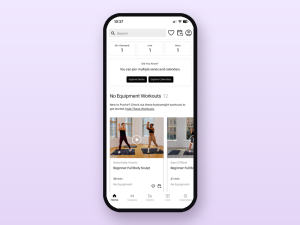
Pvolve: pelvic floor work built into the strength programme, not bolted on
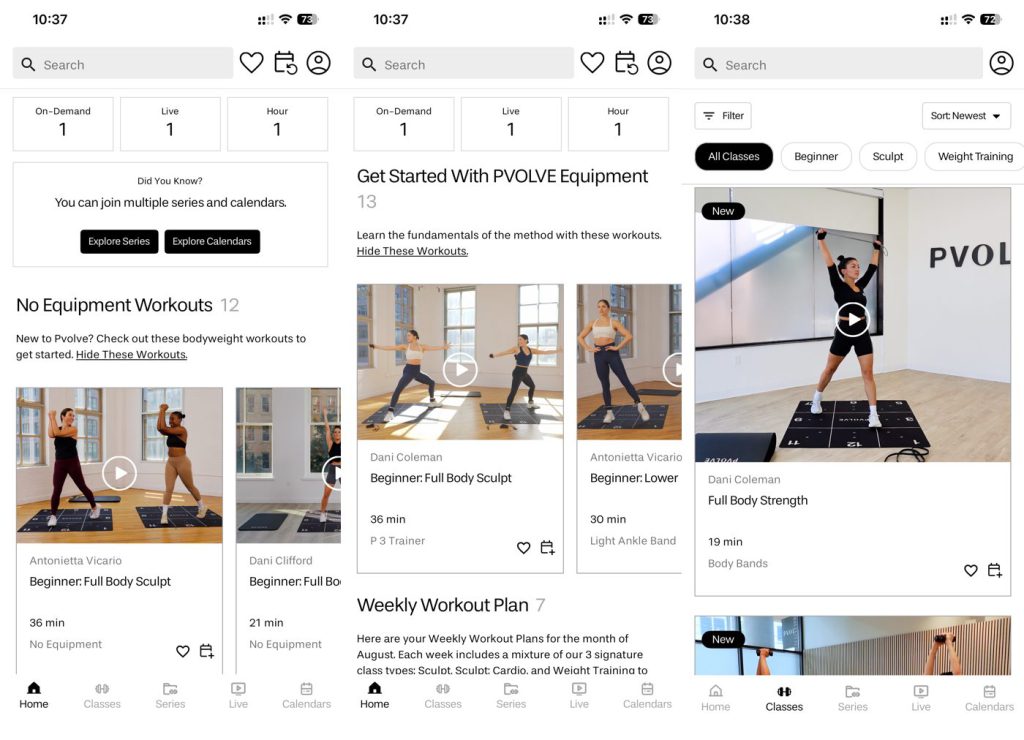
The only programme here where the pelvic floor work happens inside the strength sessions you were going to do anyway
Pvolve is a low-impact functional training method with a clinical advisory board that includes Dr Amy Hoover, a doctor of physical therapy working in pelvic and women’s health, alongside a muscle physiologist and an OBGYN. Its dedicated pelvic floor series runs through the Menopause Strong programme rather than sitting in a separate library, which is rarer than it sounds.
That structural choice is the reason it ranks first. Pelvic floor training fails on adherence far more often than it fails on technique, and NICE asks for at least three months of it. Work you have to remember to do separately is work you stop doing in week three. Work that is already inside Tuesday’s session is work that still happens in week twelve.
Tested by Katy Cole: The pelvic floor work especially: it is the kind of training that is easy to deprioritise because it does not feel dramatic, but I have noticed a real difference in stability and core connection after two weeks. It is not the sort of change you can point at in a mirror, which is precisely why it needs to be built into the programme rather than left to willpower.
The honest limitation: the method leans on its own equipment, and that adds real cost on top of the subscription. Loading also stays light, so this is not the programme to pick if bone density is your main concern.
Best for: women who want the pelvic floor covered without making it a separate project, and who are happy to buy into the equipment.
Cost: $24.99 a month, or $224.91 a year, which works out at about $18.74 a month. The trial runs 14 days and asks for a card, so set a reminder for day 13 if you are undecided.
Visit PvolveAffiliate link, opens pvolve.com. I earn a commission at no extra cost to you. Full disclosureJessica Valant Pilates: the strongest clinical credential on the page
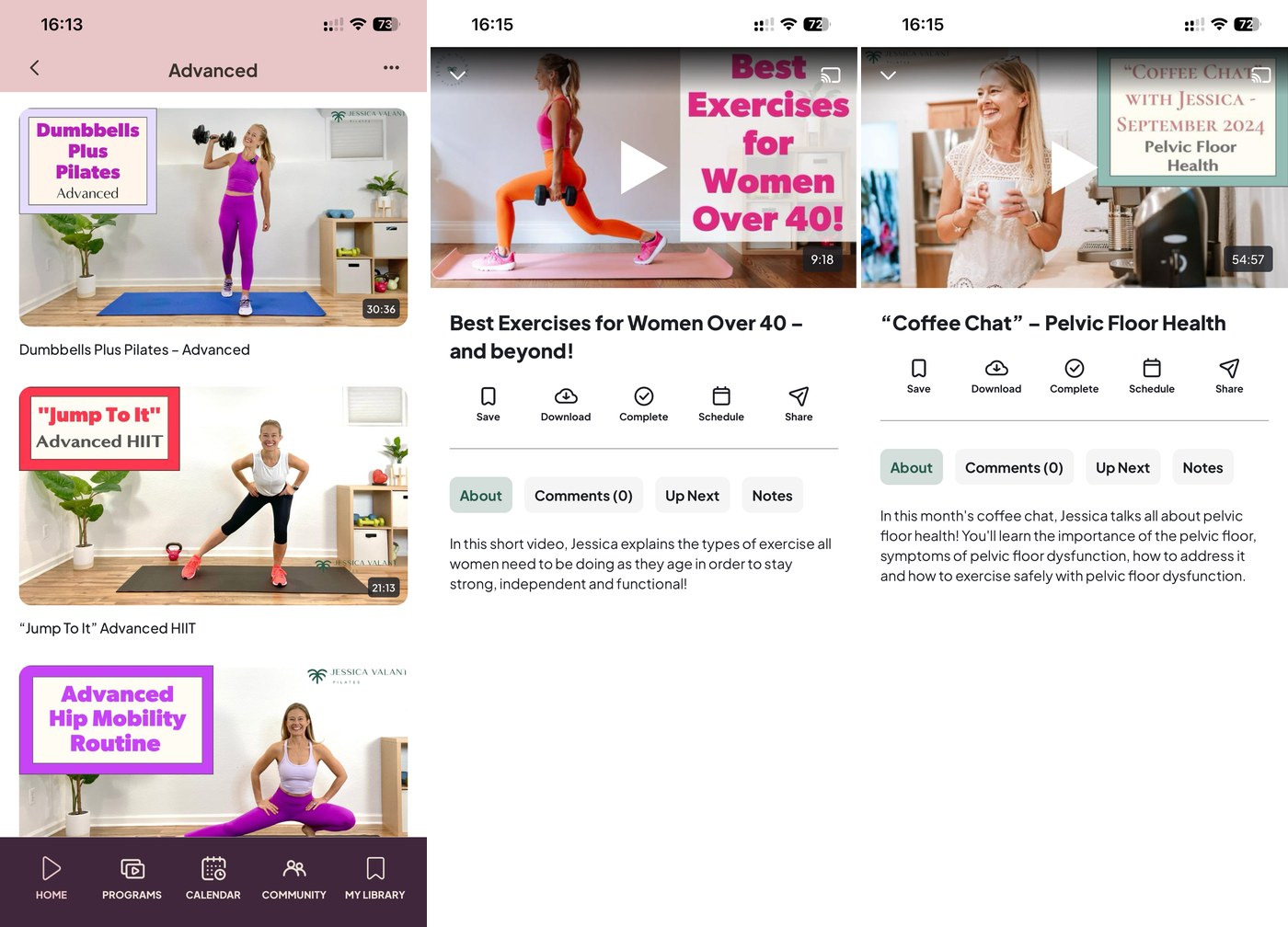
Built by a licensed physical therapist, with a prolapse-aware collection most fitness apps will not attempt
Jessica Valant Pilates is led by Jessica Valant, MSPT, a licensed physical therapist with roughly 25 years in practice who also holds a certification as a perimenopause and menopause specialist. It carries a Data profile tier on this list rather than a tested one.
I have not tested this one first hand. What follows comes from the research profile, not from using it. What earns it second place is the credential attached to the pelvic floor content specifically. NICE frames first-line treatment as supervised training, and supervision means a clinician. Among creator-led apps, a dedicated pelvic floor and prolapse-safe collection designed by a practising physical therapist is the closest thing to that standard you will find at subscription prices.
The prolapse point deserves its own line. Most fitness platforms avoid the word entirely, either from caution or from not knowing what to say. A collection designed around it is unusual, and for anyone who has been told to avoid certain movements it is the difference between guessing and following a plan.
What the research profile cannot tell you: whether the teaching actually lands for a beginner who has never located these muscles. That is the thing a credential does not guarantee and only testing reveals. It matters more here than on any other page, because a well-taught contraction is the entire intervention. The 3-day trial is also short for a judgement this specific, and at $59 a month this is the second most expensive option here.
Best for: on the research, women managing prolapse or wanting clinically grounded Pilates, who value the credential over the price.
Cost: $59 a month. There is no published annual price, though a 3-month prepaid term is $149. The free trial is 3 days.
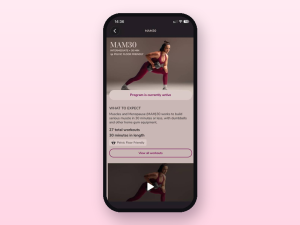
MUTU System: leaking and abdominal separation as the main event
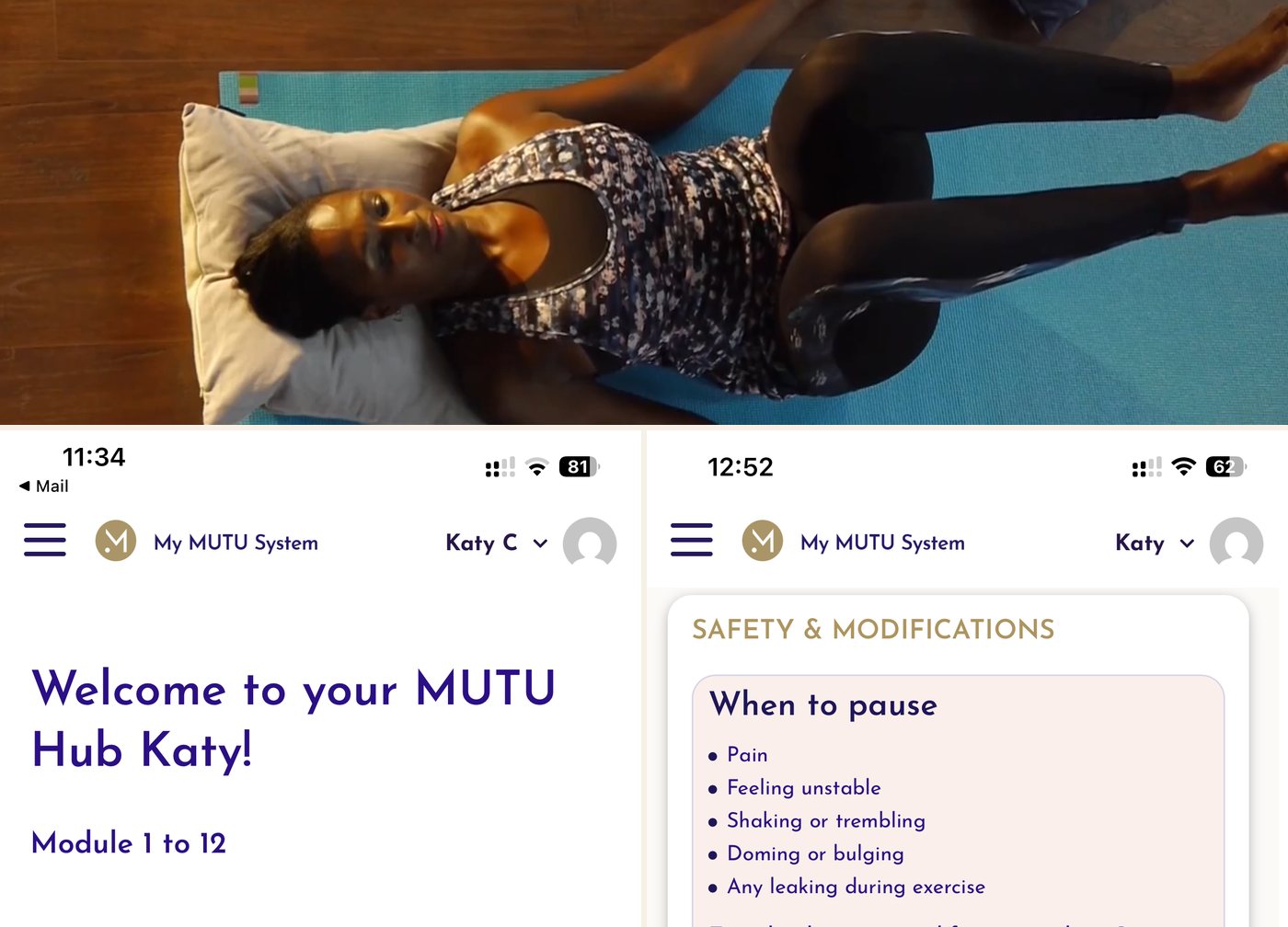
The programme I have come back to across fifteen years, and the only one here built for this problem alone
MUTU System was founded by Wendy Powell, a certified postpartum exercise specialist and personal trainer. She is not a physiotherapist or a clinician, and the programme is upfront about that; it was built in collaboration with women’s health professionals rather than by one. Everything in it is aimed at strengthening and releasing the pelvic floor and closing abdominal separation.
It ranks third rather than higher because the founder credential sits below Pvolve’s clinical board and Jessica Valant’s licence, and because the app itself is the plainest of the three. On pelvic floor content alone it is the equal of either.
Tested by Katy Cole: I first started MUTU after my first pregnancy, ran through it again after my second, and I still use its core and pelvic floor exercises today, in perimenopause, sometimes swapping in a MUTU move for whatever ab exercise a programme has given me. My separation was not massive, about 3 cm wide, but it was enough to make my belly protrude, and I noticed some leaking too. The sessions are breath-led and supported rather than hard, which took some adjusting to, because it does not feel like you have done anything until you notice you have stopped leaking.
That last point is worth sitting with. Nothing about this work feels productive while you are doing it. The feedback arrives weeks later, and it arrives as an absence. That is a difficult thing to stay motivated by, and the reason the built-in guidance telling you when to pause matters more than it appears to.
The honest limitation: loading is light throughout, so this does very little for bone density or maximal strength. Most women on this page will want it alongside a strength programme, not instead of one.
Best for: anyone whose actual problem is leaking, heaviness, or abdominal separation, rather than anyone shopping for a general workout app.
Cost: a subscription rather than the one-off purchase it used to be, at roughly $28 a month, with a first month around $22.40 and an annual near $190. There is a 10-day free trial, the longest here.
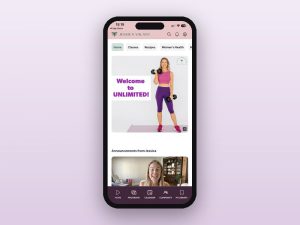
Visit MUTU SystemAffiliate link, opens mutusystem.com. I earn a commission at no extra cost to you. Full disclosureOwning Your Menopause: pelvic floor classes with the deepest hormone education
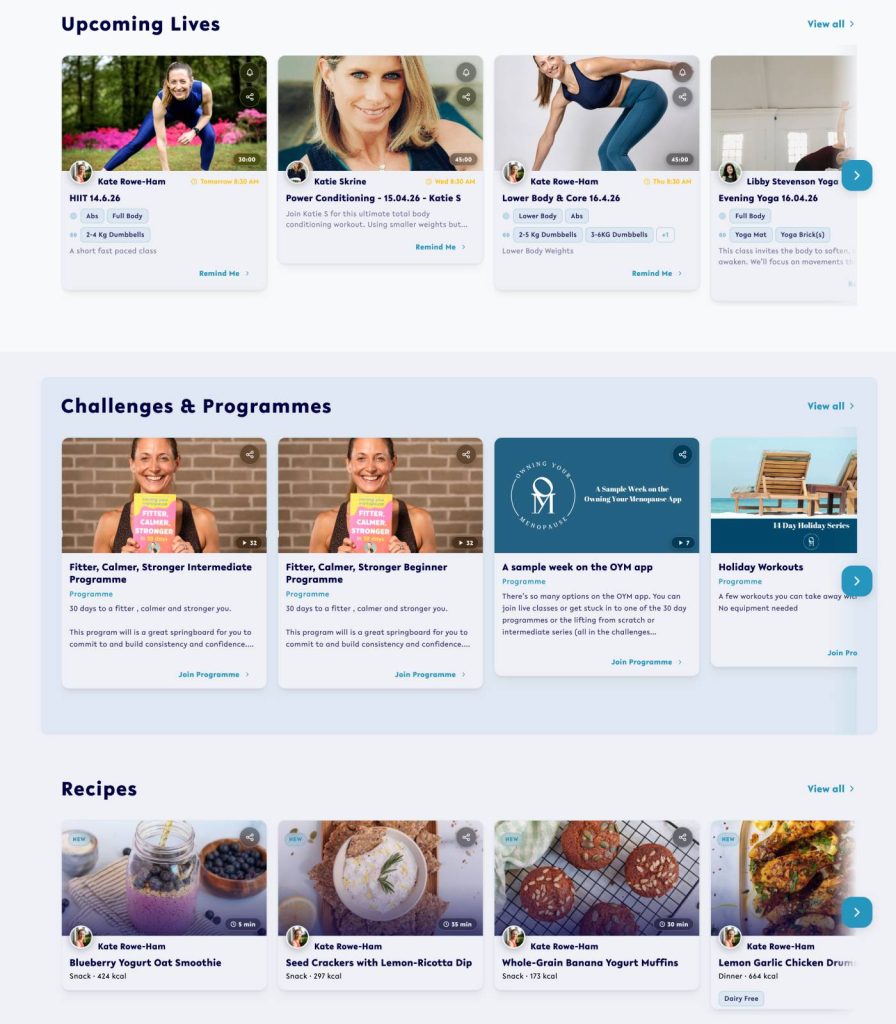
The clearest example on this page of good content held back by a dated platform
Owning Your Menopause is led by Kate Rowe-Ham, a Level 3 personal trainer with women’s health and menopause coaching qualifications and pelvic health certification, supported by a GP panel including Dr Katie Armstrong and Dr Eloise Elphinstone. It carries dedicated pelvic floor classes taught by someone qualified to teach them.
This is the programme that explains why this page is ranked the way it is. On pelvic floor content it scores near the top of the list. On ease of use it scores the lowest here, with video production I described in the review as noticeably basic. Rank it on content alone and it finishes second; rank it on the blend and it finishes fourth.
That is the correct answer rather than a compromise. NICE asks for three months of consistent training. A platform you find unpleasant to open is a platform you will quietly abandon in week five, and a pelvic floor programme abandoned in week five has done nothing at all.
Tested by Katy Cole: Working with 4 to 9 lb and 13 lb dumbbells, lighter than my usual range because I was recovering from an injury, I maintained my existing muscle tone and noticed some definition returning around my core and belly area. That surprised me, because I had been neglecting abdominal work entirely. The hormone education here is genuinely the best I have found, and the GP access is not a gimmick.
Best for: women who want to understand what is happening to them as well as train, and who will not be put off by a platform that looks a decade older than it is.
Cost: £16.99 a month or £159.99 a year, which gives you two months free. The trial is 14 days; ignore the 7-day figure still listed on some aggregator sites.
Menovation: pelvic floor work inside real strength training
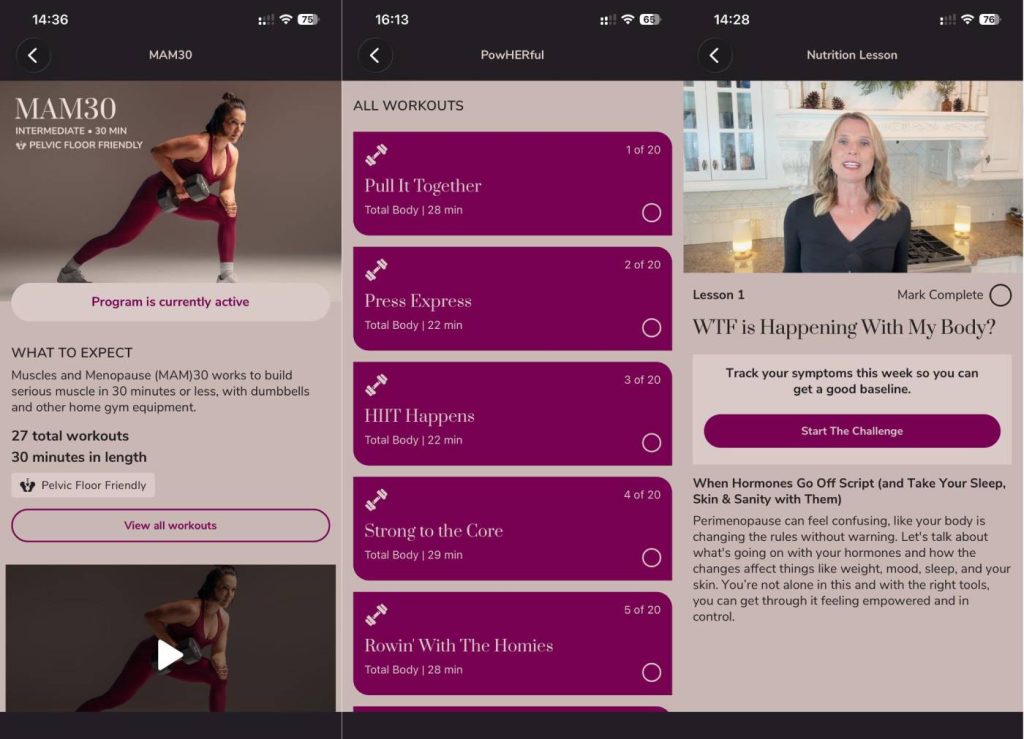
Pelvic health specialists on the clinical roster, and dumbbells rather than a mat
Menovation is led by Ashley Nowe, a Certified Menopause Coaching Specialist, with a clinician roster that includes an OBGYN, a reproductive psychiatrist and pelvic floor physical therapists. That roster is company-reported rather than independently verified, which is worth knowing before you weigh it.
What it offers that the three above it do not is loading. The pelvic floor modality sits inside a programme that has you lifting real dumbbells, which matters because the two goals compete for the same limited hours. A programme covering both is one subscription instead of two.
Tested by Katy Cole: No other platform I have reviewed commits this fully to the midlife woman. The education and the nutrition lessons are exceptional, and the strength work is genuinely progressive rather than token. The interface is dated and the library is still growing, so you are buying into the approach rather than the polish.
Best for: women who want pelvic floor work and progressive strength from the same subscription, and who care more about the programming than the interface.
Cost: $28.99 a month, $69.99 quarterly, or $199.99 a year. The trial is 8 days at the checkout, although the homepage still says 7.
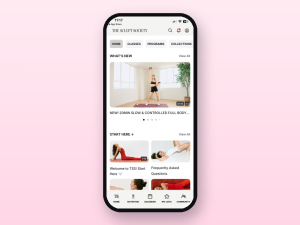
The Sculpt Society: deep core sessions in the nicest app here
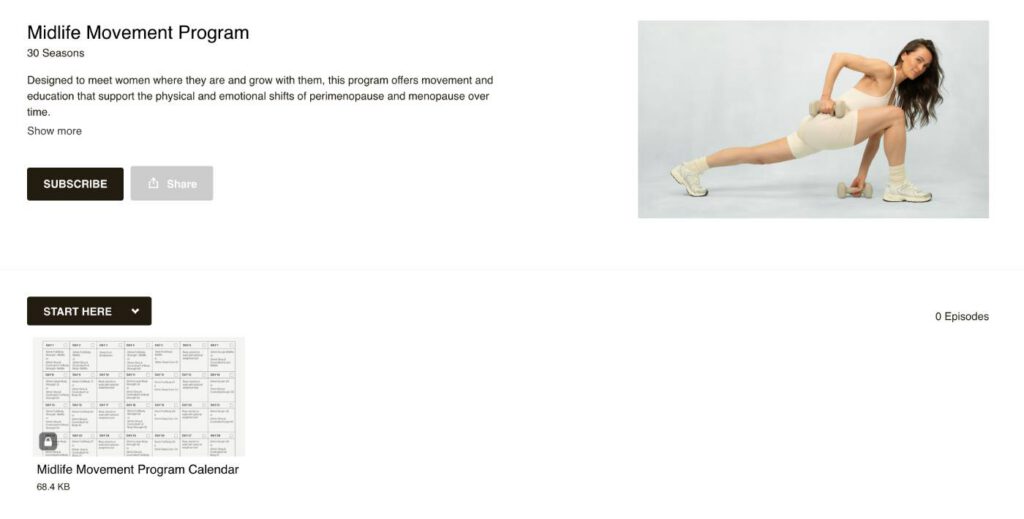
The best platform on this page, with the shallowest pelvic floor content of the tested six
The Sculpt Society was founded by Megan Roup, a certified fitness instructor with a dance background, and offers deep core sessions and postnatal tracks. No pelvic health specialist is named behind that content, which is the honest distinction between this and the top three.
It ranks sixth because the blend works in both directions. Owning Your Menopause has the stronger pelvic floor content and finishes above it; The Sculpt Society has much the better app and closes most of the gap. Neither position is an accident.
Tested by Katy Cole: The deep core sessions, particularly the pelvic floor work, reminded me of postpartum exercises I had long forgotten. That is a fair description of what is here: competent, familiar, and not specialist. If the pelvic floor is your reason for subscribing, this is not the one. If you want to enjoy opening the app and the core work is a welcome extra, it is the easiest sell on the page.
Best for: women who want low-impact sessions they will actually look forward to, with deep core work as a bonus rather than the point.
Cost: $24.99 a month on the web or $27.99 through Apple, and $229.99 a year on the web, about $19.17 a month. The trial is 7 days.
Moves App: core work designed by a pelvic floor physical therapist
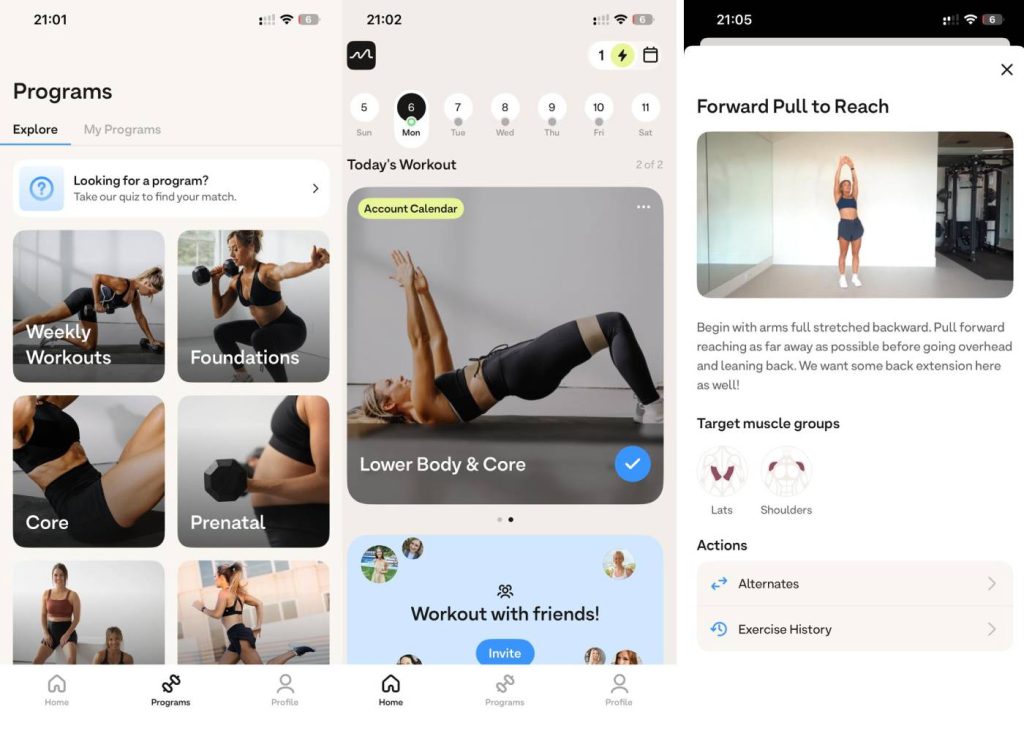
The cheapest option here, with a named pelvic floor clinician behind the core content
Moves App was built by Madeline Custer, a certified personal trainer with a kinesiology degree and pre and postnatal qualifications, working with a team that includes Dr Brandon Moss, a doctor of physical therapy, and Dr Katie Fincher, a pelvic floor physical therapist who designed the Core Moves content specifically.
That is a genuine credential attached to a genuine module, at $20 a month. On credentials per pound this is the best value on the page.
Tested by Katy Cole: I came across Moves when researching strength-based programmes and signed up through the website, which was refreshingly simple. It reminded me of EvolveYou but with a narrower focus. The pelvic floor content is real and the physical therapist modifications throughout are more useful than they first appear, particularly on days when something is already sore.
The gap for this page specifically: Moves leans towards new mothers and has no menopause programming at all. The pelvic floor content is sound, but nothing in the app acknowledges that oestrogen decline changes the tissue it is training. If you are postnatal, that is irrelevant. If you are postmenopausal, it means the programme is treating you as a case it was not designed around.
Best for: women who want credentialled pelvic floor work at the lowest price here, and who do not need the programme to address menopause.
Cost: $20 a month on the site, $19.99 through Apple, or $200 a year, roughly $16.67 a month. The trial is 7 days with all features unlocked.
Flipping 50: a dedicated pelvic floor track inside menopause strength
A separate pelvic floor programme rather than incidental core work, which is unusual for a strength brand
Flipping 50 is built by Debra Atkinson, who holds an MS in exercise and sport psychology and a BS in exercise science, along with an NSCA CSCS. Her Medical Exercise Specialist credential is self-reported and the certifying body is not confirmed. It carries a Data profile tier on this list rather than a tested one.
I have not tested this one first hand. What follows comes from the research profile, not from using it. What earns it a place on a pelvic floor page is that the pelvic floor work is a named programme rather than a few core classes folded into the library, which for a brand whose identity is strength training is a deliberate choice rather than an accident.
Why it ranks eighth despite a good app: the pelvic floor content is the thinnest of the eight on the page, and at $69 a month this is the most expensive option here by a wide margin. There is also no dependable free trial, so you cannot look before you buy. Those are exactly the judgements a research profile cannot make for you, which is another reason to treat this ranking as provisional.
Best for: on the research, women who already want menopause-staged strength training and would treat the pelvic floor track as a useful inclusion rather than the reason to subscribe.
Cost: $69 a month, or $549 a year on the website. Apple in-app annual is $649, and the site annual also renews at $649. A free trial is offered only occasionally and the length is not stated.
Which pelvic floor programme is right for you?
If leaking or heaviness is the actual problem, start with MUTU System. It is the only programme here built for that alone, the 10-day trial is the longest on the page, and it is the one I have kept coming back to.
If you have prolapse symptoms or want a clinician’s programme, look at Jessica Valant Pilates first, and see a pelvic health physiotherapist alongside it rather than instead of it.
If you want the pelvic floor covered without it becoming a separate project, Pvolve is the one, provided you are willing to buy the equipment.
If you want to understand your hormones as well as train, Owning Your Menopause has the best education here, and you will have to forgive the platform.
If budget is the deciding factor, Moves App at $20 a month has a named pelvic floor physical therapist behind its core content, which is more than most programmes at twice the price can say.
Whichever you choose, give it three months. That is what the guideline asks for, and it is longer than almost anyone expects.
How did we choose these eight pelvic floor programmes?
Every programme in our library carries a pelvic floor capability score, judged on how much dedicated work it contains, who designed that work, and whether it covers release as well as contraction. This page ranks on that score, weighted 70%, blended with each programme’s ease of use score, weighted 30%.
The blend exists because content and consistency are both necessary. A programme has to qualify on pelvic floor content to appear at all, and eight programmes cleared that bar. Ranking them purely on content would have put a platform I found genuinely unpleasant to use in second place, and three months of training does not happen on a platform you avoid.
Six of the eight I have subscribed to and used. Two, Jessica Valant Pilates and Flipping 50, are assessed from published information only, and both are labelled as such on their card and in their section. No first-hand observation appears in either.
We buy our own subscriptions. Some links on this page earn a commission, which never affects a score or a position; the scores are set in each programme’s own review before any page like this is built.
What research is this page based on?
- Dumoulin C, Cacciari LP, Hay-Smith EJC. Pelvic floor muscle training versus no treatment, or inactive control treatments, for urinary incontinence in women. Cochrane Database of Systematic Reviews, 2018.
- National Institute for Health and Care Excellence. Urinary incontinence and pelvic organ prolapse in women: management (NG123), 2019.
- Kharaji G, ShahAli S, Ebrahimi-Takamjani I, et al. Supervised versus unsupervised pelvic floor muscle training in the treatment of women with urinary incontinence: a systematic review and meta-analysis. International Urogynecology Journal, 2023.
- Jones HJ, Huang AJ, Subak LL, Brown JS, Lee KA. Bladder Symptoms in the Early Menopausal Transition. Journal of Women’s Health, 2016.
Nothing on this page is medical advice. If you have prolapse symptoms, pain, or leaking that is not improving, see a pelvic health physiotherapist or your GP.
Where should you read next?
- Our full Pvolve review, including the pelvic floor series and what the equipment actually costs.
- Our full MUTU System review, covering abdominal separation and what changed when it moved to a subscription.
- How we score, if you want to see how the nine criteria and the capability scores are built.
Frequently asked questions about pelvic floor apps
It can deliver the training, and the training works. A Cochrane systematic review by Dumoulin, Cacciari and Hay-Smith in 2018 concluded we can be confident pelvic floor muscle training can cure or improve symptoms of stress urinary incontinence and all other types, and that it belongs in first-line conservative management. What an app cannot do is confirm you are contracting correctly in the first place.
Plan on three months. NICE guideline NG123 advises offering a trial of supervised pelvic floor muscle training of at least 3 months' duration as first-line treatment for stress or mixed urinary incontinence, and at least 16 weeks for symptomatic prolapse at POP-Q stage 1 or 2. Nothing on this page will do much in a fortnight.
Usually not, and the distinction is what the evidence rests on. Kharaji and colleagues, in the International Urogynecology Journal in 2023, found supervised and unsupervised training can both work if training sessions and regular reassessments are provided. An app that teaches and re-checks is doing the thing that was tested. An app that fires a daily reminder to squeeze is not.
At least once, ideally before you start. NICE advises clinicians to undertake routine digital assessment to confirm pelvic floor muscle contraction before recommending supervised training, because a substantial share of women bear down instead of lifting when told to contract. No app can check this. See a pelvic health physiotherapist if you have prolapse symptoms, pain, or no change after three months.
It is common and it is not something you have to live with. In a cohort of midlife women with a mean age of 48, Jones and colleagues reported in the Journal of Women's Health in 2016 that 50% experienced urinary incontinence at least once a week and 72% had nocturia at least once a night. Common is not the same as untreatable, and the evidence for training is strong.
Yes, and it improves the odds you keep doing it. Pelvic floor work fails on adherence far more often than on technique, which is why programmes that build it into their strength sessions rank highest here rather than parking it in a separate library. Work already inside Tuesday's session still happens in week twelve.