
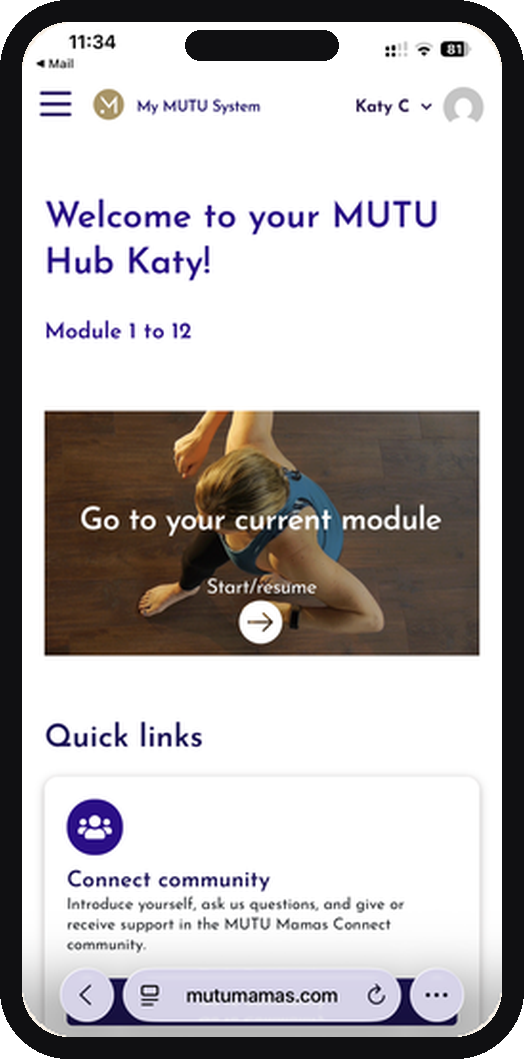
A clinically developed core and pelvic-floor programme from Wendy Powell, built around gentle, progressive deep-core, breathing and pelvic-floor work in about 12 minutes a day · rooted in postpartum recovery but now explicitly extended to perimenopause and menopause · developed with, and recommended by, OB-GYNs and pelvic-floor physiotherapists · a structured 12-module programme on web and app · Bodyweight, with just a mat.
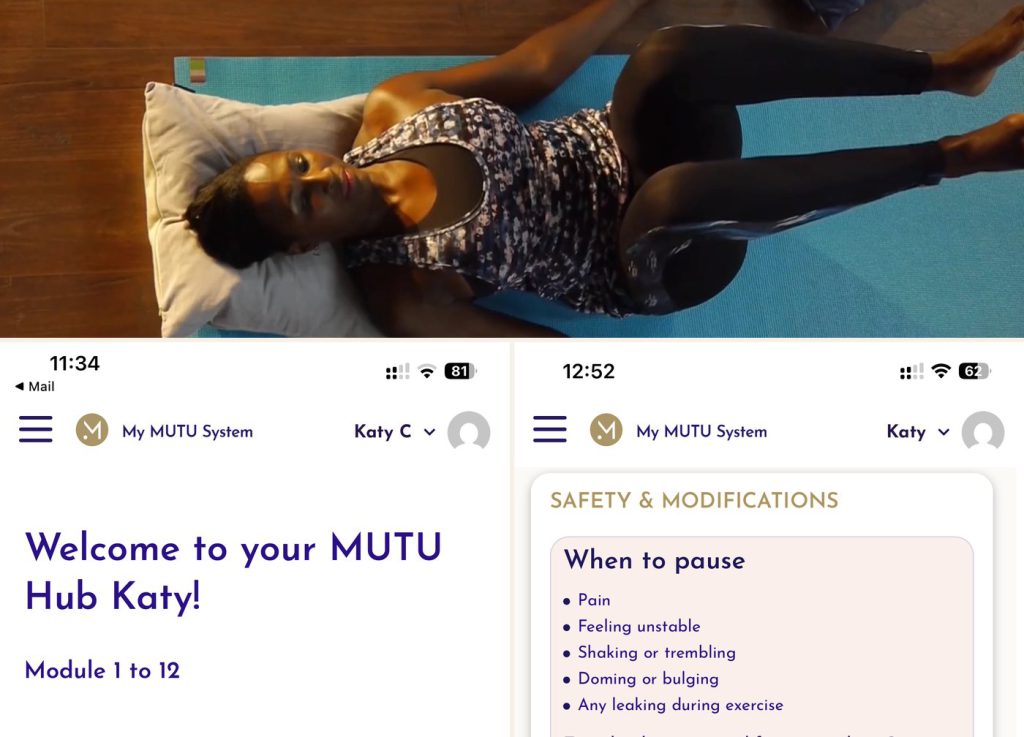
How I tested this. I have a twelve-year relationship with MUTU. I first started it after my first pregnancy, ran through it again after my second, and I still use its core and pelvic-floor exercises in my own workouts today, in perimenopause, sometimes swapping in a MUTU move for whatever ab exercise a coach is showing. It fixed a real problem for me, so this is not a quick test but years of genuine use, and the screenshots are my own. This is education, not medical advice; MUTU is developed with clinicians, but pelvic-floor and menopause symptoms are individual, so speak to your clinician or a pelvic-health physiotherapist about your own situation, especially with prolapse or significant symptoms.
MUTU System Review 2026: Quick Answer
Fully tested: completed the programme more than once, and use its exercises daily. Our own screenshots.
Women who want to rebuild and protect the pelvic floor and deep core, including after pregnancy and through perimenopause and menopause, gently and safely; strong for diastasis recti and leaking
You want a complete fitness solution, heavier progressive strength or bone loading, or a fast, high-intensity workout; MUTU is a foundation, not the whole plan
A clinically developed 12-module core and pelvic-floor programme, about 12 minutes a day, on web and app
About 12 minutes a day for the core work, with optional longer intensity workouts later
A mat is all MUTU needs; a light resistance band and small pilates ball are handy extras, and light dumbbells are optional for the later intensity workouts
Very low and gentle, alignment and breath based, and safe for the pelvic floor
Its whole purpose, and its biggest strength: diastasis recti, pelvic-floor strengthening and relaxation, and deep-core function
Strong for pelvic-floor and core health, which decline with the menopausal oestrogen drop; not a muscle, bone or hormone programme
Developed with, and recommended by, OB-GYNs and pelvic-floor physiotherapists; a real clinical differentiator
Web app on any device, plus iOS and Android
$28 a month or $190 a year, with a 10-day free trial
A 10-day free trial that auto-converts; the old one-time lifetime purchase has been retired
Builds deep-core and functional strength, but is not heavy loading; pair it with progressive strength for muscle and bone
7.1 / 10
Quick Verdict
Worth it for women over 40? For pelvic-floor and core health, genuinely yes, and it is one of the few programmes actually built with clinicians. It threads the perimenopause and menopause hubs, with the caveat that it is a foundation, not a complete plan.
MUTU System earns 7.1/10 in this fully tested review, and it stands apart from almost everything else we have reviewed for one reason: it is genuinely clinically developed. It was built with OB-GYNs and pelvic-floor physiotherapists, it is recommended by them, and it has been through an NHS trial and evaluation. Its purpose, rebuilding and protecting the deep core and pelvic floor through gentle, progressive, breath and alignment-based work in about 12 minutes a day, is exactly the kind of foundation that matters at midlife, because the menopausal drop in oestrogen weakens the pelvic floor and raises the risk of leaking, prolapse and core weakness. It is gentle, safe, well structured and teaches you the why, so the exercises transfer into daily life, which is why, having done the programme more than once, I still use them every day.
Where it is genuinely limited. MUTU is a specialist foundation, not a complete fitness programme. It is core and pelvic-floor rehabilitation plus low-impact functional work, so it is not heavy progressive strength and does little for building muscle or bone, which need heavier loading. The nutrition side is supportive but light, its founder is a certified specialist rather than a physiotherapist herself, and much of the efficacy data is self-reported or from service evaluation rather than large independent trials. And the pricing has moved to a subscription. Start here: use the 10-day free trial and the 12-week programme to build a strong, safe pelvic-floor and core base, then layer progressive strength training on top for the muscle and bone a midlife body also needs.
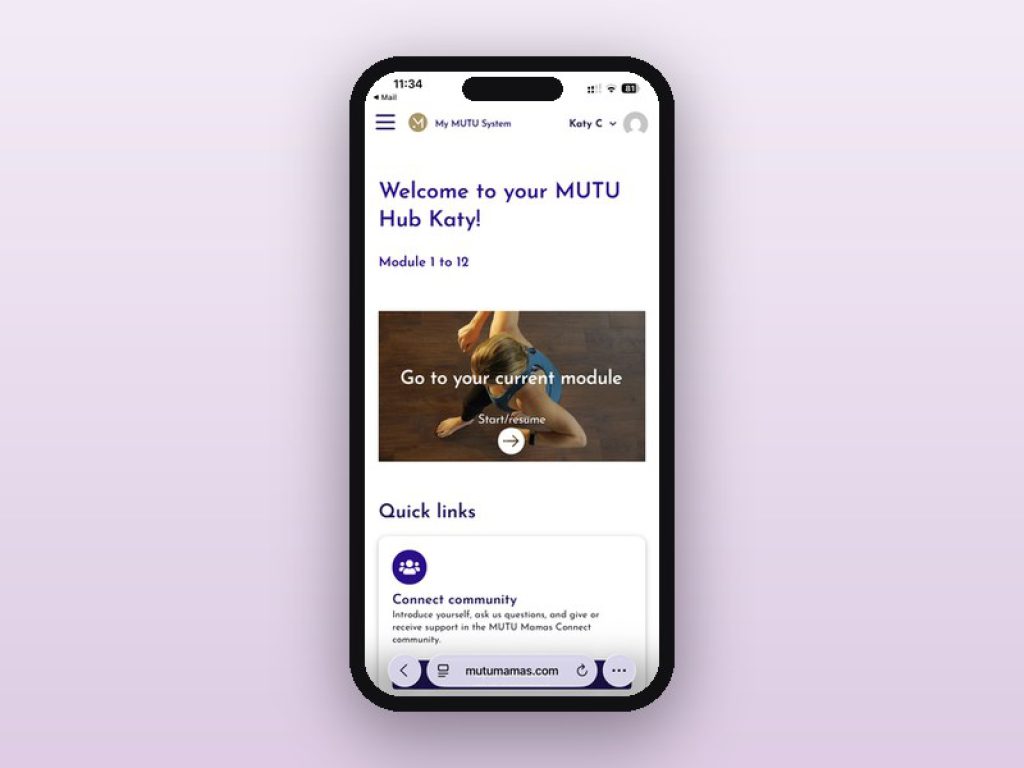
Try MUTU before you commit to a subscription.
- Price
- $28/mo or $190/yr
- Free trial
- 10 days, full access
- Note
- Auto-converts to paid unless you cancel
Is MUTU System right for you?
MUTU System is strongest for pelvic floor problems (9.0 out of 10, against a 4.6 average across the 77 programmes scored) and weakest for building bone density (4.0 against 5.1).
| Question | Verdict | Rating | Score |
|---|---|---|---|
| How it suits a perimenopausal body | |||
| Is MUTU System good for pelvic floor problems?Based on pelvic floor support and low-impact design | Strong, and better than mostmost score 4.6/10 | 9.0 / 10 | |
| Is MUTU System genuinely built for perimenopause and menopause?Based on menopause programming, hormone awareness, education and expert credibility | Moderate, but better than mostmost score 3.3/10 | 6.5 / 10 | |
| Is MUTU System good for painful joints?Based on low-impact design and recovery provision | Strong, and better than mostmost score 6.2/10 | 8.5 / 10 | |
| Is MUTU System manageable when your energy is low?Based on recovery provision and mind-body support | Strong, and better than mostmost score 5.7/10 | 7.5 / 10 | |
| Is MUTU System good if you are new to strength training?Based on beginner on-ramp and mind-body support | Strong, and better than mostmost score 6.1/10 | 7.5 / 10 | |
| Is MUTU System good for building bone density?Based on bone loading and progressive strength | Low, and worse than mostmost score 5.1/10 | 4.0 / 10 | |
| Does MUTU System help with nutrition?Based on midlife nutrition support | Moderate, but better than mostmost score 4.0/10 | 5.0 / 10 | |
| How it performs as a product | |||
| Can you fit MUTU System into a busy week?Based on time efficiency | Strong, about the same as mostmost score 7.6/10 | 8.0 / 10 | |
| Is MUTU System worth the money?Based on value for money | Strong, about the same as mostmost score 6.9/10 | 7.0 / 10 | |
Jump to Section
What MUTU System Actually Is
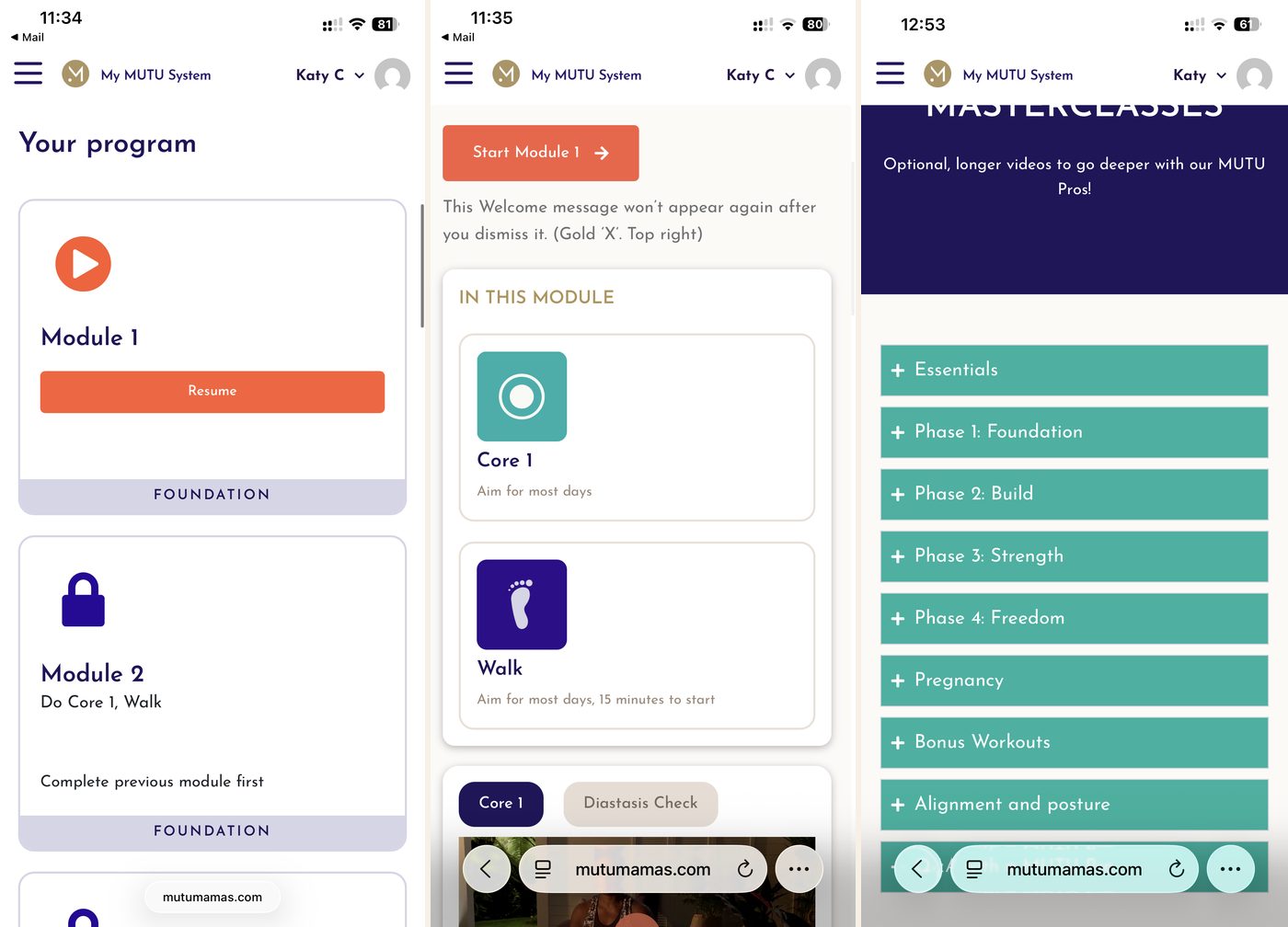
MUTU System is an online core and pelvic-floor programme founded by Wendy Powell and running since 2010. It began as a postpartum recovery programme, and it is still the best known for that, but in 2026 it is explicitly positioned as a core and pelvic-floor programme for every life stage, from pre-pregnancy through to menopause, with a dedicated perimenopause and menopause section. It is a twelve-week programme built from twelve modules across four phases, Foundation, Build, Strength and Freedom, where you start by learning the breathing techniques and the deep-core and pelvic-floor connection, then progress through building strength to the freedom of a strong, dependable core, with each module teaching something new and adding intensity in a safe, staged way.
It is self-paced rather than a race: you move on when you can feel improvement from your own starting point and have no red flags. The daily core work is small, around twelve minutes, and it is paired with walking, which the programme treats as an important part of the strengthening rather than an afterthought, aiming for most days from about fifteen minutes; from around week three you also get a cardio or more intensive workout. It runs on the web on any device and as iOS and Android apps, with narrated real-time videos, a progress tracker, a diastasis check, clear safety guidance on when to pause, and a moderated community.
For this audience it helps to be precise about what it is and is not. It is a clinically developed, gentle, progressive programme whose central purpose, rebuilding and protecting the pelvic floor and deep core, is highly relevant to midlife women, because those are exactly the systems the menopause transition tends to weaken. It teaches you the movements and the reasons behind them so they become part of everyday life, which is a genuine strength. What it is not is a complete fitness programme: it is core and pelvic-floor rehabilitation plus low-impact functional work, not heavy strength or bone loading. There is a genuine nutrition section, a supportive, non-diet approach that even covers how hormonal changes and HRT affect weight, but it is guidance and recipes rather than a full nutrition plan. Read MUTU as the strongest pelvic-floor and core foundation we have tested, best used alongside progressive strength training rather than instead of it.
Who Is Behind MUTU System? Credibility
This is where MUTU genuinely separates itself. It was founded by Wendy Powell, a certified postpartum and pelvic-health specialist who has worked in women’s core and pelvic health for many years and holds a 2021 NHS Innovation Accelerator Fellowship, and it is developed with a medical advisory panel that includes OB-GYNs, a consultant urologist and pelvic-floor physiotherapists, among them a doctor of physical therapy specialising in pelvic health. It has been through a trial and an evaluation within the NHS, it is approved by a recognised health-app assessor, and, importantly, it is genuinely recommended by pelvic-floor physiotherapists and OB-GYNs rather than only by the company itself. Among the programmes we review, this level of clinical development and endorsement is rare.
Two fair qualifications keep it in proportion. First, Wendy Powell is a certified specialist and educator, not a physiotherapist or physician herself, so the clinical credibility comes from the panel and the development process rather than from the founder’s own clinical licence. Second, while there is a real NHS trial and evaluation, much of the headline efficacy data is self-reported customer survey data and service evaluation rather than large, independently published randomised trials, so it is best read as strong, clinician-backed and encouraging evidence rather than definitive proof. Even with those qualifications, the credibility here is well above the norm for this category, and for a pelvic-floor and core programme that matters a great deal.
My Experience: What It Was Actually Like
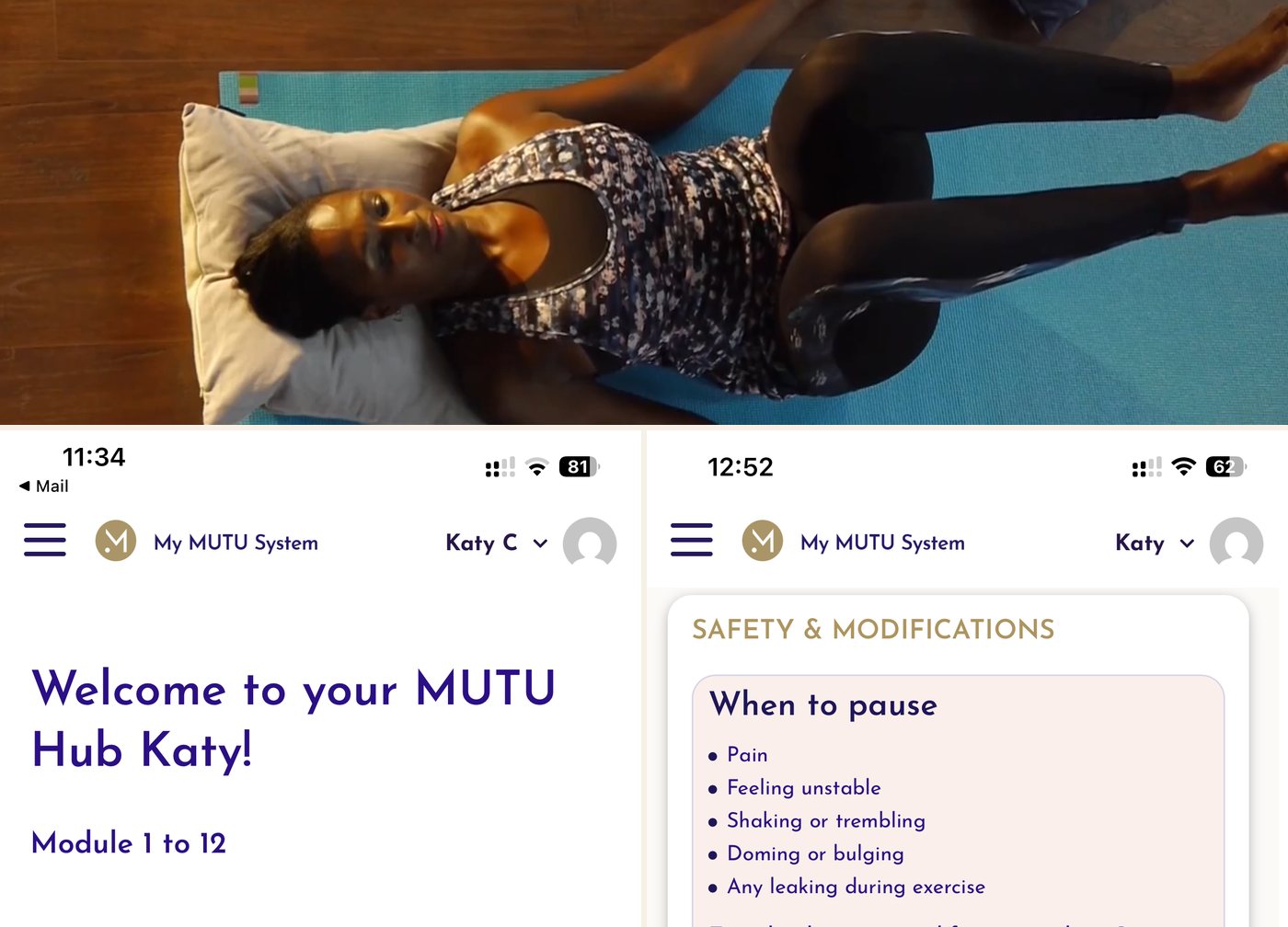
Why I started. After my first pregnancy I had a mild case of diastasis recti, the separation of the abdominal muscles. It was not massive, about 3 cm wide, but it was enough to make my belly protrude, and I noticed some leaking too. That is what sent me looking for ways to rebuild a weak pelvic floor, and it is how I found MUTU. I did the full programme then, again after my second pregnancy, and I have kept its exercises in my routine ever since.
What the programme is actually like. The core workouts are some of the most relaxing training I have ever done. I love the setting, the calm atmosphere and the soothing voice, and the pace is judged beautifully, so I always finished a session feeling more relaxed than when I started rather than wrung out. It builds patiently: you feel the progress arrive, week by week. When my core was very weak at the start, that gentle pace was exactly right. Coming back to it a second time, already training regularly, I did find the early Foundation and Build weeks less challenging, so a fit woman with a strong core may want to move through the early phase faster, but for a true beginner or a genuinely weak core the pacing is spot on.
The results, and why I still use it. MUTU worked for me. I brought my diastasis recti down from about 3 cm to 1 cm, flattened my belly and have kept it that way for years, and the leaking resolved. My core went from very weak to strong enough that I now hold a 1.5-minute plank, though a word of caution there: do not attempt planks with a weak or separated core, as I only got there after a lot of the foundational work first. The deeper reason I still use MUTU is that what you learn stays with you. Once you understand how to breathe, brace and engage your deep core and pelvic floor properly, you carry that into everything else you do, so today, in perimenopause, I fold MUTU moves into my regular ab work and sometimes use them in place of what a coach demonstrates. It became the foundation the rest of my training is built on.
Pelvic Floor, Core and Diastasis: MUTU’s Real Strength
This is the heart of the programme and the reason it matters so much for our audience. MUTU is built to address diastasis recti, the separation of the abdominal muscles, by rebuilding deep-core function rather than through crunches or sit-ups, and to work the pelvic floor properly, which means not only strengthening it but also teaching it to relax and release, a distinction pelvic-health physiotherapists specifically value. It targets the symptoms that flow from pelvic-floor and core weakness, including bladder leaking and stress incontinence, pelvic organ prolapse and discomfort, through gentle, progressive, alignment-based work.
Why this is a midlife issue, not just a postpartum one. These are often thought of as after-baby problems, but they are just as relevant in perimenopause and menopause, because the fall in oestrogen weakens connective tissue and the pelvic floor, so leaking, prolapse and core weakness commonly appear or worsen at midlife.[5] Pelvic-floor muscle training is the recommended first-line approach for stress incontinence in women, so a well-structured programme that teaches it properly is genuinely valuable, and it is precisely the area that almost every general fitness app ignores. For pelvic-floor and core health, MUTU is the strongest option we have tested. If that is the problem you are trying to solve, the 10-day free trial is long enough to tell whether the method suits you.
Content and Features
At a glance: a clinically developed, gentle, progressive 12-module core and pelvic-floor programme, about 12 minutes a day, that teaches you the why and transfers into daily life. Capped for our audience only by being a specialist foundation: low-load, so limited for muscle and bone, with a supportive but light nutrition side and a subscription price.
| Format | A twelve-week, 12-module programme across four phases (Foundation, Build, Strength, Freedom), self-paced, with narrated real-time videos, a diastasis check, a progress tracker and a moderated community, on web and app. |
| Core focus | Diaphragmatic breathing, alignment, deep-core and pelvic-floor connection, then progressive strength, with walking treated as part of the strengthening and a cardio or intensity workout added from around week three. |
| Pelvic floor and diastasis | The central strength: strengthening and relaxing the pelvic floor, and closing and strengthening abdominal separation without crunches. |
| Women over 40 / menopause | Explicitly addressed, with a perimenopause and menopause section, and directly relevant because oestrogen decline weakens the pelvic floor and core. |
| Impact and joints | Very low-impact, gentle and alignment-based, and safe for the pelvic floor. |
| Credibility | Developed with and recommended by OB-GYNs and pelvic-floor physiotherapists, with NHS trial and evaluation involvement. |
| Strength and loading | Deep-core and low-impact functional strength with optional intensity workouts; not heavy loading, so limited for muscle and bone. |
| Nutrition | A supportive, non-diet section: inclusive eating, food that supports you, how hormonal changes and HRT affect weight, and meal ideas for breakfast, lunch and dinner; guidance and recipes rather than a full plan. |
| Education | A real strength: clear, easy-to-follow education on the weak core, pelvic floor and other issues women face at different life stages, tied directly to the corrective exercises you learn. |
What Equipment Do You Need for MUTU System?
Almost nothing, which suits its gentle, at-home style. MUTU is bodyweight, so a mat is really all you need for the core and pelvic-floor work, and you can do it in a small space in a few minutes. A light resistance band and a small pilates ball echo the props MUTU uses and add variety to the activation and core work, and a set of light dumbbells is optional for the higher-intensity workouts later in the programme. You can start the 10-day trial with a mat alone and add the props later, once you know the method suits you.
The band and ball are the natural, inexpensive companions to the mat, in keeping with MUTU’s gentle pilates style. If you want to add the progressive strength MUTU deliberately leaves out, a set of light dumbbells is the simplest place to start, so you can build the muscle and bone that heavier loading protects on top of the strong core base MUTU gives you.
Recommended spec examples. These picks are curated for convenience by specification and feature fit, not personally lab-tested for long-term durability. Prices are examples; verify before buying.
Exercise mat
The one essential, for the core and pelvic-floor work.Recommended
Resistance Band
Light band for gentle glute and core activation work.$10 to $25
Pilates Ball
Small soft ball for the pelvic-floor and core exercises.$8 to $15
Light Dumbbells (optional)
Only for the optional higher-intensity workouts later on.~$65 to $80
A quick heads-up: some of the buy links above are Amazon affiliate links, so if you grab something through them I may earn a small commission, at no extra cost to you. I only ever point you to kit I would happily use myself.
Bottom line on equipment: a mat runs MUTU, with a light band and a pilates ball as inexpensive extras; light dumbbells are optional for the higher-intensity sessions.
How We Scored MUTU System: the 7.1 / 10 Breakdown
Scores on our 9 weighted criteria, from hands-on use plus research. Women Over 40 is our menopause-fit criterion, and its full 12-capability breakdown follows in the next section.
| Category | Weight | Score | Reasoning |
|---|---|---|---|
| Time Efficiency | 15% | 8 | About 12 minutes a day makes it very easy to keep up. |
| Muscle Potential | 18% | 5 | Builds deep-core and functional strength with optional intensity work, but it is low-load, not heavy strength. |
| Women Over 40 Specificity | 10% | 6.6 | Genuinely built for pelvic-floor and core health at every stage including menopause, and clinically developed; full breakdown below. |
| Joint Friendliness | 12% | 9 | Very low-impact, gentle and alignment-based, and safe for the pelvic floor. |
| Recovery Compatibility | 10% | 8 | Genuinely restorative and calming, breath-led, with pelvic-floor relaxation as well as strengthening. |
| Programme Structure | 12% | 8 | A clear, progressive 12-week, 12-module structure that builds safely from Foundation, with staged intensity and a tracker. |
| Value for Money | 8% | 7 | A clinically developed programme for far less than repeated physiotherapy, though the subscription switch draws some complaints. |
| UX and Design | 8% | 7 | A calm, well-produced experience with a lovely pace on any device; some explainer videos run long. |
| Nutrition Integration | 7% | 5 | A supportive, non-diet section with hormone and HRT-aware guidance and recipes, though not a full nutrition plan. |
| Total | 100% | 7.1 / 10 | Tested Score. |
Is MUTU System Good for Women Over 40?
For pelvic-floor and core health, it is one of the best things a woman over 40 can do, and it is genuinely built with that in mind. The menopause transition weakens the pelvic floor and connective tissue as oestrogen falls, which is why leaking, prolapse and core weakness so often appear or worsen at midlife, and MUTU addresses exactly that, gently, progressively and with real clinical input. It is low-impact and safe, the daily commitment is tiny, and because it teaches the reasons behind the movements, the work transfers into everyday life. Having used it myself over time, that transfer is the thing I value most.
Who it suits, and what to pair it with. It suits any woman over 40 who wants to protect or rebuild her pelvic floor and deep core, whether she has symptoms or simply wants to get ahead of them, and it suits women who prefer a gentle, patient, clinically grounded approach. What it does not do is build the muscle and bone that also matter enormously at midlife, because it is low-load rather than heavy progressive strength. It is a foundation, not the whole plan, and the ideal use is to build a strong pelvic-floor and core base with MUTU and add progressive strength training on top.
The lasting value: skills you carry into everything else. The reason MUTU is such a good first step is that it is not only a set of workouts, it is a training in how your own core and pelvic floor work. Once you can breathe diaphragmatically, brace properly and engage the deep core and pelvic floor on demand, that skill does not stay behind in the app. It is exactly the foundation you need before you pick up heavier weights, because a strong, well-connected core and a pelvic floor that can manage pressure are what let you load safely and lift with good mechanics, protecting you from the leaking and the doming that heavier training can otherwise provoke. So MUTU pays off twice: it rebuilds the foundation now, and it makes every squat, deadlift, carry and strength session you do afterwards safer and more effective. That is why so many women, myself included, keep using its exercises long after the twelve weeks are done, folding them into a warm-up or an ab session as the base the rest of their training is built on.
What the wider picture shows. MUTU is well regarded by users and, importantly, by pelvic-floor physiotherapists and OB-GYNs, and it has been through NHS trial and evaluation, which is a level of clinical grounding almost no general fitness app can claim. Read MUTU as the strongest pelvic-floor and core foundation for a woman over 40 that we have tested, best combined with progressive strength for muscle and bone and, for specific or significant symptoms, with a pelvic-health physiotherapist.
How MUTU System Fits Perimenopause, Menopause and Beyond
Our capability breakdown of how well MUTU suits women across perimenopause, menopause and post-menopause. Women Over 40 is our menopause-fit criterion, and this is the full breakdown behind the Women Over 40 row above.
MUTU is strongest, by a distance among the programmes we review, for pelvic floor and clinical credibility, and for low-impact, menopause-relevant core work; it is weakest on bone loading and heavy progressive strength, in our menopause and midlife capability assessment.
| At a glance | Score |
|---|---|
| Right training for a midlife body | 6.3 / 10 |
| Built for menopause | 7.0 / 10 |
| Whole-woman support | 6.7 / 10 |
This is the perimenopause and menopause assessment, and it is separate from the overall score. Twelve things a programme either does for a midlife body or does not, each scored out of 10 with my reasoning next to it. Together they produce a single menopause fit score, and that becomes one of the nine categories in the overall scoring below.
How MUTU System Fits Perimenopause, Menopause & Beyond
Women Over 40 is our most important criterion, and here's the full breakdown behind it.
MUTU System is strongest for low-impact, pelvic floor, recovery & deload and expert credibility, and weakest for bone loading, in our menopause and midlife capability assessment for women over 40.
At a glance
| Capability | Score | Rating | Why |
|---|---|---|---|
| Right training for a midlife body | |||
| Low-impact | 9/10 | Best-in-class | Very low-impact, gentle, alignment and breath-based work that is deliberately safe for the pelvic floor and kind to joints. |
| Progressive strength | 5/10 | Some | Builds deep-core and functional strength with staged higher-intensity workouts, but it is low-load and not heavy progressive resistance. |
| Bone loading | 3/10 | Minimal | Low-impact with some intensity work, but no heavy or high-impact loading, so limited bone-building stimulus. |
| Recovery & deload | 8/10 | Strong | Genuinely restorative and calming, breath-led, and teaches the pelvic floor to relax as well as strengthen, so it sits beautifully with recovery. |
| Built for menopause | |||
| Menopause programming | 5/10 | Some | Now explicitly addresses perimenopause and menopause with dedicated content, and the core and pelvic-floor focus is genuinely menopause-relevant, though it is a specialist foundation not a full menopause protocol. |
| Pelvic floor | 9/10 | Best-in-class | Best in class among the programmes we review: a physiotherapist-developed programme built to strengthen and relax the pelvic floor and close diastasis recti. |
| Hormone awareness | 6/10 | Some | Clinically informed content on how the menopausal oestrogen decline weakens the pelvic floor and core, plus nutrition guidance covering hormonal weight change and HRT. |
| Menopause education | 7/10 | Strong | Strong, clinically developed, easy-to-follow education on the weak core, pelvic floor and life-stage issues, tied directly to the corrective exercises. |
| Expert credibility | 8/10 | Strong | Developed with, and recommended by, OB-GYNs and pelvic-floor physiotherapists, with NHS trial and evaluation involvement; the founder is a certified specialist rather than a clinician herself, and much efficacy data is self-reported. |
| Whole-woman support | |||
| Mind-body support | 7/10 | Strong | Calm, mindful, breath-led sessions with a lovely pace and atmosphere and a moderated community, though not a dedicated stress programme. |
| Beginner on-ramp | 8/10 | Strong | Outstanding: gentle, foundational, safe, staged progression that teaches the why, ideal for a very weak core or a cautious start. |
| Midlife nutrition | 5/10 | Some | A supportive, non-diet nutrition section with hormone and HRT-aware guidance and meal ideas; a genuine plus, though guidance and recipes rather than a full plan. |
ScaleBest-in-classStrongSomeMinimalNone
These are evidence-informed suitability ratings, not clinical measurements. They combine exercise science with product-specific research and, where indicated, hands-on testing, alongside multi-source verification, and are approximate. Individual response varies. A starting point, not medical advice. How we score menopause fit
What the sources say: scores combine hands-on use, the programme and its clinical development, independent coverage and the science. The built-for-menopause group scored high, unusually for us, because the pelvic-floor focus is genuinely clinical and menopause-relevant, with real physiotherapist and OB-GYN development and a menopause section. It is held back from a top score only by bone loading, which needs heavier work, by a lighter nutrition side, and by efficacy data that is encouraging but largely self-reported and service-evaluation rather than large independent trials.
These are evidence-informed suitability ratings, not clinical measurements. They combine exercise science with hands-on testing and multi-source verification, and are approximate. Individual response varies. A starting point, not medical advice. How we score menopause fit.
What the Research Says: MUTU System Checked
The core idea behind MUTU is well supported. Pelvic-floor muscle training is the recommended first-line treatment for stress urinary incontinence in women: a Cochrane review found that women who did pelvic-floor muscle training were far more likely to report being cured or improved than those who did not, which is exactly the kind of gentle, progressive, well-taught training MUTU delivers.[1] That matters at midlife, because across the menopause transition body composition shifts, with fat mass rising and lean mass falling,[2] while connective tissue and pelvic-floor and core function commonly decline too, because falling oestrogen causes atrophic changes in the urogenital tract that contribute to urinary and pelvic-floor symptoms, so protecting them is a real priority.[5] MUTU has also been through an NHS trial and evaluation reporting improvements in pelvic-floor function, core strength and quality of life, which, while largely service-evaluation and self-reported rather than a large independent trial, adds genuine clinical weight.
Where the real limits lie. MUTU is core and pelvic-floor work, not heavy strength, so it does not provide the stimulus that builds muscle and bone. Building and keeping muscle needs progressive resistance,[3] and bone responds to heavier, progressive loading, as trials such as LIFTMOR show.[4] The sensible way to use MUTU is exactly as intended: a strong, safe pelvic-floor and core foundation, layered with progressively heavier strength training for the muscle and bone protection a midlife body also needs.
What Users Report: Verified Sentiment
Rating snapshot: MUTU is well and consistently rated, holding around 4.7 stars on Trustpilot from several hundred reviews, read in 2026, and, more tellingly, it is repeatedly recommended by pelvic-floor physiotherapists and OB-GYNs, which is a stronger signal than any star count for a programme like this. We did not find a reliable app-store star aggregate, so we do not cite one.
What users praise and criticise. The praise is specific and credible: real improvements in core and pelvic-floor symptoms, including diastasis, leaking and prolapse-related issues; a gentle, safe, well-structured approach; strong educational value; and how well it works alongside physiotherapy. The fair criticisms are that the pace can feel too slow and lacking in intensity for fitter users, that some explainer videos are long and some demo footage dated, that the postpartum roots can feel off-putting despite the every-stage repositioning, and, most consistently, that the move to a subscription has frustrated members who remember, or expected, the old one-time lifetime purchase, with some reporting that inactive legacy accounts were later removed. There were also isolated reports of symptoms not improving, which reinforces the sensible advice to involve your own clinician. We found no controversies or legal issues.
Consistently praised
- Real pelvic-floor, core and diastasis improvements, gently and safely.
- Clinically developed and recommended by physiotherapists and OB-GYNs.
- Strong education, so the exercises transfer into daily life.
- Short, manageable daily sessions that fit a busy life.
Consistently noted
- Low-load, so limited for building muscle or bone.
- Pace can feel slow, and some want more intensity.
- A lighter nutrition side, and some long explainer videos.
- Subscription switch, and retirement of the old lifetime access.
Source and credibility note: the Trustpilot figure was read in 2026; we did not find a reliable app-store rating and do not cite one. The strongest signal is genuine recommendation by pelvic-floor physiotherapists and OB-GYNs. Efficacy figures from the programme are largely self-reported customer and NHS service-evaluation data rather than large independent trials, so we treat them as encouraging and clinician-backed rather than definitive.
MUTU System specifications
- Free trial
- 10-day free trial
- Cancellation
- cancel anytime; payments non-refundable; separate 60-day money-back guarantee
- Who makes it
- Founded by Wendy Powell, a certified postpartum exercise specialist and personal trainer (Dip PT). She is not a physiotherapist or clinician, but she built MUTU in collaboration with women’s health physiotherapists, and the programme was accepted into the NHS Apps Library.
- Still maintained
- Actively maintained. It runs as a web-based progressive web app rather than a native iOS app, so you add it to your home screen.
- What is included
- On-demand classes: yesLive classes: partlyRecovery content: yesMenopause education: yesStructured programmes: yesMeditation: partlyNutrition guidance: partly
- Women over 40
- Pelvic floor work: yesMenopause clinician involved: partlyInjury modifications: yesBone-health focus: noModified progressions: yesCycle syncing: noPrenatal options: yes
- Devices and access
- Offline downloads: noCasting to TV: partlySubtitles: partlyWearable sync: no
- Support
- Clinical advisory board: partlyCommunity: yesSupplement upsell: no
- Last verified
- 13 August 2026
MUTU System Price 2026: What You Actually Pay
| Plan | Cost | Notes |
|---|---|---|
| Free trial | 10 days free | Full access; auto-converts to paid unless you cancel during the trial. |
| Monthly | $28 a month | The full 12-module programme, intensity workouts, tracker and community. |
| Annual | $190 a year | About $16 a month, the best value, and far less than repeated physiotherapy appointments. |
| Lifetime (retired) | No longer offered | The old one-time lifetime purchase has been replaced by the subscription above. |
Cost and Cancellation
MUTU now costs $28 a month or $190 a year, with a 10-day free trial that auto-converts to paid unless you cancel during it, so set a reminder if you are only trialing. The programme used to be a one-time purchase with lifetime access, and that model has been retired, which has frustrated some long-standing members, and there are reports that inactive legacy accounts were later removed, so do not assume lifetime access. For a clinically developed pelvic-floor and core programme, the annual price is good value against the cost of repeated physiotherapy, but confirm the current terms at checkout. In the US it may be eligible for FSA or HSA payment with a letter of medical necessity. Prices were checked in 2026 and can change.
I did hit a billing problem myself. In August 2026, a bug on the site charged me for a subscription I hadn’t meant to start. I’d read complaints about MUTU’s billing beforehand, so I wasn’t sure how it would go. Support replied quickly and sorted the charge without any back and forth. One case isn’t a guarantee, but it’s worth knowing that what I’d read didn’t match what happened to me.
MUTU System Pros and Cons
Pros
- The strongest pelvic-floor and core foundation we have tested, and it delivered real results for me
- Genuinely clinically developed and recommended by physiotherapists and OB-GYNs
- Directly relevant to menopause, with an explicit perimenopause and menopause focus
- Calm, beautifully paced sessions that leave you feeling restored, not wrung out
- Teaches you skills that stay with you and transfer into all your other training
Cons
- Low-load, so it does little for building muscle or bone
- Not a complete fitness programme; the early phase can feel slow for fitter users
- A supportive but light nutrition side, and a founder who is a certified specialist rather than a physiotherapist herself
- Efficacy data is largely self-reported and service-evaluation, not large independent trials
- The subscription switch and retirement of lifetime access frustrate some members
How MUTU System Compares
Here is how MUTU System stacks up against the alternatives women most often weigh it against. Scores come from our own reviews; apps we have not scored yet are marked and update automatically once reviewed.
| Feature | MUTU System | Pvolve | The Sculpt Society | EvolveYou | FitOn |
|---|---|---|---|---|---|
| Our score | 7.1 / 10 | 8.3 / 10 | 8.2 / 10 | 6.1 / 10 | 7.3 / 10 |
| Monthly price | $28/mo · $190/yr | $24.99/mo · equipment from $199 | ~$19.99/mo | ~$14.99/mo | Free tier · ~$29.99/yr Pro |
| Free trial | 10-day | 14-day | 7-day | 7-day (annual) | Free tier |
| Focus | Core and pelvic-floor rehabilitation | Functional strength, menopause-built | Dance cardio and sculpt | Progressive women’s strength | Varied class library |
| Pelvic floor | Best in class: physio-developed | Yes, included | None | Minimal | None |
| Builds muscle and bone | Core and functional only, low-load | Yes, functional | Light | Yes, progressive | Some |
| Clinical credibility | High: OB-GYN and physio developed | Strong, women’s-health focus | Creator-led | Qualified trainers | Good |
| Best suited to | Women wanting pelvic-floor and core recovery, including at menopause | Women ~35+ wanting menopause-built strength | Women wanting low-impact sculpt | Women wanting app-based strength | Women wanting a free library |
MUTU System vs Pvolve: Which Is Better for Women Over 40?
This is a genuinely useful pairing, because both take the pelvic floor seriously, which is rare. Pvolve is a broader, menopause-built platform: it combines joint-friendly progressive functional strength with a dedicated menopause programme and pelvic-floor work, so it does more of the whole midlife picture, including building strength, in one place. It is the stronger single choice if you want one platform that covers strength and pelvic floor together.
MUTU goes deeper on the one thing it does. It is a clinically developed, dedicated core and pelvic-floor rehabilitation programme, developed with physiotherapists and OB-GYNs and genuinely recommended by them, and it teaches the pelvic floor, including how to relax it as well as strengthen it, more thoroughly than a broader platform tends to. What it does not do is build muscle or bone. So the fair answer is that they are not quite competitors: for the deepest pelvic-floor and core foundation, especially if you have symptoms, MUTU is exceptional and pairs beautifully with a strength programme; for one all-round menopause-built platform that includes both strength and pelvic-floor work, Pvolve is the more complete single choice. Many women would do well to use MUTU as the pelvic-floor foundation and a progressive-strength option for muscle and bone.
Best Complements and Alternatives to MUTU System
MUTU is itself one of the strongest pelvic-floor options, so the most useful additions are the things it deliberately does not do, progressive strength for muscle and bone, and a broader menopause platform. These published options pair well with it, and for menopause-specific programming a specialist platform such as Menovation or Flipping 50 is also worth a look.
MUTU System FAQ
MUTU System is a clinically developed online core and pelvic-floor programme founded by Wendy Powell. It is a structured 12-module programme, about 12 minutes a day, built on breathing, alignment, deep-core and pelvic-floor work, then progressive strength. Rooted in postpartum recovery, it is now explicitly extended to perimenopause and menopause, and it is developed with, and recommended by, OB-GYNs and pelvic-floor physiotherapists. It runs on the web and as iOS and Android apps.
For pelvic-floor and core health, genuinely yes, and it is one of very few programmes actually built with clinicians. The menopausal drop in oestrogen weakens the pelvic floor and core, raising the risk of leaking, prolapse and core weakness, and MUTU addresses exactly that, gently and progressively, with an explicit menopause focus. The caveat is that it is a specialist foundation, not a complete plan: it is low-load, so it does little for muscle and bone, which need heavier strength training alongside it.
It is designed for exactly that, and it is its biggest strength. It rebuilds deep-core function to close and strengthen abdominal separation without crunches, and it trains the pelvic floor properly, both strengthening and relaxing it. Pelvic-floor muscle training is the recommended first-line approach for stress incontinence in women, and MUTU is developed with pelvic-floor physiotherapists, so it teaches it well. For significant symptoms such as prolapse, use it alongside a pelvic-health physiotherapist.
Not really, and it does not claim to. MUTU is core and pelvic-floor rehabilitation plus low-impact functional work, so it builds deep-core strength and function but is not heavy progressive loading, which is what builds significant muscle and bone. Treat MUTU as a strong pelvic-floor and core foundation, and add progressive strength training with weights on top for the muscle and bone a midlife body also needs.
MUTU now costs $28 a month or $190 a year, with a 10-day free trial that auto-converts to paid unless you cancel during it. The old one-time lifetime purchase has been retired in favour of the subscription, which has frustrated some long-standing members. For a clinically developed pelvic-floor and core programme it is good value against repeated physiotherapy, and in the US it may be eligible for FSA or HSA payment with a letter of medical necessity. Confirm the current terms at checkout.
For a woman who wants to rebuild or protect her pelvic floor and deep core, including through perimenopause and menopause, yes, and it earns our highest menopause-fit score because it is clinically developed and genuinely built for this. It is a weaker standalone choice if you want a complete fitness programme or heavier strength for muscle and bone. This is a fully tested review; we have used the programme more than once and still use its exercises daily, and it is best paired with progressive strength.
The 10-day free trial auto-converts to a paid subscription, so cancel inside the trial if you do not want to be billed. Payments are non-refundable, though there is a separate 60-day money-back guarantee. In August 2026 a bug on the site charged me for a subscription I had not meant to start, and support replied quickly and resolved it without any back and forth. One case is not a guarantee, but the billing complaints I had read did not match my own experience.
Final Verdict
Tested Score: 7.1 / 10 · Fully tested, used more than once
MUTU System is the strongest pelvic-floor and core foundation we have tested, and it is genuinely different from almost everything else in this space because it is clinically developed, built with and recommended by OB-GYNs and pelvic-floor physiotherapists, and taken through NHS trial and evaluation. Its gentle, progressive, breath and alignment-based work rebuilds the deep core and pelvic floor, exactly the systems the menopause transition weakens, in about twelve minutes a day, and it teaches the reasons so well that the exercises stay with you. I am a living example that it delivers: it took my diastasis recti from about 3 cm to 1 cm, flattened my belly for good, cleared up the leaking, and gave me the strong core I still build on today. I have used its exercises for over a decade, which is the strongest recommendation I can give.
MUTU System is for women who want to protect or rebuild their pelvic floor and deep core, including through perimenopause and menopause, gently and with real clinical grounding. If you have had children or have reached menopause, you like a structured programme, and you have a few dollars spare, this is one to do. It is not for women who want a complete fitness programme or heavier strength for muscle and bone, because it is a specialist, low-load foundation rather than the whole plan. The ideal use is to build a strong pelvic-floor and core base with MUTU and layer progressive strength on top, and for significant symptoms, to work alongside a pelvic-health physiotherapist. On the pelvic-floor and menopause dimension it matters most for, it earns our highest score.
Build the core base first, then add strength on top.
- Price
- $28/mo or $190/yr
- Free trial
- 10 days, full access
Testing Status
Fully tested: we have completed the MUTU programme more than once and continue to use its exercises in our everyday routine, alongside research into the programme, its clinical development and the evidence, with our own screenshots. How we score and test.
Sources and Further Reading
- Dumoulin, C., Cacciari, L.P. & Hay-Smith, E.J.C. (2018). Pelvic floor muscle training versus no treatment, or inactive control treatments, for urinary incontinence in women. Cochrane Database of Systematic Reviews. Available at: pubmed.ncbi.nlm.nih.gov. Pelvic-floor muscle training is recommended as a first-line treatment; women doing it were far more likely to report cure or improvement of incontinence.
- Greendale, G.A. et al. (2019). Changes in body composition and weight during the menopause transition. JCI Insight (Study of Women’s Health Across the Nation). Available at: pubmed.ncbi.nlm.nih.gov. The rate of fat-mass gain roughly doubled while lean mass declined across the menopause transition.
- Liu, C.J. & Latham, N.K. (2009). Progressive resistance strength training for improving physical function in older adults. Cochrane Database of Systematic Reviews. Available at: pubmed.ncbi.nlm.nih.gov. Progressive resistance training improved strength and physical function in older adults.
- Watson, S.L. et al. (2018). High-intensity resistance and impact training improves bone mineral density and physical function in postmenopausal women: the LIFTMOR randomized controlled trial. Journal of Bone and Mineral Research. Available at: pubmed.ncbi.nlm.nih.gov. Heavier, progressive loading improved bone density and function; light exercise did not.
- Bodner-Adler, B., Alarab, M., Ruiz-Zapata, A.M. & Latthe, P. (2020). Effectiveness of hormones in postmenopausal pelvic floor dysfunction: International Urogynecological Association research and development committee opinion. International Urogynecology Journal, 31(8), 1577 to 1582. Available at: pubmed.ncbi.nlm.nih.gov. Confirms that oestrogen deficiency after menopause causes atrophic changes in the urogenital tract and contributes to urinary and pelvic-floor symptoms.
This is a fully tested review based on real hands-on use. Pricing and features were verified in 2026 and may have changed. Some affiliate links may be present. This site does not accept payment from platforms reviewed. Education, not medical advice; speak to your clinician or a pelvic-health physiotherapist about pelvic-floor or menopause symptoms, especially with prolapse.
Related Guides
What To Do Next
- → Start the 10-day MUTU trial and build the core base first.
- → Take our 2-minute quiz for a personalised recommendation.
- → See our best workouts for perimenopause rankings.
- → Compare with our Pvolve review and see how we score every programme.