
What weight dumbbells do you actually need after 40?
This is the question everyone asks first and almost nobody answers with real numbers, so here are mine. I have tested close to fifty platforms over fifteen years, and I record the weights I actually used in every review.
| Programme | What I used | Context |
|---|---|---|
| Menovation | 11 to 20 lb per hand | My normal working range |
| Pvolve | 11 to 19 lb | Plus bands and ankle weights |
| Peloton | A single pair at 17 lb | Strength classes |
| BODi | 15 to 20 lb | Heavier than the programme suggested |
| Sweat | 15 lb | Genuinely challenging at that weight |
| Evlo Fitness | Dropped from 15 lb to 11 lb | To complete the sets properly |
| FitOn | 9 to 11 lb | Lighter than usual, still challenging |
| Owning Your Menopause | 4 to 9 lb and 13 lb | Recovering from a meniscus injury |
| EvolveYou | 35 lb combined | As a barbell substitute |
Two things stand out that I did not expect when I started recording this.
The good programmes made me go lighter, not heavier. Evlo dropped me from 15 lb to 11 lb, not because it was easier but because the sets were long enough and controlled enough that 15 lb meant cheating the last reps. If a programme has you reaching for a heavier weight in week one, be a little suspicious.
Lower body needs roughly double. The 8 to 10 lb pair that challenges your shoulders is nowhere near enough for squats and deadlifts. That is the single most common reason women stall: one pair of light dumbbells, bought once, used for everything.
A 30-minute full body dumbbell workout for women over 40
This is the session I come back to, and the one I would give anyone starting. Six compound movements, three rounds, about thirty minutes including the warm-up. It trains everything, it needs one pair of dumbbells, and it scales for years by adding weight rather than adding exercises.
Do it two or three times a week on non-consecutive days.
Warm-up, 4 minutes
Do not skip this after 40, and do it inside the thirty minutes rather than pretending it does not count. Thirty seconds each: marching on the spot, arm circles forwards and back, bodyweight squats, hip hinges with no weight, shoulder taps in a high plank, then one light set of the first exercise below.
The session
| Exercise | Sets and reps | Rest | Weight I use | What to watch |
|---|---|---|---|---|
| Goblet squat | 3 x 10 to 12 | 60 sec | 20 lb | Chest tall, knees tracking over toes, sit down rather than forward |
| Romanian deadlift | 3 x 10 | 60 sec | 2 x 17 lb | Hinge at the hip, soft knees, stop when you feel the hamstrings, not the lower back |
| Single-arm row | 3 x 10 each side | 45 sec | 17 lb | Pull to the hip, not the shoulder; keep the ribs down |
| Floor press or overhead press | 3 x 10 | 45 sec | 2 x 13 lb | Floor press if shoulders are cranky; overhead only if it is pain-free |
| Split squat | 3 x 8 each leg | 60 sec | 2 x 11 lb | Back knee down towards the floor; hold a wall at first if balance is the limit |
| Suitcase carry | 3 x 30 sec each side | 30 sec | 20 lb | Walk tall, resist leaning; this is core work disguised as walking |
Those are the weights I actually work at, not recommendations. Start lower. If you can complete every rep of the last set comfortably, the weight is too light for the next session.
How to know it is working
The last two reps of the final set should be genuinely hard while your form still holds. That is the standard the research uses: Schoenfeld and colleagues, in the Journal of Strength and Conditioning Research in 2017, found low and high loads both build muscle when sets are taken close to failure. Your 12 lb dumbbells count, provided the end of the set is difficult.
Then make the weight go up. Schoenfeld, Ogborn and Krieger, in the Journal of Sports Sciences in 2017, found a dose-response relationship between weekly volume and muscle gain, so the sessions have to get harder over the weeks rather than merely repeat.
The simplest progression rule, and the only one you need for the first year: when you can complete all three sets at the top of the rep range with good form, add the smallest increment you own to that exercise next session, usually 2 to 5 lb. Change one exercise at a time, not all six. Write down what you lifted, because in eight weeks you will not remember, and if you cannot answer that question the programme is not progressing you.
If something hurts
Sharp pain is a stop signal, not something to push through, and that becomes more true rather than less in this decade. Swap the overhead press for a floor press if shoulders complain, hold a doorframe for split squats if balance is the limiting factor, and reduce the range before you reduce the weight. If you have a diagnosed joint condition, osteopenia or osteoporosis, take this session to a physiotherapist before starting it rather than after.
Want this programmed for you?
The workout above is deliberately simple, and simple works for a long time. What it does not do is decide when to progress you, vary the stimulus, or adapt when a week goes badly. That is what the programmes below are for, and the ones ranked highest are the ones that track your loads and move them.
Why dumbbells, and why they beat machines for this
Dumbbells are not a compromise for people without a gym. For a midlife body training at home, they have a specific advantage.
In a controlled comparison, Schwanbeck and colleagues, writing in the Journal of Strength and Conditioning Research in 2020, compared training with free weights against machines and found both produced gains, with free weights demanding more stabilising work. That stabilising demand is the part that transfers to carrying shopping, catching yourself on a stair, and the balance work that matters more each decade.
What matters more than the equipment is the loading. In a systematic review, Schoenfeld and colleagues, in the Journal of Strength and Conditioning Research in 2017, compared low-load and high-load resistance training and found both build muscle when sets are taken close to failure, though heavier loads favour maximal strength. In practice that means your 12 lb dumbbells can build muscle, provided the last two reps are genuinely hard.
And volume drives the result. Schoenfeld, Ogborn and Krieger, in the Journal of Sports Sciences in 2017, found a dose-response relationship between weekly resistance training volume and gains in muscle mass. More total hard sets per week, more muscle, within reason.
For why any of this matters at this age specifically: in the Study of Women’s Health Across the Nation, Greendale and colleagues, in JCI Insight in 2019, found that at the start of the menopause transition “rate of fat gain doubled, and lean mass declined”. Dumbbell training is the most practical home countermeasure to the second half of that sentence.
Dumbbell picks for a home setup
You do not need a rack. For most women over 40 training at home, one adjustable pair covers the first year and a second heavier pair covers the next few. Buying two fixed pairs is usually the more expensive mistake.
Starter Dumbbells (up to 10 lb)
A light adjustable pair, enough for upper body while you learn the movements
~$65 to $80
Medium Dumbbells (up to 25 lb)
The range most women actually work in, and the one I use most
~$50 to $65
Advanced Dumbbells (up to 50 lb)
For squats, deadlifts and years of progression without rebuying
~$350 to $430
My own set covers 11 to 20 lb per hand, which has handled every programme on this page except the barbell-substitute work in EvolveYou, where I used 35 lb combined.
How do the best dumbbell programmes compare?
Eight programmes that all use dumbbells, ranked on how much progressive strength each delivers, weighted 70%, blended with ease of use, weighted 30%. Dumbbell use is the qualifier rather than the ranking, because fifty-nine of our 77 programmes use them. Overall is the weighted score across all nine criteria, which is why a programme can rank near the top here on a lower overall. All three scores update live from each programme’s own review.
| Rank | Programme | Strength 70% | Ease of use 30% | Overall | Testing tier | Best for | Cost |
|---|---|---|---|---|---|---|---|
| 1 | Ladder | 9/10 | 9/10 | 6.9/10 | Sample tested | Coach-set weekly progression with your loads tracked | $29.99/mo |
| 2 | Evlo Fitness | 9/10 | 8.5/10 | 8.0/10 | Fully tested | Building real muscle without loading your joints | $55.99/mo |
| 3 | Caroline Girvan | 9/10 | 7/10 | 7.6/10 | Fully tested | Serious structured dumbbell programmes, free on YouTube | Free or $12.99/mo |
| 4 | Fitbod | 9/10 | 6/10 | 5.8/10 | Sample tested | Auto-progressed loads around whatever dumbbells you own | $15.99/mo |
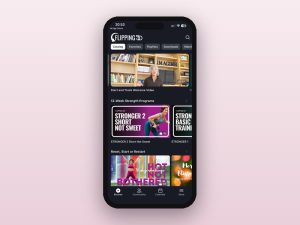
| 5 | Flipping 50 | 8/10 | 8/10 | 7.8/10 | Data profile | Dumbbell strength staged by menopause phase | $69/mo |
| 6 | Centr | 8/10 | 8/10 | 7.4/10 | Sample tested | A polished all-rounder with real dumbbell programming | $29.99/mo |
| 7 | trainwell | 8/10 | 8/10 | 6.9/10 | Data profile | A human trainer choosing your loads for you | $149/mo |
| 8 | Menovation | 8/10 | 6.5/10 | 7.7/10 | Fully tested | Real dumbbell loading inside menopause programming | $28.99/mo |
The price column is worth reading across. Progressive overload is the one thing on this site that does not track what you pay: the free option ranks third and the $149 option ranks seventh.
Which dumbbell programmes rank highest?
Ladder: your loads tracked and progressed by a coach
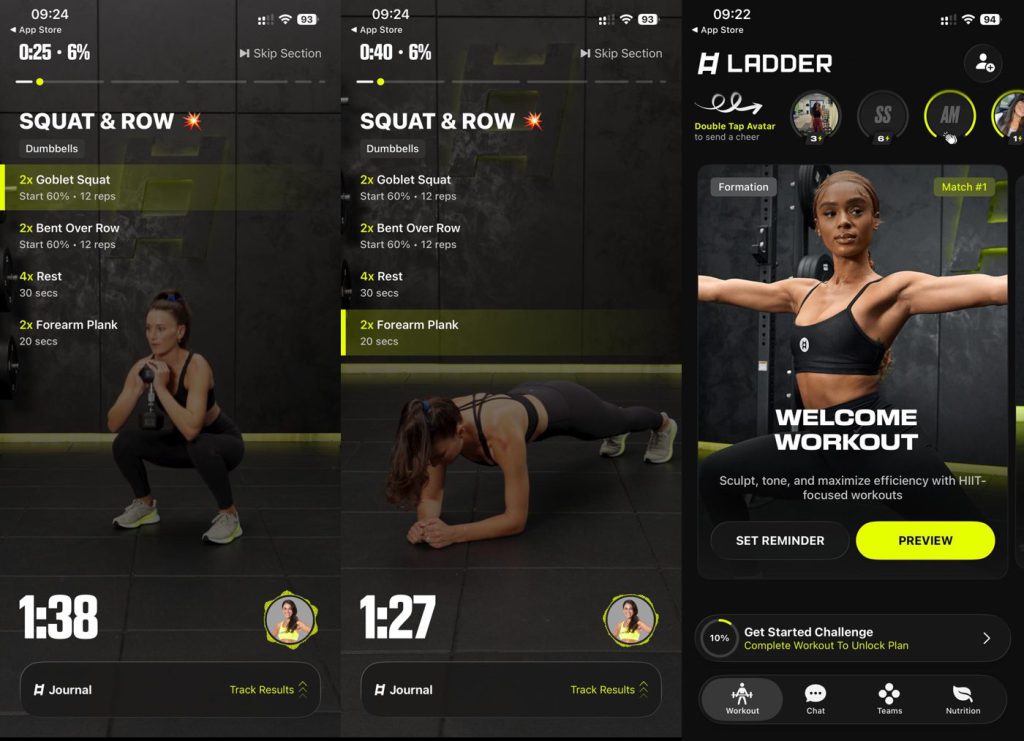
Built around progression rather than around classes, which is rarer than it should be
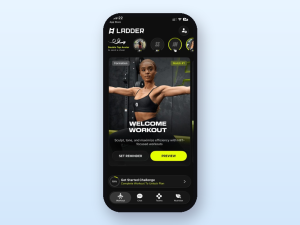
Ladder is a coach-led team strength app. Coaches set the week, you log what you lifted, and the weights move. It carries a Sample tested tier here rather than a full test.
Sampled by Katy Cole: Even before logging in I had a feeling Ladder is an app for building muscle, and that held up.
It ranks first because it scores at the top of this page on both halves: the strongest progression model, in the joint-best interface. The practical test I apply to any strength app is whether it knows what you lifted last time, and this one does.
Three things to weigh: iOS only, so Android users can stop here. Light on recovery content, which matters more in midlife than the app seems to think. And no menopause-specific programming at all.
Cost: $29.99 a month for Pro, with a 7-day trial that takes no card until it ends.
Evlo Fitness: the most muscle for the least joint stress
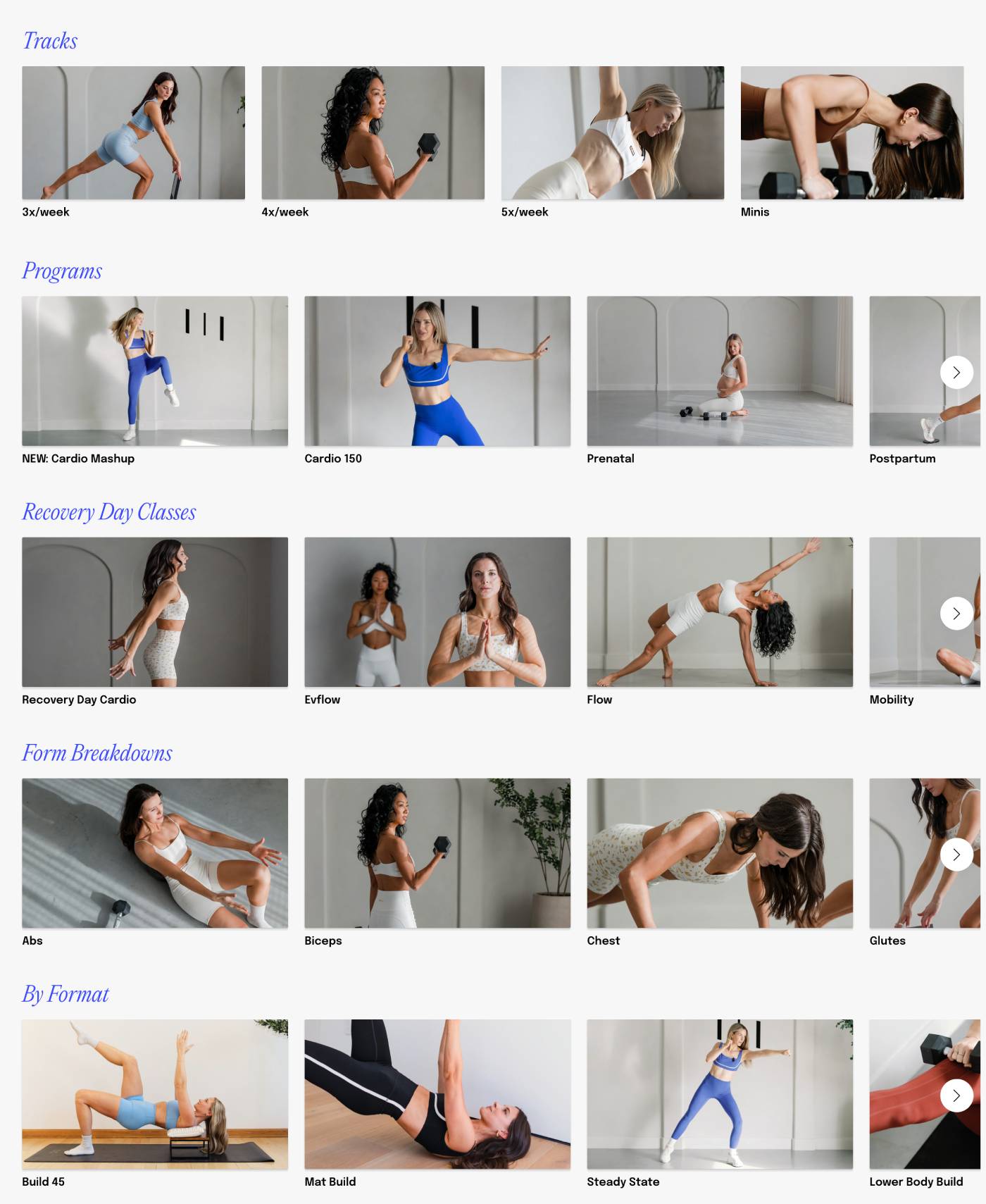
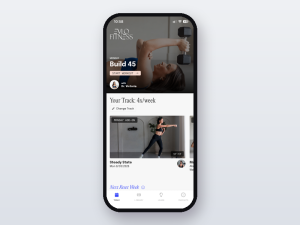
Every instructor holds a doctorate in physical therapy, and the training still goes close to failure
Evlo Fitness uses resistance to failure with weight tracking inside a joint-protective design: no jumping, no heavy axial loading.
Tested by Katy Cole, 8 weeks: I dropped from my usual 15 lb dumbbells to 11 lb to complete sets properly. After 8 weeks I had lost 3 lb without changing my diet, felt soreness in muscles my usual training had stopped reaching, and came back stronger in my core and glutes than I had been in years.
That weight drop is the detail I would point at. A programme that makes a fitter woman use lighter dumbbells is usually programming the sets properly rather than counting reps.
The honest limitation: $55.99 a month is the second highest price here, and the sessions demand attention.
Cost: $55.99 a month with a 14-day free trial. The App Store still shows a legacy 7-day figure.
Caroline Girvan: the best free dumbbell programming anywhere
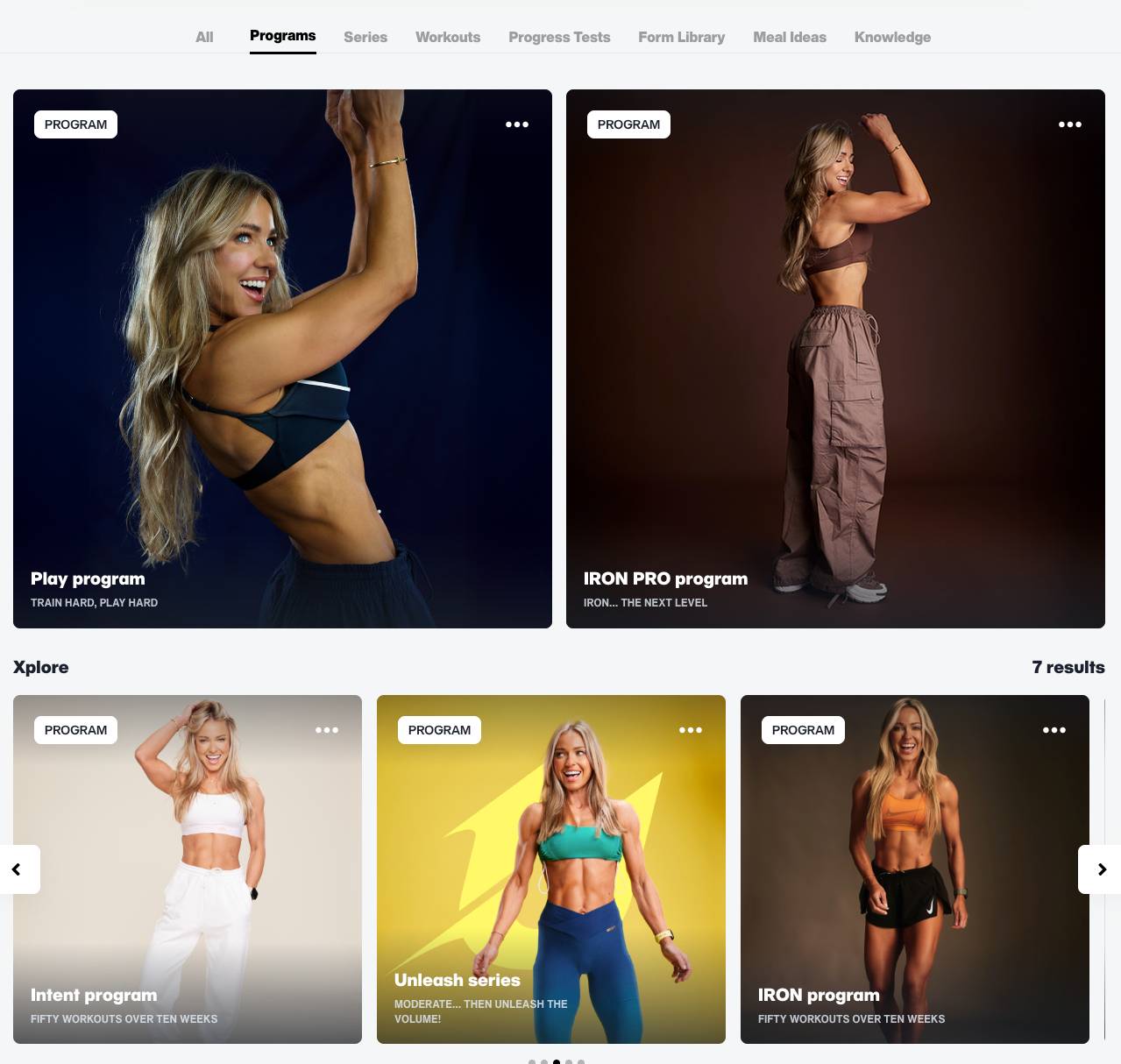
Properly structured multi-week blocks, on YouTube, for nothing
Caroline Girvan is a certified personal trainer with over thirteen years in the field. Her programmes are structured blocks rather than standalone classes, which is what makes the free version usable as an actual plan.
Tested by Katy Cole: I went from 141 lb to 134 lb just by following her daily workouts consistently and eating healthily, with no restrictions.
Who should not start here: the programmes are demanding and the cueing assumes you already know the movements. If you are new to dumbbells, learn the lifts somewhere gentler and come back in a few months.
Cost: free on YouTube. The CGX app is $12.99 a month with a 14-day trial for new members.
Fitbod: the load progressed around the dumbbells you actually own
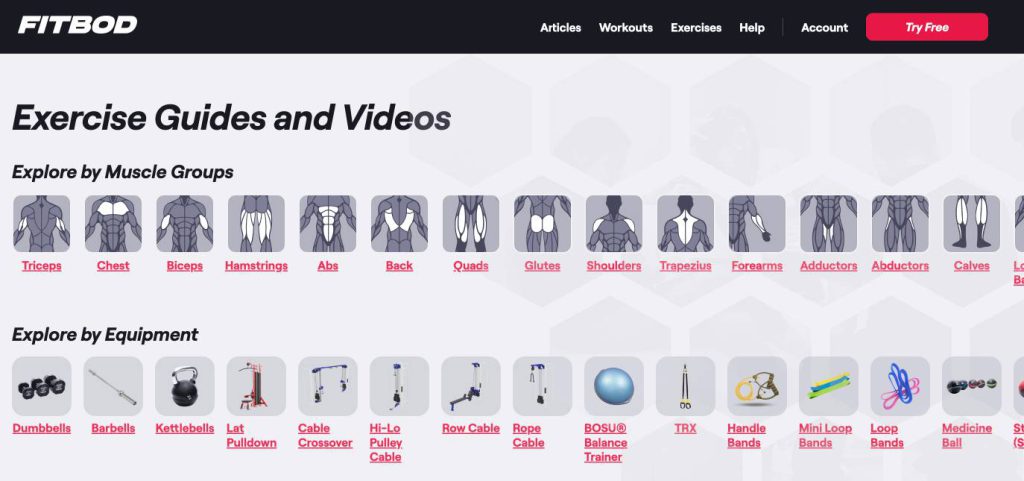
An algorithmic generator that adapts to your equipment and your recovery
Fitbod generates sessions and auto-progresses the load, adapting to what you have and what you trained recently. If your set stops at 20 lb, it works within that.
Why its overall score is low and it still ranks fourth: Fitbod scores 5.8/10 overall, the lowest here, dragged down by criteria this page deliberately ignores such as nutrition and menopause content. On progressive strength it scores 9/10, level with the top. That is exactly the case the blended ranking exists to handle.
The honest limitation: it will not teach you the movements. If you would not be confident doing a Romanian deadlift unsupervised, choose something coached.
Cost: $15.99 a month, with a 7-day trial and a limited free tier.
Flipping 50: dumbbell strength staged by phase
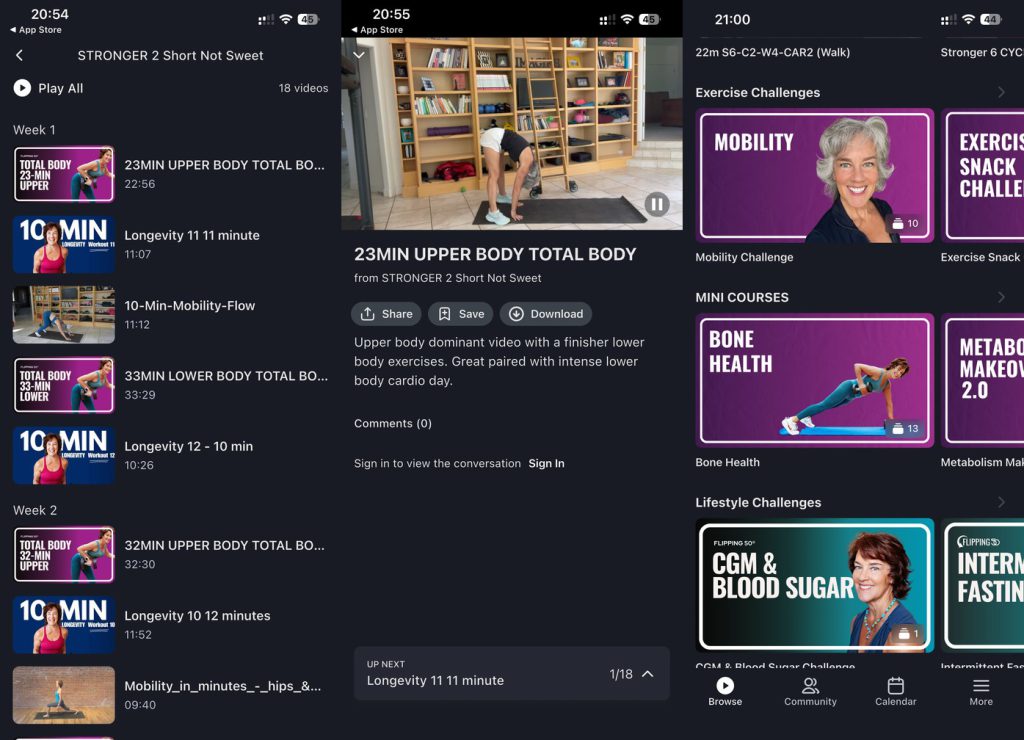
Twelve-week programmes built separately for perimenopause, menopause and postmenopause
Flipping 50 is built by Debra Atkinson, MS in exercise science with an NSCA CSCS. It carries a Data profile tier here rather than a tested one.
I have not tested this one first hand. What follows comes from the research profile, not from using it. What earns it a place is the staging: most platforms treat the whole transition as one audience, and this one does not.
The cost: $69 a month is the most expensive option here, and a free trial is offered only occasionally with the length unstated, so you cannot easily look before you buy.
Cost: $69 a month, or $549 a year on the website.
Centr: a polished all-rounder that takes loading seriously
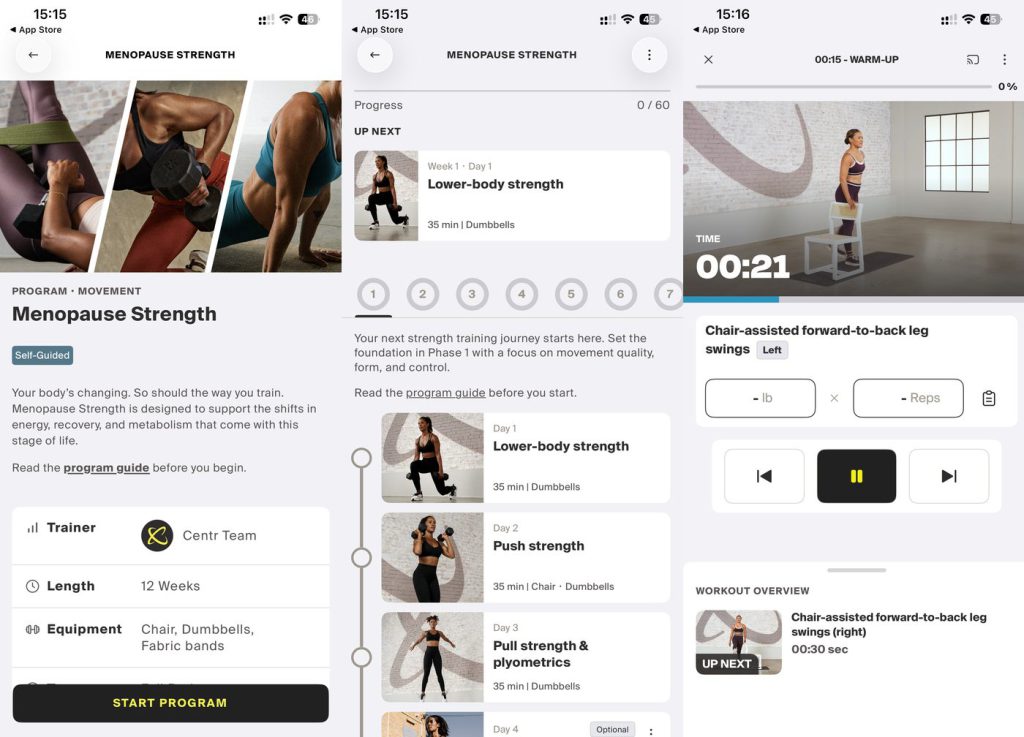
Real dumbbell programming inside an app most people buy for other reasons
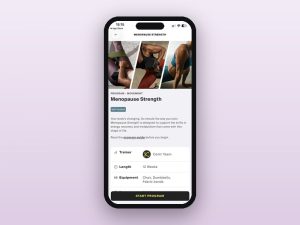
Centr is Chris Hemsworth’s platform, with strength programming more substantial than the celebrity framing suggests and a 12-week Menopause Strength programme.
Sampled by Katy Cole: It is a well-designed app with a huge range of programmes, including a dedicated Menopause Strength programme, which I liked.
The honest limitation: the menopause layer has no named clinician behind it, and the breadth means the strength work competes with a lot of other content for your week.
Cost: $29.99 a month with a 7-day trial.
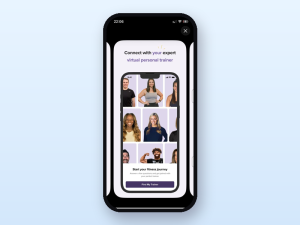
trainwell: a person choosing your weights
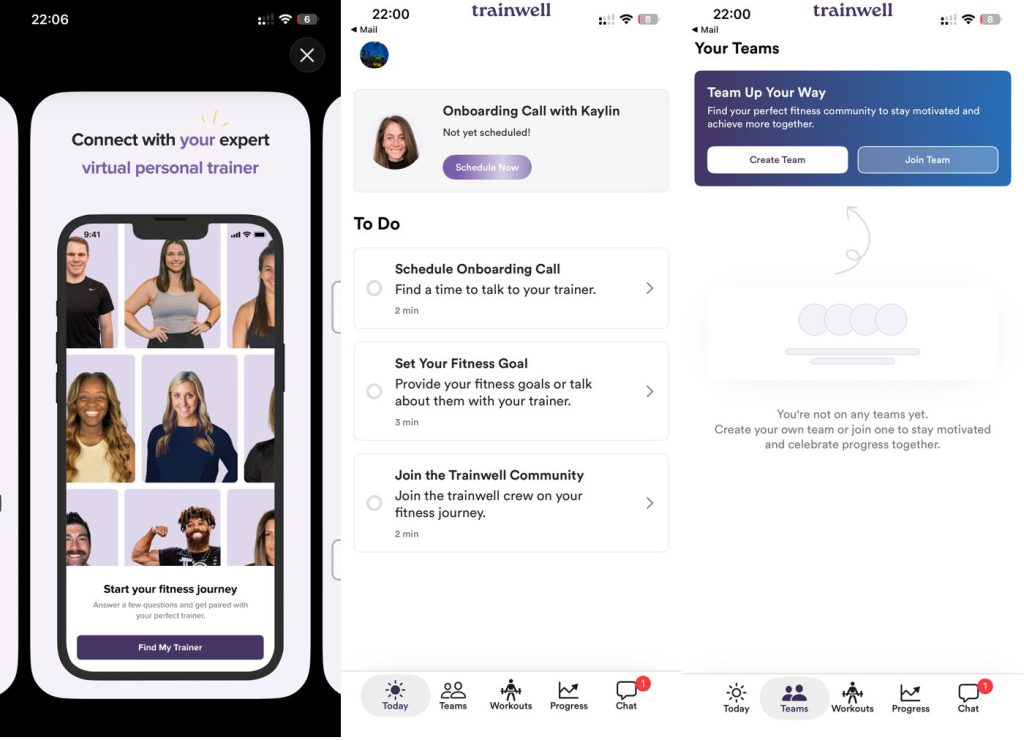
One-to-one remote coaching, which is a different product from everything else here
trainwell pairs you with a certified human trainer who builds and adjusts your plan. It carries a Data profile tier here rather than a tested one.
I have not tested this one first hand. What follows comes from the research profile, not from using it. What places it on a dumbbell page is that a real trainer can tell you to go up to 17 lb this week, which is the decision most people get wrong on their own.
The obvious caveat is price: $149 a month, billed in three-month increments, is five times the median here. Whether coaching is worth that against Ladder at $29.99 is a budget judgement a research profile cannot make for you. The 14-day free trial is the right way to find out.
Cost: $149 a month with a 14-day free trial.
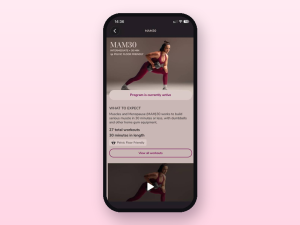
Menovation: real loading inside menopause programming
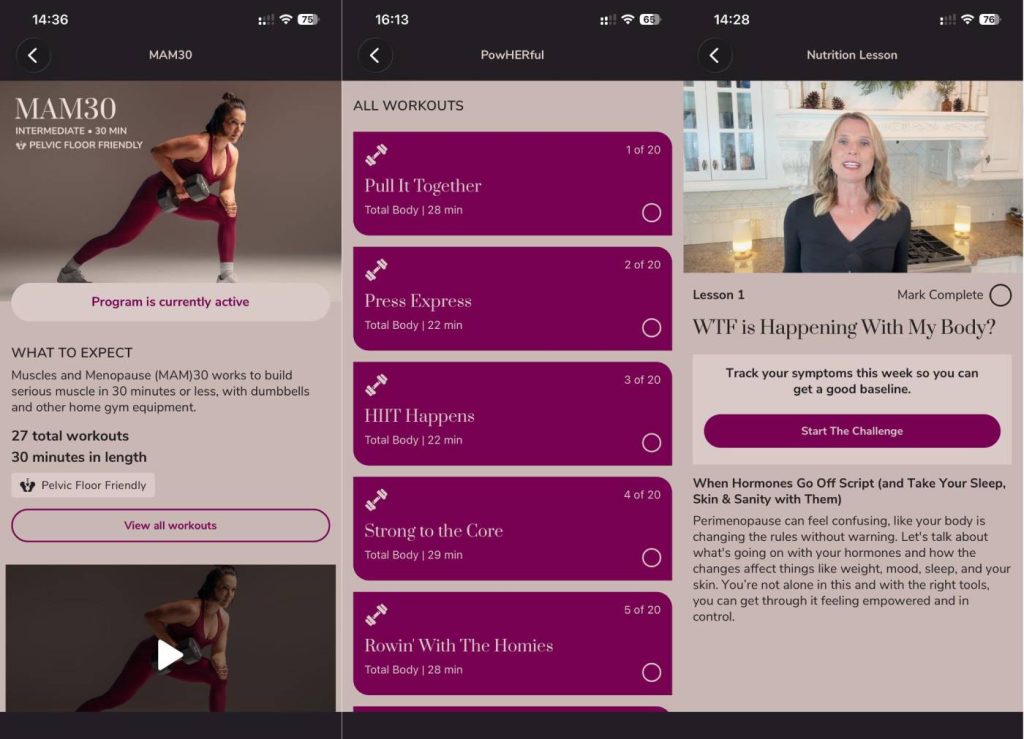
The only programme here where progressive dumbbell work and menopause content are the same product
Menovation is led by Ashley Nowe, a Certified Menopause Coaching Specialist. Its PowHERful programme uses real dumbbell loading rather than the light weights that usually accompany menopause branding.
Tested by Katy Cole, 6 to 8 weeks: The PowHERful programme delivered real results over five weeks. I increased my weights from around 11 lb to 13 lb on upper body and 17 lb to 20 lb on lower body per hand, and dropped from 141 lb to 136 lb.
Those are the clearest progression numbers I recorded anywhere, and they came from a platform most people would file under menopause rather than strength.
The honest limitation: the interface is dated and the library is still growing.
Cost: $28.99 a month, $69.99 quarterly or $199.99 a year. The trial is 8 days at the checkout, although the homepage says 7.
Which dumbbell programme is right for you?
If you want your loads programmed and tracked, Ladder, provided you have an iPhone.
If your joints are the limiting factor, Evlo Fitness.
If you want to spend nothing, Caroline Girvan, and be ready to work.
If you already lift and just want the programming, Fitbod at $15.99.
If you want dumbbells and menopause programming together, Menovation.
If what you actually need is a person, trainwell, and use the 14 days to find out.
Whichever you choose, write down what you lifted. If you cannot answer that question in eight weeks, the programme is not progressing you, whatever it says on the tin.
How did we choose these eight?
The qualifier is dumbbells. Fifty-nine of our 77 published programmes use them, so this gate is deliberately wide: it is the page’s subject, not a filter.
The ranking is progressive strength, weighted 70%, blended with ease of use at 30%. Progressive overload is the mechanism behind every muscle finding cited above, and the practical test is whether the app records what you lifted. If it does not, it cannot progress you.
We deliberately did not rank on overall score. Overall includes nutrition, menopause content and recovery, none of which is what someone searching for a dumbbell workout is asking about. That is why Fitbod ranks fourth on the lowest overall score here.
Six of the eight I have used, three across a full test and three sampled. Flipping 50 and trainwell are assessed from published information only, are labelled that way, and carry no first-hand observation.
The weights table near the top is drawn from my own review notes across roughly fifty platforms tested over fifteen years. Those are the loads I actually used, not recommendations.
We buy our own subscriptions. Some links on this page earn a commission, which never affects a score or a position.
What research is this page based on?
- Schwanbeck SR, Cornish SM, Barss T, Chilibeck PD. Effects of Training With Free Weights Versus Machines on Muscle Mass, Strength, Free Testosterone, and Free Cortisol Levels. Journal of Strength and Conditioning Research, 2020.
- Schoenfeld BJ, Grgic J, Ogborn D, Krieger JW. Strength and Hypertrophy Adaptations Between Low- vs. High-Load Resistance Training: A Systematic Review and Meta-analysis. Journal of Strength and Conditioning Research, 2017.
- Schoenfeld BJ, Ogborn D, Krieger JW. Dose-response relationship between weekly resistance training volume and increases in muscle mass. Journal of Sports Sciences, 2017.
- Ramos-Campo DJ, Andreu-Caravaca L, Carrasco-Poyatos M, et al. Effects of Circuit Resistance Training on Body Composition, Strength, and Cardiorespiratory Fitness in Middle-Aged and Older Women. Journal of Aging and Physical Activity, 2022.
- Greendale GA, Sternfeld B, Huang M, et al. Changes in body composition and weight during the menopause transition. JCI Insight, 2019.
- Momma H, Kawakami R, Honda T, Sawada SS. Muscle-strengthening activities are associated with lower risk and mortality in major non-communicable diseases. British Journal of Sports Medicine, 2022.
Nothing on this page is medical advice. If you have a diagnosed condition or injury, check with your doctor or a physiotherapist before starting a loaded strength programme.
Frequently asked questions about dumbbell workouts
Six compound movements, three rounds, about thirty minutes: goblet squat, Romanian deadlift, single-arm row, floor or overhead press, split squat and suitcase carry. Two or three times a week on non-consecutive days. The full session with sets, reps, rest and the weights I use is set out above.
Thirty minutes is enough for a full body session if you keep rest periods to 45 to 60 seconds and use compound movements rather than isolation exercises. Reviewing nineteen studies, Murphy and colleagues found in Sports Medicine in 2019 that accumulated exercise produced no worse outcomes than continuous, so splitting it into shorter blocks is also fine.
Yes, and for most women training at home it is the most practical option. One adjustable pair covers a squat, a hinge, a row, a press, a lunge variation and a loaded carry, which between them train every major movement pattern. You add weight rather than adding equipment.
Two pairs covers most people: roughly 8 to 10 lb for upper body and 15 to 20 lb for lower body and compound movements. Across the platforms I have tested my own working range settled at 11 to 20 lb per hand. The most common mistake is buying one light pair and using it for everything, because the weight that challenges your shoulders is nowhere near enough for squats.
Yes. In a systematic review in the Journal of Strength and Conditioning Research in 2017, Schoenfeld and colleagues found low-load and high-load resistance training both build muscle when sets are taken close to failure, with heavier loads favouring maximal strength. Your 12 lb dumbbells will build muscle provided the last two reps are genuinely hard and the load goes up over time.
For home training, and for what matters at this age, generally yes. Schwanbeck and colleagues, in the Journal of Strength and Conditioning Research in 2020, compared free weights with machines and found both produce gains, with free weights demanding more stabilising work. That stabilisation is what transfers to carrying shopping and catching yourself on a stair.
Three to four sessions a week is the practical target, with volume mattering more than any single session. Schoenfeld, Ogborn and Krieger found a dose-response relationship between weekly resistance training volume and muscle gain in the Journal of Sports Sciences in 2017, so more hard sets across the week produces more muscle, within reason.
Adjustable, almost always. Fixed pairs are cheaper individually but you outgrow them, and buying three fixed pairs costs more than one good adjustable set. An adjustable pair reaching 25 lb covers most women for the first year or two; a set reaching 50 lb covers squats and deadlifts and will not need rebuying.
Usually because it is programming the sets properly. Evlo dropped me from my usual 15 lb to 11 lb, not because it was easier but because the sets were long enough and controlled enough that 15 lb meant cheating the final reps. A programme that has you reaching for a heavier weight in week one is worth a little suspicion.
Caroline Girvan, free on YouTube, with properly structured multi-week blocks rather than standalone classes. It is demanding and the cueing assumes you know the movements, so if you are completely new to dumbbells learn the lifts somewhere gentler first.
Where should you read next?
- Our full Evlo Fitness review, including the eight weeks behind its position here.
- Our full Caroline Girvan review, if the free route appeals.
- Best strength training apps, if you want the app comparison rather than the training guide.
- How we score, including how the capability scores are built.