
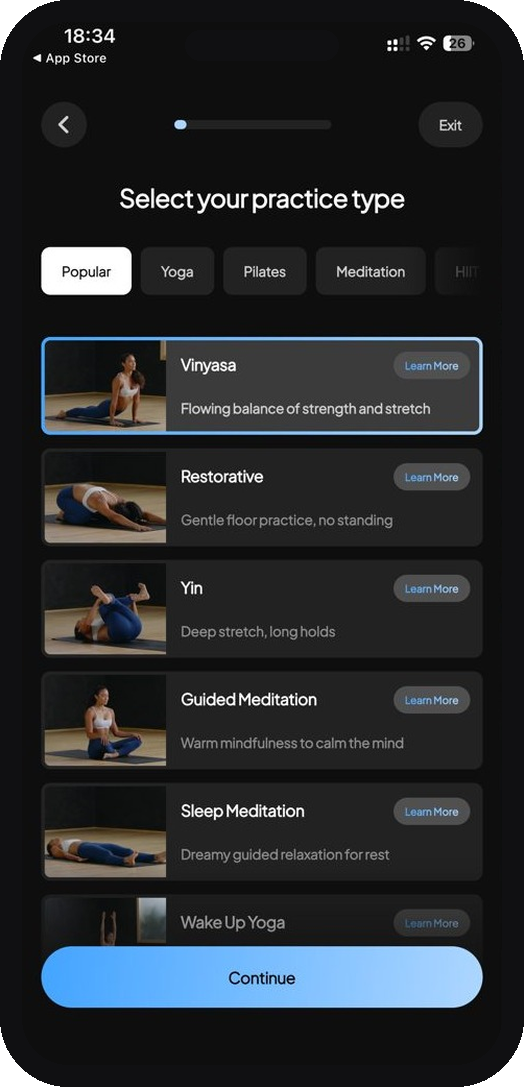
About $12.99/month or $99.99/year for one membership that unlocks the whole app family ($99.99 works out near $8.33/mo) · a brief full-access free trial · a set of algorithmically generated yoga, Pilates, barre, HIIT, prenatal yoga and meditation apps from Yoga Buddhi Co. that build a fresh, never-repeating class every time · levels from beginner to advanced, session length fully adjustable · founders Ben Simon and Carlos Ormachea · A mat, and optional light weights for the barre and Pilates work.
Personally tested: completed the AI onboarding and ran a generated Pilates practice in the Down Dog app, and the screenshots here are our own. Pricing verified August 2026 against official sources. Testing status: Sample tested (a hands-on look rather than a full multi-week test, so long-term ratings are provisional).
How we tested this. We signed into Down Dog, went through its AI onboarding quiz and ran a generated Pilates practice, and the screenshots on this page are our own. This is a hands-on look rather than a completed multi-week test, so long-term scores are provisional, and we have combined it with the official pages, the app store listings and the science. This is education, not medical advice; speak to your clinician, especially about HRT or existing conditions.
Down Dog Review 2026: Quick Answer
Sample tested: completed the AI onboarding and a generated Pilates practice, with our own screenshots. Long-term scores provisional.
Women who want flexible, low-impact yoga and mind-body practice at home, love variety, and want to set their own level, length and pace without a fixed class schedule
Your priority is progressive strength and bone loading, a guided week-by-week plan, or menopause-specific programming; Down Dog is generative and has no menopause track
A family of apps that generate a brand-new yoga, Pilates, barre, HIIT, prenatal or meditation session each time, all under one subscription
Fully adjustable, from about 10 to 15 minutes up to 60 minutes or more
A mat, plus optional light weights, blocks or a strap for some practices
Low for the yoga, restorative and Pilates work; the separate HIIT app is high impact
Good low-impact and mind-body base, but no menopause programming, no pelvic-floor track, no hormone content and light on bone loading
None. Every session is generated on demand, so there is no live or fixed-schedule class
iOS, Android, Mac and web browser; casts to a TV over AirPlay or Chromecast; offline downloads on mobile; Apple Health sync; no dedicated wearable app
About $12.99/month or $99.99/year on the App Store; the website advertises a discount, and one membership covers every app
A brief full-access free trial (card required); students and teachers can get free access with a school email
Cancel anytime through your account on the web, or via the App Store or Google Play if you subscribed there
Neutral; makes no medical claims and is silent on menopause medicine
Active and frequently updated across the app family
6.0 / 10
Quick Verdict
Worth it for women over 40? Yes as flexible, low-impact yoga and mind-body practice, no as a menopause tool.
Down Dog earns 6.0/10 on our hands-on look. Its strengths suit a midlife body and mind well: it is low-impact and joint-friendly in its yoga, restorative and Pilates work, it is one of the easiest apps in the market to start from zero, its restorative, yin, yoga nidra and meditation content genuinely supports recovery and a calmer nervous system, and one membership unlocking six practice types is strong value. The limits for our audience are real: it is generative rather than a guided plan, so you assemble your own routine; it uses bodyweight and light weights, so it under-delivers on the progressive strength and bone loading midlife guidance prioritises; and it has no menopause programming, education or dedicated pelvic-floor work. Start here: use the free trial for the yoga, restorative and meditation practices, and pair it with a heavier strength habit for bone and muscle.
Is Down Dog right for you?
Down Dog is strongest for starting strength training (8.5 out of 10, against a 6.1 average across the 77 programmes scored) and weakest for nutrition support (1.0 against 4.0).
| Question | Verdict | Rating | Score |
|---|---|---|---|
| How it suits a perimenopausal body | |||
| Is Down Dog good for pelvic floor problems?Based on pelvic floor support and low-impact design | Low, about the same as mostmost score 4.6/10 | 4.5 / 10 | |
| Is Down Dog genuinely built for perimenopause and menopause?Based on menopause programming, hormone awareness, education and expert credibility | Low, and worse than mostmost score 3.3/10 | 1.5 / 10 | |
| Is Down Dog good for painful joints?Based on low-impact design and recovery provision | Strong, and better than mostmost score 6.2/10 | 7.5 / 10 | |
| Is Down Dog manageable when your energy is low?Based on recovery provision and mind-body support | Strong, and better than mostmost score 5.7/10 | 8.0 / 10 | |
| Is Down Dog good if you are new to strength training?Based on beginner on-ramp and mind-body support | Strong, and better than mostmost score 6.1/10 | 8.5 / 10 | |
| Is Down Dog good for building bone density?Based on bone loading and progressive strength | Low, and worse than mostmost score 5.1/10 | 2.5 / 10 | |
| Does Down Dog help with nutrition?Based on midlife nutrition support | Low, and worse than mostmost score 4.0/10 | 1.0 / 10 | |
| How it performs as a product | |||
| Can you fit Down Dog into a busy week?Based on time efficiency | Strong, about the same as mostmost score 7.6/10 | 8.0 / 10 | |
| Is Down Dog worth the money?Based on value for money | Strong, and better than mostmost score 6.9/10 | 8.0 / 10 | |
Jump to Section
What Down Dog Actually Is
Down Dog is not a single app but a family of them, built by Yoga Buddhi Co. and launched in 2015. The flagship is Yoga, and alongside it sit Pilates, Barre, HIIT, Prenatal Yoga and Meditation, all covered by one membership. What makes Down Dog different from almost every other platform is that it does not play pre-recorded classes. Instead it generates a brand-new session each time from a huge library of segments, so no two practices are identical. You choose the style, level, length, pace, focus areas, music and voice, and the app assembles a flow to match. Real, recorded yoga-teacher voices guide you, with a synthesized voice offered as an option and instruction available in more than a dozen languages.
For this audience it is worth being precise about what Down Dog is and is not. It is a genuinely excellent low-impact and mind-body platform with unusual flexibility and a generous free trial, and its restorative, yin, gentle, chair and meditation options make it approachable for an older or stiffer body. What it does not have is any menopause-specific programming: there is no perimenopause or menopause track, no menopause education inside the app, and no dedicated pelvic-floor work beyond what is incidental to the Prenatal Yoga app. It also is not a guided, week-by-week plan; because every session is generated on demand, you set your own goals through personal challenges rather than following a structured progression. Read it as a flexible practice tool, not a menopause program or a fixed roadmap.
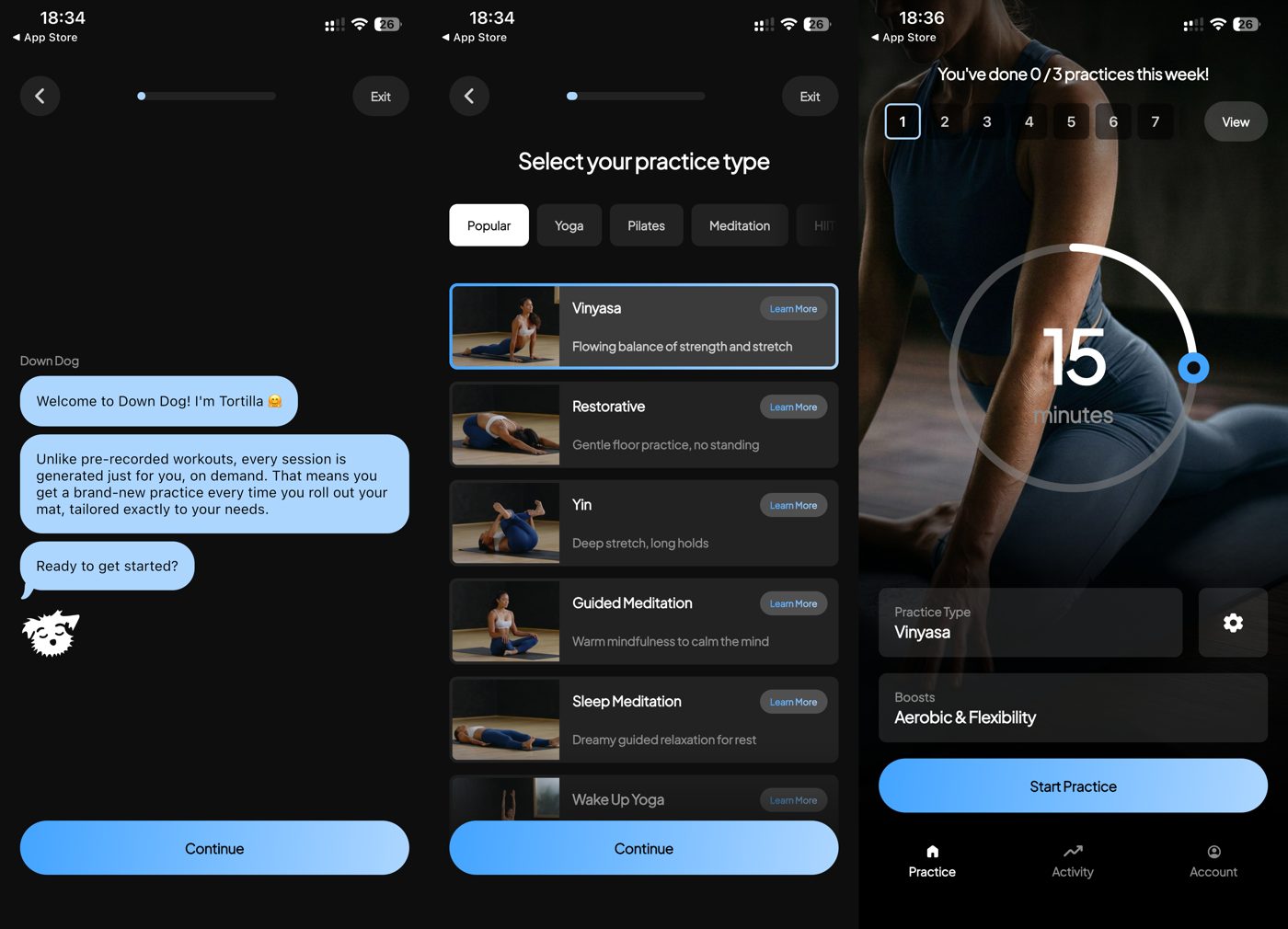
What I found using it
Down Dog starts with a long, AI-powered quiz that builds your workouts from your answers: you pick the type of practice, the voice of the teacher, how often you want to train and more. I chose Pilates. The practices themselves are made beautifully, with a calm voice showing exactly what to do and how, and I am not usually a yoga or Pilates person. The thing that disappointed me is that I could not change a practice once it was generated: it is all laid out and you follow along, with no way to swap a movement out, and I did not find a filtering option to build my own session (it may have been limited because I was on the trial). There was no nutrition, no community, and no perimenopause or menopause practices or educational content. As a perimenopausal woman, the part I really missed was strength training, there is none here. It is lovely for a low-impact or recovery day, but on its own it would not cover all of my perimenopause and menopause needs.
Who Is Behind Down Dog? Credibility
Down Dog is made by Yoga Buddhi Co., founded by Ben Simon and Carlos Ormachea, who paired software engineering backgrounds with formal yoga-teacher training. That combination is the whole story of the product: the algorithmic sequence generator is a real engineering achievement, and the guidance comes from qualified, recorded yoga instructors rather than pure text-to-speech. So its credibility as a yoga and mind-body brand is sound, and its craft and polish are widely praised. What it does not have is clinical authority for the menopause questions some readers will bring. There is no clinician, no pelvic-floor physiotherapist and no menopause specialist shaping the content, and no medical advisory board. Read Down Dog as a well-built, credible yoga and mind-body platform, rather than a source of menopause or medical guidance.
Content and Features
At a glance: a deeply customisable, best-in-class yoga and mind-body engine with strong recovery and beginner support and excellent value. It is generative rather than a guided plan, has no menopause track, and is light on progressive strength.
| Format | Algorithmically generated, non-repeating sessions on demand; recorded instructor voices, with a synthesized voice option; no live classes. |
| Disciplines | Yoga (Vinyasa, Restorative, Yin, Gentle, Hatha, Chair, Yoga Nidra and more), Pilates, Barre, HIIT, Prenatal Yoga, Meditation and breathwork. |
| Menopause / perimenopause | None. No dedicated menopause programming, education or hormone content. |
| Prenatal and postnatal | Yes, via a dedicated Prenatal Yoga app tailored by trimester, included in the membership. |
| Pelvic floor | No standalone pelvic-floor program; only incidental engagement within prenatal yoga. |
| Recovery and mind | Strong. Restorative, yin, yoga nidra, meditation and breathwork, with a calm, self-paced feel. |
| Nutrition | None. There is no nutrition or meal content in any of the apps. |
| Strength | Bodyweight yoga plus light-weight barre and Pilates; toning and mobility rather than heavy progressive loading. |
| Customisation | Adjustable level, length, pace, warmup and cooldown, hold lengths, instruction level, plus Boost to target specific body areas, and voice and music choices. |
| Community and coaching | No in-app community and no live coaching; personal challenges and streaks track your own goals. |
What Equipment Do You Need for Down Dog?
Down Dog needs very little. For the yoga, restorative and meditation work you really only need a mat and, if you like, a couple of blocks and a strap to make poses more accessible, which is especially useful for a midlife body easing back into flexibility work. The Barre and Pilates practices call for a set of light hand weights, and the HIIT app is bodyweight by default. If you want the barre and Pilates work to keep challenging you over time, a slightly heavier adjustable pair is worth having, because light fixed weights stop providing a strength stimulus once you adapt.
Recommended spec examples. These picks are curated by specification and feature fit, not personally lab-tested for long-term durability. Prices are examples; verify before buying.
Exercise mat
~$20 to $40
The one essential. Every generated yoga, Pilates and barre practice is mat-based; a half-inch mat is kinder to knees, hips and spine.
Yoga blocks
~$15 a pair
Optional but helps. Brings the floor closer so poses stay accessible for a midlife body; buy two.
Light dumbbells
from ~$9
Optional. A light 1 to 5 lb pair adds a little load to the barre and Pilates practices; the app itself stays bodyweight.
Bottom line on equipment: a mat covers the yoga and meditation work; add light weights and, if you like, blocks and a strap for the barre, Pilates and flexibility practices.
How We Scored Down Dog: the 6.0 / 10 Breakdown
Our scores on the 9 weighted criteria, from a hands-on look combined with research. Because this was a sample test rather than a full multi-week run, longer-term scores carry a confidence level. Women Over 40 is our most heavily weighted menopause criterion, and its full 12-capability breakdown follows in the next section.
| Category | Weight | Score | Reasoning (confidence) |
|---|---|---|---|
| Time Efficiency | 15% | 8 | Session length is fully adjustable with quick options, so it flexes easily around a busy schedule. (confidence: high) |
| Muscle Potential | 18% | 4 | Bodyweight yoga plus light barre and Pilates build some tone, but there is no progressive external loading. (confidence: medium) |
| Women Over 40 Specificity | 10% | 3.8 | Strong low-impact and mind-body base, but no menopause layer and light bone loading; full breakdown below. (confidence: medium) |
| Joint Friendliness | 12% | 7 | Yoga and restorative work are very joint-kind, though vigorous flows and the HIIT app add stress and there is no live form correction. (confidence: medium) |
| Recovery Compatibility | 10% | 8 | Restorative, yin, yoga nidra and meditation make recovery and down-regulation a genuine strength. (confidence: high) |
| Programme Structure | 12% | 5 | Generative and on-demand by design, not a guided progressive plan; you self-assemble via challenges. (confidence: high) |
| Value for Money | 8% | 8 | A generous free trial and one membership covering six apps at about $12.99/month is strong value. (confidence: high) |
| UX and Design | 8% | 9 | Highly polished and deeply customisable, and consistently rated near 4.9; minor knocks for the synthesized voice option and lighter web features. (confidence: high) |
| Nutrition Integration | 7% | 1 | No nutrition or meal content of any kind. (confidence: high) |
| Total | 100% | 6.0 / 10 | Our Score, sample tested. |
Is Down Dog Good for Women Over 40?
In many ways, yes. Down Dog is a low-impact, joint-friendly way to practise yoga and mind-body movement at home, and it is one of the easiest apps to start from zero. You can set a gentle level, a short length and a slow pace, and lean on the restorative, yin, gentle and chair styles, all of which suit a body that is easing back into movement or managing stiffness. Its meditation, breathwork and yoga nidra content supports a calmer nervous system, which matters when stress sensitivity and sleep disruption rise in perimenopause. And because one membership covers yoga, Pilates, barre, HIIT and meditation, you can vary your practice with the day and your energy.
Who it suits, and what is missing. The gaps are specific and important for this site. First, strength and bone. Midlife guidance prioritises progressive resistance and heavier loading to protect muscle and bone, and Down Dog’s bodyweight and light-weight work builds mobility and some tone but sits below the stimulus needed for real strength or bone-density gains. Second, structure. Down Dog is generative, so it does not hand you a guided, week-by-week plan; a woman who wants a clear roadmap will need to build her own consistency through the challenge feature. Third, menopause. There is no perimenopause or menopause programming, no menopause education and no dedicated pelvic-floor work, so it is a general wellness tool rather than a menopause solution. It suits a woman who wants flexible, low-impact, mind-body practice; it is a weaker single choice for someone whose priority is bone, muscle, a structured plan or menopause-specific support.
What the wider picture shows. Reviewers and long-term users describe Down Dog the way we would: an unusually flexible, high-quality yoga and mind-body engine that people stick with because it never gets stale and adapts to their level. Older users repeatedly point to the restorative and gentle styles as what keeps them practising, while the recurring caveat is that there is no live teacher to correct your form, which matters more for a 40-plus or injured body. Read Down Dog as a superb low-impact and mind-body foundation for a woman over 40, best paired with a dedicated heavier-strength habit and, if menopause support is the priority, with guidance from elsewhere.
This is the perimenopause and menopause assessment, and it is separate from the overall score. Twelve things a programme either does for a midlife body or does not, each scored out of 10 with my reasoning next to it. Together they produce a single menopause fit score, and that becomes one of the nine categories in the overall scoring below.
How Down Dog Fits Perimenopause, Menopause & Beyond
Women Over 40 is our most important criterion, and here's the full breakdown behind it.
Down Dog is strongest for beginner on-ramp, recovery & deload and mind-body support, and weakest for menopause programming, hormone awareness, menopause education, midlife nutrition, bone loading, pelvic floor, progressive strength and expert credibility, in our menopause and midlife capability assessment for women over 40.
At a glance
| Capability | Score | Rating | Why |
|---|---|---|---|
| Right training for a midlife body | |||
| Low-impact | 7/10 | Strong | The yoga-led catalogue is gentle and mat-based, held below best-in-class only because the separate HIIT app is genuinely high impact. |
| Progressive strength | 3/10 | Minimal | Bodyweight yoga with light barre and Pilates builds some tone, but there is no external load or rep-and-set progression. |
| Bone loading | 2/10 | None | Bodyweight and light-weight work sit below the mechanical load that drives bone-density gains. |
| Recovery & deload | 8/10 | Strong | Restorative, yin, yoga nidra and a dedicated meditation app give real, deliberate down-regulation. |
| Built for menopause | |||
| Menopause programming | 1/10 | None | No menopause track, filter or life-stage-aware programming in any of the apps. |
| Pelvic floor | 2/10 | None | No pelvic-floor program; only incidental engagement through the Prenatal Yoga app. |
| Hormone awareness | 1/10 | None | Generative sequencing has no awareness of cycle, hormones or menopausal status. |
| Menopause education | 1/10 | None | No menopause education or guidance inside the app. |
| Expert credibility | 3/10 | Minimal | Qualified yoga instructors and real voices lend some trust, but there is no clinician, pelvic PT or menopause specialist and no advisory board. |
| Whole-woman support | |||
| Mind-body support | 8/10 | Strong | Meditation, breathwork and yoga nidra deliver strong stress, sleep and mind-body support. |
| Beginner on-ramp | 9/10 | Best-in-class | Adjustable level, length, pace and voice plus a generous free trial make it exceptionally easy to start from zero. |
| Midlife nutrition | 1/10 | None | No nutrition content, tracking or guidance is offered. |
ScaleBest-in-classStrongSomeMinimalNone
What the sources say: Sample-tested (completed the AI onboarding and ran a generated Pilates practice, iOS, Aug 2026), cross-checked against the official pages, the app store listings and aggregated user reviews.
These are evidence-informed suitability ratings, not clinical measurements. They combine exercise science with product-specific research and, where indicated, hands-on testing, alongside multi-source verification, and are approximate. Individual response varies. A starting point, not medical advice. How we score menopause fit
What the sources say: scores combine the official pages, the app store and user reviews. Beginner on-ramp, mind-body support, recovery and low-impact scored well because they are core, verifiable strengths and a good match for a midlife body. The built-for-menopause group scored low because there is no dedicated menopause programming, education, hormone or standalone pelvic-floor content, and progressive strength and bone loading are limited by the bodyweight and light-weight format.
These are evidence-informed suitability ratings, not clinical measurements. They combine exercise science with published-feature analysis and multi-source verification, and are approximate. Individual response varies. A starting point, not medical advice. How we score menopause fit.
What the Research Says: Down Dog’s Approach Checked
Down Dog’s low-impact, mind-body approach is well matched to some midlife needs, with important caveats. Yoga has real, if modest, benefits for menopausal women: a systematic review and meta-analysis of 13 trials found yoga improved menopausal symptoms across the psychological, somatic and vasomotor clusters, with effects broadly comparable to other forms of exercise, though the overall evidence was rated low to moderate quality, so we would frame it as helpful for general wellbeing rather than a treatment for hot flashes.[1] For mood and stress the signal is genuine but not unique to yoga: a 2025 review of mind-body therapies in menopausal women found improvements in sleep, depression and anxiety, though mindfulness and some other practices outperformed yoga specifically.[2] In older adults, yoga improves balance, lower-body strength and flexibility, which are fall-risk factors, though the evidence does not show it prevents actual falls, so we do not claim that.[3] Its meditation and breathwork content is a reasonable support for sleep and stress, but be cautious: a meta-analysis found yoga improved sleep in women overall while the peri and postmenopausal subgroup specifically showed no significant benefit.[4]
The caveat that matters most for our audience is strength and bone. The biggest gains for midlife muscle and bone come from progressive resistance and heavier loading. In the LIFTMOR trial, brief high-intensity resistance and impact training improved bone density and function in postmenopausal women, whereas light, low-intensity exercise did not, and reviews confirm that bone responds to higher mechanical loads.[5][6] Down Dog’s bodyweight and light-weight work sits well below that threshold, so treat it as excellent low-impact conditioning, mobility and mind-body practice rather than a strategy for building strength or bone. One bright spot is its HIIT app: high-intensity interval training improves cardiorespiratory fitness in midlife and older women, so if higher-intensity cardio suits you, that sibling app has real value, though it does not transfer to bone or muscle mass.[7] Pair Down Dog with a dedicated heavier-strength routine to cover what it cannot.
What Users Report: Verified Sentiment
Rating snapshot: Down Dog is very highly and very widely rated, which is unusual and credible on this scale. On the Apple App Store the flagship Yoga app holds about 4.9 stars from roughly 327,000 ratings, and on Google Play it sits at about 4.9 from several hundred thousand reviews on more than 5 million installs, with the sibling apps clustering around 4.8 to 4.9. On Trustpilot, a much smaller and self-selected sample of about 68 reviews averages around 4.4, skewed by billing complaints. A near-4.9 average sustained across hundreds of thousands of reviews is a trustworthy overall-satisfaction signal, though the corpus reflects general users rather than women over 40 specifically.
Consistently praised
- Non-repeating, algorithmically generated sequences that never get stale.
- Deep customisation of level, length, pace, focus areas, voice and music.
- Strong value: one membership covers six practice types.
- Beginner-friendly, with a clear progression and a gentle on-ramp.
Consistently criticised
- The free trial requires a card and can feel like an immediate charge; some billing complaints.
- A voice re-recording that some users found faster and less soothing for restorative practice.
- No live teacher, so no one corrects your form, and occasional left and right cueing mismatches.
- Occasional bugs, and music that can drown the cues if not adjusted.
Source and credibility note: figures were read live from the Apple App Store, Google Play and Trustpilot (August 2026). The store ratings sit on a very large base and are credible; the Trustpilot 4.4 comes from a tiny, self-selected sample and mainly reflects billing rather than practice quality, so we present it as the complaint-channel view, not the headline. No fake-review signals were found. No women-40-plus breakdown exists in the review corpus, so that lens is inferred from features and older-user comments, not reviewer statements.
Devices, Platforms and App
Down Dog runs on iOS, Android, Mac and in a web browser, and you can cast to a TV over AirPlay or Chromecast, download practices for offline use on mobile, and sync to Apple Health. Captions are available in every supported language. There is no dedicated Apple Watch or Apple TV app, and offline downloads are mobile only, so a member who wants to follow along on the television will do so by casting. For a woman over 40 who likes to practise in the living room, the casting path is worth testing during the free trial, and the deep customisation means you can dial the level and pace right down when you need to.
Down Dog specifications
- Free trial
- Vendor says a free trial exists but does not publish its length
- Cancellation
- cancel anytime via store/site
- Session length
- ~5 to 90 min (user-set)
- Who makes it
- Yoga Buddhi Co. (Down Dog); procedurally-generated; no named clinician
- Still maintained
- Active; Yoga
- What is included
- On-demand classes: yesLive classes: noRecovery content: yesMenopause education: noStructured programmes: partlyMeditation: yesNutrition guidance: no
- Women over 40
- Pelvic floor work: partlyMenopause clinician involved: noInjury modifications: partlyBone-health focus: noModified progressions: partlyCycle syncing: noPrenatal options: yes
- Devices and access
- Offline downloads: yesSubtitles: noWearable sync: partly
- Support
- Clinical advisory board: noCommunity: partlySupplement upsell: no
- Last verified
- 12 August 2026
Down Dog Price 2026: What You Actually Pay
| Plan | Cost | Includes |
|---|---|---|
| Free trial | A brief full-access trial (card required) | Full access to every feature during the window; cancel before it ends to avoid a charge. |
| Monthly membership | About $12.99/month | One membership unlocks all six apps: Yoga, Pilates, Barre, HIIT, Prenatal Yoga and Meditation. |
| Annual membership | About $99.99/year (roughly $8.33/month) | The same all-apps access; the website advertises a discount off the in-app price. |
| Students and teachers | Free with a school email | Primary and secondary students and teachers can get free access; separate programs exist for universities. |
Cancellation and Billing
Down Dog can be cancelled anytime through your account on the website, or via the App Store or Google Play if you subscribed there, with access continuing to the end of the billing period. Two things to watch: the free trial requires a card, so cancel before it ends if you are unsure, and the price is lower on the website than in the apps because the website avoids the app-store commission, so it is worth comparing before you subscribe. There is one membership rather than a per-app purchase, so you are not paying separately for yoga and meditation. Prices were checked in August 2026; confirm the current figure at checkout.
Will You Actually Stick With It?
Adjustable level, length and pace make this one of the easiest apps to start and keep up.
The yoga, restorative and meditation work is calm by design, so it rarely leaves you needing days to recover.
Bodyweight and light weights mean strength gains stall unless you add heavier loading elsewhere.
Generative sessions mean no guided plan; staying consistent relies on the challenge feature and your own goals.
Down Dog Pros and Cons
Pros
- Best-in-class beginner on-ramp with adjustable level, length and pace
- Non-repeating sessions that stay fresh and adapt to your energy
- Strong recovery content: restorative, yin, yoga nidra and meditation
- Low-impact and joint-friendly in the yoga and Pilates work
- Excellent value: one membership covers six practice types
- Deep customisation, including Boost to target specific areas
- Offline downloads, captions in many languages and TV casting
- Prenatal yoga included, and free access for students and teachers
Cons
- Bodyweight and light weights under-deliver on progressive strength and bone loading
- No menopause programming, education or standalone pelvic-floor track
- Generative rather than a guided, week-by-week plan
- Once a session is generated you follow it as laid out, with no way to swap a movement
- No strength training, and no filtering to build your own session
- No live teacher, so no one corrects your form
- No nutrition or meal content
- The free trial requires a card, with some billing complaints
- No clinician or menopause specialist; no dedicated wearable app
How Down Dog Compares to Similar Platforms
If you are deciding between low-impact, flexible home platforms, this is how Down Dog sits against the alternatives. Scores come from our independent reviews and update automatically as each is scored; Pvolve is included as the menopause-built contrast.
| Feature | Down Dog | FitOn | Peloton | The Sculpt Society | Pvolve |
|---|---|---|---|---|---|
| Our score | 6.0 / 10 (research) | 7.3 / 10 | 7.3 / 10 | 8.2 / 10 | 8.3 / 10 |
| Monthly price | $12.99/mo · ~$99.99/yr | Free tier · ~$29.99/yr Pro (verify) | ~$12.99 to $44/mo (verify) | ~$24.99/mo (verify) | $24.99/mo · equipment from $199 |
| Free trial | Yes (brief, card required) | Generous free tier | Yes (app tiers) | 7 days | 14 days (card required) |
| Best for | Flexible, low-impact yoga and mind-body practice | Free, varied at-home workouts | Studio-style cycling and classes | Dance cardio and low-impact sculpt | Low-impact functional strength, menopause, joints |
| Impact level | Low (yoga); high in the HIIT app | Low to moderate | Moderate to high | Low to moderate | Low by design |
| Progressive strength | Bodyweight and light weights | Some, light weights | Yes | Light weights only | Yes, functional |
| Programme structure | Generative, self-directed | Some programs | Structured classes and plans | Guided programs | Guided programs |
| Perimenopause content | None | Minimal | Some women’s-health content | Dedicated midlife and peri program | Best in class: Menopause Strong, pelvic floor |
| Mind-body content | Strong, yoga and meditation | Good | Good | Some | Some |
| App Store rating | ~4.9 iOS · ~4.9 Android | 4.8 iOS | 4.9 iOS | 4.9 iOS | ~4.9 (streaming app) |
| Best suited to | Women wanting flexible low-impact yoga and mind-body practice | Women wanting free, varied home workouts | Cycling and studio-class fans | Women who enjoy dance and low-impact toning | Women ~35+, perimenopause, joint issues |
Competitor prices are approximate; verify on each platform’s website. Scores reflect our independent reviews. See each full review for methodology.
Down Dog vs FitOn: Which Is Better for Women Over 40?
This is the closest pairing for a value-minded woman who wants variety at home: both are affordable, broad and easy to start, and both lean on yoga and low-impact work rather than heavy loading. FitOn is built around a large library of pre-recorded classes across many disciplines, with a genuinely useful free tier, so it suits a woman who likes following named instructors and browsing a class catalogue, and who wants to spend as little as possible.
Down Dog is different in feel: instead of a fixed catalogue, it generates a fresh session each time and lets you set the level, length, pace and focus, which keeps practice from getting stale and makes it unusually easy to tailor to a stiff or tired body. It is the better pick if you want deep customisation and a calm, self-directed yoga and mind-body practice, and it includes prenatal yoga and meditation under one membership. Neither is a menopause tool, and both are light on the progressive strength and bone loading a midlife body needs. For a free, class-based library, FitOn; for a customisable, generative yoga and mind-body practice, Down Dog; and for genuine menopause programming and pelvic-floor work, a purpose-built option such as Pvolve goes further than either.
If Down Dog Is Not Right for You: Best Alternatives
Down Dog is a beautiful generative yoga app, but it has no progressive strength and is not built for menopause. If that is your sticking point, here is where our other reviews point:
- Best for menopause-specific design: Pvolve adds clinically informed, low-impact programming for perimenopause and menopause that Down Dog does not.
- Best gentle, joint-friendly strength: The Sculpt Society stays low impact and beginner friendly with clear cueing and real muscle work.
- Best free filterable library: FitOn lets you sort a big free library by type and length, including yoga, strength and Pilates.
Down Dog FAQ
Down Dog is a family of apps from Yoga Buddhi Co. that generate a brand-new, non-repeating session each time rather than playing pre-recorded classes. One membership covers Yoga, Pilates, Barre, HIIT, Prenatal Yoga and Meditation, and you set the style, level, length, pace, focus areas, voice and music. Real recorded yoga-teacher voices guide you, with instruction available in more than a dozen languages.
One membership is about $12.99 per month or about $99.99 a year, which works out near $8.33 a month, and it unlocks every app rather than charging per practice type. The website advertises a discount off the in-app price because it avoids the app-store commission. There is a brief full-access free trial that requires a card, and students and teachers can get free access with a school email. Confirm the current figure at checkout.
As flexible, low-impact yoga and mind-body practice, yes: it is joint-friendly, calming and one of the easiest apps to start, with strong restorative and meditation content. But it is not menopause-built. There is no menopause programming or education, no standalone pelvic-floor track, and its bodyweight and light-weight work does not provide the progressive strength or bone loading a midlife body needs, so pair it with heavier strength work.
Only up to a point. Down Dog uses bodyweight yoga and light weights in its barre and Pilates work, which build mobility and some tone but sit below the loading needed for meaningful strength or bone-density gains. The evidence is clear that bone and strength respond to heavier, progressive resistance. Treat Down Dog as excellent low-impact conditioning, mobility and mind-body practice, and add a dedicated heavier-strength routine for muscle and bone.
You choose. Down Dog is generative and on demand: it builds a fresh session to your settings each time rather than following a structured, week-by-week plan. You can set personal challenges and streaks to stay consistent, but if you want a clear roadmap that tells you what to do each day, that is not how Down Dog works, and a more structured program may suit you better.
Very little. The yoga, restorative and meditation work needs only a mat, with optional blocks and a strap to make poses more accessible. The Barre and Pilates practices use light hand weights, and the HIIT app is bodyweight. If you want the strength side to keep challenging you, a slightly heavier adjustable pair is worth adding.
For a woman who wants flexible, low-impact, mind-body practice she can tailor to her level and energy, Down Dog is one of the best-value options and easy to stick with, at about $12.99 a month for six apps. It is a weaker single choice if your priority is progressive strength, bone, a guided plan or menopause-specific support. In our hands-on test the practices were beautifully made and calming, but there was no strength training and nothing menopause-specific.
Final Verdict
Our Score: 6.0 / 10 · Sample tested
Down Dog is one of the most flexible and best-value yoga and mind-body platforms we have tested. It is excellent for starting from zero, its restorative and meditation content genuinely supports recovery and a calmer nervous system, it is low-impact and joint-friendly in its core practices, and one membership covering six apps is strong value. In testing, the generated practices were beautifully made and the voice calming, which earns it a solid score. The moderating factors for our audience are that its bodyweight and light-weight work under-delivers on the progressive strength and bone loading that protect a midlife body, it is generative rather than a guided plan, and it has no menopause programming, education or pelvic-floor track.
Down Dog is for women who want calm, flexible, low-impact yoga and mind-body practice they can tailor to their level and energy. Down Dog is not for women whose priority is progressive strength and bone, a structured plan, or menopause-specific programming, who would be better served by adding heavier strength work and, for menopause, a purpose-built option such as Pvolve.
Testing Status
Sample tested. We signed into Down Dog, completed its AI onboarding quiz and ran a generated Pilates practice, and the screenshots on this page are our own. This was a hands-on look rather than a full multi-week test, so long-term scores are provisional and will firm up if we run an extended test. Research inputs: official site, App Store, Google Play and Trustpilot, user reviews, and peer-reviewed exercise and menopause science. How we score and test.
Sources and Further Reading
- Cramer, H., Peng, W., Lauche, R. (2018). Yoga for menopausal symptoms: a systematic review and meta-analysis. Maturitas. Available at: pubmed.ncbi.nlm.nih.gov. Yoga reduced menopausal symptoms, most consistently psychological ones; vasomotor effects were less robust.
- Fan, Z. et al. (2025). Mind-body therapies for sleep disturbances, depression and anxiety in menopausal women: a systematic review and meta-analysis of RCTs. Frontiers in Public Health. Available at: pmc.ncbi.nlm.nih.gov. Mind-body therapies improved sleep, depression and anxiety; yoga was not the standout modality.
- Sivaramakrishnan, D. et al. (2019). The effects of yoga compared to active and inactive controls on physical function and health-related quality of life in older adults: a systematic review and meta-analysis. International Journal of Behavioral Nutrition and Physical Activity. Available at: pmc.ncbi.nlm.nih.gov. Yoga improved balance, lower-limb strength and flexibility (fall-risk factors), not actual falls.
- Wang, W.L. et al. (2020). The effect of yoga on sleep quality and insomnia in women with sleep problems: a systematic review and meta-analysis. BMC Psychiatry. Available at: pmc.ncbi.nlm.nih.gov. Yoga modestly improved sleep in women overall, but the peri and postmenopausal subgroup showed no significant benefit.
- Watson, S.L. et al. (2018). High-intensity resistance and impact training improves bone mineral density and physical function in postmenopausal women: the LIFTMOR randomized controlled trial. Journal of Bone and Mineral Research. Available at: pubmed.ncbi.nlm.nih.gov. Heavier, high-intensity loading improved bone density; light exercise did not.
- Kumar, S. et al. (2025). Exercise for postmenopausal bone health: can we raise the bar? Current Osteoporosis Reports. Available at: pmc.ncbi.nlm.nih.gov. Bone-building needs high-magnitude loading; low-to-moderate exercise yields minimal bone-density change.
- Cai, L. et al. (2026). Effects of high-intensity interval training on cardiopulmonary fitness and physical function in middle-aged and elderly women: a systematic review and meta-analysis. Frontiers in Physiology. Available at: pmc.ncbi.nlm.nih.gov. HIIT significantly improved VO2max in middle-aged and older women; it does not build bone or muscle mass.
This is a sample-tested review based on hands-on use of the app, with our own screenshots. Pricing and features were verified August 2026 and may have changed. Some affiliate links may be present. This site does not accept payment from platforms reviewed. Education, not medical advice; speak to your clinician, especially about HRT or existing conditions.
Related Guides
What To Do Next
- → Take our 2-minute quiz for a personalised recommendation.
- → See our best workouts for perimenopause rankings.
- → Compare with our FitOn review and see how we score every programme.