
What does yoga actually do for menopause symptoms?
Yoga is one of the few midlife recommendations with a real evidence base behind it, and also one of the most oversold. Both of those are true at once, which makes it worth going symptom by symptom rather than accepting the general claim that yoga is good for menopause.
The best summary of the overall picture comes from Cramer and colleagues, writing in Maturitas in 2018. They pooled thirteen randomised trials covering 1,306 women. Compared with no treatment, yoga reduced total menopausal symptoms, and reduced psychological, somatic, vasomotor and urogenital symptoms specifically. Their own conclusion carries the caveat that matters most: the effects are comparable to those of other exercise interventions. Yoga is good for you in the way that exercise is good for you, not because it is yoga.
Sleep, and the 3am waking
This is the strongest claim yoga has. Newton and colleagues, writing in Menopause in 2014, randomised 249 women and compared twelve weeks of yoga classes plus home practice against normal activity. Hot flush frequency did not improve. How much the flushes bothered women did not improve. Insomnia symptoms did.
A larger 2025 review by Fan and colleagues in Frontiers in Public Health pointed the same way, reporting moderate-to-large improvements in sleep quality across mind-body therapies in menopausal women, alongside reductions in depression and anxiety. If you are waking at three in the morning and not getting back down, a short evening practice is a reasonable thing to try before anything stronger. Our guide to exercise for menopause insomnia covers the wider picture.
Mood, anxiety and a shorter fuse
The same 2025 review found moderate-to-large reductions in both depression and anxiety scores from mind-body approaches. This matches what most women report anecdotally, and it is the reason yoga tends to survive in a routine when harder training does not: it is the session you can still do on a bad day.
This is also the mechanism behind most of yoga’s indirect benefits. Better sleep and lower stress make appetite easier to manage and make you more likely to turn up for the training that does load your bones. See our guide to exercise for menopause anxiety and mood.
Hot flushes: the claim to be careful with
Here is the tension worth understanding. Against no treatment, yoga reduces vasomotor symptoms. Against normal activity, in the largest trial we have, it does not. Both findings are real, and the difference between them is the comparison group.
The practical reading: if you currently do nothing, starting yoga will probably help your flushes somewhat, in the way that starting any exercise would. If you already move regularly, adding yoga specifically for flushes is unlikely to be the lever you are looking for. Our hot flushes page covers what the evidence supports instead.
Joints, stiffness and the morning creak
Joint aches are among the most common and least discussed perimenopause symptoms, and they are the complaint yoga is most obviously suited to. Yoga takes joints through their full range under almost no load, which is exactly what a stiff, sore, oestrogen-deprived joint tolerates well.
The evidence here is less specific than for sleep, so treat this as mechanism plus reported experience rather than a proven effect. What we can say confidently is that short frequent mobility work is better tolerated than one long weekly class, and that an app which lets you exclude a painful joint is worth more than a bigger catalogue.
What should women over 40 prioritise in a yoga platform?
Most yoga platforms are sold on the size of the library and the beauty of the filming. Neither is what determines whether you are still practising in six months. Four things matter more, and they are worth checking before you pay anyone.
Short sessions that are actually complete
The single biggest predictor of whether a yoga habit survives perimenopause is whether the platform has genuine 15 and 20 minute classes, rather than 60 minute classes with a truncated version bolted on. A short class needs to be designed short, with its own warm up and its own ending, or it feels like a compromise and you stop choosing it. Look at how many classes under 25 minutes a platform has before you look at the total count.
The ability to avoid a joint
Wrist, shoulder and knee complaints arrive in perimenopause and come and go unpredictably. A platform that lets you filter out weight-bearing poses, or generate a practice that excludes them, is worth considerably more than one with a larger catalogue you have to search manually. This is the single clearest differentiator between the platforms on this page.
A restorative and yin section that is properly stocked
The strongest evidence for yoga in midlife concerns sleep and mood, and those benefits come from the slow, long-hold, breath-led end of the practice. A platform whose restorative offering is a handful of classes is not equipped for the thing yoga is actually best at. Check that section specifically rather than trusting the headline library size.
A teaching voice you can tolerate daily
This sounds soft and it is the most practical criterion on the list. You will hear this person several times a week in your own home. Tone, pace and how often they tell you to push are the difference between a subscription you use and one you resent. Try two full classes before deciding, not a trailer.
What matters less than you would think
Library size past a few hundred classes, live class schedules, community features and celebrity teachers all correlate poorly with whether women keep practising. Beyond a certain point, more choice makes the decision harder rather than the habit stronger.
Which style of yoga suits which symptom?
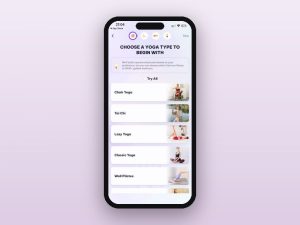
The word “yoga” covers practices with almost nothing in common. If you have a specific complaint, the style matters more than the platform.
| If your main problem is | Look for | Avoid | Session length |
|---|---|---|---|
| Waking at night, racing mind | Restorative, yin, yoga nidra | Power flow late in the evening | 15 to 25 minutes |
| Anxiety, short fuse | Slow hatha with long exhales, breathwork | Fast transitions, competitive cueing | 10 to 20 minutes |
| Stiffness, morning aches | Gentle vinyasa, hatha, mobility-led flows | Long static holds only | 20 to 30 minutes |
| Hot flushes, heat intolerance | Cooling, room-temperature practice | Hot yoga of any kind | Any |
| Sore wrists, shoulders or knees | Chair yoga, or an app that excludes poses | Plank-heavy and weight-bearing flows | 15 to 25 minutes |
| Pelvic floor awareness | Breath-led practice, supported bridge work | Repeated deep core bracing | 10 to 20 minutes |
How do the best yoga platforms compare?
| Library | Mind-body support (70% of rank) | Usability (30% of rank) | Overall score | Price | Best for |
|---|---|---|---|---|---|
| Alo Wellness Club | 9 | 8 | 7.7 | Free with Alo Access | Breadth without paying |
| Yoga With Adriene | 9 | 8 | 6.8 | Free, app $12.99 | Starting again after time off |
| Down Dog | 8 | 9 | 6.0 | $12.99 a month | Practising around a sore joint |
| Daily Yoga | 8 | 6 | 5.9 | Free tier | A gentle, guided start |
| Asana Rebel | 7 | 6 | 5.2 | Around $19.99 | Yoga-flavoured fitness |
Which yoga platforms score highest?
Alo Wellness Club: the broadest library, and it now costs nothing
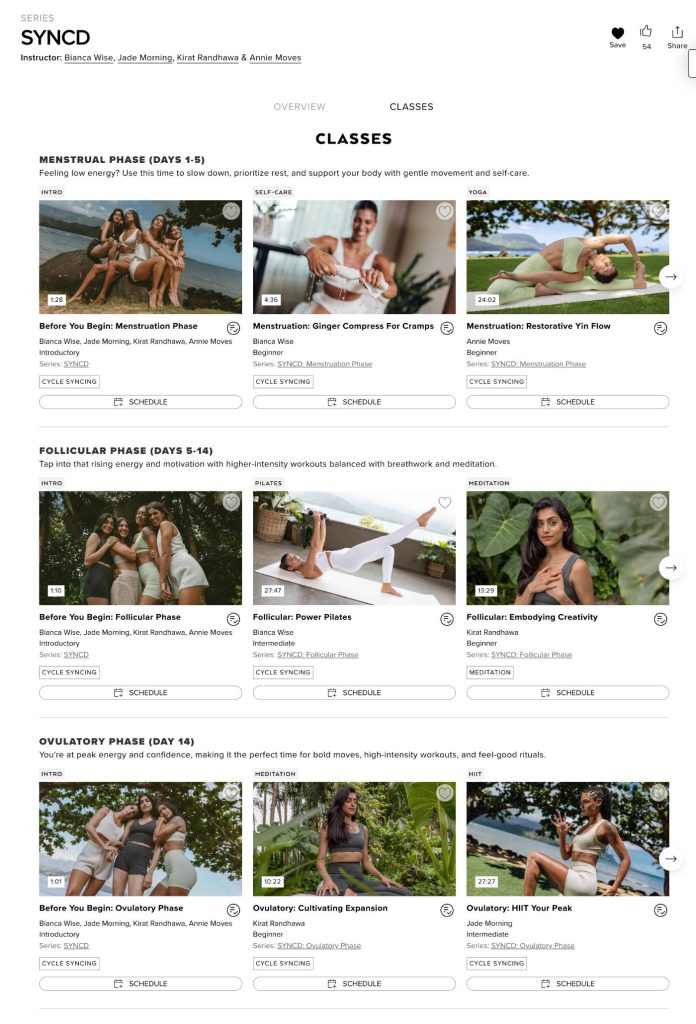
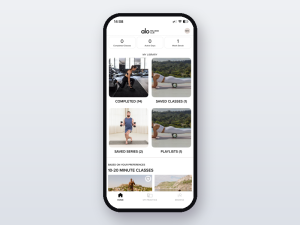
Alo Moves became Alo Wellness Club and, unusually for this industry, got cheaper rather than dearer: the library is now free with an Alo Access account. It scores 9 on mind-body support, the joint highest here, and pairs that with genuinely good production and navigation.
What that buys you in practice is range. There is enough restorative and yin for a bad-sleep week, enough gentle vinyasa for a stiff morning, and enough length variety to fit a real diary. For a symptom set that changes month to month in perimenopause, range is the single most useful property a library can have.
The catch is that yoga is no longer the whole story. The catalogue has expanded into Pilates, strength and recovery, so a purist will find the yoga sitting alongside a lot of other things. For most women that is a feature rather than a fault, because the strength content is exactly what a yoga habit needs next to it.
Best for: breadth, and anyone who wants a serious library without a subscription. Less good for: someone who wants a single teacher’s voice and a clear path through. Read the full Alo Wellness Club review.
Yoga With Adriene: the warmest teaching anywhere
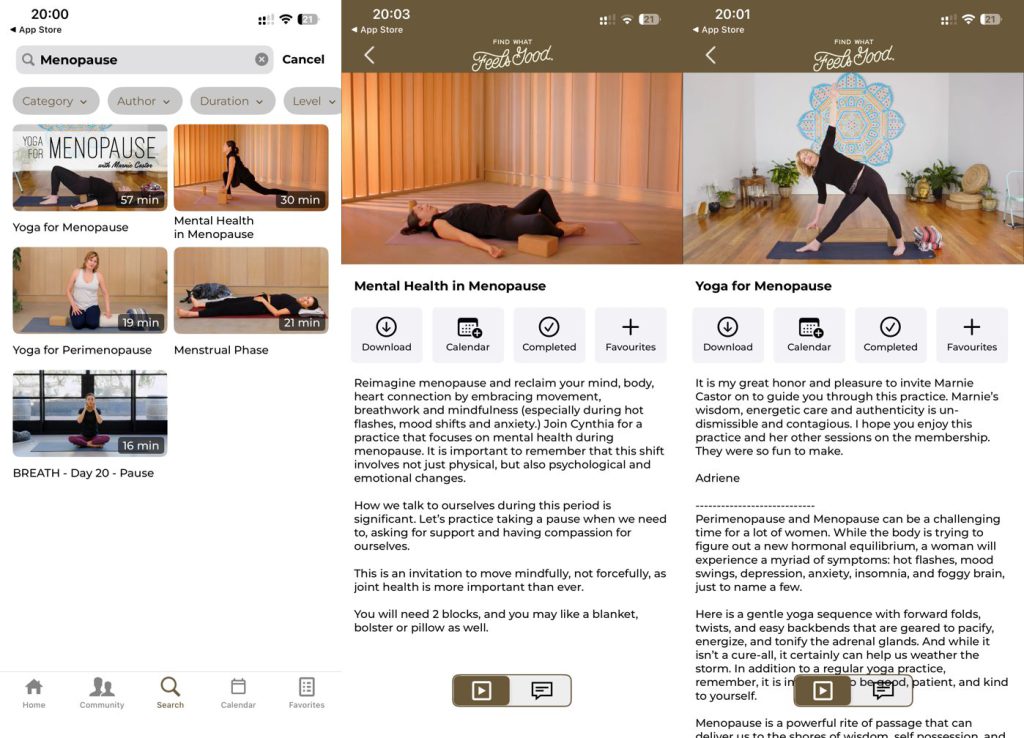
Adriene Mishler’s Find What Feels Good is the most recommended yoga on the internet for a reason, and it matches Alo at 9 on mind-body support. The teaching tone is the differentiator: permissive, unhurried, and unusually good at making a beginner feel welcome rather than behind.
That matters more in midlife than it sounds. The most common reason women stop practising is not difficulty, it is feeling out of place. A teacher who repeatedly gives you permission to do less is a teacher you keep going back to.
The weakness is structure. YouTube is a library, not a programme, and the annual 30-day series only partly fills that gap. If you want to be told what to do on a Tuesday in week six, this is the weakest option here for that.
Best for: restarting after time away, and anyone who has bounced off harder styles. Less good for: people who need a plan rather than a catalogue. Read the full Yoga With Adriene review.
Down Dog: the one that bends around your body
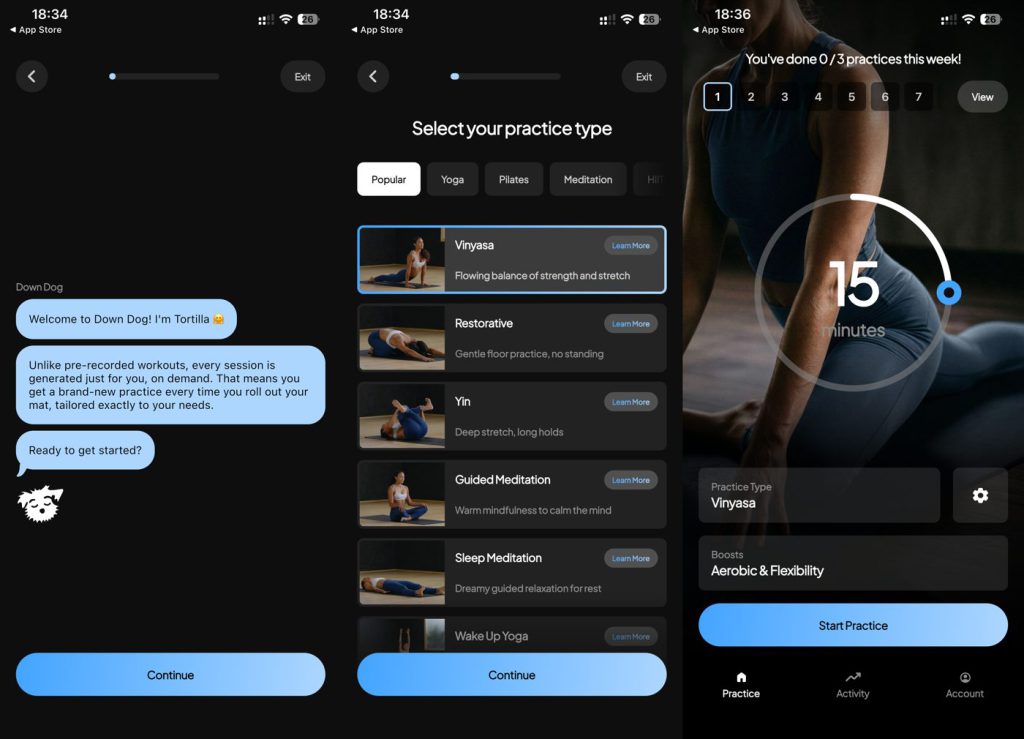
Down Dog generates a practice rather than serving a recorded class. You set the length, the pace, the style and the focus, and it builds the sequence. That is why it earns 9 on usability, the highest on this page.
For perimenopause specifically, that flexibility is worth more than it first appears. A body that varies week to week benefits enormously from being able to say “20 minutes, gentle, no wrists today” and get a sensible practice back. No recorded library can do that.
The trade-off is human warmth. Generated sequences with a synthesised voice will never feel like a teacher who knows you, and some women find that hollow over months rather than weeks.
Best for: practising around a sore shoulder, wrist or knee. Less good for: anyone who practises for the teaching as much as the movement. Read the full Down Dog review.
Daily Yoga: gentle and structured, and it stays in its lane
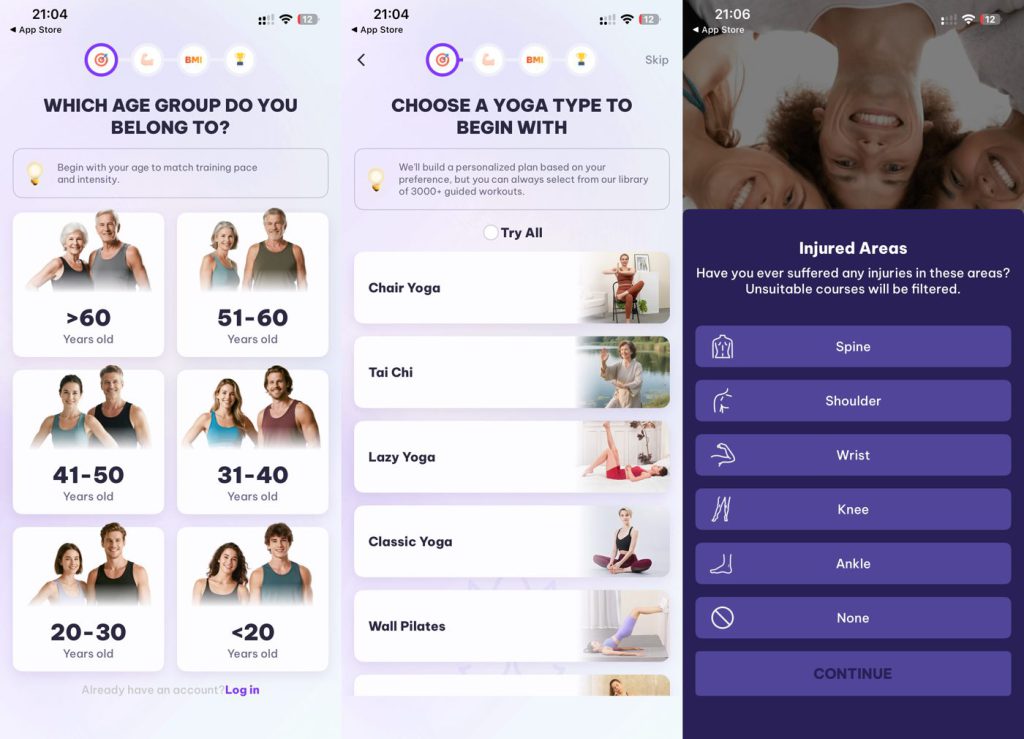
Daily Yoga is a large, calm library with meditation woven through it and a free tier that is genuinely usable rather than a trailer for the paid one. It scores 8 on mind-body support, which is why it is here.
It is also the clearest illustration of this category’s ceiling. It does very little for strength or bone, its usability lags the others at 6, and its overall score of 5.9 reflects a platform that is good at one thing and untroubled by the rest. That is a legitimate choice, as long as you know you are making it.
Best for: a gentle guided start at no cost. Less good for: anyone who wants their yoga app to also cover strength. Read the full Daily Yoga review.
Asana Rebel: polished, and only loosely yoga
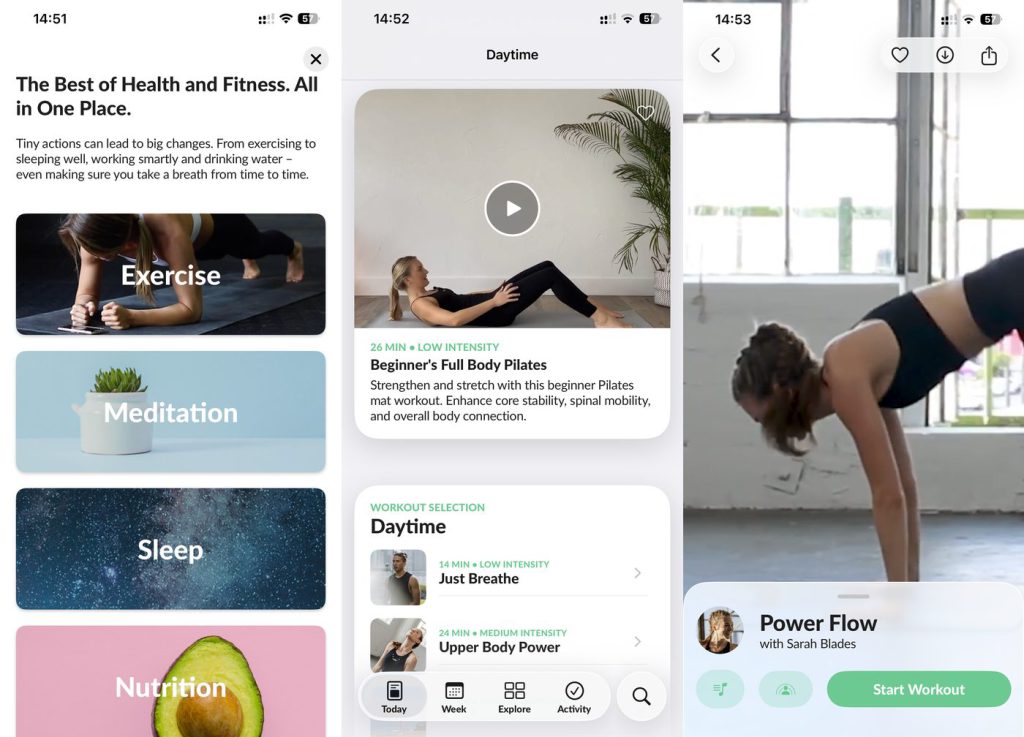
Asana Rebel is yoga-inspired fitness rather than yoga: expect flows blended with bodyweight conditioning in a well-made app. It clears the bar at 7 on mind-body support, but it is the weakest fit here for anyone who came looking for a traditional practice.
It is also the most expensive on this page at around $19.99 a month, against a free option at the top of the list, and its overall score of 5.2 is the lowest of the five. It stays on the list because the mind-body content genuinely clears our floor, not because we would push you towards it.
Best for: someone who wants the aesthetic of yoga with more sweat. Less good for: sleep, stress and restorative work, which is what most women come to yoga for in midlife. Read the full Asana Rebel review.
A 20-minute evening sequence for a perimenopausal body
You do not need an app to start. If your main complaint is sleep or a racing mind, this is a sequence you can do tonight on a rug, and it uses the long-hold, breath-led pattern that carries the sleep evidence.
- Child pose, 3 minutes. Knees wide, forehead down. Breathe into the back of the ribs and make the exhale longer than the inhale.
- Cat cow, 2 minutes. Slow, following the breath rather than a count. This is where morning stiffness starts to release.
- Thread the needle, 2 minutes each side. For the upper back and shoulders, which take the brunt of desk work and poor sleep.
- Low lunge, 2 minutes each side. Hips and hip flexors, gently. Use a cushion under the back knee.
- Supported bridge, 4 minutes. A block or firm cushion under the sacrum. This is the pose most women report as the one that switches something off.
- Reclined butterfly, 3 minutes. Soles together, knees supported so nothing has to hold itself up.
- Legs up the wall, 5 minutes. The single most useful pose in this list for a nervous system that will not settle.
Long holds and slow breathing matter more than the exact shapes. If a pose hurts rather than stretches, come out of it.
Worth checking next: dedicated yoga platforms not yet reviewed
This page ranks what we have assessed, and we would rather show you a short accurate list than pad it. Several dedicated yoga platforms are in our review queue and are not represented above.
Glo is the most significant omission. It is a long-established yoga and Pilates platform with a deep teacher roster and a genuinely serious catalogue, and it is currently working through our review process. Yoga International is similar in position: a large, teaching-led library with more depth in philosophy and technique than most of the apps here. Yoga With Kassandra is worth naming separately because her yin and morning practice work is well regarded and closely matched to what this page recommends for sleep.
Outside our queue, Y7 and various studio-brand subscriptions serve a hotter, more vigorous audience than this page is written for, which is why they are not a priority for us.
We will add these to the ranking when their reviews publish rather than listing them now on reputation. If any of them would change the order, the order will change.
Which yoga platform is right for you?
- You want the most for nothing: Alo Wellness Club, then Yoga With Adriene.
- You are coming back after months or years off: Yoga With Adriene.
- Something hurts this week: Down Dog, and build the practice around it.
- You want to be told what to do: Daily Yoga for structure, Alo for range.
- Your main problem is sleep: any of them, practised in the evening, restorative or yin.
- You want to sweat: Asana Rebel, but read the bone section below first.
What will yoga not do for you after 40?
This is the part most yoga pages leave out, and it is the reason this page does not simply tell you to do more yoga.
Yoga is light loading by definition. The two things falling oestrogen takes fastest are bone density and muscle mass, and neither responds well to bodyweight flows. Cramer’s meta-analysis is useful here precisely because it found yoga comparable to other exercise rather than superior to it.
The most direct evidence comes from Zhou and colleagues, writing in the Journal of Sport and Health Science in 2026. They reviewed 74 studies covering 5,331 postmenopausal women and compared exercise types for their effect on bone mineral density. The most effective approach was mind-body exercise combined with resistance training, which outperformed single-modality approaches at the lumbar spine, femoral neck and total body.
That is a genuinely useful finding, and it is not an argument against yoga. It is an argument against yoga alone. The combination beat either component, so the practical answer is not to abandon your practice but to stop asking it to do everything. Our bone density guide covers what loading actually looks like.
How does yoga fit alongside the rest of a midlife training week?
A realistic week for a woman in perimenopause who wants to keep yoga central:
- Two strength sessions, 30 to 45 minutes, progressively loaded. This is the non-negotiable part. See our low-impact strength training rankings.
- Two to three short yoga sessions, 15 to 30 minutes, at least one of them restorative and in the evening.
- Daily walking, because it is weight bearing and costs nothing.
- One genuinely restful day, which in perimenopause is training, not the absence of it.
If that looks like a lot, cut the yoga before you cut the strength work. It is the harder thing to replace.
Why some popular platforms did not make this list
Three kinds of platform were considered and excluded, and the reasoning matters more than the names.
Pilates platforms. Melissa Wood Health, Lindywell and FORM all score as well or better on mind-body support than programmes we have listed. All three are Pilates platforms with some yoga rather than yoga platforms, and putting them here would make this a general mind-body list wearing a yoga title. If Pilates is what you want, our Pilates rankings assess them properly.
General platforms with a yoga shelf. Fabletics Fit carries a yoga tag but mentions yoga, Pilates and barre in almost equal measure in its own review. Peloton, FitOn and iFit all have yoga libraries of reasonable quality attached to something that is not primarily a yoga product. A woman searching for yoga is not well served by being sent to a cycling platform that also does yoga.
Platforms that failed on usability rather than content. Our ranking blends usability in at thirty per cent precisely because a library you find frustrating is a library you abandon. No platform was excluded on this basis alone, but it is why the order is not simply a list of the biggest catalogues.
The gate was applied from each platform’s own review text rather than from its category tag, because the tag over-includes: sixteen programmes carry a yoga tag and several are general apps. Tags are convenient and they are not evidence.
How did we rank these five?
Two filters, applied in order.
The gate is whether it is genuinely a yoga library. We adjudicated that from each platform’s own review rather than from its category tag, because the tag over-includes: sixteen programmes carry a yoga tag and several are general platforms with a yoga shelf. Fabletics Fit is the clearest example, mentioning yoga, Pilates and barre almost equally, and it is excluded for that reason rather than for its score.
The ranking is 70% mind-body support and 30% usability. Mind-body support is the capability that matches what the yoga evidence supports, and it is independent enough from our general menopause-fit score that this page does not simply reproduce our menopause rankings. Usability is blended in because a platform that gets the content right and is unpleasant to use does not get practised.
Near misses worth naming. Melissa Wood Health, Lindywell and FORM all score as well or better on mind-body support than some programmes on this list, and all three are excluded as Pilates platforms rather than yoga ones. If Pilates is what you actually want, our Pilates page ranks them properly. Barre platforms are excluded on the same principle.
What is not here yet. Several dedicated yoga platforms are still working through review and will be added when they publish. A short accurate list beats a padded one.
Where is the evidence still evolving on yoga and menopause?
We have been deliberate on this page about separating what is established from what is plausible, and it is worth marking the boundary explicitly.
Reasonably established: yoga improves sleep quality in menopausal women, and improves depression and anxiety scores, with moderate to large effect sizes across pooled mind-body research. Yoga also reduces overall menopausal symptom scores compared with doing nothing.
Genuinely contested: whether yoga does anything specific for hot flushes. The meta-analytic answer and the best single trial disagree, and the disagreement traces to what yoga was compared against. Until there are more trials using active control groups, the fair position is that yoga is unlikely to be a targeted vasomotor treatment.
Largely untested: yoga for menopausal joint pain specifically. The mechanism is obvious and the anecdotal reports are consistent, but the trials have not been done in this population. Everything this page says about stiffness is inference plus reported experience, and we have flagged it as such rather than borrowing authority from unrelated studies.
Where we would change our minds: a well-powered trial of restorative yoga against an active control, measuring sleep and joint symptoms in perimenopausal women specifically, would settle most of the open questions here. If it lands and it contradicts this page, we will rewrite the page.