Peloton scores higher overall, 7.3 against 6.4, and is the stronger platform for building muscle and menopause-stage suitability. iFIT is the better pick if what you need most is nutrition guidance and a structured programme.
Quick answer
- Peloton 7.3 vs iFIT 6.4
- Peloton wins 7 of 9 criteria
- iFIT wins structure and nutrition
- Peloton $15.99/mo, 30-day trial
- iFIT $15/mo, no usable free trial
- Both offer app-only plans
Peloton is the better choice for most women over 40. It wins seven of the nine weighted criteria, including the two that matter most in midlife: muscle potential, the heaviest-weighted criterion at 18%, and joint friendliness. It is also the only large platform in our library with genuine menopause programming, scoring 8 out of 10 there against iFIT’s 1.
iFIT is the better choice in three situations. If you already own a NordicTrack or ProForm machine, if scenic walking and hiking is the thing that will actually get you moving, or if you want a structured multi-week programme to follow rather than a class library to browse. iFIT wins programme structure, 7.5 against 6.5, and nutrition integration, 5 against 2.

Peloton, for most women over 40, and the margin is not close on the things this site exists to measure. It scores 7.5 on Muscle Potential against iFIT’s 5, 9 on Joint Friendliness against 8, and 6 on Women Over 40 Specificity against 4.2. iFIT is a strong scenic cardio product that has not been built with midlife women in mind.
Before you sign up to iFIT, know this. Peloton offers a 30-day free trial. iFIT has no usable free trial: a card is required up front and the subscription auto-renews. Billing and cancellation are the dominant themes in user complaints about iFIT, covering trials that auto-convert, difficulty cancelling and refused refunds. That is not a reason to rule it out, but it is a reason to set a calendar reminder before the first renewal, and to cancel at ifit.com/cancel rather than expecting to do it in the app.
iFIT vs Peloton: the two platforms
Same nine weighted criteria, same twelve capability scores, same scale. One difference in how the two were assessed, which we set out in full in the next section.
Peloton
Winner
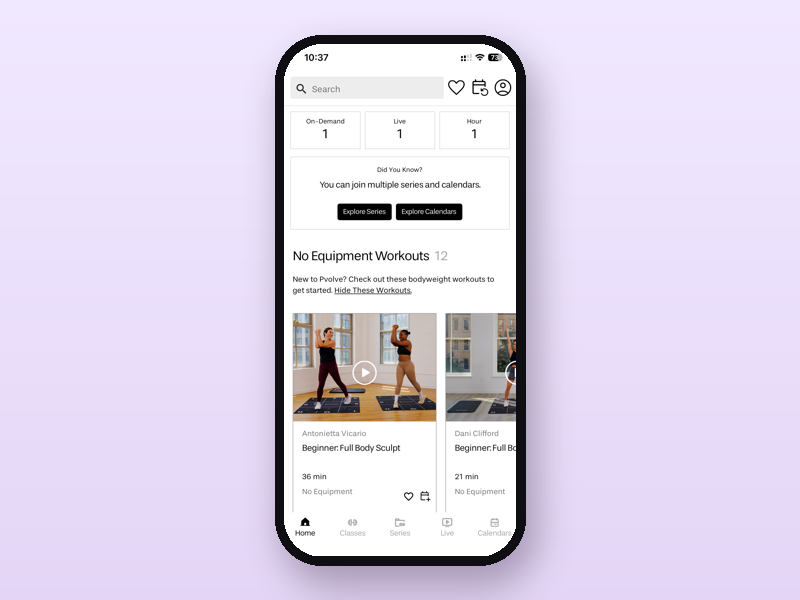
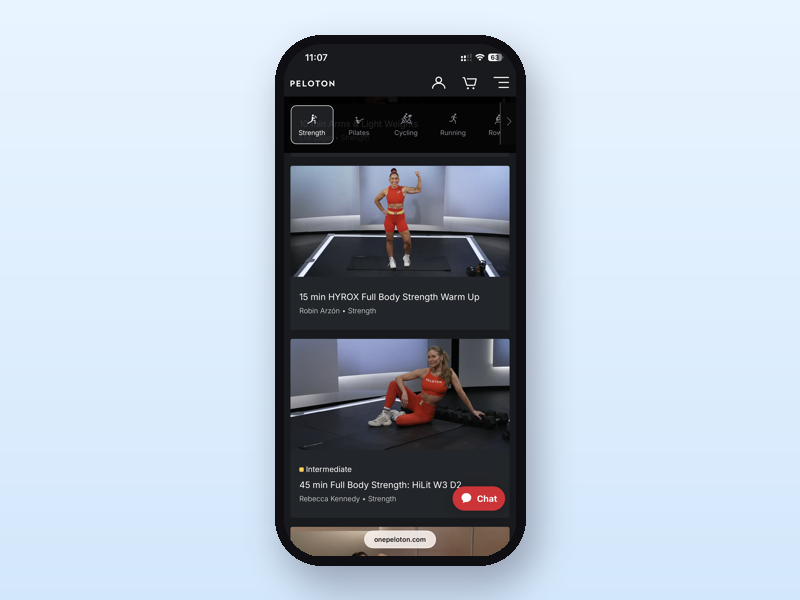
A very large live and on-demand class library across cycling, strength, running, yoga, Pilates and meditation, usable with no equipment at all.
- No equipment needed
- 20 to 45 min typical
- Menopause content
- 30-day free trial
- Optional hardware
Choose Peloton if you:
- Want the strongest menopause-aware content of any large platform we have assessed
- Want strength that actually progresses, not strength as an afterthought to cardio
- Have joint issues and want the full range from very low impact to high available in one place
- Want to try before you pay, properly, for 30 days
- Prefer a class library you browse over a programme you follow
iFIT
Runner-up
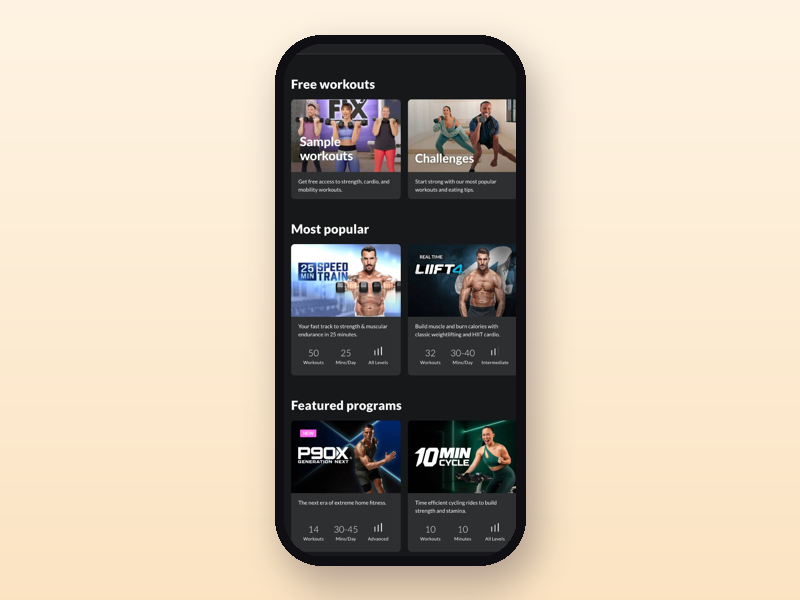
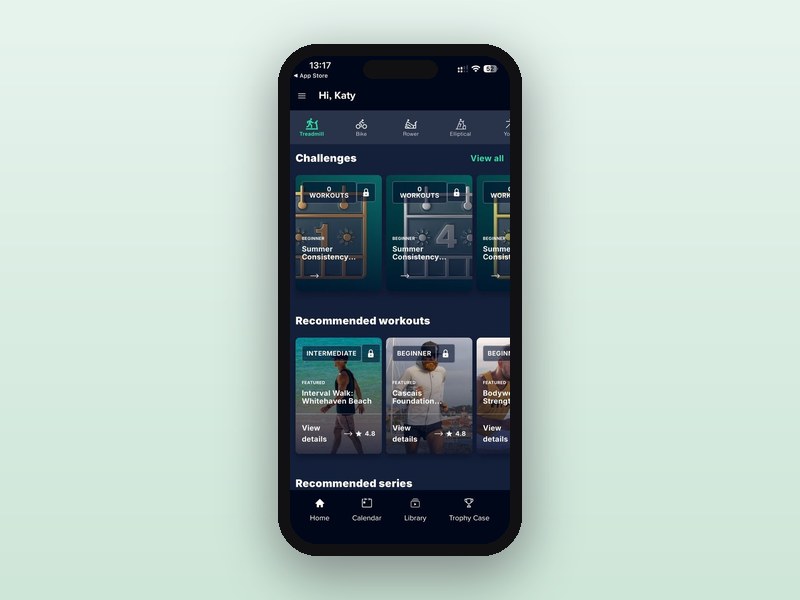
A trainer-led, machine-connected platform with more than 10,000 workouts, best known for scenic global walking, hiking and running sessions that auto-adjust a compatible machine.
- App or machine
- 10 to 60 min
- Scenic global routes
- No usable free trial
- Strong structure
Choose iFIT if you:
- Already own a NordicTrack or ProForm machine, where the auto-adjust experience is the whole point
- Find scenic walking and hiking sessions more motivating than a studio class
- Want a structured multi-week programme rather than a library to browse
- Want some nutrition guidance included rather than almost none
- Are training at low to moderate impact and are not looking for menopause-specific content
How we scored this, and why the two were assessed differently
These two platforms were not assessed the same way, and you should know that before you read a single score. Peloton was fully tested: Katy used the platform herself and the review reflects hands-on use. iFIT is a research-based data profile: iFIT gates its full library behind a paid subscription with no meaningful free trial, so the app was browsed rather than worked through. Where a rating genuinely needed hands-on time to be fair, that is flagged on the iFIT review itself.
What testing Peloton actually looked like. Katy tested it over four weeks, mixing classes across strength, yoga, walking and running, using her own treadmill for the cardio content and a single pair of 17 lb dumbbells for strength. She is in her early 40s, perimenopausal, working full-time with children, with a history of a meniscus injury and a training background in HIIT and dumbbells. That is the lens the Peloton scores on this page were set through, and it is worth knowing whose week they were tested against.
This matters most in one direction. A data profile can assess what a platform contains, how it is structured, what it costs and what it claims. It is weaker at assessing how a session actually feels, whether the coaching cues land, and whether the thing is pleasant enough to keep opening in week six. So treat iFIT’s UX and Design score of 7 as the least certain number on this page.
Both platforms are scored on the same nine criteria, weighted the same way. The weights are ours and they are deliberate: Muscle Potential carries the most weight at 18%, because preserving lean mass through the menopause transition is the single highest-value thing a training programme can do for a woman in this age group. Time Efficiency is 15%, because the most common reason a programme fails is that the sessions are longer than the life around them.
Alongside the nine criteria, every programme carries twelve capability scores out of 10. Those are the ones that separate a general fitness brand from a midlife one: menopause programming, menopause education, hormone awareness, pelvic floor, bone loading, midlife nutrition, and so on. On this pair the capability scores are where the real story is, and they are considerably less flattering to iFIT than the headline number suggests.
Perimenopause and menopause fit: Peloton wins, and it is not close
Peloton wins, scoring 6 on Women Over 40 Specificity against iFIT’s 4.2. On the underlying capability scores the gap is wider still. Peloton scores 8 out of 10 for menopause programming, 7 for hormone awareness and 6 for menopause education. iFIT scores 1 on all three.
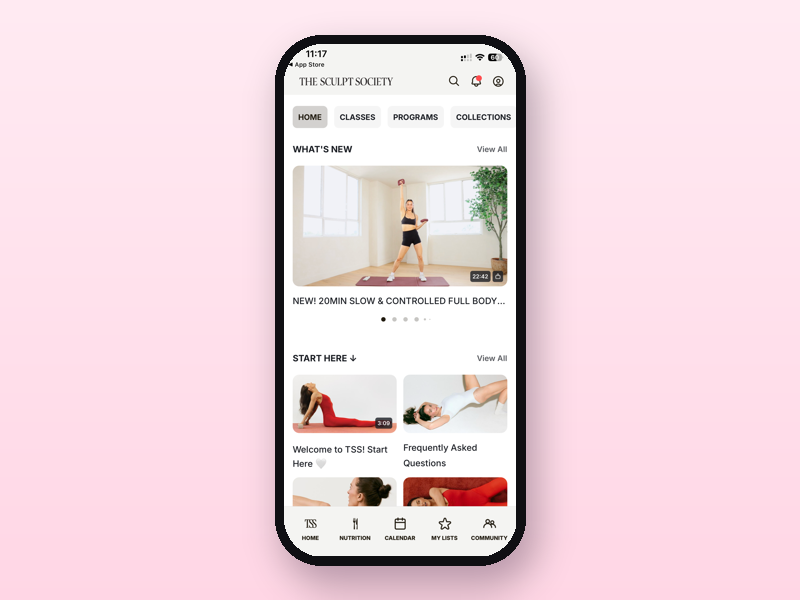
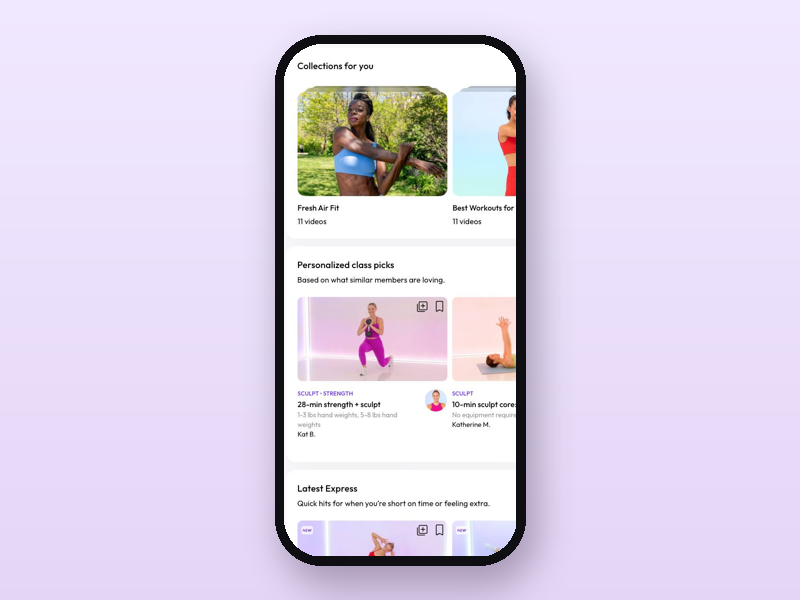
Katy went into the Peloton test expecting to be underwhelmed, on the reasoning that the louder a fitness brand markets itself, the thinner the substance tends to be for women who are not the default athletic 28-year-old. What she found instead was a curated Menopause Collection of 20-minute sessions built around this life stage: low-impact rides, hikes, endurance work, bodyweight strength and kettlebell. Not a token class buried three menus deep, an actual set. That finding is the reason Peloton’s menopause programming score is 8 rather than the 3 or 4 most large platforms earn, and it changed how the rest of the platform was evaluated.
A score of 1 is not a rounding-down of a modest offering. It means the platform has no menopause programming, no menopause education and no hormone-aware content at all. iFIT’s own review records it plainly: not menopause-built, no menopause programming, no pelvic floor work, no menopause education.
Why this is the criterion that separates them
Wright and colleagues describe a cluster of musculoskeletal changes associated with the menopause transition, including effects on tendon and ligament integrity and a raised injury risk.1 Maltais and colleagues document accelerated loss of muscle mass and strength through the same window.2 Neither of those is a reason to train less. They are reasons that what you train, and how it progresses, matters more in this decade than it did in the last one.
A platform can respond to that in two ways. It can build content that names the transition and programmes around it, which is what Peloton has done. Or it can offer a large general library and leave the reader to work out which parts apply, which is what iFIT does. The second is not worthless. It is simply not the same product.
Pelvic floor: Peloton is better, both are thin
Peloton scores 4 out of 10 for pelvic floor support, iFIT scores 1. Neither has a structured pelvic floor programme. Peloton’s advantage is that pelvic floor is at least mentioned within some of its postnatal and women’s health content, so the topic exists on the platform. On iFIT it does not appear at all.
This matters more on a cardio-led platform than it might elsewhere. Teixeira and colleagues report a 36% prevalence of urinary incontinence across female athletes in a systematic review and meta-analysis.3 That review did not separate high-impact from low-impact sport, so we do not claim that it did, and we are not going to tell you what your symptoms are. What we will say is that if this is something you are managing, neither platform contains a programme for it, and you would be looking at a dedicated app alongside either one.
What this means for your decision
If menopause-specific content is what you are shopping for, Peloton is the only one of these two that has any. If you have no interest in that framing and simply want good cardio, this criterion should not decide your choice, and you can weight the next few sections more heavily.
Peloton pros and cons
Peloton scores 7.3. It is strongest on joint-friendly training and weakest on nutrition guidance.
Pros
- The strongest menopause content of any large platform we have assessed.
- Highest Time Efficiency score on this page at 9.
- Full impact spectrum from very low to high in one subscription.
- Genuine 30-day free trial.
- Works with no equipment at all.
- Expert credibility 8 out of 10.
Cons
- Nutrition integration is the weakest score on the page at 2.
- Programme structure is its lowest criterion of the nine, at 6.5, because it is a library first and a programme second.
- Midlife nutrition capability is 2 out of 10.
- The hardware is expensive if you want it.
iFIT pros and cons
iFIT scores 6.4. It leads on joint-friendly training and trails on suitability for women over 40.
Pros
- Best low-impact capability score on this page at 9 out of 10.
- Scenic global routes that people genuinely keep coming back to.
- Strong programme structure at 7.5, the one criterion where it beats Peloton on training design.
- Mind-body support 8 out of 10.
- More than 10,000 workouts.
Cons
- No menopause programming, education or hormone awareness, all scored 1 out of 10.
- Expert credibility 3 out of 10, with no named clinician.
- No usable free trial and a card required up front.
- Billing and cancellation are the dominant user complaints.
- Value for Money 5.5, the lower of the two.
Quick yes/no comparison
| Feature | Peloton | iFIT |
|---|---|---|
| Usable without buying equipment | Yes | Yes |
| Free trial you can actually use | Yes, 30 days | No |
| Menopause-specific programming | Yes | No |
| Menopause education content | Yes | No |
| Structured pelvic floor programme | No | No |
| Progressive strength programming | Partly | Partly |
| Structured multi-week programmes | Partly | Yes |
| Nutrition guidance included | No | Partly |
| Scenic outdoor-style cardio | Yes | Yes, the strongest we have seen |
| Sessions under 15 minutes | Yes | Yes |
| Live classes | Yes | Partly |
| Auto-adjusting connected machine | Yes, Peloton hardware | Yes, NordicTrack and ProForm |
| Named clinical expert | No | No |
iFIT vs Peloton at a glance
| Peloton | iFIT | |
|---|---|---|
| Overall score | 7.3 | 6.4 |
| How it was assessed | Fully tested | Research-based data profile |
| US cost | $15.99/mo App One, $28.99/mo App Plus, $9.99/mo Strength+ | $15/mo or $144/yr app-only, Pro $39/mo or $396/yr for up to 5 users |
| Free trial | 30 days | None usable, card required, auto-renews |
| Session length | 20 to 45 min typical | About 10 to 60 min |
| Equipment needed | None. Optional Bike from about $1,445, Tread from about $2,495, Row from about $3,195 | None for app-only. An iFIT-compatible machine for the auto-adjust experience |
| Impact level | Low to high, full spectrum | Low to moderate |
| Who makes it | Peloton Interactive | ICON Health & Fitness / iFIT, parent of NordicTrack and ProForm |
| Menopause content | Yes, the strongest of any large platform we have assessed | None |
iFIT vs Peloton: the full scoring breakdown
Peloton wins seven of the nine weighted criteria. iFIT takes Programme Structure and Nutrition Integration. Scores are pulled live from each programme’s own assessment, so this table updates when the assessment does.
| Criterion | Weight | Peloton | iFIT | Winner |
|---|---|---|---|---|
| Muscle Potential | 18% | 7.5 | 5 | Peloton |
| Time Efficiency | 15% | 9 | 7.5 | Peloton |
| Joint Friendliness | 12% | 9 | 8 | Peloton |
| Programme Structure | 12% | 6.5 | 7.5 | iFIT |
| Women Over 40 Specificity | 10% | 6 | 4.2 | Peloton |
| Recovery Compatibility | 10% | 8.5 | 7.5 | Peloton |
| Value for Money | 8% | 7 | 5.5 | Peloton |
| UX and Design | 8% | 7.8 | 7 | Peloton |
| Nutrition Integration | 7% | 2 | 5 | iFIT |
| Overall | 100% | 7.3 | 6.4 | Peloton |
The twelve capability scores
Peloton wins seven of the twelve, iFIT wins four, one is tied. These are scored out of 10 and they are where a general fitness platform and a midlife-aware one come apart. Read the middle four rows first: they are the four where the gap is widest.
| Capability | Peloton | iFIT | Winner |
|---|---|---|---|
| Low-impact | 8 | 9 | iFIT |
| Progressive strength | 5 | 4 | Peloton |
| Bone loading | 5 | 4 | Peloton |
| Recovery & deload | 6 | 7 | iFIT |
| Menopause programming | 8 | 1 | Peloton |
| Pelvic floor | 4 | 1 | Peloton |
| Hormone awareness | 7 | 1 | Peloton |
| Menopause education | 6 | 1 | Peloton |
| Expert credibility | 8 | 3 | Peloton |
| Mind-body support | 7 | 8 | iFIT |
| Beginner on-ramp | 6 | 6 | Tied |
| Midlife nutrition | 2 | 4 | iFIT |
The hardware question: app-only, or app plus machine?
If you are not buying a machine, this comparison is close to even on cardio and Peloton wins everywhere else. Both platforms have a genuine app-only plan that works on a phone, tablet or computer with nothing but a mat. Peloton’s App One is $15.99 a month, or from £12.99 a month in the UK, and iFIT’s app-only Train tier is $15 a month or $144 a year. On price alone there is very little in it. No equipment is required on either: a phone, tablet or computer is sufficient.
If you already own a NordicTrack or ProForm, iFIT changes character completely. Those machines are made by iFIT’s parent company, and the auto-adjust experience, where the trainer’s route changes your incline and resistance without you touching anything, is the reason the platform exists. No app subscription reproduces that. If you own one of those machines, iFIT is the natural choice and this comparison is largely academic.
If you are buying a machine from scratch, the price gap is the point. Peloton hardware starts at about $1,445 for the Bike, about $2,495 for the Tread and about $3,195 for the Row. NordicTrack and ProForm machines generally sit below Peloton on price for a comparable category. We have not tested either manufacturer’s hardware, so we are not going to rate build quality, and you should read hardware reviews elsewhere before spending that much.
Our tester used Peloton without any of that hardware for four weeks. She mixed and matched rather than following a fixed programme, and she trained consistently without aggravation across the month, which is the outcome that matters most if a joint is setting your terms.
What this means for your decision. The machine decision should come first and the subscription second, not the other way round. Buying a machine because you liked the app is how people end up with expensive clothes racks.
Joint friendliness: Peloton wins on the score, iFIT wins on low-impact capability
Peloton wins, 9 against 8. But the capability scores point the other way: iFIT scores 9 out of 10 for low-impact against Peloton’s 8. Both things are true, and the difference between them is worth understanding.
Why the two numbers disagree
Low-impact capability asks a narrow question: how well does this platform serve someone who cannot tolerate impact? iFIT wins that, because scenic walking, hiking, cycling and rowing are its core, and its whole range sits at low to moderate impact.
Joint Friendliness is broader. It asks whether the platform gives you control over impact across a full range, whether it offers genuine alternatives when something hurts, and whether the coaching acknowledges that some days are different. Peloton wins that, because its range runs from very low impact to high and you can move between them inside one subscription, rather than being limited to the low end by default. In testing, with a history of a meniscus injury, the modification cueing was good enough to make that range usable rather than theoretical, and the sessions sat in a normal week without leaving her wrecked the next day.
What this means for your decision
If impact is your hard limit and you want it removed from the equation entirely, iFIT is the more single-minded answer. If you want low-impact available but not compulsory, because some weeks your knee is fine and you want to push, Peloton gives you more room to move. Neither is our top pick overall in that category, and our best low-impact workouts for women over 50 ranking sets out what does win.
Muscle potential: Peloton wins, and both are lower than you might expect
Peloton wins, 7.5 against 5. This is the heaviest-weighted criterion on the page at 18%, so this gap does more work in the overall result than any other single number.
Why progressive overload matters more after 40
Progressive overload means gradually increasing the demand on a muscle so it has a reason to adapt. According to Maltais and colleagues, muscle mass and strength decline at an accelerated rate through the menopause transition.2 Mohebbi and colleagues, in an updated systematic review and meta-analysis, identify progressive resistance training as the primary non-hormonal intervention for bone mineral density after menopause.4 A separate systematic review and meta-analysis of resistance training in postmenopausal women reports improvements in menopause symptoms and functional capacity, on evidence its own authors rate as very low to low certainty.5 All three point the same way: the loading has to increase over time, and a class library that never asks more of you than it did in week one will not deliver that on its own.
What each platform actually delivers
Peloton has a substantial strength library, a separate Strength+ product at $9.99 a month, and progressive strength capability scored at 5 out of 10. In testing, the dumbbell strength classes were the most demanding thing on the platform: with a single pair of 17 lb dumbbells, some classes pushed hard enough that Katy was working at her limit by the end. That is a real ceiling, and it is higher than the score alone suggests, but it is still a ceiling set by the class rather than by a plan that adds load week on week. iFIT has strength content but it is secondary to cardio, and scores 4. Neither is a dedicated strength programme, and neither scores highly on bone loading, at 5 and 4 respectively.
What this means for your decision
The conclusion is the same for both, with a different starting point. Peloton gets you closer, and Strength+ narrows the gap further if you are willing to pay for it. If protecting muscle and bone is your main goal, a dedicated progressive strength programme will outperform either of these, and you would be using one of these platforms for the cardio alongside it. Our best workouts to build muscle after 50 ranking covers the platforms built for that job specifically.
Time efficiency: Peloton wins by the widest margin of the nine
Peloton wins, 9 against 7.5. This is its highest criterion score on the page and one of the highest we have recorded.
Both platforms have short sessions. iFIT runs about 10 to 60 minutes, Peloton typically 20 to 45 with shorter options available. The difference is not the floor, it is the filtering and the default. Peloton’s review notes that filtering by duration and type is a strength of the interface, which means the short session is easy to find on a bad week. On iFIT, the scenic sessions that are the reason to be there tend to be the longer ones, so the short option exists but it is not what the platform is showing you.
What this means for your decision. Peloton’s own review sets a minimum effective dose of three sessions of 20 to 30 minutes a week. If your realistic week is three short sessions rather than five long ones, Peloton is built for that and iFIT is not. Our 30-minute workouts for women over 40 ranking is the wider comparison if session length is your deciding factor.
Recovery compatibility: Peloton wins the criterion, iFIT wins the deload content
Peloton wins, 8.5 against 7.5. The capability score underneath it goes the other way, which is worth knowing before you treat the criterion as settled.
Recovery compatibility asks how well a platform fits a week when you are already tired, sore or short of sleep. Peloton wins it on range. Its impact runs from low to high, so a hard session and an easy one live in the same library, and the duration and intensity filters that make its time efficiency score hold up are the same filters that surface a 20-minute low-intensity ride on a flat day. iFIT sits in the low to moderate band, and its scenic walks are a good deload session in their own right, but the drop from a hard week to an easy one is a smaller drop because the ceiling is lower.
On the capability score the order reverses. iFIT takes recovery and deload 7 out of 10 against Peloton’s 6, and mind-body support 8 against 7, on the strength of a Mind section that treats rest and self-compassion as programmed content rather than as something you improvise between sessions.
What this means for your decision. If your weeks vary a lot and you want to scale a session down without leaving the app, Peloton gives you more room. If you want the easier week planned for you rather than self-selected, iFIT is the better recovery partner of the two, which is the one place its lower overall score understates it.
Value for money: Peloton wins, and the trial is most of the reason
Peloton wins, 7 against 5.5. The headline monthly prices are close, so the gap is not really about the number.
| Plan | Peloton | iFIT |
|---|---|---|
| Entry app plan | $15.99/mo App One, from £12.99/mo UK | $15/mo Train, or $144/yr |
| Upper tier | $28.99/mo App Plus | $39/mo Pro, or $396/yr, up to 5 users |
| Add-on | $9.99/mo Strength+ | None |
| Free trial | 30 days | None usable |
| Cancellation | Cancel in account settings | Cancel at ifit.com/cancel, non-refundable, active to cycle end |
If price is the deciding factor rather than fit, our best free and budget workout apps for women over 40 ranking covers the cheaper end properly. iFIT’s Pro tier covers up to five users, which is genuinely good value for a household and is the one place iFIT’s pricing clearly beats Peloton’s. Against that, iFIT requires a card before you can see the library properly, auto-renews, and has cancellation friction as a documented and recurring user complaint. Peloton lets you use it for 30 days and decide.
What this means for your decision. If you are unsure, the trial asymmetry decides it. Take Peloton’s 30 days first. If it does not suit you, you will have lost nothing, and you will know a good deal more about what you want from iFIT.
UX and design: Peloton wins, with a caveat about how iFIT was assessed
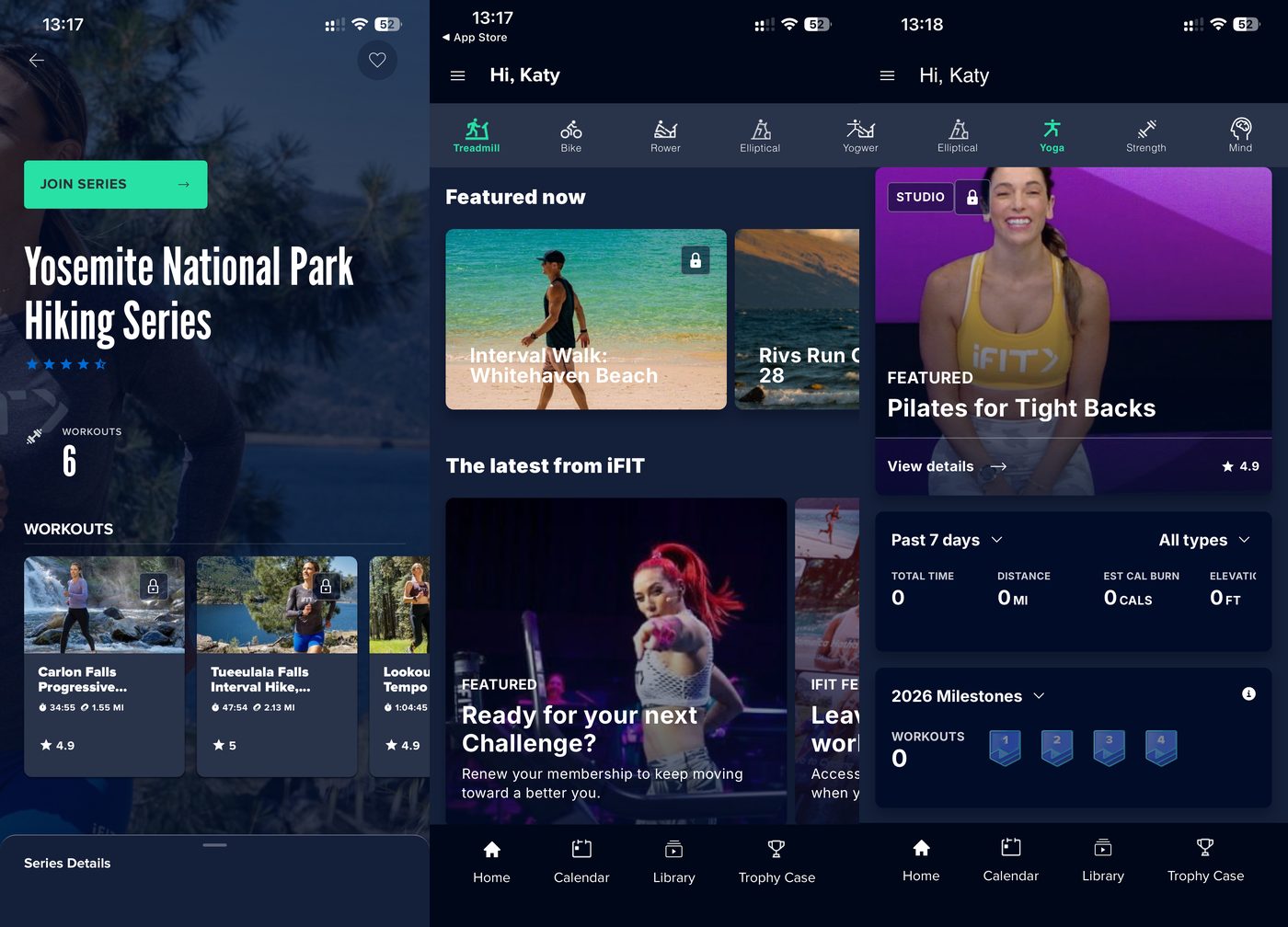
Peloton wins, 7.8 against 7. This is the score on this page we would treat with the most caution, for the reason set out earlier: Peloton was used hands-on and iFIT was browsed rather than worked through, and interface quality is exactly the thing that browsing assesses least well.
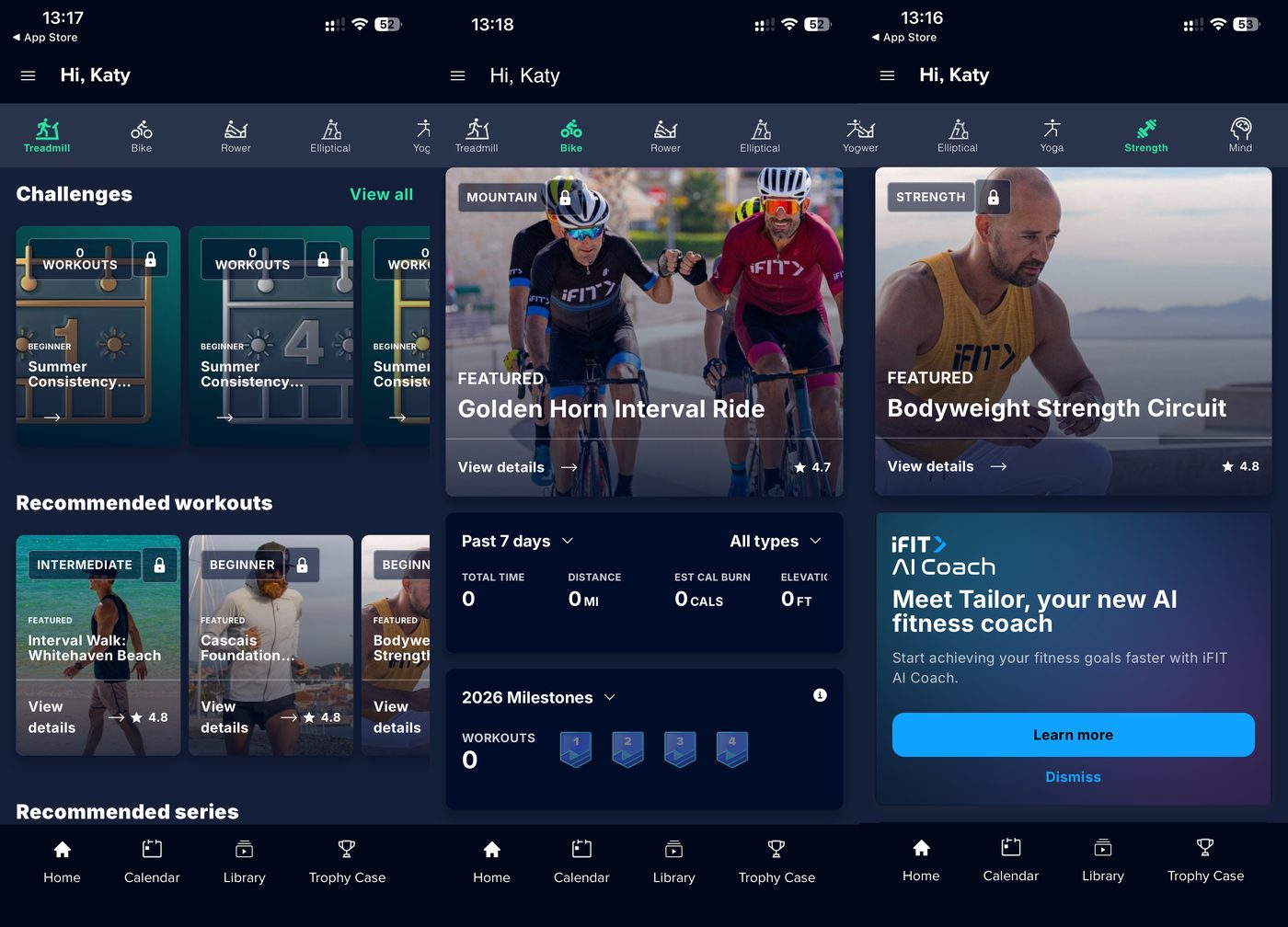
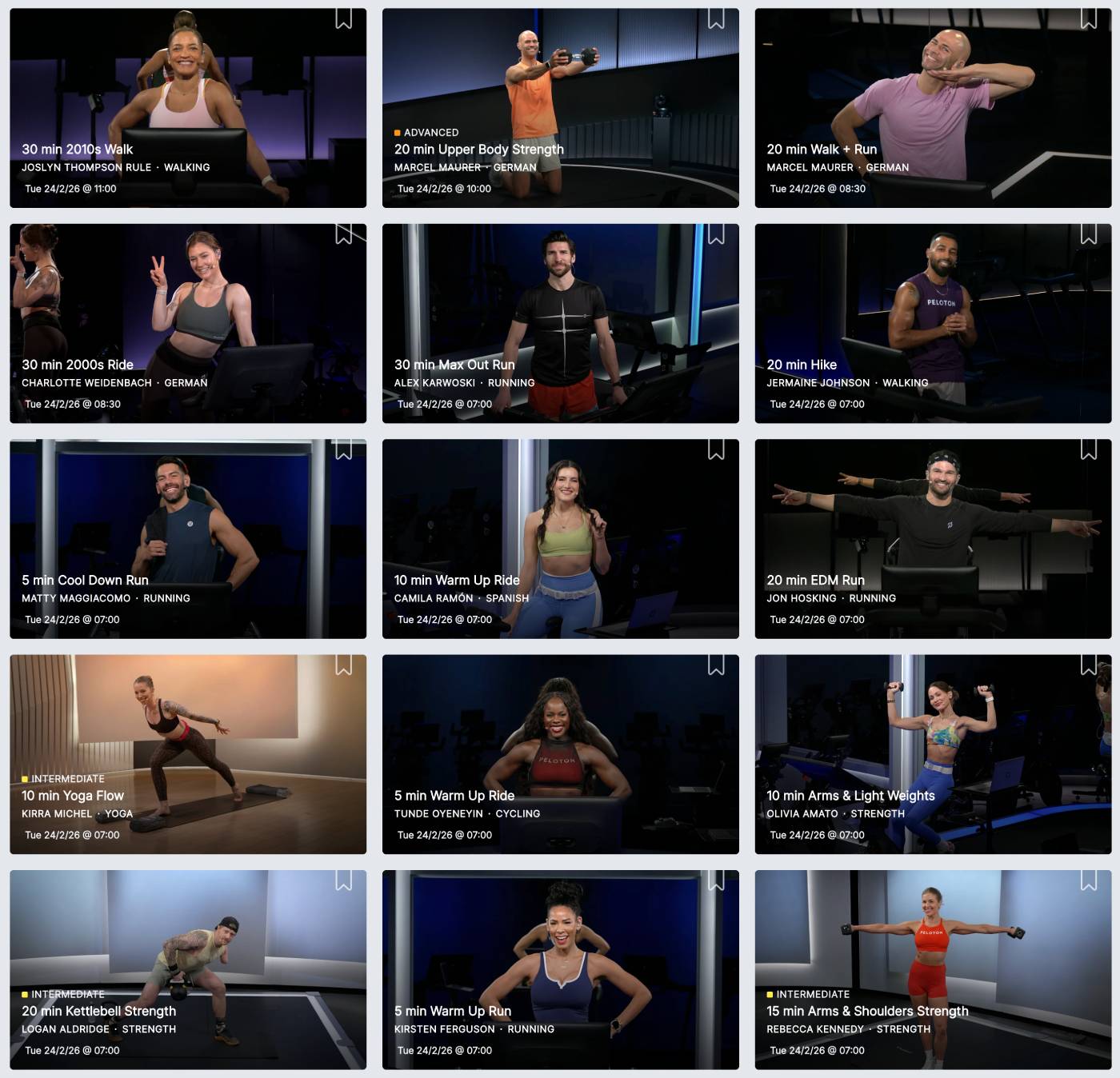
What we can say with confidence, because it was used rather than browsed, is that Peloton’s filtering by duration and type is strong, which is what makes its time efficiency score hold up in practice. Peloton IQ was the feature Katy found most useful across the four weeks. On iFIT, the scenic library is presented well and the multi-discipline home screens are clear. iFIT scores 8 out of 10 on mind-body support, its second-highest capability, which reflects a Mind section with mindfulness and self-compassion content that is better developed than most cardio platforms bother with.
Nutrition integration: iFIT wins, and both are weak
iFIT wins, 5 against Peloton’s 2. Peloton’s is the lowest score of the eighteen criterion scores on this page.
iFIT includes partial nutrition guidance and scores 4 out of 10 on midlife nutrition capability. Peloton scores 2. Neither offers meal planning, tracking or anything you could reasonably call a nutrition programme, and neither has a registered dietitian attached to what they do offer.
What this means for your decision. If nutrition support is part of what you want from a subscription, neither of these is the answer, and iFIT winning here is a narrow win in a weak field. You would be pairing either platform with something separate.
Who wins for…
Who wins for anything menopause-specific
Peloton. On the three capability scores that matter here, set out in full in the perimenopause and menopause fit section above, it leads on every one. iFIT scores 1 on all three, meaning none of it exists on the platform.
Who wins for scenic low-impact cardio
iFIT. Low-impact capability 9 out of 10, the highest on this page, and the scenic global walking and hiking series is the single best thing either platform does.
Who wins for trying before you pay
Peloton. A 30-day free trial against no usable free trial, a card required up front and auto-renewal.
Who wins for short sessions on a busy week
Peloton. 9 against 7.5 on Time Efficiency, and filtering by duration is one of its interface strengths.
Who wins for muscle and bone
Peloton. 7.5 against 5 on Muscle Potential, plus progressive strength 5 against 4 and bone loading 5 against 4. Both are lower than a dedicated strength programme.
Who wins for following a structured programme
iFIT. Programme Structure 7.5 against 6.5. Peloton is a library you browse, iFIT is more often a plan you follow.
Who wins if you already own a NordicTrack or ProForm
iFIT. The machines are made by iFIT’s parent company and the auto-adjust experience is the reason the platform exists. Nothing Peloton offers reproduces it on that hardware.
Who wins for training with no equipment at all
Peloton. Both have app-only plans, but Peloton is designed to be complete without hardware, whereas iFIT app-only is the reduced version of the product.
Who wins for pelvic floor symptoms
Neither. Peloton scores 4 out of 10 and iFIT scores 1, and neither has a structured pelvic floor programme. This is a job for a dedicated app alongside either one.
Who wins for absolute beginners over 40
Tied. Both score 6 out of 10 on beginner on-ramp. Peloton has more hand-holding in its programmes, iFIT has a gentler default intensity.
Who wins for nutrition guidance
iFIT. 5 against 2, and midlife nutrition 4 against 2. Both are weak in absolute terms.
Who wins for a household on one subscription
iFIT. The $39 a month Pro tier covers up to five users. Peloton has no equivalent family plan.
Who wins for expert credibility
Peloton. 8 out of 10 against 3. Neither has a named clinician, but Peloton’s instructor credentials and content oversight are considerably better documented.
Who wins for mind-body content
iFIT. 8 out of 10 against 7, on the strength of a Mind section with mindfulness and self-compassion series that is better developed than most cardio-led platforms bother with.
Decision tree for women over 40
You already own a NordicTrack or ProForm. iFIT. The auto-adjust experience is not reproducible and you have already paid for the hardware.
You want menopause-aware content. Peloton. It is the only one of the two that has any.
Impact is your hard limit and you will not be pushing it. iFIT, on low-impact capability of 9 out of 10, unless you also want the menopause content, in which case Peloton at 8 is close enough.
You want to follow a plan rather than choose a class. iFIT, on Programme Structure.
Your week is three short sessions, not five long ones. Peloton.
You are not sure and do not want to commit. Peloton, because you can use it for 30 days and find out.
What we did not test
Three things on this page are not based on hands-on use, and you should weigh them accordingly.
iFIT was not personally tested. For the paywall reason set out in the scoring section above, the app was browsed rather than worked through, and its scores are research-based. Peloton was fully tested, so where the two are compared on anything that only use reveals, the iFIT side is the weaker evidence.
Neither manufacturer’s hardware was tested. We have not ridden a Peloton Bike or run on a NordicTrack treadmill, so nothing on this page is a judgement on build quality, durability or after-sales service for either.
We do not publish calorie-burn comparisons for either platform. Energy expenditure varies too much between individuals for a published figure to be useful, and it is not what our scoring measures.
Which is better for women over 50?
Peloton, for most women in this group
The overall verdict holds and in some ways strengthens. The menopause content is more likely to be relevant, the full impact range is more useful when some days are worse than others, and expert credibility at 8 out of 10 against 3 matters more when you are less inclined to experiment on yourself.
The exception
If you are training primarily by walking, and you want scenery rather than a studio, iFIT’s scenic library is the better daily experience and its low-impact capability score of 9 out of 10 is the highest on this page. That is a real reason to choose it, and it has nothing to do with the menopause content neither of you will be using. Our best walking and treadmill workouts for women over 50 ranking goes further into that category, and best workouts for postmenopause covers the stage-specific question.
Women over 60 starting fresh
Either can work, and the beginner on-ramp is tied at 6 out of 10, which is moderate rather than excellent for both. Peloton’s 30-day trial makes it the lower-risk place to find out. If the first sessions feel like too much on either platform, that is information about the platform, not about you.
Frequently asked questions
Is iFIT or Peloton better for women over 40?
Peloton, on our scoring. It wins seven of the nine weighted criteria, including Muscle Potential at 18% weight and Joint Friendliness at 12%, and it is the only one of the two with menopause programming. iFIT wins Programme Structure and Nutrition Integration.
Which is lower impact, iFIT or Peloton?
iFIT, on capability. It scores 9 out of 10 for low-impact against Peloton’s 8, and its whole range sits at low to moderate impact. Peloton wins the broader Joint Friendliness criterion because it offers the full range from very low to high, so you are not limited to the low end.
Which is better for strength training after 40?
Peloton, 7.5 against 5 on Muscle Potential, with a separate Strength+ product at $9.99 a month. Both score modestly on progressive strength, 5 and 4 out of 10, so a dedicated strength programme will outperform either.
Do either have menopause-specific programming?
Peloton does. Its menopause programming, hormone awareness and menopause education capability scores, listed in full earlier on this page, are the strongest of any large platform we have assessed, built around a curated Menopause Collection rather than a token class. iFIT scores 1 on all three, meaning it has none.
How much do iFIT and Peloton cost?
Peloton is $15.99 a month for App One, $28.99 for App Plus and $9.99 for Strength+, with a 30-day free trial. iFIT is $15 a month or $144 a year for app-only Train, and $39 a month or $396 a year for Pro covering up to five users, with no usable free trial and a card required up front.
Does iFIT have a free trial?
Not a usable one. A card is required and the subscription auto-renews. Billing and cancellation are the dominant themes in user complaints about iFIT, including trials that auto-convert and refused refunds. Cancellation is at ifit.com/cancel, is non-refundable, and access continues to the end of the cycle.
Can I use either without buying equipment?
Yes, both have genuine app-only plans at similar prices. Peloton is designed to be complete without hardware. iFIT app-only works but omits the auto-adjust experience that is the platform’s main selling point, so you are getting the reduced version.
Which burns more calories, iFIT or Peloton?
We do not publish calorie comparisons. Energy expenditure varies too much between individuals for a published figure to mean anything useful, and it is not what our nine criteria measure. If your goal is body composition after 40, the more useful questions are whether the strength work progresses and whether you will still be doing it in three months.
Will either protect my bone density?
Both give some weight-bearing stimulus, and both score modestly on bone loading, 5 out of 10 for Peloton and 4 for iFIT. The bone density research set out in the muscle potential section above points to progressive loading rather than to class libraries.4 Neither of these platforms is built around that, so neither is the strongest available option for that specific goal.
Which subscription is more cost-effective for a woman over 40 who wants variety?
Peloton, on breadth for the money. App One at $15.99 a month covers cycling, strength, running, yoga, Pilates, dance and meditation, and both platforms tie on Value for Money at 7 each. iFIT’s $39 a month Pro tier is the better household deal because it covers up to five users, so if several people will use it, the maths reverses.
Are Peloton or iFIT instructors more experienced with post-menopausal fitness?
Peloton, on expert credibility 8 out of 10 against 3. Neither platform has a named clinician attached, so neither is offering clinical expertise. The difference is that Peloton has instructors delivering a curated Menopause Collection built around this life stage, while iFIT is trainer-led with no menopause content at all, scoring 1 out of 10 for menopause programming, hormone awareness and menopause education.
Which platform has better community support and motivation for women over 40?
Peloton, which is the better known of the two for live classes, leaderboards and a large member community. We did not test the community features of either platform, so this page does not score them, and the capability tables above contain no community metric. What we can say from testing is that Peloton’s filtering by duration and type is what kept sessions happening on a busy week, and adherence is usually a better predictor than community.
Peloton vs iFIT for improving bone density in women over 40: which is better?
Peloton, marginally, on bone loading 5 out of 10 against 4. Neither platform is built primarily around the progressive loading that the bone density research cited on this page points to,4 so if bone density is your main goal, a dedicated strength plan will do more than either.
iFIT vs Peloton app-only plans: which is better if you do not want to buy equipment?
Peloton. Both have genuine app-only plans at similar prices, $15.99 a month against $15, but Peloton is designed to be complete without hardware. iFIT app-only works and gives you the full class library, yet it omits the auto-adjust experience that is the platform’s main selling point, so you are getting the reduced version of the product.
Is iFIT or Peloton better for pelvic floor symptoms?
Neither has a structured pelvic floor programme. Peloton scores 4 out of 10 because the topic at least appears within some of its women’s health content, iFIT scores 1 because it does not appear at all. If this is what you are looking for, you would be using a dedicated app alongside either one.
Research citations
- Wright VJ, Schwartzman JD, Itinoche R, Wittstein J. The musculoskeletal syndrome of menopause. Climacteric. 2024;27(5):466–472. menopause MSK study. (Cited for: oestrogen decline’s effect on tendon and ligament integrity, and increased injury risk in midlife.)
- Maltais ML, Desroches J, Dionne IJ. Changes in muscle mass and strength after menopause. Journal of Musculoskeletal and Neuronal Interactions. 2009;9(4):186–197. PubMed. (Cited for: accelerated loss of muscle mass and strength through the menopause transition.)
- Teixeira RV, Colla C, Sbruzzi G, Mallmann A, Paiva LL. Prevalence of urinary incontinence in female athletes: a systematic review with meta-analysis. International Urogynecology Journal. 2018;29(12):1717–1725. urinary incontinence meta-analysis. (Cited for: 36% prevalence of urinary incontinence across female athletes in a range of sports. Note: this review did not separate high-impact from low-impact sport, so we do not claim it did.)
- Mohebbi R, Shojaa M, Kohl M, et al. Exercise training and bone mineral density in postmenopausal women: an updated systematic review and meta-analysis. Osteoporosis International. 2023;34:1145–1178. bone density meta-analysis. (Cited for: progressive resistance training as the primary non-hormonal intervention for bone density after menopause.)
- Sá KMM, et al. Resistance training for postmenopausal women: systematic review and meta-analysis. Menopause. 2022. PubMed. (Cited for: improvements in menopause symptoms and functional capacity with resistance training. Note: this review did not measure strength or lean mass as primary outcomes, and its authors rate the certainty of evidence as very low to low, so we report it on that basis.)
This page compares fitness platforms. It is not medical advice. Katy is a woman who has trained through perimenopause, not a clinician. If you have a diagnosed condition, an injury, or symptoms that concern you, speak to a qualified healthcare professional before changing how you train.
About this comparison
Compiled by Katy Cole for Her Daily Fit. Peloton was fully tested. iFIT was assessed as a research-based data profile, for the paywall reason given above. Both were scored on the same nine weighted criteria and the same twelve capability scores. Prices were verified against official sources in 2026 and may differ if there has been a recent change. Scores on this page are pulled live from each programme’s own assessment, so they update when the assessment does.
Compared with
Where these brands appear in our “Best for” rankings