
Obé Fitness scores higher overall, 7.5 against 6.9, and is the stronger platform for recovery and app quality. Apple Fitness+ is the better pick if what you need most is building muscle and a structured programme.
Quick answer
- Obé 7.5 vs Apple 6.9
- Obé wins 5 of 9, Apple wins 2, 2 tied
- Obé $24.99/mo, Apple $9.99/mo
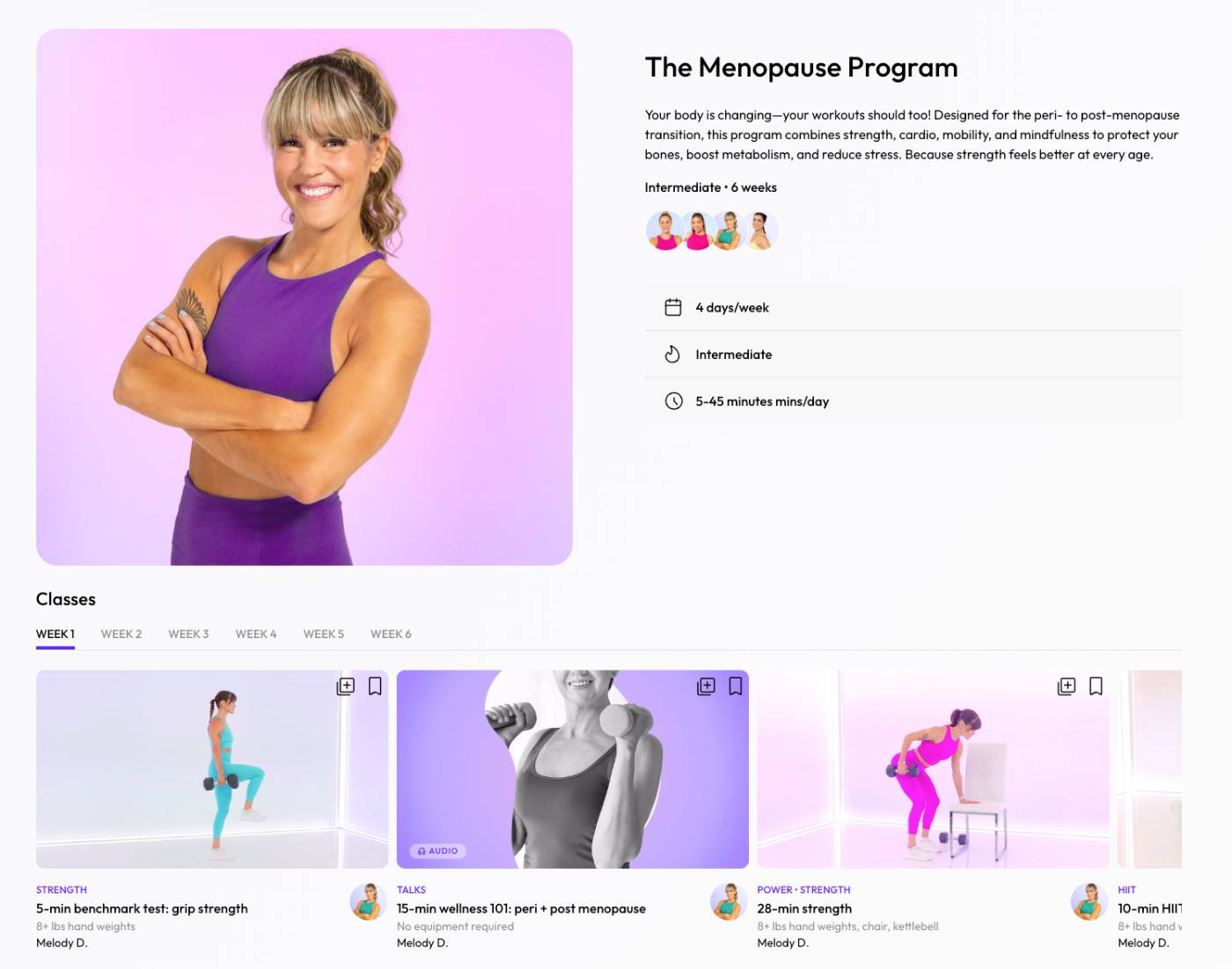
- Obé has a 6-week Menopause Program
- Apple: load rose over five weeks
- Both tested with a meniscus history
Obé Fitness wins on our scoring, and it is the better platform for most women over 40. It takes five of the nine weighted criteria, including a perfect 10 on Time Efficiency, and it is the only one of the two with menopause content: menopause programming 7 out of 10 against Apple’s 2, hormone awareness 7 against 1, menopause education 6 against 1.
Apple Fitness+ is the better answer if progressive strength is your goal, or if $15 a month matters. It wins Muscle Potential, 7.5 against 6.5, and in testing the progression was real rather than theoretical: the working dumbbells went up across five weeks, with improved form on several movements. The figures are in the muscle potential section below. It costs $9.99 a month against Obé’s $24.99.
Obé if you want to be looked after: a structured menopause programme, the best filtering Katy has used, and a platform whose design she found genuinely lifting, in words quoted in the UX section below. Apple Fitness+ if you already know what you are doing and want the load to go up without paying two and a half times as much. The scores favour Obé. The five weeks of testing favour Apple on the single outcome that matters most after 40.
Two things to check before you sign up to either. Obé Fitness is available in the US and Canada only, and requires a US or Canadian credit card. Its free trial is seven days, which is short for a platform with a six-week programme in it, so plan to try five sessions inside that window rather than easing in. Apple Fitness+ needs the Apple ecosystem, and it carries a known bug: the screen goes black while the audio continues, fixable only by stopping and restarting the workout. That happened a handful of times across five weeks of testing.
Obé Fitness vs Apple Fitness+: the two platforms
Same nine weighted criteria, same twelve capability scores, and for once the same standard of evidence: both were used daily for over a month.
Obé Fitness
Winner
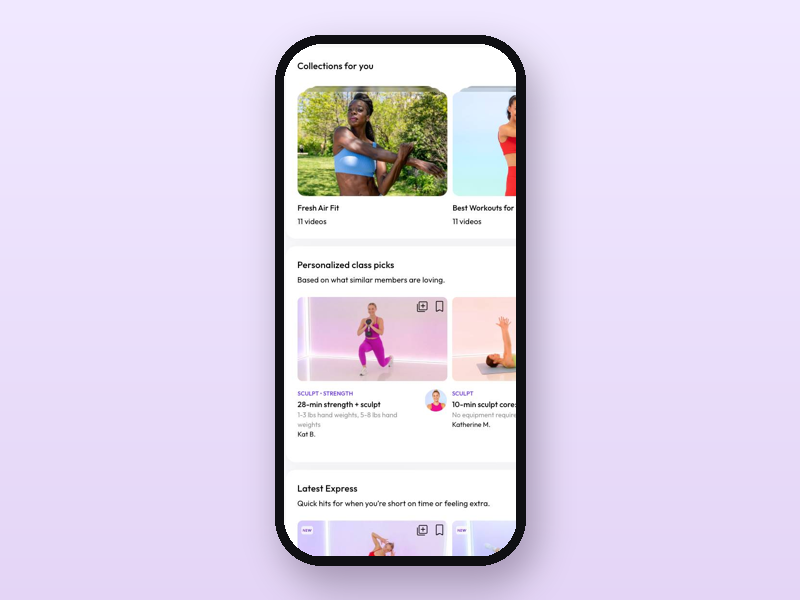
A 16,000-class on-demand library built around signature 28-minute sessions, with a six-week Menopause Program, an Age Well collection, cycle tracking and a recovery pillar.
- 16,000+ classes
- 5 to 60 min
- 6-week Menopause Program
- 7-day trial
- US and Canada only
Choose Obé if you:
- Want a structured menopause programme rather than a general library you have to interpret
- Want the shortest possible route from opening the app to starting a class
- Value recovery, meditation and mood as part of the product rather than an afterthought
- Are newer to training and want a platform that eases you in
- Live in the US or Canada and have a card issued there
Affiliate link, at no extra cost to you. Full disclosure.
Apple Fitness+
Runner-up
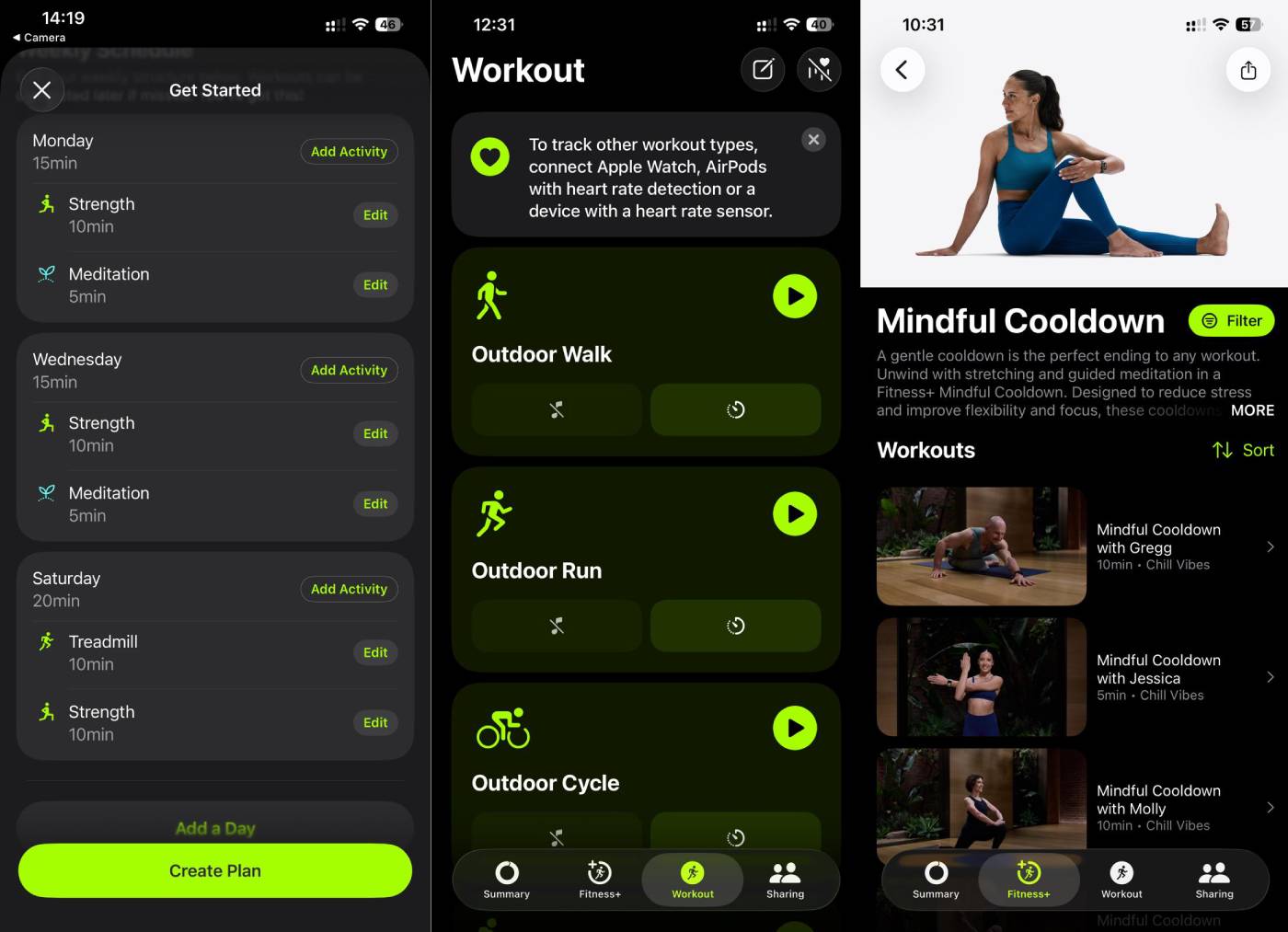
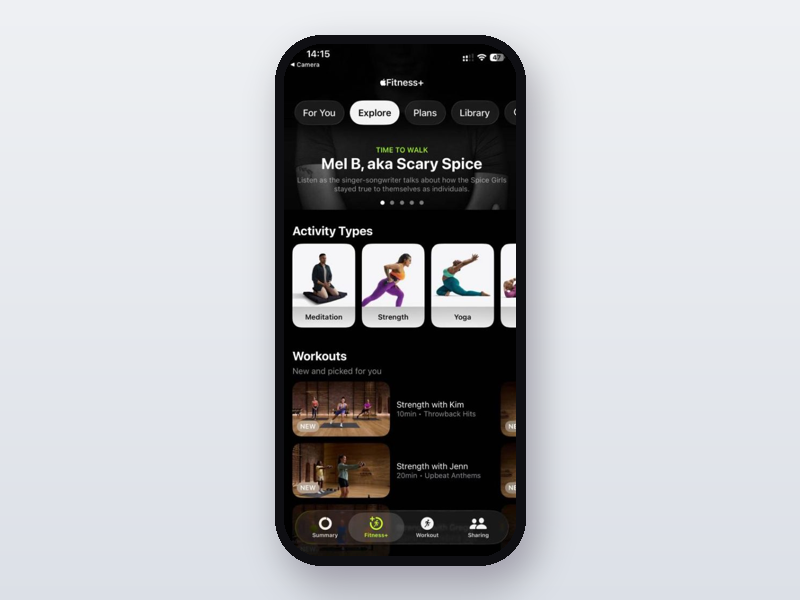
Apple’s own studio library across strength, HIIT, Pilates, yoga, dance and treadmill, with custom plans, structured programmes and Mindful Cooldowns, built for the Apple ecosystem.
- $9.99/month
- 20 min typical
- Progressive strength
- Apple ecosystem
- No menopause label
Choose Apple Fitness+ if you:
- Want strength that actually progresses, and already know roughly what you are doing
- Are in the Apple ecosystem, ideally with a device purchase that includes three months free
- Want a 20-minute session and a 10-minute cooldown to stack
- Would rather pay $9.99 than $24.99 and do your own programming
- Do not need the word menopause on the label to recognise a suitable workout
How we scored this, and how both were tested
Both platforms were used, not browsed, which is unusual for a comparison on this site. That means every section below carries lived evidence rather than only a number, and you can weigh the two sets of scores against each other on equal terms.
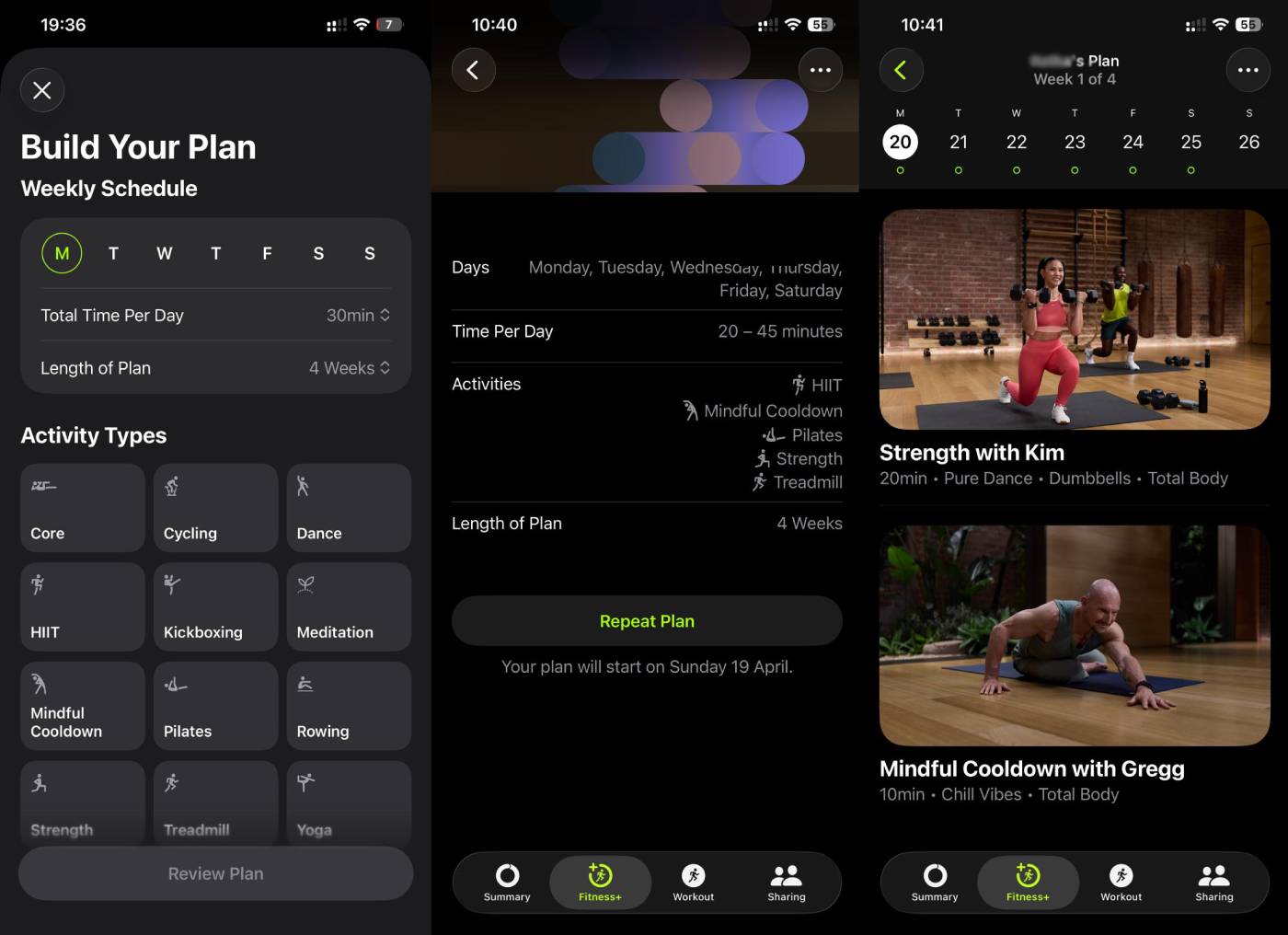
Apple Fitness+ was tested for five weeks of structured daily use. Katy started after buying an iPad that came with three months free, having been through a long rotation of fitness apps and wanting to see whether Apple’s ecosystem play could compete. She built her own custom weekly plan for four weeks, then moved into the 3 Weeks of Strength programme and ran it for five weeks total, repeating weeks as she built up, because she had been inactive for about a month beforehand. She used dumbbells from 9 lb to 20 lb, resistance bands, ankle weights, a kettlebell and a mat, on iPhone and iPad projected to a TV. She does not own an Apple Watch, so the testing reflects the platform without the metrics layer, and she says so plainly.
Obé Fitness was tested across a month of daily use, with dumbbells between 3 lb and 20 lb depending on class type, plus resistance loops and ankle weights she already owned. That covered the six-week Menopause Program, strength classes with Natalie D. and Olivia T., the joint stretch content and dance.
She is in her mid-forties, navigating perimenopause, with a previous meniscus injury. That is the body these scores were measured against, and it shapes what she noticed on both platforms.
Muscle Potential carries the most weight of the nine at 18%, because preserving lean mass through the menopause transition is the highest-value thing a training programme can do for a woman in this age group. Time Efficiency is 15%, because the most common reason a programme fails is that the sessions are longer than the life around them. Alongside the nine criteria sit twelve capability scores out of 10.
Perimenopause and menopause fit: Obé wins on the label, and the testing complicates it
Obé wins, 6 on Women Over 40 Specificity against Apple’s 4.3. On the capability scores the gap is wider: menopause programming 7 against 2, hormone awareness 7 against 1, menopause education 6 against 1. Apple has none of this. Obé has a genuine six-week Menopause Program led by Melody D., an Age Well collection, cycle tracking and cycle-syncing.
What the Menopause Program was actually like
This is where the testing earns its keep. Katy ended her first week on the Menopause Program feeling she had not done enough physical work. She is careful about why: the programme is not unchallenging, it is simply pitched at a beginner to intermediate audience. She found herself adding a 20 or 30 minute treadmill walk on programme days to make the week feel complete.
That is not a reason to dismiss it. If you are returning to training, beginner to intermediate is exactly right, and a structured six weeks with a named coach is worth more than a library you have to assemble yourself. But if you are already training regularly, the branded programme may be the wrong entry point on a platform that also holds 16,000 other classes.
Apple has no menopause content, and the workouts still suited it
Apple Fitness+ scores 1 out of 10 for hormone awareness and 1 for menopause education, meaning nothing on the platform addresses either. Katy’s verdict after five weeks is more interesting than the score: the workouts suit perimenopause and menopause well, Apple has simply not branded them that way. Her caveat is the important half of it. If you know what your body needs, the library delivers. If you do not, you are on your own.
That is the real trade on this pair, and it is why the label is a poor guide. Obé tells you where to start and pitches gently. Apple tells you nothing and expects you to know.
Why this matters physiologically
Wright and colleagues describe a cluster of musculoskeletal changes associated with the menopause transition, including effects on tendon and ligament integrity and a raised injury risk.1 Maltais and colleagues document accelerated loss of muscle mass and strength through the same window.2 That is not an argument for a menopause label on a class. It is an argument for progressive loading and sensible impact choices, which is exactly what the next two sections examine.
Pelvic floor: tied, and both are effectively absent
Both score 2 out of 10, and neither has a dedicated pelvic floor programme. Teixeira and colleagues report a 36% prevalence of urinary incontinence across female athletes in a systematic review and meta-analysis.3 That review did not separate high-impact from low-impact sport, so we do not claim that it did, and we are not going to tell you what your symptoms are. If this is something you are managing, neither platform contains a programme for it and you would be pairing either with a dedicated app.
Muscle potential: Apple wins, and this is the strongest piece of evidence on the page
Apple Fitness+ wins, 7.5 against 6.5. This is the heaviest-weighted criterion at 18%, and it is the one place where five weeks of testing produced a measurable result rather than an impression.
What actually happened
On Apple’s 3 Weeks of Strength programme, run for five weeks total, the progressive overload was real: dumbbells moved from 9 to 13 lb up to 11 to 17 lb, with improved form on several movements. She also fixed her posture on a few movements after watching the basics sessions. Over the five weeks her weight went up 2 lb in the first week, then came back down plus an extra pound, a net loss of 1 lb, and she was visibly more toned. Progressive strength capability scores 7 out of 10.
On Obé, she reached for 18 lb and 20 lb dumbbells on compound lifts in Olivia T.’s classes, so the platform is not light-only. But progressive strength scores 5 out of 10 and bone loading 4, the lowest on this page, because the loads are largely light to moderate and there is no mechanism that pushes them up over time.
Why progressive overload matters more after 40
Progressive overload means gradually increasing the demand on a muscle so it has a reason to adapt. Mohebbi and colleagues, in an updated systematic review and meta-analysis, identify progressive resistance training as the primary non-hormonal intervention for bone mineral density after menopause.4 A separate systematic review and meta-analysis of resistance training in postmenopausal women reports improvements in menopause symptoms and functional capacity, on evidence its own authors rate as very low to low certainty.5 The five-week rise in working weight recorded above is precisely that mechanism working.
What this means for your decision
If muscle and bone are your reason for training, Apple Fitness+ is the better of these two, and it is also the cheaper one. Bone loading is 5 out of 10 against Obé’s 4, so neither is a bone-density programme, and a dedicated progressive strength plan would beat both. Our best workouts to build muscle after 50 ranking covers those.
Time efficiency: Obé wins with a perfect score, and Apple is the reason she kept going
Obé wins, 10 against 9. That is a perfect mark on the criterion, the highest we have awarded anywhere, and the review calls it one of the best time-efficiency models tested across close to 50 platforms.
Obé earns it structurally: signature 28-minute classes with warm-up and cooldown baked in, a deep library of 5 to 10 minute stackables, and audio-only options. Her own framing is the useful part. She is not going to commit to 60-minute sessions at 6am. Twenty to thirty minutes, most days, is something she does.
Apple scores 9, marginally lower, and produced the single strongest adherence passage across either review. Working full time with two school-aged children, pickups, after-school clubs and driving around, fitting in a 20-minute workout was genuinely achievable in a way a 45 to 60 minute daily commitment simply was not, and she names that as the single biggest reason she kept coming back. She almost always stacked a 20-minute strength session with a 10-minute cooldown, did the workouts a few times at around 9pm when she could not fit them in earlier, and showed up nearly every day for five weeks without struggling to find time.
What this means for your decision. The scores say Obé, and structurally that is right. The testing says both cleared the bar that matters, which is whether the session is short enough to actually happen. Our 20-minute workouts for perimenopause ranking covers the wider field.
Joint friendliness: tied, and both were tested on the same knee
Tied at 8 each. This is the most directly comparable finding on the page, because the same person with the same meniscus history used both platforms within months of each other.
On Apple Fitness+, she was able to follow every strength and Pilates session without knee pain by watching the modifier. A modifier shown in every session is a structural feature, not a lucky class choice, and it is why the score holds despite the platform having no low-impact branding.
On Obé, with the same history, she used a lower range of motion on deep pliés and it was fine. She also singles out the coaching: in the same breath as the choreography, Natalie D. gave a specific note about knee positioning, which is the kind of cue she was listening out for. Obé’s low-impact capability is 8 out of 10 against Apple’s 7, with an explicit low-impact filter.
What this means for your decision. Both are usable with a knee history and neither is a rehabilitation programme. Obé gives you a filter, Apple gives you a modifier in shot. If you want impact removed rather than managed, our best low-impact workouts for women over 50 ranking covers platforms built for that.
Recovery: Obé wins clearly, and this is its most underrated advantage
Obé wins, 9 against 7, with recovery and deload capability 7 out of 10 against 5.
Obé has a dedicated Activate and Recover pillar with meditation, breathwork and mood-based suggestions, short and longer meditations, and a 10-minute Stretch for Joint Pain. She tried the joint stretch on a rest day after a full day of sitting, and describes it as exactly what her body needed. That is a small observation that tells you something structural: the recovery content is good enough to be worth opening on a day you are not training.
Apple’s recovery offer is the Mindful Cooldown series, and she used the 5 to 10 minute cooldowns almost daily after strength sessions. That is genuine use rather than a feature list, but it is a cooldown attached to a workout rather than a recovery pillar in its own right. She also noticed her energy levels felt better on training days than rest days, which is the sort of thing a platform with deload structure would help you interpret and neither of these does.
Obé Fitness pros and cons
Obé Fitness scores 7.5. It is strongest on short sessions and weakest on nutrition guidance.
Pros
- A perfect 10 on Time Efficiency and 9 on UX, the two highest scores on this page.
- A genuine six-week Menopause Program, plus hormone awareness 7 and menopause education 6.
- Best recovery offer of the two at 9.
- Beginner on-ramp 8 out of 10.
- Filtering that takes about ten seconds rather than ten minutes of scrolling.
Cons
- $24.99 a month, two and a half times Apple’s price.
- Bone loading 4 out of 10, the lowest score on this page.
- Progressive strength 5 against 7.
- The Menopause Program felt light in week one for someone already training.
- Seven-day trial is short.
- US and Canada only, with a card issued there.
- Live classes were discontinued in 2024 and cancellation friction is reported.
- The Android app lags iOS, with no offline downloads.
Apple Fitness+ pros and cons
Apple Fitness+ scores 6.9. It leads on short sessions and trails on nutrition guidance.
Pros
- $9.99 a month, and three months free with an eligible device purchase.
- Wins Muscle Potential at 7.5, with a documented five-week load progression.
- Programme Structure 7.5, the higher of the two.
- A modifier shown in every session, which held up against a meniscus history.
- Twenty-minute sessions that fitted a full-time working week with two children.
Cons
- Nutrition Integration 0, the only zero on this page, with midlife nutrition 1 out of 10.
- No menopause programming, hormone awareness or education.
- Requires the Apple ecosystem.
- A screen-goes-black bug that needs the workout restarted.
- Filtering cannot always combine time, coach and body area, which the review calls an afterthought from a company that prides itself on user experience.
- Trainers are Apple employees, and it can feel a bit acted.
Quick yes/no comparison
| Feature | Obé Fitness | Apple Fitness+ |
|---|---|---|
| Branded menopause programme | Yes, six weeks | No |
| Menopause education content | Yes | No |
| Cycle tracking or syncing | Yes | No |
| Progressive strength programme | Partly | Yes |
| Structured pelvic floor programme | No | No |
| Modifier or low-impact option shown in class | Yes, plus a low-impact filter | Yes, a modifier in every session |
| Dedicated recovery pillar | Yes | Partly, cooldowns only |
| Nutrition guidance | Partly, education only | No |
| Sessions under 15 minutes | Yes, 5 to 10 minute stackables | Yes |
| Audio-only workouts | Yes | Partly |
| Works outside the Apple ecosystem | Yes | No |
| Available outside the US and Canada | No | Yes |
| Free trial | Yes, 7 days | Yes, 3 months with a device purchase |
Obé Fitness vs Apple Fitness+ at a glance
| Obé Fitness | Apple Fitness+ | |
|---|---|---|
| Overall score | 7.5 | 6.9 |
| How it was assessed | Tested, one month of daily use | Tested, five weeks of structured daily use |
| US cost | $24.99/month or $169.99/year, about $14.17/month | $9.99/month |
| Free trial | 7 days | Three months with an eligible Apple device purchase |
| Session length | 5 to 60 min, signature 28-minute classes | 20 min typical, plus 5 to 10 minute cooldowns |
| Library | 16,000+ on-demand classes | Apple’s own studio library across strength, HIIT, Pilates, yoga, dance and treadmill |
| Equipment used in testing | Dumbbells 3 to 20 lb, resistance loops, ankle weights | Dumbbells 9 to 20 lb, resistance bands, ankle weights, kettlebell, mat |
| Availability | US and Canada only, US or Canadian card required | Apple ecosystem |
| Menopause content | Six-week Menopause Program, Age Well collection, cycle tracking | None branded as such |
Obé Fitness vs Apple Fitness+: the full scoring breakdown
Obé wins five of the nine weighted criteria, Apple wins two, and two are tied. Scores are pulled live from each programme’s own assessment, so this table updates when the assessment does.
| Criterion | Weight | Obé Fitness | Apple Fitness+ | Winner |
|---|---|---|---|---|
| Muscle Potential | 18% | 6.5 | 7.5 | Apple Fitness+ |
| Time Efficiency | 15% | 10 | 9 | Obé Fitness |
| Joint Friendliness | 12% | 8 | 8 | Tied |
| Programme Structure | 12% | 7 | 7.5 | Apple Fitness+ |
| Women Over 40 Specificity | 10% | 6 | 4.3 | Obé Fitness |
| Recovery Compatibility | 10% | 9 | 7 | Obé Fitness |
| Value for Money | 8% | 7 | 7 | Tied |
| UX and Design | 8% | 9 | 7.5 | Obé Fitness |
| Nutrition Integration | 7% | 3 | 0 | Obé Fitness |
| Overall | 100% | 7.5 | 6.9 | Obé Fitness |
The twelve capability scores
Obé wins nine of the twelve, Apple wins two, one is tied. The four menopause rows are where the platforms genuinely diverge, and the two strength rows are where Apple takes it back.
| Capability | Obé Fitness | Apple Fitness+ | Winner |
|---|---|---|---|
| Low-impact | 8 | 7 | Obé Fitness |
| Progressive strength | 5 | 7 | Apple Fitness+ |
| Bone loading | 4 | 5 | Apple Fitness+ |
| Recovery & deload | 7 | 5 | Obé Fitness |
| Menopause programming | 7 | 2 | Obé Fitness |
| Pelvic floor | 2 | 2 | Tied |
| Hormone awareness | 7 | 1 | Obé Fitness |
| Menopause education | 6 | 1 | Obé Fitness |
| Expert credibility | 6 | 5 | Obé Fitness |
| Mind-body support | 8 | 7 | Obé Fitness |
| Beginner on-ramp | 8 | 7 | Obé Fitness |
| Midlife nutrition | 5 | 1 | Obé Fitness |
UX and design: Obé wins by the widest margin on the page
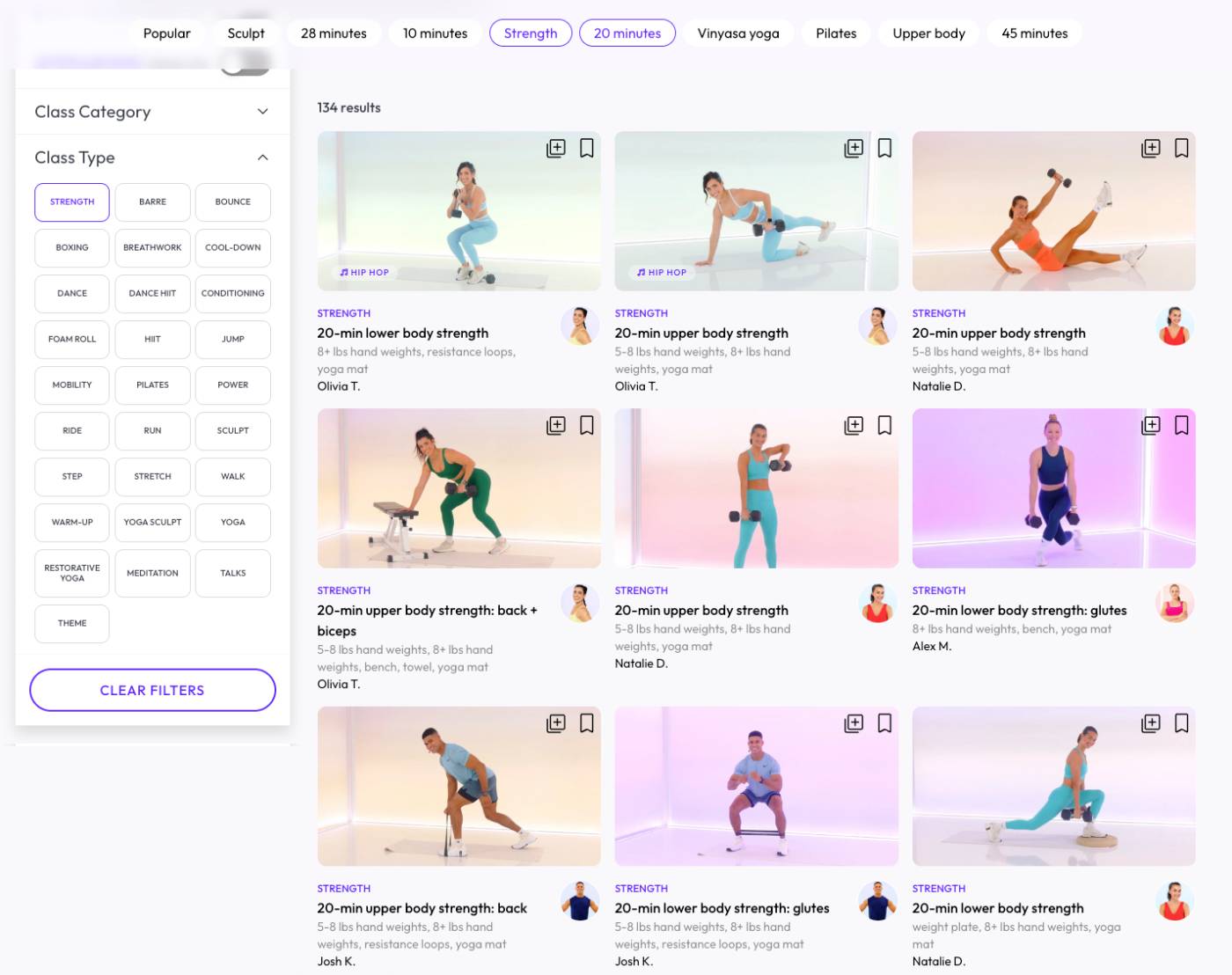
Obé wins, 9 against 7.5. That is among the highest scores anywhere in our library, and it reflects one of the best filtering systems tested: class type, length, instructor, body focus, impact, equipment and fitness goal, all filterable and fast. Her summary is that finding exactly what you are in the mood for takes about ten seconds rather than ten minutes of scrolling, and that the design genuinely lifts mood. On most days, she says, Obé felt like walking into a room that wanted her to have a good time.
Apple’s is the more surprising result, because this is the company that made its name on interface. She wanted to filter simultaneously by time, coach and body area, the way she can on other platforms, and could not always do that cleanly. Her verdict is blunt: for a company that prides itself on user experience, the filter design feels like an afterthought. Add the intermittent bug where the screen goes black while the audio continues, fixable only by stopping and restarting the workout, which she calls mildly infuriating mid-session.
Two caveats on Obé. Its Android app is materially behind iOS, with no offline downloads and frequent stability complaints, so a 9.5 describes the iOS experience. And live classes were discontinued in 2024.
Instructors: different models, and it shows
Obé wins on expert credibility, 6 out of 10 against 5, though the more useful difference is structural rather than scored.
Apple’s trainers are Apple employees rather than independent creators with their own followings. Her read after five weeks is mixed in an instructive way. Jhon’s Latin Grooves sessions are 20 minutes of good music, high energy and a coach who makes you want to move, and she clicks play and the time is over before she notices. She also always finishes energised and in a better mood than when she started, which she says is not something she says about many workouts. Against that, sometimes it feels a bit acted, a bit too upbeat, though she calls that a minor quibble you get used to.
On Obé, the coaching detail she singles out is smaller and more specific: Natalie D. giving a note about knee positioning in the same breath as the choreography. With a meniscus history, that is the cue she was listening for, and it is the sort of thing that separates a class filmed for a general audience from one aware that some of its audience has a knee.
Value for money: tied on the score, and the price gap is two and a half times
Tied at 7 each, which needs explaining, because $24.99 and $9.99 are not remotely the same price.
| Plan | Obé Fitness | Apple Fitness+ |
|---|---|---|
| Monthly | $24.99 | $9.99 |
| Annual | $169.99, about $14.17/month | Not published as an annual plan |
| Free trial | 7 days | Three months with an eligible device purchase |
| Other routes | HSA/FSA eligible via Truemed | Bundled with some Apple device purchases |
| Availability | US and Canada only | Wherever the Apple ecosystem reaches |
The scores land level because value is what you get for what you pay, not the number on the invoice. Obé delivers considerably more for the money: the menopause programme, the recovery pillar, the filtering, 16,000 classes. Apple delivers less but asks for far less, and on the annual plan Obé narrows to about $14.17 a month.
Katy’s own position is worth quoting, because it is the argument against her own scoring. The ongoing $9.99 a month is harder to justify, she writes, when she can get similar workout quality from Alo Wellness Club for free. She will keep using Apple through her free trial, and whether she pays after that depends on whether she can justify the cost against free alternatives. If that is true of $9.99, it is a sharper question at $24.99.
What this means for your decision. If the trial is what decides it, Apple wins outright: three months against seven days is not a close comparison, and Obé’s seven days is short for a platform whose flagship is a six-week programme. Our best free and budget workout apps for women over 40 ranking covers the free alternatives she is weighing them against.
Nutrition integration: Obé wins, and Apple records the only zero on the page
Obé wins, 3 against Apple’s 0. Midlife nutrition capability is 5 out of 10 against 1.
Obé offers nutrition education only, covering things like protein and hydration, with no meal planning or tracking. Apple offers nothing. Neither has a registered dietitian attached. If nutrition support is part of what you want from a subscription, our best workout apps with meal plans ranking is the right place to look instead.
Who wins for…
Who wins for anything menopause-specific
Obé Fitness. A six-week Menopause Program, hormone awareness 7 against 1 and menopause education 6 against 1. Apple has no menopause content at all.
Who wins for strength that actually progresses
Apple Fitness+. 7.5 against 6.5, and in five weeks of testing the working dumbbells went up, which is progression you can point at rather than infer.
Who wins on price
Apple Fitness+. $9.99 a month against $24.99, and three months free with an eligible device purchase against a seven-day trial.
Who wins for finding a class quickly
Obé Fitness. 9 against 7.5. About ten seconds rather than ten minutes of scrolling, against filtering the review calls an afterthought.
Who wins for a knee history
Tied. Both scored 8 and both were used without knee pain by the same tester: a modifier in every Apple session, a lower range of motion on deep pliés on Obé.
Who wins for rest days and recovery
Obé Fitness. 9 against 7, with a dedicated recovery pillar and a joint stretch worth opening on a day you are not training.
Who wins for absolute beginners over 40
Obé Fitness. Beginner on-ramp 8 out of 10 against 7, with a starter pack and a quiz-built schedule. Apple expects you to already know what your body needs.
Who wins for a busy working week
Tied. Obé scores higher on Time Efficiency, but Apple produced the clearest adherence result: nearly every day for five weeks, full-time work and two school-aged children, because 20 minutes was achievable where 45 to 60 was not.
Who wins for training outside the US and Canada
Apple Fitness+. Obé is US and Canada only and requires a card issued there.
Who wins for training without Apple hardware
Obé Fitness. Apple Fitness+ needs the ecosystem. Note that Obé’s Android app lags its iOS one materially.
Who wins for pelvic floor symptoms
Neither. Both score 2 out of 10 and neither has a dedicated programme.
Who wins for nutrition guidance
Obé Fitness. 3 against 0, though education only, and Apple offers none.
Who wins for a session that lifts your mood
Tied, and both are unusually good at it. What Obé does to your mood is quoted in the UX section above, and it is the strongest thing on this page about how a platform feels to be in. On Apple she always finished energised and in a better mood than when she started, which she notes is not something she says about many workouts.
Decision tree for women over 40
You want a structured menopause programme. Obé Fitness. It is the only one of the two that has one.
You want the load to go up. Apple Fitness+, on the only documented progression across this pair.
You already own an Apple device that came with three months free. Apple Fitness+, and decide at the end of it.
You are returning to training after a break. Obé, on beginner on-ramp 8 against 7 and a programme that tells you where to start.
You are already training regularly. Apple, and be aware the Obé Menopause Program may feel light in week one.
Price is the deciding factor. Apple, at less than half the monthly cost.
You live outside the US or Canada. Apple, because Obé is not available to you.
What we did not test
Both platforms were used properly, and there are still gaps worth naming.
Apple Fitness+ was tested without an Apple Watch, so nothing here reflects the metrics layer, and that materially changes the product for people who have one. Time to Walk and Time to Run were not part of the testing. Obé’s Age Well collection was not covered in depth and is flagged in the review for a separate piece.
Neither platform’s Android experience was tested. That matters more for Obé, whose Android app is reported to lag iOS with no offline downloads.
We do not publish calorie-burn comparisons. The body-composition observations on this page are what one person recorded over five weeks, not a promised result, and energy expenditure varies too much between individuals for a published figure to be useful.
Which is better for women over 50?
Obé Fitness, for most women in this group
The overall verdict holds and strengthens. The Age Well collection exists, the beginner on-ramp is higher, the recovery pillar matters more, and the menopause and hormone content is the whole reason to pay the premium. Apple gives you a good library and no map.
A second tester on the Apple side
Katy’s mum, 68, a regular walker who does Pilates, tried Apple Fitness+ in the older-adult category. Her verdict was mixed, and she said she prefers dipping into the regular Workouts for Beginners library with light or no weights. That is a small sample of one, and it points the same way as the scores: Apple’s general library is the strong part, and its attempt to serve an older beginner specifically is not.
Women over 60 starting fresh
Obé, on beginner on-ramp 8 out of 10 and a quiz-built starting schedule. If cost rules that out, Apple’s Workouts for Beginners library with light or no weights is the route a 68-year-old tester actually preferred. Our best workouts for postmenopause ranking covers the stage-specific question.
- Price
- $24.99/mo (same on web and Apple)
- Free trial
- 7 days, or 30 days via a Guest Pass referral
- Price
- $9.99/mo (£9.99 UK)
- Free trial
- 1 month free (new subs); 3 months with eligible Apple device purchase
The Obé Fitness button is an affiliate link, at no extra cost to you. Full disclosure.
Frequently asked questions
Is Obé Fitness or Apple Fitness+ better for women over 40?
Obé Fitness on our scoring, 7.5 against 6.9, winning five of the nine weighted criteria. It is the only one of the two with menopause content. Apple Fitness+ wins Muscle Potential and costs less than half as much, so if progressive strength or price is your priority it is the better pick.
Do either offer menopause-focused classes or guidance?
Obé does: a six-week Menopause Program led by Melody D., an Age Well collection, cycle tracking and cycle-syncing, scoring 7 out of 10 for menopause programming. Apple Fitness+ has none, scoring 2. In testing, the Obé programme was found to be pitched at a beginner to intermediate audience, so someone already training regularly may find week one light.
Which is better for building strength starting at 40?
Apple Fitness+, 7.5 against 6.5. Across five weeks of the 3 Weeks of Strength programme the working dumbbells went up and form improved on several movements, with the figures given in the muscle potential section. Progressive strength capability is 7 out of 10 against Obé’s 5.
Which has more low-impact and joint-friendly workouts?
They are tied at 8 on Joint Friendliness. Obé edges the low-impact capability, 8 out of 10 against 7, and has an explicit low-impact filter. Apple shows a modifier in every session. Both were used by the same tester with a meniscus history without knee pain.
Can Apple Fitness+ and Obé Fitness work with an Apple Watch?
Apple Fitness+ is built for the Apple ecosystem and an Apple Watch adds a metrics layer. Our testing was done without one, so this page does not assess that layer. Obé Fitness is a streaming platform and does not depend on Apple hardware, though its Android app lags its iOS app materially.
Which subscription is more affordable?
Apple Fitness+ at $9.99 a month, against Obé at $24.99 a month or $169.99 a year, which works out at about $14.17 a month. Apple also offers three months free with an eligible device purchase, against Obé’s seven-day trial.
Is Obé Fitness available outside the US?
No. Obé Fitness is US and Canada only, and signing up requires a US or Canadian credit card. Apple Fitness+ is available wherever the Apple ecosystem reaches.
Which is better for weight loss after 40?
We do not publish calorie comparisons or promise weight outcomes. For what it is worth as one person’s record: across a month on Obé, weight and measurements stayed where she wanted them, and across five weeks on Apple, weight rose 2 lb in week one then finished a net 1 lb down with visibly more tone. Those are observations, not predictions, and the more useful questions after 40 are whether the strength progresses and whether you will still be doing it in three months.
Will either protect my bone density?
Both give some weight-bearing stimulus and both score modestly on bone loading, 5 out of 10 for Apple Fitness+ and 4 for Obé, the lower of the two. Mohebbi and colleagues identify progressive resistance training as the primary non-hormonal intervention for bone mineral density after menopause.4 Neither platform is primarily a progressive resistance programme, so neither is the strongest available option for that specific goal.
Is Obé Fitness or Apple Fitness+ better for pelvic floor symptoms?
Neither. Both score 2 out of 10 and neither has a dedicated pelvic floor programme. You would be using a dedicated app alongside whichever platform you choose.
Research citations
- Wright VJ, Schwartzman JD, Itinoche R, Wittstein J. The musculoskeletal syndrome of menopause. Climacteric. 2024;27(5):466–472. menopause MSK study. (Cited for: oestrogen decline’s effect on tendon and ligament integrity, and increased injury risk in midlife.)
- Maltais ML, Desroches J, Dionne IJ. Changes in muscle mass and strength after menopause. Journal of Musculoskeletal and Neuronal Interactions. 2009;9(4):186–197. PubMed. (Cited for: accelerated loss of muscle mass and strength through the menopause transition.)
- Teixeira RV, Colla C, Sbruzzi G, Mallmann A, Paiva LL. Prevalence of urinary incontinence in female athletes: a systematic review with meta-analysis. International Urogynecology Journal. 2018;29(12):1717–1725. urinary incontinence meta-analysis. (Cited for: 36% prevalence of urinary incontinence across female athletes in a range of sports. Note: this review did not separate high-impact from low-impact sport, so we do not claim it did.)
- Mohebbi R, Shojaa M, Kohl M, et al. Exercise training and bone mineral density in postmenopausal women: an updated systematic review and meta-analysis. Osteoporosis International. 2023;34:1145–1178. bone density meta-analysis. (Cited for: progressive resistance training as the primary non-hormonal intervention for bone density after menopause.)
- Sá KMM, et al. Resistance training for postmenopausal women: systematic review and meta-analysis. Menopause. 2022. PubMed. (Cited for: improvements in menopause symptoms and functional capacity with resistance training. Note: this review did not measure strength or lean mass as primary outcomes, and its authors rate the certainty of evidence as very low to low, so we report it on that basis.)
This page compares fitness platforms. It is not medical advice. Katy is a woman who has trained through perimenopause, not a clinician. Any body-composition figures described are one person’s recorded experience, not an expected result. If you have a diagnosed condition, an injury, or symptoms that concern you, speak to a qualified healthcare professional before changing how you train.
About this comparison
Compiled by Katy Cole for Her Daily Fit. Both platforms were tested hands-on: Apple Fitness+ across five weeks of structured daily use without an Apple Watch, and Obé Fitness across a month of daily use. Both were scored on the same nine weighted criteria and the same twelve capability scores. Prices were verified against official sources in 2026 and may differ if there has been a recent change. Scores on this page are pulled live from each programme’s own assessment, so they update when the assessment does.
Compared with
Where these brands appear in our “Best for” rankings