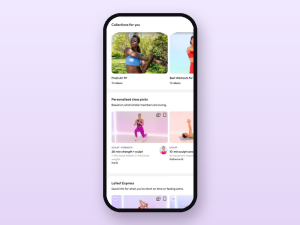
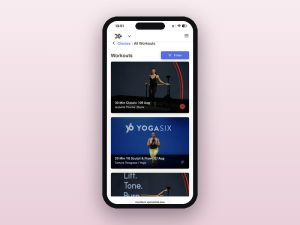
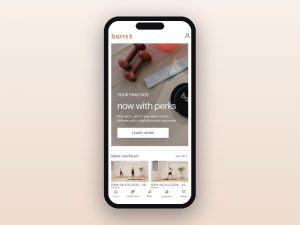
What is barre, and how does it differ from Pilates?
Barre is a low-impact class format built from small, repeated movements borrowed loosely from ballet conditioning. You work at a support rail, or more realistically the back of a dining chair, doing tiny pulses at the end range of a movement, long isometric holds, and high repetition work with light hand weights.
The defining characteristic is that the load stays low and the repetitions stay high. That produces a very specific sensation, the shaking legs that barre marketing loves, which is muscular fatigue rather than a signal that you have trained hard in any structural sense. Understanding that distinction is the difference between using barre well and expecting the wrong things from it.
Is barre a good workout for women over 40?
Lower-body endurance and control
Barre spends most of its time in the glutes, quads and calves, in small ranges, under continuous tension. That builds real muscular endurance and, more usefully, a lot of body awareness in the hips and pelvis. For women who have lost track of what their lower body is doing, it is a fast way to reconnect.
Balance and single-leg stability
Almost every barre class spends time on one leg, with a hand resting lightly on support rather than gripping it. Single-leg work is one of the more useful things you can do in midlife and one of the easiest to neglect, and barre delivers it without ever feeling like balance training.
This is the one place where barre lines up neatly with the evidence. Wong and colleagues, writing in the Journal of Orthopaedic Translation in 2020, reviewed twelve studies covering 4,784 older adults and found exercise reduced falls, with the combination of strength and balance training the most effective. Note the combination: balance work was effective alongside strength, not instead of it. The same review found that fracture prevention specifically came from resistance and jumping exercises, neither of which barre contains.
Joint-friendly consistency
There is no impact, no load overhead, and nothing that demands you get up and down off the floor at speed. For a body dealing with the joint aches that arrive in perimenopause, that makes barre one of the formats women actually keep doing, and a session you complete beats a better session you skip.
What is the real problem with barre in midlife?
Here is the part the barre industry does not put on the homepage. Muscle and bone respond to progressive load, meaning weight that increases over time. Barre has no mechanism for that. The weights stay light by design, the repetitions stay high, and there is nowhere for the stimulus to go.
That matters more after 40 than before it, and the timing is sharper than most women are told. Ho-Pham and colleagues, writing in Osteoporosis International in 2023, tracked bone density through the perimenopausal transition and found femoral neck loss ran at about 0.51 per cent a year before the late forties, then accelerated to roughly 1.39 per cent a year between 49 and 54, before slowing again. The window where bone is disappearing fastest is a handful of years wide, and it is the window most women are in when they take up barre.
Falling oestrogen accelerates the loss of exactly the two tissues barre cannot address. The most direct evidence comes from Zhou and colleagues, writing in the Journal of Sport and Health Science in 2026. They reviewed 74 studies covering 5,331 postmenopausal women and compared exercise types for their effect on bone mineral density. The most effective approach was mind-body exercise combined with resistance training, which beat single-modality approaches at the lumbar spine, femoral neck and total body.
Read that carefully, because it is not an argument against barre. The combination won. Barre can be the mind-body half of that pairing, and it is a perfectly good one. What it cannot be is the whole plan. Our bone density guide covers what the loading half looks like.
One more thing worth saying plainly: barre itself has almost no research base. We searched for controlled trials of barre specifically and found essentially nothing. Everything above is inference from what barre physically is, not from studies of barre. Anyone citing hard numbers for barre outcomes is extrapolating, and you should treat their confidence accordingly.
What should women over 40 prioritise in a barre platform?
Barre platforms compete on class count and studio pedigree. Neither predicts whether the subscription survives past February. Four things do, and they are worth checking before you commit.
A genuine beginner track, not a beginner class
Barre cueing leans heavily on ballet vocabulary: tuck, pulse, first position, parallel. Instructors who have taught for years forget that none of this is obvious. A platform with a real beginner series that teaches the vocabulary before assuming it will get you further than one with a single introductory class buried in a large library. This is the most common reason women try barre once and never return.
Explicit modification, offered without ceremony
Barre’s small ranges and long holds are gentle on paper and surprisingly provocative for a sore knee or an unhappy hip. What you want is an instructor who offers the easier option in the same breath as the standard one, rather than as an afterthought for people who cannot cope. That tonal difference is the single clearest separator between the platforms on this page.
Sessions under 30 minutes that are properly built
A 45 minute barre class is a significant commitment for a format that is a supplement rather than a foundation. Platforms with well-designed 20 and 30 minute classes make it realistic to keep barre in a week that also contains two strength sessions. If barre is eating the time your strength training needs, the priorities have inverted.
Accuracy about what it is
Some barre marketing promises long, lean muscles, changes to muscle shape, and results that the format cannot deliver. A platform that describes itself accurately, as low-impact muscular endurance work, is more likely to have designed its programming with the same care. Treat overclaiming as a signal.
What matters less than the marketing suggests
Studio brand heritage, class variety past a certain point, and whether there is a live schedule all matter less than the four above. So does having an actual ballet barre at home, which almost nobody needs.
Which barre platform suits which goal?
| If you want | Choose | Why |
|---|---|---|
| The classic studio format at home | Pure Barre | The most faithful to traditional barre, and the most structured |
| A gentler, less rigid session | Barre3 | Built around modification and a mindful tone rather than precision |
| Barre plus everything else | Obé Fitness | Barre sits alongside strength, dance and mobility in one library |
| To sweat and raise your heart rate | Obé Fitness | The cardio-leaning barre and dance cardio classes |
| To protect a sore knee | Barre3 | The strongest modification culture of the three |
| To build bone and muscle | None of them | Add strength training. Barre cannot do this job |
How do the best barre apps compare?
| Platform | Suitability over 40 (70% of rank) | Usability (30% of rank) | Overall score | Price | Best for |
|---|---|---|---|---|---|
| Obé Fitness | 6 | 9 | 7.5 | $24.99 a month | Barre inside a full library |
| Pure Barre | 4.5 | 7 | 6.6 | Around $29.99 a month | The traditional format |
| Barre3 | 4.4 | 5.5 | 6.3 | $29.99 a month | Gentler, modification-led |
Which barre apps score highest?
Obé Fitness: the best barre, inside a library that does everything else too
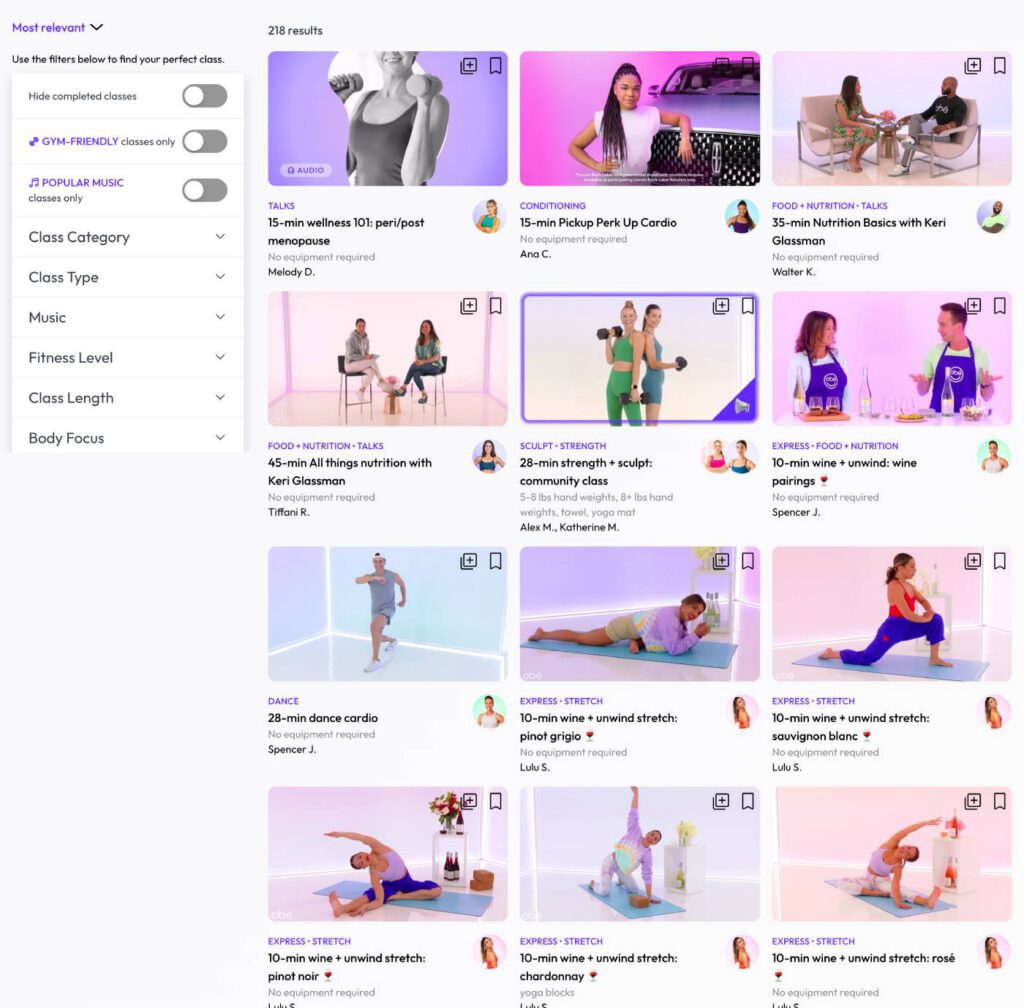
Obé scores 9 on usability, the highest of any platform on this page and one of the highest on the site. The app is genuinely enjoyable, the production is bright without being exhausting, and the barre classes are well cued for people who have never stood at a rail.
It also scores 6 on suitability over 40, which is the highest here, largely because barre is not all it does. The same subscription gives you strength, dance cardio and mobility, which means the pairing this whole page recommends can happen inside one app rather than two.
The trade-off for a purist is that Obé is not a barre specialist. If you want the exact studio format, taught with the vocabulary and precision of a dedicated barre brand, this is not that.
Best for: anyone who wants barre without giving up everything else. Less good for: traditionalists. Read the full Obé Fitness review.
Pure Barre: the traditional format, faithfully delivered
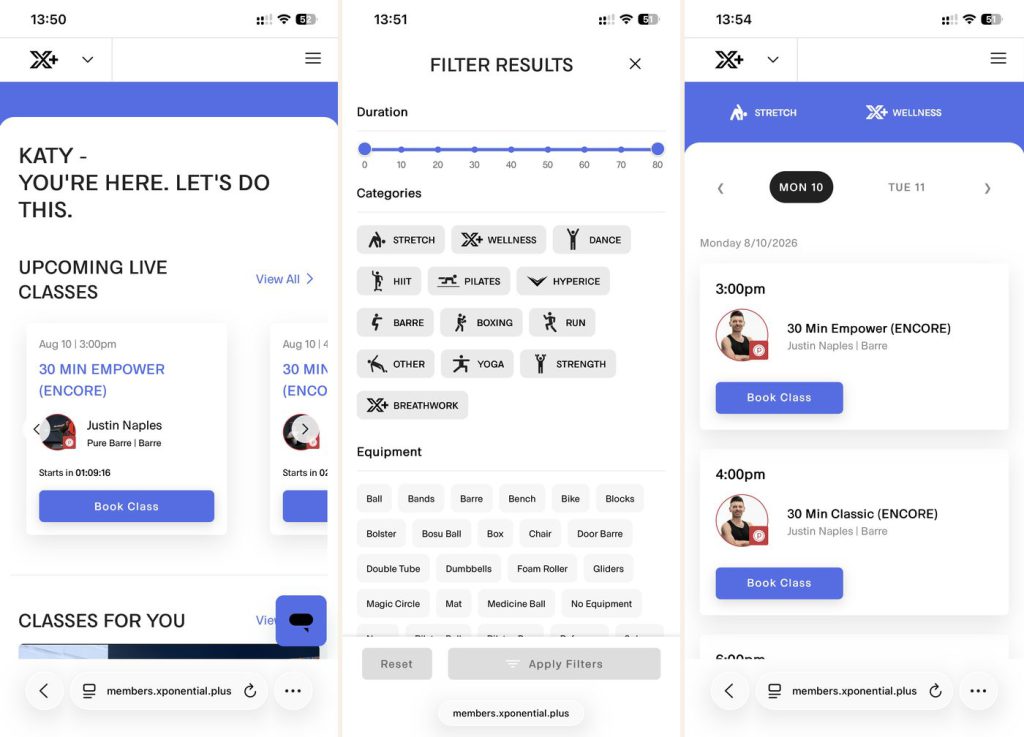
Pure Barre is the closest thing here to the studio experience, and for people who like barre because it is barre, that fidelity is the point. The classes are structured, the progression through a class is familiar and repeatable, and the brand knows exactly what it is.
Its weakness in this context is the same as its strength. Suitability over 40 sits at 4.5, because a faithful barre class is a light-load class and nothing in the format addresses bone or strength. The On Demand subscription is also the most expensive way to access the least varied catalogue on this page.
Best for: people who already love barre and want it done properly. Less good for: anyone hoping barre alone will cover their training. Read the full Pure Barre review.
Barre3: the gentlest, and the most forgiving
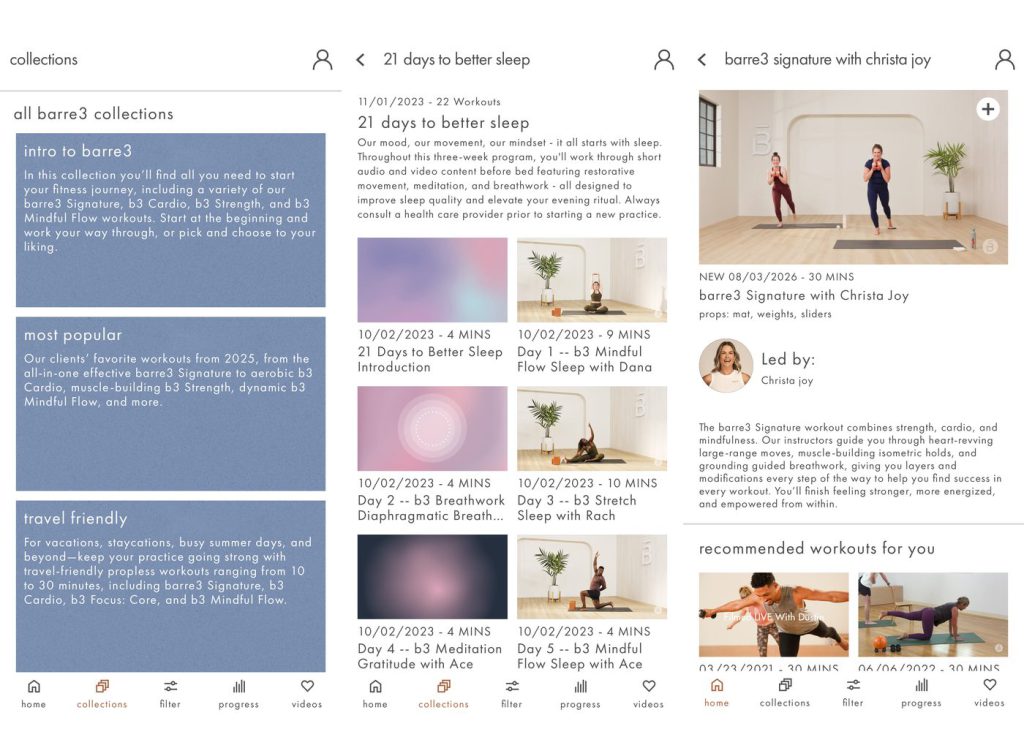
Barre3 built its identity around modification and a less punishing tone, and that is a genuine differentiator in a category that often leans on the language of burning and shaking. If you have a knee that objects or you are returning after a long gap, this is the most welcoming of the three.
It is ranked third because of usability rather than content: it scores 5.5 there, the weakest here, and the platform experience has not kept pace with the others. Its suitability over 40 of 4.4 sits in the same range as Pure Barre.
Best for: sore joints, and anyone who finds standard barre cueing relentless. Less good for: people who want a polished app. Read the full Barre3 review.
How does barre fit alongside the rest of a midlife training week?
- Two strength sessions, 30 to 45 minutes, with weights that get heavier over time. Non-negotiable. Our low-impact strength training page ranks the options.
- Two barre sessions, for endurance, balance and because you enjoy them.
- Daily walking, which is weight bearing and free.
- One genuinely restful day.
If the week gets compressed, cut a barre session before you cut a strength session. Barre is the more pleasant one to lose and the easier one to replace.
Worth checking next: dedicated barre platforms not yet reviewed
Three platforms qualified for this ranking, which is a short list, and we would rather be short than pad it. Several dedicated barre products exist that we have not yet assessed.
The Bar Method is the most notable gap and is currently working through our review process. It is one of the oldest barre brands and its online offering is well established. Physique 57 is the other name that appears consistently in barre rankings, positioned as the more intense end of the format. Barre Definition and Fittbe are smaller app-first products aimed squarely at home practice, and Barre Eclipse is an instructor-led app with a following.
We have not ranked any of them on reputation. When their reviews publish they will be assessed on the same two filters as everything here, and if they change the order, the order changes.
One structural note worth making: none of these will solve the loading problem described above. A better barre platform is still a barre platform.
Why some popular platforms did not make this list
Fabletics Fit is the clearest exclusion. It carries a barre tag, and its own review mentions barre 13 times against 15 each for yoga and Pilates. It is a general platform with a barre shelf. Including it would produce a general low-impact list wearing a barre title, which is exactly the failure this site tries to avoid.
Pilates platforms with barre-adjacent content. Melissa Wood Health, Lindywell and FORM all contain movement that looks like barre to an untrained eye. They are Pilates products, they are ranked as such on our Pilates page, and sending you here for them would help nobody.
Studio-brand subscriptions without a real home offering. Several barre studio chains sell digital access that is effectively a marketing channel for in-person classes, with a thin and irregularly updated library. We assess the home product on its own merits, and a video archive is not a programme.
The gate here was adjudicated from each platform’s own review text rather than its category tag, because the tag over-includes. Pure Barre mentions barre 130 times and Barre3 94 times, so neither was ever in question. Obé mentions it 19 times against 12 for yoga and 14 for Pilates, which places it accurately as a general platform with real barre content, and that is how the page describes it.
How did we rank these three?
The gate is whether it is genuinely barre. We adjudicated from each platform’s own review rather than from its category tag. Pure Barre mentions barre 130 times in its review and Barre3 94 times, so neither is in doubt. Obé mentions it 19 times against 12 for yoga and 14 for Pilates, which makes it a general platform with real barre content rather than a barre specialist, and it is included on that basis. Competitor barre rankings name it for the same reason.
Fabletics Fit is excluded. It carries a barre tag but mentions barre 13 times against 15 each for yoga and Pilates. It is a general platform with a barre shelf, not a barre platform, and including it would make this a general low-impact list wearing a barre title.
The ranking is 70% suitability over 40 and 30% usability. Barre is a style rather than a midlife-specific capability, so under our model it acts as the gate, and the ranking then asks which of the qualifying platforms actually serves a woman over 40 best.
We have deliberately suspended our usual quality floor on this page. Normally a programme must clear a minimum score to be listed. Barre is structurally light-loading, so applying that floor here would leave exactly one platform and no barre page at all. Rather than pretend the category scores better than it does, we have listed the three that genuinely qualify and been explicit that the scores are low. That candour is the page: if you came here to be told barre is enough, we are not going to tell you that.
Where is the evidence still evolving on barre?
This section is shorter than we would like, and the reason is the finding.
There is essentially no research on barre. We searched PubMed for controlled trials of barre as an intervention and found nothing usable. Not thin evidence, not mixed evidence: an absent literature. That is unusual for a format with this much commercial reach, and it should temper anybody’s confidence, including ours.
What we are inferring from, and how safe the inference is. Everything this page claims about barre follows from what barre mechanically is: sustained low-load work in small ranges, with a lot of single-leg time. The claim that this builds muscular endurance is close to definitional and safe. The claim that it will not build bone or meaningful muscle rests on well-established loading principles and on direct evidence about which exercise modalities improve bone density in postmenopausal women, and is also safe. The claim that it improves balance is plausible and, to our knowledge, untested in this population.
What would change our assessment. A controlled trial of a barre intervention in perimenopausal women, measuring balance, lower-body endurance and bone density over six months or more. If barre turned out to do more for bone than the loading principles predict, this page would need rewriting. We do not expect that, and we would rather say so than pretend to neutrality we do not hold.
Where a page has no evidence base, the right move is to say what it is reasoning from. Anyone quoting hard percentages for barre outcomes is extrapolating from something else.