
Nike Training Club scores higher overall, 6.6 against 6.2, and is the stronger platform for value for money and joint-friendly training. Freeletics is the better pick if what you need most is building muscle and a plan built for you.
Quick answer
- Nike Training Club 6.6 vs Freeletics 6.2
- Free vs from $34.99 a bundle
- Joints 7 vs 4
- Muscle 7 vs 6, Freeletics
- Structure 8 vs 7, Freeletics
- Menopause programming 1 vs 1
Nike Training Club is the better choice for a woman over 40, and the fact that it costs nothing is only part of the reason. It wins Value for Money 10 against 6, Joint Friendliness 7 against 4, Women Over 40 Specificity 4.5 against 3.6 and UX and Design 7 against 6. On the twelve capability scores it wins seven against three, including low-impact 6 out of 10 against 3, pelvic floor 4 against 1 and beginner on-ramp 6 against 4.
Freeletics is the better programmer, and that is a real advantage if intensity is what you want. It wins Muscle Potential 7 against 6, Programme Structure 8 against 7 and Nutrition Integration 5 against 3, with progressive strength 7 out of 10 against 6. Its AI Coach builds you a plan; Nike Training Club leaves that to you.
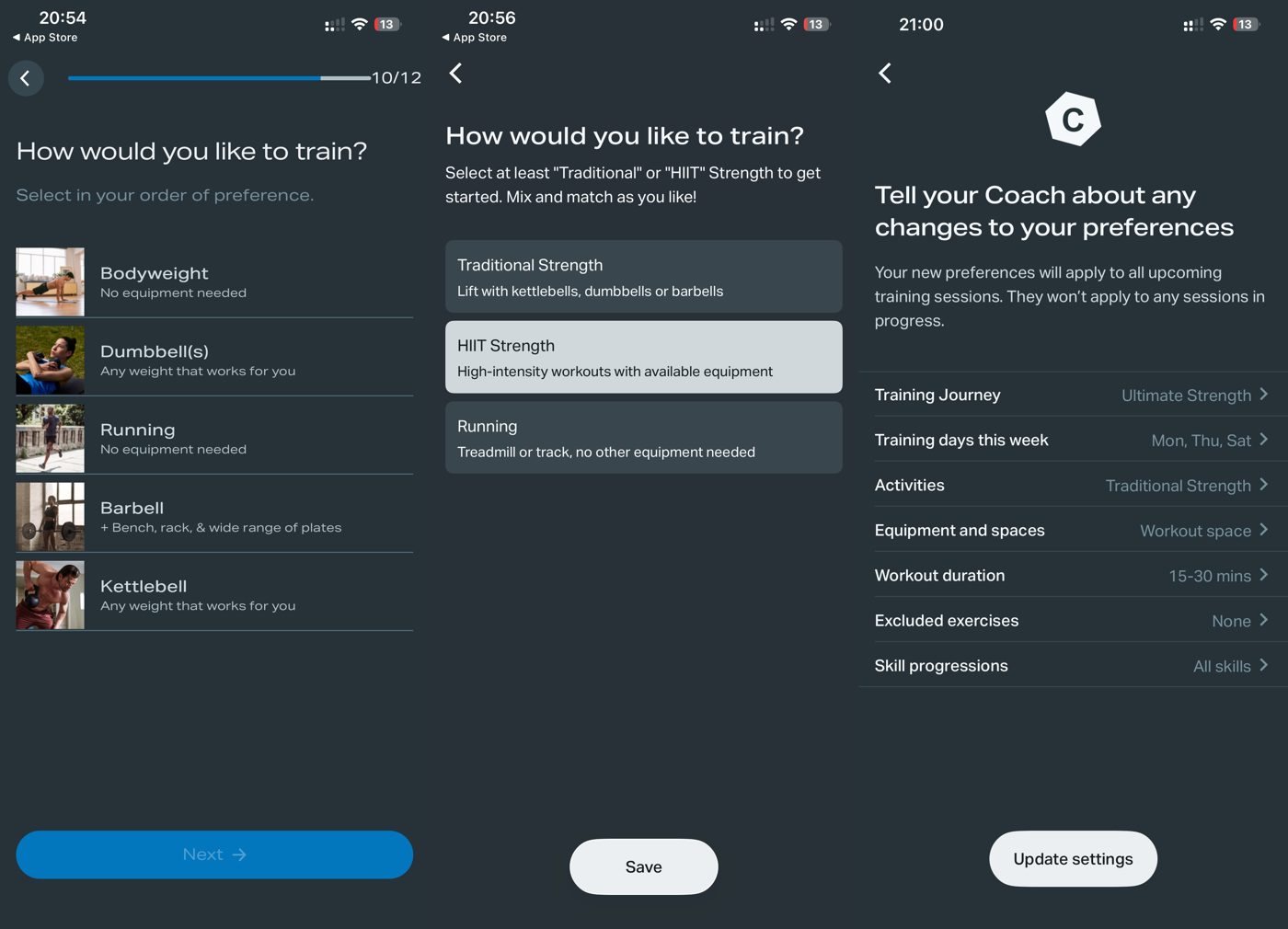
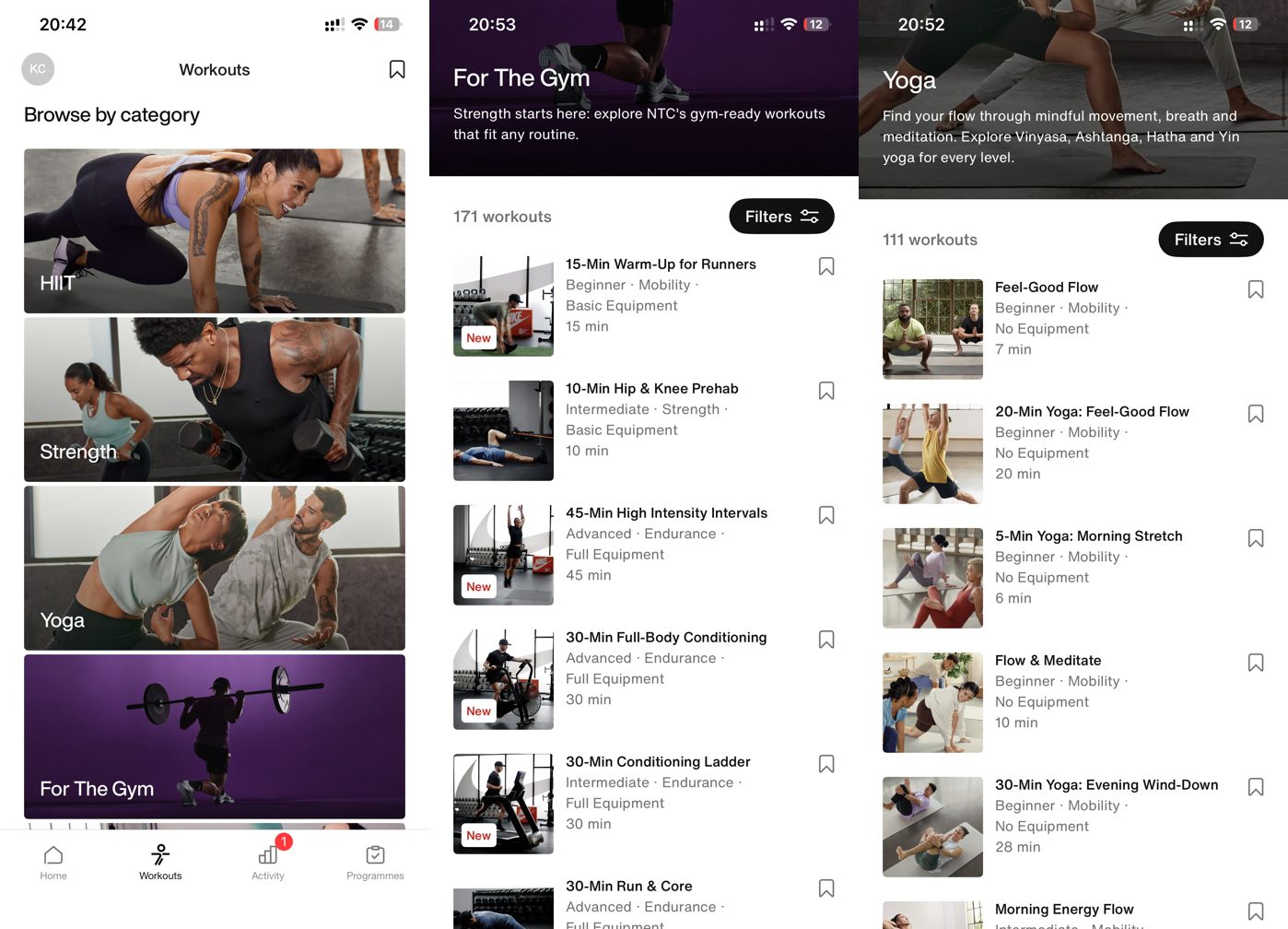
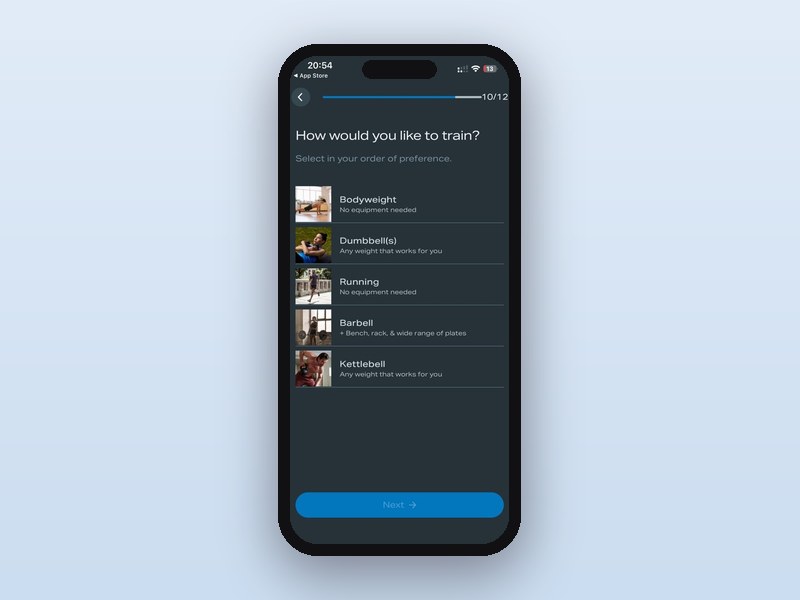
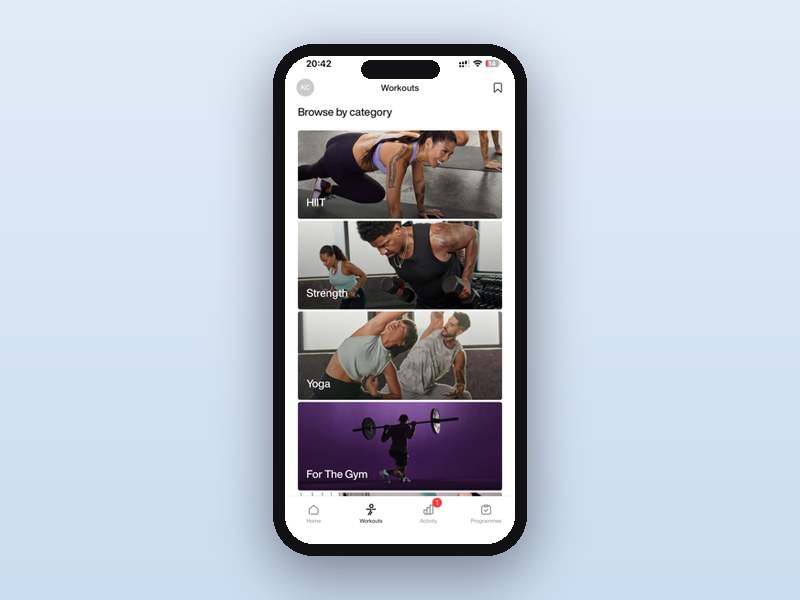
These two were not assessed to the same depth, and one of them was not used at all. Nike Training Club was sample tested: Katy Cole signed up, explored the whole free library and completed a workout. Freeletics is a research-based data profile. It has no free trial, only a 14-day money-back guarantee, so no workout was completed on it. The onboarding and preference screens were walked through and the screenshots on its review are our own, and everything else comes from the official pages, the app store listings, user reviews and the science. So every Freeletics score on this page describes what the platform contains, not how it felt to train on. We say so again in each section where that limit bites.
Nike Training Club if you want the best free way into quality movement, if a joint is setting your terms, or if you are happy to build your own week from a large library. Freeletics if you already train hard, want something to build the plan for you, and will steer it toward the weights journeys rather than the jumping. Neither one programmes anything for menopause, so if that is why you are looking, this is the wrong pair.
Freeletics vs Nike Training Club: the two platforms
Same nine weighted criteria, same twelve capability scores, and one of them costs nothing.
Freeletics
Runner-up
An AI Coach that builds a personalised plan from your goal, level, time and equipment, spanning bodyweight HIIT, weights and gym journeys, running, mobility and a Mindset audio coach.
- 15 to 45 min
- Structure 8.0
- Progressive strength 7/10
- No free trial
- Not tested
Choose Freeletics if you:
- Already train hard and want intensity
- Want a plan built and progressed for you
- Will use the weights journeys rather than the bodyweight default
- Want nutrition available in the same subscription family
- Are comfortable managing a multi-month auto-renewal
Affiliate link, at no extra cost to you. Full disclosure.
Nike Training Club
Winner
Nike’s free workout app: a large library of trainer-led sessions and multi-week programmes across strength, HIIT, yoga, Pilates, mobility, recovery and mindfulness.
- A few min to 45
- Value 10.0
- Joints 7.0
- Free
- Sample tested
Choose Nike Training Club if you:
- Want quality movement at no cash cost
- Have a joint that limits what you can do
- Are happy to build your own week
- Want yoga, Pilates and mobility alongside strength
- Do not want a subscription to manage
How we scored this, and why one column is weaker evidence
Both platforms were scored on the same nine weighted criteria and the same twelve capability scores. Muscle Potential carries 18%, Time Efficiency 15%, Joint Friendliness and Programme Structure 12% each, Women Over 40 Specificity and Recovery Compatibility 10%, Value for Money and UX and Design 8%, and Nutrition Integration 7%.
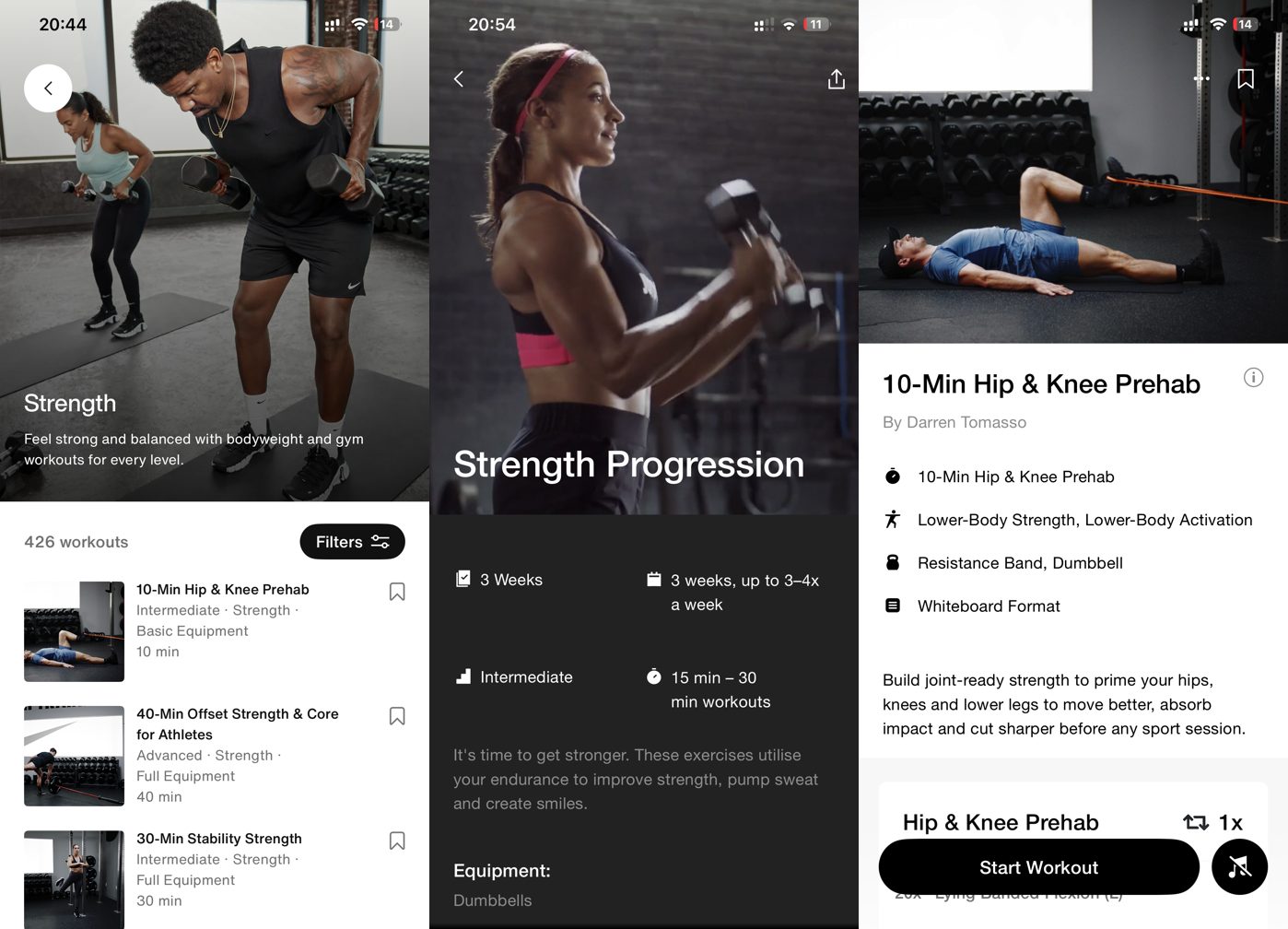
Same tester, and only one platform was used. Katy is a woman in her early 40s, perimenopausal, working full-time with children, with a previous meniscus injury. On Nike Training Club she signed up, browsed the whole free library, completed a Hip and Knee Prehab joint workout in the Whiteboard follow-along format, and worked through the library filters.
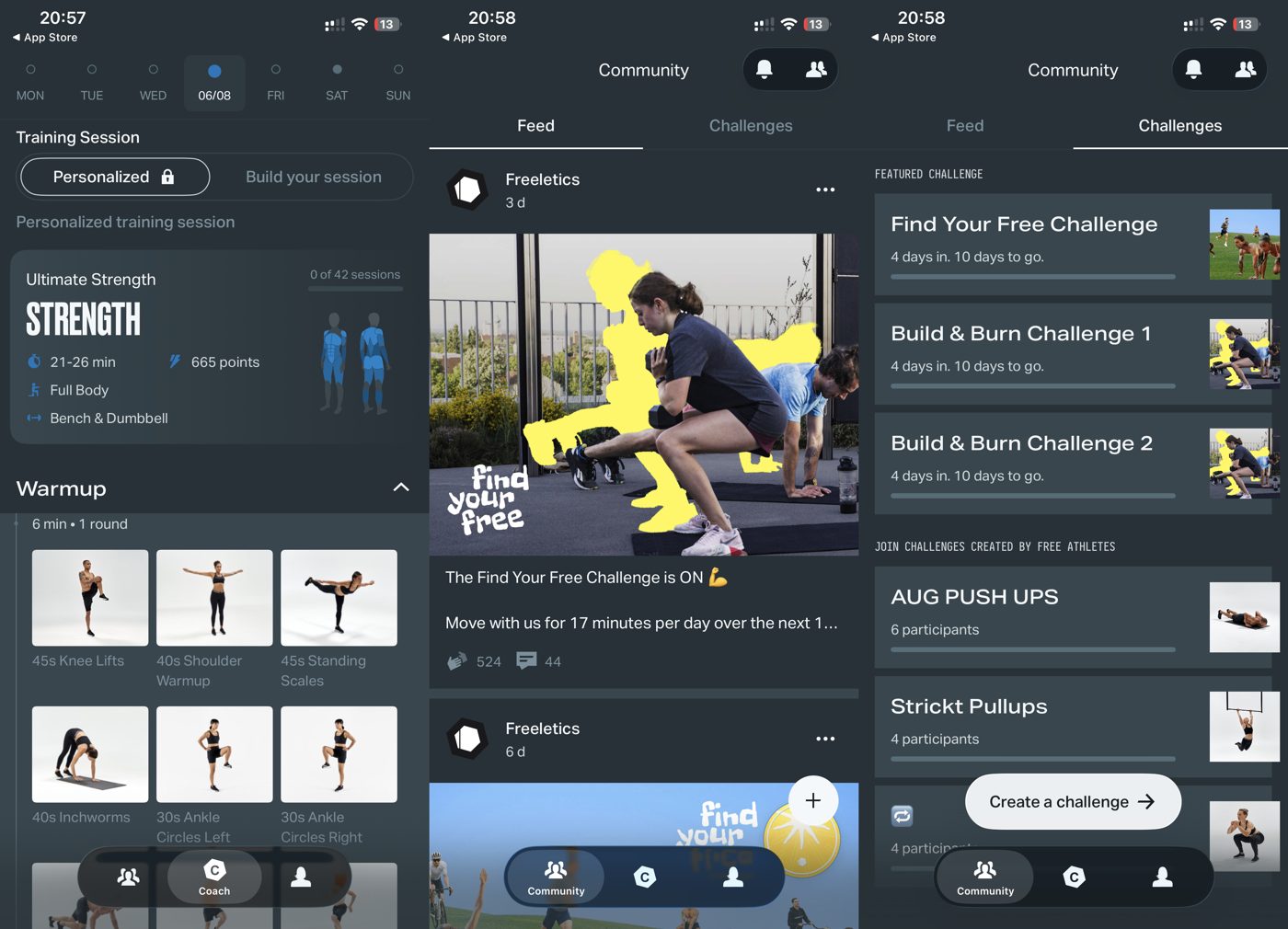
Freeletics was not used, because there is nothing to use without paying, and we do not buy a multi-month bundle to produce a comparison. What we did instead was walk through the onboarding and preference screens, so we can describe the setup controls accurately, and build the rest of the assessment from the official pages, the App Store, Google Play and Trustpilot listings, independent reviews and the peer-reviewed science.
That asymmetry has a specific consequence, and it is worth being clear about it rather than burying it. Where a criterion depends on how a platform feels in use, the Nike Training Club score rests on a session and the Freeletics score rests on what the platform is documented to contain. Where a criterion depends on what a platform offers, price, library breadth, whether menopause programming exists, both columns are on equal footing. We flag the difference in the sections where it changes how much weight a reader should give the number.
Joint friendliness: Nike Training Club wins, and this is the widest practical gap
Nike Training Club wins, 7 against 4, with low-impact capability 6 out of 10 against 3. On a page where the two overall scores are four tenths apart, this is where the real difference lives.
Freeletics is high-impact by heritage. It grew up around burpees, jump squats and plyometrics, those movements still feature heavily, and there is no dedicated low-impact or joint-friendly mode. That is not a criticism of the training itself, and the intensity has a real upside: Cai and colleagues found in a systematic review and meta-analysis that high-intensity interval training significantly improved cardiorespiratory fitness in middle-aged and older women.4 It is a statement about who the default was built for.
Nike Training Club is not low-impact by design either, and its HIIT is prominent, but it carries genuine yoga, Pilates, mobility and recovery sessions you can mix in, plus specific joint content. Our tester went looking for exactly that. Since she has had a meniscus injury before, she knows how important it is to care for the joints and build the muscles around them, so when a workout for strong joints appeared as she signed up, she did it to see if she could learn something new. Finding a Hip and Knee Prehab session in a free general-fitness library is not nothing.
What the evidence says about the impact question. Vetrovsky and colleagues found in a systematic review that lower-limb plyometric training improved strength, bone and function in older adults without raising injury rates, when it was age-adapted and progressed gradually from lower intensities.3 That is a real endorsement of impact work, and it is also precisely the condition Freeletics’ hard-charging default does not meet for a deconditioned or joint-sensitive body. The evidence supports impact training that is built up carefully, not impact training at full effort from a standing start.
Muscle and bone: Freeletics wins, and the loading is your job on both
Freeletics wins Muscle Potential, 7 against 6, with progressive strength capability 7 out of 10 against 6 and bone loading 5 against 4. Muscle Potential carries the heaviest weight in our model at 18%, so this is Freeletics’ single most valuable win.
The reason is progression rather than content. Freeletics’ weights and gym journeys carry AI load progression, so the platform decides when to add weight. That is genuine progressive overload, and it is conditional: it applies only if you choose the weights journeys over the signature bodyweight work, which under-loads for this purpose.
Nike Training Club’s strength library is deeper than its reputation suggests, hundreds of workouts including progressive dumbbell programmes with moderate-to-heavy cues, and she was positively surprised by how much real strength content is free. What it does not do is push you. Nothing in the app tells you to add weight, so reaching a stimulus that matters is entirely on you.
That distinction is what the evidence cares about. Khalafi and colleagues found in a systematic review and meta-analysis that exercise increased muscle and reduced fat mass, waist circumference and visceral fat in postmenopausal women, with resistance work best for muscle.1 Watson and colleagues found in the LIFTMOR trial that heavier, high-intensity resistance and impact training improved bone density and physical function in postmenopausal women, where light exercise did not to the same degree.2 Both platforms can deliver that. Only one of them will nudge you toward it, and we could not verify how well its progression works in practice because we did not train on it.
Our best workouts to build muscle after 50 ranking covers platforms that programme progression explicitly.
Value for money: the widest gap on the page, and one score is a first
Nike Training Club wins, 10 against 6, and 10 is the highest Value for Money score we have published.
| Plan | Freeletics | Nike Training Club |
|---|---|---|
| Free tier | About 34 bodyweight workouts, the AI Coach not included | Everything, the whole library and all programmes |
| Training plan | About $34.99 to $79.99 a bundle | No paid tier exists |
| With nutrition | About $49.99 to $89.99 a bundle | No nutrition content |
| Billing | 3, 6 or 12-month bundles that auto-renew | Nothing to bill |
| Trial | None, a 14-day money-back guarantee instead | Nothing to trial |
| What you pay with | Money | A free Nike account and extensive data collection |
Nike Training Club is genuinely free, with no subscription and no ads, and Nike made its former Premium tier free in 2020. It is fair to say the cost is not zero: a free Nike account is required and the app collects a broad set of information linked to you, so what you are really doing is trading data for a high-quality app. For most readers that is a trade worth making, and it should be a conscious one.
Freeletics is the opposite shape. There is no free trial, the multi-month bundles auto-renew, and the platform runs frequent discounts, so the price at signup is often well below the renewal price and two people can pay very different amounts. Its Trustpilot profile sits about a full star below its app store ratings, and that gap is driven by auto-renewal, refund and cancellation disputes rather than by the training. If you do subscribe, subscribe through the App Store or Google Play so cancellation sits in your own account settings, cancel at least a day before the period ends, and keep a confirmation.
What this means for your decision. A paid platform has to be clearly better to justify the money, and on the criteria that matter for a midlife body Freeletics is not. Our best free and budget workout apps ranking covers the wider free field.
Structure and progression: Freeletics wins, and it is a genuine strength
Freeletics wins, 8 against 7, and this is the argument for paying.
Its AI Coach builds a personalised plan from your goal, fitness level, available time and equipment, then adapts each session to your feedback: tell it a workout was too hard, or that you only have 15 minutes, or that you have no equipment, and it adjusts. Behind that sit 30 training journeys with progression. As a piece of programming that is a real asset, and it is the thing a free library cannot replicate.
Nike Training Club has multi-week programmes and they give real structure, but there is no weekly plan built for you. Her verdict names the consequence: if you are a beginner and do not know how to structure your workout week, you might feel lost. The experienced-user version of the same problem is the filters, which have no body-target option, so on strength days when she wanted a full-body session she had to hunt for it manually.
The limit on Freeletics’ advantage is one we cannot resolve. Reviewers report that you cannot reshuffle a session once it has been generated, and that stopping mid-session can lose your progress. For a woman managing a joint or easing back in, that lack of granular control matters, and we could not test how much it bites in practice.
Perimenopause and menopause fit: neither, and one has a near miss
Nike Training Club edges Women Over 40 Specificity, 4.5 against 3.6, and menopause programming ties at 1 out of 10, which is the joint lowest score we have published for that capability.
Freeletics has nothing here. No perimenopause or menopause programming, no cycle awareness, no symptom-phase adaptation, no pelvic-floor work and no hormone content anywhere in the product.
Nike Training Club has one thing, and it is worth describing precisely because it is easy to overstate. It carries a four-week, four-phase programme called Harness the Power of Your Menstrual Cycle, which syncs training to the cycle. That is genuinely relevant to a still-cycling perimenopausal woman, and it is not menopause support, which is why hormone awareness scores 3 against 1 rather than anything higher. The verdict from testing is unambiguous: they do not have a dedicated peri or menopausal program, nor workouts for other women’s issues like pelvic floor, but there are many strength workouts.
Pelvic floor
Nike Training Club wins, 4 out of 10 against 1. Its pelvic-floor work exists inside the postpartum maternity programme, Nike (M)ove Like a Mother, whose deep-core and pelvic-floor recovery block was designed by a pelvic-health physical therapist and vetted by an obstetrician. That is real clinical input and it is scoped to pregnancy and postpartum, not to a woman in her fifties. Freeletics has no pelvic-floor, prenatal or postnatal content at all.
Expert credibility
Nike Training Club wins, 6 out of 10 against 4. Nike Master Trainers are an established coaching roster and the maternity module carries named clinical input. Freeletics’ expertise is institutional and anonymous: its Coach is refined against behavioural data from tens of millions of users, which is a real asset for general programming, but there are no named sports scientists, physiologists or clinicians publicly attached to it. Neither platform has a menopause specialist or advisory board.
Time efficiency: tied, and both suit a compressed week
Tied at 8 each, and these are two of the stronger Time Efficiency scores in our comparison set.
Freeletics runs about 15 to 45 minutes and the Coach adapts to the time you have, which is the more elegant answer: tell it you have 15 minutes and the session is built to fit. Nike Training Club runs from a few minutes to around 45 and you filter by duration yourself.
The tie is fair. One automates the choice and the other gives you a bigger library to choose from, and for a woman fitting training around work and children either approach works. Our 30-minute workouts for women over 40 and 20-minute workouts for perimenopause guides cover the wider field in both bands.
Recovery: tied, and neither schedules it for you
Tied at 6 each, though recovery and deload capability runs to Nike Training Club at 6 out of 10 against 5.
Freeletics has mobility and recovery sessions plus a Mindset audio coach covering habits, stress, sleep and focus, which is more than most training apps offer. What offsets it is the default intensity: a platform that trains hard by default and gives you limited deload control is asking more of your recovery than it gives back.
Nike Training Club has recovery, mobility, yoga, breathwork and mindfulness content, with mindset and sleep material alongside. There is no adaptive deload logic, so a rest week is something you decide to take.
Neither platform will notice that you are tired. Our low-cortisol workouts for perimenopause guide covers platforms that treat this as a design problem.
UX and design: Nike Training Club wins, with a specific irritation on each side
Nike Training Club wins, 7 against 6, and both platforms are polished.
Nike Training Club is a well-built app with an Apple Watch app, syncing to Apple Health or Google Fit and casting to a television. Two frictions came out of the session, and both are usability rather than quality problems. Workouts come in two formats: instructor-led Class sessions with spoken coaching, and Whiteboard sessions that are a follow-along demo-and-timer format without voiceover. The one she picked happened to be a whiteboard-style, follow-along session with no voiceover, and while she could still follow the video reasonably well, it would be nice to have someone explain and remind you of the correct posture. The fix is simply to choose the Class format. The second friction is the filters, which do not include a body target.
Freeletics is polished too, an Apple Editors’ Choice with high-definition how-to videos and genuinely useful preference controls. What holds its score down is the pair of complaints that recur through its reviews: the fixed-session limitation described above, and the billing friction set out in the value section. We are reporting both from the review corpus rather than from use.
Nutrition: Freeletics wins, and neither is a reason to choose
Freeletics wins, 5 against 3, with midlife nutrition capability 4 out of 10 against 3.
Freeletics has a real nutrition coach, and it sits in a separate Freeletics Nutrition app available through the pricier training and nutrition bundle, so it is neither integrated nor included. It is also general rather than midlife-specific.
Nike Training Club has no structured nutrition, no education library and no community. It is purely a workout app, and it does not pretend otherwise. Nutrition carries the smallest weight in our model at 7%, so this barely moves either score, and if you want training and eating handled together neither platform does it.
Equipment and space needed at home
Almost identical, and the useful purchase is the same on both.
Freeletics’ bodyweight journeys need nothing but a mat and space, which is part of the appeal and also exactly what makes the default high-impact. Nike Training Club has a large bodyweight library that needs a mat and some room.
For either platform, the addition that changes what you get out of it is a pair of adjustable dumbbells, because a fixed light pair stops providing a stimulus once you adapt to it. On Freeletics that unlocks the weights and gym journeys, which is where its strength advantage actually lives. On Nike Training Club it lets you work through the progressive dumbbell programmes with enough load to matter. Neither platform requires any subscription hardware, a machine or a dedicated room.
Starting from scratch: a genuine dilemma
Nike Training Club wins beginner on-ramp, 6 out of 10 against 4, and neither answer is comfortable.
Nike Training Club is free, which removes the biggest barrier entirely, and it has beginner workouts and starter programmes. What it does not have is a plan, and a true beginner facing hundreds of workouts can stall on the choosing rather than the training.
Freeletics does build the plan, which is the thing a beginner most needs, and then trains at a default intensity reviewers find demanding, which is the thing a beginner least needs. One real user review describes an old injury aggravated by a movement that could not be swapped out. That combination, a steep default plus limited control over a single exercise, is why its on-ramp scores 4.
Adherence is worth a word here, because it is the outcome that actually decides whether either works. Reljic and colleagues found in a meta-analysis that drop-out from interval training was low overall, around 18 percent, and was predicted by a greater time commitment rather than by exercise intensity.5 That is mildly reassuring about hard training and a caution about over-committing, and on a free self-directed library the practical risk is sustaining a routine nobody built for you.
Freeletics pros and cons
Freeletics scores 6.2. It is strongest on short sessions and weakest on suitability for women over 40.
Pros
- Muscle Potential 7 against 6, leading both the progressive strength and bone loading rows, on weights journeys that carry AI load progression.
- Programme Structure 8 against 7: an AI Coach that builds and adapts a plan, plus 30 journeys.
- Nutrition Integration 5 against 3.
- Sessions from 15 to 45 minutes that adapt to the time you have.
- A Mindset audio coach for stress, sleep and habits.
- Real preference controls before a session is generated.
Cons
- Joint Friendliness 4 against 7, with low-impact 3 out of 10 against 6 and no dedicated low-impact mode.
- Value for Money 6 against 10, on multi-month bundles with no free trial.
- Pelvic floor 1 out of 10, hormone awareness 1, expert credibility 4 against 6.
- Beginner on-ramp 4 against 6.
- Auto-renewal and refund complaints.
- And we could not test any of it.
Nike Training Club pros and cons
Nike Training Club scores 6.6. It leads on value for money and trails on nutrition guidance.
Pros
- Value for Money 10, the highest we have published, because it is genuinely free with no subscription and no ads.
- Joint Friendliness 7 against 4, with real yoga, Pilates, mobility and joint content.
- A deeper strength library than its reputation suggests.
- Pelvic floor 4 out of 10 against 1 and expert credibility 6 against 4.
- UX and Design 7 against 6, with an Apple Watch app, health sync and casting.
- A cycle-syncing programme.
- And it was actually tested.
Cons
- Muscle Potential 6 against 7, with bone loading 4 out of 10 against 5 and no push to add load.
- Programme Structure 7 against 8: a library rather than a coach, so you build the week.
- Nutrition Integration 3, with none at all.
- No body-target filter.
- Whiteboard workouts carry no voiceover.
- A free Nike account is required, with extensive data collection.
Quick yes/no comparison
| Feature | Freeletics | Nike Training Club |
|---|---|---|
| Free to use | No, a limited free tier only | Yes, entirely |
| Free trial of the paid product | No, a 14-day money-back guarantee | Not applicable |
| A plan built for you | Yes, the AI Coach | No, multi-week programmes only |
| Automatic load progression | Yes, in the weights journeys | No, you add load yourself |
| Dedicated low-impact mode | No | No, but low-impact content is there |
| Yoga and Pilates | No | Yes |
| Menopause or perimenopause programming | No | No |
| Any hormone or cycle content | No | Yes, one cycle-syncing programme |
| Pelvic floor content | No | Yes, within the postpartum programme |
| Nutrition guidance | Yes, in a separate app behind a bundle | No |
| Exclude specific exercises | Yes, in the preferences | Not assessed |
| Filter by body target | Not assessed | No |
| Apple Watch app | Yes | Yes |
| Cast to a television | Not assessed | Yes |
| Was it tested hands-on | No, research-based only | Yes, one session |
Freeletics vs Nike Training Club at a glance
| Freeletics | Nike Training Club | |
|---|---|---|
| Overall score | 6.2 | 6.6 |
| How it was assessed | Data profile, research-based. The onboarding and preferences were walked through, no workout was completed | Sample tested, signed up, browsed the whole free library and completed a workout |
| Cost | About $34.99 to $79.99 a bundle, or $49.99 to $89.99 with nutrition | Free |
| Trial | None, a 14-day money-back guarantee | Nothing to trial |
| Session length | About 15 to 45 minutes, adapts to the time you have | A few minutes to around 45 |
| Approach | An AI Coach that generates and adapts a personalised plan | A large self-directed library plus multi-week programmes |
| Impact by default | High: burpees, jump squats and plyometrics | Mixed, with HIIT prominent and real low-impact content |
| Who is behind it | Freeletics GmbH, Munich, since 2013, no named experts | Nike Master Trainers, plus clinical input on the maternity module |
| Menopause content | None | None, one cycle-syncing programme |
| Equipment | A mat to start, dumbbells or a barbell for the weights journeys | A mat to start, dumbbells for the strength library |
| Known live issue | Auto-renewal and refund complaints, no in-session reshuffle | No body-target filter, Whiteboard workouts have no voiceover |
| How we assessed it | Research-based, onboarding walked through, no workout completed | Sample tested, library browsed and one workout completed |
Freeletics vs Nike Training Club: the full scoring breakdown
Nike training club wins four of the nine weighted criteria and freeletics wins three, with two tied. The overall gap is 6.6 against 6.2, which is narrow, and it understates the difference because one of these platforms costs nothing.
| Criterion | Weight | Freeletics | Nike Training Club | Winner |
|---|---|---|---|---|
| Muscle Potential | 18% | 7 | 6 | Freeletics |
| Time Efficiency | 15% | 8 | 8 | Tied |
| Joint Friendliness | 12% | 4 | 7 | Nike Training Club |
| Programme Structure | 12% | 8 | 7 | Freeletics |
| Women Over 40 Specificity | 10% | 3.6 | 4.5 | Nike Training Club |
| Recovery Compatibility | 10% | 6 | 6 | Tied |
| Value for Money | 8% | 6 | 10 | Nike Training Club |
| UX and Design | 8% | 6 | 7 | Nike Training Club |
| Nutrition Integration | 7% | 5 | 3 | Freeletics |
| Overall | 100% | 6.2 | 6.6 | Nike Training Club |
The twelve capability scores
Nike training club wins seven of the twelve capability scores and freeletics wins three, with two tied. The widest gaps are low-impact, 6 out of 10 against 3, and pelvic floor, 4 against 1, both to Nike Training Club. Freeletics leads on progressive strength, 7 against 6. Menopause programming and menopause education tie, which is the clearest statement that neither platform is built for this stage.
| Capability | Freeletics | Nike Training Club | Winner |
|---|---|---|---|
| Low-impact | 3 | 6 | Nike Training Club |
| Progressive strength | 7 | 6 | Freeletics |
| Bone loading | 5 | 4 | Freeletics |
| Recovery & deload | 5 | 6 | Nike Training Club |
| Menopause programming | 1 | 1 | Tied |
| Pelvic floor | 1 | 4 | Nike Training Club |
| Hormone awareness | 1 | 3 | Nike Training Club |
| Menopause education | 2 | 2 | Tied |
| Expert credibility | 4 | 6 | Nike Training Club |
| Mind-body support | 5 | 6 | Nike Training Club |
| Beginner on-ramp | 4 | 6 | Nike Training Club |
| Midlife nutrition | 4 | 3 | Freeletics |
Who wins for…
Who wins for painful joints
Nike Training Club. Joint Friendliness 7 against 4 and low-impact 6 out of 10 against 3.
Who wins on price
Nike Training Club, decisively. Value for Money 10 against 6, because it is free.
Who wins for building muscle
Freeletics. Muscle Potential 7 against 6, on weights journeys with AI load progression.
Who wins for bone density
Freeletics, narrowly. It leads the bone loading row, and on both platforms reaching a real stimulus is your decision.2
Who wins for being told what to do
Freeletics. Programme Structure 8 against 7: it builds the plan, Nike Training Club does not.
Who wins for perimenopause and menopause
Neither. Menopause programming ties at 1 out of 10. Nike Training Club has a cycle-syncing programme, which is adjacent rather than an answer.
Who wins for pelvic floor
Nike Training Club, on a low bar. 4 out of 10 against 1, and its content is postpartum rather than menopause-stage.
Who wins for a beginner
Nike Training Club. Beginner on-ramp 6 out of 10 against 4, and free removes the cost of finding out.
Who wins for yoga, Pilates and mobility
Nike Training Club. Freeletics has mobility sessions; it does not have the breadth.
Who wins for nutrition
Freeletics, and barely. 5 against 3, with the nutrition coach in a separate app behind a pricier bundle.
Who wins for a busy week
A tie at 8. Freeletics adapts the session to your time; Nike Training Club gives you more to filter.
Who wins on evidence
Nike Training Club, because we used it. Freeletics has no free trial, so its column is research-based throughout.
Decision tree for women over 40
You do not want to spend anything. Nike Training Club. It is free and it is also the better midlife fit, so this is the easiest call on the page.
A joint dictates what you can do. Nike Training Club, for Joint Friendliness 7 against 4 and the low-impact content to mix in.
You want to be told exactly what to do each week. Freeletics, for the AI Coach. This is the one thing money buys you here.
You already train hard and want intensity. Freeletics, steered toward the weights journeys.
You are a beginner. Nike Training Club, and start with the Class format rather than Whiteboard so you get spoken coaching.
Your priority is muscle and bone. Either, and add load deliberately on both, because only Freeletics progresses it for you and only within the weights journeys.
Perimenopause is why you are looking. Neither. Both score 1 out of 10 on menopause programming.
You dislike managing subscriptions. Nike Training Club. There is nothing to cancel, and Freeletics has a recurring auto-renewal problem.
What we did not test
The largest untested surface of any comparison on this site, and it sits entirely on one side.
We did not complete any workout on Freeletics. We did not use the weights and gym journeys, the running and cardio content, or the Mindset audio coach. Everything on this page about how Freeletics trains comes from the research basis set out at the top, plus a walk through the onboarding and preference screens. Its scores are research-based and its column should be read as a description of the platform rather than a verdict on the experience.
On Nike Training Club we did not run a full multi-week programme, the cycle-syncing programme, the maternity programme or the Apple Watch app. One session and a thorough browse tell you what the library holds and how one workout format feels. They do not tell you whether the strength programmes progress well across two months.
Neither platform’s handling of an injury or a symptom flare was assessed, and nothing on this page should be read as a claim about long-term results on either.
Which is better for women over 50?
Nike Training Club, more clearly than at 40
Every argument in its favour gets stronger with age. Joint Friendliness of 7 against 4 matters more when a knee sets the terms, the yoga, Pilates and mobility content gives you somewhere to go on a day when loading is wrong, and free means you can try it without any commitment at all. Our best low-impact workouts for women over 50 and best workouts for postmenopause rankings cover the wider field.
Freeletics, only with conditions
If you already train hard and want the progression, its weights journeys are the better mechanism for muscle and bone. The condition is that you set it up deliberately, choose Traditional Strength over HIIT, exclude the movements you do not want, and build gradually rather than starting at the default, which is exactly what the plyometric evidence says impact training requires.3 That is a lot of steering to ask of a platform you cannot try first.
What we would actually suggest
Start with Nike Training Club, because it costs nothing to find out, and add progressive loading deliberately. If after a few months you find that choosing your own sessions is the thing stopping you, then a coached platform is worth paying for, and there are menopause-aware options that would serve you better than either of these.
- Price
- No monthly plan. Prepaid terms only, from $49.99 for 3 months
- Free trial
- No free trial; 14-day money-back guarantee. A substantial free tier exists with 34 bodyweight workouts
The Freeletics button is an affiliate link, at no extra cost to you. Full disclosure.
Frequently asked questions
Is Freeletics or Nike Training Club better for women over 40?
Nike Training Club, 6.6 against 6.2, and the gap is wider than those numbers suggest because it is also free. It wins Value for Money 10 against 6, Joint Friendliness 7 against 4, and seven of the twelve midlife capability scores against Freeletics’ three. Freeletics is the better programmer, winning Muscle Potential 7 against 6 and Programme Structure 8 against 7. But it is high-impact by default, it costs money, and neither platform has any menopause programming.
Is Nike Training Club really free?
Yes. There is no subscription, no paid tier and no ads, and the whole library including the multi-week programmes is included. Nike made its former Premium tier free in 2020. The trade is a free Nike account, which is required and comes with extensive data collection, so the fair way to describe it is a high-quality app at no cash cost in exchange for being part of Nike’s membership ecosystem. That is why Value for Money is 10 out of 10, the highest score of its kind we have published.
Which one is gentler on joints?
Nike Training Club, 7 against 4, and this is the clearest practical difference between them. Low-impact capability is 6 out of 10 against 3. Freeletics is high-impact by heritage, built around burpees, jump squats and plyometrics, with no dedicated low-impact mode. Nike Training Club has genuine yoga, Pilates, mobility and recovery content to mix in, and a Hip and Knee Prehab workout turned up in the free library during testing. Neither has a low-impact filter, so on both you steer yourself.
Can you make Freeletics low-impact?
Only partly, and this is a fair question because the setup gives you more control than the reputation suggests. The preferences let you choose Traditional Strength over HIIT, rank your equipment from bodyweight up to barbell, set your duration and days, and exclude specific exercises you want to avoid, and those choices apply to upcoming sessions. What you cannot do is reshuffle a session once it has been generated, and there is no dedicated low-impact mode. We did not complete a workout on Freeletics, so we cannot tell you how low-impact a steered session actually feels, only that the controls exist.
Which builds more muscle and bone?
Freeletics, 7 against 6, with progressive strength 7 out of 10 against 6 and bone loading 5 against 4. Its weights and gym journeys carry AI load progression, which is genuine progressive overload if you choose them over the bodyweight default. Nike Training Club’s strength library is deep, hundreds of workouts with dumbbell programmes, but nothing in the app pushes you to add load. Watson and colleagues found in the LIFTMOR trial that heavier, high-intensity resistance and impact training improved bone density in postmenopausal women where light exercise did not to the same degree,2 so on either platform the loading is your decision to make.
Does either have menopause or perimenopause content?
No, and menopause programming ties at 1 out of 10, the joint lowest we have published. Nike Training Club has one adjacent feature, a four-week cycle-syncing programme called Harness the Power of Your Menstrual Cycle, which is relevant to a still-cycling perimenopausal woman and is not menopause support, which is why hormone awareness is 3 against 1. Our tester’s account is direct: they do not have a dedicated peri or menopausal program, nor workouts for other women’s issues like pelvic floor, but there are many strength workouts. Freeletics has nothing in this area at all.
Which has better pelvic floor content?
Nike Training Club, 4 out of 10 against 1, and the detail matters. Its pelvic-floor work sits inside the postpartum maternity programme, Nike (M)ove Like a Mother, whose recovery block was designed by a pelvic-health physical therapist and vetted by an obstetrician. That is real clinical input, and it is scoped to pregnancy and postpartum rather than menopause. Freeletics has no pelvic-floor, prenatal or postnatal content of any kind.
Which suits a beginner better?
Nike Training Club, on a beginner on-ramp of 6 out of 10 against 4, though neither is ideal and both share the same underlying problem. Freeletics is demanding by default and reviewers find it steep for a returning body. Nike Training Club is free and has beginner workouts and starter programmes, but it is a library rather than a coach. Our tester puts the risk plainly: if you are a beginner and do not know how to structure your workout week, you might feel lost. Freeletics at least builds you a plan, which is what its Programme Structure score of 8 reflects.
How much did you actually test each platform?
Unequally, and it is the most important caveat on this page. Nike Training Club was sample tested: Katy Cole signed up, explored the whole free library and completed a workout. Freeletics was not tested at all, because it has no free trial. This is a research-based data profile, with the onboarding and preference screens walked through. Every Freeletics score describes what the platform contains rather than how it felt to use.
Which is better value?
Nike Training Club, 10 against 6, and it is not a close call. Nike Training Club costs nothing. Freeletics is subscription only, sold as 3, 6 and 12-month bundles from about $34.99 to $79.99, or about $49.99 to $89.99 with the nutrition bundle, with no free trial and a 14-day money-back guarantee instead. It also runs frequent discounts, so the onboarding price is often well below the renewal price, and it carries a steady stream of auto-renewal and refund complaints. If you subscribe, do it through the App Store or Google Play so cancellation sits in your own account settings, and set a reminder.
Which has nutrition guidance?
Freeletics, 5 against 3, and neither is a reason to subscribe. Freeletics has a real nutrition coach, but it lives in a separate app behind the pricier training and nutrition bundle rather than being integrated, and it is not midlife-specific. Nike Training Club has no structured nutrition at all: it is purely a workout app. Midlife nutrition capability is 4 out of 10 against 3, which tells you how little separates them.
Which one would you actually recommend?
Nike Training Club for almost everyone reading this, because it is free, it is gentler, and its strength library is deeper than its reputation suggests. Use it the way the review describes: mix strength days with low-impact sessions from the yoga and Pilates categories, and add load deliberately, because nothing in the app will push you to. Freeletics is worth considering only if you already train hard, want a plan built for you, and will steer it toward the weights journeys and away from the jumping. Neither is a menopause tool, and if that is your priority both are the wrong shelf.
Research citations
- Khalafi M, Habibi Maleki A, Sakhaei MH, et al. The effects of exercise training on body composition in postmenopausal women: a systematic review and meta-analysis. Frontiers in Endocrinology. 2023. PMC. (Cited for: exercise increased muscle and reduced fat mass, waist circumference and visceral fat in postmenopausal women, with resistance training best for muscle.)
- Watson SL, Weeks BK, Weis LJ, Harding AT, Horan SA, Beck BR. High-intensity resistance and impact training improves bone mineral density and physical function in postmenopausal women: the LIFTMOR randomized controlled trial. Journal of Bone and Mineral Research. 2018;33(2):211–220. PubMed. (Cited for: heavier, high-intensity resistance and impact training improved bone density and physical function, where light exercise did not to the same degree.)
- Vetrovsky T, Steffl M, Stastny P, Tufano JJ. The efficacy and safety of lower-limb plyometric training in older adults: a systematic review. Sports Medicine. 2019;49(1):113–131. PubMed. (Cited for: impact training improved strength, bone and function in older adults without raising injury rates, when age-adapted and progressed gradually from lower intensities. Note: the review’s conclusion is conditional on that gradual progression, which is why we do not read it as an endorsement of training at an unmodified default intensity.)
- Cai L, et al. Effects of high-intensity interval training on cardiopulmonary fitness and physical function in middle-aged and elderly women: a systematic review and meta-analysis. Frontiers in Physiology. 2026. PMC. (Cited for: high-intensity interval training significantly improved cardiorespiratory fitness in middle-aged and older women.)
- Reljic D, Lampe D, Wolf F, Zopf Y, Herrmann HJ, Fischer J. Prevalence and predictors of dropout from high-intensity interval training in sedentary individuals: a meta-analysis. Scandinavian Journal of Medicine and Science in Sports. 2019. Wiley. (Cited for: drop-out was low overall, about 18 percent, and was predicted by a greater time commitment rather than by exercise intensity.)
This page compares fitness platforms. It is not medical advice. Katy is a woman who has trained through perimenopause, not a clinician. Any training observations described are one person’s recorded experience, not an expected result or a general pattern. If you have a diagnosed condition, an injury, or symptoms that concern you, speak to a qualified healthcare professional before changing how you train.
About this comparison
Compiled by Katy Cole for Her Daily Fit. The two platforms were not assessed to the same depth and the difference is structural rather than a matter of effort. Nike Training Club was sample tested; the methods section above lists what that session covered. Freeletics has no free trial, so it is a research-based data profile: the onboarding and preference screens were walked through and the screenshots on its review are our own, and everything else comes from the official pages, the app store and Trustpilot listings, independent reviews and peer-reviewed science. Both were scored on the same nine weighted criteria and the same twelve capability scores, and the Freeletics column describes what the platform contains rather than how it performs in use. Khalafi and colleagues found that resistance work is the modality that best protects muscle across the menopause transition,1 which is why Muscle Potential carries the most weight in that model. Prices were verified against official sources in 2026 and may differ if there has been a recent change. Freeletics runs frequent discounts, so the figure you are shown at signup may not be the figure you are charged at renewal. Scores are pulled live from each programme’s own assessment. Her Daily Fit earns nothing from either platform.
Compared with