FORM scores higher overall, 7.6 against 6.9, and is the stronger platform for building muscle and nutrition guidance. Melissa Wood Health is the better pick if what you need most is joint-friendly training and recovery.
Quick answer
- FORM 7.6 vs MWH 6.9
- Muscle 7 vs 4
- Joints 6.5 vs 8.5
- FORM $28/mo, MWH $14.95/mo
- Menopause education 0 vs 1
- Time efficiency tied at 9
FORM is the better platform if you want to actually get stronger, and it is twice the price. It wins Muscle Potential, 7 against 4, with progressive strength capability 6 out of 10 against 2. It also takes UX and Design, 9 against 8, the highest UX score in this comparison set, plus Nutrition Integration 8 against 5 and Programme Structure 8 against 7.
Melissa Wood Health is gentler, cheaper and better for a recovery week. It wins Joint Friendliness, 8.5 against 6.5, and Recovery Compatibility 9.5 against 8, with low-impact capability 9 out of 10 against 7 and mind-body support 9 against 8. At $14.95 a month it is roughly half the price, and Value for Money ties at 8.
Neither of these platforms is built for perimenopause, and one of them records the lowest score we have ever published. FORM’s menopause education capability is 0 out of 10, the only zero anywhere in our library, and Melissa Wood Health scores 1. Hormone awareness is 1 on both. Women Over 40 Specificity is 4.8 against 4. Both platforms skew younger and are led by aesthetics and wellness rather than by this life stage. That does not make either a bad product, and it does mean this page is answering which of two general platforms suits a woman over 40 better, not which one was designed for her.
FORM if you want a programme assigned to you, a genuinely beautiful app, and workouts that will make you sore in the first week. Melissa Wood Health if your joints need the gentler option, if you want a recovery-weighted week, or if the $13 a month difference matters. The clearest signal on this page is what Katy Cole did rather than what she scored: FORM is now her favourite workout app, and she did not continue MWH past the testing period because the workouts started to feel repetitive after about six weeks.
Melissa Wood Health vs FORM: the two platforms
Same nine weighted criteria, same twelve capability scores, two well-made wellness apps, and a large gap in how hard they will work you.
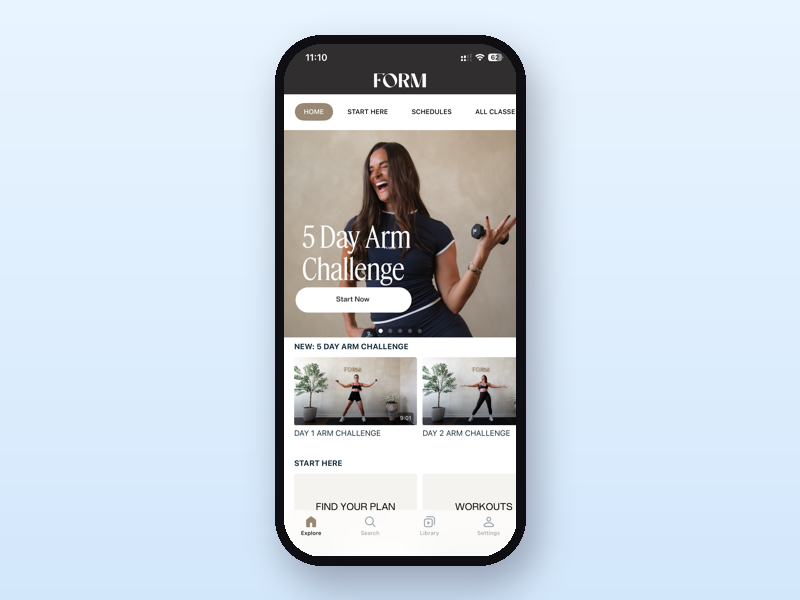
FORM
Winner
Sami Clarke’s Form Method: a quiz-assigned programme spanning strength, Pilates, mindfulness and a dietitian-backed nutrition section, in the best-designed app in this comparison set.
- About 30 min
- UX 9.0
- Beginner on-ramp 8/10
- 7-day trial
- $28/month
Choose FORM if you:
- Want a programme assigned rather than a library to browse
- Want to get meaningfully stronger, not just move
- Care about how an app looks and feels to use
- Want dietitian-backed recipes included
- Have no joint issues that need modifications
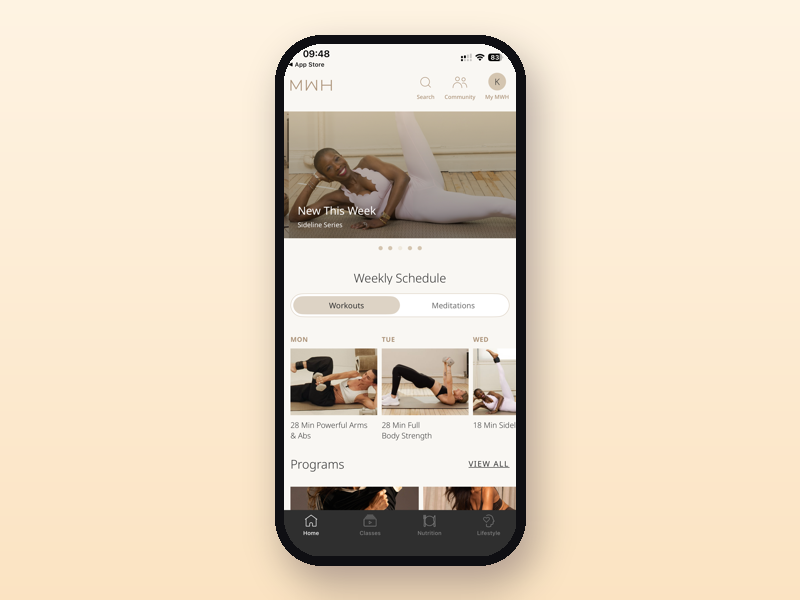
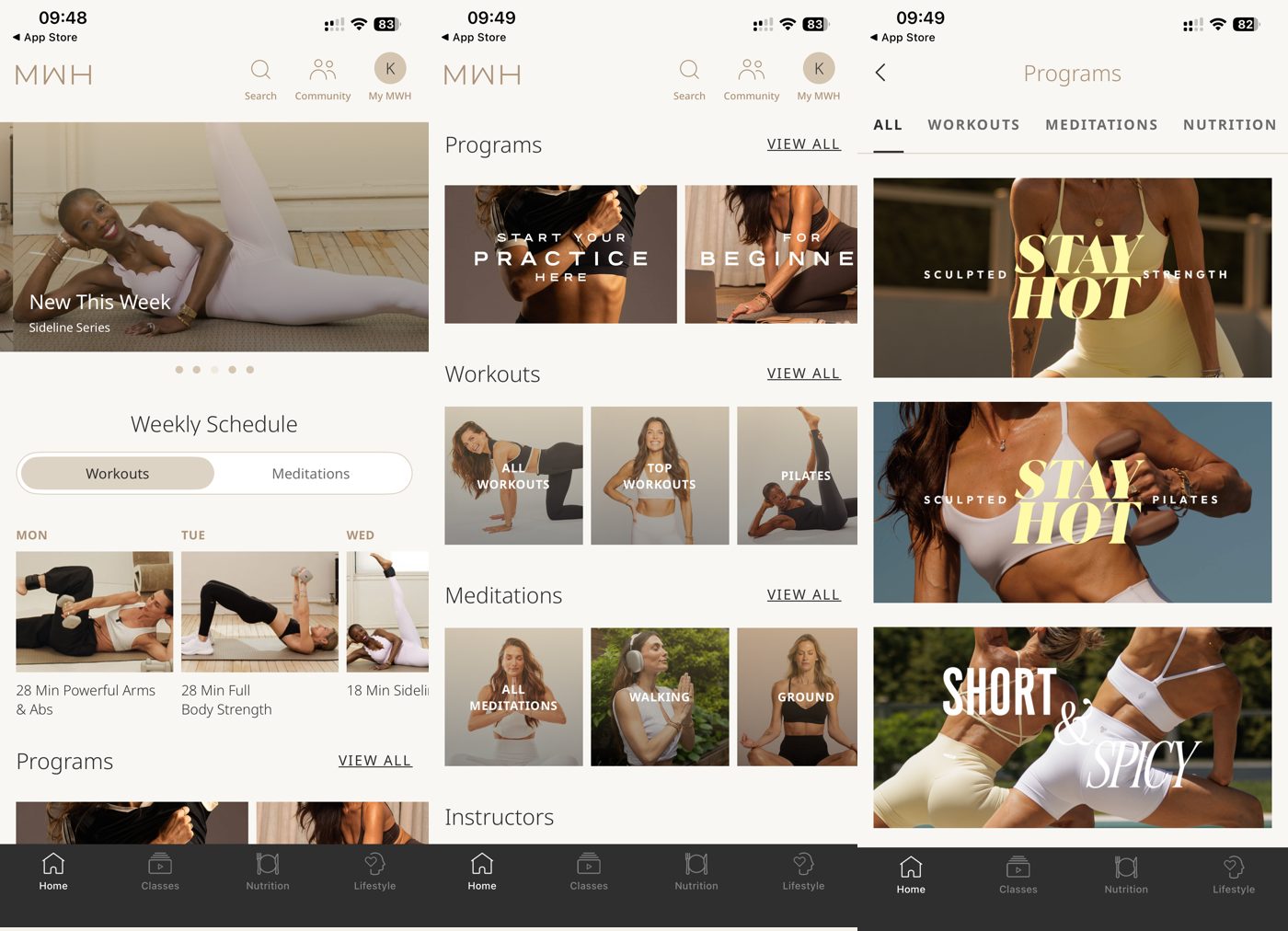
Melissa Wood Health
Runner-up
Pilates plus light strength in short, low-intensity sessions, weighted towards mind-body work and recovery, at roughly half the price of most platforms here.
- 10 to 30 min
- Low-impact 9/10
- Mind-body 9/10
- 7-day trial
- $14.95/month
Choose Melissa Wood Health if you:
- Need the gentler option for your joints
- Want a recovery-weighted week rather than a training block
- Want sessions that can drop to 10 minutes
- Want to spend around half as much per month
- Value mind-body work as much as training
How we scored this, and how both were tested
Both platforms were paid for and used firsthand, and both were scored on the same nine weighted criteria and the same twelve capability scores. Muscle Potential carries 18%, Time Efficiency 15%, Joint Friendliness and Programme Structure 12% each, Women Over 40 Specificity and Recovery Compatibility 10%, Value for Money and UX and Design 8%, and Nutrition Integration 7%.
Same tester, same knee, and one detail that matters for reading the FORM results. Katy is in her mid-forties, in perimenopause, with a previous meniscus injury. She came to FORM straight after four weeks on The Sculpt Society, and states that she had not been consistent with exercise in the weeks before. She also went into FORM at lower weights than her usual, 14 lb and 11 lb, down from her normal 19 lb. So the soreness and the sense of progress she reports come partly from returning after a gap, and she says so herself rather than leaving it implicit.
Melissa Wood Health was tested on the 7-day trial plus about six weeks paid, covering Total Body Tone with Kim and the Signature Series with Melissa, at a default load well below what she was used to elsewhere. That drop runs through her whole assessment of the platform.
Muscle potential: FORM wins, and MWH records one of our lowest scores
FORM wins, 7 against 4, with progressive strength capability 6 out of 10 against 2 and bone loading 4 against 2. Muscle Potential carries the heaviest weight in our model at 18%, because Maltais and colleagues document accelerated loss of muscle mass and strength through the menopause transition.2
What happened on FORM
She used 14 lb for most exercises, dropping to 11 lb on upper body work, and her verdict on the load is the useful part: she was working hard with 14 lb in a way she was not expecting. For a platform that looks like a wellness app, that is a genuine finding.
The first few days of the Form Method produced that recognisable muscle soreness. By the second week that had eased, and she had a clear sense of returning to her previous level. Her own summary of how that felt is short: she felt tighter, and her belly had gone flat. She found the sessions easy to follow, challenging without being overwhelming, and she was looking forward to every session, which is the adherence signal that matters more than any score.
What happened on Melissa Wood Health
The load was the problem. She had been training with 11 to 20 lb per hand on other platforms, so the drop was significant, and she felt like she had lost some of the strength she had built previously. Her sharper phrasing elsewhere is that she felt like she was losing the strength she had built from heavier training.
She also found herself naturally stacking two or three workouts together to feel challenged, which tells you the individual sessions were not enough on their own for someone who already trains. Once she added heavier dumbbells and ankle weights the challenge improved, so the ceiling is partly a matter of what you bring to it.
What MWH did produce was a different kind of stimulus: she had actually engaged muscles she does not normally target and was getting sore in new places. That is worth something, and it is not the same as progressive strength.
Bone loading
FORM wins, 4 out of 10 against 2, and both scores are low. Mohebbi and colleagues identify progressive resistance training as the primary non-hormonal intervention for bone mineral density after menopause,4 and a further review reports improvements in menopause symptoms and functional capacity with resistance training, on evidence its own authors rate as very low to low certainty.5 Neither platform is a serious answer for bone. Our best workouts to build muscle after 50 ranking covers platforms that are.
Joint friendliness: Melissa Wood Health wins, and FORM has no modifications at all
Melissa Wood Health wins, 8.5 against 6.5, with low-impact capability 9 out of 10 against 7. This is MWH’s strongest section and FORM’s weakest.
Our tester has a previous meniscus injury and reports that the MWH workouts felt comfortable on her joints during testing. Six weeks of low-intensity Pilates and light strength without aggravation is a real result for anyone managing a knee.
FORM offers no injury modifications and no joint-protective programming. There is also no warm-up or cool-down built into the workouts, which compounds it: you are dropped into a session at working intensity with nothing to prepare you. For an app rated so highly overall, that is the omission we would fix first.
Why this matters more now. Wright and colleagues describe the musculoskeletal syndrome of menopause, covering oestrogen decline’s effect on tendon and ligament integrity and increased injury risk in midlife.1 If you are managing a joint, MWH is the safer of the two and FORM asks you to manage it entirely yourself.

UX and design: FORM wins with the highest score in the set
FORM wins, 9 against 8, and 9 is the highest UX and Design score we have recorded. Both are well made, which makes the gap notable.
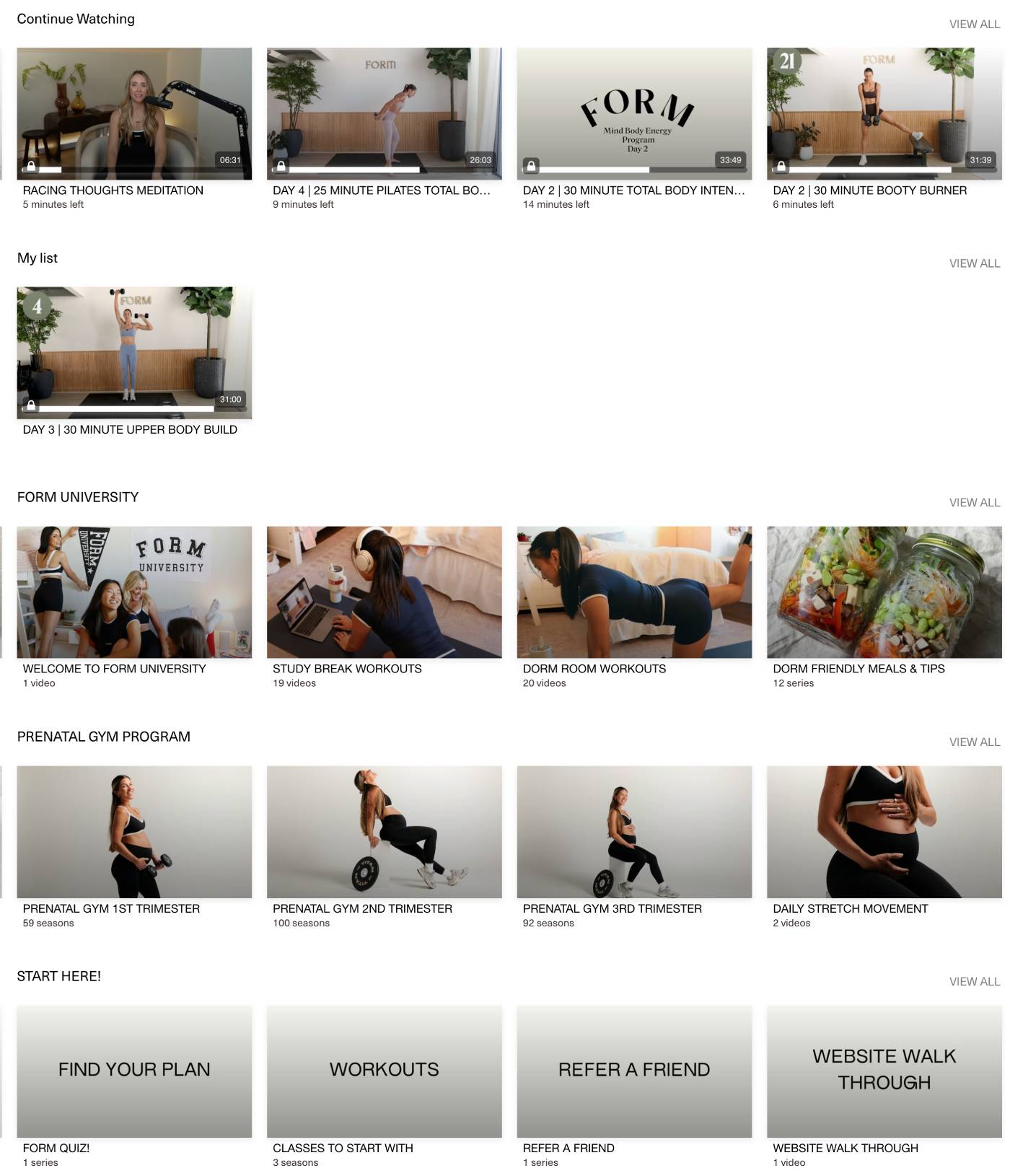
The evidence for FORM is her first contact with it. She found it on Instagram through Sami Clarke and landed on the website first, and the design stopped her before she even looked at a workout. An app that earns attention before it has shown you a single session is doing something most platforms in this set do not.
The one interface complaint she records is small and fixable: the quiz result is delivered by email rather than on screen, so the moment of being told what your programme is happens in your inbox rather than in the app.
MWH at 8 is not far behind and is a clean, calm product. Neither platform loses points here, which is why this section is about degree rather than failure.
Programme structure: FORM wins, and she finished two programmes in three weeks
FORM wins, 8 against 7.
FORM assigns you a programme from a quiz rather than handing you a library. Our tester signed up, completed the quiz, was recommended The Form Method, and two weeks later had finished the full programme. She then did the 7-day Beginner Pilates series and tried a handful of standalone advanced sessions. Two completed programmes in three weeks is a strong structural result, and it is the same finishability argument that has decided several pages in this comparison set.
MWH’s structure is looser. Across the two named series she tested, the stacking behaviour described above is the tell: a structure that leaves an experienced trainee assembling her own volume is not doing the programming for her.
Her instructor preference is worth recording because it is specific: Kim’s teaching style suited her more than Melissa’s, on the platform that carries Melissa’s name.
Recovery: Melissa Wood Health wins, and it is one of the highest scores on this site
Melissa Wood Health wins, 9.5 against 8, and 9.5 is one of the highest Recovery Compatibility scores we have published. Mind-body support is 9 out of 10 against 8 and low-impact 9 against 7.
This is what MWH is for. Short, low-intensity Pilates and light strength, weighted towards mind-body work, is a recovery-week product rather than a training-block product, and judged on that basis it does its job well.
FORM’s recovery provision is thinner than its score suggests. It has meditations of 6 to 10 minutes and she explored that section, but the workouts themselves have no warm-up or cool-down. Its recovery and deload capability of 6 out of 10 reflects a platform organised around programmes rather than around the week.
Our low-cortisol workouts for perimenopause guide covers platforms that treat downregulation as a design problem rather than a library category.
Perimenopause and menopause fit: FORM edges it, and this is the weakest pair on the site
FORM wins Women Over 40 Specificity, 4.8 against 4, and both are among the lowest scores of their kind we have published.
The capability rows are stark. FORM’s menopause education is 0 out of 10, the only zero anywhere in our library, against 1 for Melissa Wood Health. Hormone awareness is 1 on both. Menopause programming is 2 against 1. FORM has no perimenopause-specific guidance and MWH has no menopause programming, hormone awareness or menopause education.
We are stating that plainly rather than softening it, because both platforms are marketed into a wellness space that many women over 40 occupy. Being good at Pilates and beautiful to use is not the same as being built for a perimenopausal body, and if that is your requirement, the menopause-specialist platforms we have reviewed are a different category of product.
Pelvic floor
Tied at 4 out of 10 each, which is mid-range and comes from Pilates-style core work rather than dedicated guidance. Teixeira and colleagues report a 36% prevalence of urinary incontinence across female athletes in a systematic review with meta-analysis,3 which is reason to want the subject addressed directly on a Pilates-led platform. That review did not separate high-impact from low-impact sport, so we do not claim it did. Neither platform coaches pelvic floor work.
Nutrition: FORM wins, and it is one of the stronger nutrition offers in this set
FORM wins, 8 against 5, with midlife nutrition capability 6.5 out of 10 against 3. Nutrition carries the smallest weight in our model at 7%, and this is one of the wider gaps on the page.
FORM has a nutrition section with dietitian-approved recipes. She reports feeling noticeably less bloated and attributes that partly to the low-inflammatory food and partly to the consistency of exercise, which is her own attribution and we repeat it as given rather than crediting the food alone. We did not test full nutrition plan implementation.
MWH has a 7-day nutrition reset that we did not test at length, and its midlife nutrition capability of 3 reflects the limited provision rather than a judgement on that reset.
Time efficiency: tied at the top of our scale
Tied at 9 each, which is the joint highest pair of Time Efficiency scores in this comparison set. Time Efficiency carries 15% weight.
FORM runs about 30 minutes for main workouts, with a 5 to 50 minute range across the library and meditations of 6 to 10 minutes. Melissa Wood Health runs 10 to 30 minutes.
MWH has the lower floor, which matters on a day with fifteen minutes in it. FORM has the more consistent main session, which matters if you want to know what you are committing to. Both are realistic for a compressed week, and our 30-minute workouts for women over 40 and 20-minute workouts for perimenopause guides cover the wider field in both bands.
Value for money: tied, and Melissa Wood Health is half the price
Tied at 8 each, which is worth explaining given a roughly $13 monthly gap.
| Plan | FORM | Melissa Wood Health |
|---|---|---|
| Monthly | $28 | $14.95 |
| Annual | $180 | $134.99, about $11.25 a month |
| Free trial | 7 days, full access | 7 days, full access on both plans |
| Refunds | None once billed | Not assessed |
| What the money buys | A quiz-assigned programme, the best-designed app here, and dietitian-backed recipes | Short low-intensity Pilates and light strength, weighted to recovery and mind-body |
The tie reflects what each delivers for its price rather than the price alone: MWH is cheap and narrow, FORM costs more and does more. Both are priced in USD only, and MWH charges in USD outside the US, so UK readers should expect a conversion.
What this means for your decision. If you want a recovery-weighted week, MWH at about $11.25 a month on the annual plan is genuinely good value. If you want to get stronger, FORM’s extra $13 a month buys the difference between Muscle Potential 7 and 4. Note FORM has no refunds once billed, so use the trial properly. Our best free and budget workout apps ranking covers cheaper options than both.
Equipment and space needed at home
Both work on a mat in a small space, and the useful difference is the weight range each expects.
On FORM the 14 lb working load described above, dropping to 11 lb for upper body sessions, is a moderate set most home trainers will own. On Melissa Wood Health the default loading is much lighter, and she added heavier dumbbells and ankle weights to make it challenging, so if you already train you should plan to bring your own load rather than expecting the platform to supply the challenge.
Neither needs machines, and neither offers classes for them.
Starting from scratch: tied at 8 out of 10
Beginner on-ramp ties at 8 out of 10, which is the joint highest pair in this comparison set, and the two get there differently.
FORM’s route in is the quiz and the assigned programme: a beginner is told what to do and in what order, and she found the sessions easy to follow and challenging without being overwhelming, which is exactly the balance a newcomer needs.
MWH’s route in is the intensity. Short, low-impact sessions at light load are a gentler first month than almost anything else on this site, and its low-impact capability of 9 out of 10 is the highest of the two.
The caution for a beginner is FORM’s missing warm-up and cool-down, which an experienced trainee will supply for herself and a newcomer will not know to.
FORM pros and cons
FORM scores 7.6. It is strongest on short sessions and weakest on suitability for women over 40.
Pros
- UX and Design 9, the highest score of its kind on this site, and a website that stopped her before she looked at a workout.
- Muscle Potential 7 against 4, with load she found genuinely challenging at 14 lb.
- Programme Structure 8, with two programmes completed in three weeks.
- Nutrition Integration 8 with dietitian-approved recipes.
- Beginner on-ramp 8 out of 10.
- It became her favourite workout app.
Cons
- No injury modifications and no joint-protective programming, with Joint Friendliness 6.5 against 8.5.
- No warm-up or cool-down built into workouts.
- Menopause education 0 out of 10, the only zero in our library, and no perimenopause guidance.
- The quiz result arrives by email rather than on screen.
- A smaller library than competitors.
- $28 a month with no refunds once billed.
Melissa Wood Health pros and cons
Melissa Wood Health scores 6.9. It leads on recovery between sessions and trails on suitability for women over 40.
Pros
- Joint Friendliness 8.5 against 6.5 and low-impact 9 out of 10, with workouts she found comfortable on a previous meniscus injury.
- Recovery Compatibility 9.5, one of the highest on this site, and mind-body support 9 out of 10.
- Sessions from 10 minutes.
- $14.95 a month, or about $11.25 on the annual plan.
- Beginner on-ramp 8 out of 10.
- It engaged muscles she does not normally target.
Cons
- Muscle Potential 4, one of the lowest we have published, with progressive strength 2 out of 10 and bone loading 2.
- She felt she was losing strength built from heavier training and stacked workouts to feel challenged.
- The workouts start to feel repetitive after about six weeks, and she did not renew.
- No menopause programming, hormone awareness or menopause education.
- Priced in USD only, charged in USD outside the US.
Quick yes/no comparison
| Feature | FORM | Melissa Wood Health |
|---|---|---|
| Assigns you a programme | Yes, from a quiz | No, library based |
| Progressive strength loading | Partly | No |
| Injury modifications shown | No | No |
| Warm-up and cool-down built in | No | Not assessed |
| Pilates included | Yes | Yes, it is the core |
| Meditation or mindfulness | Yes, 6 to 10 minutes | Yes |
| Nutrition content | Yes, dietitian-approved recipes | Yes, a 7-day reset |
| Menopause or perimenopause guidance | No | No |
| Sessions under 20 minutes | Yes | Yes, from 10 minutes |
| Refunds after billing | No | Not assessed |
| Priced in your local currency outside the US | Not assessed | No, charged in USD |
| Free trial | Yes, 7 days | Yes, 7 days |
Melissa Wood Health vs FORM at a glance
| FORM | Melissa Wood Health | |
|---|---|---|
| Overall score | 7.6 | 6.9 |
| How it was assessed | Fully tested over three weeks and more, and it became her favourite workout app | Fully tested, 7-day trial plus about six weeks paid |
| Cost | $28/month or $180/year | $14.95/month or $134.99/year, about $11.25 a month |
| Free trial | 7 days, full access, no refunds once billed | 7 days, full access on both plans |
| Session length | About 30 minutes, 5 to 50 across the library | 10 to 30 minutes |
| Approach | A quiz-assigned Form Method across strength, Pilates, mindfulness and nutrition | Pilates plus light strength, weighted to recovery and mind-body |
| Named trainers | Sami Clarke, with Grace Freyre, Brynley Joyner and Calyn Brooke | Melissa Wood and Kim |
| Weight range used in testing | 14 lb, dropping to 11 lb on upper body | Light by default; heavier dumbbells and ankle weights added |
| Menopause content | None, menopause education 0 out of 10 | None |
| Impact level | Low to moderate | Low |
| Did the tester stay | Yes, it is now her favourite workout app | No, not renewed past the testing period |
Melissa Wood Health vs FORM: the full scoring breakdown
Form wins five of the nine weighted criteria and melissa wood health wins two, with two tied. The overall gap is 7.6 against 6.9, and it is carried by muscle, nutrition and interface rather than by anything to do with how gentle either platform is.
| Criterion | Weight | FORM | Melissa Wood Health | Winner |
|---|---|---|---|---|
| Muscle Potential | 18% | 7 | 4 | FORM |
| Time Efficiency | 15% | 9 | 9 | Tied |
| Joint Friendliness | 12% | 6.5 | 8.5 | Melissa Wood Health |
| Programme Structure | 12% | 8 | 7 | FORM |
| Women Over 40 Specificity | 10% | 4.8 | 4 | FORM |
| Recovery Compatibility | 10% | 8 | 9.5 | Melissa Wood Health |
| Value for Money | 8% | 8 | 8 | Tied |
| UX and Design | 8% | 9 | 8 | FORM |
| Nutrition Integration | 7% | 8 | 5 | FORM |
| Overall | 100% | 7.6 | 6.9 | FORM |
The twelve capability scores
Form wins six of the twelve capability scores and melissa wood health wins three, with three tied. The progressive strength row, 6 against 2, is the widest gap. The four menopause rows are the weakest matched pair we have published, including the only 0 out of 10 anywhere in our library.
| Capability | FORM | Melissa Wood Health | Winner |
|---|---|---|---|
| Low-impact | 7 | 9 | Melissa Wood Health |
| Progressive strength | 6 | 2 | FORM |
| Bone loading | 4 | 2 | FORM |
| Recovery & deload | 6 | 4 | FORM |
| Menopause programming | 2 | 1 | FORM |
| Pelvic floor | 4 | 4 | Tied |
| Hormone awareness | 1 | 1 | Tied |
| Menopause education | 0 | 1 | Melissa Wood Health |
| Expert credibility | 6 | 5 | FORM |
| Mind-body support | 8 | 9 | Melissa Wood Health |
| Beginner on-ramp | 8 | 8 | Tied |
| Midlife nutrition | 6.5 | 3 | FORM |
Who wins for…
Who wins for building muscle after 40
FORM. Muscle Potential 7 against 4 and progressive strength 6 out of 10 against 2.
Who wins for a knee or joint history
Melissa Wood Health. 8.5 against 6.5, and six weeks without aggravation on a previous meniscus injury.
Who wins on price
Melissa Wood Health. Value for Money ties at 8, and MWH costs roughly half.
Who wins for using the app
FORM. UX and Design 9, the highest we have recorded.
Who wins for a recovery week
Melissa Wood Health. Recovery Compatibility 9.5 against 8 and mind-body support 9 out of 10 against 8.
Who wins for being told what to do
FORM. Programme Structure 8 against 7, with a quiz-assigned programme.
Who wins for nutrition
FORM. Nutrition Integration 8 against 5, with dietitian-approved recipes.
Who wins for a 10-minute window
Melissa Wood Health. Its floor is 10 minutes against FORM’s typical 30.
Who wins for perimenopause
Neither, and FORM scores a zero. Menopause education 0 out of 10 against 1.
Who wins for Pilates
Melissa Wood Health, on emphasis. Pilates is its core rather than one strand. Our best Pilates programmes for women over 40 ranking covers the specialists.
Who wins for staying subscribed
FORM. It is now her favourite workout app. She did not renew MWH.
Decision tree for women over 40
You want to get stronger. FORM, on Muscle Potential 7 against 4.
You have a knee, hip or shoulder that limits you. Melissa Wood Health, and know that FORM shows no modifications at all.
Price is the constraint. Melissa Wood Health, at roughly half the monthly cost.
You want a plan handed to you. FORM, which assigns one from a quiz.
You are in a recovery phase rather than a training block. Melissa Wood Health.
Some days you only have 10 minutes. Melissa Wood Health.
You want perimenopause-aware training. Neither. Look at the menopause specialists.
You already train and want the platform to challenge you. FORM. On MWH she ended up stacking workouts to feel worked.
What we did not test
Here is what this comparison does not cover.
On FORM we did not test the gym-based programmes, HIIT classes, barre-specific classes, prenatal or postnatal content, or full nutrition plan implementation. She completed The Form Method and the Beginner Pilates series and sampled the advanced sessions, so her account covers the assigned path rather than the whole library.
On Melissa Wood Health we did not test the meditation library at length or the 7-day nutrition reset, which is relevant because mind-body work is the platform’s strongest capability at 9 out of 10.
One confound Katy Cole names herself: she came to FORM after four weeks on The Sculpt Society and had not been consistent with exercise in the weeks before, at lower weights than her usual. Some of the soreness and sense of progress she reports is a return after a gap rather than the platform alone, and we flag that wherever her FORM results appear.
Neither platform was tested by a beginner, and both beginner assessments are an experienced tester’s judgement.
Which is better for women over 50?
Melissa Wood Health, if joints are the constraint
Low-impact capability 9 out of 10 against 7, Joint Friendliness 8.5 against 6.5, and six weeks of comfortable training on a previous meniscus injury make it the safer entry. FORM’s complete absence of modifications and of any warm-up or cool-down is a harder sell after 50. Our best low-impact workouts for women over 50 and best workouts for postmenopause rankings cover the wider field.
FORM, if you are uninjured and want to keep getting stronger
Progressive loading remains the intervention with the best evidence behind it for muscle and bone after menopause,4 and MWH’s progressive strength capability of 2 out of 10 makes it a poor vehicle for that. FORM at least moves you forward, and she found 14 lb genuinely demanding on it. Neither platform will teach you anything about menopause, so pair either with a specialist source.
Frequently asked questions
Is FORM or Melissa Wood Health better for women over 40?
FORM, 7.6 against 6.9, and both score poorly on the measures that matter most for this life stage. Women Over 40 Specificity is 4.8 against 4. FORM wins Muscle Potential, 7 against 4, UX and Design 9 against 8, Nutrition Integration 8 against 5 and Programme Structure 8 against 7. Melissa Wood Health wins Joint Friendliness, 8.5 against 6.5, and Recovery Compatibility 9.5 against 8. Our tester’s outcome tells you more than the scores: FORM became her favourite workout app, and she did not continue her MWH subscription past the testing period.
Which builds more muscle for women over 40?
FORM, 7 against 4. That 4 is one of the lowest Muscle Potential scores we have published. Progressive strength capability is 6 out of 10 against 2 and bone loading 4 against 2. On FORM she worked at 14 lb, dropping to 11 lb on upper body work, and says she was working hard with 14 lb in a way she was not expecting. On Melissa Wood Health the default loading was far lighter than the 11 to 20 lb per hand she had used elsewhere, and she felt like she was losing the strength she had built from heavier training.
Which is better if you have a knee or joint history?
Melissa Wood Health, 8.5 against 6.5, and it leads on low-impact capability, 9 out of 10 against 7. On a previous meniscus injury she says the MWH workouts felt comfortable on her joints during testing. FORM has no injury modifications and no joint-protective programming at all, which is its clearest gap and the reason its Joint Friendliness sits at 6.5 despite everything else it does well.
How do FORM and Melissa Wood Health compare on price?
They tie on Value for Money at 8 each, and MWH is much cheaper. Melissa Wood Health is $14.95 a month or $134.99 a year, which works out at about $11.25 a month, with a 7-day free trial on both plans. FORM is $28 a month or $180 a year with a 7-day free trial and no refunds once billed. Both are priced in USD only, and MWH charges in USD outside the US, so watch for currency conversion if you are in the UK.
Which app is better to actually use?
FORM, 9 against 8, and 9 is the highest UX and Design score in this comparison set. Her first contact with it is the evidence: she found FORM on Instagram through Sami Clarke, landed on the website first, and the design stopped her before she even looked at a workout. MWH scores well too at 8. The one FORM interface complaint she records is that the quiz result arrives by email rather than on screen.
Which has better nutrition guidance?
FORM, 8 against 5, with midlife nutrition capability 6.5 out of 10 against 3. FORM has a nutrition section with dietitian-approved recipes, and she attributes feeling noticeably less bloated partly to the low-inflammatory food and partly to the consistency of exercise, which is her own attribution and we report it as she gave it. We did not test full nutrition plan implementation on FORM, nor the MWH 7-day nutrition reset.
Do either platform have perimenopause content?
Neither, and FORM records the lowest score we have ever published on one measure. Menopause education is 0 out of 10 for FORM against 1 for Melissa Wood Health, and that zero is the only one in our library. Hormone awareness is 1 against 1, menopause programming 2 against 1. Women Over 40 Specificity is 4.8 against 4. Both are aesthetically led wellness platforms that skew younger, and if perimenopause is your reason for looking, neither is built for you.
Which is better for recovery and low-intensity days?
Melissa Wood Health, 9.5 against 8. Its 9.5 is among the highest Recovery Compatibility scores on this site. Mind-body support is 9 out of 10 against 8 and low-impact 9 against 7. MWH is Pilates plus light strength and is built for exactly this. FORM has meditations of 6 to 10 minutes and she explored that section, but its workouts have no warm-up or cool-down built in, which is a real omission.
What is the time commitment and typical session length for each?
They tie on Time Efficiency at 9 each, the joint highest pair of scores in this comparison set. FORM runs about 30 minutes for main workouts, with a 5 to 50 minute range across the library and meditations of 6 to 10 minutes. Melissa Wood Health runs 10 to 30 minutes. MWH has the lower floor; FORM has the more consistent main session.
Which has better programme structure?
FORM, 8 against 7. FORM assigns you a programme from a quiz, and she completed The Form Method in 14 days and then the 7-day Beginner Pilates series, which is two finished programmes in three weeks. On MWH, across the two named series described above, she found herself naturally stacking two or three workouts together to feel challenged, which is a sign the individual sessions were not enough on their own.
Which platform did the tester stay with?
FORM, and her verdict is unusually direct: it is now her favourite workout app. She did not continue her Melissa Wood Health subscription past the testing period, and her stated reason is that the workouts start to feel repetitive after about six weeks. She is careful to balance the FORM praise, saying she wants to say it upfront because the rest of the review includes candid criticism, and that she wants those two things to sit alongside each other.
Research citations
- Wright VJ, Schwartzman JD, Itinoche R, Wittstein J. The musculoskeletal syndrome of menopause. Climacteric. 2024;27(5):466–472. menopause MSK study. (Cited for: oestrogen decline’s effect on tendon and ligament integrity, and increased injury risk in midlife.)
- Maltais ML, Desroches J, Dionne IJ. Changes in muscle mass and strength after menopause. Journal of Musculoskeletal and Neuronal Interactions. 2009;9(4):186–197. PubMed. (Cited for: accelerated loss of muscle mass and strength through the menopause transition.)
- Teixeira RV, Colla C, Sbruzzi G, Mallmann A, Paiva LL. Prevalence of urinary incontinence in female athletes: a systematic review with meta-analysis. International Urogynecology Journal. 2018;29(12):1717–1725. urinary incontinence meta-analysis. (Cited for: 36% prevalence of urinary incontinence across female athletes in a range of sports. Note: this review did not separate high-impact from low-impact sport, so we do not claim it did.)
- Mohebbi R, Shojaa M, Kohl M, et al. Exercise training and bone mineral density in postmenopausal women: an updated systematic review and meta-analysis. Osteoporosis International. 2023;34:1145–1178. bone density meta-analysis. (Cited for: progressive resistance training as the primary non-hormonal intervention for bone density after menopause.)
- Sá KMM, et al. Resistance training for postmenopausal women: systematic review and meta-analysis. Menopause. 2022. PubMed. (Cited for: improvements in menopause symptoms and functional capacity with resistance training. Note: this review did not measure strength or lean mass as primary outcomes, and its authors rate the certainty of evidence as very low to low, so we report it on that basis.)
This page compares fitness platforms. It is not medical advice. Katy is a woman who has trained through perimenopause, not a clinician. Any strength, body-composition or digestive observations described are one person’s recorded experience, not an expected result or a general pattern. If you have a diagnosed condition, an injury, or symptoms that concern you, speak to a qualified healthcare professional before changing how you train.
About this comparison
Compiled by Katy Cole for Her Daily Fit. Both platforms were paid for and used firsthand. FORM was tested across three weeks and more, including The Form Method completed in 14 days, the 7-day Beginner Pilates series, the meditation section and a handful of standalone advanced classes, training at 14 lb dropping to 11 lb on upper body work. Melissa Wood Health was tested on the 7-day trial plus approximately six weeks paid, covering the two named series listed above. Both were scored on the same nine weighted criteria and the same twelve capability scores. Maltais and colleagues document accelerated loss of muscle mass and strength through the menopause transition,2 which is why Muscle Potential carries the most weight in that model. She came to FORM directly after four weeks on The Sculpt Society, having not been consistent with exercise beforehand and training below her usual load, and we flag that confound wherever her FORM results are discussed. Where she attributes a change partly to nutrition rather than to training, we report that attribution as she gave it. Prices were verified against official sources in 2026 and may differ if there has been a recent change; both platforms are priced in USD only. Scores are pulled live from each programme’s own assessment. Her Daily Fit earns nothing from either platform.
Compared with
Featured in