
Subscription only, with no free tier and no genuinely free trial. In app prices run from $6.99 to $59.99 depending which offer you are shown, and the web checkout runs live price experiments, so there is no single price.
Research-based data profile, not personally tested · Assessed from Dancebit’s own site, Terms of Use, Privacy Policy and help centre, its advertising funnel code, both app store listings, and 4,025 user reviews we sampled and coded across the two stores · Prices regularly verified
Data profileDancebit Review 2026: Quick Answer
Quick Verdict
Worth it for women over 35 or 40? As a mood and movement habit, possibly. As anything you are relying on for muscle, bone or menopause support, no, and its own advertising makes that harder to work out than it should be.
What Dancebit does well is real and worth saying first. The choreography is liked, the sessions are short enough that a woman who has not exercised in years will actually start, the app works properly, and it has an unusually warm older user base. In the 4,025 reviews we coded in September 2026, 49 people identified themselves as over 40 and 41 of those rated it four or five stars, roughly double the rate of the corpus as a whole. People with arthritic knees and recent joint replacements describe using it and enjoying it. That counts.
The problem is the gap between what it sells and what it contains. It runs dedicated menopause advertising funnels, none of whose claims appear anywhere in the product or carry a source, while the thing a woman in her forties or fifties is losing fastest, muscle and bone, gets no loading stimulus at all.
Where to start: if the appeal is that you would genuinely do this when you would not do a strength session, that is a legitimate reason to buy it, and you should treat it as your cardio and your mood, not your programme. Read the guarantee section before you pay, because the conditions are not what the advertising says.
Is Dancebit right for you?
Dancebit fits if you: do almost nothing now and dislike conventional exercise, so the workout you will actually do beats the better one you will abandon · already strength train and want a short cardio and mood top-up · have healthy joints and a pelvic floor that tolerates impact.
Look elsewhere if you: want muscle, strength or bone density, because there is no loading mechanism · have stress incontinence, prolapse, osteopenia, or knee or hip problems · find scale language difficult, since on Android the app is called Weight Loss Dance · want menopause guidance or nutrition support · are price sensitive.
Jump to Section
What Dancebit Actually Is
Dancebit is a subscription dance cardio app built around a 28 day challenge, sold through an online quiz, and published by Gismart Limited, a London-registered consumer app studio whose catalogue is mostly music and casual games.
You meet it through an advert, take a quiz of roughly nineteen questions, hand over an email address, and reach a paywall. After payment you get a 28 day calendar with one short class a day, chosen around the dance styles you said you liked. Sessions run 5 to 12 minutes on the Play listing and 7 to 12 on the App Store listing, because the vendor’s own two descriptions disagree. There is no equipment. When the 28 days end you retake the quiz and either change level or go round again.
The library covers Aerobics, Kiat Jud Dai, High Heels, Chair Dance and Low Impact Cardio, with a Walking Programme added in September 2026, across three self-selected difficulty levels. What it does not contain is equally clear: no strength training, no equipment, no progression in load, no nutrition, no meditation and no education section. Its two help centres, fourteen Dancebit articles on Gismart’s and a separate one at support.dance-bit.com, cover billing, account access and casting to a television, and contain no fitness, health or safety guidance at all.
Who Is Behind Dancebit
Four choreographers are named, which is better than the anonymity common in this category, and not one of them has a stated certification.
Dancebit’s site lists them under the heading Professional Choreographers: Iaryna Strynagliuk, a “Health & fitness coach with 13 years of experience”, plus Alina Duma, Alexa Popovici and Olga Savchuk, each a “Professional dancer, choreography teacher”. No certification, certifying body, degree or licence is stated for any of them, and the “fitness experts” the store listings credit are never named. No physiotherapist, pelvic health specialist or gynaecologist is named on the website, and there is no advisory board. The advertising funnels name a further set of people who appear nowhere on the site, including a dietitian, and attach the same “13 years of experience” credential to a different name. The company’s own terms are explicit:
“We are not licensed healthcare providers or medical professionals, and we do not claim expertise in diagnosing, treating, or preventing any medical conditions.” Dancebit Terms of Use, effective 15 February 2026.
That disclaimer is legally sensible. It also sits oddly against advertising that explains to women what oestrogen is doing to their fat storage.
The Menopause Advertising Dancebit Does Not Mention on Its Own Site
This is the most important finding on this page, so here it is plainly. Dancebit markets menopause-specific promises inside its paid advertising funnels, and the word menopause appears nowhere on its own website, in its Terms of Use, in its Privacy Policy, in either app store listing, or in either of its two help centres.
We searched all of those sources for menopause, perimenopause, postmenopause, hormone, oestrogen, HRT, pelvic floor, bone density, osteoporosis, hot flush and night sweat. Every count was zero. The one exception is the word pregnancy, which appears twice in the Terms, as a contraindication warning.
The advertising funnels are a different matter. Dancebit runs at least four dedicated menopause acquisition cohorts, and their copy is in the company’s own JavaScript. Verbatim:
| Where it appears | What it says |
|---|---|
| Funnel landing headline | “Say Goodbye to Menopause Belly” |
| Selectable goal in the quiz | “Balance my hormones” |
| Quiz question | “Have you gone through menopause?” with the options No, Going through it, Already passed it, Prefer not to answer |
| Education screen, titled “How hormonal changes impact weight” | “90% of women struggle with weight gain or find it more challenging to lose weight during menopause transition.” |
| Same screen | “This happens because changing estrogen and progesterone levels alter how your body stores and burns fat, slowing your metabolism and increasing hunger.” |
| Lead magnet | A free PDF titled “Navigating Menopause” |
| Feature bullet, postpartum funnel | “Strengthens pelvic floor” |
Four things about that table matter.
The 90% figure carries no source, and neither does the oestrogen and progesterone mechanism claim. Elsewhere in the same funnel Dancebit does cite things, invoking a University of Maryland study and the Journal of Aging and Physical Activity, which makes the omission on the menopause screen a choice rather than an oversight.
Experts are named, and that is where it gets stranger. Two screens after the hormonal explanation, the same funnel runs a quotation crediting “Dr. Emma Caldwel”, described as “Professor of Reproductive Health at JN University”. We could not find any person or institution of either name. Elsewhere the funnel credits “Dr. Oliver Carey”, a “Certified dietitian and nutritionist”, and invokes Daniel Tarsy, correctly described as a professor of neurology at Harvard Medical School. Professor Tarsy was a real and senior figure, head of movement disorders at Beth Israel Deaconess, who died in July 2026. His field was Parkinson’s disease. We found no indication of any connection between him and Dancebit.
A fourth claim appears alongside them: “A study in the Journal of Aging and Physical Activity found that women over” a given age “who danced regularly for 12 weeks lost 6-8% of their body weight”. The age is a variable the funnel fills in from your quiz answer. No author, year or title is given.
“Strengthens pelvic floor” is a marketing bullet. We found no pelvic floor exercise, module, assessment or guidance on any surface we could reach, and Dancebit publishes none. What sits behind the paywall we cannot see. For an app whose library leads with jumping styles, making that claim without publishing the content is the wrong way round.
And perimenopause is never mentioned, in the funnel or anywhere else. The quiz collapses it into “going through it”. Perimenopause is the phase in which most symptoms occur and it is the phase most of this site’s readers are in.
The practical consequence is a split product. A woman who clicks a menopause advert is sold a “Menopause Belly Plan” with a hormonal explanation attached. A woman who searches for the app and downloads it from the App Store is sold a dance workout, because no menopause content exists in the store listing. They are paying for the same subscription. We could not verify what, if anything, differs inside the app after payment, because that sits behind the paywall, and we do not claim it either way.
Inside the Dancebit App
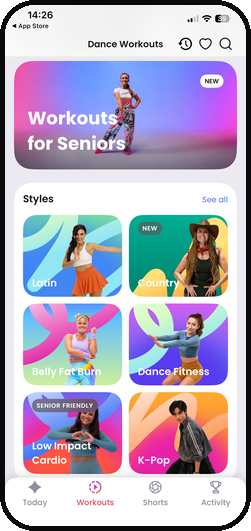
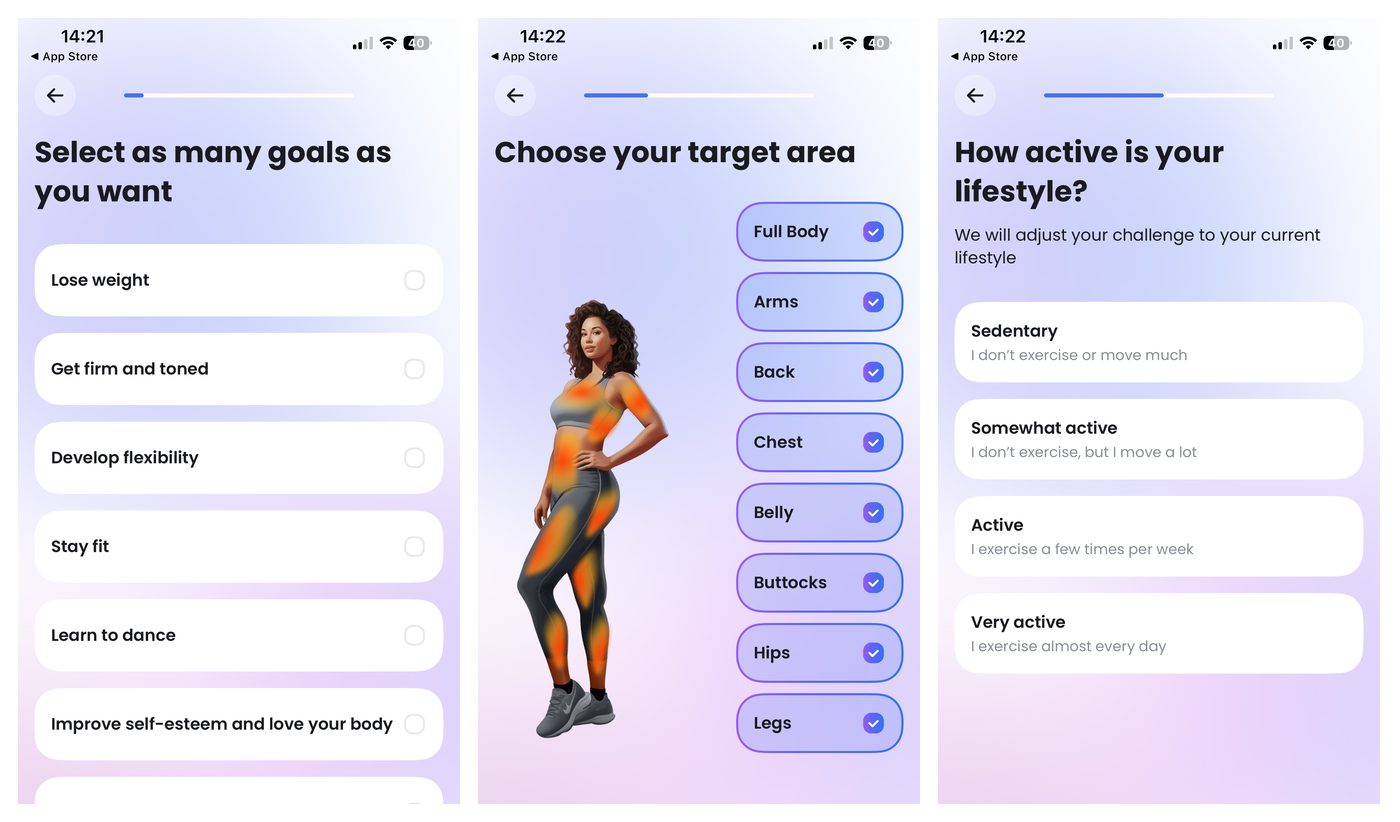
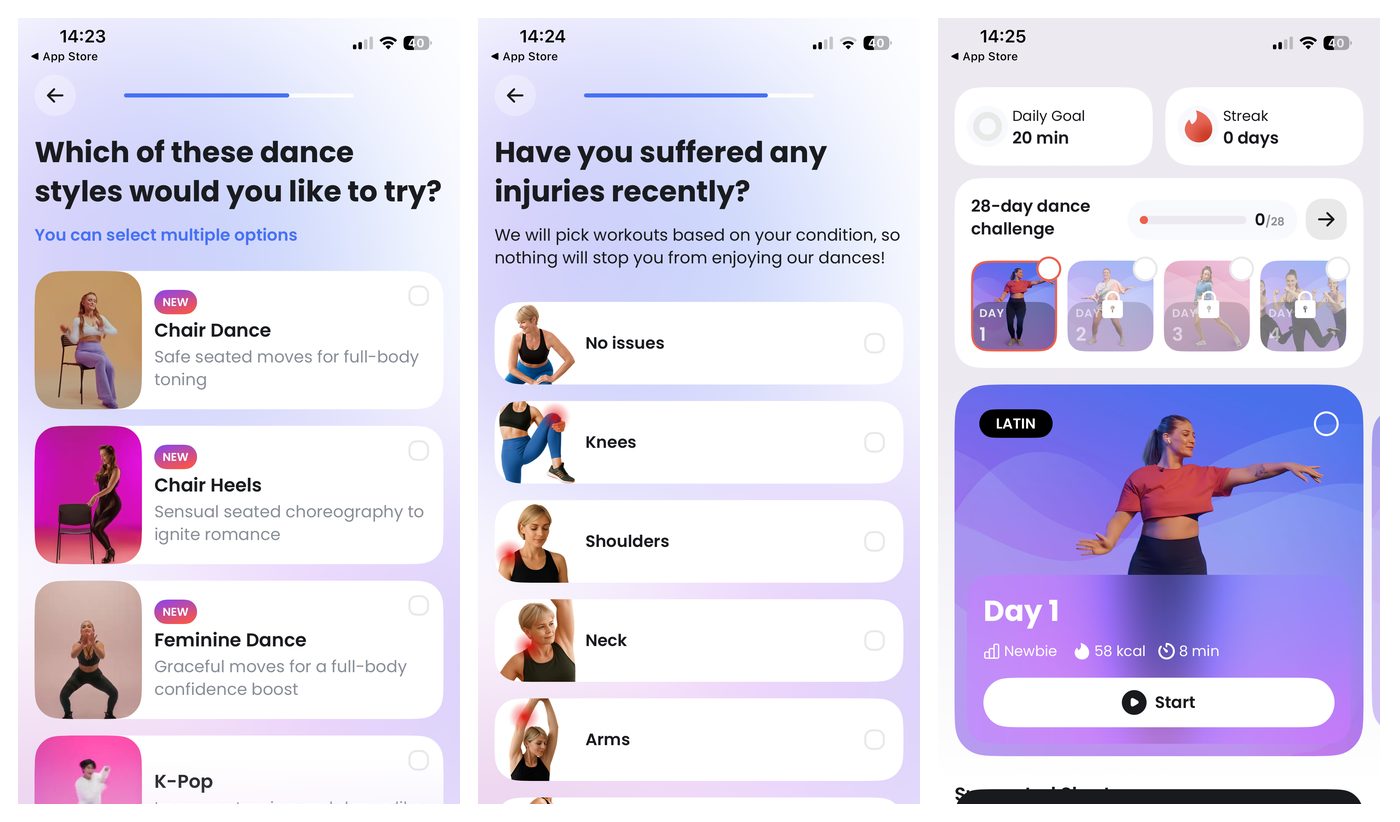
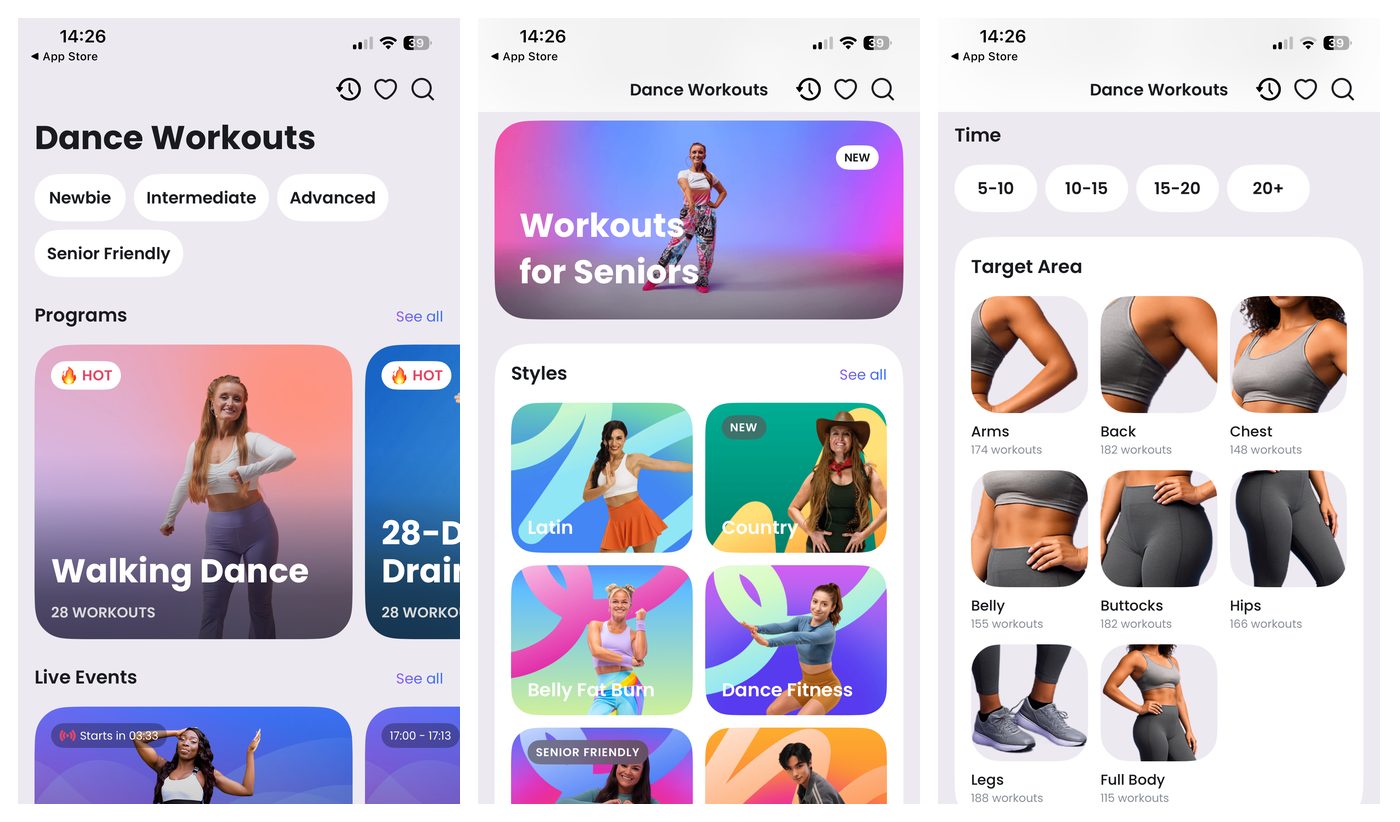
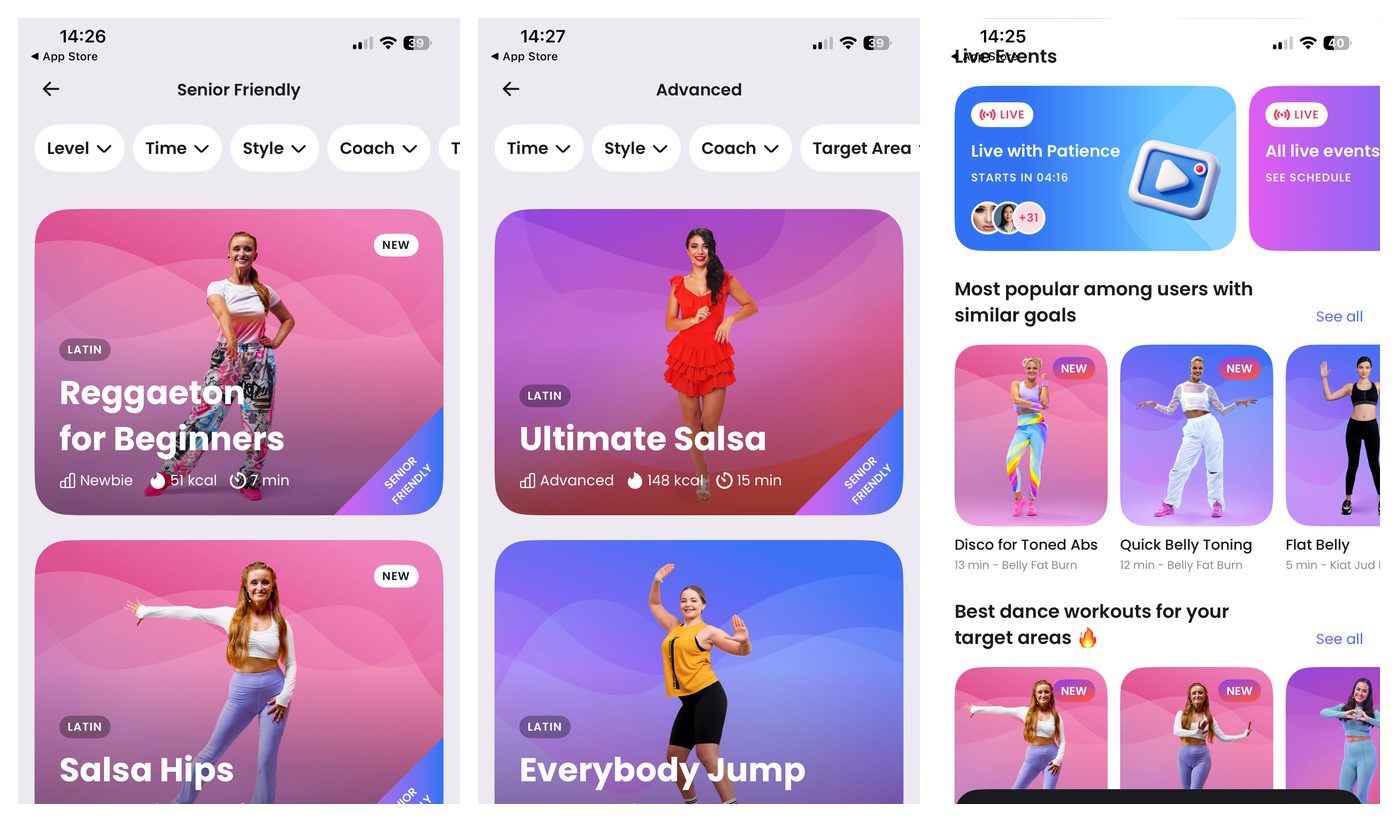
The app lets you browse the library before you pay, and what you see is a well-built dance catalogue wrapped in body-part and calorie framing. These screens were captured on an iPhone in September 2026 from the free-to-browse areas. The classes themselves stay behind the paywall, so this is what the product looks like, not what it feels like to follow.
Sign-up runs through goals (lose weight, get firm and toned, develop flexibility, stay fit, learn to dance, improve self-esteem, reduce stress), a body map where you pick target areas, your activity level, the dance styles you want, and a question headed “Have you suffered any injuries recently?” with options for knees, shoulders, neck, arms, elbows and legs. It promises to “pick workouts based on your condition”. That is a better screen than many apps in this category run, and we could not test whether the plan that follows reflects it.
The Today tab shows a daily goal of 20 minutes, a streak counter and the 28 day challenge with later days locked. Day 1 is listed as Newbie, 8 minutes and 58 kcal.
The workouts tab filters by Newbie, Intermediate, Advanced and Senior Friendly, and carries a “Workouts for Seniors” collection. Styles include Latin, Country, Belly Fat Burn, Dance Fitness, Low Impact Cardio, which itself carries a Senior Friendly label, and K-Pop. Programmes include Walking Dance at 28 workouts. There are live events with named coaches and a schedule, which is more than the store listings describe.
Two things stand out for this audience. First, the Senior Friendly label is not tied to intensity: a 15 minute Advanced salsa class carries it, next to a 5 minute Newbie one. Second, the library is browsable by body part, with Arms, Back, Chest, Belly, Buttocks, Hips, Legs and Full Body each showing a workout count, and every class card leads with calories burned. The body-part and calorie framing runs through the product, not just the adverts.
Content and Features
| Feature | Available | Detail |
|---|---|---|
| On-demand dance library | Yes | Multiple styles including Aerobics, Kiat Jud Dai, High Heels, Chair Dance, Low Impact Cardio |
| Structured programme | Yes | A 28 day challenge, one class a day, quiz-personalised on style and goal |
| Low impact option | Partial | A Low Impact Cardio style, a seated Chair Dance style, a Senior Friendly filter and a “Workouts for Seniors” collection. There is no jump-free filter, and the Senior Friendly label also appears on Advanced classes |
| Strength or resistance work | No | No equipment, no load, no progression mechanism |
| In-class modifications | No | No regressions or alternative movements found. Adaptation is which class you are served, not how a movement is demonstrated |
| Injury screening | Yes, at sign-up | The app asks about recent injuries (knees, shoulders, neck, arms, elbows, legs) and about target areas. The generic web funnel we walked asked neither. Whether the plan reflects the answers we could not test |
| Nutrition, meditation, recovery | No | None of the three. The only published programming guidance is to “practice it every day, even for a little bit”, so there is no rest day in the model |
| Menopause education | Not on any public surface | Present only in advertising funnels. See above |
| Pelvic floor | Not published | Claimed in one funnel bullet. No content on any public surface, and the app itself is behind the paywall |
| Human coaching | No one to one | Classes are pre-recorded. The app also schedules live group classes with named coaches, which the store listings do not mention. A separate paid AI coach upsell exists at $39.99 per month |
What Equipment You Need for Dancebit
None, and that is a genuine strength. Neither store description mentions equipment, the advertising funnel promises “anywhere, anytime, no-equipment-needed training”, and nothing in the product requires any. There is nothing to buy, set up or store. For someone who has not exercised in years, removing every barrier between deciding and starting is worth more than most features.
Two practical things Dancebit does not mention. Non-slip flooring matters, because the styles involve pivoting, and dancing on a rug or a polished floor is how ankles get turned. And if you live above someone, the jumping styles will be audible, which several reviewers raise as the reason they stopped.
Tip: the one purchase worth making alongside this is a pair of adjustable dumbbells, not for Dancebit but for the strength work Dancebit does not provide. Two sessions a week of progressively loaded resistance work covers the thing this app structurally cannot. The trial behind that recommendation used supervised heavy barbell training in postmenopausal women with low bone mass, so treat it as the direction of travel and get form coaching before you load heavily.7
How We Scored Dancebit: the 4.0 / 10 Breakdown
| Category | Weight | Score | Weighted |
|---|---|---|---|
| Time Efficiency | 15% | 8.0 | 1.20 |
| Muscle Potential | 18% | 1.5 | 0.27 |
| Women Over 40 Specificity | 10% | 2.2 | 0.22 |
| Joint Friendliness | 12% | 5.0 | 0.60 |
| Recovery Compatibility | 10% | 5.0 | 0.50 |
| Programme Structure | 12% | 4.0 | 0.48 |
| Value for Money | 8% | 2.5 | 0.20 |
| UX and Design | 8% | 7.0 | 0.56 |
| Nutrition Integration | 7% | 0.0 | 0.00 |
| Total | 100% | 4.0 / 10 |
Scoring notes
Time efficiency (8) is the highest score on the page and it is deserved. Five to twelve minutes, no equipment, no setup, casts to a television, works offline. The friction is close to zero, and friction is what ends most exercise habits.
Muscle potential (1.5) is the lowest of any programme in our library. Bodyweight dance cardio with no external load and no overload mechanism maintains some lower-body endurance and offers essentially nothing against age-related muscle loss. Dancebit’s own copy promises “muscle toning”, and there is no mechanism behind it.
Value for money (2.5) is scored against what else exists. Alo Wellness Club gives 4,000 classes across strength, Pilates, yoga and recovery for nothing, and FitOn Pro costs $29.99 for a whole year, the same as Dancebit’s headline monthly rate. Dancebit is dance cardio only, at a higher price, with ads on Android.
Women over 40 (2.2) is the composite of the twelve capabilities and is the lowest we have recorded. The menopause capabilities score marginally above zero rather than at zero, because menopause-branded content does exist in the advertising, and it is uncited marketing rather than education, which is why it earns almost nothing.
Final research score: 4.0 / 10
A likeable cardio habit sold as something it is not.
Is Dancebit Good for Women Over 40?
It is usable by women over 40, genuinely enjoyed by many of them, and structurally unable to deliver the two things this age group needs most.
Start with the credit, because it is real and it is unusual. In the 4,025 written reviews we coded in September 2026, 49 people self-identified as over 40, over 50, a senior or a grandmother. Forty-one of those 49 rated four or five stars, against a corpus-wide rate of 44%. Reviewers describe using it after knee replacements, with arthritic knees, with fibromyalgia, and while waiting for surgery. One 75 year old describes the low-cardio classes as manageable and reports improved flexibility. Most strength apps generate nothing like this.
Two qualifications. Those self-reported ages cluster in the sixties, seventies and eighties: only two of the 49 were aged 50 to 55 and none were in their forties. So the enthusiasm is real evidence about deconditioned beginners in later life, not about a 45 year old in perimenopause. And exactly one review in 4,025 mentioned menopause at all.
Now the structural gap. What accelerates after the menopause transition is loss of muscle and loss of bone, and both respond to progressive mechanical loading. Dancebit has no load to progress. Jumping does deliver some ground-reaction force at the hip, which is not nothing, but in the one meta-analysis that ranked leisure activities by their effect on bone density in postmenopausal women, step and dance came last, and leisure activity overall did not produce a statistically significant gain.6 What does move bone is heavy progressive resistance work,7 and across 53 trials the conclusion was that resistance training, potentially combined with impact, is the effective osteogenic stimulus.8
Impact is mixed rather than damning. Low Impact Cardio, a seated Chair Dance style, a Senior Friendly filter and a seniors collection all exist, and the app does ask about injuries at sign-up. But there is no jump-free filter, no in-class modifications, and the Senior Friendly label sits on Advanced classes as well as Newbie ones, so it tells you less than it looks like it does. Reviewers who chose the senior setting report routines still running too fast and jumping increasing as the 28 days progress.
How Dancebit Fits Perimenopause, Menopause and Beyond
How Dancebit Fits Perimenopause, Menopause & Beyond
Women Over 40 is our most important criterion, and here's the full breakdown behind it.
Dancebit is strongest for beginner on-ramp, low-impact and mind-body support, and weakest for pelvic floor, midlife nutrition, progressive strength, menopause programming, hormone awareness, menopause education, recovery & deload, expert credibility and bone loading, in our menopause and midlife capability assessment for women over 40.
At a glance
What the app teaches about perimenopause and/or menopause, not whether the training suits a midlife body.
| Capability | Score | Rating | Why |
|---|---|---|---|
| Right training for a midlife body | |||
| Low-impact | 5/10 | Some | A Low Impact Cardio style and a seated Chair Dance style genuinely exist, but the default library leads with jumping and there is no jump-free filter. |
| Progressive strength | 1/10 | None | No resistance training and no load progression. Three self-selected difficulty levels are the only progression on offer. |
| Bone loading | 3/10 | Minimal | Dance involves impact, which loads bone, but nothing is programmed or labelled for bone density. |
| Recovery & deload | 2/10 | None | No deload weeks, no recovery sessions and no rest-day logic in the plan. |
| Menopause education and programming* | |||
| Menopause programming | 1/10 | None | No menopause programming in the product. Menopause appears in the advertising funnel only. |
| Pelvic floor | 0/10 | None | Nothing on pelvic floor, despite a library that leads with jumping. |
| Hormone awareness | 1/10 | None | Hormone claims appear in marketing copy without citation and nothing in the app acts on them. |
| Menopause education | 1/10 | None | No educational content. The menopause-branded material is uncited advertising, which earns almost nothing rather than nothing. |
| Expert credibility | 2/10 | None | Four choreographers named on the site, none with a stated certification, and funnel copy names experts who could not be verified. |
| Whole-woman support | |||
| Mind-body support | 5/10 | Some | The tone is warm and the short sessions are genuinely approachable, which counts for something. |
| Beginner on-ramp | 6/10 | Some | Short sessions, three difficulty levels and an injury question at sign-up make it easy to start. |
| Midlife nutrition | 0/10 | None | No nutrition content of any kind. |
ScaleBest-in-classStrongSomeMinimalNone
What the sources say: Research-based, primary sources only. Assessed 2026-09-20 from dancebit.dance (site, Terms, Privacy), dance-bit.com and its funnel JavaScript bundles, both app store listings, the iTunes lookup API, both Gismart help centres, and 4,025 user reviews sampled and coded in house across the two stores. Quiz funnel walked to the paywall, not passed. No competitor or affiliate review site used as a source. Not personally tested.
* What the app teaches and programmes around menopause, not whether the training suits a midlife body. Many programmes that score low here are still a good fit, they simply never use the word. A high score is not proof either: a few menopause videos added to a general library lifts this score without changing the training.
These are evidence-informed suitability ratings, not clinical measurements. They combine exercise science with product-specific research and, where indicated, hands-on testing, alongside multi-source verification, and are approximate. Individual response varies. A starting point, not medical advice. How we score menopause fit
What the Research Says: Dancebit’s Claims Checked
Dance is real exercise with real evidence behind it. The specific things Dancebit sells, weight loss and muscle toning, are the two claims the evidence supports least.
Dance holds up well as exercise. A meta-analysis of 28 studies covering 1,276 participants, all with a structured-exercise comparator, found dance improved body composition, blood biomarkers and musculoskeletal function and matched other exercise for cardiovascular function, concluding it is “equally and occasionally more effective” than other structured exercise.2 That is parity, not superiority, and parity is a good result.
In this age group the evidence is psychological. The only meta-analysis of dance in perimenopausal, menopausal and postmenopausal women found significant effects on depression, anxiety, vitality and interpersonal relationships, with the authors flagging high heterogeneity.4 A review comparing dance with other physical activity found the two statistically indistinguishable for anxiety and depression, with only preliminary evidence favouring dance on motivation and preliminary evidence against it on self-efficacy.3 Mood and social connection are genuine benefits Dancebit plausibly delivers, and the ones it never advertises.
On weight loss, which is what it does advertise and what the Android app is named after, the evidence is unkind. Across 14 randomised trials covering 1,847 participants, aerobic exercise on its own produced a mean weight loss of 1.6kg at six months and 1.7kg at twelve. The authors concluded plainly that isolated aerobic exercise is not an effective weight loss therapy, though it may work alongside dietary change.10 Dancebit provides no dietary component at all.
On muscle, the mechanism matters more than the effort. Where participants lost the same weight by different routes, the aerobic-only group lost 5% of lean mass and 3% of hip bone density against 2% and 0.5% for the resistance group, and gained 4% in strength against 19%.9 That was obese adults over 65 in a supervised deficit, so read it as direction, not prediction. Closer to home, a trial in 70 postmenopausal women averaging 53 found jazz dance and strength-inclusive training both beat control, and the strength-inclusive arm beat dance on both fitness and strength.5
The Royal Osteoporosis Society is the cleanest authority here, because it explicitly counts dancing as impact exercise and then says impact alone is not the recommendation: you need both impact and strength exercise.12 That is the whole argument in a national charity’s own words.
To be precise about what this means: dance is not bad exercise and this is not a page telling you not to dance. Dancebit delivers the aerobic half of the physical activity guidelines1 plus mood and adherence value that deserves credit. It cannot deliver the strengthening half, and the weight-loss promise it is sold on has a measured ceiling under 2kg from exercise alone.
What Users Report: Verified Sentiment
The store ratings and the written reviews describe two different products, and the split runs almost perfectly along one line: people rating the dancing are happy, and people rating the billing are not.
| Measure | Value | Sample, checked September 2026 |
|---|---|---|
| App Store, US | 4.66 | 28,241 ratings |
| App Store, UK | 4.57 | 4,750 ratings |
| Google Play | 4.26 | 21,134 ratings, over 1M installs |
| Google Play, one star share | 13.0% | 2,750 of 21,121 in the published histogram |
| Google Play, newest written reviews | 37.7% one star | 1,800 reviews, newest first |
| App Store written reviews, Australia | 46.8% one star | 158 reviews, most recent |
The clearest statistic in the 4,025 written reviews we sampled and coded in September 2026: 79.3% of one-star reviews mention money, charges, cancellation, refunds or a subscription, against 3.3% of five-star reviews. These are not two groups disagreeing about a product. They are rating different experiences.
The mechanism looks structural rather than sinister, and we found no sign of fabricated reviews: no template clusters and no five-star date bursts. But within that sample five-star reviews are much shorter, a median of 70 characters against 201 for one-star, and 15.7% of them explicitly describe day one or a first session, against 2.0% of one-star reviews. Google Play’s own listing reports 2,110 written reviews against 21,134 ratings, so nine in ten ratings carry no text at all. The high average is largely first-session enthusiasm collected by an in-app prompt, before anyone has reached a renewal date.
Billing dominates the complaints: among the one and two star reviews in that sample, 81.4% on the App Store and 70.4% on Play mention it. The patterns are unexpected charges, charges after cancelling, and subscriptions that do not appear in the user’s Apple or Google subscription list at all, which happens when the purchase went through the web checkout and which makes the platform cancel button useless.
On the workouts the picture is positive: 14% of that sample volunteers unprompted praise, overwhelmingly at five stars, with named instructors cited as the reason people stay. The main criticism is repetition, at 2.2%. Two smaller findings matter here: 33 reviewers report failing to cast to a television, which counts for more than its share when older reviewers say they cannot see the choreography on a phone, and a consistent 1.2% say the quiz answers are ignored, with declared beginners served advanced routines and body-restriction answers not reflected in what arrives.
Dancebit Specifications
| Specification | Detail |
|---|---|
| Publisher | Gismart Limited, registered in England and Wales, company number 10152488, 151 Wardour Street, London W1F 8WE |
| Store titles | iOS “Dancebit: Home Dance Workouts” in the US and “Dancebit: Dance Home Workout” in the UK, Android “Dancebit: Weight Loss Dance”. The name differs by platform and by storefront |
| Version and release | 2.89, released 11 September 2026. First released 21 January 2021 |
| Platform | iOS 16 and above, Android. No web app for training |
| Session length | 5 to 12 minutes per the Play listing, 7 to 12 per the App Store listing. Classes in the app library run from 5 to 15 minutes. Dancebit’s own descriptions disagree |
| Frequency | Daily. The only published guidance is to practise every day, even briefly |
| Equipment | None |
| Ads | Yes on Android, declared on the Play listing, in addition to the subscription |
| Impact level | Moderate to high by default |
Dancebit Price 2026: What You Actually Pay
There is no single Dancebit price, and that is not an evasion, it is the product design. The web checkout runs live pricing experiments segmented by advertising cohort, country and language, so any figure we quoted would be one arm of a running test rather than the price.
What we can state is the App Store in-app purchase catalogue, which is fixed and published. As at September 2026 the US listing shows ten SKUs:
| In-app purchase | US price | UK price |
|---|---|---|
| Get Your Premium Plan | $59.99 | £59.99 |
| Yearly Premium Access | $59.99 and $29.99 | £26.99 |
| Get Your Weight Loss Plan | $44.99 and $29.99 | £44.99 and £29.99 |
| Dance Workout Premium Access | $29.99 | £25.99 |
| Monthly Weight Loss Plan | not listed | £34.99 |
| Monthly Premium Access | $19.99 and $6.99 | £19.99 and £6.99 |
| Get My Weight Loss Plan | $14.99 | £12.99 |
| Weekly Weight Loss Plan | $7.99 | £7.99 |
Two contradictions in Dancebit’s own listing. The App Store description states “Monthly at $29.99”, but the actual monthly SKUs in the catalogue on the same page are $6.99 and $19.99, and $29.99 is a yearly SKU. And the UK listing quotes those dollar figures in its description while its purchase list is entirely in pounds. The numerals do exist in the UK catalogue, but as £29.99, £44.99 and £59.99, so the dollar prices a UK reader is quoted are ones she cannot be charged.
There is no free tier and no unconditional free trial. The Terms state that “certain features of the App are accessible exclusively through a subscription”, and every class sits behind it. They also say a trial “can be either free or paid”, with the purchase proceeding without one if none is stated at checkout. The trial offers in the funnel are discounted paid periods: one reads “Your 7-day trial will cost only” a daily rate, “afterwards, it will be” a weekly rate. A card is required, and conversion is automatic unless you cancel 24 hours before it ends. After checkout come further paid upsells, including one-to-one coaching, a Pilates programme, a cross-sell to another Gismart app, and an AI coach at $39.99 per month.
Not sure Dancebit is the right programme for you?
Answer a few questions about your goals, schedule and fitness level, and get matched with programmes that fit.
The Money-Back Guarantee, and What It Actually Requires
Dancebit advertises a full refund “no questions asked”. Its Terms of Use ask a great many questions.
The advertising, verbatim from Dancebit’s own funnel code, says “Complete your 28-day Dancebit Challenge and GET A FULL REFUND – no questions asked”, “100% money-back guarantee included!” and, in some cohorts, “30-day money-back guarantee”.
The Terms of Use, effective 15 February 2026, set out what is actually required:
| Condition | What the Terms say |
|---|---|
| Consecutive days | You must “fulfill all daily goals for 28 consecutive days without interruption”. The Terms give a worked example in which 15 days, one missed day, then 13 more days is explicitly ineligible |
| Window | The challenge must be completed within 60 calendar days of purchase |
| Evidence | Two screenshots from the app showing daily goal progress |
| Channel | One specific contact form. The Terms give a worked example in which supplying the email, the reason and the screenshots but using a different channel is ineligible |
| Deadline | Within 30 calendar days of completing the challenge |
| Cap | Capped at USD 60.00 |
| Scope | First subscription payment only. Renewals and additional offers are non-refundable, and auto-renewal stays active regardless |
| Eligibility | Only if your purchase came with a promotional offer. A purchase without one is ineligible. Once per customer |
Outside that challenge the Terms state that “except where applicable law provides otherwise or as outlined in these Terms, all payments are final, non-refundable, and non-transferable”, leaving two other routes: a confirmed technical bug, and any statutory cooling-off right your country gives you. In that same September 2026 sample, 99 of the 4,025 reviews mention the guarantee, 86 of them at one star. Three describe actually receiving the money, and one of those says it was reversed and re-charged months later.
Two further things UK and EU readers should know. The Terms grant the statutory 14 day right of withdrawal and then ask you to waive it by consenting to immediate access, and require any withdrawal notice at least 24 hours before the period expires, which shortens a 14 day right to 13. And the Terms state that if the company believes a chargeback is made in bad faith it may permanently ban you and take legal action.
Cancellation and Billing
Cancelling is self-service on every route, with no retention call, which is better than much of this category. The difficulty is knowing which of the three routes applies to you.
If you bought through the App Store or Google Play, cancel in your Apple or Google account settings, at least 24 hours before the term ends. If you bought through the web checkout, log in to your Dancebit account and turn off auto-renewal, or use the contact form.
The trap is stated by Dancebit itself, in capitals, in its Terms: “UNINSTALLING THE APP OR DELETING YOUR ACCOUNT DOES NOT AUTOMATICALLY CANCEL YOUR SUBSCRIPTION.” The company repeats that warning in the Terms, the help centre and the funnel FAQ, which suggests how often it catches people. Account deletion itself is not self-service: the Terms say you can delete your account in the app, while the help centre says you must email support to do it.
One more: if you paid by PayPal, the help centre states the plan cannot be altered, because of a PayPal limitation.
Will You Actually Stick With It?
The base rate
An analysis of 389,481 fitness app users followed for twelve months found 10.1% of beginners still training at a year, with a median time to dropout of 19 weeks. Retention was higher in users over 51 at 13.3% than in those aged 18 to 40 at 8.4%.11 That was a strength training app, so treat it as a sector base rate, not a Dancebit figure.
What helps here
The short sessions are the real adherence feature. Five to twelve minutes with no equipment and no setup removes almost every excuse, and the one-class-a-day calendar removes the decision. Enjoyment is a legitimate mechanism and this product has it.
What works against you
The daily streak model has no rest days and no deload built in. And the success metric is the scale, at a life stage when body composition shifts for hormonal reasons, so the predictable sequence is effort, no movement on the scale, self-blame, and cancelling.
Dancebit Pros and Cons
What works
- Five to twelve minute sessions with no equipment, which is the lowest barrier to starting of anything we have reviewed
- The choreography is genuinely liked, with named instructors cited as the reason people stay
- An unusually warm older user base, including women using it after joint replacements
- Low Impact Cardio and a seated Chair Dance style both exist
- Four choreographers are named, which beats the anonymity common in this category
- Good app: Apple Health sync, offline downloads, casting, seven languages, actively maintained
- Coordination, rhythm and balance practice, a real and underrated midlife benefit
What does not
- Menopause promises in the advertising, including an uncited “90% of women” claim and a hormonal mechanism, with no menopause content anywhere in the product
- “Balance my hormones” offered as a selectable goal by a company whose terms disclaim any healthcare expertise
- “Strengthens pelvic floor” claimed with no pelvic floor content behind it
- No strength work, no load, no progression, against copy promising muscle toning
- A “no questions asked” guarantee requiring 28 consecutive days, screenshots, one specific form, and capped at $60
- No free tier, and the trial is a discounted paid period rather than a free one
- The App Store description contradicts its own purchase list, and the UK listing quotes dollar prices
- No nutrition, meditation, recovery content or rest days, no in-class modifications and no jump-free filter
- Ads on Android on top of the subscription
How Dancebit Compares
| Dancebit | The Sculpt Society | Obé Fitness | Get Healthy U TV | Alo Wellness Club | |
|---|---|---|---|---|---|
| Our score | 4.0 | 8.2 | 7.5 | 7.2 | 7.7 |
| Menopause fit | 2.2 | 6.6 | 6 | 6 | 5.7 |
| Muscle potential | 1.5 | 7 | 6.5 | 7 | 8 |
| Joint friendliness | 5 | 9 | 8 | 8 | 8 |
| Value for money | 2.5 | 8.5 | 7 | 8 | 10 |
| Dance content | The whole product | Dance cardio plus sculpt | Dance cardio among many formats | Some, among strength and walking | None |
| Strength work | None | Light dumbbells, progressive | Yes | Yes | Yes, extensive |
| Pelvic floor | Claimed, not provided | Yes, dedicated sessions | No | In the higher tier | No |
| Menopause programming | In advertising only | Yes, a dedicated midlife programme | Yes | In the higher tier | Limited |
| Session length | 5 to 12 minutes | 5 to 50 minutes | About 28 minutes | 10 to 60 minutes | Varies widely |
| Best suited to | Someone who will dance but will not train | Someone who wants dance cardio built properly for midlife | Someone who wants variety with good filters | Someone who wants low impact and named trainers cheaply | Someone who wants everything for nothing |
Dancebit against The Sculpt Society, the comparison that matters
These two are the same idea executed differently, which makes the contrast useful. Both are dance-led and both are aimed at women. The Sculpt Society adds light dumbbells and progression, per-class modifications, pelvic floor and deep core sessions, a dedicated midlife programme, doctor-led education and a named expert board including an OBGYN, and it costs less per month than Dancebit’s headline monthly rate. It scores far higher for this audience on every criterion in the table above.
What Dancebit keeps is the five minute entry point and the sheer lack of friction, which for a genuinely deconditioned beginner is not a small thing. The Sculpt Society is the upgrade path once dancing has become a habit rather than an intention.
Similar programmes we partner with
Close to Dancebit, if it is not quite right for you
These are not part of this review’s score. Each shares a goal or training style with Dancebit, and each is worth a look if it is closer to what you need.
A polished UK studio-style HIIT, strength and yoga app with great variety and a motivating community, but HIIT-leaning with weak recovery, a modest be…
A well-structured AI coach app with genuine strength progression, but a high-impact default that is hard on midlife joints, no menopause programming,…
Joyful low-impact dance cardio and sculpt with a doctor-backed midlife programme added in 2026. Excellent for joints and consistency, though light loa…
One of the most enjoyable fitness platforms for women in midlife: outstanding filtering, signature 28-minute classes, genuine menopause programming. U…
Affiliate links, at no extra cost to you. I buy my own subscriptions and a commission never moves a score or a position. Full disclosure.
Dancebit FAQ
There is no single price. Dancebit’s web checkout runs live pricing experiments by advertising cohort, country and language, so what you are shown depends on which advert you clicked. The App Store catalogue is fixed and runs from $6.99 to $59.99 in the US, £6.99 to £59.99 in the UK. Dancebit’s own App Store description says “Monthly at $29.99”, which contradicts its own purchase list, where the monthly SKUs are $6.99 and $19.99.
No. The app downloads free but there is no free tier: Dancebit’s Terms state that certain features are accessible exclusively through a subscription, and every class sits behind it. There is no unconditional free trial either. The Terms say a trial may be free or paid, and the offers in the funnels are discounted paid periods that auto-convert unless you cancel 24 hours ahead.
It is usable and many older women enjoy it, but it is not built for this age group. In our sample of 4,025 reviews, 41 of the 49 people identifying as over 40 rated it four or five stars, roughly double the corpus rate. Against that, there is no strength work, no load and no progression, so it cannot address the muscle and bone loss that accelerate through menopause, and there is no jump-free filter or modification for joints or pelvic floor. It scores 2.2 out of 10 on menopause fit against 4.0 overall.
In its advertising, yes. In the product, no. The word menopause appears nowhere on Dancebit’s website, Terms, Privacy Policy, either app store listing, or either of its two help centres. It appears only in its advertising funnel code, which runs dedicated menopause cohorts promising to address “menopause belly”, offers “Balance my hormones” as a selectable goal, and states that 90% of women struggle with weight during menopause because changing oestrogen and progesterone alter fat storage. Neither claim carries a source. The funnel does credit a “Dr. Emma Caldwel, Professor of Reproductive Health at JN University”, and we could find no person or institution of either name. Perimenopause is never mentioned at all.
It exists, and the conditions are far stricter than the advertising suggests. Dancebit advertises a full refund “no questions asked”. Its Terms require all daily goals completed for 28 consecutive days without interruption, within 60 days of purchase, then two screenshots submitted through one specific contact form within 30 days. One missed day makes you ineligible, as does using a different contact method. It is capped at USD 60.00, covers your first payment only, requires that your purchase carried a promotional offer, and is once per customer.
It depends where you bought it. Store purchases cancel in your Apple or Google account settings, at least 24 hours before the term ends. Web purchases cancel by logging into your Dancebit account and turning off auto-renewal. Dancebit states in capitals in its own Terms that uninstalling the app or deleting your account does not cancel your subscription. If you paid by PayPal, the help centre says the plan cannot be altered.
Less than the marketing implies, because exercise without dietary change is a weak weight loss lever and Dancebit has no nutrition component. Across 14 randomised trials covering 1,847 participants, aerobic exercise alone produced a mean loss of 1.6kg at six months and 1.7kg at twelve, and the authors concluded it is not an effective weight loss therapy on its own. Dance has real benefits for mood, fitness and balance. Weight loss is the claim it supports least.
Partly. A Low Impact Cardio style exists, which Dancebit describes as lively low-impact moves for seniors, and so does a seated Chair Dance style. But the default library leads with jumping styles including Aerobics and High Heels, there is no jump-free filter, and we found no in-class modifications. Reviewers who selected the senior setting report routines still running too fast, and some report jumping increasing as the challenge progresses. If impact matters for your knees or pelvic floor, do not assume it before subscribing.
Final Verdict
4.0 / 10
What moves Dancebit from unsuitable to troubling is not the dancing, which is fine, but the advertising. A company that disclaims any healthcare expertise in its own terms should not be offering “balance my hormones” as a goal you tick, explaining oestrogen’s effect on fat storage without a citation, or claiming to strengthen a pelvic floor it has no content for. Add a “no questions asked” refund that requires 28 unbroken days and screenshots filed through one specific form, and the pattern is a product sold on promises its own documentation does not support.
Best for: a woman who currently does no exercise, actively dislikes conventional workouts, has healthy joints and pelvic floor, and would genuinely dance for ten minutes a day, treating it as cardio and mood rather than as a programme.
Not ideal for: anyone whose goal is muscle, strength or bone; anyone with pelvic floor, knee, hip or bone density concerns; anyone who wants menopause guidance or nutrition support; anyone who finds weight-loss framing difficult; and anyone price sensitive, given what is available free elsewhere.
Testing Status
This is a research-based data profile, not a hands-on review. The classes sit behind a paywall, so no class has been followed. We did download the app and browse its free-to-browse areas in September 2026, which is where the screenshots and the “Inside the Dancebit App” section come from. The rest is built from primary sources only: Dancebit’s own website, Terms of Use, Privacy Policy and help centre, the advertising funnel code the company serves publicly, both app store listings, the Apple ratings API, and 4,025 user reviews we sampled and coded ourselves across the two stores. We walked the quiz funnel to the paywall and did not pass it. What differs inside the app after payment is not something we can verify, and we do not claim it either way. Scores are marked research-based and will be updated rather than replaced if we test the platform directly.
Sources and Further Reading
- Bull FC, Al-Ansari SS, Biddle S, et al. 2020. World Health Organization 2020 guidelines on physical activity and sedentary behaviour. British Journal of Sports Medicine 54(24):1451 to 1462. doi.org/10.1136/bjsports-2020-102955
- Fong Yan A, Cobley S, Chan C, et al. 2018. The effectiveness of dance interventions on physical health outcomes compared to other forms of physical activity: a systematic review and meta-analysis. Sports Medicine 48(4):933 to 951. doi.org/10.1007/s40279-017-0853-5
- Fong Yan A, Nicholson LL, Ward RE, et al. 2024. The effectiveness of dance interventions on psychological and cognitive health outcomes compared with other forms of physical activity: a systematic review with meta-analysis. Sports Medicine 54(5):1179 to 1205. doi.org/10.1007/s40279-023-01990-2
- Liao D, Mo L, Chen M. 2025. The effectiveness of dance interventions on health-related outcomes in perimenopausal, menopausal, and postmenopausal women: a systematic review and meta-analysis. Healthcare 13(8):881. doi.org/10.3390/healthcare13080881
- Fausto DY, Martins JBB, da Rocha ARA, et al. 2025. Effects of jazz dance and concurrent training on physical variables in postmenopausal women. Climacteric 28(5):597 to 606. doi.org/10.1080/13697137.2025.2486052
- Siyahtaş A, Sayın EÜ, Kurnaz D. 2026. The effect of leisure-time physical activities on bone mineral density in postmenopausal women: systematic review and meta-analysis. Archives of Gerontology and Geriatrics 140:106054. doi.org/10.1016/j.archger.2025.106054
- Watson SL, Weeks BK, Weis LJ, et al. 2018. High-intensity resistance and impact training improves bone mineral density and physical function in postmenopausal women with osteopenia and osteoporosis: the LIFTMOR randomized controlled trial. Journal of Bone and Mineral Research 33(2):211 to 220. doi.org/10.1002/jbmr.3284
- Kistler-Fischbacher M, Weeks BK, Beck BR. 2021. The effect of exercise intensity on bone in postmenopausal women (part 2): a meta-analysis. Bone 143:115697. doi.org/10.1016/j.bone.2020.115697
- Villareal DT, Aguirre L, Gurney AB, et al. 2017. Aerobic or resistance exercise, or both, in dieting obese older adults. New England Journal of Medicine 376(20):1943 to 1955. doi.org/10.1056/NEJMoa1616338
- Thorogood A, Mottillo S, Shimony A, et al. 2011. Isolated aerobic exercise and weight loss: a systematic review and meta-analysis of randomized controlled trials. The American Journal of Medicine 124(8):747 to 755. doi.org/10.1016/j.amjmed.2011.02.037
- Conti F, Marzagão T, Galpin AJ, Schoenfeld BJ. 2026. Predictors of long-term resistance exercise adherence: evidence from a large cohort of mobile app users of various experience levels. Frontiers in Sports and Active Living 8:1855668. doi.org/10.3389/fspor.2026.1855668
- Royal Osteoporosis Society. Exercise for bones. theros.org.uk (accessed September 2026)
Related Guides
What To Do Next
If the appeal is that you would actually do this, that is a real reason to try it. Buy it as your cardio and your mood, and plan the strength work separately, because this app cannot provide it.
If what you want is dance cardio built properly for midlife, with load, modifications and clinical input, start with our best dance workout apps for women over 40 ranking instead.