
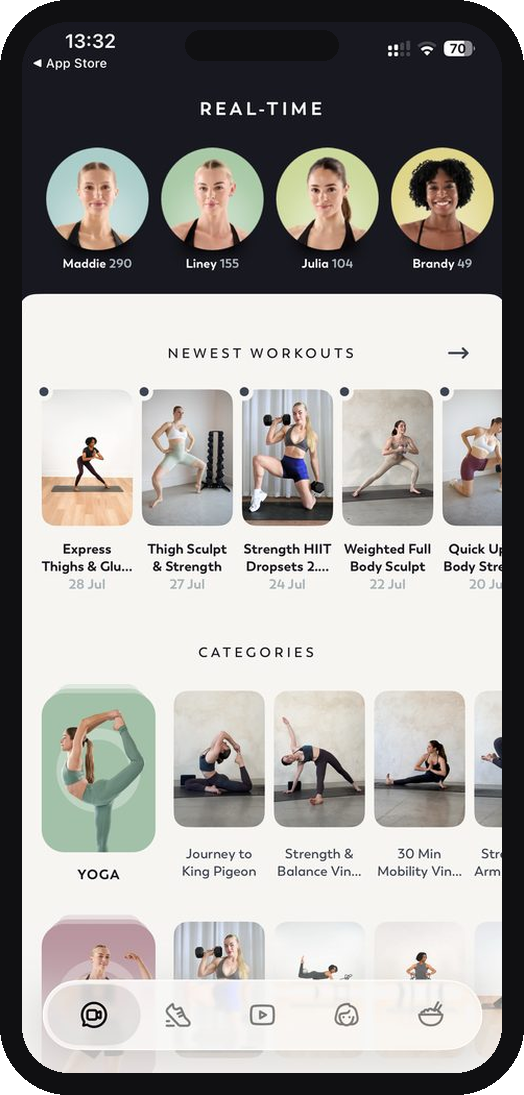
Free on YouTube, with an optional MadFit app that is freemium, roughly $19.99 to $29.99 a month or a discounted annual and lifetime plan · a huge follow-along channel from Maddie Lymburner, with around 11.6 million subscribers · real-time HIIT, low-impact and “apartment-friendly” no-jump cardio, dance-cardio, dumbbell strength, Pilates, barre, yoga and stretch · sessions from about 5 to 45 minutes · a mat and a pair of dumbbells cover it · Optional light to moderate dumbbells.
What this review is. This is a sample-tested review: I trained with the free MadFit YouTube workouts (30-minute dumbbell sessions here and there, plus the dance-cardio classes) and browsed the paid app through my own screenshots, rather than running a full multi-week programme, and the app is paid so I could not fully test it without subscribing. Two things from actually using it: the posture cues and instruction are genuinely good, and there is far more real strength and structure than a first look suggests, with dumbbell and dropset sessions and proper multi-week programmes in the app. What has not changed is the menopause picture: there is still no perimenopause or menopause programming, hormone or pelvic-floor content, so this stays a fun, general resource rather than a menopause tool. This is education, not medical advice; speak to your clinician, especially about HRT, bone health or existing conditions.
MadFit Review 2026: Quick Answer
Sample-tested: trained with the free YouTube workouts (dumbbell and dance sessions) and browsed the paid app. Full multi-week test still to come.
Women who want free, fun, low-impact and apartment-friendly home workouts in a small space, who like real-time instruction, and who will assemble their own week from strength and low-impact days
Your priority is progressive strength and bone loading, genuine menopause programming, hormone or pelvic-floor content, or clinical, credentialed guidance
A huge free MadFit YouTube channel by Maddie Lymburner, plus a low-cost freemium app with several trainers, structured multi-week programmes, challenges, recipes and mindfulness
About 5 to 45 minutes, with many short 10 to 30 minute options
A mat, plus a pair of light to moderate dumbbells for the strength and sculpt work; many workouts are body-weight only
Low to moderate; a signature low-impact, no-jump range, plus faster HIIT and dance-cardio
Weak. Accessible, joint-friendly and with real strength variety, but no strength progression, no bone work, and no perimenopause or menopause content at all
None; on-demand videos on YouTube, plus in-app challenges and structured programmes
YouTube on any device or TV; the MadFit app on iOS and Android, with music, health and calendar syncing
Free on YouTube and in the app’s free tier; app premium is roughly $19.99 to $29.99 a month, with discounted annual and lifetime plans
The whole YouTube library and a free tier of the app; any app free trial is inconsistent, so confirm at checkout
The app subscription is billed through the App Store or Google Play; some users report cancellation and auto-renewal friction
Neutral; general fitness content with no menopause or medical claims
Active; frequent new YouTube workouts and regular app updates through 2026
6.2 / 10
Quick Verdict
Worth it for women over 40? Yes as free, fun, low-impact movement with real strength variety, no as a menopause tool.
MadFit earns 6.2/10 after a hands-on look. Its strengths are real: it is one of the largest free workout libraries anywhere, the real-time follow-along format is easy to press play on, and the low-impact, no-jump, apartment-friendly workouts are genuinely joint-friendly and small-space friendly.
Using it surprised me on two counts, and disappointed on one. The instruction is good, with clear posture cues, and there is more real strength than I expected, dumbbell and dropset sessions and proper multi-week programmes in the app, so this is not only body-weight toning. What it still is not is a menopause platform: the strength is self-loaded with no progression, and there is no perimenopause or menopause programming, hormone or pelvic-floor content. Maddie Lymburner is a talented, likeable creator, but a former dancer rather than a certified trainer or clinician. Our take: use it for fun, joint-aware movement and strength variety, and pair it with a dedicated progressive-strength habit for the muscle and bone a midlife body needs.
Is MadFit right for you?
MadFit is strongest for value for money (8.0 out of 10, against a 6.9 average across the 77 programmes scored) and weakest for building bone density (2.5 against 5.1).
| Question | Verdict | Rating | Score |
|---|---|---|---|
| How it suits a perimenopausal body | |||
| Is MadFit good for pelvic floor problems?Based on pelvic floor support and low-impact design | Low, about the same as mostmost score 4.6/10 | 4.5 / 10 | |
| Is MadFit genuinely built for perimenopause and menopause?Based on menopause programming, hormone awareness, education and expert credibility | Low, and worse than mostmost score 3.3/10 | 1.5 / 10 | |
| Is MadFit good for painful joints?Based on low-impact design and recovery provision | Moderate, about the same as mostmost score 6.2/10 | 6.0 / 10 | |
| Is MadFit manageable when your energy is low?Based on recovery provision and mind-body support | Moderate, about the same as mostmost score 5.7/10 | 5.0 / 10 | |
| Is MadFit good if you are new to strength training?Based on beginner on-ramp and mind-body support | Moderate, about the same as mostmost score 6.1/10 | 6.5 / 10 | |
| Is MadFit good for building bone density?Based on bone loading and progressive strength | Low, and worse than mostmost score 5.1/10 | 2.5 / 10 | |
| Does MadFit help with nutrition?Based on midlife nutrition support | Low, and worse than mostmost score 4.0/10 | 2.0 / 10 | |
| How it performs as a product | |||
| Can you fit MadFit into a busy week?Based on time efficiency | Strong, about the same as mostmost score 7.6/10 | 8.0 / 10 | |
| Is MadFit worth the money?Based on value for money | Strong, and better than mostmost score 6.9/10 | 8.0 / 10 | |
Jump to Section
Who Is Behind It
Content and Features
Equipment You Need
Full Scoring
Good for Women Over 40?
Menopause and Midlife Fit
What the Research Says
What Users Report
Devices and App
Pricing 2026
Will You Stick With It?
Pros and Cons
How It Compares
vs FitOn
Best Alternatives
FAQ
Verdict
Testing Status
Sources
What MadFit Actually Is
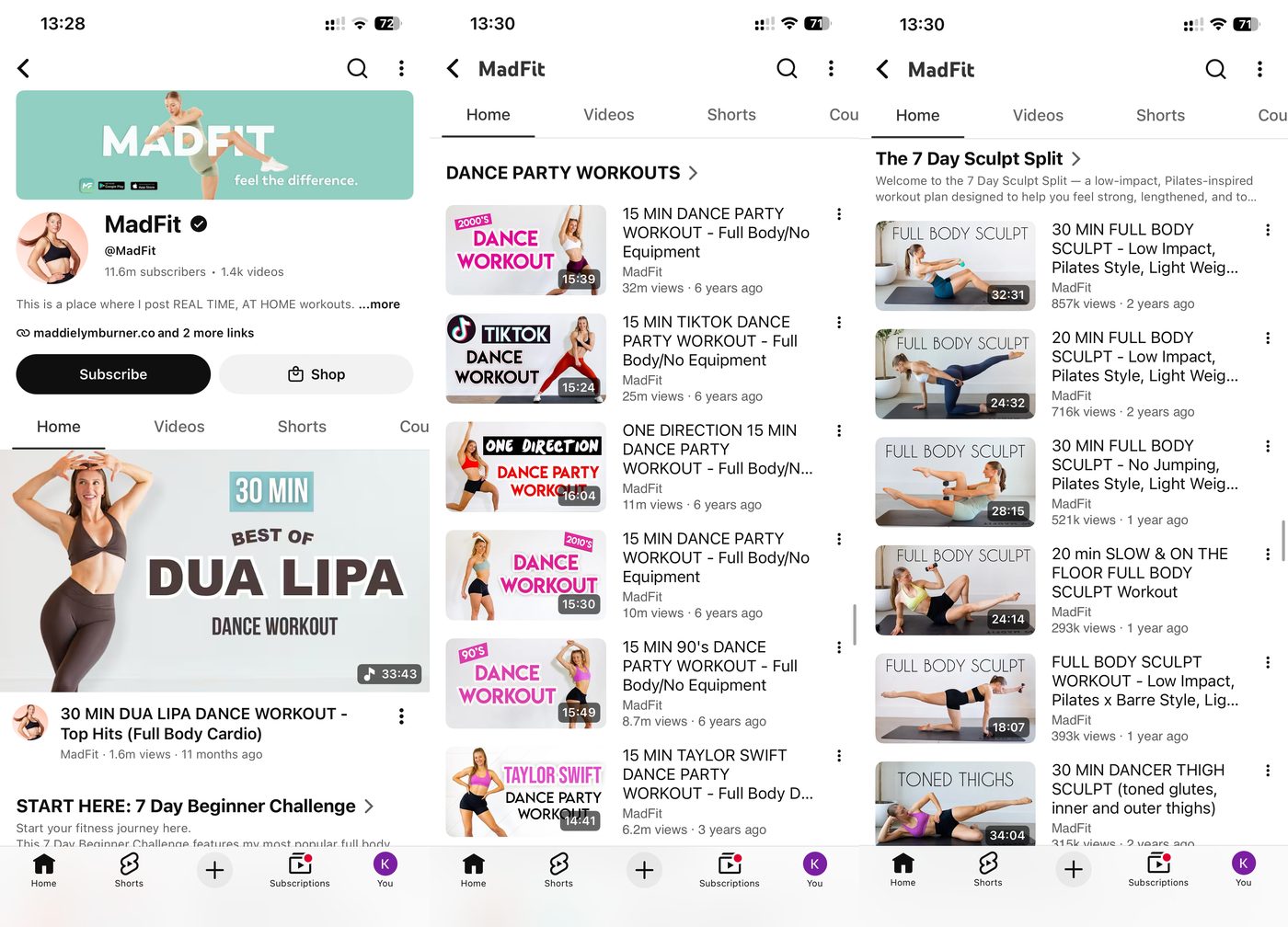
MadFit is, at heart, a free YouTube fitness channel, and one of the biggest in the world, with around 11.6 million subscribers and roughly 1,400 videos. Maddie Lymburner started it in 2018 and it grew into a phenomenon during the pandemic on the strength of one idea: real-time, follow-along workouts you can do at home in a small space. Her signature is the “workout to a song” format, routines timed to popular music, alongside a large low-impact, no-jump, apartment-friendly range and a mix of HIIT, dance-cardio, dumbbell strength, Pilates, barre, yoga and stretch. Sessions run from about 5 to 45 minutes.
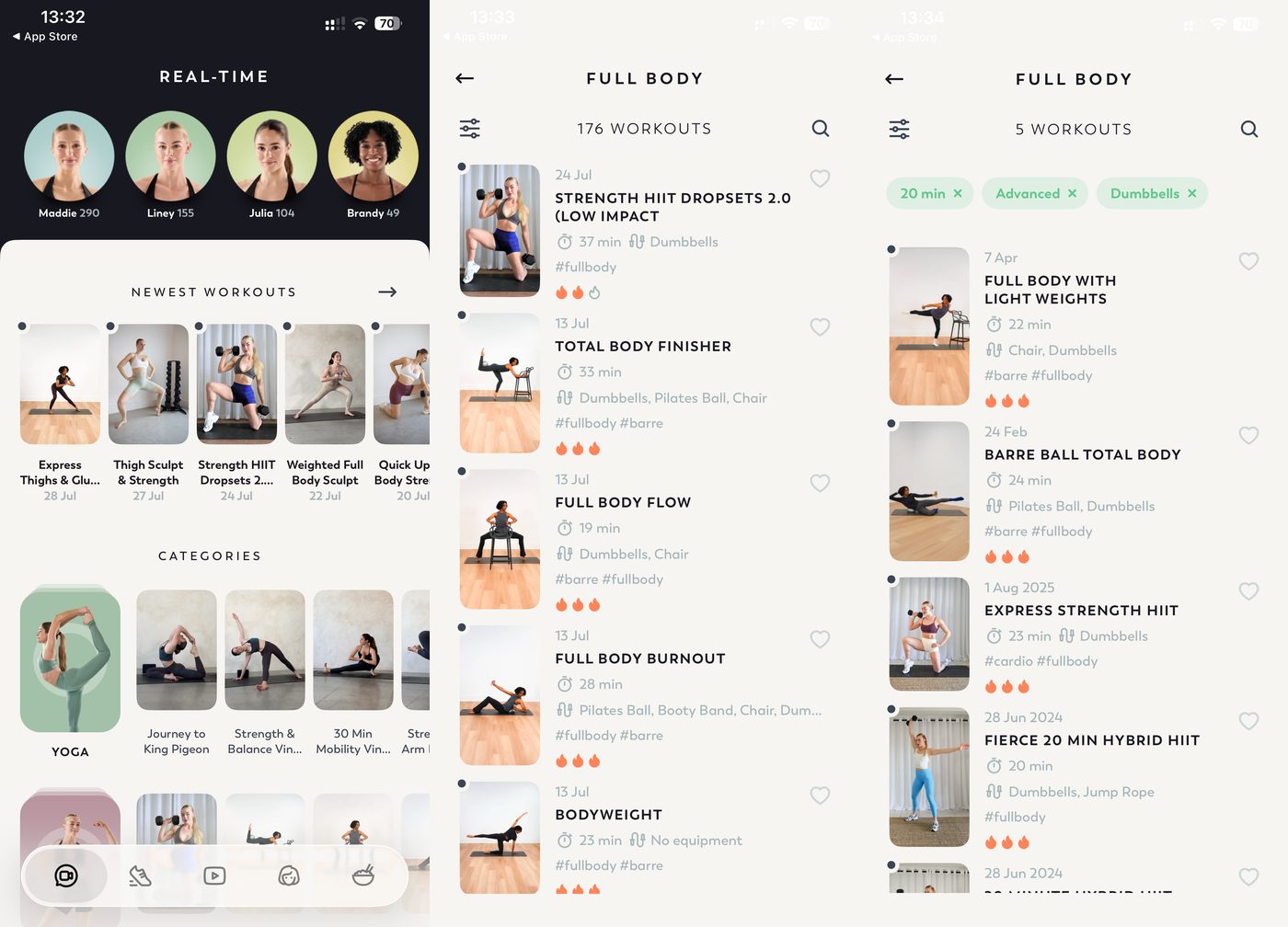
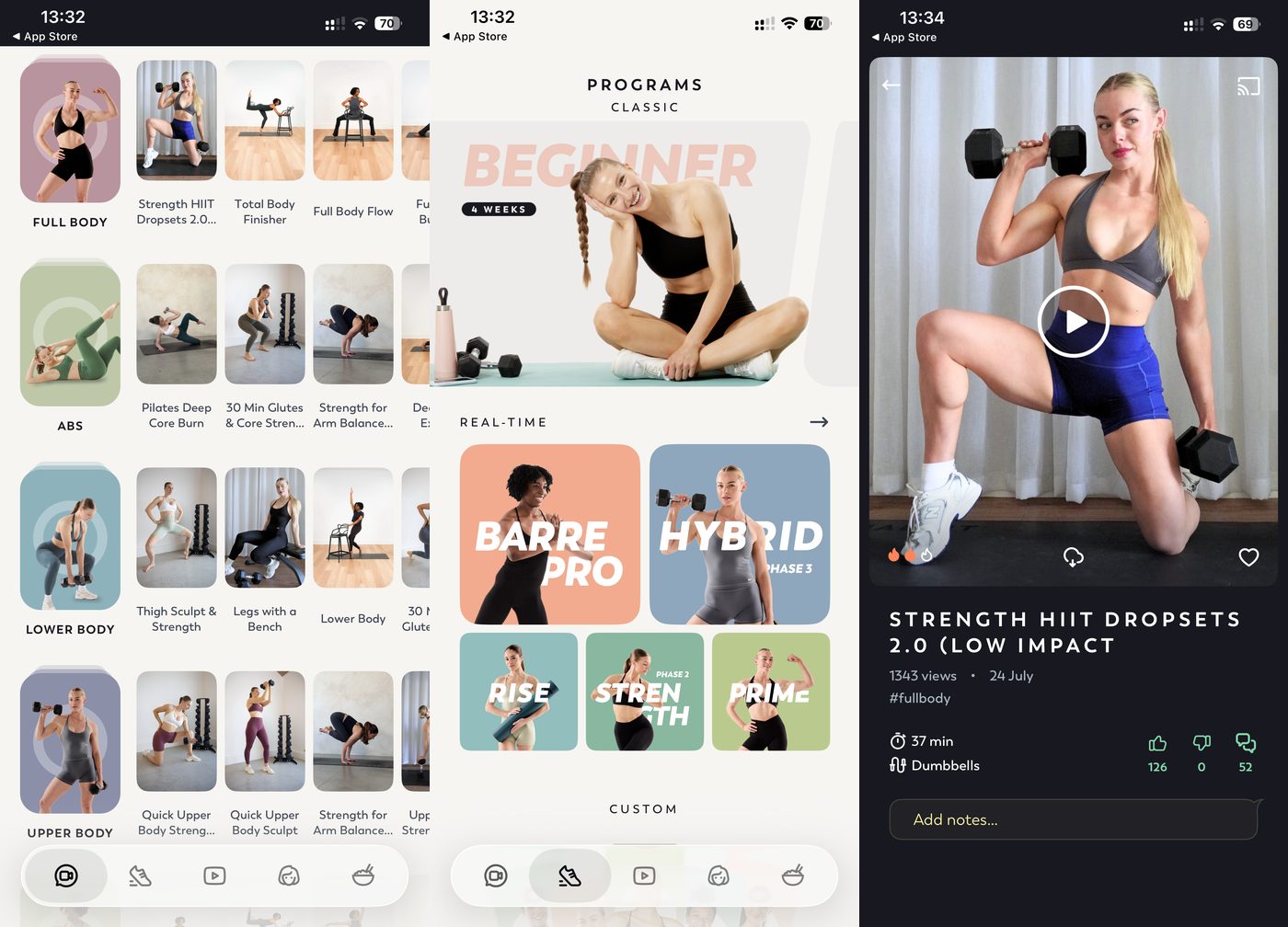
Around the free channel sits a paid MadFit app, and it is a separate product from the YouTube library rather than the same thing. Browsing it, it is more substantial than the channel alone: several trainers beyond Maddie, a large filterable library that you can sort by trainer, intensity, equipment and time, structured multi-week programmes such as a 4-week beginner plan and phased Barre Pro, Hybrid, Rise, Strength and Prime programmes, a custom-programme builder, real-time challenges, a recipe section and mindfulness content, on a freemium subscription.
For this audience it is worth being precise about what MadFit is and is not. It is a large, fun, genuinely free library of low-impact and strength movement, with a warm, calm teacher and real small-space appeal, and for a woman who wants to move at home without spending, that accessibility is real. What it is not is a midlife or menopause platform. The content is built for a young, general audience, the framing is aesthetic, and there is no perimenopause or menopause programming, no progressive strength system, no bone-loading work and no pelvic-floor content. Read MadFit as a low-cost, fun way to move that a woman over 40 can absolutely use, rather than a programme designed for her stage of life.
Who Is Behind MadFit? Credibility
MadFit is Maddie Lymburner, a Canadian creator who built one of the largest fitness followings on the internet. Her background is in dance: she trained as a competitive dancer for around 17 years before moving into online fitness, and that shows in the choreography-led, music-timed style that made the channel famous. She is a genuinely skilled, likeable and hugely popular movement teacher, and the app runs under her company, Maddie Lymburner Wholesome Influence Inc., with several other trainers now leading classes alongside her.
What she is not is a certified trainer or a clinician. We found no evidence of a personal-training or exercise-science certification for Maddie herself; she is best understood as a talented, self-taught fitness creator rather than a credentialed coach, and she is not a physician, physiotherapist, registered dietitian or menopause specialist. There is no medical or menopause advisory behind the content. For a midlife audience that means high appeal and safety for general low-impact movement, and low authority on menopause-specific medical or training questions. Read her as a well-loved movement creator, rather than a source of menopause or clinical guidance.
Content and Features
At a glance: a huge free library of fun, low-impact and strength movement with a warm teacher, plus a low-cost app with several trainers, a large filterable library, structured programmes, challenges and recipes. It is general fitness for a young audience, with no menopause programming, no progressive strength system, and no pelvic-floor or bone work.
| Format | On-demand, real-time follow-along videos on YouTube, plus the MadFit app with several trainers, structured programmes and challenges. No live classes. |
| Disciplines | HIIT, low-impact and no-jump cardio, dance-cardio, dumbbell strength, Pilates, barre, yoga and stretch. |
| Menopause / perimenopause | None. No hormone, symptom, stage or education content of any kind. |
| Low-impact and joints | A genuine signature: a large “apartment-friendly”, no-jump range that is quiet and easy on the joints. |
| Pelvic floor | No confirmed dedicated pelvic-floor training or cueing. |
| Recovery and mind | Yoga, stretch and in-app mindfulness and meditation, plus rest days in the programmes; no structured midlife deload. |
| Nutrition | A recipe section in the app (around 87 recipes across breakfast, mains, snacks and more), reflecting Maddie’s vegan-cooking roots; no structured meal plans, macro coaching or registered-dietitian guidance. |
| Strength | Body-weight and light-to-moderate dumbbell work, including dropset and bench sessions, with clear posture cues; more real strength than a first look suggests, but no progressive overload. |
| Structure | The YouTube channel is standalone videos and playlists; the app adds real structure, with multi-week programmes (Beginner, Barre Pro, Hybrid, Rise, Strength, Prime), a custom builder and a large library you can filter by trainer, intensity, equipment and time. |
| Community and tracking | An enormous free following, plus in-app challenges, a community feed and sleep, water and journal trackers. |
What Equipment Do You Need for MadFit?
Very little, which is a big part of the appeal. Many MadFit workouts are body-weight only, so a mat is really all you need for those, and the low-impact, apartment-friendly range is designed for a small space with quiet, no-jump movement. For the strength and sculpt sessions, and the dumbbell workouts I did, a pair of light to moderate dumbbells is the key addition, and some app sessions also use a bench.
Because MadFit offers no progressive strength system, the more valuable midlife purchase is a set of adjustable dumbbells for a separate strength habit, so you can add load over time, since building and keeping muscle and bone is exactly what this content does not do.
Recommended spec examples. These picks are curated by specification and feature fit, not personally lab-tested for long-term durability. Prices are examples; verify before buying.
Starter Dumbbells (up to 10 lb)
A light adjustable pair, a great starting point
~ to
Medium Dumbbells (up to 25 lb)
For steady progression as you get stronger
~ to
Advanced Dumbbells (up to 50 lb)
For serious strength and progressive overload; grows with you
~0 to 0
Resistance Bands (light to medium)
Fabric bands for glute and lower-body work
~ to
Exercise Mat
Any standard mat works for floor, yoga and Pilates work
~ to
A quick heads-up: some of the buy links above are Amazon affiliate links, so if you grab something through them I may earn a small commission, at no extra cost to you. I only ever point you to kit I would happily use myself.
How We Scored MadFit: the 6.2 / 10 Breakdown
Hands-on scores on our 9 weighted criteria. Women Over 40 is our most heavily weighted menopause criterion, and its full 12-capability breakdown follows in the next section.
| Category | Weight | Score | Reasoning (confidence) |
|---|---|---|---|
| Time Efficiency | 15% | 8 | A deep range of short 5 to 45 minute sessions and app programmes fit a busy day easily. (confidence: high) |
| Muscle Potential | 18% | 5 | More real strength than expected, with dumbbell, bench and dropset sessions and good posture cues, but self-loaded with no progressive overload. (confidence: high) |
| Women Over 40 Specificity | 10% | 3.3 | Accessible, joint-friendly and with real strength variety, but young-skewing with no menopause, hormone or pelvic-floor content, which testing confirmed; full breakdown below. (confidence: high) |
| Joint Friendliness | 12% | 8 | A large low-impact, no-jump, apartment-friendly range makes this genuinely easy on the joints. (confidence: high) |
| Recovery Compatibility | 10% | 6 | Low-impact, yoga and stretch content fit around fatigue, though there is no menopause-specific recovery structure. (confidence: medium) |
| Programme Structure | 12% | 7 | The app has real structure: multi-week programmes, a custom builder and a large library you can filter by trainer, intensity, equipment and time. (confidence: high) |
| Value for Money | 8% | 8 | A huge free YouTube library plus a low-cost app; excellent value, with a slight drag from app billing complaints. (confidence: medium) |
| UX and Design | 8% | 6 | The YouTube experience is excellent and the app is tidy and easy to filter; the app rates well on Apple but lower on Google Play, with bug and billing complaints. (confidence: medium) |
| Nutrition Integration | 7% | 3 | A recipe section only, with no meal plans, tracking or dietitian-led guidance. (confidence: high) |
| Total | 100% | 6.2 / 10 | Hands-on Score, from a sample test. |
Is MadFit Good for Women Over 40?
In a general way, yes, and the price and format make it easy to say so. MadFit is free at its core, the real-time follow-along style is unintimidating, the sessions are short, and the low-impact, no-jump range is quiet, small-space friendly and kind to the joints, which removes real barriers for a beginner. Pilates, barre, yoga and gentle cardio all support core strength, mobility and posture, so a woman over 40 who is easing back into movement can start here without spending a penny.
What I found using it. The app is paid, so I could not fully try it without paying, but I took screenshots to see inside. On YouTube there are so many workouts, and the dance classes especially stand out as a fun way to do cardio. I have been using MadFit for 30-minute dumbbell workouts here and there: they explain the posture and how to do the exercises well, and there is a good bit of choice, from strength sessions to low-impact days.
Who it suits, and what I missed. As our research showed, there is no peri or menopause-specific programme. But if you already know what you need, there is lots of content, from strength training with dumbbells to gentle low-impact days, so you can build your own week around it. It suits a woman who is happy to self-direct; what I missed is any menopause layer, and the fact that the strength, while varied, does not progress the load for you. For structured, guided menopause support and the progressive strength it does not build, see our low-impact strength guide or a purpose-built option like Pvolve.
What others found too. Independent coverage and a very large following describe MadFit the way I did: fun, accessible and easy to keep coming back to, with the free YouTube the widely praised part. The recurring caveats match mine, the strength does not progress, and the paid app draws more billing and bug complaints, worse on Android.
Who it suits, and what is missing. The gaps are specific and important for this site. First, the training emphasis: midlife guidance prioritises progressive resistance to protect muscle and bone, and MadFit offers dumbbell and body-weight work with no progression, so it does more for strength than it looks but still little for bone density. Second, the audience and framing: this content is designed for a young, general crowd, so it is aesthetic-led, and the HIIT and dance-cardio can be faster than a cautious midlife body wants on a given day. Third, the menopause gap: there is no perimenopause or menopause programming, no hormone or symptom content and no pelvic-floor work. It suits a woman who wants free, fun, joint-friendly movement and will add her own progression; it is a weak single choice for someone whose priority is bone or a menopause-specific plan.
How MadFit Fits Perimenopause, Menopause and Beyond
Our capability breakdown of how well MadFit suits women across perimenopause, menopause and post-menopause. Women Over 40 is our most important criterion for this site, and this is the full breakdown behind the Women Over 40 row in the scoring table above.
MadFit is strongest for low-impact movement, a beginner on-ramp and a mind-body range, and weakest for progressive strength, bone loading and every menopause-specific capability, in our menopause and midlife capability assessment for women over 40. My hands-on look did not move these menopause capabilities, because the menopause content simply is not there.
| At a glance | Score |
|---|---|
| Right training for a midlife body | 4.3 / 10 |
| Built for menopause | 1.4 / 10 |
| Whole-woman support | 5.0 / 10 |
This is the perimenopause and menopause assessment, and it is separate from the overall score. Twelve things a programme either does for a midlife body or does not, each scored out of 10 with my reasoning next to it. Together they produce a single menopause fit score, and that becomes one of the nine categories in the overall scoring below.
How MadFit Fits Perimenopause, Menopause & Beyond
Women Over 40 is our most important criterion, and here's the full breakdown behind it.
MadFit is strongest for low-impact, and weakest for menopause programming, pelvic floor, hormone awareness, menopause education, bone loading, midlife nutrition, progressive strength, expert credibility and recovery & deload, in our menopause and midlife capability assessment for women over 40.
At a glance
| Capability | Score | Rating | Why |
|---|---|---|---|
| Right training for a midlife body | |||
| Low-impact | 8/10 | Strong | Signature strength: quiet, no-jump, apartment-friendly low-impact cardio, best-in-class for the format. |
| Progressive strength | 3/10 | Minimal | Real dumbbell, bench and dropset work with good cues, but self-loaded with no programmed progressive overload. |
| Bone loading | 2/10 | None | Light-to-moderate loading with no progression cannot drive bone adaptation. |
| Recovery & deload | 4/10 | Minimal | Rest days plus stretch, yoga and mindfulness, but no structured deload or midlife-specific recovery. |
| Built for menopause | |||
| Menopause programming | 1/10 | None | No perimenopause or menopause programming of any kind. |
| Pelvic floor | 1/10 | None | No pelvic-floor content or cueing. |
| Hormone awareness | 1/10 | None | No hormone, cycle or symptom-aware content. |
| Menopause education | 1/10 | None | No menopause education library or articles. |
| Expert credibility | 3/10 | Minimal | Self-taught ex-dancer plus several non-clinical app trainers; not a certified trainer/clinician/RD/menopause specialist. |
| Whole-woman support | |||
| Mind-body support | 6/10 | Some | Real yoga, Pilates, barre, stretch and in-app mindfulness/meditation. |
| Beginner on-ramp | 7/10 | Strong | 4-week beginner programme, abundant 5-minute sessions, clear posture cues, low-barrier apartment-friendly format. |
| Midlife nutrition | 2/10 | None | Recipe section only (~87 recipes); no structured or dietitian guidance and nothing midlife-specific. |
ScaleBest-in-classStrongSomeMinimalNone
What the sources say: Scores combine a hands-on trial of the free MadFit YouTube workouts (30-min dumbbell and dance-cardio sessions, iOS, Aug 2026) and a browse of the paid app via Katy's own screenshots, plus the app and store listings, independent coverage and peer-reviewed science. The built-for-menopause group scores near the floor because there is no menopause programming, education, hormone or pelvic-floor content; the low-impact, beginner and structure caps score well because the quiet no-jump range, clear cues and structured app programmes are verifiable strengths.
These are evidence-informed suitability ratings, not clinical measurements. They combine exercise science with product-specific research and, where indicated, hands-on testing, alongside multi-source verification, and are approximate. Individual response varies. A starting point, not medical advice. How we score menopause fit
What the sources say: scores combine a hands-on trial with the channel, the app and store listings, independent coverage and the science. Low-impact movement, beginner access and the mind-body range scored acceptably because they are core, verifiable strengths, and the strength variety was better than expected in testing. The built-for-menopause group scored very low because there is no menopause programming, education, hormone or pelvic-floor content of any kind, and the creator, while a talented movement teacher, is a former dancer rather than a clinician or menopause specialist.
These are evidence-informed suitability ratings, not clinical measurements. They combine exercise science with hands-on and feature analysis, and are approximate. Individual response varies. A starting point, not medical advice. How we score menopause fit.
What the Research Says: MadFit’s Approach Checked
The movement MadFit offers is well matched to some real midlife needs, with clear limits. Its low-impact cardio and HIIT are genuinely useful: a 2026 systematic review and meta-analysis found high-intensity interval training significantly improved cardiorespiratory fitness in middle-aged and older women, a time-efficient benefit that suits short home sessions.[1] And low-impact, land-based exercise is safe for older joints: a Cochrane review found it reduced knee pain and improved function with no serious adverse events, which supports the gentler, no-jump work.[2] Because a brand built on consistency lives or dies on adherence, it is worth noting that enjoyment reliably predicts sticking with exercise, and dance-based movement has shown mood benefits in menopausal women, both of which play to MadFit’s fun, follow-along format.[3][4]
The caveat that matters most for our audience is strength and bone. Across the menopause transition, body composition shifts, with the rate of fat gain roughly doubling and lean muscle declining, which is exactly when muscle needs protecting.[5] Progressive resistance is the active ingredient: a large Cochrane review found progressive resistance training produced big gains in strength and everyday function in older adults, and MadFit’s dumbbell and body-weight work, without programmed progression, does not fully provide that stimulus.[6] Bone is the same story: a network meta-analysis found at least moderate-intensity resistance was needed to improve bone density, and in the LIFTMOR trial heavier, progressive loading improved bone density and function where light exercise did not.[7][8] The sensible way to use MadFit is as fun, low-impact movement and strength variety that supports fitness and mood, paired with your own progression for the muscle and bone it cannot programme for you.
What Users Report: Verified Sentiment
Rating snapshot, and a split worth naming: the free content is loved, while the paid app divides opinion by platform. The MadFit YouTube channel has around 11.6 million subscribers, and independent coverage from outlets such as Toronto Life, Global News and Tom’s Guide is consistently warm about the accessible, living-room workouts. The MadFit app holds about 4.7 stars on the Apple App Store from roughly 5,900 ratings, but only about 3.0 on Google Play from around 1,200 reviews on more than 100,000 installs, both read in 2026. That gap is the story: iOS users are happy, while the much lower Android rating is driven largely by app bugs and billing complaints rather than the workouts. My own time in the app matched the positive picture on content and instruction, with the paywall and the store split the main things I would flag.
Consistently praised
- Free, fun and easy to follow in real time, with no clicking between moves.
- Low-impact, no-jump and apartment-friendly, ideal for small spaces and beginners.
- Short, time-efficient sessions from about 5 to 45 minutes, with clear posture cues.
- Maddie’s calm, encouraging, non-shouty energy, and a genuinely varied library.
Consistently criticised
- The paid app is buggy for some, especially on Android.
- Subscription and cancellation friction, and reports of surprise auto-renewals.
- Value doubts on the app, since the free YouTube channel gives you a lot of it.
- Self-loaded strength with no programmed progression, and a young, aesthetic-led framing.
Source and credibility note: the app ratings were read live from the Apple App Store and Google Play (2026) and cross-checked against a hands-on trial; the strong iOS base and the much weaker Android base should be reported separately, not blended, because the Android gap reflects technical and billing complaints rather than workout quality. The YouTube subscriber figure is approximate and varies by source. Reddit and forum themes are directional rather than measured. We found little direct testimony from women over 40; the midlife read draws on the content design, the hands-on session and the science rather than a menopause-labelled programme, of which there is none.
Devices, Platforms and App
MadFit is easy to reach. The free channel is on YouTube, so it plays on any phone, tablet, computer or smart TV and casts easily to a screen, which suits a woman who wants to follow a workout on the television in her living room. The MadFit app adds iOS and Android, with a free tier of workouts plus a premium subscription that unlocks the structured programmes, several trainers, challenges, recipes and trackers, and it syncs with music, health and calendar apps. Browsing it, the filtering is genuinely handy: you can narrow by trainer, intensity, equipment and time to find, say, a 20-minute advanced dumbbell session quickly.
The catches are app catches, not workout ones. The app is paid, so you cannot fully try it without subscribing, owners report bugs especially on Android, and there are recurring complaints about subscription cancellation and auto-renewal, with any free trial appearing inconsistent. For a woman over 40 who mostly wants to press play on a free video, the YouTube channel is the smoother, no-cost experience; the paid app is inexpensive and better structured, but more variable, so try the free library first.
MadFit specifications
- Free trial
- app trial (confirm)
- Cancellation
- free on YouTube; optional paid MadFit app (cancel via store)
- Session length
- ~10 to 30 min
- Who makes it
- Maddie Lymburner (MadFit), fitness trainer/content creator; formal PT cert not strongly documented; no clinician
- Still maintained
- Active; MadFit app iOS v1.12.0
- What is included
- On-demand classes: yesLive classes: noRecovery content: partlyMenopause education: noStructured programmes: yesMeditation: partlyNutrition guidance: partly
- Women over 40
- Pelvic floor work: noMenopause clinician involved: noInjury modifications: partlyBone-health focus: noModified progressions: partlyCycle syncing: noPrenatal options: partly
- Devices and access
- Offline downloads: partlyCasting to TV: yesSubtitles: partlyWearable sync: no
- Support
- Clinical advisory board: noCommunity: partlySupplement upsell: no
- Last verified
- 12 August 2026
MadFit Price 2026: What You Actually Pay
| Plan | Cost | Includes |
|---|---|---|
| Free (YouTube) | $0 | The full library of follow-along workouts and playlists, ad-supported, with no account needed. |
| App free tier | $0 | A selection of workouts in the MadFit app, free to download on iOS and Android. |
| App premium (monthly) | About $19.99 to $29.99/month | Adds the structured multi-week programmes, several trainers, challenges, recipes, mindfulness and trackers. Pricing is promo-dependent. |
| App premium (annual / lifetime) | About $99.99 to $149.99/year, or a ~$199.99 lifetime | The same at a lower effective rate, often discounted; confirm the current tier and any trial at checkout. |
Cost and Cancellation
The value here is strong, because the whole YouTube channel is genuinely free, so you can follow MadFit for years without paying at all. The optional app is inexpensive, but its pricing is unusually messy, with several concurrent monthly, annual and lifetime tiers that shift with promotions, so check exactly what you are being charged. The app is paid with no reliable free trial, and the subscription is billed through the App Store or Google Play, so cancel there rather than expecting the app to stop the renewal; some users report cancellation and auto-renewal friction. If you subscribe, set a reminder and manage it through your store account. Prices were checked in 2026 and can vary by region and promotion; confirm at checkout.
Will You Actually Stick With It?
The core is free and the app is inexpensive, so cost is almost never why you stop.
Short, real-time, low-impact and apartment-friendly workouts with clear cues make it very easy to start.
The strength is varied but self-loaded, so results can plateau unless you add and increase the weight yourself.
No programmed progression and no menopause content means you must add real progressive loading and menopause guidance elsewhere.
MadFit Pros and Cons
Pros
- Genuinely free at its core, with a huge library and no equipment barrier
- A large low-impact, no-jump, apartment-friendly range that is easy on the joints
- Fun real-time follow-along format, clear posture cues and a warm, calm teacher
- More real strength than expected: dumbbell, bench and dropset sessions
- An inexpensive app with several trainers, structured programmes and easy filtering
- Yoga, Pilates, barre and mindfulness for a genuine mind-body range
Cons
- No programmed progression, so the strength does not build load for you
- Does little for bone, a top midlife priority
- No perimenopause or menopause programming, hormone or pelvic-floor content
- Only recipe-level nutrition, with no structured or dietitian guidance
- The app is paid with no reliable trial, and draws bug and billing complaints, worse on Android
- A self-taught creator, not a certified trainer, clinician or menopause specialist
How MadFit Compares to Similar Platforms
If you are deciding between free and low-cost, at-home options, this is how MadFit sits against the alternatives. Scores come from our independent reviews and update automatically as each is scored; Pvolve is included as the menopause-built contrast, and free options are shown alongside.
| Feature | MadFit | FitOn | The Sculpt Society | Melissa Wood Health | Pvolve |
|---|---|---|---|---|---|
| Our score | 6.2 / 10 (hands-on) | 7.3 / 10 | 8.2 / 10 | 6.9 / 10 | 8.3 / 10 |
| Monthly price | Free · app ~$19.99/mo (verify) | Free tier · ~$29.99/yr Pro (verify) | ~$24.99/mo (verify) | ~$9.99/mo (verify) | $24.99/mo · equipment from $199 (verify) |
| Approach | HIIT, low-impact, dance and dumbbell strength | Varied class library | Dance cardio and sculpt | Low-impact Pilates and light strength | Functional strength, menopause-built |
| Impact level | Low core, higher in HIIT/dance | Low to moderate | Low to moderate | Low by design | Low by design |
| Progressive strength | Dumbbell variety, but no programmed progression | Some, light weights | Light weights, limited progression | Light, limited progression | Yes, functional |
| Perimenopause content | None | Minimal | Some pre and postnatal, no menopause focus | Minimal | Best in class: Menopause Strong, pelvic floor |
| Expert credibility | Self-taught creator, not clinical | Good | Certified trainer, not clinical | Self-taught creator, not clinical | Strong, women’s-health focus |
| Free trial / billing | Free core; app paid, trial inconsistent, store-billed | Generous free tier | 7-day trial (verify) | Trial (verify) | 14-day trial |
| Best suited to | Women wanting free, fun, low-impact workouts with strength variety | Women wanting a free class library | Women wanting dance-led sculpt workouts | Women wanting gentle Pilates and calm | Women ~35+, perimenopause, joints |
Competitor prices are approximate; verify on each platform’s website. Scores reflect our independent reviews. See each full review for methodology.
MadFit vs FitOn: Which Is Better for Women Over 40?
This is the closest pairing for a woman who wants quality home workouts without paying much, because both lead with a genuinely useful free offering and cover a broad range. FitOn is built around a large library of pre-recorded classes across many disciplines, with named instructors, spoken coaching and a strong free tier, and it leans a little more toward accessible, coached variety. It suits a woman who wants a friendly, class-based free library with instruction throughout.
MadFit is the more improvised, creator-led option: a vast free channel on YouTube built on real-time, music-timed follow-alongs and a signature low-impact, no-jump range, plus an inexpensive, better-structured app with several trainers. It is the better pick if you like a warm real-time teacher, the apartment-friendly quiet format and pressing play for free, and testing showed more strength variety than its reputation suggests. Neither builds programmed progression or bone, and neither is a menopause programme, so pair whichever you choose with dedicated progressive-strength work. For genuine menopause programming and the pelvic-floor and structured strength both lack, a purpose-built option such as Pvolve goes further than either.
If MadFit Is Not Right for You: Best Alternatives
MadFit’s gaps for our audience are programmed progressive strength and bone work, and the absence of any menopause, hormone or pelvic-floor content. If those matter, these published options map to the gaps.
MadFit FAQ
MadFit is a free YouTube fitness channel by Maddie Lymburner, one of the biggest in the world with around 11.6 million subscribers, built on real-time follow-along workouts: HIIT, low-impact and apartment-friendly no-jump cardio, dance-cardio, dumbbell strength, Pilates, barre, yoga and stretch, in sessions from about 5 to 45 minutes. There is also a separate low-cost MadFit app with several trainers that adds structured multi-week programmes, challenges, recipes, mindfulness and trackers.
The whole MadFit YouTube library is free and ad-supported, with no account needed, and it is where most people practise. The MadFit app is a separate, freemium product from the same creator: it has a free tier plus a premium subscription of roughly $19.99 to $29.99 a month (with discounted annual and lifetime plans) that unlocks structured programmes, several trainers, challenges and recipes not on YouTube. Confirm the current price and any trial at checkout.
For free, fun, low-impact movement, it can be, since the no-jump, apartment-friendly range is genuinely joint-friendly, and in testing there was more real dumbbell strength than expected, with good posture cues. But MadFit is built for a young, general audience, its strength is self-loaded with no programmed progression, and it has no perimenopause or menopause programming, no bone work and no pelvic-floor content. Pair it with a dedicated strength habit, and for menopause specifically consider a purpose-built option.
It builds some strength but little bone. It uses body weight and dumbbells, including dropset and bench work, but there is no programmed progressive overload, and the evidence is clear that building muscle and bone in midlife needs heavier, progressive resistance. Treat MadFit as good for low-impact movement, mobility and strength variety, and add your own progression, with adjustable dumbbells, for the muscle and bone it does not programme for you.
Maddie Lymburner is a Canadian creator and former competitive dancer who built one of the largest fitness channels online. We found no evidence of a personal-training or exercise-science certification for her, so she is best understood as a talented, self-taught fitness creator rather than a credentialed coach, and she is not a clinician, dietitian or menopause specialist. The app is led by Maddie with several other trainers, but there is no medical advisory behind the content.
For a woman who wants free, fun, low-impact home workouts with real strength variety, and does not mind a young-skewing style, the MadFit YouTube channel is excellent value, and the app is inexpensive and better structured if you want programmes and filtering. It is a weaker choice if your priority is building bone or you want a menopause-specific plan, because it offers neither. This is a sample-tested review; a full multi-week test is still to come.
Final Verdict
Hands-on Score: 6.2 / 10 · Sample-tested
MadFit is one of the largest and most approachable free fitness resources anywhere, and a hands-on look confirmed it: fun, low-impact, real-time movement with clear posture cues, a big low-impact and apartment-friendly range, and more strength variety than its reputation suggests, with dumbbell and dropset sessions and a properly structured app. Maddie Lymburner is a talented, much-loved movement teacher. The moderating factors for our audience are clear and important: the content is built for a young, general crowd, the strength is self-loaded with no programmed progression, and there is no perimenopause or menopause programming, no bone work and no pelvic-floor content.
MadFit is for women who want free, fun, low-impact movement and strength variety they can follow at home in a small space, and who are happy to add their own progression. MadFit is not for women whose priority is building bone or following a menopause-specific plan, who should pair it with a dedicated progressive-strength habit and, for menopause, a purpose-built option such as Pvolve.
Testing Status
Sample-tested. This review is based on a hands-on look (training with the free MadFit YouTube workouts, including 30-minute dumbbell and dance-cardio sessions, and browsing the paid app through my own screenshots, iOS, August 2026), plus the app and store listings, independent coverage and peer-reviewed science. The app is paid, so it was browsed rather than fully run. A full multi-week test, with adherence and progression over time, would move it to Fully tested and may refine the score. Screenshots are my own. How we score and test.
Sources and Further Reading
- Cai, L. et al. (2026). Effects of high-intensity interval training on cardiopulmonary fitness and physical function in middle-aged and elderly women: a systematic review and meta-analysis. Frontiers in Physiology. Available at: pmc.ncbi.nlm.nih.gov. HIIT significantly improved cardiorespiratory fitness (VO2max) in middle-aged and older women.
- Fransen, M. et al. (2015). Exercise for osteoarthritis of the knee. Cochrane Database of Systematic Reviews. Available at: cochranelibrary.com. Land-based exercise reduced knee pain and improved function with no serious adverse events reported.
- Teixeira, D.S. et al. (2022). Enjoyment as a predictor of exercise habit, intention to continue exercising, and exercise frequency. Frontiers in Psychology. Available at: pmc.ncbi.nlm.nih.gov. Exercise enjoyment significantly predicted exercise habit, intention to continue and frequency.
- Coelho de Farias Marques, M. et al. (2024). Effects of jazz dance and concurrent training on psychological variables in menopausal women: a randomised controlled trial. Archives of Women’s Mental Health. Available at: pubmed.ncbi.nlm.nih.gov. Sixteen weeks of jazz dance improved anxiety and depression in menopausal women (single modest trial, n=70).
- Greendale, G.A. et al. (2019). Changes in body composition and weight during the menopause transition. JCI Insight (Study of Women’s Health Across the Nation). Available at: insight.jci.org. Fat-mass gain accelerated and lean mass declined across the menopause transition.
- Liu, C.-J. and Latham, N.K. (2009). Progressive resistance strength training for improving physical function in older adults. Cochrane Database of Systematic Reviews. Available at: cochranelibrary.com. Progressive resistance training produced large gains in strength and improved everyday function in older adults.
- Wang, Z. et al. (2023). Comparative efficacy of different resistance training protocols on bone mineral density in postmenopausal women: a systematic review and network meta-analysis. Frontiers in Physiology. Available at: ncbi.nlm.nih.gov. At least moderate-intensity resistance training was needed to improve bone density; low-intensity loading was not superior to control.
- Watson, S.L. et al. (2018). High-intensity resistance and impact training improves bone mineral density and physical function in postmenopausal women: the LIFTMOR randomized controlled trial. Journal of Bone and Mineral Research. Available at: pubmed.ncbi.nlm.nih.gov. Heavier, high-intensity loading improved bone density and function; light exercise did not.
This is a sample-tested review based on a hands-on look, not a full multi-week test. Pricing and features were verified in 2026 and may have changed. Some affiliate links may be present. This site does not accept payment from platforms reviewed. Education, not medical advice; speak to your clinician, especially about HRT, bone health or existing conditions.
Related Guides
What To Do Next
- → Take our 2-minute quiz for a personalised recommendation.
- → See our best workouts for perimenopause rankings.
- → Compare with our Pvolve review and see how we score every programme.