
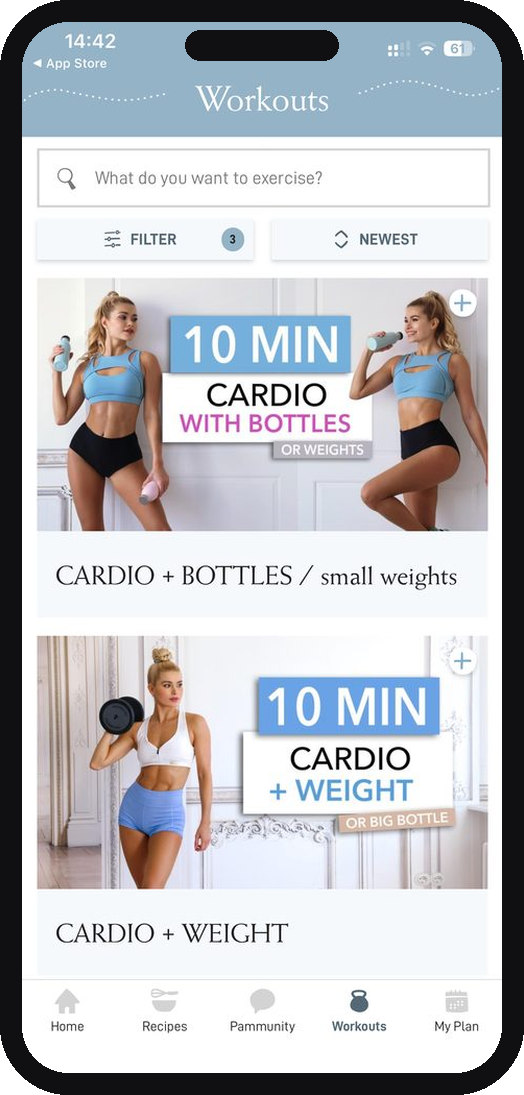
Free on YouTube, with an optional Pam app that is unusually cheap, about $2.99 a month, $34.99 a year or an $89.99 lifetime, with a first week free · a huge channel from Pamela Reif, with around 10.7 million subscribers · silent, real-time, timed follow-along workouts, no talking, driven by music and an on-screen counter · cardio, HIIT, dance, abs, Pilates, yoga, stretch and light strength, plus a large recipe library · a mat and light weights cover it · Optional bottles, small weights or a booty band.
Pamela Reif Data Profile 2026: Quick Answer
Data profile: research-based, not personally tested. Hands-on score pending.
Women who want free or very cheap, fun, low-impact and knee-friendly home workouts they can follow in real time, and who like a clean app with recipes and a meal planner
Your priority is progressive strength and bone loading, genuine menopause programming, hormone or pelvic-floor content, spoken coaching and form cues, or a weight-neutral approach
A huge free Pamela Reif YouTube channel of silent, timed follow-along workouts, plus a very cheap Pam app that adds plans, a large recipe library, a meal planner and a community
About 5 to 45 minutes, with many short 10 to 20 minute routines
A mat, plus optional bottles, small weights or a booty band; most workouts are body-weight only
Low to moderate; a genuine low-impact and knee-friendly range, plus faster HIIT and dance
Weak. Accessible and joint-friendly, but no strength progression, no bone work, and no perimenopause or menopause content at all
None; on-demand videos on YouTube, plus in-app plans and a community
YouTube on any device or TV; the Pam app on iOS and Android; no confirmed web player, casting or offline
Free on YouTube and in the app’s free tier; the Pam app is about $2.99/month, $34.99/year or an $89.99 lifetime
The whole YouTube library and a free tier of the app; the app has a first week free, then the recipes and blog are paywalled
The app subscription is billed through the App Store or Google Play; cancel there anytime
Neutral; general fitness content with no menopause or medical claims, and an aesthetic, appearance-led framing
Active; frequent new YouTube workouts, regular app updates and a new community feature in 2026
6.1 / 10
Quick Verdict
Worth it for women over 40? Yes as free, fun, low-impact movement, no as a strength or menopause tool.
Pamela Reif earns 6.1/10 on our research-based evaluation. Its strengths are real: it is one of the largest free workout libraries anywhere, the silent, real-time follow-along format is easy to press play on, the app is unusually cheap and well made, and there is a genuine low-impact and knee-friendly range that suits many midlife bodies.
What it is not is a menopause platform, and it leans light and aesthetic. The content is built for a young, appearance-led audience, the strength work is body-weight and light-band toning with no progression, and there is no perimenopause or menopause programming, no bone work and no pelvic-floor content. The paywall is mostly recipes and a meal planner, authored by Pamela and family rather than a dietitian, and Pamela herself is a talented, self-taught creator rather than a certified trainer or clinician. Start here: use the free channel and the knee-friendly plan for joint-aware movement, and pair it with a dedicated progressive-strength habit for the muscle and bone a midlife body needs.
How this profile is different. We have not personally completed a Pamela Reif programme. This is a research-based Data Profile built from the free channel, the Pam app and store listings, independent coverage and the science, scored only where the evidence reliably supports it. Two things to know up front: Pamela Reif is a free YouTube channel at heart, with a very cheap app that leans on recipes and a meal planner as much as workouts, and it is built for a young, aesthetic audience rather than menopause, so it carries no perimenopause or menopause programming, hormone or pelvic-floor content at all. Its low-impact and knee-friendly workouts are genuinely usable at midlife, but the value here is joint-friendly movement and cheap variety, not menopause care.
This is education, not medical advice; speak to your clinician, especially about HRT, bone health or existing conditions.
Is Pamela Reif right for you?
Pamela Reif is strongest for value for money (9.0 out of 10, against a 7.0 average across the 72 programmes scored) and weakest for building bone density (2.0 against 5.1).
| Question | Verdict | Rating | Score |
|---|---|---|---|
| How it suits a perimenopausal body | |||
| Is Pamela Reif good for pelvic floor problems?Based on pelvic floor support and low-impact design | Low, about the same as mostmost score 4.6/10 | 4.5 / 10 | |
| Is Pamela Reif genuinely built for perimenopause and menopause?Based on menopause programming, hormone awareness, education and expert credibility | Low, and worse than mostmost score 3.4/10 | 1.3 / 10 | |
| Is Pamela Reif good for painful joints?Based on low-impact design and recovery provision | Moderate, about the same as mostmost score 6.2/10 | 6.0 / 10 | |
| Is Pamela Reif manageable when your energy is low?Based on recovery provision and mind-body support | Moderate, and worse than mostmost score 5.8/10 | 5.0 / 10 | |
| Is Pamela Reif good if you are new to strength training?Based on beginner on-ramp and mind-body support | Moderate, about the same as mostmost score 6.2/10 | 5.5 / 10 | |
| Is Pamela Reif good for building bone density?Based on bone loading and progressive strength | Low, and worse than mostmost score 5.1/10 | 2.0 / 10 | |
| Does Pamela Reif help with nutrition?Based on midlife nutrition support | Moderate, but better than mostmost score 4.1/10 | 5.0 / 10 | |
| How it performs as a product | |||
| Can you fit Pamela Reif into a busy week?Based on time efficiency | Strong, about the same as mostmost score 7.6/10 | 8.0 / 10 | |
| Is Pamela Reif worth the money?Based on value for money | Strong, and better than mostmost score 7.0/10 | 9.0 / 10 | |
Jump to Section
Who Is Behind It
Content and Features
Equipment You Need
Full Scoring
Good for Women Over 40?
Menopause and Midlife Fit
What the Research Says
What Users Report
Devices and App
Pricing 2026
Will You Stick With It?
Pros and Cons
How It Compares
vs FitOn
Best Alternatives
FAQ
Verdict
Testing Status
Sources
What Pamela Reif Actually Is
Pamela Reif is, at heart, a free YouTube fitness channel, and one of the biggest in the world, with around 10.7 million subscribers. The German creator started posting in her teens and built the channel on one distinctive idea: silent, real-time, follow-along workouts, with no talking and no cueing, just a music playlist and an on-screen timer that counts each exercise, so you simply mirror her in real time. Around that sit cardio, HIIT, dance, abs, Pilates, yoga and stretch routines, warm-ups, and light strength work, in sessions from about 5 to 45 minutes.
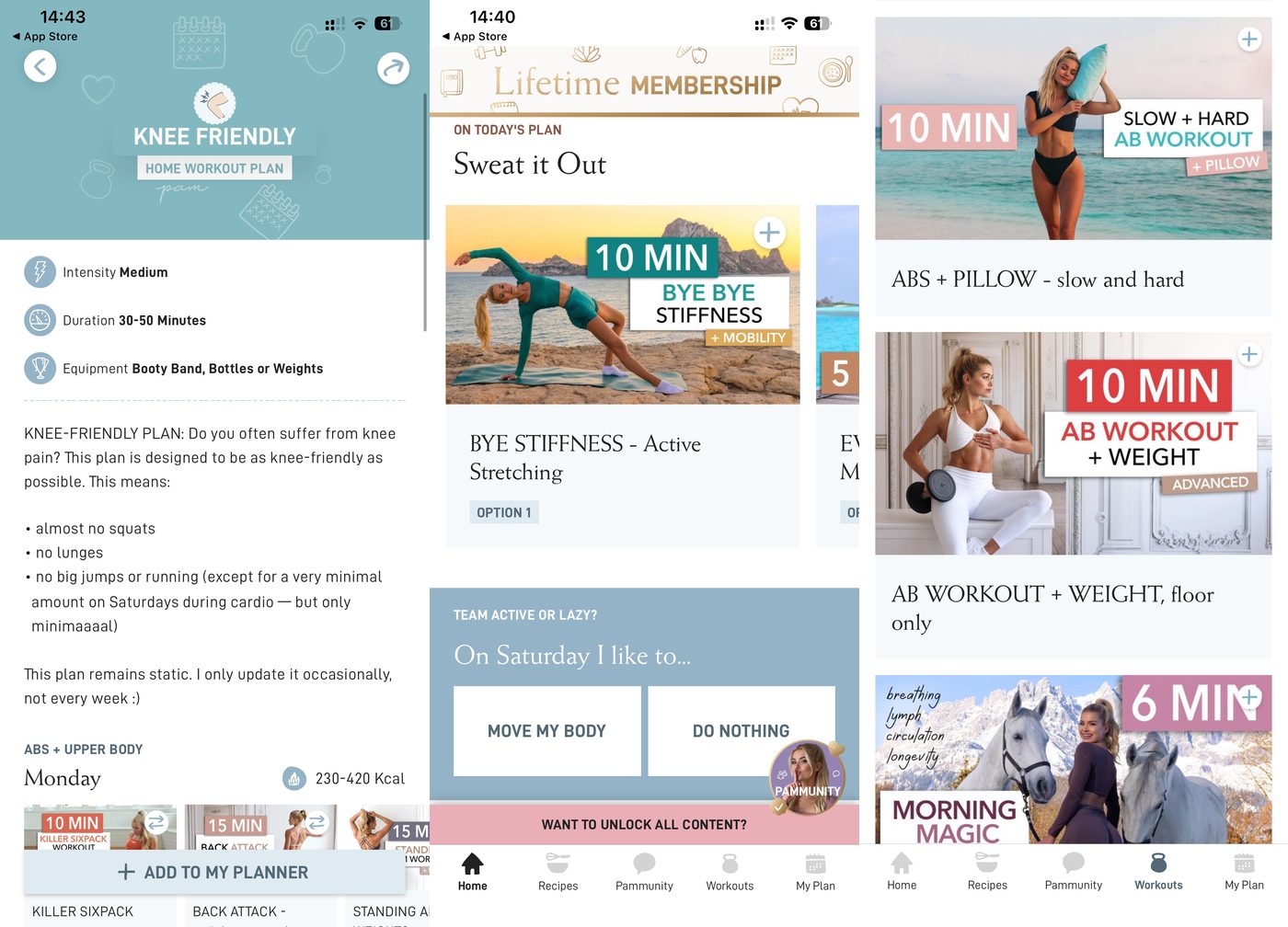
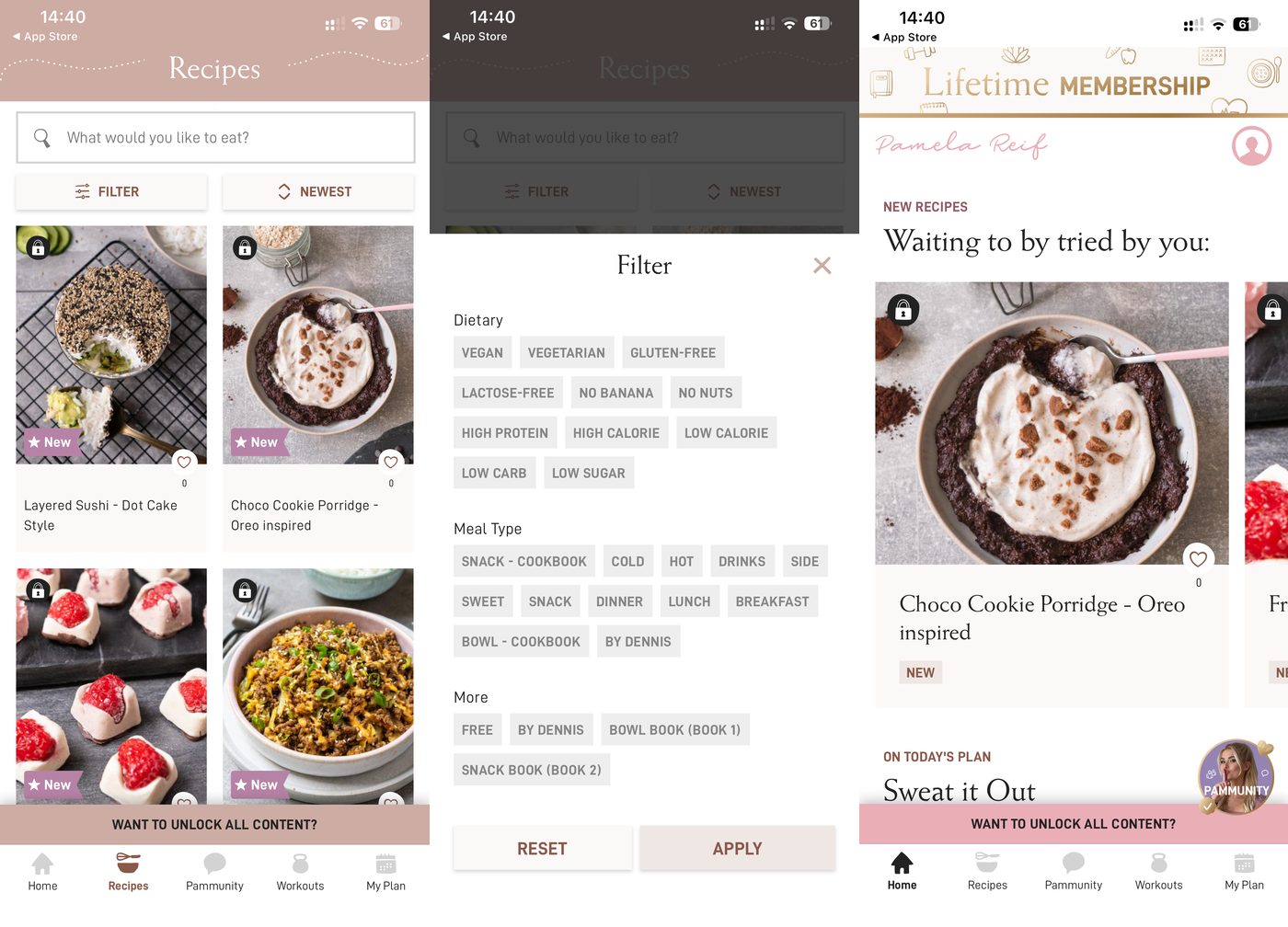
Around the free channel sits a paid Pam app, and it is a separate product from the YouTube library. It adds a filterable workout library, more than a dozen ready-made plans including a genuine knee-friendly, no-jump plan, a large recipe library with a meal planner, a macros calculator, a journal and a new members community called the Pammunity. Notably, both app stores file it under food and drink, and the paywall is mostly the recipes and blog, with a lot of the workouts free.
For this audience it is worth being precise about what Pamela Reif is and is not. It is a large, fun, genuinely free library of low-impact and light-strength movement, with a clean, cheap app and a real knee-friendly range, and for a woman who wants to move at home without spending, that accessibility is real. What it is not is a midlife or menopause platform. The content is built for a young, aesthetic audience, its framing is appearance-led, and there is no perimenopause or menopause programming, no progressive strength system, no bone-loading work and no pelvic-floor content. Read Pamela Reif as a low-cost, fun way to move that a woman over 40 can absolutely use, rather than a programme designed for her stage of life.
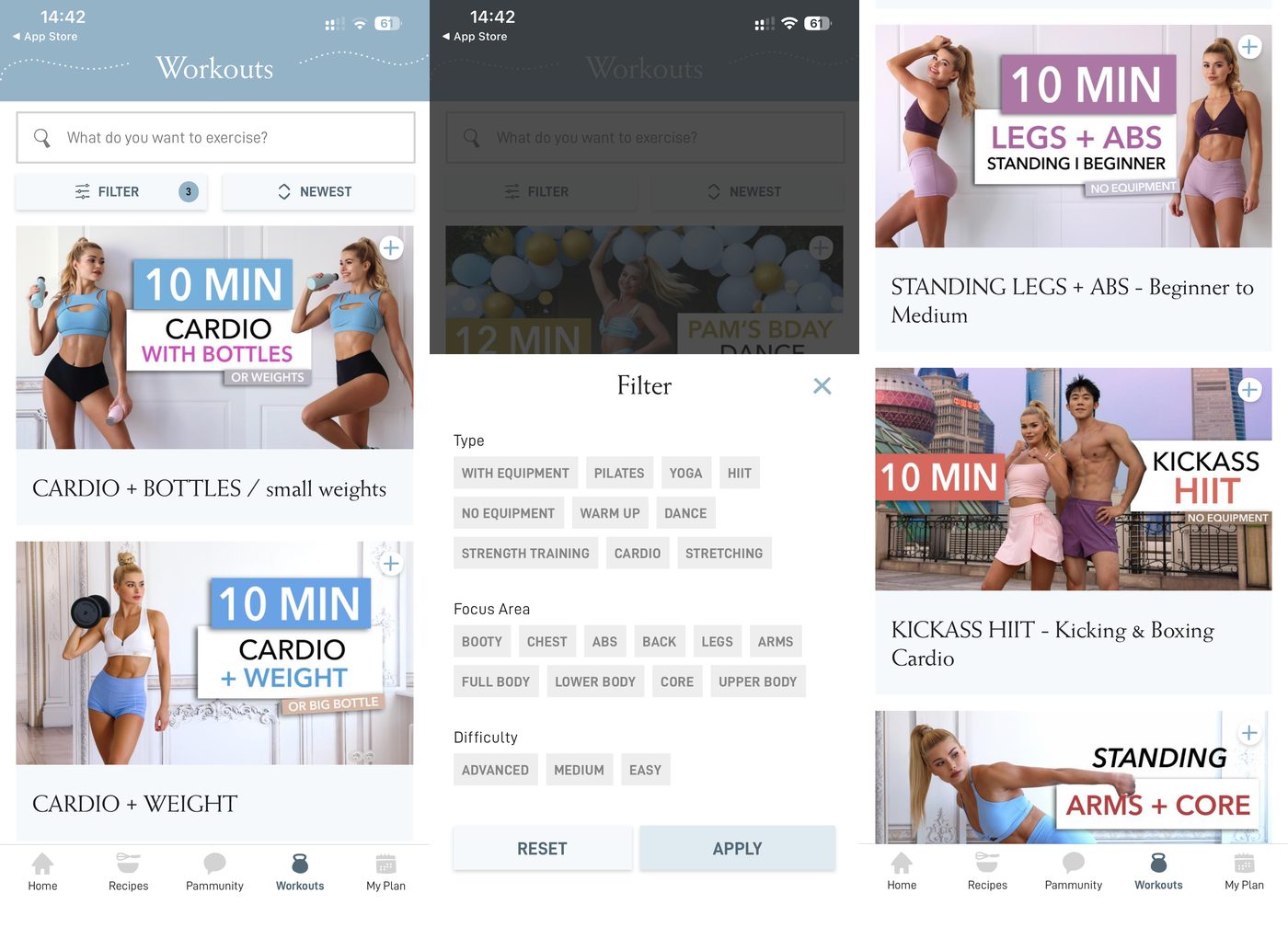
Who Is Behind Pamela Reif? Credibility
Pamela Reif is a German creator and entrepreneur who built one of the largest fitness followings on the internet, alongside a food brand, a hair-care line, cookbooks and a podcast. She started on social media as a teenager and grew the channel on the strength of her silent, real-time workout format, and the app is run under her company, PLR UG, in Karlsruhe. She is a genuinely skilled, hugely popular movement creator, and the workouts are athletic and well put together.
What she is not is a certified trainer, a clinician or a dietitian. We found no evidence of a personal-training or exercise-science certification, and she is not a physician, physiotherapist, registered dietitian or menopause specialist; media descriptions that call her a “personal trainer” or “nutritionist” name no certifying body. The recipes in the app are created by Pamela and her family, including her brother Dennis, rather than a registered dietitian, and there is no medical or menopause advisory behind the content. For a midlife audience that means high appeal and safety for general low-impact movement, and low authority on menopause-specific medical, hormonal or nutrition questions. Read her as a well-loved, self-taught creator, rather than a source of menopause or clinical guidance.
Content and Features
At a glance: a huge free library of fun, low-impact and light-strength movement with a real knee-friendly range, plus a very cheap, polished app with plans, a large recipe library, a meal planner and a community. It is general fitness for a young audience, with no menopause programming, no progressive strength system, and no pelvic-floor or bone work.
| Format | On-demand, silent, real-time follow-along videos on YouTube (no talking, on-screen timer), plus the Pam app with plans and challenges. No live classes. |
| Disciplines | Cardio, HIIT, dance, abs, Pilates, yoga, stretch and warm-ups, plus light strength with bands and small weights. |
| Menopause / perimenopause | None. No hormone, symptom, stage or education content of any kind. |
| Low-impact and joints | A genuine signature: a knee-friendly, no-jump plan (almost no squats, lunges or jumps) and standing, low-impact routines. |
| Pelvic floor | No confirmed dedicated pelvic-floor training or cueing. |
| Recovery and mind | Yoga, stretch, mobility and warm-ups, plus a journal and mood check-in; no structured midlife deload. |
| Nutrition | A large recipe library with dietary filters, an AI meal planner and a macros calculator, authored by Pamela and family, with no registered dietitian and an aesthetic framing; some recipes are locked behind cookbook purchases. |
| Strength | Body-weight plus bottles, small weights and booty bands only, with no progressive loading; a toning ceiling. |
| Structure | The YouTube channel is standalone videos; the app adds more than a dozen ready-made plans, a workout planner and the knee-friendly plan. |
| Community and tracking | An enormous free following, plus the in-app Pammunity community, a planner, a shopping list and a journal. |
What Equipment Do You Need for Pamela Reif?
Very little, which is a big part of the appeal. Most Pamela Reif workouts are body-weight only, so a mat is really all you need for those, and the knee-friendly and low-impact routines are designed for a small space. For the strength and toning sessions she uses light kit: bottles or small weights and a booty band, so a light pair of dumbbells and a band are a useful optional addition.
Because the content offers no progressive strength system, the more valuable midlife purchase is a set of adjustable dumbbells for a separate strength habit, so you can add load over time, since building and keeping muscle and bone is exactly what this content does not do.
Recommended spec examples. These picks are curated by specification and feature fit, not personally lab-tested for long-term durability. Prices are examples; verify before buying.
Starter Dumbbells (up to 10 lb)
A light adjustable pair, a great starting point
~ to
Medium Dumbbells (up to 25 lb)
For steady progression as you get stronger
~ to
Resistance Bands (light to medium)
Fabric bands for glute and lower-body work
~ to
Exercise Mat
Any standard mat works for floor, yoga and Pilates work
~ to
A quick heads-up: some of the buy links above are Amazon affiliate links, so if you grab something through them I may earn a small commission, at no extra cost to you. I only ever point you to kit I would happily use myself.
How We Scored Pamela Reif: the 6.1 / 10 Breakdown
Research-based scores on our 9 weighted criteria. Because this is a Data Profile rather than a hands-on test, each score carries a confidence level. Women Over 40 is our most heavily weighted menopause criterion, and its full 12-capability breakdown follows in the next section.
| Category | Weight | Score | Reasoning (confidence) |
|---|---|---|---|
| Time Efficiency | 15% | 8 | A deep range of short 10 to 20 minute routines and app plans fit a busy day easily. (confidence: high) |
| Muscle Potential | 18% | 4 | Body-weight and light band or small-weight toning only, with no progressive overload; a real toning ceiling. (confidence: high) |
| Women Over 40 Specificity | 10% | 3.1 | Accessible and knee-friendly, but young and aesthetic-skewing, with no strength, bone or menopause programming; full breakdown below. (confidence: high) |
| Joint Friendliness | 12% | 8 | A genuine knee-friendly, no-jump plan and low-impact, standing routines make this notably easy on the joints. (confidence: high) |
| Recovery Compatibility | 10% | 5 | Stretch, mobility and yoga help, but the library skews intense HIIT with no structured deload. (confidence: medium) |
| Programme Structure | 12% | 6 | The app adds more than a dozen ready-made plans and a planner; the free YouTube library is unstructured. (confidence: medium) |
| Value for Money | 8% | 9 | A huge free YouTube library plus an app at only about $2.99 a month; outstanding value. (confidence: high) |
| UX and Design | 8% | 7 | A polished, well-rated app; the silent, no-talking format gives beginners no form cues, and some music is muted on older videos. (confidence: medium) |
| Nutrition Integration | 7% | 6 | A real recipe library, meal planner and macros calculator, but no registered dietitian and an aesthetic framing. (confidence: medium) |
| Total | 100% | 6.1 / 10 | Research Score; hands-on score pending. |
Is Pamela Reif Good for Women Over 40?
In a general way, yes, and the price and the knee-friendly range make it easy to say so. Pamela Reif is free at its core, the silent, real-time format is unintimidating, the sessions are short, and there is a genuine low-impact, no-jump plan built to spare the knees, which is a real plus for a midlife body. Pilates, yoga, stretch and gentle standing routines all support core strength, mobility and posture, so a woman over 40 who wants to ease into movement can start here without spending, or for only a few dollars a month.
Who it suits, and what is missing. The gaps are specific and important for this site. First, the training emphasis: midlife guidance prioritises progressive resistance to protect muscle and bone, and Pamela Reif offers only body-weight and light band or small-weight toning with no progression, so it does little for strength and almost nothing for bone density. Second, the audience and framing: this content is designed for a young, aesthetic crowd, with a “flat tummy and toned thighs” message that is a poor fit for a midlife health focus, and the silent, no-talking format gives a beginner no form cues. Third, the menopause gap: there is no perimenopause or menopause programming, no hormone or symptom content and no pelvic-floor work. It suits a woman who wants free, fun, joint-friendly movement; it is a weak single choice for someone whose priority is strength, bone or a menopause-specific plan.
What the wider picture shows. Independent coverage and a very large following describe Pamela Reif the way we would: fun, effective, cheap and easy to keep coming back to, with the free content and the knee-friendly options the widely praised parts. The recurring caveats are that the strength work plateaus, that the brand skews young and appearance-led, and that the app leans as much on recipes as workouts. Direct testimony from women over 40 is thin, because this is not where the brand aims. Read Pamela Reif as a fun, cheap, low-impact movement resource a woman over 40 can use, best paired with a dedicated strength habit for the muscle and bone it does not build, and, for menopause specifically, with a purpose-built option.
How Pamela Reif Fits Perimenopause, Menopause and Beyond
Our capability breakdown of how well Pamela Reif suits women across perimenopause, menopause and post-menopause. Women Over 40 is our most important criterion for this site, and this is the full breakdown behind the Women Over 40 row in the scoring table above.
Pamela Reif is strongest for low-impact and knee-friendly movement, low-cost access and a mind-body range, and weakest for progressive strength, bone loading and every menopause-specific capability, in our menopause and midlife capability assessment for women over 40.
| At a glance | Score |
|---|---|
| Right training for a midlife body | 4.0 / 10 |
| Built for menopause | 1.2 / 10 |
| Whole-woman support | 5.3 / 10 |
This is the perimenopause and menopause assessment, and it is separate from the overall score. Twelve things a programme either does for a midlife body or does not, each scored out of 10 with my reasoning next to it. Together they produce a single menopause fit score, and that becomes one of the nine categories in the overall scoring below.
How Pamela Reif Fits Perimenopause, Menopause & Beyond
Women Over 40 is our most important criterion, and here's the full breakdown behind it.
Pamela Reif is strongest for low-impact, and weakest for menopause programming, pelvic floor, hormone awareness, menopause education, progressive strength, bone loading, expert credibility and recovery & deload, in our menopause and midlife capability assessment for women over 40.
At a glance
| Capability | Score | Rating | Why |
|---|---|---|---|
| Right training for a midlife body | |||
| Low-impact | 8/10 | Strong | Genuine knee-friendly, no-jump plan (almost no squats, lunges or jumps) and standing low-impact routines sit alongside the HIIT library. |
| Progressive strength | 2/10 | None | Bodyweight plus bottles, small weights and booty bands only; toning with no heavy or progressive loading. |
| Bone loading | 2/10 | None | No heavy or progressive resistance and no impact-loading protocol, so little osteogenic stimulus. |
| Recovery & deload | 4/10 | Minimal | Stretch, yoga, mobility and warm-ups exist, but the library skews intense HIIT with no structured deload. |
| Built for menopause | |||
| Menopause programming | 1/10 | None | No menopause-specific programming of any kind. |
| Pelvic floor | 1/10 | None | No pelvic-floor or core-rehab content. |
| Hormone awareness | 1/10 | None | No cycle- or hormone-aware training guidance. |
| Menopause education | 1/10 | None | No menopause, HRT or midlife-physiology education. |
| Expert credibility | 2/10 | None | Self-taught creator, not a certified trainer, RD or clinician; recipes by Pamela and family with no dietitian. |
| Whole-woman support | |||
| Mind-body support | 6/10 | Some | Real yoga, Pilates and stretch range plus a journal and the Pammunity community, though none menopause-framed. |
| Beginner on-ramp | 5/10 | Some | Beginner filters, free access and short formats lower the barrier, but the silent no-talking format gives beginners no form cues. |
| Midlife nutrition | 5/10 | Some | Large recipe library, AI meal planner and macros calculator, but no RD, an aesthetic framing and nothing midlife-specific. |
ScaleBest-in-classStrongSomeMinimalNone
What the sources say: Scores combine the free Pamela Reif channel, the Pam app and its Apple/Google Play listings, independent coverage and peer-reviewed science. The built-for-menopause group scores near the floor because there is no menopause programming, education, hormone or pelvic-floor content; low-impact, value, beginner access and the mind-body range score well because the knee-friendly range, cheap access and yoga/Pilates/stretch are verifiable strengths.
These are evidence-informed suitability ratings, not clinical measurements. They combine exercise science with product-specific research and, where indicated, hands-on testing, alongside multi-source verification, and are approximate. Individual response varies. A starting point, not medical advice. How we score menopause fit
What the sources say: scores combine the channel, the app and store listings, independent coverage and the science. Low-impact and knee-friendly movement, value, beginner access and the mind-body range scored acceptably because they are core, verifiable strengths. The built-for-menopause group scored very low because there is no menopause programming, education, hormone or pelvic-floor content of any kind, and the creator, while a talented movement teacher, is self-taught rather than a clinician, dietitian or menopause specialist.
These are evidence-informed suitability ratings, not clinical measurements. They combine exercise science with published-feature analysis and multi-source verification, and are approximate. Individual response varies. A starting point, not medical advice. How we score menopause fit.
What the Research Says: Pamela Reif’s Approach Checked
The movement Pamela Reif offers is well matched to some real midlife needs, with clear limits. Her low-impact cardio and HIIT are genuinely useful: a 2026 systematic review and meta-analysis found high-intensity interval training significantly improved cardiorespiratory fitness in middle-aged and older women, a time-efficient benefit that suits short home sessions.[1] And low-impact, land-based exercise is safe for older joints: a Cochrane review found it reduced knee pain and improved function with no serious adverse events, which supports the gentler, knee-friendly work she explicitly builds a plan around.[2] Because a brand built on consistency lives or dies on adherence, it is worth noting that enjoyment reliably predicts sticking with exercise, and dance-based movement has shown mood benefits in menopausal women, both of which play to her fun, follow-along format.[3][4]
The caveat that matters most for our audience is strength and bone. Across the menopause transition, body composition shifts, with the rate of fat gain roughly doubling and lean muscle declining, which is exactly when muscle needs protecting.[5] Progressive resistance is the active ingredient: a large Cochrane review found progressive resistance training produced big gains in strength and everyday function in older adults, and Pamela Reif’s body-weight and light-band work, without progression, does not provide that stimulus.[6] Bone is the same story: a network meta-analysis found at least moderate-intensity resistance was needed to improve bone density, and in the LIFTMOR trial heavier, progressive loading improved bone density and function where light exercise did not.[7][8] The sensible way to use Pamela Reif is as fun, low-impact movement that supports fitness and mood, paired with a dedicated progressive-strength habit for the muscle and bone it cannot address.
What Users Report: Verified Sentiment
Rating snapshot: the app is well loved, on a large and consistent base. The Pam app holds about 4.8 stars on the Apple App Store from roughly 1,100 US ratings, and about 4.8 on Google Play from around 11,000 reviews on more than a million installs, both read in 2026. There is no genuine Trustpilot profile for the app; a Trustpilot page you may find belongs to her separate Naturally Pam snack brand, not the workouts or the app, so we do not blend it in. The store ratings are strong and stable, but they come from a young, aesthetics-motivated fan base, so we read them as a fan view rather than a neutral one.
Consistently praised
- Free and very cheap, with a huge library and no equipment barrier.
- The silent, real-time, timed follow-along format is effective and easy to repeat.
- A beautiful, well-made app with a strong recipe library and meal planner.
- Genuine knee-friendly and low-impact options for when you want no-jump work.
Consistently criticised
- Young-skewing, aesthetic framing, with a “flat tummy, toned thighs” message.
- Light on real progressive strength; toning with bands and small weights, no loading.
- The no-talking format gives beginners no form cues or technique guidance.
- The app is recipe-led, with some recipes locked behind cookbook purchases, and some older videos have muted music.
Source and credibility note: the app ratings were read live from the Apple App Store and Google Play (2026); the large, stable base on both stores argues against manipulation, but the reviewers are a young, appearance-motivated fan base, so we treat the enthusiasm as brand loyalty and product polish more than clinical suitability. There is no genuine Trustpilot profile for the app; the Naturally Pam page is a separate snack business and is not a signal about the workouts. We found essentially no menopause-specific sentiment; the midlife read draws on the content design and the science rather than a menopause-labelled programme, of which there is none.
Devices, Platforms and App
Pamela Reif is easy to reach. The free channel is on YouTube, so it plays on any phone, tablet, computer or smart TV and casts easily to a screen, which suits a woman who wants to follow a workout on the television in her living room. The Pam app adds iOS and Android, with a free tier of workouts plus a very cheap premium subscription that unlocks the full recipe and blog library, the meal planner and premium content, and it is polished and well rated on both stores.
The catches are worth knowing. The app is recipe-led as much as workout-led, and a lot of what the subscription buys is nutrition content, so if you mainly want workouts, much of that is already free on YouTube. The silent, no-talking format is loved by regulars but leaves a beginner without spoken form cues, and some older YouTube videos have their music muted for licensing. We did not find a confirmed web player, casting from the app, offline downloads or an Apple Watch app, so treat it as an app-first, phone-based experience. For a woman over 40 who mostly wants to press play on a free video, the YouTube channel is the simplest route; the app is cheap and lovely if you also want the recipes and plans.
Pamela Reif specifications
- Free trial
- Yes, first week free, cancel anytime
- Cancellation
- free, no subscription (YouTube)
- Session length
- ~10 to 15 min/video, stackable to 30+ min
- Who makes it
- Pamela Reif, a German fitness influencer and bestselling author. She is not a certified personal trainer, and no clinician is involved in the content.
- Still maintained
- Active; Pam Fitness & Food app v2.4.1 (rel 2026-07-17), id 1540604002
- What is included
- On-demand classes: yesLive classes: noRecovery content: partlyMenopause education: noStructured programmes: partlyMeditation: partlyNutrition guidance: partly
- Women over 40
- Pelvic floor work: noMenopause clinician involved: noInjury modifications: partlyBone-health focus: noModified progressions: noCycle syncing: noPrenatal options: no
- Devices and access
- Offline downloads: partlyCasting to TV: yesSubtitles: partlyWearable sync: no
- Support
- Clinical advisory board: noCommunity: partlySupplement upsell: no
- Last verified
- 12 August 2026
Pamela Reif Price 2026: What You Actually Pay
| Plan | Cost | Includes |
|---|---|---|
| Free (YouTube) | $0 | The full library of silent, real-time follow-along workouts, ad-supported, with no account needed. |
| App free tier | $0 | A selection of workouts and content in the Pam app, free to download on iOS and Android, with a first week free of premium. |
| App premium (monthly) | About $2.99/month | Unlocks the full recipe and blog library, the meal planner, macros calculator and premium content. |
| App premium (annual / lifetime) | About $34.99/year, or an $89.99 lifetime | The same at a lower effective rate; cookbooks are sold separately as one-off unlocks. Prices are US and vary by region. |
Cost and Cancellation
The value here is unusually good, because the whole YouTube channel is genuinely free, and the app is one of the cheapest around at about $2.99 a month or $34.99 a year, with a first week free. The one thing to understand is what you are paying for: a large part of the premium content is recipes, the meal planner and blog articles, while much of the workout library is already free, so the subscription is really for the nutrition and planning extras and the ad-free app. The subscription is billed through the App Store or Google Play, so cancel there anytime, and a one-off lifetime option exists at $89.99 if you know you will use it. Prices were checked in 2026 and vary by region; confirm at checkout.
Will You Actually Stick With It?
The core is free and the app is very cheap, so cost is almost never why you stop.
Short, real-time, low-impact and knee-friendly options make it very easy to start.
The silent, no-talking format leaves beginners without technique guidance, so learning good form is on you.
Light toning only, with no progression, means you must add real progressive strength work elsewhere.
Pamela Reif Pros and Cons
Pros
- Genuinely free at its core, with a huge library and no equipment barrier
- An unusually cheap, polished app with plans, recipes and a meal planner
- A genuine knee-friendly, no-jump plan and low-impact, joint-friendly routines
- Short, time-efficient, effective silent follow-along workouts
- A real mind-body range of yoga, Pilates and stretch, plus a community
- Best-in-class value across the free channel and the app
Cons
- No progressive strength system, only body-weight and light band or small-weight toning
- Does little for muscle or bone, the top midlife priority
- No perimenopause or menopause programming, hormone or pelvic-floor content
- A young, aesthetic “flat tummy” framing that is a poor fit for a midlife health focus
- The silent format gives beginners no form cues; some older videos have muted music
- A self-taught creator, not a certified trainer, clinician or menopause specialist, and recipes with no dietitian
How Pamela Reif Compares to Similar Platforms
If you are deciding between free and low-cost, at-home options, this is how Pamela Reif sits against the alternatives. Scores come from our independent reviews and update automatically as each is scored; Pvolve is included as the menopause-built contrast, and free options are shown alongside.
| Feature | Pamela Reif | FitOn | The Sculpt Society | Melissa Wood Health | Pvolve |
|---|---|---|---|---|---|
| Our score | 6.1 / 10 (research) | 7.3 / 10 | 8.2 / 10 | 6.9 / 10 | 8.3 / 10 |
| Monthly price | Free · app ~$2.99/mo (verify) | Free tier · ~$29.99/yr Pro (verify) | ~$24.99/mo (verify) | ~$9.99/mo (verify) | $24.99/mo · equipment from $199 (verify) |
| Approach | Silent cardio, HIIT, dance and light toning | Varied class library | Dance cardio and sculpt | Low-impact Pilates and light strength | Functional strength, menopause-built |
| Impact level | Low core, higher in HIIT/dance | Low to moderate | Low to moderate | Low by design | Low by design |
| Progressive strength | None, light toning | Some, light weights | Light weights, limited progression | Light, limited progression | Yes, functional |
| Perimenopause content | None | Minimal | Some pre and postnatal, no menopause focus | Minimal | Best in class: Menopause Strong, pelvic floor |
| Expert credibility | Self-taught creator, not clinical | Good | Certified trainer, not clinical | Self-taught creator, not clinical | Strong, women’s-health focus |
| Free trial / billing | Free core; app first week free, store-billed | Generous free tier | 7-day trial (verify) | Trial (verify) | 14-day trial |
| Best suited to | Women wanting free, cheap, low-impact and knee-friendly workouts | Women wanting a free class library | Women wanting dance-led sculpt workouts | Women wanting gentle Pilates and calm | Women ~35+, perimenopause, joints |
Competitor prices are approximate; verify on each platform’s website. Scores reflect our independent reviews. See each full review for methodology.
Pamela Reif vs FitOn: Which Is Better for Women Over 40?
This is the closest pairing for a woman who wants quality home workouts without paying much, because both lead with a genuinely useful free offering and cover a broad range. FitOn is built around a large library of pre-recorded classes across many disciplines, with named instructors, spoken coaching and a strong free tier, and it leans a little more toward accessible, coached variety. It suits a woman who wants a friendly, class-based free library with instruction throughout.
Pamela Reif is the more creator-led, minimalist option: a vast free channel on YouTube built on silent, real-time follow-alongs and a genuine knee-friendly range, plus an unusually cheap app that adds recipes and plans. It is the better pick if you like the no-talking, press-play format, want knee-friendly low-impact work, and value the cheapest app around. Neither builds meaningful strength or bone, and neither is a menopause programme, so pair whichever you choose with dedicated progressive-strength work. For genuine menopause programming and the pelvic-floor and strength content both lack, a purpose-built option such as Pvolve goes further than either.
If Pamela Reif Is Not Right for You: Best Alternatives
Pamela Reif’s gaps for our audience are progressive strength and bone work, and the absence of any menopause, hormone or pelvic-floor content. If those matter, these published options map to the gaps.
Pamela Reif FAQ
Pamela Reif is a free YouTube fitness channel by the German creator Pamela Reif, one of the biggest in the world with around 10.7 million subscribers, built on silent, real-time, timed follow-along workouts: cardio, HIIT, dance, abs, Pilates, yoga, stretch and light strength, in sessions from about 5 to 45 minutes. There is also a very cheap Pam app that adds ready-made plans, a large recipe library, a meal planner and a community.
The whole YouTube library is free and ad-supported, and it is where most people practise. The Pam app is a separate freemium product: it has a free tier plus a very cheap premium subscription of about $2.99 a month, $34.99 a year or an $89.99 lifetime, with a first week free, that unlocks the full recipe and blog library, the meal planner and premium content. Because much of the workout library is already free, the app is really for the recipes, plans and planning extras. Confirm the current price at checkout.
For free, fun, low-impact movement, it can be, and there is a genuine knee-friendly, no-jump plan that suits sensitive joints. But Pamela Reif is built for a young, aesthetic audience, its strength work is light band and body-weight toning with no progression, and it has no perimenopause or menopause programming, no bone work and no pelvic-floor content. Pair it with a dedicated strength habit, and for menopause specifically consider a purpose-built option.
Only a little. It uses body weight, bands and small weights for toning, with no progressive overload, and the evidence is clear that building muscle and bone in midlife needs heavier, progressive resistance. Treat Pamela Reif as good for low-impact movement, mobility and cardio, and add a separate progressive-strength routine, with dumbbells, for the muscle and bone it does not build.
Pamela Reif is a German creator and entrepreneur who built one of the largest fitness channels online. We found no evidence of a personal-training or exercise-science certification for her, so she is best understood as a talented, self-taught fitness creator rather than a credentialed coach, and she is not a clinician, dietitian or menopause specialist. The recipes are created by Pamela and her family, including her brother Dennis, rather than a registered dietitian, and there is no medical advisory behind the content.
For a woman who wants free, fun, low-impact and knee-friendly home workouts, and does not mind a young-skewing style and no spoken coaching, the YouTube channel is excellent value and the app is one of the cheapest around. It is a weaker choice if your priority is building strength or bone, or you want a menopause-specific plan, because it offers neither. This is a research-based Data Profile; a hands-on test is still to come.
Final Verdict
Research Score: 6.1 / 10 · Hands-on Score: pending
Pamela Reif is one of the largest and most approachable free fitness resources anywhere, and for fun, low-impact movement it delivers a great deal at very little cost. It is genuinely free at its core, the silent, real-time format is easy to start, there is a real knee-friendly, no-jump range for midlife joints, and the app is unusually cheap and well made. Pamela Reif is a talented, much-loved creator. The moderating factors for our audience are clear and important: the content is built for a young, aesthetic crowd, the strength work is light toning with no progression, and there is no perimenopause or menopause programming, no bone work and no pelvic-floor content.
Pamela Reif is for women who want free, fun, low-impact and knee-friendly movement they can follow at home, and who are happy to add their own strength work. Pamela Reif is not for women whose priority is building muscle and bone or following a menopause-specific plan, who should pair it with a dedicated strength habit and, for menopause, a purpose-built option such as Pvolve.
Testing Status
Research profile complete (the free Pamela Reif channel, the Pam app and store listings, independent coverage, and peer-reviewed exercise and menopause science). Hands-on testing: pending. When we test it, first-person notes, real screenshots, adherence and a Hands-on Score are added to this same page, moving it to Sample-tested then Fully tested. How we score and profile.
Sources and Further Reading
- Cai, L. et al. (2026). Effects of high-intensity interval training on cardiopulmonary fitness and physical function in middle-aged and elderly women: a systematic review and meta-analysis. Frontiers in Physiology. Available at: pmc.ncbi.nlm.nih.gov. HIIT significantly improved cardiorespiratory fitness (VO2max) in middle-aged and older women.
- Fransen, M. et al. (2015). Exercise for osteoarthritis of the knee. Cochrane Database of Systematic Reviews. Available at: cochranelibrary.com. Land-based exercise reduced knee pain and improved function with no serious adverse events reported.
- Teixeira, D.S. et al. (2022). Enjoyment as a predictor of exercise habit, intention to continue exercising, and exercise frequency. Frontiers in Psychology. Available at: pmc.ncbi.nlm.nih.gov. Exercise enjoyment significantly predicted exercise habit, intention to continue and frequency.
- Coelho de Farias Marques, M. et al. (2024). Effects of jazz dance and concurrent training on psychological variables in menopausal women: a randomised controlled trial. Archives of Women’s Mental Health. Available at: pubmed.ncbi.nlm.nih.gov. Sixteen weeks of jazz dance improved anxiety and depression in menopausal women (single modest trial, n=70).
- Greendale, G.A. et al. (2019). Changes in body composition and weight during the menopause transition. JCI Insight (Study of Women’s Health Across the Nation). Available at: insight.jci.org. Fat-mass gain accelerated and lean mass declined across the menopause transition.
- Liu, C.-J. and Latham, N.K. (2009). Progressive resistance strength training for improving physical function in older adults. Cochrane Database of Systematic Reviews. Available at: cochranelibrary.com. Progressive resistance training produced large gains in strength and improved everyday function in older adults.
- Wang, Z. et al. (2023). Comparative efficacy of different resistance training protocols on bone mineral density in postmenopausal women: a systematic review and network meta-analysis. Frontiers in Physiology. Available at: ncbi.nlm.nih.gov. At least moderate-intensity resistance training was needed to improve bone density; low-intensity loading was not superior to control.
- Watson, S.L. et al. (2018). High-intensity resistance and impact training improves bone mineral density and physical function in postmenopausal women: the LIFTMOR randomized controlled trial. Journal of Bone and Mineral Research. Available at: pubmed.ncbi.nlm.nih.gov. Heavier, high-intensity loading improved bone density and function; light exercise did not.
This is a research-based Data Profile, not a hands-on review. Pricing and features were verified in 2026 and may have changed. Some affiliate links may be present. This site does not accept payment from platforms reviewed. Education, not medical advice; speak to your clinician, especially about HRT, bone health or existing conditions.
Related Guides
What To Do Next
- → Take our 2-minute quiz for a personalised recommendation.
- → See our best workouts for perimenopause rankings.
- → Compare with our Pvolve review and see how we score every programme.